REVENUE
AND
CALENDAR
(‫الرحيم‬ ‫الرحمن‬ ‫هللا‬ ‫بسم‬)
"In the name of Allah, most
Gracious, most
Compassionate".
Consultant Book
THE EMERGENCE OF ISLAM
By : Prof . Dr Hamid Ullah
MADE BY
M MANSOOR UL HAQ
2736-FBAS-BSCS4-F13(A)
SYED BILAL HASSAN
2721-FBAS-BSCS4-F13(A)
FAHEEM AKHTAR
2710-FBAS-BSCS4-F13(A)
INTERNATIONAL ISLAMIC UNIVERSITY
ISLAMABAD
The Quran Considers property a mean of
Survival and Support For Mankind .
YOUR PROPERTY WHICH ALLAH HAS
MADE FOR YOU A MEANS OF SUPPORT
(4:5)
Historian and Jurists agree that Zakah Became
mandatory in 9AH
The Prophet Muhammad (PBUH) used to ask Muslims to spend a part of
their income from trade, agriculture and other sources in the way of God In
Makkah.
Zakah was Began on a VOLUNTARY BASIS
Initially word Zakah signified an act PURIFIED THE SOUL.
MUSLIMS MIGRATION TO MADINAH
After migration both the NUMBER and NEEDS of Muslims
increased.
Money was required for DEFENCE.
THE PROPHET MEAN OF LIVELIGHOOD
When Muslims migrate from Makkah to Madinah their
problem of poverty and unemployment was solved by the
introduction of the institution of BROTHERHOOD which led
to the creation of unit bound one helper and one Emigrant
togethar the resulted in the merging of their families into a
single family
Now the Question Arise
•How did the Prophet Muhammad (PBUH) live ?
•What were the means of their livelihood ?
A Swedish Orientalist writes
“ To began with , Muslims were extremely poor . They
include in loot. They had nothing to eat and were Obliged
to attack caravans . The Prophet Muhammad (PBUH) used
to send them on such expeditions”
THIS IS A VERY SERIOUS CHARGE AGAINST ISLAM
FROM MORAL POINT OF VIEW , AND THERE WAS NO
TRUTH IN THE ALLEGATION
•On arrival to Madinah from Makkah , Prophet Muhammad (PBUH)
stayed in Quba in the south of city.
•Prophet Muhammad (PBUH) then moved forward to the settlement of
BANU NAJJAR and Prophet Muhammad (PBUH) stay there in the house
of Abu Ayyub Al Ansari.
•Prophet Muhammad (PBUH) stayed there for a few months because he
ordered the construction of large mosque there.
•A few residential rooms were provided for the Prophet Muhammad
(PBUH) in this mosque.
What were the Prophet Muhammad (PBUH) means of
livelihood ?
Most of the Helpers (Ansar) in Madinah who were prosperous farmer
had earmarked a fruit tree in their gardens for Him. This was done with
the Prophet Muhammad (PBUH) consent . “ ALL DATES OF THESE
TREES WERE SENT TO HIS HOUSE EVERY YEAR”.
Muslims historians and traditionists often quote from Lady Aishah that
“ Some times the family had to be content with dates and water for
months and no food was cooked in the house” .
Prophet Muhammad (PBUH) means of
livelihood
The Prophet Muhammad (PBUH) bought a few goats whose milk was
consumed by the household . Some time she-camel or a goat was gifted
by people who considered it an honor to offer a present . The Prophet
Muhammad (PBUH) occasionally accepted it .
Sa’d Ibn Ubadah , a close relative of Prophet Muhammad (PBUH) from
his mother side , regularly sent some food deserts , vegetable, meat to
the house .
Prophet Muhammad (PBUH) means of
livelihood
Soon another small means of income was added. From the month of
Ramadan 2AH began with a series of battles with enemy.
Of the spoils of war, one-fifth went to state treasury while four-fifth was
distributed equally among the soldiers .
Prophet Muhammad (PBUH) participated in the most of the battles. He
than two resources of the income
One as a soldier and second as a head of state to whom one-fifth of the
spoils were given
ZAKAH
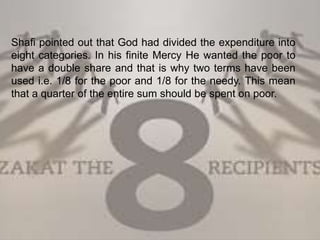
Shafi pointed out that God had divided the expenditure into
eight categories. In his finite Mercy He wanted the poor to
have a double share and that is why two terms have been
used i.e. 1/8 for the poor and 1/8 for the needy. This mean
that a quarter of the entire sum should be spent on poor.
ZAKAH
It appears from work of Muslims jurists that zakah cannot be given to non
Muslims. It is restricted only to Muslims.
Abu Yusuf writes in Kitab Al Kharaj that “ Umer used to help Jews from
Zakah funds during His caliphate.
Tarabi has mentioned other companions such as Zayd Ibn Thabit, Ibn
Abbas . As holding the view that Zakah may be given to non Muslims.
Some early authors say that FUQARA are meant the poor Muslims and by
the needy MASAKIN are meant the poor non-Muslims.
ZAKAH
The next category (al- amilin alayha) comprises the civil
servant employed to collect and distributed zakah . It will not
be surprising if we interpret it to mean the entire structure of
civil administration because collectors, accountants, auditors,
distributers, supervisors, are all invoked in task. We can say
that the salaries of entire civil administration should be met
from Zakah
ZAKAH
Then come a category of those who need to be won over. Abu Ya Iabin Al
farra Al Hanbali, a distinguished scholar, who was a contemporary of
Marwardi, has written a book which, like that of Marwardi, bears the same
title Al Ahkam Al Sultaniyyah.
In a detailed discussion of category he has divided into four categories.
The first comprises people who are paid to help peoples.
The second consist of those who are paid so that they are persuaded to
refrain from harming Muslims.
The third category consist of those who may be provide financial
assistance in order to soften attitude towards islam.
The fourth category comprises those who are provided funds in order that
this show of good will soften the attitude of their near relatives, families and
tribes towards islam.
ZAKAH
As regard the freeing of slaves, the government has a responsibility
towards the slaves living in islamic terriority as well as the citizens
who have been made prisoners or slaves by another state.
There is no distinction between the two in respect of ransom to be
paid to the enemy.
Caliph Umer held that all the needy and the poor could be held from
Zakah irrespective of their religion
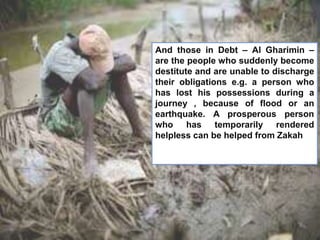
And those in Debt – Al Gharimin –
are the people who suddenly become
destitute and are unable to discharge
their obligations e.g. a person who
has lost his possessions during a
journey , because of flood or an
earthquake. A prosperous person
who has temporarily rendered
helpless can be helped from Zakah.
The category covered by Fi Sabil Allah (In the way of Allah) is applicable
to the entire military administration. It includes salaries, expenditures on
purchase of arms and other military requirements. The buildings of
mosques, caravans , schools etc., also fall in same category
The last category –Ibn Al Sabil- the wayfarer, can be any traveler, Muslim
or non Muslim . No distinction need to be made while offering help or
hospitality. It is the duty of the state to help the traveler.
CALENDAR
Before Islam Arab peoples were
followed Solar calendar as it is today ,
This system was having fixed months
but Arab mulsims were have different
calendar . Months began and end on
the moon sight . Six months of lunar
year are usually of twenty nine days and
other six are thirty days . The total
numbers of days in a year is 354. The
difference in season was due to the
revolutionary of earth around the sun . It
was completed in 365 or 366 days .
When Babylonians find that lunar year is shorter than solar one by eleven
or twelve days than they adopt the solar system . They notice that while
working according the lunar year , they sowing and the raping of crops
suffered a loss.
The solution they found for the problem was a add a thirteen
months year after every three years . Since a lunar year is shorter
by eleven days than a solar years, the difference would be 33
days after three years . This would be approximately a month.
That is why a month is added after three years .
Thus they succeeded in
deriving the same benefit
from the lunar month as
they would have thought a
solar system so far as their
agriculture needs were
concerned . The same
system operated in the city
of Makkah . This system of
adding a month to the
calendar was referred to a
nasi . Because of Hajj, the
entire Arab peninsula acted
in according with it .
Prophet Muhammad ‫ﷺ‬
spent all but the last three
months of his life under this
system.
This last three months were an exception because nasi was abolished
according to the quranic injunction at the time of Farewell pilgrimage of the
Prophet Muhammad ‫ﷺ‬ . “Surely nasi is an addition to disbelief . Those who
disbelieve are led astray thereby. They allow it one year and forbid it another
year, that they may agree in the number of months in which Allah has made
sacred, and thus may make lawful what Allah is Forbidden”. (9:37).
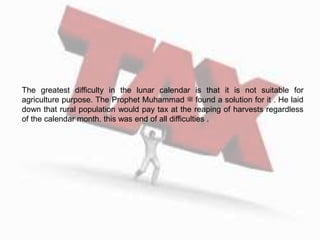
The greatest difficulty in the lunar calendar is that it is not suitable for
agriculture purpose. The Prophet Muhammad ‫ﷺ‬ found a solution for it . He laid
down that rural population would pay tax at the reaping of harvests regardless
of the calendar month. this was end of all difficulties .
. Under the lunar year system an Islamic government receives taxes at different
time throughout the year. Agriculture taxes are received in a particular season
while other taxes follow a different schedule with the result that the treasury is not
empty at any time of the year.
ANY QUESTIONS ????
REVENUE AND CALENDAR

REVENUE AND CALENDAR

  • 1.
  • 2.
    (‫الرحيم‬ ‫الرحمن‬ ‫هللا‬‫بسم‬) "In the name of Allah, most Gracious, most Compassionate".
  • 3.
    Consultant Book THE EMERGENCEOF ISLAM By : Prof . Dr Hamid Ullah
  • 4.
    MADE BY M MANSOORUL HAQ 2736-FBAS-BSCS4-F13(A) SYED BILAL HASSAN 2721-FBAS-BSCS4-F13(A) FAHEEM AKHTAR 2710-FBAS-BSCS4-F13(A) INTERNATIONAL ISLAMIC UNIVERSITY ISLAMABAD
  • 5.
    The Quran Considersproperty a mean of Survival and Support For Mankind . YOUR PROPERTY WHICH ALLAH HAS MADE FOR YOU A MEANS OF SUPPORT (4:5) Historian and Jurists agree that Zakah Became mandatory in 9AH
  • 6.
    The Prophet Muhammad(PBUH) used to ask Muslims to spend a part of their income from trade, agriculture and other sources in the way of God In Makkah. Zakah was Began on a VOLUNTARY BASIS Initially word Zakah signified an act PURIFIED THE SOUL. MUSLIMS MIGRATION TO MADINAH After migration both the NUMBER and NEEDS of Muslims increased. Money was required for DEFENCE.
  • 7.
    THE PROPHET MEANOF LIVELIGHOOD When Muslims migrate from Makkah to Madinah their problem of poverty and unemployment was solved by the introduction of the institution of BROTHERHOOD which led to the creation of unit bound one helper and one Emigrant togethar the resulted in the merging of their families into a single family
  • 8.
    Now the QuestionArise •How did the Prophet Muhammad (PBUH) live ? •What were the means of their livelihood ?
  • 9.
    A Swedish Orientalistwrites “ To began with , Muslims were extremely poor . They include in loot. They had nothing to eat and were Obliged to attack caravans . The Prophet Muhammad (PBUH) used to send them on such expeditions” THIS IS A VERY SERIOUS CHARGE AGAINST ISLAM FROM MORAL POINT OF VIEW , AND THERE WAS NO TRUTH IN THE ALLEGATION
  • 10.
    •On arrival toMadinah from Makkah , Prophet Muhammad (PBUH) stayed in Quba in the south of city. •Prophet Muhammad (PBUH) then moved forward to the settlement of BANU NAJJAR and Prophet Muhammad (PBUH) stay there in the house of Abu Ayyub Al Ansari. •Prophet Muhammad (PBUH) stayed there for a few months because he ordered the construction of large mosque there. •A few residential rooms were provided for the Prophet Muhammad (PBUH) in this mosque.
  • 11.
    What were theProphet Muhammad (PBUH) means of livelihood ? Most of the Helpers (Ansar) in Madinah who were prosperous farmer had earmarked a fruit tree in their gardens for Him. This was done with the Prophet Muhammad (PBUH) consent . “ ALL DATES OF THESE TREES WERE SENT TO HIS HOUSE EVERY YEAR”. Muslims historians and traditionists often quote from Lady Aishah that “ Some times the family had to be content with dates and water for months and no food was cooked in the house” .
  • 12.
    Prophet Muhammad (PBUH)means of livelihood The Prophet Muhammad (PBUH) bought a few goats whose milk was consumed by the household . Some time she-camel or a goat was gifted by people who considered it an honor to offer a present . The Prophet Muhammad (PBUH) occasionally accepted it . Sa’d Ibn Ubadah , a close relative of Prophet Muhammad (PBUH) from his mother side , regularly sent some food deserts , vegetable, meat to the house .
  • 13.
    Prophet Muhammad (PBUH)means of livelihood Soon another small means of income was added. From the month of Ramadan 2AH began with a series of battles with enemy. Of the spoils of war, one-fifth went to state treasury while four-fifth was distributed equally among the soldiers . Prophet Muhammad (PBUH) participated in the most of the battles. He than two resources of the income One as a soldier and second as a head of state to whom one-fifth of the spoils were given
  • 14.
  • 15.
    Shafi pointed outthat God had divided the expenditure into eight categories. In his finite Mercy He wanted the poor to have a double share and that is why two terms have been used i.e. 1/8 for the poor and 1/8 for the needy. This mean that a quarter of the entire sum should be spent on poor.
  • 16.
    ZAKAH It appears fromwork of Muslims jurists that zakah cannot be given to non Muslims. It is restricted only to Muslims. Abu Yusuf writes in Kitab Al Kharaj that “ Umer used to help Jews from Zakah funds during His caliphate. Tarabi has mentioned other companions such as Zayd Ibn Thabit, Ibn Abbas . As holding the view that Zakah may be given to non Muslims. Some early authors say that FUQARA are meant the poor Muslims and by the needy MASAKIN are meant the poor non-Muslims.
  • 17.
    ZAKAH The next category(al- amilin alayha) comprises the civil servant employed to collect and distributed zakah . It will not be surprising if we interpret it to mean the entire structure of civil administration because collectors, accountants, auditors, distributers, supervisors, are all invoked in task. We can say that the salaries of entire civil administration should be met from Zakah
  • 18.
    ZAKAH Then come acategory of those who need to be won over. Abu Ya Iabin Al farra Al Hanbali, a distinguished scholar, who was a contemporary of Marwardi, has written a book which, like that of Marwardi, bears the same title Al Ahkam Al Sultaniyyah. In a detailed discussion of category he has divided into four categories. The first comprises people who are paid to help peoples. The second consist of those who are paid so that they are persuaded to refrain from harming Muslims. The third category consist of those who may be provide financial assistance in order to soften attitude towards islam. The fourth category comprises those who are provided funds in order that this show of good will soften the attitude of their near relatives, families and tribes towards islam.
  • 19.
    ZAKAH As regard thefreeing of slaves, the government has a responsibility towards the slaves living in islamic terriority as well as the citizens who have been made prisoners or slaves by another state. There is no distinction between the two in respect of ransom to be paid to the enemy. Caliph Umer held that all the needy and the poor could be held from Zakah irrespective of their religion
  • 20.
    And those inDebt – Al Gharimin – are the people who suddenly become destitute and are unable to discharge their obligations e.g. a person who has lost his possessions during a journey , because of flood or an earthquake. A prosperous person who has temporarily rendered helpless can be helped from Zakah.
  • 21.
    The category coveredby Fi Sabil Allah (In the way of Allah) is applicable to the entire military administration. It includes salaries, expenditures on purchase of arms and other military requirements. The buildings of mosques, caravans , schools etc., also fall in same category
  • 22.
    The last category–Ibn Al Sabil- the wayfarer, can be any traveler, Muslim or non Muslim . No distinction need to be made while offering help or hospitality. It is the duty of the state to help the traveler.
  • 23.
  • 24.
    Before Islam Arabpeoples were followed Solar calendar as it is today , This system was having fixed months but Arab mulsims were have different calendar . Months began and end on the moon sight . Six months of lunar year are usually of twenty nine days and other six are thirty days . The total numbers of days in a year is 354. The difference in season was due to the revolutionary of earth around the sun . It was completed in 365 or 366 days .
  • 25.
    When Babylonians findthat lunar year is shorter than solar one by eleven or twelve days than they adopt the solar system . They notice that while working according the lunar year , they sowing and the raping of crops suffered a loss.
  • 26.
    The solution theyfound for the problem was a add a thirteen months year after every three years . Since a lunar year is shorter by eleven days than a solar years, the difference would be 33 days after three years . This would be approximately a month. That is why a month is added after three years .
  • 27.
    Thus they succeededin deriving the same benefit from the lunar month as they would have thought a solar system so far as their agriculture needs were concerned . The same system operated in the city of Makkah . This system of adding a month to the calendar was referred to a nasi . Because of Hajj, the entire Arab peninsula acted in according with it . Prophet Muhammad ‫ﷺ‬ spent all but the last three months of his life under this system.
  • 28.
    This last threemonths were an exception because nasi was abolished according to the quranic injunction at the time of Farewell pilgrimage of the Prophet Muhammad ‫ﷺ‬ . “Surely nasi is an addition to disbelief . Those who disbelieve are led astray thereby. They allow it one year and forbid it another year, that they may agree in the number of months in which Allah has made sacred, and thus may make lawful what Allah is Forbidden”. (9:37).
  • 29.
    The greatest difficultyin the lunar calendar is that it is not suitable for agriculture purpose. The Prophet Muhammad ‫ﷺ‬ found a solution for it . He laid down that rural population would pay tax at the reaping of harvests regardless of the calendar month. this was end of all difficulties .
  • 30.
    . Under thelunar year system an Islamic government receives taxes at different time throughout the year. Agriculture taxes are received in a particular season while other taxes follow a different schedule with the result that the treasury is not empty at any time of the year.
  • 31.