WHAT IS FILM PIRACY 
The earliest type of film piracy was cam recordings in cinema and theatres. 
This began in 1998 when warez groups would upload these films online prior to 
their release in cinemas. 
An example is American Pie. This is noteable for 2 reasons 
It was different to the cinema film as it had been cut down to remove nudity and 
follow the MPAA guidelines. 
It was found online 2 months prior 
Today Film piracy is still easy to access as it took us 1 minuet to find a pirated 
movie on you tube. 
Longest piracy prison sentence was 5 years given to Jeremiah Perkins from 
Virginia for running a film download ring called IMAGiNE.
TYPES OF FILM PIRACY 
Cam – a recording device used in the audience to capture the movie. Can contain 
sound from the audience over the film. 
Telesync – a recorder used in the projection booth, which syncs the actual 
sound from the audio device. 
Screener – a trial copy of the film is released to gather reviews and this is copied 
but contains a message in the middle of the screen such as ‘The film you are 
watching is a promotional copy’.
BASIC FACTS 
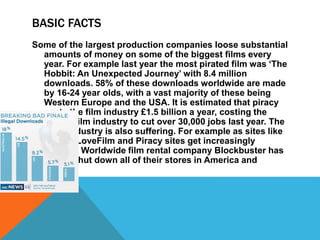
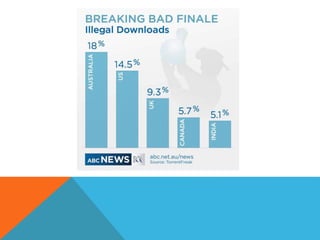
Some of the largest production companies loose substantial 
amounts of money on some of the biggest films every 
year. For example last year the most pirated film was ‘The 
Hobbit: An Unexpected Journey’ with 8.4 million 
downloads. 58% of these downloads worldwide are made 
by 16-24 year olds, with a vast majority of these being 
Western Europe and the USA. It is estimated that piracy 
costs the film industry £1.5 billion a year, costing the 
British film industry to cut over 30,000 jobs last year. The 
retail industry is also suffering. For example as sites like 
Netflix, LoveFilm and Piracy sites get increasingly 
popular, Worldwide film rental company Blockbuster has 
had to shut down all of their stores in America and 
Britain.
PROS OF FILM PIRACY FOR THE CONSUMER 
Pros 
-Free Films for the public 
-Easy to get 
-Able to watch a movie before its release 
-No travel involved so its easier
CONS OF FILM PIRACY FOR THE CONSUMER 
-There may be missing footage 
-Bad picture quality 
-Bad sound quality 
-Refunds for bad products may not be allowed 
-Its illegal and if you sell the pirated copies you may be fined or go to 
prison
PROS OF FILM PIRACY FOR THE INDUSTRY 
- Early release contribute to publicity and therefore there will be more sales 
(Exaple : X Men Origins:Wolverine) 
-Fran Djoukeng says no: piracy is a cheap, efficient way to spread the word 
among the public and generate hype from a variety of sources. 
(http://silverchips.mbhs.edu/story/9249) 
-“Ms Croxson points out that piracy poses a threat to sales only when 
those who otherwise would buy become tempted instead to copy. In any 
market there are some who value the product but never would buy. 
Their piracy cannot harm the seller.” 
(http://www.ox.ac.uk/media/news_stories/2008/080317.html )
CONS OF FILM PIRACY FOR THE INDUSTRY 
-The industry loses money 
-Jenna Bushnell says yes: piracy is a criminal activity that saps millions of 
dollars in revenue from an already-struggling industry. 
(http://silverchips.mbhs.edu/story/9249

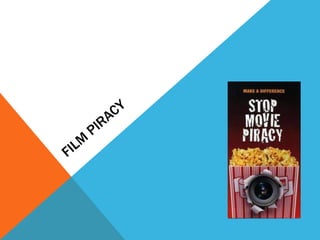
film piracy

  • 2.
    WHAT IS FILMPIRACY The earliest type of film piracy was cam recordings in cinema and theatres. This began in 1998 when warez groups would upload these films online prior to their release in cinemas. An example is American Pie. This is noteable for 2 reasons It was different to the cinema film as it had been cut down to remove nudity and follow the MPAA guidelines. It was found online 2 months prior Today Film piracy is still easy to access as it took us 1 minuet to find a pirated movie on you tube. Longest piracy prison sentence was 5 years given to Jeremiah Perkins from Virginia for running a film download ring called IMAGiNE.
  • 3.
    TYPES OF FILMPIRACY Cam – a recording device used in the audience to capture the movie. Can contain sound from the audience over the film. Telesync – a recorder used in the projection booth, which syncs the actual sound from the audio device. Screener – a trial copy of the film is released to gather reviews and this is copied but contains a message in the middle of the screen such as ‘The film you are watching is a promotional copy’.
  • 4.
    BASIC FACTS Someof the largest production companies loose substantial amounts of money on some of the biggest films every year. For example last year the most pirated film was ‘The Hobbit: An Unexpected Journey’ with 8.4 million downloads. 58% of these downloads worldwide are made by 16-24 year olds, with a vast majority of these being Western Europe and the USA. It is estimated that piracy costs the film industry £1.5 billion a year, costing the British film industry to cut over 30,000 jobs last year. The retail industry is also suffering. For example as sites like Netflix, LoveFilm and Piracy sites get increasingly popular, Worldwide film rental company Blockbuster has had to shut down all of their stores in America and Britain.
  • 6.
    PROS OF FILMPIRACY FOR THE CONSUMER Pros -Free Films for the public -Easy to get -Able to watch a movie before its release -No travel involved so its easier
  • 7.
    CONS OF FILMPIRACY FOR THE CONSUMER -There may be missing footage -Bad picture quality -Bad sound quality -Refunds for bad products may not be allowed -Its illegal and if you sell the pirated copies you may be fined or go to prison
  • 8.
    PROS OF FILMPIRACY FOR THE INDUSTRY - Early release contribute to publicity and therefore there will be more sales (Exaple : X Men Origins:Wolverine) -Fran Djoukeng says no: piracy is a cheap, efficient way to spread the word among the public and generate hype from a variety of sources. (http://silverchips.mbhs.edu/story/9249) -“Ms Croxson points out that piracy poses a threat to sales only when those who otherwise would buy become tempted instead to copy. In any market there are some who value the product but never would buy. Their piracy cannot harm the seller.” (http://www.ox.ac.uk/media/news_stories/2008/080317.html )
  • 9.
    CONS OF FILMPIRACY FOR THE INDUSTRY -The industry loses money -Jenna Bushnell says yes: piracy is a criminal activity that saps millions of dollars in revenue from an already-struggling industry. (http://silverchips.mbhs.edu/story/9249