Production
Production – Investors
• For a film to go into production
it needs investors to provide the
necessary funding.
• Box office is success is never
certain and so investors try to
reduce the risk of losing their
money by becoming involved in
important decisions
Production – Investors
• Key questions that they will ask are:
• Is the film’s storyline similar to other
films that have made money recently?
• Does it offer easy selling points?
• Are there obvious marketing spin offs to
give added publicity?
• Is the star popular?
• Had the director had previous successes?
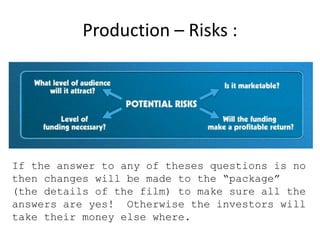
Production – Risks :
If the answer to any of theses questions is no
then changes will be made to the “package”
(the details of the film) to make sure all the
answers are yes! Otherwise the investors will
take their money else where.
Production - Greenlit
• Before a director can start filming a film has to be “greenlit” – this
meaning that funding has been made available by the investors
• At this stage a project will have most of the key elements such as:
• Principle cast,
• Director
• Cinematographer
• Screenplay
• It is the job of the producer to bring all of these elements together.
Film Rights
• When an existing story (book, play, comic) is made into a
film the “rights” have to be bought from the author – the
product is their “intellectual property”
• E.g. Warner Brothers bought the rights to make the first
4 Harry Potter for £ 1 million. (They bought the
remaining 3 when the first had been a success.)
• Film makes may “option” a script – meaning they only
pay 10% of the fee and then pay the full amount if the
project is “green lit” ( goes into production) .
• There is normally a time limit on an “option” – usual two
or three years. If the film isn’t made in this time the
rights can be re-sold.
What is a non-digital film?
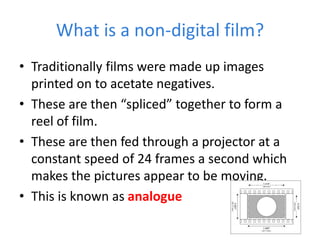
• Traditionally films were made up images
printed on to acetate negatives.
• These are then “spliced” together to form a
reel of film.
• These are then fed through a projector at a
constant speed of 24 frames a second which
makes the pictures appear to be moving.
• This is known as analogue
Digital Cinema – Production
Advantages of Digital Production
• Digital camcorders using a high-definition
format called HD-CAM are much cheaper
than standard film cameras.
• New digital camera technology rivals
traditional film for quality
• High quality film production is now far more
accessible to film makers outside of the
major studios.
Digital Cinema – Production
• Digital technology can be stored, transmit and
retrieve a huge amount of data exactly as it
was originally recorded.
• The quality of digital film does not deteriorate.
• Analogue technology (film) loses information
in transmission and generally degrades with
each viewing
Digital Cinema – Production
• Memory Cards can be re-used many times –
unlike film
• Footage can be viewed immediately on set
• Production time is cut and so are costs
• BY HOLLYWOOD STANDARDS DIGITAL VIDEO
COSTS VIRTUALLY NOTHING
Digital Cinema – Production
• Digital information is a lot more flexible than
analogue information
• A computer can manipulate bytes of data very
easily
• Virtually no processing necessary before the
editing stage
• E.g. ease of editing using a program such as
Final Cut/AVID/Premiere
• This saves time and therefore saves money.
Digital Cinema – Production
Example:
• Attack of the Clones (The first digital film)
$16,000 on 220 hours of digital tape
Would have spent:
• $1.8million on 220 hours of film
Distribution
Digital Cinema – Distribution
Advantages to Digital Distribution
• Digital films are basically big computer files
• Can be written to DVD-ROM
• Sent via broadband
• Transmitted via satellite
• Virtually no shipping costs
• Not much more expensive to show in 100
cinemas as 1
Digital Cinema – Distribution
• Film prints are very expensive (£1500-£3000
per print)
• Expensive to ship heavy reels of film and then
to collect them when film finishes its run
• Because of cost you have to very cautious about
where films are played – unless it is a
guaranteed hit it is a risk to send film to a lot of
cinemas
• Digital films can be opened simultaneously all
over the world
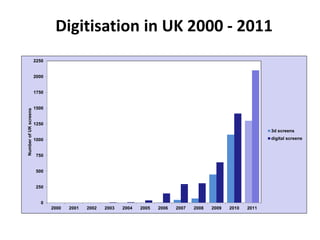
Digitisation in UK 2000 - 2011
0
250
500
750
1000
1250
1500
1750
2000
2250
2000 2001 2002 2003 2004 2005 2006 2007 2008 2009 2010 2011
NumberofUKscreens
3d screens
digital screens
Distribution
• The distribution phase of the film industry is a highly
competitive business of launching and sustaining films
in the “market place”
• You must remember that the film industry is a business
and the films are products to be marketed and sold.
• Every film has its own distribution plan to ensure it
reaches the right audiences.
• Clip: Target Audience
http://www.launchingfilms.tv/planning.php?video=2&
autostart=1
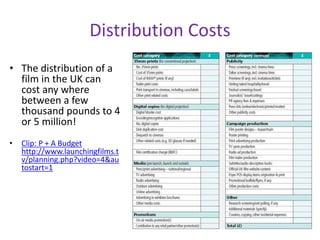
Distribution Costs
• The distribution of a
film in the UK can
cost any where
between a few
thousand pounds to 4
or 5 million!
• Clip: P + A Budget
http://www.launchingfilms.t
v/planning.php?video=4&au
tostart=1
Release Date
Release timing is critical in the film industry
There is significant “seasonality” in box office figures.
Major holidays such as Christmas, New Year Day,
Halloween, Thanksgiving (US) Independence Day (US),
the school holidays all play a role in the success of a film.
Clip: Competition
http://www.launchingfilms.tv/planning.php?video=3&aut
ostart=1
•
Release Date
• Studios make and pre-announce the release date
decisions on a weekly basis.
• Film release dates can be announced years in
advance.
• Pre announcing dates in the film industry is a bit
of a game played by the studios.
• Dates will be announced and then shifted to
reflect various new additions to the calendar.
• Distributors have to position their films carefully
to avoid disastrous clashes.
Release Strategies
• There are a number of different ways of releasing a film. Each
has its pros and cons.
• Films are released in “release windows".
• This keeps different instances of a film from competing with
each other.
Standard release
• In the standard release, a film is first released in the
cinema (theatrical window),
• After approximately 16 and a half weeks, it is released to
DVD (video window).
• After an additional number of months (different for each
film) it is released to Pay TV and On Demand services
and
Simultaneous release
• A simultaneous release takes place when a film is made
available on many media (cinema, DVD, internet) at the same
time or with very little difference in timing.
• What are the pros and cons of a simultaneous release?
• Consumers have more choice
• Producers only need one marketing campaign
Straight-to-video release
• A straight to video (DVD/BluRay) release
occurs when a movie is released on home
video formats without being released in
cinemas first.
• STV releases used to be seen as a sign of poor
quality
• Have become a more profitable option in
recent years. Especially for independent
moviemakers and companies.
Shrinking the theatrical
window
• Originally a six months duration
• Today’s theatrical window is usually around four
months.
• Studios have reportedly been pushing to shrink
the duration of the theatrical window.
• Cinema owners have fought fiercely against this.
• Why do you think studios are
in favour but cinema chains
are against shrinking the
theatrical window?
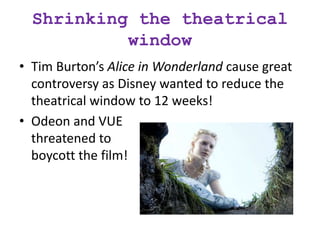
Shrinking the theatrical
window
• Tim Burton’s Alice in Wonderland cause great
controversy as Disney wanted to reduce the
theatrical window to 12 weeks!
• Odeon and VUE
threatened to
boycott the film!
Distribution
• In starting to plan a marketing campaign, the film
distributor has to decide how it will present a film to a
potential audience.
• They need to decide what sets this film apart from all
the other films that are released – they look for a film’s
‘unique selling point’ (USP).
• If, for example, the distributor is handling an
adventure film, they will need to look for aspects of the
film which set it aside from the other action adventure
films.
Distribution
• After this they will look at such things as who
stars in the film, are there new and
spectacular special effects in the film and who
is the director?
• Taking all of these into consideration, the
distributor will then decide which elements to
stress in the marketing campaign (posters,
trailers, etc.) i.e. how to position the film in
the market place.
Distribution - Marketing
• Marketing is one of the most important aspects
of a film’s distribution and there are many
different ways to market a film.
• Make a list of the different the ways you can
market a film.
• Posters
• Trailers
• Online and mobile content
• Special Screenings/Premieres
• Interviews/ articles
• Merchandising
• Festivals/ Awards
Distribution – Marketing -Task:
• www.launchingfilms.com/releaseschedule
• Choose a film that has either been released this
week or is just about to be released.
• Create a PowerPoint presentation that covers as
much about the marketing strategy for that film
as possible
• Make a note of whether your chosen film is
British or American
• Record the name of the distribution company
Exhibition / Circulation
Digital Cinema – Exhibition
• A good analogue film projector produces a
clear, crisp vibrant image but every time the
print is projected the film is damaged.
• A digital projector produces a high quality
image and sound every time.
• The 1000th view is a good as the first!
• A digital projector does not need a trained
projectionist!
Digital Cinema – Exhibition
Advantages to Digital Exhibition
• A digital projector does not need a trained
projectionist!
• With a film reel, once it begins playing it can not
be stopped. If there is a problem with the print
it is very problematic to re-start the screening.
• Cinemas are looking to run from “hubs”
meaning the projection for each screen is
centralised.
Digital Cinema – Exhibition
• Staff could be cut to a bare minimum.
• According to Edward Fletcher (Soda
Distribution):
• ‘In place of the projectionist, you could have
one person in a business park in Stevenage sat
in front of a bank of screens. That person
could programme their entire group of
cinemas by doing some drag-and-drops on a
laptop’
Circulation
• The cinema release of a film marks the final stage of
one part of a film’s journey from idea to audience.
• After the cinema release, the film will then be available
on several different formats.
• Each of these “exhibitions” of the film offer the
opportunity to generate profit.
• List as many different ways to watch as film as you can.
Cinema – the first and the
best way!
• There are several different
types cinema :
• Multiplex
• Imax
• Art-house
screens
Changes in Exhibition

Production, Distribution, Exhibition

  • 1.
  • 2.
    Production – Investors •For a film to go into production it needs investors to provide the necessary funding. • Box office is success is never certain and so investors try to reduce the risk of losing their money by becoming involved in important decisions
  • 3.
    Production – Investors •Key questions that they will ask are: • Is the film’s storyline similar to other films that have made money recently? • Does it offer easy selling points? • Are there obvious marketing spin offs to give added publicity? • Is the star popular? • Had the director had previous successes?
  • 4.
    Production – Risks: If the answer to any of theses questions is no then changes will be made to the “package” (the details of the film) to make sure all the answers are yes! Otherwise the investors will take their money else where.
  • 5.
    Production - Greenlit •Before a director can start filming a film has to be “greenlit” – this meaning that funding has been made available by the investors • At this stage a project will have most of the key elements such as: • Principle cast, • Director • Cinematographer • Screenplay • It is the job of the producer to bring all of these elements together.
  • 6.
    Film Rights • Whenan existing story (book, play, comic) is made into a film the “rights” have to be bought from the author – the product is their “intellectual property” • E.g. Warner Brothers bought the rights to make the first 4 Harry Potter for £ 1 million. (They bought the remaining 3 when the first had been a success.) • Film makes may “option” a script – meaning they only pay 10% of the fee and then pay the full amount if the project is “green lit” ( goes into production) . • There is normally a time limit on an “option” – usual two or three years. If the film isn’t made in this time the rights can be re-sold.
  • 7.
    What is anon-digital film? • Traditionally films were made up images printed on to acetate negatives. • These are then “spliced” together to form a reel of film. • These are then fed through a projector at a constant speed of 24 frames a second which makes the pictures appear to be moving. • This is known as analogue
  • 8.
    Digital Cinema –Production Advantages of Digital Production • Digital camcorders using a high-definition format called HD-CAM are much cheaper than standard film cameras. • New digital camera technology rivals traditional film for quality • High quality film production is now far more accessible to film makers outside of the major studios.
  • 9.
    Digital Cinema –Production • Digital technology can be stored, transmit and retrieve a huge amount of data exactly as it was originally recorded. • The quality of digital film does not deteriorate. • Analogue technology (film) loses information in transmission and generally degrades with each viewing
  • 10.
    Digital Cinema –Production • Memory Cards can be re-used many times – unlike film • Footage can be viewed immediately on set • Production time is cut and so are costs • BY HOLLYWOOD STANDARDS DIGITAL VIDEO COSTS VIRTUALLY NOTHING
  • 11.
    Digital Cinema –Production • Digital information is a lot more flexible than analogue information • A computer can manipulate bytes of data very easily • Virtually no processing necessary before the editing stage • E.g. ease of editing using a program such as Final Cut/AVID/Premiere • This saves time and therefore saves money.
  • 12.
    Digital Cinema –Production Example: • Attack of the Clones (The first digital film) $16,000 on 220 hours of digital tape Would have spent: • $1.8million on 220 hours of film
  • 13.
  • 14.
    Digital Cinema –Distribution Advantages to Digital Distribution • Digital films are basically big computer files • Can be written to DVD-ROM • Sent via broadband • Transmitted via satellite • Virtually no shipping costs • Not much more expensive to show in 100 cinemas as 1
  • 15.
    Digital Cinema –Distribution • Film prints are very expensive (£1500-£3000 per print) • Expensive to ship heavy reels of film and then to collect them when film finishes its run • Because of cost you have to very cautious about where films are played – unless it is a guaranteed hit it is a risk to send film to a lot of cinemas • Digital films can be opened simultaneously all over the world
  • 16.
    Digitisation in UK2000 - 2011 0 250 500 750 1000 1250 1500 1750 2000 2250 2000 2001 2002 2003 2004 2005 2006 2007 2008 2009 2010 2011 NumberofUKscreens 3d screens digital screens
  • 17.
    Distribution • The distributionphase of the film industry is a highly competitive business of launching and sustaining films in the “market place” • You must remember that the film industry is a business and the films are products to be marketed and sold. • Every film has its own distribution plan to ensure it reaches the right audiences. • Clip: Target Audience http://www.launchingfilms.tv/planning.php?video=2& autostart=1
  • 18.
    Distribution Costs • Thedistribution of a film in the UK can cost any where between a few thousand pounds to 4 or 5 million! • Clip: P + A Budget http://www.launchingfilms.t v/planning.php?video=4&au tostart=1
  • 19.
    Release Date Release timingis critical in the film industry There is significant “seasonality” in box office figures. Major holidays such as Christmas, New Year Day, Halloween, Thanksgiving (US) Independence Day (US), the school holidays all play a role in the success of a film. Clip: Competition http://www.launchingfilms.tv/planning.php?video=3&aut ostart=1 •
  • 20.
    Release Date • Studiosmake and pre-announce the release date decisions on a weekly basis. • Film release dates can be announced years in advance. • Pre announcing dates in the film industry is a bit of a game played by the studios. • Dates will be announced and then shifted to reflect various new additions to the calendar. • Distributors have to position their films carefully to avoid disastrous clashes.
  • 21.
    Release Strategies • Thereare a number of different ways of releasing a film. Each has its pros and cons. • Films are released in “release windows". • This keeps different instances of a film from competing with each other.
  • 22.
    Standard release • Inthe standard release, a film is first released in the cinema (theatrical window), • After approximately 16 and a half weeks, it is released to DVD (video window). • After an additional number of months (different for each film) it is released to Pay TV and On Demand services and
  • 23.
    Simultaneous release • Asimultaneous release takes place when a film is made available on many media (cinema, DVD, internet) at the same time or with very little difference in timing. • What are the pros and cons of a simultaneous release? • Consumers have more choice • Producers only need one marketing campaign
  • 24.
    Straight-to-video release • Astraight to video (DVD/BluRay) release occurs when a movie is released on home video formats without being released in cinemas first. • STV releases used to be seen as a sign of poor quality • Have become a more profitable option in recent years. Especially for independent moviemakers and companies.
  • 25.
    Shrinking the theatrical window •Originally a six months duration • Today’s theatrical window is usually around four months. • Studios have reportedly been pushing to shrink the duration of the theatrical window. • Cinema owners have fought fiercely against this. • Why do you think studios are in favour but cinema chains are against shrinking the theatrical window?
  • 26.
    Shrinking the theatrical window •Tim Burton’s Alice in Wonderland cause great controversy as Disney wanted to reduce the theatrical window to 12 weeks! • Odeon and VUE threatened to boycott the film!
  • 27.
    Distribution • In startingto plan a marketing campaign, the film distributor has to decide how it will present a film to a potential audience. • They need to decide what sets this film apart from all the other films that are released – they look for a film’s ‘unique selling point’ (USP). • If, for example, the distributor is handling an adventure film, they will need to look for aspects of the film which set it aside from the other action adventure films.
  • 28.
    Distribution • After thisthey will look at such things as who stars in the film, are there new and spectacular special effects in the film and who is the director? • Taking all of these into consideration, the distributor will then decide which elements to stress in the marketing campaign (posters, trailers, etc.) i.e. how to position the film in the market place.
  • 29.
    Distribution - Marketing •Marketing is one of the most important aspects of a film’s distribution and there are many different ways to market a film. • Make a list of the different the ways you can market a film. • Posters • Trailers • Online and mobile content • Special Screenings/Premieres • Interviews/ articles • Merchandising • Festivals/ Awards
  • 30.
    Distribution – Marketing-Task: • www.launchingfilms.com/releaseschedule • Choose a film that has either been released this week or is just about to be released. • Create a PowerPoint presentation that covers as much about the marketing strategy for that film as possible • Make a note of whether your chosen film is British or American • Record the name of the distribution company
  • 31.
  • 32.
    Digital Cinema –Exhibition • A good analogue film projector produces a clear, crisp vibrant image but every time the print is projected the film is damaged. • A digital projector produces a high quality image and sound every time. • The 1000th view is a good as the first! • A digital projector does not need a trained projectionist!
  • 33.
    Digital Cinema –Exhibition Advantages to Digital Exhibition • A digital projector does not need a trained projectionist! • With a film reel, once it begins playing it can not be stopped. If there is a problem with the print it is very problematic to re-start the screening. • Cinemas are looking to run from “hubs” meaning the projection for each screen is centralised.
  • 34.
    Digital Cinema –Exhibition • Staff could be cut to a bare minimum. • According to Edward Fletcher (Soda Distribution): • ‘In place of the projectionist, you could have one person in a business park in Stevenage sat in front of a bank of screens. That person could programme their entire group of cinemas by doing some drag-and-drops on a laptop’
  • 35.
    Circulation • The cinemarelease of a film marks the final stage of one part of a film’s journey from idea to audience. • After the cinema release, the film will then be available on several different formats. • Each of these “exhibitions” of the film offer the opportunity to generate profit. • List as many different ways to watch as film as you can.
  • 36.
    Cinema – thefirst and the best way! • There are several different types cinema : • Multiplex • Imax • Art-house screens
  • 37.