COMPARATIVE GOVERNMENT AND HISTORY 
Philippines vs Mexico
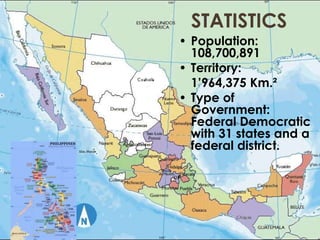
STATISTICS 
• Population: 
108,700,891 
• Territory: 
1’964,375 Km.² 
• Type of 
Government: 
Federal Democratic 
with 31 states and a 
federal district.
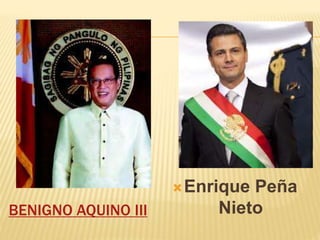
BENIGNO AQUINO III 
Enrique Peña 
Nieto
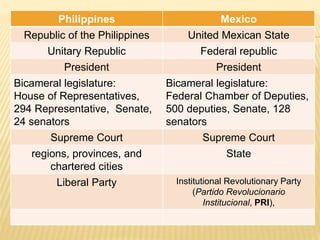
Philippines Mexico 
Republic of the Philippines United Mexican State 
Unitary Republic Federal republic 
President President 
Bicameral legislature: 
House of Representatives, 
294 Representative, Senate, 
24 senators 
Bicameral legislature: 
Federal Chamber of Deputies, 
500 deputies, Senate, 128 
senators 
Supreme Court Supreme Court 
regions, provinces, and 
chartered cities 
State 
Liberal Party Institutional Revolutionary Party 
(Partido Revolucionario 
Institucional, PRI),
mexico 
ECONOMIC OVERVIEW
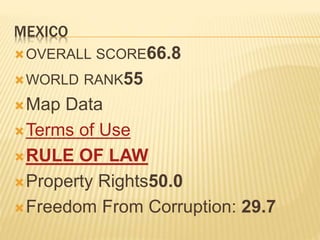
MEXICO 
OVERALL SCORE66.8 
WORLD RANK55 
Map Data 
Terms of Use 
RULE OF LAW 
Property Rights50.0 
Freedom From Corruption: 29.7
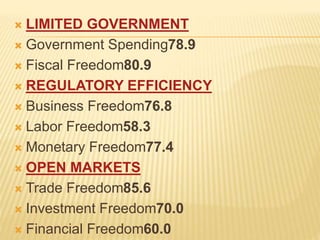
 LIMITED GOVERNMENT 
 Government Spending78.9 
 Fiscal Freedom80.9 
 REGULATORY EFFICIENCY 
 Business Freedom76.8 
 Labor Freedom58.3 
 Monetary Freedom77.4 
 OPEN MARKETS 
 Trade Freedom85.6 
 Investment Freedom70.0 
 Financial Freedom60.0
MEXICO
MEXICO
ECONOMY
MEXICO 
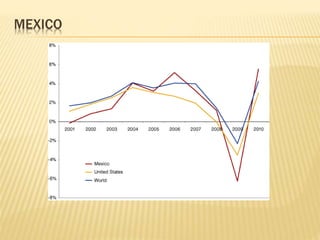
 Mexico has recently had one of the fastest 
growing economics in Latin America. 
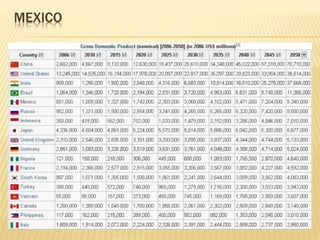
It is the 14th largest in the world in 
nominal terms and the 10th largest by 
purchasing power parity, according to the 
World Bank.
 Main export goods are automobiles, 
electronics, televisions, computers, mobile 
phones, LCD players, oil and oil products, 
silver, fruits, vegetables, coffee, cottons. 
 Main export goods are automobiles, 
electronics, televisions, computers, mobile 
phones, LCD players, oil and oil products, 
silver, fruits, vegetables, coffee, cottons.
ELECTRONICS 
Mexico has the sixth largest electronics 
industry in the world and Mexico is the 2nd 
largest exporter of electronics to the United 
States. 
Mexico manufactures OEM design of 
televisions, displays, computers, mobile 
phones, circuit boards, semiconductors, 
electronic appliances, communications 
equipment and LCD modules.
AUTOMOTIVE 
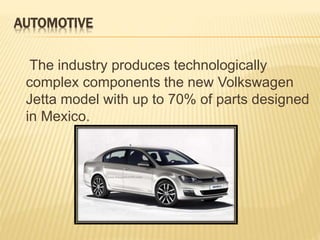
The industry produces technologically 
complex components the new Volkswagen 
Jetta model with up to 70% of parts designed 
in Mexico.
 And the new car companies Mastretta 
design that builds the Mastretta MXT 
sports car and Autobuses King that plans 
to build 10000 microbuses by 2015.
ENERGY AND MINERAL RESOURCE 
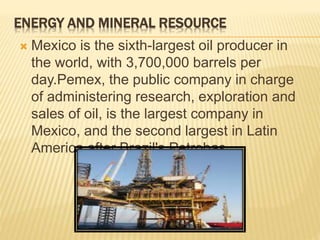
 Mexico is the sixth-largest oil producer in 
the world, with 3,700,000 barrels per 
day.Pemex, the public company in charge 
of administering research, exploration and 
sales of oil, is the largest company in 
Mexico, and the second largest in Latin 
America after Brazil's Petrobas.
AGRICULTURE 
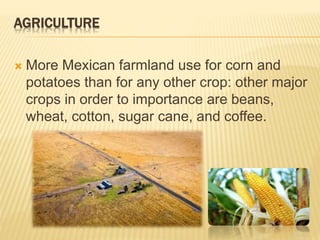
 More Mexican farmland use for corn and 
potatoes than for any other crop: other major 
crops in order to importance are beans, 
wheat, cotton, sugar cane, and coffee.
MINING 
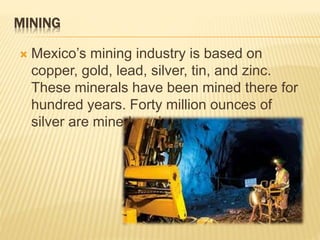
 Mexico’s mining industry is based on 
copper, gold, lead, silver, tin, and zinc. 
These minerals have been mined there for 
hundred years. Forty million ounces of 
silver are mined each year.
TRADE 
 Two thirds of Mexico’s trade is with the 
United States, but trade with Europe and 
Japan is increasing. 
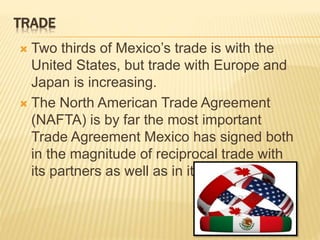
 The North American Trade Agreement 
(NAFTA) is by far the most important 
Trade Agreement Mexico has signed both 
in the magnitude of reciprocal trade with 
its partners as well as in its scope.
PHILIPPINES 
 Philippines is the 40th largest in the world, 
according to 2012 IMF statistics, and is 
also one of the immerging markets in the 
world. The Philippines is considered as a 
newly industrialize country. 
 2012 and 2013, the Philippines posted 
high GDP growth rates, reaching 6.8% in 
2012 and 7.7% in the first quarter and 
7.5% in the second quarter of 2013.
ELECTRONICS 
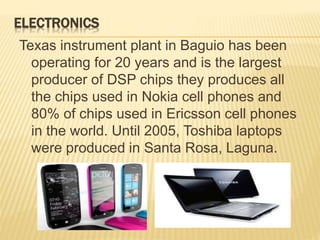
Texas instrument plant in Baguio has been 
operating for 20 years and is the largest 
producer of DSP chips they produces all 
the chips used in Nokia cell phones and 
80% of chips used in Ericsson cell phones 
in the world. Until 2005, Toshiba laptops 
were produced in Santa Rosa, Laguna.
AUTOMOTIVE 
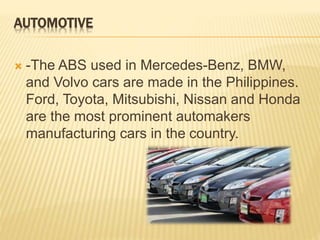
 -The ABS used in Mercedes-Benz, BMW, 
and Volvo cars are made in the Philippines. 
Ford, Toyota, Mitsubishi, Nissan and Honda 
are the most prominent automakers 
manufacturing cars in the country.
AGRICULTURE 
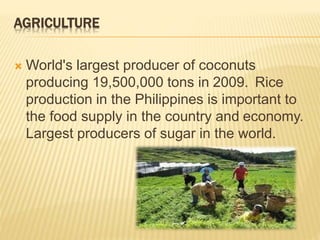
World's largest producer of coconuts 
producing 19,500,000 tons in 2009. Rice 
production in the Philippines is important to 
the food supply in the country and economy. 
Largest producers of sugar in the world.
MINING 
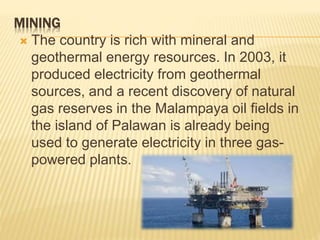
 The country is rich with mineral and 
geothermal energy resources. In 2003, it 
produced electricity from geothermal 
sources, and a recent discovery of natural 
gas reserves in the Malampaya oil fields in 
the island of Palawan is already being 
used to generate electricity in three gas-powered 
plants.
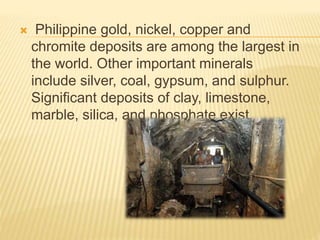
 Philippine gold, nickel, copper and 
chromite deposits are among the largest in 
the world. Other important minerals 
include silver, coal, gypsum, and sulphur. 
Significant deposits of clay, limestone, 
marble, silica, and phosphate exist.
mexico 
MILITARY
MEXICO
MEXICO
MEXICO
WHILE PH IS!
WHILE PH IS!
WHILE PH IS!
WHILE PH IS!

Mexico

  • 1.
    COMPARATIVE GOVERNMENT ANDHISTORY Philippines vs Mexico
  • 2.
    STATISTICS • Population: 108,700,891 • Territory: 1’964,375 Km.² • Type of Government: Federal Democratic with 31 states and a federal district.
  • 5.
    BENIGNO AQUINO III Enrique Peña Nieto
  • 6.
    Philippines Mexico Republicof the Philippines United Mexican State Unitary Republic Federal republic President President Bicameral legislature: House of Representatives, 294 Representative, Senate, 24 senators Bicameral legislature: Federal Chamber of Deputies, 500 deputies, Senate, 128 senators Supreme Court Supreme Court regions, provinces, and chartered cities State Liberal Party Institutional Revolutionary Party (Partido Revolucionario Institucional, PRI),
  • 7.
  • 8.
    MEXICO OVERALL SCORE66.8 WORLD RANK55 Map Data Terms of Use RULE OF LAW Property Rights50.0 Freedom From Corruption: 29.7
  • 9.
     LIMITED GOVERNMENT  Government Spending78.9  Fiscal Freedom80.9  REGULATORY EFFICIENCY  Business Freedom76.8  Labor Freedom58.3  Monetary Freedom77.4  OPEN MARKETS  Trade Freedom85.6  Investment Freedom70.0  Financial Freedom60.0
  • 10.
  • 11.
  • 12.
  • 13.
    MEXICO  Mexicohas recently had one of the fastest growing economics in Latin America. It is the 14th largest in the world in nominal terms and the 10th largest by purchasing power parity, according to the World Bank.
  • 14.
     Main exportgoods are automobiles, electronics, televisions, computers, mobile phones, LCD players, oil and oil products, silver, fruits, vegetables, coffee, cottons.  Main export goods are automobiles, electronics, televisions, computers, mobile phones, LCD players, oil and oil products, silver, fruits, vegetables, coffee, cottons.
  • 15.
    ELECTRONICS Mexico hasthe sixth largest electronics industry in the world and Mexico is the 2nd largest exporter of electronics to the United States. Mexico manufactures OEM design of televisions, displays, computers, mobile phones, circuit boards, semiconductors, electronic appliances, communications equipment and LCD modules.
  • 16.
    AUTOMOTIVE The industryproduces technologically complex components the new Volkswagen Jetta model with up to 70% of parts designed in Mexico.
  • 17.
     And thenew car companies Mastretta design that builds the Mastretta MXT sports car and Autobuses King that plans to build 10000 microbuses by 2015.
  • 18.
    ENERGY AND MINERALRESOURCE  Mexico is the sixth-largest oil producer in the world, with 3,700,000 barrels per day.Pemex, the public company in charge of administering research, exploration and sales of oil, is the largest company in Mexico, and the second largest in Latin America after Brazil's Petrobas.
  • 19.
    AGRICULTURE  MoreMexican farmland use for corn and potatoes than for any other crop: other major crops in order to importance are beans, wheat, cotton, sugar cane, and coffee.
  • 20.
    MINING  Mexico’smining industry is based on copper, gold, lead, silver, tin, and zinc. These minerals have been mined there for hundred years. Forty million ounces of silver are mined each year.
  • 21.
    TRADE  Twothirds of Mexico’s trade is with the United States, but trade with Europe and Japan is increasing.  The North American Trade Agreement (NAFTA) is by far the most important Trade Agreement Mexico has signed both in the magnitude of reciprocal trade with its partners as well as in its scope.
  • 22.
    PHILIPPINES  Philippinesis the 40th largest in the world, according to 2012 IMF statistics, and is also one of the immerging markets in the world. The Philippines is considered as a newly industrialize country.  2012 and 2013, the Philippines posted high GDP growth rates, reaching 6.8% in 2012 and 7.7% in the first quarter and 7.5% in the second quarter of 2013.
  • 23.
    ELECTRONICS Texas instrumentplant in Baguio has been operating for 20 years and is the largest producer of DSP chips they produces all the chips used in Nokia cell phones and 80% of chips used in Ericsson cell phones in the world. Until 2005, Toshiba laptops were produced in Santa Rosa, Laguna.
  • 24.
    AUTOMOTIVE  -TheABS used in Mercedes-Benz, BMW, and Volvo cars are made in the Philippines. Ford, Toyota, Mitsubishi, Nissan and Honda are the most prominent automakers manufacturing cars in the country.
  • 25.
    AGRICULTURE World's largestproducer of coconuts producing 19,500,000 tons in 2009. Rice production in the Philippines is important to the food supply in the country and economy. Largest producers of sugar in the world.
  • 26.
    MINING  Thecountry is rich with mineral and geothermal energy resources. In 2003, it produced electricity from geothermal sources, and a recent discovery of natural gas reserves in the Malampaya oil fields in the island of Palawan is already being used to generate electricity in three gas-powered plants.
  • 27.
     Philippine gold,nickel, copper and chromite deposits are among the largest in the world. Other important minerals include silver, coal, gypsum, and sulphur. Significant deposits of clay, limestone, marble, silica, and phosphate exist.
  • 28.
  • 29.
  • 30.
  • 31.
  • 32.
  • 33.
  • 34.
  • 35.