12051514-066
 Reptilian lungs are better developed than
amphibians
 Muscular ribs help them expand the chest
cavity as we do to draw in the air
 Nostrils allow them to bring in air while their
mouth is closed
 Snakes only have one long, lung that fits in
their bodies.
 Snakes also have a tube that projects out of the
mouth when the snake is swallowing so that it
can breathe and swallow at the same time
 The ribs of turtles attached to their shells which
prevent movement of body wall
 They exhale by contacting muscles
 More efficient circulatory system, higher blood
pressure
 All reptiles have at least an incomplete
separation of the ventricles
 Still incomplete separation of oxygen-rich and
oxygen-poor blood
 Crocodilians have two completely separated
ventricles
 All reptiles have two functionally separate
circulations.
 Reptiles regulate their body temperature with
in a narrow range, between 25-37
 Behavioral and physiological activities to
regulate temperature.
 lizards absorbs heat by conduction.
 Panting which releases heat through
evaporative cooling
 Reptiles basking in sun and warm up quickly.
 Chromatophores also aid in temperature
regulation.
 In winter, individuals may migrate to a
common site called a hibernaculum.
 Larger cerebral hemisphere
than the amphibians
 Optic lobes and the cerebellum
are also large
 Increased reliance on vision
 More refined co-ordination of
muscle functions.
 Vision - dominant sense
 In lizards eyes are movable while in snakes
permanent transparent covering is present.
 Hearing - no obvious external ear
 Not deaf - have internal ears
 No obvious response to aerial sounds
 Sensitive to vibrations carried in ground
 Olfaction important, but not in nostrils
 Blind-ending pouches called as Jacobson’s
pouches.
 These pouches open in secondary palate
through mouth cavity.
 Tongue carries scent
particles to organ.
12051514-039
 Behavioral changes helps to regulate
temperature and conserves water
 During day, nocturnal habitats and avoiding
hot surfaces reduce water loss
 In water availability, reptiles store large water
quantities in lymphatic spaces
 Kidneys is more advanced in reptiles called
metanephric.
 Blood-filtering units called as nephrons are
present.
 Kidney lack loop of Henley, it unable to
produce liquid urine more concentrated than
their body fluid.
 Kidneys produce urine in the form of uric acid
 Urine is either passed out directly through the
cloaca, or stored in the urinary bladder where
water is further reabsorbed
 Uric acid crystallizes when concentrated, and is
eliminated as a white paste (like birds)
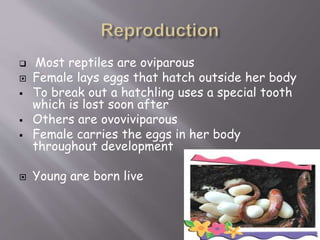
 Most reptiles are oviparous
 Female lays eggs that hatch outside her body
 To break out a hatchling uses a special tooth
which is lost soon after
 Others are ovoviviparous
 Female carries the eggs in her body
throughout development
 Young are born live
 Internal fertilization
 A pair of ducts delivers sperm into cloaca of
female
 Male inserts penis into female’s cloaca
 Female’s body coats the embryos in protective
shell, with membranes and yolk sac.
 Parthenogenesis
No male found higher reproductive bisexual
population
 Head-bobbing
Displays by some male lizards reveal bright
patches of colors on the throat.
 Tail waving
It is performed by male running chin along
female
 Vocalization
During breeding season male is hostile that may
bark and worn other males to attract females
 Mating occurs after this

Presentation1

  • 1.
  • 2.
     Reptilian lungsare better developed than amphibians  Muscular ribs help them expand the chest cavity as we do to draw in the air  Nostrils allow them to bring in air while their mouth is closed  Snakes only have one long, lung that fits in their bodies.
  • 3.
     Snakes alsohave a tube that projects out of the mouth when the snake is swallowing so that it can breathe and swallow at the same time  The ribs of turtles attached to their shells which prevent movement of body wall  They exhale by contacting muscles
  • 4.
     More efficientcirculatory system, higher blood pressure  All reptiles have at least an incomplete separation of the ventricles  Still incomplete separation of oxygen-rich and oxygen-poor blood  Crocodilians have two completely separated ventricles
  • 5.
     All reptileshave two functionally separate circulations.
  • 6.
     Reptiles regulatetheir body temperature with in a narrow range, between 25-37  Behavioral and physiological activities to regulate temperature.  lizards absorbs heat by conduction.  Panting which releases heat through evaporative cooling
  • 7.
     Reptiles baskingin sun and warm up quickly.  Chromatophores also aid in temperature regulation.  In winter, individuals may migrate to a common site called a hibernaculum.
  • 8.
     Larger cerebralhemisphere than the amphibians  Optic lobes and the cerebellum are also large  Increased reliance on vision  More refined co-ordination of muscle functions.
  • 9.
     Vision -dominant sense  In lizards eyes are movable while in snakes permanent transparent covering is present.  Hearing - no obvious external ear  Not deaf - have internal ears  No obvious response to aerial sounds  Sensitive to vibrations carried in ground
  • 10.
     Olfaction important,but not in nostrils  Blind-ending pouches called as Jacobson’s pouches.  These pouches open in secondary palate through mouth cavity.  Tongue carries scent particles to organ.
  • 11.
  • 12.
     Behavioral changeshelps to regulate temperature and conserves water  During day, nocturnal habitats and avoiding hot surfaces reduce water loss  In water availability, reptiles store large water quantities in lymphatic spaces
  • 13.
     Kidneys ismore advanced in reptiles called metanephric.  Blood-filtering units called as nephrons are present.  Kidney lack loop of Henley, it unable to produce liquid urine more concentrated than their body fluid.
  • 14.
     Kidneys produceurine in the form of uric acid  Urine is either passed out directly through the cloaca, or stored in the urinary bladder where water is further reabsorbed  Uric acid crystallizes when concentrated, and is eliminated as a white paste (like birds)
  • 15.
     Most reptilesare oviparous  Female lays eggs that hatch outside her body  To break out a hatchling uses a special tooth which is lost soon after  Others are ovoviviparous  Female carries the eggs in her body throughout development  Young are born live
  • 16.
     Internal fertilization A pair of ducts delivers sperm into cloaca of female  Male inserts penis into female’s cloaca  Female’s body coats the embryos in protective shell, with membranes and yolk sac.
  • 17.
     Parthenogenesis No malefound higher reproductive bisexual population  Head-bobbing Displays by some male lizards reveal bright patches of colors on the throat.  Tail waving It is performed by male running chin along female
  • 18.
     Vocalization During breedingseason male is hostile that may bark and worn other males to attract females  Mating occurs after this