A challenge
Can we challenge it?
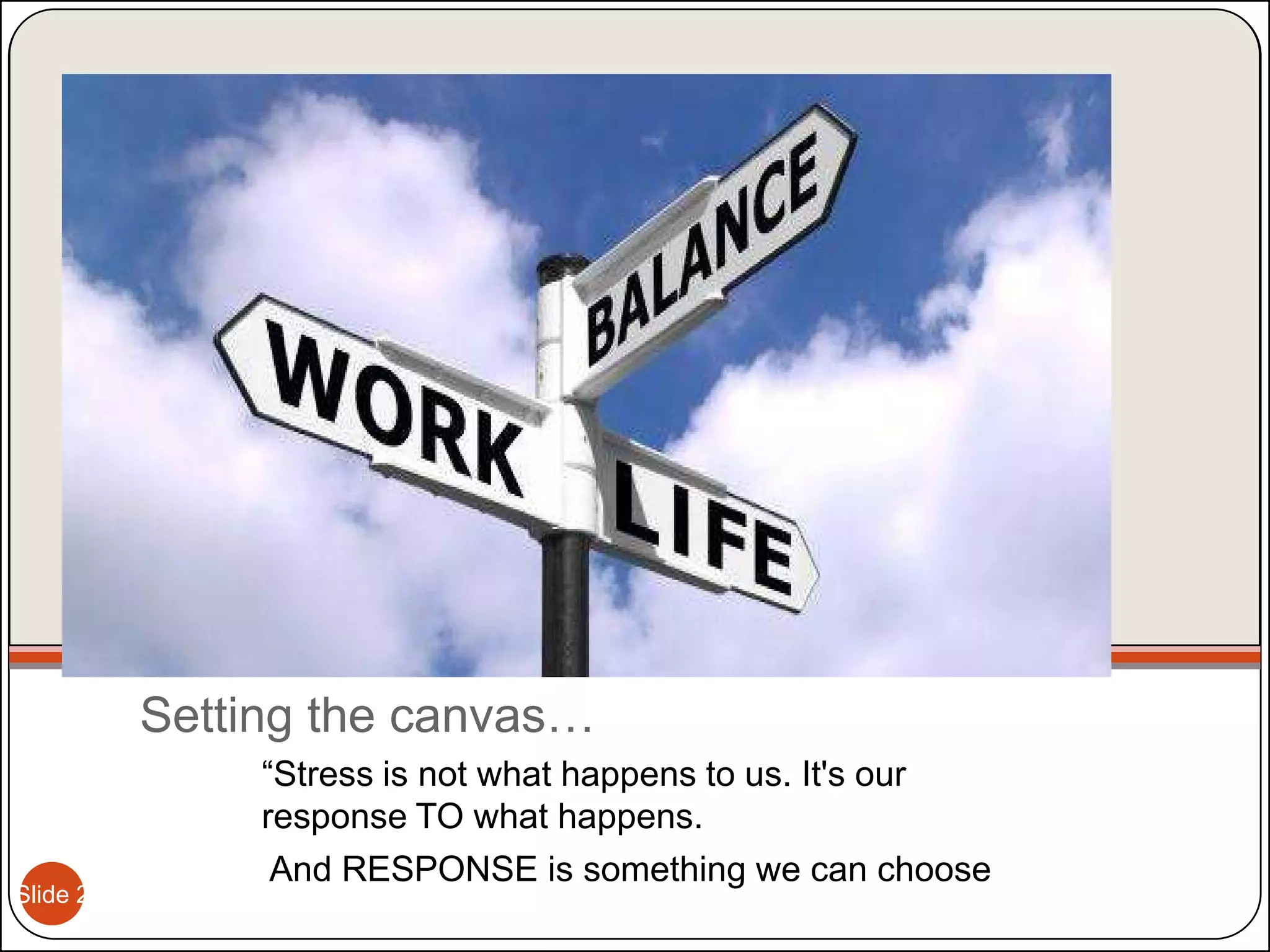
Setting the canvas…

Slide 2

―Stress is not what happens to us. It's our
response TO what happens.
And RESPONSE is something we can choose
Stress & Anxiety
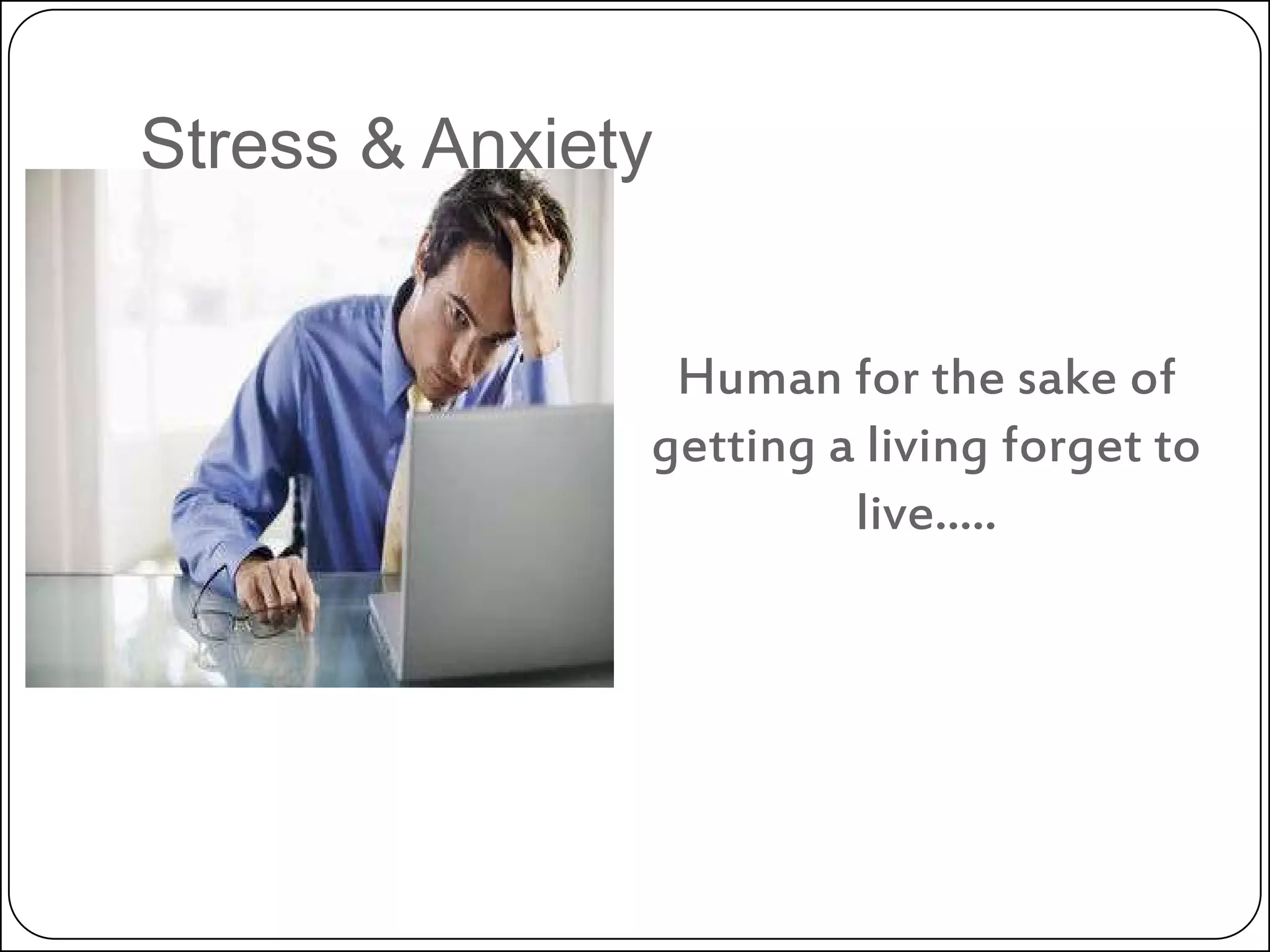
Human for the sake of
getting a living forget to
live.....
Stress & Anxiety
 THE SANSKRIT CHARACTER FOR FUNERAL IS

STRIKINGLY SIMILAR TO THE SANSKRIT
CHARACTER FOR WORRY…ONE BURNS THE
DEAD WHILE THE OTHER BURNS THE LIVING….

 “STRESS IS DEFINED AS THE ANTICIPATION OF

INABILITY TO RESPOND ADEQUATELY TO
PERCIVED DEMAND, ACCOMPAINED BY
ANTICIPATION OF NEGATIVE CONSEQUENCES
FOR INADEQUATE RESPONSE”

 - JOSEPH E.McGRATH
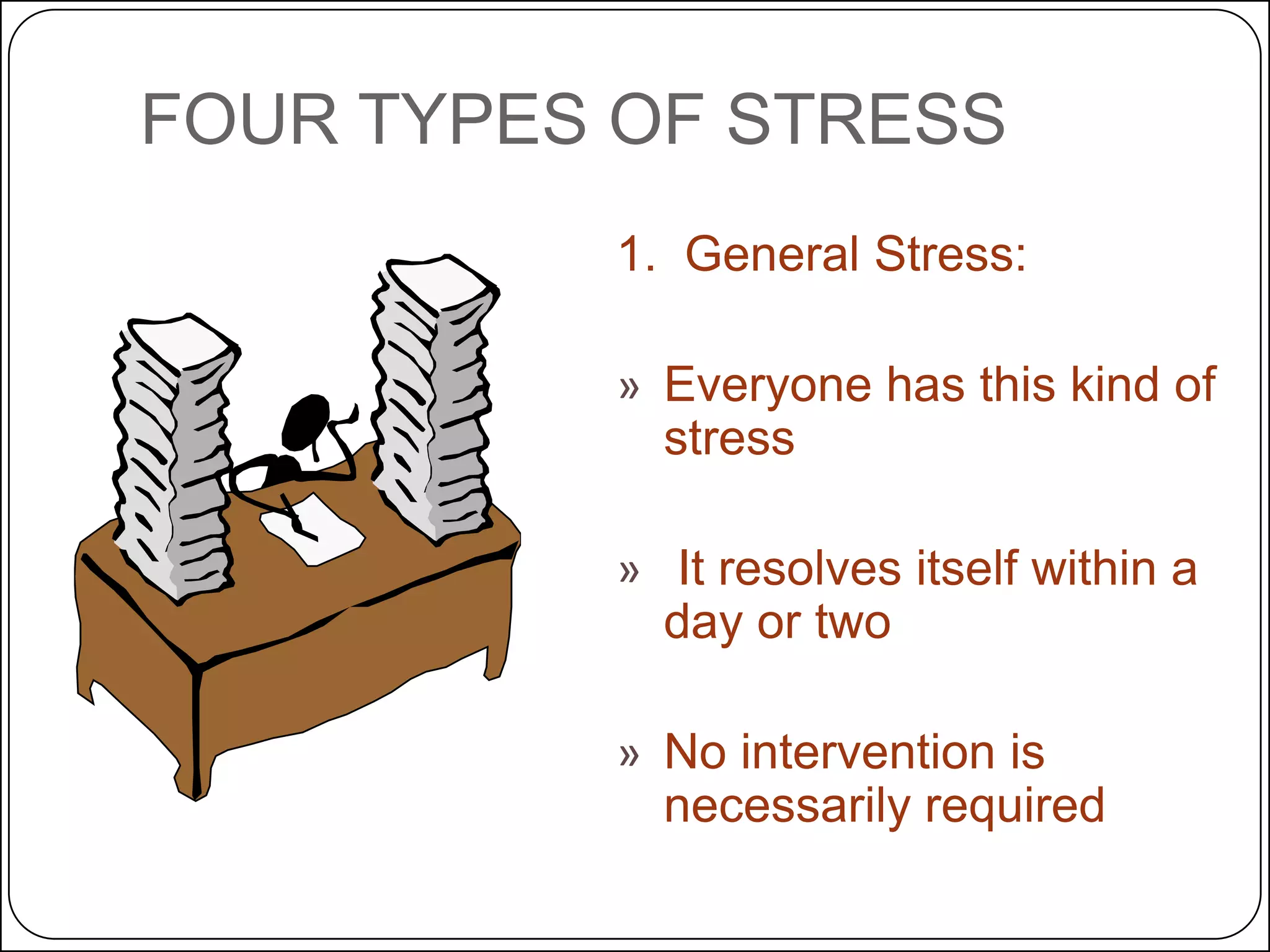
FOUR TYPES OF STRESS
1. General Stress:
» Everyone has this kind of
stress
» It resolves itself within a
day or two

» No intervention is
necessarily required
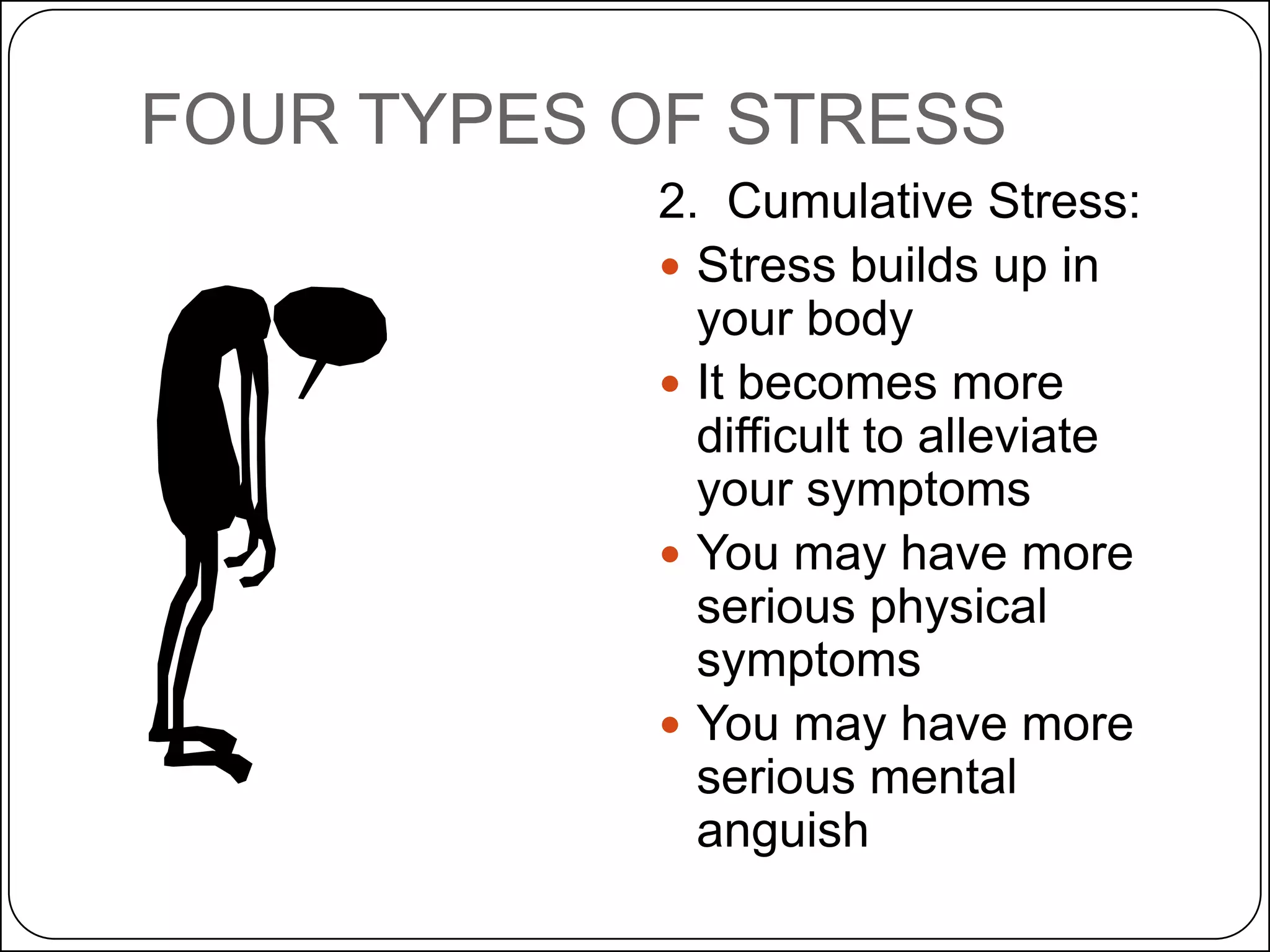
FOUR TYPES OF STRESS
2. Cumulative Stress:
 Stress builds up in
your body
 It becomes more
difficult to alleviate
your symptoms
 You may have more
serious physical
symptoms
 You may have more
serious mental
anguish
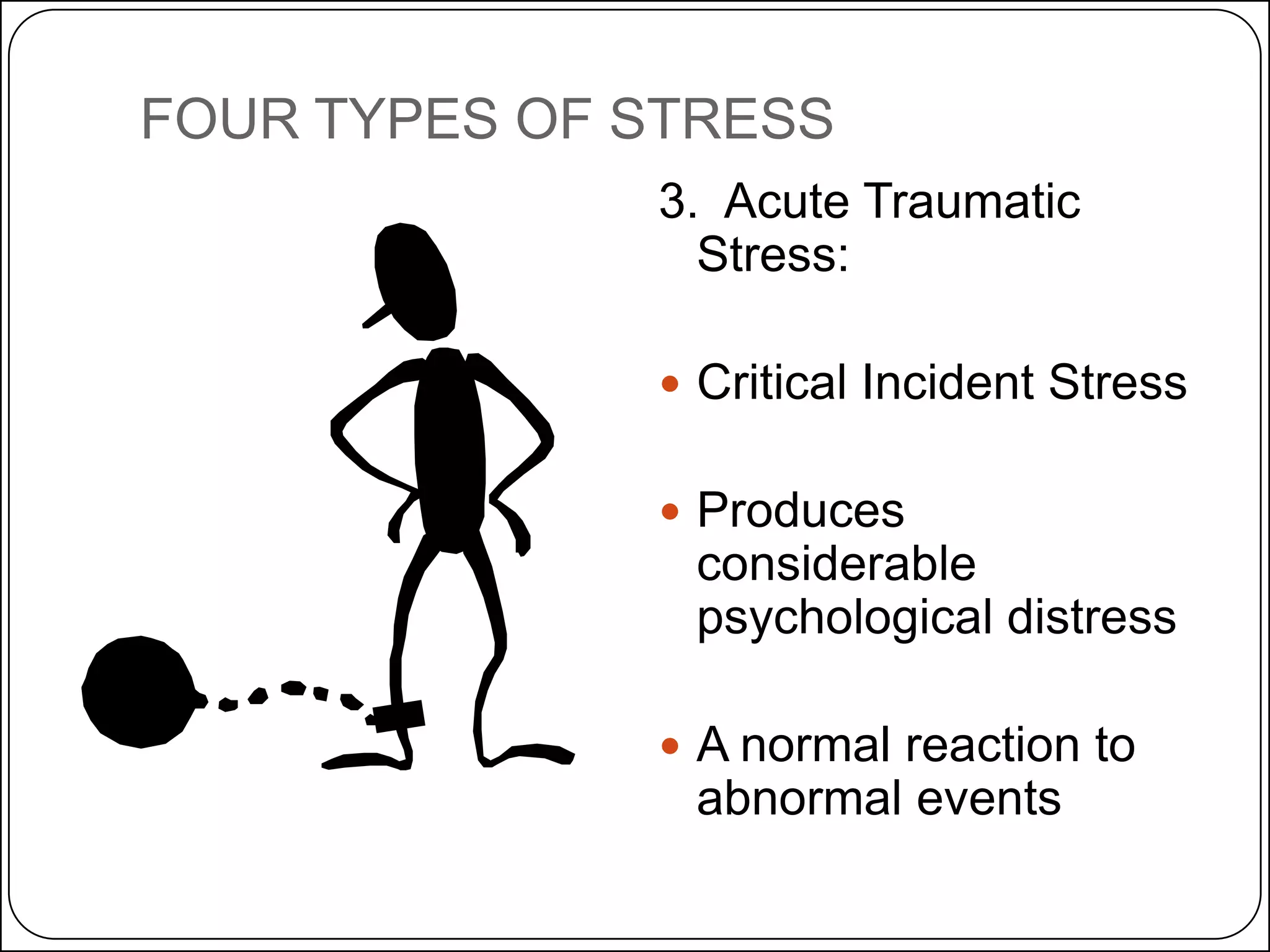
FOUR TYPES OF STRESS
3. Acute Traumatic
Stress:
 Critical Incident Stress

 Produces

considerable
psychological distress

 A normal reaction to

abnormal events
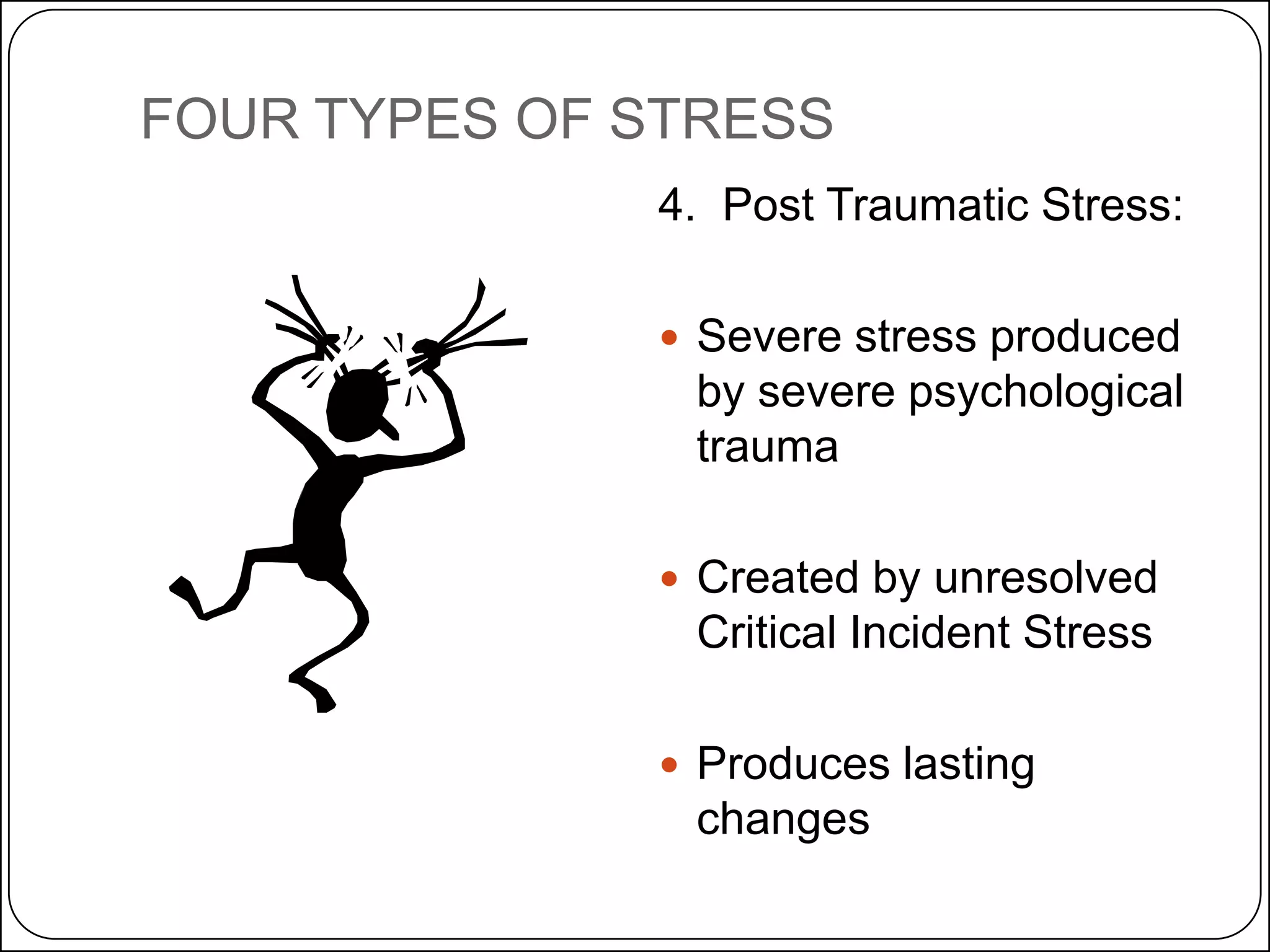
FOUR TYPES OF STRESS
4. Post Traumatic Stress:
 Severe stress produced

by severe psychological
trauma
 Created by unresolved

Critical Incident Stress
 Produces lasting

changes
Anxiety & Stress – The Causes











WORK OVERLOAD
TIME PRESSURES
POOR QUALITY OF SUPERVISION
INSECURE JOB CLIMATE
LACK OF PERSONAL CONTROL
INADEQUATE AUTHORITY TO MATCH
RESPONSIBLITIES
ROLE CONFLICT AND AMBIGUITY
DIFFRENCE BETWEEN COMPANY AND EMPLOYEE
VALUES
FRUSTRATION
TECHNOLOGY WITH INADEQUATE TRAINING AND
SUPPORT
Anxiety & Stress – The
Causes……..Contd.
 Work overload
 Quantitative: too much to do in too short a time
 Qualitative: work that is too difficult
 Quantitative has increased in recent years due to

downsizing
 Work under load – work that is too simple or
insufficient to fill one’s time
 Both of these impact stress and health, appears that a
moderate amount of stress is optimal
Anxiety & Stress – The
Causes……..Contd.
 Organizational Change – if not hardy, change

causes stress in individuals. Can be reduced by
including employees in planning
 Role Ambiguity – unstructured or poorly defined job
responsibilities (expected standards, methods,
schedules)
 Role Conflict – conflict between job demands and
employee’s personal standards
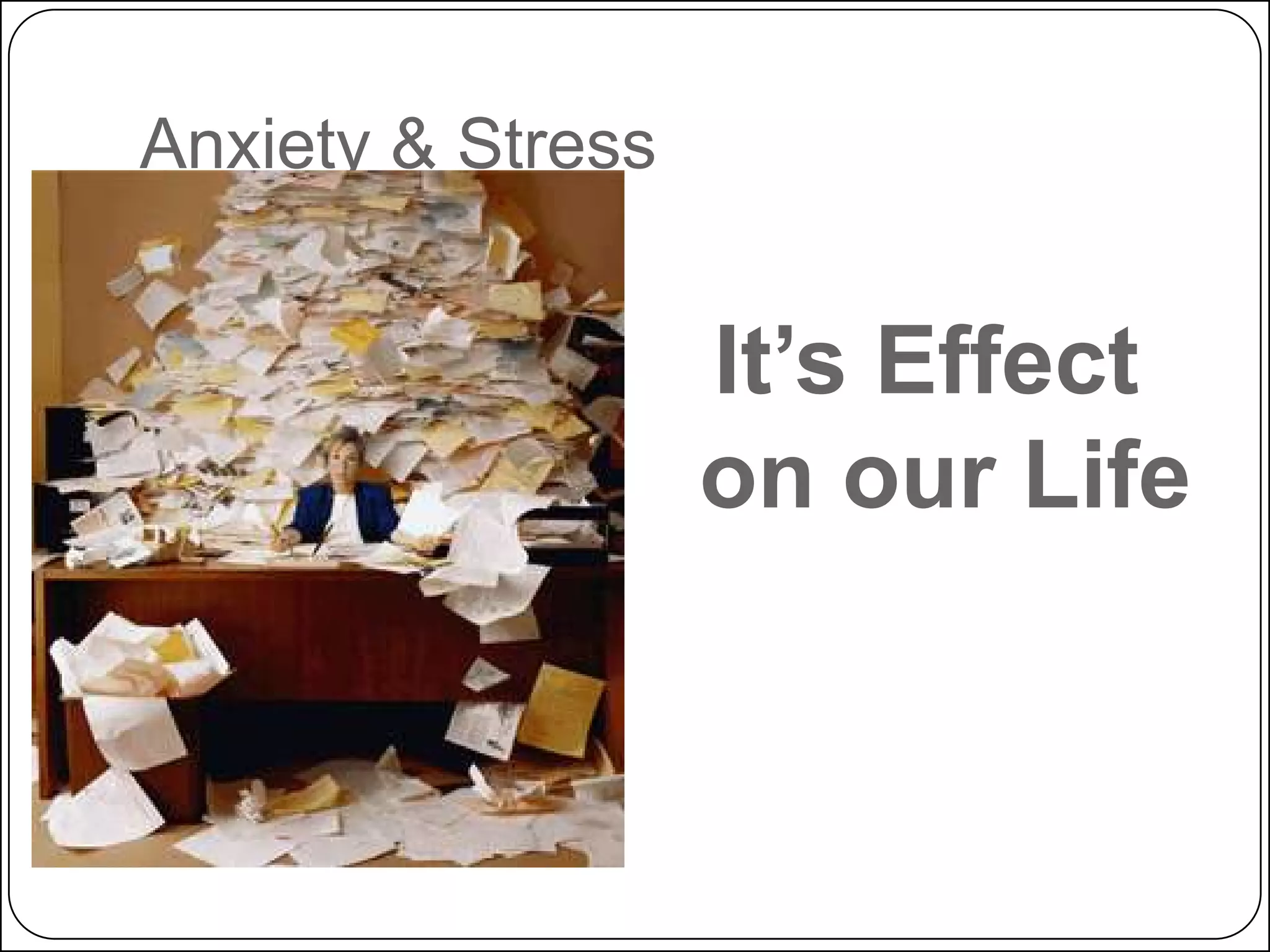
Anxiety & Stress

It’s Effect
on our Life
General Adaptation Syndrome
Stage I - Alarm Reaction
 The ―fight or flight‖ response which causes you to
be ready for physical activity
 However, it decreases the effectiveness of the

immune system which makes you more
susceptible to illness
General Adaptation Syndrome
Stage II – Stage of adaptation
 If stress continues, the body adapts to the

stressors it is being exposed to
 If the stressor is starvation, the person
experiences a reduced desire for physical activity
to conserve energy, and the absorption of
nutrients from any food intake is maximized
General Adaptation Syndrome
Stage III – Stage of Exhaustion
 Stress persists for a long time
 The body’s resistance may be reduced or

collapse quickly
 People who experience long-term stress may

have heart attacks, severe infections, or chronic
pain or illness
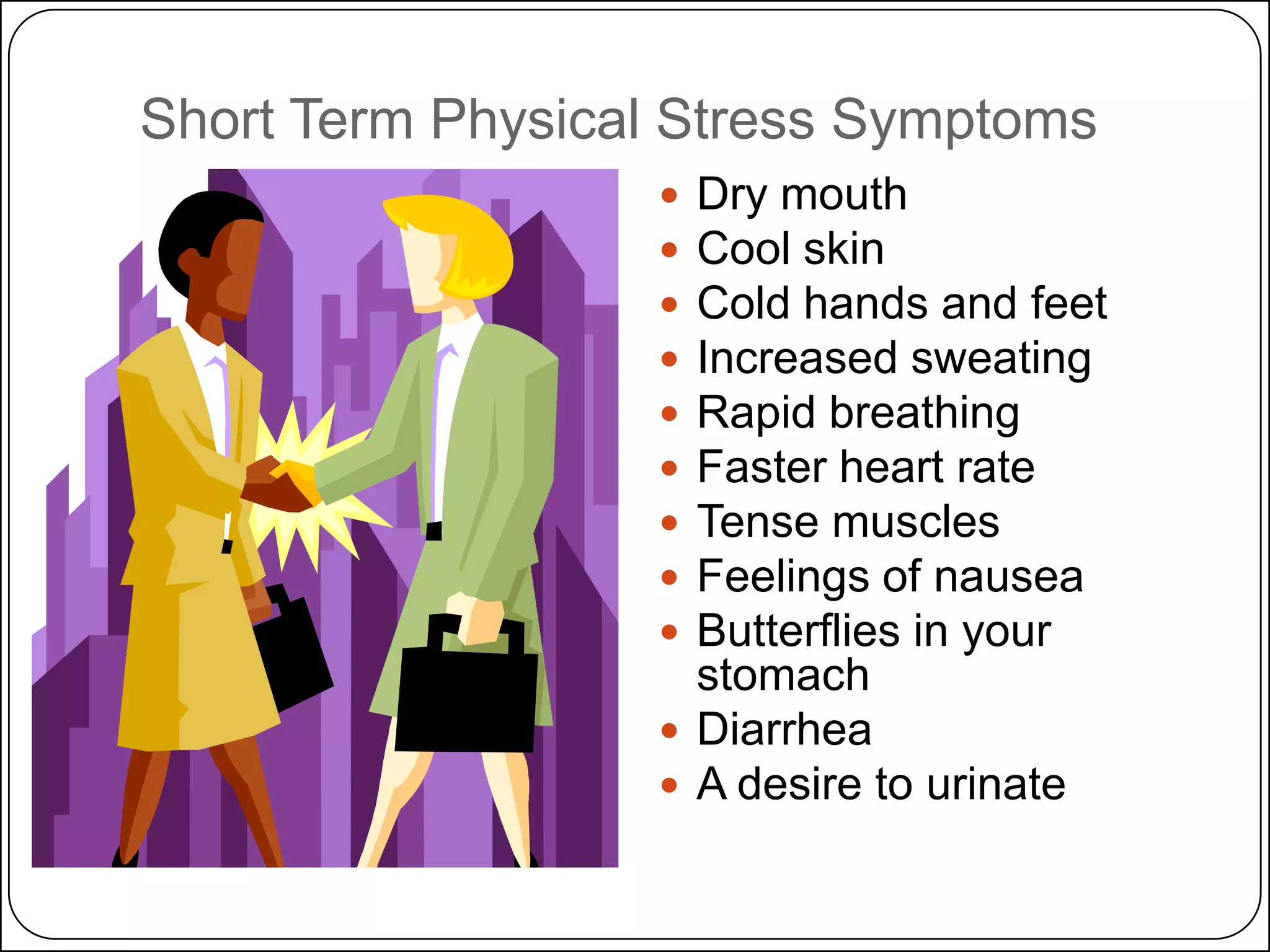
Short Term Physical Stress Symptoms
Dry mouth
Cool skin
Cold hands and feet
Increased sweating
Rapid breathing
Faster heart rate
Tense muscles
Feelings of nausea
Butterflies in your
stomach
 Diarrhea
 A desire to urinate









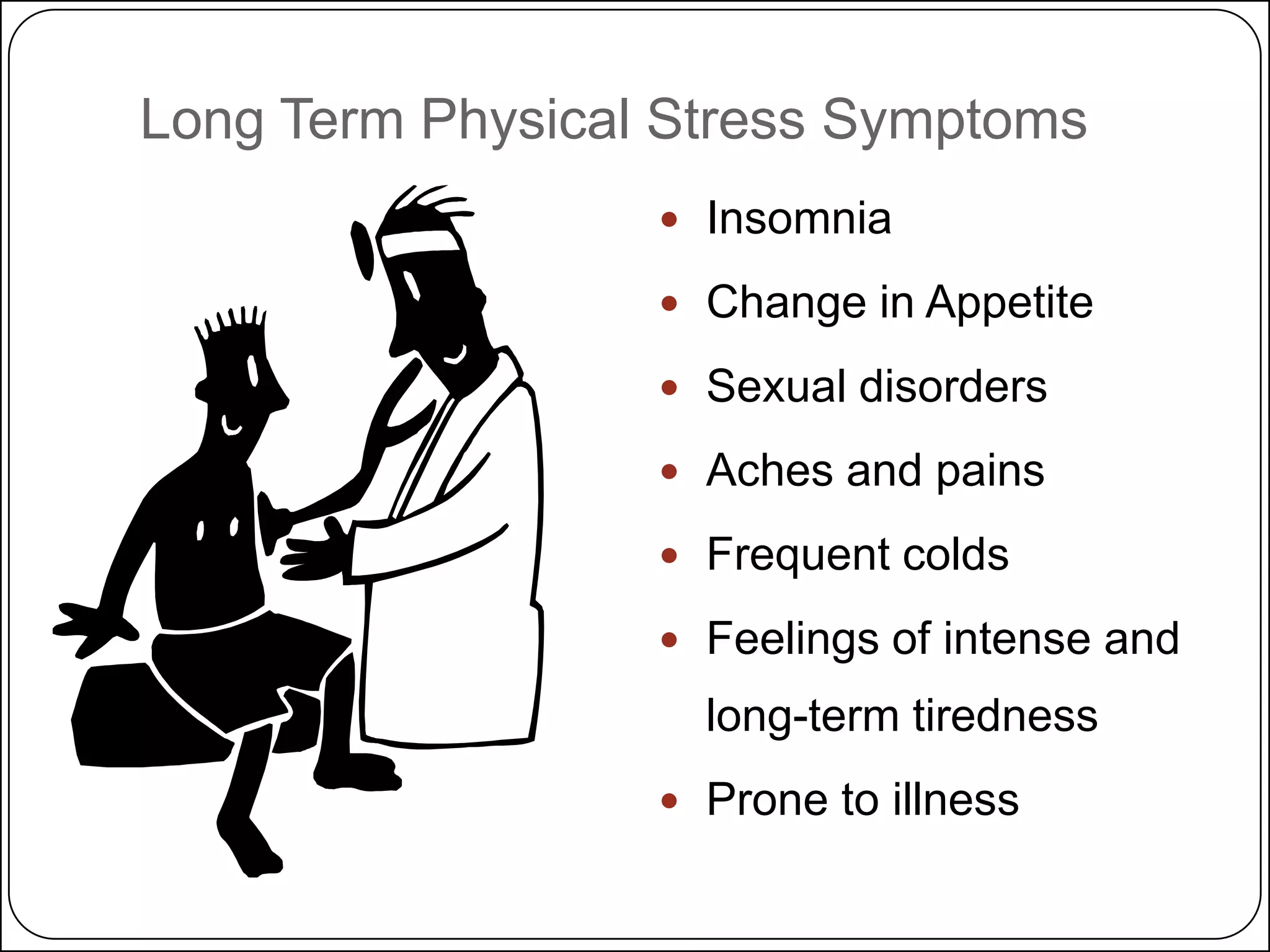
Long Term Physical Stress Symptoms
 Insomnia
 Change in Appetite
 Sexual disorders
 Aches and pains

 Frequent colds
 Feelings of intense and

long-term tiredness
 Prone to illness
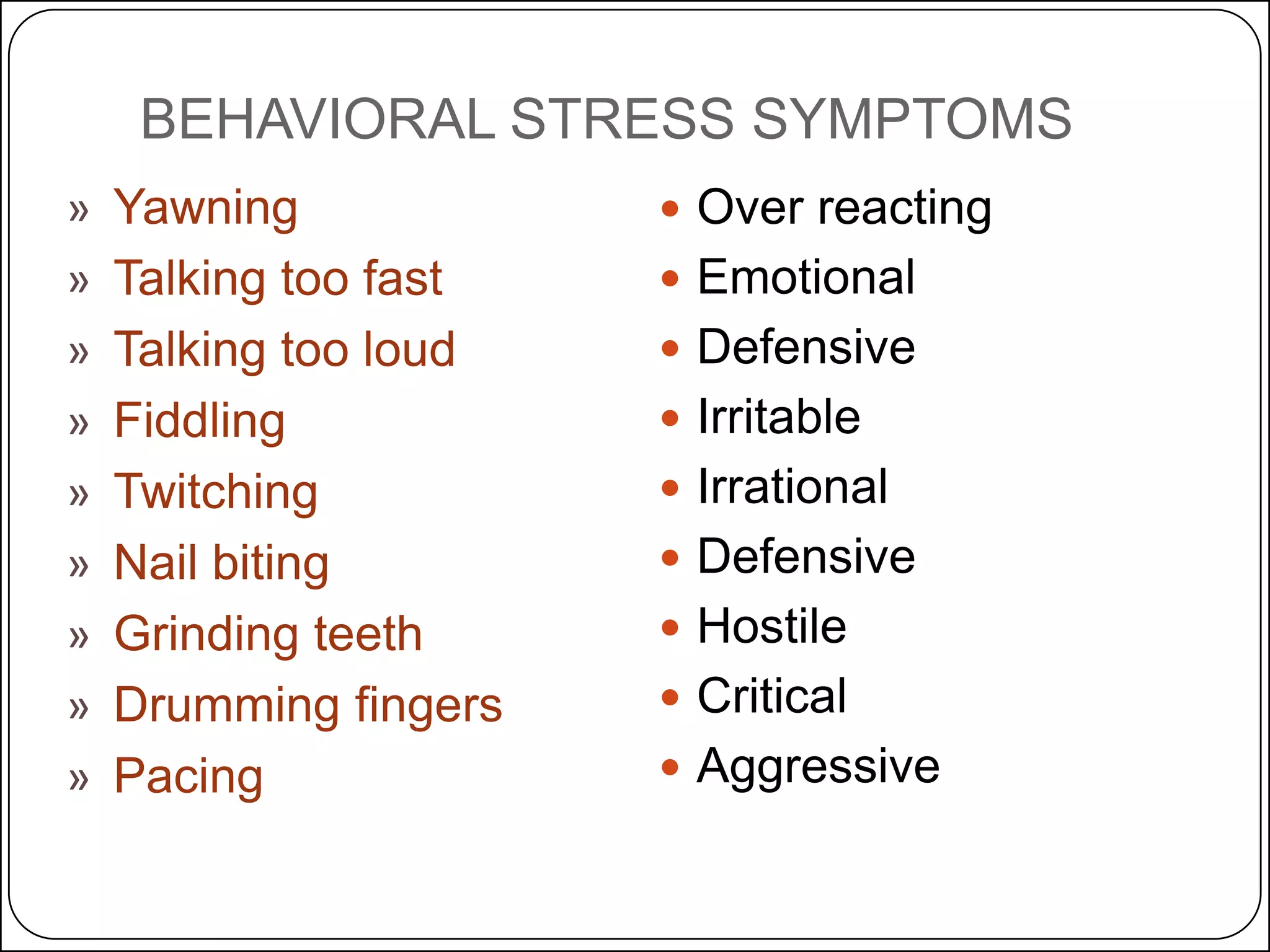
BEHAVIORAL STRESS SYMPTOMS
»
»
»
»
»
»
»
»
»

Yawning
Talking too fast
Talking too loud
Fiddling
Twitching
Nail biting
Grinding teeth
Drumming fingers
Pacing

 Over reacting
 Emotional
 Defensive
 Irritable
 Irrational
 Defensive
 Hostile
 Critical
 Aggressive
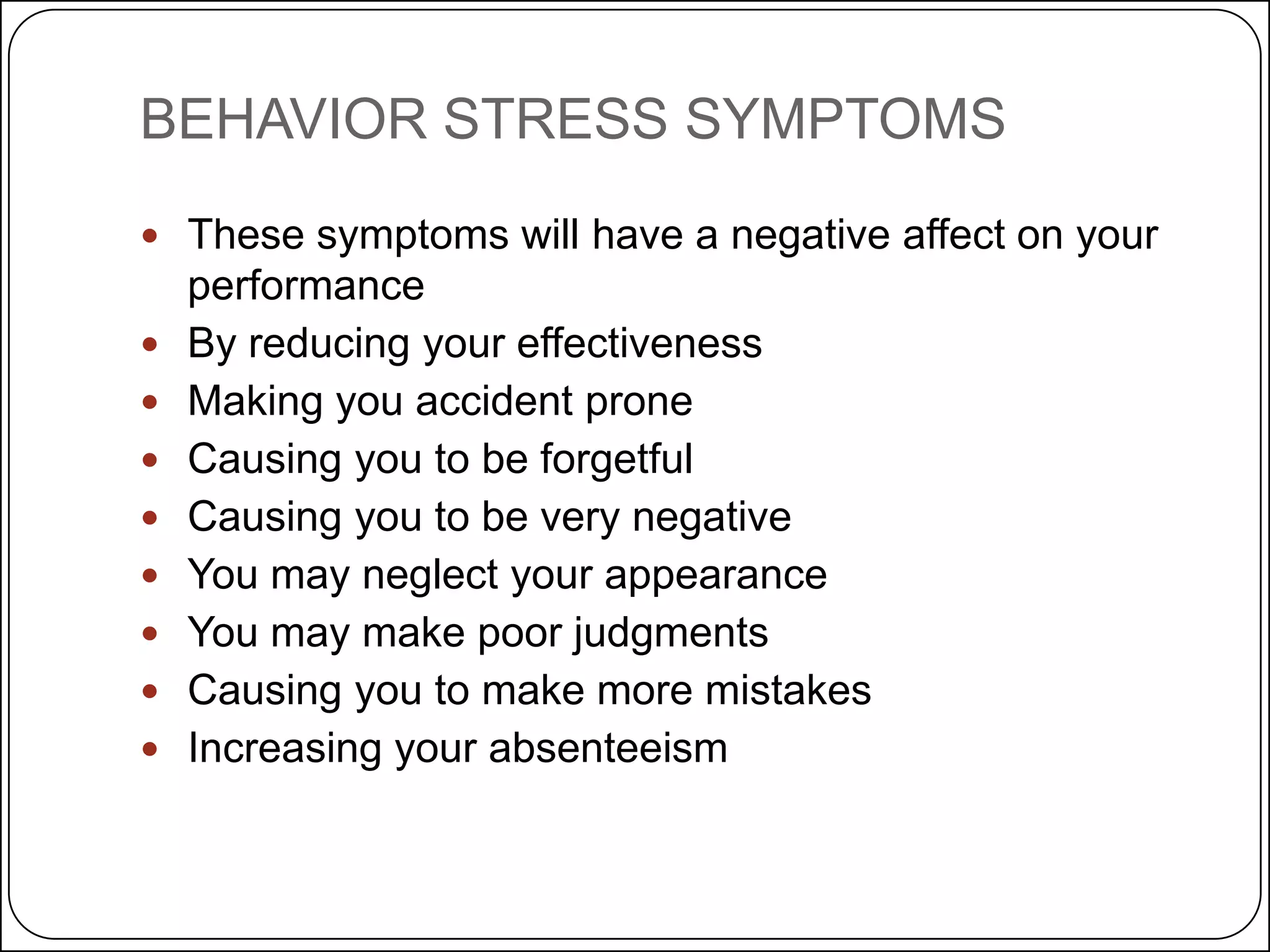
BEHAVIOR STRESS SYMPTOMS
 These symptoms will have a negative affect on your










performance
By reducing your effectiveness
Making you accident prone
Causing you to be forgetful
Causing you to be very negative
You may neglect your appearance
You may make poor judgments
Causing you to make more mistakes
Increasing your absenteeism
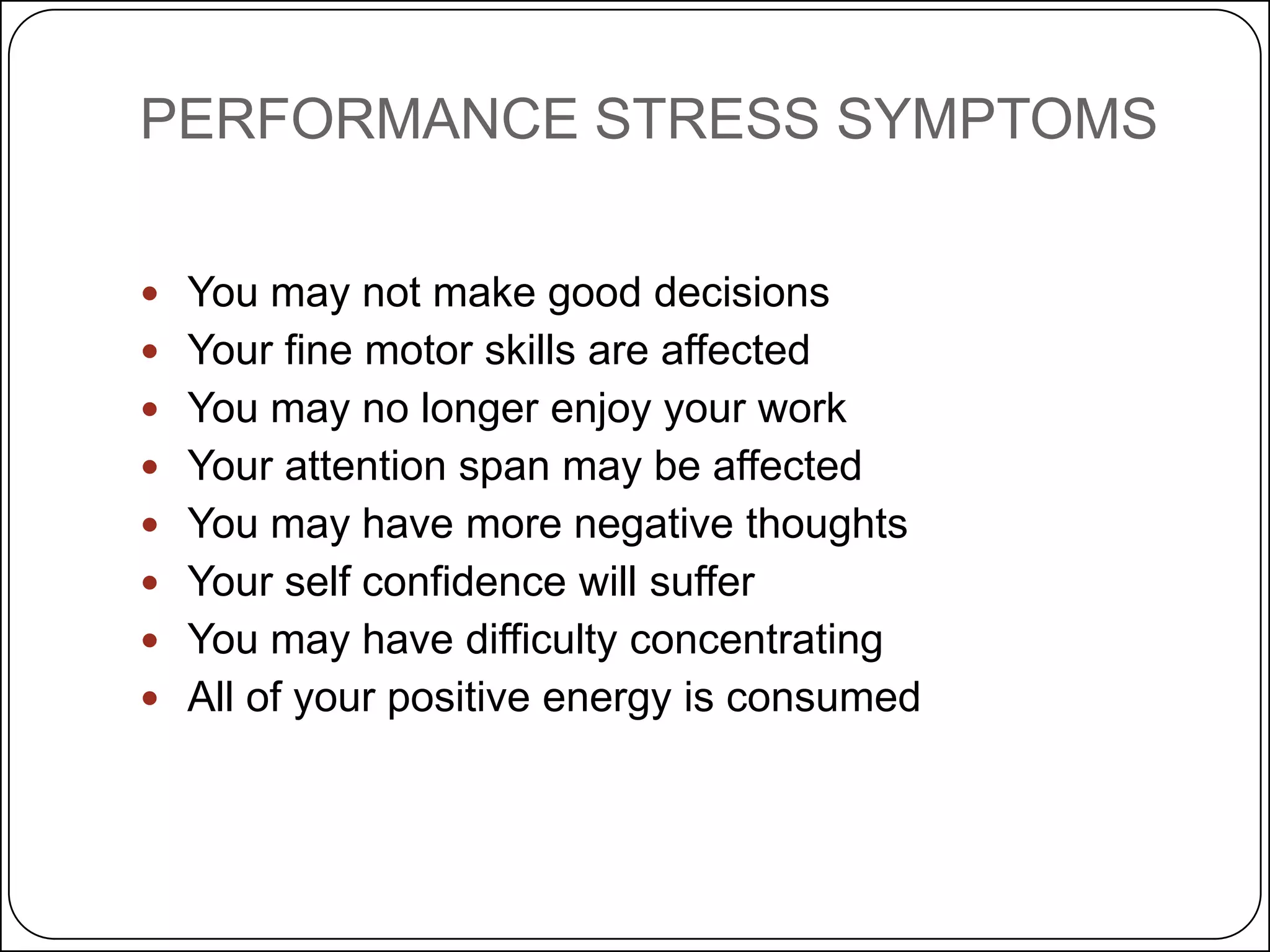
PERFORMANCE STRESS SYMPTOMS
 You may not make good decisions
 Your fine motor skills are affected
 You may no longer enjoy your work
 Your attention span may be affected

 You may have more negative thoughts
 Your self confidence will suffer
 You may have difficulty concentrating
 All of your positive energy is consumed
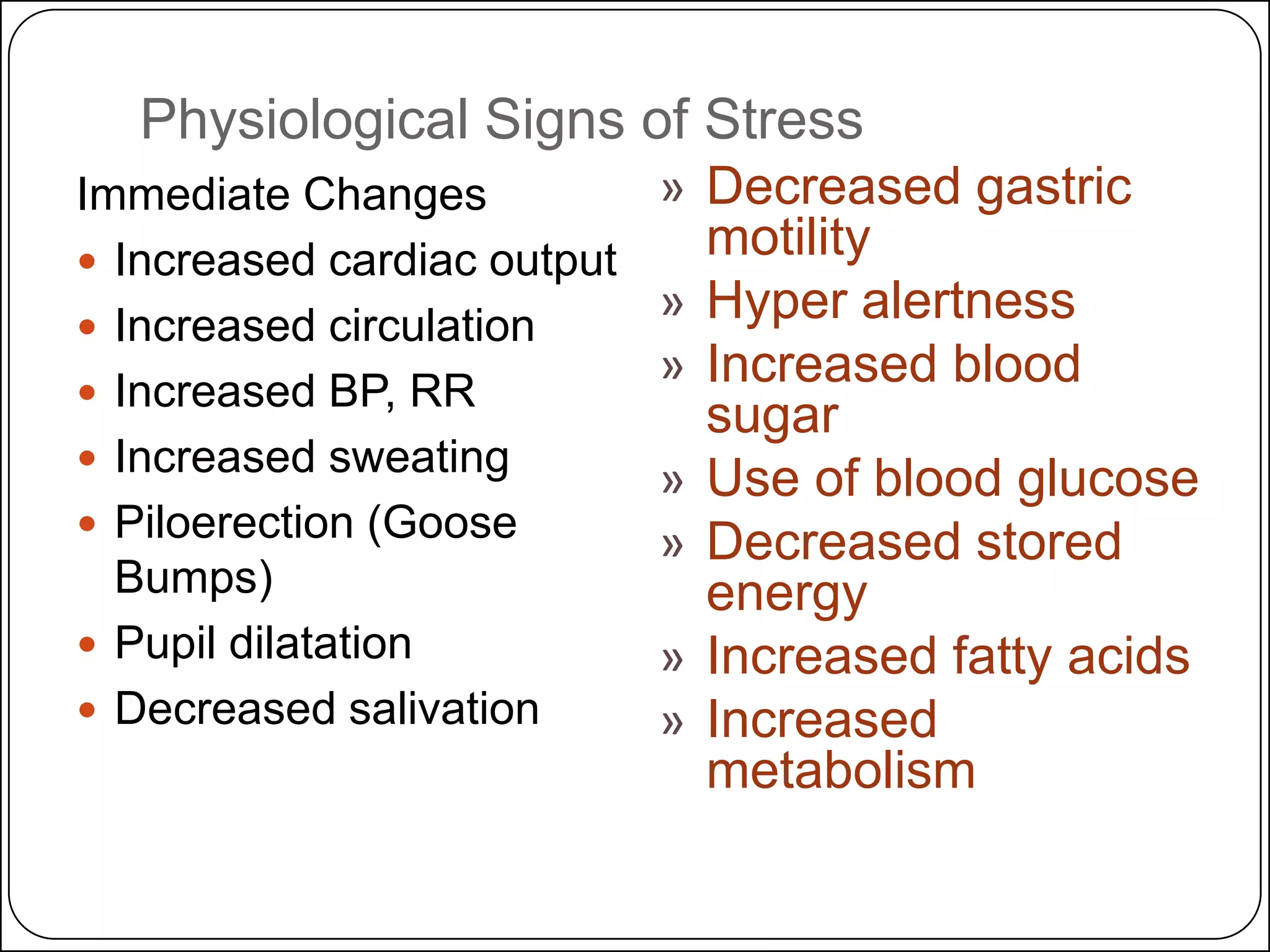
Physiological Signs of Stress
Immediate Changes
 Increased cardiac output
 Increased circulation
 Increased BP, RR
 Increased sweating
 Piloerection (Goose
Bumps)
 Pupil dilatation
 Decreased salivation

» Decreased gastric
motility
» Hyper alertness
» Increased blood
sugar
» Use of blood glucose
» Decreased stored
energy
» Increased fatty acids
» Increased
metabolism
Emotional Signs of Stress
 Denial
» Hopelessness
 Fear
» Helplessness
 Depression
» Feeling lost
 Grief
» Wishing to hide
 Anger
 Worry
» Anxiety
 Uncertainty
» Panic
» Inappropriate
Emotions
Cognitive Signs & Symptom
 Difficulty Making Decisions
 Confusion
 Difficulty Naming Familiar Items
 Poor Concentration
 Blaming Others
 Memory Problems
 Replaying Events Over & Over
Behavioral Signs of Stress
 Withdrawal
 Suspiciousness
 Excessive Humor or Silence
 Increased Smoking, Alcohol or Food
 Change in Activity Level
 Angry Outbursts
 Crying Spells
Negative Self-Talk
 The Worrier Voice - ―What if…..?‖
 Make a plan then get it out of your head.

 The Critic Voice - ―How stupid…..‖
 Recognize what is really true.

 The Victim Voice - ―I’ll never be able to…..‖
 There is always something to do to work toward a

goal.
 The Perfectionist - ―I should……‖
 Assess your unrealistic expectations of yourself.
Physical Symptoms of Anxiety
 Increased Muscle Tension
 Dizziness
 Rapid Heartbeat
 Shortness of Breath
 Queasy Stomach
 Dry Mouth
 Increased Perspiration
 Problems with Sleep
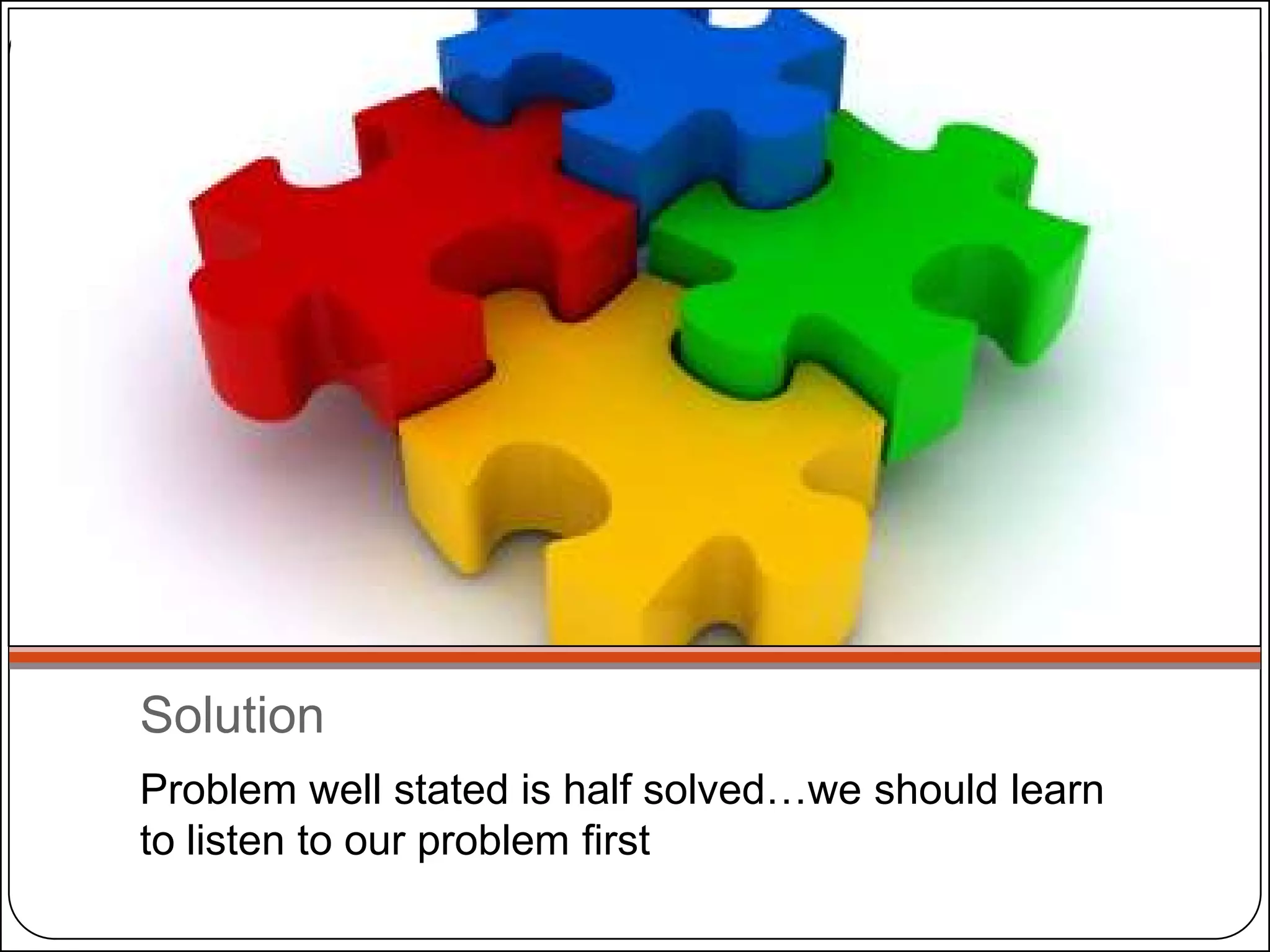
Solution
Problem well stated is half solved…we should learn
to listen to our problem first
Treating Stress in the Workplace
Organizational Techniques
 Provide sufficient support for change
 Provide sense of control through participation
 Clearly define employee roles
 Eliminate work over and under load
 EAPs for stress reduction (teach coping
strategies)
 Provide opportunity for social support (formal or
informal)
Treating Stress in the Workplace
Organizational Techniques
 Provide sufficient support for change
 Provide sense of control through participation
 Clearly define employee roles
 Eliminate work over and under load
 EAPs for stress reduction (teach coping
strategies)
 Provide opportunity for social support (formal or
informal)
Individual Techniques for Stress
Reduction
 Exercise
 Relaxation Training
 Biofeedback
 Behavior Modification
Stress Management
Add life to the days not days to the life…
Individual Techniques for Stress
Reduction
 Take a Deep Breath and Count to Ten
 Stand up and stretch. Remember relaxation is the

opposite of stress.
 ―We don’t laugh because we are happy…We are
happy because we laugh"
 Stand up and smile. Try it! You’ll feel better!
 Take a short walk. If you’re at work, take a
bathroom break or get a glass of water. Do
something that changes your focus. When you
come back to the problem, chances are it won’t
seem nearly as insurmountable.
Individual Techniques for Stress
Reduction
 Every cloud has a silver lining. After all, rain makes








things grow! Ben Franklin found good in a bolt of
lightning. Find the good in your stressful situation by
listing the negative surges and determining what it will
take to make them into positive charges!
―A Man's Got to Know His Limitations—‖
Knowing yourself and your limits may be the most
important way to manage stress effectively
Quit blaming yourself.
Be pro-active in finding peace.
When you need help, get help.
Other Tips:
 Get a good night's rest.
 Eat healthily.
 Listen to your favorite music.
 Exercise, participate in a sport or engage in fun








activity.
Plan out your time and prioritize.
Talk to a friend about your problems, don't hold it in.
Get a massage.
Take a nap.
Take a warm bath.
Read a book or watch TV
Final Remarks
Final Remarks


―Laughter and tears are both responses to
frustration and exhaustion . . .I myself prefer to
laugh, since there is less cleaning up to do
afterward.‖
-Kurt
Vonnegut



Heaven on Earth is a choice you must make,
not a place we must find…
-Wayne Dyer
SHAKESPEAR SAID…..

DON’T WORRY…..
BECAUSE IF YOU ARE
WORRIED YOU GET A
WRINKLE. SO WHY
DON’T YOU SMILE AND
GET A DIMPLE .ALWAYS
SMILE AND BE
HAPPY……..
THANK YOU

Stress management a challenge

  • 1.
    A challenge Can wechallenge it?
  • 2.
    Setting the canvas… Slide2 ―Stress is not what happens to us. It's our response TO what happens. And RESPONSE is something we can choose
  • 3.
    Stress & Anxiety Humanfor the sake of getting a living forget to live.....
  • 4.
    Stress & Anxiety THE SANSKRIT CHARACTER FOR FUNERAL IS STRIKINGLY SIMILAR TO THE SANSKRIT CHARACTER FOR WORRY…ONE BURNS THE DEAD WHILE THE OTHER BURNS THE LIVING….  “STRESS IS DEFINED AS THE ANTICIPATION OF INABILITY TO RESPOND ADEQUATELY TO PERCIVED DEMAND, ACCOMPAINED BY ANTICIPATION OF NEGATIVE CONSEQUENCES FOR INADEQUATE RESPONSE”  - JOSEPH E.McGRATH
  • 5.
    FOUR TYPES OFSTRESS 1. General Stress: » Everyone has this kind of stress » It resolves itself within a day or two » No intervention is necessarily required
  • 6.
    FOUR TYPES OFSTRESS 2. Cumulative Stress:  Stress builds up in your body  It becomes more difficult to alleviate your symptoms  You may have more serious physical symptoms  You may have more serious mental anguish
  • 7.
    FOUR TYPES OFSTRESS 3. Acute Traumatic Stress:  Critical Incident Stress  Produces considerable psychological distress  A normal reaction to abnormal events
  • 8.
    FOUR TYPES OFSTRESS 4. Post Traumatic Stress:  Severe stress produced by severe psychological trauma  Created by unresolved Critical Incident Stress  Produces lasting changes
  • 9.
    Anxiety & Stress– The Causes           WORK OVERLOAD TIME PRESSURES POOR QUALITY OF SUPERVISION INSECURE JOB CLIMATE LACK OF PERSONAL CONTROL INADEQUATE AUTHORITY TO MATCH RESPONSIBLITIES ROLE CONFLICT AND AMBIGUITY DIFFRENCE BETWEEN COMPANY AND EMPLOYEE VALUES FRUSTRATION TECHNOLOGY WITH INADEQUATE TRAINING AND SUPPORT
  • 10.
    Anxiety & Stress– The Causes……..Contd.  Work overload  Quantitative: too much to do in too short a time  Qualitative: work that is too difficult  Quantitative has increased in recent years due to downsizing  Work under load – work that is too simple or insufficient to fill one’s time  Both of these impact stress and health, appears that a moderate amount of stress is optimal
  • 11.
    Anxiety & Stress– The Causes……..Contd.  Organizational Change – if not hardy, change causes stress in individuals. Can be reduced by including employees in planning  Role Ambiguity – unstructured or poorly defined job responsibilities (expected standards, methods, schedules)  Role Conflict – conflict between job demands and employee’s personal standards
  • 12.
    Anxiety & Stress It’sEffect on our Life
  • 13.
    General Adaptation Syndrome StageI - Alarm Reaction  The ―fight or flight‖ response which causes you to be ready for physical activity  However, it decreases the effectiveness of the immune system which makes you more susceptible to illness
  • 14.
    General Adaptation Syndrome StageII – Stage of adaptation  If stress continues, the body adapts to the stressors it is being exposed to  If the stressor is starvation, the person experiences a reduced desire for physical activity to conserve energy, and the absorption of nutrients from any food intake is maximized
  • 15.
    General Adaptation Syndrome StageIII – Stage of Exhaustion  Stress persists for a long time  The body’s resistance may be reduced or collapse quickly  People who experience long-term stress may have heart attacks, severe infections, or chronic pain or illness
  • 16.
    Short Term PhysicalStress Symptoms Dry mouth Cool skin Cold hands and feet Increased sweating Rapid breathing Faster heart rate Tense muscles Feelings of nausea Butterflies in your stomach  Diarrhea  A desire to urinate         
  • 17.
    Long Term PhysicalStress Symptoms  Insomnia  Change in Appetite  Sexual disorders  Aches and pains  Frequent colds  Feelings of intense and long-term tiredness  Prone to illness
  • 18.
    BEHAVIORAL STRESS SYMPTOMS » » » » » » » » » Yawning Talkingtoo fast Talking too loud Fiddling Twitching Nail biting Grinding teeth Drumming fingers Pacing  Over reacting  Emotional  Defensive  Irritable  Irrational  Defensive  Hostile  Critical  Aggressive
  • 19.
    BEHAVIOR STRESS SYMPTOMS These symptoms will have a negative affect on your         performance By reducing your effectiveness Making you accident prone Causing you to be forgetful Causing you to be very negative You may neglect your appearance You may make poor judgments Causing you to make more mistakes Increasing your absenteeism
  • 20.
    PERFORMANCE STRESS SYMPTOMS You may not make good decisions  Your fine motor skills are affected  You may no longer enjoy your work  Your attention span may be affected  You may have more negative thoughts  Your self confidence will suffer  You may have difficulty concentrating  All of your positive energy is consumed
  • 21.
    Physiological Signs ofStress Immediate Changes  Increased cardiac output  Increased circulation  Increased BP, RR  Increased sweating  Piloerection (Goose Bumps)  Pupil dilatation  Decreased salivation » Decreased gastric motility » Hyper alertness » Increased blood sugar » Use of blood glucose » Decreased stored energy » Increased fatty acids » Increased metabolism
  • 22.
    Emotional Signs ofStress  Denial » Hopelessness  Fear » Helplessness  Depression » Feeling lost  Grief » Wishing to hide  Anger  Worry » Anxiety  Uncertainty » Panic » Inappropriate Emotions
  • 23.
    Cognitive Signs &Symptom  Difficulty Making Decisions  Confusion  Difficulty Naming Familiar Items  Poor Concentration  Blaming Others  Memory Problems  Replaying Events Over & Over
  • 24.
    Behavioral Signs ofStress  Withdrawal  Suspiciousness  Excessive Humor or Silence  Increased Smoking, Alcohol or Food  Change in Activity Level  Angry Outbursts  Crying Spells
  • 25.
    Negative Self-Talk  TheWorrier Voice - ―What if…..?‖  Make a plan then get it out of your head.  The Critic Voice - ―How stupid…..‖  Recognize what is really true.  The Victim Voice - ―I’ll never be able to…..‖  There is always something to do to work toward a goal.  The Perfectionist - ―I should……‖  Assess your unrealistic expectations of yourself.
  • 26.
    Physical Symptoms ofAnxiety  Increased Muscle Tension  Dizziness  Rapid Heartbeat  Shortness of Breath  Queasy Stomach  Dry Mouth  Increased Perspiration  Problems with Sleep
  • 27.
    Solution Problem well statedis half solved…we should learn to listen to our problem first
  • 28.
    Treating Stress inthe Workplace Organizational Techniques  Provide sufficient support for change  Provide sense of control through participation  Clearly define employee roles  Eliminate work over and under load  EAPs for stress reduction (teach coping strategies)  Provide opportunity for social support (formal or informal)
  • 29.
    Treating Stress inthe Workplace Organizational Techniques  Provide sufficient support for change  Provide sense of control through participation  Clearly define employee roles  Eliminate work over and under load  EAPs for stress reduction (teach coping strategies)  Provide opportunity for social support (formal or informal)
  • 30.
    Individual Techniques forStress Reduction  Exercise  Relaxation Training  Biofeedback  Behavior Modification
  • 31.
    Stress Management Add lifeto the days not days to the life…
  • 32.
    Individual Techniques forStress Reduction  Take a Deep Breath and Count to Ten  Stand up and stretch. Remember relaxation is the opposite of stress.  ―We don’t laugh because we are happy…We are happy because we laugh"  Stand up and smile. Try it! You’ll feel better!  Take a short walk. If you’re at work, take a bathroom break or get a glass of water. Do something that changes your focus. When you come back to the problem, chances are it won’t seem nearly as insurmountable.
  • 33.
    Individual Techniques forStress Reduction  Every cloud has a silver lining. After all, rain makes      things grow! Ben Franklin found good in a bolt of lightning. Find the good in your stressful situation by listing the negative surges and determining what it will take to make them into positive charges! ―A Man's Got to Know His Limitations—‖ Knowing yourself and your limits may be the most important way to manage stress effectively Quit blaming yourself. Be pro-active in finding peace. When you need help, get help.
  • 34.
    Other Tips:  Geta good night's rest.  Eat healthily.  Listen to your favorite music.  Exercise, participate in a sport or engage in fun       activity. Plan out your time and prioritize. Talk to a friend about your problems, don't hold it in. Get a massage. Take a nap. Take a warm bath. Read a book or watch TV
  • 35.
  • 36.
    Final Remarks  ―Laughter andtears are both responses to frustration and exhaustion . . .I myself prefer to laugh, since there is less cleaning up to do afterward.‖ -Kurt Vonnegut  Heaven on Earth is a choice you must make, not a place we must find… -Wayne Dyer
  • 37.
    SHAKESPEAR SAID….. DON’T WORRY….. BECAUSEIF YOU ARE WORRIED YOU GET A WRINKLE. SO WHY DON’T YOU SMILE AND GET A DIMPLE .ALWAYS SMILE AND BE HAPPY……..
  • 39.