ELEMENTS OF MUSICELEMENTS OF MUSIC
There are several key elements of music. When
combined and used correctly they express emotion
and provide us with “singable”, enjoyable pieces that
can represent time, place and even become what we
use to describe who we are and what we represent.
RhythmRhythm
Definition: The patterns of long and short
sounds and silences in music.
To create a rhythm combine any variety of
notes and rests together (see your note and
rest value chart).
Rhythms can and are performed throughout
any piece of music by any instrument,
however, we can mostly recognize a rhythm
when it is performed on a percussion
instrument.
BeatBeat
Definition: A steady pulse contained in
music.
Music is organized with time signatures
that indicate how many beats are found
within one measure of music.
TempoTempo
Definition: The pace or speed at which
a piece of music is performed.
Tempo markings are traditionally given in
Italian and the words that refer to tempo
can be categorized in the following ways:
SLOWSLOW
Grave – extremely slow and solemn
Adagio – very slow
Lento – slow
Largo – slow and broad
Larghetto – less slow than largo
MEDIUMMEDIUM
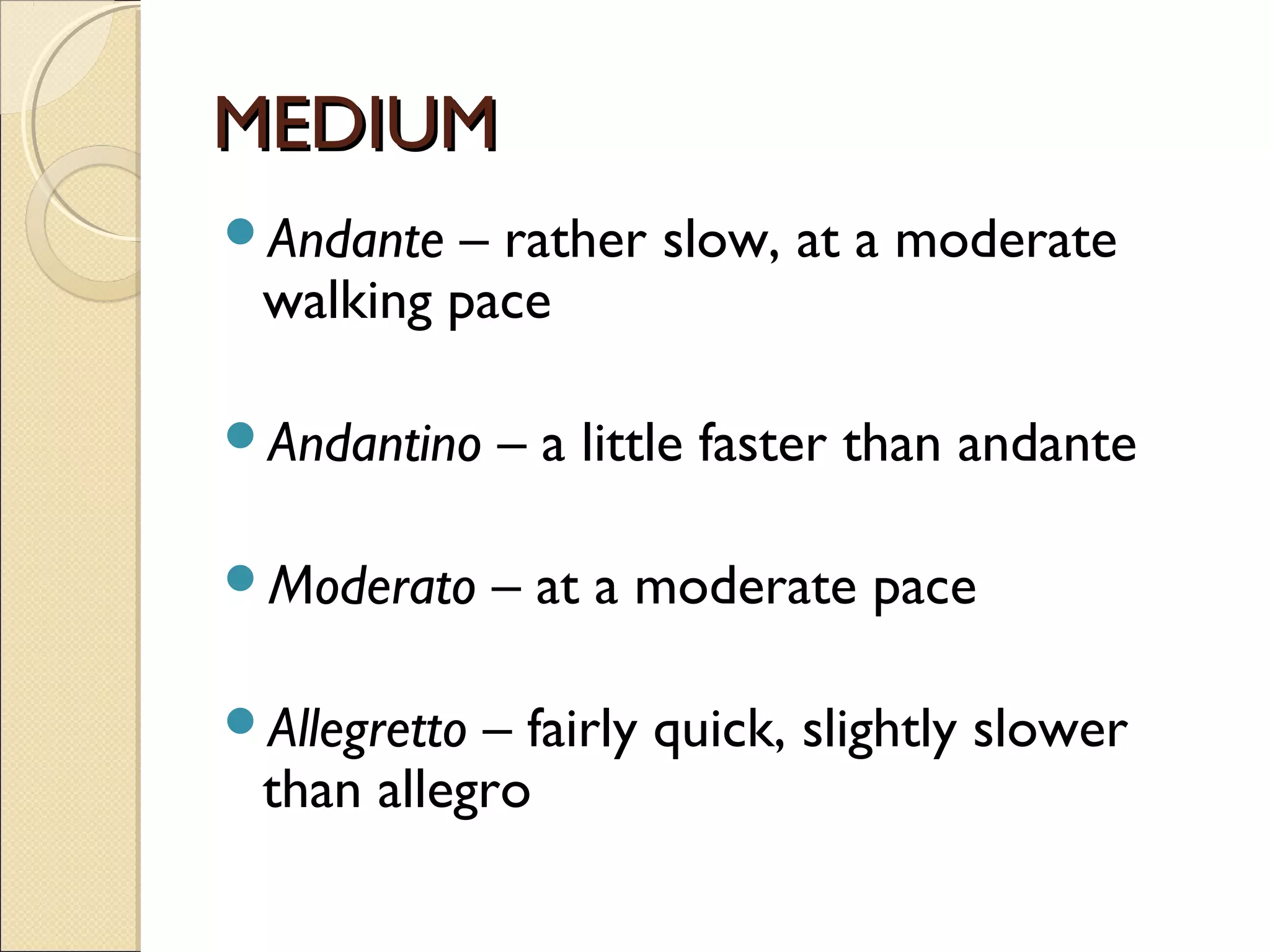
Andante – rather slow, at a moderate
walking pace
Andantino – a little faster than andante
Moderato – at a moderate pace
Allegretto – fairly quick, slightly slower
than allegro
FASTFAST
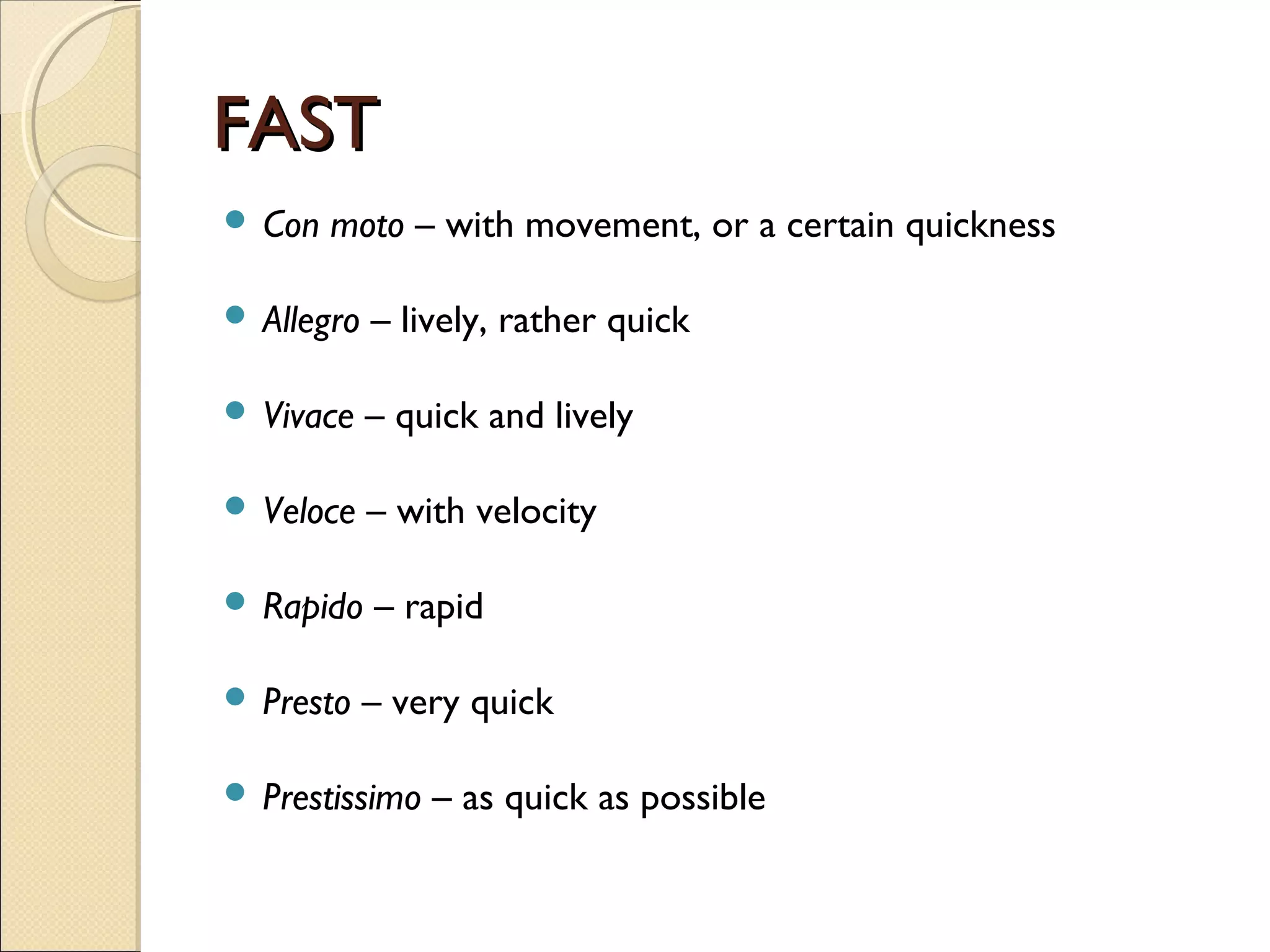
 Con moto – with movement, or a certain quickness
 Allegro – lively, rather quick
 Vivace – quick and lively
 Veloce – with velocity
 Rapido – rapid
 Presto – very quick
 Prestissimo – as quick as possible
DYNAMICSDYNAMICS
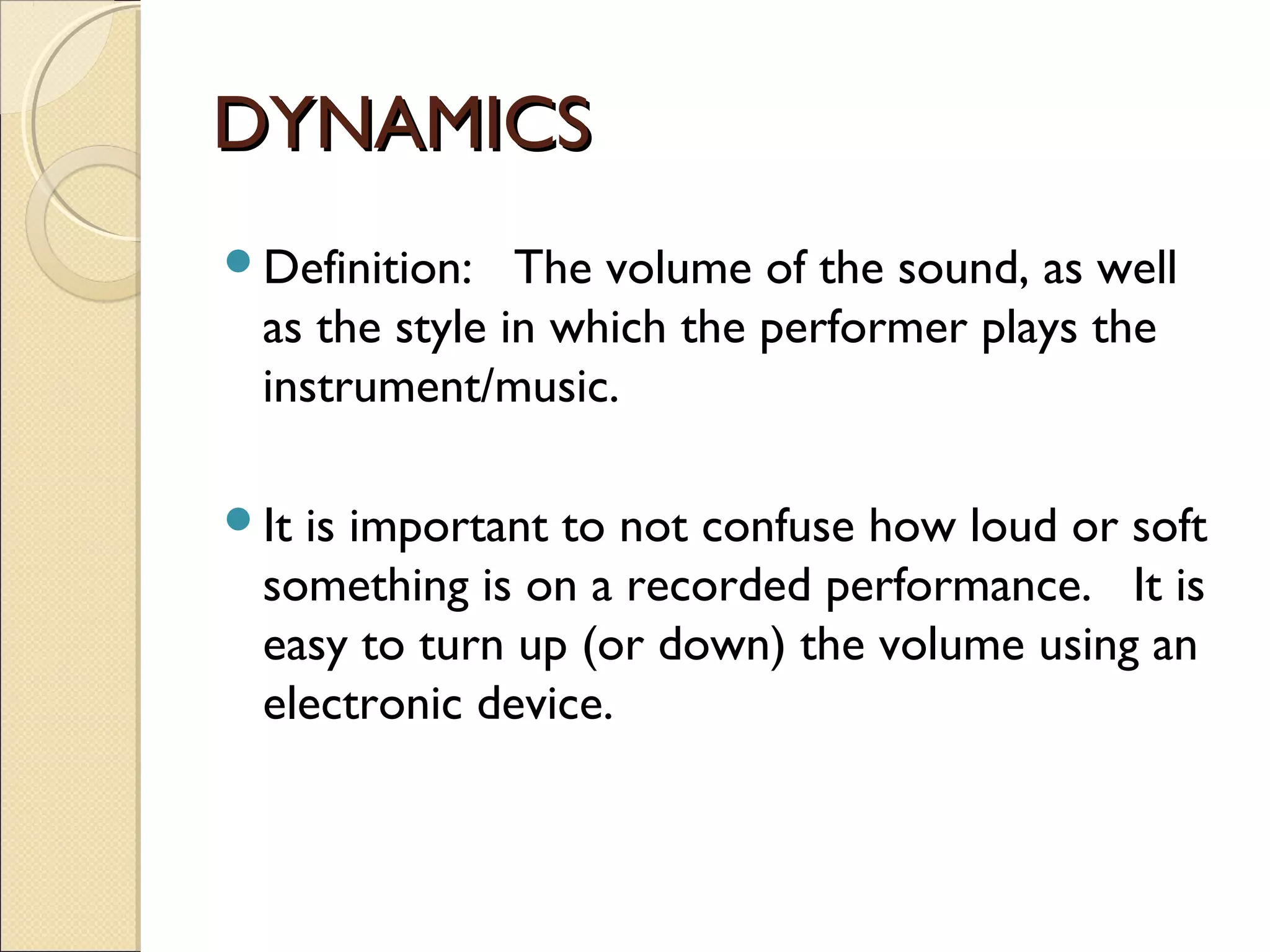
Definition: The volume of the sound, as well
as the style in which the performer plays the
instrument/music.
It is important to not confuse how loud or soft
something is on a recorded performance. It is
easy to turn up (or down) the volume using an
electronic device.
Italian TerminologyItalian Terminology
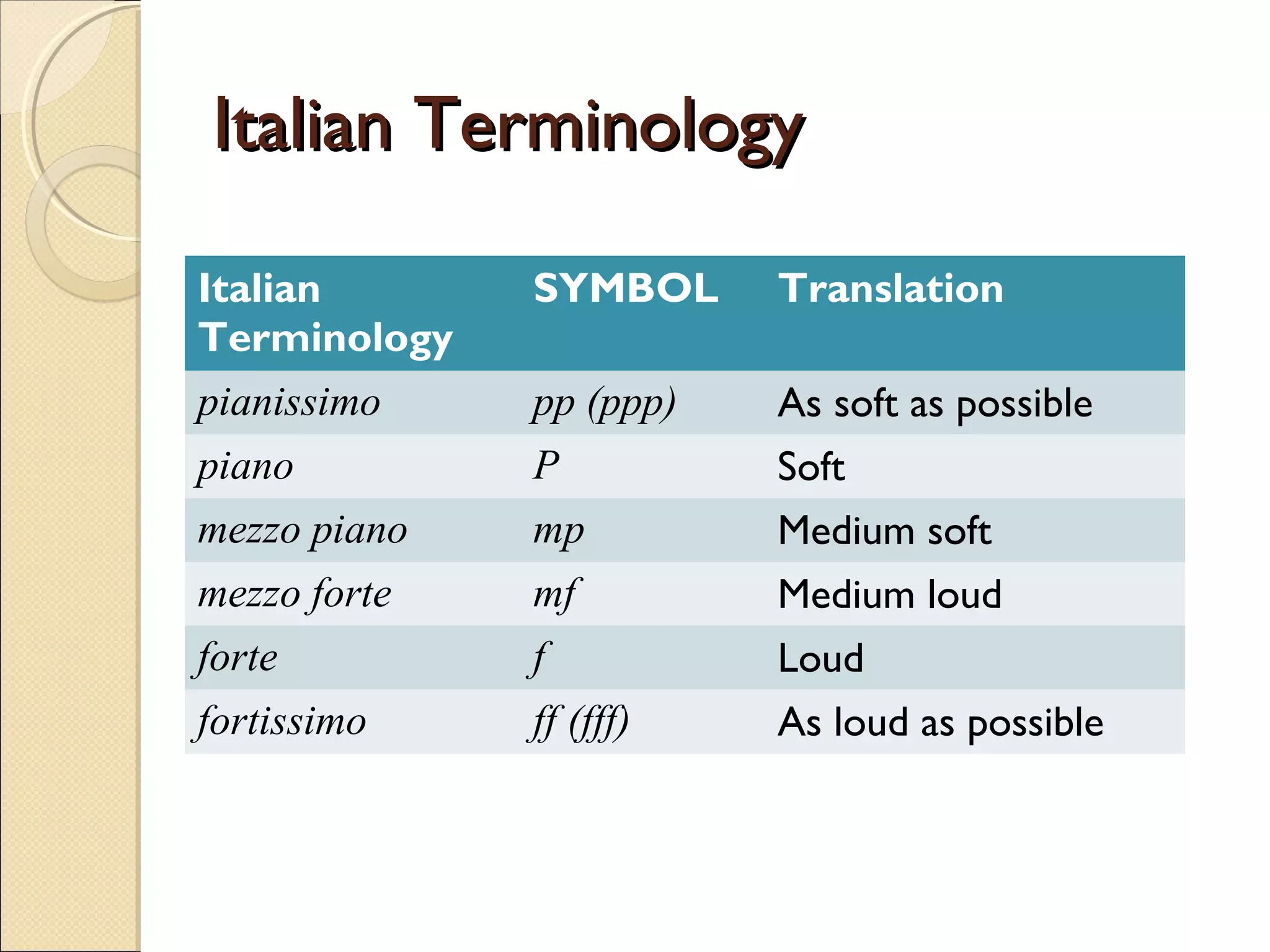
Italian
Terminology
SYMBOL Translation
pianissimo pp (ppp) As soft as possible
piano P Soft
mezzo piano mp Medium soft
mezzo forte mf Medium loud
forte f Loud
fortissimo ff (fff) As loud as possible
Variations in VolumeVariations in Volume
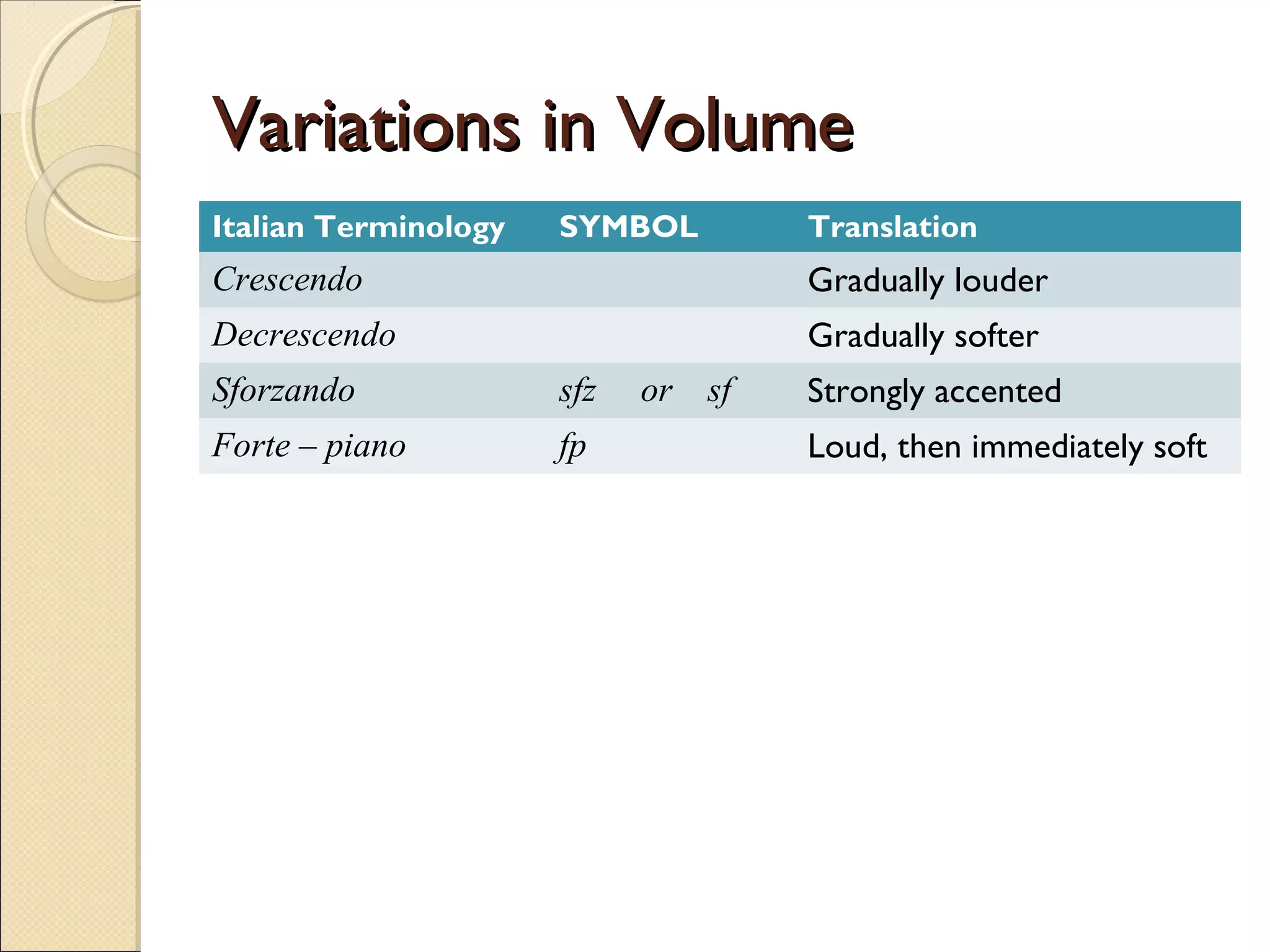
Italian Terminology SYMBOL Translation
Crescendo Gradually louder
Decrescendo Gradually softer
Sforzando sfz or sf Strongly accented
Forte – piano fp Loud, then immediately soft
TIMBRETIMBRE
Definition: The unique quality or
qualities inherent in sounds that allow us
to distinguish between them.
Timber (TAMBOUR – as in
“tambourine”) has also been referred to
as the tone colouring of an instrument.
The distinct tone quality of an instrument
can be represented by the colour that
matches the sound.
Let us consider the Flute.
What colour(s) would you think best
represents the sound quality of this
instrument?
There are major differences between the
families of instruments and how they
sound.
There are also differences that occur
within each family. For example Flute vs.
Bassoon (both Woodwind), however
very different tone qualities.
PITCHPITCH
Definition: The degree of highness or
lowness of a sound.
Treble ClefTreble Clef
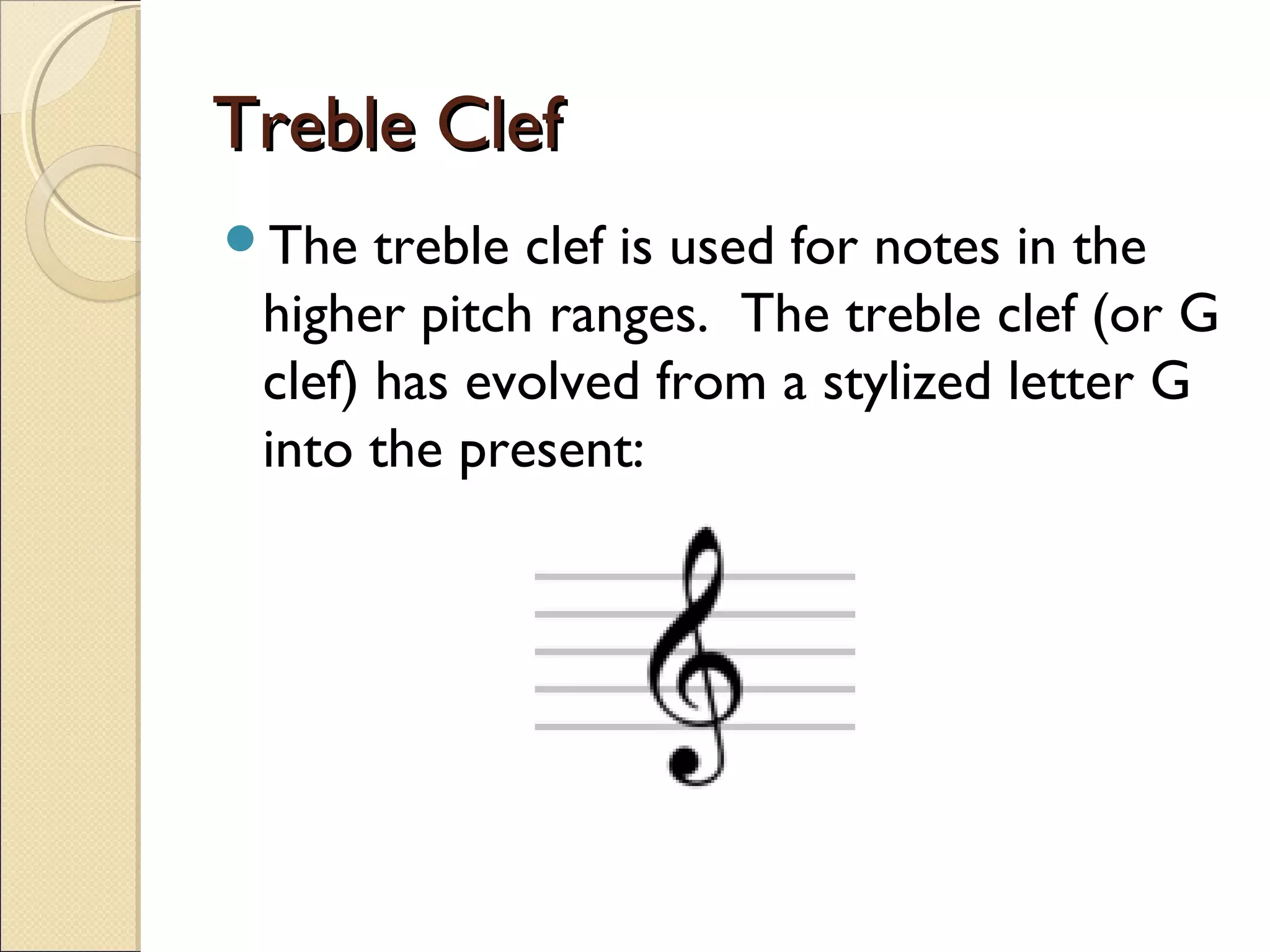
The treble clef is used for notes in the
higher pitch ranges. The treble clef (or G
clef) has evolved from a stylized letter G
into the present:
MELODYMELODY
Definition: A series of pitches that move
forward (the sing-able part) within a piece
of music.
HARMONYHARMONY
Definition: Combinations of pitches
sounding simultaneously.
Consider two performers presenting a
piece to an audience. If one instrument is
performing on whole notes while the
other is playing the main melody there
will be harmony.
Instruments that have strings (violin,
harp) or tuned percussion (piano,
xylophone) can play harmony on their
own.
However, instruments like Flute,
Clarinet, or Trumpet, need to have other
performers playing with them for the
harmony to occur.
FORMFORM
Definition: The structure of a piece of
music, the way a piece of music is
organized.
In Modern or 20th
Century music sections
or musical ideas have been categorized
using the terms “Chorus” (or Refrain)
and “Verse”.
There may even be a “Bridge” which is
sometimes a completely different idea
within the melody that often occurs near
the end of the song.
TEXTURETEXTURE
Definition: The fabric or layering of
sound created by melody, harmony and
tone colouring (timbre).
Each instrument is responsible for a
melodic and/or rhythmic line.
When each instrument combines
together with the ensemble (orchestra)
the texture is specific to what and how
they are performing.
Different TexturesDifferent Textures
Homophonic:
A soloist performing a melody.
Monophonic:
A soloist performing a melody with
accompaniment (for example Flute with
Piano).
Polyphonic:
Many musicians performing/combining
rhythmic and melodic patterns together.

Elements of music

  • 1.
    ELEMENTS OF MUSICELEMENTSOF MUSIC There are several key elements of music. When combined and used correctly they express emotion and provide us with “singable”, enjoyable pieces that can represent time, place and even become what we use to describe who we are and what we represent.
  • 2.
    RhythmRhythm Definition: The patternsof long and short sounds and silences in music. To create a rhythm combine any variety of notes and rests together (see your note and rest value chart). Rhythms can and are performed throughout any piece of music by any instrument, however, we can mostly recognize a rhythm when it is performed on a percussion instrument.
  • 3.
    BeatBeat Definition: A steadypulse contained in music. Music is organized with time signatures that indicate how many beats are found within one measure of music.
  • 4.
    TempoTempo Definition: The paceor speed at which a piece of music is performed. Tempo markings are traditionally given in Italian and the words that refer to tempo can be categorized in the following ways:
  • 5.
    SLOWSLOW Grave – extremelyslow and solemn Adagio – very slow Lento – slow Largo – slow and broad Larghetto – less slow than largo
  • 6.
    MEDIUMMEDIUM Andante – ratherslow, at a moderate walking pace Andantino – a little faster than andante Moderato – at a moderate pace Allegretto – fairly quick, slightly slower than allegro
  • 7.
    FASTFAST  Con moto– with movement, or a certain quickness  Allegro – lively, rather quick  Vivace – quick and lively  Veloce – with velocity  Rapido – rapid  Presto – very quick  Prestissimo – as quick as possible
  • 8.
    DYNAMICSDYNAMICS Definition: The volumeof the sound, as well as the style in which the performer plays the instrument/music. It is important to not confuse how loud or soft something is on a recorded performance. It is easy to turn up (or down) the volume using an electronic device.
  • 9.
    Italian TerminologyItalian Terminology Italian Terminology SYMBOLTranslation pianissimo pp (ppp) As soft as possible piano P Soft mezzo piano mp Medium soft mezzo forte mf Medium loud forte f Loud fortissimo ff (fff) As loud as possible
  • 10.
    Variations in VolumeVariationsin Volume Italian Terminology SYMBOL Translation Crescendo Gradually louder Decrescendo Gradually softer Sforzando sfz or sf Strongly accented Forte – piano fp Loud, then immediately soft
  • 11.
    TIMBRETIMBRE Definition: The uniquequality or qualities inherent in sounds that allow us to distinguish between them. Timber (TAMBOUR – as in “tambourine”) has also been referred to as the tone colouring of an instrument.
  • 12.
    The distinct tonequality of an instrument can be represented by the colour that matches the sound. Let us consider the Flute. What colour(s) would you think best represents the sound quality of this instrument?
  • 13.
    There are majordifferences between the families of instruments and how they sound. There are also differences that occur within each family. For example Flute vs. Bassoon (both Woodwind), however very different tone qualities.
  • 14.
    PITCHPITCH Definition: The degreeof highness or lowness of a sound.
  • 15.
    Treble ClefTreble Clef Thetreble clef is used for notes in the higher pitch ranges. The treble clef (or G clef) has evolved from a stylized letter G into the present:
  • 16.
    MELODYMELODY Definition: A seriesof pitches that move forward (the sing-able part) within a piece of music.
  • 17.
    HARMONYHARMONY Definition: Combinations ofpitches sounding simultaneously. Consider two performers presenting a piece to an audience. If one instrument is performing on whole notes while the other is playing the main melody there will be harmony.
  • 18.
    Instruments that havestrings (violin, harp) or tuned percussion (piano, xylophone) can play harmony on their own. However, instruments like Flute, Clarinet, or Trumpet, need to have other performers playing with them for the harmony to occur.
  • 19.
    FORMFORM Definition: The structureof a piece of music, the way a piece of music is organized.
  • 20.
    In Modern or20th Century music sections or musical ideas have been categorized using the terms “Chorus” (or Refrain) and “Verse”. There may even be a “Bridge” which is sometimes a completely different idea within the melody that often occurs near the end of the song.
  • 21.
    TEXTURETEXTURE Definition: The fabricor layering of sound created by melody, harmony and tone colouring (timbre).
  • 22.
    Each instrument isresponsible for a melodic and/or rhythmic line. When each instrument combines together with the ensemble (orchestra) the texture is specific to what and how they are performing.
  • 23.
    Different TexturesDifferent Textures Homophonic: Asoloist performing a melody. Monophonic: A soloist performing a melody with accompaniment (for example Flute with Piano). Polyphonic: Many musicians performing/combining rhythmic and melodic patterns together.