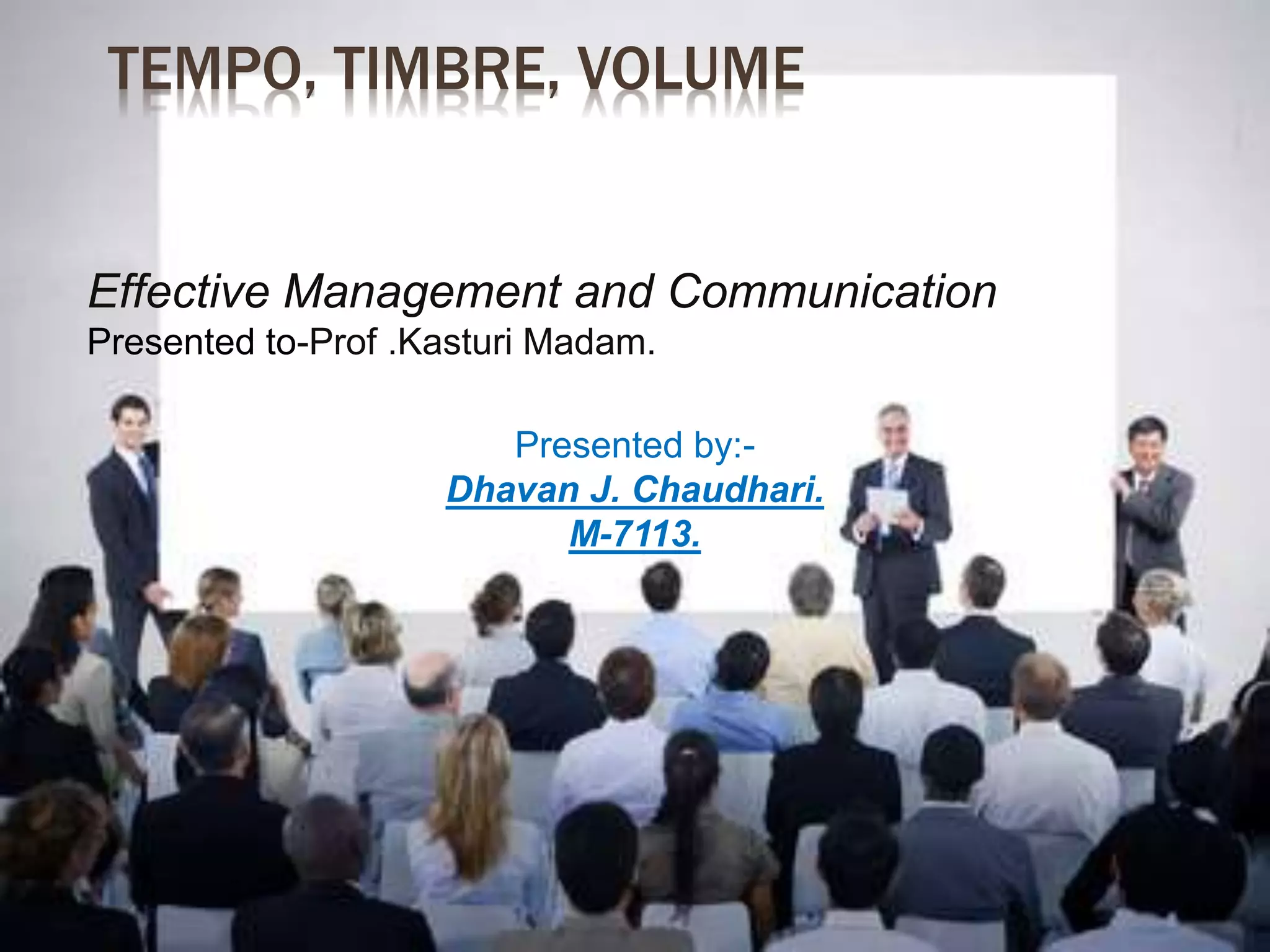
TEMPO, TIMBRE, VOLUME
Effective Management and Communication
Presented to-Prof .Kasturi Madam.
Presented by:-
Dhavan J. Chaudhari.
M-7113.
ORAL COMMUNICATION
● Oral Communication is the ability to talk with
others.
● Oral Communication to help to communicate
easy.
● Give and exchange information & ideas, such
as: ask questions, give directions, coordinate
work tasks, explain & persuade.
TYPES OF ORAL COMMUNICATION
● Tempo
● Timbre
● Volume
TEMPO
1.Tempo can be defined as the pace or speed
at which a section of music is played.
2.We can think of the tempo as the
speedometer of the music.
3.Typically, the speed of the music is
measured in beats per minute, or BPM.
TIMBRE
In music, timbre is the quality of a musical
note, sound, or tone that distinguishes
different types of sound production, such as
voices and musical instruments, string
instruments, wind instruments, and
percussion instruments. The physical
characteristics of sound that determine the
perception of timbre include spectrum and
envelope.
ATTRIBUTES OF TIMBRE
Harmonics-
The richness of a sound or note a
musical instrument produces is sometimes
described in terms of a sum of a number of
distinct frequencies.
Envelope
The timbre of a sound is also greatly affected
by the following aspects of its envelope: attack
time and characteristics, decay, sustain, release
(ADSR envelope) and transients.
TEMPO
1.Tempo can be defined as the pace or speed at
which a section of music is played.
2.We can think of the tempo as the speedometer of
the music.
3.Typically, the speed of the music is measured in
beats per minute, or BPM.
VOLUME
● Volume is a loudness.
● Volume means pitch.
● Pitch, in speech, the relative highness or lowness of a tone as perceived by
the ear, which depends on the number of vibrations per second produced
by the vocal cords.
● Pitch is the fundamental frequency of the note
● In music the pitch of a note means how high or low a note is.
The pitch of a note can be measured in a unit called hertz. A note that is
vibrating at 256 hz will be caused by sound waves that vibrate at 256
times a second.
● Not all musical instruments give notes of a particular pitch.
Many percussion instruments like drums, triangles and cymbals are
instruments used for rhythms.
THANK YOU….

Tempo, timbre, volume

  • 1.
    TEMPO, TIMBRE, VOLUME EffectiveManagement and Communication Presented to-Prof .Kasturi Madam. Presented by:- Dhavan J. Chaudhari. M-7113.
  • 2.
    ORAL COMMUNICATION ● OralCommunication is the ability to talk with others. ● Oral Communication to help to communicate easy. ● Give and exchange information & ideas, such as: ask questions, give directions, coordinate work tasks, explain & persuade.
  • 3.
    TYPES OF ORALCOMMUNICATION ● Tempo ● Timbre ● Volume
  • 4.
    TEMPO 1.Tempo can bedefined as the pace or speed at which a section of music is played. 2.We can think of the tempo as the speedometer of the music. 3.Typically, the speed of the music is measured in beats per minute, or BPM.
  • 5.
    TIMBRE In music, timbreis the quality of a musical note, sound, or tone that distinguishes different types of sound production, such as voices and musical instruments, string instruments, wind instruments, and percussion instruments. The physical characteristics of sound that determine the perception of timbre include spectrum and envelope.
  • 6.
    ATTRIBUTES OF TIMBRE Harmonics- Therichness of a sound or note a musical instrument produces is sometimes described in terms of a sum of a number of distinct frequencies. Envelope The timbre of a sound is also greatly affected by the following aspects of its envelope: attack time and characteristics, decay, sustain, release (ADSR envelope) and transients.
  • 7.
    TEMPO 1.Tempo can bedefined as the pace or speed at which a section of music is played. 2.We can think of the tempo as the speedometer of the music. 3.Typically, the speed of the music is measured in beats per minute, or BPM.
  • 8.
    VOLUME ● Volume isa loudness. ● Volume means pitch. ● Pitch, in speech, the relative highness or lowness of a tone as perceived by the ear, which depends on the number of vibrations per second produced by the vocal cords. ● Pitch is the fundamental frequency of the note ● In music the pitch of a note means how high or low a note is. The pitch of a note can be measured in a unit called hertz. A note that is vibrating at 256 hz will be caused by sound waves that vibrate at 256 times a second. ● Not all musical instruments give notes of a particular pitch. Many percussion instruments like drums, triangles and cymbals are instruments used for rhythms.
  • 9.