An Introduction to Music
www.muziclub.com
2
Why live Music
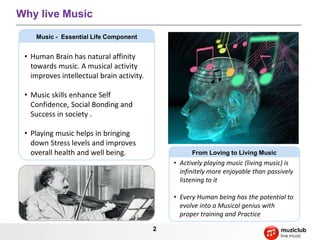
• Human Brain has natural affinity
towards music. A musical activity
improves intellectual brain activity.
• Music skills enhance Self
Confidence, Social Bonding and
Success in society .
• Playing music helps in bringing
down Stress levels and improves
overall health and well being.
Music - Essential Life Component
• Actively playing music (living music) is
infinitely more enjoyable than passively
listening to it
• Every Human being has the potential to
evolve into a Musical genius with
proper training and Practice
From Loving to Living Music
3
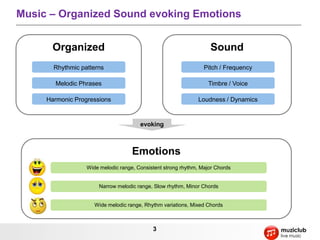
Music – Organized Sound evoking Emotions
Organized Sound
evoking
Emotions
Rhythmic patterns
Melodic Phrases
Harmonic Progressions
Pitch / Frequency
Timbre / Voice
Loudness / Dynamics
Wide melodic range, Consistent strong rhythm, Major Chords
Narrow melodic range, Slow rhythm, Minor Chords
Wide melodic range, Rhythm variations, Mixed Chords
4
Musical Note
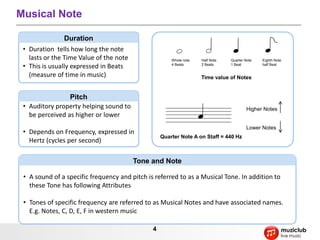
• Duration tells how long the note
lasts or the Time Value of the note
• This is usually expressed in Beats
(measure of time in music)
Duration
• Auditory property helping sound to
be perceived as higher or lower
• Depends on Frequency, expressed in
Hertz (cycles per second)
Pitch
• A sound of a specific frequency and pitch is referred to as a Musical Tone. In addition to
these Tone has following Attributes
Intensity: A measure of loudness
• Tones of specific frequency are referred to as Musical Notes and have associated names.
E.g. Notes, C, D, E, F in western music
Tone and Note
Whole note
4 Beats
Half Note
2 Beats
Quarter Note
1 Beat
Eighth Note
half Beat
Time value of Notes
Higher Notes
Lower Notes
Quarter Note A on Staff = 440 Hz
5
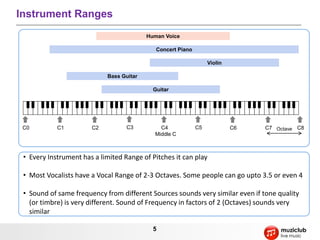
Instrument Ranges
C4
Middle C
C5C3C2C1C0 C6 C7 C8
Human Voice
Guitar
Bass Guitar
Violin
Concert Piano
• Every Instrument has a limited Range of Pitches it can play
• Most Vocalists have a Vocal Range of 2-3 Octaves. Some people can go upto 3.5 or even 4
• Sound of same frequency from different Sources sounds very similar even if tone quality
(or timbre) is very different. Sound of Frequency in factors of 2 (Octaves) sounds very
similar
Octave
6
Musical Phrases
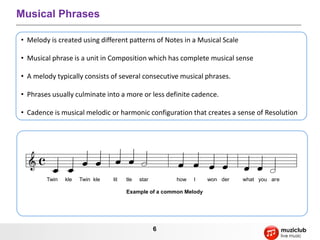
Example of a common Melody
Twin kle Twin kle lit tle star how I won der what you are
• Melody is created using different patterns of Notes in a Musical Scale
• Musical phrase is a unit in Composition which has complete musical sense
• A melody typically consists of several consecutive musical phrases.
• Phrases usually culminate into a more or less definite cadence.
• Cadence is musical melodic or harmonic configuration that creates a sense of Resolution
7
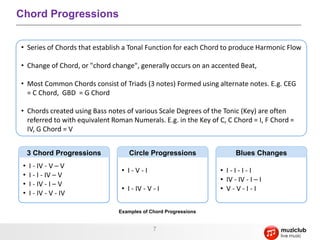
Chord Progressions
• I - IV - V – V
• I - I - IV – V
• I - IV - I – V
• I - IV - V - IV
3 Chord Progressions
• I - V - I
• I - IV - V - I
Circle Progressions
• I - I - I - I
• IV - IV - I – I
• V - V - I - I
Blues Changes
Examples of Chord Progressions
• Series of Chords that establish a Tonal Function for each Chord to produce Harmonic Flow
• Change of Chord, or "chord change", generally occurs on an accented Beat,
• Most Common Chords consist of Triads (3 notes) Formed using alternate notes. E.g. CEG
= C Chord, GBD = G Chord
• Chords created using Bass notes of various Scale Degrees of the Tonic (Key) are often
referred to with equivalent Roman Numerals. E.g. in the Key of C, C Chord = I, F Chord =
IV, G Chord = V
8
Rhythm
• Organization of music into
regularly recurring measures
of stressed and unstressed
"beats“
• Indicated in Western music
notation by a time signature
and bar-lines.
Meter
• Speed or Pace of a given piece
• Can affect the mood and
difficulty of a piece.
• Usually expressed in Beats per
minute
Tempo
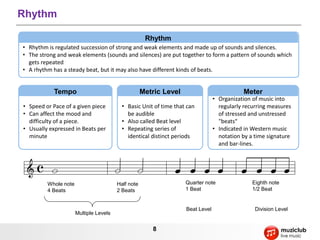
• Rhythm is regulated succession of strong and weak elements and made up of sounds and silences.
• The strong and weak elements (sounds and silences) are put together to form a pattern of sounds which
gets repeated
• A rhythm has a steady beat, but it may also have different kinds of beats.
Rhythm
• Basic Unit of time that can
be audible
• Also called Beat level
• Repeating series of
identical distinct periods
Metric Level
Whole note
4 Beats
Half note
2 Beats
Quarter note
1 Beat
Eighth note
1/2 Beat
Beat Level Division Level
Multiple Levels
9
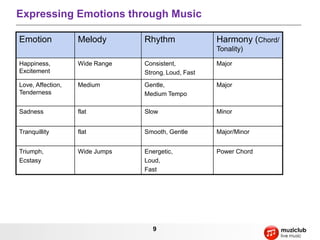
Expressing Emotions through Music
Emotion Melody Rhythm Harmony (Chord/
Tonality)
Happiness,
Excitement
Wide Range Consistent,
Strong, Loud, Fast
Major
Love, Affection,
Tenderness
Medium Gentle,
Medium Tempo
Major
Sadness flat Slow Minor
Tranquillity flat Smooth, Gentle Major/Minor
Triumph,
Ecstasy
Wide Jumps Energetic,
Loud,
Fast
Power Chord

Music introduction

  • 1.
    An Introduction toMusic www.muziclub.com
  • 2.
    2 Why live Music •Human Brain has natural affinity towards music. A musical activity improves intellectual brain activity. • Music skills enhance Self Confidence, Social Bonding and Success in society . • Playing music helps in bringing down Stress levels and improves overall health and well being. Music - Essential Life Component • Actively playing music (living music) is infinitely more enjoyable than passively listening to it • Every Human being has the potential to evolve into a Musical genius with proper training and Practice From Loving to Living Music
  • 3.
    3 Music – OrganizedSound evoking Emotions Organized Sound evoking Emotions Rhythmic patterns Melodic Phrases Harmonic Progressions Pitch / Frequency Timbre / Voice Loudness / Dynamics Wide melodic range, Consistent strong rhythm, Major Chords Narrow melodic range, Slow rhythm, Minor Chords Wide melodic range, Rhythm variations, Mixed Chords
  • 4.
    4 Musical Note • Durationtells how long the note lasts or the Time Value of the note • This is usually expressed in Beats (measure of time in music) Duration • Auditory property helping sound to be perceived as higher or lower • Depends on Frequency, expressed in Hertz (cycles per second) Pitch • A sound of a specific frequency and pitch is referred to as a Musical Tone. In addition to these Tone has following Attributes Intensity: A measure of loudness • Tones of specific frequency are referred to as Musical Notes and have associated names. E.g. Notes, C, D, E, F in western music Tone and Note Whole note 4 Beats Half Note 2 Beats Quarter Note 1 Beat Eighth Note half Beat Time value of Notes Higher Notes Lower Notes Quarter Note A on Staff = 440 Hz
  • 5.
    5 Instrument Ranges C4 Middle C C5C3C2C1C0C6 C7 C8 Human Voice Guitar Bass Guitar Violin Concert Piano • Every Instrument has a limited Range of Pitches it can play • Most Vocalists have a Vocal Range of 2-3 Octaves. Some people can go upto 3.5 or even 4 • Sound of same frequency from different Sources sounds very similar even if tone quality (or timbre) is very different. Sound of Frequency in factors of 2 (Octaves) sounds very similar Octave
  • 6.
    6 Musical Phrases Example ofa common Melody Twin kle Twin kle lit tle star how I won der what you are • Melody is created using different patterns of Notes in a Musical Scale • Musical phrase is a unit in Composition which has complete musical sense • A melody typically consists of several consecutive musical phrases. • Phrases usually culminate into a more or less definite cadence. • Cadence is musical melodic or harmonic configuration that creates a sense of Resolution
  • 7.
    7 Chord Progressions • I- IV - V – V • I - I - IV – V • I - IV - I – V • I - IV - V - IV 3 Chord Progressions • I - V - I • I - IV - V - I Circle Progressions • I - I - I - I • IV - IV - I – I • V - V - I - I Blues Changes Examples of Chord Progressions • Series of Chords that establish a Tonal Function for each Chord to produce Harmonic Flow • Change of Chord, or "chord change", generally occurs on an accented Beat, • Most Common Chords consist of Triads (3 notes) Formed using alternate notes. E.g. CEG = C Chord, GBD = G Chord • Chords created using Bass notes of various Scale Degrees of the Tonic (Key) are often referred to with equivalent Roman Numerals. E.g. in the Key of C, C Chord = I, F Chord = IV, G Chord = V
  • 8.
    8 Rhythm • Organization ofmusic into regularly recurring measures of stressed and unstressed "beats“ • Indicated in Western music notation by a time signature and bar-lines. Meter • Speed or Pace of a given piece • Can affect the mood and difficulty of a piece. • Usually expressed in Beats per minute Tempo • Rhythm is regulated succession of strong and weak elements and made up of sounds and silences. • The strong and weak elements (sounds and silences) are put together to form a pattern of sounds which gets repeated • A rhythm has a steady beat, but it may also have different kinds of beats. Rhythm • Basic Unit of time that can be audible • Also called Beat level • Repeating series of identical distinct periods Metric Level Whole note 4 Beats Half note 2 Beats Quarter note 1 Beat Eighth note 1/2 Beat Beat Level Division Level Multiple Levels
  • 9.
    9 Expressing Emotions throughMusic Emotion Melody Rhythm Harmony (Chord/ Tonality) Happiness, Excitement Wide Range Consistent, Strong, Loud, Fast Major Love, Affection, Tenderness Medium Gentle, Medium Tempo Major Sadness flat Slow Minor Tranquillity flat Smooth, Gentle Major/Minor Triumph, Ecstasy Wide Jumps Energetic, Loud, Fast Power Chord