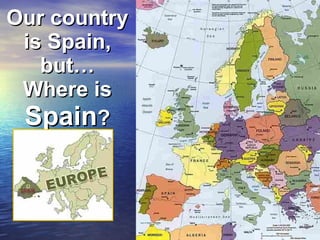
Our country
 is Spain,
   but…
 Where is
 Spain?
Administrative division:
 Communities


Spain is divided into
 17 Communities:
They have their own
 self-government
SPANISH
GALICIAN


CATALAN
BASQUE
BARCELONA   VALENCIA
MADRID
These are our flags


Spain       Galicia
STEREOTYPES ¿?


Bullfight   Flamenco
Our region is Galicia, but…
    Where is Galicia ?
Our
village
is Mos,
 but…
 Where
   is
Mos?
And this is our
   school!
Come in!
Follow me and
I’ll show you
my school!
This is the hall


                   The canteen
The library         The assembly
                    The assembly
                         hall
                    hll


And upstairs
there are classes
and labs.
The Computers The Technology
room
              room


The Music      The Drawing
room           room
Labs of geology, chemistry
and sciences


                   The
                   gym
Playground
Swimming pool

                           sca r!!!
                    ne   O
          W el l do
It is called Oscar Pereiro who was
the winner of Tour of France 2006.
Oscar Pereiro was born and lives in Mos.
Mos is near a big city,
Vigo, on the coast, a
beautiful coast…
If you go up one of the
hills of Mos, you can
see the sea.
GALICIA
The educational
   system in
    GALICIA

   (SPAIN)
EDUCATIVE COMPETENCES
•Central government:
  Geneal organisation of the system, minimum
requirements for schools, international cooperation,
general planning…
•Autonomous communities:
  Staff management, developement of educational
planning…
•  Local administration:
  Maintenance of facilities, planning of extra-curricular
activities…
•Schools:
 They are autonomous as regards their organization
and management of their teaching and economic affairs
PUBLIC, PRIVATE AND
    PARTIALLY SUBSIDIZED
          SCHOOLS
 -PUBLIC: free of charge


 -PRIVATE: not free of charge


  -PARTIALLY SUBSIDIZED: usually free
of charge regarding compulsory education
L.O.E.
    (Organic law of education)
              2/2006
•Education is the right and duty of all children
•Diagnostic assesments
•Curricular diversification programmes
•Contact with a foreign language and ICT
encouraged at Pre-primary second stage
•Programmes        for   initial   vocational
qualifications for young people over 16 and
under 21
Structure of our educational system:
•Pre-primary (not compulsory)                       two stages:
                     -children aged 0-3       - children aged 3-6 (free of charge)


•Primary education (compulsory): six grades,
                 - children aged 6 to 12


• Lower secondary education (compulsory):
                         -children aged 12 to 16...Secondary Education Certificate or Enrolment Certificate


•Post-compulsory education, two different types:
-General upper secondary education (Bachillerato): children aged 16 to 18 . 3 branches: Arts, Science and Technology,
Humanities and Social Studies.......High School Diploma
-Vocational training: children aged 16 to 18

•Higher education:
            - University (there is a university entrance examination -PAU-)
           - Non university education (Higher artistic education, Advanced specific vocational training, Higher music
         academies, Higher schools)
School organization
-Administration: principal, assistant principal, HOS,
secretary.

-Course tutor
-Teaching staff
-Guidance department
-School board: students, parents, teachers, service staff and a
representative from the town council.

-Parents' associations.
Content areas that make up
     the curriculum
•Primary education:
   -Natural, Social and Cultural Environment, -Artistic education, -Physical education,
-Spanish language and Literature, -Galician language, -Foreign language, -Mathematics.
-Religion is an optional subject for pupils.


• Lower secondary education:
  -Spanish language and literature, -Galician language and literature, -Foreign language,
-Mathematics, -Physical education, -Natural Science, -Plastic and Visual education,
-Social studies, -Geography and History, -Music, -Technology. -Religion is an optional
subject for pupils.

  In lower secondary education assesment is continuous and separate for each subject.
At the end of each school year, the assesment team decides whether each pupil should
proceed to the following year or not. In September pupils may take an special
examination in subjects they have not passed. Those who still have more than two
subjects to complete have to repeat the year. Each year can only be repeated once.
School holidays
•Christmas
 (2 weeks, between 23 December and 8 January)


•Carnival
 (3 days, 15,16 and 17 February)


•Easter
 (1 week, between 3 and 12 April)


•Summer
 (2 months and a half, between late June and mid-
September for students)


•Public holidays
 (around 8 days: 12 October, 2 November, 7 and 8
December, 19 March 17 May, )
School time in Galicia.
  (Dates vary depending on the different Autonomous
                    Communities)

                                Begining 2009    End 2010
                                 10 September     23 June
                  Primary
•Students         Secondary       17 September   23 June


                    Primary

•Teachers           and            1 September    30 June

                    Secondary
SCHOOLS OPEN FIVE DAYS A
     WEEK ON AN AVERAGE OF:
 -25 LESSONS A WEEK AT PRIMARY
LEVEL.
 -32      LESSONS         A     WEEK         AT
SECONDARY LEVEL.
 Lessons are from 8.30 to 14.10 and from 16.15 to
17.55 ( only on Mondays)
Two co-official languages
             •Galician
             •Spanish
Both are compulsory languages of instruction

Spain, presentation about IES de Mos, Galicia, and education system in Galicia, Spain.

  • 1.
    Our country isSpain, but… Where is Spain?
  • 2.
    Administrative division: Communities Spainis divided into 17 Communities: They have their own self-government
  • 3.
  • 4.
    BARCELONA VALENCIA
  • 5.
  • 7.
    These are ourflags Spain Galicia
  • 8.
  • 11.
    Our region isGalicia, but… Where is Galicia ?
  • 12.
  • 13.
    And this isour school!
  • 15.
    Come in! Follow meand I’ll show you my school! This is the hall The canteen
  • 16.
    The library The assembly The assembly hall hll And upstairs there are classes and labs.
  • 17.
    The Computers TheTechnology room room The Music The Drawing room room
  • 18.
    Labs of geology,chemistry and sciences The gym
  • 19.
  • 20.
    Swimming pool sca r!!! ne O W el l do It is called Oscar Pereiro who was the winner of Tour of France 2006. Oscar Pereiro was born and lives in Mos.
  • 21.
    Mos is neara big city, Vigo, on the coast, a beautiful coast… If you go up one of the hills of Mos, you can see the sea.
  • 25.
  • 26.
    The educational system in GALICIA (SPAIN)
  • 27.
    EDUCATIVE COMPETENCES •Central government: Geneal organisation of the system, minimum requirements for schools, international cooperation, general planning… •Autonomous communities: Staff management, developement of educational planning… • Local administration: Maintenance of facilities, planning of extra-curricular activities… •Schools: They are autonomous as regards their organization and management of their teaching and economic affairs
  • 28.
    PUBLIC, PRIVATE AND PARTIALLY SUBSIDIZED SCHOOLS -PUBLIC: free of charge -PRIVATE: not free of charge -PARTIALLY SUBSIDIZED: usually free of charge regarding compulsory education
  • 29.
    L.O.E. (Organic law of education) 2/2006 •Education is the right and duty of all children •Diagnostic assesments •Curricular diversification programmes •Contact with a foreign language and ICT encouraged at Pre-primary second stage •Programmes for initial vocational qualifications for young people over 16 and under 21
  • 30.
    Structure of oureducational system: •Pre-primary (not compulsory) two stages: -children aged 0-3 - children aged 3-6 (free of charge) •Primary education (compulsory): six grades, - children aged 6 to 12 • Lower secondary education (compulsory): -children aged 12 to 16...Secondary Education Certificate or Enrolment Certificate •Post-compulsory education, two different types: -General upper secondary education (Bachillerato): children aged 16 to 18 . 3 branches: Arts, Science and Technology, Humanities and Social Studies.......High School Diploma -Vocational training: children aged 16 to 18 •Higher education: - University (there is a university entrance examination -PAU-) - Non university education (Higher artistic education, Advanced specific vocational training, Higher music academies, Higher schools)
  • 31.
    School organization -Administration: principal,assistant principal, HOS, secretary. -Course tutor -Teaching staff -Guidance department -School board: students, parents, teachers, service staff and a representative from the town council. -Parents' associations.
  • 32.
    Content areas thatmake up the curriculum •Primary education: -Natural, Social and Cultural Environment, -Artistic education, -Physical education, -Spanish language and Literature, -Galician language, -Foreign language, -Mathematics. -Religion is an optional subject for pupils. • Lower secondary education: -Spanish language and literature, -Galician language and literature, -Foreign language, -Mathematics, -Physical education, -Natural Science, -Plastic and Visual education, -Social studies, -Geography and History, -Music, -Technology. -Religion is an optional subject for pupils. In lower secondary education assesment is continuous and separate for each subject. At the end of each school year, the assesment team decides whether each pupil should proceed to the following year or not. In September pupils may take an special examination in subjects they have not passed. Those who still have more than two subjects to complete have to repeat the year. Each year can only be repeated once.
  • 33.
    School holidays •Christmas (2weeks, between 23 December and 8 January) •Carnival (3 days, 15,16 and 17 February) •Easter (1 week, between 3 and 12 April) •Summer (2 months and a half, between late June and mid- September for students) •Public holidays (around 8 days: 12 October, 2 November, 7 and 8 December, 19 March 17 May, )
  • 34.
    School time inGalicia. (Dates vary depending on the different Autonomous Communities) Begining 2009 End 2010 10 September 23 June Primary •Students Secondary 17 September 23 June Primary •Teachers and 1 September 30 June Secondary
  • 35.
    SCHOOLS OPEN FIVEDAYS A WEEK ON AN AVERAGE OF: -25 LESSONS A WEEK AT PRIMARY LEVEL. -32 LESSONS A WEEK AT SECONDARY LEVEL. Lessons are from 8.30 to 14.10 and from 16.15 to 17.55 ( only on Mondays)
  • 36.
    Two co-official languages •Galician •Spanish Both are compulsory languages of instruction