EUROPEANS: IDENTICALS AIMS, DIFFERENT WAYS, IDENTICAL  HEARTS, DIFFERENT FEELINGS. EUID Spanish Educational System
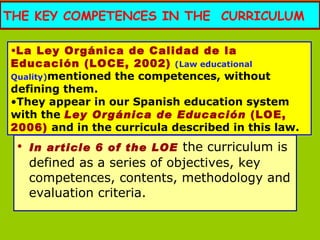
THE KEY COMPETENCES IN THE  CURRICULUM In article 6 of the LOE   the curriculum is defined as a series of objectives, key competences, contents, methodology and evaluation criteria. La Ley Orgánica de Calidad de la Educación (LOCE, 2002)   (Law educational Quality) mentioned the competences, without defining them.  They appear in our Spanish education system with the  Ley Orgánica de Educación  (LOE, 2006)  and in the curricula described in this law.
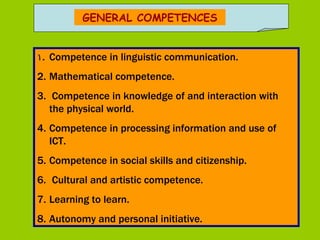
GENERAL  COMPETENCES Competence in linguistic communication. Mathematical competence. Competence in knowledge of and interaction with the physical world.   Competence in processing information and use of ICT.  Competence  in  social skills and citizenship. Cultural and artistic competence.   Learning to learn. Autonomy and personal initiative .
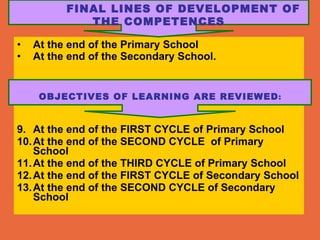
At the end of the Primary School  At the end of the Secondary School.   At the end of the FIRST CYCLE of Primary School  At the end of the SECOND CYCLE  of Primary School  At the end of the THIRD CYCLE of Primary School  At the end of the FIRST CYCLE of Secondary School  At the end of the SECOND CYCLE of Secondary School FINAL LINES OF DEVELOPMENT OF THE COMPETENCES OBJECTIVES OF LEARNING ARE REVIEWED :
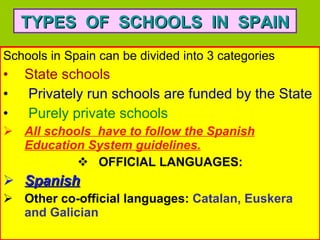
Schools in Spain can be divided into 3 categories State schools   Privately run schools are funded by the State  Purely private schools  All schools  have to follow the Spanish Education System   guidelines. OFFICIAL LANGUAGES: Spanish   Other co-official languages:  Catalan, Euskera and Galician TYPES  OF  SCHOOLS  IN  SPAIN
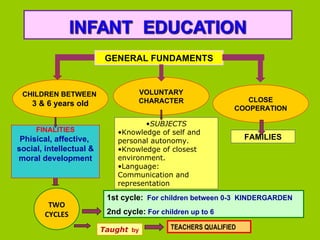
GENERAL FUNDAMENTS VOLUNTARY CHARACTER CHILDREN BETWEEN  3 & 6 years old SUBJECTS Knowledge of self and personal autonomy. Knowledge of closest environment.  Language: Communication and representation FAMILIES CLOSE COOPERATION TWO CYCLES 1st cycle:   For children between 0-3   KINDERGARDEN 2nd cycle:   For children up to 6 Taught   by TEACHERS QUALIFIED FINALITIES Phisical, affective,  social, intellectual & moral development
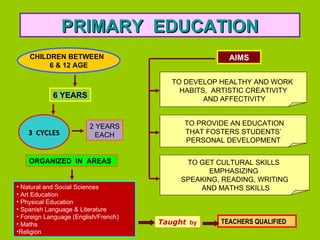
PRIMARY  EDUCATION 6 YEARS CHILDREN BETWEEN  6 & 12 AGE AIMS TO PROVIDE AN EDUCATION THAT FOSTERS STUDENTS’  PERSONAL DEVELOPMENT TO GET CULTURAL SKILLS  EMPHASIZING  SPEAKING, READING, WRITING AND MATHS SKILLS TO DEVELOP HEALTHY AND WORK  HABITS,  ARTISTIC CREATIVITY AND AFFECTIVITY 3  CYCLES 2 YEARS EACH ORGANIZED  IN  AREAS Natural and Social Sciences Art Education Physical Education Spanish Language & Literature Foreign Language (English/French)  Maths Religion TEACHERS QUALIFIED Taught   by
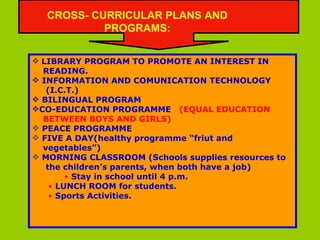
LIBRARY PROGRAM TO PROMOTE AN INTEREST IN  READING. INFORMATION AND COMUNICATION TECHNOLOGY (I.C.T.) BILINGUAL PROGRAM CO-EDUCATION PROGRAMME  (EQUAL EDUCATION  BETWEEN BOYS AND GIRLS) PEACE PROGRAMME FIVE A DAY(healthy programme “friut and  vegetables”) MORNING CLASSROOM (Schools supplies resources to the children’s parents, when both have a job)   Stay in school until 4 p.m. LUNCH ROOM for students. Sports Activities. CROSS- CURRICULAR PLANS AND PROGRAMS:
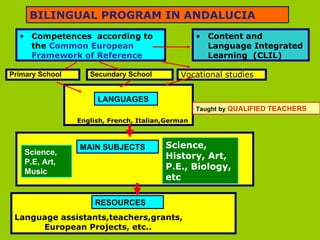
Competences  according to the  Common European Framework of Reference Vocational studies Secundary School Primary School Content and Language Integrated Learning  (CLIL) BILINGUAL PROGRAM IN ANDALUCIA Science, P.E, Art, Music Science, History, Art, P.E., Biology, etc Language assistants,teachers,grants,  European Projects, etc.. MAIN SUBJECTS LANGUAGES English, French, Italian,German RESOURCES Taught by  QUALIFIED TEACHERS
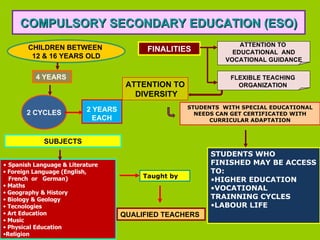
COMPULSORY SECONDARY EDUCATION (ESO) 4 YEARS   CHILDREN BETWEEN  12 & 16 YEARS OLD FINALITIES ATTENTION TO  EDUCATIONAL  AND VOCATIONAL GUIDANCE 2 CYCLES 2 YEARS EACH SUBJECTS Spanish Language & Literature  Foreign Language (English,  French  or  German) Maths Geography & History Biology & Geology  Tecnologies  Art Education  Music Physical Education Religion QUALIFIED TEACHERS Taught by FLEXIBLE TEACHING  ORGANIZATION   ATTENTION TO DIVERSITY STUDENTS  WITH SPECIAL EDUCATIONAL NEEDS CAN GET CERTIFICATED WITH CURRICULAR ADAPTATION STUDENTS WHO  FINISHED MAY BE ACCESS TO: HIGHER EDUCATION VOCATIONAL TRAINNING CYCLES LABOUR LIFE
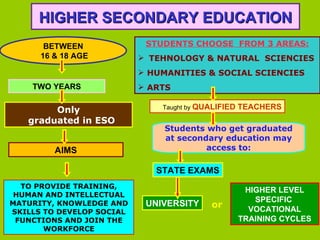
HIGHER SECONDARY EDUCATION AIMS TO PROVIDE TRAINING, HUMAN AND INTELLECTUAL MATURITY, KNOWLEDGE AND SKILLS TO DEVELOP SOCIAL FUNCTIONS AND JOIN THE WORKFORCE Only graduated in ESO BETWEEN 16 & 18 AGE TWO YEARS UNIVERSITY HIGHER LEVEL SPECIFIC  VOCATIONAL TRAINING CYCLES Taught by   QUALIFIED TEACHERS Students who get graduated at secondary education may access to: STUDENTS CHOOSE  FROM 3 AREAS: TEHNOLOGY & NATURAL  SCIENCIES HUMANITIES & SOCIAL SCIENCIES ARTS or STATE EXAMS
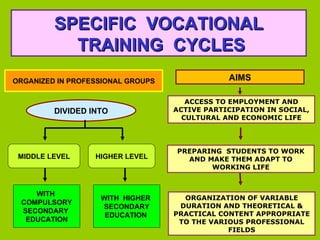
SPECIFIC  VOCATIONAL  TRAINING  CYCLES ACCESS TO EMPLOYMENT AND ACTIVE PARTICIPATION IN SOCIAL, CULTURAL AND ECONOMIC LIFE PREPARING  STUDENTS TO WORK AND MAKE THEM ADAPT TO WORKING LIFE ORGANIZATION OF VARIABLE DURATION AND THEORETICAL & PRACTICAL CONTENT APPROPRIATE TO THE VARIOUS PROFESSIONAL FIELDS DIVIDED INTO AIMS MIDDLE LEVEL HIGHER LEVEL ORGANIZED IN  PROFESSIONAL GROUPS WITH  COMPULSORY SECONDARY  EDUCATION WITH  HIGHER   SECONDARY EDUCATION
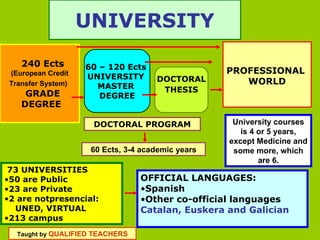
DOCTORAL PROGRAM PROFESSIONAL  WORLD 60 Ects, 3-4 academic years 60 – 120 Ects  UNIVERSITY  MASTER  DEGREE DOCTORAL THESIS 240 Ects (European Credit Transfer System)   GRADE DEGREE UNIVERSITY 73 UNIVERSITIES 50 are Public 23 are Private 2 are notpresencial:  UNED, VIRTUAL 213 campus OFFICIAL LANGUAGES: Spanish  Other co-official languages  Catalan, Euskera and Galician University courses is 4 or 5 years, except Medicine and some more, which are 6. Taught by  QUALIFIED TEACHERS
SPANISH EDUCATIONAL SYSTEM ABROAD:   IN ITALY The Instituto Cervantes manages and provides all about the development of Spanish language in abroad.   IN ROME  “ MARÍA ZAMBRANO LIBRARY“
THANK YOU VERY MUCH. Adoración Peinado, Spanish Comenius team Coordinator.

Spanish_education_system_comenius_PROJECT

  • 1.
    EUROPEANS: IDENTICALS AIMS,DIFFERENT WAYS, IDENTICAL HEARTS, DIFFERENT FEELINGS. EUID Spanish Educational System
  • 2.
    THE KEY COMPETENCESIN THE CURRICULUM In article 6 of the LOE the curriculum is defined as a series of objectives, key competences, contents, methodology and evaluation criteria. La Ley Orgánica de Calidad de la Educación (LOCE, 2002) (Law educational Quality) mentioned the competences, without defining them. They appear in our Spanish education system with the Ley Orgánica de Educación (LOE, 2006) and in the curricula described in this law.
  • 3.
    GENERAL COMPETENCESCompetence in linguistic communication. Mathematical competence. Competence in knowledge of and interaction with the physical world. Competence in processing information and use of ICT. Competence in social skills and citizenship. Cultural and artistic competence. Learning to learn. Autonomy and personal initiative .
  • 4.
    At the endof the Primary School At the end of the Secondary School. At the end of the FIRST CYCLE of Primary School At the end of the SECOND CYCLE of Primary School At the end of the THIRD CYCLE of Primary School At the end of the FIRST CYCLE of Secondary School At the end of the SECOND CYCLE of Secondary School FINAL LINES OF DEVELOPMENT OF THE COMPETENCES OBJECTIVES OF LEARNING ARE REVIEWED :
  • 5.
    Schools in Spaincan be divided into 3 categories State schools Privately run schools are funded by the State Purely private schools All schools have to follow the Spanish Education System guidelines. OFFICIAL LANGUAGES: Spanish Other co-official languages: Catalan, Euskera and Galician TYPES OF SCHOOLS IN SPAIN
  • 6.
    GENERAL FUNDAMENTS VOLUNTARYCHARACTER CHILDREN BETWEEN 3 & 6 years old SUBJECTS Knowledge of self and personal autonomy. Knowledge of closest environment. Language: Communication and representation FAMILIES CLOSE COOPERATION TWO CYCLES 1st cycle: For children between 0-3 KINDERGARDEN 2nd cycle: For children up to 6 Taught by TEACHERS QUALIFIED FINALITIES Phisical, affective, social, intellectual & moral development
  • 7.
    PRIMARY EDUCATION6 YEARS CHILDREN BETWEEN 6 & 12 AGE AIMS TO PROVIDE AN EDUCATION THAT FOSTERS STUDENTS’ PERSONAL DEVELOPMENT TO GET CULTURAL SKILLS EMPHASIZING SPEAKING, READING, WRITING AND MATHS SKILLS TO DEVELOP HEALTHY AND WORK HABITS, ARTISTIC CREATIVITY AND AFFECTIVITY 3 CYCLES 2 YEARS EACH ORGANIZED IN AREAS Natural and Social Sciences Art Education Physical Education Spanish Language & Literature Foreign Language (English/French) Maths Religion TEACHERS QUALIFIED Taught by
  • 8.
    LIBRARY PROGRAM TOPROMOTE AN INTEREST IN READING. INFORMATION AND COMUNICATION TECHNOLOGY (I.C.T.) BILINGUAL PROGRAM CO-EDUCATION PROGRAMME (EQUAL EDUCATION BETWEEN BOYS AND GIRLS) PEACE PROGRAMME FIVE A DAY(healthy programme “friut and vegetables”) MORNING CLASSROOM (Schools supplies resources to the children’s parents, when both have a job) Stay in school until 4 p.m. LUNCH ROOM for students. Sports Activities. CROSS- CURRICULAR PLANS AND PROGRAMS:
  • 9.
    Competences accordingto the Common European Framework of Reference Vocational studies Secundary School Primary School Content and Language Integrated Learning (CLIL) BILINGUAL PROGRAM IN ANDALUCIA Science, P.E, Art, Music Science, History, Art, P.E., Biology, etc Language assistants,teachers,grants, European Projects, etc.. MAIN SUBJECTS LANGUAGES English, French, Italian,German RESOURCES Taught by QUALIFIED TEACHERS
  • 10.
    COMPULSORY SECONDARY EDUCATION(ESO) 4 YEARS CHILDREN BETWEEN 12 & 16 YEARS OLD FINALITIES ATTENTION TO EDUCATIONAL AND VOCATIONAL GUIDANCE 2 CYCLES 2 YEARS EACH SUBJECTS Spanish Language & Literature Foreign Language (English, French or German) Maths Geography & History Biology & Geology Tecnologies Art Education Music Physical Education Religion QUALIFIED TEACHERS Taught by FLEXIBLE TEACHING ORGANIZATION ATTENTION TO DIVERSITY STUDENTS WITH SPECIAL EDUCATIONAL NEEDS CAN GET CERTIFICATED WITH CURRICULAR ADAPTATION STUDENTS WHO FINISHED MAY BE ACCESS TO: HIGHER EDUCATION VOCATIONAL TRAINNING CYCLES LABOUR LIFE
  • 11.
    HIGHER SECONDARY EDUCATIONAIMS TO PROVIDE TRAINING, HUMAN AND INTELLECTUAL MATURITY, KNOWLEDGE AND SKILLS TO DEVELOP SOCIAL FUNCTIONS AND JOIN THE WORKFORCE Only graduated in ESO BETWEEN 16 & 18 AGE TWO YEARS UNIVERSITY HIGHER LEVEL SPECIFIC VOCATIONAL TRAINING CYCLES Taught by QUALIFIED TEACHERS Students who get graduated at secondary education may access to: STUDENTS CHOOSE FROM 3 AREAS: TEHNOLOGY & NATURAL SCIENCIES HUMANITIES & SOCIAL SCIENCIES ARTS or STATE EXAMS
  • 12.
    SPECIFIC VOCATIONAL TRAINING CYCLES ACCESS TO EMPLOYMENT AND ACTIVE PARTICIPATION IN SOCIAL, CULTURAL AND ECONOMIC LIFE PREPARING STUDENTS TO WORK AND MAKE THEM ADAPT TO WORKING LIFE ORGANIZATION OF VARIABLE DURATION AND THEORETICAL & PRACTICAL CONTENT APPROPRIATE TO THE VARIOUS PROFESSIONAL FIELDS DIVIDED INTO AIMS MIDDLE LEVEL HIGHER LEVEL ORGANIZED IN PROFESSIONAL GROUPS WITH COMPULSORY SECONDARY EDUCATION WITH HIGHER SECONDARY EDUCATION
  • 13.
    DOCTORAL PROGRAM PROFESSIONAL WORLD 60 Ects, 3-4 academic years 60 – 120 Ects UNIVERSITY MASTER DEGREE DOCTORAL THESIS 240 Ects (European Credit Transfer System) GRADE DEGREE UNIVERSITY 73 UNIVERSITIES 50 are Public 23 are Private 2 are notpresencial: UNED, VIRTUAL 213 campus OFFICIAL LANGUAGES: Spanish Other co-official languages Catalan, Euskera and Galician University courses is 4 or 5 years, except Medicine and some more, which are 6. Taught by QUALIFIED TEACHERS
  • 14.
    SPANISH EDUCATIONAL SYSTEMABROAD: IN ITALY The Instituto Cervantes manages and provides all about the development of Spanish language in abroad. IN ROME “ MARÍA ZAMBRANO LIBRARY“
  • 15.
    THANK YOU VERYMUCH. Adoración Peinado, Spanish Comenius team Coordinator.