Spanish
The Spanish Education System offers the
following
types of Education
Infant Education Primary Education
Compulsory
Secondary Education
High School Vocational Training
Language Studies Art Studies Sport Studies Adult Education University Education
Infant School Education is not compulsory.
It is divided in two periods:
0-3 years old 3-6 years old
Most of the children attend classes
where Infant Schools are
integrated with Primary Schools.
Children have differentiated
subjects: Personal Identity, Social
Environment, etc.
Normally, children start to learn
reading and writing at this stage.
People who work there must be
qualified teachers.
Types of Education
Infant Education
Most of the schools are private
and parents must pay for them.
Some towns have municipal
nursery schools that are cheaper
than private.
Children only play and do some
painting works.
People who work there don’t need
to be teachers but head teachers
usually are.
Primary Education is compulsory.
It is divided in six levels from
Families can choose to take their children to:
6 to 12 years old
Types of Education
Primary Education
State Schools
Most of the schools are
State Schools.
They are free.
Families only pay for
lunch, books, materials
and sometimes
uniforms.
State-financed but
privately-managed
Schools
They are usually free
but sometimes families
must pay a small
amount of money for
the teaching and then
they pay for the same
that for State schools.
Private Schools
They are not State-
financed and parents
must pay for all the
services.
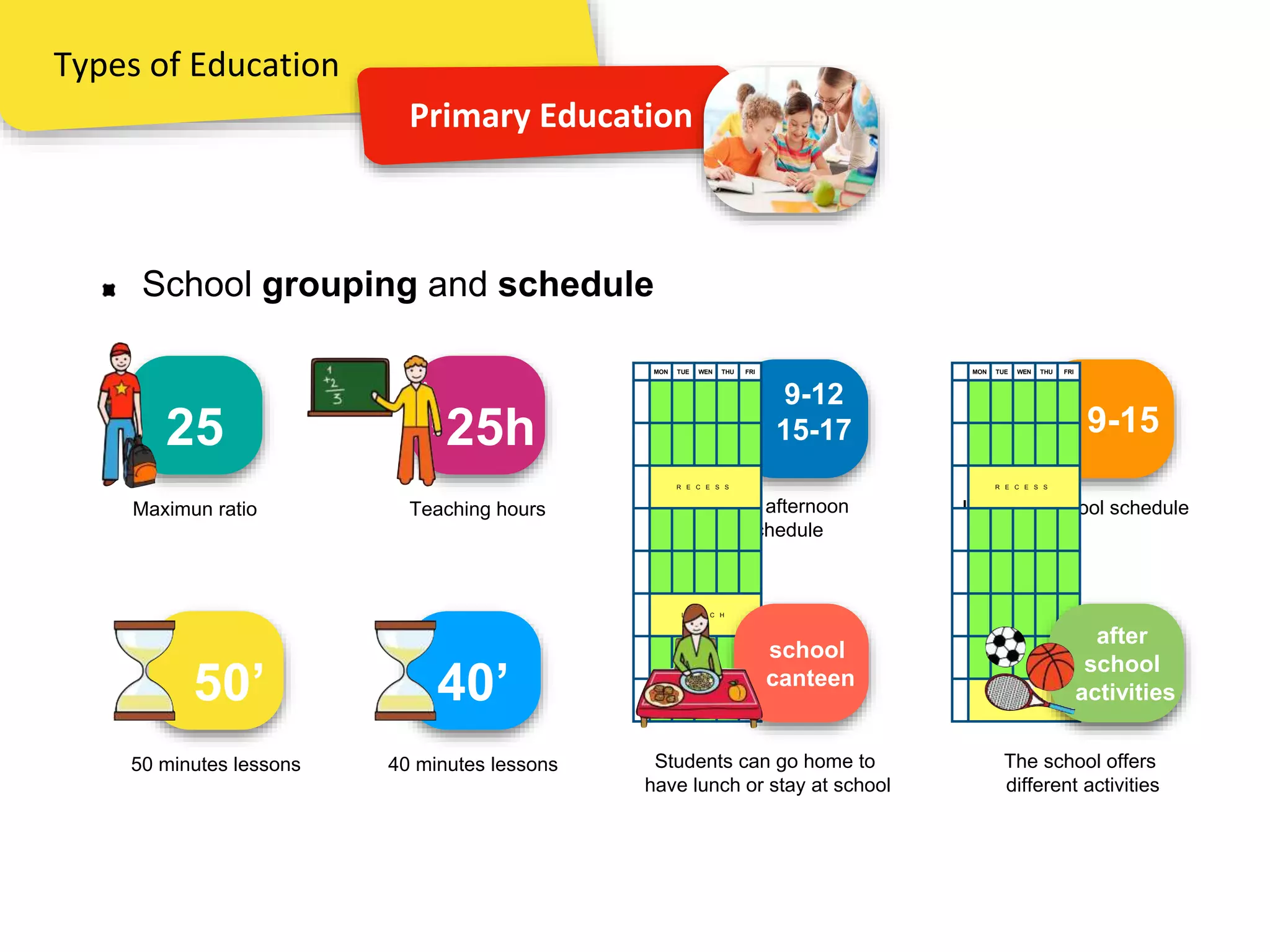
School grouping and schedule
Types of Education
Primary Education
25
Maximun ratio Teaching hours
25h
9-12
15-17
Morning and afternoon
school schedule
MON TUE WEN THU FRI
R E C E S S
L U N C H
9-15
Intensive school schedule
MON TUE WEN THU FRI
R E C E S S
L U N C H
school
canteen
Students can go home to
have lunch or stay at school
50 minutes lessons
50’ 40’
40 minutes lessons
after
school
activities
The school offers
different activities
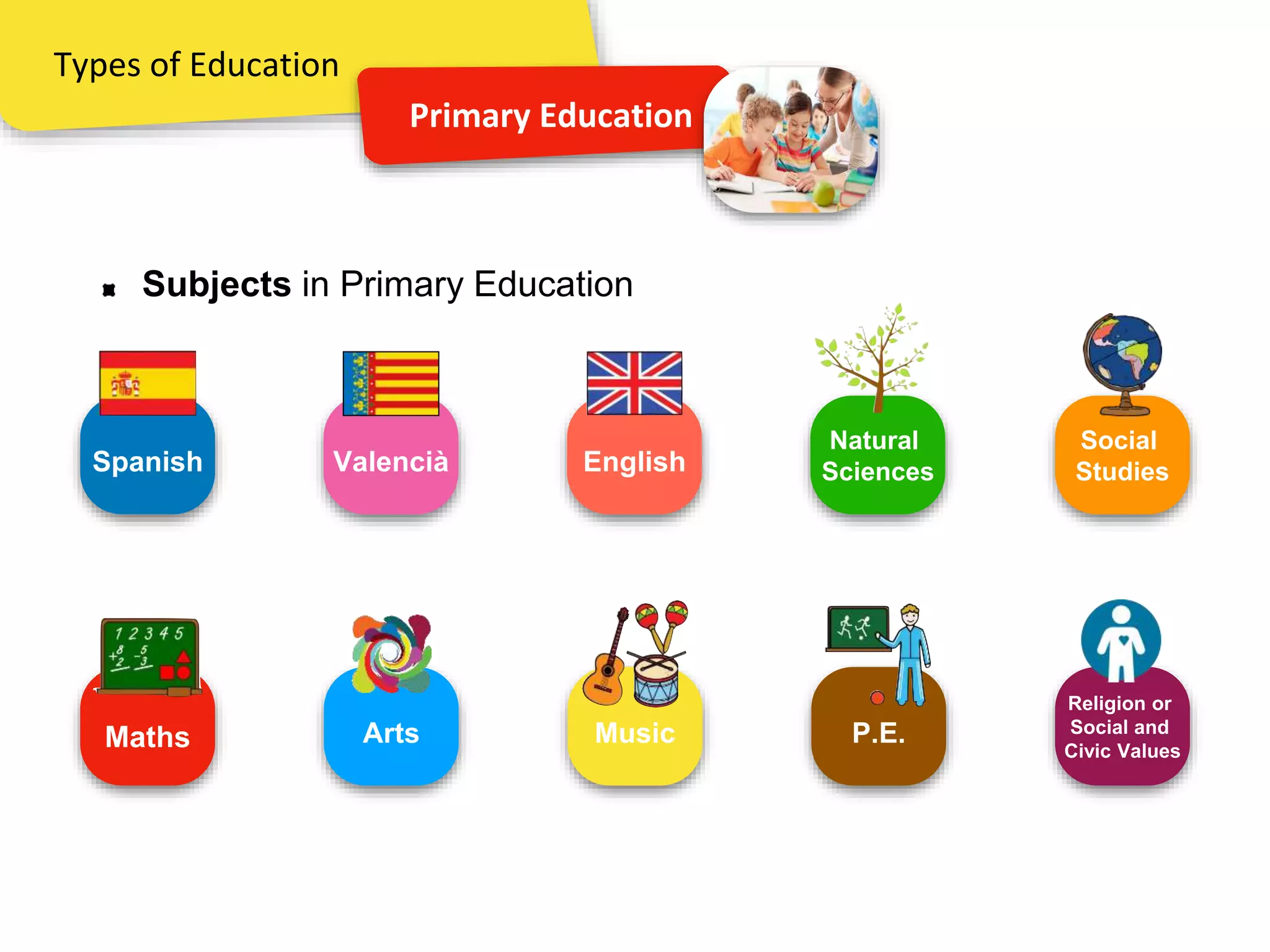
Subjects in Primary Education
Types of Education
Primary Education
Maths
Spanish
Natural
Sciences
Social
StudiesValencià English
Arts Music P.E.
Religion or
Social and
Civic Values
Other facts about Primary Education
Types of Education
Primary Education
Children have several
teachers:
A class teacher, who
usually teaches
languages (Spanish
and Valencià), Maths,
Social Studies and
Science.
A Music teacher
An English teacher
(in our school they
also teach art)
A P.E. teacher.
ICT is not considered
as a subject, but
some teachers use it in
their classes.
Connecting a laptop to
a digital whiteboard.
Using multimedia
content as the digital
books.
Going to the computers
room.
There are tests and
marks each term.
Children can repeat
1 course in the whole
primary studies.
Only if they are
children with
Special needs they
can repeat an extra
year.
Tests and
marksICTTeachers
Children with Special Educational Needs
Types of Education
Primary Education
Secondary Education is compulsory.
There are 4 grades divided in 2 cycles:
Types of Education
Secondary School
1st cycle 2nd cyclefrom 12 to 14 years old and from 14 to 16 years old
Teachers must be graduated and experts in one subject.
If the students pass the exams, they get the Secondary Studies
degree.
If not, there is a possibility to get the degree doing another course or
courses that are focused to teach those students some jobs.
Some facts about Secondary Education
30
Maximun ratio
Teaching hours
30h
1 or 2
Years of grade
retention
Types of Education
Secondary School
Subjects
Those of Primary Education
+ Technology + 2 optional
End of Secondary School
Start to work Study Vocational
Training
University
Study High School
(Bachillerato)
Bachillerato (Baccalaureate) is not compulsory.
Students must have the degree on Secondary School.
It is made up of two school years
Types of Education
High School
16 -17 years old 17-18 years old
There are different choices:
Students must pass a State Exam called PAU if they want
to go to University.
Sciences Arts
Humanities and
Social Sciences
Vocational Training is not compulsory.
Students must have the degree on Secondary School.
If you don’t have it you must be 17 years old and pass a test.
There are three different programmes:
Types of Education
Vocational
Training
The courses have between 1300 and 2000 hours in 2 years.
The 20% - 30 % of the studies are practices in enterprises.
When students finish these studies they can access to University.
Basic Vocational
Training
Intermediate
Vocational Training
Higher Vocational
Training
Other possibilities when students finish Secondary Education.
Types of Education
Specialised Education
Language Education Artistic Education Sports Education
Languages at levels A1-C2
(CEFR)
Official Language Schools
Music, Dance, Dramatic
Arts, Preservation and
Restoration of Cultural
Property, and Plastic
Arts and Design.
Specific Schools
Intermediate and
advanced training
cycles
Vocational traning
The normal duration for University courses is 4 years, except
Medicine and some more, which are 6.
University studies have "ECTS credits" as a measure for the lessons,
and normally, 60 ECTS are taken each year, so each course comprises
240 ECTS credits.
Passing every subject, and getting the 240 ECTS credits, gives the
right to obtaining an academic degree (Grado), architecture or
engineering qualification.
Postgraduate courses are Master's degrees (Máster), and Doctoral
degrees (Doctorado). The access is regulated by the university itself,
through the Doctorate Commission. It is necessary to have the correct
degree course, architecture or engineering.
Most universities offer non-regulated studies leading to an unofficial
degree, recognised only by the granting university.
Types of Education
University

The spanish education system

  • 1.
  • 2.
    The Spanish EducationSystem offers the following types of Education Infant Education Primary Education Compulsory Secondary Education High School Vocational Training Language Studies Art Studies Sport Studies Adult Education University Education
  • 3.
    Infant School Educationis not compulsory. It is divided in two periods: 0-3 years old 3-6 years old Most of the children attend classes where Infant Schools are integrated with Primary Schools. Children have differentiated subjects: Personal Identity, Social Environment, etc. Normally, children start to learn reading and writing at this stage. People who work there must be qualified teachers. Types of Education Infant Education Most of the schools are private and parents must pay for them. Some towns have municipal nursery schools that are cheaper than private. Children only play and do some painting works. People who work there don’t need to be teachers but head teachers usually are.
  • 4.
    Primary Education iscompulsory. It is divided in six levels from Families can choose to take their children to: 6 to 12 years old Types of Education Primary Education State Schools Most of the schools are State Schools. They are free. Families only pay for lunch, books, materials and sometimes uniforms. State-financed but privately-managed Schools They are usually free but sometimes families must pay a small amount of money for the teaching and then they pay for the same that for State schools. Private Schools They are not State- financed and parents must pay for all the services.
  • 5.
    School grouping andschedule Types of Education Primary Education 25 Maximun ratio Teaching hours 25h 9-12 15-17 Morning and afternoon school schedule MON TUE WEN THU FRI R E C E S S L U N C H 9-15 Intensive school schedule MON TUE WEN THU FRI R E C E S S L U N C H school canteen Students can go home to have lunch or stay at school 50 minutes lessons 50’ 40’ 40 minutes lessons after school activities The school offers different activities
  • 6.
    Subjects in PrimaryEducation Types of Education Primary Education Maths Spanish Natural Sciences Social StudiesValencià English Arts Music P.E. Religion or Social and Civic Values
  • 7.
    Other facts aboutPrimary Education Types of Education Primary Education Children have several teachers: A class teacher, who usually teaches languages (Spanish and Valencià), Maths, Social Studies and Science. A Music teacher An English teacher (in our school they also teach art) A P.E. teacher. ICT is not considered as a subject, but some teachers use it in their classes. Connecting a laptop to a digital whiteboard. Using multimedia content as the digital books. Going to the computers room. There are tests and marks each term. Children can repeat 1 course in the whole primary studies. Only if they are children with Special needs they can repeat an extra year. Tests and marksICTTeachers
  • 8.
    Children with SpecialEducational Needs Types of Education Primary Education
  • 9.
    Secondary Education iscompulsory. There are 4 grades divided in 2 cycles: Types of Education Secondary School 1st cycle 2nd cyclefrom 12 to 14 years old and from 14 to 16 years old Teachers must be graduated and experts in one subject. If the students pass the exams, they get the Secondary Studies degree. If not, there is a possibility to get the degree doing another course or courses that are focused to teach those students some jobs.
  • 10.
    Some facts aboutSecondary Education 30 Maximun ratio Teaching hours 30h 1 or 2 Years of grade retention Types of Education Secondary School Subjects Those of Primary Education + Technology + 2 optional End of Secondary School Start to work Study Vocational Training University Study High School (Bachillerato)
  • 11.
    Bachillerato (Baccalaureate) isnot compulsory. Students must have the degree on Secondary School. It is made up of two school years Types of Education High School 16 -17 years old 17-18 years old There are different choices: Students must pass a State Exam called PAU if they want to go to University. Sciences Arts Humanities and Social Sciences
  • 12.
    Vocational Training isnot compulsory. Students must have the degree on Secondary School. If you don’t have it you must be 17 years old and pass a test. There are three different programmes: Types of Education Vocational Training The courses have between 1300 and 2000 hours in 2 years. The 20% - 30 % of the studies are practices in enterprises. When students finish these studies they can access to University. Basic Vocational Training Intermediate Vocational Training Higher Vocational Training
  • 13.
    Other possibilities whenstudents finish Secondary Education. Types of Education Specialised Education Language Education Artistic Education Sports Education Languages at levels A1-C2 (CEFR) Official Language Schools Music, Dance, Dramatic Arts, Preservation and Restoration of Cultural Property, and Plastic Arts and Design. Specific Schools Intermediate and advanced training cycles Vocational traning
  • 14.
    The normal durationfor University courses is 4 years, except Medicine and some more, which are 6. University studies have "ECTS credits" as a measure for the lessons, and normally, 60 ECTS are taken each year, so each course comprises 240 ECTS credits. Passing every subject, and getting the 240 ECTS credits, gives the right to obtaining an academic degree (Grado), architecture or engineering qualification. Postgraduate courses are Master's degrees (Máster), and Doctoral degrees (Doctorado). The access is regulated by the university itself, through the Doctorate Commission. It is necessary to have the correct degree course, architecture or engineering. Most universities offer non-regulated studies leading to an unofficial degree, recognised only by the granting university. Types of Education University