Uses and differences
Upper-intermediate
Ongoing situations
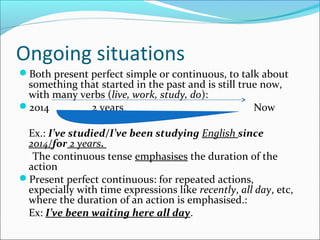
Both present perfect simple or continuous, to talk about
something that started in the past and is still true now,
with many verbs (live, work, study, do):
2014 2 years Now
Ex.: I’ve studied/I’ve been studying English since
2014/for 2 years.
The continuous tense emphasises the duration of the
action
Present perfect continuous: for repeated actions,
expecially with time expressions like recently, all day, etc,
where the duration of an action is emphasised.:
Ex: I’ve been waiting here all day.
Ongoing situations (2)
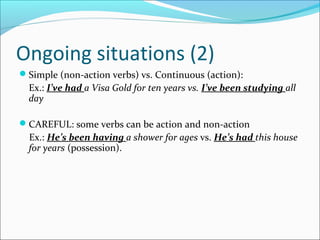
Simple (non-action verbs) vs. Continuous (action):
Ex.: I’ve had a Visa Gold for ten years vs. I’ve been studying all
day
CAREFUL: some verbs can be action and non-action
Ex.: He’s been having a shower for ages vs. He’s had this house
for years (possession).
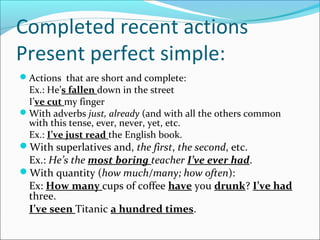
Completed recent actions
Present perfect simple:
Actions that are short and complete:
Ex.: He’s fallen down in the street
I’ve cut my finger
With adverbs just, already (and with all the others common
with this tense, ever, never, yet, etc.
Ex.: I’ve just read the English book.
With superlatives and, the first, the second, etc.
Ex.: He’s the most boring teacher I’ve ever had.
With quantity (how much/many; how often):
Ex: How many cups of coffee have you drunk? I’ve had
three.
I’ve seen Titanic a hundred times.
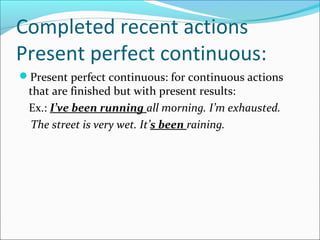
Completed recent actions
Present perfect continuous:
Present perfect continuous: for continuous actions
that are finished but with present results:
Ex.: I’ve been running all morning. I’m exhausted.
The street is very wet. It’s been raining.
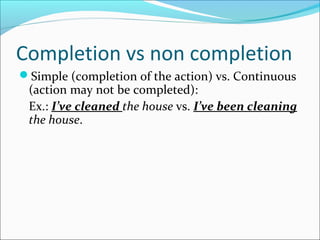
Completion vs non completion
Simple (completion of the action) vs. Continuous
(action may not be completed):
Ex.: I’ve cleaned the house vs. I’ve been cleaning
the house.
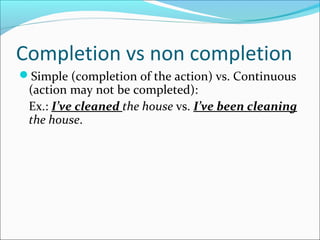
Completion vs non completion
Simple (completion of the action) vs. Continuous
(action may not be completed):
Ex.: I’ve cleaned the house vs. I’ve been cleaning
the house.

Present perfect simple and continuous upper intermediate

  • 1.
  • 2.
    Ongoing situations Both presentperfect simple or continuous, to talk about something that started in the past and is still true now, with many verbs (live, work, study, do): 2014 2 years Now Ex.: I’ve studied/I’ve been studying English since 2014/for 2 years. The continuous tense emphasises the duration of the action Present perfect continuous: for repeated actions, expecially with time expressions like recently, all day, etc, where the duration of an action is emphasised.: Ex: I’ve been waiting here all day.
  • 3.
    Ongoing situations (2) Simple(non-action verbs) vs. Continuous (action): Ex.: I’ve had a Visa Gold for ten years vs. I’ve been studying all day CAREFUL: some verbs can be action and non-action Ex.: He’s been having a shower for ages vs. He’s had this house for years (possession).
  • 4.
    Completed recent actions Presentperfect simple: Actions that are short and complete: Ex.: He’s fallen down in the street I’ve cut my finger With adverbs just, already (and with all the others common with this tense, ever, never, yet, etc. Ex.: I’ve just read the English book. With superlatives and, the first, the second, etc. Ex.: He’s the most boring teacher I’ve ever had. With quantity (how much/many; how often): Ex: How many cups of coffee have you drunk? I’ve had three. I’ve seen Titanic a hundred times.
  • 5.
    Completed recent actions Presentperfect continuous: Present perfect continuous: for continuous actions that are finished but with present results: Ex.: I’ve been running all morning. I’m exhausted. The street is very wet. It’s been raining.
  • 6.
    Completion vs noncompletion Simple (completion of the action) vs. Continuous (action may not be completed): Ex.: I’ve cleaned the house vs. I’ve been cleaning the house.
  • 7.
    Completion vs noncompletion Simple (completion of the action) vs. Continuous (action may not be completed): Ex.: I’ve cleaned the house vs. I’ve been cleaning the house.