PARASYMPATHETIC NERVOUS SYSTEM
OR
CHOLINERGIC NERVOUS SYSTEM
AUTONOMIC NERVOUS SYSTEM
• Part of nervous system that controls and
regulate the internal organs.
Two types
• Sympathetic Nervous System: Release
Adrenaline
• Parasympathetic Nervous System: Release
Acetylcholine
Cholinergic Neurotransmitter
Acetylcholine
• Pre & post ganglionic fibres of
parasympathetic nerves liberate Ach.
• Important Responses of Ach
1. Contraction of Smooth muscles
2. Cardiac Inhibition
3. Peripheral Vasodilation
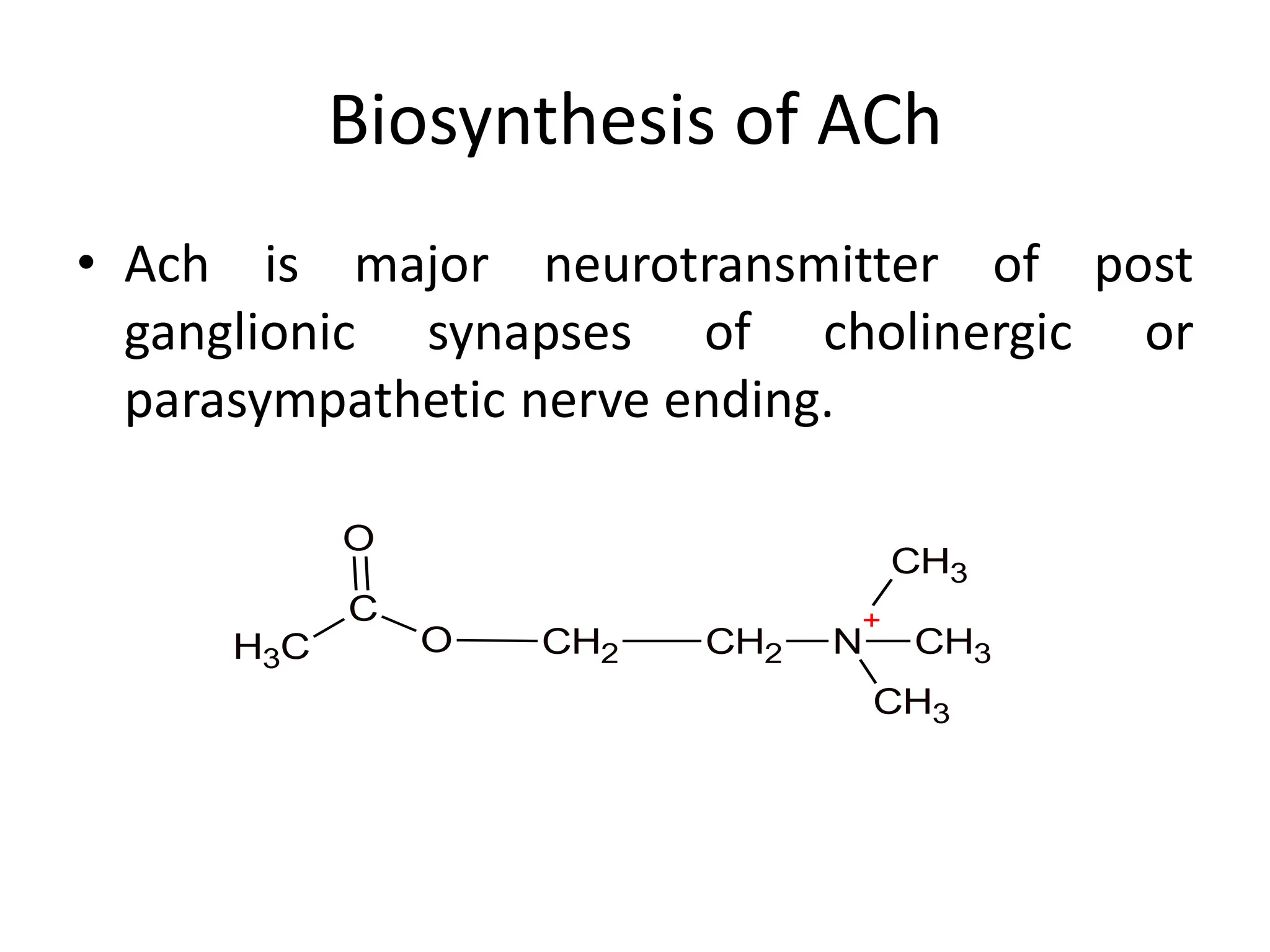
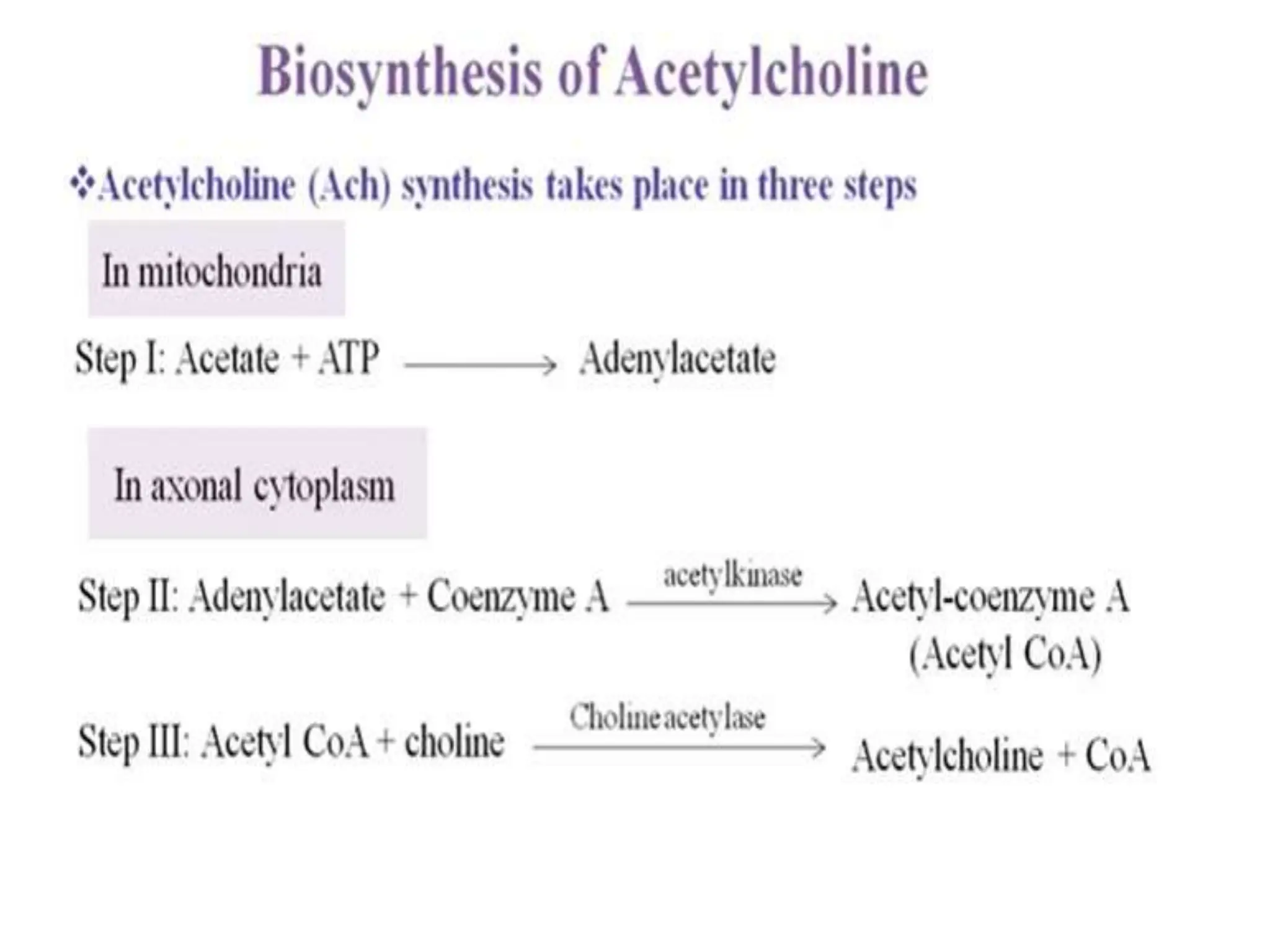
Biosynthesis of ACh
• Ach is major neurotransmitter of post
ganglionic synapses of cholinergic or
parasympathetic nerve ending.
C
H3
C
O
O
CH2 CH2 N
+
CH3
CH3
CH3
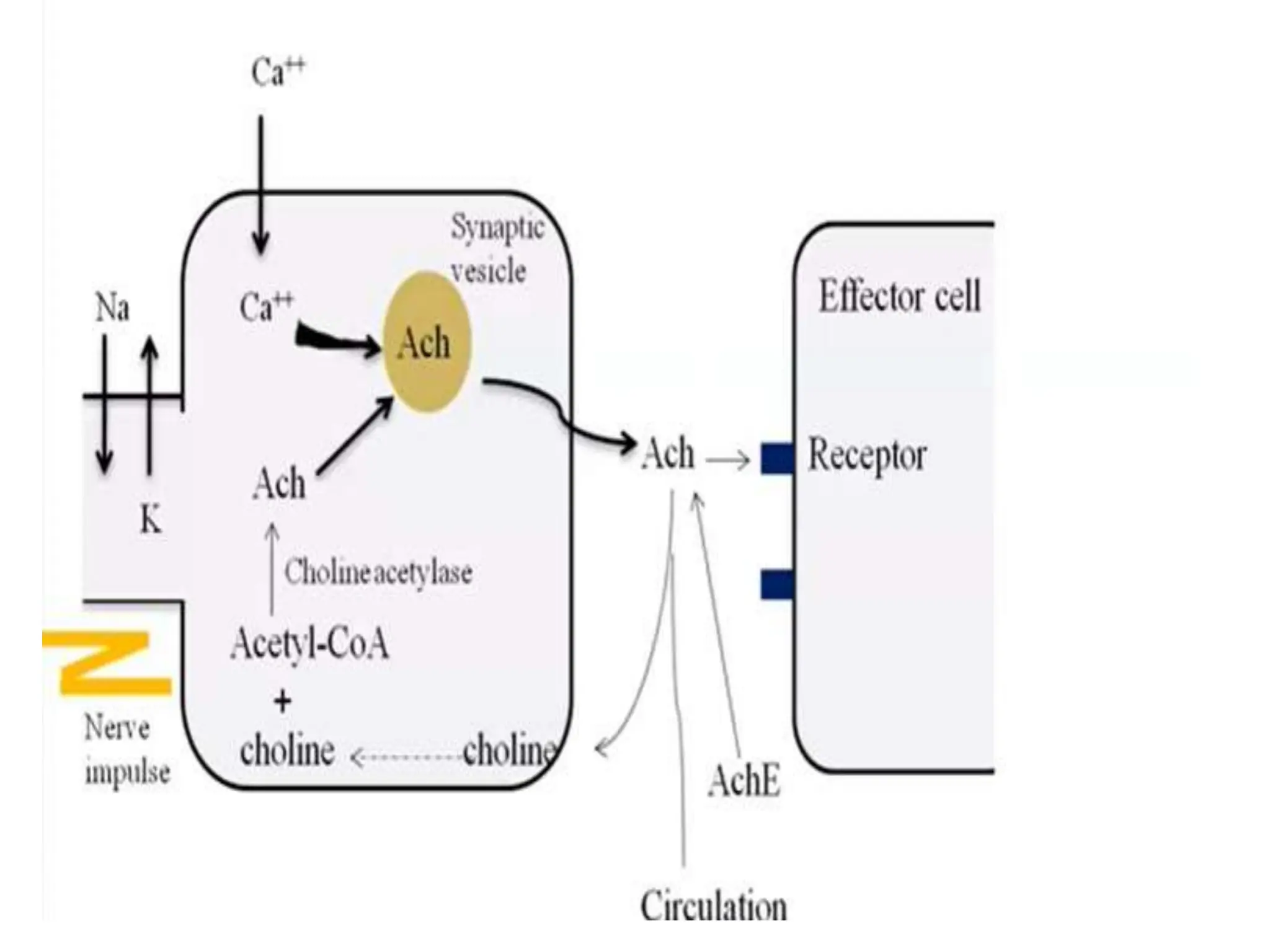
• Ach is biosynthesized in nerve terminal.
• Ach is synthesized by Choline and Acetyl
coenzyme with the help of Acetycholine
transferase.
• Active transport system involves picking up of
choline molecule from extrasynaptic fluid.
• This transport is dependent upon intracellular
conc. of Na+ & K+ ions.
• Choline is acetylated in the cytoplasm by
acetyl coenzyme A which is biosynthesized in
mitochondria present in the nerve terminal.
• Ach is stored in synaptic vesicles
• When impulse reaches to nerve terminal
depolarization causes activation of Ca
ionophore , allows influx of Ca ions, rupturing
of storage vesicles to release of Ach.
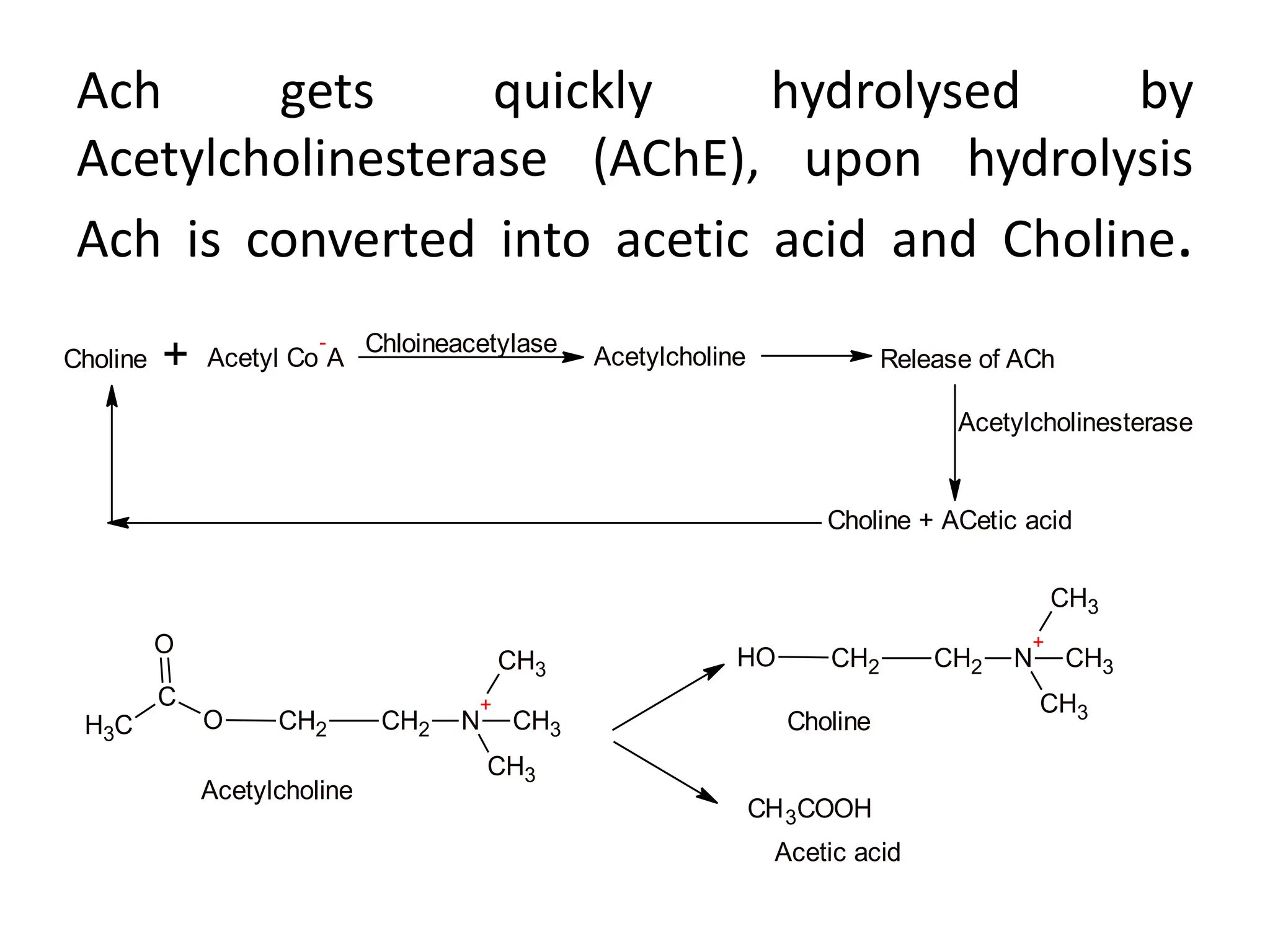
Ach gets quickly hydrolysed by
Acetylcholinesterase (AChE), upon hydrolysis
Ach is converted into acetic acid and Choline.
C
H3
C
O
O
CH2 CH2 N
+
CH3
CH3
CH3
Choline + Acetyl Co
-
A
Chloineacetylase Acetylcholine Release of ACh
Acetylcholinesterase
Choline + ACetic acid
O
H CH2 CH2 N
+
CH3
CH3
CH3
Choline
CH3COOH
Acetylcholine
Acetic acid
Cholinergic Receptor
• Acetylcholine acts on more than one type of receptor.
• Henry Dale, a British physiologist working in London in 1914,
found that two foreign substances, nicotine and muscarine,
could each mimic some, but not all, of the parasympathetic
effects of acetylcholine.
• It was found that Nicotine stimulates receptors on skeletal
muscle however, muscarine stimulates receptor sites located
only at the junction between postganglionic parasympathetic
neurons and the target organ.
• Dale therefore classified the many actions of acetylcholine
into nicotinic effects and muscarinic effects.
• nicotinic receptors cause sympathetic postganglionic neurons
and parasympathetic postganglionic neurons to release their
chemicals and skeletal muscle to contract.
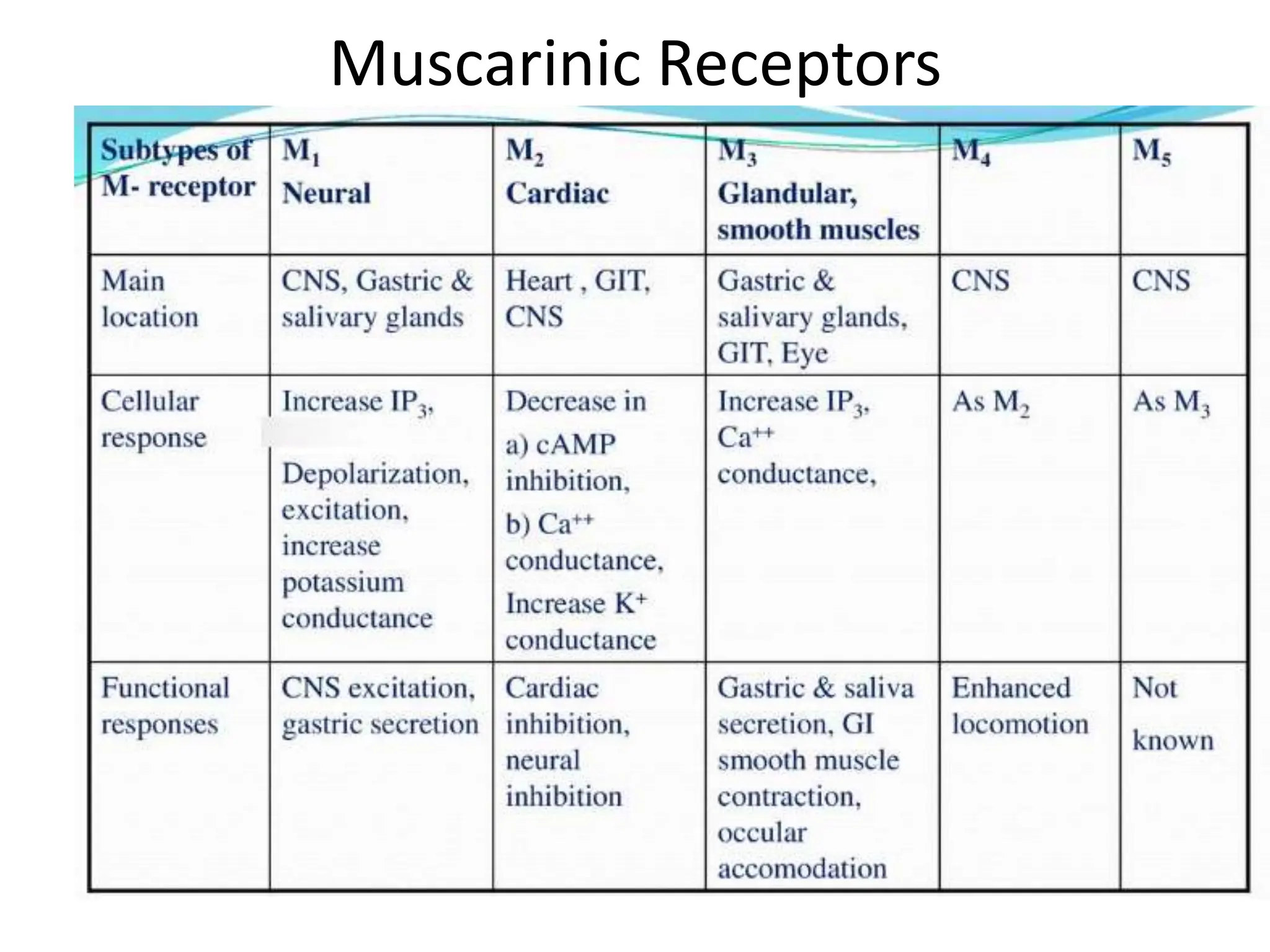
• Muscarinic receptors are associated mainly with
parasympathetic functions and stimulates receptors located in
peripheral tissues (e.g., glands, smooth muscle).
• Acetylcholine activates all of these sites.
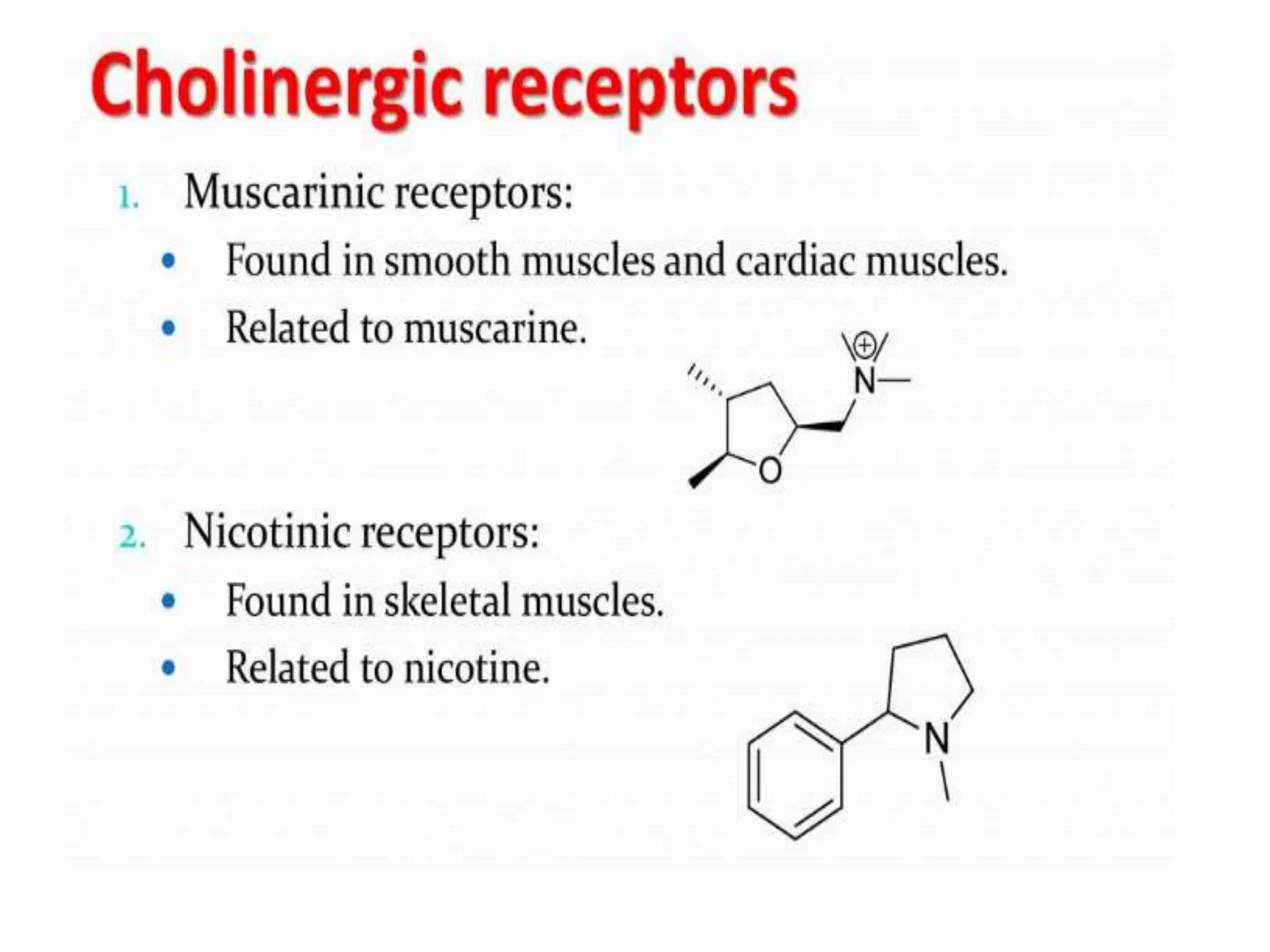
Muscarinic Receptors
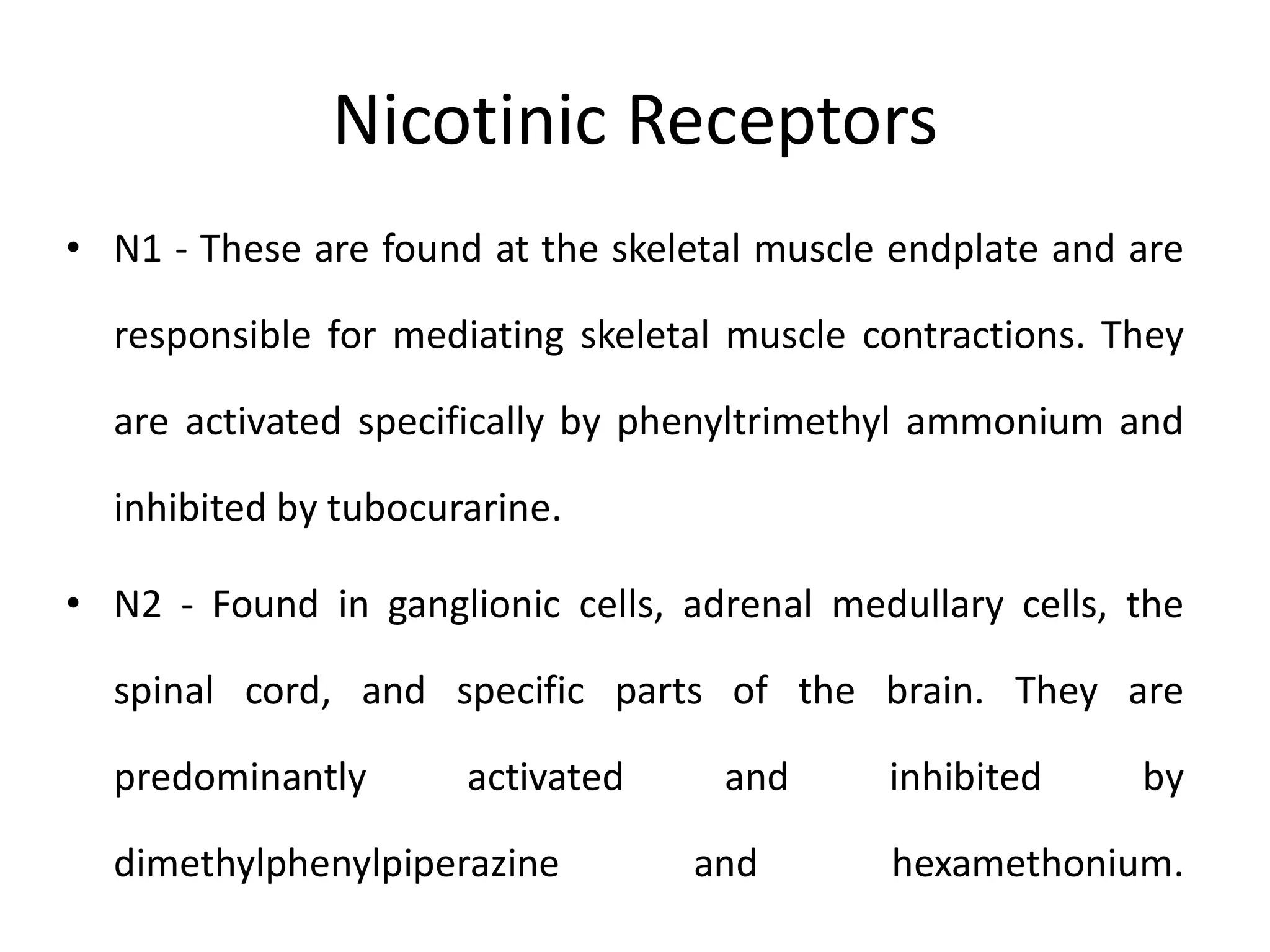
Nicotinic Receptors
• N1 - These are found at the skeletal muscle endplate and are
responsible for mediating skeletal muscle contractions. They
are activated specifically by phenyltrimethyl ammonium and
inhibited by tubocurarine.
• N2 - Found in ganglionic cells, adrenal medullary cells, the
spinal cord, and specific parts of the brain. They are
predominantly activated and inhibited by
dimethylphenylpiperazine and hexamethonium.
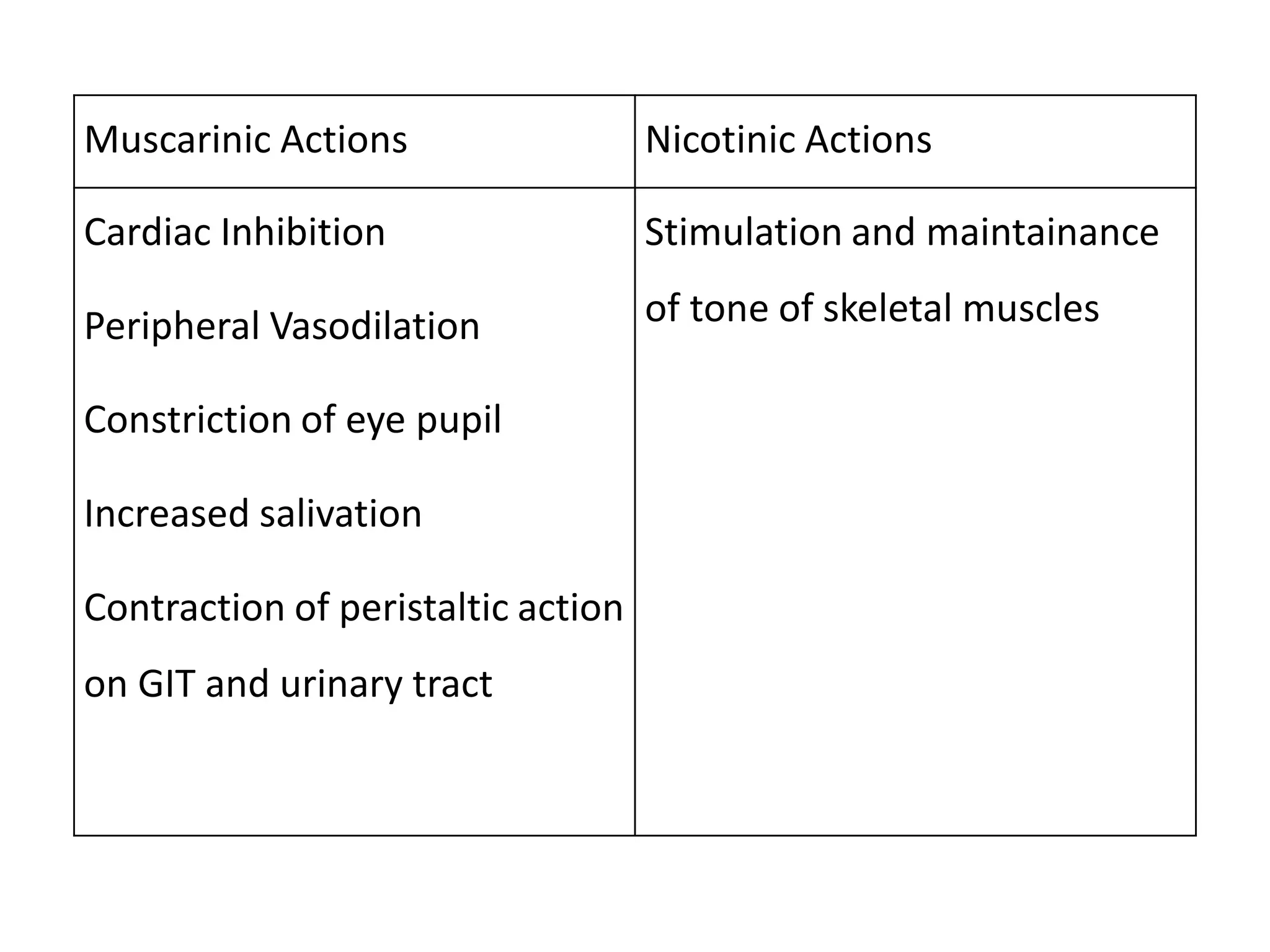
Muscarinic Actions Nicotinic Actions
Cardiac Inhibition
Peripheral Vasodilation
Constriction of eye pupil
Increased salivation
Contraction of peristaltic action
on GIT and urinary tract
Stimulation and maintainance
of tone of skeletal muscles
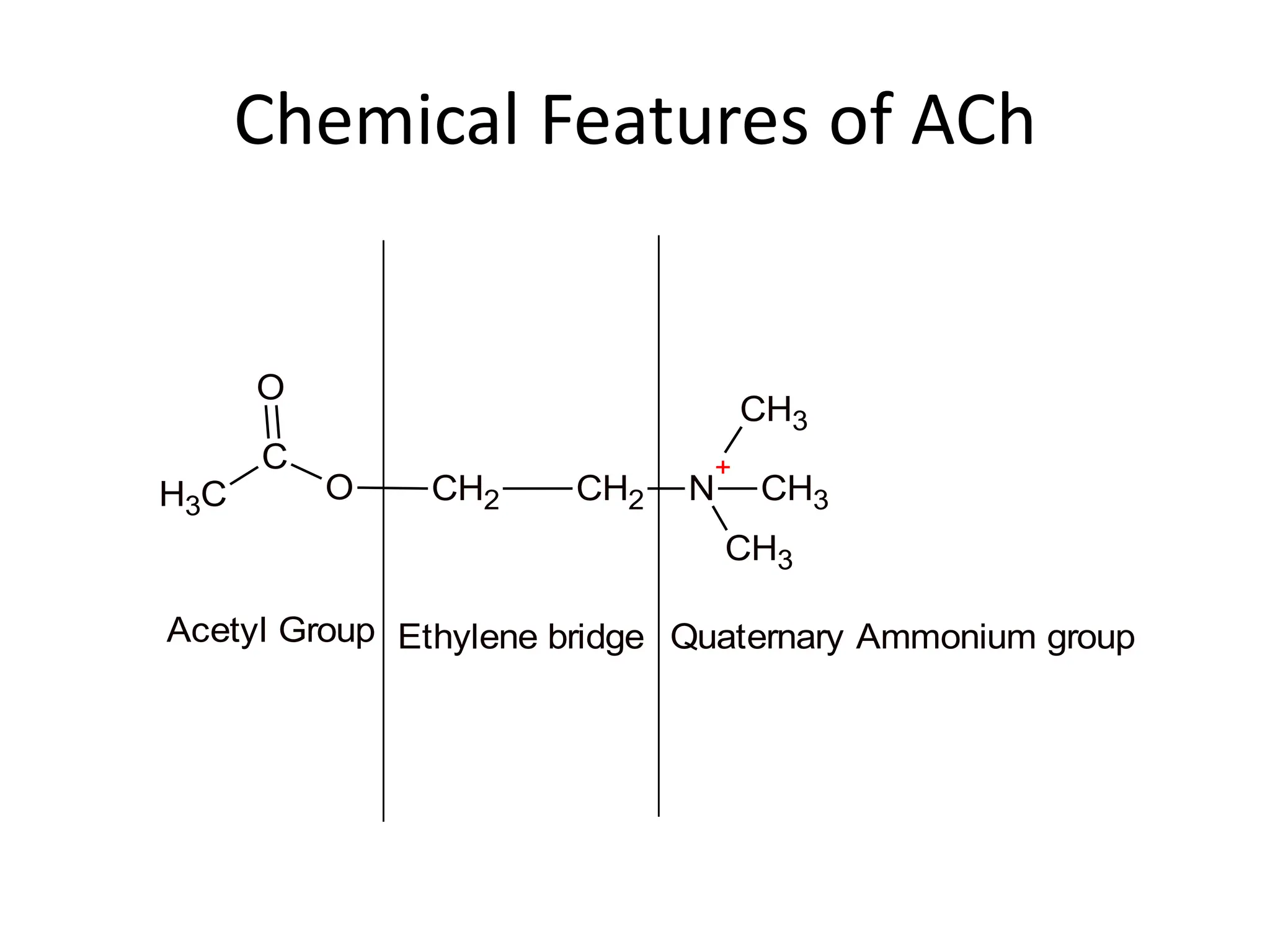
Chemical Features of ACh
C
H3
C
O
O
CH2 CH2 N
+
CH3
CH3
CH3
Acetyl Group Ethylene bridge Quaternary Ammonium group
Chemical Features of ACh
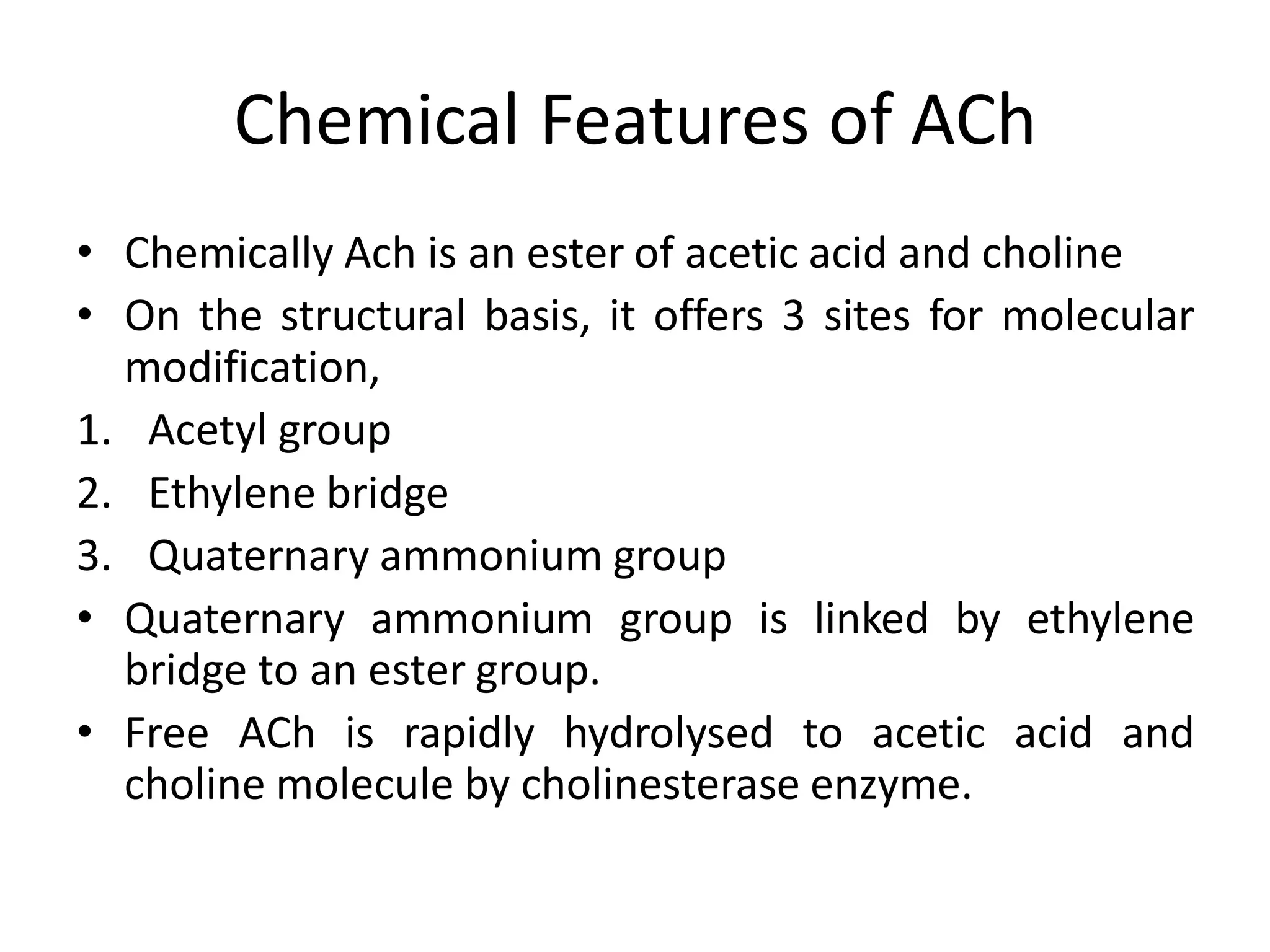
• Chemically Ach is an ester of acetic acid and choline
• On the structural basis, it offers 3 sites for molecular
modification,
1. Acetyl group
2. Ethylene bridge
3. Quaternary ammonium group
• Quaternary ammonium group is linked by ethylene
bridge to an ester group.
• Free ACh is rapidly hydrolysed to acetic acid and
choline molecule by cholinesterase enzyme.
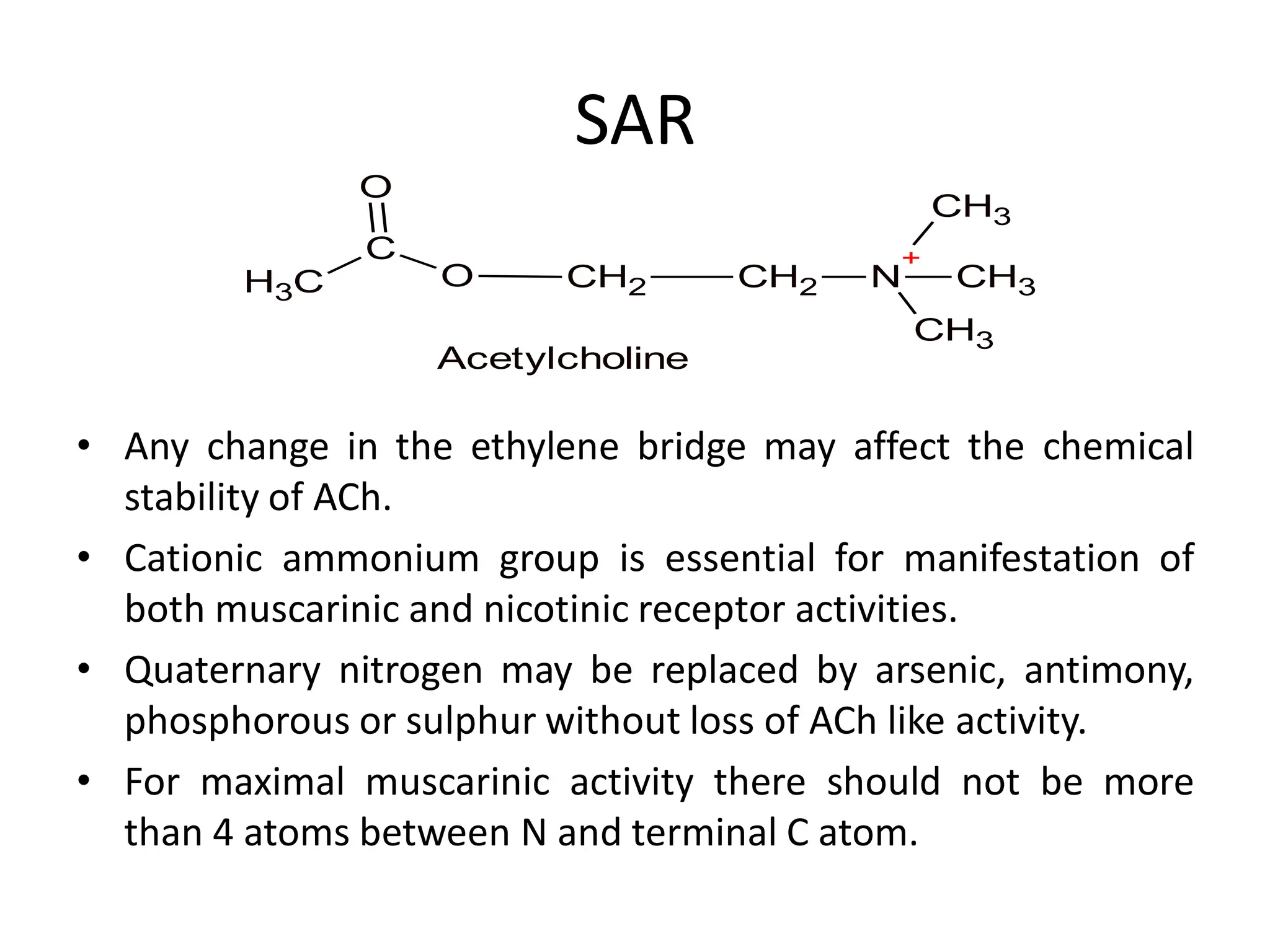
SAR
• Any change in the ethylene bridge may affect the chemical
stability of ACh.
• Cationic ammonium group is essential for manifestation of
both muscarinic and nicotinic receptor activities.
• Quaternary nitrogen may be replaced by arsenic, antimony,
phosphorous or sulphur without loss of ACh like activity.
• For maximal muscarinic activity there should not be more
than 4 atoms between N and terminal C atom.
C
H3
C
O
O
CH2 CH2 N
+
CH3
CH3
CH3
Acetylcholine
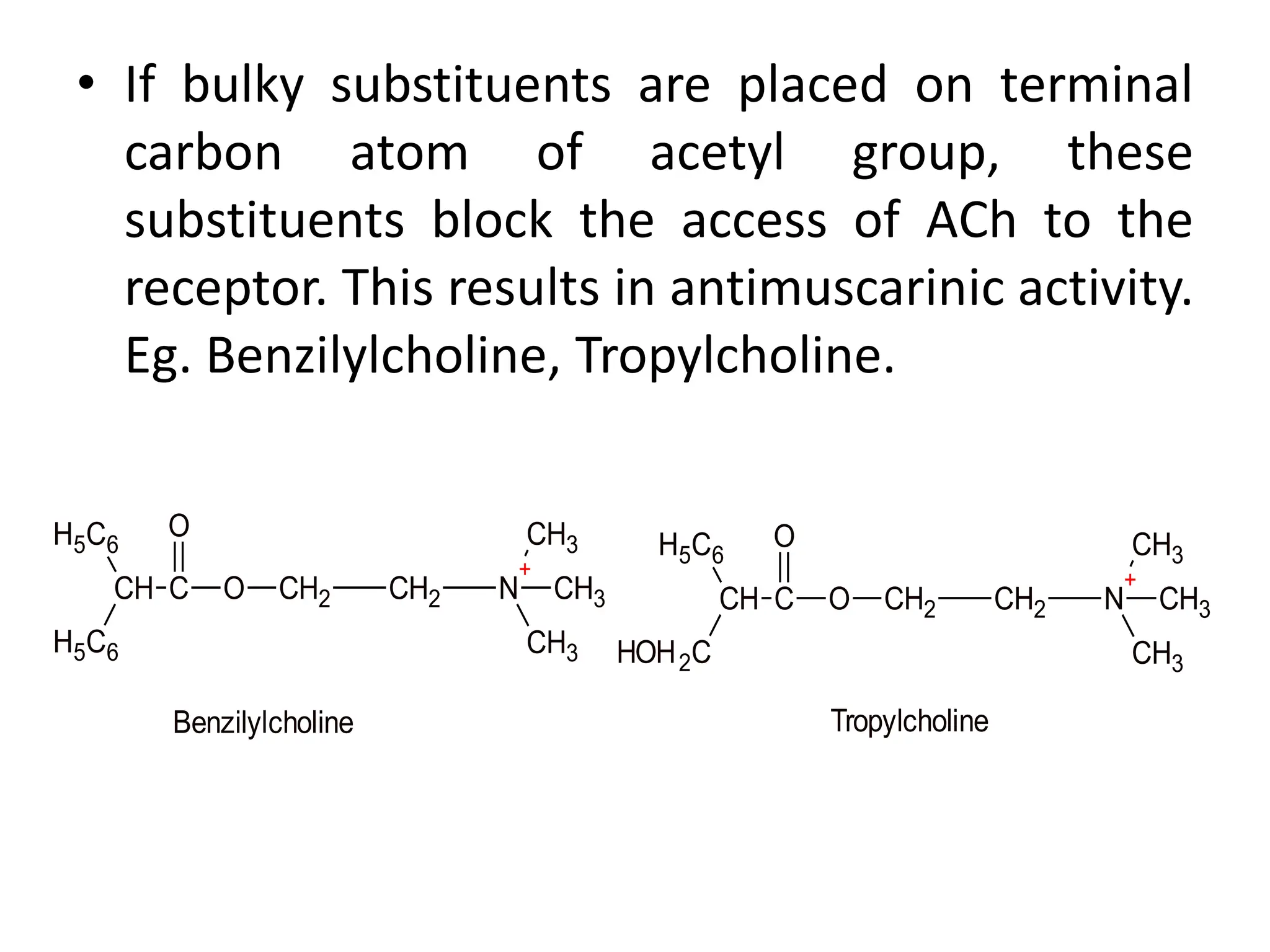
• If bulky substituents are placed on terminal
carbon atom of acetyl group, these
substituents block the access of ACh to the
receptor. This results in antimuscarinic activity.
Eg. Benzilylcholine, Tropylcholine.
CH C
H5C6
H5C6
O
O CH2 CH2 N
+
CH3
CH3
CH3
CH C
H5C6
HOH2C
O
O CH2 CH2 N
+
CH3
CH3
CH3
Benzilylcholine Tropylcholine
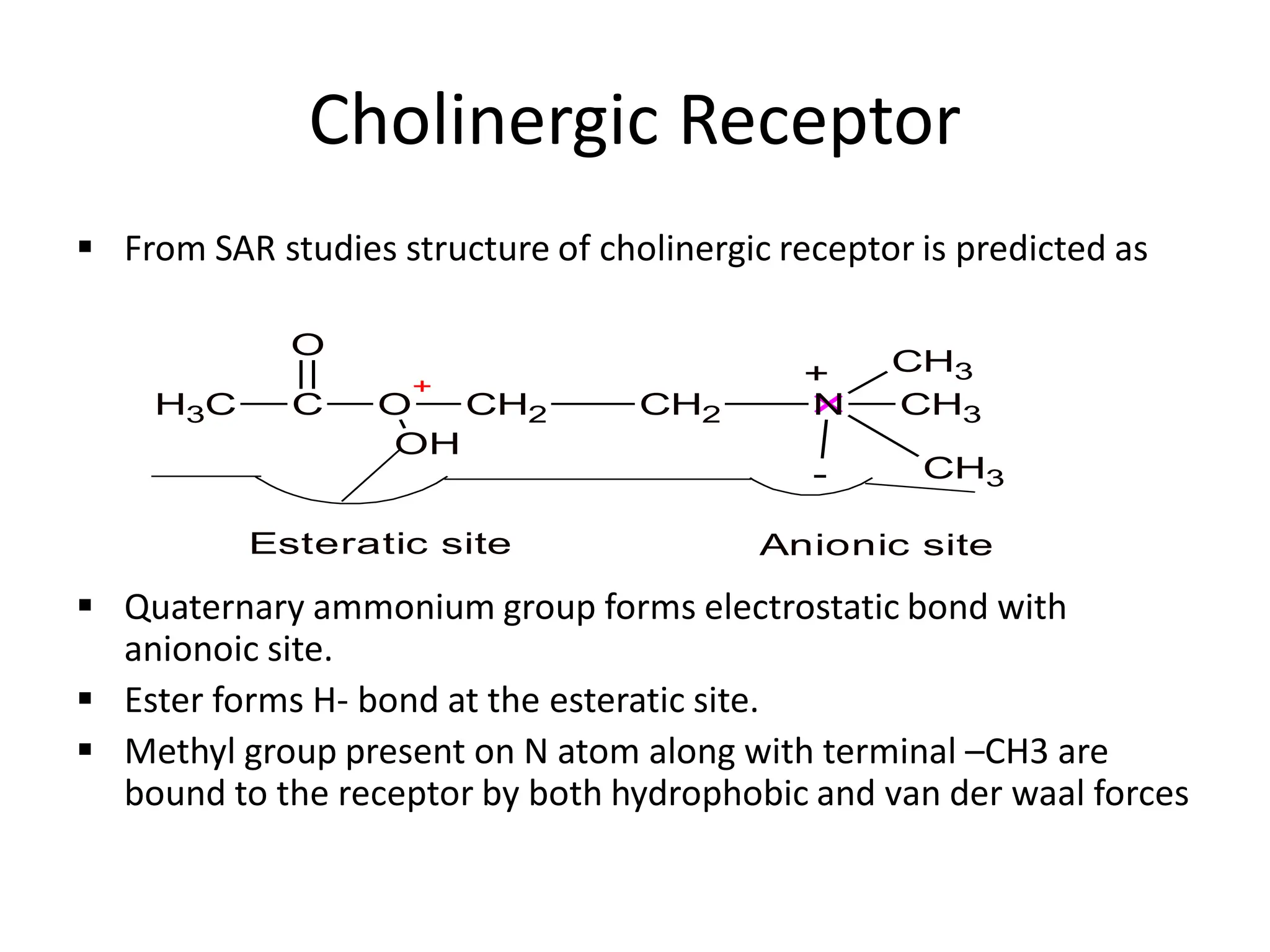
Cholinergic Receptor
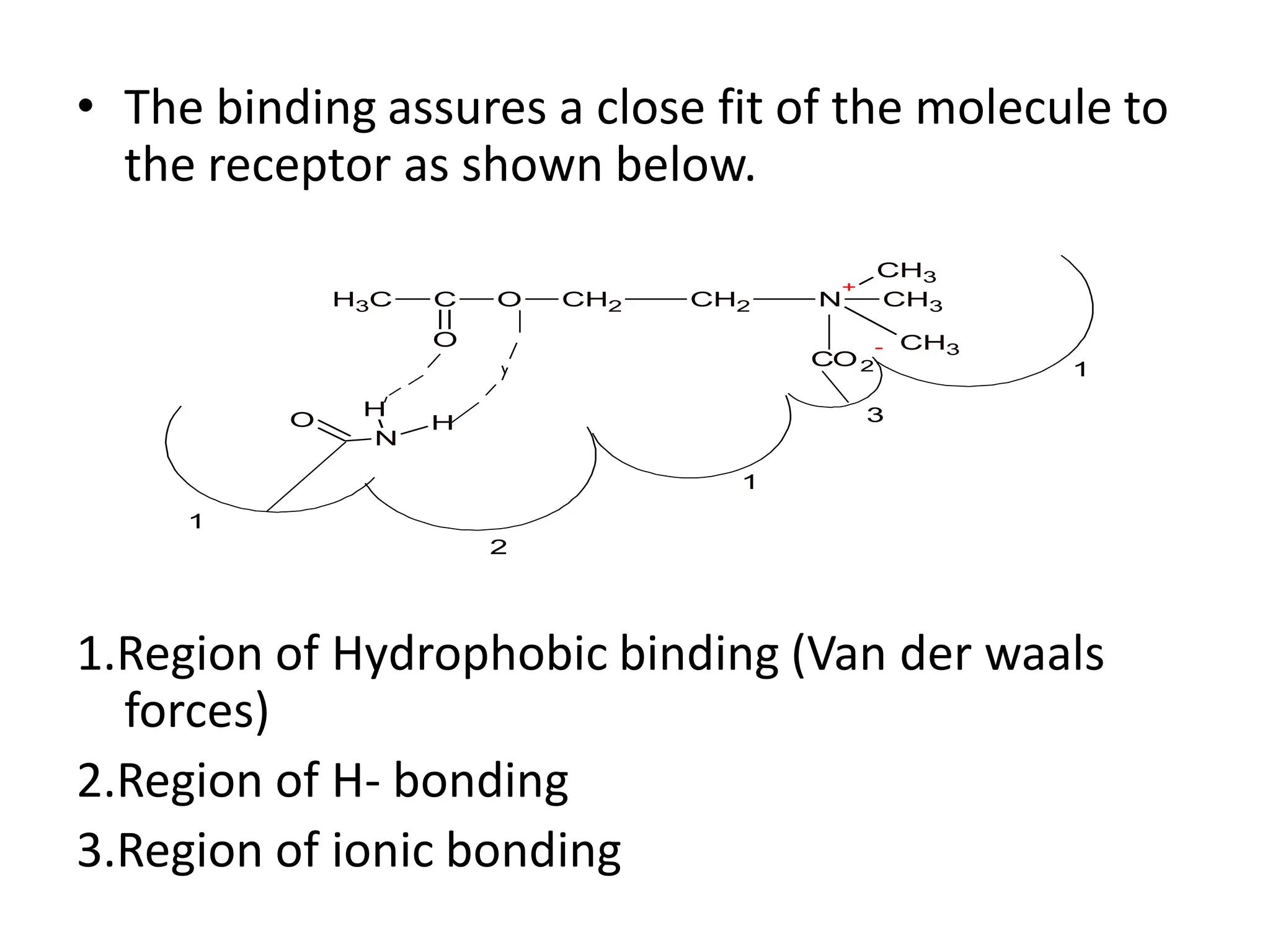
 From SAR studies structure of cholinergic receptor is predicted as
 Quaternary ammonium group forms electrostatic bond with
anionoic site.
 Ester forms H- bond at the esteratic site.
 Methyl group present on N atom along with terminal –CH3 are
bound to the receptor by both hydrophobic and van der waal forces
C
H3 C
O
O
+
CH2 CH2 N CH3
CH3
CH3
OH
-
Esteratic site Anionic site
+
• The binding assures a close fit of the molecule to
the receptor as shown below.
1.Region of Hydrophobic binding (Van der waals
forces)
2.Region of H- bonding
3.Region of ionic bonding
C
H3 C O CH2 CH2 N
+
CH3
CH3
CH3
O
O
N
H
H
1
1
2
1
3
CO2
-
SAR of Parasympathomimetic agents
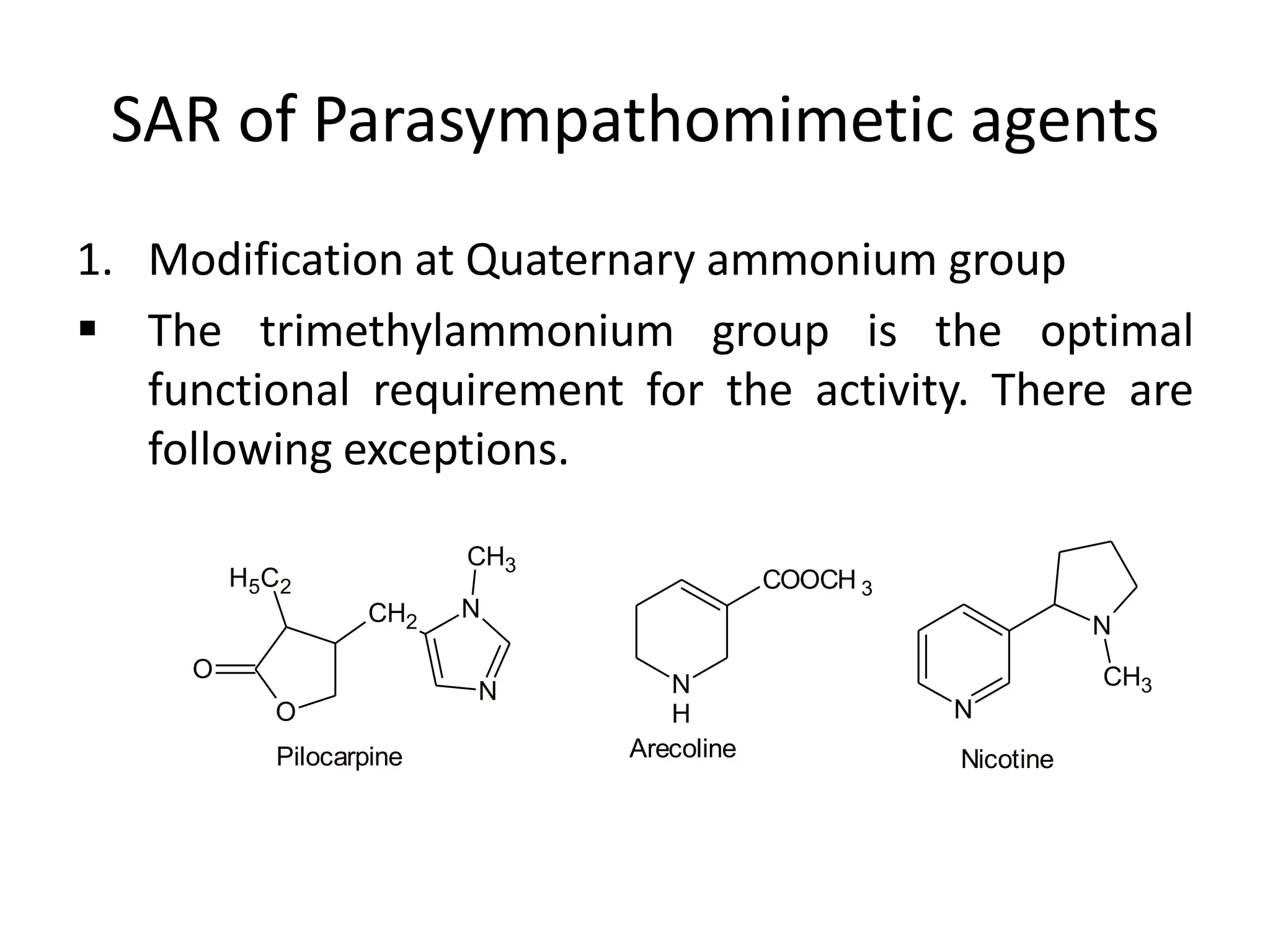
1. Modification at Quaternary ammonium group
 The trimethylammonium group is the optimal
functional requirement for the activity. There are
following exceptions.
O
O
H5C2
CH2
N
N
CH3
Pilocarpine
N
H
COOCH 3
Arecoline
N
N
CH3
Nicotine
2. Modification of Ethylene bridge
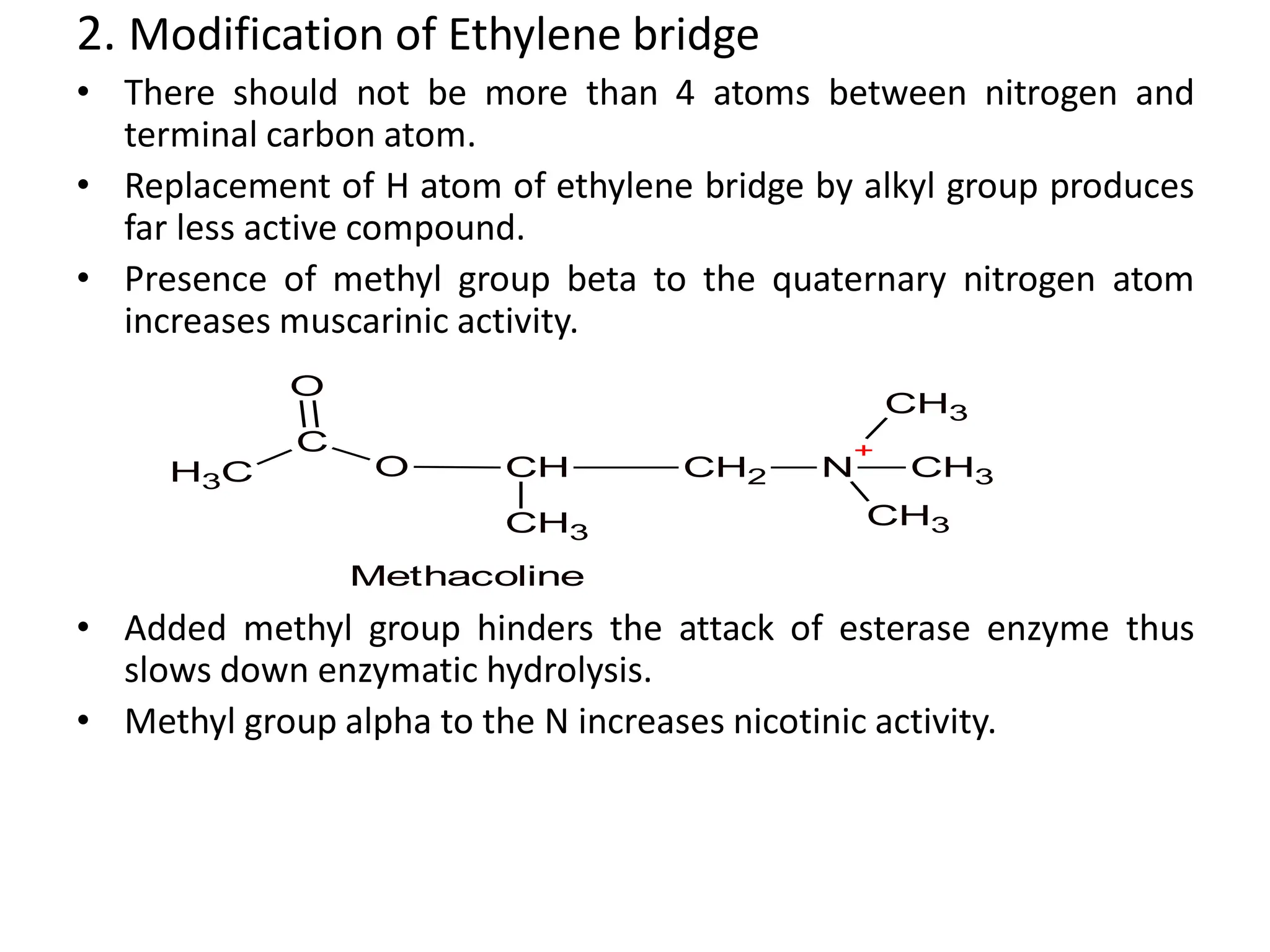
• There should not be more than 4 atoms between nitrogen and
terminal carbon atom.
• Replacement of H atom of ethylene bridge by alkyl group produces
far less active compound.
• Presence of methyl group beta to the quaternary nitrogen atom
increases muscarinic activity.
• Added methyl group hinders the attack of esterase enzyme thus
slows down enzymatic hydrolysis.
• Methyl group alpha to the N increases nicotinic activity.
C
H3
C
O
O
CH CH2 N
+
CH3
CH3
CH3
CH3
Methacoline
3. Modification of the Acyl group
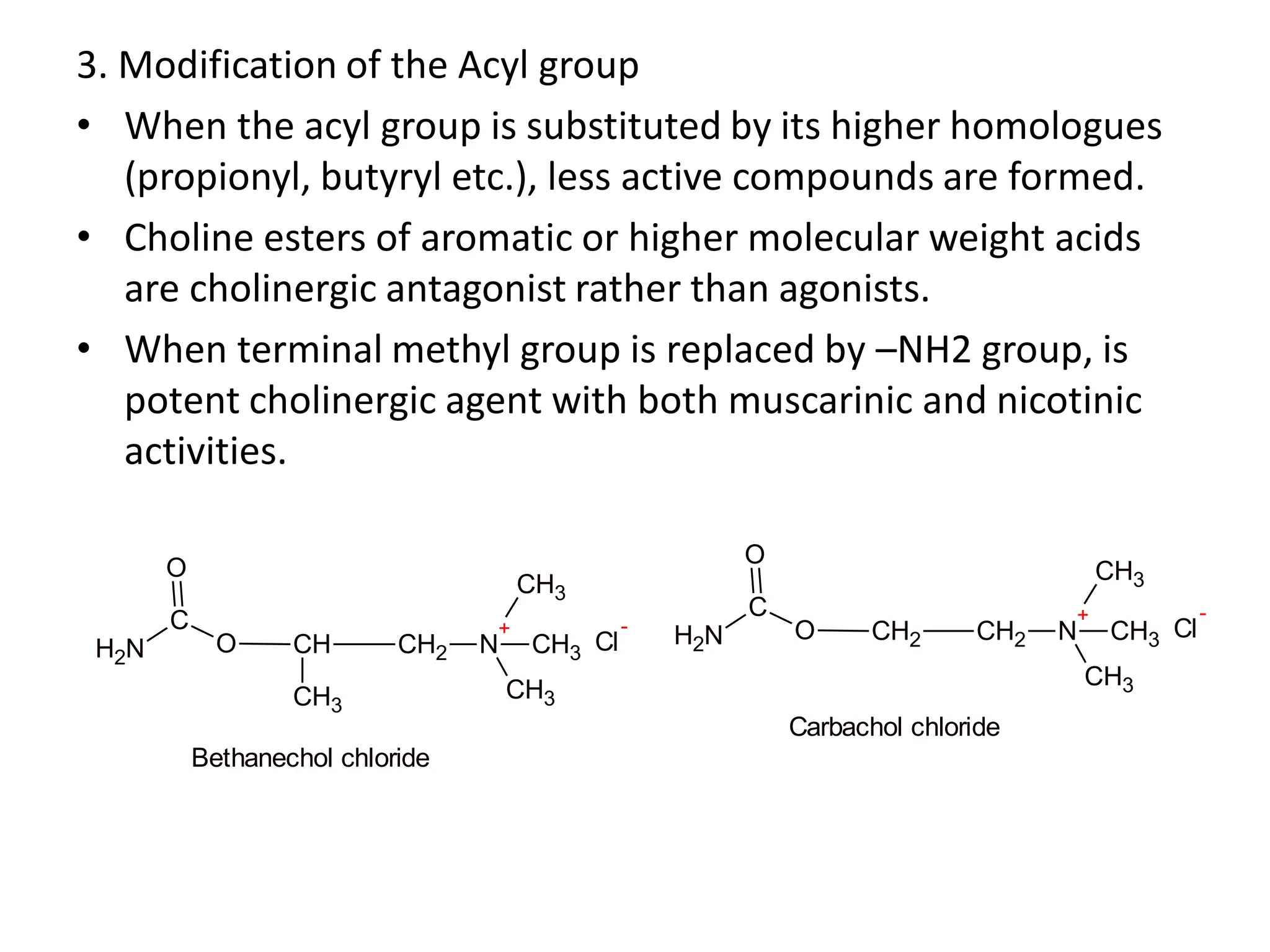
• When the acyl group is substituted by its higher homologues
(propionyl, butyryl etc.), less active compounds are formed.
• Choline esters of aromatic or higher molecular weight acids
are cholinergic antagonist rather than agonists.
• When terminal methyl group is replaced by –NH2 group, is
potent cholinergic agent with both muscarinic and nicotinic
activities.
N
H2
C
O
O
CH CH2 N
+
CH3
CH3
CH3
CH3
Cl
-
Bethanechol chloride
Cl
-
N
H2
C
O
O
CH2 CH2 N
+
CH3
CH3
CH3
Carbachol chloride
• Carbachol is stable to hydrolysis and has right size to fit the
cholinergic receptor.
• In carbachol terminal –CH3 of ACh is replaced by –NH2 group,
while the size of the moecule remains same as that of Ach. So,
the size of the molecule may be imp. to its activity.
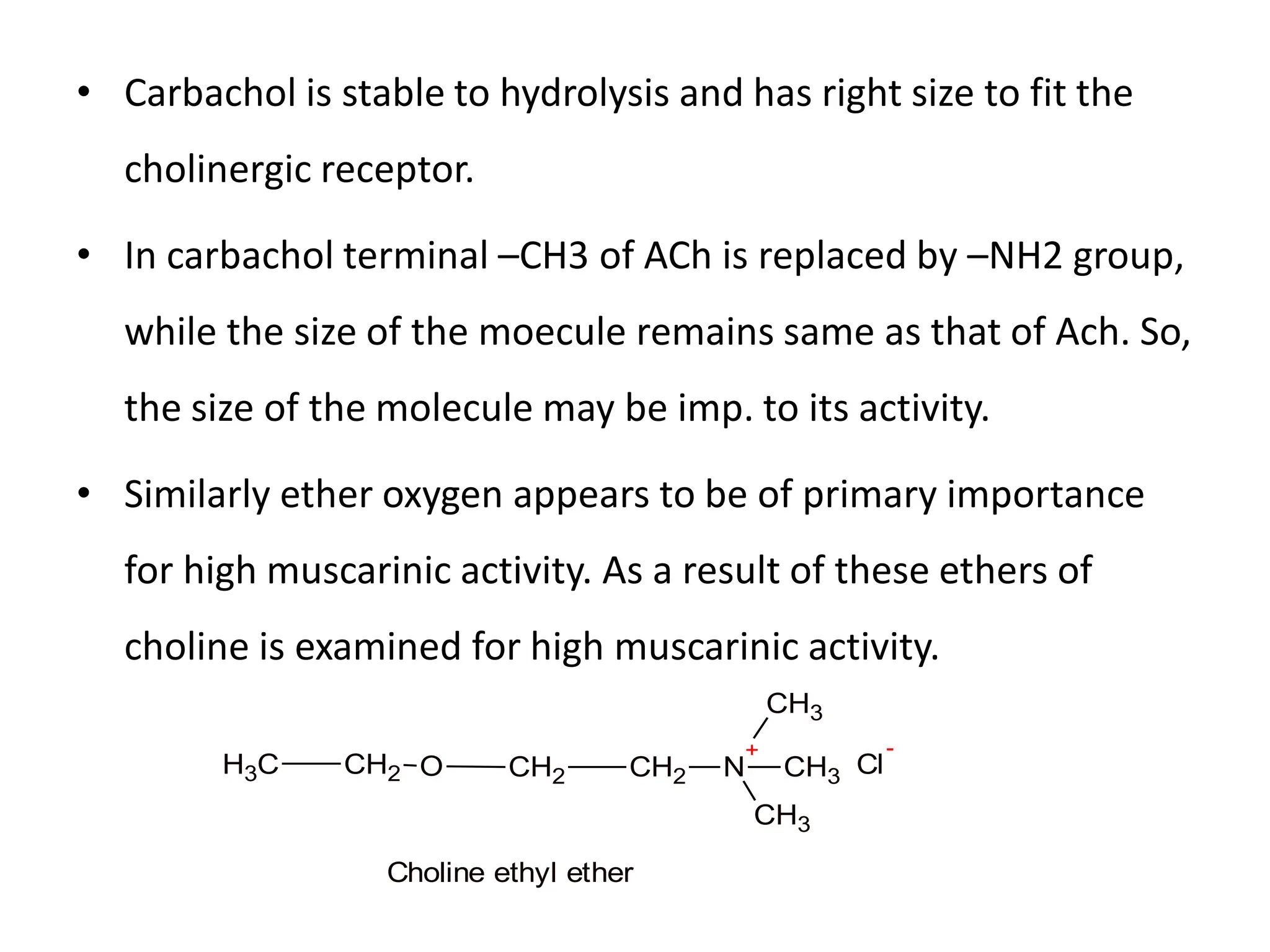
• Similarly ether oxygen appears to be of primary importance
for high muscarinic activity. As a result of these ethers of
choline is examined for high muscarinic activity.
Cl
-
O CH2 CH2 N
+
CH3
CH3
CH3
CH2
C
H3
Choline ethyl ether
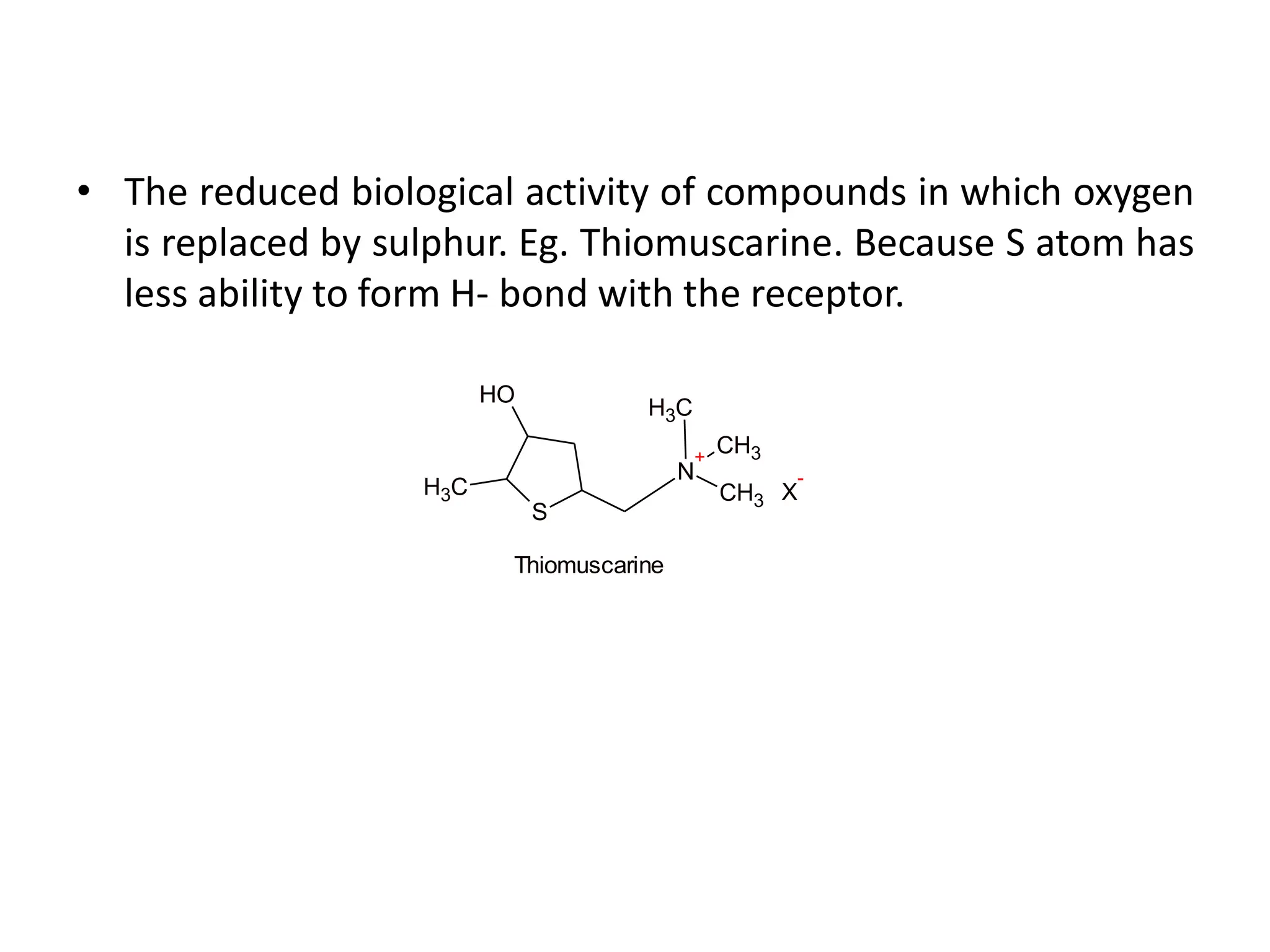
• The reduced biological activity of compounds in which oxygen
is replaced by sulphur. Eg. Thiomuscarine. Because S atom has
less ability to form H- bond with the receptor.
N
+
CH3
CH3
C
H3
S
C
H3
O
H
Thiomuscarine
X
-

Presentation on Parasympathetic Nervous System

  • 1.
  • 2.
    AUTONOMIC NERVOUS SYSTEM •Part of nervous system that controls and regulate the internal organs. Two types • Sympathetic Nervous System: Release Adrenaline • Parasympathetic Nervous System: Release Acetylcholine
  • 3.
    Cholinergic Neurotransmitter Acetylcholine • Pre& post ganglionic fibres of parasympathetic nerves liberate Ach. • Important Responses of Ach 1. Contraction of Smooth muscles 2. Cardiac Inhibition 3. Peripheral Vasodilation
  • 4.
    Biosynthesis of ACh •Ach is major neurotransmitter of post ganglionic synapses of cholinergic or parasympathetic nerve ending. C H3 C O O CH2 CH2 N + CH3 CH3 CH3
  • 5.
    • Ach isbiosynthesized in nerve terminal. • Ach is synthesized by Choline and Acetyl coenzyme with the help of Acetycholine transferase. • Active transport system involves picking up of choline molecule from extrasynaptic fluid. • This transport is dependent upon intracellular conc. of Na+ & K+ ions.
  • 6.
    • Choline isacetylated in the cytoplasm by acetyl coenzyme A which is biosynthesized in mitochondria present in the nerve terminal. • Ach is stored in synaptic vesicles • When impulse reaches to nerve terminal depolarization causes activation of Ca ionophore , allows influx of Ca ions, rupturing of storage vesicles to release of Ach.
  • 9.
    Ach gets quicklyhydrolysed by Acetylcholinesterase (AChE), upon hydrolysis Ach is converted into acetic acid and Choline. C H3 C O O CH2 CH2 N + CH3 CH3 CH3 Choline + Acetyl Co - A Chloineacetylase Acetylcholine Release of ACh Acetylcholinesterase Choline + ACetic acid O H CH2 CH2 N + CH3 CH3 CH3 Choline CH3COOH Acetylcholine Acetic acid
  • 10.
    Cholinergic Receptor • Acetylcholineacts on more than one type of receptor. • Henry Dale, a British physiologist working in London in 1914, found that two foreign substances, nicotine and muscarine, could each mimic some, but not all, of the parasympathetic effects of acetylcholine. • It was found that Nicotine stimulates receptors on skeletal muscle however, muscarine stimulates receptor sites located only at the junction between postganglionic parasympathetic neurons and the target organ.
  • 11.
    • Dale thereforeclassified the many actions of acetylcholine into nicotinic effects and muscarinic effects. • nicotinic receptors cause sympathetic postganglionic neurons and parasympathetic postganglionic neurons to release their chemicals and skeletal muscle to contract. • Muscarinic receptors are associated mainly with parasympathetic functions and stimulates receptors located in peripheral tissues (e.g., glands, smooth muscle). • Acetylcholine activates all of these sites.
  • 13.
  • 14.
    Nicotinic Receptors • N1- These are found at the skeletal muscle endplate and are responsible for mediating skeletal muscle contractions. They are activated specifically by phenyltrimethyl ammonium and inhibited by tubocurarine. • N2 - Found in ganglionic cells, adrenal medullary cells, the spinal cord, and specific parts of the brain. They are predominantly activated and inhibited by dimethylphenylpiperazine and hexamethonium.
  • 15.
    Muscarinic Actions NicotinicActions Cardiac Inhibition Peripheral Vasodilation Constriction of eye pupil Increased salivation Contraction of peristaltic action on GIT and urinary tract Stimulation and maintainance of tone of skeletal muscles
  • 16.
    Chemical Features ofACh C H3 C O O CH2 CH2 N + CH3 CH3 CH3 Acetyl Group Ethylene bridge Quaternary Ammonium group
  • 17.
    Chemical Features ofACh • Chemically Ach is an ester of acetic acid and choline • On the structural basis, it offers 3 sites for molecular modification, 1. Acetyl group 2. Ethylene bridge 3. Quaternary ammonium group • Quaternary ammonium group is linked by ethylene bridge to an ester group. • Free ACh is rapidly hydrolysed to acetic acid and choline molecule by cholinesterase enzyme.
  • 18.
    SAR • Any changein the ethylene bridge may affect the chemical stability of ACh. • Cationic ammonium group is essential for manifestation of both muscarinic and nicotinic receptor activities. • Quaternary nitrogen may be replaced by arsenic, antimony, phosphorous or sulphur without loss of ACh like activity. • For maximal muscarinic activity there should not be more than 4 atoms between N and terminal C atom. C H3 C O O CH2 CH2 N + CH3 CH3 CH3 Acetylcholine
  • 19.
    • If bulkysubstituents are placed on terminal carbon atom of acetyl group, these substituents block the access of ACh to the receptor. This results in antimuscarinic activity. Eg. Benzilylcholine, Tropylcholine. CH C H5C6 H5C6 O O CH2 CH2 N + CH3 CH3 CH3 CH C H5C6 HOH2C O O CH2 CH2 N + CH3 CH3 CH3 Benzilylcholine Tropylcholine
  • 20.
    Cholinergic Receptor  FromSAR studies structure of cholinergic receptor is predicted as  Quaternary ammonium group forms electrostatic bond with anionoic site.  Ester forms H- bond at the esteratic site.  Methyl group present on N atom along with terminal –CH3 are bound to the receptor by both hydrophobic and van der waal forces C H3 C O O + CH2 CH2 N CH3 CH3 CH3 OH - Esteratic site Anionic site +
  • 21.
    • The bindingassures a close fit of the molecule to the receptor as shown below. 1.Region of Hydrophobic binding (Van der waals forces) 2.Region of H- bonding 3.Region of ionic bonding C H3 C O CH2 CH2 N + CH3 CH3 CH3 O O N H H 1 1 2 1 3 CO2 -
  • 22.
    SAR of Parasympathomimeticagents 1. Modification at Quaternary ammonium group  The trimethylammonium group is the optimal functional requirement for the activity. There are following exceptions. O O H5C2 CH2 N N CH3 Pilocarpine N H COOCH 3 Arecoline N N CH3 Nicotine
  • 23.
    2. Modification ofEthylene bridge • There should not be more than 4 atoms between nitrogen and terminal carbon atom. • Replacement of H atom of ethylene bridge by alkyl group produces far less active compound. • Presence of methyl group beta to the quaternary nitrogen atom increases muscarinic activity. • Added methyl group hinders the attack of esterase enzyme thus slows down enzymatic hydrolysis. • Methyl group alpha to the N increases nicotinic activity. C H3 C O O CH CH2 N + CH3 CH3 CH3 CH3 Methacoline
  • 24.
    3. Modification ofthe Acyl group • When the acyl group is substituted by its higher homologues (propionyl, butyryl etc.), less active compounds are formed. • Choline esters of aromatic or higher molecular weight acids are cholinergic antagonist rather than agonists. • When terminal methyl group is replaced by –NH2 group, is potent cholinergic agent with both muscarinic and nicotinic activities. N H2 C O O CH CH2 N + CH3 CH3 CH3 CH3 Cl - Bethanechol chloride Cl - N H2 C O O CH2 CH2 N + CH3 CH3 CH3 Carbachol chloride
  • 25.
    • Carbachol isstable to hydrolysis and has right size to fit the cholinergic receptor. • In carbachol terminal –CH3 of ACh is replaced by –NH2 group, while the size of the moecule remains same as that of Ach. So, the size of the molecule may be imp. to its activity. • Similarly ether oxygen appears to be of primary importance for high muscarinic activity. As a result of these ethers of choline is examined for high muscarinic activity. Cl - O CH2 CH2 N + CH3 CH3 CH3 CH2 C H3 Choline ethyl ether
  • 26.
    • The reducedbiological activity of compounds in which oxygen is replaced by sulphur. Eg. Thiomuscarine. Because S atom has less ability to form H- bond with the receptor. N + CH3 CH3 C H3 S C H3 O H Thiomuscarine X -