1
2
3
What is Orange Book
The Orange Book identifies
(1) drug products approved by FDA under the Federal Food, Drug, and Cosmetic Act
(FD&C Act) and
(2) Patent and exclusivity information related to approved drug products.
The Orange Book is composed of four main parts:
(1) The Prescription Drug Product List,
(2) The OTC Drug Product List,
(3) The Drug Products with Approval under Section 505 of the FD&C Act
Administered by the Center for Biologics Evaluation and Research List; and
(4) The Discontinued Drug Product List,
4
This Q&A guidance cover the following topics:
A. General inquiries about the content and format of the Orange Book
B. Petitioned ANDAs
C. The movement of drug products between the Active and
Discontinued Sections of the Orange Book
D. Patent listings
5
A. General inquiries about the content and format of
the Orange Book
Q1. Which applications are not listed in the Orange Book?
The Orange Book does not include:
(1) approved drug products that were discontinued either before the first
edition in October 1980 or discontinued between 1980 and 1987, prior to
the identification of discontinued products;
(2) Drug products that have a tentative approval;
(3) Drug products marketed before 1962 for which a Drug Efficacy Study
Implementation review has not been completed;
(4) Biological products licensed by FDA under the Public Health Service
Act
(5) Marketed drug products that are not the subject of an approved
NDA or ANDA (e.g., under OTC monograph); and
(6) Drug products compounded by a pharmacy and drug products
compounded by an outsourcing facility.
6
A. General inquiries about the content and format of
the Orange Book
Q2. Can I access the current data files for the Orange Book? How are data
provided?
Yes.
The Orange Book Data Files contain current Orange Book data for approved drug
products and unexpired patent and exclusivity data,
7
A. General inquiries about the content and format of
the Orange Book
Q3. When is the Orange Book updated? What information is included in the
updates?
The information in the Orange Book is updated in two ways—
on its website and in print publications that are also available as downloadable
PDFs.
Website updates occur on a daily, semimonthly, monthly, and annual basis.
Print updates occur on a monthly and annual basis.
 Daily updates generally occurs in the afternoon (work days) and consist of patent
information and new generic drug approvals.
 The Semimonthly website updates generally occur twice each month on a
Monday. They consist of new drug approvals, ownership changes, market status
updates, and various types of changes to drug listing information.
 The monthly data files updates, the monthly website updates, and the monthly
print updates, generally occur at the end of the second week of each month and
consist of all changes to the Orange Book which occurred in the prior month.
 The print annual edition of the Orange Book, which is posted on the website,
generally occurs in January and consists of a full copy of the Orange Book
8
A. General inquiries about the content and format of
the Orange Book
Q4. When are newly approved NDA drug products listed in the Orange Book?
Newly approved NDA drug products will generally appear in the Active Section of
the Orange Book in the month following their approval, and will remain there unless
the If the NDA holder notifies FDA that it does not intend to market upon approval,
the NDA drug product will, in the month following such approval, appear in the
Discontinued Section.
9
A. General inquiries about the content and format of
the Orange Book
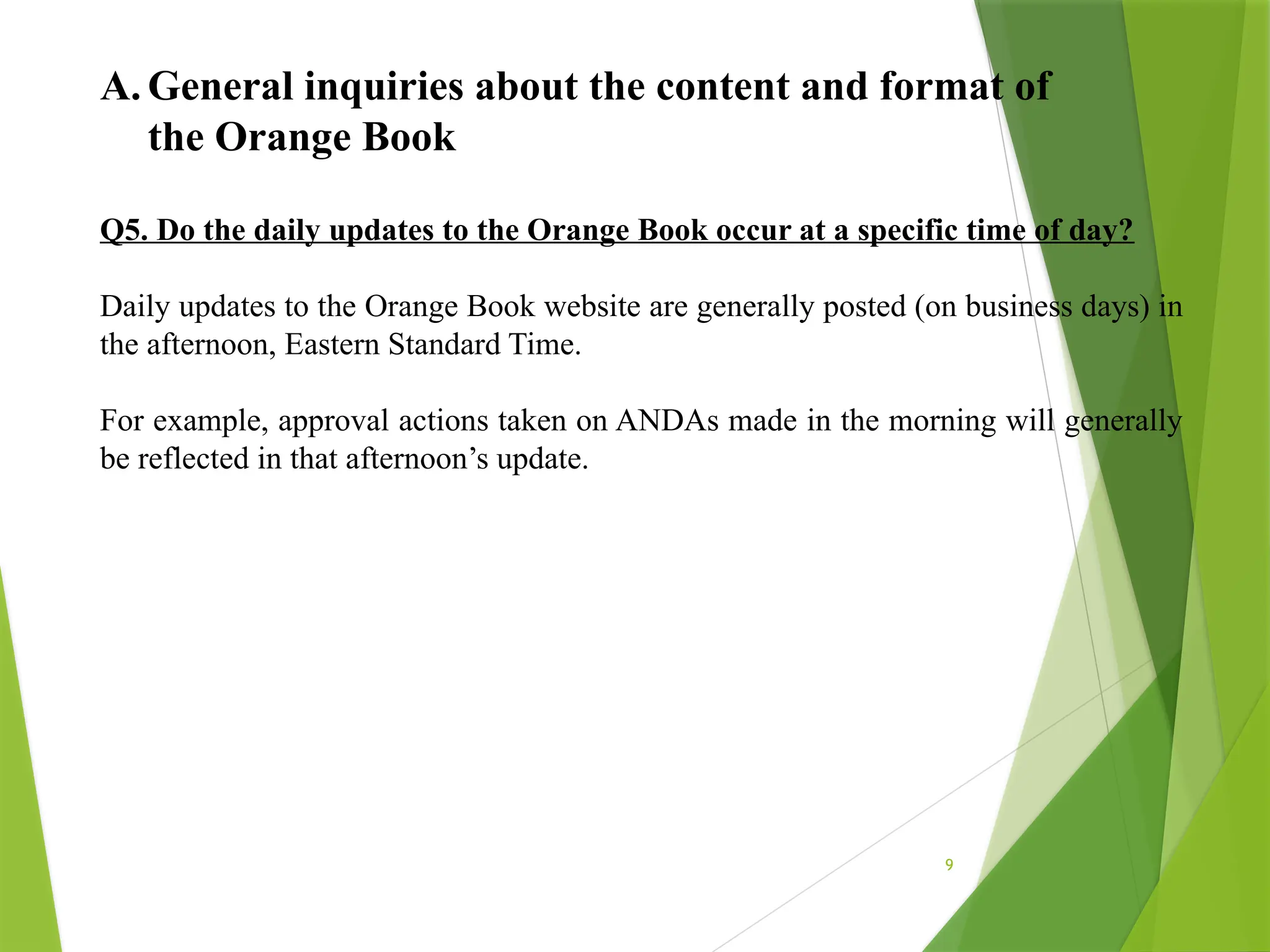
Q5. Do the daily updates to the Orange Book occur at a specific time of day?
Daily updates to the Orange Book website are generally posted (on business days) in
the afternoon, Eastern Standard Time.
For example, approval actions taken on ANDAs made in the morning will generally
be reflected in that afternoon’s update.
10
A. General inquiries about the content and format of
the Orange Book
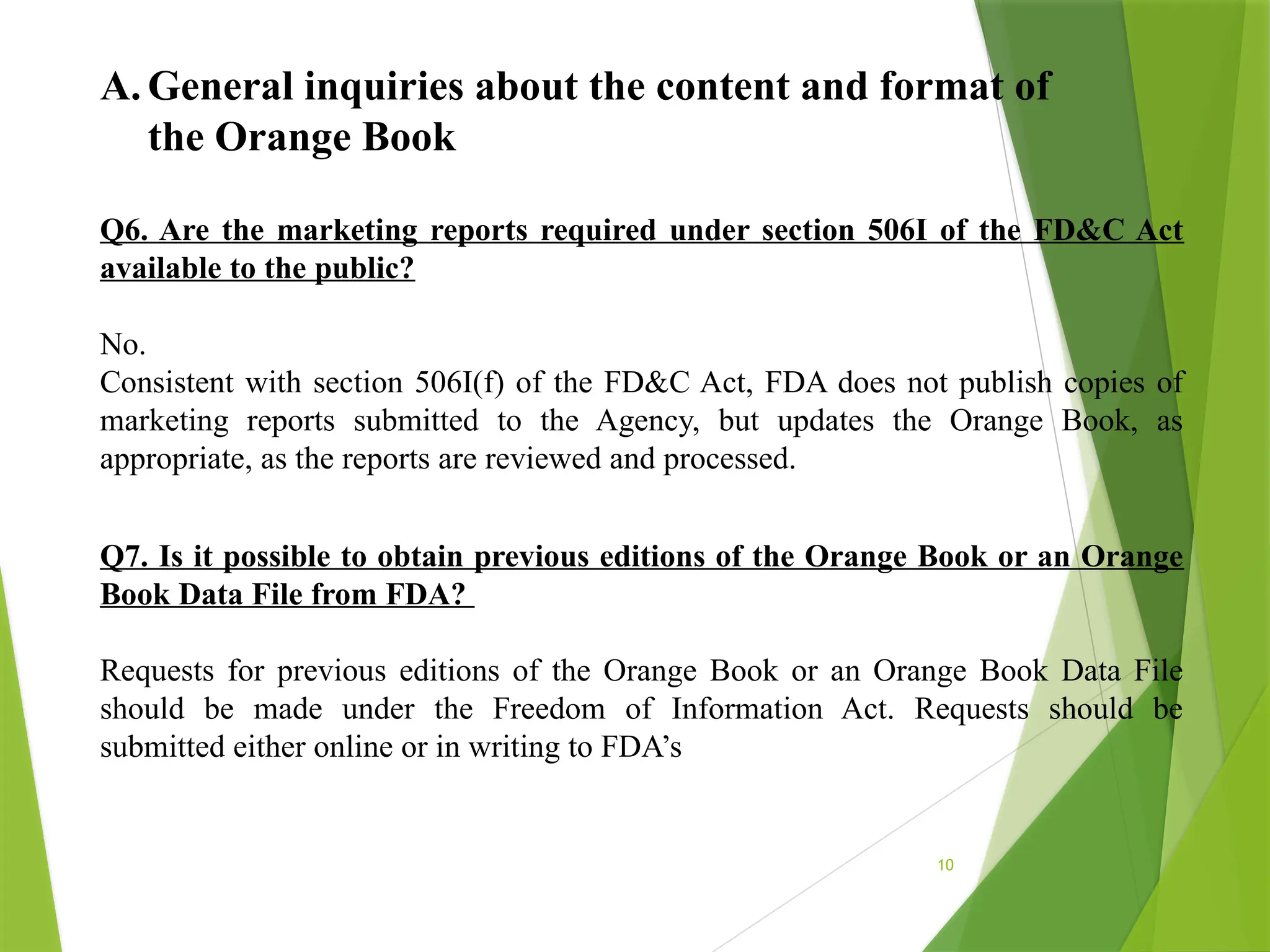
Q6. Are the marketing reports required under section 506I of the FD&C Act
available to the public?
No.
Consistent with section 506I(f) of the FD&C Act, FDA does not publish copies of
marketing reports submitted to the Agency, but updates the Orange Book, as
appropriate, as the reports are reviewed and processed.
Q7. Is it possible to obtain previous editions of the Orange Book or an Orange
Book Data File from FDA?
Requests for previous editions of the Orange Book or an Orange Book Data File
should be made under the Freedom of Information Act. Requests should be
submitted either online or in writing to FDA’s
11
B. Petitioned ANDAs
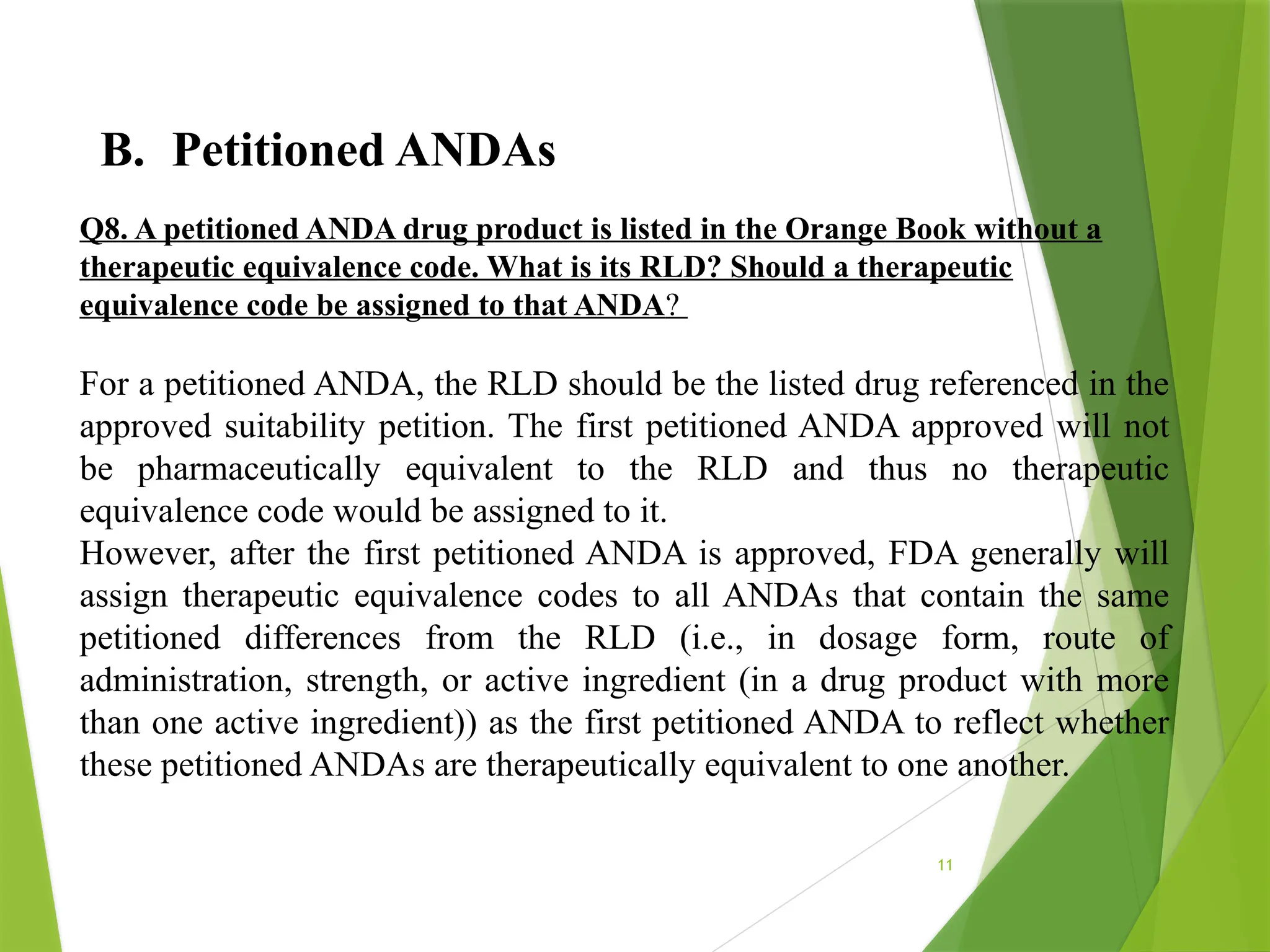
Q8. A petitioned ANDA drug product is listed in the Orange Book without a
therapeutic equivalence code. What is its RLD? Should a therapeutic
equivalence code be assigned to that ANDA?
For a petitioned ANDA, the RLD should be the listed drug referenced in the
approved suitability petition. The first petitioned ANDA approved will not
be pharmaceutically equivalent to the RLD and thus no therapeutic
equivalence code would be assigned to it.
However, after the first petitioned ANDA is approved, FDA generally will
assign therapeutic equivalence codes to all ANDAs that contain the same
petitioned differences from the RLD (i.e., in dosage form, route of
administration, strength, or active ingredient (in a drug product with more
than one active ingredient)) as the first petitioned ANDA to reflect whether
these petitioned ANDAs are therapeutically equivalent to one another.
12
C. The Movement of Drug Products Between the Active
and Discontinued Sections of the Orange Book
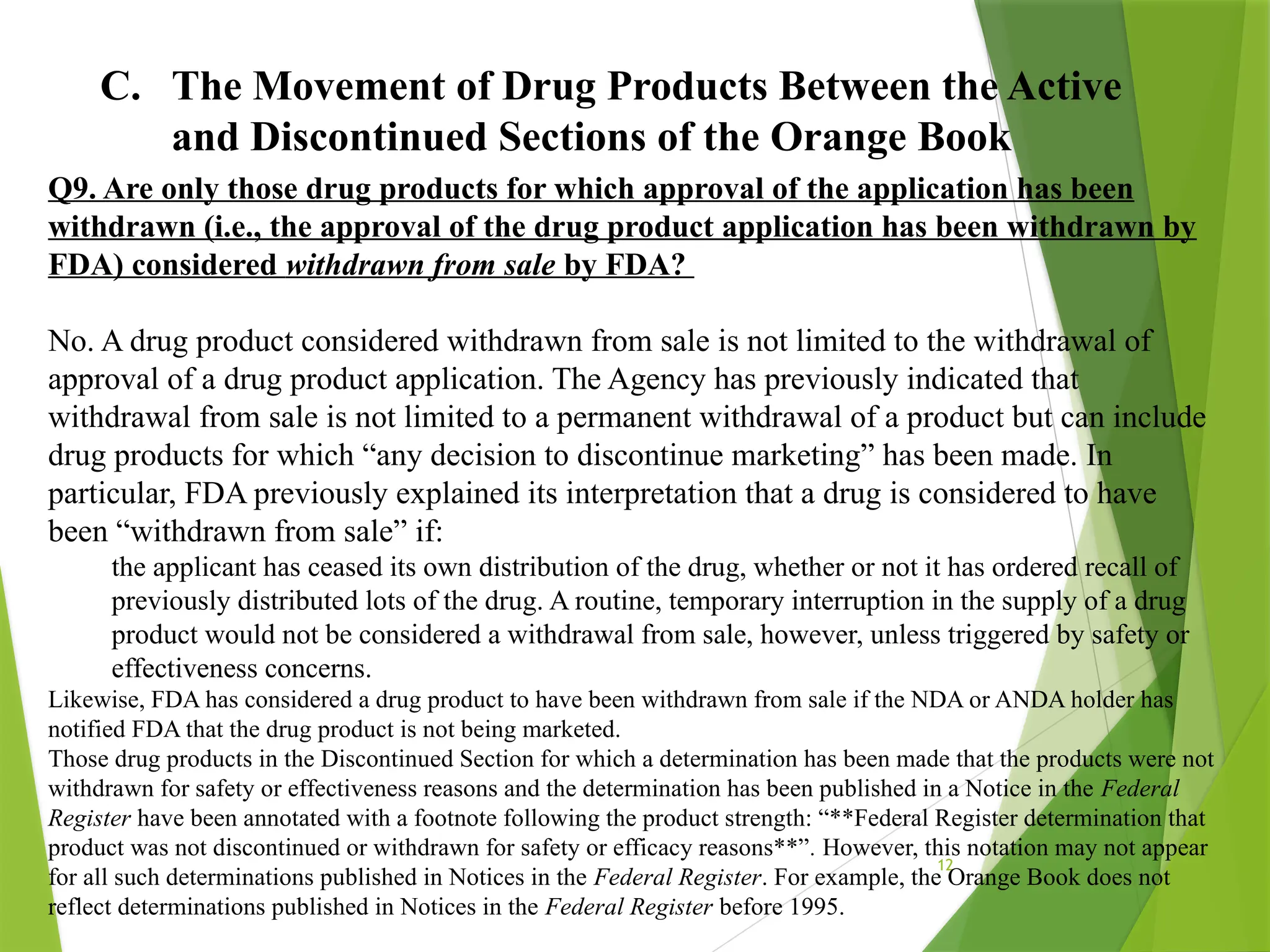
Q9. Are only those drug products for which approval of the application has been
withdrawn (i.e., the approval of the drug product application has been withdrawn by
FDA) considered withdrawn from sale by FDA?
No. A drug product considered withdrawn from sale is not limited to the withdrawal of
approval of a drug product application. The Agency has previously indicated that
withdrawal from sale is not limited to a permanent withdrawal of a product but can include
drug products for which “any decision to discontinue marketing” has been made. In
particular, FDA previously explained its interpretation that a drug is considered to have
been “withdrawn from sale” if:
the applicant has ceased its own distribution of the drug, whether or not it has ordered recall of
previously distributed lots of the drug. A routine, temporary interruption in the supply of a drug
product would not be considered a withdrawal from sale, however, unless triggered by safety or
effectiveness concerns.
Likewise, FDA has considered a drug product to have been withdrawn from sale if the NDA or ANDA holder has
notified FDA that the drug product is not being marketed.
Those drug products in the Discontinued Section for which a determination has been made that the products were not
withdrawn for safety or effectiveness reasons and the determination has been published in a Notice in the Federal
Register have been annotated with a footnote following the product strength: “**Federal Register determination that
product was not discontinued or withdrawn for safety or efficacy reasons**”. However, this notation may not appear
for all such determinations published in Notices in the Federal Register. For example, the Orange Book does not
reflect determinations published in Notices in the Federal Register before 1995.
13
C. The Movement of Drug Products Between the Active
and Discontinued Sections of the Orange Book
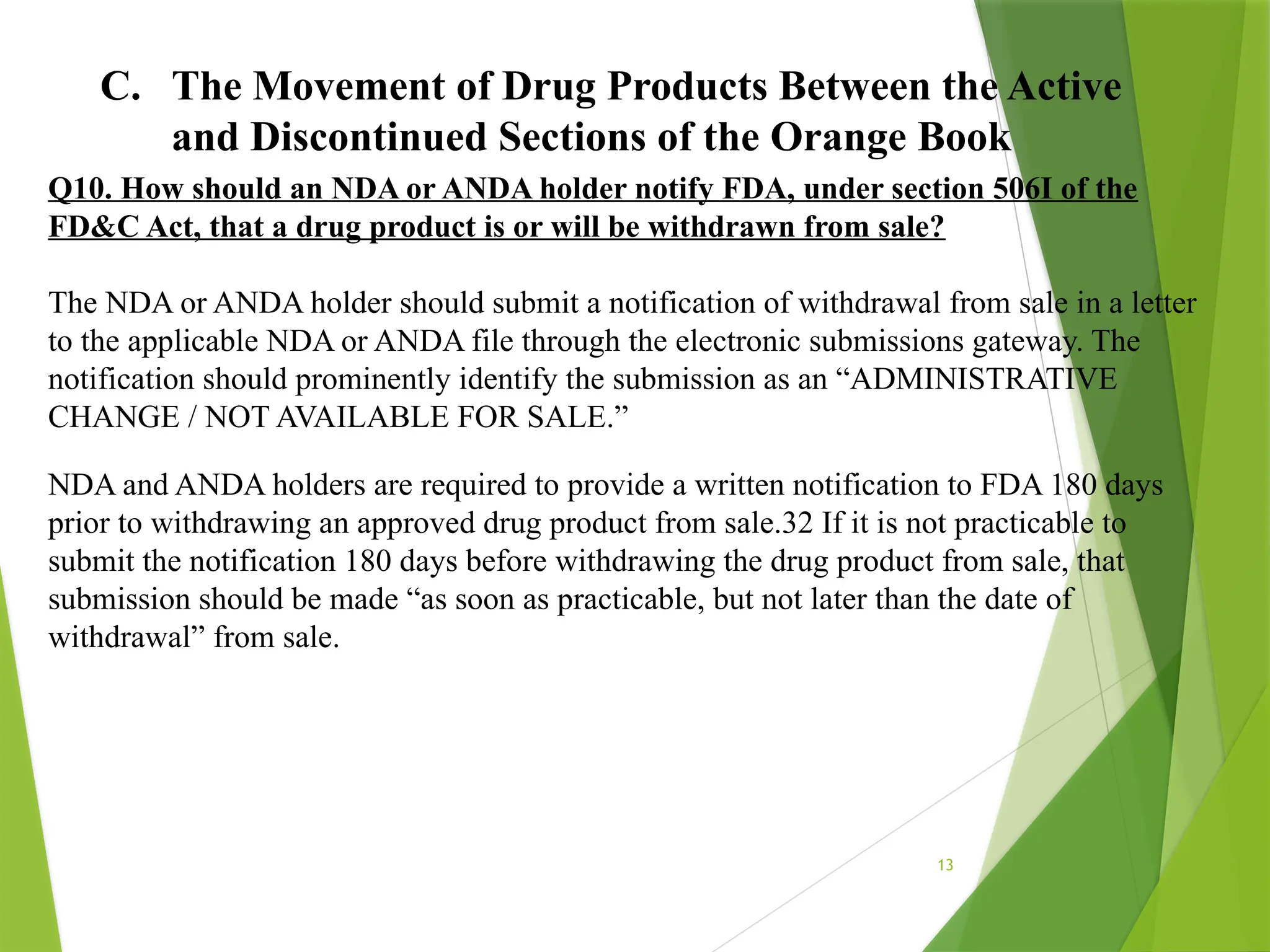
Q10. How should an NDA or ANDA holder notify FDA, under section 506I of the
FD&C Act, that a drug product is or will be withdrawn from sale?
The NDA or ANDA holder should submit a notification of withdrawal from sale in a letter
to the applicable NDA or ANDA file through the electronic submissions gateway. The
notification should prominently identify the submission as an “ADMINISTRATIVE
CHANGE / NOT AVAILABLE FOR SALE.”
NDA and ANDA holders are required to provide a written notification to FDA 180 days
prior to withdrawing an approved drug product from sale.32 If it is not practicable to
submit the notification 180 days before withdrawing the drug product from sale, that
submission should be made “as soon as practicable, but not later than the date of
withdrawal” from sale.
14
C. The Movement of Drug Products Between the Active
and Discontinued Sections of the Orange Book
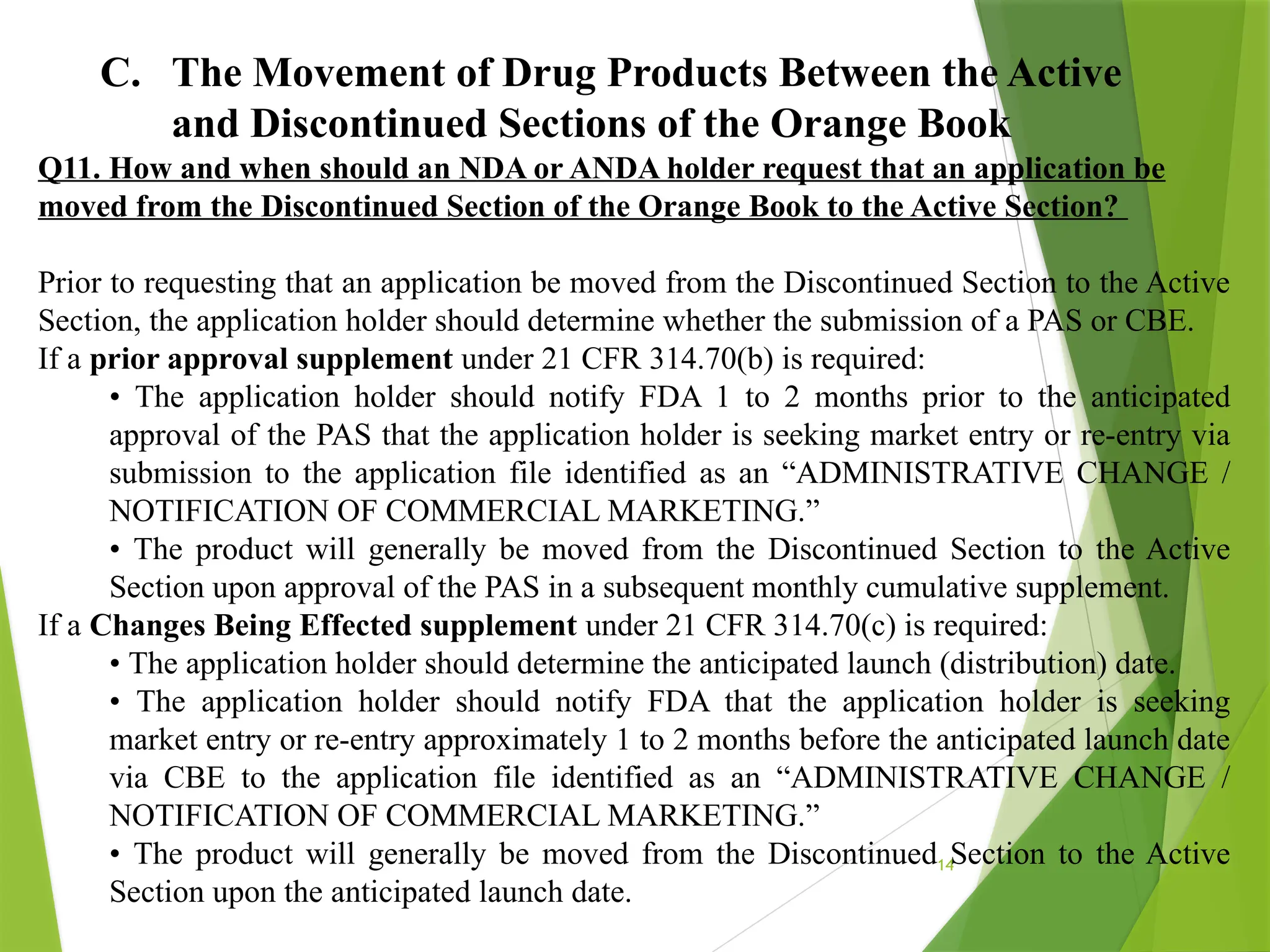
Q11. How and when should an NDA or ANDA holder request that an application be
moved from the Discontinued Section of the Orange Book to the Active Section?
Prior to requesting that an application be moved from the Discontinued Section to the Active
Section, the application holder should determine whether the submission of a PAS or CBE.
If a prior approval supplement under 21 CFR 314.70(b) is required:
• The application holder should notify FDA 1 to 2 months prior to the anticipated
approval of the PAS that the application holder is seeking market entry or re-entry via
submission to the application file identified as an “ADMINISTRATIVE CHANGE /
NOTIFICATION OF COMMERCIAL MARKETING.”
• The product will generally be moved from the Discontinued Section to the Active
Section upon approval of the PAS in a subsequent monthly cumulative supplement.
If a Changes Being Effected supplement under 21 CFR 314.70(c) is required:
• The application holder should determine the anticipated launch (distribution) date.
• The application holder should notify FDA that the application holder is seeking
market entry or re-entry approximately 1 to 2 months before the anticipated launch date
via CBE to the application file identified as an “ADMINISTRATIVE CHANGE /
NOTIFICATION OF COMMERCIAL MARKETING.”
• The product will generally be moved from the Discontinued Section to the Active
Section upon the anticipated launch date.
15
C. The Movement of Drug Products Between the Active
and Discontinued Sections of the Orange Book
Q12. When will a move of a drug product to or from the Discontinued Section be
reflected in the Orange Book?
A move to or from the Discontinued Section will generally be reflected in a future Orange
Book monthly cumulative supplement update.
16
D. Patent listings
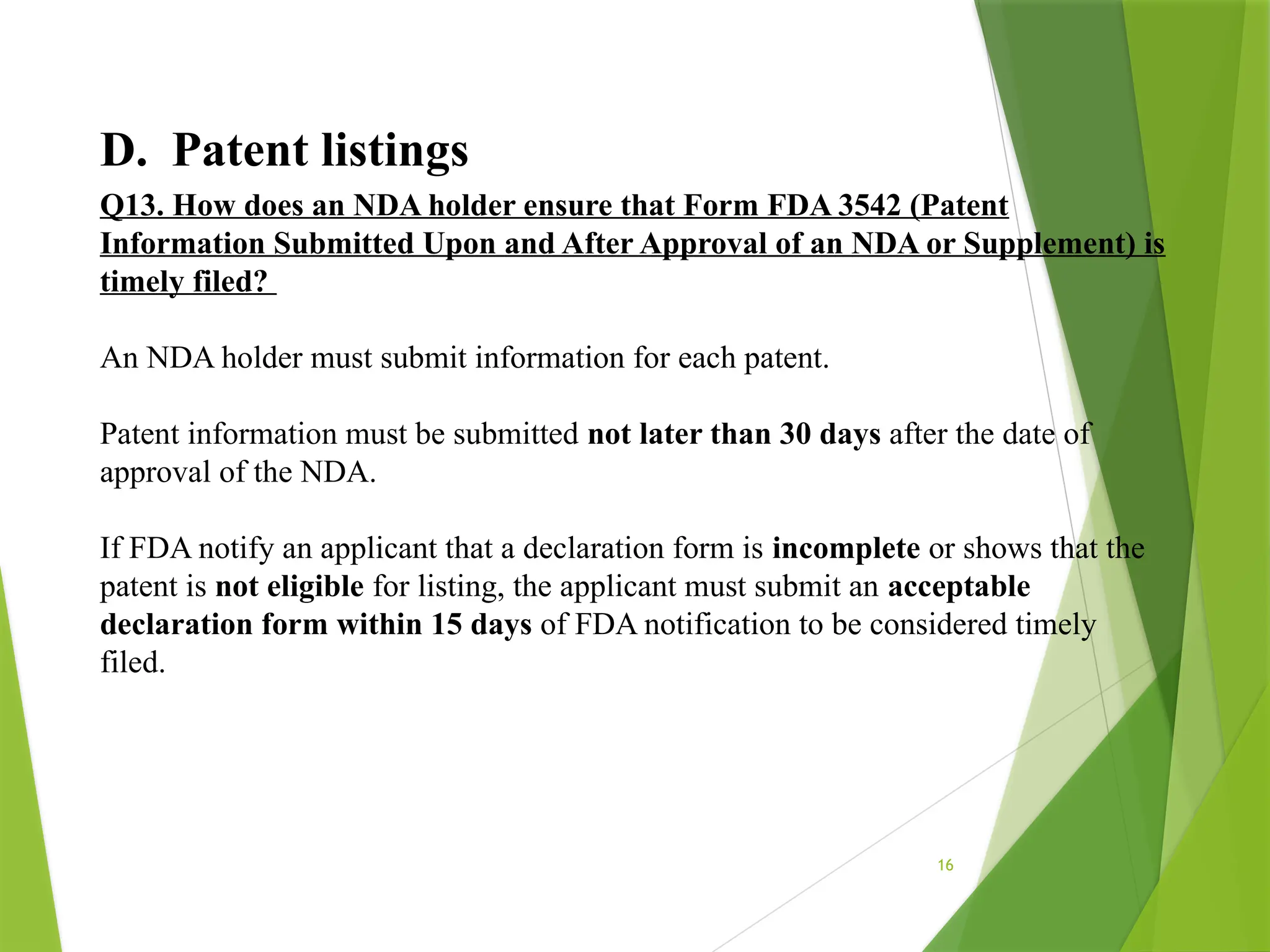
Q13. How does an NDA holder ensure that Form FDA 3542 (Patent
Information Submitted Upon and After Approval of an NDA or Supplement) is
timely filed?
An NDA holder must submit information for each patent.
Patent information must be submitted not later than 30 days after the date of
approval of the NDA.
If FDA notify an applicant that a declaration form is incomplete or shows that the
patent is not eligible for listing, the applicant must submit an acceptable
declaration form within 15 days of FDA notification to be considered timely
filed.
17
D. Patent listings
Q14. How does an NDA holder ensure that an amendment to the description of
an approved method of use claimed by the patent is timely filed?
An NDA holder’s amendment to the description of an approved method(s) of use
(MOU) claimed by the patent will be considered timely filed if it is submitted
within 30 days of
(1) patent issuance,
(2) approval of a corresponding change to the drug product labeling, or
(3) a decision by the U.S. Patent and Trademark Office or a Federal court that is
specific to the patent and alters the construction of a method-of-use claim(s) of
the patent.
Outside of these circumstances, and except as provided in the patent listing dispute
regulations, an amendment to the description of the approved MOU claimed by the
patent will not be considered timely filed.
18
D. Patent listings
Q15. How can an NDA holder submit a reissued patent to the Orange Book for
listing?
An NDA holder is required to request that the original patent be removed from the
Orange Book once a patent is reissued because, upon patent reissuance, the original
patent is surrendered and ceases to have legal effect.
Consistent with our regulations for any request to withdraw a patent from the
Orange Book, the original patent will remain listed in the Orange Book until FDA
determines that no first applicant is eligible for 180-day exclusivity based on a
paragraph IV certification to that patent or after the 180-day exclusivity period of a
first applicant based on that patent has expired or has been extinguished or
relinquished.
19
D. Patent listings
Q16. How does FDA receive and process a request from an NDA holder for
removal of a patent or patent information from the Orange Book?
If an NDA holder determines that a patent or patent claim no longer meets the
statutory requirements for listing, the NDA holder must promptly notify FDA to
amend or withdraw the patent information and request that the patent information
be removed from the Orange Book.
Where any claim of a listed patent has been cancelled or invalidated by law/ court,
if the NDA holder determines that a patent or patent information no longer meets
the statutory listing requirements, the NDA holder must notify FDA in writing
within 14 days of the decision by law/court.
FDA will remove a patent or patent information from the Orange Book if there is
no first applicant eligible for 180-day exclusivity based on a paragraph IV
certification to that patent or after the expiration, extinguishment, or relinquishment
of any 180-day exclusivity period for a first applicant.
20
D. Patent listings
Q17. An NDA holder has requested that a patent be removed from the Orange
Book. The patent remains in the Orange Book with a delist request flag. When
will the patent be removed?
A patent may remain listed for a certain period even if the NDA holder requests that
it be removed because a first applicant may retain eligibility for 180-day
exclusivity based on a paragraph IV certification to this patent.
Until the patent is removed from the Orange Book ― after any associated 180-day
exclusivity has expired or has been extinguished or relinquished ― ANDA
applicants must submit or maintain appropriate certifications to the patent
notwithstanding the NDA holder’s request to remove the patent.
Applicants submitting a 505(b)(2) application are not required to certify
to a patent when the delist request flag is set to Y in the Orange Book.
21
D. Patent listings
Q18. Can a patent listing be disputed?
Yes.
Section 314.53(f)(1) outlines a process through which a person other than the NDA
holder can dispute the accuracy or relevance of patent information published in the
Orange Book, as well as the process for the relevant NDA holder to respond to such
disputes.
If any person either “disputes the accuracy or relevance of patent information
submitted to the Agency” and published by the Agency in the Orange Book or
“believes that an NDA holder has failed to submit required patent information, that
person must first notify the Agency in a written or electronic communication.
The patent listing dispute “must include a statement of dispute that describes the
specific grounds for disagreement regarding the accuracy or relevance of patent
information,” which FDA will send to the applicable NDA holder
22
D. Patent listings
Q19. How does FDA provide notification to the public of whether a patent
listing dispute has been submitted?
For all patent listing disputes, FDA promptly posts information to a Patent Listing
Dispute List website indicating whether
(1) a patent listing dispute has been submitted to FDA and
(2) the NDA holder has timely responded to the patent listing dispute.
The Patent Listing Dispute List contains relevant drug product information and
information on the disputed patent. This list is cumulative in nature and is
organized by the drug product established name and patent number(s).
23

Presentation on Orange Book Questions and Answers

  • 1.
  • 2.
  • 3.
    3 What is OrangeBook The Orange Book identifies (1) drug products approved by FDA under the Federal Food, Drug, and Cosmetic Act (FD&C Act) and (2) Patent and exclusivity information related to approved drug products. The Orange Book is composed of four main parts: (1) The Prescription Drug Product List, (2) The OTC Drug Product List, (3) The Drug Products with Approval under Section 505 of the FD&C Act Administered by the Center for Biologics Evaluation and Research List; and (4) The Discontinued Drug Product List,
  • 4.
    4 This Q&A guidancecover the following topics: A. General inquiries about the content and format of the Orange Book B. Petitioned ANDAs C. The movement of drug products between the Active and Discontinued Sections of the Orange Book D. Patent listings
  • 5.
    5 A. General inquiriesabout the content and format of the Orange Book Q1. Which applications are not listed in the Orange Book? The Orange Book does not include: (1) approved drug products that were discontinued either before the first edition in October 1980 or discontinued between 1980 and 1987, prior to the identification of discontinued products; (2) Drug products that have a tentative approval; (3) Drug products marketed before 1962 for which a Drug Efficacy Study Implementation review has not been completed; (4) Biological products licensed by FDA under the Public Health Service Act (5) Marketed drug products that are not the subject of an approved NDA or ANDA (e.g., under OTC monograph); and (6) Drug products compounded by a pharmacy and drug products compounded by an outsourcing facility.
  • 6.
    6 A. General inquiriesabout the content and format of the Orange Book Q2. Can I access the current data files for the Orange Book? How are data provided? Yes. The Orange Book Data Files contain current Orange Book data for approved drug products and unexpired patent and exclusivity data,
  • 7.
    7 A. General inquiriesabout the content and format of the Orange Book Q3. When is the Orange Book updated? What information is included in the updates? The information in the Orange Book is updated in two ways— on its website and in print publications that are also available as downloadable PDFs. Website updates occur on a daily, semimonthly, monthly, and annual basis. Print updates occur on a monthly and annual basis.  Daily updates generally occurs in the afternoon (work days) and consist of patent information and new generic drug approvals.  The Semimonthly website updates generally occur twice each month on a Monday. They consist of new drug approvals, ownership changes, market status updates, and various types of changes to drug listing information.  The monthly data files updates, the monthly website updates, and the monthly print updates, generally occur at the end of the second week of each month and consist of all changes to the Orange Book which occurred in the prior month.  The print annual edition of the Orange Book, which is posted on the website, generally occurs in January and consists of a full copy of the Orange Book
  • 8.
    8 A. General inquiriesabout the content and format of the Orange Book Q4. When are newly approved NDA drug products listed in the Orange Book? Newly approved NDA drug products will generally appear in the Active Section of the Orange Book in the month following their approval, and will remain there unless the If the NDA holder notifies FDA that it does not intend to market upon approval, the NDA drug product will, in the month following such approval, appear in the Discontinued Section.
  • 9.
    9 A. General inquiriesabout the content and format of the Orange Book Q5. Do the daily updates to the Orange Book occur at a specific time of day? Daily updates to the Orange Book website are generally posted (on business days) in the afternoon, Eastern Standard Time. For example, approval actions taken on ANDAs made in the morning will generally be reflected in that afternoon’s update.
  • 10.
    10 A. General inquiriesabout the content and format of the Orange Book Q6. Are the marketing reports required under section 506I of the FD&C Act available to the public? No. Consistent with section 506I(f) of the FD&C Act, FDA does not publish copies of marketing reports submitted to the Agency, but updates the Orange Book, as appropriate, as the reports are reviewed and processed. Q7. Is it possible to obtain previous editions of the Orange Book or an Orange Book Data File from FDA? Requests for previous editions of the Orange Book or an Orange Book Data File should be made under the Freedom of Information Act. Requests should be submitted either online or in writing to FDA’s
  • 11.
    11 B. Petitioned ANDAs Q8.A petitioned ANDA drug product is listed in the Orange Book without a therapeutic equivalence code. What is its RLD? Should a therapeutic equivalence code be assigned to that ANDA? For a petitioned ANDA, the RLD should be the listed drug referenced in the approved suitability petition. The first petitioned ANDA approved will not be pharmaceutically equivalent to the RLD and thus no therapeutic equivalence code would be assigned to it. However, after the first petitioned ANDA is approved, FDA generally will assign therapeutic equivalence codes to all ANDAs that contain the same petitioned differences from the RLD (i.e., in dosage form, route of administration, strength, or active ingredient (in a drug product with more than one active ingredient)) as the first petitioned ANDA to reflect whether these petitioned ANDAs are therapeutically equivalent to one another.
  • 12.
    12 C. The Movementof Drug Products Between the Active and Discontinued Sections of the Orange Book Q9. Are only those drug products for which approval of the application has been withdrawn (i.e., the approval of the drug product application has been withdrawn by FDA) considered withdrawn from sale by FDA? No. A drug product considered withdrawn from sale is not limited to the withdrawal of approval of a drug product application. The Agency has previously indicated that withdrawal from sale is not limited to a permanent withdrawal of a product but can include drug products for which “any decision to discontinue marketing” has been made. In particular, FDA previously explained its interpretation that a drug is considered to have been “withdrawn from sale” if: the applicant has ceased its own distribution of the drug, whether or not it has ordered recall of previously distributed lots of the drug. A routine, temporary interruption in the supply of a drug product would not be considered a withdrawal from sale, however, unless triggered by safety or effectiveness concerns. Likewise, FDA has considered a drug product to have been withdrawn from sale if the NDA or ANDA holder has notified FDA that the drug product is not being marketed. Those drug products in the Discontinued Section for which a determination has been made that the products were not withdrawn for safety or effectiveness reasons and the determination has been published in a Notice in the Federal Register have been annotated with a footnote following the product strength: “**Federal Register determination that product was not discontinued or withdrawn for safety or efficacy reasons**”. However, this notation may not appear for all such determinations published in Notices in the Federal Register. For example, the Orange Book does not reflect determinations published in Notices in the Federal Register before 1995.
  • 13.
    13 C. The Movementof Drug Products Between the Active and Discontinued Sections of the Orange Book Q10. How should an NDA or ANDA holder notify FDA, under section 506I of the FD&C Act, that a drug product is or will be withdrawn from sale? The NDA or ANDA holder should submit a notification of withdrawal from sale in a letter to the applicable NDA or ANDA file through the electronic submissions gateway. The notification should prominently identify the submission as an “ADMINISTRATIVE CHANGE / NOT AVAILABLE FOR SALE.” NDA and ANDA holders are required to provide a written notification to FDA 180 days prior to withdrawing an approved drug product from sale.32 If it is not practicable to submit the notification 180 days before withdrawing the drug product from sale, that submission should be made “as soon as practicable, but not later than the date of withdrawal” from sale.
  • 14.
    14 C. The Movementof Drug Products Between the Active and Discontinued Sections of the Orange Book Q11. How and when should an NDA or ANDA holder request that an application be moved from the Discontinued Section of the Orange Book to the Active Section? Prior to requesting that an application be moved from the Discontinued Section to the Active Section, the application holder should determine whether the submission of a PAS or CBE. If a prior approval supplement under 21 CFR 314.70(b) is required: • The application holder should notify FDA 1 to 2 months prior to the anticipated approval of the PAS that the application holder is seeking market entry or re-entry via submission to the application file identified as an “ADMINISTRATIVE CHANGE / NOTIFICATION OF COMMERCIAL MARKETING.” • The product will generally be moved from the Discontinued Section to the Active Section upon approval of the PAS in a subsequent monthly cumulative supplement. If a Changes Being Effected supplement under 21 CFR 314.70(c) is required: • The application holder should determine the anticipated launch (distribution) date. • The application holder should notify FDA that the application holder is seeking market entry or re-entry approximately 1 to 2 months before the anticipated launch date via CBE to the application file identified as an “ADMINISTRATIVE CHANGE / NOTIFICATION OF COMMERCIAL MARKETING.” • The product will generally be moved from the Discontinued Section to the Active Section upon the anticipated launch date.
  • 15.
    15 C. The Movementof Drug Products Between the Active and Discontinued Sections of the Orange Book Q12. When will a move of a drug product to or from the Discontinued Section be reflected in the Orange Book? A move to or from the Discontinued Section will generally be reflected in a future Orange Book monthly cumulative supplement update.
  • 16.
    16 D. Patent listings Q13.How does an NDA holder ensure that Form FDA 3542 (Patent Information Submitted Upon and After Approval of an NDA or Supplement) is timely filed? An NDA holder must submit information for each patent. Patent information must be submitted not later than 30 days after the date of approval of the NDA. If FDA notify an applicant that a declaration form is incomplete or shows that the patent is not eligible for listing, the applicant must submit an acceptable declaration form within 15 days of FDA notification to be considered timely filed.
  • 17.
    17 D. Patent listings Q14.How does an NDA holder ensure that an amendment to the description of an approved method of use claimed by the patent is timely filed? An NDA holder’s amendment to the description of an approved method(s) of use (MOU) claimed by the patent will be considered timely filed if it is submitted within 30 days of (1) patent issuance, (2) approval of a corresponding change to the drug product labeling, or (3) a decision by the U.S. Patent and Trademark Office or a Federal court that is specific to the patent and alters the construction of a method-of-use claim(s) of the patent. Outside of these circumstances, and except as provided in the patent listing dispute regulations, an amendment to the description of the approved MOU claimed by the patent will not be considered timely filed.
  • 18.
    18 D. Patent listings Q15.How can an NDA holder submit a reissued patent to the Orange Book for listing? An NDA holder is required to request that the original patent be removed from the Orange Book once a patent is reissued because, upon patent reissuance, the original patent is surrendered and ceases to have legal effect. Consistent with our regulations for any request to withdraw a patent from the Orange Book, the original patent will remain listed in the Orange Book until FDA determines that no first applicant is eligible for 180-day exclusivity based on a paragraph IV certification to that patent or after the 180-day exclusivity period of a first applicant based on that patent has expired or has been extinguished or relinquished.
  • 19.
    19 D. Patent listings Q16.How does FDA receive and process a request from an NDA holder for removal of a patent or patent information from the Orange Book? If an NDA holder determines that a patent or patent claim no longer meets the statutory requirements for listing, the NDA holder must promptly notify FDA to amend or withdraw the patent information and request that the patent information be removed from the Orange Book. Where any claim of a listed patent has been cancelled or invalidated by law/ court, if the NDA holder determines that a patent or patent information no longer meets the statutory listing requirements, the NDA holder must notify FDA in writing within 14 days of the decision by law/court. FDA will remove a patent or patent information from the Orange Book if there is no first applicant eligible for 180-day exclusivity based on a paragraph IV certification to that patent or after the expiration, extinguishment, or relinquishment of any 180-day exclusivity period for a first applicant.
  • 20.
    20 D. Patent listings Q17.An NDA holder has requested that a patent be removed from the Orange Book. The patent remains in the Orange Book with a delist request flag. When will the patent be removed? A patent may remain listed for a certain period even if the NDA holder requests that it be removed because a first applicant may retain eligibility for 180-day exclusivity based on a paragraph IV certification to this patent. Until the patent is removed from the Orange Book ― after any associated 180-day exclusivity has expired or has been extinguished or relinquished ― ANDA applicants must submit or maintain appropriate certifications to the patent notwithstanding the NDA holder’s request to remove the patent. Applicants submitting a 505(b)(2) application are not required to certify to a patent when the delist request flag is set to Y in the Orange Book.
  • 21.
    21 D. Patent listings Q18.Can a patent listing be disputed? Yes. Section 314.53(f)(1) outlines a process through which a person other than the NDA holder can dispute the accuracy or relevance of patent information published in the Orange Book, as well as the process for the relevant NDA holder to respond to such disputes. If any person either “disputes the accuracy or relevance of patent information submitted to the Agency” and published by the Agency in the Orange Book or “believes that an NDA holder has failed to submit required patent information, that person must first notify the Agency in a written or electronic communication. The patent listing dispute “must include a statement of dispute that describes the specific grounds for disagreement regarding the accuracy or relevance of patent information,” which FDA will send to the applicable NDA holder
  • 22.
    22 D. Patent listings Q19.How does FDA provide notification to the public of whether a patent listing dispute has been submitted? For all patent listing disputes, FDA promptly posts information to a Patent Listing Dispute List website indicating whether (1) a patent listing dispute has been submitted to FDA and (2) the NDA holder has timely responded to the patent listing dispute. The Patent Listing Dispute List contains relevant drug product information and information on the disputed patent. This list is cumulative in nature and is organized by the drug product established name and patent number(s).
  • 23.