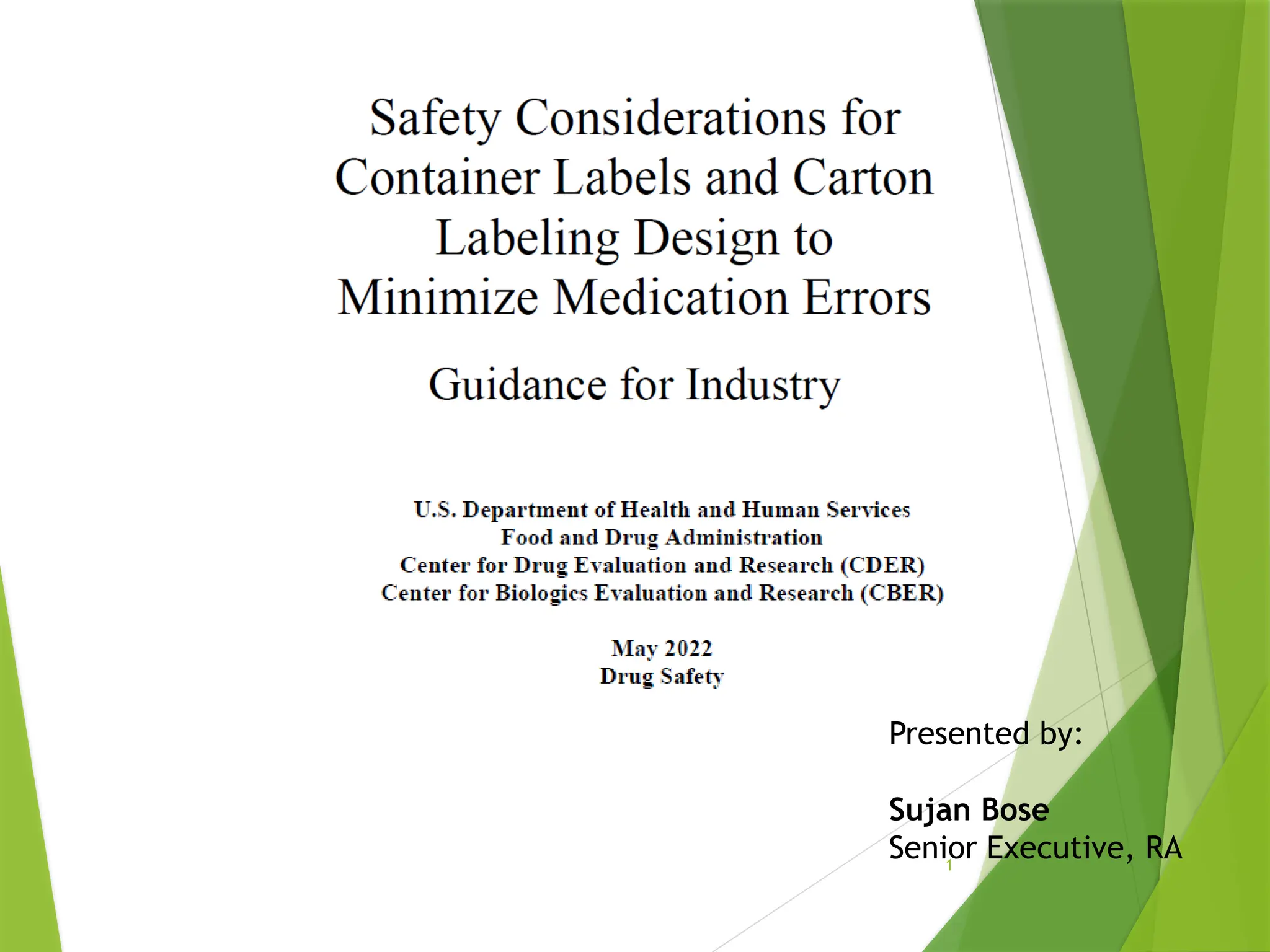
1
Presented by:
Sujan Bose
Senior Executive, RA
2
3
4
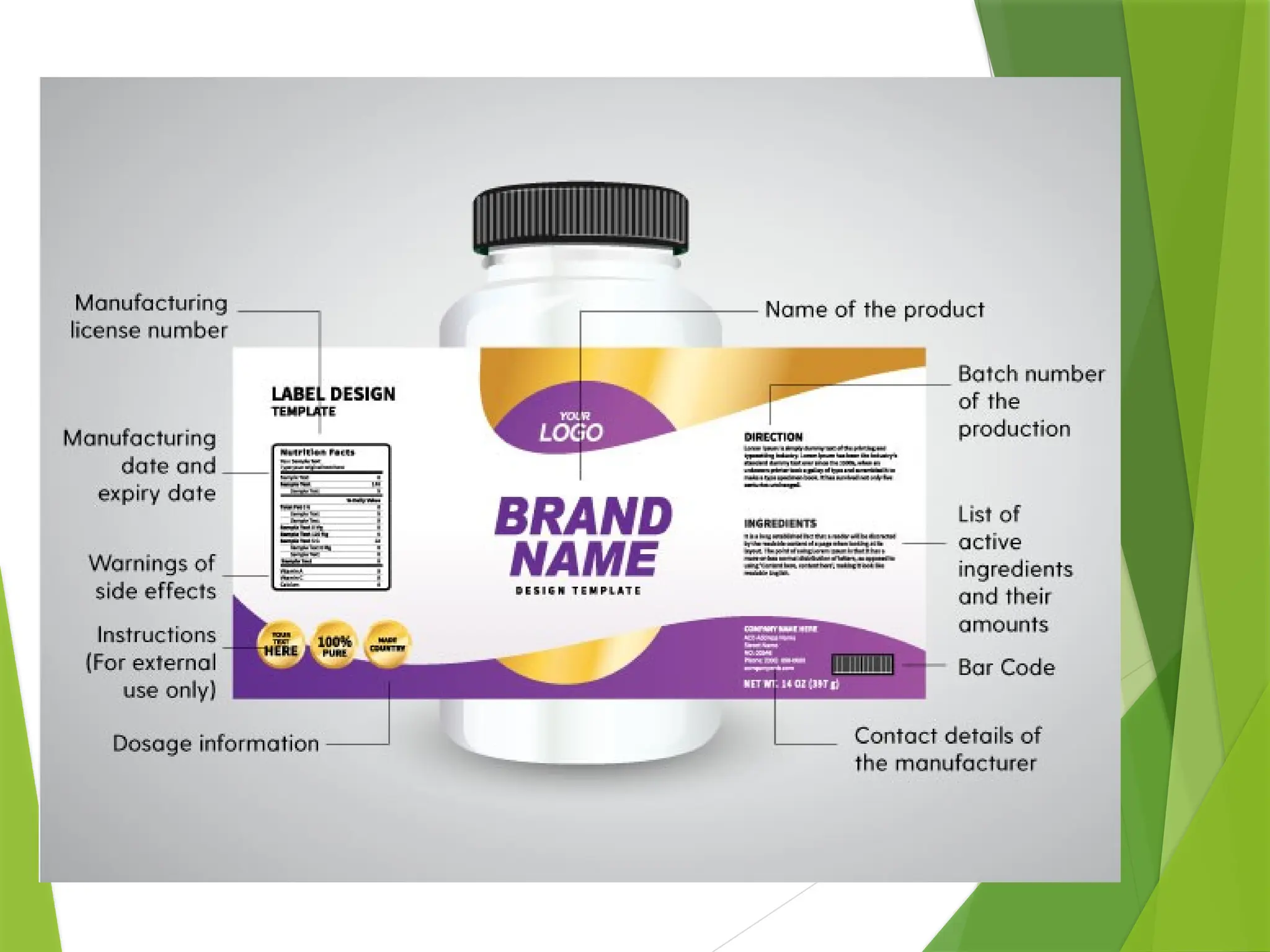
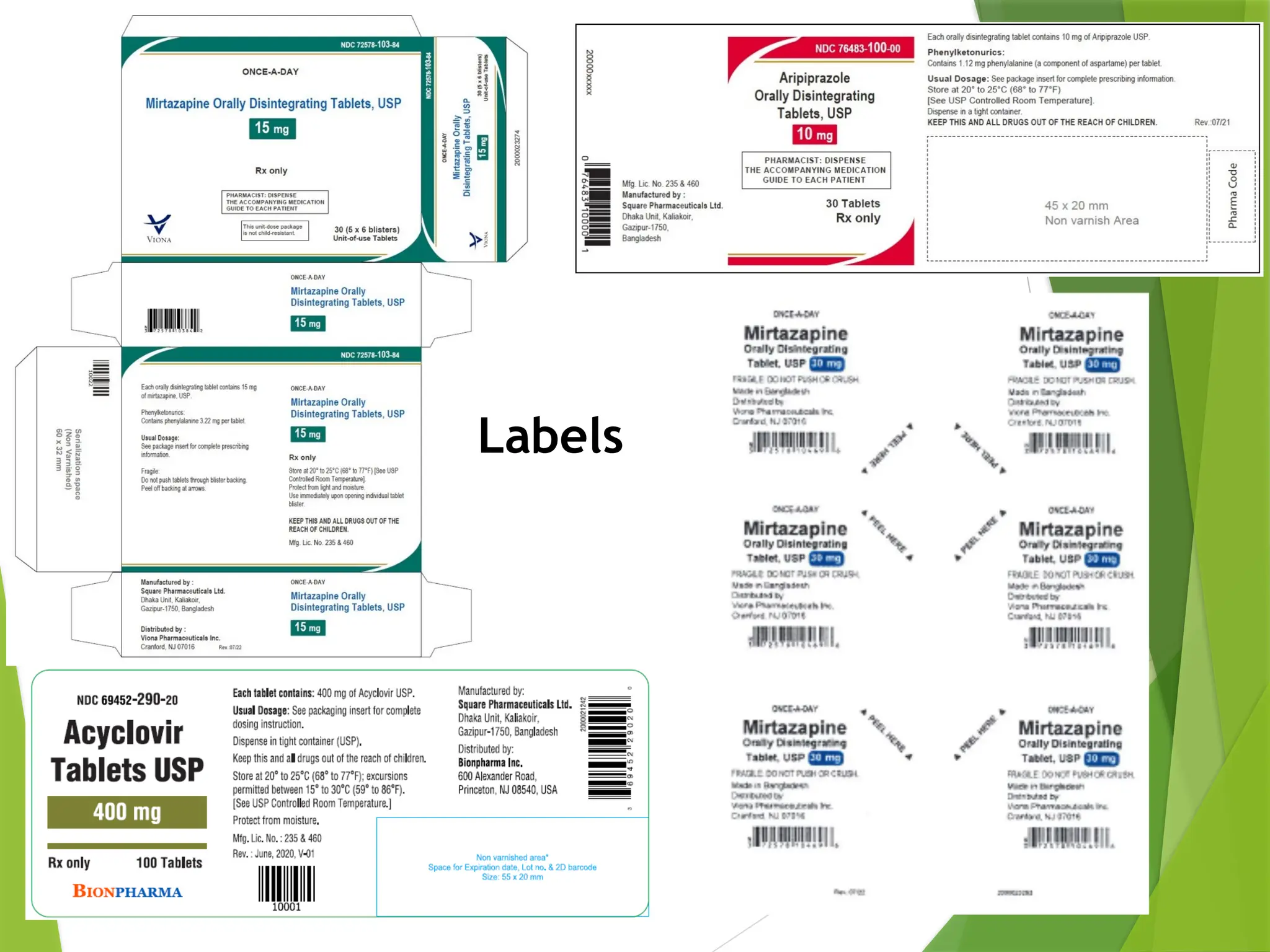
Labels
5
General Note:
The development of labels and labeling is product-specific, and the risk for
medication errors differs between products and can be impacted by many factors.
Although this guidance provides a set of principles and recommendations for
ensuring that critical elements of a product’s container label and carton labeling are
designed to promote safe dispensing, administration, and use of the product, the
considerations described are intended to support flexibility where appropriate.
Factors to be considered
I. GENERAL CONSIDERATIONS
II. SPECIAL CONSIDERATIONS AND RECOMMENDATIONS
III. OTHER SPECIAL CONTAINER LABEL AND CARTON LABELING
CONSIDERATIONS
6
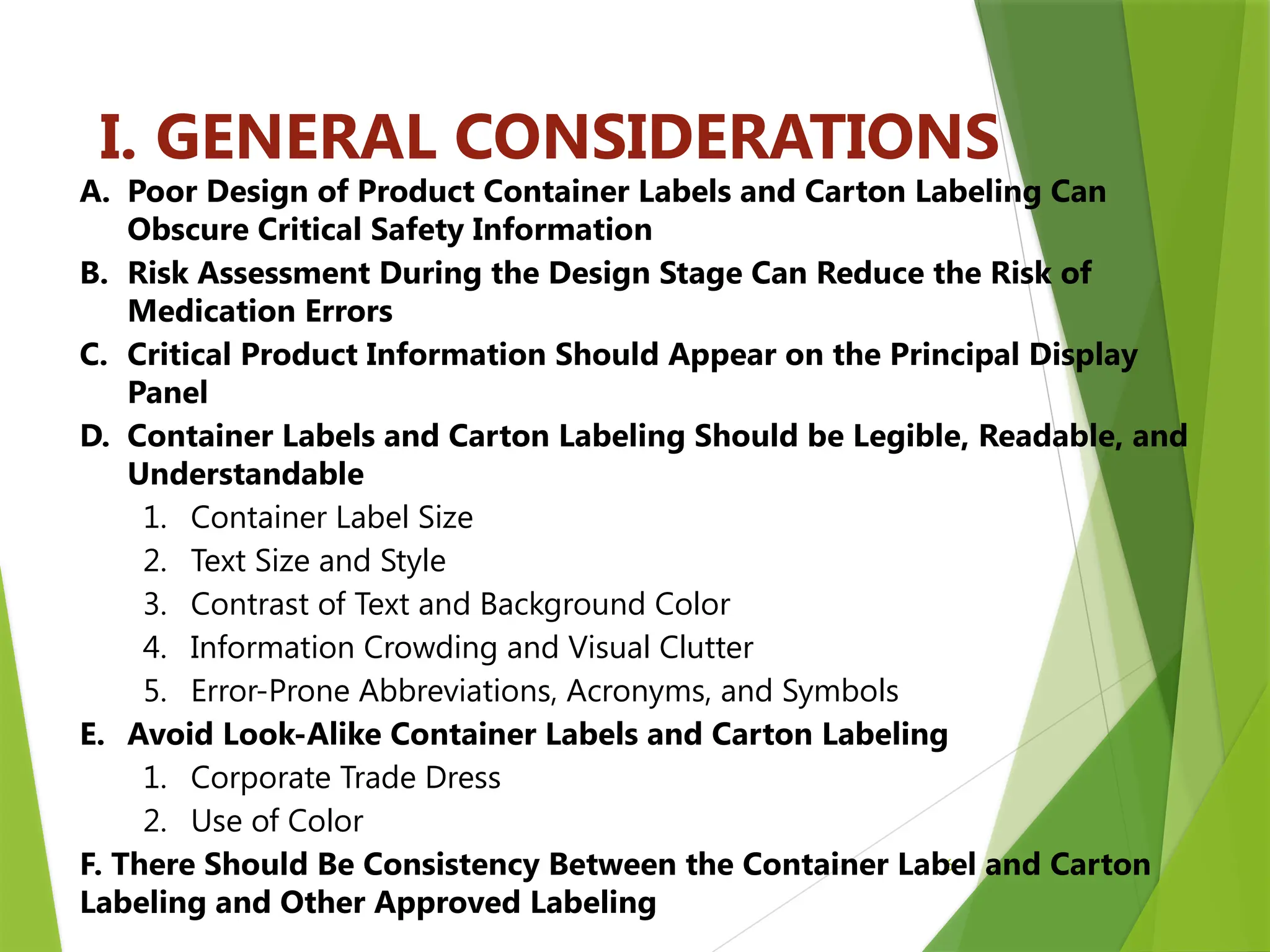
I. GENERAL CONSIDERATIONS
A. Poor Design of Product Container Labels and Carton Labeling Can
Obscure Critical Safety Information
B. Risk Assessment During the Design Stage Can Reduce the Risk of
Medication Errors
C. Critical Product Information Should Appear on the Principal Display
Panel
D. Container Labels and Carton Labeling Should be Legible, Readable, and
Understandable
1. Container Label Size
2. Text Size and Style
3. Contrast of Text and Background Color
4. Information Crowding and Visual Clutter
5. Error-Prone Abbreviations, Acronyms, and Symbols
E. Avoid Look-Alike Container Labels and Carton Labeling
1. Corporate Trade Dress
2. Use of Color
F. There Should Be Consistency Between the Container Label and Carton
Labeling and Other Approved Labeling
7
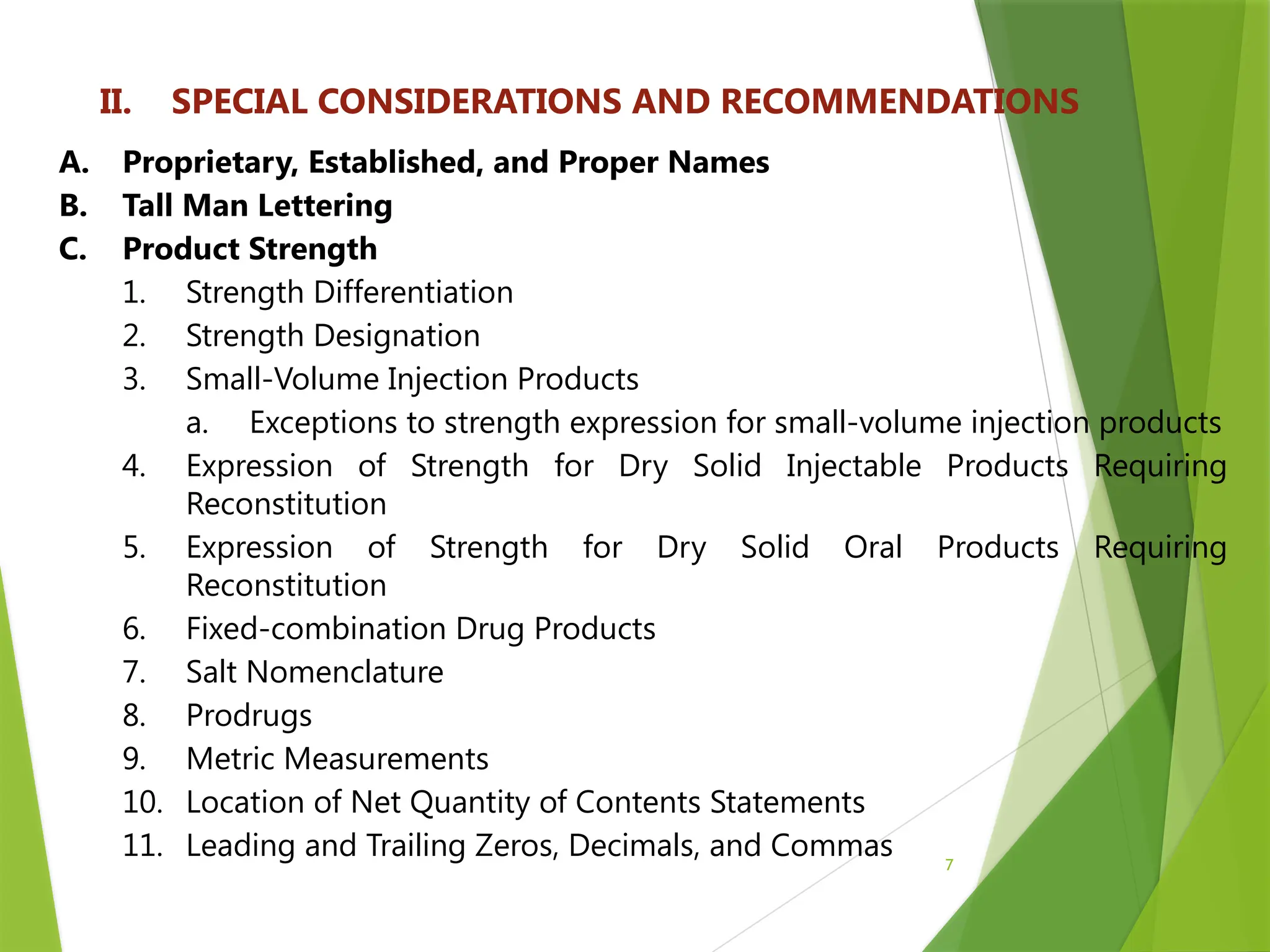
II. SPECIAL CONSIDERATIONS AND RECOMMENDATIONS
A. Proprietary, Established, and Proper Names
B. Tall Man Lettering
C. Product Strength
1. Strength Differentiation
2. Strength Designation
3. Small-Volume Injection Products
a. Exceptions to strength expression for small-volume injection products
4. Expression of Strength for Dry Solid Injectable Products Requiring
Reconstitution
5. Expression of Strength for Dry Solid Oral Products Requiring
Reconstitution
6. Fixed-combination Drug Products
7. Salt Nomenclature
8. Prodrugs
9. Metric Measurements
10. Location of Net Quantity of Contents Statements
11. Leading and Trailing Zeros, Decimals, and Commas
8
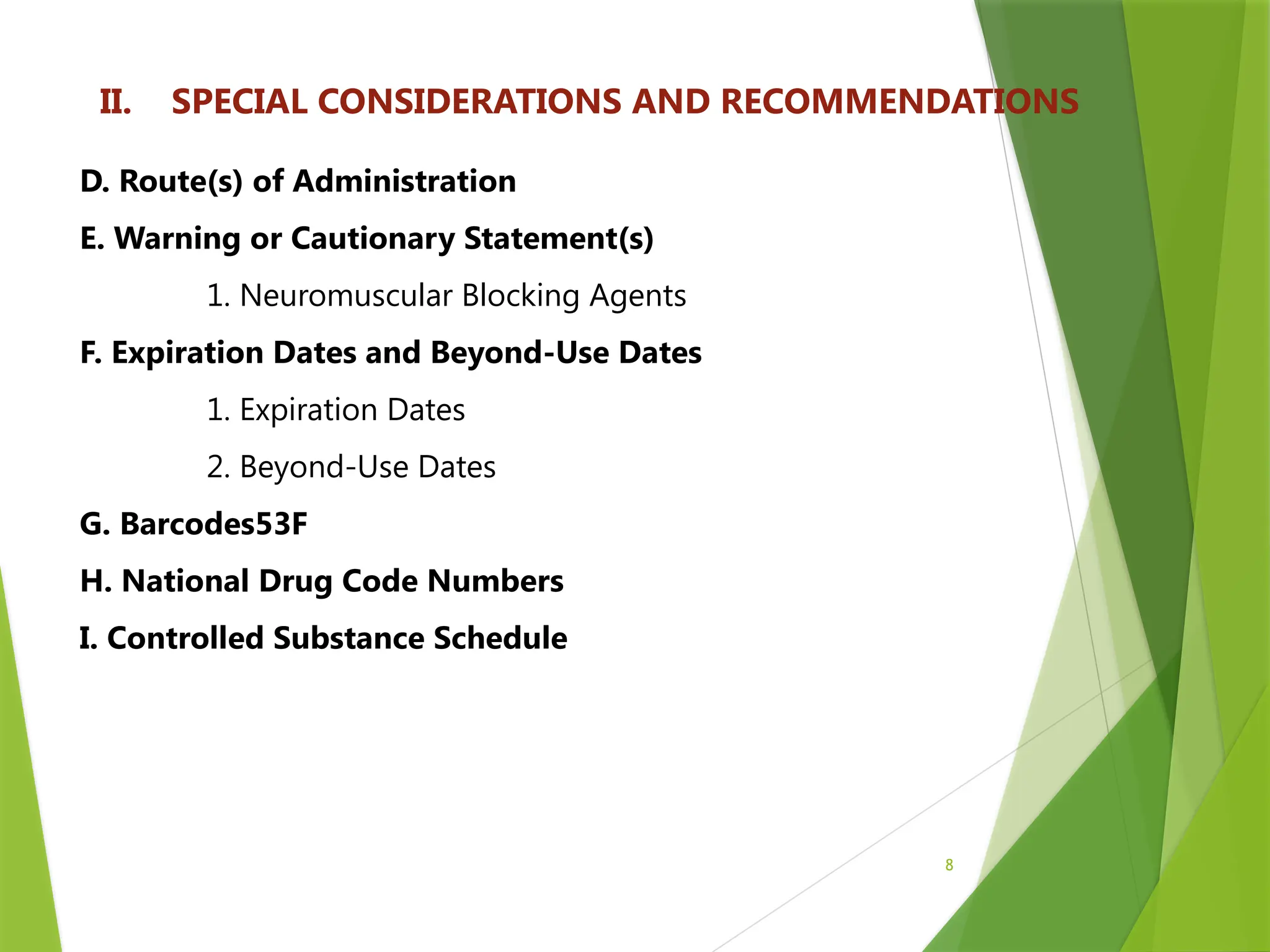
II. SPECIAL CONSIDERATIONS AND RECOMMENDATIONS
D. Route(s) of Administration
E. Warning or Cautionary Statement(s)
1. Neuromuscular Blocking Agents
F. Expiration Dates and Beyond-Use Dates
1. Expiration Dates
2. Beyond-Use Dates
G. Barcodes53F
H. National Drug Code Numbers
I. Controlled Substance Schedule
9
III. OTHER SPECIAL CONTAINER LABEL AND CARTON
LABELING CONSIDERATIONS
A. Blister Pack Presentations
1. Unit Dose Blister Cell Label
2. Product Strength on Carton Labeling
3. Blister Cell Label Material and Readability
4.Blister Pack Label Design
B. Labeling of Ferrules and Cap Overseals
C. Color Closure System for Concentrated Potassium Chloride
D. Labels and Labeling for Large-Volume Injections
1. Information for Container Labels of Large-Volume Injections
2. Container Label Clutter
3. Other Container Label and Carton Labeling Considerations
4. Product Differentiation
E. Transferable or Peel-off Labels for Injectable Medications
F. Double-Sided Container Labels and Carton Labeling
10
III. OTHER SPECIAL CONTAINER LABEL AND CARTON
LABELING CONSIDERATIONS
G. Pharmacy Bulk Packages
H. Communication of Important Product Changes
I. Dosing Devices for Oral Liquid Drug Products
J. Product Samples
K. Package Type76F
L. Insulin Pens
M. Quick Response Code
N. Container Labels for Diluents
O. Unit Dose Cups for Oral Liquid Drug Products
P. Transdermal and Topical Systems
Q. Unit Dose Packaging Intended for Hospital Use
R. Infusion Containers with Hangers Used for Administration
11
I. GENERAL CONSIDERATIONS
A. Poor Design of Product Container Labels and Carton
Labeling Can Obscure Critical Safety Information
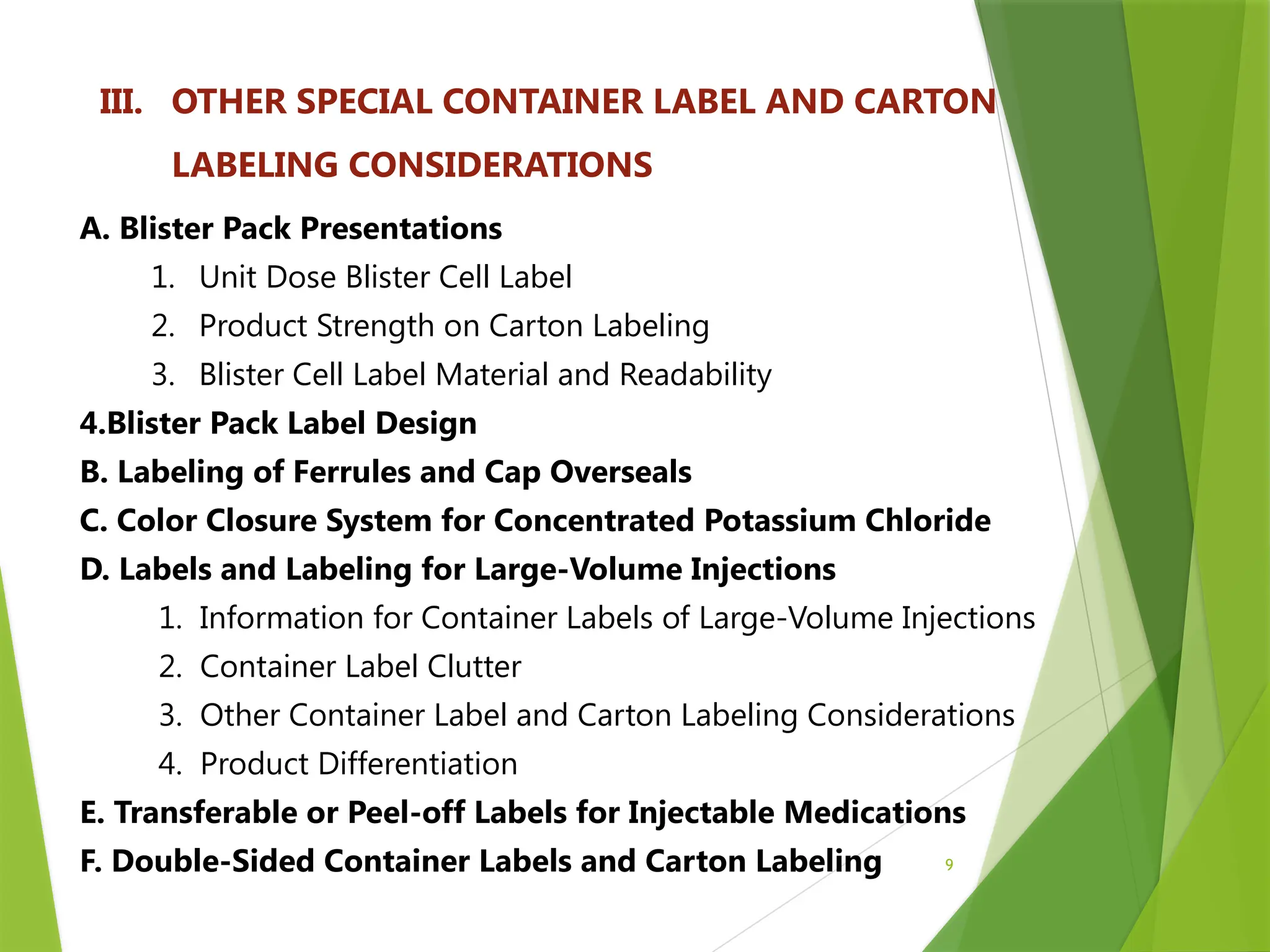
• Key information missing: product name(s), dosage form(s),
and strength(s) or expressed in a confusing manner, or is not
prominently located and displayed.
• Key information does not appear in the same field of vision.
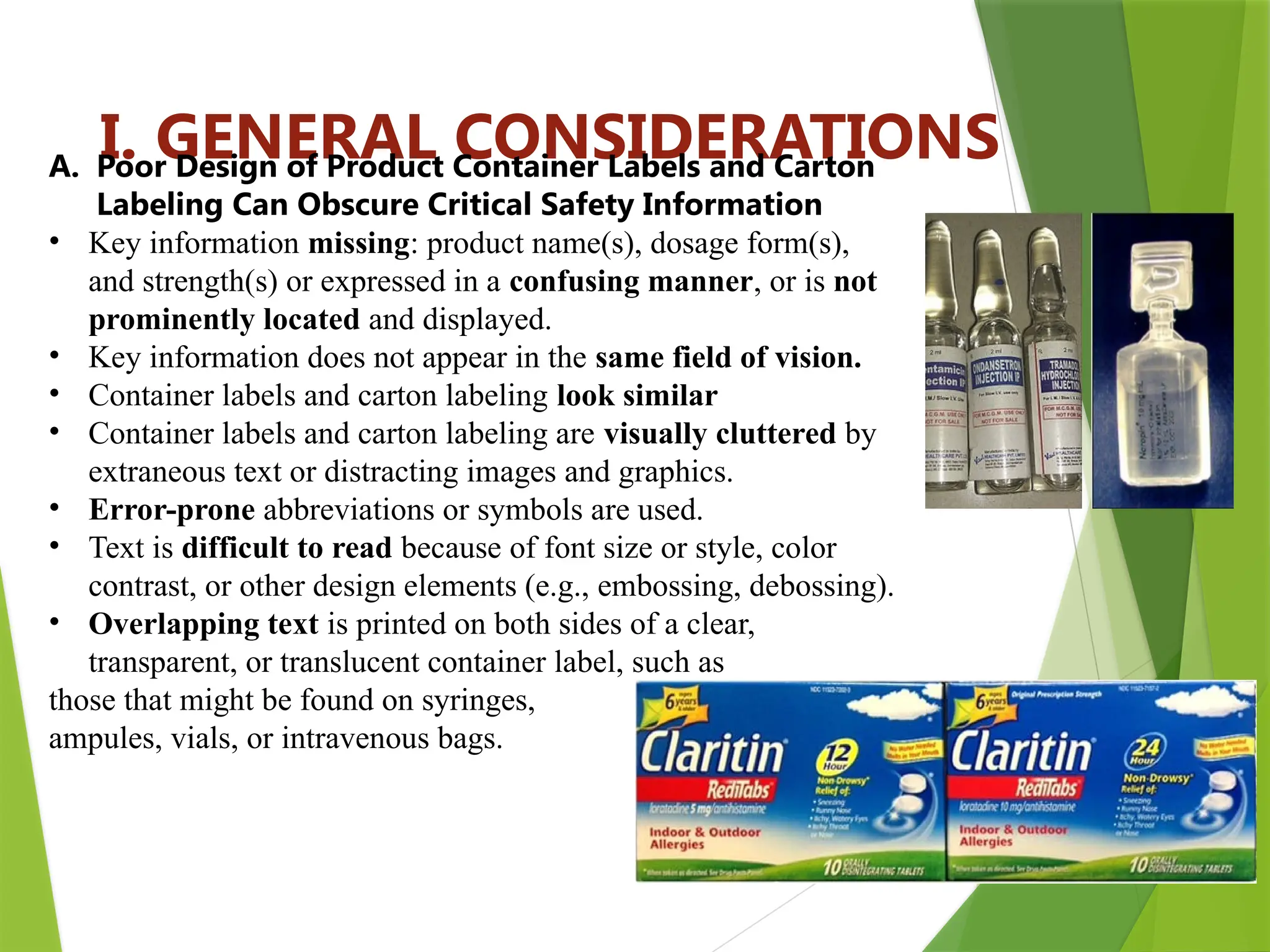
• Container labels and carton labeling look similar
• Container labels and carton labeling are visually cluttered by
extraneous text or distracting images and graphics.
• Error-prone abbreviations or symbols are used.
• Text is difficult to read because of font size or style, color
contrast, or other design elements (e.g., embossing, debossing).
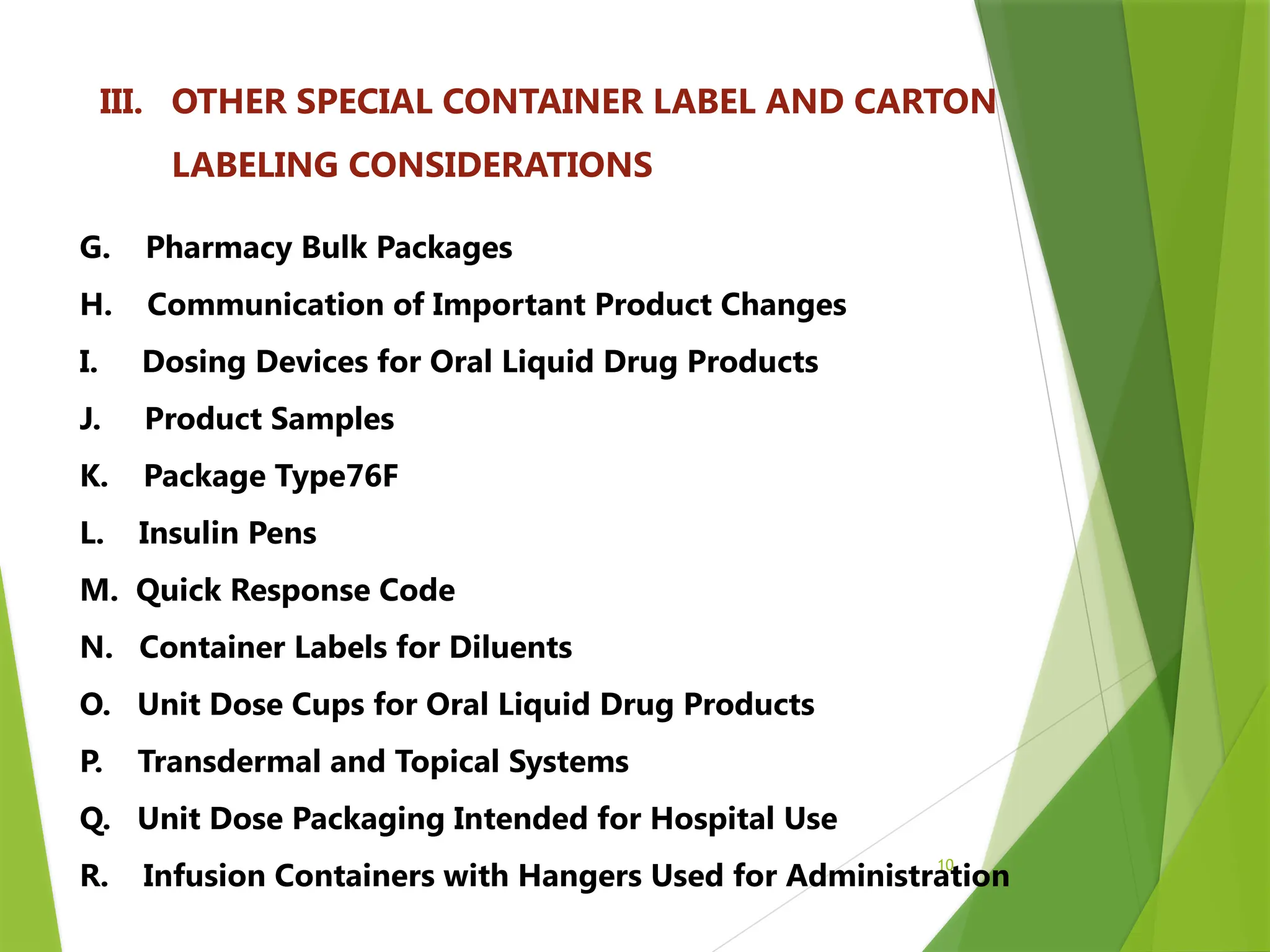
• Overlapping text is printed on both sides of a clear,
transparent, or translucent container label, such as
those that might be found on syringes,
ampules, vials, or intravenous bags.
12
I. GENERAL CONSIDERATIONS
B. Risk Assessment During the Design Stage Can Reduce the Risk of
Medication Errors
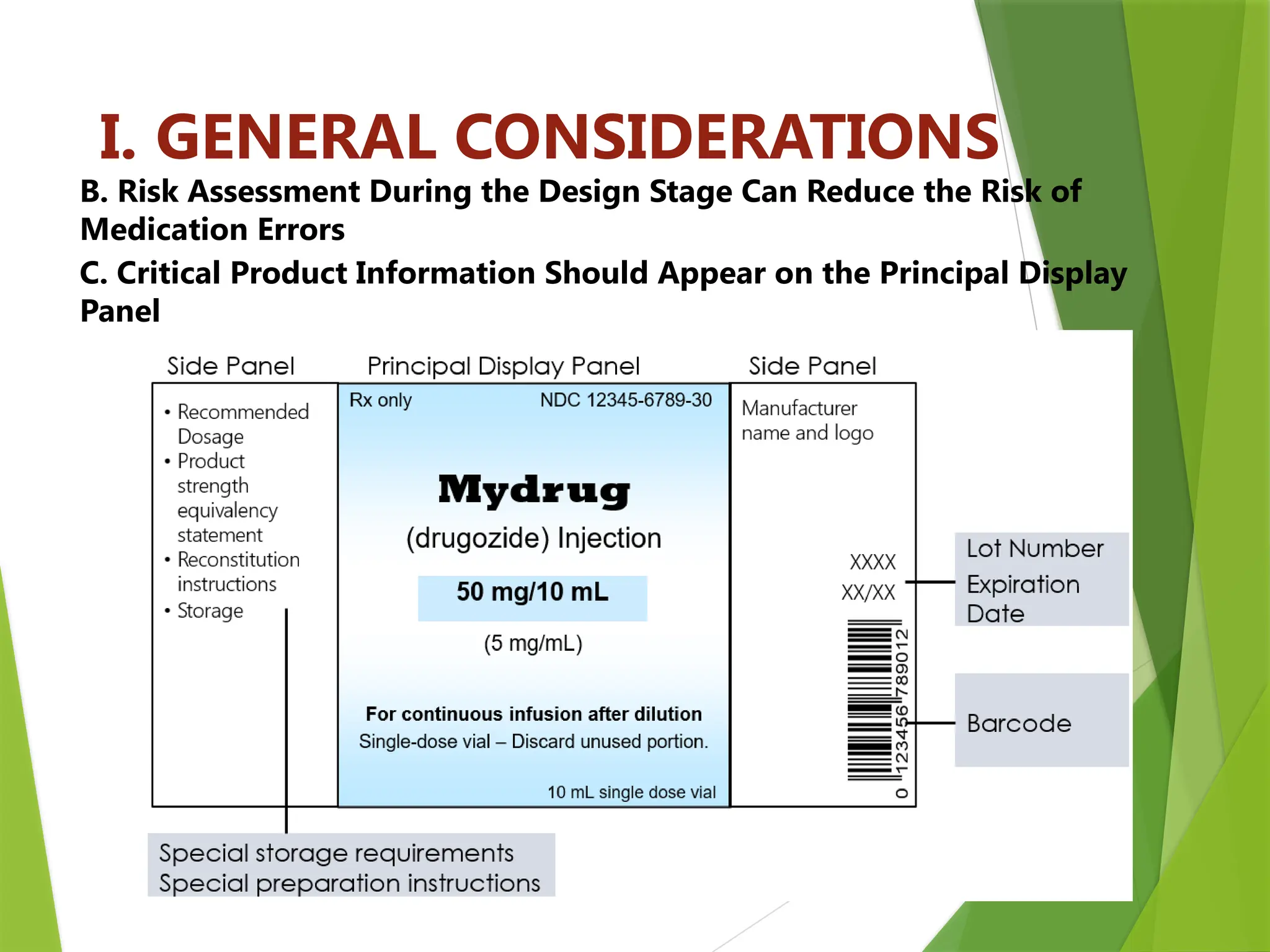
C. Critical Product Information Should Appear on the Principal Display
Panel
13
I. GENERAL CONSIDERATIONS
D. Container Labels and Carton Labeling Should be Legible, Readable, and
Understandable
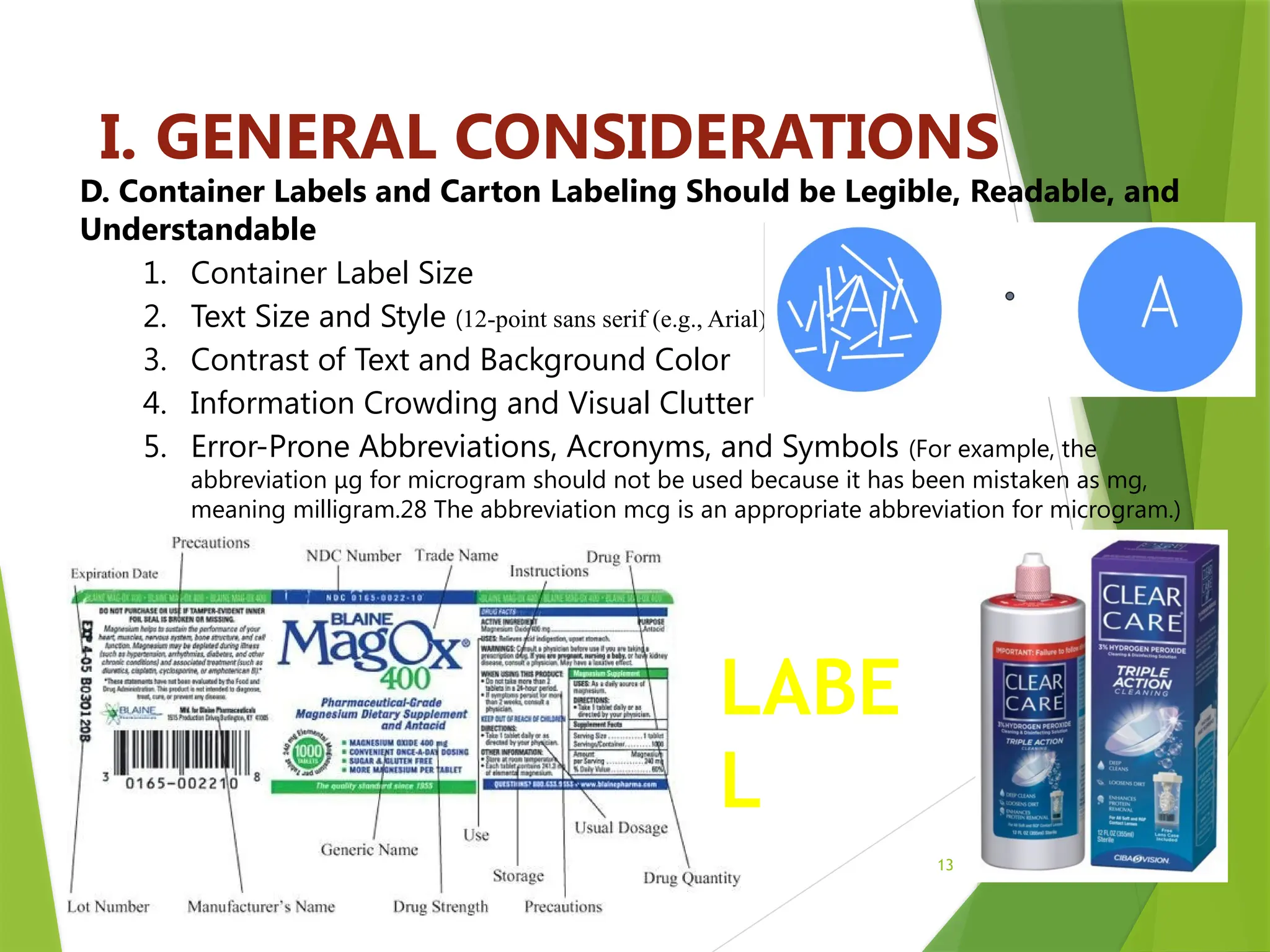
1. Container Label Size
2. Text Size and Style (12-point sans serif (e.g., Arial)
3. Contrast of Text and Background Color
4. Information Crowding and Visual Clutter
5. Error-Prone Abbreviations, Acronyms, and Symbols (For example, the
abbreviation μg for microgram should not be used because it has been mistaken as mg,
meaning milligram.28 The abbreviation mcg is an appropriate abbreviation for microgram.)
LABE
L
14
I. GENERAL CONSIDERATIONS
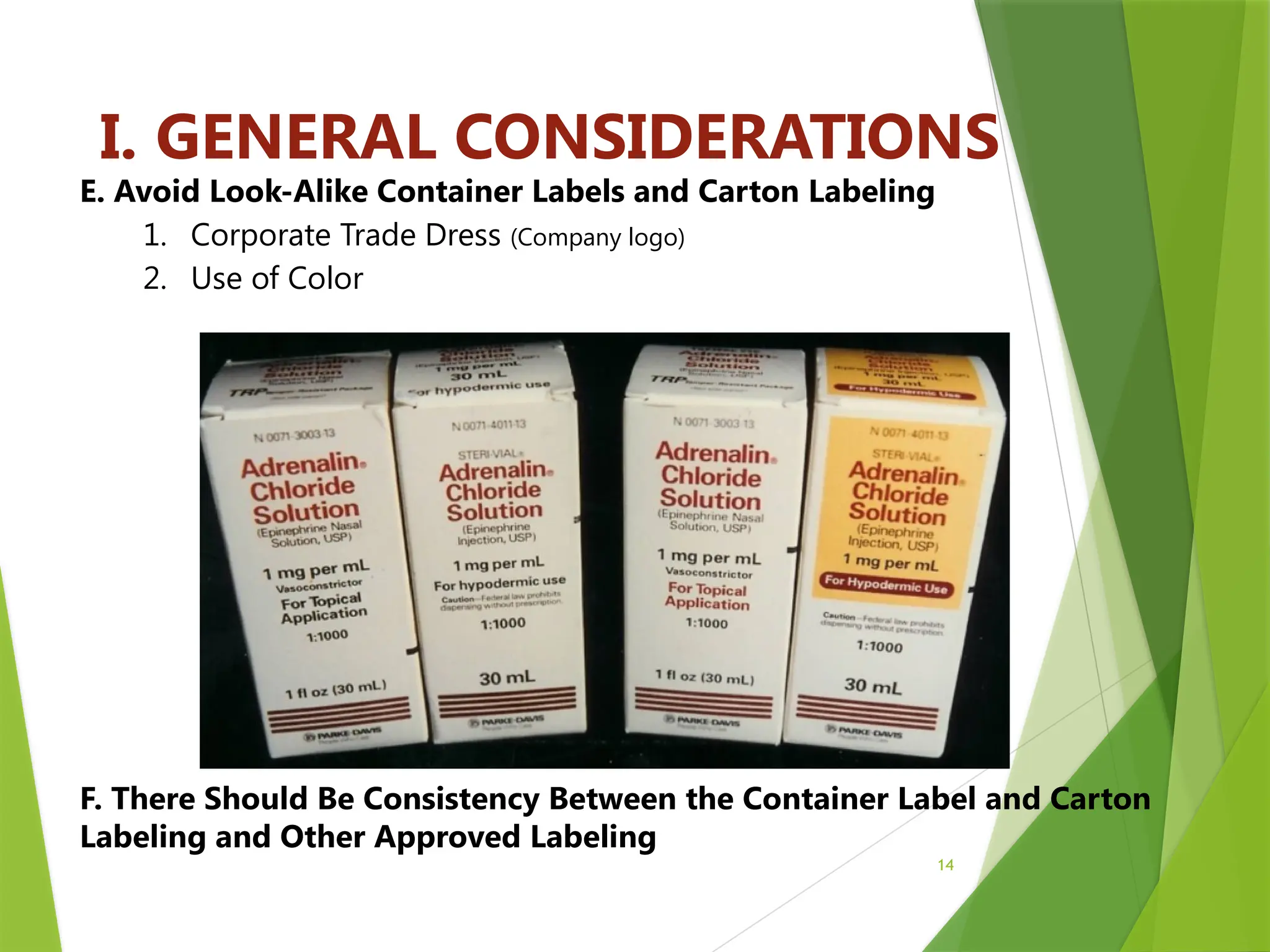
E. Avoid Look-Alike Container Labels and Carton Labeling
1. Corporate Trade Dress (Company logo)
2. Use of Color
F. There Should Be Consistency Between the Container Label and Carton
Labeling and Other Approved Labeling
15
I. SPECIAL CONSIDERATIONS AND RECOMMENDATIONS
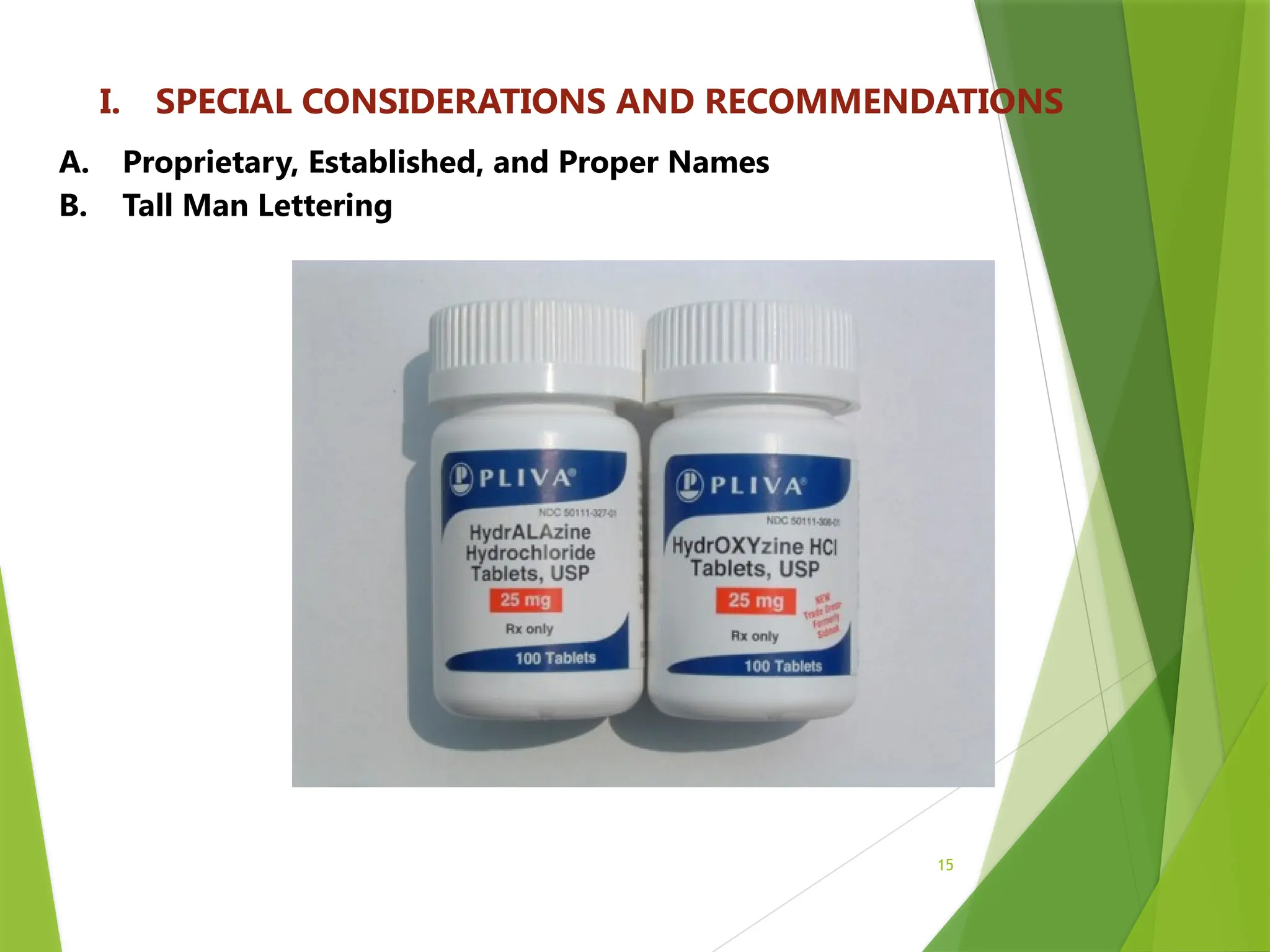
A. Proprietary, Established, and Proper Names
B. Tall Man Lettering
16
I. SPECIAL CONSIDERATIONS AND RECOMMENDATIONS
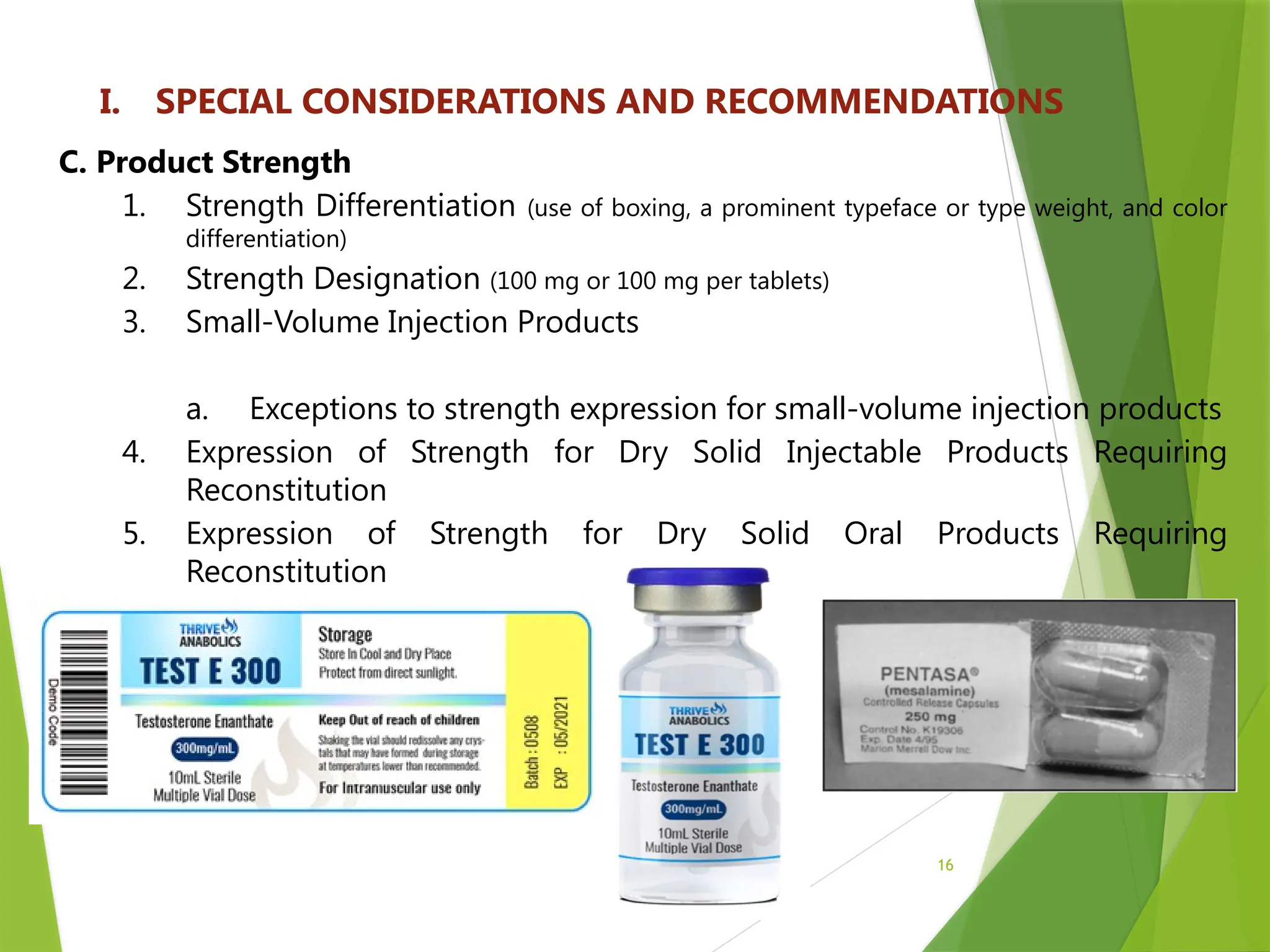
C. Product Strength
1. Strength Differentiation (use of boxing, a prominent typeface or type weight, and color
differentiation)
2. Strength Designation (100 mg or 100 mg per tablets)
3. Small-Volume Injection Products
a. Exceptions to strength expression for small-volume injection products
4. Expression of Strength for Dry Solid Injectable Products Requiring
Reconstitution
5. Expression of Strength for Dry Solid Oral Products Requiring
Reconstitution
17
I. SPECIAL CONSIDERATIONS AND RECOMMENDATIONS
C. Product Strength
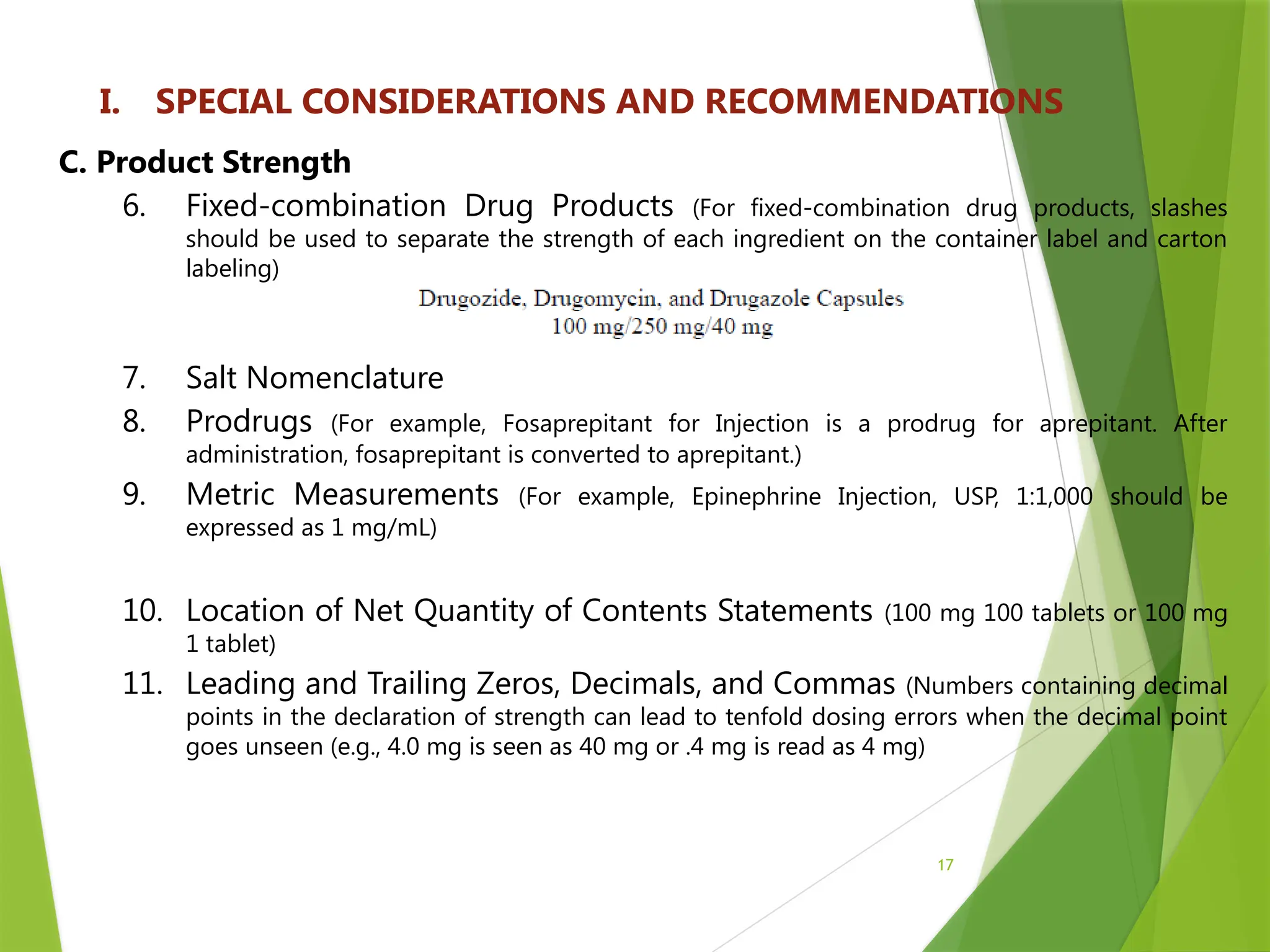
6. Fixed-combination Drug Products (For fixed-combination drug products, slashes
should be used to separate the strength of each ingredient on the container label and carton
labeling)
7. Salt Nomenclature
8. Prodrugs (For example, Fosaprepitant for Injection is a prodrug for aprepitant. After
administration, fosaprepitant is converted to aprepitant.)
9. Metric Measurements (For example, Epinephrine Injection, USP, 1:1,000 should be
expressed as 1 mg/mL)
10. Location of Net Quantity of Contents Statements (100 mg 100 tablets or 100 mg
1 tablet)
11. Leading and Trailing Zeros, Decimals, and Commas (Numbers containing decimal
points in the declaration of strength can lead to tenfold dosing errors when the decimal point
goes unseen (e.g., 4.0 mg is seen as 40 mg or .4 mg is read as 4 mg)
18
I. SPECIAL CONSIDERATIONS AND RECOMMENDATIONS
D. Route(s) of Administration
E. Warning or Cautionary Statement(s)
1. Neuromuscular Blocking Agents
(WARNING: Paralyzing Agent. Causes Respiratory
Arrest. Facilities must be immediately available
for artificial respiration)
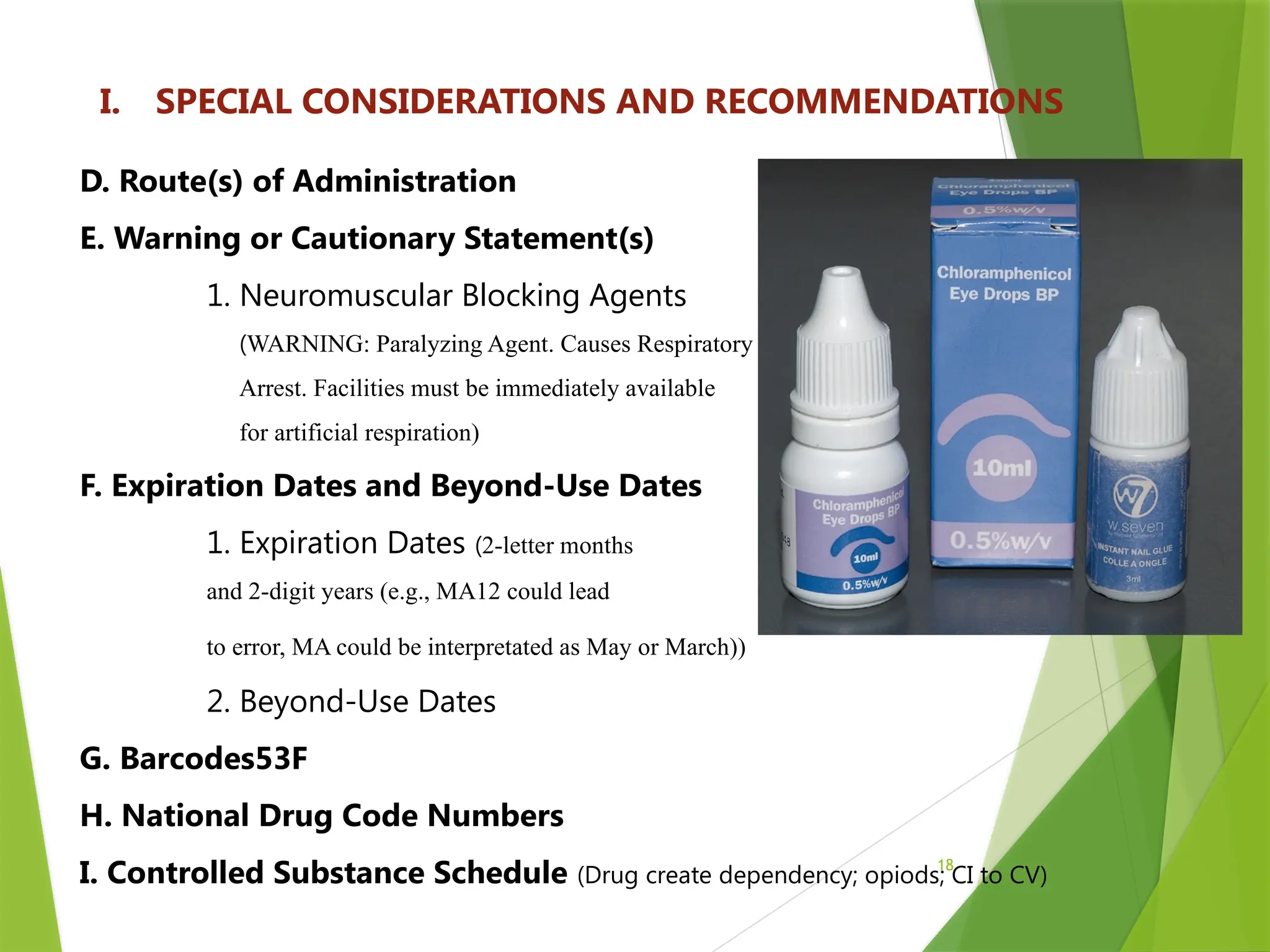
F. Expiration Dates and Beyond-Use Dates
1. Expiration Dates (2-letter months
and 2-digit years (e.g., MA12 could lead
to error, MA could be interpretated as May or March))
2. Beyond-Use Dates
G. Barcodes53F
H. National Drug Code Numbers
I. Controlled Substance Schedule (Drug create dependency; opiods; CI to CV)
19
III. OTHER SPECIAL CONTAINER LABEL AND CARTON
LABELING CONSIDERATIONS
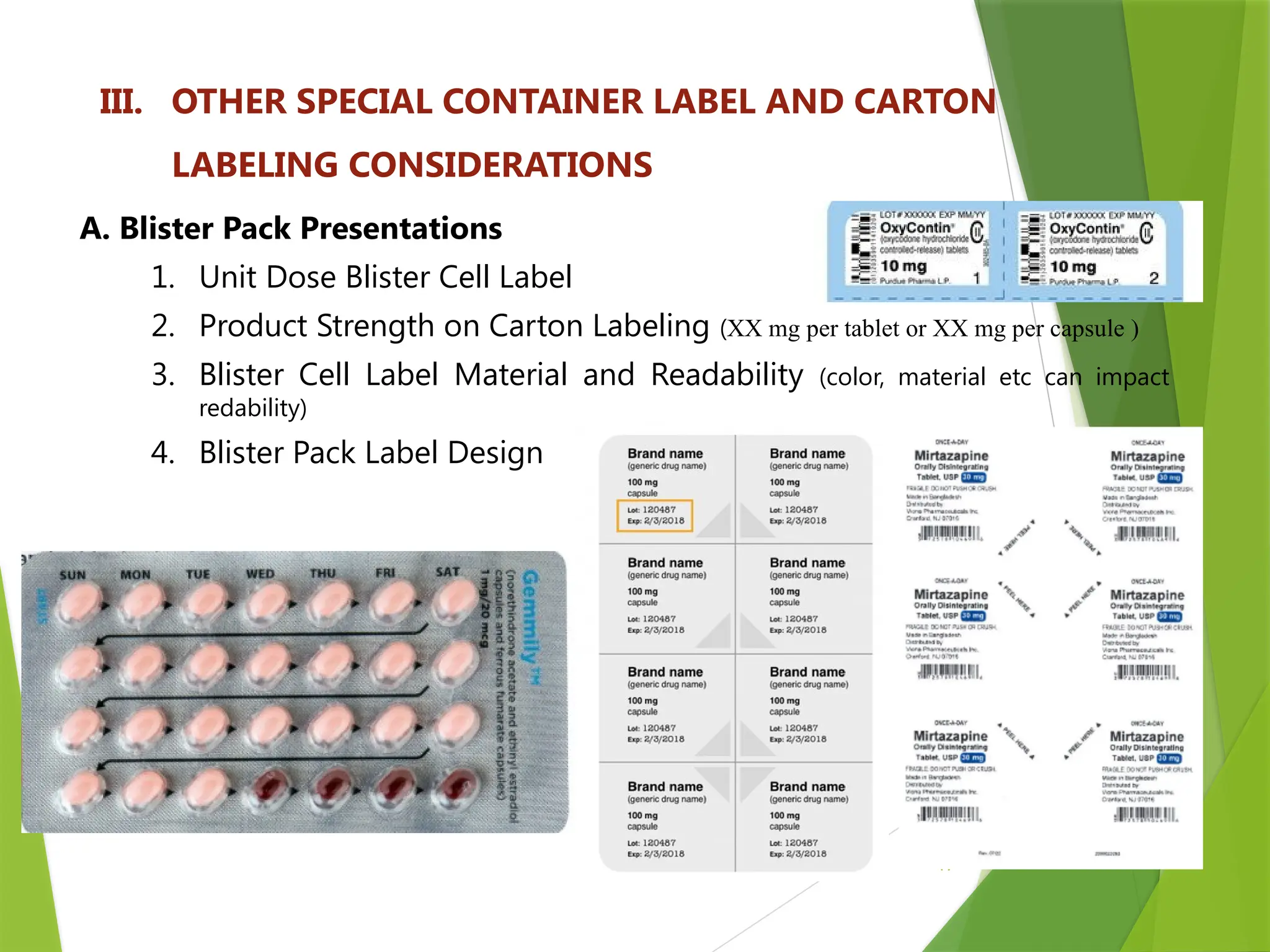
A. Blister Pack Presentations
1. Unit Dose Blister Cell Label
2. Product Strength on Carton Labeling (XX mg per tablet or XX mg per capsule )
3. Blister Cell Label Material and Readability (color, material etc can impact
redability)
4. Blister Pack Label Design
20
III. OTHER SPECIAL CONTAINER LABEL AND CARTON
LABELING CONSIDERATIONS
B. Labeling of Ferrules and Cap Overseals
C. Color Closure System for Concentrated Potassium Chloride
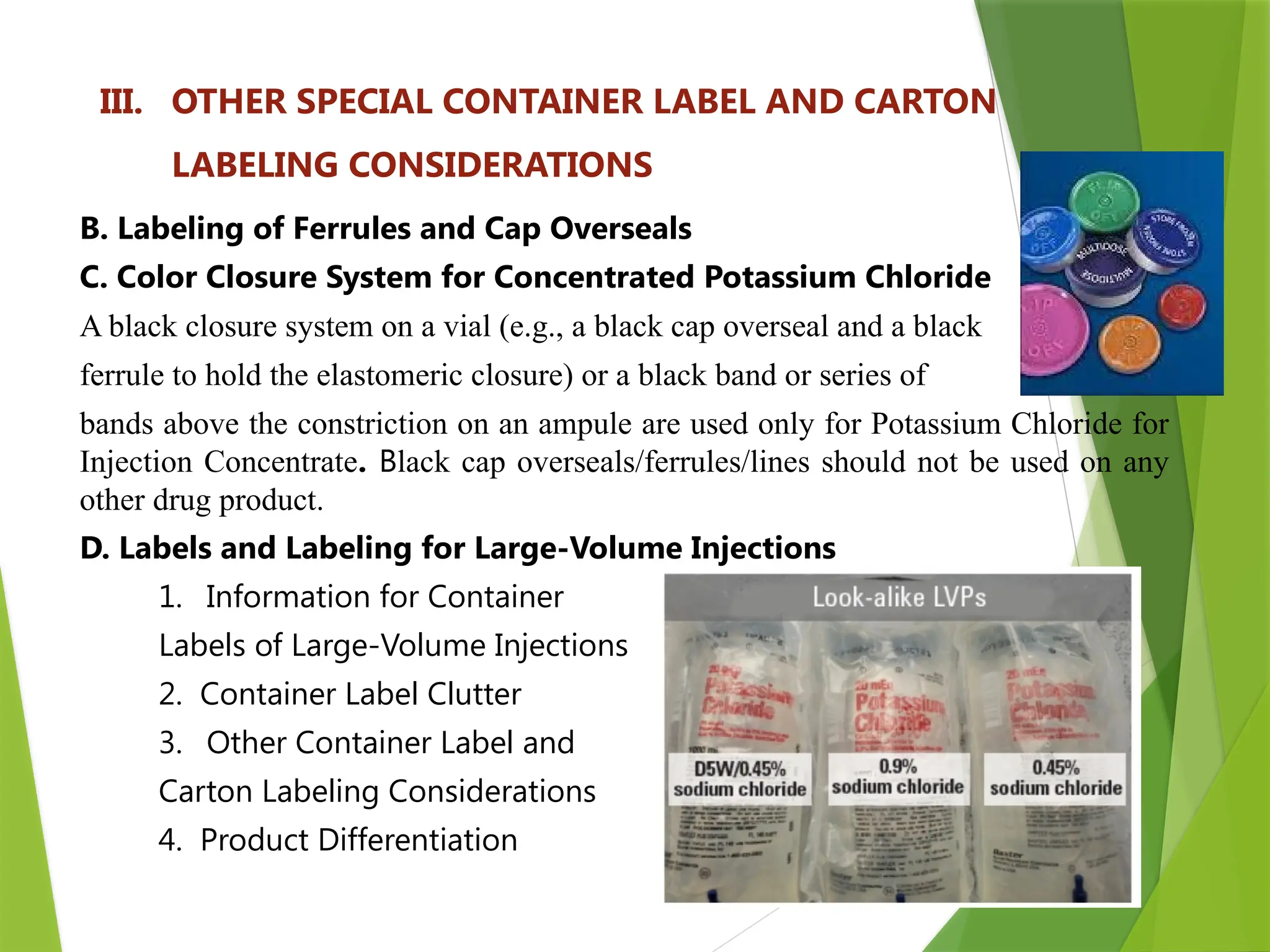
A black closure system on a vial (e.g., a black cap overseal and a black
ferrule to hold the elastomeric closure) or a black band or series of
bands above the constriction on an ampule are used only for Potassium Chloride for
Injection Concentrate. Black cap overseals/ferrules/lines should not be used on any
other drug product.
D. Labels and Labeling for Large-Volume Injections
1. Information for Container
Labels of Large-Volume Injections
2. Container Label Clutter
3. Other Container Label and
Carton Labeling Considerations
4. Product Differentiation
21
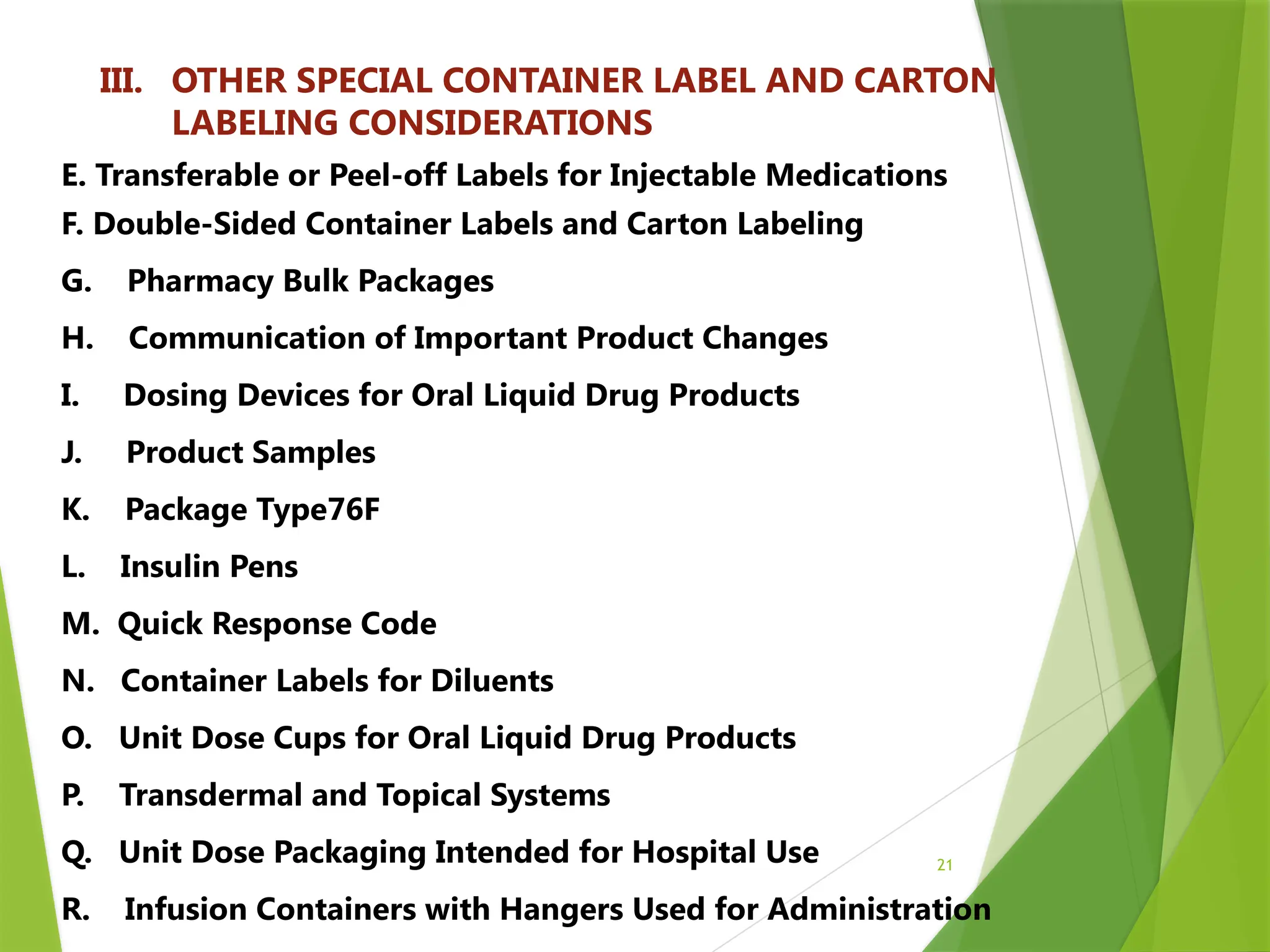
III. OTHER SPECIAL CONTAINER LABEL AND CARTON
LABELING CONSIDERATIONS
E. Transferable or Peel-off Labels for Injectable Medications
F. Double-Sided Container Labels and Carton Labeling
G. Pharmacy Bulk Packages
H. Communication of Important Product Changes
I. Dosing Devices for Oral Liquid Drug Products
J. Product Samples
K. Package Type76F
L. Insulin Pens
M. Quick Response Code
N. Container Labels for Diluents
O. Unit Dose Cups for Oral Liquid Drug Products
P. Transdermal and Topical Systems
Q. Unit Dose Packaging Intended for Hospital Use
R. Infusion Containers with Hangers Used for Administration
23

Presentation on Safety Consideration during Labeling design

  • 1.
  • 2.
  • 3.
  • 4.
  • 5.
    5 General Note: The developmentof labels and labeling is product-specific, and the risk for medication errors differs between products and can be impacted by many factors. Although this guidance provides a set of principles and recommendations for ensuring that critical elements of a product’s container label and carton labeling are designed to promote safe dispensing, administration, and use of the product, the considerations described are intended to support flexibility where appropriate. Factors to be considered I. GENERAL CONSIDERATIONS II. SPECIAL CONSIDERATIONS AND RECOMMENDATIONS III. OTHER SPECIAL CONTAINER LABEL AND CARTON LABELING CONSIDERATIONS
  • 6.
    6 I. GENERAL CONSIDERATIONS A.Poor Design of Product Container Labels and Carton Labeling Can Obscure Critical Safety Information B. Risk Assessment During the Design Stage Can Reduce the Risk of Medication Errors C. Critical Product Information Should Appear on the Principal Display Panel D. Container Labels and Carton Labeling Should be Legible, Readable, and Understandable 1. Container Label Size 2. Text Size and Style 3. Contrast of Text and Background Color 4. Information Crowding and Visual Clutter 5. Error-Prone Abbreviations, Acronyms, and Symbols E. Avoid Look-Alike Container Labels and Carton Labeling 1. Corporate Trade Dress 2. Use of Color F. There Should Be Consistency Between the Container Label and Carton Labeling and Other Approved Labeling
  • 7.
    7 II. SPECIAL CONSIDERATIONSAND RECOMMENDATIONS A. Proprietary, Established, and Proper Names B. Tall Man Lettering C. Product Strength 1. Strength Differentiation 2. Strength Designation 3. Small-Volume Injection Products a. Exceptions to strength expression for small-volume injection products 4. Expression of Strength for Dry Solid Injectable Products Requiring Reconstitution 5. Expression of Strength for Dry Solid Oral Products Requiring Reconstitution 6. Fixed-combination Drug Products 7. Salt Nomenclature 8. Prodrugs 9. Metric Measurements 10. Location of Net Quantity of Contents Statements 11. Leading and Trailing Zeros, Decimals, and Commas
  • 8.
    8 II. SPECIAL CONSIDERATIONSAND RECOMMENDATIONS D. Route(s) of Administration E. Warning or Cautionary Statement(s) 1. Neuromuscular Blocking Agents F. Expiration Dates and Beyond-Use Dates 1. Expiration Dates 2. Beyond-Use Dates G. Barcodes53F H. National Drug Code Numbers I. Controlled Substance Schedule
  • 9.
    9 III. OTHER SPECIALCONTAINER LABEL AND CARTON LABELING CONSIDERATIONS A. Blister Pack Presentations 1. Unit Dose Blister Cell Label 2. Product Strength on Carton Labeling 3. Blister Cell Label Material and Readability 4.Blister Pack Label Design B. Labeling of Ferrules and Cap Overseals C. Color Closure System for Concentrated Potassium Chloride D. Labels and Labeling for Large-Volume Injections 1. Information for Container Labels of Large-Volume Injections 2. Container Label Clutter 3. Other Container Label and Carton Labeling Considerations 4. Product Differentiation E. Transferable or Peel-off Labels for Injectable Medications F. Double-Sided Container Labels and Carton Labeling
  • 10.
    10 III. OTHER SPECIALCONTAINER LABEL AND CARTON LABELING CONSIDERATIONS G. Pharmacy Bulk Packages H. Communication of Important Product Changes I. Dosing Devices for Oral Liquid Drug Products J. Product Samples K. Package Type76F L. Insulin Pens M. Quick Response Code N. Container Labels for Diluents O. Unit Dose Cups for Oral Liquid Drug Products P. Transdermal and Topical Systems Q. Unit Dose Packaging Intended for Hospital Use R. Infusion Containers with Hangers Used for Administration
  • 11.
    11 I. GENERAL CONSIDERATIONS A.Poor Design of Product Container Labels and Carton Labeling Can Obscure Critical Safety Information • Key information missing: product name(s), dosage form(s), and strength(s) or expressed in a confusing manner, or is not prominently located and displayed. • Key information does not appear in the same field of vision. • Container labels and carton labeling look similar • Container labels and carton labeling are visually cluttered by extraneous text or distracting images and graphics. • Error-prone abbreviations or symbols are used. • Text is difficult to read because of font size or style, color contrast, or other design elements (e.g., embossing, debossing). • Overlapping text is printed on both sides of a clear, transparent, or translucent container label, such as those that might be found on syringes, ampules, vials, or intravenous bags.
  • 12.
    12 I. GENERAL CONSIDERATIONS B.Risk Assessment During the Design Stage Can Reduce the Risk of Medication Errors C. Critical Product Information Should Appear on the Principal Display Panel
  • 13.
    13 I. GENERAL CONSIDERATIONS D.Container Labels and Carton Labeling Should be Legible, Readable, and Understandable 1. Container Label Size 2. Text Size and Style (12-point sans serif (e.g., Arial) 3. Contrast of Text and Background Color 4. Information Crowding and Visual Clutter 5. Error-Prone Abbreviations, Acronyms, and Symbols (For example, the abbreviation μg for microgram should not be used because it has been mistaken as mg, meaning milligram.28 The abbreviation mcg is an appropriate abbreviation for microgram.) LABE L
  • 14.
    14 I. GENERAL CONSIDERATIONS E.Avoid Look-Alike Container Labels and Carton Labeling 1. Corporate Trade Dress (Company logo) 2. Use of Color F. There Should Be Consistency Between the Container Label and Carton Labeling and Other Approved Labeling
  • 15.
    15 I. SPECIAL CONSIDERATIONSAND RECOMMENDATIONS A. Proprietary, Established, and Proper Names B. Tall Man Lettering
  • 16.
    16 I. SPECIAL CONSIDERATIONSAND RECOMMENDATIONS C. Product Strength 1. Strength Differentiation (use of boxing, a prominent typeface or type weight, and color differentiation) 2. Strength Designation (100 mg or 100 mg per tablets) 3. Small-Volume Injection Products a. Exceptions to strength expression for small-volume injection products 4. Expression of Strength for Dry Solid Injectable Products Requiring Reconstitution 5. Expression of Strength for Dry Solid Oral Products Requiring Reconstitution
  • 17.
    17 I. SPECIAL CONSIDERATIONSAND RECOMMENDATIONS C. Product Strength 6. Fixed-combination Drug Products (For fixed-combination drug products, slashes should be used to separate the strength of each ingredient on the container label and carton labeling) 7. Salt Nomenclature 8. Prodrugs (For example, Fosaprepitant for Injection is a prodrug for aprepitant. After administration, fosaprepitant is converted to aprepitant.) 9. Metric Measurements (For example, Epinephrine Injection, USP, 1:1,000 should be expressed as 1 mg/mL) 10. Location of Net Quantity of Contents Statements (100 mg 100 tablets or 100 mg 1 tablet) 11. Leading and Trailing Zeros, Decimals, and Commas (Numbers containing decimal points in the declaration of strength can lead to tenfold dosing errors when the decimal point goes unseen (e.g., 4.0 mg is seen as 40 mg or .4 mg is read as 4 mg)
  • 18.
    18 I. SPECIAL CONSIDERATIONSAND RECOMMENDATIONS D. Route(s) of Administration E. Warning or Cautionary Statement(s) 1. Neuromuscular Blocking Agents (WARNING: Paralyzing Agent. Causes Respiratory Arrest. Facilities must be immediately available for artificial respiration) F. Expiration Dates and Beyond-Use Dates 1. Expiration Dates (2-letter months and 2-digit years (e.g., MA12 could lead to error, MA could be interpretated as May or March)) 2. Beyond-Use Dates G. Barcodes53F H. National Drug Code Numbers I. Controlled Substance Schedule (Drug create dependency; opiods; CI to CV)
  • 19.
    19 III. OTHER SPECIALCONTAINER LABEL AND CARTON LABELING CONSIDERATIONS A. Blister Pack Presentations 1. Unit Dose Blister Cell Label 2. Product Strength on Carton Labeling (XX mg per tablet or XX mg per capsule ) 3. Blister Cell Label Material and Readability (color, material etc can impact redability) 4. Blister Pack Label Design
  • 20.
    20 III. OTHER SPECIALCONTAINER LABEL AND CARTON LABELING CONSIDERATIONS B. Labeling of Ferrules and Cap Overseals C. Color Closure System for Concentrated Potassium Chloride A black closure system on a vial (e.g., a black cap overseal and a black ferrule to hold the elastomeric closure) or a black band or series of bands above the constriction on an ampule are used only for Potassium Chloride for Injection Concentrate. Black cap overseals/ferrules/lines should not be used on any other drug product. D. Labels and Labeling for Large-Volume Injections 1. Information for Container Labels of Large-Volume Injections 2. Container Label Clutter 3. Other Container Label and Carton Labeling Considerations 4. Product Differentiation
  • 21.
    21 III. OTHER SPECIALCONTAINER LABEL AND CARTON LABELING CONSIDERATIONS E. Transferable or Peel-off Labels for Injectable Medications F. Double-Sided Container Labels and Carton Labeling G. Pharmacy Bulk Packages H. Communication of Important Product Changes I. Dosing Devices for Oral Liquid Drug Products J. Product Samples K. Package Type76F L. Insulin Pens M. Quick Response Code N. Container Labels for Diluents O. Unit Dose Cups for Oral Liquid Drug Products P. Transdermal and Topical Systems Q. Unit Dose Packaging Intended for Hospital Use R. Infusion Containers with Hangers Used for Administration
  • 22.