GARMENT PRODUCTION
LEVEL – III
Module Title: Fabric cutting operation
Module Code: IND GAP3 M04 1123
Nominal durassions: 60 Hours
course instructor : Kefitaw katale.
Contents of the module
Workstation
 cutting machine minor maintenance
cutting and spreading equipment
 Fabric Lay-up
 Fabric check
 Fabric performance
 Marker Lay
Cut order planning
marker efficiency Calculation
1.1 Workstation
When designing workstations for garment production, it is
important to consider the spec ic tasks and operations involved in
the production process.
A. Workstation: Arrange workstations in a logical sequence that
aligns with the flow of operations. Consider the order of tasks such
as fabric cutting, sewing, pressing, and finishing.
B. Space and Size: Allocate sufficient space for each workstation
to accommodate the spec ic tasks and equipment involved.
Consider the size of the machines, the workspace required for
operators, and any additional tools or materials needed for the
operations.
Workstation for fabric cutting
A workstation is a high-performance computer system that is
typically used for demanding tasks such as scientist computing,
engineering design, and video editing. Workstations are typically
more powerful and expensive than personal computers, but offer
better performance and reliability.
C. Ergonomics: Design workstations with ergonomics in mind
to promote operator comfort and productivity. Ensure that work
surfaces, chair height, and equipment placement are suitable for
the tasks being performed.
D. Lighting: Ensure that workstations are well-lit to facilitate
accurate and precise work. Use natural lighting whenever possible
and supplement it with appropriate art icial lighting to minimize
eye strain and ensure visibility of details.
E. Tool and Equipment Placement: Organize tools and
equipment within easy reach of operators, minimizing the need
for excessive movement or stretching. Consider the frequency of
tool usage and arrange them in a manner that promotes efficiency
and productivity.
1. Choose a well-ventilated area:-This will help to prevent the
inhalation of dust and fumes from the cutting process.
2. Place a cutting mat on a flat work surface:-This will protect
the surface from scratches and cuts, and it will also provide a
stable surface for cutting.
3. Position cutting tools within reach:-Make sure that tools are
sharp and in good condition.
4. Put on safety glasses:-This will protect eyes from flying
debris.
5. Place the fabric on the cutting mat:-Smooth out any
wrinkles in the fabric.
6. Using rotary cutters: - Rotary cutters can be dangerous not
used properly.
.7 Surroundings and be aware of the other workers in the area:
- Communicate with r co-workers and let them know what are
doing.
8. Keep the cutting area free of clutter: - This will help to
move around safely and avoid tripping hazards.
1.2 cutting machine minor maintenance
Performing regular minor maintenance on the cutting machine
workstation in garment production can help ensure a safe and
efficient working environment. here are some maintenance tasks
specic to the workstation:
A. Cleanliness: Keep the cutting machine workstation clean
and free from debris. Regularly remove fabric scraps, dust, and
other waste materials from the cutting table, surrounding areas,
and floor.
B. Surface Maintenance: Check the condition of the cutting
table or surface. Repair or replace any damaged or worn-out
sections to ensure a smooth and flat working area.
C. Workspace Organization: Maintain an organized workstation
to optimize workflow and minimize clutter.
Ensure that tools, supplies, and materials are properly stored and
easily accessible.
Use storage containers, racks, or shelves to keep items organized
and within reach of the operator.
D.Tool Maintenance: Regularly inspect and maintain the tools used
at the cutting machine workstation.
This may include scissors, rotary cutters, rulers, or marking tools.
Clean the tools after use and ensure they are in good working
condition.
1.3 cutting and spreading equipment
Cutting and spreading equipment play a crucial role in garment
production, as they are responsible for accurately cutting fabric
and efficiently spreading fabric layers for cutting. Here are some
commonly used cutting and spreading equipment in garment
production:
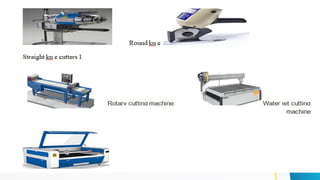
A. Cutting Machines: Cutting machines are used to precisely
cut fabric layers according to predetermined patterns. They can
be manual, semi-automatic, or fully automatic. Common types of
cutting machines include straight knife cutters, rotary cutters,
and laser cutters.
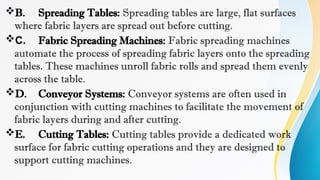
B. Spreading Tables: Spreading tables are large, flat surfaces
where fabric layers are spread out before cutting.
C. Fabric Spreading Machines: Fabric spreading machines
automate the process of spreading fabric layers onto the spreading
tables. These machines unroll fabric rolls and spread them evenly
across the table.
D. Conveyor Systems: Conveyor systems are often used in
conjunction with cutting machines to facilitate the movement of
fabric layers during and after cutting.
E. Cutting Tables: Cutting tables provide a dedicated work
surface for fabric cutting operations and they are designed to
support cutting machines.
2.1 Fabric Lay-up
Fabric lay-up refers to the process of layering or stacking
multiple fabric plies on top of each other in preparation for
cutting.
It is an essential step in garment production, as it ensures that the
fabric is properly aligned and ready for accurate cutting.
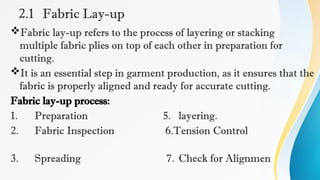
Fabric lay-up process:
1. Preparation 5. layering.
2. Fabric Inspection 6.Tension Control
3. Spreading 7. Check for Alignmen
2.2 Fabric check
Fabric checks are essential quality control procedures conducted
to ensure the suitability, integrity, and conformity of fabric before
it is used in garment production.
These checks help identify any defects, flaws, or inconsistencies in
the fabric that could affect the final product's quality.
Common fabric checks performed in garment production:
A. Visual Inspection: The fabric is visually examined under
proper lighting conditions to detect any visible defects such as stains,
holes, snags, colour variations, printing or weaving inconsistencies,
or other surface abnormalities. This inspection is usually done by
trained quality control personnel.
B. Colour Fastness Testing: Colour fastness refers to the
fabric's ability to retain its colour when exposed to various
conditions such as washing, rubbing, light exposure, or
perspiration. colour fastness testing is conducted to ensure that
the fabric's colour does not bleed or fade excessively during
normal use or care.
C. Dimensional Stability Testing: Dimensional stability testing
assesses how well the fabric maintains its original size and shape
after exposure to various conditions like washing, dry cleaning, or
mechanical stress. Shrinking, stretching, or distortion beyond
acceptable limits can affect the garment's fit and appearance.
 Their are other important fabric quality check parameters:
 Fabric Weight and Thickness Measurement
 Fabric Strength Testing
 Seam Slippage Testing
 Pilling Resistance Testing
 Fabric Composition Analysis
 Flammability Testing
2.3 Minimize fabric fault
To minimize fabric faults in garment production, it is important
to implement effective quality control measures and follow best
practices throughout the manufacturing process.
Some strategies to minimize fabric faults:
1. Reliable Fabric Suppliers
2. Incoming Fabric Inspection
3. Quality Control at Cutting Stage
4. Proper Fabric Handling
5. Regular Maintenance of Cutting Equipment
6. Quality Control during Sewing.......etc.
2.4 Fabric performance
Fabric performance refers to the ability of a fabric to meet spec ic
functional requirements or standards when subjected to various
conditions or environments.
 confort
 durability
 moisture management
 breathability
 Stain Resistance
 Wrinkle Resistance
 Fire Resistance/Fire retardancy
UNIT THREE
MARKER LAY AND POSITION
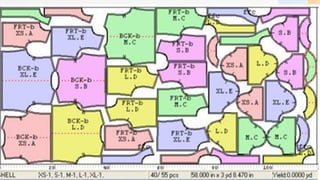
Marker lay, also known as fabric marker placement, is a crucial
step in garment production that involves arranging and
positioning fabric markers on the fabric layers before cutting.
The marker lay determines the efficiency of fabric utilization and
affects the overall production cost. Here's an overview of the
marker lay process:
 marker planning Nesting and Optimization
spreading the fabric Marker Verification
place the fabric marker
3.3 Pattern pieces Checking and collecting
Checking and collecting pattern pieces is an essential step in
garment production that involves verifying the accuracy and
completeness of the pattern pieces before they are used in cutting
and sewing. Here's an overview of the process:
1. Pattern Piece Verification
2. Pattern Markings
3. Pattern Numbering and Libelling
4. Pattern Quantity
5. Quality Control
6. Organizing and Collecting..etc
3.4 marker making
• It involves creating the lat of fabric markers on a marker paper
or digital file. The marker serves as a guide for cutting the fabric
and plays a significant role in optimizing fabric utilization and
minimizing waste.
• Ihe steps involved in marker making:
• 1. Gather Pattern Information
• 2. Determine Marker Width
• 3. Create the Marker Plan
• 4. Nest the Pattern Pieces
• 5. Optimize Fabric Utilization.....etc
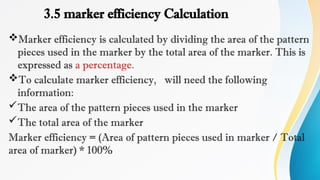
3.5 marker efficiency Calculation
Marker efficiency is calculated by dividing the area of the pattern
pieces used in the marker by the total area of the marker. This is
expressed as a percentage.
To calculate marker efficiency, will need the following
information:
The area of the pattern pieces used in the marker
The total area of the marker
Marker efficiency = (Area of pattern pieces used in marker / Total
area of marker) * 100%
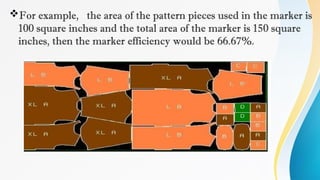
For example, the area of the pattern pieces used in the marker is
100 square inches and the total area of the marker is 150 square
inches, then the marker efficiency would be 66.67%.
UNIT FOUR: COPY MARKER
Position marker is a series of lines and symbols that are printed
on the lay marker paper.
These lines and symbols indicate the position of the fabric on the
marker, as well as the direction in which the fabric should be cut.
The position marker is typically located in the top left corner of
the lay marker.
It should be clear and easy to read, so that the fabric cutter can
easily understand how to position the fabric on the marker.
The position marker is a small symbol that is placed on the lay
marker to indicate where the fabric should be placed on the
cutting table. The position marker typically includes the
following information:
 Garment style
 Size
 Quantity
Example of how the position marker and copy marker could be
used in the introduction of a lay marker:
Position marker: Copy marker:
Style: T-shirt Style: T-shirt
Size: M Size: M
Quantity: 10 Quantity: 10
Copy and maintaining marker
The copy marker is a series of numbers and symbols that are
printed on the lay marker paper.
These numbers and symbols indicate the number of times that
each pattern piece should be cut.
The copy marker is typically located in the bottom right corner of
the lay marker.
It should be clear and easy to read, so that the fabric cutter can
easily understand how many times to cut each pattern piece.
UNIT FIVE : CUT AND COMPLETE WORK
5.1 Follow OHS practices for fabric cutting
Occupational health and safety (OHS) practices for fabric cutting
are important to protect workers from hazards such as cuts,
abrasions, eye injuries, and exposure to dust and fumes.
Here are some OHS practices that should be followed in fabric
cutting operations:
Wear appropriate personal protective equipment (PPE). This
includes safety glasses, gloves, and a dust mask.
Use sharp cutting tools. Sharp tools are less likely to slip and
cause cuts.
Keep the cutting area clean and free of clutter. This will help to
prevent tripping and slipping accidents.
 Be aware of surroundings. Be careful not to cut self or others
with the cutting tools.
Use a cutting board or other protective surface to protect work
surfaces.
 Dispose of fabric scraps properly. Fabric scraps can be a
tripping hazard and can also catch fire.
Here are some additional OHS practices that can be followed in
fabric cutting operations:
Use a well-ventilated cutting area. This will help to reduce
exposure to dust and fumes.
Take breaks regularly. This will help to prevent fatigue and
accidents.
Report any accidents or injuries immediately.
Examples of how to follow OHS practices for fabric cutting:
When using a rotary cutter, always keep the blade guard in
place until are ready to make a cut.
When using a straight edge, make sure that it is held securely in
place before making a cut.
When using scissors, make sure that they are sharp and that the
blades are properly aligned.
When cutting fabric with a machine, make sure that the
machine is properly guarded and that the blades are sharp.
5.2 Fabric cutting machine and equipment
Fabric cutting machines and equipment are used to automate
and streamline the fabric cutting process in the textile and
garment manufacturing industry.
These machines are designed to cut fabric with precision,
speed, and efficiency, reducing labor requirements and
improving productivity.
Here are some commonly used fabric cutting machines and
equipment:
A. Straight Knife Cutting Machine: This type of cutting machine
features a straight, oscillating blade that moves up and down to cut
through the fabric layers.
It is suitable for cutting straight lines and curves and is versatile
enough to handle various types of fabrics.
B. Round Knife Cutting Machine: Round knife cutting machines
have a circular blade that rotates and cuts through the fabric.
 They are particularly useful for cutting small radius curves and are
efficient for both straight and curved cuts.
C. Band Knife Cutting Machine: Band knife cutting machines
utilize a long, narrow blade that moves in a continuous loop.
D. Automated Cutting Systems: These systems integrate
computerized software, cutting machines, and material handling
equipment to automate the entire cutting process.
5.3 cutting operation
Fabric cutting is the process of converting large rolls or bolts of
fabric into individual garment components or patterns.
Here are the key steps involved in fabric cutting:
1. Spreading 2.Marking:
3. Layering 4.Cutting
5. Sorting and bundling


Fabric Cutting operation for garment students

  • 1.
    GARMENT PRODUCTION LEVEL –III Module Title: Fabric cutting operation Module Code: IND GAP3 M04 1123 Nominal durassions: 60 Hours course instructor : Kefitaw katale.
  • 3.
    Contents of themodule Workstation  cutting machine minor maintenance cutting and spreading equipment  Fabric Lay-up  Fabric check  Fabric performance  Marker Lay Cut order planning marker efficiency Calculation
  • 4.
    1.1 Workstation When designingworkstations for garment production, it is important to consider the spec ic tasks and operations involved in the production process. A. Workstation: Arrange workstations in a logical sequence that aligns with the flow of operations. Consider the order of tasks such as fabric cutting, sewing, pressing, and finishing. B. Space and Size: Allocate sufficient space for each workstation to accommodate the spec ic tasks and equipment involved. Consider the size of the machines, the workspace required for operators, and any additional tools or materials needed for the operations.
  • 5.
    Workstation for fabriccutting A workstation is a high-performance computer system that is typically used for demanding tasks such as scientist computing, engineering design, and video editing. Workstations are typically more powerful and expensive than personal computers, but offer better performance and reliability.
  • 6.
    C. Ergonomics: Designworkstations with ergonomics in mind to promote operator comfort and productivity. Ensure that work surfaces, chair height, and equipment placement are suitable for the tasks being performed. D. Lighting: Ensure that workstations are well-lit to facilitate accurate and precise work. Use natural lighting whenever possible and supplement it with appropriate art icial lighting to minimize eye strain and ensure visibility of details. E. Tool and Equipment Placement: Organize tools and equipment within easy reach of operators, minimizing the need for excessive movement or stretching. Consider the frequency of tool usage and arrange them in a manner that promotes efficiency and productivity.
  • 7.
    1. Choose awell-ventilated area:-This will help to prevent the inhalation of dust and fumes from the cutting process. 2. Place a cutting mat on a flat work surface:-This will protect the surface from scratches and cuts, and it will also provide a stable surface for cutting. 3. Position cutting tools within reach:-Make sure that tools are sharp and in good condition. 4. Put on safety glasses:-This will protect eyes from flying debris.
  • 8.
    5. Place thefabric on the cutting mat:-Smooth out any wrinkles in the fabric. 6. Using rotary cutters: - Rotary cutters can be dangerous not used properly. .7 Surroundings and be aware of the other workers in the area: - Communicate with r co-workers and let them know what are doing. 8. Keep the cutting area free of clutter: - This will help to move around safely and avoid tripping hazards.
  • 9.
    1.2 cutting machineminor maintenance Performing regular minor maintenance on the cutting machine workstation in garment production can help ensure a safe and efficient working environment. here are some maintenance tasks specic to the workstation: A. Cleanliness: Keep the cutting machine workstation clean and free from debris. Regularly remove fabric scraps, dust, and other waste materials from the cutting table, surrounding areas, and floor. B. Surface Maintenance: Check the condition of the cutting table or surface. Repair or replace any damaged or worn-out sections to ensure a smooth and flat working area.
  • 10.
    C. Workspace Organization:Maintain an organized workstation to optimize workflow and minimize clutter. Ensure that tools, supplies, and materials are properly stored and easily accessible. Use storage containers, racks, or shelves to keep items organized and within reach of the operator. D.Tool Maintenance: Regularly inspect and maintain the tools used at the cutting machine workstation. This may include scissors, rotary cutters, rulers, or marking tools. Clean the tools after use and ensure they are in good working condition.
  • 11.
    1.3 cutting andspreading equipment Cutting and spreading equipment play a crucial role in garment production, as they are responsible for accurately cutting fabric and efficiently spreading fabric layers for cutting. Here are some commonly used cutting and spreading equipment in garment production: A. Cutting Machines: Cutting machines are used to precisely cut fabric layers according to predetermined patterns. They can be manual, semi-automatic, or fully automatic. Common types of cutting machines include straight knife cutters, rotary cutters, and laser cutters.
  • 13.
    B. Spreading Tables:Spreading tables are large, flat surfaces where fabric layers are spread out before cutting. C. Fabric Spreading Machines: Fabric spreading machines automate the process of spreading fabric layers onto the spreading tables. These machines unroll fabric rolls and spread them evenly across the table. D. Conveyor Systems: Conveyor systems are often used in conjunction with cutting machines to facilitate the movement of fabric layers during and after cutting. E. Cutting Tables: Cutting tables provide a dedicated work surface for fabric cutting operations and they are designed to support cutting machines.
  • 14.
    2.1 Fabric Lay-up Fabriclay-up refers to the process of layering or stacking multiple fabric plies on top of each other in preparation for cutting. It is an essential step in garment production, as it ensures that the fabric is properly aligned and ready for accurate cutting. Fabric lay-up process: 1. Preparation 5. layering. 2. Fabric Inspection 6.Tension Control 3. Spreading 7. Check for Alignmen
  • 15.
    2.2 Fabric check Fabricchecks are essential quality control procedures conducted to ensure the suitability, integrity, and conformity of fabric before it is used in garment production. These checks help identify any defects, flaws, or inconsistencies in the fabric that could affect the final product's quality. Common fabric checks performed in garment production: A. Visual Inspection: The fabric is visually examined under proper lighting conditions to detect any visible defects such as stains, holes, snags, colour variations, printing or weaving inconsistencies, or other surface abnormalities. This inspection is usually done by trained quality control personnel.
  • 16.
    B. Colour FastnessTesting: Colour fastness refers to the fabric's ability to retain its colour when exposed to various conditions such as washing, rubbing, light exposure, or perspiration. colour fastness testing is conducted to ensure that the fabric's colour does not bleed or fade excessively during normal use or care. C. Dimensional Stability Testing: Dimensional stability testing assesses how well the fabric maintains its original size and shape after exposure to various conditions like washing, dry cleaning, or mechanical stress. Shrinking, stretching, or distortion beyond acceptable limits can affect the garment's fit and appearance.
  • 17.
     Their areother important fabric quality check parameters:  Fabric Weight and Thickness Measurement  Fabric Strength Testing  Seam Slippage Testing  Pilling Resistance Testing  Fabric Composition Analysis  Flammability Testing
  • 18.
    2.3 Minimize fabricfault To minimize fabric faults in garment production, it is important to implement effective quality control measures and follow best practices throughout the manufacturing process. Some strategies to minimize fabric faults: 1. Reliable Fabric Suppliers 2. Incoming Fabric Inspection 3. Quality Control at Cutting Stage 4. Proper Fabric Handling 5. Regular Maintenance of Cutting Equipment 6. Quality Control during Sewing.......etc.
  • 19.
    2.4 Fabric performance Fabricperformance refers to the ability of a fabric to meet spec ic functional requirements or standards when subjected to various conditions or environments.  confort  durability  moisture management  breathability  Stain Resistance  Wrinkle Resistance  Fire Resistance/Fire retardancy
  • 20.
    UNIT THREE MARKER LAYAND POSITION Marker lay, also known as fabric marker placement, is a crucial step in garment production that involves arranging and positioning fabric markers on the fabric layers before cutting. The marker lay determines the efficiency of fabric utilization and affects the overall production cost. Here's an overview of the marker lay process:  marker planning Nesting and Optimization spreading the fabric Marker Verification place the fabric marker
  • 22.
    3.3 Pattern piecesChecking and collecting Checking and collecting pattern pieces is an essential step in garment production that involves verifying the accuracy and completeness of the pattern pieces before they are used in cutting and sewing. Here's an overview of the process: 1. Pattern Piece Verification 2. Pattern Markings 3. Pattern Numbering and Libelling 4. Pattern Quantity 5. Quality Control 6. Organizing and Collecting..etc
  • 23.
    3.4 marker making •It involves creating the lat of fabric markers on a marker paper or digital file. The marker serves as a guide for cutting the fabric and plays a significant role in optimizing fabric utilization and minimizing waste. • Ihe steps involved in marker making: • 1. Gather Pattern Information • 2. Determine Marker Width • 3. Create the Marker Plan • 4. Nest the Pattern Pieces • 5. Optimize Fabric Utilization.....etc
  • 24.
    3.5 marker efficiencyCalculation Marker efficiency is calculated by dividing the area of the pattern pieces used in the marker by the total area of the marker. This is expressed as a percentage. To calculate marker efficiency, will need the following information: The area of the pattern pieces used in the marker The total area of the marker Marker efficiency = (Area of pattern pieces used in marker / Total area of marker) * 100%
  • 25.
    For example, thearea of the pattern pieces used in the marker is 100 square inches and the total area of the marker is 150 square inches, then the marker efficiency would be 66.67%.
  • 26.
    UNIT FOUR: COPYMARKER Position marker is a series of lines and symbols that are printed on the lay marker paper. These lines and symbols indicate the position of the fabric on the marker, as well as the direction in which the fabric should be cut. The position marker is typically located in the top left corner of the lay marker. It should be clear and easy to read, so that the fabric cutter can easily understand how to position the fabric on the marker.
  • 27.
    The position markeris a small symbol that is placed on the lay marker to indicate where the fabric should be placed on the cutting table. The position marker typically includes the following information:  Garment style  Size  Quantity
  • 28.
    Example of howthe position marker and copy marker could be used in the introduction of a lay marker: Position marker: Copy marker: Style: T-shirt Style: T-shirt Size: M Size: M Quantity: 10 Quantity: 10
  • 29.
    Copy and maintainingmarker The copy marker is a series of numbers and symbols that are printed on the lay marker paper. These numbers and symbols indicate the number of times that each pattern piece should be cut. The copy marker is typically located in the bottom right corner of the lay marker. It should be clear and easy to read, so that the fabric cutter can easily understand how many times to cut each pattern piece.
  • 30.
    UNIT FIVE :CUT AND COMPLETE WORK 5.1 Follow OHS practices for fabric cutting Occupational health and safety (OHS) practices for fabric cutting are important to protect workers from hazards such as cuts, abrasions, eye injuries, and exposure to dust and fumes. Here are some OHS practices that should be followed in fabric cutting operations: Wear appropriate personal protective equipment (PPE). This includes safety glasses, gloves, and a dust mask. Use sharp cutting tools. Sharp tools are less likely to slip and cause cuts.
  • 31.
    Keep the cuttingarea clean and free of clutter. This will help to prevent tripping and slipping accidents.  Be aware of surroundings. Be careful not to cut self or others with the cutting tools. Use a cutting board or other protective surface to protect work surfaces.  Dispose of fabric scraps properly. Fabric scraps can be a tripping hazard and can also catch fire.
  • 32.
    Here are someadditional OHS practices that can be followed in fabric cutting operations: Use a well-ventilated cutting area. This will help to reduce exposure to dust and fumes. Take breaks regularly. This will help to prevent fatigue and accidents. Report any accidents or injuries immediately.
  • 33.
    Examples of howto follow OHS practices for fabric cutting: When using a rotary cutter, always keep the blade guard in place until are ready to make a cut. When using a straight edge, make sure that it is held securely in place before making a cut. When using scissors, make sure that they are sharp and that the blades are properly aligned. When cutting fabric with a machine, make sure that the machine is properly guarded and that the blades are sharp.
  • 34.
    5.2 Fabric cuttingmachine and equipment Fabric cutting machines and equipment are used to automate and streamline the fabric cutting process in the textile and garment manufacturing industry. These machines are designed to cut fabric with precision, speed, and efficiency, reducing labor requirements and improving productivity. Here are some commonly used fabric cutting machines and equipment:
  • 35.
    A. Straight KnifeCutting Machine: This type of cutting machine features a straight, oscillating blade that moves up and down to cut through the fabric layers. It is suitable for cutting straight lines and curves and is versatile enough to handle various types of fabrics. B. Round Knife Cutting Machine: Round knife cutting machines have a circular blade that rotates and cuts through the fabric.  They are particularly useful for cutting small radius curves and are efficient for both straight and curved cuts. C. Band Knife Cutting Machine: Band knife cutting machines utilize a long, narrow blade that moves in a continuous loop.
  • 36.
    D. Automated CuttingSystems: These systems integrate computerized software, cutting machines, and material handling equipment to automate the entire cutting process. 5.3 cutting operation Fabric cutting is the process of converting large rolls or bolts of fabric into individual garment components or patterns. Here are the key steps involved in fabric cutting: 1. Spreading 2.Marking: 3. Layering 4.Cutting 5. Sorting and bundling