Welcome to the Presentation
ON
The lace fabric.
What is lace fabric ?
 Lace is an open work fabric consisting of a network
of yarns formed into intricate designs.
Features:
 Lace is an open work fabric consisting of a network of yarns formed into intricate
designs.
 Lace may be hand or machine made, and intricate pattern scan be produced by
either technique.
 Both narrow and wide lace fabrics are available.
 The edges of the fabric may be straight or curved.
 It is an important trimming, for it is used for table cloths,
curtains, handkerchiefs, dresses, and underwear .
 The pattern, flower, or group, which forms the closer-worked
and more solid portion.
 The ground or filling, which serves to hold the pattern
together.
History of lace :
 Lace, a decorative openwork web, was first developed in Europe during the
sixteenth century. Two distinct types of lace making needle lace and bobbin
lace began simultaneously. Needle lace is made with a single needle and
thread, while bobbin lace entails the plaiting of many threads. Lace thread was
typically made from linen, and later silk or metallic gold threads, followed by
cotton in the nineteenth century. Needle and bobbin laces were often named
after the region or town where they were made. Preeminent lace making
centers were established in Italy, Flanders, and France.
 The finest lace involved the talents and skills of three distinct specialists:
the artist who created the designs on paper, the pattern maker who
translated the designs onto parchment, and the lace maker who worked
directly on the patterns to make the lace. Lace adorned women’s and
men’s collars and cuffs, draped women’s shoulders, hands, heads, covered
entire gowns, and decorated furnishings
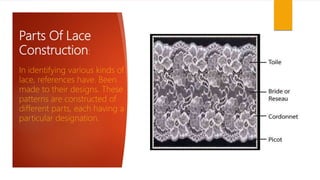
Parts Of Lace
Construction:
In identifying various kinds of
lace, references have. Been
made to their designs. These
patterns are constructed of
different parts, each having a
particular designation.
Bride, or Reseau: It is the fine yarn that forms the mesh which provides the sheer
ground(background)between the prominent parts of the pattern.
Cordonnet : It is the heavy yarn that outlines the pattern.
Picot : It is a decorative loop used both in the pattern and on the edge of the lace.
Toile : It represents the predominant parts of the pattern made by braiding,
knotting, looping, or twisting the yarn.
Types Of Lace:
 The two main types of laces are real or handmade or machine made.
Linen thread is usually used for real lace and also expensive laces, but
cotton, rayon, nylon, silk or other yarns are now used for various qualities
and types and for machine lace.
 Bobbin lace: Sometimes called pillow lace, the lace design is drawn either
on pillow or on a paper that is placed over the pillow.
 Antique lace :Has a darned lace pattern on a rectangular mesh ground.
 Filet lace :Has a darned lace design on a square mesh ground.
 Needle point lace: The design for needle point is drawn on parchment stitched to a
backing of stout linen, and the lace is made by filling in the pattern with button hole
stitches. When the lace is completed, the parchment is removed. Needle point lace
is made entirely with a sewing needle and thread. A design is drawn on paper,
thread is laid over the design, and the thread is then sewn in place with button hole
and blanket stitches.
 Darned lace: It has a design darned by a chain stitch onto a mesh background.
When made by hand, the design of darned lace is sewn with thread and needle
passed in and out of a mesh net. There are two principal types of darned lace.
 Crochet lace: When handmade, this is made with a crochet hook, to form a
series of loops, each one of which is finished with a fine stitch, working usually
with specially twisted cotton thread. It originated in Ireland as an imitation of
Venetian needle point. It is a comparatively inexpensive heavy lace.
Machine made Lace:
 Nearly all the laces classified as real laces can be duplicated by machine with slight
variations and simplifications.
 Leavers lace: The leavers lace machine can produce the most intricate patterns from
any type of yarn into fabrics up to ten yards wide. It is huge, complex machine that
takes an operator two to three weeks to thread. Very thin, round, brass bobbins
containing up to 300 yds.' each are individually conveyed by carriages moving back
and forth from one warp to another. As each bobbin is moved to a predetermined
position, it swings between the warp yarns and wraps its yarn around one warp
before it is moved to another. Since there are about 20 bobbins per inch, very
intricate designs are possible. The fabrics can be fairly expensive. Leavers lace is used
to a great extent in the dress industry.
 Nottingham Lace: The Nottingham machine originated in Nottingham, England. It
also utilizes swinging brass bobbins but produces a flat lace that is coarser than
leavers lace.
 Bobbin lace: The bobbin machine employs the braiding principle. The lace produced
has a fairly heavy texture, with an angular appearance and a uniform count.
 Rachel lace: Knitting machines can be constructed to make lace resembling levers
and crocheted laces. The Rachel machine, which has its needles set horizontally
instead of vertically as for knitting.
 Ratine lace: It is a machine made lace that has a ground of heavy loops resembling
that of terry cloth.
Machine Specification
 Origin :Switzerland
 Brand :Surer
 Model:EPOCA04 ,HP4040,HPE4040
 Production speed ;320rpm,200 rpm, 220 rpm
 Motion transfer system :Servo mechanism
 Operating system : Windows pro 2000
 Frame width :16 yds.
 Production Unit : 2 unit
working principle :
 The Schiffli machine used two threads - one on the front side and one on the back
side of the fabric. The first thread is entwined with the second thread to form a lock
stitch. The front side thread, or embroidery yarn is held on a spool, or rather a
creel of spools. A boat shaped shuttle carries the bobbin thread, also known as the
schiffli yarn. There is one shuttle per needle . The needle withdraws it forms a loop
on the back side of the material. The shuttle which trails the bobbin thread passes
through this loop. A shuttle embroidery machine can have two rows of needles
with several hundred needles per row.
Uses Of Laces:
 Lace is a decorative fabric used in apparel and home furnishings. Narrow
laces are used for trims and insertions; wide lace fabrics are used for curtains,
table cloths, and garments.
 Lace is a decorative fabric used in apparel and home finishing . Narrow laces
are used for trims and insertions; wide lace fabrics are used for curtains, table
cloths, and garments.
 Laces are made in different widths for different uses. For example, a narrow
lace with a Scalloped edge is used for trimming a baby's dress; a lace with
slits or eyelets is so made that ribbon may be run through it.
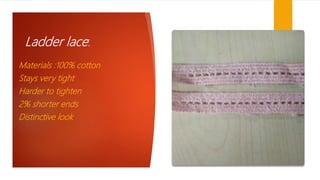
Ladder lace:
Materials :100% cotton
Stays very tight
Harder to tighten
2% shorter ends
Distinctive look
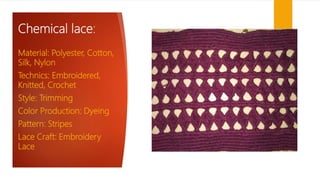
Chemical lace:
Material: Polyester, Cotton,
Silk, Nylon
Technics: Embroidered,
Knitted, Crochet
Style: Trimming
Color Production: Dyeing
Pattern: Stripes
Lace Craft: Embroidery
Lace
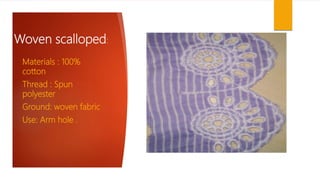
Woven scalloped:
Materials : 100%
cotton
Thread : Spun
polyester
Ground: woven fabric
Use: Arm hole .
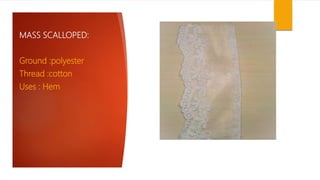
MASS SCALLOPED:
Ground :polyester
Thread :cotton
Uses : Hem
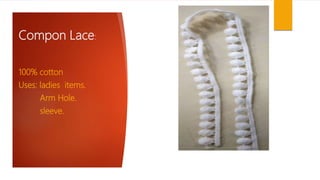
Compon Lace:
100% cotton
Uses: ladies items.
Arm Hole.
sleeve.
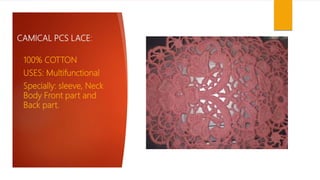
CAMICAL PCS LACE:
100% COTTON
USES: Multifunctional
Specially: sleeve, Neck
Body Front part and
Back part.
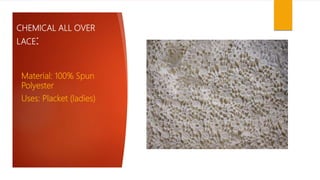
CHEMICAL ALL OVER
LACE:
Material: 100% Spun
Polyester
Uses: Placket (ladies)
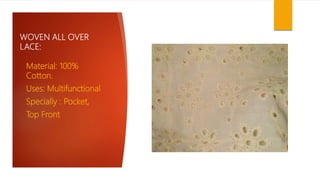
WOVEN ALL OVER
LACE:
Material: 100%
Cotton.
Uses: Multifunctional
Specially : Pocket,
Top Front
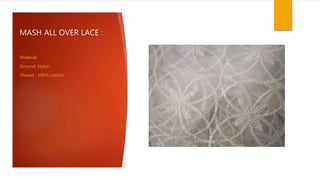
MASH ALL OVER LACE :
Material:
Ground: Nylon
Thread : 100% cotton
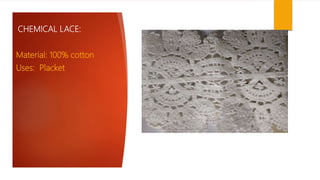
CHEMICAL LACE:
Material: 100% cotton
Uses: Placket
Visited factory:
Name: Alif Embroidery Village LTD. ( Top Star Lace)
Location : Tonga Bari , Bangabandhu Road, Saver .
Machine Model: EPOCA 04
Competitor : EPZ, Zuka San Bangladesh Limited , LAMS
Fashion.
Presentation On Lace fabric

Presentation On Lace fabric

  • 1.
    Welcome to thePresentation ON The lace fabric.
  • 2.
    What is lacefabric ?  Lace is an open work fabric consisting of a network of yarns formed into intricate designs.
  • 3.
    Features:  Lace isan open work fabric consisting of a network of yarns formed into intricate designs.  Lace may be hand or machine made, and intricate pattern scan be produced by either technique.  Both narrow and wide lace fabrics are available.  The edges of the fabric may be straight or curved.
  • 4.
     It isan important trimming, for it is used for table cloths, curtains, handkerchiefs, dresses, and underwear .  The pattern, flower, or group, which forms the closer-worked and more solid portion.  The ground or filling, which serves to hold the pattern together.
  • 5.
    History of lace:  Lace, a decorative openwork web, was first developed in Europe during the sixteenth century. Two distinct types of lace making needle lace and bobbin lace began simultaneously. Needle lace is made with a single needle and thread, while bobbin lace entails the plaiting of many threads. Lace thread was typically made from linen, and later silk or metallic gold threads, followed by cotton in the nineteenth century. Needle and bobbin laces were often named after the region or town where they were made. Preeminent lace making centers were established in Italy, Flanders, and France.
  • 6.
     The finestlace involved the talents and skills of three distinct specialists: the artist who created the designs on paper, the pattern maker who translated the designs onto parchment, and the lace maker who worked directly on the patterns to make the lace. Lace adorned women’s and men’s collars and cuffs, draped women’s shoulders, hands, heads, covered entire gowns, and decorated furnishings
  • 7.
    Parts Of Lace Construction: Inidentifying various kinds of lace, references have. Been made to their designs. These patterns are constructed of different parts, each having a particular designation.
  • 8.
    Bride, or Reseau:It is the fine yarn that forms the mesh which provides the sheer ground(background)between the prominent parts of the pattern. Cordonnet : It is the heavy yarn that outlines the pattern. Picot : It is a decorative loop used both in the pattern and on the edge of the lace. Toile : It represents the predominant parts of the pattern made by braiding, knotting, looping, or twisting the yarn.
  • 9.
    Types Of Lace: The two main types of laces are real or handmade or machine made. Linen thread is usually used for real lace and also expensive laces, but cotton, rayon, nylon, silk or other yarns are now used for various qualities and types and for machine lace.  Bobbin lace: Sometimes called pillow lace, the lace design is drawn either on pillow or on a paper that is placed over the pillow.
  • 10.
     Antique lace:Has a darned lace pattern on a rectangular mesh ground.  Filet lace :Has a darned lace design on a square mesh ground.  Needle point lace: The design for needle point is drawn on parchment stitched to a backing of stout linen, and the lace is made by filling in the pattern with button hole stitches. When the lace is completed, the parchment is removed. Needle point lace is made entirely with a sewing needle and thread. A design is drawn on paper, thread is laid over the design, and the thread is then sewn in place with button hole and blanket stitches.  Darned lace: It has a design darned by a chain stitch onto a mesh background. When made by hand, the design of darned lace is sewn with thread and needle passed in and out of a mesh net. There are two principal types of darned lace.
  • 11.
     Crochet lace:When handmade, this is made with a crochet hook, to form a series of loops, each one of which is finished with a fine stitch, working usually with specially twisted cotton thread. It originated in Ireland as an imitation of Venetian needle point. It is a comparatively inexpensive heavy lace.
  • 12.
    Machine made Lace: Nearly all the laces classified as real laces can be duplicated by machine with slight variations and simplifications.  Leavers lace: The leavers lace machine can produce the most intricate patterns from any type of yarn into fabrics up to ten yards wide. It is huge, complex machine that takes an operator two to three weeks to thread. Very thin, round, brass bobbins containing up to 300 yds.' each are individually conveyed by carriages moving back and forth from one warp to another. As each bobbin is moved to a predetermined position, it swings between the warp yarns and wraps its yarn around one warp before it is moved to another. Since there are about 20 bobbins per inch, very intricate designs are possible. The fabrics can be fairly expensive. Leavers lace is used to a great extent in the dress industry.
  • 13.
     Nottingham Lace:The Nottingham machine originated in Nottingham, England. It also utilizes swinging brass bobbins but produces a flat lace that is coarser than leavers lace.  Bobbin lace: The bobbin machine employs the braiding principle. The lace produced has a fairly heavy texture, with an angular appearance and a uniform count.  Rachel lace: Knitting machines can be constructed to make lace resembling levers and crocheted laces. The Rachel machine, which has its needles set horizontally instead of vertically as for knitting.  Ratine lace: It is a machine made lace that has a ground of heavy loops resembling that of terry cloth.
  • 14.
    Machine Specification  Origin:Switzerland  Brand :Surer  Model:EPOCA04 ,HP4040,HPE4040  Production speed ;320rpm,200 rpm, 220 rpm  Motion transfer system :Servo mechanism  Operating system : Windows pro 2000  Frame width :16 yds.  Production Unit : 2 unit
  • 15.
    working principle : The Schiffli machine used two threads - one on the front side and one on the back side of the fabric. The first thread is entwined with the second thread to form a lock stitch. The front side thread, or embroidery yarn is held on a spool, or rather a creel of spools. A boat shaped shuttle carries the bobbin thread, also known as the schiffli yarn. There is one shuttle per needle . The needle withdraws it forms a loop on the back side of the material. The shuttle which trails the bobbin thread passes through this loop. A shuttle embroidery machine can have two rows of needles with several hundred needles per row.
  • 16.
    Uses Of Laces: Lace is a decorative fabric used in apparel and home furnishings. Narrow laces are used for trims and insertions; wide lace fabrics are used for curtains, table cloths, and garments.  Lace is a decorative fabric used in apparel and home finishing . Narrow laces are used for trims and insertions; wide lace fabrics are used for curtains, table cloths, and garments.  Laces are made in different widths for different uses. For example, a narrow lace with a Scalloped edge is used for trimming a baby's dress; a lace with slits or eyelets is so made that ribbon may be run through it.
  • 17.
    Ladder lace: Materials :100%cotton Stays very tight Harder to tighten 2% shorter ends Distinctive look
  • 18.
    Chemical lace: Material: Polyester,Cotton, Silk, Nylon Technics: Embroidered, Knitted, Crochet Style: Trimming Color Production: Dyeing Pattern: Stripes Lace Craft: Embroidery Lace
  • 19.
    Woven scalloped: Materials :100% cotton Thread : Spun polyester Ground: woven fabric Use: Arm hole .
  • 20.
  • 21.
    Compon Lace: 100% cotton Uses:ladies items. Arm Hole. sleeve.
  • 22.
    CAMICAL PCS LACE: 100%COTTON USES: Multifunctional Specially: sleeve, Neck Body Front part and Back part.
  • 23.
    CHEMICAL ALL OVER LACE: Material:100% Spun Polyester Uses: Placket (ladies)
  • 24.
    WOVEN ALL OVER LACE: Material:100% Cotton. Uses: Multifunctional Specially : Pocket, Top Front
  • 25.
    MASH ALL OVERLACE : Material: Ground: Nylon Thread : 100% cotton
  • 26.
    CHEMICAL LACE: Material: 100%cotton Uses: Placket
  • 27.
    Visited factory: Name: AlifEmbroidery Village LTD. ( Top Star Lace) Location : Tonga Bari , Bangabandhu Road, Saver . Machine Model: EPOCA 04 Competitor : EPZ, Zuka San Bangladesh Limited , LAMS Fashion.