
Presentation on COX-2 Inhibitors
Presented By Sukanta Debnath
M.Pharm 1st semester
Presented to DR. Kuntal Manna
Associate Professor, Dept of Pharmacy
Tripura University
1
Advanced Medicinal Chemistry-I
CONTENTS:-
I. Introduction
II. Types of cox
III. Mechanism of cox
IV. Active site of cox 2
V. Structure of cox 2 isoenzyme
VI. Non steroidal anti inflammatory drugs
VII. Side effects of NSAIDs
2
VII. Categories of NSAIDs
IX. Selective COX 2 inhibitors
X. MOA of coxib
XI. SAR of Non selective COX 2 inhibitors
XII. Non selective COX 2 inhibitors
XIII. Classification of Non selective COX 2 inhibitors
XIV. Mechanism by which COX 2 contributes to Cancer
INTRODUCTION
 Cyclooxygenase (COX), officially known as prostaglandin-endoperoxide
synthase (PTGS), is an enzyme that is responsible for formation of prostanoids,
including thromboxane and prostaglandins such as prostacyclin, from arachidonic acid. A
member of the animal-type heme peroxidase family, it is also known as prostaglandin
G/H synthase
 COX-2 inhibitors are a type of nonsteroidal anti-inflammatory drug (NSAID) that
directly targets cyclooxygenase-2, COX-2, an enzyme responsible
for inflammation and pain.
3
Types Of Cyclooxygenase (Cox)
 The enzymes that produce prostaglandins are called cyclooxygenase (COX).
 There are two types of COX enzymes, COX-1 and COX-2.
 Both enzymes produce prostaglandins that promote inflammation, pain, and
fever; however, only COX-1 produces prostaglandins that activate platelets and
protect the stomach and intestinal lining.
4
Mechanism Of Action
5
Arachidonic Acid
Cox 2
(inducible)
Cytokines,
growth factor,
Selective Cox 2
Inhibitors
Classical NSAIDs
Macrophage,
Endothelial Cells,
Brain ,
Kidneys,
Reproductive Tract
PGs Diseases Target:- Arthritis,
Inflammation,
Epithelial Neoplasms
Active sites of Cox 2
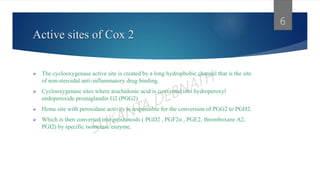
 The cyclooxygenase active site is created by a long hydrophobic channel that is the site
of non-steroidal anti-inflammatory drug binding.
 Cyclooxygenase sites where arachidonic acid is converted into hydroperoxyl
endoperoxide prostaglandin G2 (PGG2)
 Heme site with peroxidase activity is responsible for the conversion of PGG2 to PGH2.
 Which is then converted into prostanoids ( PGD2 , PGF2α , PGE2, thromboxane A2,
PGI2) by specific isomerase enzyme.
6
Structure of Cox 2 isoenzymes
7
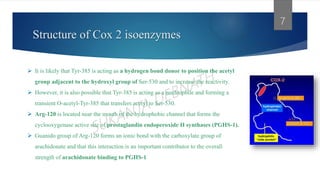
 It is likely that Tyr-385 is acting as a hydrogen bond donor to position the acetyl
group adjacent to the hydroxyl group of Ser-530 and to increase the reactivity.
 However, it is also possible that Tyr-385 is acting as a nucleophile and forming a
transient O-acetyl-Tyr-385 that transfers acetyl to Ser-530.
 Arg-120 is located near the mouth of the hydrophobic channel that forms the
cyclooxygenase active site of prostaglandin endoperoxide H synthases (PGHS-1).
 Guanido group of Arg-120 forms an ionic bond with the carboxylate group of
arachidonate and that this interaction is an important contributor to the overall
strength of arachidonate binding to PGHS-1
Non Steroidal Anti Inflammatory Drugs
 NSAIDS produce anti-inflammatory, anti-pyretic and analgesic effects.
 Finding ways of reducing pain and inflammation are key roles of NSAIDS.
 The mechanism of these drugs is due to their binding ability to the active sites of COX ,
preventing the catalysis of Arachidonic acid to prostaglandins
8
Contd…..
 NSAIDs binds irreversibly to COX enzymes and inhibit their action i.e the
conversion of Arachidonic acid to the prostaglandins.
 NSAIDs acetylates the actives site of cox enzyme which causes inhibition.
 Some examples of NSAIDs are:-Aspirin . Ibuprofen . Piroxicam etc .
 Aspirin irreversibly inactivates both COX 1 and COX 2 by acetylation of a
specific Serine residues.
9
Side Effects of NSAIDs
Aspirin and other similar NSAIDs lead to excessive production of
stomach acid as well as ulceration and gastrointestinal bleeding.
NSAIDs can prolong the bleeding time.
NSAIDSs can increase blood pressure.
These all side effects are due to the inhibition of COX 1's house keeping
role.
10
Selective Drug Targeting of COX 2
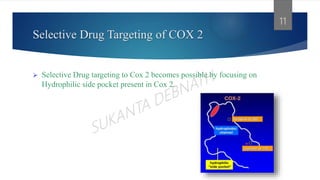
 Selective Drug targeting to Cox 2 becomes possible by focusing on
Hydrophilic side pocket present in Cox 2.
11
Categories of NSAIDs
NSAIDS can be divided into the following categories:-
Non-selective COX inhibitors (Aspirin, Naproxen, ibuprofen and piroxicam).
Selective COX-2 inhibitors (meloxicam, Celecoxib and diclofenac).
12
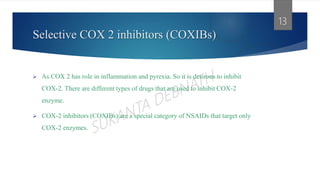
Selective COX 2 inhibitors (COXIBs)
 As COX 2 has role in inflammation and pyrexia. So it is desirous to inhibit
COX-2. There are different types of drugs that are used to inhibit COX-2
enzyme.
 COX-2 inhibitors (COXIBs) are a special category of NSAIDs that target only
COX-2 enzymes.
13
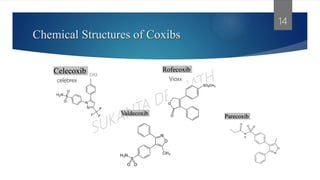
Chemical Structures of Coxibs
14
CH3
Celecoxib
celebrex
Rofecoxib
Vioxx
Valdecoxib
Parecoxib
MOA of Celecoxib
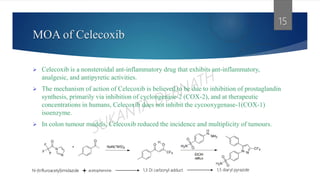
 Celecoxib is a nonsteroidal ant-inflammatory drug that exhibits ant-inflammatory,
analgesic, and antipyretic activities.
 The mechanism of action of Celecoxib is believed to be due to inhibition of prostaglandin
synthesis, primarily via inhibition of cyclongenase-2 (COX-2), and at therapeutic
concentrations in humans, Celecoxib does not inhibit the cycooxygenase-1(COX-1)
isoenzyme.
 In colon tumour models, Celecoxib reduced the incidence and multiplicity of tumours.
15
N-(trifluroacetyl)imidazole acetophenone 1,3 Di carbonyl adduct 1,5 diaryl pyrazole
SAR of Selective COX 2 inhibitors
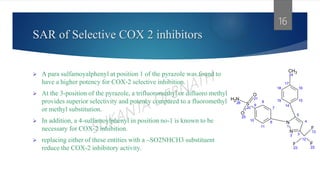
 A para sulfamoyalphenyl at position 1 of the pyrazole was found to
have a higher potency for COX-2 selective inhibition.
 At the 3-position of the pyrazole, a trifluoromethyl or difluoro methyl
provides superior selectivity and potency compared to a fluoromethyl
or methyl substitution.
 In addition, a 4-sulfamoylphenyl in position no-1 is known to be
necessary for COX-2 inhibition.
 replacing either of these entities with a –SO2NHCH3 substituent
reduce the COX-2 inhibitory activity.
16
16
15
17
14
18
19
CH3
24
7
6
8
11
9
10
S
20
N
H2
26
O
21
O
25
5
4
3
N
1
N
2
12
F
13
F
22
F
23
Non Selective COX 2 inhibitors
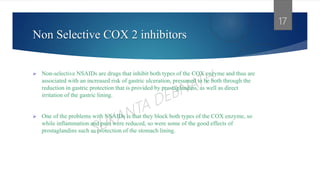
 Non-selective NSAIDs are drugs that inhibit both types of the COX enzyme and thus are
associated with an increased risk of gastric ulceration, presumed to be both through the
reduction in gastric protection that is provided by prostaglandins, as well as direct
irritation of the gastric lining.
 One of the problems with NSAIDs is that they block both types of the COX enzyme, so
while inflammation and pain were reduced, so were some of the good effects of
prostaglandins such as protection of the stomach lining.
17
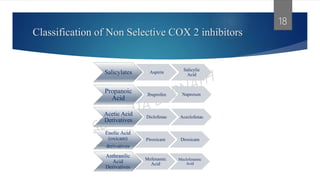
Classification of Non Selective COX 2 inhibitors
Salicylates Aspirin
Salicylic
Acid
Propanoic
Acid
Ibuprofen Naproxen
Acetic Acid
Derivatives
Diclofenac Aceclofenac
18
Enolic Acid
(oxicam)
derivatives
Piroxicam Droxicam
Anthranilic
Acid
Derivatives
Mefenamic
Acid
Meclofenamic
Acid
References
 https://www.drugs.com/drug-class/cox-2-inhibitors.html
 https://en.wikipedia.org/wiki/COX -2_inhibitor
 Structural and Functional Basis of Cyclooxygenase Inhibition Anna L.
Blobaum and Lawrence J. Marnett.
 https://www.researchgate.net/publication/11592340_COX-
2_inhibitors_Are_they_nonsteroidal_anti-
inflammatory_drugs_with_a_better_safety_profile
19
20

Cox 2 inhibitors

  • 1.
    Presentation on COX-2Inhibitors Presented By Sukanta Debnath M.Pharm 1st semester Presented to DR. Kuntal Manna Associate Professor, Dept of Pharmacy Tripura University 1 Advanced Medicinal Chemistry-I
  • 2.
    CONTENTS:- I. Introduction II. Typesof cox III. Mechanism of cox IV. Active site of cox 2 V. Structure of cox 2 isoenzyme VI. Non steroidal anti inflammatory drugs VII. Side effects of NSAIDs 2 VII. Categories of NSAIDs IX. Selective COX 2 inhibitors X. MOA of coxib XI. SAR of Non selective COX 2 inhibitors XII. Non selective COX 2 inhibitors XIII. Classification of Non selective COX 2 inhibitors XIV. Mechanism by which COX 2 contributes to Cancer
  • 3.
    INTRODUCTION  Cyclooxygenase (COX),officially known as prostaglandin-endoperoxide synthase (PTGS), is an enzyme that is responsible for formation of prostanoids, including thromboxane and prostaglandins such as prostacyclin, from arachidonic acid. A member of the animal-type heme peroxidase family, it is also known as prostaglandin G/H synthase  COX-2 inhibitors are a type of nonsteroidal anti-inflammatory drug (NSAID) that directly targets cyclooxygenase-2, COX-2, an enzyme responsible for inflammation and pain. 3
  • 4.
    Types Of Cyclooxygenase(Cox)  The enzymes that produce prostaglandins are called cyclooxygenase (COX).  There are two types of COX enzymes, COX-1 and COX-2.  Both enzymes produce prostaglandins that promote inflammation, pain, and fever; however, only COX-1 produces prostaglandins that activate platelets and protect the stomach and intestinal lining. 4
  • 5.
    Mechanism Of Action 5 ArachidonicAcid Cox 2 (inducible) Cytokines, growth factor, Selective Cox 2 Inhibitors Classical NSAIDs Macrophage, Endothelial Cells, Brain , Kidneys, Reproductive Tract PGs Diseases Target:- Arthritis, Inflammation, Epithelial Neoplasms
  • 6.
    Active sites ofCox 2  The cyclooxygenase active site is created by a long hydrophobic channel that is the site of non-steroidal anti-inflammatory drug binding.  Cyclooxygenase sites where arachidonic acid is converted into hydroperoxyl endoperoxide prostaglandin G2 (PGG2)  Heme site with peroxidase activity is responsible for the conversion of PGG2 to PGH2.  Which is then converted into prostanoids ( PGD2 , PGF2α , PGE2, thromboxane A2, PGI2) by specific isomerase enzyme. 6
  • 7.
    Structure of Cox2 isoenzymes 7  It is likely that Tyr-385 is acting as a hydrogen bond donor to position the acetyl group adjacent to the hydroxyl group of Ser-530 and to increase the reactivity.  However, it is also possible that Tyr-385 is acting as a nucleophile and forming a transient O-acetyl-Tyr-385 that transfers acetyl to Ser-530.  Arg-120 is located near the mouth of the hydrophobic channel that forms the cyclooxygenase active site of prostaglandin endoperoxide H synthases (PGHS-1).  Guanido group of Arg-120 forms an ionic bond with the carboxylate group of arachidonate and that this interaction is an important contributor to the overall strength of arachidonate binding to PGHS-1
  • 8.
    Non Steroidal AntiInflammatory Drugs  NSAIDS produce anti-inflammatory, anti-pyretic and analgesic effects.  Finding ways of reducing pain and inflammation are key roles of NSAIDS.  The mechanism of these drugs is due to their binding ability to the active sites of COX , preventing the catalysis of Arachidonic acid to prostaglandins 8
  • 9.
    Contd…..  NSAIDs bindsirreversibly to COX enzymes and inhibit their action i.e the conversion of Arachidonic acid to the prostaglandins.  NSAIDs acetylates the actives site of cox enzyme which causes inhibition.  Some examples of NSAIDs are:-Aspirin . Ibuprofen . Piroxicam etc .  Aspirin irreversibly inactivates both COX 1 and COX 2 by acetylation of a specific Serine residues. 9
  • 10.
    Side Effects ofNSAIDs Aspirin and other similar NSAIDs lead to excessive production of stomach acid as well as ulceration and gastrointestinal bleeding. NSAIDs can prolong the bleeding time. NSAIDSs can increase blood pressure. These all side effects are due to the inhibition of COX 1's house keeping role. 10
  • 11.
    Selective Drug Targetingof COX 2  Selective Drug targeting to Cox 2 becomes possible by focusing on Hydrophilic side pocket present in Cox 2. 11
  • 12.
    Categories of NSAIDs NSAIDScan be divided into the following categories:- Non-selective COX inhibitors (Aspirin, Naproxen, ibuprofen and piroxicam). Selective COX-2 inhibitors (meloxicam, Celecoxib and diclofenac). 12
  • 13.
    Selective COX 2inhibitors (COXIBs)  As COX 2 has role in inflammation and pyrexia. So it is desirous to inhibit COX-2. There are different types of drugs that are used to inhibit COX-2 enzyme.  COX-2 inhibitors (COXIBs) are a special category of NSAIDs that target only COX-2 enzymes. 13
  • 14.
    Chemical Structures ofCoxibs 14 CH3 Celecoxib celebrex Rofecoxib Vioxx Valdecoxib Parecoxib
  • 15.
    MOA of Celecoxib Celecoxib is a nonsteroidal ant-inflammatory drug that exhibits ant-inflammatory, analgesic, and antipyretic activities.  The mechanism of action of Celecoxib is believed to be due to inhibition of prostaglandin synthesis, primarily via inhibition of cyclongenase-2 (COX-2), and at therapeutic concentrations in humans, Celecoxib does not inhibit the cycooxygenase-1(COX-1) isoenzyme.  In colon tumour models, Celecoxib reduced the incidence and multiplicity of tumours. 15 N-(trifluroacetyl)imidazole acetophenone 1,3 Di carbonyl adduct 1,5 diaryl pyrazole
  • 16.
    SAR of SelectiveCOX 2 inhibitors  A para sulfamoyalphenyl at position 1 of the pyrazole was found to have a higher potency for COX-2 selective inhibition.  At the 3-position of the pyrazole, a trifluoromethyl or difluoro methyl provides superior selectivity and potency compared to a fluoromethyl or methyl substitution.  In addition, a 4-sulfamoylphenyl in position no-1 is known to be necessary for COX-2 inhibition.  replacing either of these entities with a –SO2NHCH3 substituent reduce the COX-2 inhibitory activity. 16 16 15 17 14 18 19 CH3 24 7 6 8 11 9 10 S 20 N H2 26 O 21 O 25 5 4 3 N 1 N 2 12 F 13 F 22 F 23
  • 17.
    Non Selective COX2 inhibitors  Non-selective NSAIDs are drugs that inhibit both types of the COX enzyme and thus are associated with an increased risk of gastric ulceration, presumed to be both through the reduction in gastric protection that is provided by prostaglandins, as well as direct irritation of the gastric lining.  One of the problems with NSAIDs is that they block both types of the COX enzyme, so while inflammation and pain were reduced, so were some of the good effects of prostaglandins such as protection of the stomach lining. 17
  • 18.
    Classification of NonSelective COX 2 inhibitors Salicylates Aspirin Salicylic Acid Propanoic Acid Ibuprofen Naproxen Acetic Acid Derivatives Diclofenac Aceclofenac 18 Enolic Acid (oxicam) derivatives Piroxicam Droxicam Anthranilic Acid Derivatives Mefenamic Acid Meclofenamic Acid
  • 19.
    References  https://www.drugs.com/drug-class/cox-2-inhibitors.html  https://en.wikipedia.org/wiki/COX-2_inhibitor  Structural and Functional Basis of Cyclooxygenase Inhibition Anna L. Blobaum and Lawrence J. Marnett.  https://www.researchgate.net/publication/11592340_COX- 2_inhibitors_Are_they_nonsteroidal_anti- inflammatory_drugs_with_a_better_safety_profile 19
  • 20.