
Welcome to Presentation on
“Civet”
Presented By
Monzur Kader Chowdhury
I.D:1201039, Reg. No. 1446
Faculty of Veterinary & Animal Science
Sylhet Agricultural University
Introduction
Civet, also called civet cat, long-
bodied,short-legged omninivores
of the family Viverridae. mostly
nocturnal mammal native to
tropical Asia and Africa, especially
the tropical forests. Civet applies
over a dozen different mammal
species. Most of the species
diversity is found in southeast
Asia. The best-known civet
species is the African civet,
Rather catlike in appearance, they
have a thickly furred tail, small
ears, and a pointed snout. The
coloration varies widely among
the species but commonly is buff
or grayish with a pattern of black
spots or stripes or both.
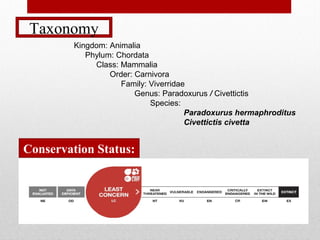
Taxonomy
Kingdom: Animalia
Phylum: Chordata
Class: Mammalia
Order: Carnivora
Family: Viverridae
Genus: Paradoxurus / Civettictis
Species:
Paradoxurus hermaphroditus
Civettictis civetta
Conservation Status:
Distribution:
The civet ranges from Nepal, northeast India, Bhutan,
Bangladesh
to Myanmar,Thailand,Singapore to Cambodia, Laos, Vietnam a
nd China.
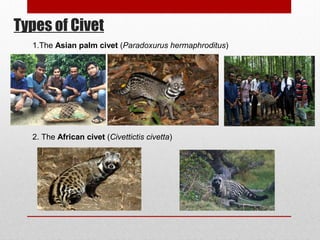
Types of Civet
1.The Asian palm civet (Paradoxurus hermaphroditus)
2. The African civet (Civettictis civetta)
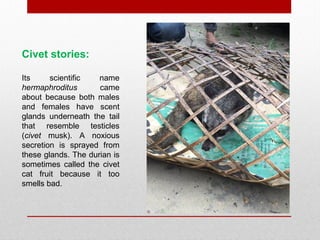
Civet stories:
Its scientific name
hermaphroditus came
about because both males
and females have scent
glands underneath the tail
that resemble testicles
(civet musk). A noxious
secretion is sprayed from
these glands. The durian is
sometimes called the civet
cat fruit because it too
smells bad.
Where seen?
This cute little 'bandit' of a beast is
sometimes seen at dusk or at
night. But it is quiet and shy and
easily spooked. It is not a cat!
In Bangladesh, it is widespread
and common even in urban areas
where it lives in the roof spaces of
buildings and forages in gardens.
They travel between houses via
telephone wires, poles and trees.
It is also found in forest,
scrubland, parks and mangroves.
It is more active at night and tends
to stay in the trees and high places
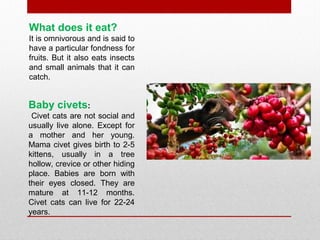
What does it eat?
It is omnivorous and is said to
have a particular fondness for
fruits. But it also eats insects
and small animals that it can
catch.
Baby civets:
Civet cats are not social and
usually live alone. Except for
a mother and her young.
Mama civet gives birth to 2-5
kittens, usually in a tree
hollow, crevice or other hiding
place. Babies are born with
their eyes closed. They are
mature at 11-12 months.
Civet cats can live for 22-24
years.
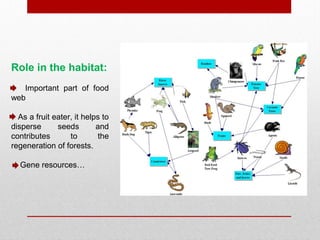
Role in the habitat:
Important part of food
web
As a fruit eater, it helps to
disperse seeds and
contributes to the
regeneration of forests.
Gene resources…
Civet-processed coffee:
'Kopi Luwak' is a type of expensive
gourmet coffee made from coffee
beans that have been 'processed'
by a civet cat. In nature, the civet
cat eats coffee beans, among many
other natural food. The coffee
beans which are excreted by the
civet cat are collected to be made
into coffee for humans to drink.
Unfortunately, growing demand has
resulted in cruel abuse of civet cats
to produce this coffee. The civet
cats are caged, fed nothing but
coffee beans and poorly looked
after. Please do NOT support
Kopi Luwak!
Threat:
Disease of Civet:
Severe Acute Respiratory
Syndrome (SARS)-like virus
has been isolated from civets.
A dangerous zoonotic disease
so civet banned to import in
USA and others countries.
As Cat family others viral
disease (Rabies etc), Bacterial
disease ( tuberculosis,
Brucellosis, Plague ,
Salmonellosis etc) , fungal and
parasitic disease.
Presentation on civet

Presentation on civet

  • 1.
    Welcome to Presentationon “Civet” Presented By Monzur Kader Chowdhury I.D:1201039, Reg. No. 1446 Faculty of Veterinary & Animal Science Sylhet Agricultural University
  • 2.
    Introduction Civet, also calledcivet cat, long- bodied,short-legged omninivores of the family Viverridae. mostly nocturnal mammal native to tropical Asia and Africa, especially the tropical forests. Civet applies over a dozen different mammal species. Most of the species diversity is found in southeast Asia. The best-known civet species is the African civet, Rather catlike in appearance, they have a thickly furred tail, small ears, and a pointed snout. The coloration varies widely among the species but commonly is buff or grayish with a pattern of black spots or stripes or both.
  • 3.
    Taxonomy Kingdom: Animalia Phylum: Chordata Class:Mammalia Order: Carnivora Family: Viverridae Genus: Paradoxurus / Civettictis Species: Paradoxurus hermaphroditus Civettictis civetta Conservation Status:
  • 4.
    Distribution: The civet rangesfrom Nepal, northeast India, Bhutan, Bangladesh to Myanmar,Thailand,Singapore to Cambodia, Laos, Vietnam a nd China.
  • 5.
    Types of Civet 1.TheAsian palm civet (Paradoxurus hermaphroditus) 2. The African civet (Civettictis civetta)
  • 6.
    Civet stories: Its scientificname hermaphroditus came about because both males and females have scent glands underneath the tail that resemble testicles (civet musk). A noxious secretion is sprayed from these glands. The durian is sometimes called the civet cat fruit because it too smells bad.
  • 7.
    Where seen? This cutelittle 'bandit' of a beast is sometimes seen at dusk or at night. But it is quiet and shy and easily spooked. It is not a cat! In Bangladesh, it is widespread and common even in urban areas where it lives in the roof spaces of buildings and forages in gardens. They travel between houses via telephone wires, poles and trees. It is also found in forest, scrubland, parks and mangroves. It is more active at night and tends to stay in the trees and high places
  • 8.
    What does iteat? It is omnivorous and is said to have a particular fondness for fruits. But it also eats insects and small animals that it can catch. Baby civets: Civet cats are not social and usually live alone. Except for a mother and her young. Mama civet gives birth to 2-5 kittens, usually in a tree hollow, crevice or other hiding place. Babies are born with their eyes closed. They are mature at 11-12 months. Civet cats can live for 22-24 years.
  • 9.
    Role in thehabitat: Important part of food web As a fruit eater, it helps to disperse seeds and contributes to the regeneration of forests. Gene resources…
  • 10.
    Civet-processed coffee: 'Kopi Luwak'is a type of expensive gourmet coffee made from coffee beans that have been 'processed' by a civet cat. In nature, the civet cat eats coffee beans, among many other natural food. The coffee beans which are excreted by the civet cat are collected to be made into coffee for humans to drink. Unfortunately, growing demand has resulted in cruel abuse of civet cats to produce this coffee. The civet cats are caged, fed nothing but coffee beans and poorly looked after. Please do NOT support Kopi Luwak! Threat:
  • 11.
    Disease of Civet: SevereAcute Respiratory Syndrome (SARS)-like virus has been isolated from civets. A dangerous zoonotic disease so civet banned to import in USA and others countries. As Cat family others viral disease (Rabies etc), Bacterial disease ( tuberculosis, Brucellosis, Plague , Salmonellosis etc) , fungal and parasitic disease.