Tree House’s Guide to Humane Cat Care
about cats
Everything you’ve always
	 wanted to know
Advisor: Steve Dale
Veterinary Advisors: Dr. Colleen Currigan, Dr. Lynda Ewald
Contributors: Lorie Crouse, Caryn Davidson, Ollie Davidson, Elissa Ferguson,
Dave de Funiak, Richard Glasser, Sarah Koz, Joan Levergood, Melanie Roeder,
Jenny Schlueter and Lila Stromer.
Many thanks to the Helen Brach Foundation for funding this important
educational project.
© 2008 by Tree House Humane Society
A Brief History of the Cat
Adopting the Right Cat for You
The World According to Your Cat
Feline Diet and Nutrition
Why Cats Need Their Claws
Changing Your Cat’s Behavior
How to Train Your Cat 	
(it Really CAN be Done!)
Litter Box 101
Top Ten Reasons to See Your Vet
Feline Health Issues and Symptoms
Special Concerns for Senior Cats
How to Find a Lost Cat
How to Help Stray and Feral Cats:
Trap-Neuter-Return
Estate Planning: Your Cat’s Future
1
2
4
6
8
10
12
14
16
18
24
26
28
30
about cats
Everything you’ve always
	 wanted to know
Egyptians are believed to be the first
people to have domesticated cats more
than 4,000 years ago. Cats became
invaluable to the Egyptians due to
the felines’ incomparable ability to
exterminate mice and other rodents,
thereby protecting food stores. Cats
became so useful that the Egyptians
came to regard cats as sacred feline
deities, and killing a cat became a crime
punishable by death. After death, cats
were treated to the same burial rites
as people: they were mummified and
buried, often in enormous tombs with
thousands of other cats.
The Egyptian cat was a large desert cat
known today by the scientific name Felis
iybicia. The Egyptian cat was eventually
brought to Europe by merchant traders
who used the cats as mousers on ships
and ultimately sold them. Cats became
further domesticated in Europe and
eventually found their way to America.
The scientific name for today’s housecat
is Felis domesticus. So, although
modern housecats and their Egyptian
predecessors share a family tree, they
reside on distinct genetic branches. The
domestic cat is literally a breed apart
from its wild ancestors.
Despite the rift between your
housecat and its ancestors, today’s
domesticated cat is still influenced
by the same instinctive behavior that
enabled the wild Egyptian cat to survive.
Instinctive behavior is the result of
millions of years of evolutionary fine-
tuning, and you can see evidence of that
fine-tuning each time you witness your
cat hunting a laser pointer or leaping
to the top branch of a cat tree. In fact,
knowing the instinctive drive behind
many of your cat’s behaviors will help
you better understand and ultimately
care for your cat.
In the pages that follow, you will
find information on everything
from diet to litter box problems to
feral cats. Interestingly, so much
of the information on the need for
wet food diets or correct litter box
placement is derived from knowledge
of a cat’s natural instincts. Although
domesticated cats no longer roam the
African savannah or hunt in the desert,
knowing that their ancestors did is the
key to unlocking many of the mysteries
of feline behavior. 
everything you’ve always wanted to know about cats  1
		the cat
A brief history of
Sharing your life with an animal can be
a wonderful, rewarding experience, but
having a pet is not for everyone. Before
bringing a cat home, consider whether
or not you’re ready for the commitment
of caring for an animal. Ask yourself the
following questions: Are you willing to
commit to caring for a cat for the entirety
of her lifetime, which could be as long as
twenty years? If you move, marry or have
a child, will you keep your cat? Do you
have time to spend with a cat? Are you
financially prepared to care for a cat? The
average annual cost for general cat care
is approximately $1,000 and could be
more should your cat require emergency
veterinary care, preventive dental care or
treatment for chronic issues. Remember
that all cats require a commitment of
time, money and energy. If you’re unable
to take on the responsibilities of caring
for and supporting a cat, you should
probably reconsider adopting.
If you do decide you are ready to bring
an animal into your life and family, it is
important that you choose your compan-
ion carefully. Please consider adopting
a homeless cat or kitten from your local
humane society or animal shelter. With
millions of healthy, adoptable ani-
mals euthanized in shelters each year,
purchasing an animal from a breeder
or store is unnecessary. Contrary to
what some may believe, shelter cats are
likely to be just as healthy, and are often
healthier, than are pure bred or store
bought cats. Also, by adopting a shelter
cat, you will be helping to cut down
animal overpopulation, and you will be
giving a second chance to a cat in need.
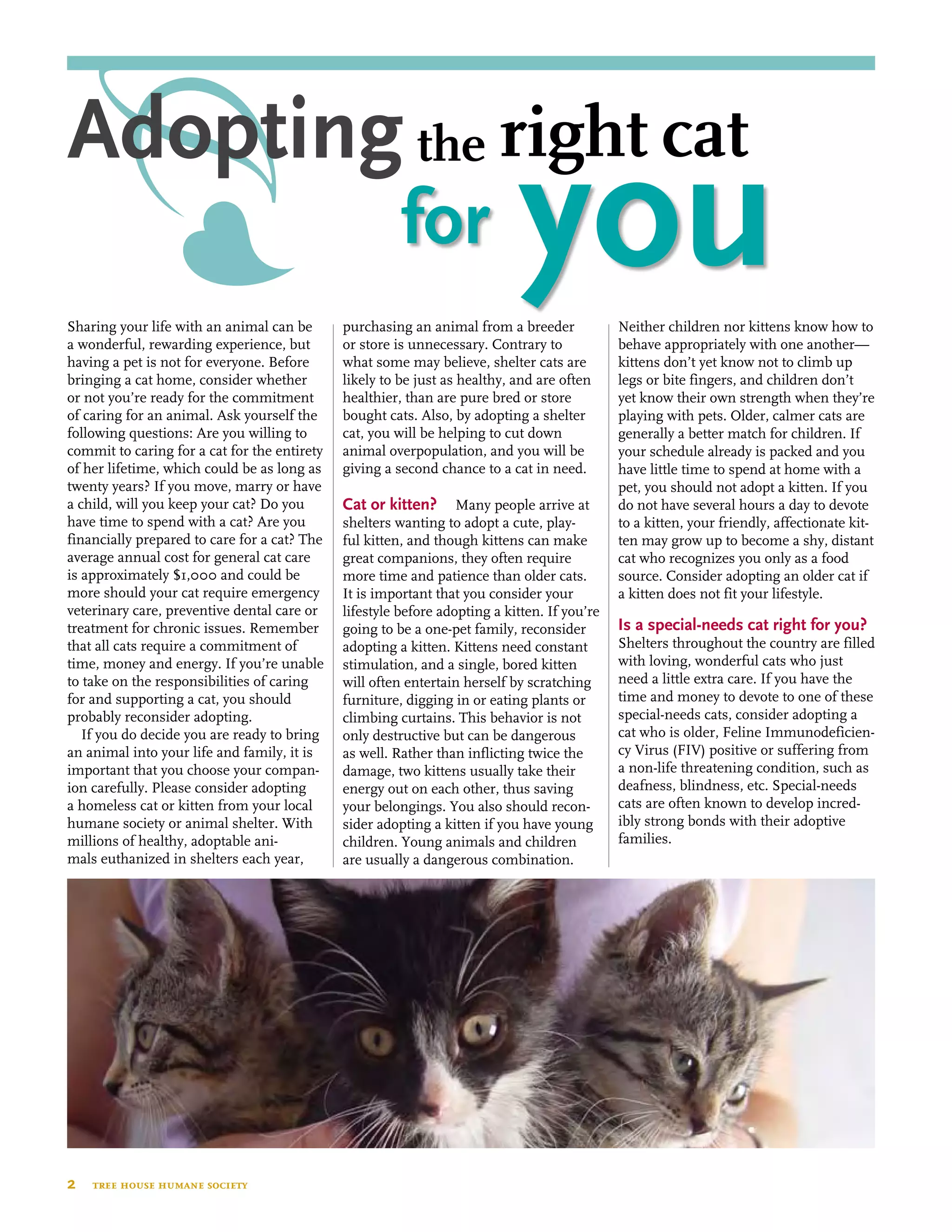
Cat or kitten? Many people arrive at
shelters wanting to adopt a cute, play-
ful kitten, and though kittens can make
great companions, they often require
more time and patience than older cats.
It is important that you consider your
lifestyle before adopting a kitten. If you’re
going to be a one-pet family, reconsider
adopting a kitten. Kittens need constant
stimulation, and a single, bored kitten
will often entertain herself by scratching
furniture, digging in or eating plants or
climbing curtains. This behavior is not
only destructive but can be dangerous
as well. Rather than inflicting twice the
damage, two kittens usually take their
energy out on each other, thus saving
your belongings. You also should recon-
sider adopting a kitten if you have young
children. Young animals and children
are usually a dangerous combination.
Neither children nor kittens know how to
behave appropriately with one another—
kittens don’t yet know not to climb up
legs or bite fingers, and children don’t
yet know their own strength when they’re
playing with pets. Older, calmer cats are
generally a better match for children. If
your schedule already is packed and you
have little time to spend at home with a
pet, you should not adopt a kitten. If you
do not have several hours a day to devote
to a kitten, your friendly, affectionate kit-
ten may grow up to become a shy, distant
cat who recognizes you only as a food
source. Consider adopting an older cat if
a kitten does not fit your lifestyle.
Is a special-needs cat right for you?
Shelters throughout the country are filled
with loving, wonderful cats who just
need a little extra care. If you have the
time and money to devote to one of these
special-needs cats, consider adopting a
cat who is older, Feline Immunodeficien-
cy Virus (FIV) positive or suffering from
a non-life threatening condition, such as
deafness, blindness, etc. Special-needs
cats are often known to develop incred-
ibly strong bonds with their adoptive
families.
2  tree house humane society
Adopting the right cat
for you
Preparing to adopt Before visiting
your local shelter, be sure to call or visit
its website to familiarize yourself with
the adoption procedures. Some shelters
may require proof of address, references
or a copy of your rental lease to prove
that pets are allowed in the building.
Also, keep in mind that all members
of the household should be included in
the adoption process—adopting a pet
is a life-long commitment and these
important decisions need to be mutually
agreed upon. Now you’re ready to adopt.
Congratulations on bringing home a new
family member!
Bringing a new cat home Here are a
few things you should know to ensure the
experience goes as smoothly as possible!
First, prepare your house for the new ar-
rival. Remove toxic plants (for a complete
list of poisonous plants, visit treehou-
seanimals.org), put away small objects
which may be ingested by your new cat
(yarn, paper clips, rubber bands, etc.),
put away any breakables, so there’s no
chance that your new cat might knock
them off shelves or tables and close
all cabinets and closets where your cat
might hide.
Next, set up a single room as a home
base for your cat. Cats are territorial
animals, and for a new cat, too large a
territory can be overwhelming. By keep-
ing your new cat in a small area you will
be providing a less stressful introduction
to your home. For most cats a bathroom
or a bedroom is an ideal location to get
accustomed to the home.
Remind everyone to make the initial
homecoming peaceful and quiet, without
excited squeals and hugs. The secret to
success is to allow your new friend to
come to you. It is important not to force
affection upon your new cat; soft talk and
treats can be more reassuring in the early
stages than petting. When your new cat
seems comfortable with you being in the
room, hold out your hand, palm down
in a relaxed manner, and let her smell
you. If your cat backs away, you have
gotten too close. If your cat approaches,
hold your position and continue to speak
softly. At this point, begin petting your
new cat by softly stroking the top of your
cat’s head and cheeks, and slowly work
down the cat’s body, if she allows it.
Once your cat is thoroughly at ease
with you, begin to allow her to explore
the rest of the house. The first few times
your cat is allowed to roam, supervise
the exploration. This will prevent her
from finding a hiding place. When your
new cat has explored her new environ-
ment and seems comfortable, position
food, water and the litter box(es) in their
permanent places. Be sure to show the
cat where you have moved them.
Be patient. Remember that each step
must be taken at your cat’s pace.
Introducing a new cat to resident
cats As described above, set up a
room as a home base for your new cat,
allowing for a gradual introduction to the
family.
For the first 72 hours, do nothing. It is
important to allow your new cat to become
accustomed to her surroundings. Your new
cat is not only acclimating to home base,
she also is using her fine-tuned senses to
discover what is beyond the closed door
of her home base, including resident cats.
After 72 hours, begin introducing the cats
to each others’ scents. First, leave a blanket
or towel in the home base for the new cat
and another on your resident cat’s favorite
sleeping spot. After they each have spent
time sleeping on the blanket or towel, ex-
change the linens. This scent introduction
will help your cats get used to each other
and will help improve the eventual face-to
face-meeting.
While the cats are becoming used
to each others’ scents, create positive
experiences for them while they are still
safely separated. Feed the cats on either
side of the closed home base door. Get a
feather toy and encourage play under the
door. By creating positive experiences,
you send the message that another cat is
a good, fun friend to have in the house.
After a week of allowing your new cat
to acclimate to home base, it is time to
switch the cats’ living areas. Let your new
cat explore the rest of the house while
your resident cat stays in home base. Be
sure to not let the cats meet while you
are swapping rooms. After a few hours
of exploration, you can return the cats to
their original spaces.
After about two weeks, it is time to
start introducing the cats. Clip both cats’
nails to lessen the chance of injury (see
how to clip nails on page 8). Place a treat
(a plate of wet food or some fresh deli
meat) outside of the home base door and
place another treat down the hall from
the door, but still in sight of home base.
Lure your resident cat to the treat down
the hall and while she is enjoying the
treat, open the door to home base and
allow the new cat to enjoy her treat. By
allowing the cats to see each other while
enjoying good food, you are helping
them associate rewards with the other
cat. After they have finished their treat,
place the new cat back in home base.
The next day, repeat the above step, but
this time place the plates a couple of feet
closer together. Continue this process
until the cats get close enough to meet
face-to-face. It is important not to inter-
fere when they meet. It is normal for cats
to hiss, howl, posture and swat when
they first meet. In the unlikely event that
they do begin to fight, do not pick up
either cat. Put a towel or blanket between
them to block their view of each other
and try to corral one to a safe place. You
will need to spend more time creating
positive experiences before introduc-
ing them face-to-face again. After the
cats have spent time together without
conflict, gradually increase the amount
of time the cats are out together. After
they have spent several hours harmoni-
ously sharing the same territory, several
times in a row, you can leave them alone
together.
Remember to be patient as the process
of introducing cats can take time, but
in most cases, cats will learn to coexist
peacefully. And in many cases, cats can
become life-long friends. 
everything you’ve always wanted to know about cats  3
Your cat hears, sees, smells, tastes and
feels the world differently than you do
(and processes it all through a very differ-
ent brain), so it should be no surprise
that there are often miscommunications
between humans and cats! To under-
stand and to ultimately change your cat’s
behavior, it is essential that you under-
stand how your cat interprets the world.
Hearing Although not as good at
detecting lower pitches, cats can pick
up sounds so faint or high-pitched they
are out of the range of human hearing.
Sound is an important part of the cat’s
world for both surviving and commu-
nicating. Listen to how many different
sounds your cat makes—this is your cat
communicating in an undeniably com-
plex language. Because your cat hears
high-pitched sounds better than you, it
is important that you be aware of noise
levels in your home, particularly if your
cat is timid or easily upset by commo-
tion. Are you playing music loudly or
using the vacuum cleaner? If your cat is
reacting to these sounds, it is best to cre-
ate a quiet, calm room for your cat to stay
in while you are cleaning or entertaining
guests.
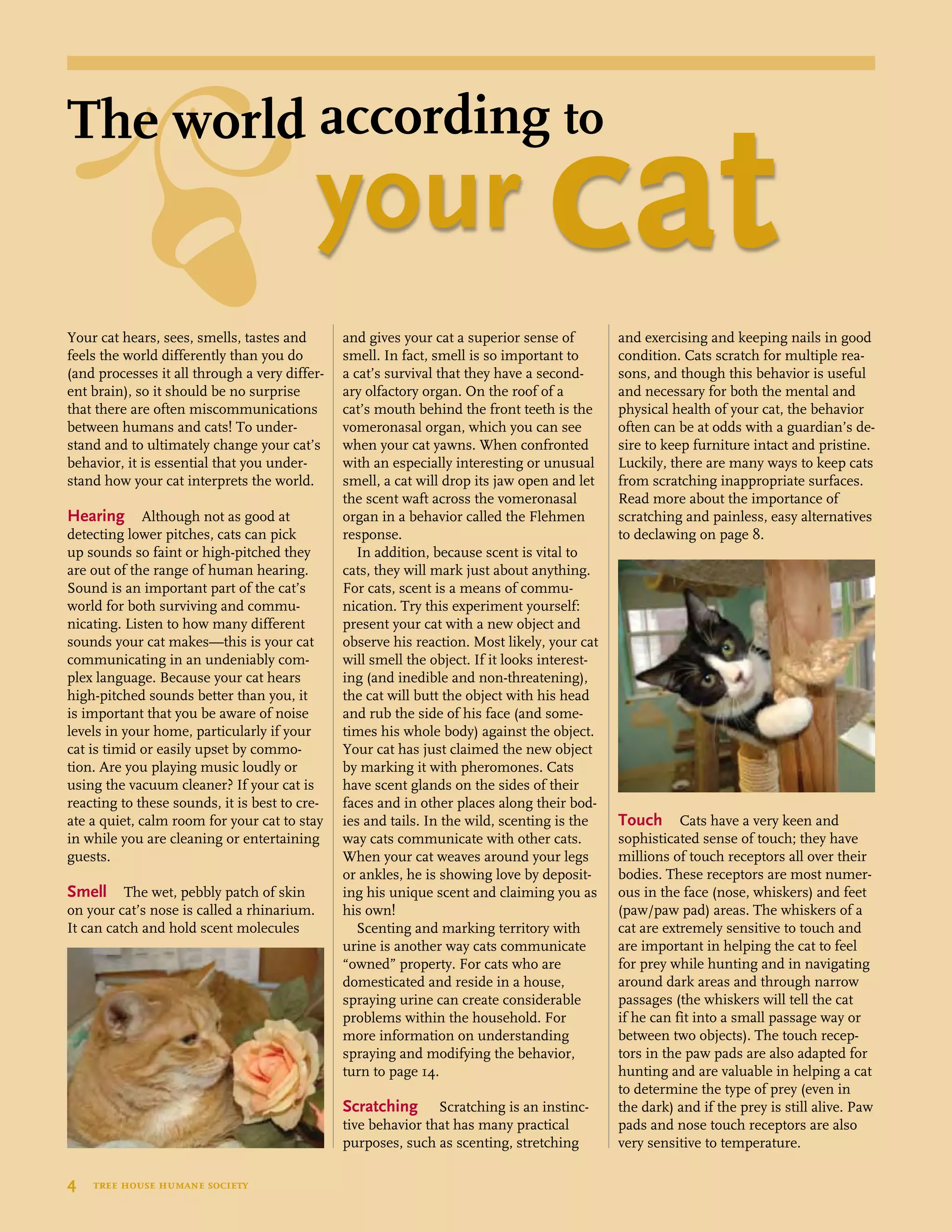
Smell The wet, pebbly patch of skin
on your cat’s nose is called a rhinarium.
It can catch and hold scent molecules
and gives your cat a superior sense of
smell. In fact, smell is so important to
a cat’s survival that they have a second-
ary olfactory organ. On the roof of a
cat’s mouth behind the front teeth is the
vomeronasal organ, which you can see
when your cat yawns. When confronted
with an especially interesting or unusual
smell, a cat will drop its jaw open and let
the scent waft across the vomeronasal
organ in a behavior called the Flehmen
response.
In addition, because scent is vital to
cats, they will mark just about anything.
For cats, scent is a means of commu-
nication. Try this experiment yourself:
present your cat with a new object and
observe his reaction. Most likely, your cat
will smell the object. If it looks interest-
ing (and inedible and non-threatening),
the cat will butt the object with his head
and rub the side of his face (and some-
times his whole body) against the object.
Your cat has just claimed the new object
by marking it with pheromones. Cats
have scent glands on the sides of their
faces and in other places along their bod-
ies and tails. In the wild, scenting is the
way cats communicate with other cats.
When your cat weaves around your legs
or ankles, he is showing love by deposit-
ing his unique scent and claiming you as
his own!
Scenting and marking territory with
urine is another way cats communicate
“owned” property. For cats who are
domesticated and reside in a house,
spraying urine can create considerable
problems within the household. For
more information on understanding
spraying and modifying the behavior,
turn to page 14.
Scratching Scratching is an instinc-
tive behavior that has many practical
purposes, such as scenting, stretching
and exercising and keeping nails in good
condition. Cats scratch for multiple rea-
sons, and though this behavior is useful
and necessary for both the mental and
physical health of your cat, the behavior
often can be at odds with a guardian’s de-
sire to keep furniture intact and pristine.
Luckily, there are many ways to keep cats
from scratching inappropriate surfaces.
Read more about the importance of
scratching and painless, easy alternatives
to declawing on page 8.
Touch Cats have a very keen and
sophisticated sense of touch; they have
millions of touch receptors all over their
bodies. These receptors are most numer-
ous in the face (nose, whiskers) and feet
(paw/paw pad) areas. The whiskers of a
cat are extremely sensitive to touch and
are important in helping the cat to feel
for prey while hunting and in navigating
around dark areas and through narrow
passages (the whiskers will tell the cat
if he can fit into a small passage way or
between two objects). The touch recep-
tors in the paw pads are also adapted for
hunting and are valuable in helping a cat
to determine the type of prey (even in
the dark) and if the prey is still alive. Paw
pads and nose touch receptors are also
very sensitive to temperature.
4  tree house humane society
The world according to
	 your cat
Taste Since taste is related to smell,
and cats have a superior sense of smell,
their sense of taste is exceptional, too.
However, this does not necessarily mean
your cat has what we might consider
good taste. Cats will put things in
their mouths that we find disgusting or
unclean. This is part curiosity and part
necessity as the only way for cats to carry
something is in their mouths.
When it comes to food, cats have dif-
ferent likes and dislikes. It is important
for you to discover what type of food is
appealing to your cat to ensure that he
eats well. It is also important, how-
ever, for you to be aware of what diet is
healthiest for your cat. Sometimes the
food your cat wants to eat is not always
the healthiest option—just like children,
cats often prefer “junk food” to healthy,
nutritionally complete foods. For more
information on diet and nutrition, please
turn to page 6.
Vision Contrary to popular belief, cats
cannot see in total darkness. Mammals
need some light to see; however, cats are
far better equipped to see in minimal
light. Unlike our pupils, which expand
and contract as a circle, cats’ pupils begin
as tiny vertical slits that can open to
include the entire iris, the colored por-
tion of the eye. The tapetum is a reflec-
tive layer of cells at the back of the eye
that bounces even the faintest light back
through the light-sensitive cells. Have
you ever noticed your cat’s eyes glowing
at night? The glowing is actually light
reflected off the tapetum. This reflective
feature enhances a cat’s ability to best
utilize low amounts of light, a trait all
nocturnal animals need to survive.
Nocturnal instincts Cats are natu-
rally nocturnal (most active at night) and
crepuscular (most active at dawn and
dusk) animals. If we consider that the
domesticated cat’s ancestors came from
the plains and deserts of Africa, the mod-
ern cat’s midnight antics make perfect
sense. Temperatures rise dramatically
during the day on the African grasslands.
To survive the heat, animals find shade
and sit still. A smart predator (which the
cat most certainly is) won’t waste energy
searching out hiding places of prey and
chasing down game while the sun is
up. At sunset, the temperature drops
and darkness hides movement. This is
the ideal time to come out to find food
and water, and it is precisely the time
when the ancestors of your cat went on
the prowl. So your cat’s noisy charg-
ing around at 3 a.m. isn’t necessarily a
“behavior problem”—it’s an instinct!
For more information on how to combat
nocturnal “behavior problems,” turn to
page 10.
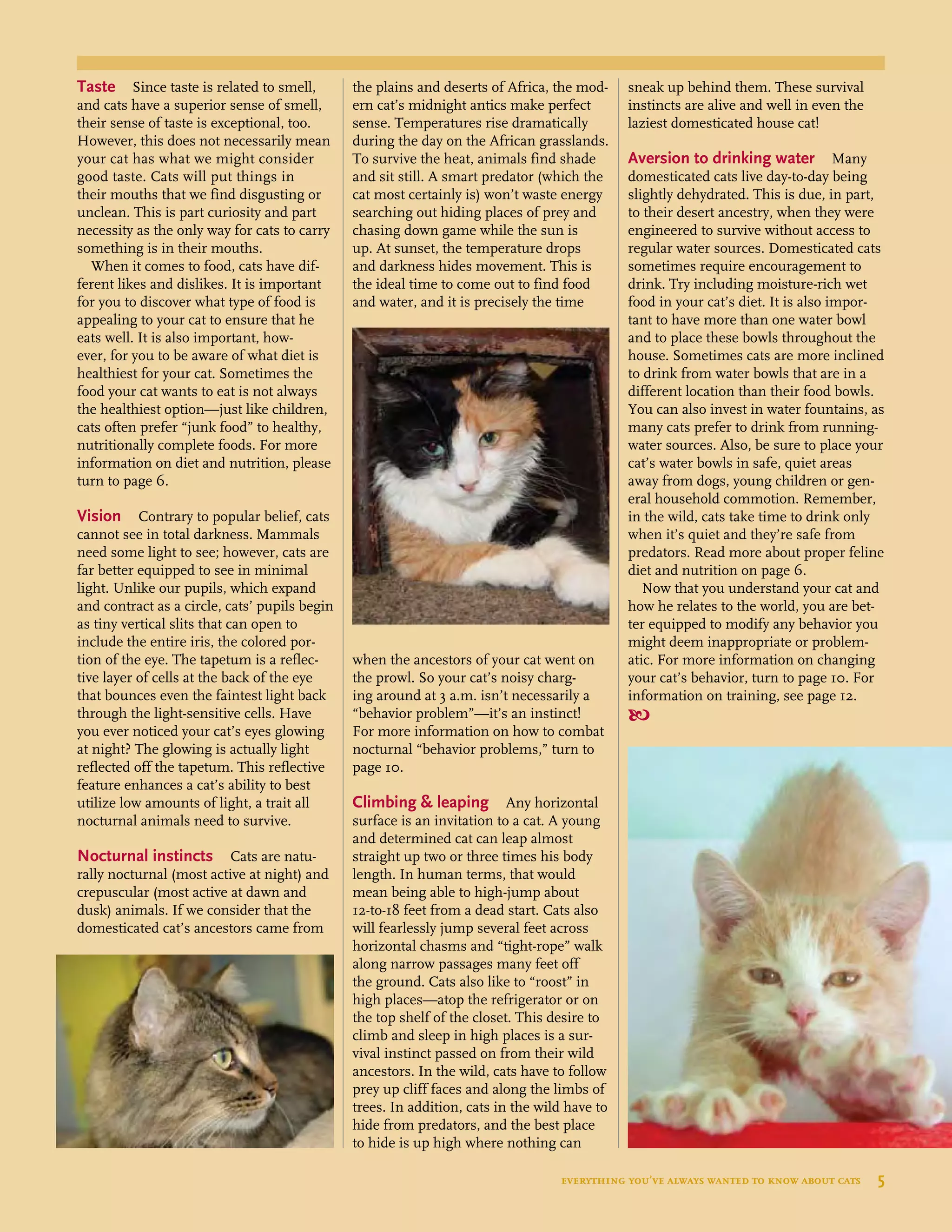
Climbing & leaping Any horizontal
surface is an invitation to a cat. A young
and determined cat can leap almost
straight up two or three times his body
length. In human terms, that would
mean being able to high-jump about
12-to-18 feet from a dead start. Cats also
will fearlessly jump several feet across
horizontal chasms and “tight-rope” walk
along narrow passages many feet off
the ground. Cats also like to “roost” in
high places—atop the refrigerator or on
the top shelf of the closet. This desire to
climb and sleep in high places is a sur-
vival instinct passed on from their wild
ancestors. In the wild, cats have to follow
prey up cliff faces and along the limbs of
trees. In addition, cats in the wild have to
hide from predators, and the best place
to hide is up high where nothing can
sneak up behind them. These survival
instincts are alive and well in even the
laziest domesticated house cat!
Aversion to drinking water Many
domesticated cats live day-to-day being
slightly dehydrated. This is due, in part,
to their desert ancestry, when they were
engineered to survive without access to
regular water sources. Domesticated cats
sometimes require encouragement to
drink. Try including moisture-rich wet
food in your cat’s diet. It is also impor-
tant to have more than one water bowl
and to place these bowls throughout the
house. Sometimes cats are more inclined
to drink from water bowls that are in a
different location than their food bowls.
You can also invest in water fountains, as
many cats prefer to drink from running-
water sources. Also, be sure to place your
cat’s water bowls in safe, quiet areas
away from dogs, young children or gen-
eral household commotion. Remember,
in the wild, cats take time to drink only
when it’s quiet and they’re safe from
predators. Read more about proper feline
diet and nutrition on page 6.
Now that you understand your cat and
how he relates to the world, you are bet-
ter equipped to modify any behavior you
might deem inappropriate or problem-
atic. For more information on changing
your cat’s behavior, turn to page 10. For
information on training, see page 12.

everything you’ve always wanted to know about cats  5
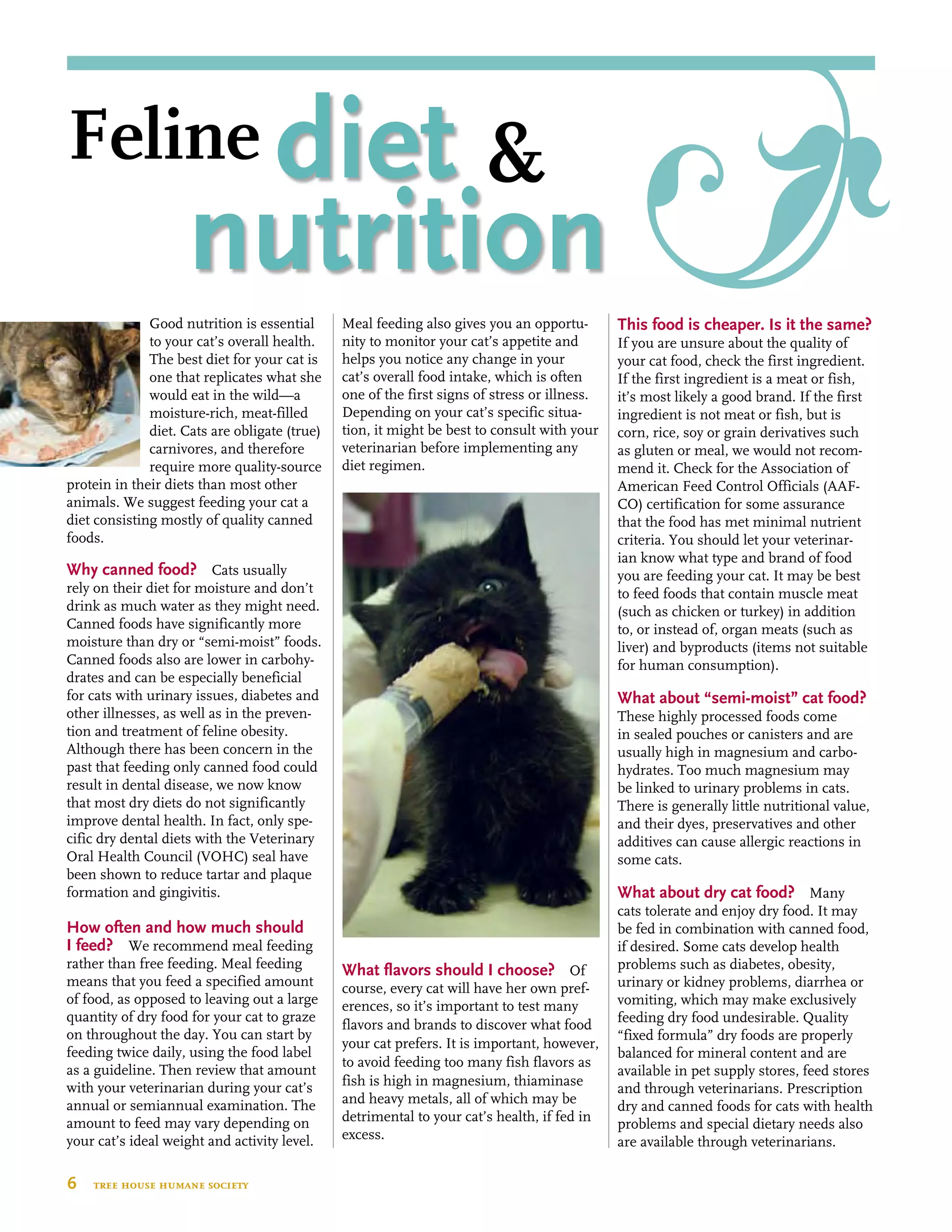
Good nutrition is essential
to your cat’s overall health.
The best diet for your cat is
one that replicates what she
would eat in the wild—a
moisture-rich, meat-filled
diet. Cats are obligate (true)
carnivores, and therefore
require more quality-source
protein in their diets than most other
animals. We suggest feeding your cat a
diet consisting mostly of quality canned
foods.
Why canned food? Cats usually
rely on their diet for moisture and don’t
drink as much water as they might need.
Canned foods have significantly more
moisture than dry or “semi-moist” foods.
Canned foods also are lower in carbohy-
drates and can be especially beneficial
for cats with urinary issues, diabetes and
other illnesses, as well as in the preven-
tion and treatment of feline obesity.
Although there has been concern in the
past that feeding only canned food could
result in dental disease, we now know
that most dry diets do not significantly
improve dental health. In fact, only spe-
cific dry dental diets with the Veterinary
Oral Health Council (VOHC) seal have
been shown to reduce tartar and plaque
formation and gingivitis.
How often and how much should
I feed? We recommend meal feeding
rather than free feeding. Meal feeding
means that you feed a specified amount
of food, as opposed to leaving out a large
quantity of dry food for your cat to graze
on throughout the day. You can start by
feeding twice daily, using the food label
as a guideline. Then review that amount
with your veterinarian during your cat’s
annual or semiannual examination. The
amount to feed may vary depending on
your cat’s ideal weight and activity level.
Meal feeding also gives you an opportu-
nity to monitor your cat’s appetite and
helps you notice any change in your
cat’s overall food intake, which is often
one of the first signs of stress or illness.
Depending on your cat’s specific situa-
tion, it might be best to consult with your
veterinarian before implementing any
diet regimen.
What flavors should I choose? Of
course, every cat will have her own pref-
erences, so it’s important to test many
flavors and brands to discover what food
your cat prefers. It is important, however,
to avoid feeding too many fish flavors as
fish is high in magnesium, thiaminase
and heavy metals, all of which may be
detrimental to your cat’s health, if fed in
excess.
This food is cheaper. Is it the same?
If you are unsure about the quality of
your cat food, check the first ingredient.
If the first ingredient is a meat or fish,
it’s most likely a good brand. If the first
ingredient is not meat or fish, but is
corn, rice, soy or grain derivatives such
as gluten or meal, we would not recom-
mend it. Check for the Association of
American Feed Control Officials (AAF-
CO) certification for some assurance
that the food has met minimal nutrient
criteria. You should let your veterinar-
ian know what type and brand of food
you are feeding your cat. It may be best
to feed foods that contain muscle meat
(such as chicken or turkey) in addition
to, or instead of, organ meats (such as
liver) and byproducts (items not suitable
for human consumption).
What about “semi-moist” cat food?
These highly processed foods come
in sealed pouches or canisters and are
usually high in magnesium and carbo-
hydrates. Too much magnesium may
be linked to urinary problems in cats.
There is generally little nutritional value,
and their dyes, preservatives and other
additives can cause allergic reactions in
some cats.
What about dry cat food? Many
cats tolerate and enjoy dry food. It may
be fed in combination with canned food,
if desired. Some cats develop health
problems such as diabetes, obesity,
urinary or kidney problems, diarrhea or
vomiting, which may make exclusively
feeding dry food undesirable. Quality
“fixed formula” dry foods are properly
balanced for mineral content and are
available in pet supply stores, feed stores
and through veterinarians. Prescription
dry and canned foods for cats with health
problems and special dietary needs also
are available through veterinarians.
6  tree house humane society
	 nutrition
diet &Feline
What about raw food? Many argue
raw food is the most natural and nutri-
tionally complete feeding regimen, if pre-
pared and fed properly. There are, how-
ever, some risks involved, and careful
preparation and hygiene standards need
to be followed to feed it successfully. If
this feeding option is something you’re
interested in, we advise that you discuss
it with your veterinarian. Whether you
feed a commercial product or you make
your own, consult your veterinarian to
ensure the diet is nutritionally complete
for cats. Cats, although they need to eat
meat, cannot live on meat alone; they
require nutrients such as minerals, vita-
mins and specific amino acids.
Are table scraps okay? We don’t
recommend feeding them in excess. Nu-
tritionists suggest keeping table snacks
to less than 10 percent of cats’ daily
intake. Occasional treats of meat, fruit or
vegetables won’t hurt, as long as you feed
them in small doses. Don’t feed dairy (if
your cat is lactose intolerant), fried foods
or sweets as they can contribute to prob-
lems such as obesity, diabetes and stom-
ach upset. Never feed cooked bones as
they are sharp and brittle and can cause
severe injury. Also never feed onions or
chocolate to cats—both are toxic.
My cat is overweight. Should I be
concerned? Yes. An overweight cat
is more vulnerable to many chronic and
lifespan-shortening health problems,
such as diabetes and arthritis. Also,
fat cats often are unable to groom
themselves, so their coats become dull
and oily and they develop dandruff
and mats. In addition, cats who cannot
groom themselves may become clinically
depressed. Often fat cats cannot reach
their own hind quarters, which means
that fecal matter and urine can build up
and cause discomfort and infection, even
if you clean your cat on a regular basis.
Although fat cats may be perceived as
cute, you are doing your cat a disservice
by allowing her to gain too much weight.
You can control your cat’s weight by
going to your veterinarian and working
out a diet plan that will ensure very
gradual weight loss (be sure to consider
an all wet-food diet). Never put your cat
on a crash diet; it is very dangerous for
a cat to lose weight too fast and doing so
could lead to life-threatening liver issues.
A safe way of promoting weight loss is
to encourage your cat to become more
active through play. Once your fat cat
has become a slimmer, more active cat,
you can be sure her overall health, and
therefore quality and length of life, has
improved.
What should my cat drink? Water!
Keep plenty of fresh water available at all
times. Also, using a pet water fountain
encourages cats to drink more and keeps
them away from toilets and faucets.
We don’t recommend giving your cat
milk on a regular basis. Many cats can’t
tolerate it and can experience digestive
troubles, including diarrhea.
What about dishes? Plastic feeding
dishes can cause skin irritation in some
cats. A shallow, stainless steel or ceramic
bowl is your best bet as cats prefer to
keep their whiskers and faces out of their
food. Don’t use chemical disinfectants or
strong detergents to clean your cat’s food
dishes. Not only can they be poisonous
but cats are easily put off by harsh odors.
Other resources: For more
information on nutrition, please visit
our website at treehouseanimals.org.
We also recommend the following
websites: felineoutreach.org, catinfo.org,
catnutrition.org, petdiets.com,
balanceit.com. 
A note on coats: Feeding your
cat a proper diet will help keep her
coat healthy, but grooming is also
essential. Keeping your cat’s coat
healthy and mat-free is your responsi-
bility. Cats keep themselves clean by
licking, so baths are generally unneces-
sary, but regular grooming with a long-
tooth, stainless steel cat comb for long-
hairs, or a short-tooth, stainless steel cat
comb or slicker brush for shorthairs,
helps control shedding and prevents
your cat from swallowing too much hair.
“Hairballs” form in the stomach and are
usually passed or coughed up without
trouble. But in extreme cases, large hair-
balls can be life-threatening and require
surgery. Regular grooming—especially
of longhaired cats and particularly in hot
weather—is the best prevention.
One of the most important rules when
it comes to grooming your cat’s coat is
to never use scissors to cut out a mat,
regardless of how careful you may be.
Cats have thin skin that can easily be
nicked or cut without you realizing it,
and the resulting wound could become
infected and form an abscess. If your
cat has a mat that cannot be removed by
combing or brushing, try a mat splitter
or a seam ripper. You can work out the
mat by tearing it through the middle
and up toward the end of the mat, away
from the cat’s body. If your cat has too
many mats and is not amenable to being
groomed at home, consider having her
professionally groomed by a veterinarian
or reputable groomer.
Regular grooming sessions are a great
way for guardians to bond with their
cats. Many cats enjoy the grooming
process and look forward to time spent
with their guardian. So in addition to
helping keep your cat clean and mat-
free, grooming also can be an enjoyable
way for you and your cat to spend time
together.
everything you’ve always wanted to know about cats  7
Tree House is firmly against the practice
of declawing cats. The surgery (the medi-
cal term is onychectomy) involves ampu-
tation of the cat’s toes to the equivalent
of the first knuckle on your own fingers.
The surgery and long recovery period
necessitate aggressive pain management
for several weeks after surgery. Although
laser declawing and advances in analge-
sia may decrease the amount of pain and
the length of the recovery period, the end
result is still the same: an amputation.
Aside from the pain associated with the
surgery and recovery period, we don’t
support declawing for these reasons:
1 	Scratching serves a purpose Cats
scratch for a variety of reasons, ranging
from simple pleasure and exercise to
complex instinctual motivations. Here
are some of the reasons cats scratch:
	 •	Scratching communicates a cat’s 	
		 presence with both physical		
		 and scent marks. Cats’ paws have 	
		 special scent glands between the toes 	
		 that leave a residual scent (phero-	
		 mone) after they’ve scratched. We 	
		 can’t smell these scents, but for cats 	
		 they’re a powerful form of communi-	
		 cation.
	 •	Scratching is a good form of exercise. 	
		 Indoor cats in particular need all the
		 exercise they can get.
	 •	Scratching helps cats groom by re-	
		 moving old nail sheaths.
	 •	Cats express emotions through 		
		 scratching. Have you noticed your 	
		 cat scratching when you arrive home 	
		 from work or as you prepare his 	
		 dinner? Your cat is expressing his
		 excitement!
2 	There is no health benefit to the cat
and serious complications can occur
Surgeries such as spaying and neuter-
ing have direct long- and short-term
health and behavioral benefits; declaw-
ing does not. In fact, many declawed
cats suffer health problems as a result
of the amputation. Complications that
may result from the surgery include
hemorrhaging, abscesses, bone chips
that prevent healing (if the declaw sur-
gery was not performed correctly) and
regrowth of a deformed claw. In the
long term, as shoulder, leg and back
muscles weaken due to a shift in bal-
ance and weight, your cat may develop
chronic conditions such as arthritis or
back and joint pain.
3 	Declawing may cause behavioral 	
	problems Scratching is instinctive
(declawed cats still go through the mo-
tions of scratching). Interfering with an
instinctive behavior is generally known
to be stressful for an animal, and may
result in other undesirable behav-
ioral issues. Urinating and defecating
outside the litter box and biting are two
of the most common behavioral side ef-
fects of declawing. Other potential side
effects include cats becoming fearful,
nervous, withdrawn or aggressive after
being declawed.
4 Cats need claws should they escape
As careful as we try to be with our
indoor cats, accidents happen. Should
your cat ever escape, he will need claws
to ensure his survival.
5	Nonsurgical corrections exist and are 	
	 effective You can trim your cat’s 	
	 nails, train him to use scratching posts, 	
	 use Soft Paws, apply Sticky Paws to 	
	 your furniture or use Feliway spray or 	
	 diffusers.
How to clip your cat’s nails Nail
clipping is an important part of keeping
your housecat groomed. If a cat’s nails
grow too long, they can cut into the paw
pad and cause infection, or at the very
least, discomfort. To clip your cat’s nails,
simply grasp the paw and squeeze the
pad so that the nails unsheathe. Look
for the pink part (the “quick”) inside the
base of the nail. This is the sensitive tis-
sue that contains the vessels and nerves.
Don’t cut close to the quick. All you need
to do is clip off the curved part of the
nail. If you only cut off this small part,
you run little risk of cutting the quick.
If you do accidentally cut the quick, the
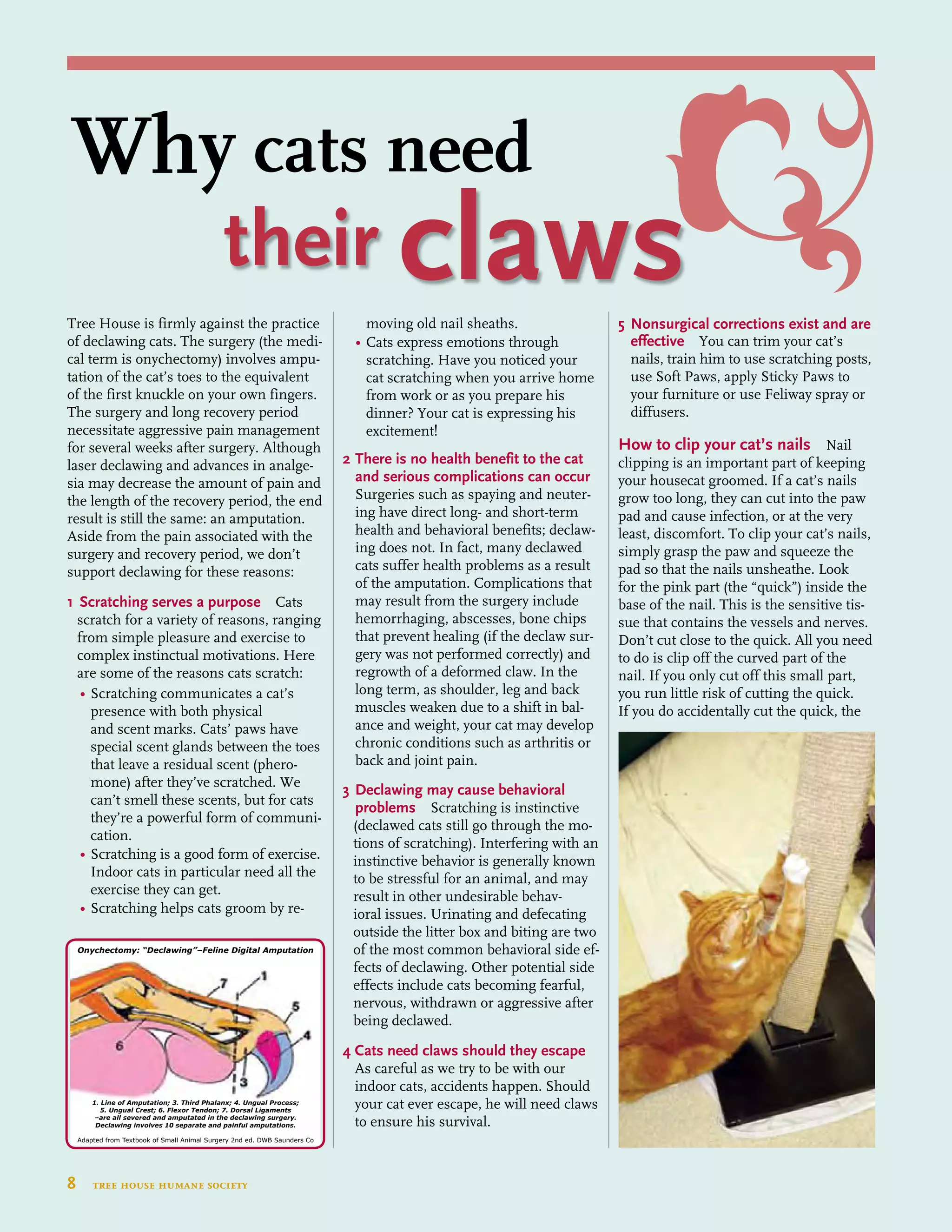
Onychectomy: “Declawing”–Feline Digital Amputation
1. Line of Amputation; 3. Third Phalanx; 4. Ungual Process;
5. Ungual Crest; 6. Flexor Tendon; 7. Dorsal Ligaments
–are all severed and amputated in the declawing surgery.
Declawing involves 10 separate and painful amputations.
Adapted from Textbook of Small Animal Surgery 2nd ed. DWB Saunders Co
8  tree house humane society
Why cats need
their claws
nail will bleed and the cat will experience
a moment of pain. Still, you have done
no serious damage. Apply pressure to
the end of the nail with a clean piece of
tissue or gauze until the bleeding stops.
If the bleeding persists, a septic pencil or
flour should stop the bleeding.
A video demonstration of nail clipping
from Cornell Feline Health Center can
be found at http://partnersah.vet.cornell.
edu/pet/fhc/trimming_claws.
Ideally, nails should be clipped regu-
larly from kittenhood, so that the process
becomes familiar and non-threatening.
Touch your cat’s paws often when the
cat is calm to help him get accustomed
to the way it feels. You also can train
your cat to enjoy nail clipping by offering
treats when you use the clippers. For
adult cats who will not tolerate nail clip-
pings without biting and struggling, it is
best to get someone to assist. Two people
can easily wrap the cat in a towel or blan-
ket (make sure to cover his face so your
cat cannot bite anyone), and then clip the
nails. If this isn’t possible, a veterinarian
or a qualified groomer can clip your cat’s
nails.
Recommendations for a good
scratching post A good scratching
post should have a strong and sturdy
base (so it will not rock or tip over when
your cat uses it) and should be no less
than two feet high (taller is preferable),
so your cat can get a full-body stretch.
The post should be covered in sisal or
a similar natural fiber. Smaller, carpet-
covered posts are unappealing to many
cats because they won’t reliably hold a
cat’s weight. In addition, there’s no clear
distinction for your cat between a carpet-
covered post and the carpet on your floor.
We recommend spending a little extra
money for a good, natural fiber-covered
post that will keep for years, save your
furniture and appeal to your cats.
It’s a good idea to have several differ-
ent kinds of scratching posts, especially
if you live in a multi-cat household. This
is because individual cats may differ
in the surfaces they prefer to scratch
(sisal, cardboard, carpet, bark, etc.) Also,
cats are territorial, and while they may
share their posts, some prefer their own.
Lastly, individual cats stretch and scratch
differently; some cats enjoy a good hori-
zontal stretch or even a semi-horizontal
stretch. You can find good, inexpensive
cardboard scratchers to fulfill these
purposes. Be sure to securely anchor all
posts so they don’t slide across the floor.
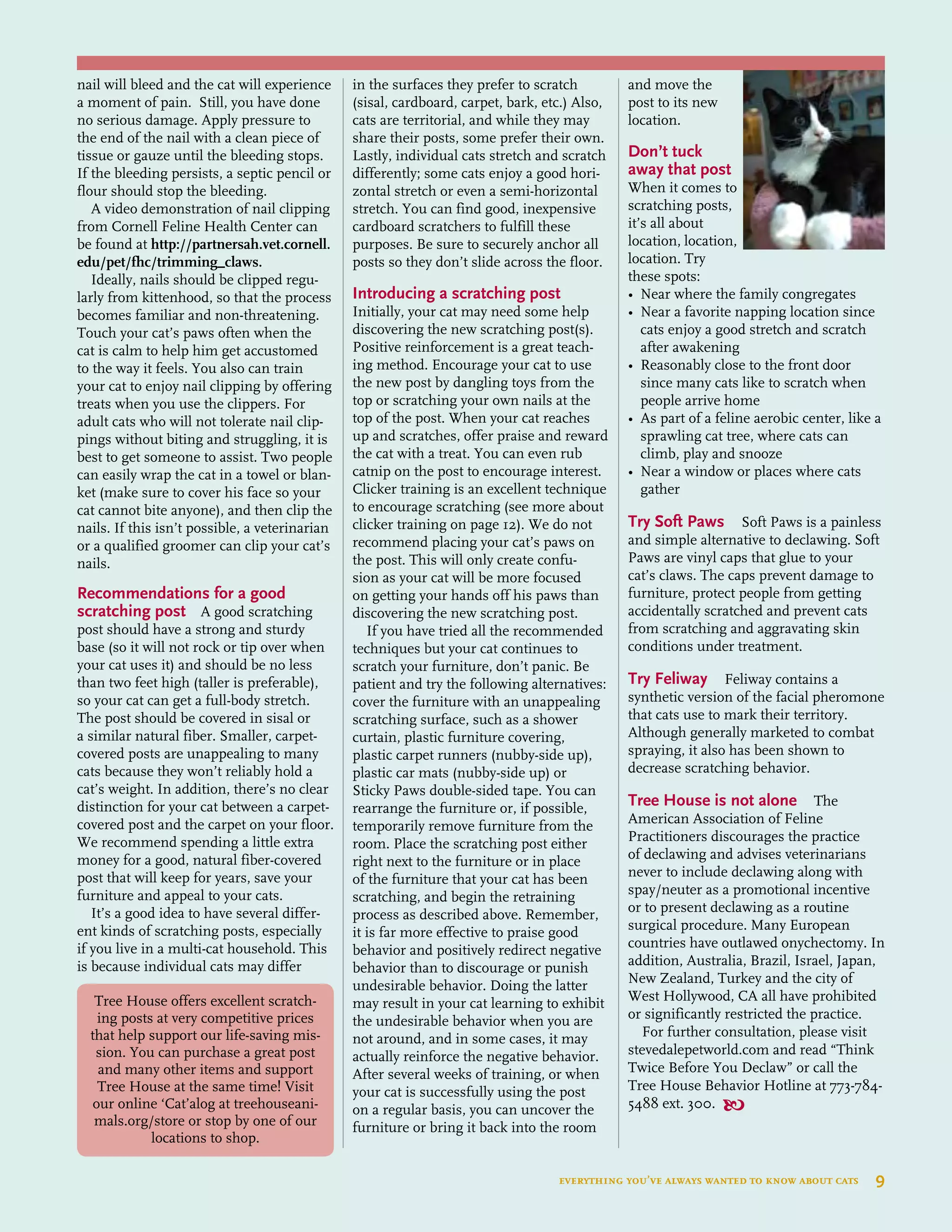
Introducing a scratching post 
Initially, your cat may need some help
discovering the new scratching post(s).
Positive reinforcement is a great teach-
ing method. Encourage your cat to use
the new post by dangling toys from the
top or scratching your own nails at the
top of the post. When your cat reaches
up and scratches, offer praise and reward
the cat with a treat. You can even rub
catnip on the post to encourage interest.
Clicker training is an excellent technique
to encourage scratching (see more about
clicker training on page 12). We do not
recommend placing your cat’s paws on
the post. This will only create confu-
sion as your cat will be more focused
on getting your hands off his paws than
discovering the new scratching post.
If you have tried all the recommended
techniques but your cat continues to
scratch your furniture, don’t panic. Be
patient and try the following alternatives:
cover the furniture with an unappealing
scratching surface, such as a shower
curtain, plastic furniture covering,
plastic carpet runners (nubby-side up),
plastic car mats (nubby-side up) or
Sticky Paws double-sided tape. You can
rearrange the furniture or, if possible,
temporarily remove furniture from the
room. Place the scratching post either
right next to the furniture or in place
of the furniture that your cat has been
scratching, and begin the retraining
process as described above. Remember,
it is far more effective to praise good
behavior and positively redirect negative
behavior than to discourage or punish
undesirable behavior. Doing the latter
may result in your cat learning to exhibit
the undesirable behavior when you are
not around, and in some cases, it may
actually reinforce the negative behavior.
After several weeks of training, or when
your cat is successfully using the post
on a regular basis, you can uncover the
furniture or bring it back into the room
and move the
post to its new
location.
Don’t tuck
away that post
When it comes to
scratching posts,
it’s all about
location, location,
location. Try
these spots:
•	 Near where the family congregates
•	 Near a favorite napping location since 	
	 cats enjoy a good stretch and scratch 	
	 after awakening
•	 Reasonably close to the front door 	
	 since many cats like to scratch when 	
	 people arrive home
•	 As part of a feline aerobic center, like a
	 sprawling cat tree, where cats can 	
	 climb, play and snooze
•	 Near a window or places where cats 	
	 gather
Try Soft Paws Soft Paws is a painless
and simple alternative to declawing. Soft
Paws are vinyl caps that glue to your
cat’s claws. The caps prevent damage to
furniture, protect people from getting
accidentally scratched and prevent cats
from scratching and aggravating skin
conditions under treatment.
Try Feliway Feliway contains a
synthetic version of the facial pheromone
that cats use to mark their territory.
Although generally marketed to combat
spraying, it also has been shown to
decrease scratching behavior.
Tree House is not alone The
American Association of Feline
Practitioners discourages the practice
of declawing and advises veterinarians
never to include declawing along with
spay/neuter as a promotional incentive
or to present declawing as a routine
surgical procedure. Many European
countries have outlawed onychectomy. In
addition, Australia, Brazil, Israel, Japan,
New Zealand, Turkey and the city of
West Hollywood, CA all have prohibited
or significantly restricted the practice.
For further consultation, please visit
stevedalepetworld.com and read “Think
Twice Before You Declaw” or call the
Tree House Behavior Hotline at 773-784-
5488 ext. 300. 
Tree House offers excellent scratch-
ing posts at very competitive prices
that help support our life-saving mis-
sion. You can purchase a great post
and many other items and support
Tree House at the same time! Visit
our online ‘Cat’alog at treehouseani-
mals.org/store or stop by one of our
locations to shop.
everything you’ve always wanted to know about cats  9
Tree House’s
Behavior
Hotline 
Every year, Tree
House behavior
counselors
receive thousands of calls from all
across the country. Due to the number
of calls we receive, and the intensive
counseling often involved, it is not
always possible to solve complex
problems such as litter box issues and
inter-cat aggression with one phone
call. If you would like to work with our
counselors to permanently solve your
cat’s problems, please contact us today:
	•	Call 773-784-5488 ext. 300 and leave 	
		 a detailed message describing the 	
		 behavior problem.
	•	One of our counselors will be in 		
		 touch shortly for an assessment call. 	
		 This counselor will gather
		 information about your situation 		
		 to help determine whether your
		 problem can be discussed in a 		
		 shorter counseling session or
		 whether you will need more 		
		 intensive counseling. At this time 	
		 the counselor will, at the very least,
		 help you begin to solve your 		
		 problem.
•	 In a couple of days, you will receive 	
		 another call to discuss your problem 	
		 in-depth.
•	 Our counselors will then be 		
		 available for guidance over the next 	
		 several months as you put your plan 	
		 into action.
10  tree house humane society
Changing your
Many people believe that cats are too
independent or apathetic to respond to
people’s attempts to modify their behav-
ior. But the failures people have expe-
rienced when attempting to alter their
cat’s behavior are not the fault of the cat.
Rather, they are a misunderstandings
between humans and felines. The moti-
vations behind cat behavior are compli-
cated and deep-seated, but with creative
thinking, flexibility and patience, you can
correct unwanted behavior in your feline
companions.
Be patient There are often multiple
reasons for some behaviors, like litter
box problems or aggression among cats.
Discovering the reasons for the unde-
sired behavior and finding solutions to
the problem may take weeks or months.
But don’t worry; most problems can be
solved!
Medical problems and behavior
Oftentimes, your cat’s behavior prob-
lems are her way of communicating to
you that she is experiencing a serious
health issue. Any sudden change in your
cat’s behavior that does not resolve itself
quickly after an obvious cause (like last
week’s visit by your sister and her brood
of unruly kids) should be considered a
potential medical problem, and your cat
should be checked by your veterinarian.
Keep in mind that even behavior prob-
lems that reveal themselves more slowly
also can be the result of a medical issue.
For example, your older cat may become
less tolerant of the other cats in your
household because of a serious health
concern, such as kidney disease. Your
older cat may not want to appear weak
in front of your other cats, so instead
of playing and cuddling as she once
did, your older cat becomes aggressive
towards her feline roommates.
Additionally, behavior issues also can
become medical problems. A cat who is
fearful of another cat in the household
may be too afraid to come out to eat and
drink or may not feel safe going into the
litter box. Not eating or drinking enough,
or holding her bladder for long periods
of time, can quickly become a medical
problem.
Once you take your cat to a veterinar-
ian and can rule out a medical condition,
you can begin working with your cat to
eliminate undesired behaviors. Here are
some tips to get you started.
Four Easy Rules of Cat Training
1. Understanding the behavior
Instincts A cat’s basic instincts for
safety or play often are at the root of com-
mon behavior problems. For example,
the need for safety when using the litter
box is often at odds with where we would
like to keep the litter box. The instinct to
hunt and play hunt often is the motiva-
tion behind your cat attacking your legs
while you sleep. And the fear of potential
predators or the instinct to protect her
territory from other cats may trigger an
indoor cat to spray near the door after
sensing another cat outside.
			 cat’s behavior
Individual personality  Every cat has a
different personality which may have
been defined by life experience, genetic
make-up or a combination of the two.
Some cats are constantly on your lap
and demanding your attention, some are
content simply being near you and some
are fearful of people. All of these are nor-
mal cat personalities. What you might
consider a behavior problem may simply
be the personality of your cat.
Territory and changes  Cats are territo-
rial animals. They spend a great deal of
time marking and defining the space
that belongs to them, and most cats
are not comfortable with change to, or
within, their territory. If something new
and possibly frightening comes into your
cat’s territory, such as a
new feline roommate or
a construction project,
your cat may perceive
the territory as unsafe
and retreat to a spot
under the bed or couch.
This is a common re-
sponse to change.
2. Offer another option
 
Now that you know why your cat is
behaving in a certain way, you can begin
working to change that behavior. You
can manage your cat’s natural instincts
and her impact on your home by provid-
ing acceptable options to meet your cat’s
needs. If your cat is attacking your legs
while you sleep, try engaging her in a
long play session before you go to bed, so
she receives the playhunting session she
so desperately needs. Also, by playing
with your cat at night, you will ensure
that she will be tired enough to sleep
through the night. Or you might consid-
er adding another cat to your household,
so the two cats can tire each other out
during the day, leaving you able to sleep
at night. If your cat reacts negatively to
change, you can help her by introducing
change more slowly to reduce the cat’s
stress levels. For information on how to
correct problems with improper elimina-
tion, please see page 14. For information
on how to deter your cat from scratching
furniture, please see page 8.
3. Remove the cause of the problem
Punishing your cat will only teach her
to fear you. Also, punishing your cat can
exacerbate problems and can make an
anxious cat even more anxious. The easi-
est way to manage a behavior problem
is to eliminate whatever is causing the
problem. If your cat licks or chews plas-
tic bags from the grocery store, be sure
to keep them in a place where the cat
cannot reach them. If you have a cat who
chews on cords, you should keep cords
hidden, or coat them with liquid dish
soap to discourage chewing.
4. Ignore unwanted behavior and
encourage desired behavior
It’s easy to react to unwanted behavior by
yelling or chasing your cat away from the
couch she is scratching or the plant she
is chewing. But this reaction actually can
be just the attention your cat is seeking,
and by yelling or chasing, you have just
unknowingly encouraged the behavior
you are trying so hard to deter. Instead
of reacting to the scratching or biting,
ignore the behavior completely. When
your cat receives no response from you,
she will eventually move on to a more in-
teresting activity (like napping or eating).
You also can encourage good behavior.
When your cat uses the scratching post
or lies near a cat companion she previ-
ously disliked, be sure to give her treats
or pets or engage her in play. By associat-
ing food, affection and play with good
behavior, you are ensuring that your cat
will repeat the desired behavior. Consis-
tently ignoring unwanted behavior while
encouraging desired behavior will bring
about long-term change in your cat! 
Timeouts and how to use them
Timeouts are very useful for managing a variety of feline behavior issues, including
play aggression and inter-cat aggression. Timeouts are used to eliminate the reward
for an unwanted behavior (such as the reaction from a fearful cat or your own reac-
tion of yelling and chasing, which your cat could perceive as great fun) and to give
the cat time to forget about the activity in which she was participating. The cat will
spend 20 minutes to one half-hour in a room by herself, without the opportunity to
continue the behavior. The key to correctly using timeouts is to corral or place the
cat into the quiet timeout room, while giving the cat minimum attention. Do not
chase the cat to give her a timeout. Chasing the cat may turn out to be even more
fun for the cat than the original behavior, so you may inadvertently encourage the
unwanted behavior. Do not play, pet or talk to the cat when putting her in timeout.
This attention could be viewed as a reward. After 20 minutes in the timeout room,
release the cat. If she goes right back to the unwanted behavior, promptly return
the cat the timeout room. Consistent use of timeouts will help eliminate many
types of behaviors.
everything you’ve always wanted to know about cats  11
12  tree house humane society
How to 			
your cat
(it really CAN 	
		 be done!)
A kitten’s mind is a terrible thing to
waste. “It all began when my clients in
puppy classes wanted equal attention
for their cats,” says Dr. Kersti Seksel, a
veterinary behaviorist in Seaforth, New
South Wales, Australia. “Kittens have
potential, and kittens deserve an educa-
tion too.”
Just over a decade ago, Seksel began
offering classes for kittens from Down
Under, which she called Kitty Kindy. The
60-minute to 90-minute course meets
twice (over the course of two consecu-
tive weeks), and it’s exclusively for little
kitties.
Legendary veterinary behaviorist Dr.
Ian Dunbar developed somewhat similar
sorts of classes for puppies back in the
1960s, and he calls these sessions for
kittens, “potentially far more valuable.”
There may be one hundred reasons why
kitties should attend school. Here are a
few:
For starters, cats and kittens visit
veterinarians far less than they should
(on average less than once a year); that’s
notably less often than dogs do.
One reason why cats don’t see veteri-
narians for wellness exams is the exhaus-
tion and frustration that guardians often
experience just getting the cat to the
veterinarian. Take out the carrier and
watch what happens. The cat bolts. You
might as well join a health club for the
calories you burn attempting to snag the
cat and then stuff him into the carrier.
It’s exhausting.
Once inside the carrier, the situation
gets no better. Cars are enemies of cats.
The cat isn’t pleased about being in
the carrier in the first place, and in the
second place, they’re not accustomed
to going in the car. The only time most
cats find themselves in a carrier and in
the car is when they’re about to go the
veterinarian’s office, which hasn’t exactly
been a fun experience for them. Also,
these cats feel particularly uncomfortable
being away from their territories, since
they are hardly ever away from their
home turf.
Of course, it doesn’t have to be this
way. An objective of the kitten classes
is to socialize kitties while they’re still
impressionable (from 8 to 15 weeks) and
to at least establish a relationship with
a veterinarian. A completed veterinary
form is required for any kitten who
enrolls in a kitten class.
Instead of being forcibly chased
around the house and stuffed inside the
carrier, owners are taught to properly
desensitize kittens to the carrier. Cats ac-
tually can be taught to voluntarily jump
into a carrier just as dogs can be taught
to go inside their crates.
In fact, cats
can be taught
a whole lot of
things. Cats can
be taught to do
most anything
a dog can do
(and often they
do it better).
Of course, the question may be—why
would you bother training a cat in the
first place? Just as owners who work with
dogs (those who train dogs for agility,
or obedience, who do search and rescue
work, or just those who teach their dogs
tricks) seem to have stronger bonds than
those who don’t train their dogs, the
same logical assumption may be made
for people who train cats. No one knows
why more cats are relinquished to shel-
ters than dogs, but perhaps people don’t
have as strong a bond with their cats as
they do with their dogs. Also, learning is
fun for the cats, just as teaching can be
fun for their people.
“Cats may sometimes take more
patience to train than dogs,” says Karen
Thomas, who trains animals for televi-
sion and the movies. “Cats will want to
be paid for their work, but I think that’s
fair. They do learn and they seem to
enjoy learning.”
Begin by using a clicker (available in
our ‘Cat’alog and at most pet stores).
Click the clicker as you feed your cat.
Click and treat. Click and treat. Click and
treat. Soon cats associate the clicker with
train
something good.
There are two ways to begin. One
is simply to wait until your cat does
something you like. For example, you
can start clicker training when your kitty
happens to sit. Click the clicker and offer
just a pinch of tuna or salmon from a
spoon. Sit and wait, and odds are your
cat will sooner or later re-create what he
did for getting that yummy. At first you’ll
require patience, but your cat will soon
understand that sitting means “I get
‘paid.’”
Another method is to shape the behav-
ior. Hold that spoon with the moist food
just a tad above your kitty’s head. If it’s
too high, he’ll want to bat for the food
with a paw or jump for it. But if it’s just
the right height, kitty will lift his head
up just a tad. When his head goes up,
his rear-end will go down—and he’ll be
sitting; it’s feline physiology.
It’s not always easy to teach a cat to
come by name, but it’s absolutely pos-
sible. Most cats are trained to come to
“calling” when the refrigerator opens
or to the sound of a can opener; you
can simply pair the cat’s name with the
mechanical device. And absolutely of-
fer a treat when he comes running. Of
course, you can do the same with clicker
training. In any case, teaching a cat to
respond to “come” may be lifesaving
should she accidentally get outdoors, or
in case you require a fast response in an
emergency.
Tree House advisory board member
and veterinary behaviorist Dr. Karen
Overall, from the Center for Neurobiol-
ogy and Behavior at the University of
Pennsylvania School of Medicine in Glen
Mills, says, “As cats age they typically get
bored, because we don’t ask anything of
them, and we have a problem with obe-
sity in cats. They simply have so little in
their lives, nothing interesting is going
on except for food. In fact, a surprising
number of cats who live to eat—and if
their families are lucky—use the litter
box, are clinically depressed. Enriching
their lives is necessary, and training is
one way to do that.”
In the kitten classes, kittens are passed
around the room (so they become accus-
tomed to meeting strangers and being
handled by novel people), they also meet
dogs (at some point around one-quarter
of all cat homes will also have a dog).
Family members are taught how to teach
their kitties to scratch in all the right
places, and there’s a lecture on “Litter
Box 101.” There are also basic care dem-
onstrations, such as clipping nails and
brushing teeth, and a discussion on how
to enrich the indoor environment.
A few years back, Dr. Illona Rodan
heard about Seksel’s tutoring for tabbies
Down Under; she immediately imported
the curriculum to her feline practice in
Madison, Wisconsin. “I’m sure people
thought I was a little crazy,” she says.
“But I knew these classes would save
lives. The number one cause of death
in indoor cats isn’t heart or kidney
disease or cancer; it’s people who give
up on their cats’ bad behavior. These
kitten classes are great fun, but they also
teach people how to prevent behavior
problems, or if they occur, they offer a
resource for help.”
The hope following the kitten classes
is that families will continue to socialize
their cats, bringing them outside safely
in kitty strollers or allowing them to
play in the yard in safe cat containment
systems. When they learn young, most
of these cats enjoy being on a leash and
harness, and going places and meeting
new people isn’t so traumatic.
Also, by training their cat, perhaps
family members will be more “tuned
into their cat” even when signs of illness
are very subtle (as they often are with
cats). Without hiding and running from
the carrier, expressing disdain about
car rides or minding being handled by
veterinary professionals, the hope is that
people will more often take their cats to
the veterinarian.
Most of all, imagine how impressed
your friends and family will be when
they see that your kitty will sit on com-
mand and offer a high five. 
Thanks to Pet Expert Steve Dale for con-
tributing this article. Steve is the author of
the bi-weekly syndicated newspaper column
“My Pet World” (Tribune Media Services),
and the host of nationally syndicated radio
programs Steve Dale’s Pet World, The Pet
Minute with Steve Dale, and Pet Central,
at WGN Radio, Chicago. Steve is a con-
tributing editor at USA Weekend and serves
on the Board of Directors for Tree House
Humane Society.
Kitty Kindergarten Tree House
hosts Kitty Kindergarten Classes dur-
ing the summer months. Check our
website or sign up for our E-Newslet-
ter for more information.
everything you’ve always wanted to know about cats  13
De-clawing and litter box
problems  Tree House behavior
counselors have found that many
declawed cats experience litter box
problems. The declaw surgery is
the equivalent of the amputation
of human fingers at the first
joint (for more information on
declawing, please turn to page 8).
After having this painful surgery,
it is not surprising that our feline
friends might not be happy about
digging around in a pile of sharp
gravel when they have to go to the
bathroom! Declawed cats often
will choose small rugs or other soft
materials like clothing or bedding
rather than use the litter box. The
best way to avoid these litter box
problems is to not declaw your cat.
If your cat is already declawed
and has a litter box problem, use
the softest litter you can find.
Avoid litters with large pellets or
gravel. Finer materials are much
more comfortable to your kitty’s
sensitive paws.
14  tree house humane society
Litter box issues are a common problem,
and they are the number one reason
why guardians relinquish their cats to
shelters. Although litter box issues can
be very frustrating, they usually can be
solved if you are patient and willing to
explore the problem and the various pos-
sible solutions.
Medical problems and inappropri-
ate elimination The first thing to
consider when confronted with a litter
box issue is whether your cat is trying to
communicate physical discomfort. Uri-
nary tract problems (including cystitis,
kidney infection, urinary bladder stones,
etc.), diabetes, arthritis and bowel issues
are some of the more common medical
explanations for litter box problems. Any
time a cat begins urinating outside of the
litter box, she should be seen by a veteri-
narian for a physical examination and to
rule out medical causes for the change
in behavior. Even if there is a logical
explanation for the cat not using the
box, such as a new animal in the home,
there is a possibility that lack of access
to the box has caused the cat to hold her
urine, which can cause a urinary tract
infection. Problems can occur the other
way around as well. A cat with a pain-
ful, untreated urinary tract infection can
begin to associate the pain of urination
with the litter box, creating a possible
future behavior problem in addition to
the existing medical problem. Urinary
tract problems do not always show up on
the first test, so work closely with your
veterinarian when your cat has urinated
outside of the box.
Good litter, maintenance and num-
ber of boxes If your cat defecates or
urinates directly next to the litter box,
this could be a sign that the litter box is
too dirty or your cat finds the litter unap-
pealing. It is important that a cat’s litter
box be kept clean. Cats will instinctively
avoid eliminating in an area that has
too many feces or too much urine. This
aversion to dirty boxes is derived from
your cat’s natural survival instinct. In the
wild, predators seek out prey by tracking
urine and feces. A dirty box is a red flag
for your cat; it says that predators will
soon find her and attack! By scooping
the box daily, you ensure that your cat
feels comfortable and safe using it. Also,
every few weeks litter boxes should be
washed with mild soap and rinsed out.
Don’t use detergent that is too harsh, as
the odor can be off-putting to your cat. A
good litter box has about two inches of
unscented litter in it. There are a variety
of litters available, from clay to crystals to
natural, biodegradable matter. Some-
times the solution to a litter box problem
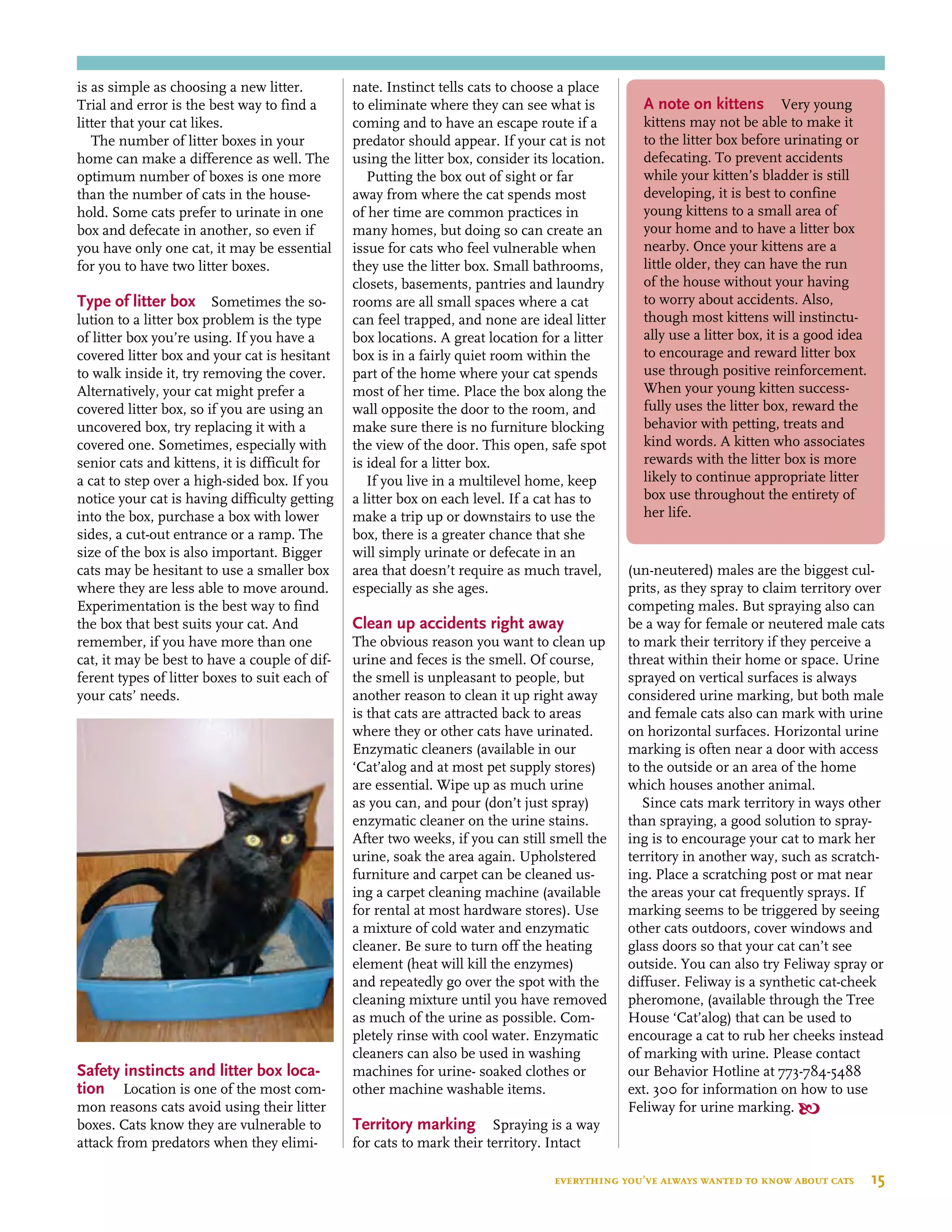
Litter box 101
A note on kittens  Very young
kittens may not be able to make it
to the litter box before urinating or
defecating. To prevent accidents
while your kitten’s bladder is still
developing, it is best to confine
young kittens to a small area of
your home and to have a litter box
nearby. Once your kittens are a
little older, they can have the run
of the house without your having
to worry about accidents. Also,
though most kittens will instinctu-
ally use a litter box, it is a good idea
to encourage and reward litter box
use through positive reinforcement.
When your young kitten success-
fully uses the litter box, reward the
behavior with petting, treats and
kind words. A kitten who associates
rewards with the litter box is more
likely to continue appropriate litter
box use throughout the entirety of
her life.
everything you’ve always wanted to know about cats  15
is as simple as choosing a new litter.
Trial and error is the best way to find a
litter that your cat likes.
The number of litter boxes in your
home can make a difference as well. The
optimum number of boxes is one more
than the number of cats in the house-
hold. Some cats prefer to urinate in one
box and defecate in another, so even if
you have only one cat, it may be essential
for you to have two litter boxes.
Type of litter box Sometimes the so-
lution to a litter box problem is the type
of litter box you’re using. If you have a
covered litter box and your cat is hesitant
to walk inside it, try removing the cover.
Alternatively, your cat might prefer a
covered litter box, so if you are using an
uncovered box, try replacing it with a
covered one. Sometimes, especially with
senior cats and kittens, it is difficult for
a cat to step over a high-sided box. If you
notice your cat is having difficulty getting
into the box, purchase a box with lower
sides, a cut-out entrance or a ramp. The
size of the box is also important. Bigger
cats may be hesitant to use a smaller box
where they are less able to move around.
Experimentation is the best way to find
the box that best suits your cat. And
remember, if you have more than one
cat, it may be best to have a couple of dif-
ferent types of litter boxes to suit each of
your cats’ needs.
Safety instincts and litter box loca-
tion  Location is one of the most com-
mon reasons cats avoid using their litter
boxes. Cats know they are vulnerable to
attack from predators when they elimi-
nate. Instinct tells cats to choose a place
to eliminate where they can see what is
coming and to have an escape route if a
predator should appear. If your cat is not
using the litter box, consider its location.
Putting the box out of sight or far
away from where the cat spends most
of her time are common practices in
many homes, but doing so can create an
issue for cats who feel vulnerable when
they use the litter box. Small bathrooms,
closets, basements, pantries and laundry
rooms are all small spaces where a cat
can feel trapped, and none are ideal litter
box locations. A great location for a litter
box is in a fairly quiet room within the
part of the home where your cat spends
most of her time. Place the box along the
wall opposite the door to the room, and
make sure there is no furniture blocking
the view of the door. This open, safe spot
is ideal for a litter box.
If you live in a multilevel home, keep
a litter box on each level. If a cat has to
make a trip up or downstairs to use the
box, there is a greater chance that she
will simply urinate or defecate in an
area that doesn’t require as much travel,
especially as she ages.
Clean up accidents right away
The obvious reason you want to clean up
urine and feces is the smell. Of course,
the smell is unpleasant to people, but
another reason to clean it up right away
is that cats are attracted back to areas
where they or other cats have urinated.
Enzymatic cleaners (available in our
‘Cat’alog and at most pet supply stores)
are essential. Wipe up as much urine
as you can, and pour (don’t just spray)
enzymatic cleaner on the urine stains.
After two weeks, if you can still smell the
urine, soak the area again. Upholstered
furniture and carpet can be cleaned us-
ing a carpet cleaning machine (available
for rental at most hardware stores). Use
a mixture of cold water and enzymatic
cleaner. Be sure to turn off the heating
element (heat will kill the enzymes)
and repeatedly go over the spot with the
cleaning mixture until you have removed
as much of the urine as possible. Com-
pletely rinse with cool water. Enzymatic
cleaners can also be used in washing
machines for urine- soaked clothes or
other machine washable items.
Territory marking Spraying is a way
for cats to mark their territory. Intact
(un-neutered) males are the biggest cul-
prits, as they spray to claim territory over
competing males. But spraying also can
be a way for female or neutered male cats
to mark their territory if they perceive a
threat within their home or space. Urine
sprayed on vertical surfaces is always
considered urine marking, but both male
and female cats also can mark with urine
on horizontal surfaces. Horizontal urine
marking is often near a door with access
to the outside or an area of the home
which houses another animal.
Since cats mark territory in ways other
than spraying, a good solution to spray-
ing is to encourage your cat to mark her
territory in another way, such as scratch-
ing. Place a scratching post or mat near
the areas your cat frequently sprays. If
marking seems to be triggered by seeing
other cats outdoors, cover windows and
glass doors so that your cat can’t see
outside. You can also try Feliway spray or
diffuser. Feliway is a synthetic cat-cheek
pheromone, (available through the Tree
House ‘Cat’alog) that can be used to
encourage a cat to rub her cheeks instead
of marking with urine. Please contact
our Behavior Hotline at 773-784-5488
ext. 300 for information on how to use
Feliway for urine marking. 
There is a common misconception
that cats can “take care of themselves.”
Consequently, they are taken to the
veterinarian far less frequently than
dogs, statistically about half as often.
Like all companion animals, though, cats
require ongoing veterinary care to live
happy, healthy lives. Regular checkups
are even more critical for cats because
they instinctively hide signs of illness.
This behavior, developed in the wild to
disguise cats’ weaknesses from preda-
tors, serves little purpose for domesti-
cated cats. In fact, subtle signs of illness
in cats often are overlooked or mistaken
for behavior problems, which is why it is
extremely important to bring your cat to
the veterinarian for regular checkups and
when you notice even slight changes in
behavior.
If you do not already have a veteri-
narian, talk to friends and relatives, or
contact your local humane society for
a referral. In some cases, it may be
advantageous to see a veterinarian at a
feline-only hospital, or a veterinarian
at a mixed (dog/cat) practice, but who
has a special interest in feline medicine.
Members of the American Association of
Feline Practitioners (AAFP) can be found
at catvets.com. Just as there are board
certified specialists in veterinary cardiol-
ogy and oncology, there are specialists in
feline medicine who are certified by the
American Board of Veterinary Practi-
tioners (ABVP). Names of veterinarians
boarded in feline medicine can be found
at abvp.com or catvets.com.
Visit the clinic or hospital you are
considering and ask questions about
the facility, including available services,
hours, etc. Make sure you’re comfortable
with the environment, as well as the pro-
fessionalism and friendliness of the doc-
tors and staff. Schedule an appointment
for a checkup. Do you like the way the
veterinarian communicates with you and
handles your cat? If not, don’t be afraid
to move to a new veterinarian or clinic.
It’s best to establish a good relationship
with a veterinarian before an emergency
arises. If the clinic you choose doesn’t
have emergency services, find out where
the nearest emergency veterinary clinic is
located or where your veterinary hospital
refers patients after hours.
Below is a list of changes that may
signal that your cat is not feeling well.
These are only guidelines and are not by
themselves definitively diagnostic for a
specific condition. Rather, they indicate
that a veterinary visit may be needed.
You know your cat’s habits and behav-
ior better than anyone. Do not ignore
changes that may indicate a developing
health issue. If there is a sudden change
in behavior, see your veterinarian as
soon as possible.
* NOTE: Even if your cat shows none
of these signs, consider scheduling
wellness examinations every six months.
Diagnosing disease early can be the key
to successful treatment and may be less
costly in the long run. Often, by the time
cats display an illness, the disease has
progressed significantly, necessitating
more extensive and costly treatment.
Learn more at catwellness.org.
The “Subtle Signs of Sickness,” writ-
ten by Fort Dodge Animal Health and
the AAFP and adapted by Tree House,
include:
	
Inappropriate elimination This is
one of the most common reasons given
for relinquishing cats to shelters. Guard-
ians often assume that the problem is be-
havioral, so they don’t seek medical help.
When a cat begins to urinate or defecate
outside the litter box, medical conditions
must be ruled out before behavioral in-
tervention is attempted. Any cat that does
not feel well for any reason may behave
differently, and in cats, that behavior
may include eliminating outside the
litter box. Defecation outside the box can
be a sign of inflammatory bowel disease,
constipation, arthri-
tis or other medical
conditions. Cats may
urinate outside the
box because of Feline
Lower Urinary Tract
Disease (FLUTD), kid-
ney disease, Cognitive
Dysfunction Syndrome
(kitty Alzheimer’s),
hyperthyroidism, dia-
betes, etc. The urinary
tract also can become
blocked by crystals, stones or mucous
plugs. This is a medical emergency, es-
pecially in male cats who are more prone
to urinary tract blockages because of the
anatomy of their urinary tracts. These
cats can quickly become sick and die as
toxins that normally are eliminated via
the urinary tract instead build up in their
bloodstream. Signs of blockage include
straining in or out of the box but only
producing a small amount of urine or
none at all, frequent trips to the box and/
or vocalizing while attempting to urinate.
Once medical problems have effec-
tively been eliminated, or while they are
being resolved, you can address litter box
problems associated with behavior. For
more information on litter box problems,
turn to page 14.
Changes in interaction A cat that
suddenly has little desire for attention
from his human family may not be feel-
ing well. For a normally docile cat, ag-
gression towards people or other animals
can be a sign of pain, and general irrita-
bility may be a sign that your cat simply
is not feeling up to par. Having regular
playtime and routines for interacting
with your cat will help you notice sudden
behavioral changes.
16  tree house humane society
Top ten reasons to
	 see your vet
Changes in activity Decreased physi-
cal activity can be caused by medical
conditions that result in pain, discom-
fort or lack of energy. As cats age, they
can develop arthritis and other illnesses
that may cause them to be less active or
playful, but they do not necessarily slow
down just due to old age. Some older
cats can experience increased physical
activity, which can be a sign of hyperthy-
roidism.
Changes in sleeping habits Know-
ing your cat’s daily habits will help you
determine if there is a significant change
in his normal sleep pattern. On aver-
age, cats can spend 16 to 18 hours daily
sleeping; daytime rest generally consists
of several catnaps. These naps aren’t
typically deep sleeps, so cats usually can
be easily roused by normal household
sounds and other stimuli, such as light
petting or food. If a cat is sleeping more
often and/or more deeply than usual or
has difficulty lying down and getting up,
it could signal an underlying problem.
Changes in food and water con-
sumption Most cats eat well and
regularly, provided they are offered food
they enjoy. Get to know your cat’s eating
and drinking habits; they are valuable
indicators of the cat’s overall health.
Increased food consumption can point to
problems such as diabetes or hyperthy-
roidism. Increased water consumption
can indicate kidney disease, diabetes, hy-
perthyroidism or other conditions. Many
diseases can cause cats to decrease their
food intake or stop eating altogether,
which can lead to rapid, even dangerous,
weight loss. A cat that has not eaten at
all for more than a day is at potential risk
of developing serious liver problems.
Meal feeding your cat is preferable to
free feeding in part because if your cat’s
eating patterns change, you will notice it
right away.
Unexplained weight loss or gain
Cats can gain or lose weight even when
they continue to eat normally, and such
instances point toward one or more
underlying health problems, such as
hyperthyroidism. Obesity is a significant
health issue—studies indicate 50 percent
or more of indoor cats are overweight—
which can lead to or be a complicat-
ing factor in a long list of medical and
behavior problems, including diabetes,
heart disease and joint problems, as
well as an overall reduced quality of life.
Cats should be weighed regularly to
determine if they’re maintaining their
ideal weight. This can be done at home
with a scale designed for weighing cats
(pediatric human scales or any scale that
weighs to the ounce will work well) or at
regular veterinary visits. Weight checks
are another good reason for semiannual
exams. It may not be apparent that your
cat has lost weight, but even the slight-
est weight loss can be cause for concern.
For example, a 12-pound cat losing
three pounds may not seem significant,
but this is akin to a 160-pound person
shedding 40 pounds. If such weight loss
was not planned and/or happened too
quickly, it could indicate an underlying
medical cause.
Changes in grooming Cats are
generally meticulous groomers and
maintain their coats in a healthy and
lustrous condition, free of mats. Areas of
fur loss or an unkempt appearance can
be signs of disease. Overweight and/or
arthritic cats may have trouble groom-
ing their hind quarters and may need
help keeping those areas clean. Anxiety
and depression can cause cats to groom
improperly as well, but as always, it is
best to rule out physical causes first.
Excessive grooming might indicate al-
lergies or skin irritation. If your cat is
over-grooming certain areas, look at the
skin in those areas to see if there are any
abnormalities. Also, keep in mind that
even indoor cats can become infested
with fleas, and flea allegies can cause
over-grooming.
Signs of stress Stress (as experienced
by the cat) can result from good or bad
events. A situation that a cat perceives
as stressful may or may not be seen the
same way by his human family. Any
change within a household can poten-
tially be a source of stress to the family
cat, so changes should be made slowly
and carefully. At times of stress, cats may
hide, become depressed and eat more or
less than usual. Because these same signs
can be indicators of medical problems,
cats should visit the veterinarian to rule
out medical causes. Alternatively, stress
can also prompt the onset of disease.
It is also important to recognize that
chronic or long-term boredom can be a
stressful situation for cats, just as in peo-
ple. As discussed above, stress can lead
to depression along with a host of other
health and quality-of-life issues. Cats like
to play and be mentally challenged just
as we do. Your cat will benefit from daily
interactive play and other creative ways
that you may be able to find to keep him
active and stimulated.
Changes in vocalization Increased
vocalization or howling tends to be more
common in older cats, and it can signal
an underlying medical condition such
as hyperthyroidism. Pain also can cause
cats to be more vocal, so schedule a
veterinary visit if your quiet cat suddenly
develops inexplicable howling behavior.
In elderly cats, howling may be a sign of
hearing loss or Feline Cognitive Syn-
drome (kitty Alzheimer’s), the latter of
which may be helped by medication.
Bad breath Bad breath can be caused
by conditions such as kidney failure or
diabetes, but it is most often an indicator
of poor dental health. Dental disease is
common in cats; some sources suggest
that 70 percent have gum disease as
early as age three. You may be able to see
tartar on your cat’s teeth, but the major-
ity of dental problems in cats involve pa-
thology that is below the gum line. Cats
should have their teeth examined at least
annually. Home brush-
ing in conjunction with
regular veterinary den-
tal care can prevent bad
breath, painful teeth
and gums, tooth loss
and spread of infection
to other organs. 
everything you’ve always wanted to know about cats  17
18  tree house animal foundation
Feline health issues
and symptoms
Below is a partial list of cat illnesses,
their causes and tips on how to best
prevent them. It is important to note,
however, that if you think your cat is
suffering from an illness, it is essential
to visit the veterinarian for diagnosis and
treatment.
Upper Respiratory Infection (URI)
This is one of the most common
problems seen in cats and especially in
kittens. Symptoms include sneezing,
discharge from the eyes and/or the nose,
lethargy, fever and loss of appetite.
The risk of URI can be decreased by
keeping your cat indoors and away from
infected cats. Although most cats have
been exposed, many are asymptomatic
carriers, and viruses can be transmit-
ted not only directly but also via hands,
clothes, toys, etc. Vaccinations limit the
severity of illness but may not prevent
upper respiratory infections altogether.
Antiviral medications are not completely
effective, but in severe or chronic cases,
they may reduce symptoms. Antibiotics
also may be prescribed to treat secondary
bacterial infections. Relief from nasal
congestion is important for comfort and
may require medications and/or a steam
humidifier or nebulizer.
Here is an overview of the agents that
may cause or contribute to upper respira-
tory infection in cats:
•	 Feline Viral Rhinotracheitis This
virus is caused by the feline herpesvirus,
which only affects cats and is not conta-
gious to humans. In addition to upper
respiratory signs, this virus can cause
corneal ulcers. In some cats, permanent
damage may be done to the nasal pas-
sages, which may result in chronic is-
sues such as sneezing, congestion, noisy
breathing, etc. As with other herpesvi-
ruses, this infection can be life-long and
signs can recur during times of stress.
Treatment with the amino acid L-Lysine
may be beneficial. Vaccination is recom-
mended.
•	 Feline Calicivirus This virus can
be associated with oral ulcers, gingivitis,
stomatitis (inflammation of the mouth)
and/or limping. Recovered cats can
become carriers. In some kittens, it can
lead to serious, even fatal, pneumonia.
In recent years, a more virulent but
much less common strain of the virus
has been shown to cause extremely high
fevers, facial and limb swelling and
often death, even in adult cats. Vaccina-
tion is recommended.
•	 Bordetella Bronchiseptica This
bacteria is known as the cause of kennel
cough in dogs, but it also can affect cats.
Signs are generally mild, and the cat
only may require supportive care or a
course of antibiotics. A vaccine is avail-
able but is not considered necessary for
most cats.
•	 Chlamydophila Felis (formerly
Chlamydia Psittaci) This bacte-
ria can cause conjunctivitis as well as
typically minor respiratory symptoms.
Again, it is susceptible to antibiotics,
and vaccines are available but are not
considered necessary for most cats.
•	 Mycoplasma This bacteria may
cause primary or secondary ocular and/
or respiratory signs and also can be
involved in pneumonia. No vaccines are
available, but mycoplasma is susceptible
to antibiotic treatment.
Feline Distemper or Panleukope-
nia (FPV) This disease is caused by
the feline parvovirus, which is passed
in all body secretions and can live for
months to years in the environment. The
virus causes suppression of white blood
cell production by the bone marrow,
as well as ulceration of the intestines.
Signs include vomiting, diarrhea, fever,
decreased appetite and dehydration.
Among unvaccinated cats, it is highly
contagious and often fatal, even with
treatment, which usually involves hospi-
talization and intensive care. Kittens are
particularly at risk. Vaccines are very ef-
fective and have dramatically reduced the
number of cats who contract the disease.
Feline Leukemia Virus (FeLV) This
retrovirus is unrelated to human leuke-
mia. The virus is passed between cats via
saliva, usually through mutual grooming
and sharing food and water dishes. It
also can be transmitted to kittens before
birth or via nursing. The signs vary, but
FeLV can cause multiple illnesses includ-
ing anemia and cancer. Affected cats also
become immunosuppressed and suscep-
tible to other infectious diseases. This
disease is incurable and generally fatal,
although some cats can live for years
before becoming ill, especially if they
receive regular veterinary care, proper
nutrition and are not subjected to a
stressful lifestyle. In most cases, a simple
everything you’ve always wanted to know about cats  19
blood test can detect FeLV infection. The
preventative vaccines are very good, but
they may not give your cat absolute pro-
tection. The best prevention is eliminat-
ing exposure, which
means keeping cats
indoors and away
from any direct con-
tact with any known
FeLV positive cats.
Healthy-looking cats
may carry the virus
and be contagious;
therefore, it is im-
portant to test any new arrivals for FeLV
before allowing contact with your cat.
Feline Immunodeficiency Virus
(FIV) This virus is similar to the Hu-
man Immunodeficiency Virus (HIV).
Most often, FIV is transmitted through
cat bites, but it also may be passed in-ute-
ro. Infected cats gradually lose their abil-
ity to resist disease but may still live long,
healthy lives if kept indoors and provided
with diligent veterinary care and proper
nutrition. Reliable blood tests for FIV
exist, but cats who have been vaccinated
against FIV also will test positive, and
currently the tests cannot differentiate
between a vaccinated cat and an infected
cat. In addition to causing cats to test
positive, the FIV vaccine may not protect
against all strains of the virus. The best
way to protect cats from FIV is to keep
them indoors and to prevent fighting.
NOTE: FIV and FeLV are only 		
infectious between cats—you can’t catch
them from your pet.
Feline Infectious Peritonitis (FIP)
This disease is both frustrating and
misunderstood. It is nearly always fatal
and is far more common in kittens. It
begins when a cat contracts the com-
mon feline coronavirus, usually through
contact with infected stool (that is,
through shared litter boxes). The benign
coronavirus causes mild signs of intes-
tinal upset or no signs at all. Most cats
recover on their own, but in some cats
the coronavirus changes and the mutated
virus then causes an immune-mediated
disease called FIP. Why this happens
in certain cats is unknown, but genetic
predisposition and stress are likely fac-
tors in the development of the disease.
There are two types of FIP. One form is
the effusive (or wet) form, in which fluid
builds up in body cavities, most often the
abdominal cavity causing a characteristic
distended abdomen. The other is the dry
form where virus associated inflamma-
tory cells invade internal organs. Signs
of FIP include prolonged high fever that
does not respond to therapy, lethargy,
weight loss and decreased appetite. Dry
FIP, in particular, is difficult to diagnose.
While research on various types of treat-
ment continues, there is currently no
cure for FIP and no reliable treatment.
A vaccine exists, but it is not generally
recommended as its efficacy is contro-
versial. The risk of FIP may lessen with
good sanitation practices and a reduction
of both overcrowding and stress.
Excellent brochures on FeLV, FIV,
and FIP are available from the Cornell
Feline Health Center, Cornell University,
Ithaca, New York 14853-6401. Write to
them for details or check out vet.cornell.
edu/fhc/. Another excellent source of
information is the Winn Feline Founda-
tion, winnfelinehealth.org.
Feline Lower Urinary Tract Disease
(FLUTD) This disease, formerly
known as Feline Urologic Syndrome
(FUS), is a general term for a set of
signs including frequent squatting or
straining in the litter box, painful and/or
inappropriate urination or blood in the
urine. Causes include cystitis (bladder
inflammation), urinary tract infections,
crystals in the urine, bladder stones, and
less commonly, urinary bladder cancer.
Especially in younger cats, there is a
good chance that no definitive cause will
be found. Lack of water in the diet (ex-
clusive dry food diets), stress and change
of seasons are currently among the pre-
disposing factors thought to be involved
in leading to FLUTD in cats. Because of
their urinary tract anatomy, male cats
are more prone to blockages if stones,
crystals or mucous plugs become lodged
in the urinary tract. Immediate treatment
is necessary to save their lives. FLUTD
can sometimes be prevented by diet,
and sometimes it can be controlled with
diet and drug therapy. Reducing stress
through behavioral and environmental
enrichment programs is now a part of
standard treatment for cystitis. For more
information, see indoorcat.org.
Parasites Parasites draw their sus-
tenance from a cat’s body. Although
parasites rarely kill their hosts, severe
parasitic infestations can lead to death.
At the very least, parasitic infections can
have an adverse effect on a cat’s quality
of life. Some parasites are also zoonotic
(can affect people). Keeping your cat
indoors will help reduce the chance of
exposure to parasites. The most common
parasites are:
•	 Fleas Cats who spend time out-
doors or cats who have contact with
unprotected pets are most at risk for flea
infestation. Flea control is important to
prevent flea allergy dermatitis, an irritat-
ing and potentially severe skin condition
caused by an allergy to flea bites. Fleas
also transmit the larval form of one type
of tapeworm. There are medications that
effectively treat tapeworms, but flea con-
trol is necessary to prevent reinfection.
Fleas may also transmit Bartonella, the
bacteria that causes “Cat Scratch Dis-
ease,” as well as a blood parasite called
Mycoplasma Haemophilus that can
cause severe anemia. In addition, while
fleas prefer animals as hosts, they may
bite people. Our warm and often humid
homes provide perfect shelter (especially
carpeting) for flea eggs to hatch and pu-
pae and larvae to hide. A single flea can
lay up to 50 eggs daily and 2,000 eggs
in a lifetime. Both the cat and the home
must be treated to break the lifecycle.
Talk with your veterinarian about which
flea control method is best for your cats.
Only use flea control products labeled
for cats. Some flea treatments for dogs
can be toxic to cats.
•	 Ear Mites These tiny, almost invis-
ible insects live and breed in your cat’s
ear canal. They are very contagious, can
be passed between cats and dogs and
20  tree house humane society
can be difficult to treat. Head-shaking,
excessive ear scratching and crumbly or
greasy brown or black matter in the ears
suggest an infestation. Your veterinar-
ian can offer treatment options. Do not
attempt to treat the ears yourself, and
don’t assume that every ear infection is
caused by ear mites. Cats also can have
bacterial or fungal infections, either
alone or in conjunction with the ear
mite infection.
Intestinal Parasites
•	 Roundworms These parasites are
fairly common, especially in kittens and
in stray and other outdoor-roaming cats.
Roundworms often are easily detected
by a microscopic fecal examination.
They are acquired by ingesting the eggs
of the parasite, eating an infected host
such as a rodent or bird or through
drinking an infected queen’s milk. The
white worms live in the small intestines
of the cat and grow up to six inches
long. The eggs produced by the female
worms shed in the cat’s feces and can
persist in contaminated soil for years.
While treatment is routine (professional
deworming is best—some over-the-
counter dewormers don’t work), it’s
extremely important to treat the cat.
Roundworms are a public health con-
cern, potentially causing larval migrans
in people. This is a condition most often
seen affecting children who dig or play
in roundworm-affected sand or soil. The
immature roundworms (larvae), when
ingested by these children, can migrate
to the lungs, liver or eyes and may cause
damage to these organs, including
blindness.
•	 Tapeworms Typically detected by
the presence of tapeworm segments,
these parasites resemble grains of rice
or sesame seeds and are found in the
area around the cat’s anus. One type
of tapeworm is contracted by ingesting
fleas and the other by eating animals
such as mice and rabbits. Tapeworms
attach to the intestine and absorb nu-
trients. Most cats are asymptomatic but
in some cases cats can develop diarrhea
and/or experience weight loss. As de-
scribed above, treatment involves both
medication and flea control.
•	 Coccidia Coccidia are not worms
but rather one-celled organisms that
thrive in the intestinal tract and some-
times may cause life-threatening diar-
rhea. They are detected through micro-
scopic fecal examination. The treatment
period is longer versus tapeworm and
roundworms. Treatment for coccidia
involves meticulous scooping of feces
from the litter box along with a 14- to
21-day antibiotic regimen.
•	 Hookworms Common symptoms
of hookworms include bloody stool,
weight loss, weakness and/or anemia.
However, in some cases, particularly
in adults, cats may be asymptomatic.
Hookworm infection is caused by eating
infected animals or ingesting feces that
contain infected larvae. Hookworms
may be transmitted to humans, caus-
ing cutaneous larva migrans. This is a
condition where the larval or immature
forms of the hookworm travel under
the skin in people, creating red, itchy
bumps. Deworming treatment is the
same as it is for roundworms.
•	 Heartworm Disease This disease
can affect cats, but hasn’t been an
area of veterinary concentration until
recently. In cats, heartworms tend to
cause lung disease as opposed to the
heart disease that dogs develop. In fact,
some cats with symptoms suggestive of
feline asthma may actually be suffering
from Heartworm Associated Respiratory
Disease (HARD). Diagnostic testing for
heartworms in cats is much more diffi-
cult than it is in dogs and often requires
a combination of blood tests, x-rays and
ultrasound. There is no cure for heart-
worms in cats, but some may respond
to symptomatic treatment with anti-
inflammatory medications and certain
antibiotics. Monthly preventive medica-
tions, however, are very effective and
safe. Since heartworm is transmitted by
mosquitoes, cats who roam outside or
spend time on porches, decks or near
open windows are at risk for heartworm
disease. For more information, visit
knowheartworms.org and heartwormso-
ciety.org.
•	 Ringworm Ringworm is not caused
by a worm, as the name may imply. In-
stead, it is caused by a highly contagious
fungus. Although it has a classic “ring”
appearance on human skin and is often
recognized in cats by hair loss with scaly
or red skin, it can mimic other skin
and coat conditions as well. Cats also
can carry ringworm without showing
any signs. Diagnosis and treatment are
important because ringworm is conta-
gious to other pets and people. Affected
hairs may glow under UV light (Wood’s
Lamp), but this occurs in less than half
of infected cats, so a fungal culture is of-
ten necessary to confirm the diagnosis.
Treatment includes both oral and topical
medications prescribed by a veterinarian
and must continue until fungal cultures
are negative. Environmental decontami-
nation is critical to prevent reinfection.
The fungal spores are very hardy, and
most over-the-counter products are not
effective at killing them. Household
Signs of an emergency Seek
immediate treatment from your
veterinarian or the closest veterinary
emergency clinic if your cat:
•	 Has a seizure (convulsions)
•	 Becomes ataxic (staggers or has
	 poor coordination, loss of
	 balance) or has vision loss
•	 Cannot urinate
•	 Is gasping or has labored 	 	
	 breathing
•	 Has a loss of bladder and/or 	 	
	 bowel control
•	 Becomes comatose or 	 	 	
	 unresponsive
•	 Paws or scratches excessively at 	 	
	 his mouth or face
•	 Shows evidence of having 	 	
	 suffered a serious trauma or
	 accident (bleeding, broken bone, 		
	 head tilt, etc.)
•	 Has eaten anything toxic,
	 including certain plants, 		
	 antifreeze, human medications,
	 etc (a list of dangerous
	 substances can be found at
	 aspca.org)
•	 Stops eating or drinking 	 	
	 completely
•	 Develops diarrhea that lasts more 	
	 than 48 hours
•	 Has atypical vomiting or
	 persistent vomiting of food or 		
	 fluid
•	 Passes blood in urine or stool
When in doubt, contact your
veterinarian as soon as possible.
Your cat can’t tell you what’s wrong,
and the problem is not going to
correct itself!
everything you’ve always wanted to know about cats  21
bleach in a dilution of one part bleach to
ten parts water works best. Also, vacu-
uming well and frequently and washing
all bedding are important.
For more information on parasites and
pets, visit petsandparasites.org.
Chronic Kidney Failure (Chronic
Renal Failure) This is a progres-
sive but often manageable disease in
which the kidneys lose their ability to
perform many important functions,
including removal of waste products
and conserving water. It can have many
causes, but chronic aging changes in
older cats are the most common cause.
The clinical signs seen most often are
excessive drinking and urination. Later
signs include weight loss, anorexia,
lethargy, vomiting, anemia and sores in
the mouth. Unfortunately, by the time
many of these signs are seen, the disease
often has progressed significantly.
Diagnostic tests include blood work,
urinalysis, urine culture (which helps
to screen for kidney infection) and, in
some cases, x-rays and an ultrasound.
Treatment for kidney failure may initially
require hospitalization with IV fluids as
well as medications to control nausea
and vomiting, appetite stimulants and
antibiotics, if needed. Home treatment
may start with changing your cat’s diet,
but may also involve your administering
fluids (a balanced electrolyte solution) by
injection under the skin, as well as other
supportive medications. Prescription
foods may reduce the workload of the
kidneys and may slow the progression
of the kidney disease, and moist foods
in general help to increase water intake.
Periodic rechecking of laboratory values
and subsequent adjusting of supportive
treatments will be recommended by
your veterinarian. This is one of many
diseases where early detection and inter-
vention may prolong quality of life and
lessen suffering, which is another reason
semiannual visits to your veterinarian
are important.
Hyperthyroidism This occurs when
the thyroid, a small gland in the neck
that helps to regulate metabolism, be-
comes enlarged and produces too much
thyroid hormone. In most cases, this
is due to a benign tumor. The cause of
these benign tumors is unknown but is
actively being researched. Environmental
toxins may possibly play a role. The hall-
mark sign of hyperthyroidism is weight
loss despite a normal or increased ap-
petite. Hyperthyroid cats also may have
intermittent vomiting and/or diarrhea
as well as increased thirst and urination,
skin conditions, behavior changes, etc.
Some cats become agitated, hyperactive
and/or more vocal.
Hyperthyroidism can be diagnosed
through blood work. It is important
that kidney and liver function also be
assessed as this affects future treatment.
Hyperthyroidism can adversely affect
multiple body systems, most signifi-
cantly the heart, so control of the disease
is very important. There are three treat-
ment options available:
1.	 Medication, typically Methimazole,
needs to be administered daily (usually
twice a day) to adequately control thyroid
hormone levels. It is generally given in
pill form, but can be specially formulat-
ed (compounded) into a flavored liquid,
chew or a transdermal gel that can be
applied to the inside of the ears. Because
this medication is intended only to
blunt thyroid hormone production and
does not actually cure the condition,
methimazole is a lifelong treatment.
Occasionally, some cats will experience
minor side effects, but the drug has the
advantage of being easily adjusted. Cats
on oral medication must have exams
and laboratory work performed regularly
to monitor efficacy and also because
treatment affects other organ systems.
2.	Radioactive iodine is generally consid-
ered the safest and most effective treat-
ment, and it is perhaps the best option
for cats with adequate kidney function.
In more than 95 percent of cats, it is
curative with only one treatment. Also,
in the rare case of a malignant thyroid
tumor, the thyroid scan that many
facilities use prior to treatment will aid
in diagnosis and appropriate treatment.
Only specialized facilities are licensed to
perform the radioactive iodine proce-
dure, and cats must be hospitalized for
several days because of the exposure
to radioactive materials. A very small
number of cats may become hypothy-
roid after therapy and require thyroid
supplementation.
3.	Surgery to remove the thyroid glands
is usually curative, but hyperthyroidism
can recur in some cats if tissue is left
behind or if they have thyroid tissue in
abnormal locations (ectopic thyroid).
Other potential complications include
22  tree house humane society
those associated with anesthesia and
surgery in general as well as damage to
the adjacent parathyroid gland, which
can result in dangerously low calcium
levels.
Your veterinarian can assist in choos-
ing the option best suited for your cat’s
personality and health, taking economics
into consideration as well. Surgery and
radioactive iodine are far more expensive
initially, but in relatively younger cats,
the costs of years of medication and
monitoring may exceed the costs associ-
ated with the two curative options.
Inflammatory Bowel Disease (IBD)
This disease can cause chronic vomiting,
diarrhea, dehydration and/or weight loss.
IBD is characterized by inflammatory
cells found in the lining of the stomach
and/or intestinal tract. To confirm the
diagnosis, an exploratory abdominal sur-
gery or endoscopy with biopsy is needed,
but less invasive diagnostics, such as
blood tests, x-rays and ultrasound can
help to make a presumptive diagnosis.
There is no one specific cause for IBD
in cats, and the explanation may vary
from cat to cat. Known causes include
dietary allergies or intolerances, para-
sites, bacterial infections, etc. Some cats
respond to special diets or supplements.
Steroids also may be prescribed, and
they often are very effective. Many cats
tolerate steroids well enough to use for
the remainder of their lives without any
serious deleterious effects.
Diabetes Mellitus This disease
develops when insulin secretion by
the pancreas is impaired or when the
body’s cells are resistant to the action of
insulin, thus inhibiting the body’s ability
to regulate blood glucose (blood sugar).
The key clinical signs are increased
water and food intake, excessive urina-
tion and weight loss. In the later stages,
cats may have trouble walking (due to
effects on the nervous system) and be-
come extremely lethargic. The disease is
diagnosed through blood work and a uri-
nalysis. Diabetic cats may require insulin
injections, but some cats can be treated
with low carbohydrate diets, especially if
diagnosed early (please turn to page 6 for
more information on diet and nutrition).
Occasionally, diabetes can be maintained
with oral medications, but these are rare
exceptions. Not all cats remain insulin
dependent forever. Diabetes is far more
common in overweight cats, especially
middle-age male cats, and its incidence
has risen along with the rise in feline
obesity.
Cancer This disease includes a large
group of malignancies that can affect
any organ system. Signs and symptoms
often are subtle at first, if apparent at
all. Examples include visible masses on
or under the skin, diarrhea, vomiting,
persistent lameness, decreased appetite,
lethargy, weight loss, labored breathing
and difficulty urinating and/or defecat-
ing. Unusual bleeding or discharge
from any area may be cause for concern.
Check your cat on a regular basis for
any lumps. Especially with female cats,
guardians should periodically check for
mammary (breast) masses. If any of
these signs or symptoms are observed in
your cat, bring them to the attention of
your veterinarian.
Many cancers are very aggressive
and can accelerate quickly. In some
cases early detection is possible. The
earlier cancer is diagnosed, the better
the chance is for effective treatment and
a positive outcome. Annual, or ideally
semiannual, veterinary examinations will
allow your veterinarian to catch weight
loss earlier and to detect any abnormal
findings at an early stage. Treatment for
cancer depends on its type and location.
In some cases, surgery, chemotherapy
and/or radiation therapy may lead to
remission or a cure. In others, the goal
may be to keep the cat comfortable. Vet-
erinary oncologists are making progress
in identifying effective treatments with
fewer side effects. Still, our cats can’t
live forever, and cancer often is fatal,
particularly in elderly cats. The ques-
tion of whether to treat and how to treat
depends on economic realities as well as
how to best maintain your cat’s quality
of life.
Hypertension High blood pressure
in cats almost always is secondary to
another disease process, such as chronic
kidney failure or hyperthyroidism. There
often are no obvious symptoms, so
routine screening is important. Hyper-
tension should never be ignored because
it indicates the presence of an underlying
condition. Also, if left untreated, hyper-
tension can cause blindness, stroke or
seizures and can hasten the progression
of kidney disease, especially in older cats.
Treatment of hypertension begins
with treating the primary disease. Often,
though, antihypertensive medication
also is needed, and some of the same
drugs that treat hypertension in people
are used in cats.
Arthritis (Osteoarthritis) This
degenerative joint disease is a painful
condition that primarily affects older
cats. Unfortunately, much more research
is needed to enhance our knowledge
about the causes and management of
this disease in cats and to approach the
level of understanding that we have
about arthritis in dogs. The prevalence
of arthritis in cats is unknown, but it is
thought to affect a significant portion of
senior cats (older than 10 years of age)
with the elbows showing the highest
frequency of obvious disease.
Clinical signs of arthritis in cats are
often subtle. Only a small portion of
arthritic cats will exhibit lameness or
limping. Instead, the signs more com-
monly seen are behavior changes, such
as reduced activity and a decreased ability
to perform some of the tasks that they
once were able to perform, or that they
should perform (jumping, playing, etc).
Owners may not even initially recognize
these signs since many cats are generally
less active indoors. Additionally, owners
may not interpret the reduced activity
as problematic but instead attribute it to
advancing age. Arthritic cats also may
groom less completely if their mobility
or flexibility is reduced, and they may
find other normal functions difficult as
well, such as getting in and out of the
litter box, going up and down stairs and
defecating.
The diagnosis of arthritis can be dif-
ficult in cats, and for this reason, the
Pain recognition and management
in cats There are several reasons why
it can be very easy to miss signs that
a cat is in pain. First, cats are masters
at hiding pain. In the wild, a sick or
injured animal is vulnerable to attack,
so survival can depend on the animal’s
ability to act like everything is fine even
when something is terribly wrong.
Second, cats don’t exhibit signs of pain
the same way people or other animals
do. Relatively quiet creatures, cats won’t
bark, whine, cry or otherwise vocalize
when they’re in pain. Just because your
cat isn’t crying or acting out doesn’t
mean she’s not in pain.
Here are some signs that your cat may be in pain:
•	 Lack of grooming
•	 Sleeping a lot and/or sleeping in only one position
•	 Lack of interest in food, water or surroundings
•	 Wanting to be left alone
•	 Growling or hissing when stroked, touched or moved
•	 Nonstop purring
•	 Licking a particular area
•	 Abnormal body positions, such as a hunched-back or head-in-the-corner 	
	 stance
•	 Restlessness
•	 Change in food preferences, sleeping spots and/or litter box habits
•	 General irritability or crankiness
•	 Reluctance to jump to favorite spots, such as window sills and beds
If you notice any of these behaviors (or any other changes in your cat’s regular
behavior), contact your veterinarian. Treating pain in cats can significantly
speed their healing and recovery from surgery or illness, and can help reduce
stress and enhance the quality of life associated with chronic painful
conditions such as arthritis. To assist owners and veterinarians alike in
recognizing and managing pain in cats, visit:
aahanet.org/PublicDocuments/PainManagementGuidelines.pdf.
condition is likely under diagnosed.
Radiographs are not always helpful; there
often is a discrepancy between what is
seen radiographically and what is seen
clinically. Therefore, owner observations
of notable changes in their cat’s behav-
iors and activity levels are important fac-
tors in helping to diagnose arthritis.
Some of the treatment approaches for
feline arthritis include: diet restriction if
the cat is overweight; home environment
changes, including low-sided litter boxes
and pet stairs; exercise/rehabilitation/
physical therapy; acupuncture/massage;
nutraceuticals (glucosamine/chondroi-
tin sulfate); and pain medication (see
sidebar).
Toxoplasmosis Some obstetricians
still suggest that pregnant women relin-
quish their cats because of the potential
for this protozoal parasite to be transmit-
ted to them, which would potentially
cause birth defects, even death, in their
unborn children.
“Absolutely, positively, you do not have
to give up your cat because you are preg-
nant; please don’t even consider that,”
urges Dr. Margie Scherk, a board-certi-
fied feline veterinarian from Vancouver,
British Columbia, Canada.
Toxoplasmosis (Toxoplasma gondii)
occurs naturally in the environment.
Cats most frequently get the infection by
eating an infected animal or by eating
undercooked meat. Following a meal
of infected prey or undercooked meat,
an intraintestinal infection cycle begins
which is unique to cats. The organ-
ism multiplies in the walls of the small
intestine and ultimately comes out in
the feces. Cats are the only animals to
pass the organisms in their infectious
stage in their feces. While some cats with
toxoplasmosis do become ill, many show
no symptoms whatsoever.
Dr. Michael Lappin, professor of small
animal internal medicine at the College
of Veterinary Medicine at Colorado State
University, Fort Collins, explains the
specific series of events that must occur
for a person to get toxoplasmosis from a
feline host. Initially, a person must come
in contact with an infected cat, and not
all cats are infected. According to Lap-
pin’s research, about 30 percent of cats
are positive for toxoplasmosis. Cats pass
the organisms in their infectious stage of
the disease in their feces for only seven
to ten days of their entire lives (when
there is an acute infection). To affect an
unborn baby, the infection must occur
within the first trimester.
By scooping the litter box daily, there’s
no potential for infection to people be-
cause the feces eliminated by a cat carry-
ing toxoplasmosis require from 24 hours
to five days to become actively infectious.
Lappin says he encourages women to
wear gloves while changing the box, of-
fering further protection. Scherk prefers
delegating the task. “It’s a perfect job for
your partner. You’re carrying the baby; at
least he can scoop the box.” 
everything you’ve always wanted to know about cats  23
Advances in veterinary medicine, espe-
cially in the areas of preventive medicine,
diagnostics, nutrition and cutting-edge
specialty medicine, have led to better care
and a prolonged life expectancy for our
feline friends. To ensure that your older
cat lives a long, happy life, it is important
to be vigilant about your cat’s health and
take steps to prevent illness.
How to Care for Your Older Cat
Regular veterinary checkups are essen-
tial to maintain your older cat’s health.
Examinations should be performed every
six months so that health issues can be
identified and intervention can occur as
soon as possible.
Appropriate vaccines may be even
more important in older cats. As animals
age, their immune systems may not
function at the level that they once did,
and thus their response to disease is
impaired. Vaccination decisions should
be made with the cat’s disease risk and
health status in mind.
Good nutrition is essential for senior
cats. Many diets currently are marketed
for older cats that are designed to provide
extra antioxidants, fatty acids, high qual-
ity protein and joint health supplements.
They also are purported to maintain ideal
urine pH. Not every food is appropriate
for every cat, though, and diet decisions
should be made on an individual basis.
Your veterinarian can help steer you in
the right direction based on your indi-
vidual cat’s nutritional needs. Ultimately,
it is most important that senior cats con-
sume adequate calories and nutrients.
Due to their decreased senses of smell
and taste, this can mean trying different
types of food, adding water to the food or
warming the food.
Cats often develop tartar and gingivitis
as they age, which can lead to infections
and oral pain. Many cats require regu-
lar dental cleanings under anesthesia.
If they have dental problems that were
ignored in the past or that dramatically
worsened with age, they may need to
have oral surgery, including extraction
of diseased teeth. No cat should live with
a painful mouth, and by removing the
diseased teeth, the pain is eliminated.
Cats generally adjust quite well to los-
ing teeth, and most will continue to eat
normally, including dry kibble, even
after having lost multiple teeth. Regular
teeth brushing can help to avoid prob-
lems but can be painful when the gums
are inflamed or the teeth are loose, so
see your veterinarian before beginning
any home care regimen. Oral cleansing
solutions, water additives and/or plaque
prevention gels also may be used to help
slow the progression of dental disease.
See your veterinarian right away if your
cat is pawing at her mouth, clearly chew-
ing only on one side or refusing food—
all these are signs of dental problems.
Unfortunately, many cats tend to live
with or hide pain, and you may never see
any signs that your cat’s mouth hurts, so
regular dental exams are critical.
Baseline blood values, taken while
your cat is healthy, allow your veterinar-
ian to know what is normal for your cat.
How old is my cat? In general, the
first year of a cat’s life is equivalent to
the first sixteen years of a human’s.
The second year adds another seven
to eight years, for an equivalent of 23
to 24 years of age. Each subsequent
year of life adds about four human
years. Thus, a 10-year-old cat would be
equivalent to a 56-year-old person, a
15-year-old cat to a 76-year-old person
and a 20-year-old cat to a 96-year-old
person. Most veterinarians consider
any cat over 10 years old senior, as
that is when age-associated illnesses
generally begin to develop.
24  tree house humane society
	 senior cats
Special concerns for
They also provide a reference point for
later treatment if those values do change
as the cat ages. Routine diagnostics can
detect a problem early on, before the cat
is showing any symptoms of illness. This
can lead to more effective and rewarding
treatment for the senior cat.
Signs you should take your older cat
to the veterinarian Knowing your cat
and monitoring her for changes so that
problems can be detected early can help
prolong a healthy and comfortable life.
It is important to note that aging itself is
not a disease. In cats, behavior changes,
including subtle changes, may be the
first indicators of illness, pain or dis-
comfort. Guardians who know their cats
well, and specifically their cat’s normal
behaviors, will better be able to detect
significant changes. Simply getting older
is not a reason for your cat to experience
weight loss, difficulty walking, etc. The
following signs, as well as those listed
in the article beginning on page 18, may
indicate disease and should be discussed
with your veterinarian.
•	 Weight loss This is often the first
(and sometimes only) sign that your
older cat may be having a problem. This
can indicate almost any geriatric dis-
ease, so it is important that you either
weigh your cat at home or schedule
regular veterinarian checks to keep
track of her weight.
•	 Excessive drinking/urination
This is very important as these are
symptoms of diabetes, kidney disease,
hyperthyroidism, uterine infections and
bladder infections.
•	 Vomiting/diarrhea Alone or
together, these can indicate a variety of
problems.
•	 Difficulty seeing Poor vision
can be a sign of retinal degeneration,
cataracts or sudden blindness caused by
detachment of the back portion of the
eye, called the retina, from untreated
high blood pressure.
•	 Difficulty walking This may be an
indication of arthritis, diabetes, infection
or a metabolic problem, such as a min-
eral deficiency. For more information on
arthritis and diabetes, see page 22.
•	 Decrease in appetite Any time
a cat does not eat for more than a day
there is cause for concern. It is impor-
tant to meal feed your cat rather than
leaving food out all day (see page 6 for
more information), so you can more
quickly notice any loss of appetite in
your older cat.
•	 Nasal discharge Bloody or green-
ish discharge can indicate severe dental
disease or oral/nasal tumors.
•	 Lethargy It’s normal for cats to
sleep more as they get older. However, a
dramatic change in activity over a short
period of time is a cause for concern.
•	 Confusion A cat who seems to
forget family members, walks into
objects, stands in the center of a room
and vocalizes or awakens in the middle
of the night and vocalizes for no appar-
ent reason may be demonstrating signs
of Feline Cognitive Dysfunction (kitty
Alzheimer’s). These also may be signs
of hearing and/or vision loss as well as
other diseases, including hyperthyroid-
ism, in the senior cat.
•	 Constipation Your cat may be
constipated if she is straining in the
litter box, eliminating less frequently,
vomiting while defecating or attempt-
ing to defecate or eliminating outside
the box. Another sign of constipation
is small, pebble-like, unusually firm
pieces of stool. A common cause of
constipation is a lack of water intake
so it is important to feed moisture-rich
canned food and make sure your cat has
easy access to water bowls. Many older
cats also may need stool softeners to
alleviate the discomfort associated with
constipation.
Your older cat, whether you have had
her since kittenhood or adopted her as
an adult, is an important part of your
family and she has given you years of
companionship and unconditional love.
Please return the favor by providing the
essential care and attention that your
older cat so desperately needs. 
Coping with the loss of a pet
Losing a pet can be a heartbreaking,
isolating experience, and many pet
guardians do not know how to ask for
help or who to reach out to for sup-
port. To help pet guardians under-
stand and deal with the potentially
crippling effects of grief, Tree House
created the Pet Loss Grief Support
Group. It is a group where people
who are dealing with the imminent or
recent death of a beloved companion
animal can share their thoughts and
feelings in confidence. The group
is led by two trained counselors and
meets once a month. For more infor-
mation on the Tree House Pet Loss
Grief Support Group, call 773-784-
5488 ext. 227 or email griefsupport@
treehouseanimals.org.
Older cats and litter box prob-
lems If your older cat is eliminating
outside the litter box, having trouble
making it downstairs or upstairs or is
avoiding stepping into the litter box,
she may have arthritis. Easy solutions
to this problem include adding litter
boxes to each level of your house,
particularly to the area where your
cat spends most of her time, and pur-
chasing litter boxes with lower sides
so your older cat can have an easier
time entering the box. You also might
want to consider removing the litter
box cover, as your older, visually im-
paired cat may not like stepping into
a dark box. For more information on
litter box problems, turn to page 14.
everything you’ve always wanted to know about cats  25
If your cat becomes lost, act fast and
don’t give up. How quickly and care-
fully you search, and how persistent
and resourceful you are, can determine
whether or not your cat will be found. In
the event that your cat is lost, here are
some tips:
Your cat needs you  The important
thing to remember is that your cat can’t
tell you where he is—you are respon-
sible for his safety and rescue. So please
don’t give up after only a day or two. We
recommend that you keep looking for as
long as six months, if necessary. There
are reports in the media of “miracle cats”
who return after a year or more. Your cat
could be a miracle cat.
Look closest to home If you did not
actually see your cat slip outside, be sure
to thoroughly search your home. Cats
have been known to hide in the most re-
mote places, such as closets, empty boxes
and under furniture. If you live in an
apartment, be sure to check the hallways,
stairwells, basement, storage closets,
laundry rooms and any vacant apart-
ments that may have had a door ajar.
Also, check with neighbors as they may
have either seen or taken in your cat.
Most lost cats who have always lived
indoors will not go far from home. Many
are discovered hiding just a few doors
away or even a few feet from the front
door. Start by looking under nearby
porches, in basements and garages,
in bushes and even under cars. Once
outside, your cat will likely be wary or
frightened of any human voice and may
not recognize you or come immediately
when you call. Don’t be discouraged if
he doesn’t respond. Call to your cat as
if you’ve just seen him, using an upbeat
voice, the kind of voice that you normally
use to greet him. Call your cat’s name
often and listen for a reply.
Be a detective  As you search for your
cat, ask everyone you meet if they’ve
seen him. Children are particularly good
sources of information as they are usu-
ally outdoors more often than adults. Ask
people walking dogs, the mail carrier,
owners of nearby businesses and people
coming to and from work. The more peo-
ple you include in your search, the more
likely you are to find your cat.
Post signs  As soon as possible after
losing a cat, post signs to alert the neigh-
borhood. The lettering must be large
enough to read from a distance, and a
Help…I found a stray! Take a good look at the cat (or dog, for that matter). Is he in good physical condition, easy to approach or
wearing a collar with identification tags? If the stray is wearing tags, a phone call to the number listed is the best way to find out where
he lives. If the animal looks to be in good condition, but is not wearing tags, take him to a local shelter or veterinarian’s office to be
scanned for a microchip, which will be registered to his guardian. If there is no identification, try the following:
•	Check Lost sections of local papers or place your own Found ad.
•	Register the animal with lost/found match-up programs at local animal shelters and on the many websites created for lost and 	
		 found pets, such as pets911.com, lost-pet.org, or lostpetsos.org.
•	Post Found signs in the area where you discovered the animal.
If you think you’ve found the animal’s guardian, don’t hand over the animal right away. Take a few precautions to make sure the per-
son claiming the cat or dog is actually the guardian. Unfortunately, reselling animals for research, baiting or as breeders for puppy and
kitten mills does happen. An unscrupulous “buncher” (animal broker) may put on a well-polished act as a concerned guardian, so it’s
best to do the following:
•	Ask for identification. When someone calls in response to an ad or posted notice, ask for the caller’s name and telephone number 	
		 and tell the person you’ll call back right away.
•	Ask for a description of the animal. A guardian should be able to give you details not mentioned in your ad or notice.
•	Watch the reaction of the animal when the guardian arrives. An animal being reunited with its guardian is usually visibly excited.
•	If you’re not sure, ask for proof such as veterinary records or photographs. Don’t worry that you’re being overly cautious—a pet 	
		 guardian will understand that you are only trying to protect the animal.
If you can’t find the animal’s guardian and can’t keep the stray, there are options available to you. You can take the cat or dog to your
local animal care and control or a private shelter. Be aware that no-kill shelters have limited admissions and may not be able to admit
the animal immediately or at all. You also can consider fostering him until you can find an adopter, but be sure to screen all potential
adopters and charge an adoption fee.
26  tree house animal foundation
How to find
	 a lost cat
reward should be mentioned prominent-
ly. Put a good description and photo of
your cat on your signs. Color copies are
generally preferable to properly distin-
guish your cat’s features. Include where
and when the cat was lost and a tele-
phone number and email address where
you can be reached. If your cat has been
microchipped, include the microchip
identification number (also, alert the mi-
crochip company that your cat is lost). To
be effective, you must blanket your area
with these lost signs, beginning within
a one or two block radius and gradually
expanding the area. Ask friends to help
you slide signs under the doors of neigh-
bors’ houses and apartments, and to post
them at local businesses and veterinary
hospitals. Place the flyers in visible areas,
even on the windshields of parked cars.
Offer a reward  Offer what you can
afford. It’s not the amount as much as
the idea that seems to motivate people.
Children are especially likely to help
when they hear about a reward. Rewards
of $100 or more are not uncommon to-
day, and, if you have been searching for
a long time, offering an increased reward
may help spark renewed interest and ef-
fort from neighbors and friends.
Set up a temporary outdoor feeding
station  Leave fresh food and water
outside on a porch or in a sheltered area
close to your home. Set up a large, sturdy
box lined with an old towel or other
items that smell familiar to your cat. If
your lost cat should return while you
are asleep or away from home, food and
shelter may save his life.
When to look  The best time to look
for a lost cat is when it’s dark and streets
are quiet as the cat may be too fearful
to come out during the day when there
is more activity from people and traffic.
Take a flashlight with you and search
under parked cars, in yards, under
bushes and in alleys. It’s a good idea to
take a friend along at night for safety and
to bring some canned cat food or tuna or
salmon to attract your cat.
Notify humane agencies  Call all the
animal shelters and veterinary hospitals
in your area, beginning with the munici-
pal animal control agency. Be sure to
provide a good description of the lost cat
and ask them to post your sign or take
down specific information on your cat,
should he be brought there later. Consid-
er delivering a photo of your cat or send-
ing a picture via email—so many cats
look alike, it's hard to provide a compre-
hensive description over the phone. Be
sure to continually and frequently check
with shelters as unclaimed animals often
are at risk of being euthanized.
Place ads in newspapers and on
websites  Be sure to post a lost ad in
the Lost and Found classified section
of all local newspapers or on websites
such as craigslist.com, petfinder.com,
pets911.com, lost-pet.org and lostpetsos.
org. Beware of people answering your ad
but asking for reward money before they
return the cat—this almost always is a
scam. You also should read the Found
ads or entries in all the local papers or
the aforementioned websites, just in case
a caring person found your cat and is try-
ing to find you.
Once your cat is home Check your
cat for possible bite wounds or cuts or
scrapes which may require immediate
veterinary attention. Initially, keep him
separated from other pets in the house-
hold until you have determined that he
is healthy and reacclimated to his envi-
ronment. A visit to your veterinarian is
necessary to check for infectious disease
and parasites. Be sure to have your vet-
erinarian insert a registered microchip if
the cat does not already have one. 
Microchips: the new id tag
Even indoor pets can sometimes find
a way out of their house. And many
Americans still allow their pets to roam
unsupervised outside. Cats can get lost
if chased by a predator or another cat,
or as a result of chasing prey. Some-
times older cats simply get lost due to
a cognitive dysfunction (commonly
referred to as kitty Alzheimer’s).
Microchips are technological marvels
that have had an amazing impact on
the animal welfare community. Admit-
ted stray animals now are routinely
scanned for microchips in most animal
shelters (including Tree House) and
veterinary offices, and often these ani-
mals are reunited with their families.
Tree House microchips every cat in our
care. We encourage all pet guardians to
do the same.
The procedure for microchipping is
simple. A tiny microchip is encapsu-
lated within a biocompatible material
and injected under the skin through a
hypodermic needle. The microchip is
inserted between the shoulder blades,
near the base of the neck. The proce-
dure takes only seconds and is relative-
ly painless. The microchip provides a
permanent, positive identification that
cannot be removed.
Once your cat is microchipped, you
need to register (by mail or online)
with the microchip provider. Without
registering, the microchip provider
will have no contact information if
your cat is recovered. If you change
addresses, just as you would notify
the post office, contact your microchip
provider so that your contact informa-
tion can be updated. Be sure to consult
the microchip provider or the facility
that microchipped your pet to get more
details about this procedure. Lost or
stolen microchipped pets are far more
likely to be reunited with their families
than pets who aren’t chipped.
Recently, there have been reports
in the popular press of microchips
causing cancer in laboratory animals.
However, according to veterinary
pathologists, veterinary oncologists
and the American Veterinary Medical
Association, there have been no reports
documented in any veterinary journal
in America of cancer being directly
linked to a microchip. Clearly, the
advantages of microchipping outweigh
the risks, if indeed there are any risks.
Tree House offers low-cost micro-
chipping for those in financial need.
Call 773-784-5488 ext. 232 for more
information.
everything you’ve always wanted to know about cats  27
If you’ve noticed feral cats living in
your neighborhood, you aren’t alone. In
Chicago there are an estimated 500,000
feral cats living on the streets and more
than 60 million in the USA. For years
we’ve heard Bob Barker remind us to
spay or neuter our pets. But it shouldn’t
stop there! Feral cats may not be pets,
but they are in dire need of spaying and
neutering as well. To help combat the
problem of overpopulation of home-
less animals, Tree House is one of a
growing number of shelters promoting
Trap-Neuter-Return (TNR) as the most
effective way to control stray and feral cat
populations.
What is Trap-Neuter-Return? TNR
is a humane sterilization method used
to reduce the number of feral cats. Stray
and feral cats are humanely trapped
and evaluated by a colony caregiver. The
evaluation process allows the caregiver
to separate friendly strays and kittens 12
weeks old and younger (who are good
candidates for socialization) from the
feral cats. The feral cats are then brought
to Tree House or another participating
clinic to be sterilized, vaccinated and
ear-tipped. Ear-tipping is an effective way
to visually identify a sterilized feral cat
in a managed colony. After the surgery,
healthy adult feral cats will be returned to
their familiar habitat under the supervi-
sion of the caregiver while friendly strays
and kittens begin the adoption process.
Why TNR?  Since 1971, Tree House
has been caring almost exclusively for
sick, injured and abused stray cats—
cats who often have no other chance at
a good life—but despite our best efforts
and those of other shelters and animal
welfare agencies around the country,
the number of stray and feral cats is not
decreasing at a fast enough rate. Many
animal welfare agencies estimate the
number of feral cats in this country to be
in the tens of millions. Because feral cats
breed at a much faster rate than we can
socialize them, getting ahead of the over-
population problem through adoption
alone is not a realistic solution.
Trying to socialize a truly feral cat is
a laborious and intensive process that
could take months or even years (if you
succeed at all), and this process is not
usually in the best interest of the cat.
Feral cats have lived their entire lives
without direct human contact, other than
possible feeding and monitoring from
afar by human caregivers. Feral cats’
survival instincts tell them to be wary
of people and of confinement, so being
caged to socialize them often can harm a
cat’s physical and mental health despite
the best intentions of the rescuer.
Of course, trap and kill is never an
acceptable answer. Feral cats have as
much right to live as domesticated cats
and other animals, and statistics have re-
vealed that not only does it cost more to
trap and kill cats than it does to trap and
sterilize them, but trap and kill doesn’t
work. For years, the policy in many com-
munities has been to have a local agency
trap and euthanize feral cats. The agen-
cies typically trap
some cats within
a colony, but not
all, so the remain-
ing cats increase
their reproduction
to repopulate their
colony. In just a
few months, there
are as many feral
cats in the neighborhood as before the
trapping.
While TNR isn’t an overnight solution,
it’s a permanent one. Over time, colo-
nies diminish. In addition, spaying and
neutering colonies lessens the behavior
neighborhood residents often complain
about—yowling, fighting and territorial
marking. Vaccinating for rabies is in the
best interest of public health.
How Tree House helps  For many
years, your donations have helped us
provide low-cost spay and neuter surger-
ies for pets of low-income guardians
and for rescued strays and feral cats. In
addition to our already low-cost spay/
neuter packages, every February we offer
free spay/neuter surgeries for pets of
low-income guardians in honor of Spay/
Neuter Month, and every October we
perform one hundred free feral fixes in
honor of Feral Cat Month. In 2009, Tree
House will open a new high-volume,
low-cost spay/neuter clinic at our Buck-
town Branch. With the new facility, Tree
House will be able to significantly in-
crease the number of spay/neuter surger-
We know that many animal lovers
have questions about the logistics
and legalities of TNR, feral cats and
wildlife and feral cat quality of life.
For more information, please visit
treehouseanimals.org/tnr
or tnrchicago.org
28  tree house humane society
How to help stray
			 feral cats
Trap-Neuter-Return
ies we perform. With your support, every
surgery that our veterinarians perform
helps to alleviate the serious problem of
overpopulation.
TNR FAQ
How do I safely and humanely trap
a feral cat? Familiarize yourself with
the trap before attempting to use it. We
recommend wiring open the trap and us-
ing it as a feeding station for several days
to allow the cat to become comfortable
walking into the trap.
When is the best time of day to
trap? Early in the morning and dusk
are the best times to trap, but it is most
important to trap during the times when
you normally see or feed the cat. You
may want to withhold food for a day or
two before trapping to improve your
chances of luring the cat into the trap by
using food. Trapping at night is risky.
You could trap opossums, raccoons,
skunks or other wildlife. If you acciden-
tally catch one of these animals, release it
immediately.
It is important that you not leave a
set trap unattended for more than a few
minutes at a time. Watch the trap from
a comfortable distance. When the trap
is sprung, quickly cover it with a blanket
or towel, and move the cat to a safe area
indoors.
Where do I keep the trapped cat the
night before the veterinary appoint-
ment? Keep the cat indoors away from
predators and the elements. Safe places
include garages and sheds, inside a spare
room in the home or in an automobile
(crack the windows for ventilation, and
only use vehicles if the temperature out-
side is not too hot or cold). If you don’t
have much space, consider keeping the
trap in the bathtub. Set up the area by
putting a plastic sheet or tarp under the
trap and newspapers on top. Make sure
that all escape routes are closed.
How do I get food and water in the
trap? Do not give food to the cat the
night prior to surgery. The cat should
have an empty stomach to prevent
nausea caused by the anesthesia. Water
should be provided at all times while the
cat is not in transit. Using a trap divider
(a metal divider used to separate the cat
from the back of the trap), insert a small
bowl of water into the end of the trap.
When interacting with a trapped cat,
always avoid direct eye contact because
that is a sign of aggression. Before
transporting the cat to her appointment,
remove the water bowl just as quickly
and as carefully as you placed it inside,
or you can use a wire hanger to overturn
the bowl and spill the water.
How should I care for the cat after
surgery? After surgery, be sure to give
the cat food and water. An unbent wire
hanger may be used to slowly upright
overturned bowls. Use a water bottle
to fill the water bowl, and slide in filled
food bowls or drop the food in through
the holes in the trap. You also can use a
funnel. It is important that a cat eat and
drink while recovering. The cat must be
kept warm and dry since she will not be
able to regulate her body temperature
immediately after surgery. Ideally, she
should be in a place that is kept at room
temperature. If that’s not possible, she
can be kept in a garage or shed with
blankets wrapped around the trap, leav-
ing an opening for air circulation. You
also can stuff a towel or small blanket in
the trap for extra comfort. You may want
to use portable heaters and heat lamps in
cold weather conditions, but be sure to
keep them away from flammable objects.
It is also a good idea to elevate the traps
off the ground a few inches. Place the
trap on two-by-four pieces of wood or
on a wide and sturdy bench or table, or
put several layers of carpet remnants
or cardboard under the trap, cover with
plastic sheets and top off with newspaper
to provide insulation. Remember to keep
newspaper on the floor of the trap and
under the trap to absorb waste.
How long should I wait before
releasing the cat back to its
territory? We recommend keeping
males for one day during warm weather
and two days during winter. Females
usually need at least one day more than
males. Keep cats in their traps for the
recovery period. Generally, if the cat
is eating, drinking and eliminating
regularly, she should be ready for release.
Please understand that it is detrimental
to the cat’s mental and physical health
to keep the cat inside any longer than
necessary. As long as the sutures are still
in place and there is no excess bleeding,
the cat should be ready to be released
in a day or two. If you have any doubts
about the recovery, please call Tree
House or the facility where the surgery
was performed. 
Where should I get a humane
trap?  You can borrow a trap from
Tree House with a $50 deposit,
which is fully refunded upon return-
ing the trap. If you plan on tackling
a large colony, you may want to con-
sider buying your own trap(s). Some
quality brands include Tomahawk
(livetrap.com), Havahart (havahart.
com), and Tru Catch Traps (animal-
traps.com). Please call Tree House
at 773-784-5488 ext. 221 for more
information about our trap lending
services.
everything you’ve always wanted to know about cats  29
There is no doubt that companion
animals enrich our lives. Animals can
facilitate our recovery from illness,
improve our demeanor, offer solace and
comfort in times of tragedy and teach us
valuable life lessons about compassion
and companionship. People develop
deep, emotional bonds with their pets,
and many experts believe those bonds
can actually lengthen pet guardians’
lives. Considering all that pets do for us,
it only makes sense for us to think about
our pet’s future and make arrangements
for our animal companions, just as we
would do for our human dependents.
Establishing a formal will and making
plans for the inevitable time of your pass-
ing can be a difficult subject to address.
The proper distribution of assets among
relatives, friends and charities can raise
complicated issues and may require
difficult decisions. But the alternative is
far less appealing—without a proper will
to explain your intentions, your assets
(which include pets) can be distributed
according to rules set by state statute,
often contrary to your personal wishes.
And for those of us with companion
animals, it is frightening to imagine that
our pets could be endangered simply
because we did not have the foresight to
plan ahead.
Many people not only fail to make
formal estate plans in anticipation of
their death, they also forget to plan for
the possibility of a catastrophic injury
or illness that may debilitate them for a
long period of time. Loved ones are often
forced to decide amongst themselves
who should be responsible for animals
left unattended, and their decision may
be quite different from what you would
have wanted.
When it comes to arranging for the
care of companion animals, many people
are unaware of the options available in
planning for the future. And while the
information in this section is meant to
offer some guidance and direction, keep
in mind that you should always consult
an experienced attorney when you’re
ready to discuss formal estate plans.
There are simple steps you can take
now to ensure that your pets live out
their lives comfortably, even if you are
not able to be with them yourself.
First and foremost, make sure that you
have two types of caregivers lined up for
your pet: one caregiver for emergency
situations and one for long-term care. If
you suddenly become ill or incapacitated,
you will need someone who can visit
with your pet and offer the basic needs of
food, water and any necessary medica-
tions. This person should live close by
and be comfortable with your pet. This
caregiver should have a key to your
residence, along with the phone number
of your veterinarian and any medical
information regarding your animal. This
individual needs to be willing to take
on the responsibility of caring for your
pet until such time as you return or the
long-term caregiver is called upon. It also
might be a good idea to have two people
who would be willing to act as short-term
caregivers, as individual’s situations can
sometimes change. Once you choose
your short-term caregiver(s), make sure
each person’s name and information
are given to the individual that you have
designated as having power of attorney
over your estate.
The long-term caregiver should be
someone you know and trust. This
person should not only know your pet
and how you take care of him, but also
should personally care about the animal.
You will want to choose a person who
will be able to give your pet a lifestyle
similar to the one you give him. For
example, if your cat is an only pet, you
may not want to put him into a home
with four dogs. You must remember that
being in a new environment and, most
importantly, being without you will be
a stressful situation for your pet. Try to
pick a new home that will provide your
pet with comfort and security. Again,
having two potential long-term caregiv-
ers may be advisable.
It is a good idea to put your wishes
concerning your pet directly into your
last will and testament. To do this, it
30  tree house humane society
your cat’s future
Estate planning:
is important that you seek advice from
professionals who can help make sure
that everything is in order to protect your
pet’s future. Keep in mind that although
your will is activated immediately upon
your death, it can take days or weeks
for it to be legally recognized and acted
upon. If you have informed the indi-
vidual with power of attorney of your
designated short-term caregiver(s), you
can be sure that your pet will be looked
after in the interim. Also, this individual
will be able to disburse funds (should
your will have a provision for it) to both
the short- and long-term caregivers to
help them pay for the added expenses of
food and medicine for your pet.
In addition to including instructions
for your pet in your will, you also may
wish to establish a trust for him. A trust
will solve the problem of providing care
for your pet in the days or even hours fol-
lowing your death, as you can determine
ahead of time when the trust becomes
effective. Essentially, the trust involves
setting money aside to be used for your
pet’s care. After naming a trustee to
control the funds, you can specify when
you wish to activate them. You may
decide that the trust should take effect
on the day that you pass away, or you
may decide to have it take effect should
you become incapacitated for a certain
number of days, or upon suffering a
certain type of injury or sickness. One of
the other main advantages of the trust is
that it can be written to exclude certain
assets from the probate process typically
enacted upon your death. This will guar-
antee that funds are available to take care
of your pet in the short term. In addition,
a major advantage of a pet trust is that it
is enforceable in court, if the trustee fails
to abide by its terms. A bequest to an
individual for the care of your pet is not
enforceable if the beneficiary does not
use it as intended. The law regards such
a bequest as a preference or expectancy,
but not a legally binding obligation.
There are many options available to
you regarding wills and trusts. Find
the combination that best meets your
particular needs and is enforceable in
your state of residence. This can be done
by consulting with an attorney who has
experience in arranging trusts specific
to the care of companion animals. Many
states, including Illinois, do allow pet
trusts as an integral part of an estate
plan, but be aware that some states do
not legally recognize trusts arranged for
the benefit of animals. The only option,
if you live in a state without a pet trust,
is to make a bequest to an individual for
the care of your pets. Pet trusts can be

fairly expensive to maintain and admin-
ister, so careful consideration must be
given to your overall plan. After you and
your advisors create your will and/or
trust, make sure that copies are given to
your chosen executor, including all the
information of your chosen caregivers.
Even though pet trusts may be legal
where you live, bear in mind that leaving
money for a pet may seem odd or debat-
able to a relative or heir. In some cases,
other beneficiaries have contested money
left for the care of pets, causing the funds
to remain undistributed for months. Be
prudent but reasonable in funding the
trust, and always consult an attorney for
further direction.
In the event that you cannot find a
suitable person to name as your pet’s
long-term caregiver, there are many ani-
mal welfare organizations willing to take
them in. These organizations are gener-
ally nonprofit and require that a dona-
tion be made to them at the time of their
taking in your pet. For example, Tree
House will act as a guardian for your pet,
although we always encourage people to
exhaust any possible placement options
among friends and family members,
since the shelter environment can be a
difficult adjustment for a cat accustomed
to living in a home. In exchange for ac-
cepting this responsibility, Tree House
asks that a specific bequest is included
in the will, giving $5,000 for each cat
admitted to the shelter.
Many animal welfare organizations
across the country have created similar
arrangements, so it’s best to consult with
nearby shelters on their policies. If you
have other questions, please contact Dave
de Funiak at Tree House at 773-784-5488
ext. 226. 
Tree House’s Lifetime Care
Program  With a bequest of
$5,000, your cat will enjoy a
cageless, home-like environment
including a full veterinary clinic,
love and attention from hundreds
of staff and volunteers.
everything you’ve always wanted to know about cats  31
Mission Statement
Tree House is a humane organization that promotes the inherent value of every animal and strives to educate the public about
proper and responsible animal care, with a focus on the care and placement of stray cats with special physical and emotional
needs. We are committed to finding every healthy and treatable animal a home.
History
Tree House was founded in 1971, and since then we have expanded and enhanced our programs and services to become the
largest, cageless, no-kill shelter specializing in the care and rehabilitation of sick, injured, abused and neglected stray cats in the
country. To date we have found homes for more than 14,000 cats. In addition to our focus on the rehabilitation and adoption of
stray cats, we offer many other valuable programs and services, including our Low-cost Spay/Neuter Program, Feral Friends TNR
Program, Pet Loss Grief Support Group, Humane Investigations Team, Youth Volunteer Program, Animal-Assisted Therapy,
Behavior Hotline, Pet Food Pantry and Education Outreach Program.
In February of 2007 we acquired a new building to house a high-volume, low-cost Spay/Neuter Clinic. Our goal is to substan-
tially increase the number of spay/neuter surgeries we perform from an average of 900 (2007) to more than 5,000 every year. We
also were selected by the Chicago Animal Shelter Alliance (CASA) to be the lead agency to secure the adoption component of the
Maddie’s Fund Community Grant, which is a collaborative effort between the city’s shelters and veterinary hospitals to provide a
home for every adoptable animal and ultimately reduce euthanasia rates to help make Chicago a no-kill city.
Programs and Activities
Direct Animal Services
Lynda Ewald, DVM, our Director of
Veterinary Services, oversees an in-house
veterinary clinic for both chronic and
acute care. New arrivals are examined,
evaluated and treated in the clinic.
X-rays, spays and neuters and a variety
of surgical procedures are performed
as necessary. Current residents receive
regular check-ups, boosters, blood tests
and veterinary medical treatment as
needed. Animals adopted from Tree
House receive any care required during
the first month after adoption through
the 30-day “Health Insurance Policy”
provided to every adopter.
Admission/Adoptions
On average, Tree House rescues and
adopts out more than 500
cats every year. Our screen-
ing process to match the
right adopter with the right
cat is careful and thorough.
We are committed to find-
ing loving and permanent
homes for every cat.
All cats adopted from Tree House are
already spayed/neutered, de-wormed,
up-to-date on vaccinations and micro-
chipped before they go home.
Low-Cost Spay/Neuter Program
Every year we perform nearly 1,000
low-cost sterilizations for the pets of low-
income guardians, rescued strays and
feral cats. Upon completion of the low-
cost spay/neuter clinic at our Bucktown
Branch in February of 2009, we hope
to perform more than 5,000 low-cost
sterilizations per year.
Feral Friends Program
Trap-Neuter-Return (TNR) is a humane
sterilization method used to reduce the
number of feral cats. Stray and feral cats
are humanely trapped and evaluated
by a colony caregiver. The evaluation
process allows the caregiver to separate
friendly strays and kittens 12 weeks old
and younger (who are good candidates
for socialization) from the feral cats.
The feral cats are then brought to Tree
House or another participating clinic to
be sterilized, vaccinated and ear-tipped.
Ear-tipping is an effective way to visually
identify a sterilized feral cat in a man-
aged colony. After the surgery, healthy
adult feral cats will be returned to their
familiar habitat under the supervision
of the caregiver while friendly strays and
kittens begin the adoption process.
The Feral Friends Program includes
the Feral Cat Complete Care Package
(low-cost spay/neuter with anesthesia
and postsurgery pain medication, rabies
vaccination, FVRCP vaccination, penicil-
lin, parasite treatment, ear–tipping,
cleaning and treating of any wounds and
microchipping), Trap Bank, Recovery
Space, Pet Food Pantry, trapping as-
sistance and community meetings and
workshops.
Humane Investigation
Tree House has two on-staff humane
investigators. Their training and certifi-
cation give us a thorough knowledge of
the Illinois Department of Agriculture
animal welfare laws and the authority to
respond to reported cases of abuse.
		About
Tree House
Pet Loss Grief Support Group
Tree House developed the Pet Loss
Grief Support Group to help people
understand and cope with the potentially
crippling effects of grief. The group is
coordinated and moderated by a licensed
clinical social worker and a licensed
professional counselor, both long-time
volunteers of Tree House.
Volunteer Program
Tree House depends on volunteers to
help with every aspect of our programs
and services. Volunteers are encouraged
to keep a regular schedule and to assist
in cleaning, socializing, counseling,
graphic design work, etc. We even have
a Youth Volunteer Program which offers
children (ages 12-16) valuable skills in
animal health and behavior. Focus areas
include socialization skills and health-
care advice that will not only help chil-
dren care for their own animals but will
give them the tools to act as informed
advocates for the proper treatment of
companion animals.
Animal-Assisted Therapy
The benefits of the human/animal
interaction can be almost miraculous for
some people. Institutionalized elderly,
disabled or emotionally troubled people
of all ages face myriad challenges and
therapies. Our Animal-Assisted Therapy
Program cats visit hospitals and nurs-
ing homes all across Chicago and the
suburbs. The nonthreatening presence
and unconditional affection of the ani-
mal “therapist” stimulates conversation
and socialization, brings back pleasant
memories and even aids in increasing
attention span.
Animal Information and Behavior
Hotline
Behavior problems are the most com-
mon cause for the surrender of a pet to
an animal shelter or a heart-wrenching
trip to the veterinarian for euthanasia.
To help prevent this from happening,
Tree House offers a Behavior Hotline.
Counselors are on call seven days a week
to help guardians understand and correct
the behavior problems of their feline
companions. The hotline is free (callers
pay only the cost of the call) and the ben-
efits of the program are enormous.
Education Outreach Program
Tree House certified humane educators
travel throughout Chicagoland to present
on a variety of topics to groups ranging
in age from elementary school students
to adults. Presentations begin with a
short video produced by Animal Planet’s
“A Pet Story,” and include informa-
tion on the history and mission of Tree
House. Additional topics include: the
proper physical and emotional care of
companion animals, animal overpopula-
tion and trap-neuter-return, how animals
communicate, disaster preparedness and
more.
Pet Food Pantry
We know that low-income pet guardians
will skip meals to save enough money
to feed their cats or dogs, and feral cat
colony caretakers often are feeding up
to 15 cats or more per colony. The Pet
Food Pantry ensures that both humans
and animals are getting enough to eat.
Qualifying clients receive supplementary
pet food on a biweekly basis. The food is
donated to Tree House from a variety of
sources, including individuals and pet
supply stores.
Alley Cat Allies							 alleycat.org
American Association of Feline Practitioners			 catvets.com
American College of Veterinary Behaviorists	 		 dacvb.org
American Veterinary Medical Association			 avma.org
Animal Sheltering Magazine					 animalsheltering.org
Catalyst Summit						 catalystsummit.org
Cat Behavior Associates, LLC					 catbehaviorassociates.com
Cat Wellness News						 catwellness.org
Clicker Training							 clickertraining.com
Companion Animal Parasite Council				 petsandparasites.org
Cornell Feline Health Center					 vet.cornell.edu/fhc
Feline Nutrition						 catinfo.org
Feline Outreach						 felineoutreach.org
International Association of Animal Behavior Consultants	 iaabc.org
No-Kill Advocacy Center					 nokilladvocacycenter.org
Steve Dale Pet World						 stevedalepetworld.com
Tails Pet Media Group						 tailsinc.com
The Paw Project						 pawproject.com
Winn Feline Foundation					 winnfelinehealth.org
Yourdiabeticcat.com					 	 yourdiabeticcat.com
American Animal Hospital Association	 			 aahanet.org
Recommended Resources: The following list represents organizations that we refer to on a regular basis and that were
essential resources in the preparation of this booklet.
Tree House
humane society
Headquarters: 1212 W Carmen Ave, Chicago IL 60640
Bucktown Branch: 1629 N Ashland Ave, Chicago IL 60622
773-784-5488
www.TreeHouseAnimals.org
Tree House’s Guide to Humane Cat Care

Random Poems

  • 1.
    Tree House’s Guideto Humane Cat Care about cats Everything you’ve always wanted to know
  • 2.
    Advisor: Steve Dale VeterinaryAdvisors: Dr. Colleen Currigan, Dr. Lynda Ewald Contributors: Lorie Crouse, Caryn Davidson, Ollie Davidson, Elissa Ferguson, Dave de Funiak, Richard Glasser, Sarah Koz, Joan Levergood, Melanie Roeder, Jenny Schlueter and Lila Stromer. Many thanks to the Helen Brach Foundation for funding this important educational project. © 2008 by Tree House Humane Society A Brief History of the Cat Adopting the Right Cat for You The World According to Your Cat Feline Diet and Nutrition Why Cats Need Their Claws Changing Your Cat’s Behavior How to Train Your Cat (it Really CAN be Done!) Litter Box 101 Top Ten Reasons to See Your Vet Feline Health Issues and Symptoms Special Concerns for Senior Cats How to Find a Lost Cat How to Help Stray and Feral Cats: Trap-Neuter-Return Estate Planning: Your Cat’s Future 1 2 4 6 8 10 12 14 16 18 24 26 28 30 about cats Everything you’ve always wanted to know
  • 3.
    Egyptians are believedto be the first people to have domesticated cats more than 4,000 years ago. Cats became invaluable to the Egyptians due to the felines’ incomparable ability to exterminate mice and other rodents, thereby protecting food stores. Cats became so useful that the Egyptians came to regard cats as sacred feline deities, and killing a cat became a crime punishable by death. After death, cats were treated to the same burial rites as people: they were mummified and buried, often in enormous tombs with thousands of other cats. The Egyptian cat was a large desert cat known today by the scientific name Felis iybicia. The Egyptian cat was eventually brought to Europe by merchant traders who used the cats as mousers on ships and ultimately sold them. Cats became further domesticated in Europe and eventually found their way to America. The scientific name for today’s housecat is Felis domesticus. So, although modern housecats and their Egyptian predecessors share a family tree, they reside on distinct genetic branches. The domestic cat is literally a breed apart from its wild ancestors. Despite the rift between your housecat and its ancestors, today’s domesticated cat is still influenced by the same instinctive behavior that enabled the wild Egyptian cat to survive. Instinctive behavior is the result of millions of years of evolutionary fine- tuning, and you can see evidence of that fine-tuning each time you witness your cat hunting a laser pointer or leaping to the top branch of a cat tree. In fact, knowing the instinctive drive behind many of your cat’s behaviors will help you better understand and ultimately care for your cat. In the pages that follow, you will find information on everything from diet to litter box problems to feral cats. Interestingly, so much of the information on the need for wet food diets or correct litter box placement is derived from knowledge of a cat’s natural instincts. Although domesticated cats no longer roam the African savannah or hunt in the desert, knowing that their ancestors did is the key to unlocking many of the mysteries of feline behavior.  everything you’ve always wanted to know about cats  1 the cat A brief history of
  • 4.
    Sharing your lifewith an animal can be a wonderful, rewarding experience, but having a pet is not for everyone. Before bringing a cat home, consider whether or not you’re ready for the commitment of caring for an animal. Ask yourself the following questions: Are you willing to commit to caring for a cat for the entirety of her lifetime, which could be as long as twenty years? If you move, marry or have a child, will you keep your cat? Do you have time to spend with a cat? Are you financially prepared to care for a cat? The average annual cost for general cat care is approximately $1,000 and could be more should your cat require emergency veterinary care, preventive dental care or treatment for chronic issues. Remember that all cats require a commitment of time, money and energy. If you’re unable to take on the responsibilities of caring for and supporting a cat, you should probably reconsider adopting. If you do decide you are ready to bring an animal into your life and family, it is important that you choose your compan- ion carefully. Please consider adopting a homeless cat or kitten from your local humane society or animal shelter. With millions of healthy, adoptable ani- mals euthanized in shelters each year, purchasing an animal from a breeder or store is unnecessary. Contrary to what some may believe, shelter cats are likely to be just as healthy, and are often healthier, than are pure bred or store bought cats. Also, by adopting a shelter cat, you will be helping to cut down animal overpopulation, and you will be giving a second chance to a cat in need. Cat or kitten? Many people arrive at shelters wanting to adopt a cute, play- ful kitten, and though kittens can make great companions, they often require more time and patience than older cats. It is important that you consider your lifestyle before adopting a kitten. If you’re going to be a one-pet family, reconsider adopting a kitten. Kittens need constant stimulation, and a single, bored kitten will often entertain herself by scratching furniture, digging in or eating plants or climbing curtains. This behavior is not only destructive but can be dangerous as well. Rather than inflicting twice the damage, two kittens usually take their energy out on each other, thus saving your belongings. You also should recon- sider adopting a kitten if you have young children. Young animals and children are usually a dangerous combination. Neither children nor kittens know how to behave appropriately with one another— kittens don’t yet know not to climb up legs or bite fingers, and children don’t yet know their own strength when they’re playing with pets. Older, calmer cats are generally a better match for children. If your schedule already is packed and you have little time to spend at home with a pet, you should not adopt a kitten. If you do not have several hours a day to devote to a kitten, your friendly, affectionate kit- ten may grow up to become a shy, distant cat who recognizes you only as a food source. Consider adopting an older cat if a kitten does not fit your lifestyle. Is a special-needs cat right for you? Shelters throughout the country are filled with loving, wonderful cats who just need a little extra care. If you have the time and money to devote to one of these special-needs cats, consider adopting a cat who is older, Feline Immunodeficien- cy Virus (FIV) positive or suffering from a non-life threatening condition, such as deafness, blindness, etc. Special-needs cats are often known to develop incred- ibly strong bonds with their adoptive families. 2  tree house humane society Adopting the right cat for you
  • 5.
    Preparing to adoptBefore visiting your local shelter, be sure to call or visit its website to familiarize yourself with the adoption procedures. Some shelters may require proof of address, references or a copy of your rental lease to prove that pets are allowed in the building. Also, keep in mind that all members of the household should be included in the adoption process—adopting a pet is a life-long commitment and these important decisions need to be mutually agreed upon. Now you’re ready to adopt. Congratulations on bringing home a new family member! Bringing a new cat home Here are a few things you should know to ensure the experience goes as smoothly as possible! First, prepare your house for the new ar- rival. Remove toxic plants (for a complete list of poisonous plants, visit treehou- seanimals.org), put away small objects which may be ingested by your new cat (yarn, paper clips, rubber bands, etc.), put away any breakables, so there’s no chance that your new cat might knock them off shelves or tables and close all cabinets and closets where your cat might hide. Next, set up a single room as a home base for your cat. Cats are territorial animals, and for a new cat, too large a territory can be overwhelming. By keep- ing your new cat in a small area you will be providing a less stressful introduction to your home. For most cats a bathroom or a bedroom is an ideal location to get accustomed to the home. Remind everyone to make the initial homecoming peaceful and quiet, without excited squeals and hugs. The secret to success is to allow your new friend to come to you. It is important not to force affection upon your new cat; soft talk and treats can be more reassuring in the early stages than petting. When your new cat seems comfortable with you being in the room, hold out your hand, palm down in a relaxed manner, and let her smell you. If your cat backs away, you have gotten too close. If your cat approaches, hold your position and continue to speak softly. At this point, begin petting your new cat by softly stroking the top of your cat’s head and cheeks, and slowly work down the cat’s body, if she allows it. Once your cat is thoroughly at ease with you, begin to allow her to explore the rest of the house. The first few times your cat is allowed to roam, supervise the exploration. This will prevent her from finding a hiding place. When your new cat has explored her new environ- ment and seems comfortable, position food, water and the litter box(es) in their permanent places. Be sure to show the cat where you have moved them. Be patient. Remember that each step must be taken at your cat’s pace. Introducing a new cat to resident cats As described above, set up a room as a home base for your new cat, allowing for a gradual introduction to the family. For the first 72 hours, do nothing. It is important to allow your new cat to become accustomed to her surroundings. Your new cat is not only acclimating to home base, she also is using her fine-tuned senses to discover what is beyond the closed door of her home base, including resident cats. After 72 hours, begin introducing the cats to each others’ scents. First, leave a blanket or towel in the home base for the new cat and another on your resident cat’s favorite sleeping spot. After they each have spent time sleeping on the blanket or towel, ex- change the linens. This scent introduction will help your cats get used to each other and will help improve the eventual face-to face-meeting. While the cats are becoming used to each others’ scents, create positive experiences for them while they are still safely separated. Feed the cats on either side of the closed home base door. Get a feather toy and encourage play under the door. By creating positive experiences, you send the message that another cat is a good, fun friend to have in the house. After a week of allowing your new cat to acclimate to home base, it is time to switch the cats’ living areas. Let your new cat explore the rest of the house while your resident cat stays in home base. Be sure to not let the cats meet while you are swapping rooms. After a few hours of exploration, you can return the cats to their original spaces. After about two weeks, it is time to start introducing the cats. Clip both cats’ nails to lessen the chance of injury (see how to clip nails on page 8). Place a treat (a plate of wet food or some fresh deli meat) outside of the home base door and place another treat down the hall from the door, but still in sight of home base. Lure your resident cat to the treat down the hall and while she is enjoying the treat, open the door to home base and allow the new cat to enjoy her treat. By allowing the cats to see each other while enjoying good food, you are helping them associate rewards with the other cat. After they have finished their treat, place the new cat back in home base. The next day, repeat the above step, but this time place the plates a couple of feet closer together. Continue this process until the cats get close enough to meet face-to-face. It is important not to inter- fere when they meet. It is normal for cats to hiss, howl, posture and swat when they first meet. In the unlikely event that they do begin to fight, do not pick up either cat. Put a towel or blanket between them to block their view of each other and try to corral one to a safe place. You will need to spend more time creating positive experiences before introduc- ing them face-to-face again. After the cats have spent time together without conflict, gradually increase the amount of time the cats are out together. After they have spent several hours harmoni- ously sharing the same territory, several times in a row, you can leave them alone together. Remember to be patient as the process of introducing cats can take time, but in most cases, cats will learn to coexist peacefully. And in many cases, cats can become life-long friends.  everything you’ve always wanted to know about cats  3
  • 6.
    Your cat hears,sees, smells, tastes and feels the world differently than you do (and processes it all through a very differ- ent brain), so it should be no surprise that there are often miscommunications between humans and cats! To under- stand and to ultimately change your cat’s behavior, it is essential that you under- stand how your cat interprets the world. Hearing Although not as good at detecting lower pitches, cats can pick up sounds so faint or high-pitched they are out of the range of human hearing. Sound is an important part of the cat’s world for both surviving and commu- nicating. Listen to how many different sounds your cat makes—this is your cat communicating in an undeniably com- plex language. Because your cat hears high-pitched sounds better than you, it is important that you be aware of noise levels in your home, particularly if your cat is timid or easily upset by commo- tion. Are you playing music loudly or using the vacuum cleaner? If your cat is reacting to these sounds, it is best to cre- ate a quiet, calm room for your cat to stay in while you are cleaning or entertaining guests. Smell The wet, pebbly patch of skin on your cat’s nose is called a rhinarium. It can catch and hold scent molecules and gives your cat a superior sense of smell. In fact, smell is so important to a cat’s survival that they have a second- ary olfactory organ. On the roof of a cat’s mouth behind the front teeth is the vomeronasal organ, which you can see when your cat yawns. When confronted with an especially interesting or unusual smell, a cat will drop its jaw open and let the scent waft across the vomeronasal organ in a behavior called the Flehmen response. In addition, because scent is vital to cats, they will mark just about anything. For cats, scent is a means of commu- nication. Try this experiment yourself: present your cat with a new object and observe his reaction. Most likely, your cat will smell the object. If it looks interest- ing (and inedible and non-threatening), the cat will butt the object with his head and rub the side of his face (and some- times his whole body) against the object. Your cat has just claimed the new object by marking it with pheromones. Cats have scent glands on the sides of their faces and in other places along their bod- ies and tails. In the wild, scenting is the way cats communicate with other cats. When your cat weaves around your legs or ankles, he is showing love by deposit- ing his unique scent and claiming you as his own! Scenting and marking territory with urine is another way cats communicate “owned” property. For cats who are domesticated and reside in a house, spraying urine can create considerable problems within the household. For more information on understanding spraying and modifying the behavior, turn to page 14. Scratching Scratching is an instinc- tive behavior that has many practical purposes, such as scenting, stretching and exercising and keeping nails in good condition. Cats scratch for multiple rea- sons, and though this behavior is useful and necessary for both the mental and physical health of your cat, the behavior often can be at odds with a guardian’s de- sire to keep furniture intact and pristine. Luckily, there are many ways to keep cats from scratching inappropriate surfaces. Read more about the importance of scratching and painless, easy alternatives to declawing on page 8. Touch Cats have a very keen and sophisticated sense of touch; they have millions of touch receptors all over their bodies. These receptors are most numer- ous in the face (nose, whiskers) and feet (paw/paw pad) areas. The whiskers of a cat are extremely sensitive to touch and are important in helping the cat to feel for prey while hunting and in navigating around dark areas and through narrow passages (the whiskers will tell the cat if he can fit into a small passage way or between two objects). The touch recep- tors in the paw pads are also adapted for hunting and are valuable in helping a cat to determine the type of prey (even in the dark) and if the prey is still alive. Paw pads and nose touch receptors are also very sensitive to temperature. 4  tree house humane society The world according to your cat
  • 7.
    Taste Since tasteis related to smell, and cats have a superior sense of smell, their sense of taste is exceptional, too. However, this does not necessarily mean your cat has what we might consider good taste. Cats will put things in their mouths that we find disgusting or unclean. This is part curiosity and part necessity as the only way for cats to carry something is in their mouths. When it comes to food, cats have dif- ferent likes and dislikes. It is important for you to discover what type of food is appealing to your cat to ensure that he eats well. It is also important, how- ever, for you to be aware of what diet is healthiest for your cat. Sometimes the food your cat wants to eat is not always the healthiest option—just like children, cats often prefer “junk food” to healthy, nutritionally complete foods. For more information on diet and nutrition, please turn to page 6. Vision Contrary to popular belief, cats cannot see in total darkness. Mammals need some light to see; however, cats are far better equipped to see in minimal light. Unlike our pupils, which expand and contract as a circle, cats’ pupils begin as tiny vertical slits that can open to include the entire iris, the colored por- tion of the eye. The tapetum is a reflec- tive layer of cells at the back of the eye that bounces even the faintest light back through the light-sensitive cells. Have you ever noticed your cat’s eyes glowing at night? The glowing is actually light reflected off the tapetum. This reflective feature enhances a cat’s ability to best utilize low amounts of light, a trait all nocturnal animals need to survive. Nocturnal instincts Cats are natu- rally nocturnal (most active at night) and crepuscular (most active at dawn and dusk) animals. If we consider that the domesticated cat’s ancestors came from the plains and deserts of Africa, the mod- ern cat’s midnight antics make perfect sense. Temperatures rise dramatically during the day on the African grasslands. To survive the heat, animals find shade and sit still. A smart predator (which the cat most certainly is) won’t waste energy searching out hiding places of prey and chasing down game while the sun is up. At sunset, the temperature drops and darkness hides movement. This is the ideal time to come out to find food and water, and it is precisely the time when the ancestors of your cat went on the prowl. So your cat’s noisy charg- ing around at 3 a.m. isn’t necessarily a “behavior problem”—it’s an instinct! For more information on how to combat nocturnal “behavior problems,” turn to page 10. Climbing & leaping Any horizontal surface is an invitation to a cat. A young and determined cat can leap almost straight up two or three times his body length. In human terms, that would mean being able to high-jump about 12-to-18 feet from a dead start. Cats also will fearlessly jump several feet across horizontal chasms and “tight-rope” walk along narrow passages many feet off the ground. Cats also like to “roost” in high places—atop the refrigerator or on the top shelf of the closet. This desire to climb and sleep in high places is a sur- vival instinct passed on from their wild ancestors. In the wild, cats have to follow prey up cliff faces and along the limbs of trees. In addition, cats in the wild have to hide from predators, and the best place to hide is up high where nothing can sneak up behind them. These survival instincts are alive and well in even the laziest domesticated house cat! Aversion to drinking water Many domesticated cats live day-to-day being slightly dehydrated. This is due, in part, to their desert ancestry, when they were engineered to survive without access to regular water sources. Domesticated cats sometimes require encouragement to drink. Try including moisture-rich wet food in your cat’s diet. It is also impor- tant to have more than one water bowl and to place these bowls throughout the house. Sometimes cats are more inclined to drink from water bowls that are in a different location than their food bowls. You can also invest in water fountains, as many cats prefer to drink from running- water sources. Also, be sure to place your cat’s water bowls in safe, quiet areas away from dogs, young children or gen- eral household commotion. Remember, in the wild, cats take time to drink only when it’s quiet and they’re safe from predators. Read more about proper feline diet and nutrition on page 6. Now that you understand your cat and how he relates to the world, you are bet- ter equipped to modify any behavior you might deem inappropriate or problem- atic. For more information on changing your cat’s behavior, turn to page 10. For information on training, see page 12.  everything you’ve always wanted to know about cats  5
  • 8.
    Good nutrition isessential to your cat’s overall health. The best diet for your cat is one that replicates what she would eat in the wild—a moisture-rich, meat-filled diet. Cats are obligate (true) carnivores, and therefore require more quality-source protein in their diets than most other animals. We suggest feeding your cat a diet consisting mostly of quality canned foods. Why canned food? Cats usually rely on their diet for moisture and don’t drink as much water as they might need. Canned foods have significantly more moisture than dry or “semi-moist” foods. Canned foods also are lower in carbohy- drates and can be especially beneficial for cats with urinary issues, diabetes and other illnesses, as well as in the preven- tion and treatment of feline obesity. Although there has been concern in the past that feeding only canned food could result in dental disease, we now know that most dry diets do not significantly improve dental health. In fact, only spe- cific dry dental diets with the Veterinary Oral Health Council (VOHC) seal have been shown to reduce tartar and plaque formation and gingivitis. How often and how much should I feed? We recommend meal feeding rather than free feeding. Meal feeding means that you feed a specified amount of food, as opposed to leaving out a large quantity of dry food for your cat to graze on throughout the day. You can start by feeding twice daily, using the food label as a guideline. Then review that amount with your veterinarian during your cat’s annual or semiannual examination. The amount to feed may vary depending on your cat’s ideal weight and activity level. Meal feeding also gives you an opportu- nity to monitor your cat’s appetite and helps you notice any change in your cat’s overall food intake, which is often one of the first signs of stress or illness. Depending on your cat’s specific situa- tion, it might be best to consult with your veterinarian before implementing any diet regimen. What flavors should I choose? Of course, every cat will have her own pref- erences, so it’s important to test many flavors and brands to discover what food your cat prefers. It is important, however, to avoid feeding too many fish flavors as fish is high in magnesium, thiaminase and heavy metals, all of which may be detrimental to your cat’s health, if fed in excess. This food is cheaper. Is it the same? If you are unsure about the quality of your cat food, check the first ingredient. If the first ingredient is a meat or fish, it’s most likely a good brand. If the first ingredient is not meat or fish, but is corn, rice, soy or grain derivatives such as gluten or meal, we would not recom- mend it. Check for the Association of American Feed Control Officials (AAF- CO) certification for some assurance that the food has met minimal nutrient criteria. You should let your veterinar- ian know what type and brand of food you are feeding your cat. It may be best to feed foods that contain muscle meat (such as chicken or turkey) in addition to, or instead of, organ meats (such as liver) and byproducts (items not suitable for human consumption). What about “semi-moist” cat food? These highly processed foods come in sealed pouches or canisters and are usually high in magnesium and carbo- hydrates. Too much magnesium may be linked to urinary problems in cats. There is generally little nutritional value, and their dyes, preservatives and other additives can cause allergic reactions in some cats. What about dry cat food? Many cats tolerate and enjoy dry food. It may be fed in combination with canned food, if desired. Some cats develop health problems such as diabetes, obesity, urinary or kidney problems, diarrhea or vomiting, which may make exclusively feeding dry food undesirable. Quality “fixed formula” dry foods are properly balanced for mineral content and are available in pet supply stores, feed stores and through veterinarians. Prescription dry and canned foods for cats with health problems and special dietary needs also are available through veterinarians. 6  tree house humane society nutrition diet &Feline
  • 9.
    What about rawfood? Many argue raw food is the most natural and nutri- tionally complete feeding regimen, if pre- pared and fed properly. There are, how- ever, some risks involved, and careful preparation and hygiene standards need to be followed to feed it successfully. If this feeding option is something you’re interested in, we advise that you discuss it with your veterinarian. Whether you feed a commercial product or you make your own, consult your veterinarian to ensure the diet is nutritionally complete for cats. Cats, although they need to eat meat, cannot live on meat alone; they require nutrients such as minerals, vita- mins and specific amino acids. Are table scraps okay? We don’t recommend feeding them in excess. Nu- tritionists suggest keeping table snacks to less than 10 percent of cats’ daily intake. Occasional treats of meat, fruit or vegetables won’t hurt, as long as you feed them in small doses. Don’t feed dairy (if your cat is lactose intolerant), fried foods or sweets as they can contribute to prob- lems such as obesity, diabetes and stom- ach upset. Never feed cooked bones as they are sharp and brittle and can cause severe injury. Also never feed onions or chocolate to cats—both are toxic. My cat is overweight. Should I be concerned? Yes. An overweight cat is more vulnerable to many chronic and lifespan-shortening health problems, such as diabetes and arthritis. Also, fat cats often are unable to groom themselves, so their coats become dull and oily and they develop dandruff and mats. In addition, cats who cannot groom themselves may become clinically depressed. Often fat cats cannot reach their own hind quarters, which means that fecal matter and urine can build up and cause discomfort and infection, even if you clean your cat on a regular basis. Although fat cats may be perceived as cute, you are doing your cat a disservice by allowing her to gain too much weight. You can control your cat’s weight by going to your veterinarian and working out a diet plan that will ensure very gradual weight loss (be sure to consider an all wet-food diet). Never put your cat on a crash diet; it is very dangerous for a cat to lose weight too fast and doing so could lead to life-threatening liver issues. A safe way of promoting weight loss is to encourage your cat to become more active through play. Once your fat cat has become a slimmer, more active cat, you can be sure her overall health, and therefore quality and length of life, has improved. What should my cat drink? Water! Keep plenty of fresh water available at all times. Also, using a pet water fountain encourages cats to drink more and keeps them away from toilets and faucets. We don’t recommend giving your cat milk on a regular basis. Many cats can’t tolerate it and can experience digestive troubles, including diarrhea. What about dishes? Plastic feeding dishes can cause skin irritation in some cats. A shallow, stainless steel or ceramic bowl is your best bet as cats prefer to keep their whiskers and faces out of their food. Don’t use chemical disinfectants or strong detergents to clean your cat’s food dishes. Not only can they be poisonous but cats are easily put off by harsh odors. Other resources: For more information on nutrition, please visit our website at treehouseanimals.org. We also recommend the following websites: felineoutreach.org, catinfo.org, catnutrition.org, petdiets.com, balanceit.com.  A note on coats: Feeding your cat a proper diet will help keep her coat healthy, but grooming is also essential. Keeping your cat’s coat healthy and mat-free is your responsi- bility. Cats keep themselves clean by licking, so baths are generally unneces- sary, but regular grooming with a long- tooth, stainless steel cat comb for long- hairs, or a short-tooth, stainless steel cat comb or slicker brush for shorthairs, helps control shedding and prevents your cat from swallowing too much hair. “Hairballs” form in the stomach and are usually passed or coughed up without trouble. But in extreme cases, large hair- balls can be life-threatening and require surgery. Regular grooming—especially of longhaired cats and particularly in hot weather—is the best prevention. One of the most important rules when it comes to grooming your cat’s coat is to never use scissors to cut out a mat, regardless of how careful you may be. Cats have thin skin that can easily be nicked or cut without you realizing it, and the resulting wound could become infected and form an abscess. If your cat has a mat that cannot be removed by combing or brushing, try a mat splitter or a seam ripper. You can work out the mat by tearing it through the middle and up toward the end of the mat, away from the cat’s body. If your cat has too many mats and is not amenable to being groomed at home, consider having her professionally groomed by a veterinarian or reputable groomer. Regular grooming sessions are a great way for guardians to bond with their cats. Many cats enjoy the grooming process and look forward to time spent with their guardian. So in addition to helping keep your cat clean and mat- free, grooming also can be an enjoyable way for you and your cat to spend time together. everything you’ve always wanted to know about cats  7
  • 10.
    Tree House isfirmly against the practice of declawing cats. The surgery (the medi- cal term is onychectomy) involves ampu- tation of the cat’s toes to the equivalent of the first knuckle on your own fingers. The surgery and long recovery period necessitate aggressive pain management for several weeks after surgery. Although laser declawing and advances in analge- sia may decrease the amount of pain and the length of the recovery period, the end result is still the same: an amputation. Aside from the pain associated with the surgery and recovery period, we don’t support declawing for these reasons: 1 Scratching serves a purpose Cats scratch for a variety of reasons, ranging from simple pleasure and exercise to complex instinctual motivations. Here are some of the reasons cats scratch: • Scratching communicates a cat’s presence with both physical and scent marks. Cats’ paws have special scent glands between the toes that leave a residual scent (phero- mone) after they’ve scratched. We can’t smell these scents, but for cats they’re a powerful form of communi- cation. • Scratching is a good form of exercise. Indoor cats in particular need all the exercise they can get. • Scratching helps cats groom by re- moving old nail sheaths. • Cats express emotions through scratching. Have you noticed your cat scratching when you arrive home from work or as you prepare his dinner? Your cat is expressing his excitement! 2 There is no health benefit to the cat and serious complications can occur Surgeries such as spaying and neuter- ing have direct long- and short-term health and behavioral benefits; declaw- ing does not. In fact, many declawed cats suffer health problems as a result of the amputation. Complications that may result from the surgery include hemorrhaging, abscesses, bone chips that prevent healing (if the declaw sur- gery was not performed correctly) and regrowth of a deformed claw. In the long term, as shoulder, leg and back muscles weaken due to a shift in bal- ance and weight, your cat may develop chronic conditions such as arthritis or back and joint pain. 3 Declawing may cause behavioral problems Scratching is instinctive (declawed cats still go through the mo- tions of scratching). Interfering with an instinctive behavior is generally known to be stressful for an animal, and may result in other undesirable behav- ioral issues. Urinating and defecating outside the litter box and biting are two of the most common behavioral side ef- fects of declawing. Other potential side effects include cats becoming fearful, nervous, withdrawn or aggressive after being declawed. 4 Cats need claws should they escape As careful as we try to be with our indoor cats, accidents happen. Should your cat ever escape, he will need claws to ensure his survival. 5 Nonsurgical corrections exist and are effective You can trim your cat’s nails, train him to use scratching posts, use Soft Paws, apply Sticky Paws to your furniture or use Feliway spray or diffusers. How to clip your cat’s nails Nail clipping is an important part of keeping your housecat groomed. If a cat’s nails grow too long, they can cut into the paw pad and cause infection, or at the very least, discomfort. To clip your cat’s nails, simply grasp the paw and squeeze the pad so that the nails unsheathe. Look for the pink part (the “quick”) inside the base of the nail. This is the sensitive tis- sue that contains the vessels and nerves. Don’t cut close to the quick. All you need to do is clip off the curved part of the nail. If you only cut off this small part, you run little risk of cutting the quick. If you do accidentally cut the quick, the Onychectomy: “Declawing”–Feline Digital Amputation 1. Line of Amputation; 3. Third Phalanx; 4. Ungual Process; 5. Ungual Crest; 6. Flexor Tendon; 7. Dorsal Ligaments –are all severed and amputated in the declawing surgery. Declawing involves 10 separate and painful amputations. Adapted from Textbook of Small Animal Surgery 2nd ed. DWB Saunders Co 8  tree house humane society Why cats need their claws
  • 11.
    nail will bleedand the cat will experience a moment of pain. Still, you have done no serious damage. Apply pressure to the end of the nail with a clean piece of tissue or gauze until the bleeding stops. If the bleeding persists, a septic pencil or flour should stop the bleeding. A video demonstration of nail clipping from Cornell Feline Health Center can be found at http://partnersah.vet.cornell. edu/pet/fhc/trimming_claws. Ideally, nails should be clipped regu- larly from kittenhood, so that the process becomes familiar and non-threatening. Touch your cat’s paws often when the cat is calm to help him get accustomed to the way it feels. You also can train your cat to enjoy nail clipping by offering treats when you use the clippers. For adult cats who will not tolerate nail clip- pings without biting and struggling, it is best to get someone to assist. Two people can easily wrap the cat in a towel or blan- ket (make sure to cover his face so your cat cannot bite anyone), and then clip the nails. If this isn’t possible, a veterinarian or a qualified groomer can clip your cat’s nails. Recommendations for a good scratching post A good scratching post should have a strong and sturdy base (so it will not rock or tip over when your cat uses it) and should be no less than two feet high (taller is preferable), so your cat can get a full-body stretch. The post should be covered in sisal or a similar natural fiber. Smaller, carpet- covered posts are unappealing to many cats because they won’t reliably hold a cat’s weight. In addition, there’s no clear distinction for your cat between a carpet- covered post and the carpet on your floor. We recommend spending a little extra money for a good, natural fiber-covered post that will keep for years, save your furniture and appeal to your cats. It’s a good idea to have several differ- ent kinds of scratching posts, especially if you live in a multi-cat household. This is because individual cats may differ in the surfaces they prefer to scratch (sisal, cardboard, carpet, bark, etc.) Also, cats are territorial, and while they may share their posts, some prefer their own. Lastly, individual cats stretch and scratch differently; some cats enjoy a good hori- zontal stretch or even a semi-horizontal stretch. You can find good, inexpensive cardboard scratchers to fulfill these purposes. Be sure to securely anchor all posts so they don’t slide across the floor. Introducing a scratching post  Initially, your cat may need some help discovering the new scratching post(s). Positive reinforcement is a great teach- ing method. Encourage your cat to use the new post by dangling toys from the top or scratching your own nails at the top of the post. When your cat reaches up and scratches, offer praise and reward the cat with a treat. You can even rub catnip on the post to encourage interest. Clicker training is an excellent technique to encourage scratching (see more about clicker training on page 12). We do not recommend placing your cat’s paws on the post. This will only create confu- sion as your cat will be more focused on getting your hands off his paws than discovering the new scratching post. If you have tried all the recommended techniques but your cat continues to scratch your furniture, don’t panic. Be patient and try the following alternatives: cover the furniture with an unappealing scratching surface, such as a shower curtain, plastic furniture covering, plastic carpet runners (nubby-side up), plastic car mats (nubby-side up) or Sticky Paws double-sided tape. You can rearrange the furniture or, if possible, temporarily remove furniture from the room. Place the scratching post either right next to the furniture or in place of the furniture that your cat has been scratching, and begin the retraining process as described above. Remember, it is far more effective to praise good behavior and positively redirect negative behavior than to discourage or punish undesirable behavior. Doing the latter may result in your cat learning to exhibit the undesirable behavior when you are not around, and in some cases, it may actually reinforce the negative behavior. After several weeks of training, or when your cat is successfully using the post on a regular basis, you can uncover the furniture or bring it back into the room and move the post to its new location. Don’t tuck away that post When it comes to scratching posts, it’s all about location, location, location. Try these spots: • Near where the family congregates • Near a favorite napping location since cats enjoy a good stretch and scratch after awakening • Reasonably close to the front door since many cats like to scratch when people arrive home • As part of a feline aerobic center, like a sprawling cat tree, where cats can climb, play and snooze • Near a window or places where cats gather Try Soft Paws Soft Paws is a painless and simple alternative to declawing. Soft Paws are vinyl caps that glue to your cat’s claws. The caps prevent damage to furniture, protect people from getting accidentally scratched and prevent cats from scratching and aggravating skin conditions under treatment. Try Feliway Feliway contains a synthetic version of the facial pheromone that cats use to mark their territory. Although generally marketed to combat spraying, it also has been shown to decrease scratching behavior. Tree House is not alone The American Association of Feline Practitioners discourages the practice of declawing and advises veterinarians never to include declawing along with spay/neuter as a promotional incentive or to present declawing as a routine surgical procedure. Many European countries have outlawed onychectomy. In addition, Australia, Brazil, Israel, Japan, New Zealand, Turkey and the city of West Hollywood, CA all have prohibited or significantly restricted the practice. For further consultation, please visit stevedalepetworld.com and read “Think Twice Before You Declaw” or call the Tree House Behavior Hotline at 773-784- 5488 ext. 300.  Tree House offers excellent scratch- ing posts at very competitive prices that help support our life-saving mis- sion. You can purchase a great post and many other items and support Tree House at the same time! Visit our online ‘Cat’alog at treehouseani- mals.org/store or stop by one of our locations to shop. everything you’ve always wanted to know about cats  9
  • 12.
    Tree House’s Behavior Hotline  Every year,Tree House behavior counselors receive thousands of calls from all across the country. Due to the number of calls we receive, and the intensive counseling often involved, it is not always possible to solve complex problems such as litter box issues and inter-cat aggression with one phone call. If you would like to work with our counselors to permanently solve your cat’s problems, please contact us today: • Call 773-784-5488 ext. 300 and leave a detailed message describing the behavior problem. • One of our counselors will be in touch shortly for an assessment call. This counselor will gather information about your situation to help determine whether your problem can be discussed in a shorter counseling session or whether you will need more intensive counseling. At this time the counselor will, at the very least, help you begin to solve your problem. • In a couple of days, you will receive another call to discuss your problem in-depth. • Our counselors will then be available for guidance over the next several months as you put your plan into action. 10  tree house humane society Changing your Many people believe that cats are too independent or apathetic to respond to people’s attempts to modify their behav- ior. But the failures people have expe- rienced when attempting to alter their cat’s behavior are not the fault of the cat. Rather, they are a misunderstandings between humans and felines. The moti- vations behind cat behavior are compli- cated and deep-seated, but with creative thinking, flexibility and patience, you can correct unwanted behavior in your feline companions. Be patient There are often multiple reasons for some behaviors, like litter box problems or aggression among cats. Discovering the reasons for the unde- sired behavior and finding solutions to the problem may take weeks or months. But don’t worry; most problems can be solved! Medical problems and behavior Oftentimes, your cat’s behavior prob- lems are her way of communicating to you that she is experiencing a serious health issue. Any sudden change in your cat’s behavior that does not resolve itself quickly after an obvious cause (like last week’s visit by your sister and her brood of unruly kids) should be considered a potential medical problem, and your cat should be checked by your veterinarian. Keep in mind that even behavior prob- lems that reveal themselves more slowly also can be the result of a medical issue. For example, your older cat may become less tolerant of the other cats in your household because of a serious health concern, such as kidney disease. Your older cat may not want to appear weak in front of your other cats, so instead of playing and cuddling as she once did, your older cat becomes aggressive towards her feline roommates. Additionally, behavior issues also can become medical problems. A cat who is fearful of another cat in the household may be too afraid to come out to eat and drink or may not feel safe going into the litter box. Not eating or drinking enough, or holding her bladder for long periods of time, can quickly become a medical problem. Once you take your cat to a veterinar- ian and can rule out a medical condition, you can begin working with your cat to eliminate undesired behaviors. Here are some tips to get you started. Four Easy Rules of Cat Training 1. Understanding the behavior Instincts A cat’s basic instincts for safety or play often are at the root of com- mon behavior problems. For example, the need for safety when using the litter box is often at odds with where we would like to keep the litter box. The instinct to hunt and play hunt often is the motiva- tion behind your cat attacking your legs while you sleep. And the fear of potential predators or the instinct to protect her territory from other cats may trigger an indoor cat to spray near the door after sensing another cat outside. cat’s behavior
  • 13.
    Individual personality  Everycat has a different personality which may have been defined by life experience, genetic make-up or a combination of the two. Some cats are constantly on your lap and demanding your attention, some are content simply being near you and some are fearful of people. All of these are nor- mal cat personalities. What you might consider a behavior problem may simply be the personality of your cat. Territory and changes  Cats are territo- rial animals. They spend a great deal of time marking and defining the space that belongs to them, and most cats are not comfortable with change to, or within, their territory. If something new and possibly frightening comes into your cat’s territory, such as a new feline roommate or a construction project, your cat may perceive the territory as unsafe and retreat to a spot under the bed or couch. This is a common re- sponse to change. 2. Offer another option   Now that you know why your cat is behaving in a certain way, you can begin working to change that behavior. You can manage your cat’s natural instincts and her impact on your home by provid- ing acceptable options to meet your cat’s needs. If your cat is attacking your legs while you sleep, try engaging her in a long play session before you go to bed, so she receives the playhunting session she so desperately needs. Also, by playing with your cat at night, you will ensure that she will be tired enough to sleep through the night. Or you might consid- er adding another cat to your household, so the two cats can tire each other out during the day, leaving you able to sleep at night. If your cat reacts negatively to change, you can help her by introducing change more slowly to reduce the cat’s stress levels. For information on how to correct problems with improper elimina- tion, please see page 14. For information on how to deter your cat from scratching furniture, please see page 8. 3. Remove the cause of the problem Punishing your cat will only teach her to fear you. Also, punishing your cat can exacerbate problems and can make an anxious cat even more anxious. The easi- est way to manage a behavior problem is to eliminate whatever is causing the problem. If your cat licks or chews plas- tic bags from the grocery store, be sure to keep them in a place where the cat cannot reach them. If you have a cat who chews on cords, you should keep cords hidden, or coat them with liquid dish soap to discourage chewing. 4. Ignore unwanted behavior and encourage desired behavior It’s easy to react to unwanted behavior by yelling or chasing your cat away from the couch she is scratching or the plant she is chewing. But this reaction actually can be just the attention your cat is seeking, and by yelling or chasing, you have just unknowingly encouraged the behavior you are trying so hard to deter. Instead of reacting to the scratching or biting, ignore the behavior completely. When your cat receives no response from you, she will eventually move on to a more in- teresting activity (like napping or eating). You also can encourage good behavior. When your cat uses the scratching post or lies near a cat companion she previ- ously disliked, be sure to give her treats or pets or engage her in play. By associat- ing food, affection and play with good behavior, you are ensuring that your cat will repeat the desired behavior. Consis- tently ignoring unwanted behavior while encouraging desired behavior will bring about long-term change in your cat!  Timeouts and how to use them Timeouts are very useful for managing a variety of feline behavior issues, including play aggression and inter-cat aggression. Timeouts are used to eliminate the reward for an unwanted behavior (such as the reaction from a fearful cat or your own reac- tion of yelling and chasing, which your cat could perceive as great fun) and to give the cat time to forget about the activity in which she was participating. The cat will spend 20 minutes to one half-hour in a room by herself, without the opportunity to continue the behavior. The key to correctly using timeouts is to corral or place the cat into the quiet timeout room, while giving the cat minimum attention. Do not chase the cat to give her a timeout. Chasing the cat may turn out to be even more fun for the cat than the original behavior, so you may inadvertently encourage the unwanted behavior. Do not play, pet or talk to the cat when putting her in timeout. This attention could be viewed as a reward. After 20 minutes in the timeout room, release the cat. If she goes right back to the unwanted behavior, promptly return the cat the timeout room. Consistent use of timeouts will help eliminate many types of behaviors. everything you’ve always wanted to know about cats  11
  • 14.
    12  tree househumane society How to your cat (it really CAN be done!) A kitten’s mind is a terrible thing to waste. “It all began when my clients in puppy classes wanted equal attention for their cats,” says Dr. Kersti Seksel, a veterinary behaviorist in Seaforth, New South Wales, Australia. “Kittens have potential, and kittens deserve an educa- tion too.” Just over a decade ago, Seksel began offering classes for kittens from Down Under, which she called Kitty Kindy. The 60-minute to 90-minute course meets twice (over the course of two consecu- tive weeks), and it’s exclusively for little kitties. Legendary veterinary behaviorist Dr. Ian Dunbar developed somewhat similar sorts of classes for puppies back in the 1960s, and he calls these sessions for kittens, “potentially far more valuable.” There may be one hundred reasons why kitties should attend school. Here are a few: For starters, cats and kittens visit veterinarians far less than they should (on average less than once a year); that’s notably less often than dogs do. One reason why cats don’t see veteri- narians for wellness exams is the exhaus- tion and frustration that guardians often experience just getting the cat to the veterinarian. Take out the carrier and watch what happens. The cat bolts. You might as well join a health club for the calories you burn attempting to snag the cat and then stuff him into the carrier. It’s exhausting. Once inside the carrier, the situation gets no better. Cars are enemies of cats. The cat isn’t pleased about being in the carrier in the first place, and in the second place, they’re not accustomed to going in the car. The only time most cats find themselves in a carrier and in the car is when they’re about to go the veterinarian’s office, which hasn’t exactly been a fun experience for them. Also, these cats feel particularly uncomfortable being away from their territories, since they are hardly ever away from their home turf. Of course, it doesn’t have to be this way. An objective of the kitten classes is to socialize kitties while they’re still impressionable (from 8 to 15 weeks) and to at least establish a relationship with a veterinarian. A completed veterinary form is required for any kitten who enrolls in a kitten class. Instead of being forcibly chased around the house and stuffed inside the carrier, owners are taught to properly desensitize kittens to the carrier. Cats ac- tually can be taught to voluntarily jump into a carrier just as dogs can be taught to go inside their crates. In fact, cats can be taught a whole lot of things. Cats can be taught to do most anything a dog can do (and often they do it better). Of course, the question may be—why would you bother training a cat in the first place? Just as owners who work with dogs (those who train dogs for agility, or obedience, who do search and rescue work, or just those who teach their dogs tricks) seem to have stronger bonds than those who don’t train their dogs, the same logical assumption may be made for people who train cats. No one knows why more cats are relinquished to shel- ters than dogs, but perhaps people don’t have as strong a bond with their cats as they do with their dogs. Also, learning is fun for the cats, just as teaching can be fun for their people. “Cats may sometimes take more patience to train than dogs,” says Karen Thomas, who trains animals for televi- sion and the movies. “Cats will want to be paid for their work, but I think that’s fair. They do learn and they seem to enjoy learning.” Begin by using a clicker (available in our ‘Cat’alog and at most pet stores). Click the clicker as you feed your cat. Click and treat. Click and treat. Click and treat. Soon cats associate the clicker with train
  • 15.
    something good. There aretwo ways to begin. One is simply to wait until your cat does something you like. For example, you can start clicker training when your kitty happens to sit. Click the clicker and offer just a pinch of tuna or salmon from a spoon. Sit and wait, and odds are your cat will sooner or later re-create what he did for getting that yummy. At first you’ll require patience, but your cat will soon understand that sitting means “I get ‘paid.’” Another method is to shape the behav- ior. Hold that spoon with the moist food just a tad above your kitty’s head. If it’s too high, he’ll want to bat for the food with a paw or jump for it. But if it’s just the right height, kitty will lift his head up just a tad. When his head goes up, his rear-end will go down—and he’ll be sitting; it’s feline physiology. It’s not always easy to teach a cat to come by name, but it’s absolutely pos- sible. Most cats are trained to come to “calling” when the refrigerator opens or to the sound of a can opener; you can simply pair the cat’s name with the mechanical device. And absolutely of- fer a treat when he comes running. Of course, you can do the same with clicker training. In any case, teaching a cat to respond to “come” may be lifesaving should she accidentally get outdoors, or in case you require a fast response in an emergency. Tree House advisory board member and veterinary behaviorist Dr. Karen Overall, from the Center for Neurobiol- ogy and Behavior at the University of Pennsylvania School of Medicine in Glen Mills, says, “As cats age they typically get bored, because we don’t ask anything of them, and we have a problem with obe- sity in cats. They simply have so little in their lives, nothing interesting is going on except for food. In fact, a surprising number of cats who live to eat—and if their families are lucky—use the litter box, are clinically depressed. Enriching their lives is necessary, and training is one way to do that.” In the kitten classes, kittens are passed around the room (so they become accus- tomed to meeting strangers and being handled by novel people), they also meet dogs (at some point around one-quarter of all cat homes will also have a dog). Family members are taught how to teach their kitties to scratch in all the right places, and there’s a lecture on “Litter Box 101.” There are also basic care dem- onstrations, such as clipping nails and brushing teeth, and a discussion on how to enrich the indoor environment. A few years back, Dr. Illona Rodan heard about Seksel’s tutoring for tabbies Down Under; she immediately imported the curriculum to her feline practice in Madison, Wisconsin. “I’m sure people thought I was a little crazy,” she says. “But I knew these classes would save lives. The number one cause of death in indoor cats isn’t heart or kidney disease or cancer; it’s people who give up on their cats’ bad behavior. These kitten classes are great fun, but they also teach people how to prevent behavior problems, or if they occur, they offer a resource for help.” The hope following the kitten classes is that families will continue to socialize their cats, bringing them outside safely in kitty strollers or allowing them to play in the yard in safe cat containment systems. When they learn young, most of these cats enjoy being on a leash and harness, and going places and meeting new people isn’t so traumatic. Also, by training their cat, perhaps family members will be more “tuned into their cat” even when signs of illness are very subtle (as they often are with cats). Without hiding and running from the carrier, expressing disdain about car rides or minding being handled by veterinary professionals, the hope is that people will more often take their cats to the veterinarian. Most of all, imagine how impressed your friends and family will be when they see that your kitty will sit on com- mand and offer a high five.  Thanks to Pet Expert Steve Dale for con- tributing this article. Steve is the author of the bi-weekly syndicated newspaper column “My Pet World” (Tribune Media Services), and the host of nationally syndicated radio programs Steve Dale’s Pet World, The Pet Minute with Steve Dale, and Pet Central, at WGN Radio, Chicago. Steve is a con- tributing editor at USA Weekend and serves on the Board of Directors for Tree House Humane Society. Kitty Kindergarten Tree House hosts Kitty Kindergarten Classes dur- ing the summer months. Check our website or sign up for our E-Newslet- ter for more information. everything you’ve always wanted to know about cats  13
  • 16.
    De-clawing and litterbox problems  Tree House behavior counselors have found that many declawed cats experience litter box problems. The declaw surgery is the equivalent of the amputation of human fingers at the first joint (for more information on declawing, please turn to page 8). After having this painful surgery, it is not surprising that our feline friends might not be happy about digging around in a pile of sharp gravel when they have to go to the bathroom! Declawed cats often will choose small rugs or other soft materials like clothing or bedding rather than use the litter box. The best way to avoid these litter box problems is to not declaw your cat. If your cat is already declawed and has a litter box problem, use the softest litter you can find. Avoid litters with large pellets or gravel. Finer materials are much more comfortable to your kitty’s sensitive paws. 14  tree house humane society Litter box issues are a common problem, and they are the number one reason why guardians relinquish their cats to shelters. Although litter box issues can be very frustrating, they usually can be solved if you are patient and willing to explore the problem and the various pos- sible solutions. Medical problems and inappropri- ate elimination The first thing to consider when confronted with a litter box issue is whether your cat is trying to communicate physical discomfort. Uri- nary tract problems (including cystitis, kidney infection, urinary bladder stones, etc.), diabetes, arthritis and bowel issues are some of the more common medical explanations for litter box problems. Any time a cat begins urinating outside of the litter box, she should be seen by a veteri- narian for a physical examination and to rule out medical causes for the change in behavior. Even if there is a logical explanation for the cat not using the box, such as a new animal in the home, there is a possibility that lack of access to the box has caused the cat to hold her urine, which can cause a urinary tract infection. Problems can occur the other way around as well. A cat with a pain- ful, untreated urinary tract infection can begin to associate the pain of urination with the litter box, creating a possible future behavior problem in addition to the existing medical problem. Urinary tract problems do not always show up on the first test, so work closely with your veterinarian when your cat has urinated outside of the box. Good litter, maintenance and num- ber of boxes If your cat defecates or urinates directly next to the litter box, this could be a sign that the litter box is too dirty or your cat finds the litter unap- pealing. It is important that a cat’s litter box be kept clean. Cats will instinctively avoid eliminating in an area that has too many feces or too much urine. This aversion to dirty boxes is derived from your cat’s natural survival instinct. In the wild, predators seek out prey by tracking urine and feces. A dirty box is a red flag for your cat; it says that predators will soon find her and attack! By scooping the box daily, you ensure that your cat feels comfortable and safe using it. Also, every few weeks litter boxes should be washed with mild soap and rinsed out. Don’t use detergent that is too harsh, as the odor can be off-putting to your cat. A good litter box has about two inches of unscented litter in it. There are a variety of litters available, from clay to crystals to natural, biodegradable matter. Some- times the solution to a litter box problem Litter box 101
  • 17.
    A note onkittens  Very young kittens may not be able to make it to the litter box before urinating or defecating. To prevent accidents while your kitten’s bladder is still developing, it is best to confine young kittens to a small area of your home and to have a litter box nearby. Once your kittens are a little older, they can have the run of the house without your having to worry about accidents. Also, though most kittens will instinctu- ally use a litter box, it is a good idea to encourage and reward litter box use through positive reinforcement. When your young kitten success- fully uses the litter box, reward the behavior with petting, treats and kind words. A kitten who associates rewards with the litter box is more likely to continue appropriate litter box use throughout the entirety of her life. everything you’ve always wanted to know about cats  15 is as simple as choosing a new litter. Trial and error is the best way to find a litter that your cat likes. The number of litter boxes in your home can make a difference as well. The optimum number of boxes is one more than the number of cats in the house- hold. Some cats prefer to urinate in one box and defecate in another, so even if you have only one cat, it may be essential for you to have two litter boxes. Type of litter box Sometimes the so- lution to a litter box problem is the type of litter box you’re using. If you have a covered litter box and your cat is hesitant to walk inside it, try removing the cover. Alternatively, your cat might prefer a covered litter box, so if you are using an uncovered box, try replacing it with a covered one. Sometimes, especially with senior cats and kittens, it is difficult for a cat to step over a high-sided box. If you notice your cat is having difficulty getting into the box, purchase a box with lower sides, a cut-out entrance or a ramp. The size of the box is also important. Bigger cats may be hesitant to use a smaller box where they are less able to move around. Experimentation is the best way to find the box that best suits your cat. And remember, if you have more than one cat, it may be best to have a couple of dif- ferent types of litter boxes to suit each of your cats’ needs. Safety instincts and litter box loca- tion  Location is one of the most com- mon reasons cats avoid using their litter boxes. Cats know they are vulnerable to attack from predators when they elimi- nate. Instinct tells cats to choose a place to eliminate where they can see what is coming and to have an escape route if a predator should appear. If your cat is not using the litter box, consider its location. Putting the box out of sight or far away from where the cat spends most of her time are common practices in many homes, but doing so can create an issue for cats who feel vulnerable when they use the litter box. Small bathrooms, closets, basements, pantries and laundry rooms are all small spaces where a cat can feel trapped, and none are ideal litter box locations. A great location for a litter box is in a fairly quiet room within the part of the home where your cat spends most of her time. Place the box along the wall opposite the door to the room, and make sure there is no furniture blocking the view of the door. This open, safe spot is ideal for a litter box. If you live in a multilevel home, keep a litter box on each level. If a cat has to make a trip up or downstairs to use the box, there is a greater chance that she will simply urinate or defecate in an area that doesn’t require as much travel, especially as she ages. Clean up accidents right away The obvious reason you want to clean up urine and feces is the smell. Of course, the smell is unpleasant to people, but another reason to clean it up right away is that cats are attracted back to areas where they or other cats have urinated. Enzymatic cleaners (available in our ‘Cat’alog and at most pet supply stores) are essential. Wipe up as much urine as you can, and pour (don’t just spray) enzymatic cleaner on the urine stains. After two weeks, if you can still smell the urine, soak the area again. Upholstered furniture and carpet can be cleaned us- ing a carpet cleaning machine (available for rental at most hardware stores). Use a mixture of cold water and enzymatic cleaner. Be sure to turn off the heating element (heat will kill the enzymes) and repeatedly go over the spot with the cleaning mixture until you have removed as much of the urine as possible. Com- pletely rinse with cool water. Enzymatic cleaners can also be used in washing machines for urine- soaked clothes or other machine washable items. Territory marking Spraying is a way for cats to mark their territory. Intact (un-neutered) males are the biggest cul- prits, as they spray to claim territory over competing males. But spraying also can be a way for female or neutered male cats to mark their territory if they perceive a threat within their home or space. Urine sprayed on vertical surfaces is always considered urine marking, but both male and female cats also can mark with urine on horizontal surfaces. Horizontal urine marking is often near a door with access to the outside or an area of the home which houses another animal. Since cats mark territory in ways other than spraying, a good solution to spray- ing is to encourage your cat to mark her territory in another way, such as scratch- ing. Place a scratching post or mat near the areas your cat frequently sprays. If marking seems to be triggered by seeing other cats outdoors, cover windows and glass doors so that your cat can’t see outside. You can also try Feliway spray or diffuser. Feliway is a synthetic cat-cheek pheromone, (available through the Tree House ‘Cat’alog) that can be used to encourage a cat to rub her cheeks instead of marking with urine. Please contact our Behavior Hotline at 773-784-5488 ext. 300 for information on how to use Feliway for urine marking. 
  • 18.
    There is acommon misconception that cats can “take care of themselves.” Consequently, they are taken to the veterinarian far less frequently than dogs, statistically about half as often. Like all companion animals, though, cats require ongoing veterinary care to live happy, healthy lives. Regular checkups are even more critical for cats because they instinctively hide signs of illness. This behavior, developed in the wild to disguise cats’ weaknesses from preda- tors, serves little purpose for domesti- cated cats. In fact, subtle signs of illness in cats often are overlooked or mistaken for behavior problems, which is why it is extremely important to bring your cat to the veterinarian for regular checkups and when you notice even slight changes in behavior. If you do not already have a veteri- narian, talk to friends and relatives, or contact your local humane society for a referral. In some cases, it may be advantageous to see a veterinarian at a feline-only hospital, or a veterinarian at a mixed (dog/cat) practice, but who has a special interest in feline medicine. Members of the American Association of Feline Practitioners (AAFP) can be found at catvets.com. Just as there are board certified specialists in veterinary cardiol- ogy and oncology, there are specialists in feline medicine who are certified by the American Board of Veterinary Practi- tioners (ABVP). Names of veterinarians boarded in feline medicine can be found at abvp.com or catvets.com. Visit the clinic or hospital you are considering and ask questions about the facility, including available services, hours, etc. Make sure you’re comfortable with the environment, as well as the pro- fessionalism and friendliness of the doc- tors and staff. Schedule an appointment for a checkup. Do you like the way the veterinarian communicates with you and handles your cat? If not, don’t be afraid to move to a new veterinarian or clinic. It’s best to establish a good relationship with a veterinarian before an emergency arises. If the clinic you choose doesn’t have emergency services, find out where the nearest emergency veterinary clinic is located or where your veterinary hospital refers patients after hours. Below is a list of changes that may signal that your cat is not feeling well. These are only guidelines and are not by themselves definitively diagnostic for a specific condition. Rather, they indicate that a veterinary visit may be needed. You know your cat’s habits and behav- ior better than anyone. Do not ignore changes that may indicate a developing health issue. If there is a sudden change in behavior, see your veterinarian as soon as possible. * NOTE: Even if your cat shows none of these signs, consider scheduling wellness examinations every six months. Diagnosing disease early can be the key to successful treatment and may be less costly in the long run. Often, by the time cats display an illness, the disease has progressed significantly, necessitating more extensive and costly treatment. Learn more at catwellness.org. The “Subtle Signs of Sickness,” writ- ten by Fort Dodge Animal Health and the AAFP and adapted by Tree House, include: Inappropriate elimination This is one of the most common reasons given for relinquishing cats to shelters. Guard- ians often assume that the problem is be- havioral, so they don’t seek medical help. When a cat begins to urinate or defecate outside the litter box, medical conditions must be ruled out before behavioral in- tervention is attempted. Any cat that does not feel well for any reason may behave differently, and in cats, that behavior may include eliminating outside the litter box. Defecation outside the box can be a sign of inflammatory bowel disease, constipation, arthri- tis or other medical conditions. Cats may urinate outside the box because of Feline Lower Urinary Tract Disease (FLUTD), kid- ney disease, Cognitive Dysfunction Syndrome (kitty Alzheimer’s), hyperthyroidism, dia- betes, etc. The urinary tract also can become blocked by crystals, stones or mucous plugs. This is a medical emergency, es- pecially in male cats who are more prone to urinary tract blockages because of the anatomy of their urinary tracts. These cats can quickly become sick and die as toxins that normally are eliminated via the urinary tract instead build up in their bloodstream. Signs of blockage include straining in or out of the box but only producing a small amount of urine or none at all, frequent trips to the box and/ or vocalizing while attempting to urinate. Once medical problems have effec- tively been eliminated, or while they are being resolved, you can address litter box problems associated with behavior. For more information on litter box problems, turn to page 14. Changes in interaction A cat that suddenly has little desire for attention from his human family may not be feel- ing well. For a normally docile cat, ag- gression towards people or other animals can be a sign of pain, and general irrita- bility may be a sign that your cat simply is not feeling up to par. Having regular playtime and routines for interacting with your cat will help you notice sudden behavioral changes. 16  tree house humane society Top ten reasons to see your vet
  • 19.
    Changes in activityDecreased physi- cal activity can be caused by medical conditions that result in pain, discom- fort or lack of energy. As cats age, they can develop arthritis and other illnesses that may cause them to be less active or playful, but they do not necessarily slow down just due to old age. Some older cats can experience increased physical activity, which can be a sign of hyperthy- roidism. Changes in sleeping habits Know- ing your cat’s daily habits will help you determine if there is a significant change in his normal sleep pattern. On aver- age, cats can spend 16 to 18 hours daily sleeping; daytime rest generally consists of several catnaps. These naps aren’t typically deep sleeps, so cats usually can be easily roused by normal household sounds and other stimuli, such as light petting or food. If a cat is sleeping more often and/or more deeply than usual or has difficulty lying down and getting up, it could signal an underlying problem. Changes in food and water con- sumption Most cats eat well and regularly, provided they are offered food they enjoy. Get to know your cat’s eating and drinking habits; they are valuable indicators of the cat’s overall health. Increased food consumption can point to problems such as diabetes or hyperthy- roidism. Increased water consumption can indicate kidney disease, diabetes, hy- perthyroidism or other conditions. Many diseases can cause cats to decrease their food intake or stop eating altogether, which can lead to rapid, even dangerous, weight loss. A cat that has not eaten at all for more than a day is at potential risk of developing serious liver problems. Meal feeding your cat is preferable to free feeding in part because if your cat’s eating patterns change, you will notice it right away. Unexplained weight loss or gain Cats can gain or lose weight even when they continue to eat normally, and such instances point toward one or more underlying health problems, such as hyperthyroidism. Obesity is a significant health issue—studies indicate 50 percent or more of indoor cats are overweight— which can lead to or be a complicat- ing factor in a long list of medical and behavior problems, including diabetes, heart disease and joint problems, as well as an overall reduced quality of life. Cats should be weighed regularly to determine if they’re maintaining their ideal weight. This can be done at home with a scale designed for weighing cats (pediatric human scales or any scale that weighs to the ounce will work well) or at regular veterinary visits. Weight checks are another good reason for semiannual exams. It may not be apparent that your cat has lost weight, but even the slight- est weight loss can be cause for concern. For example, a 12-pound cat losing three pounds may not seem significant, but this is akin to a 160-pound person shedding 40 pounds. If such weight loss was not planned and/or happened too quickly, it could indicate an underlying medical cause. Changes in grooming Cats are generally meticulous groomers and maintain their coats in a healthy and lustrous condition, free of mats. Areas of fur loss or an unkempt appearance can be signs of disease. Overweight and/or arthritic cats may have trouble groom- ing their hind quarters and may need help keeping those areas clean. Anxiety and depression can cause cats to groom improperly as well, but as always, it is best to rule out physical causes first. Excessive grooming might indicate al- lergies or skin irritation. If your cat is over-grooming certain areas, look at the skin in those areas to see if there are any abnormalities. Also, keep in mind that even indoor cats can become infested with fleas, and flea allegies can cause over-grooming. Signs of stress Stress (as experienced by the cat) can result from good or bad events. A situation that a cat perceives as stressful may or may not be seen the same way by his human family. Any change within a household can poten- tially be a source of stress to the family cat, so changes should be made slowly and carefully. At times of stress, cats may hide, become depressed and eat more or less than usual. Because these same signs can be indicators of medical problems, cats should visit the veterinarian to rule out medical causes. Alternatively, stress can also prompt the onset of disease. It is also important to recognize that chronic or long-term boredom can be a stressful situation for cats, just as in peo- ple. As discussed above, stress can lead to depression along with a host of other health and quality-of-life issues. Cats like to play and be mentally challenged just as we do. Your cat will benefit from daily interactive play and other creative ways that you may be able to find to keep him active and stimulated. Changes in vocalization Increased vocalization or howling tends to be more common in older cats, and it can signal an underlying medical condition such as hyperthyroidism. Pain also can cause cats to be more vocal, so schedule a veterinary visit if your quiet cat suddenly develops inexplicable howling behavior. In elderly cats, howling may be a sign of hearing loss or Feline Cognitive Syn- drome (kitty Alzheimer’s), the latter of which may be helped by medication. Bad breath Bad breath can be caused by conditions such as kidney failure or diabetes, but it is most often an indicator of poor dental health. Dental disease is common in cats; some sources suggest that 70 percent have gum disease as early as age three. You may be able to see tartar on your cat’s teeth, but the major- ity of dental problems in cats involve pa- thology that is below the gum line. Cats should have their teeth examined at least annually. Home brush- ing in conjunction with regular veterinary den- tal care can prevent bad breath, painful teeth and gums, tooth loss and spread of infection to other organs.  everything you’ve always wanted to know about cats  17
  • 20.
    18  tree houseanimal foundation Feline health issues and symptoms Below is a partial list of cat illnesses, their causes and tips on how to best prevent them. It is important to note, however, that if you think your cat is suffering from an illness, it is essential to visit the veterinarian for diagnosis and treatment. Upper Respiratory Infection (URI) This is one of the most common problems seen in cats and especially in kittens. Symptoms include sneezing, discharge from the eyes and/or the nose, lethargy, fever and loss of appetite. The risk of URI can be decreased by keeping your cat indoors and away from infected cats. Although most cats have been exposed, many are asymptomatic carriers, and viruses can be transmit- ted not only directly but also via hands, clothes, toys, etc. Vaccinations limit the severity of illness but may not prevent upper respiratory infections altogether. Antiviral medications are not completely effective, but in severe or chronic cases, they may reduce symptoms. Antibiotics also may be prescribed to treat secondary bacterial infections. Relief from nasal congestion is important for comfort and may require medications and/or a steam humidifier or nebulizer. Here is an overview of the agents that may cause or contribute to upper respira- tory infection in cats: • Feline Viral Rhinotracheitis This virus is caused by the feline herpesvirus, which only affects cats and is not conta- gious to humans. In addition to upper respiratory signs, this virus can cause corneal ulcers. In some cats, permanent damage may be done to the nasal pas- sages, which may result in chronic is- sues such as sneezing, congestion, noisy breathing, etc. As with other herpesvi- ruses, this infection can be life-long and signs can recur during times of stress. Treatment with the amino acid L-Lysine may be beneficial. Vaccination is recom- mended. • Feline Calicivirus This virus can be associated with oral ulcers, gingivitis, stomatitis (inflammation of the mouth) and/or limping. Recovered cats can become carriers. In some kittens, it can lead to serious, even fatal, pneumonia. In recent years, a more virulent but much less common strain of the virus has been shown to cause extremely high fevers, facial and limb swelling and often death, even in adult cats. Vaccina- tion is recommended. • Bordetella Bronchiseptica This bacteria is known as the cause of kennel cough in dogs, but it also can affect cats. Signs are generally mild, and the cat only may require supportive care or a course of antibiotics. A vaccine is avail- able but is not considered necessary for most cats. • Chlamydophila Felis (formerly Chlamydia Psittaci) This bacte- ria can cause conjunctivitis as well as typically minor respiratory symptoms. Again, it is susceptible to antibiotics, and vaccines are available but are not considered necessary for most cats. • Mycoplasma This bacteria may cause primary or secondary ocular and/ or respiratory signs and also can be involved in pneumonia. No vaccines are available, but mycoplasma is susceptible to antibiotic treatment. Feline Distemper or Panleukope- nia (FPV) This disease is caused by the feline parvovirus, which is passed in all body secretions and can live for months to years in the environment. The virus causes suppression of white blood cell production by the bone marrow, as well as ulceration of the intestines. Signs include vomiting, diarrhea, fever, decreased appetite and dehydration. Among unvaccinated cats, it is highly contagious and often fatal, even with treatment, which usually involves hospi- talization and intensive care. Kittens are particularly at risk. Vaccines are very ef- fective and have dramatically reduced the number of cats who contract the disease. Feline Leukemia Virus (FeLV) This retrovirus is unrelated to human leuke- mia. The virus is passed between cats via saliva, usually through mutual grooming and sharing food and water dishes. It also can be transmitted to kittens before birth or via nursing. The signs vary, but FeLV can cause multiple illnesses includ- ing anemia and cancer. Affected cats also become immunosuppressed and suscep- tible to other infectious diseases. This disease is incurable and generally fatal, although some cats can live for years before becoming ill, especially if they receive regular veterinary care, proper nutrition and are not subjected to a stressful lifestyle. In most cases, a simple
  • 21.
    everything you’ve alwayswanted to know about cats  19 blood test can detect FeLV infection. The preventative vaccines are very good, but they may not give your cat absolute pro- tection. The best prevention is eliminat- ing exposure, which means keeping cats indoors and away from any direct con- tact with any known FeLV positive cats. Healthy-looking cats may carry the virus and be contagious; therefore, it is im- portant to test any new arrivals for FeLV before allowing contact with your cat. Feline Immunodeficiency Virus (FIV) This virus is similar to the Hu- man Immunodeficiency Virus (HIV). Most often, FIV is transmitted through cat bites, but it also may be passed in-ute- ro. Infected cats gradually lose their abil- ity to resist disease but may still live long, healthy lives if kept indoors and provided with diligent veterinary care and proper nutrition. Reliable blood tests for FIV exist, but cats who have been vaccinated against FIV also will test positive, and currently the tests cannot differentiate between a vaccinated cat and an infected cat. In addition to causing cats to test positive, the FIV vaccine may not protect against all strains of the virus. The best way to protect cats from FIV is to keep them indoors and to prevent fighting. NOTE: FIV and FeLV are only infectious between cats—you can’t catch them from your pet. Feline Infectious Peritonitis (FIP) This disease is both frustrating and misunderstood. It is nearly always fatal and is far more common in kittens. It begins when a cat contracts the com- mon feline coronavirus, usually through contact with infected stool (that is, through shared litter boxes). The benign coronavirus causes mild signs of intes- tinal upset or no signs at all. Most cats recover on their own, but in some cats the coronavirus changes and the mutated virus then causes an immune-mediated disease called FIP. Why this happens in certain cats is unknown, but genetic predisposition and stress are likely fac- tors in the development of the disease. There are two types of FIP. One form is the effusive (or wet) form, in which fluid builds up in body cavities, most often the abdominal cavity causing a characteristic distended abdomen. The other is the dry form where virus associated inflamma- tory cells invade internal organs. Signs of FIP include prolonged high fever that does not respond to therapy, lethargy, weight loss and decreased appetite. Dry FIP, in particular, is difficult to diagnose. While research on various types of treat- ment continues, there is currently no cure for FIP and no reliable treatment. A vaccine exists, but it is not generally recommended as its efficacy is contro- versial. The risk of FIP may lessen with good sanitation practices and a reduction of both overcrowding and stress. Excellent brochures on FeLV, FIV, and FIP are available from the Cornell Feline Health Center, Cornell University, Ithaca, New York 14853-6401. Write to them for details or check out vet.cornell. edu/fhc/. Another excellent source of information is the Winn Feline Founda- tion, winnfelinehealth.org. Feline Lower Urinary Tract Disease (FLUTD) This disease, formerly known as Feline Urologic Syndrome (FUS), is a general term for a set of signs including frequent squatting or straining in the litter box, painful and/or inappropriate urination or blood in the urine. Causes include cystitis (bladder inflammation), urinary tract infections, crystals in the urine, bladder stones, and less commonly, urinary bladder cancer. Especially in younger cats, there is a good chance that no definitive cause will be found. Lack of water in the diet (ex- clusive dry food diets), stress and change of seasons are currently among the pre- disposing factors thought to be involved in leading to FLUTD in cats. Because of their urinary tract anatomy, male cats are more prone to blockages if stones, crystals or mucous plugs become lodged in the urinary tract. Immediate treatment is necessary to save their lives. FLUTD can sometimes be prevented by diet, and sometimes it can be controlled with diet and drug therapy. Reducing stress through behavioral and environmental enrichment programs is now a part of standard treatment for cystitis. For more information, see indoorcat.org. Parasites Parasites draw their sus- tenance from a cat’s body. Although parasites rarely kill their hosts, severe parasitic infestations can lead to death. At the very least, parasitic infections can have an adverse effect on a cat’s quality of life. Some parasites are also zoonotic (can affect people). Keeping your cat indoors will help reduce the chance of exposure to parasites. The most common parasites are: • Fleas Cats who spend time out- doors or cats who have contact with unprotected pets are most at risk for flea infestation. Flea control is important to prevent flea allergy dermatitis, an irritat- ing and potentially severe skin condition caused by an allergy to flea bites. Fleas also transmit the larval form of one type of tapeworm. There are medications that effectively treat tapeworms, but flea con- trol is necessary to prevent reinfection. Fleas may also transmit Bartonella, the bacteria that causes “Cat Scratch Dis- ease,” as well as a blood parasite called Mycoplasma Haemophilus that can cause severe anemia. In addition, while fleas prefer animals as hosts, they may bite people. Our warm and often humid homes provide perfect shelter (especially carpeting) for flea eggs to hatch and pu- pae and larvae to hide. A single flea can lay up to 50 eggs daily and 2,000 eggs in a lifetime. Both the cat and the home must be treated to break the lifecycle. Talk with your veterinarian about which flea control method is best for your cats. Only use flea control products labeled for cats. Some flea treatments for dogs can be toxic to cats. • Ear Mites These tiny, almost invis- ible insects live and breed in your cat’s ear canal. They are very contagious, can be passed between cats and dogs and
  • 22.
    20  tree househumane society can be difficult to treat. Head-shaking, excessive ear scratching and crumbly or greasy brown or black matter in the ears suggest an infestation. Your veterinar- ian can offer treatment options. Do not attempt to treat the ears yourself, and don’t assume that every ear infection is caused by ear mites. Cats also can have bacterial or fungal infections, either alone or in conjunction with the ear mite infection. Intestinal Parasites • Roundworms These parasites are fairly common, especially in kittens and in stray and other outdoor-roaming cats. Roundworms often are easily detected by a microscopic fecal examination. They are acquired by ingesting the eggs of the parasite, eating an infected host such as a rodent or bird or through drinking an infected queen’s milk. The white worms live in the small intestines of the cat and grow up to six inches long. The eggs produced by the female worms shed in the cat’s feces and can persist in contaminated soil for years. While treatment is routine (professional deworming is best—some over-the- counter dewormers don’t work), it’s extremely important to treat the cat. Roundworms are a public health con- cern, potentially causing larval migrans in people. This is a condition most often seen affecting children who dig or play in roundworm-affected sand or soil. The immature roundworms (larvae), when ingested by these children, can migrate to the lungs, liver or eyes and may cause damage to these organs, including blindness. • Tapeworms Typically detected by the presence of tapeworm segments, these parasites resemble grains of rice or sesame seeds and are found in the area around the cat’s anus. One type of tapeworm is contracted by ingesting fleas and the other by eating animals such as mice and rabbits. Tapeworms attach to the intestine and absorb nu- trients. Most cats are asymptomatic but in some cases cats can develop diarrhea and/or experience weight loss. As de- scribed above, treatment involves both medication and flea control. • Coccidia Coccidia are not worms but rather one-celled organisms that thrive in the intestinal tract and some- times may cause life-threatening diar- rhea. They are detected through micro- scopic fecal examination. The treatment period is longer versus tapeworm and roundworms. Treatment for coccidia involves meticulous scooping of feces from the litter box along with a 14- to 21-day antibiotic regimen. • Hookworms Common symptoms of hookworms include bloody stool, weight loss, weakness and/or anemia. However, in some cases, particularly in adults, cats may be asymptomatic. Hookworm infection is caused by eating infected animals or ingesting feces that contain infected larvae. Hookworms may be transmitted to humans, caus- ing cutaneous larva migrans. This is a condition where the larval or immature forms of the hookworm travel under the skin in people, creating red, itchy bumps. Deworming treatment is the same as it is for roundworms. • Heartworm Disease This disease can affect cats, but hasn’t been an area of veterinary concentration until recently. In cats, heartworms tend to cause lung disease as opposed to the heart disease that dogs develop. In fact, some cats with symptoms suggestive of feline asthma may actually be suffering from Heartworm Associated Respiratory Disease (HARD). Diagnostic testing for heartworms in cats is much more diffi- cult than it is in dogs and often requires a combination of blood tests, x-rays and ultrasound. There is no cure for heart- worms in cats, but some may respond to symptomatic treatment with anti- inflammatory medications and certain antibiotics. Monthly preventive medica- tions, however, are very effective and safe. Since heartworm is transmitted by mosquitoes, cats who roam outside or spend time on porches, decks or near open windows are at risk for heartworm disease. For more information, visit knowheartworms.org and heartwormso- ciety.org. • Ringworm Ringworm is not caused by a worm, as the name may imply. In- stead, it is caused by a highly contagious fungus. Although it has a classic “ring” appearance on human skin and is often recognized in cats by hair loss with scaly or red skin, it can mimic other skin and coat conditions as well. Cats also can carry ringworm without showing any signs. Diagnosis and treatment are important because ringworm is conta- gious to other pets and people. Affected hairs may glow under UV light (Wood’s Lamp), but this occurs in less than half of infected cats, so a fungal culture is of- ten necessary to confirm the diagnosis. Treatment includes both oral and topical medications prescribed by a veterinarian and must continue until fungal cultures are negative. Environmental decontami- nation is critical to prevent reinfection. The fungal spores are very hardy, and most over-the-counter products are not effective at killing them. Household
  • 23.
    Signs of anemergency Seek immediate treatment from your veterinarian or the closest veterinary emergency clinic if your cat: • Has a seizure (convulsions) • Becomes ataxic (staggers or has poor coordination, loss of balance) or has vision loss • Cannot urinate • Is gasping or has labored breathing • Has a loss of bladder and/or bowel control • Becomes comatose or unresponsive • Paws or scratches excessively at his mouth or face • Shows evidence of having suffered a serious trauma or accident (bleeding, broken bone, head tilt, etc.) • Has eaten anything toxic, including certain plants, antifreeze, human medications, etc (a list of dangerous substances can be found at aspca.org) • Stops eating or drinking completely • Develops diarrhea that lasts more than 48 hours • Has atypical vomiting or persistent vomiting of food or fluid • Passes blood in urine or stool When in doubt, contact your veterinarian as soon as possible. Your cat can’t tell you what’s wrong, and the problem is not going to correct itself! everything you’ve always wanted to know about cats  21 bleach in a dilution of one part bleach to ten parts water works best. Also, vacu- uming well and frequently and washing all bedding are important. For more information on parasites and pets, visit petsandparasites.org. Chronic Kidney Failure (Chronic Renal Failure) This is a progres- sive but often manageable disease in which the kidneys lose their ability to perform many important functions, including removal of waste products and conserving water. It can have many causes, but chronic aging changes in older cats are the most common cause. The clinical signs seen most often are excessive drinking and urination. Later signs include weight loss, anorexia, lethargy, vomiting, anemia and sores in the mouth. Unfortunately, by the time many of these signs are seen, the disease often has progressed significantly. Diagnostic tests include blood work, urinalysis, urine culture (which helps to screen for kidney infection) and, in some cases, x-rays and an ultrasound. Treatment for kidney failure may initially require hospitalization with IV fluids as well as medications to control nausea and vomiting, appetite stimulants and antibiotics, if needed. Home treatment may start with changing your cat’s diet, but may also involve your administering fluids (a balanced electrolyte solution) by injection under the skin, as well as other supportive medications. Prescription foods may reduce the workload of the kidneys and may slow the progression of the kidney disease, and moist foods in general help to increase water intake. Periodic rechecking of laboratory values and subsequent adjusting of supportive treatments will be recommended by your veterinarian. This is one of many diseases where early detection and inter- vention may prolong quality of life and lessen suffering, which is another reason semiannual visits to your veterinarian are important. Hyperthyroidism This occurs when the thyroid, a small gland in the neck that helps to regulate metabolism, be- comes enlarged and produces too much thyroid hormone. In most cases, this is due to a benign tumor. The cause of these benign tumors is unknown but is actively being researched. Environmental toxins may possibly play a role. The hall- mark sign of hyperthyroidism is weight loss despite a normal or increased ap- petite. Hyperthyroid cats also may have intermittent vomiting and/or diarrhea as well as increased thirst and urination, skin conditions, behavior changes, etc. Some cats become agitated, hyperactive and/or more vocal. Hyperthyroidism can be diagnosed through blood work. It is important that kidney and liver function also be assessed as this affects future treatment. Hyperthyroidism can adversely affect multiple body systems, most signifi- cantly the heart, so control of the disease is very important. There are three treat- ment options available: 1. Medication, typically Methimazole, needs to be administered daily (usually twice a day) to adequately control thyroid hormone levels. It is generally given in pill form, but can be specially formulat- ed (compounded) into a flavored liquid, chew or a transdermal gel that can be applied to the inside of the ears. Because this medication is intended only to blunt thyroid hormone production and does not actually cure the condition, methimazole is a lifelong treatment. Occasionally, some cats will experience minor side effects, but the drug has the advantage of being easily adjusted. Cats on oral medication must have exams and laboratory work performed regularly to monitor efficacy and also because treatment affects other organ systems. 2. Radioactive iodine is generally consid- ered the safest and most effective treat- ment, and it is perhaps the best option for cats with adequate kidney function. In more than 95 percent of cats, it is curative with only one treatment. Also, in the rare case of a malignant thyroid tumor, the thyroid scan that many facilities use prior to treatment will aid in diagnosis and appropriate treatment. Only specialized facilities are licensed to perform the radioactive iodine proce- dure, and cats must be hospitalized for several days because of the exposure to radioactive materials. A very small number of cats may become hypothy- roid after therapy and require thyroid supplementation. 3. Surgery to remove the thyroid glands is usually curative, but hyperthyroidism can recur in some cats if tissue is left behind or if they have thyroid tissue in abnormal locations (ectopic thyroid). Other potential complications include
  • 24.
    22  tree househumane society those associated with anesthesia and surgery in general as well as damage to the adjacent parathyroid gland, which can result in dangerously low calcium levels. Your veterinarian can assist in choos- ing the option best suited for your cat’s personality and health, taking economics into consideration as well. Surgery and radioactive iodine are far more expensive initially, but in relatively younger cats, the costs of years of medication and monitoring may exceed the costs associ- ated with the two curative options. Inflammatory Bowel Disease (IBD) This disease can cause chronic vomiting, diarrhea, dehydration and/or weight loss. IBD is characterized by inflammatory cells found in the lining of the stomach and/or intestinal tract. To confirm the diagnosis, an exploratory abdominal sur- gery or endoscopy with biopsy is needed, but less invasive diagnostics, such as blood tests, x-rays and ultrasound can help to make a presumptive diagnosis. There is no one specific cause for IBD in cats, and the explanation may vary from cat to cat. Known causes include dietary allergies or intolerances, para- sites, bacterial infections, etc. Some cats respond to special diets or supplements. Steroids also may be prescribed, and they often are very effective. Many cats tolerate steroids well enough to use for the remainder of their lives without any serious deleterious effects. Diabetes Mellitus This disease develops when insulin secretion by the pancreas is impaired or when the body’s cells are resistant to the action of insulin, thus inhibiting the body’s ability to regulate blood glucose (blood sugar). The key clinical signs are increased water and food intake, excessive urina- tion and weight loss. In the later stages, cats may have trouble walking (due to effects on the nervous system) and be- come extremely lethargic. The disease is diagnosed through blood work and a uri- nalysis. Diabetic cats may require insulin injections, but some cats can be treated with low carbohydrate diets, especially if diagnosed early (please turn to page 6 for more information on diet and nutrition). Occasionally, diabetes can be maintained with oral medications, but these are rare exceptions. Not all cats remain insulin dependent forever. Diabetes is far more common in overweight cats, especially middle-age male cats, and its incidence has risen along with the rise in feline obesity. Cancer This disease includes a large group of malignancies that can affect any organ system. Signs and symptoms often are subtle at first, if apparent at all. Examples include visible masses on or under the skin, diarrhea, vomiting, persistent lameness, decreased appetite, lethargy, weight loss, labored breathing and difficulty urinating and/or defecat- ing. Unusual bleeding or discharge from any area may be cause for concern. Check your cat on a regular basis for any lumps. Especially with female cats, guardians should periodically check for mammary (breast) masses. If any of these signs or symptoms are observed in your cat, bring them to the attention of your veterinarian. Many cancers are very aggressive and can accelerate quickly. In some cases early detection is possible. The earlier cancer is diagnosed, the better the chance is for effective treatment and a positive outcome. Annual, or ideally semiannual, veterinary examinations will allow your veterinarian to catch weight loss earlier and to detect any abnormal findings at an early stage. Treatment for cancer depends on its type and location. In some cases, surgery, chemotherapy and/or radiation therapy may lead to remission or a cure. In others, the goal may be to keep the cat comfortable. Vet- erinary oncologists are making progress in identifying effective treatments with fewer side effects. Still, our cats can’t live forever, and cancer often is fatal, particularly in elderly cats. The ques- tion of whether to treat and how to treat depends on economic realities as well as how to best maintain your cat’s quality of life. Hypertension High blood pressure in cats almost always is secondary to another disease process, such as chronic kidney failure or hyperthyroidism. There often are no obvious symptoms, so routine screening is important. Hyper- tension should never be ignored because it indicates the presence of an underlying condition. Also, if left untreated, hyper- tension can cause blindness, stroke or seizures and can hasten the progression of kidney disease, especially in older cats. Treatment of hypertension begins with treating the primary disease. Often, though, antihypertensive medication also is needed, and some of the same drugs that treat hypertension in people are used in cats. Arthritis (Osteoarthritis) This degenerative joint disease is a painful condition that primarily affects older cats. Unfortunately, much more research is needed to enhance our knowledge about the causes and management of this disease in cats and to approach the level of understanding that we have about arthritis in dogs. The prevalence of arthritis in cats is unknown, but it is thought to affect a significant portion of senior cats (older than 10 years of age) with the elbows showing the highest frequency of obvious disease. Clinical signs of arthritis in cats are often subtle. Only a small portion of arthritic cats will exhibit lameness or limping. Instead, the signs more com- monly seen are behavior changes, such as reduced activity and a decreased ability to perform some of the tasks that they once were able to perform, or that they should perform (jumping, playing, etc). Owners may not even initially recognize these signs since many cats are generally less active indoors. Additionally, owners may not interpret the reduced activity as problematic but instead attribute it to advancing age. Arthritic cats also may groom less completely if their mobility or flexibility is reduced, and they may find other normal functions difficult as well, such as getting in and out of the litter box, going up and down stairs and defecating. The diagnosis of arthritis can be dif- ficult in cats, and for this reason, the
  • 25.
    Pain recognition andmanagement in cats There are several reasons why it can be very easy to miss signs that a cat is in pain. First, cats are masters at hiding pain. In the wild, a sick or injured animal is vulnerable to attack, so survival can depend on the animal’s ability to act like everything is fine even when something is terribly wrong. Second, cats don’t exhibit signs of pain the same way people or other animals do. Relatively quiet creatures, cats won’t bark, whine, cry or otherwise vocalize when they’re in pain. Just because your cat isn’t crying or acting out doesn’t mean she’s not in pain. Here are some signs that your cat may be in pain: • Lack of grooming • Sleeping a lot and/or sleeping in only one position • Lack of interest in food, water or surroundings • Wanting to be left alone • Growling or hissing when stroked, touched or moved • Nonstop purring • Licking a particular area • Abnormal body positions, such as a hunched-back or head-in-the-corner stance • Restlessness • Change in food preferences, sleeping spots and/or litter box habits • General irritability or crankiness • Reluctance to jump to favorite spots, such as window sills and beds If you notice any of these behaviors (or any other changes in your cat’s regular behavior), contact your veterinarian. Treating pain in cats can significantly speed their healing and recovery from surgery or illness, and can help reduce stress and enhance the quality of life associated with chronic painful conditions such as arthritis. To assist owners and veterinarians alike in recognizing and managing pain in cats, visit: aahanet.org/PublicDocuments/PainManagementGuidelines.pdf. condition is likely under diagnosed. Radiographs are not always helpful; there often is a discrepancy between what is seen radiographically and what is seen clinically. Therefore, owner observations of notable changes in their cat’s behav- iors and activity levels are important fac- tors in helping to diagnose arthritis. Some of the treatment approaches for feline arthritis include: diet restriction if the cat is overweight; home environment changes, including low-sided litter boxes and pet stairs; exercise/rehabilitation/ physical therapy; acupuncture/massage; nutraceuticals (glucosamine/chondroi- tin sulfate); and pain medication (see sidebar). Toxoplasmosis Some obstetricians still suggest that pregnant women relin- quish their cats because of the potential for this protozoal parasite to be transmit- ted to them, which would potentially cause birth defects, even death, in their unborn children. “Absolutely, positively, you do not have to give up your cat because you are preg- nant; please don’t even consider that,” urges Dr. Margie Scherk, a board-certi- fied feline veterinarian from Vancouver, British Columbia, Canada. Toxoplasmosis (Toxoplasma gondii) occurs naturally in the environment. Cats most frequently get the infection by eating an infected animal or by eating undercooked meat. Following a meal of infected prey or undercooked meat, an intraintestinal infection cycle begins which is unique to cats. The organ- ism multiplies in the walls of the small intestine and ultimately comes out in the feces. Cats are the only animals to pass the organisms in their infectious stage in their feces. While some cats with toxoplasmosis do become ill, many show no symptoms whatsoever. Dr. Michael Lappin, professor of small animal internal medicine at the College of Veterinary Medicine at Colorado State University, Fort Collins, explains the specific series of events that must occur for a person to get toxoplasmosis from a feline host. Initially, a person must come in contact with an infected cat, and not all cats are infected. According to Lap- pin’s research, about 30 percent of cats are positive for toxoplasmosis. Cats pass the organisms in their infectious stage of the disease in their feces for only seven to ten days of their entire lives (when there is an acute infection). To affect an unborn baby, the infection must occur within the first trimester. By scooping the litter box daily, there’s no potential for infection to people be- cause the feces eliminated by a cat carry- ing toxoplasmosis require from 24 hours to five days to become actively infectious. Lappin says he encourages women to wear gloves while changing the box, of- fering further protection. Scherk prefers delegating the task. “It’s a perfect job for your partner. You’re carrying the baby; at least he can scoop the box.”  everything you’ve always wanted to know about cats  23
  • 26.
    Advances in veterinarymedicine, espe- cially in the areas of preventive medicine, diagnostics, nutrition and cutting-edge specialty medicine, have led to better care and a prolonged life expectancy for our feline friends. To ensure that your older cat lives a long, happy life, it is important to be vigilant about your cat’s health and take steps to prevent illness. How to Care for Your Older Cat Regular veterinary checkups are essen- tial to maintain your older cat’s health. Examinations should be performed every six months so that health issues can be identified and intervention can occur as soon as possible. Appropriate vaccines may be even more important in older cats. As animals age, their immune systems may not function at the level that they once did, and thus their response to disease is impaired. Vaccination decisions should be made with the cat’s disease risk and health status in mind. Good nutrition is essential for senior cats. Many diets currently are marketed for older cats that are designed to provide extra antioxidants, fatty acids, high qual- ity protein and joint health supplements. They also are purported to maintain ideal urine pH. Not every food is appropriate for every cat, though, and diet decisions should be made on an individual basis. Your veterinarian can help steer you in the right direction based on your indi- vidual cat’s nutritional needs. Ultimately, it is most important that senior cats con- sume adequate calories and nutrients. Due to their decreased senses of smell and taste, this can mean trying different types of food, adding water to the food or warming the food. Cats often develop tartar and gingivitis as they age, which can lead to infections and oral pain. Many cats require regu- lar dental cleanings under anesthesia. If they have dental problems that were ignored in the past or that dramatically worsened with age, they may need to have oral surgery, including extraction of diseased teeth. No cat should live with a painful mouth, and by removing the diseased teeth, the pain is eliminated. Cats generally adjust quite well to los- ing teeth, and most will continue to eat normally, including dry kibble, even after having lost multiple teeth. Regular teeth brushing can help to avoid prob- lems but can be painful when the gums are inflamed or the teeth are loose, so see your veterinarian before beginning any home care regimen. Oral cleansing solutions, water additives and/or plaque prevention gels also may be used to help slow the progression of dental disease. See your veterinarian right away if your cat is pawing at her mouth, clearly chew- ing only on one side or refusing food— all these are signs of dental problems. Unfortunately, many cats tend to live with or hide pain, and you may never see any signs that your cat’s mouth hurts, so regular dental exams are critical. Baseline blood values, taken while your cat is healthy, allow your veterinar- ian to know what is normal for your cat. How old is my cat? In general, the first year of a cat’s life is equivalent to the first sixteen years of a human’s. The second year adds another seven to eight years, for an equivalent of 23 to 24 years of age. Each subsequent year of life adds about four human years. Thus, a 10-year-old cat would be equivalent to a 56-year-old person, a 15-year-old cat to a 76-year-old person and a 20-year-old cat to a 96-year-old person. Most veterinarians consider any cat over 10 years old senior, as that is when age-associated illnesses generally begin to develop. 24  tree house humane society senior cats Special concerns for
  • 27.
    They also providea reference point for later treatment if those values do change as the cat ages. Routine diagnostics can detect a problem early on, before the cat is showing any symptoms of illness. This can lead to more effective and rewarding treatment for the senior cat. Signs you should take your older cat to the veterinarian Knowing your cat and monitoring her for changes so that problems can be detected early can help prolong a healthy and comfortable life. It is important to note that aging itself is not a disease. In cats, behavior changes, including subtle changes, may be the first indicators of illness, pain or dis- comfort. Guardians who know their cats well, and specifically their cat’s normal behaviors, will better be able to detect significant changes. Simply getting older is not a reason for your cat to experience weight loss, difficulty walking, etc. The following signs, as well as those listed in the article beginning on page 18, may indicate disease and should be discussed with your veterinarian. • Weight loss This is often the first (and sometimes only) sign that your older cat may be having a problem. This can indicate almost any geriatric dis- ease, so it is important that you either weigh your cat at home or schedule regular veterinarian checks to keep track of her weight. • Excessive drinking/urination This is very important as these are symptoms of diabetes, kidney disease, hyperthyroidism, uterine infections and bladder infections. • Vomiting/diarrhea Alone or together, these can indicate a variety of problems. • Difficulty seeing Poor vision can be a sign of retinal degeneration, cataracts or sudden blindness caused by detachment of the back portion of the eye, called the retina, from untreated high blood pressure. • Difficulty walking This may be an indication of arthritis, diabetes, infection or a metabolic problem, such as a min- eral deficiency. For more information on arthritis and diabetes, see page 22. • Decrease in appetite Any time a cat does not eat for more than a day there is cause for concern. It is impor- tant to meal feed your cat rather than leaving food out all day (see page 6 for more information), so you can more quickly notice any loss of appetite in your older cat. • Nasal discharge Bloody or green- ish discharge can indicate severe dental disease or oral/nasal tumors. • Lethargy It’s normal for cats to sleep more as they get older. However, a dramatic change in activity over a short period of time is a cause for concern. • Confusion A cat who seems to forget family members, walks into objects, stands in the center of a room and vocalizes or awakens in the middle of the night and vocalizes for no appar- ent reason may be demonstrating signs of Feline Cognitive Dysfunction (kitty Alzheimer’s). These also may be signs of hearing and/or vision loss as well as other diseases, including hyperthyroid- ism, in the senior cat. • Constipation Your cat may be constipated if she is straining in the litter box, eliminating less frequently, vomiting while defecating or attempt- ing to defecate or eliminating outside the box. Another sign of constipation is small, pebble-like, unusually firm pieces of stool. A common cause of constipation is a lack of water intake so it is important to feed moisture-rich canned food and make sure your cat has easy access to water bowls. Many older cats also may need stool softeners to alleviate the discomfort associated with constipation. Your older cat, whether you have had her since kittenhood or adopted her as an adult, is an important part of your family and she has given you years of companionship and unconditional love. Please return the favor by providing the essential care and attention that your older cat so desperately needs.  Coping with the loss of a pet Losing a pet can be a heartbreaking, isolating experience, and many pet guardians do not know how to ask for help or who to reach out to for sup- port. To help pet guardians under- stand and deal with the potentially crippling effects of grief, Tree House created the Pet Loss Grief Support Group. It is a group where people who are dealing with the imminent or recent death of a beloved companion animal can share their thoughts and feelings in confidence. The group is led by two trained counselors and meets once a month. For more infor- mation on the Tree House Pet Loss Grief Support Group, call 773-784- 5488 ext. 227 or email griefsupport@ treehouseanimals.org. Older cats and litter box prob- lems If your older cat is eliminating outside the litter box, having trouble making it downstairs or upstairs or is avoiding stepping into the litter box, she may have arthritis. Easy solutions to this problem include adding litter boxes to each level of your house, particularly to the area where your cat spends most of her time, and pur- chasing litter boxes with lower sides so your older cat can have an easier time entering the box. You also might want to consider removing the litter box cover, as your older, visually im- paired cat may not like stepping into a dark box. For more information on litter box problems, turn to page 14. everything you’ve always wanted to know about cats  25
  • 28.
    If your catbecomes lost, act fast and don’t give up. How quickly and care- fully you search, and how persistent and resourceful you are, can determine whether or not your cat will be found. In the event that your cat is lost, here are some tips: Your cat needs you  The important thing to remember is that your cat can’t tell you where he is—you are respon- sible for his safety and rescue. So please don’t give up after only a day or two. We recommend that you keep looking for as long as six months, if necessary. There are reports in the media of “miracle cats” who return after a year or more. Your cat could be a miracle cat. Look closest to home If you did not actually see your cat slip outside, be sure to thoroughly search your home. Cats have been known to hide in the most re- mote places, such as closets, empty boxes and under furniture. If you live in an apartment, be sure to check the hallways, stairwells, basement, storage closets, laundry rooms and any vacant apart- ments that may have had a door ajar. Also, check with neighbors as they may have either seen or taken in your cat. Most lost cats who have always lived indoors will not go far from home. Many are discovered hiding just a few doors away or even a few feet from the front door. Start by looking under nearby porches, in basements and garages, in bushes and even under cars. Once outside, your cat will likely be wary or frightened of any human voice and may not recognize you or come immediately when you call. Don’t be discouraged if he doesn’t respond. Call to your cat as if you’ve just seen him, using an upbeat voice, the kind of voice that you normally use to greet him. Call your cat’s name often and listen for a reply. Be a detective  As you search for your cat, ask everyone you meet if they’ve seen him. Children are particularly good sources of information as they are usu- ally outdoors more often than adults. Ask people walking dogs, the mail carrier, owners of nearby businesses and people coming to and from work. The more peo- ple you include in your search, the more likely you are to find your cat. Post signs  As soon as possible after losing a cat, post signs to alert the neigh- borhood. The lettering must be large enough to read from a distance, and a Help…I found a stray! Take a good look at the cat (or dog, for that matter). Is he in good physical condition, easy to approach or wearing a collar with identification tags? If the stray is wearing tags, a phone call to the number listed is the best way to find out where he lives. If the animal looks to be in good condition, but is not wearing tags, take him to a local shelter or veterinarian’s office to be scanned for a microchip, which will be registered to his guardian. If there is no identification, try the following: • Check Lost sections of local papers or place your own Found ad. • Register the animal with lost/found match-up programs at local animal shelters and on the many websites created for lost and found pets, such as pets911.com, lost-pet.org, or lostpetsos.org. • Post Found signs in the area where you discovered the animal. If you think you’ve found the animal’s guardian, don’t hand over the animal right away. Take a few precautions to make sure the per- son claiming the cat or dog is actually the guardian. Unfortunately, reselling animals for research, baiting or as breeders for puppy and kitten mills does happen. An unscrupulous “buncher” (animal broker) may put on a well-polished act as a concerned guardian, so it’s best to do the following: • Ask for identification. When someone calls in response to an ad or posted notice, ask for the caller’s name and telephone number and tell the person you’ll call back right away. • Ask for a description of the animal. A guardian should be able to give you details not mentioned in your ad or notice. • Watch the reaction of the animal when the guardian arrives. An animal being reunited with its guardian is usually visibly excited. • If you’re not sure, ask for proof such as veterinary records or photographs. Don’t worry that you’re being overly cautious—a pet guardian will understand that you are only trying to protect the animal. If you can’t find the animal’s guardian and can’t keep the stray, there are options available to you. You can take the cat or dog to your local animal care and control or a private shelter. Be aware that no-kill shelters have limited admissions and may not be able to admit the animal immediately or at all. You also can consider fostering him until you can find an adopter, but be sure to screen all potential adopters and charge an adoption fee. 26  tree house animal foundation How to find a lost cat
  • 29.
    reward should bementioned prominent- ly. Put a good description and photo of your cat on your signs. Color copies are generally preferable to properly distin- guish your cat’s features. Include where and when the cat was lost and a tele- phone number and email address where you can be reached. If your cat has been microchipped, include the microchip identification number (also, alert the mi- crochip company that your cat is lost). To be effective, you must blanket your area with these lost signs, beginning within a one or two block radius and gradually expanding the area. Ask friends to help you slide signs under the doors of neigh- bors’ houses and apartments, and to post them at local businesses and veterinary hospitals. Place the flyers in visible areas, even on the windshields of parked cars. Offer a reward  Offer what you can afford. It’s not the amount as much as the idea that seems to motivate people. Children are especially likely to help when they hear about a reward. Rewards of $100 or more are not uncommon to- day, and, if you have been searching for a long time, offering an increased reward may help spark renewed interest and ef- fort from neighbors and friends. Set up a temporary outdoor feeding station  Leave fresh food and water outside on a porch or in a sheltered area close to your home. Set up a large, sturdy box lined with an old towel or other items that smell familiar to your cat. If your lost cat should return while you are asleep or away from home, food and shelter may save his life. When to look  The best time to look for a lost cat is when it’s dark and streets are quiet as the cat may be too fearful to come out during the day when there is more activity from people and traffic. Take a flashlight with you and search under parked cars, in yards, under bushes and in alleys. It’s a good idea to take a friend along at night for safety and to bring some canned cat food or tuna or salmon to attract your cat. Notify humane agencies  Call all the animal shelters and veterinary hospitals in your area, beginning with the munici- pal animal control agency. Be sure to provide a good description of the lost cat and ask them to post your sign or take down specific information on your cat, should he be brought there later. Consid- er delivering a photo of your cat or send- ing a picture via email—so many cats look alike, it's hard to provide a compre- hensive description over the phone. Be sure to continually and frequently check with shelters as unclaimed animals often are at risk of being euthanized. Place ads in newspapers and on websites  Be sure to post a lost ad in the Lost and Found classified section of all local newspapers or on websites such as craigslist.com, petfinder.com, pets911.com, lost-pet.org and lostpetsos. org. Beware of people answering your ad but asking for reward money before they return the cat—this almost always is a scam. You also should read the Found ads or entries in all the local papers or the aforementioned websites, just in case a caring person found your cat and is try- ing to find you. Once your cat is home Check your cat for possible bite wounds or cuts or scrapes which may require immediate veterinary attention. Initially, keep him separated from other pets in the house- hold until you have determined that he is healthy and reacclimated to his envi- ronment. A visit to your veterinarian is necessary to check for infectious disease and parasites. Be sure to have your vet- erinarian insert a registered microchip if the cat does not already have one.  Microchips: the new id tag Even indoor pets can sometimes find a way out of their house. And many Americans still allow their pets to roam unsupervised outside. Cats can get lost if chased by a predator or another cat, or as a result of chasing prey. Some- times older cats simply get lost due to a cognitive dysfunction (commonly referred to as kitty Alzheimer’s). Microchips are technological marvels that have had an amazing impact on the animal welfare community. Admit- ted stray animals now are routinely scanned for microchips in most animal shelters (including Tree House) and veterinary offices, and often these ani- mals are reunited with their families. Tree House microchips every cat in our care. We encourage all pet guardians to do the same. The procedure for microchipping is simple. A tiny microchip is encapsu- lated within a biocompatible material and injected under the skin through a hypodermic needle. The microchip is inserted between the shoulder blades, near the base of the neck. The proce- dure takes only seconds and is relative- ly painless. The microchip provides a permanent, positive identification that cannot be removed. Once your cat is microchipped, you need to register (by mail or online) with the microchip provider. Without registering, the microchip provider will have no contact information if your cat is recovered. If you change addresses, just as you would notify the post office, contact your microchip provider so that your contact informa- tion can be updated. Be sure to consult the microchip provider or the facility that microchipped your pet to get more details about this procedure. Lost or stolen microchipped pets are far more likely to be reunited with their families than pets who aren’t chipped. Recently, there have been reports in the popular press of microchips causing cancer in laboratory animals. However, according to veterinary pathologists, veterinary oncologists and the American Veterinary Medical Association, there have been no reports documented in any veterinary journal in America of cancer being directly linked to a microchip. Clearly, the advantages of microchipping outweigh the risks, if indeed there are any risks. Tree House offers low-cost micro- chipping for those in financial need. Call 773-784-5488 ext. 232 for more information. everything you’ve always wanted to know about cats  27
  • 30.
    If you’ve noticedferal cats living in your neighborhood, you aren’t alone. In Chicago there are an estimated 500,000 feral cats living on the streets and more than 60 million in the USA. For years we’ve heard Bob Barker remind us to spay or neuter our pets. But it shouldn’t stop there! Feral cats may not be pets, but they are in dire need of spaying and neutering as well. To help combat the problem of overpopulation of home- less animals, Tree House is one of a growing number of shelters promoting Trap-Neuter-Return (TNR) as the most effective way to control stray and feral cat populations. What is Trap-Neuter-Return? TNR is a humane sterilization method used to reduce the number of feral cats. Stray and feral cats are humanely trapped and evaluated by a colony caregiver. The evaluation process allows the caregiver to separate friendly strays and kittens 12 weeks old and younger (who are good candidates for socialization) from the feral cats. The feral cats are then brought to Tree House or another participating clinic to be sterilized, vaccinated and ear-tipped. Ear-tipping is an effective way to visually identify a sterilized feral cat in a managed colony. After the surgery, healthy adult feral cats will be returned to their familiar habitat under the supervi- sion of the caregiver while friendly strays and kittens begin the adoption process. Why TNR?  Since 1971, Tree House has been caring almost exclusively for sick, injured and abused stray cats— cats who often have no other chance at a good life—but despite our best efforts and those of other shelters and animal welfare agencies around the country, the number of stray and feral cats is not decreasing at a fast enough rate. Many animal welfare agencies estimate the number of feral cats in this country to be in the tens of millions. Because feral cats breed at a much faster rate than we can socialize them, getting ahead of the over- population problem through adoption alone is not a realistic solution. Trying to socialize a truly feral cat is a laborious and intensive process that could take months or even years (if you succeed at all), and this process is not usually in the best interest of the cat. Feral cats have lived their entire lives without direct human contact, other than possible feeding and monitoring from afar by human caregivers. Feral cats’ survival instincts tell them to be wary of people and of confinement, so being caged to socialize them often can harm a cat’s physical and mental health despite the best intentions of the rescuer. Of course, trap and kill is never an acceptable answer. Feral cats have as much right to live as domesticated cats and other animals, and statistics have re- vealed that not only does it cost more to trap and kill cats than it does to trap and sterilize them, but trap and kill doesn’t work. For years, the policy in many com- munities has been to have a local agency trap and euthanize feral cats. The agen- cies typically trap some cats within a colony, but not all, so the remain- ing cats increase their reproduction to repopulate their colony. In just a few months, there are as many feral cats in the neighborhood as before the trapping. While TNR isn’t an overnight solution, it’s a permanent one. Over time, colo- nies diminish. In addition, spaying and neutering colonies lessens the behavior neighborhood residents often complain about—yowling, fighting and territorial marking. Vaccinating for rabies is in the best interest of public health. How Tree House helps  For many years, your donations have helped us provide low-cost spay and neuter surger- ies for pets of low-income guardians and for rescued strays and feral cats. In addition to our already low-cost spay/ neuter packages, every February we offer free spay/neuter surgeries for pets of low-income guardians in honor of Spay/ Neuter Month, and every October we perform one hundred free feral fixes in honor of Feral Cat Month. In 2009, Tree House will open a new high-volume, low-cost spay/neuter clinic at our Buck- town Branch. With the new facility, Tree House will be able to significantly in- crease the number of spay/neuter surger- We know that many animal lovers have questions about the logistics and legalities of TNR, feral cats and wildlife and feral cat quality of life. For more information, please visit treehouseanimals.org/tnr or tnrchicago.org 28  tree house humane society How to help stray feral cats Trap-Neuter-Return
  • 31.
    ies we perform.With your support, every surgery that our veterinarians perform helps to alleviate the serious problem of overpopulation. TNR FAQ How do I safely and humanely trap a feral cat? Familiarize yourself with the trap before attempting to use it. We recommend wiring open the trap and us- ing it as a feeding station for several days to allow the cat to become comfortable walking into the trap. When is the best time of day to trap? Early in the morning and dusk are the best times to trap, but it is most important to trap during the times when you normally see or feed the cat. You may want to withhold food for a day or two before trapping to improve your chances of luring the cat into the trap by using food. Trapping at night is risky. You could trap opossums, raccoons, skunks or other wildlife. If you acciden- tally catch one of these animals, release it immediately. It is important that you not leave a set trap unattended for more than a few minutes at a time. Watch the trap from a comfortable distance. When the trap is sprung, quickly cover it with a blanket or towel, and move the cat to a safe area indoors. Where do I keep the trapped cat the night before the veterinary appoint- ment? Keep the cat indoors away from predators and the elements. Safe places include garages and sheds, inside a spare room in the home or in an automobile (crack the windows for ventilation, and only use vehicles if the temperature out- side is not too hot or cold). If you don’t have much space, consider keeping the trap in the bathtub. Set up the area by putting a plastic sheet or tarp under the trap and newspapers on top. Make sure that all escape routes are closed. How do I get food and water in the trap? Do not give food to the cat the night prior to surgery. The cat should have an empty stomach to prevent nausea caused by the anesthesia. Water should be provided at all times while the cat is not in transit. Using a trap divider (a metal divider used to separate the cat from the back of the trap), insert a small bowl of water into the end of the trap. When interacting with a trapped cat, always avoid direct eye contact because that is a sign of aggression. Before transporting the cat to her appointment, remove the water bowl just as quickly and as carefully as you placed it inside, or you can use a wire hanger to overturn the bowl and spill the water. How should I care for the cat after surgery? After surgery, be sure to give the cat food and water. An unbent wire hanger may be used to slowly upright overturned bowls. Use a water bottle to fill the water bowl, and slide in filled food bowls or drop the food in through the holes in the trap. You also can use a funnel. It is important that a cat eat and drink while recovering. The cat must be kept warm and dry since she will not be able to regulate her body temperature immediately after surgery. Ideally, she should be in a place that is kept at room temperature. If that’s not possible, she can be kept in a garage or shed with blankets wrapped around the trap, leav- ing an opening for air circulation. You also can stuff a towel or small blanket in the trap for extra comfort. You may want to use portable heaters and heat lamps in cold weather conditions, but be sure to keep them away from flammable objects. It is also a good idea to elevate the traps off the ground a few inches. Place the trap on two-by-four pieces of wood or on a wide and sturdy bench or table, or put several layers of carpet remnants or cardboard under the trap, cover with plastic sheets and top off with newspaper to provide insulation. Remember to keep newspaper on the floor of the trap and under the trap to absorb waste. How long should I wait before releasing the cat back to its territory? We recommend keeping males for one day during warm weather and two days during winter. Females usually need at least one day more than males. Keep cats in their traps for the recovery period. Generally, if the cat is eating, drinking and eliminating regularly, she should be ready for release. Please understand that it is detrimental to the cat’s mental and physical health to keep the cat inside any longer than necessary. As long as the sutures are still in place and there is no excess bleeding, the cat should be ready to be released in a day or two. If you have any doubts about the recovery, please call Tree House or the facility where the surgery was performed.  Where should I get a humane trap?  You can borrow a trap from Tree House with a $50 deposit, which is fully refunded upon return- ing the trap. If you plan on tackling a large colony, you may want to con- sider buying your own trap(s). Some quality brands include Tomahawk (livetrap.com), Havahart (havahart. com), and Tru Catch Traps (animal- traps.com). Please call Tree House at 773-784-5488 ext. 221 for more information about our trap lending services. everything you’ve always wanted to know about cats  29
  • 32.
    There is nodoubt that companion animals enrich our lives. Animals can facilitate our recovery from illness, improve our demeanor, offer solace and comfort in times of tragedy and teach us valuable life lessons about compassion and companionship. People develop deep, emotional bonds with their pets, and many experts believe those bonds can actually lengthen pet guardians’ lives. Considering all that pets do for us, it only makes sense for us to think about our pet’s future and make arrangements for our animal companions, just as we would do for our human dependents. Establishing a formal will and making plans for the inevitable time of your pass- ing can be a difficult subject to address. The proper distribution of assets among relatives, friends and charities can raise complicated issues and may require difficult decisions. But the alternative is far less appealing—without a proper will to explain your intentions, your assets (which include pets) can be distributed according to rules set by state statute, often contrary to your personal wishes. And for those of us with companion animals, it is frightening to imagine that our pets could be endangered simply because we did not have the foresight to plan ahead. Many people not only fail to make formal estate plans in anticipation of their death, they also forget to plan for the possibility of a catastrophic injury or illness that may debilitate them for a long period of time. Loved ones are often forced to decide amongst themselves who should be responsible for animals left unattended, and their decision may be quite different from what you would have wanted. When it comes to arranging for the care of companion animals, many people are unaware of the options available in planning for the future. And while the information in this section is meant to offer some guidance and direction, keep in mind that you should always consult an experienced attorney when you’re ready to discuss formal estate plans. There are simple steps you can take now to ensure that your pets live out their lives comfortably, even if you are not able to be with them yourself. First and foremost, make sure that you have two types of caregivers lined up for your pet: one caregiver for emergency situations and one for long-term care. If you suddenly become ill or incapacitated, you will need someone who can visit with your pet and offer the basic needs of food, water and any necessary medica- tions. This person should live close by and be comfortable with your pet. This caregiver should have a key to your residence, along with the phone number of your veterinarian and any medical information regarding your animal. This individual needs to be willing to take on the responsibility of caring for your pet until such time as you return or the long-term caregiver is called upon. It also might be a good idea to have two people who would be willing to act as short-term caregivers, as individual’s situations can sometimes change. Once you choose your short-term caregiver(s), make sure each person’s name and information are given to the individual that you have designated as having power of attorney over your estate. The long-term caregiver should be someone you know and trust. This person should not only know your pet and how you take care of him, but also should personally care about the animal. You will want to choose a person who will be able to give your pet a lifestyle similar to the one you give him. For example, if your cat is an only pet, you may not want to put him into a home with four dogs. You must remember that being in a new environment and, most importantly, being without you will be a stressful situation for your pet. Try to pick a new home that will provide your pet with comfort and security. Again, having two potential long-term caregiv- ers may be advisable. It is a good idea to put your wishes concerning your pet directly into your last will and testament. To do this, it 30  tree house humane society your cat’s future Estate planning:
  • 33.
    is important thatyou seek advice from professionals who can help make sure that everything is in order to protect your pet’s future. Keep in mind that although your will is activated immediately upon your death, it can take days or weeks for it to be legally recognized and acted upon. If you have informed the indi- vidual with power of attorney of your designated short-term caregiver(s), you can be sure that your pet will be looked after in the interim. Also, this individual will be able to disburse funds (should your will have a provision for it) to both the short- and long-term caregivers to help them pay for the added expenses of food and medicine for your pet. In addition to including instructions for your pet in your will, you also may wish to establish a trust for him. A trust will solve the problem of providing care for your pet in the days or even hours fol- lowing your death, as you can determine ahead of time when the trust becomes effective. Essentially, the trust involves setting money aside to be used for your pet’s care. After naming a trustee to control the funds, you can specify when you wish to activate them. You may decide that the trust should take effect on the day that you pass away, or you may decide to have it take effect should you become incapacitated for a certain number of days, or upon suffering a certain type of injury or sickness. One of the other main advantages of the trust is that it can be written to exclude certain assets from the probate process typically enacted upon your death. This will guar- antee that funds are available to take care of your pet in the short term. In addition, a major advantage of a pet trust is that it is enforceable in court, if the trustee fails to abide by its terms. A bequest to an individual for the care of your pet is not enforceable if the beneficiary does not use it as intended. The law regards such a bequest as a preference or expectancy, but not a legally binding obligation. There are many options available to you regarding wills and trusts. Find the combination that best meets your particular needs and is enforceable in your state of residence. This can be done by consulting with an attorney who has experience in arranging trusts specific to the care of companion animals. Many states, including Illinois, do allow pet trusts as an integral part of an estate plan, but be aware that some states do not legally recognize trusts arranged for the benefit of animals. The only option, if you live in a state without a pet trust, is to make a bequest to an individual for the care of your pets. Pet trusts can be fairly expensive to maintain and admin- ister, so careful consideration must be given to your overall plan. After you and your advisors create your will and/or trust, make sure that copies are given to your chosen executor, including all the information of your chosen caregivers. Even though pet trusts may be legal where you live, bear in mind that leaving money for a pet may seem odd or debat- able to a relative or heir. In some cases, other beneficiaries have contested money left for the care of pets, causing the funds to remain undistributed for months. Be prudent but reasonable in funding the trust, and always consult an attorney for further direction. In the event that you cannot find a suitable person to name as your pet’s long-term caregiver, there are many ani- mal welfare organizations willing to take them in. These organizations are gener- ally nonprofit and require that a dona- tion be made to them at the time of their taking in your pet. For example, Tree House will act as a guardian for your pet, although we always encourage people to exhaust any possible placement options among friends and family members, since the shelter environment can be a difficult adjustment for a cat accustomed to living in a home. In exchange for ac- cepting this responsibility, Tree House asks that a specific bequest is included in the will, giving $5,000 for each cat admitted to the shelter. Many animal welfare organizations across the country have created similar arrangements, so it’s best to consult with nearby shelters on their policies. If you have other questions, please contact Dave de Funiak at Tree House at 773-784-5488 ext. 226.  Tree House’s Lifetime Care Program  With a bequest of $5,000, your cat will enjoy a cageless, home-like environment including a full veterinary clinic, love and attention from hundreds of staff and volunteers. everything you’ve always wanted to know about cats  31
  • 34.
    Mission Statement Tree Houseis a humane organization that promotes the inherent value of every animal and strives to educate the public about proper and responsible animal care, with a focus on the care and placement of stray cats with special physical and emotional needs. We are committed to finding every healthy and treatable animal a home. History Tree House was founded in 1971, and since then we have expanded and enhanced our programs and services to become the largest, cageless, no-kill shelter specializing in the care and rehabilitation of sick, injured, abused and neglected stray cats in the country. To date we have found homes for more than 14,000 cats. In addition to our focus on the rehabilitation and adoption of stray cats, we offer many other valuable programs and services, including our Low-cost Spay/Neuter Program, Feral Friends TNR Program, Pet Loss Grief Support Group, Humane Investigations Team, Youth Volunteer Program, Animal-Assisted Therapy, Behavior Hotline, Pet Food Pantry and Education Outreach Program. In February of 2007 we acquired a new building to house a high-volume, low-cost Spay/Neuter Clinic. Our goal is to substan- tially increase the number of spay/neuter surgeries we perform from an average of 900 (2007) to more than 5,000 every year. We also were selected by the Chicago Animal Shelter Alliance (CASA) to be the lead agency to secure the adoption component of the Maddie’s Fund Community Grant, which is a collaborative effort between the city’s shelters and veterinary hospitals to provide a home for every adoptable animal and ultimately reduce euthanasia rates to help make Chicago a no-kill city. Programs and Activities Direct Animal Services Lynda Ewald, DVM, our Director of Veterinary Services, oversees an in-house veterinary clinic for both chronic and acute care. New arrivals are examined, evaluated and treated in the clinic. X-rays, spays and neuters and a variety of surgical procedures are performed as necessary. Current residents receive regular check-ups, boosters, blood tests and veterinary medical treatment as needed. Animals adopted from Tree House receive any care required during the first month after adoption through the 30-day “Health Insurance Policy” provided to every adopter. Admission/Adoptions On average, Tree House rescues and adopts out more than 500 cats every year. Our screen- ing process to match the right adopter with the right cat is careful and thorough. We are committed to find- ing loving and permanent homes for every cat. All cats adopted from Tree House are already spayed/neutered, de-wormed, up-to-date on vaccinations and micro- chipped before they go home. Low-Cost Spay/Neuter Program Every year we perform nearly 1,000 low-cost sterilizations for the pets of low- income guardians, rescued strays and feral cats. Upon completion of the low- cost spay/neuter clinic at our Bucktown Branch in February of 2009, we hope to perform more than 5,000 low-cost sterilizations per year. Feral Friends Program Trap-Neuter-Return (TNR) is a humane sterilization method used to reduce the number of feral cats. Stray and feral cats are humanely trapped and evaluated by a colony caregiver. The evaluation process allows the caregiver to separate friendly strays and kittens 12 weeks old and younger (who are good candidates for socialization) from the feral cats. The feral cats are then brought to Tree House or another participating clinic to be sterilized, vaccinated and ear-tipped. Ear-tipping is an effective way to visually identify a sterilized feral cat in a man- aged colony. After the surgery, healthy adult feral cats will be returned to their familiar habitat under the supervision of the caregiver while friendly strays and kittens begin the adoption process. The Feral Friends Program includes the Feral Cat Complete Care Package (low-cost spay/neuter with anesthesia and postsurgery pain medication, rabies vaccination, FVRCP vaccination, penicil- lin, parasite treatment, ear–tipping, cleaning and treating of any wounds and microchipping), Trap Bank, Recovery Space, Pet Food Pantry, trapping as- sistance and community meetings and workshops. Humane Investigation Tree House has two on-staff humane investigators. Their training and certifi- cation give us a thorough knowledge of the Illinois Department of Agriculture animal welfare laws and the authority to respond to reported cases of abuse. About Tree House
  • 35.
    Pet Loss GriefSupport Group Tree House developed the Pet Loss Grief Support Group to help people understand and cope with the potentially crippling effects of grief. The group is coordinated and moderated by a licensed clinical social worker and a licensed professional counselor, both long-time volunteers of Tree House. Volunteer Program Tree House depends on volunteers to help with every aspect of our programs and services. Volunteers are encouraged to keep a regular schedule and to assist in cleaning, socializing, counseling, graphic design work, etc. We even have a Youth Volunteer Program which offers children (ages 12-16) valuable skills in animal health and behavior. Focus areas include socialization skills and health- care advice that will not only help chil- dren care for their own animals but will give them the tools to act as informed advocates for the proper treatment of companion animals. Animal-Assisted Therapy The benefits of the human/animal interaction can be almost miraculous for some people. Institutionalized elderly, disabled or emotionally troubled people of all ages face myriad challenges and therapies. Our Animal-Assisted Therapy Program cats visit hospitals and nurs- ing homes all across Chicago and the suburbs. The nonthreatening presence and unconditional affection of the ani- mal “therapist” stimulates conversation and socialization, brings back pleasant memories and even aids in increasing attention span. Animal Information and Behavior Hotline Behavior problems are the most com- mon cause for the surrender of a pet to an animal shelter or a heart-wrenching trip to the veterinarian for euthanasia. To help prevent this from happening, Tree House offers a Behavior Hotline. Counselors are on call seven days a week to help guardians understand and correct the behavior problems of their feline companions. The hotline is free (callers pay only the cost of the call) and the ben- efits of the program are enormous. Education Outreach Program Tree House certified humane educators travel throughout Chicagoland to present on a variety of topics to groups ranging in age from elementary school students to adults. Presentations begin with a short video produced by Animal Planet’s “A Pet Story,” and include informa- tion on the history and mission of Tree House. Additional topics include: the proper physical and emotional care of companion animals, animal overpopula- tion and trap-neuter-return, how animals communicate, disaster preparedness and more. Pet Food Pantry We know that low-income pet guardians will skip meals to save enough money to feed their cats or dogs, and feral cat colony caretakers often are feeding up to 15 cats or more per colony. The Pet Food Pantry ensures that both humans and animals are getting enough to eat. Qualifying clients receive supplementary pet food on a biweekly basis. The food is donated to Tree House from a variety of sources, including individuals and pet supply stores. Alley Cat Allies alleycat.org American Association of Feline Practitioners catvets.com American College of Veterinary Behaviorists dacvb.org American Veterinary Medical Association avma.org Animal Sheltering Magazine animalsheltering.org Catalyst Summit catalystsummit.org Cat Behavior Associates, LLC catbehaviorassociates.com Cat Wellness News catwellness.org Clicker Training clickertraining.com Companion Animal Parasite Council petsandparasites.org Cornell Feline Health Center vet.cornell.edu/fhc Feline Nutrition catinfo.org Feline Outreach felineoutreach.org International Association of Animal Behavior Consultants iaabc.org No-Kill Advocacy Center nokilladvocacycenter.org Steve Dale Pet World stevedalepetworld.com Tails Pet Media Group tailsinc.com The Paw Project pawproject.com Winn Feline Foundation winnfelinehealth.org Yourdiabeticcat.com yourdiabeticcat.com American Animal Hospital Association aahanet.org Recommended Resources: The following list represents organizations that we refer to on a regular basis and that were essential resources in the preparation of this booklet.
  • 36.
    Tree House humane society Headquarters:1212 W Carmen Ave, Chicago IL 60640 Bucktown Branch: 1629 N Ashland Ave, Chicago IL 60622 773-784-5488 www.TreeHouseAnimals.org Tree House’s Guide to Humane Cat Care