Cats!
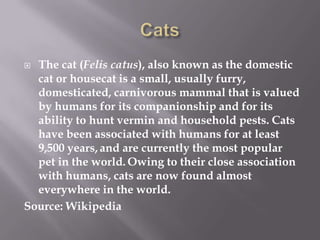
CatsThe cat (Feliscatus), also known as the domestic cat or housecat is a small, usually furry, domesticated, carnivorous mammal that is valued by humans for its companionship and for its ability to hunt vermin and household pests. Cats have been associated with humans for at least 9,500 years,and are currently the most popular pet in the world.Owing to their close association with humans, cats are now found almost everywhere in the world.Source: Wikipedia
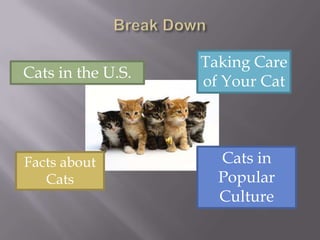
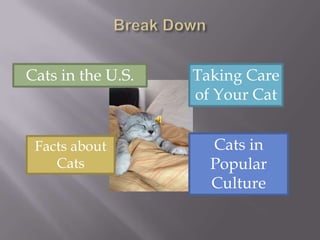
Break DownTaking Care of Your CatCats in the U.S.Cats in Popular CultureFacts about Cats
Cats in the United StatesAbout 85 million cats are owned in the United StatesAt least 20 percent of cats are acquired as strays.The cost of spaying and neutering a cat is less than the cost of raising kittens for one year. The average cost of basic food, supplies, medical care and training for a cat is $700 to $875 annually. Estimates for stray cats in the United States range up to 70 million.The average number of litters a fertile cat produces is one to two a year; average number of kittens is 4-6 per litter. Seven out of ten cats in shelters are destroyed simply because there is no one to adopt them. Source:  The American Society for the Prevention of Cruelty to Animals (ASPCA)
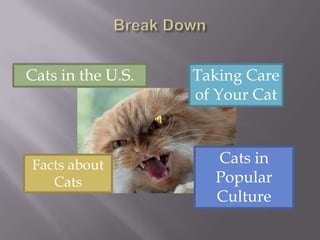
Break DownCats in the U.S.Taking Care of Your CatCats in Popular CultureFacts about Cats
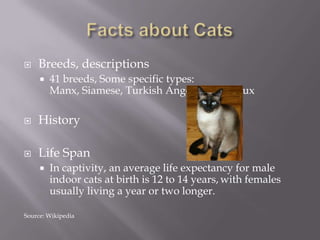
Facts about CatsBreeds, descriptions41 breeds, Some specific types: Manx, Siamese, Turkish Angora, ChartreuxHistoryLife SpanIn captivity, an average life expectancy for male indoor cats at birth is 12 to 14 years,with females usually living a year or two longer.Source: Wikipedia
Facts about CatsCats can see in the dark and hear higher ranged frequencies than humans.Despite being solitary hunters, cats are a social species and use a variety of techniques for communication including: Meowing, purring, trilling, hissing, growling,  grunting, body language and marking.  Cats are able to tolerate quite high temperatures: humans generally start to feel uncomfortable when their skin temperature passes about 112 °F but cats show no discomfort until their skin reaches around 126 °F.To aid with navigation and sensation, cats have dozens of movable whiskers over their body, especially their face. These provide information on the width of gaps and on the location of objects in the dark, both by touching objects directly and by sensing air currents; they also trigger protective blink reflexes to protect the eyes from damage.Source: Wikipedia
Facts about Cats: HealthCats are mammals and are therefore susceptible to a variety of mammal related diseases including genetic disorders,  bacterial, fungal and viral infections. The health of a cat is a serious issue. Cats are prone to a variety of diseases even when kept in captivity. In the wild these diseases and disorders keep the cat population from growing to quickly… but with domesticated cats, you don’t want to see Fluffy bite the dust at a year old.Common diseases and disorders found in cats:Feline Cystitis: inflammation of the bladder	Feline Hyperthyroidism:	Chronic kidney failure:	Feline Diabetes:	Feline Immunodeficiency Virus (FIV)	Feline Panleukopenia:	Upper Respiratory Disease (Cat Flu)	Fleas	Parasites (worms)	Ear mitesMakes sure to have your cat vaccinatedfeline rabies vaccination		feline panleukopenia vaccination		feline rhinotracheitis (feline herpesvirus) vaccination		feline calicivirus vaccinationBecause cats  share so many genetic traits in common with humans, many diseases can be passed between the species.Due to the shared genetic traits, scientists consider cats to be a suitable animal to test drugs and other chemicals on.
Facts about Cats: HealthGetting Your Cat FixedDeclawing cats? Having a cat neutered or spayed has some health benefits, primarily in that it eliminates the possibility of some forms of cancer.Cats can be surgically sterilized as early as 7 weeks to limit unwanted reproduction.[This surgery also prevents undesirable sex-related behavior, such as aggression, territory marking in males and yowling (calling) in females. Traditionally, this surgery was performed at around six to nine months of age, but it is increasingly being performed prior to puberty, at about three to six months.In the USA approximately 80% of household cats are neutered.Declawing is a major surgical procedure and can produce pain, infections and permanent lamenessDeclawing is actually an amputation of the last joint of your cat's "toes".Sources: Wikipedia,  Humane Society,  ASPCA,“Declawing”
Break DownTaking Care of Your CatCats in the U.S.Cats in Popular CultureFacts about Cats
Taking Care of Your CatOverviewCat Basics: FoodLitter BoxShelterKitten  or  Cat?Multiple Cat Homes.Cat behavior
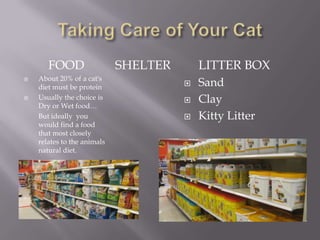
Taking Care of Your CatLITTER BOXSandClayKitty LitterSHELTERFOODAbout 20% of a cat's diet must be proteinUsually the choice is Dry or Wet food…	But ideally  you would find a food that most closely relates to the animals natural diet.
Taking Care of Your CatKitten or Cat?Generally a kitten becomes a cat at one year of age. The average rate of gestation (pregnancy) is 66 days.Kittens need full time nourishment and support from their mothers in the first few weeks after birth. Without this added care a kitten may not be able to go to the bathroom, nor receive the right antibodies and nourishment needed to develop fully. Source: “Unique Kitten Facts,” Wikipedia
Taking Care of Your CatMultiple Cat Home? Cats in groupsIntroducing catsPlaying versus fightingSeparate food and litter (sometimes) Territory markingCats sometimes communicate through urine spraying and marking with scent glands.Cats also use their claws to show their territory (scratching furniture etc)
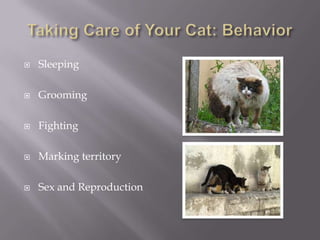
Sleeping GroomingFightingMarking territorySex and ReproductionTaking Care of Your Cat: Behavior
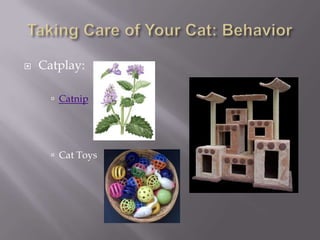
Taking Care of Your Cat: BehaviorCatplay:CatnipCat Toys
Break DownCats in the U.S.Taking Care of Your CatCats in Popular CultureFacts about Cats
Cats in Popular Culture: Music“Kitty”“Tommy the Cat”
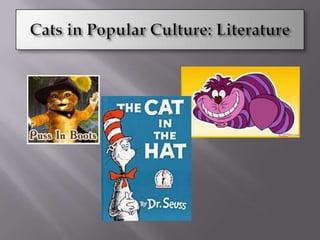
Cats in Popular Culture: Literature
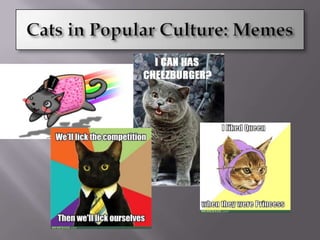
Cats in Popular Culture: Memes
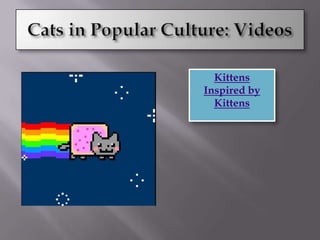
Cats in Popular Culture: VideosKittens  Inspired by Kittens
BibliographyAll About Cute Kittens	“Unique Kitten Facts” http://www.all-about-cute-kittens.com/kitten-facts.html	2008-2011	Accessed 10/5/2011The American Society for the Prevention of Cruelty to Animals (ASPCA)	“Pet Statistics” http://www.aspca.org/about-us/faq/pet-statistics.aspx	Accessed 10/4/2011.Farl, Morgan	Cat Owner	10/4/2011Grant-Smith, JoyceAnimal Talk. 2010, Nimbus Publishing LimitedHumane Society of the United States	“Tips” http://www.humanesociety.org/animals/cats/tips/	Various Articles	Last Updated 2011.	Accessed 10/4/2011. Place, Kelly	Cat Owner	10/5/2011Dr. Schelling, Christianne	“Declawing: What You Need to Know”	1998-2011Schultz, Jessica	Cat Ownder	10/3/2011Wikipedia “Cats”http://en.wikipedia.org/wiki/Cat	Last modified on 3 October 2011.	Accessed 10/4/2011.
Picture and Video Sourceshttp://cutecatsofworld.blogspot.com/http://en.wikipedia.org/wiki/Cathttp://www.lyricspond.com/artist-presidents-of-the-united-states-of-america/album-the-presidents-of-the-united-states-of-americahttp://yokulandia.blogspot.com/2010/07/primus-sealing-seas-of-cheese.html
Picture and Video Sourceshttp://animalsreign.com/blog/2009/07/09/declawing-cats-%E2%80%93-can-it-be-done-humanely/http://www.bnet.com/blog/advertising-business/what-8220nyan-cat-8221-says-about-the-future-of-marketing-and-the-end-of-civilization/8840http://www.wayofcats.com/blog/all-about-catnip/12322http://icanhascheezburger.com/2007/01/11/i-can-has-cheezburger-3/http://memebase.com/category/business-cat-2/http://memebase.com/category/hipster-kitty-2/page/2/http://jibunit.com/?p=383
http://www.pro-english.ru/articles/90/Picture and Video Sourceshttp://en.wikipedia.org/wiki/File:Laitche-P013.jpghttp://www.cats-cats-cats.net/picking-safe-cat-toys/http://www.dragoart.com/tuts/2263/1/1/how-to-draw-the-cheshire-cat-from-alice-in-wonderland.htmhttp://en.wikipedia.org/wiki/The_Cat_in_the_Hathttp://bjmarketers.com/stackable-tree.htm
Picture and Video Sourceshttp://www.youtube.com/watch?v=J5Xrcp6k8VE“Songify This: Can’t Hug Every Cat- a song about loving cats” by Schmoyhohttp://www.youtube.com/watch?v=sP4NMoJcFd4&feature=related“Tommy the Cat” by Primus. http://www.youtube.com/watch?v=r4OhIU-PmB8&ob=av3e“Kitty” by The Presidents of the United States of Americahttp://www.youtube.com/watch?v=CMRaSXh9-n4“Kittens Inspired by Kittens” by Blakekellyhttp://www.youtube.com/watch?v=FtX8nswnUKU

Cats!

  • 1.
  • 2.
    CatsThe cat (Feliscatus),also known as the domestic cat or housecat is a small, usually furry, domesticated, carnivorous mammal that is valued by humans for its companionship and for its ability to hunt vermin and household pests. Cats have been associated with humans for at least 9,500 years,and are currently the most popular pet in the world.Owing to their close association with humans, cats are now found almost everywhere in the world.Source: Wikipedia
  • 3.
    Break DownTaking Careof Your CatCats in the U.S.Cats in Popular CultureFacts about Cats
  • 4.
    Cats in theUnited StatesAbout 85 million cats are owned in the United StatesAt least 20 percent of cats are acquired as strays.The cost of spaying and neutering a cat is less than the cost of raising kittens for one year. The average cost of basic food, supplies, medical care and training for a cat is $700 to $875 annually. Estimates for stray cats in the United States range up to 70 million.The average number of litters a fertile cat produces is one to two a year; average number of kittens is 4-6 per litter. Seven out of ten cats in shelters are destroyed simply because there is no one to adopt them. Source: The American Society for the Prevention of Cruelty to Animals (ASPCA)
  • 5.
    Break DownCats inthe U.S.Taking Care of Your CatCats in Popular CultureFacts about Cats
  • 6.
    Facts about CatsBreeds,descriptions41 breeds, Some specific types: Manx, Siamese, Turkish Angora, ChartreuxHistoryLife SpanIn captivity, an average life expectancy for male indoor cats at birth is 12 to 14 years,with females usually living a year or two longer.Source: Wikipedia
  • 7.
    Facts about CatsCatscan see in the dark and hear higher ranged frequencies than humans.Despite being solitary hunters, cats are a social species and use a variety of techniques for communication including: Meowing, purring, trilling, hissing, growling, grunting, body language and marking. Cats are able to tolerate quite high temperatures: humans generally start to feel uncomfortable when their skin temperature passes about 112 °F but cats show no discomfort until their skin reaches around 126 °F.To aid with navigation and sensation, cats have dozens of movable whiskers over their body, especially their face. These provide information on the width of gaps and on the location of objects in the dark, both by touching objects directly and by sensing air currents; they also trigger protective blink reflexes to protect the eyes from damage.Source: Wikipedia
  • 8.
    Facts about Cats:HealthCats are mammals and are therefore susceptible to a variety of mammal related diseases including genetic disorders, bacterial, fungal and viral infections. The health of a cat is a serious issue. Cats are prone to a variety of diseases even when kept in captivity. In the wild these diseases and disorders keep the cat population from growing to quickly… but with domesticated cats, you don’t want to see Fluffy bite the dust at a year old.Common diseases and disorders found in cats:Feline Cystitis: inflammation of the bladder Feline Hyperthyroidism: Chronic kidney failure: Feline Diabetes: Feline Immunodeficiency Virus (FIV) Feline Panleukopenia: Upper Respiratory Disease (Cat Flu) Fleas Parasites (worms) Ear mitesMakes sure to have your cat vaccinatedfeline rabies vaccination feline panleukopenia vaccination feline rhinotracheitis (feline herpesvirus) vaccination feline calicivirus vaccinationBecause cats share so many genetic traits in common with humans, many diseases can be passed between the species.Due to the shared genetic traits, scientists consider cats to be a suitable animal to test drugs and other chemicals on.
  • 9.
    Facts about Cats:HealthGetting Your Cat FixedDeclawing cats? Having a cat neutered or spayed has some health benefits, primarily in that it eliminates the possibility of some forms of cancer.Cats can be surgically sterilized as early as 7 weeks to limit unwanted reproduction.[This surgery also prevents undesirable sex-related behavior, such as aggression, territory marking in males and yowling (calling) in females. Traditionally, this surgery was performed at around six to nine months of age, but it is increasingly being performed prior to puberty, at about three to six months.In the USA approximately 80% of household cats are neutered.Declawing is a major surgical procedure and can produce pain, infections and permanent lamenessDeclawing is actually an amputation of the last joint of your cat's "toes".Sources: Wikipedia, Humane Society, ASPCA,“Declawing”
  • 10.
    Break DownTaking Careof Your CatCats in the U.S.Cats in Popular CultureFacts about Cats
  • 11.
    Taking Care ofYour CatOverviewCat Basics: FoodLitter BoxShelterKitten or Cat?Multiple Cat Homes.Cat behavior
  • 12.
    Taking Care ofYour CatLITTER BOXSandClayKitty LitterSHELTERFOODAbout 20% of a cat's diet must be proteinUsually the choice is Dry or Wet food… But ideally you would find a food that most closely relates to the animals natural diet.
  • 13.
    Taking Care ofYour CatKitten or Cat?Generally a kitten becomes a cat at one year of age. The average rate of gestation (pregnancy) is 66 days.Kittens need full time nourishment and support from their mothers in the first few weeks after birth. Without this added care a kitten may not be able to go to the bathroom, nor receive the right antibodies and nourishment needed to develop fully. Source: “Unique Kitten Facts,” Wikipedia
  • 14.
    Taking Care ofYour CatMultiple Cat Home? Cats in groupsIntroducing catsPlaying versus fightingSeparate food and litter (sometimes) Territory markingCats sometimes communicate through urine spraying and marking with scent glands.Cats also use their claws to show their territory (scratching furniture etc)
  • 15.
    Sleeping GroomingFightingMarking territorySexand ReproductionTaking Care of Your Cat: Behavior
  • 16.
    Taking Care ofYour Cat: BehaviorCatplay:CatnipCat Toys
  • 17.
    Break DownCats inthe U.S.Taking Care of Your CatCats in Popular CultureFacts about Cats
  • 18.
    Cats in PopularCulture: Music“Kitty”“Tommy the Cat”
  • 19.
    Cats in PopularCulture: Literature
  • 20.
    Cats in PopularCulture: Memes
  • 21.
    Cats in PopularCulture: VideosKittens Inspired by Kittens
  • 22.
    BibliographyAll About CuteKittens “Unique Kitten Facts” http://www.all-about-cute-kittens.com/kitten-facts.html 2008-2011 Accessed 10/5/2011The American Society for the Prevention of Cruelty to Animals (ASPCA) “Pet Statistics” http://www.aspca.org/about-us/faq/pet-statistics.aspx Accessed 10/4/2011.Farl, Morgan Cat Owner 10/4/2011Grant-Smith, JoyceAnimal Talk. 2010, Nimbus Publishing LimitedHumane Society of the United States “Tips” http://www.humanesociety.org/animals/cats/tips/ Various Articles Last Updated 2011. Accessed 10/4/2011. Place, Kelly Cat Owner 10/5/2011Dr. Schelling, Christianne “Declawing: What You Need to Know” 1998-2011Schultz, Jessica Cat Ownder 10/3/2011Wikipedia “Cats”http://en.wikipedia.org/wiki/Cat Last modified on 3 October 2011. Accessed 10/4/2011.
  • 23.
    Picture and VideoSourceshttp://cutecatsofworld.blogspot.com/http://en.wikipedia.org/wiki/Cathttp://www.lyricspond.com/artist-presidents-of-the-united-states-of-america/album-the-presidents-of-the-united-states-of-americahttp://yokulandia.blogspot.com/2010/07/primus-sealing-seas-of-cheese.html
  • 24.
    Picture and VideoSourceshttp://animalsreign.com/blog/2009/07/09/declawing-cats-%E2%80%93-can-it-be-done-humanely/http://www.bnet.com/blog/advertising-business/what-8220nyan-cat-8221-says-about-the-future-of-marketing-and-the-end-of-civilization/8840http://www.wayofcats.com/blog/all-about-catnip/12322http://icanhascheezburger.com/2007/01/11/i-can-has-cheezburger-3/http://memebase.com/category/business-cat-2/http://memebase.com/category/hipster-kitty-2/page/2/http://jibunit.com/?p=383
  • 25.
    http://www.pro-english.ru/articles/90/Picture and VideoSourceshttp://en.wikipedia.org/wiki/File:Laitche-P013.jpghttp://www.cats-cats-cats.net/picking-safe-cat-toys/http://www.dragoart.com/tuts/2263/1/1/how-to-draw-the-cheshire-cat-from-alice-in-wonderland.htmhttp://en.wikipedia.org/wiki/The_Cat_in_the_Hathttp://bjmarketers.com/stackable-tree.htm
  • 26.
    Picture and VideoSourceshttp://www.youtube.com/watch?v=J5Xrcp6k8VE“Songify This: Can’t Hug Every Cat- a song about loving cats” by Schmoyhohttp://www.youtube.com/watch?v=sP4NMoJcFd4&feature=related“Tommy the Cat” by Primus. http://www.youtube.com/watch?v=r4OhIU-PmB8&ob=av3e“Kitty” by The Presidents of the United States of Americahttp://www.youtube.com/watch?v=CMRaSXh9-n4“Kittens Inspired by Kittens” by Blakekellyhttp://www.youtube.com/watch?v=FtX8nswnUKU