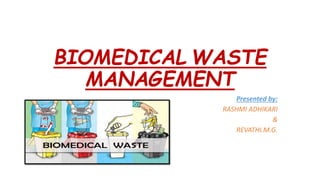
BIOMEDICAL WASTE
MANAGEMENT
Presented by:
RASHMI ADHIKARI
&
REVATHI.M.G.
CONTENTS:
• Types of Wastes.
• Biomedical waste.
• Need for Biomedical Waste Management.
• History of Biomedical Waste Management.
• Estimation of Biomedical Waste.
• Types of Biomedical Waste.
• Components of Biomedical Waste.
• Result of Exposure to Biomedical Waste.
• Biomedical Waste Management Rules.
• Steps involved in Biomedical Waste Management.
• Benefits of Biomedical Waste Management.
• Recommendations.
• Conclusion.
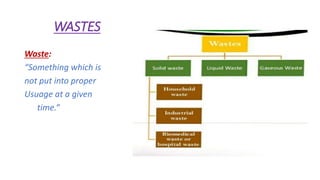
WASTES
Waste:
“Something which is
not put into proper
Usuage at a given
time.”
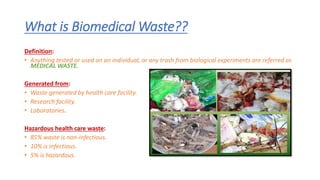
What is Biomedical Waste??
Definition:
• Anything tested or used on an individual, or any trash from biological experiments are referred as
MEDICAL WASTE.
Generated from:
• Waste generated by health care facility.
• Research facility.
• Laboratories.
Hazardous health care waste:
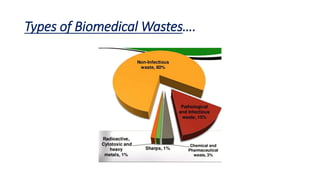
• 85% waste is non-infectious.
• 10% is infectious.
• 5% is hazardous.
Need for Biomedical Waste Management…
The need of proper hospital waste Management system is:
• as an essential component of quality assurance in hospitals.
• the protection of environment and the health of the population.
• to prevent noscomial infections in patients from poor infection control
& poor waste management.
• to eliminate risk associated with hazardous chemicals, drugs to
persons handling wastes at all levels.
History
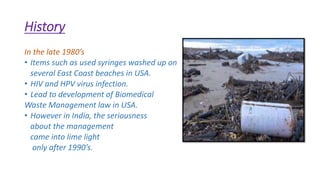
In the late 1980’s
• Items such as used syringes washed up on
several East Coast beaches in USA.
• HIV and HPV virus infection.
• Lead to development of Biomedical
Waste Management law in USA.
• However in India, the seriousness
about the management
came into lime light
only after 1990’s.
WHO has estimated that….
In 2000 injections with contaminated syringes caused:
• 21 million hepatitis B virus (HBV) infections (32% of all new
infections);
• Two million hepatitis C virus (HCV) infections(40% of all new
infections);
• 260 000 HIV infections(5% of all new infections);
Biomedical Waste Statistics….
Developed countries
• 1-5 kg/bed/day, with variations among countries.
In India
• 1-2 kg/bed/day, with variations among Government and Private
establishments.
• Approximately 506.74 tons/day waste is generated.
• Out of which only 57% waste undergoes proper disposal.
Types of Biomedical Wastes….
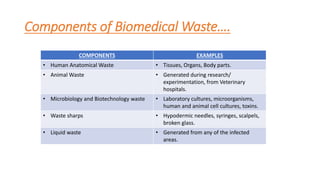
Components of Biomedical Waste….
COMPONENTS EXAMPLES
• Human Anatomical Waste • Tissues, Organs, Body parts.
• Animal Waste • Generated during research/
experimentation, from Veterinary
hospitals.
• Microbiology and Biotechnology waste • Laboratory cultures, microorganisms,
human and animal cell cultures, toxins.
• Waste sharps • Hypodermic needles, syringes, scalpels,
broken glass.
• Liquid waste • Generated from any of the infected
areas.
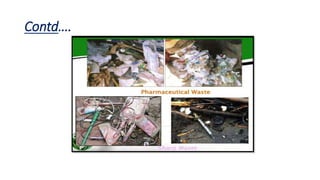
Contd….
Contd….
COMPONENTS EXAMPLES
• Solid waste • Dressing, bandages, plaster casts,
material contaminated with blood.
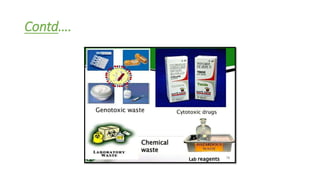
• Chemical waste • Alcohol, Sulphuric acid, Chlorine powder,
Gluteraldehyde, Picric acid, Fertiliser,
Ammonia.
• Discarded medicines and Cytotoxic drugs • Barium enema, X-rays, Cancer
chemotherapy tar-based products.
• Radioactive Components • EtBr, Radioactive components.
• Incineration ash
Contd….
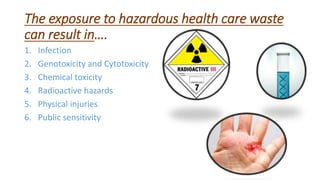
The exposure to hazardous health care waste
can result in….
1. Infection
2. Genotoxicity and Cytotoxicity
3. Chemical toxicity
4. Radioactive hazards
5. Physical injuries
6. Public sensitivity
Biomedical Waste Management Rules…
It consists of six schedules:
SCHEDULE-I:
• CLASSIFICATION and CATEGORIZATION of Biomedical Waste Management as per
WHO standards.
Classification of Waste Category as per WHO standards
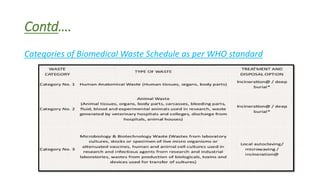
• CATEGORY-1 Human Anatomical Wastes
• CATEGORY-2 Animal Anatomical Wastes
• CATEGORY-3 Microbiology and
Biotechnology Wastes
• CATEGORY-4 Waste sharps
Contd….
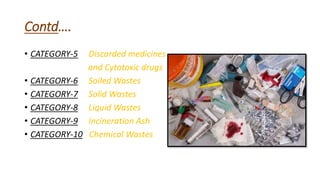
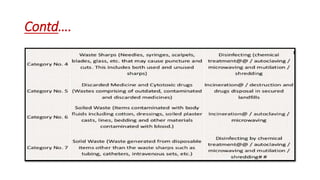
• CATEGORY-5 Discarded medicines
and Cytotoxic drugs
• CATEGORY-6 Soiled Wastes
• CATEGORY-7 Solid Wastes
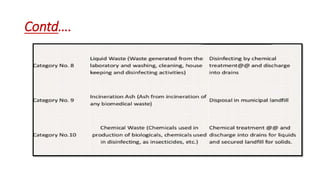
• CATEGORY-8 Liquid Wastes
• CATEGORY-9 Incineration Ash
• CATEGORY-10 Chemical Wastes
Contd….
Categories of Biomedical Waste Schedule as per WHO standard
Contd….
Contd….
Contd….
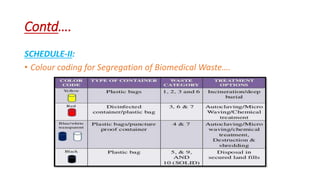
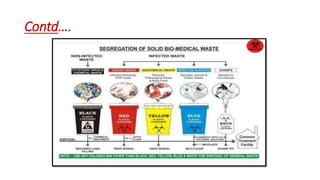
SCHEDULE-II:
• Colour coding for Segregation of Biomedical Waste….
Contd….
Contd….
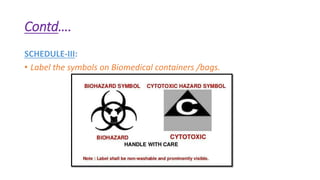
SCHEDULE-III:
• Label the symbols on Biomedical containers /bags.
Contd….
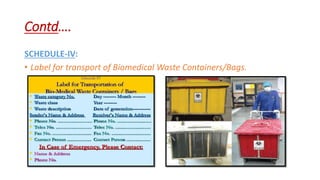
SCHEDULE-IV:
• Label for transport of Biomedical Waste Containers/Bags.
Contd….
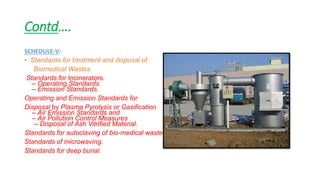
SCHEDULE-V:
• Standards for treatment and disposal of
Biomedical Wastes.
Standards for Incinerators.
– Operating Standards.
– Emission Standards.
Operating and Emission Standards for
Disposal by Plasma Pyrolysis or Gasification
– Air Emission Standards and
– Air Pollution Control Measures
-- Disposal of Ash Vitrified Material.
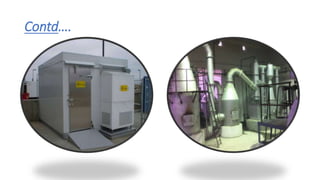
Standards for autoclaving of bio-medical waste.
Standards of microwaving.
Standards for deep burial.
Contd….
SCHEDULE-VI:
• List of Prescribed Authorities and the Corresponding Duties
• This schedule lists the duties of the concerned administration
e.g. making policies, issuing guidelines, inspection of premises,
allocation of land, giving permission etc.
Steps in the Management of Biomedical Waste
1. Survey of Waste generated.
2. Segregation of Hospital Waste.
3. Collection and Categorization of Waste.
4. Storage of Waste ,[Not beyond 48 hours].
5. Transportation of Waste.
6. Treatment of Waste.
Contd….
Benefits of Biomedical Waste Management
• Cleaner and Healthier surroundings.
• Reduction in the incidents of hospital acquired and general infections.
• Reduction in possibility of disease and death due to reuse and
repacking of infectious disposals.
• Reduction in the cost of Waste management.
• Improved image of the healthcare establishment and increase in the
quality of life.
Recommendations
• For the use of Incinerator , proper training should be given to the staff.
• Specific fund should be allocated for the use of Incinerator.
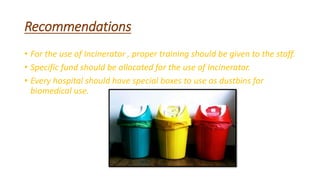
• Every hospital should have special boxes to use as dustbins for
biomedical use.
Contd….
• Biomedical waste Management board can be established in each
district.
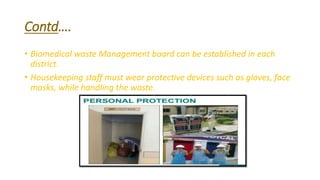
• Housekeeping staff must wear protective devices such as gloves, face
masks, while handling the waste.
Contd….
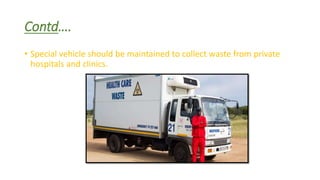
• Special vehicle should be maintained to collect waste from private
hospitals and clinics.
Conclusion
• Medical waste should be classified according to their source , risk
factors associated with their handling, storage and ultimate disposal.
• The segregation of waste at the source is the key step and has to be
done carefully.
• Municipality and Government should pay importance to disposal of
waste economically.
*THANK YOU*

Presentation on Biomedical waste Management.pptx

  • 1.
  • 2.
    CONTENTS: • Types ofWastes. • Biomedical waste. • Need for Biomedical Waste Management. • History of Biomedical Waste Management. • Estimation of Biomedical Waste. • Types of Biomedical Waste. • Components of Biomedical Waste. • Result of Exposure to Biomedical Waste.
  • 3.
    • Biomedical WasteManagement Rules. • Steps involved in Biomedical Waste Management. • Benefits of Biomedical Waste Management. • Recommendations. • Conclusion.
  • 4.
    WASTES Waste: “Something which is notput into proper Usuage at a given time.”
  • 5.
    What is BiomedicalWaste?? Definition: • Anything tested or used on an individual, or any trash from biological experiments are referred as MEDICAL WASTE. Generated from: • Waste generated by health care facility. • Research facility. • Laboratories. Hazardous health care waste: • 85% waste is non-infectious. • 10% is infectious. • 5% is hazardous.
  • 6.
    Need for BiomedicalWaste Management… The need of proper hospital waste Management system is: • as an essential component of quality assurance in hospitals. • the protection of environment and the health of the population. • to prevent noscomial infections in patients from poor infection control & poor waste management. • to eliminate risk associated with hazardous chemicals, drugs to persons handling wastes at all levels.
  • 7.
    History In the late1980’s • Items such as used syringes washed up on several East Coast beaches in USA. • HIV and HPV virus infection. • Lead to development of Biomedical Waste Management law in USA. • However in India, the seriousness about the management came into lime light only after 1990’s.
  • 8.
    WHO has estimatedthat…. In 2000 injections with contaminated syringes caused: • 21 million hepatitis B virus (HBV) infections (32% of all new infections); • Two million hepatitis C virus (HCV) infections(40% of all new infections); • 260 000 HIV infections(5% of all new infections);
  • 9.
    Biomedical Waste Statistics…. Developedcountries • 1-5 kg/bed/day, with variations among countries. In India • 1-2 kg/bed/day, with variations among Government and Private establishments. • Approximately 506.74 tons/day waste is generated. • Out of which only 57% waste undergoes proper disposal.
  • 10.
  • 11.
    Components of BiomedicalWaste…. COMPONENTS EXAMPLES • Human Anatomical Waste • Tissues, Organs, Body parts. • Animal Waste • Generated during research/ experimentation, from Veterinary hospitals. • Microbiology and Biotechnology waste • Laboratory cultures, microorganisms, human and animal cell cultures, toxins. • Waste sharps • Hypodermic needles, syringes, scalpels, broken glass. • Liquid waste • Generated from any of the infected areas.
  • 12.
  • 13.
    Contd…. COMPONENTS EXAMPLES • Solidwaste • Dressing, bandages, plaster casts, material contaminated with blood. • Chemical waste • Alcohol, Sulphuric acid, Chlorine powder, Gluteraldehyde, Picric acid, Fertiliser, Ammonia. • Discarded medicines and Cytotoxic drugs • Barium enema, X-rays, Cancer chemotherapy tar-based products. • Radioactive Components • EtBr, Radioactive components. • Incineration ash
  • 14.
  • 15.
    The exposure tohazardous health care waste can result in…. 1. Infection 2. Genotoxicity and Cytotoxicity 3. Chemical toxicity 4. Radioactive hazards 5. Physical injuries 6. Public sensitivity
  • 16.
    Biomedical Waste ManagementRules… It consists of six schedules: SCHEDULE-I: • CLASSIFICATION and CATEGORIZATION of Biomedical Waste Management as per WHO standards. Classification of Waste Category as per WHO standards • CATEGORY-1 Human Anatomical Wastes • CATEGORY-2 Animal Anatomical Wastes • CATEGORY-3 Microbiology and Biotechnology Wastes • CATEGORY-4 Waste sharps
  • 17.
    Contd…. • CATEGORY-5 Discardedmedicines and Cytotoxic drugs • CATEGORY-6 Soiled Wastes • CATEGORY-7 Solid Wastes • CATEGORY-8 Liquid Wastes • CATEGORY-9 Incineration Ash • CATEGORY-10 Chemical Wastes
  • 18.
    Contd…. Categories of BiomedicalWaste Schedule as per WHO standard
  • 19.
  • 20.
  • 21.
    Contd…. SCHEDULE-II: • Colour codingfor Segregation of Biomedical Waste….
  • 22.
  • 23.
    Contd…. SCHEDULE-III: • Label thesymbols on Biomedical containers /bags.
  • 24.
    Contd…. SCHEDULE-IV: • Label fortransport of Biomedical Waste Containers/Bags.
  • 25.
    Contd…. SCHEDULE-V: • Standards fortreatment and disposal of Biomedical Wastes. Standards for Incinerators. – Operating Standards. – Emission Standards. Operating and Emission Standards for Disposal by Plasma Pyrolysis or Gasification – Air Emission Standards and – Air Pollution Control Measures -- Disposal of Ash Vitrified Material. Standards for autoclaving of bio-medical waste. Standards of microwaving. Standards for deep burial.
  • 26.
    Contd…. SCHEDULE-VI: • List ofPrescribed Authorities and the Corresponding Duties • This schedule lists the duties of the concerned administration e.g. making policies, issuing guidelines, inspection of premises, allocation of land, giving permission etc.
  • 27.
    Steps in theManagement of Biomedical Waste 1. Survey of Waste generated. 2. Segregation of Hospital Waste. 3. Collection and Categorization of Waste. 4. Storage of Waste ,[Not beyond 48 hours]. 5. Transportation of Waste. 6. Treatment of Waste.
  • 28.
  • 29.
    Benefits of BiomedicalWaste Management • Cleaner and Healthier surroundings. • Reduction in the incidents of hospital acquired and general infections. • Reduction in possibility of disease and death due to reuse and repacking of infectious disposals. • Reduction in the cost of Waste management. • Improved image of the healthcare establishment and increase in the quality of life.
  • 30.
    Recommendations • For theuse of Incinerator , proper training should be given to the staff. • Specific fund should be allocated for the use of Incinerator. • Every hospital should have special boxes to use as dustbins for biomedical use.
  • 31.
    Contd…. • Biomedical wasteManagement board can be established in each district. • Housekeeping staff must wear protective devices such as gloves, face masks, while handling the waste.
  • 32.
    Contd…. • Special vehicleshould be maintained to collect waste from private hospitals and clinics.
  • 33.
    Conclusion • Medical wasteshould be classified according to their source , risk factors associated with their handling, storage and ultimate disposal. • The segregation of waste at the source is the key step and has to be done carefully. • Municipality and Government should pay importance to disposal of waste economically.
  • 34.