Bio Medical Waste
Management
Rules 2016
(Amendment 2018 and 2019)
What is Biomedical Waste?
Biomedical waste has been defined as “any
waste, which is generated during the diagnosis,
treatment or immunization of human beings or
animals or in research activities pertaining
thereto or in the production or testing of
biological or in health camps, including the
categories mentioned in Schedule I appended to
these Rules” as per Biomedical Waste Rules
2016.
HOSPITAL WASTE
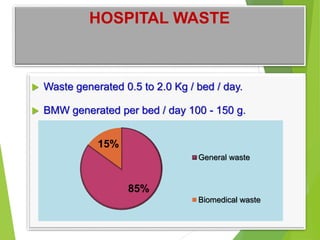
 Waste generated 0.5 to 2.0 Kg / bed / day.
 BMW generated per bed / day 100 - 150 g.

85%
15%
General waste
Biomedical waste
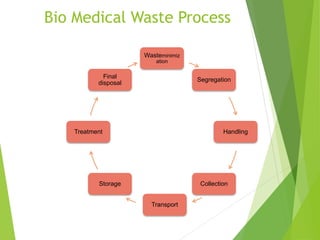
Bio Medical Waste Process
Wasteminimiz
ation
Segregation
Handling
Collection
Transport
Storage
Treatment
Final
disposal
Biomedical Waste Rules 2016
 Gazetted on 28th March 2016
 Replaces Biomedical Waste (Management & Handling)
Rules 1998
 Major Changes –
 Scope – also includes AYUSH Health Facilities,
Vaccination Camps, medical or surgical camp, First-Aid
Rooms of Schools, Forensic Labs, Inspection and
monitoring of Medical Inspection rooms, Sick bays on
board ship or submarines, Station medical centres and
field hospitals operated by DG armed force Medical
services (including 2019 amendments).
 Constitution of a new committee at the state level
 Small facilities less than thirty beds may designate a
qualified person to review and monitor the activities
relating to bio-medical waste management
Biomedical waste rules 2016
 Bar Code System for bags & containers (after 28th March
2017)
 ‘On-site’ Waste Management can be established if nearest
CTF is 75 kms away
 Segregated collection – Four Categories
 Prior Approval for ‘Deep Burial’
 Provision of safe ventilated & secure location for storage of
segregated waste.
 Ensure occupational safety of Healthcare worker & provide
them PPE
Bio Medical Waste
 Between 75% and 90% of the waste produced is
similar to domestic waste and usually called ‘non-
hazardous’ or ‘general health care waste’
 10-25% of health care waste is regarded as
‘hazardous’ and may pose a variety of environmental
and health risks
Responsibility
 As per the BMWM Rules, 2016, the liability for
implementing these rules lies with the person
having administrative control over the
healthcare facility. This person in BMWM Rules is
termed as an “Occupier” and defined as “a person
having administrative control over the institution
and the premises generating bio-medical waste,
which includes a hospital, nursing home, clinic,
dispensary, veterinary institution, animal house,
pathological laboratory, blood bank, health care
facility and clinical establishment, irrespective of
their system of medicine.”
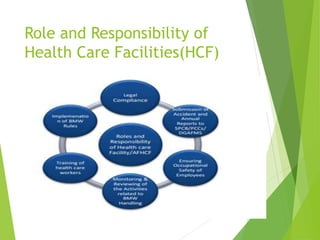
Role and Responsibility of
Health Care Facilities(HCF)
Consequences to Health Care
Facilities
 Legal Actions that can be taken against HCFs
for violation of the provisions or the
‘Directions’ under Section 5 of ‘The
Environment (P) Act, 1986’ as follows:-
 Closure, prohibition or regulation of any
operation or process
 Stoppage or regulation of the electricity or water
supply
 Closure of the HCFs
Consequences to Occupier
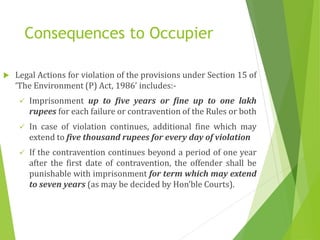
 Legal Actions for violation of the provisions under Section 15 of
‘The Environment (P) Act, 1986’ includes:-
 Imprisonment up to five years or fine up to one lakh
rupees for each failure or contravention of the Rules or both
 In case of violation continues, additional fine which may
extend to five thousand rupees for every day of violation
 If the contravention continues beyond a period of one year
after the first date of contravention, the offender shall be
punishable with imprisonment for term which may extend
to seven years (as may be decided by Hon’ble Courts).
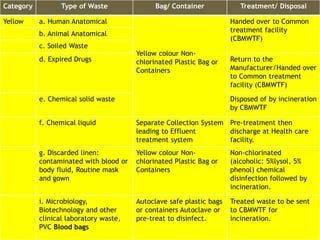
Category Type of Waste Bag/ Container Treatment/ Disposal
Yellow a. Human Anatomical
Yellow colour Non-
chlorinated Plastic Bag or
Containers
Handed over to Common
treatment facility
(CBMWTF)
b. Animal Anatomical
c. Soiled Waste
d. Expired Drugs Return to the
Manufacturer/Handed over
to Common treatment
facility (CBMWTF)
e. Chemical solid waste Disposed of by incineration
by CBMWTF
f. Chemical liquid Separate Collection System
leading to Effluent
treatment system
Pre-treatment then
discharge at Health care
facility.
g. Discarded linen:
contaminated with blood or
body fluid, Routine mask
and gown
Yellow colour Non-
chlorinated Plastic Bag or
Containers
Non-chlorinated
(alcoholic: 5%lysol, 5%
phenol) chemical
disinfection followed by
incineration.
i. Microbiology,
Biotechnology and other
clinical laboratory waste,
PVC Blood bags
Autoclave safe plastic bags
or containers Autoclave or
pre-treat to disinfect.
Treated waste to be sent
to CBMWTF for
incineration.
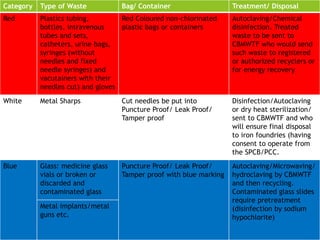
Category Type of Waste Bag/ Container Treatment/ Disposal
Red Plastics tubing,
bottles, intravenous
tubes and sets,
catheters, urine bags,
syringes (without
needles and fixed
needle syringes) and
vacutainers with their
needles cut) and gloves
Red Coloured non-chlorinated
plastic bags or containers
Autoclaving/Chemical
disinfection. Treated
waste to be sent to
CBMWTF who would send
such waste to registered
or authorized recyclers or
for energy recovery
White Metal Sharps Cut needles be put into
Puncture Proof/ Leak Proof/
Tamper proof
Disinfection/Autoclaving
or dry heat sterilization/
sent to CBMWTF and who
will ensure final disposal
to iron foundries (having
consent to operate from
the SPCB/PCC.
Blue Glass: medicine glass
vials or broken or
discarded and
contaminated glass
Puncture Proof/ Leak Proof/
Tamper proof with blue marking
Autoclaving/Microwaving/
hydroclaving by CBMWTF
and then recycling.
Contaminated glass slides
require pretreatment
(disinfection by sodium
hypochlorite)
Metal implants/metal
guns etc.
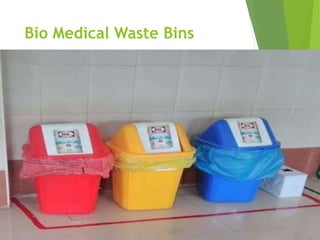
Bio Medical Waste Bins
Important consideration for BMW
 No secondary handling or pilferage of waste shall be done at healthcare
facility. If CBWTF facility is available at a distance of 75 km from the HCF,
bio-medical waste should be treated and disposed only through such
CBWTF operator.
 Biomedical Waste should be segregated at the point of generation by the
person who is generating the waste in designated colour coded bin/
container.
 Biomedical Waste & General Waste shall not be mixed. Storage time of
waste should be as less as possible so that waste storage, transportation
and disposal is done within 48 hours.
 Phase out use of chlorinated plastic bags (excluding blood bags) and
gloves by 27/3/2019.
Continue..
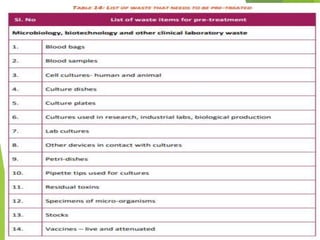
 Only Laboratory and Highly infectious waste shall be pre-treated
onsite before sending for final treatment or disposal through a CBWTF
Operator.
 Colour coded waste bags and containers should be printed with the
bio-hazard symbol, labelled with details such as date, type of waste,
waste quantity, senders name and receivers details as well as bar
coded label to allow them to be tracked till final disposal. Ensure that
Bar coded stickers are pasted on each bag as per the guidelines of
CPCB by 27 March, 2019
 Provide bar-code labels on all colour coded bags or containers
containing segregated bio-medical waste before such waste goes for
final disposal through a CBWTF.
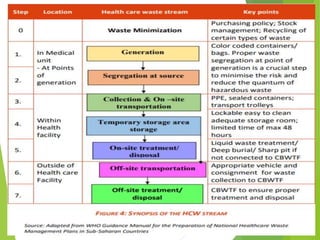
 Intra-mural transportation of segregated waste to central storage
area
 Temporary storage of biomedical waste in central storage area
 Treatment and Disposal of biomedical waste through CBWTF or
Captive facility
Continue..
 HCF should ensure collection, transportation,
treatment and disposal of bio-medical waste as
per BMWM Rules, 2016 and HCF should also
ensure disposal of human anatomical waste,
animal anatomical waste, soiled waste and
biotechnology waste within 48 hours
 Bio-medical waste bags and sharps containers
should be filled to no more than three quarters
full. Once this level is reached, they should be
sealed ready for collection.
 Plastic bags should never be stapled but may
be tied or sealed with a plastic tag or tie.
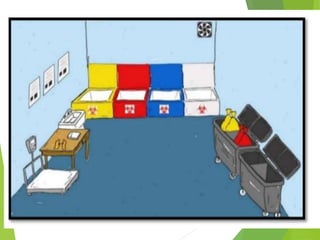
Central Waste Collection
Room
 The location of central waste collection room must be
away from the public/ visitors access.
 The space allocation for this room must be as per the
quantity of waste generated from the hospital.
 The planned space must be sufficient so as to store at
least two days generation of waste.
 Central waste collection room must be roofed and
manned and should be under lock and key under the
responsibility of designated person.
 The entrance of this centre must be accessible through a
concrete ramp for easy transportation of waste collection
trolleys.
Cont..
 Flooring should be of tiles or any other glazed material with
slope so as to ease the cleaning of the area.
 Exhaust fans should be provided in the waste collection
room for ventilation.
 It is to be ensured by the health care facility that such central
storage room is safety inspected for potential fire hazard
and based on such inspection preventive measure has to be
taken by the health care facility like installation of fire
extinguisher, smoke detector etc.
 There should also be provision for water supply adjacent to
central waste storage area for cleaning and washing of this
station and the containers.
Cont..
 Sign boards indicating relevant details such as contact
person and the telephone number should be provided.
 The entrance of this station must be labelled with “Entry for
Authorized Personal Only” and the Logo of Bio Medical
Waste Hazard.
 It is to be ensured that no general waste is stored in the
central waste collection area.
Pre treatment required
or not?
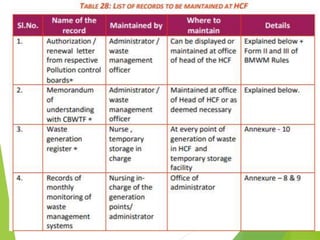
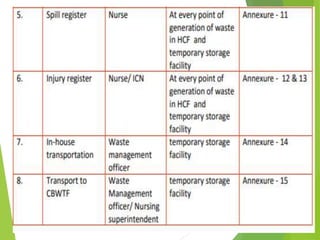
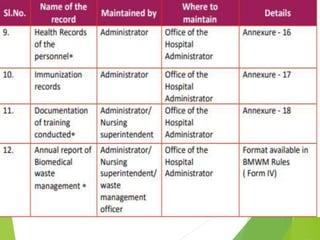
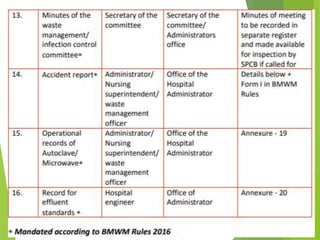
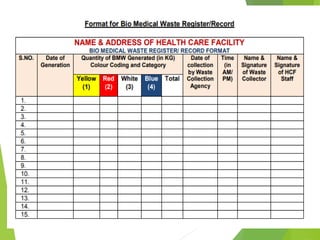
Records to be
maintained for BMW
Liquid waste
Management
As per BMW Management
(Amendment) Rule 2019
Dated 19th February 2019
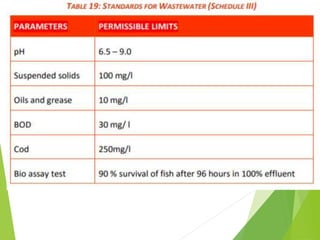
 Healthcare facilities less than ten beds
shall have to comply with the output
discharge standards for liquid waste
by 31st December 2019.
As per BMW Management
(Amendment) Rule 2019
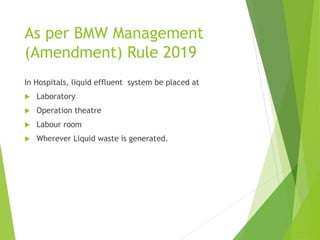
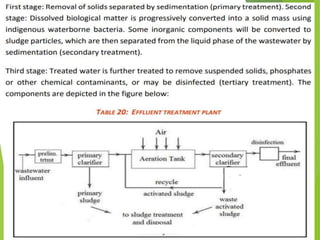
In Hospitals, liquid effluent system be placed at
 Laboratory
 Operation theatre
 Labour room
 Wherever Liquid waste is generated.
Thank You

Latest Biomedical waste management guidelines

  • 1.
    Bio Medical Waste Management Rules2016 (Amendment 2018 and 2019)
  • 2.
    What is BiomedicalWaste? Biomedical waste has been defined as “any waste, which is generated during the diagnosis, treatment or immunization of human beings or animals or in research activities pertaining thereto or in the production or testing of biological or in health camps, including the categories mentioned in Schedule I appended to these Rules” as per Biomedical Waste Rules 2016.
  • 5.
    HOSPITAL WASTE  Wastegenerated 0.5 to 2.0 Kg / bed / day.  BMW generated per bed / day 100 - 150 g. 85% 15% General waste Biomedical waste
  • 6.
    Bio Medical WasteProcess Wasteminimiz ation Segregation Handling Collection Transport Storage Treatment Final disposal
  • 7.
    Biomedical Waste Rules2016  Gazetted on 28th March 2016  Replaces Biomedical Waste (Management & Handling) Rules 1998  Major Changes –  Scope – also includes AYUSH Health Facilities, Vaccination Camps, medical or surgical camp, First-Aid Rooms of Schools, Forensic Labs, Inspection and monitoring of Medical Inspection rooms, Sick bays on board ship or submarines, Station medical centres and field hospitals operated by DG armed force Medical services (including 2019 amendments).  Constitution of a new committee at the state level  Small facilities less than thirty beds may designate a qualified person to review and monitor the activities relating to bio-medical waste management
  • 8.
    Biomedical waste rules2016  Bar Code System for bags & containers (after 28th March 2017)  ‘On-site’ Waste Management can be established if nearest CTF is 75 kms away  Segregated collection – Four Categories  Prior Approval for ‘Deep Burial’  Provision of safe ventilated & secure location for storage of segregated waste.  Ensure occupational safety of Healthcare worker & provide them PPE
  • 9.
    Bio Medical Waste Between 75% and 90% of the waste produced is similar to domestic waste and usually called ‘non- hazardous’ or ‘general health care waste’  10-25% of health care waste is regarded as ‘hazardous’ and may pose a variety of environmental and health risks
  • 10.
    Responsibility  As perthe BMWM Rules, 2016, the liability for implementing these rules lies with the person having administrative control over the healthcare facility. This person in BMWM Rules is termed as an “Occupier” and defined as “a person having administrative control over the institution and the premises generating bio-medical waste, which includes a hospital, nursing home, clinic, dispensary, veterinary institution, animal house, pathological laboratory, blood bank, health care facility and clinical establishment, irrespective of their system of medicine.”
  • 11.
    Role and Responsibilityof Health Care Facilities(HCF)
  • 12.
    Consequences to HealthCare Facilities  Legal Actions that can be taken against HCFs for violation of the provisions or the ‘Directions’ under Section 5 of ‘The Environment (P) Act, 1986’ as follows:-  Closure, prohibition or regulation of any operation or process  Stoppage or regulation of the electricity or water supply  Closure of the HCFs
  • 13.
    Consequences to Occupier Legal Actions for violation of the provisions under Section 15 of ‘The Environment (P) Act, 1986’ includes:-  Imprisonment up to five years or fine up to one lakh rupees for each failure or contravention of the Rules or both  In case of violation continues, additional fine which may extend to five thousand rupees for every day of violation  If the contravention continues beyond a period of one year after the first date of contravention, the offender shall be punishable with imprisonment for term which may extend to seven years (as may be decided by Hon’ble Courts).
  • 14.
    Category Type ofWaste Bag/ Container Treatment/ Disposal Yellow a. Human Anatomical Yellow colour Non- chlorinated Plastic Bag or Containers Handed over to Common treatment facility (CBMWTF) b. Animal Anatomical c. Soiled Waste d. Expired Drugs Return to the Manufacturer/Handed over to Common treatment facility (CBMWTF) e. Chemical solid waste Disposed of by incineration by CBMWTF f. Chemical liquid Separate Collection System leading to Effluent treatment system Pre-treatment then discharge at Health care facility. g. Discarded linen: contaminated with blood or body fluid, Routine mask and gown Yellow colour Non- chlorinated Plastic Bag or Containers Non-chlorinated (alcoholic: 5%lysol, 5% phenol) chemical disinfection followed by incineration. i. Microbiology, Biotechnology and other clinical laboratory waste, PVC Blood bags Autoclave safe plastic bags or containers Autoclave or pre-treat to disinfect. Treated waste to be sent to CBMWTF for incineration.
  • 15.
    Category Type ofWaste Bag/ Container Treatment/ Disposal Red Plastics tubing, bottles, intravenous tubes and sets, catheters, urine bags, syringes (without needles and fixed needle syringes) and vacutainers with their needles cut) and gloves Red Coloured non-chlorinated plastic bags or containers Autoclaving/Chemical disinfection. Treated waste to be sent to CBMWTF who would send such waste to registered or authorized recyclers or for energy recovery White Metal Sharps Cut needles be put into Puncture Proof/ Leak Proof/ Tamper proof Disinfection/Autoclaving or dry heat sterilization/ sent to CBMWTF and who will ensure final disposal to iron foundries (having consent to operate from the SPCB/PCC. Blue Glass: medicine glass vials or broken or discarded and contaminated glass Puncture Proof/ Leak Proof/ Tamper proof with blue marking Autoclaving/Microwaving/ hydroclaving by CBMWTF and then recycling. Contaminated glass slides require pretreatment (disinfection by sodium hypochlorite) Metal implants/metal guns etc.
  • 17.
  • 18.
    Important consideration forBMW  No secondary handling or pilferage of waste shall be done at healthcare facility. If CBWTF facility is available at a distance of 75 km from the HCF, bio-medical waste should be treated and disposed only through such CBWTF operator.  Biomedical Waste should be segregated at the point of generation by the person who is generating the waste in designated colour coded bin/ container.  Biomedical Waste & General Waste shall not be mixed. Storage time of waste should be as less as possible so that waste storage, transportation and disposal is done within 48 hours.  Phase out use of chlorinated plastic bags (excluding blood bags) and gloves by 27/3/2019.
  • 19.
    Continue..  Only Laboratoryand Highly infectious waste shall be pre-treated onsite before sending for final treatment or disposal through a CBWTF Operator.  Colour coded waste bags and containers should be printed with the bio-hazard symbol, labelled with details such as date, type of waste, waste quantity, senders name and receivers details as well as bar coded label to allow them to be tracked till final disposal. Ensure that Bar coded stickers are pasted on each bag as per the guidelines of CPCB by 27 March, 2019  Provide bar-code labels on all colour coded bags or containers containing segregated bio-medical waste before such waste goes for final disposal through a CBWTF.  Intra-mural transportation of segregated waste to central storage area  Temporary storage of biomedical waste in central storage area  Treatment and Disposal of biomedical waste through CBWTF or Captive facility
  • 20.
    Continue..  HCF shouldensure collection, transportation, treatment and disposal of bio-medical waste as per BMWM Rules, 2016 and HCF should also ensure disposal of human anatomical waste, animal anatomical waste, soiled waste and biotechnology waste within 48 hours  Bio-medical waste bags and sharps containers should be filled to no more than three quarters full. Once this level is reached, they should be sealed ready for collection.  Plastic bags should never be stapled but may be tied or sealed with a plastic tag or tie.
  • 21.
    Central Waste Collection Room The location of central waste collection room must be away from the public/ visitors access.  The space allocation for this room must be as per the quantity of waste generated from the hospital.  The planned space must be sufficient so as to store at least two days generation of waste.  Central waste collection room must be roofed and manned and should be under lock and key under the responsibility of designated person.  The entrance of this centre must be accessible through a concrete ramp for easy transportation of waste collection trolleys.
  • 22.
    Cont..  Flooring shouldbe of tiles or any other glazed material with slope so as to ease the cleaning of the area.  Exhaust fans should be provided in the waste collection room for ventilation.  It is to be ensured by the health care facility that such central storage room is safety inspected for potential fire hazard and based on such inspection preventive measure has to be taken by the health care facility like installation of fire extinguisher, smoke detector etc.  There should also be provision for water supply adjacent to central waste storage area for cleaning and washing of this station and the containers.
  • 23.
    Cont..  Sign boardsindicating relevant details such as contact person and the telephone number should be provided.  The entrance of this station must be labelled with “Entry for Authorized Personal Only” and the Logo of Bio Medical Waste Hazard.  It is to be ensured that no general waste is stored in the central waste collection area.
  • 25.
  • 27.
  • 33.
  • 34.
    As per BMWManagement (Amendment) Rule 2019 Dated 19th February 2019  Healthcare facilities less than ten beds shall have to comply with the output discharge standards for liquid waste by 31st December 2019.
  • 35.
    As per BMWManagement (Amendment) Rule 2019 In Hospitals, liquid effluent system be placed at  Laboratory  Operation theatre  Labour room  Wherever Liquid waste is generated.
  • 39.

Editor's Notes

  • #8 Advisory committee state with Health Secretary chairperson oversee the implementation of rules. & other person like health department, urban develipment environment IMA, urban local bodies, UC r member