Presentation on
AutoCad, BIM,
Revit Architecture
and Staad Pro
AUTHOR :HARSHRAJ S. GAJARLAWAR
Content
 History of Design
 AutoCAD
 BIM
 Revit Architecture
 Staad Pro
2
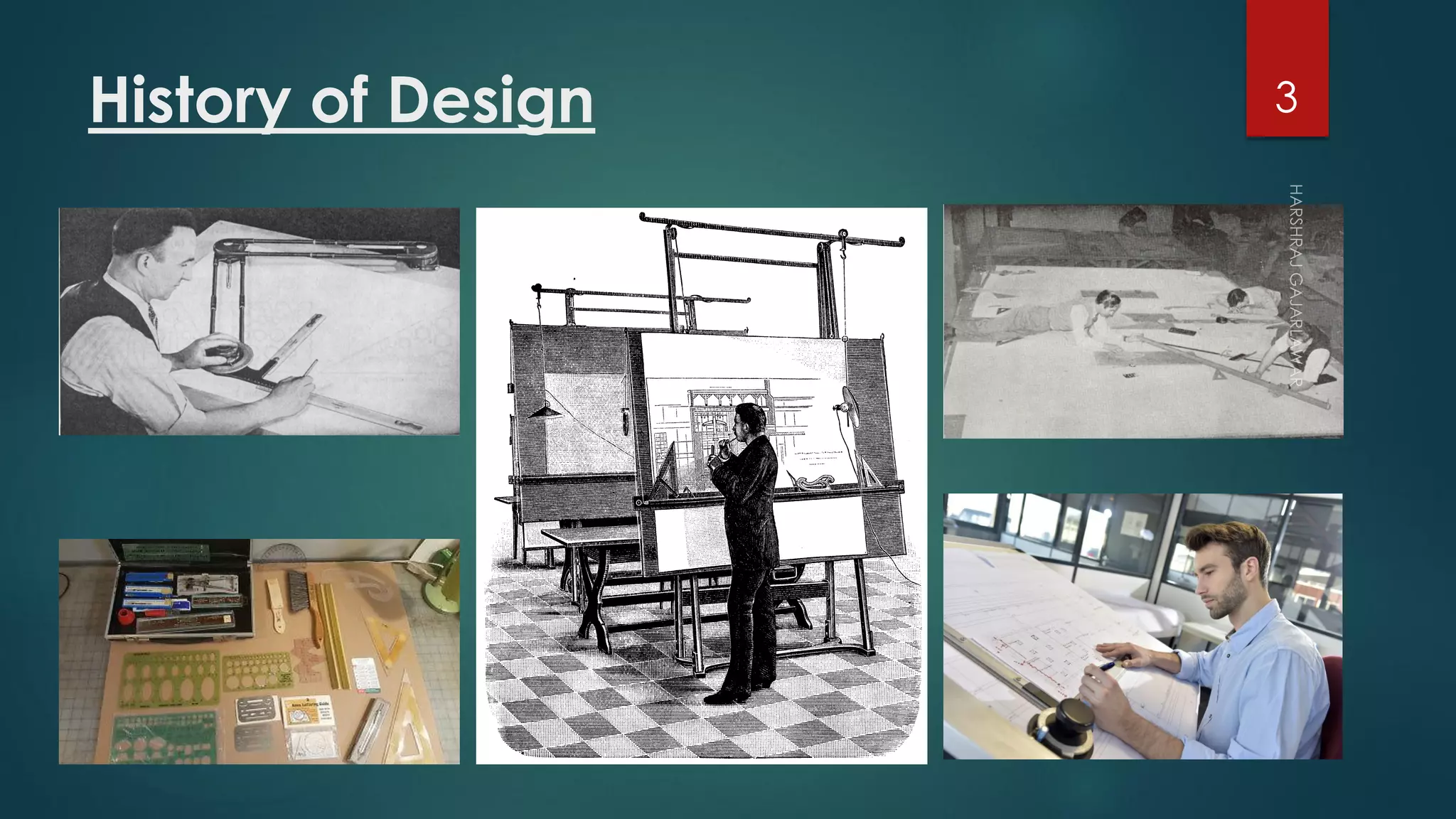
History of Design 3
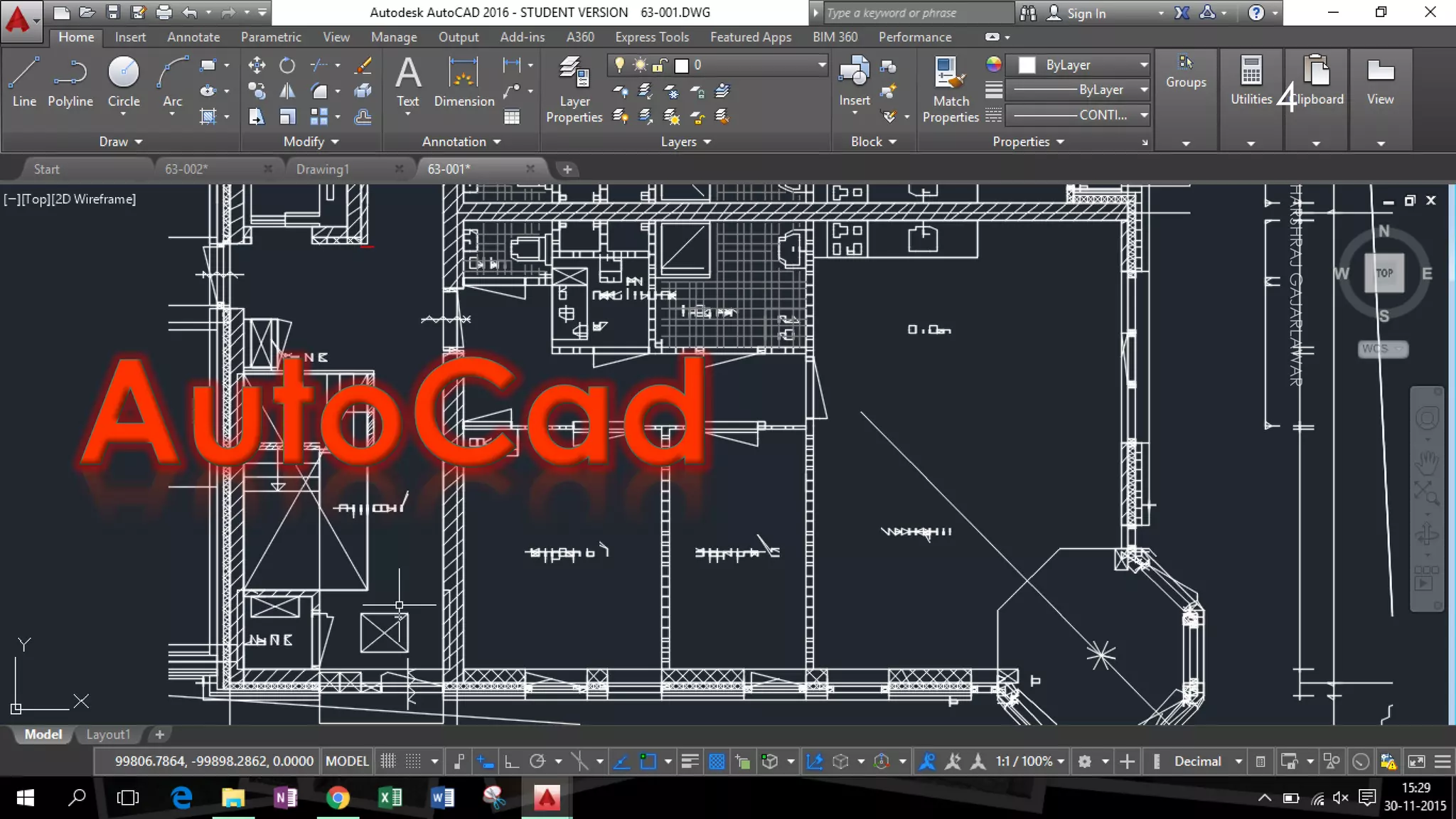
4
History of AutoCAD
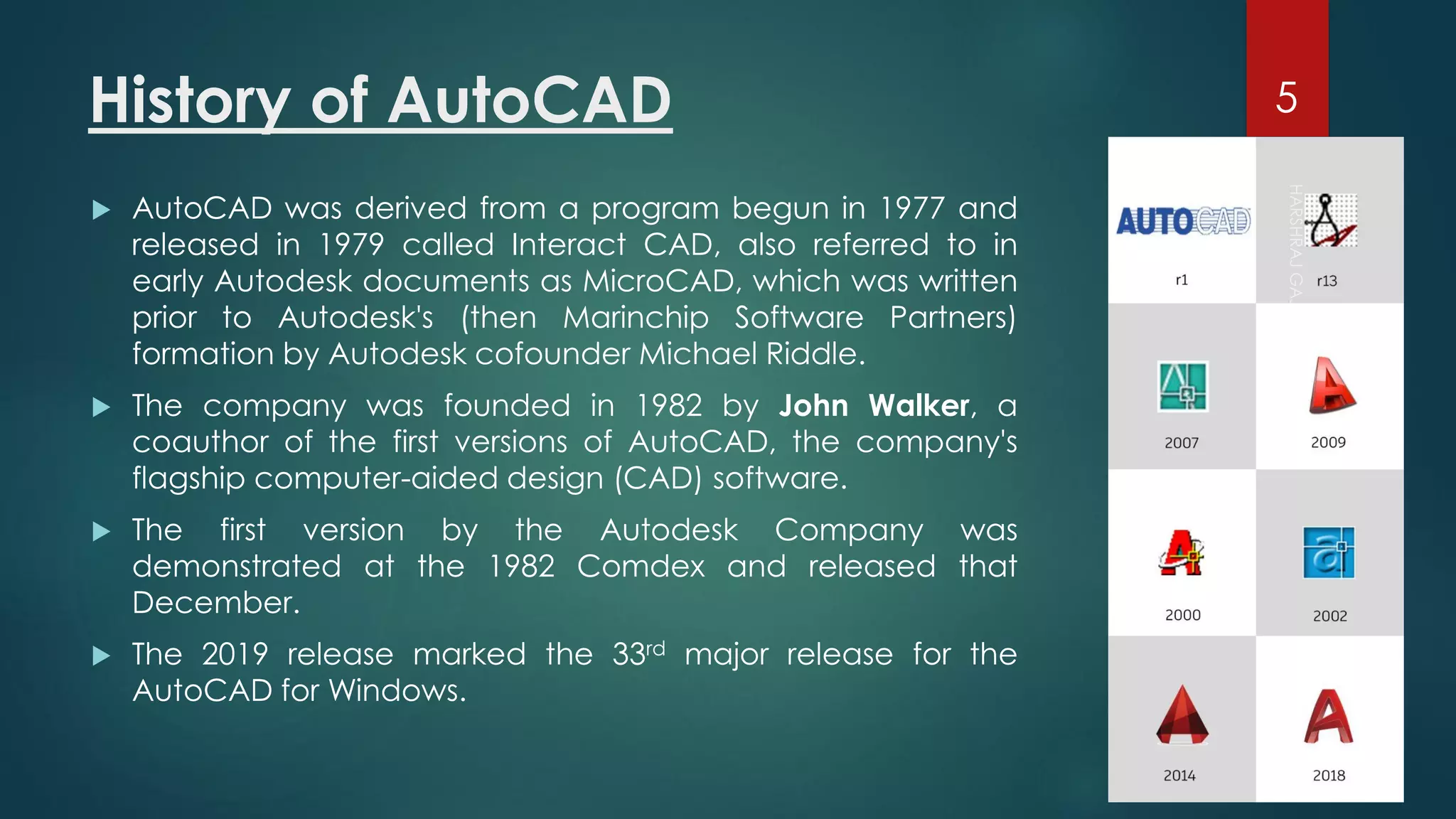
 AutoCAD was derived from a program begun in 1977 and
released in 1979 called Interact CAD, also referred to in
early Autodesk documents as MicroCAD, which was written
prior to Autodesk's (then Marinchip Software Partners)
formation by Autodesk cofounder Michael Riddle.
 The company was founded in 1982 by John Walker, a
coauthor of the first versions of AutoCAD, the company's
flagship computer-aided design (CAD) software.
 The first version by the Autodesk Company was
demonstrated at the 1982 Comdex and released that
December.
 The 2019 release marked the 33rd major release for the
AutoCAD for Windows.
5
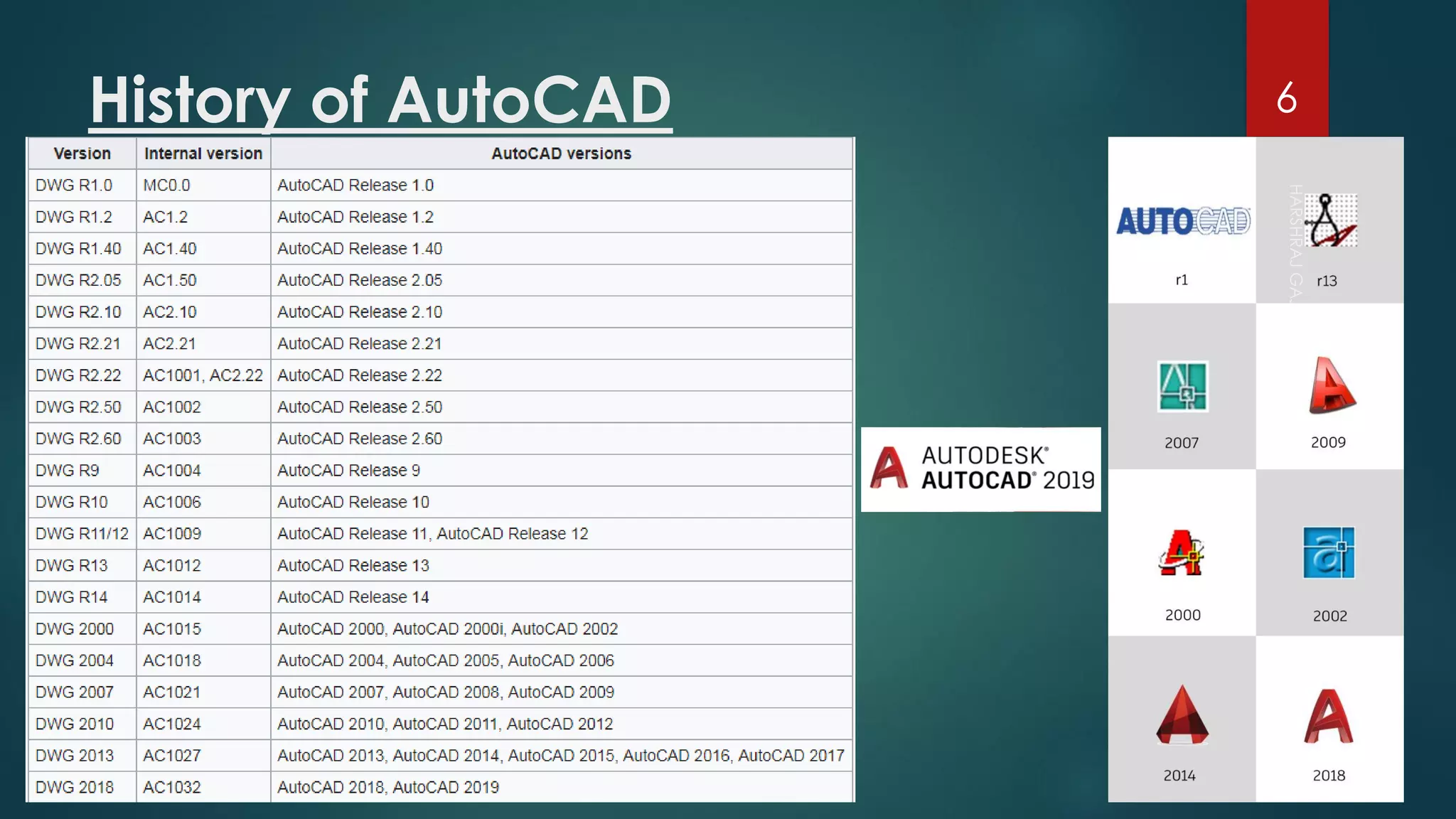
History of AutoCAD 6
AutoCAD
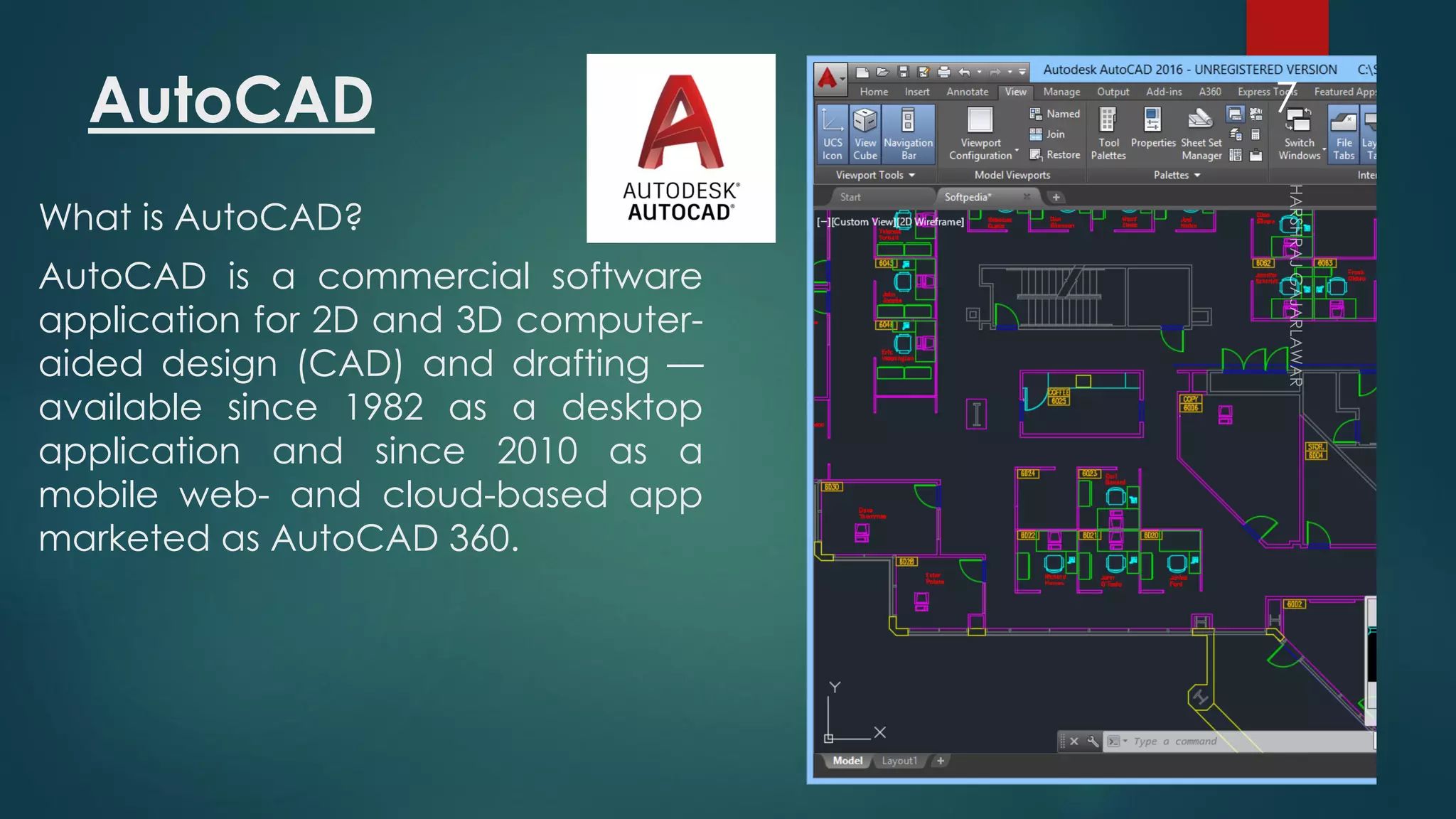
What is AutoCAD?
AutoCAD is a commercial software
application for 2D and 3D computer-
aided design (CAD) and drafting —
available since 1982 as a desktop
application and since 2010 as a
mobile web- and cloud-based app
marketed as AutoCAD 360.
7
AutoCAD
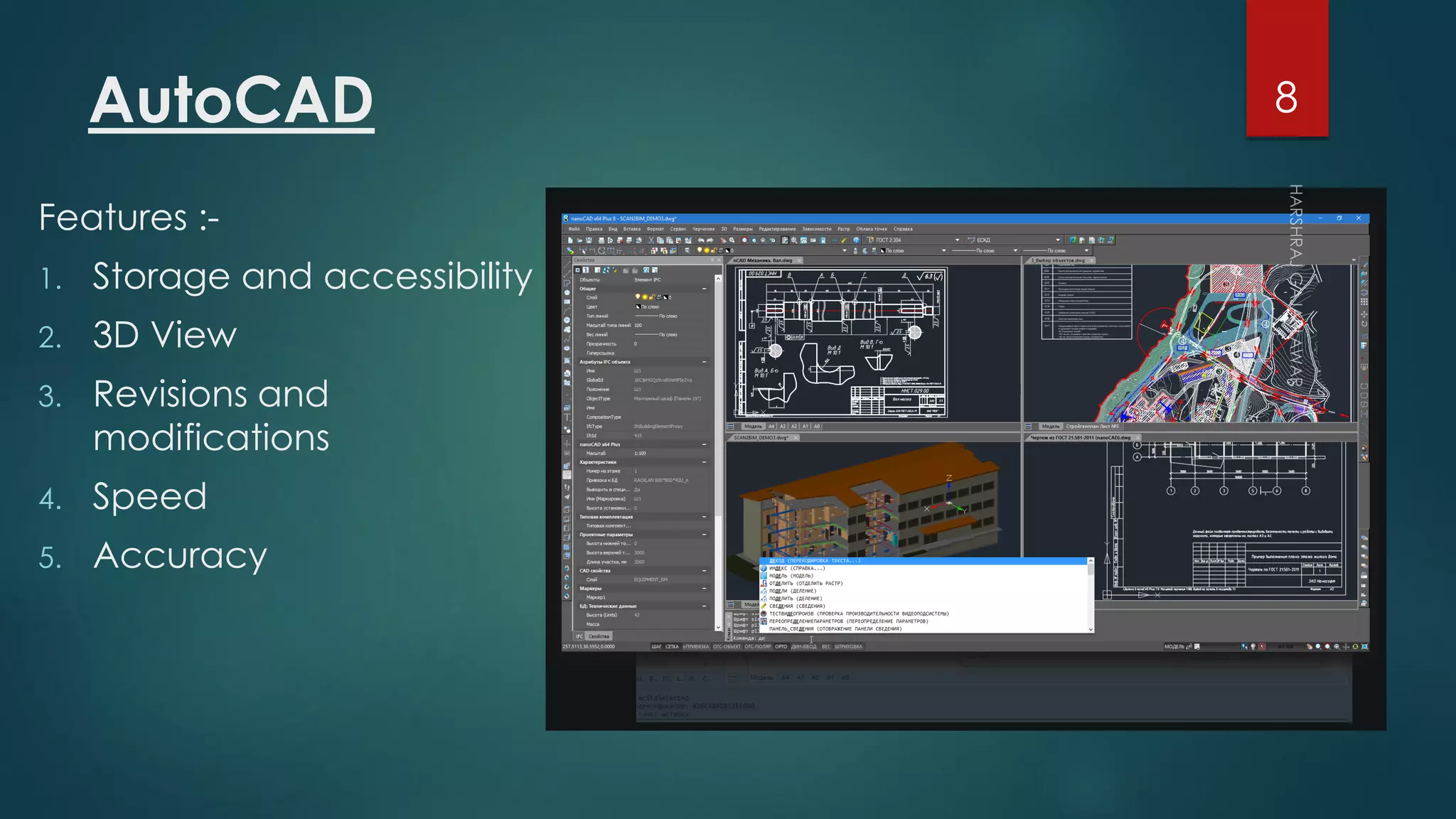
Features :-
1. Storage and accessibility
2. 3D View
3. Revisions and
modifications
4. Speed
5. Accuracy
8
AutoCAD
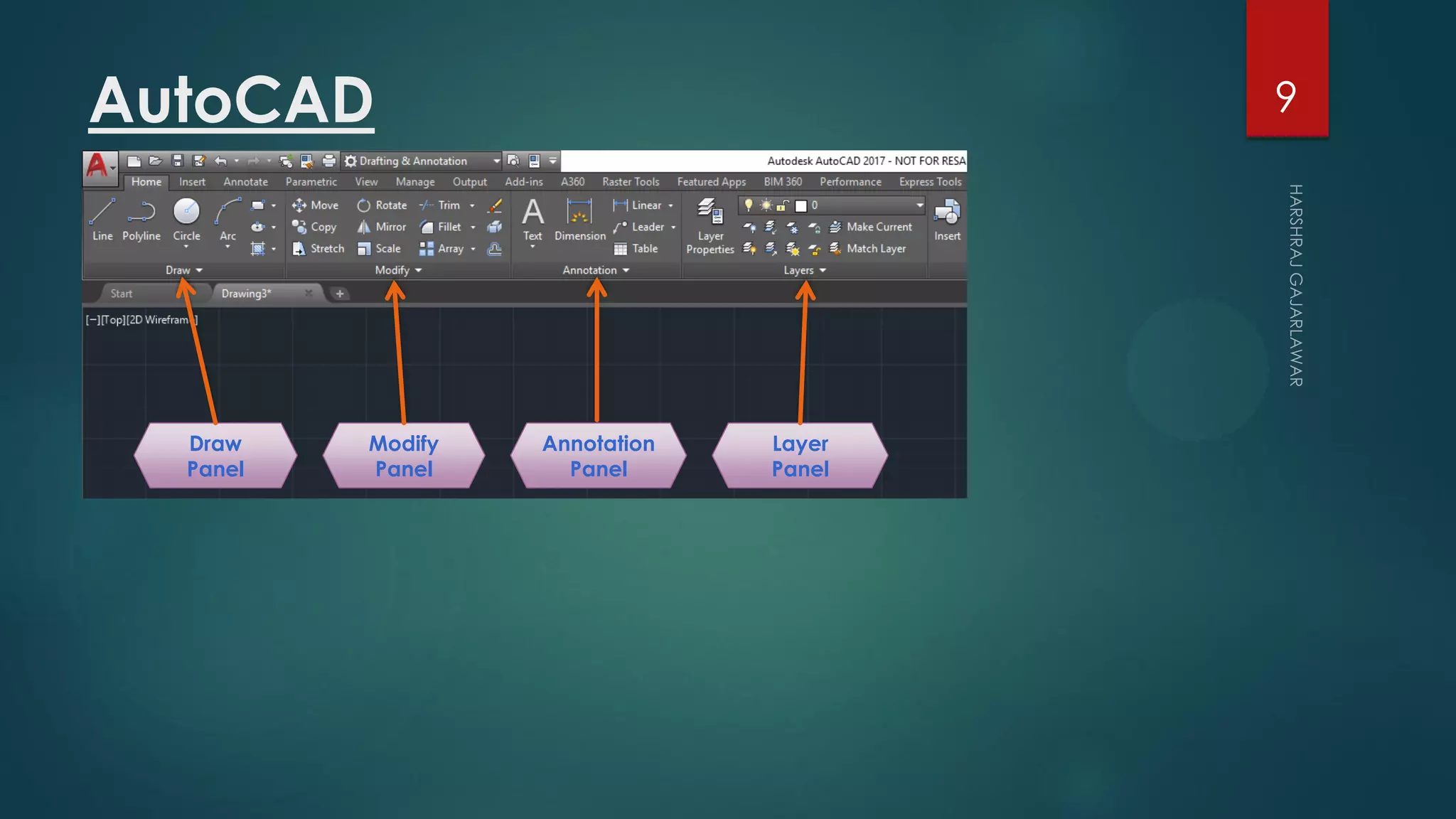
Draw
Panel
Annotation
Panel
Modify
Panel
Layer
Panel
9
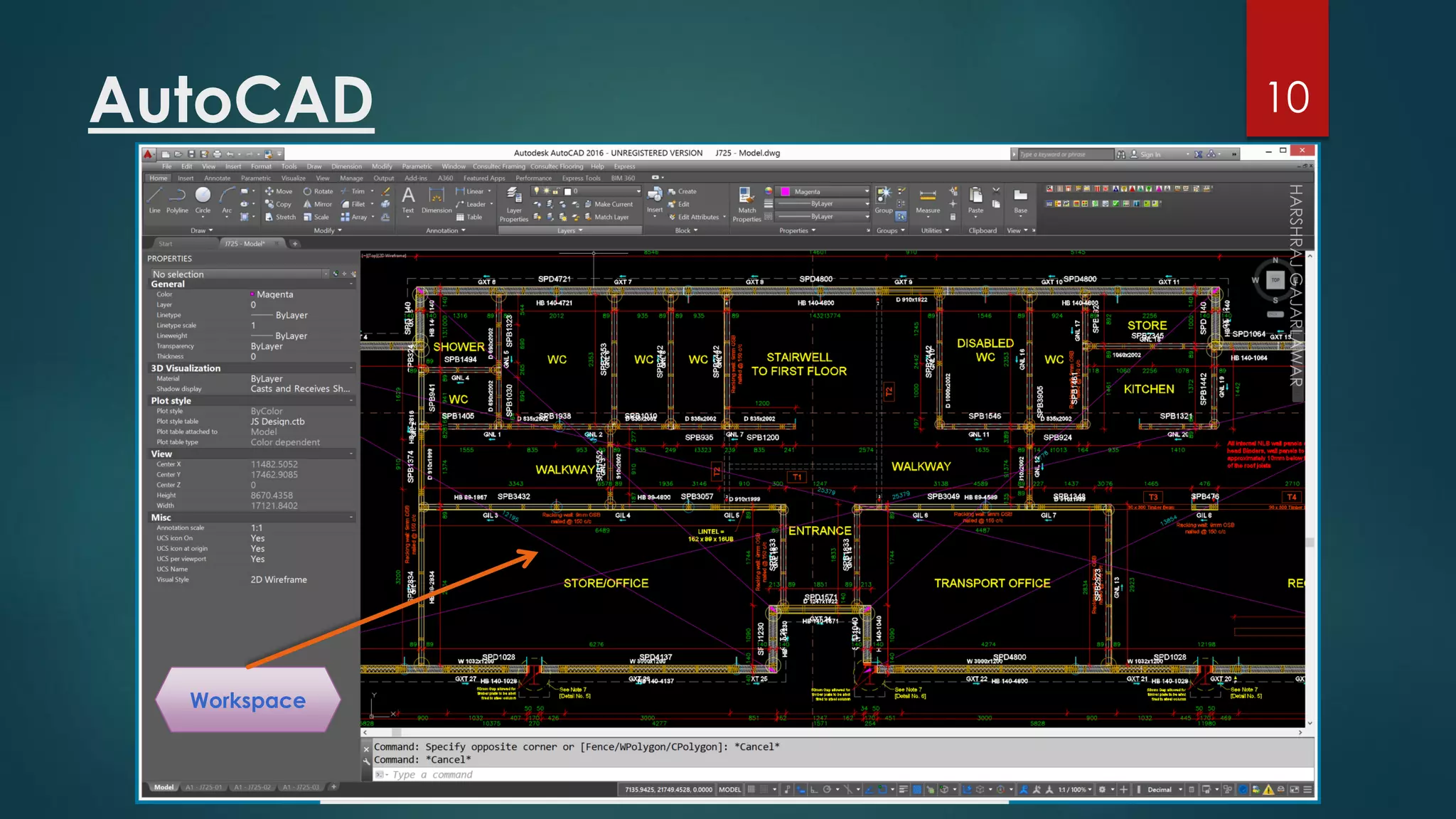
AutoCAD
Workspace
10
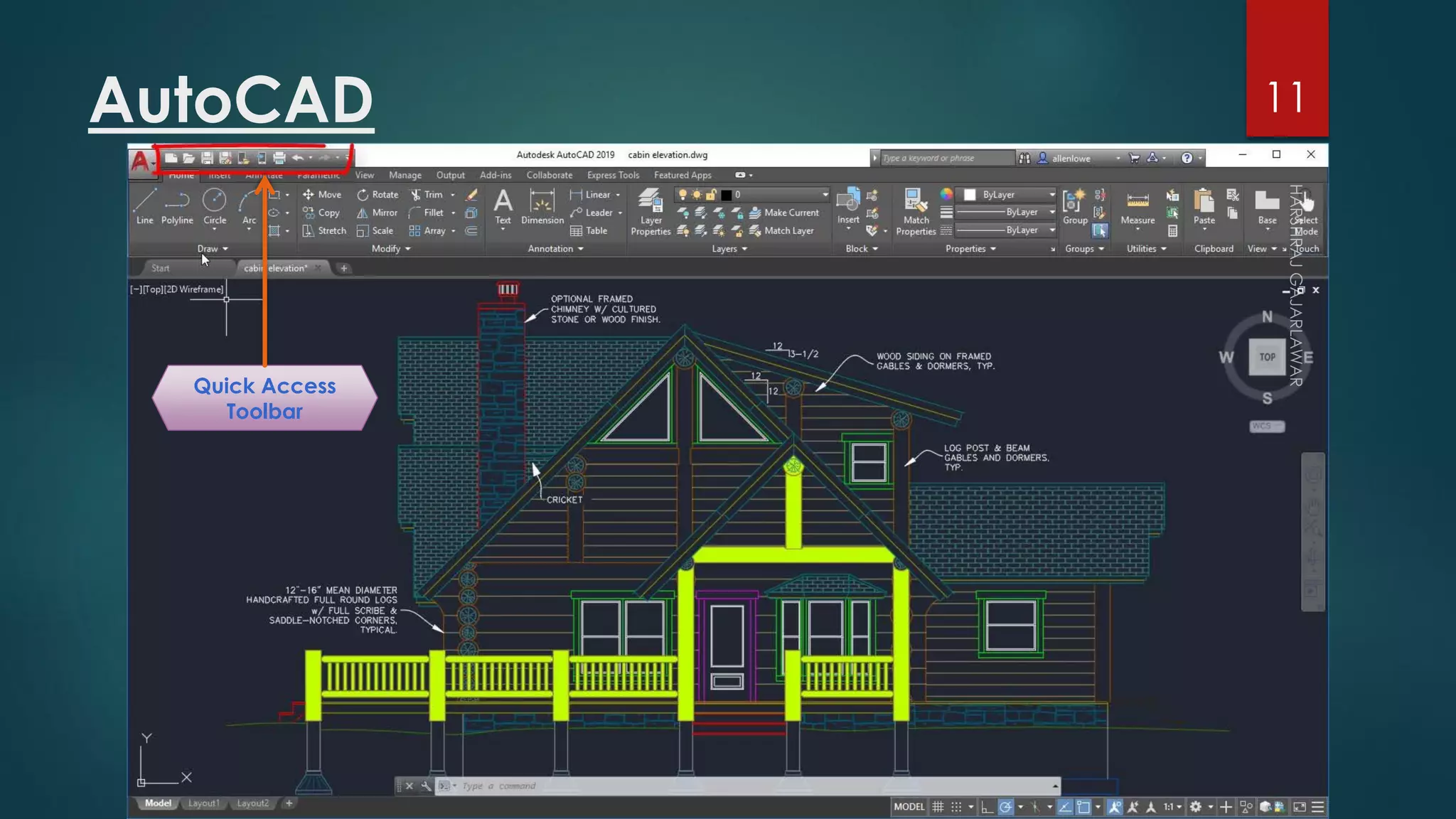
AutoCAD
Quick Access
Toolbar
11
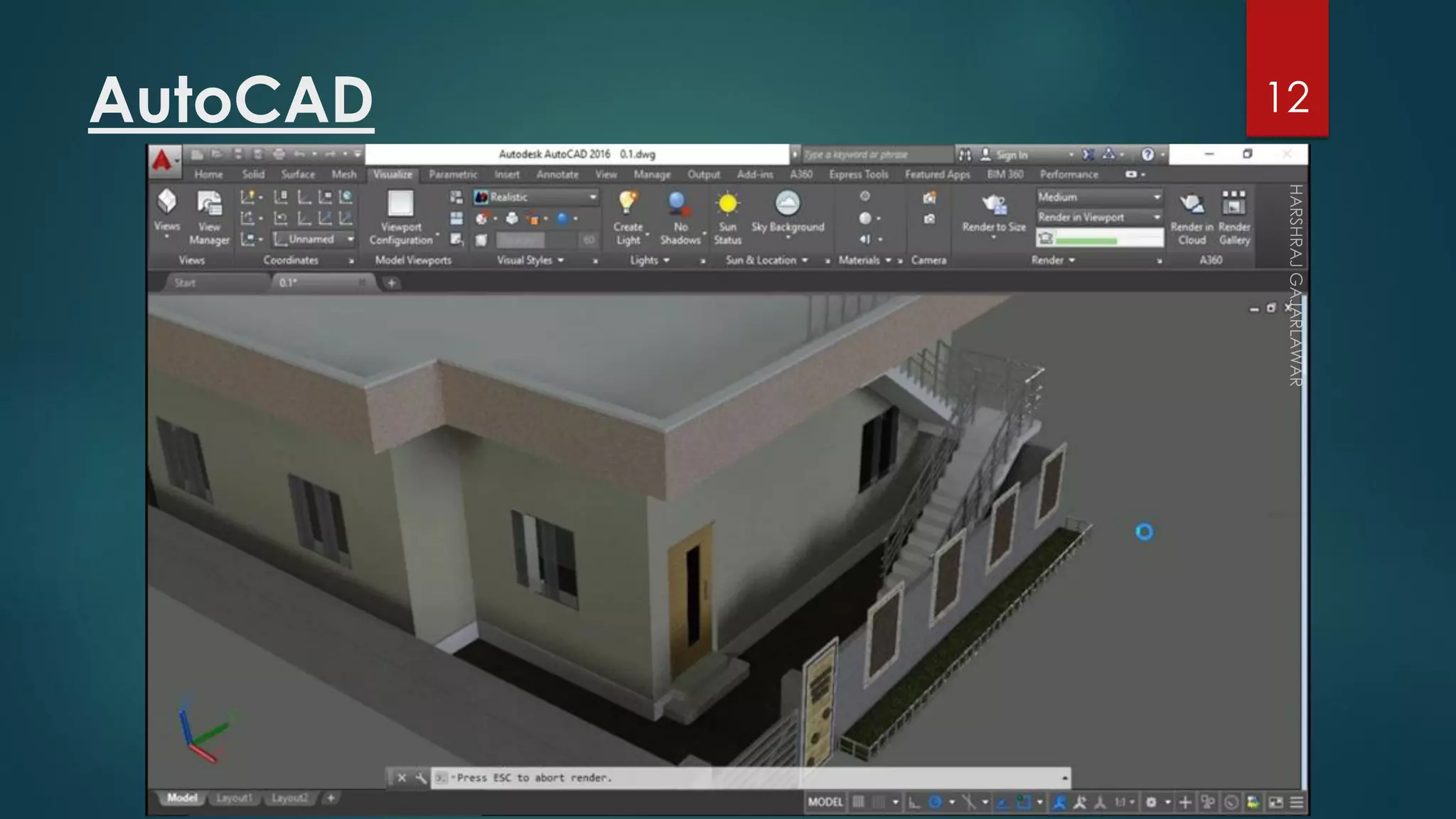
AutoCAD 12
AutoCAD
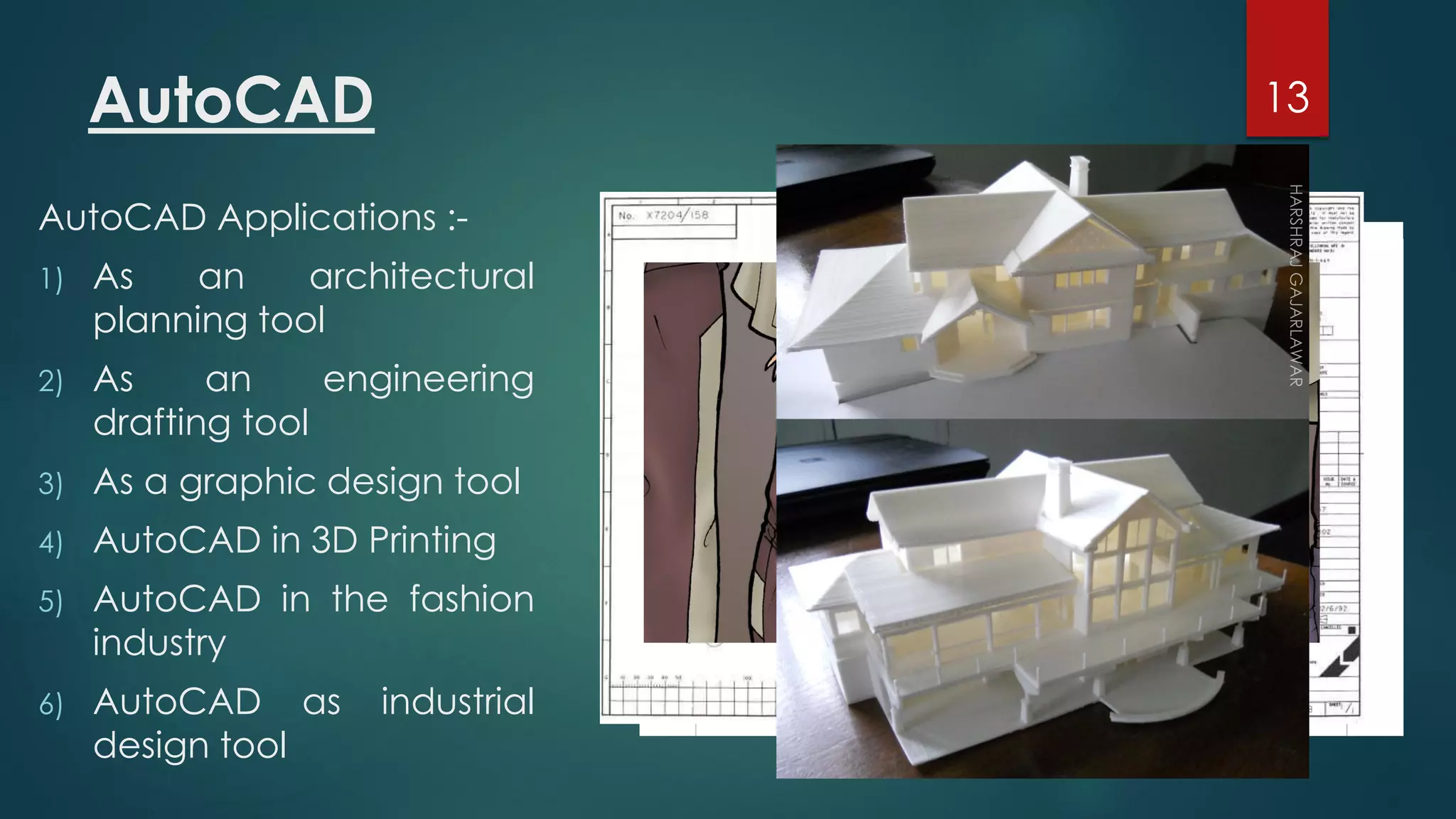
AutoCAD Applications :-
1) As an architectural
planning tool
2) As an engineering
drafting tool
3) As a graphic design tool
4) AutoCAD in 3D Printing
5) AutoCAD in the fashion
industry
6) AutoCAD as industrial
design tool
13
AutoCAD
Careers Related to Civil Engineers :-
 Architects. Architects plan and design houses, factories, office
buildings, and other structures.
 Civil Engineering Technicians. ...
 Construction Managers. ...
 Environmental Engineers. ...
 Landscape Architects. ...
 Surveyors. ...
 Urban and Regional Planners.
14
The AutoCAD Advantage
 SolidWorks / Solid Edge / Inventor Compatibility
 Industry Standard Translators
 Reduced Training Time/Cost
 Rapid Product Advancements
15
16
17
BIM
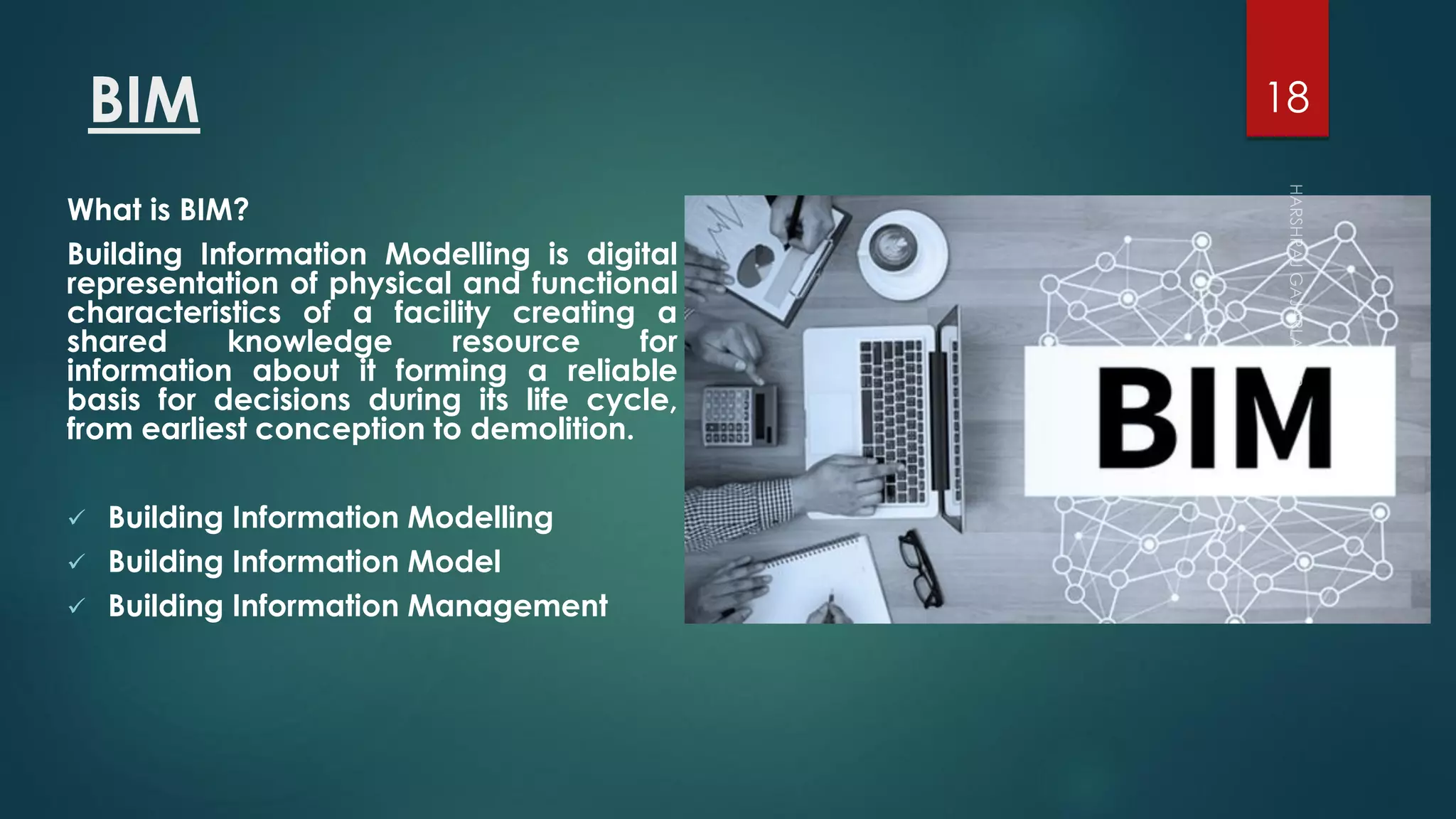
What is BIM?
Building Information Modelling is digital
representation of physical and functional
characteristics of a facility creating a
shared knowledge resource for
information about it forming a reliable
basis for decisions during its life cycle,
from earliest conception to demolition.
 Building Information Modelling
 Building Information Model
 Building Information Management
18
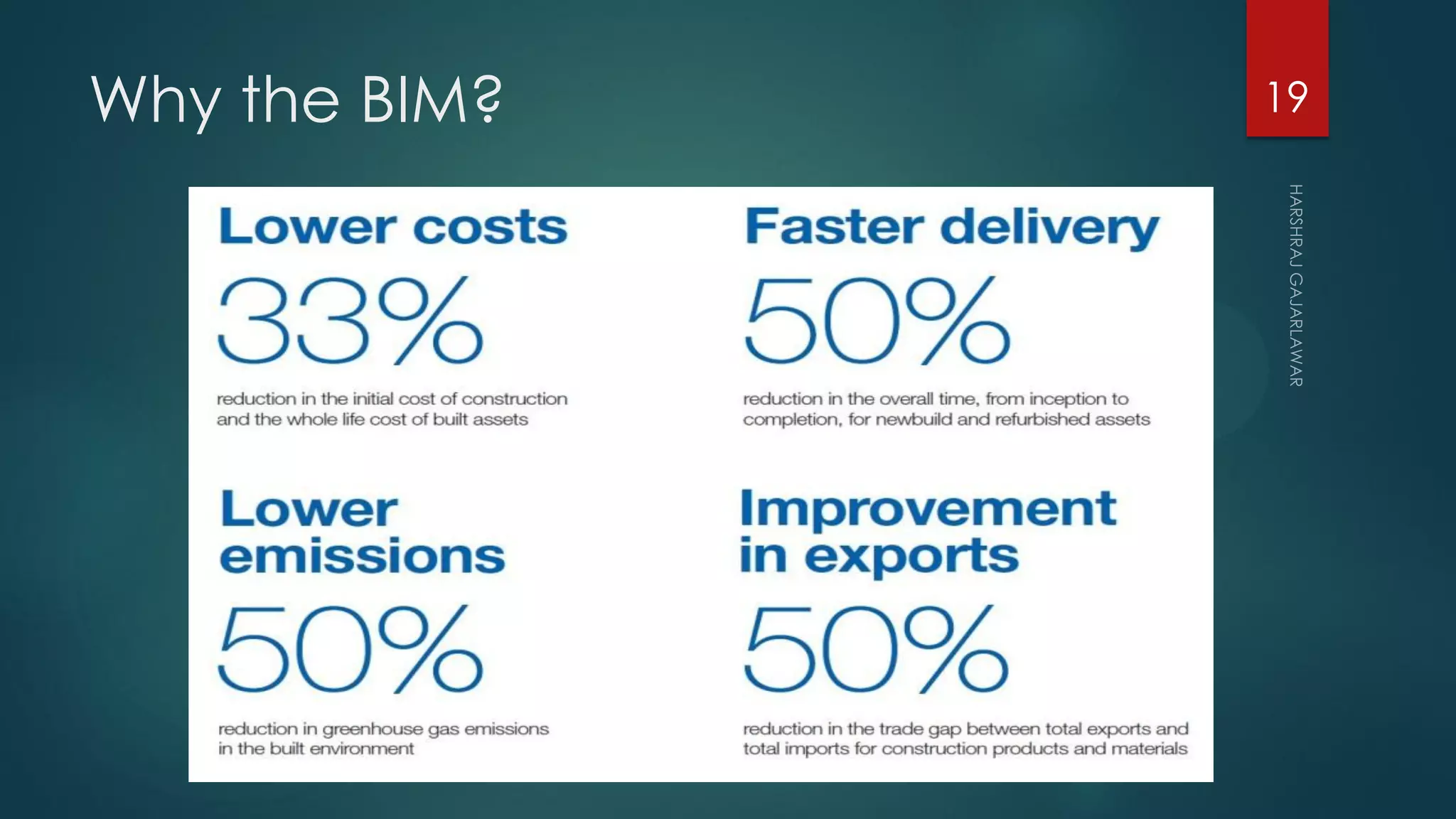
Why the BIM? 19
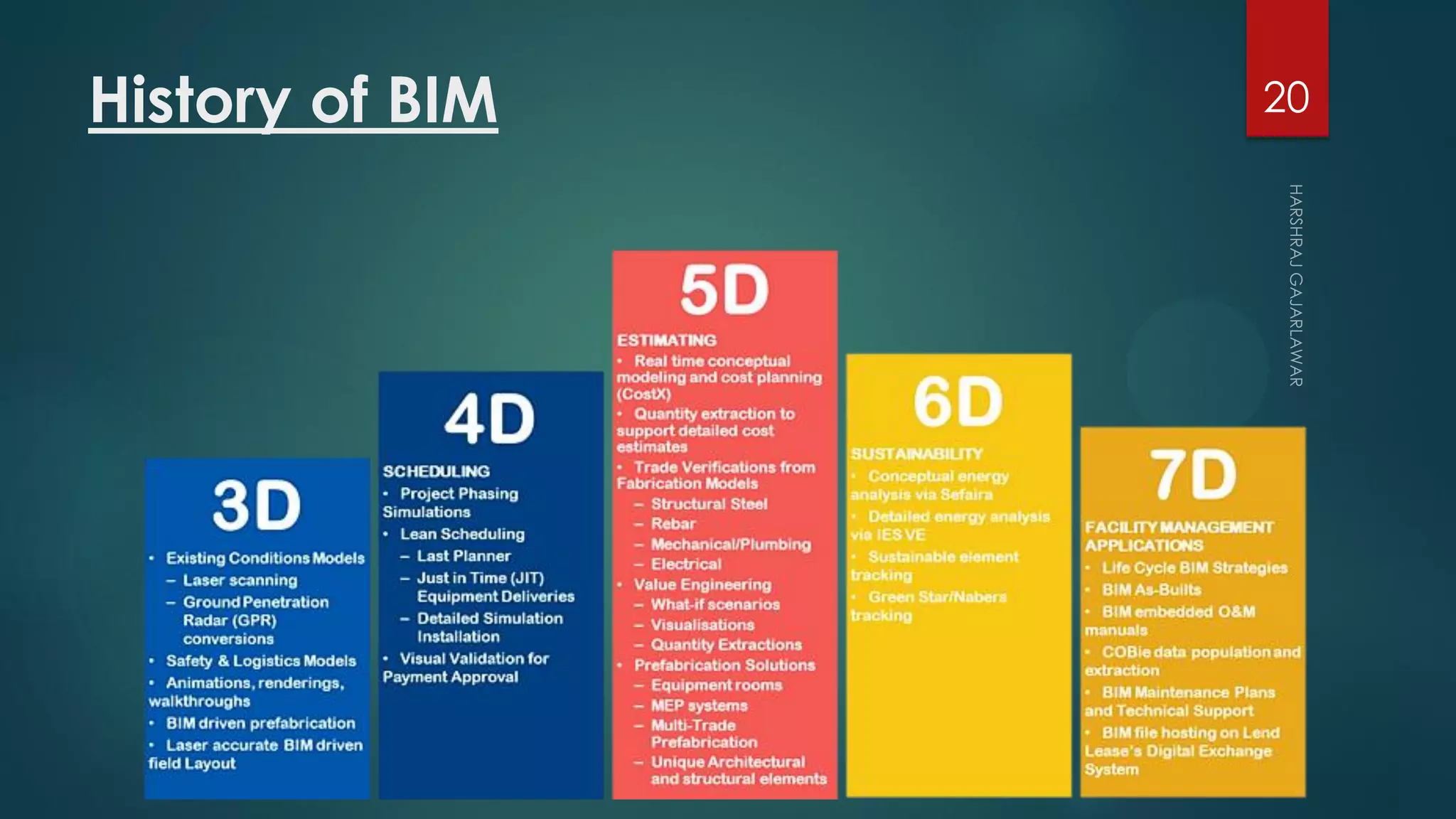
History of BIM 20
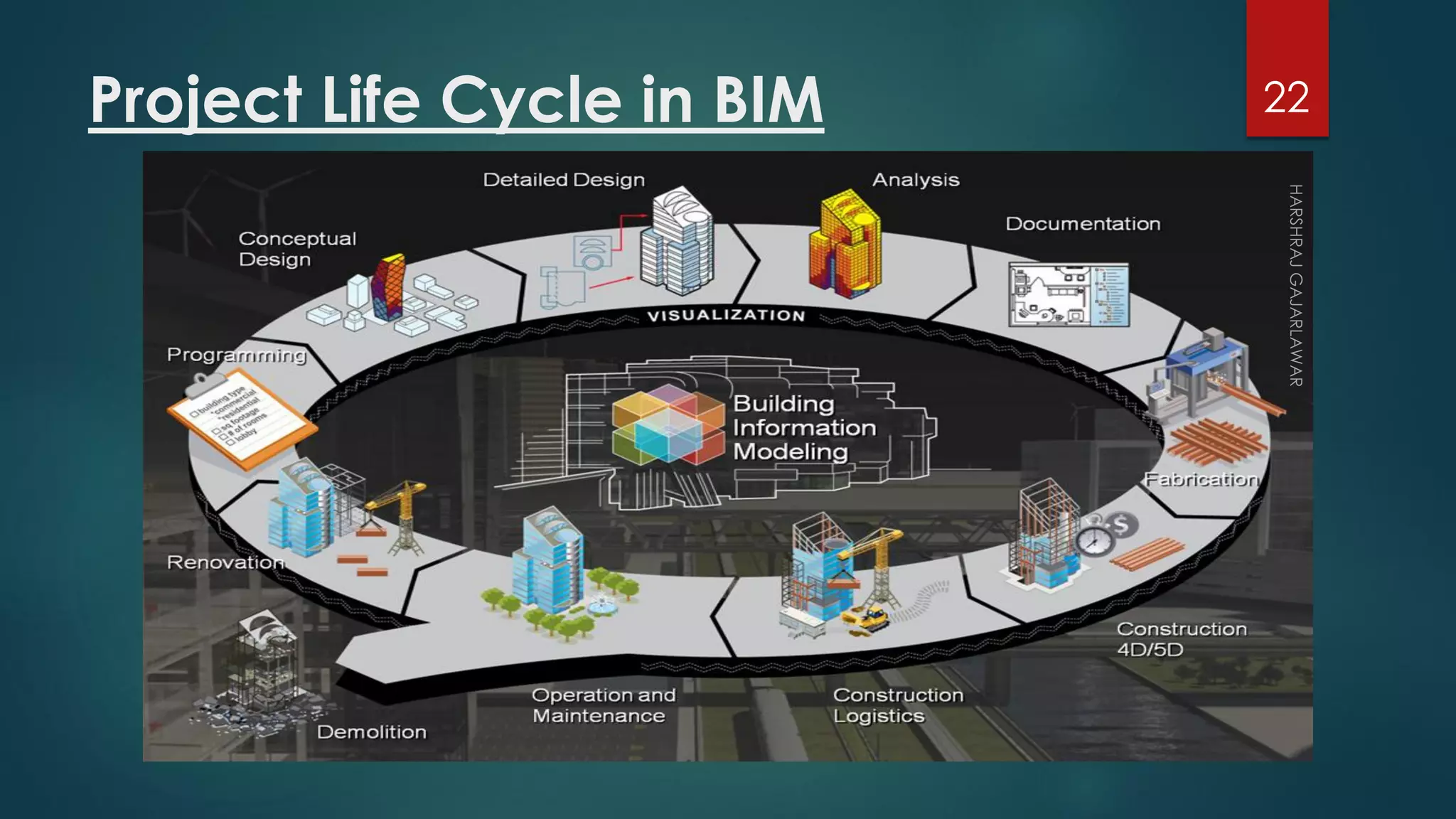
BIM
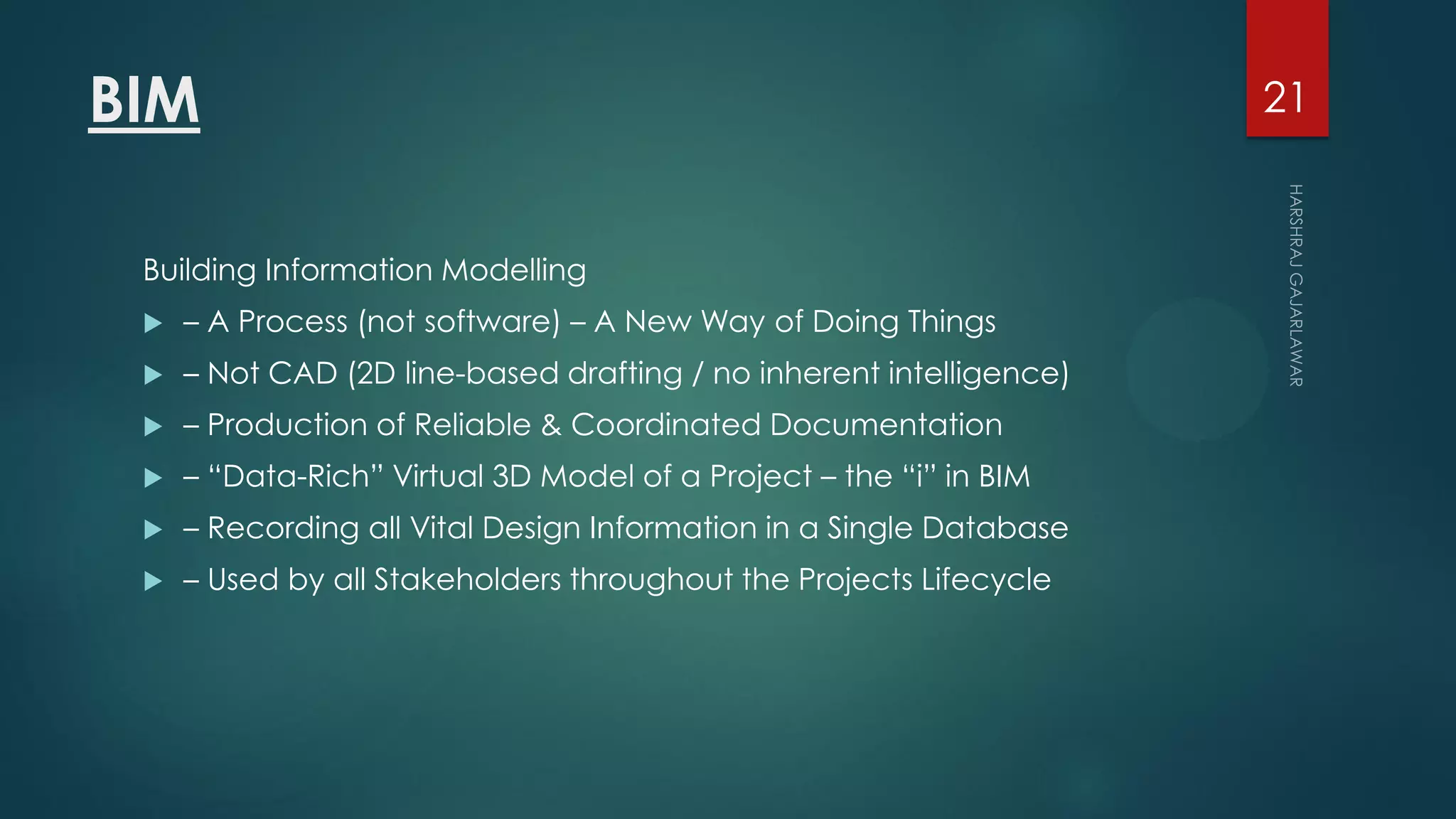
Building Information Modelling
 – A Process (not software) – A New Way of Doing Things
 – Not CAD (2D line-based drafting / no inherent intelligence)
 – Production of Reliable & Coordinated Documentation
 – “Data-Rich” Virtual 3D Model of a Project – the “i” in BIM
 – Recording all Vital Design Information in a Single Database
 – Used by all Stakeholders throughout the Projects Lifecycle
21
Project Life Cycle in BIM 22
23
Revit
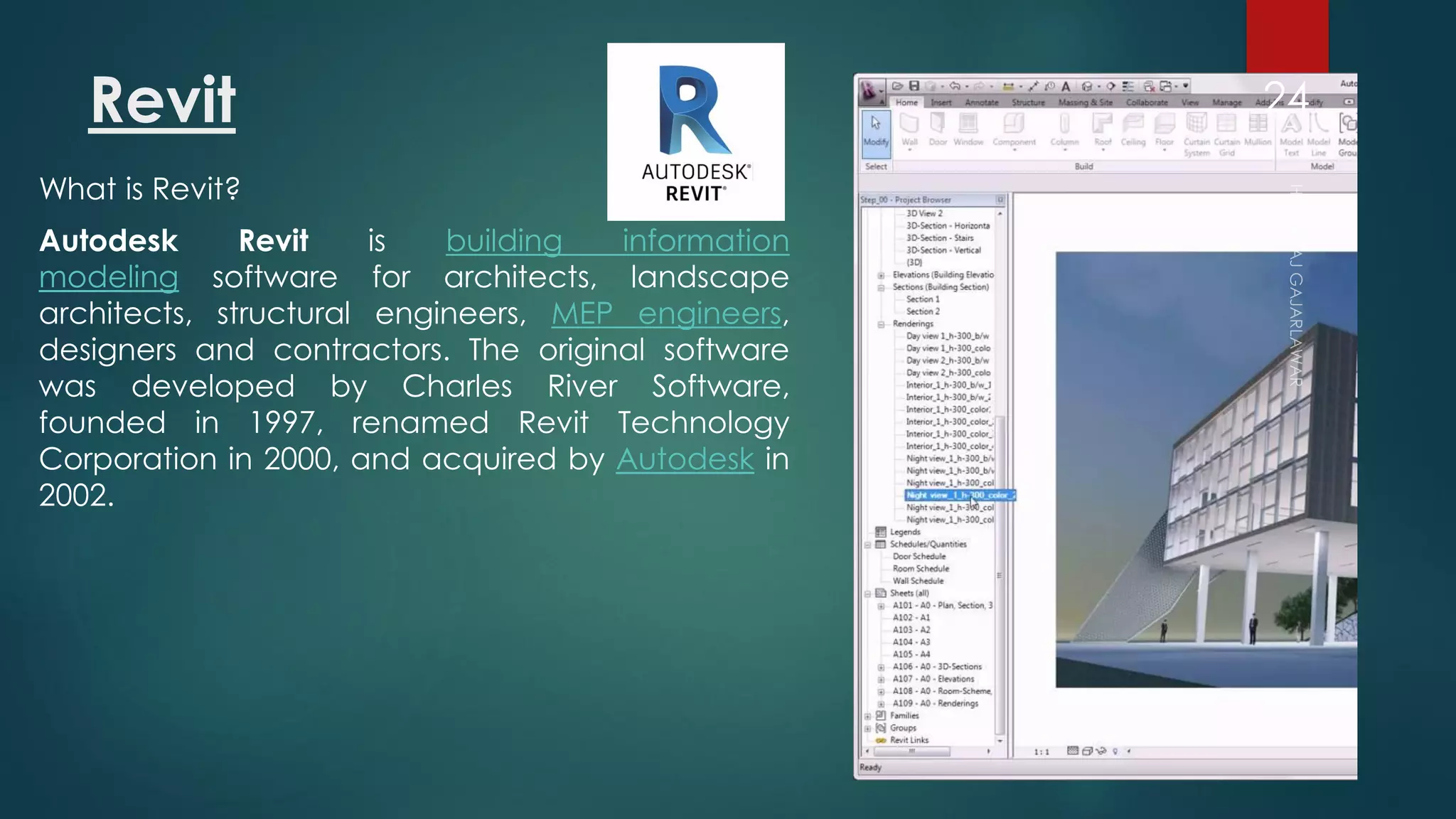
What is Revit?
Autodesk Revit is building information
modeling software for architects, landscape
architects, structural engineers, MEP engineers,
designers and contractors. The original software
was developed by Charles River Software,
founded in 1997, renamed Revit Technology
Corporation in 2000, and acquired by Autodesk in
2002.
24
Revit Architecture
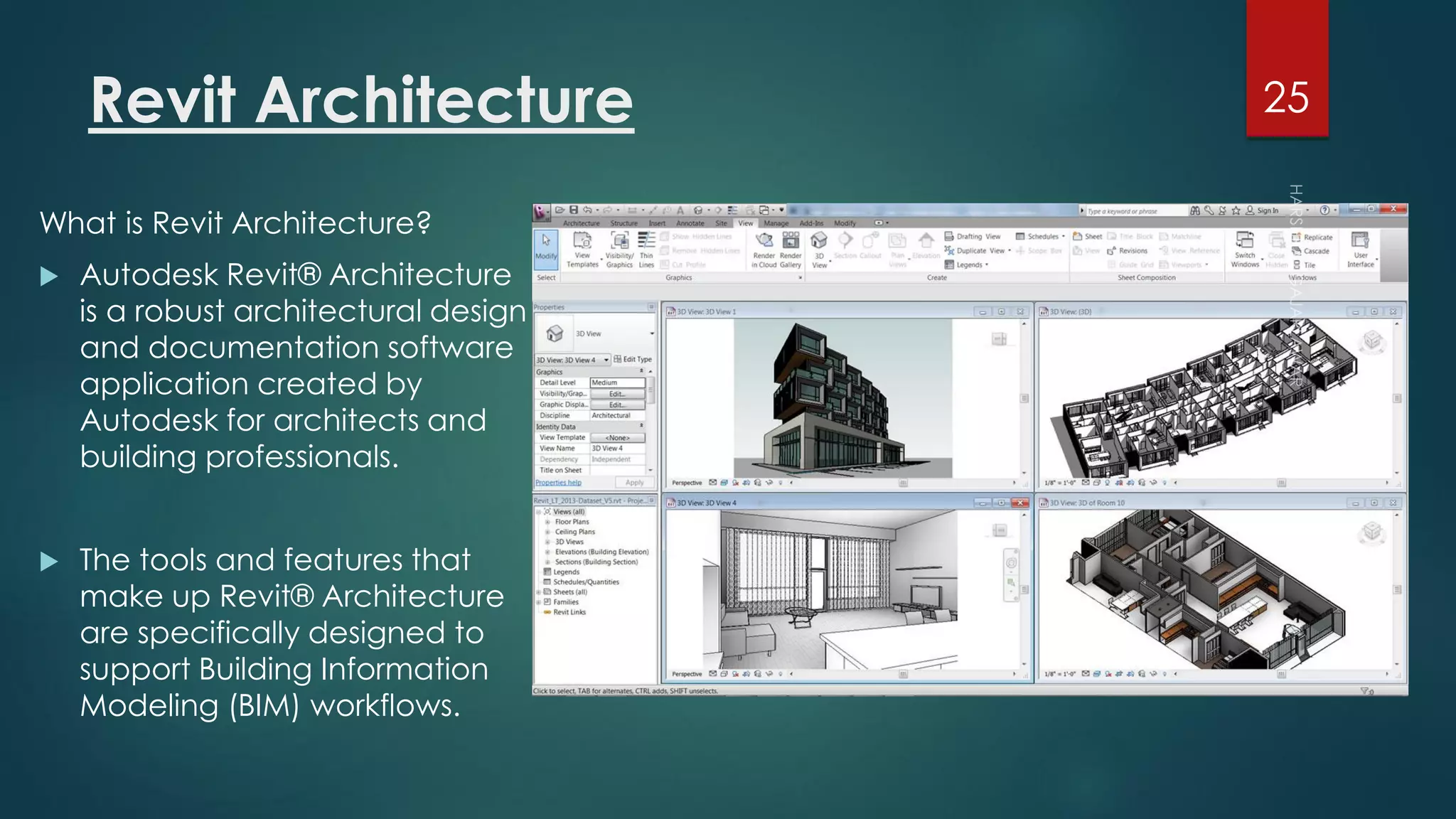
What is Revit Architecture?
 Autodesk Revit® Architecture
is a robust architectural design
and documentation software
application created by
Autodesk for architects and
building professionals.
 The tools and features that
make up Revit® Architecture
are specifically designed to
support Building Information
Modeling (BIM) workflows.
25
Revit Architecture
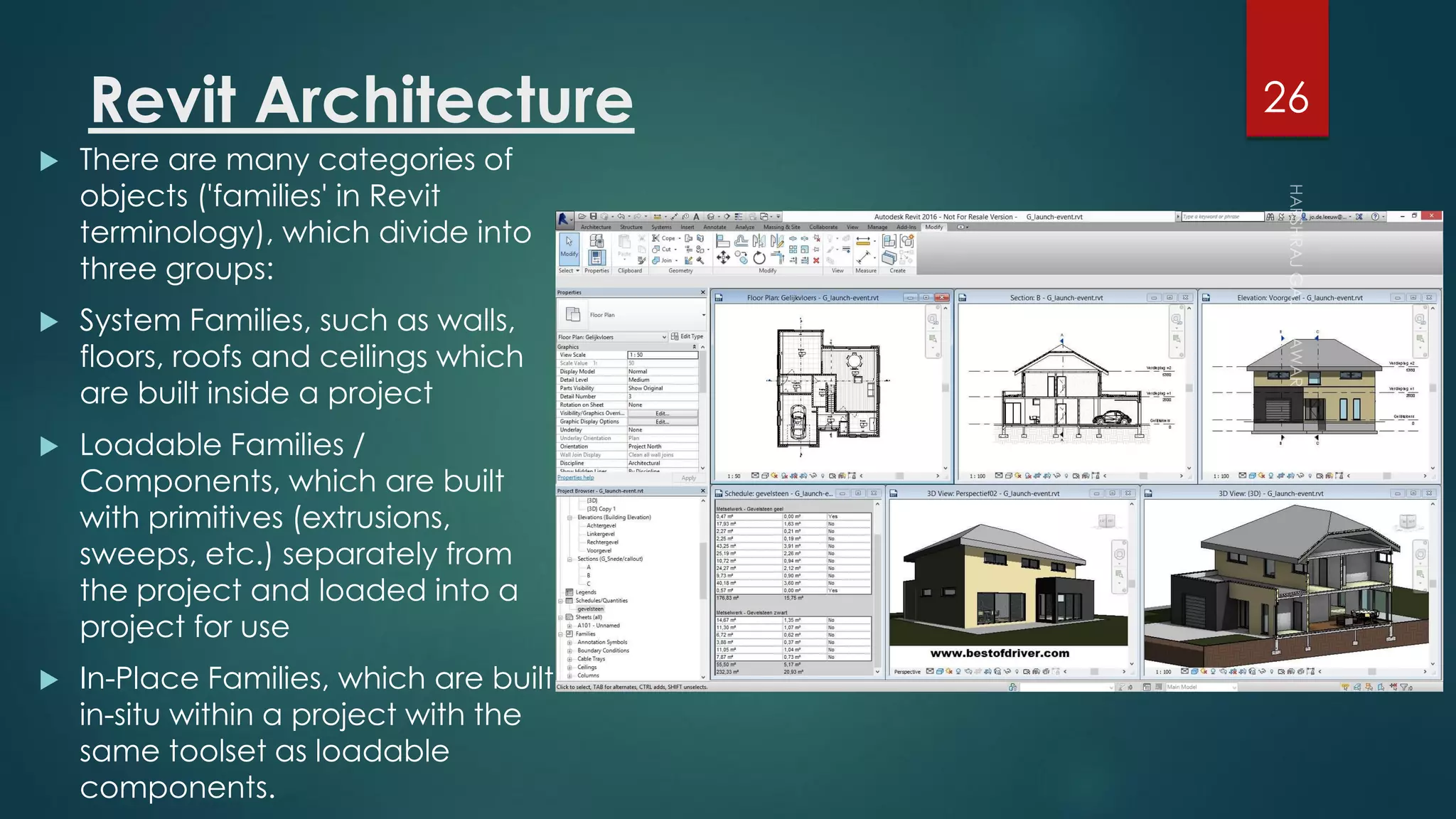
 There are many categories of
objects ('families' in Revit
terminology), which divide into
three groups:
 System Families, such as walls,
floors, roofs and ceilings which
are built inside a project
 Loadable Families /
Components, which are built
with primitives (extrusions,
sweeps, etc.) separately from
the project and loaded into a
project for use
 In-Place Families, which are built
in-situ within a project with the
same toolset as loadable
components.
26
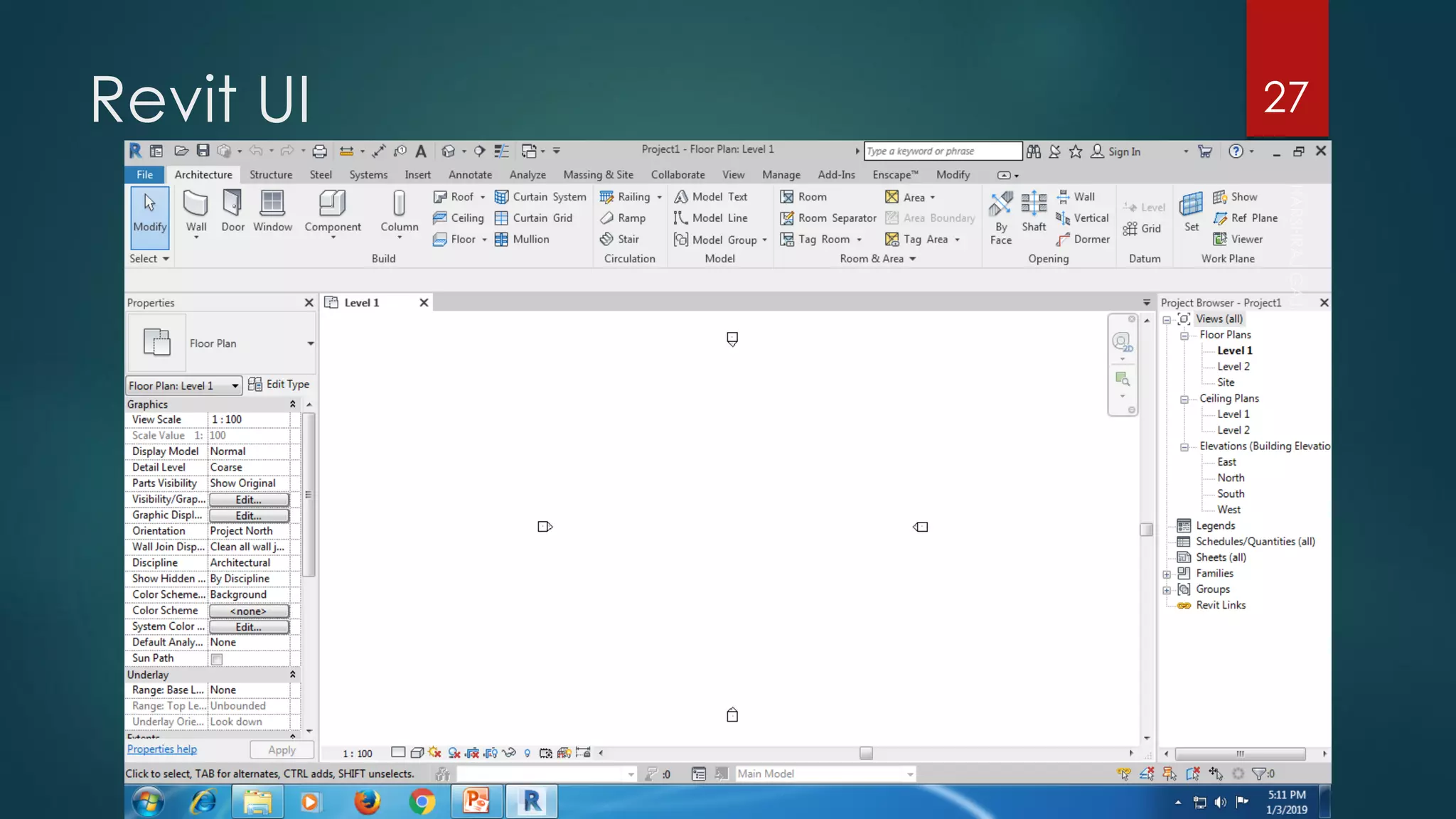
Revit UI 27
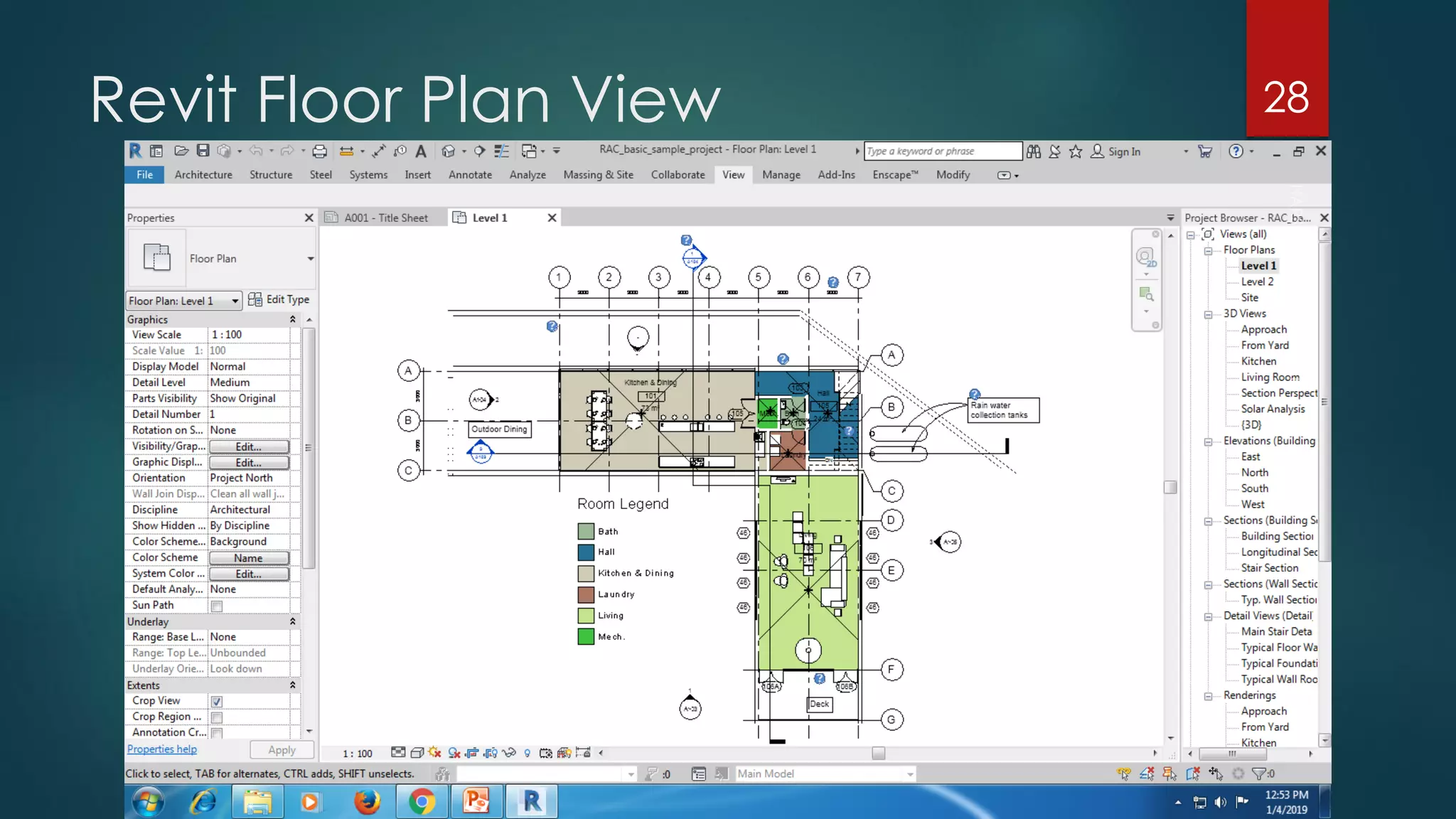
Revit Floor Plan View 28
Revit Elevation View 29
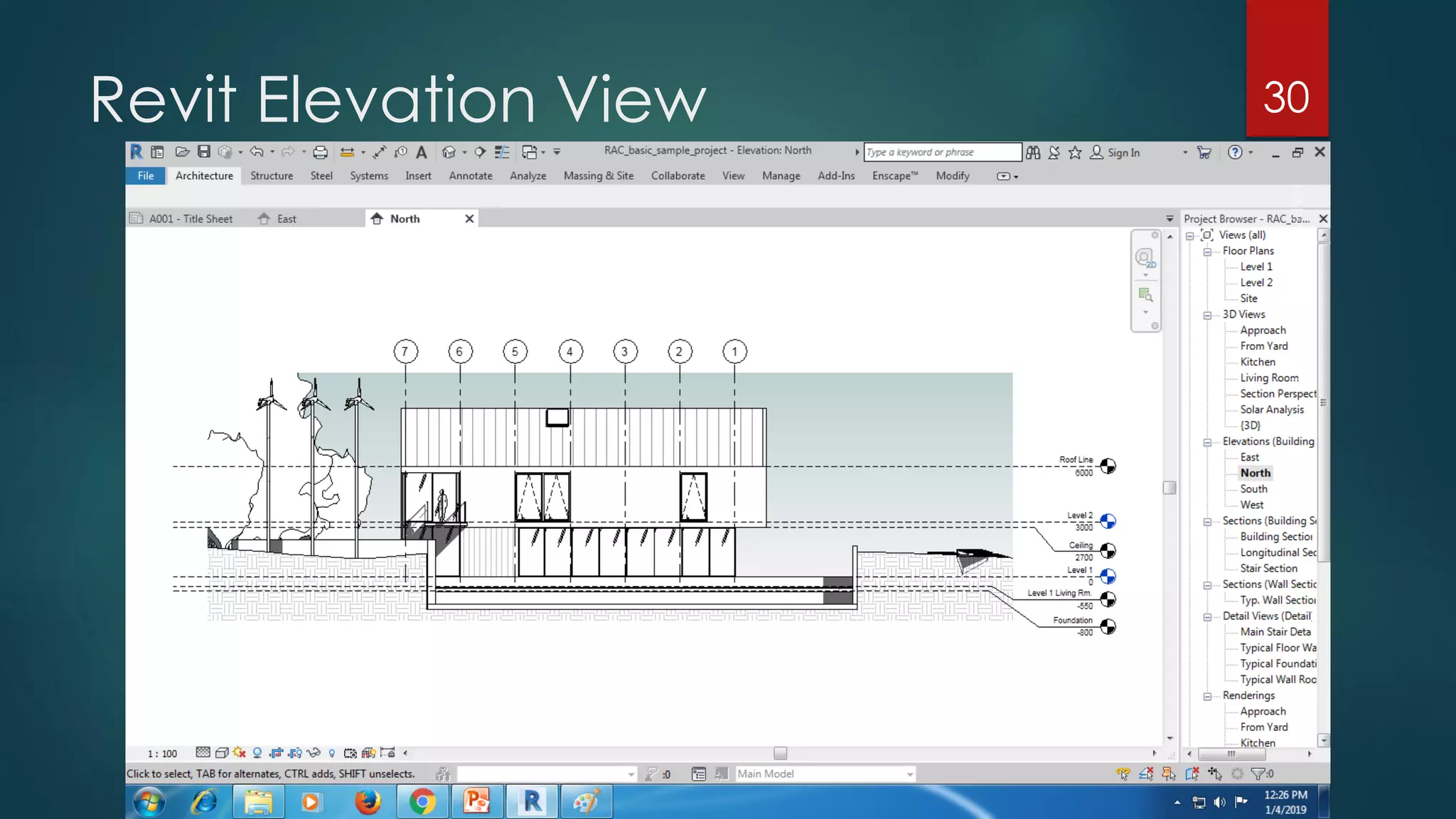
Revit Elevation View 30
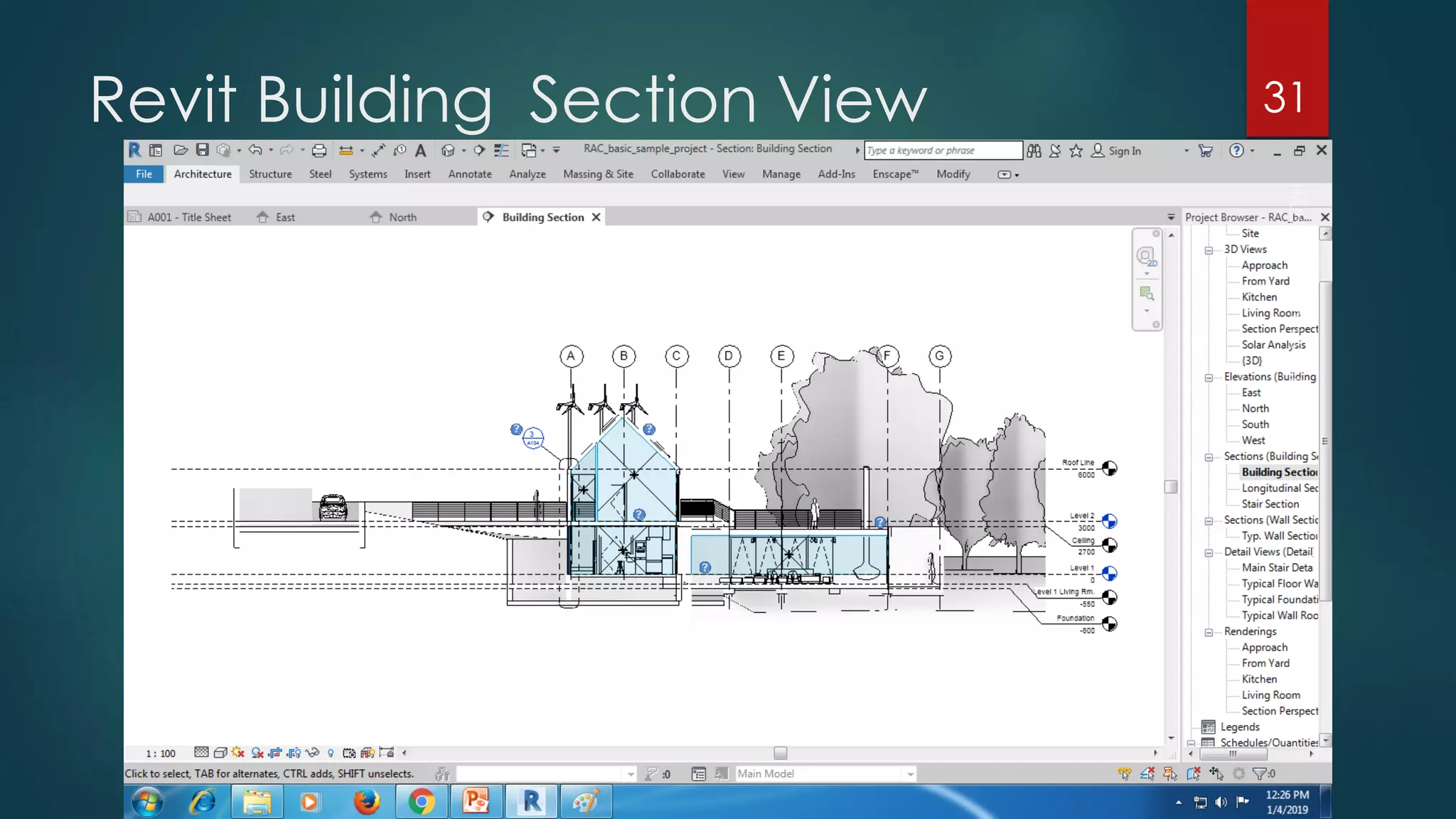
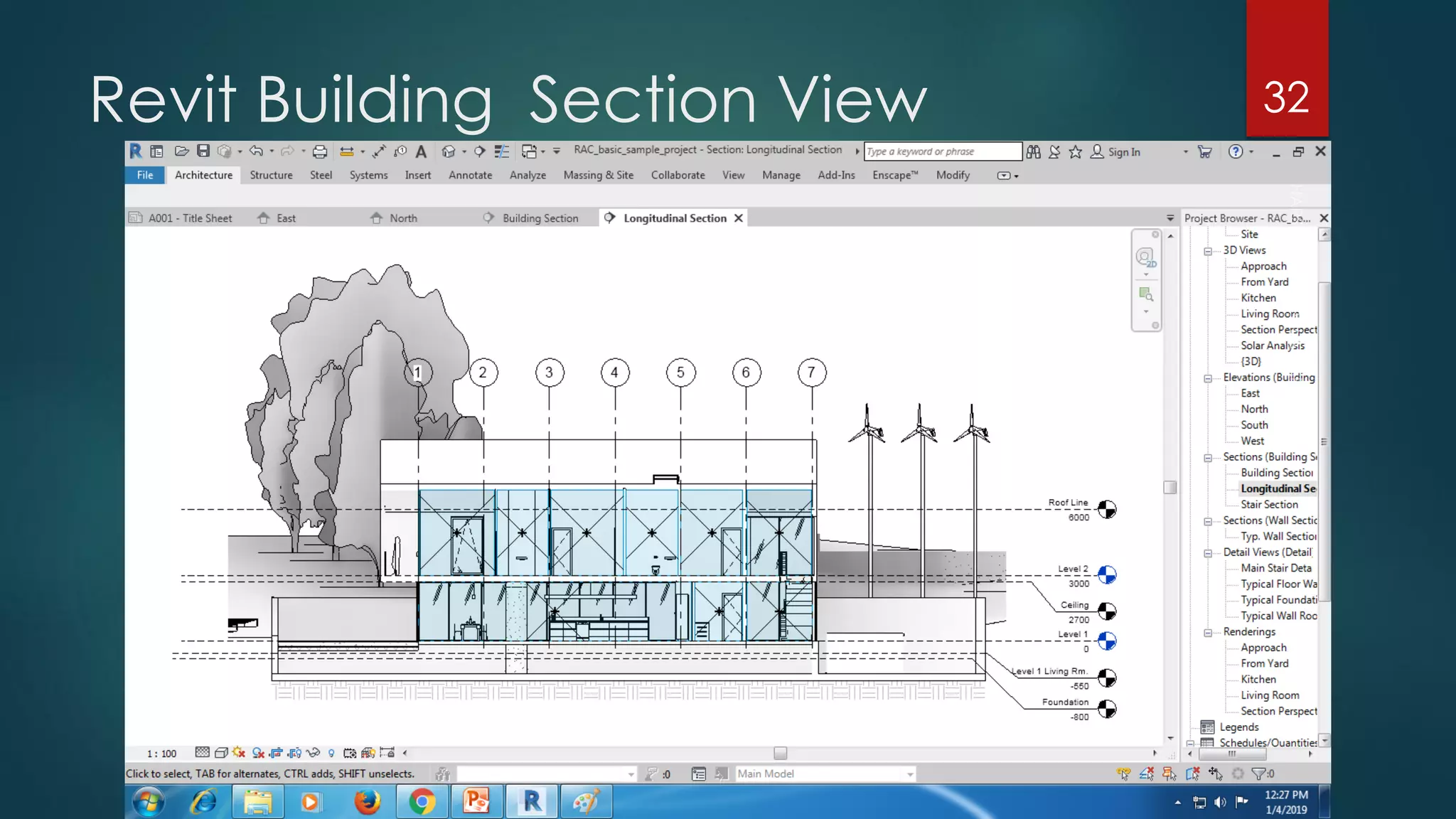
Revit Building Section View 31
Revit Building Section View 32
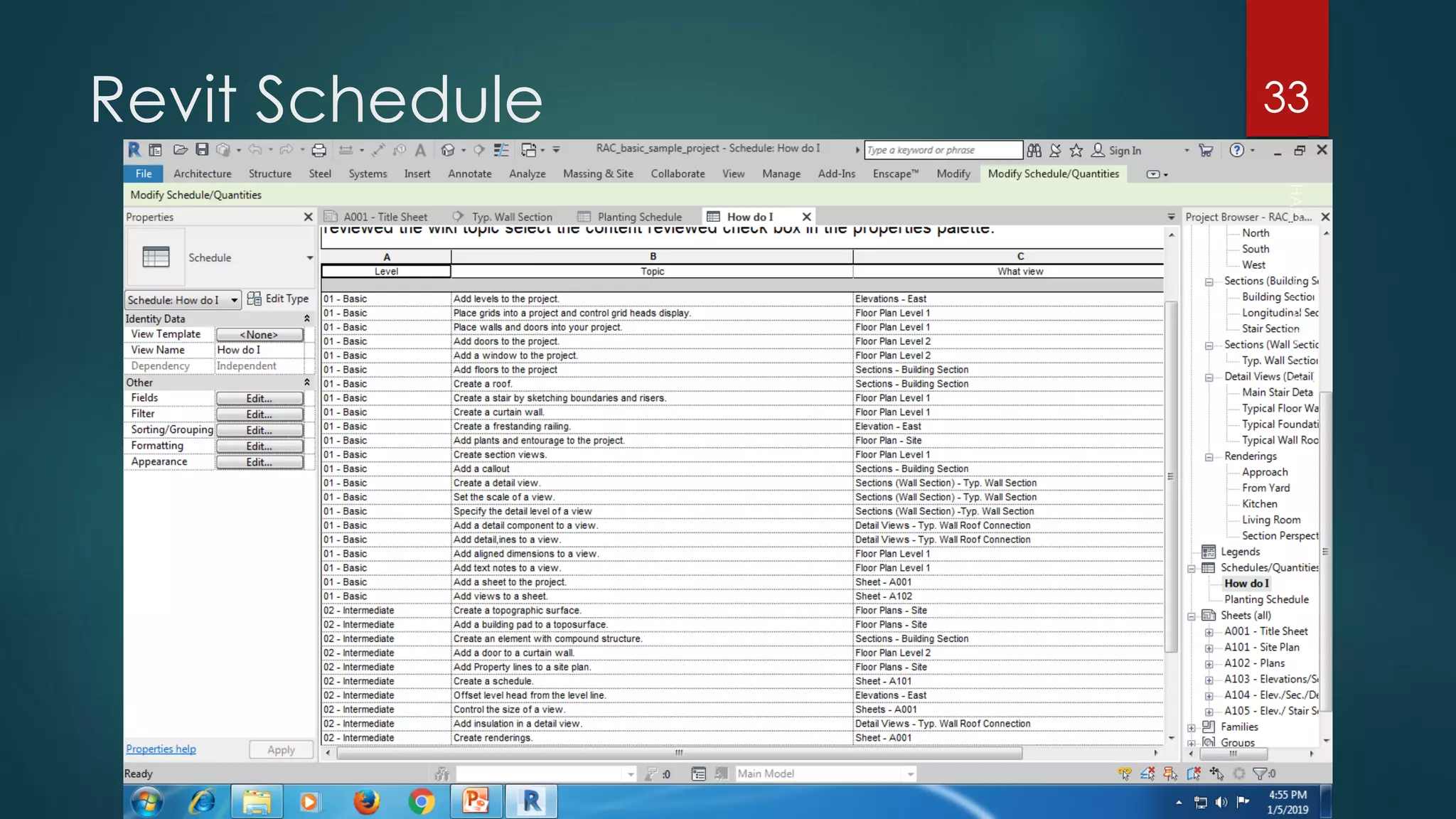
Revit Schedule 33
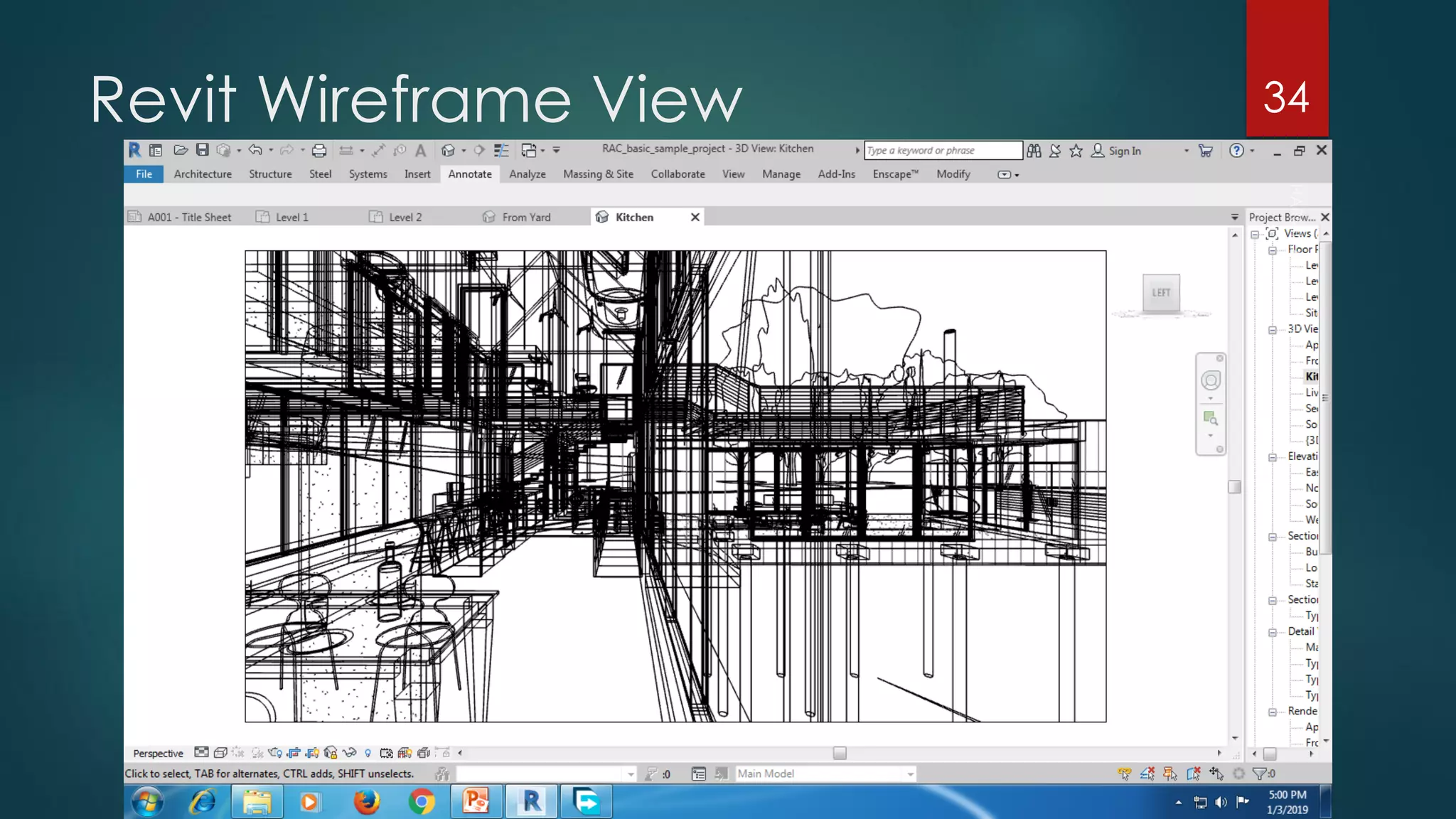
Revit Wireframe View 34
Revit Wireframe View 35
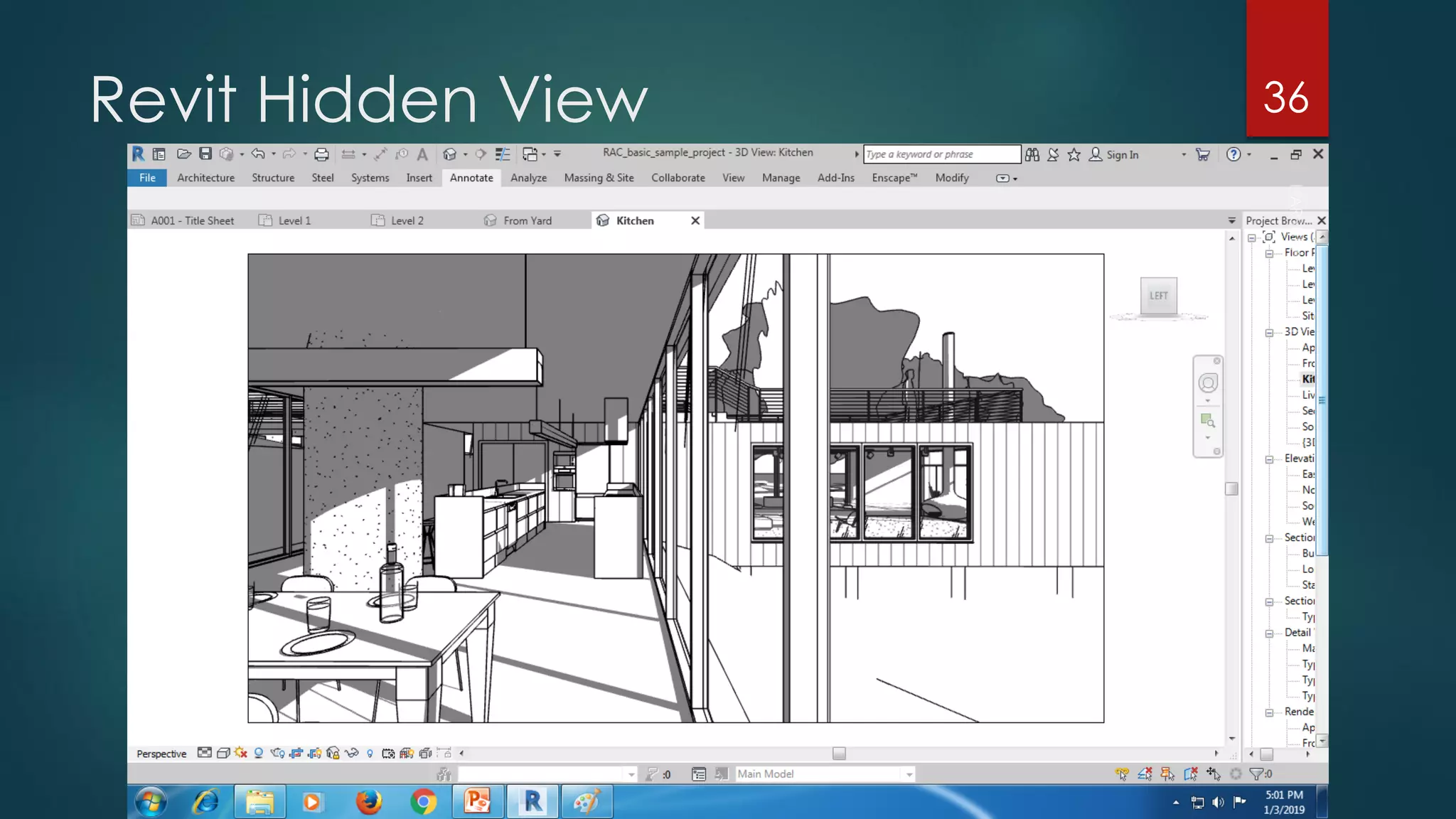
Revit Hidden View 36
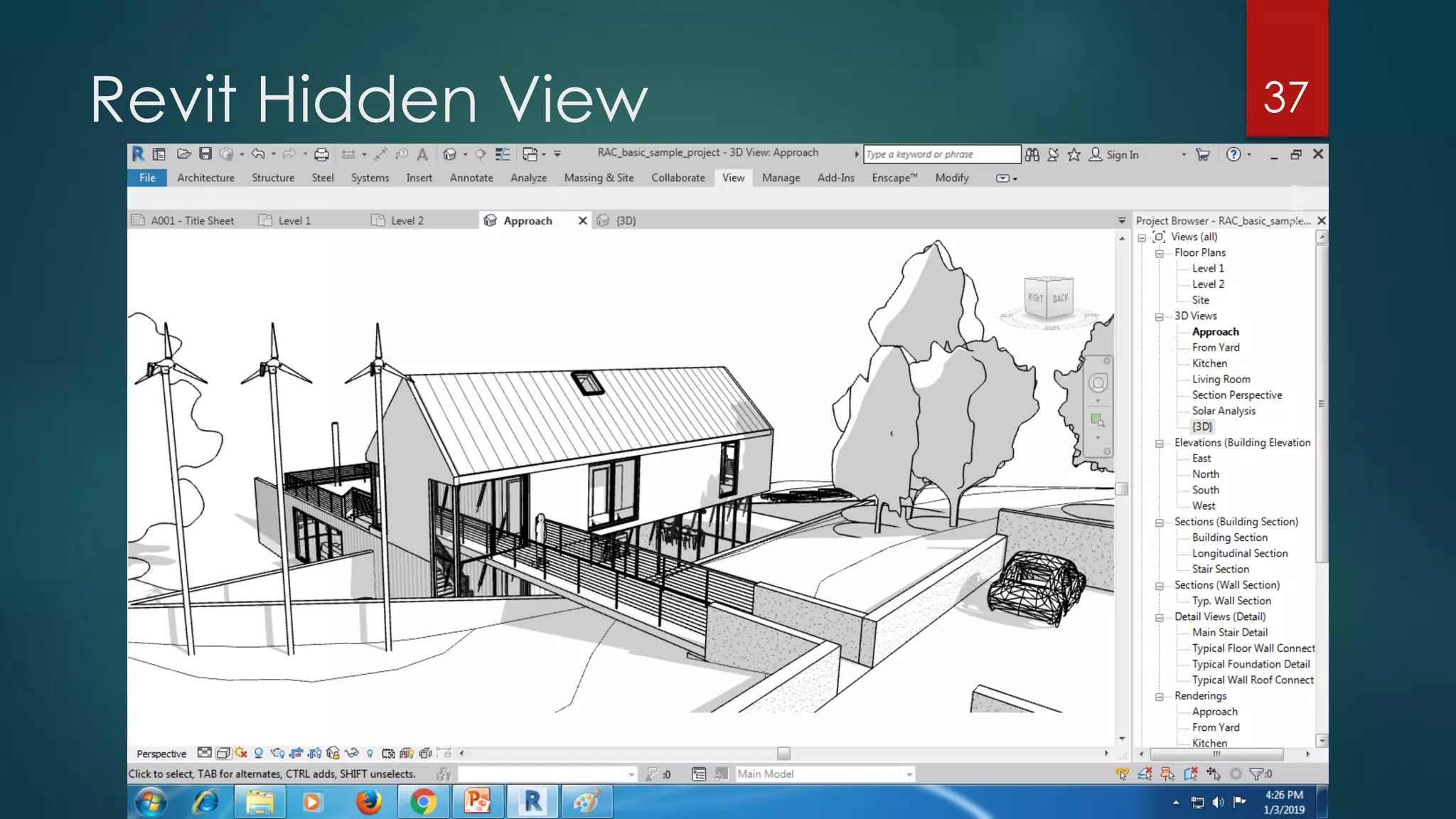
Revit Hidden View 37
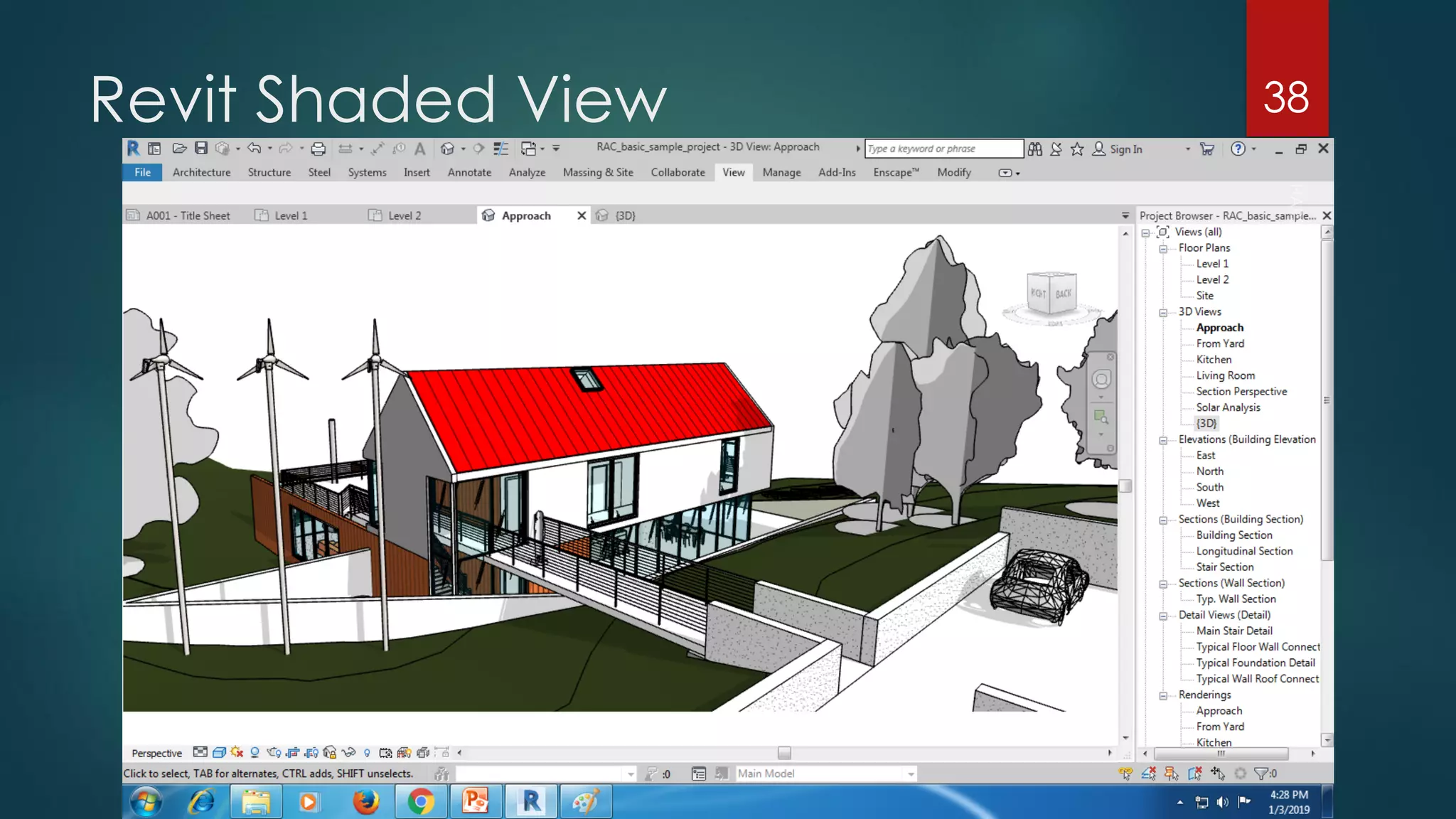
Revit Shaded View 38
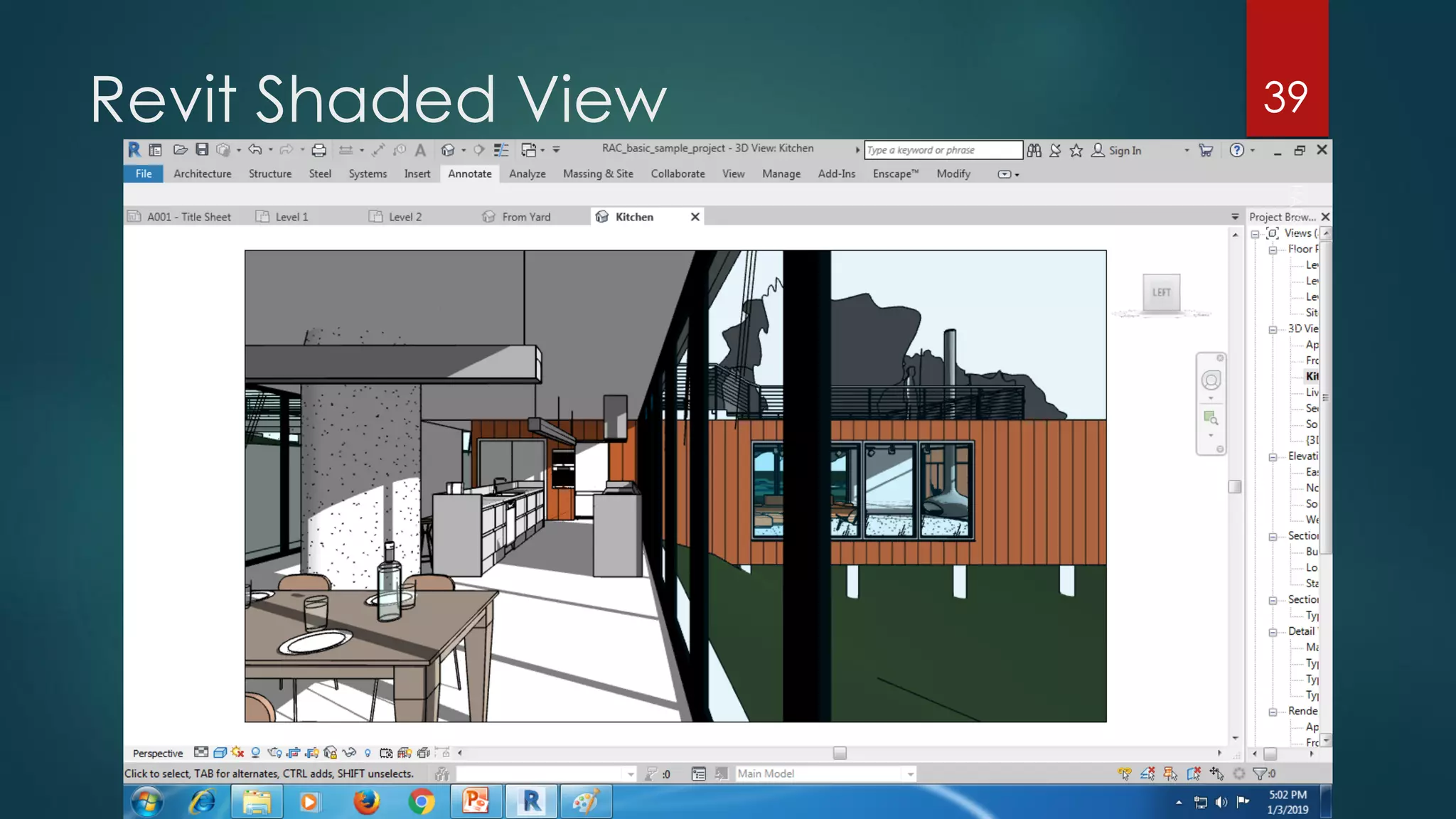
Revit Shaded View 39
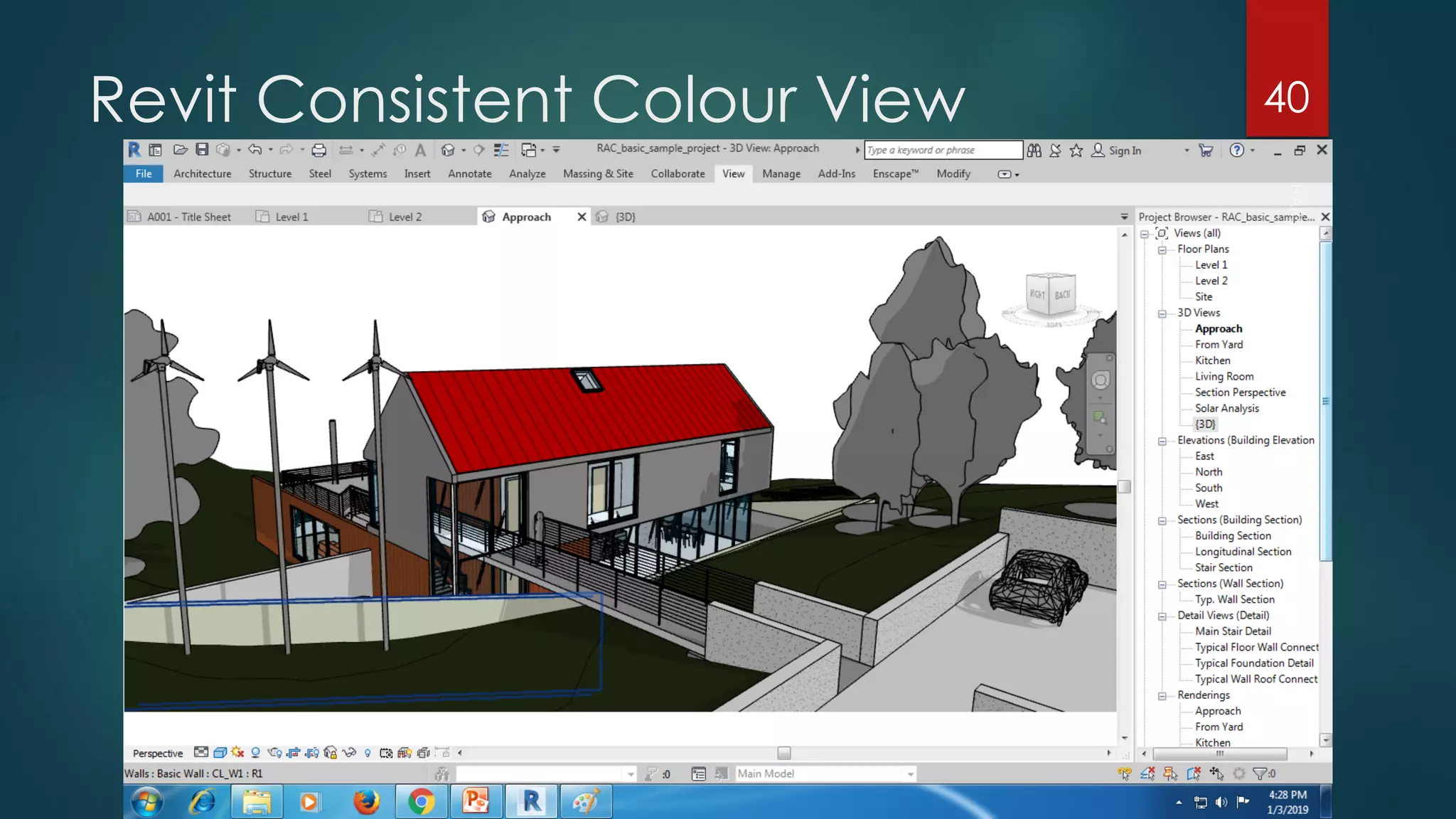
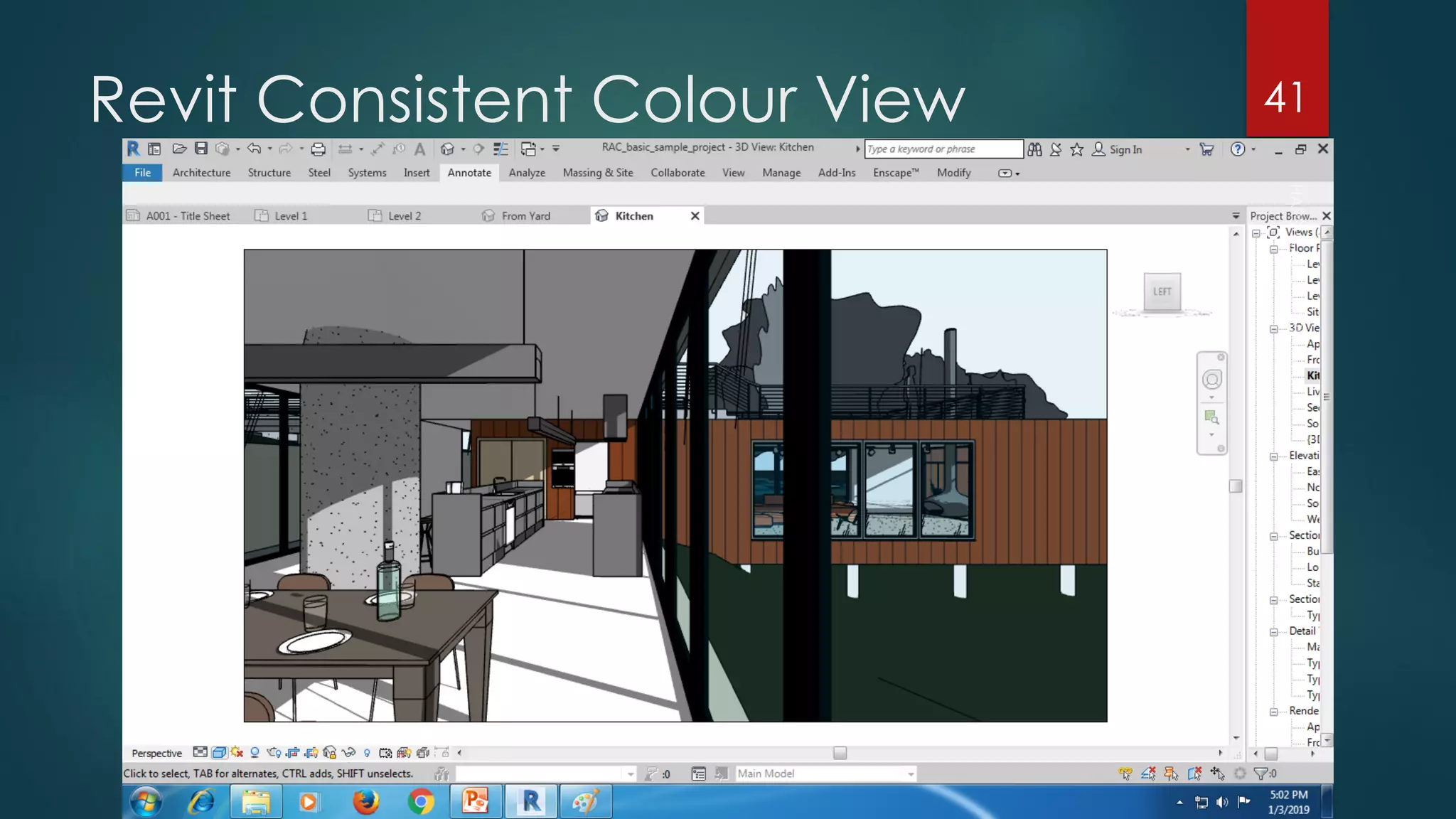
Revit Consistent Colour View 40
Revit Consistent Colour View 41
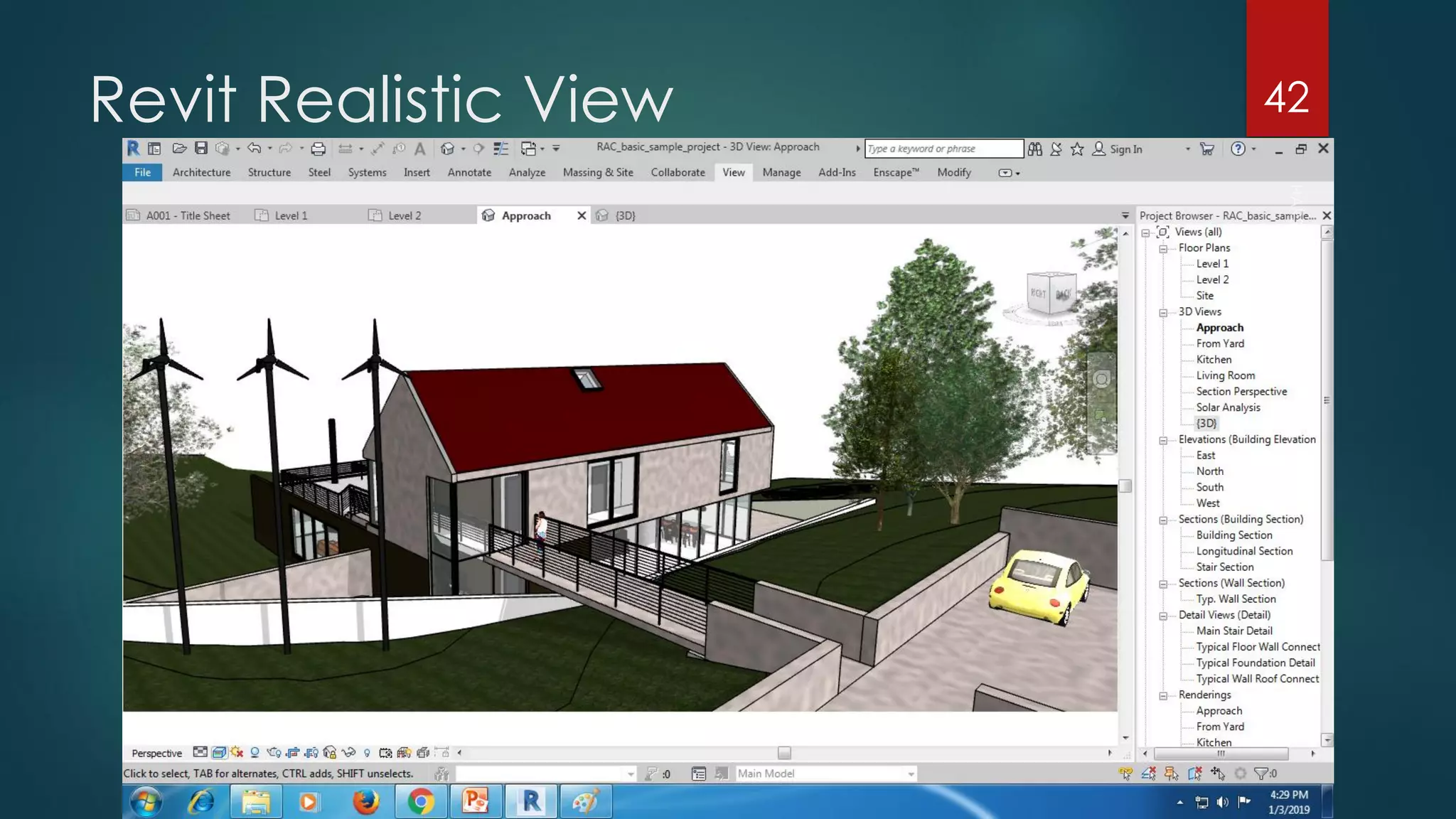
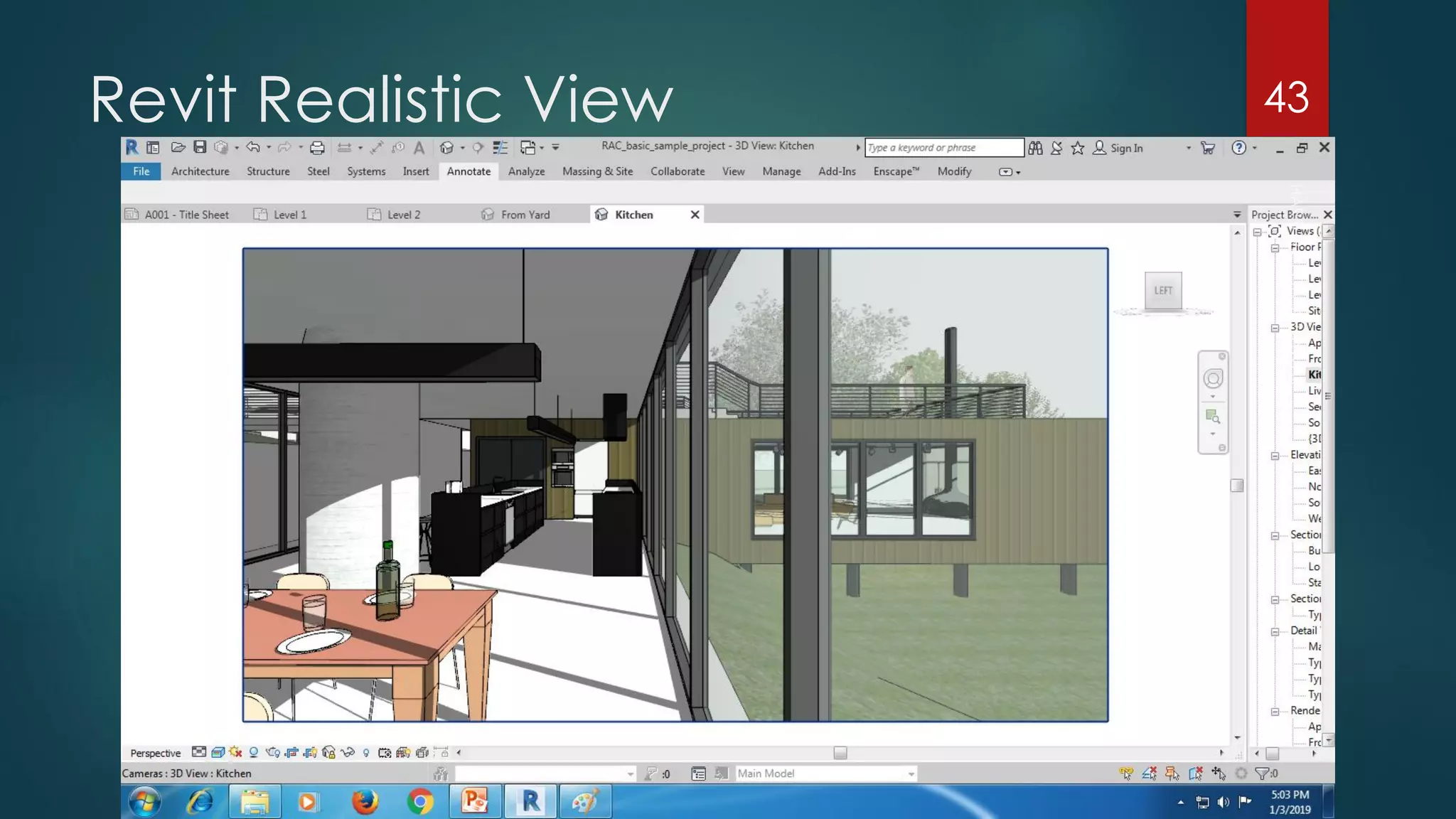
Revit Realistic View 42
Revit Realistic View 43
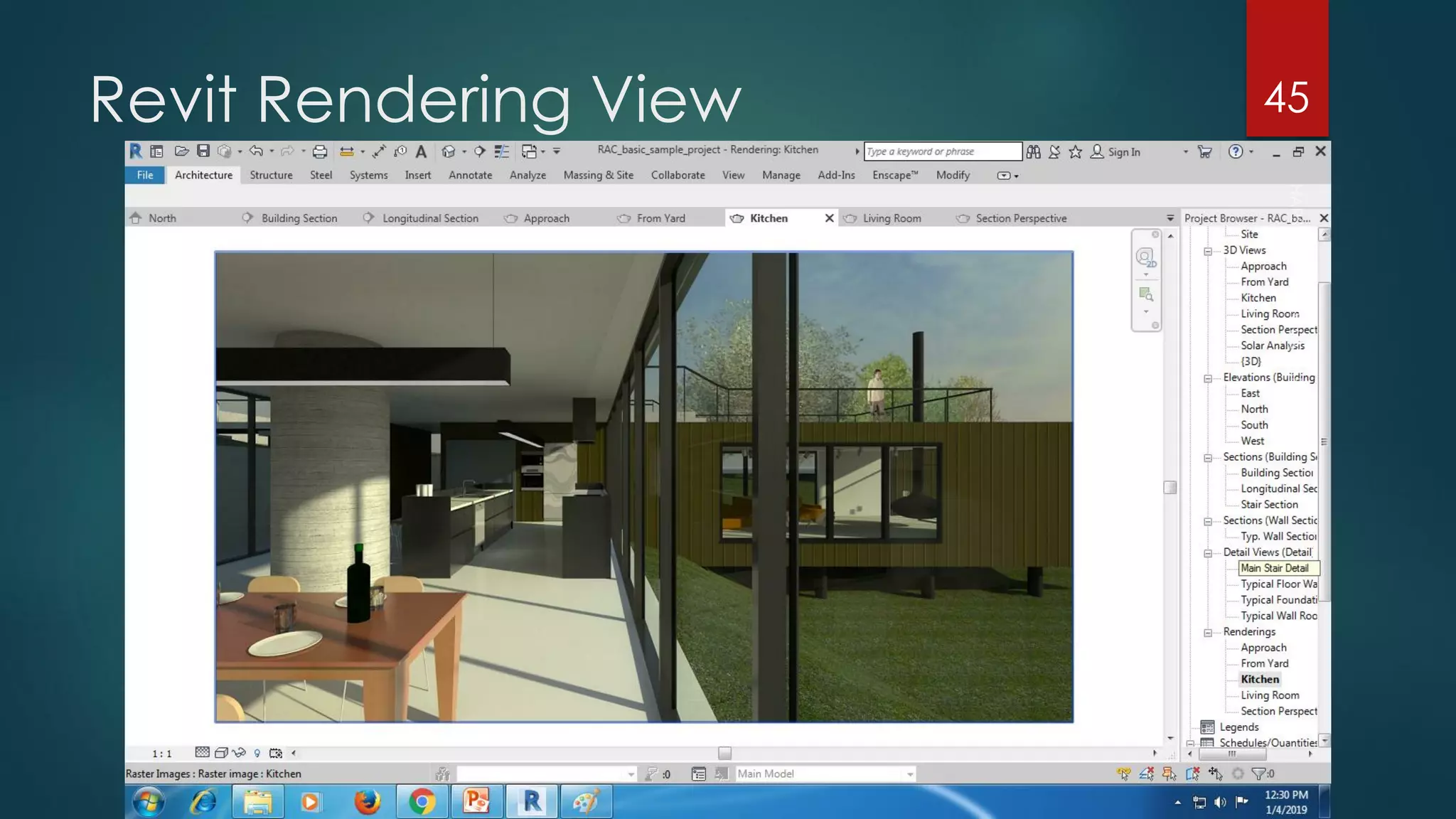
Revit Rendering View 44
Revit Rendering View 45
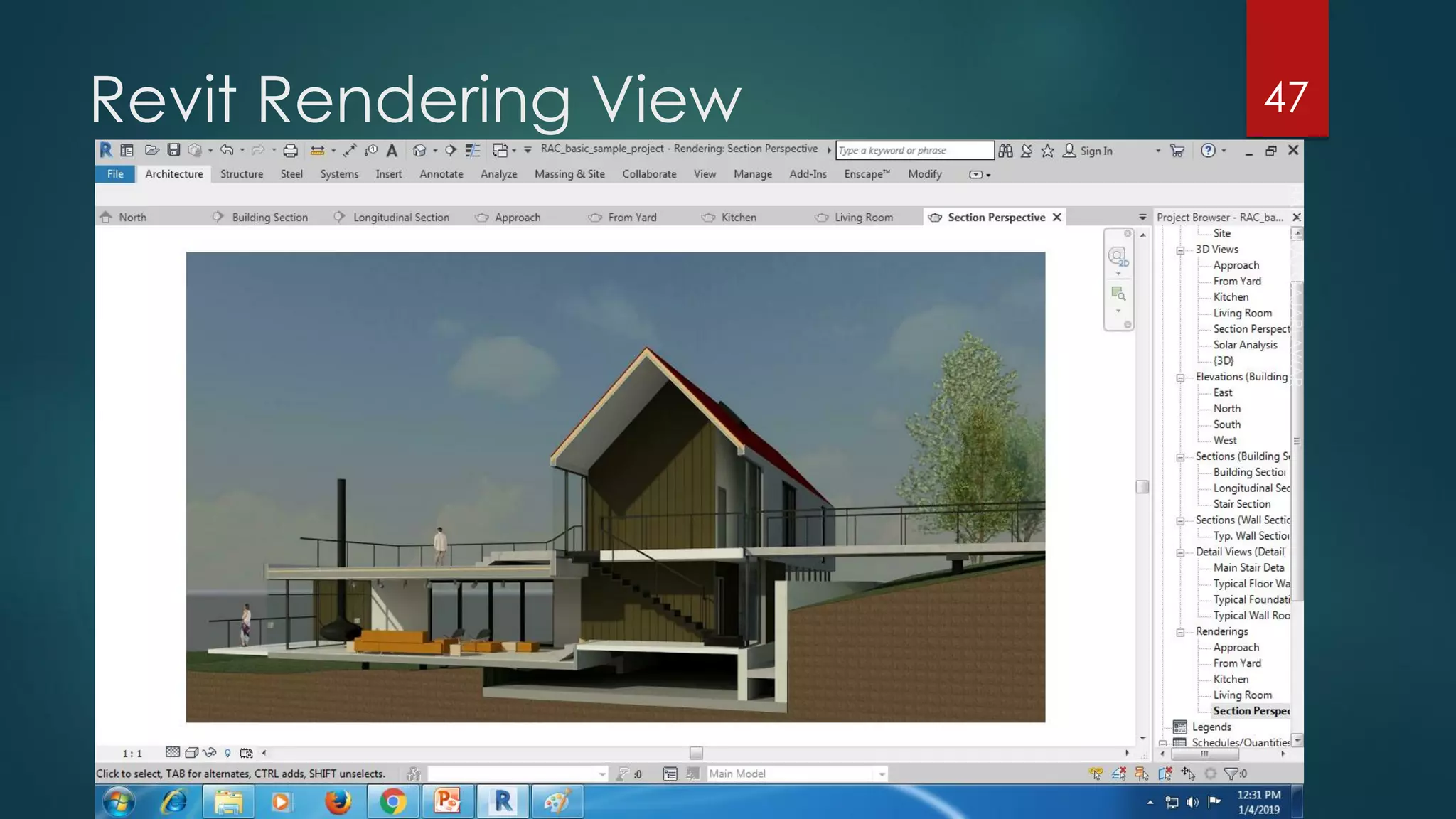
Revit Rendering View 46
Revit Rendering View 47
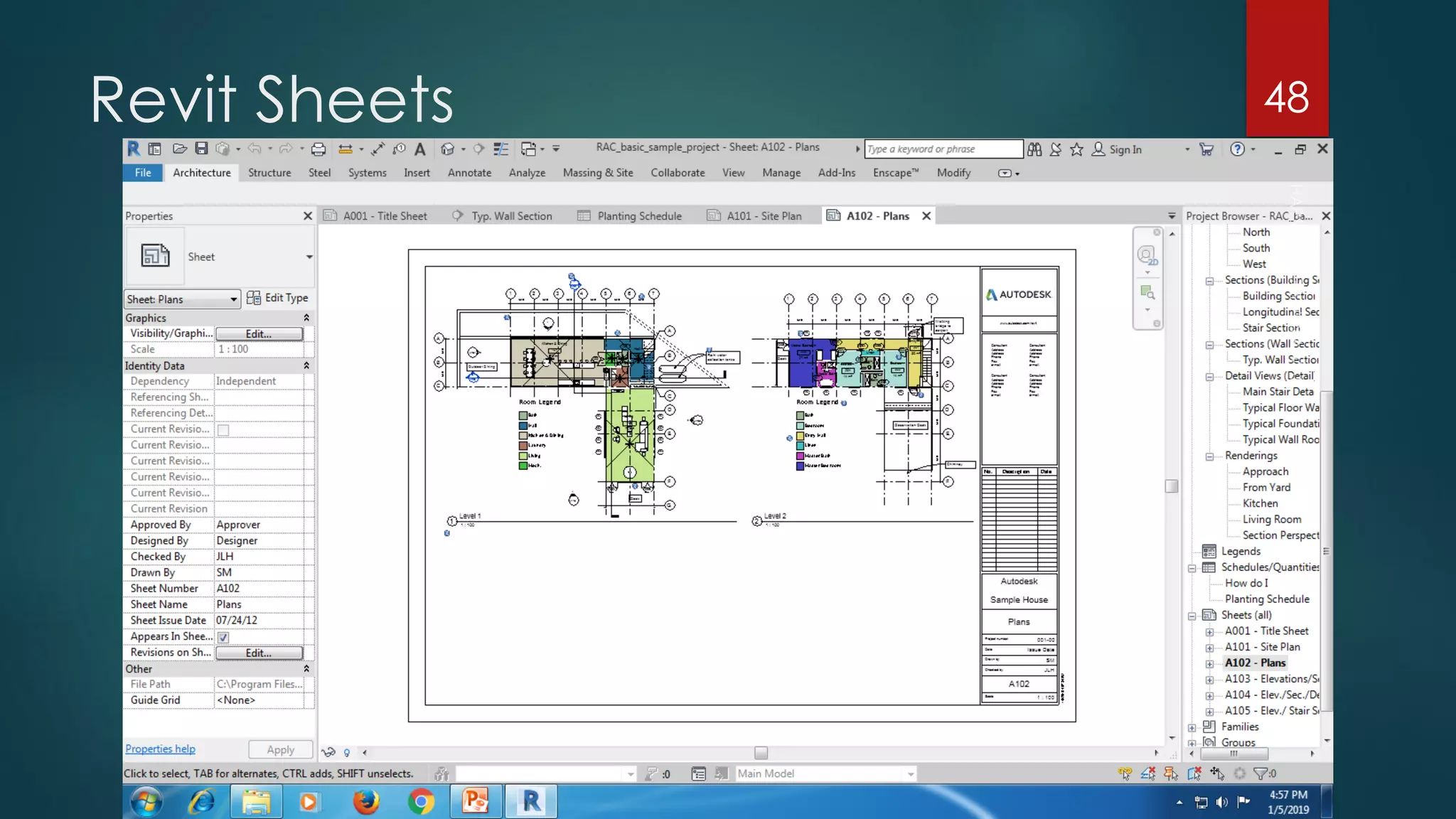
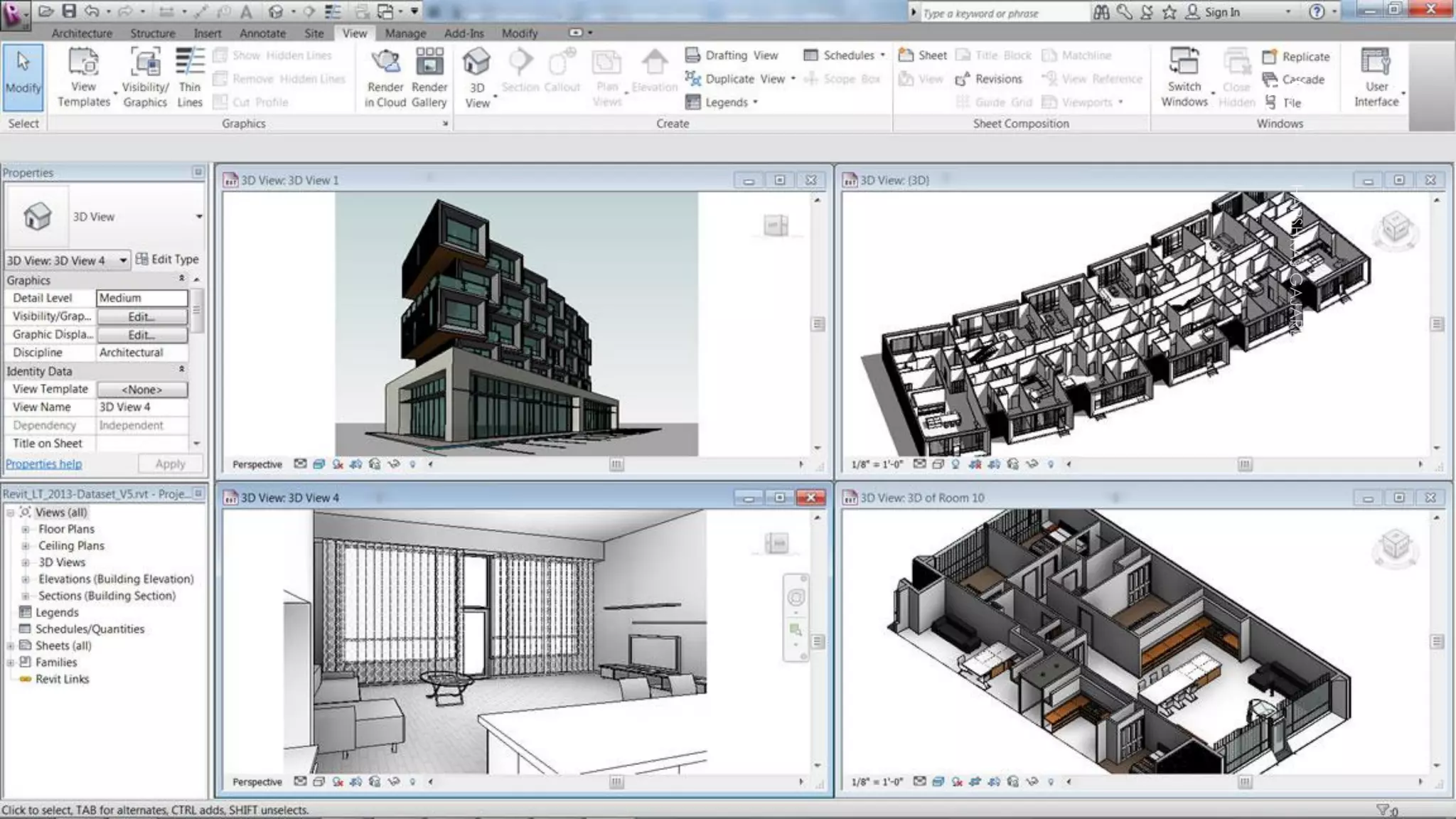
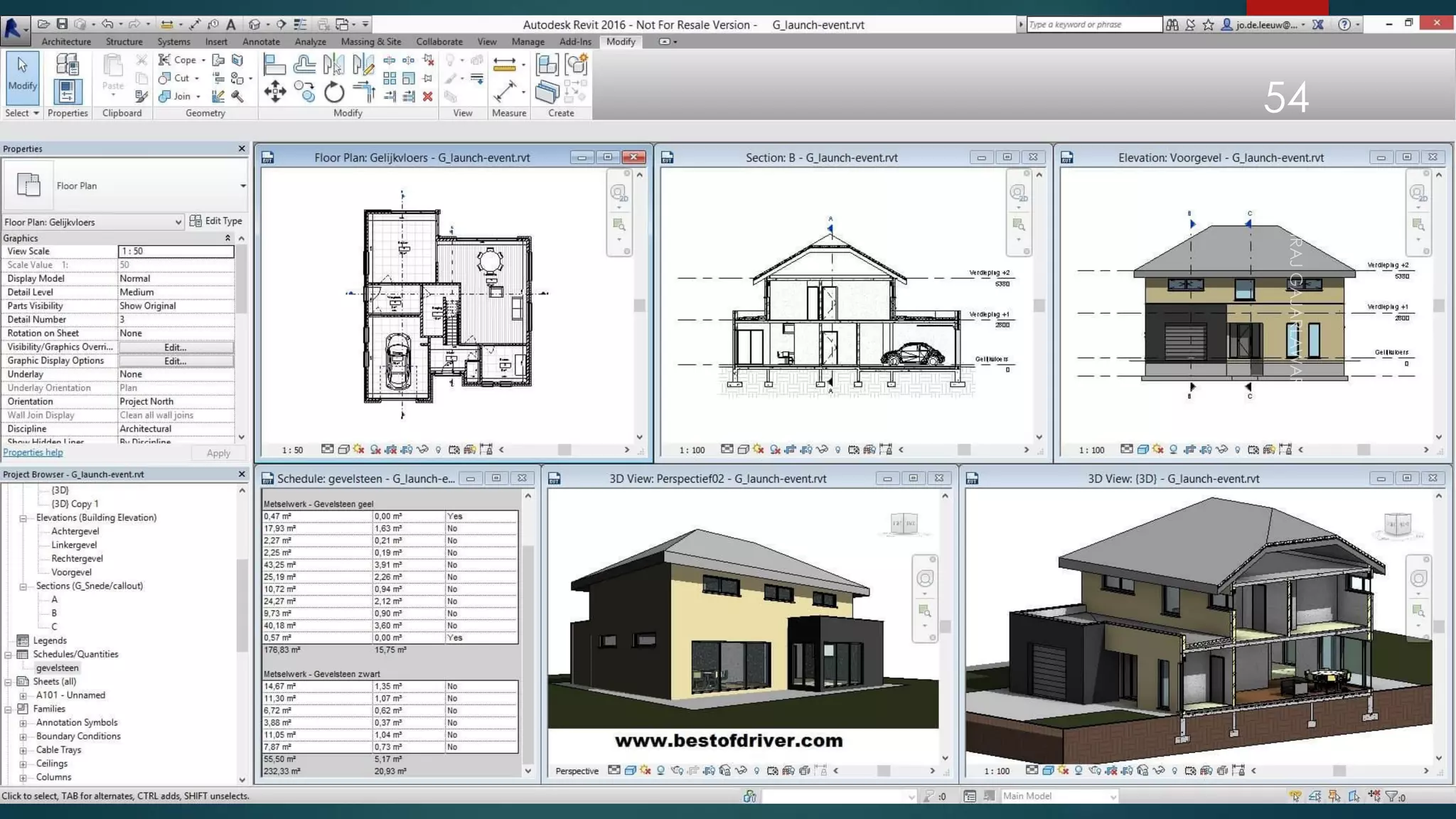
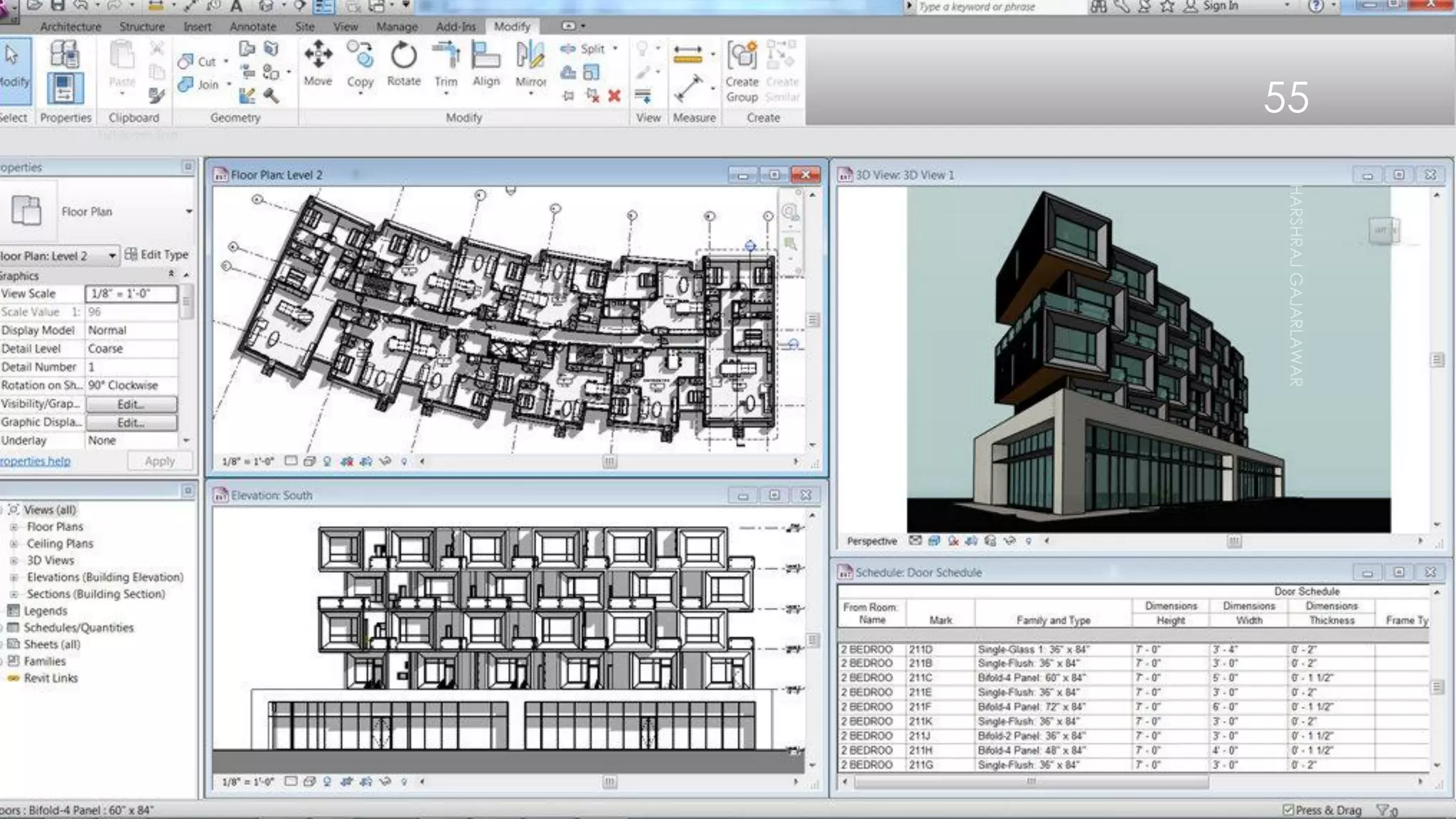
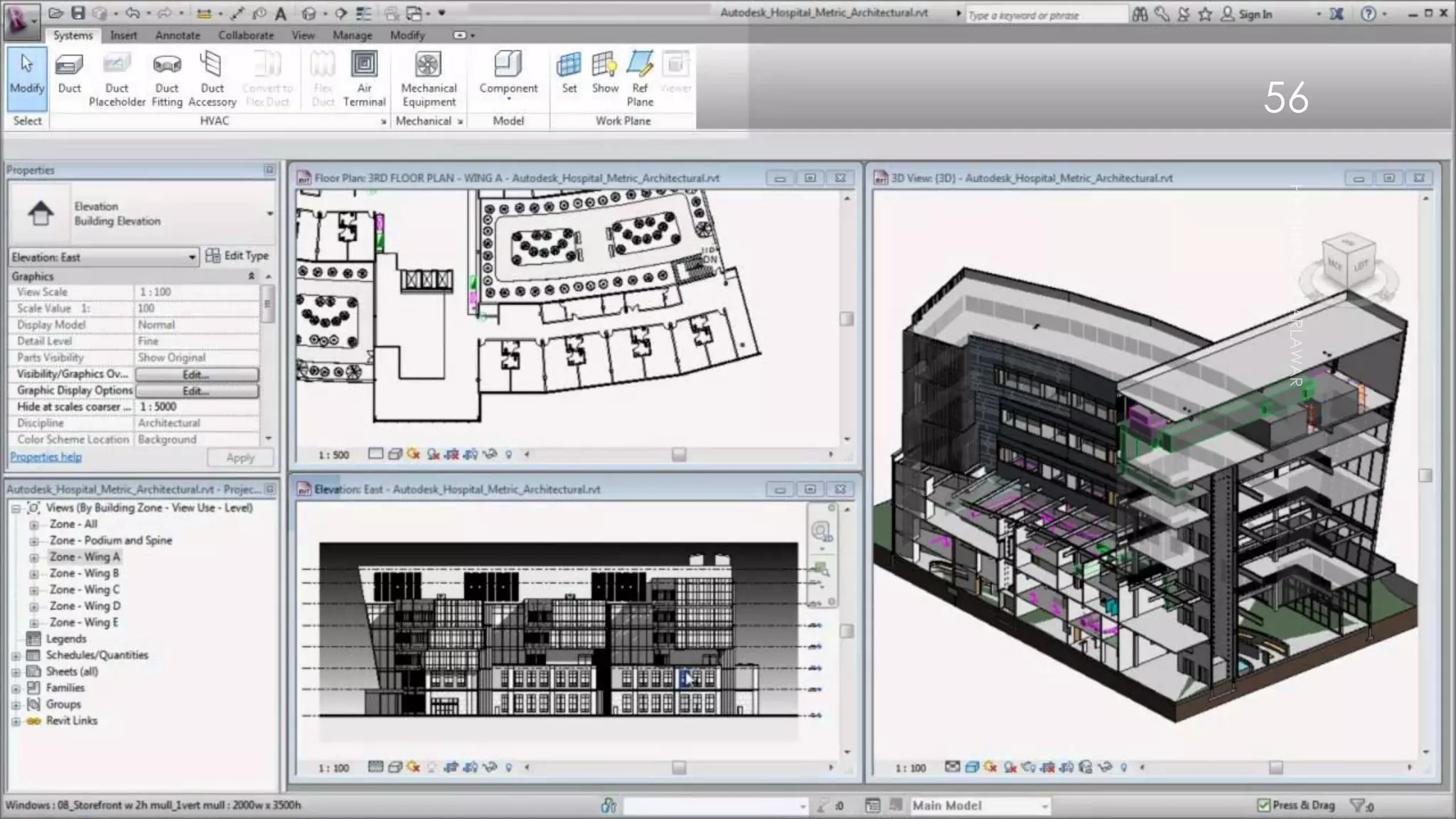
Revit Sheets 48
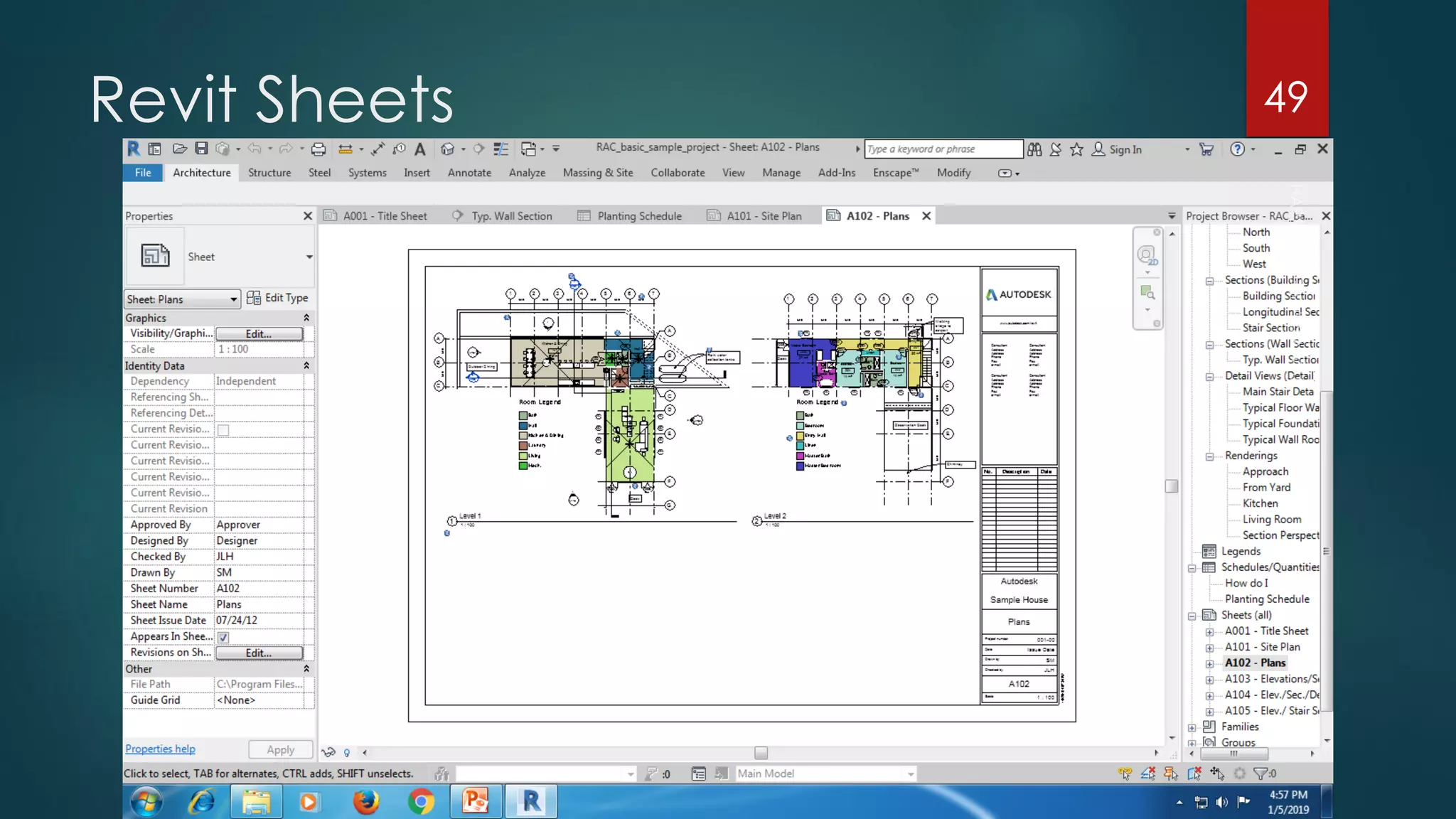
Revit Sheets 49
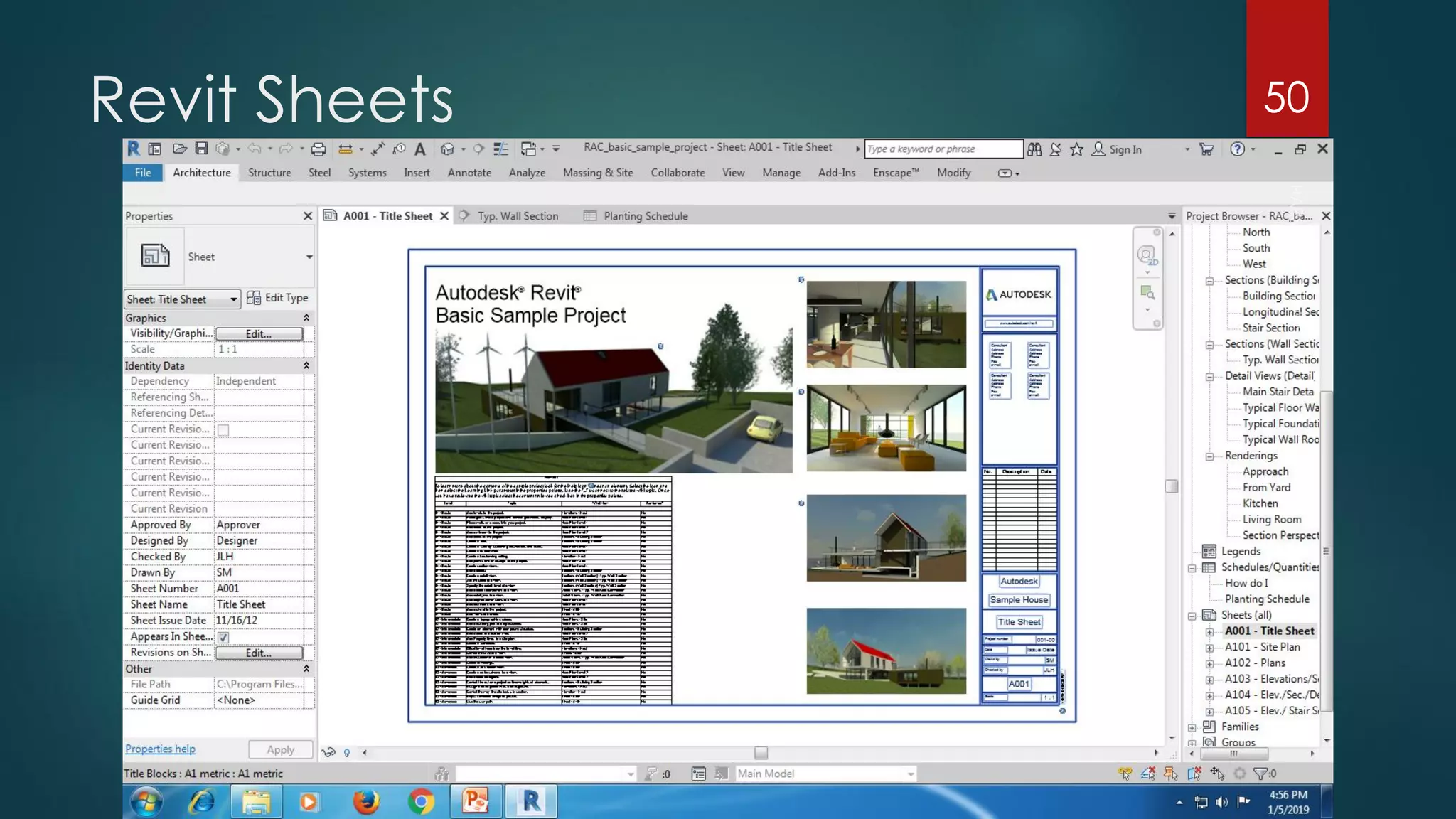
Revit Sheets 50
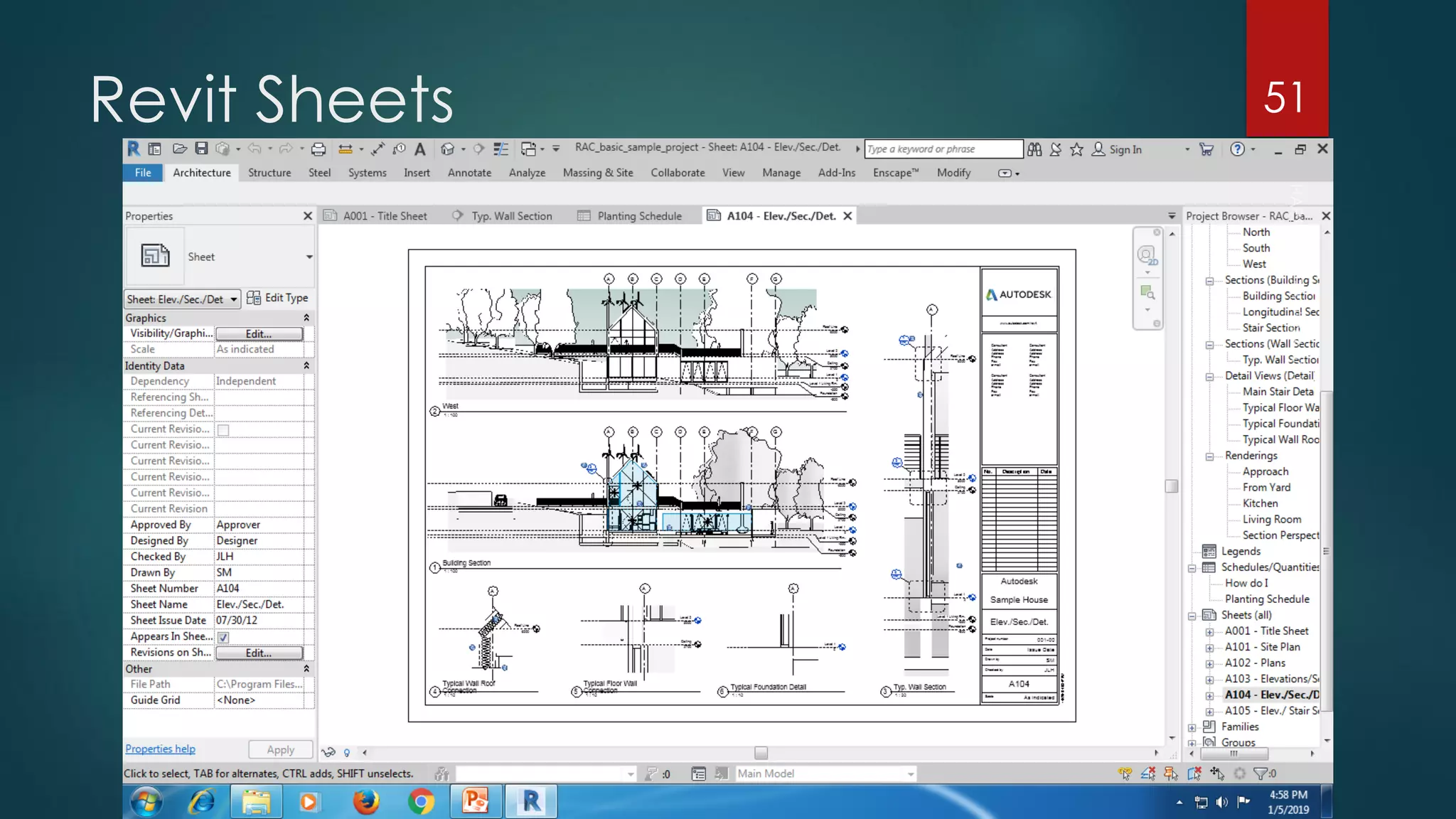
Revit Sheets 51
52
53
54
55
56
Revit Architecture
This program is designed for-
 Architecture students
 Engineering students
 Construction professionals in Architecture
 Construction consultants
57
58
CONTENTS
 • INTRODUCTION TO STAAD.Pro
 • HISTORY OF STAAD.Pro
 • STRUCTURE
 • TYPES OF STRUCTURE
 • STAAD WINDOW
 • TOOLS USED
 • VARIOUS TYPES OF CURSORS
 • PAGE CONTROL IN VARIOUS MODES
 • MODEL GENERATION
 • WIZARD
 • ASSIGNING PROPERTY
 • SUPPORTS
 • ASSIGNING LOADS
 • ANALYSIS
 • DESIGN
 • ADVANTAGES OF STAAD.Pro
 • CONCLUSION
59
INTRODUCTION
 • STAAD.Pro is a structural analysis design program software.
 • It includes a state of the art user interface, visualization tools
and international design codes.
 • It is used for 3D model generation, analysis and multi-material
design.
 • The commercial version of STAAD.Pro supports several steel
concrete and timber design codes.
 • It is one of the software applications created to help structural
engineers to automate their tasks and to remove the tedious
and long procedures of the manual methods.
60
HISTORY OF STAAD.Pro
 • STAAD.Pro was originally developed in 1997 by Research Engineers
International in Yorba Linda, CA.
 • In late 2005, Research Engineer International was bought
by Bentley Systems.
61
STRUCTURE
 • A STRUCTURE can be defined as an assemblage of elements.
STAAD is capable of analyzing and designing structures consisting of
both frame, and Finite elements. Almost any type of structure can
be analyzed by STAAD.
 Frame elements – Beam elements – 2 nodes
 Finite elements – 1.) Plate – 3 or 4 nodes
 2.) Solid – 4 to 8 nodes
 • In case of STAAD
Node becomes Joint it has a number and xyz coordinates
Beam becomes Member it has a number and nodes at its ends
Plate becomes Element it has a number and node at its corners
62
TYPES OF STRUCTURE
• A TRUSS structure consists of truss members which can have only
axial member forces and no bending in the members
• A PLANE structure is bound by a global X-Y coordinate system with
loads in the same plane
• A SPACE structure, which is a three dimensional framed structure
with loads applied in any plane, is the most general.
• A FLOOR structure is a two or three dimensional structure having
no
horizontal (global X or Z) movement of the structure [FX, FZ & MY are
restrained at every joint]. The floor framing (in global X-Z plane) of a
building is an ideal example of a FLOOR structure. Columns can also
be modelled with the floor in a FLOOR structure as long as the
structure has no horizontal loading. If there is any horizontal load, it
must be analyzed as a SPACE structure.
63
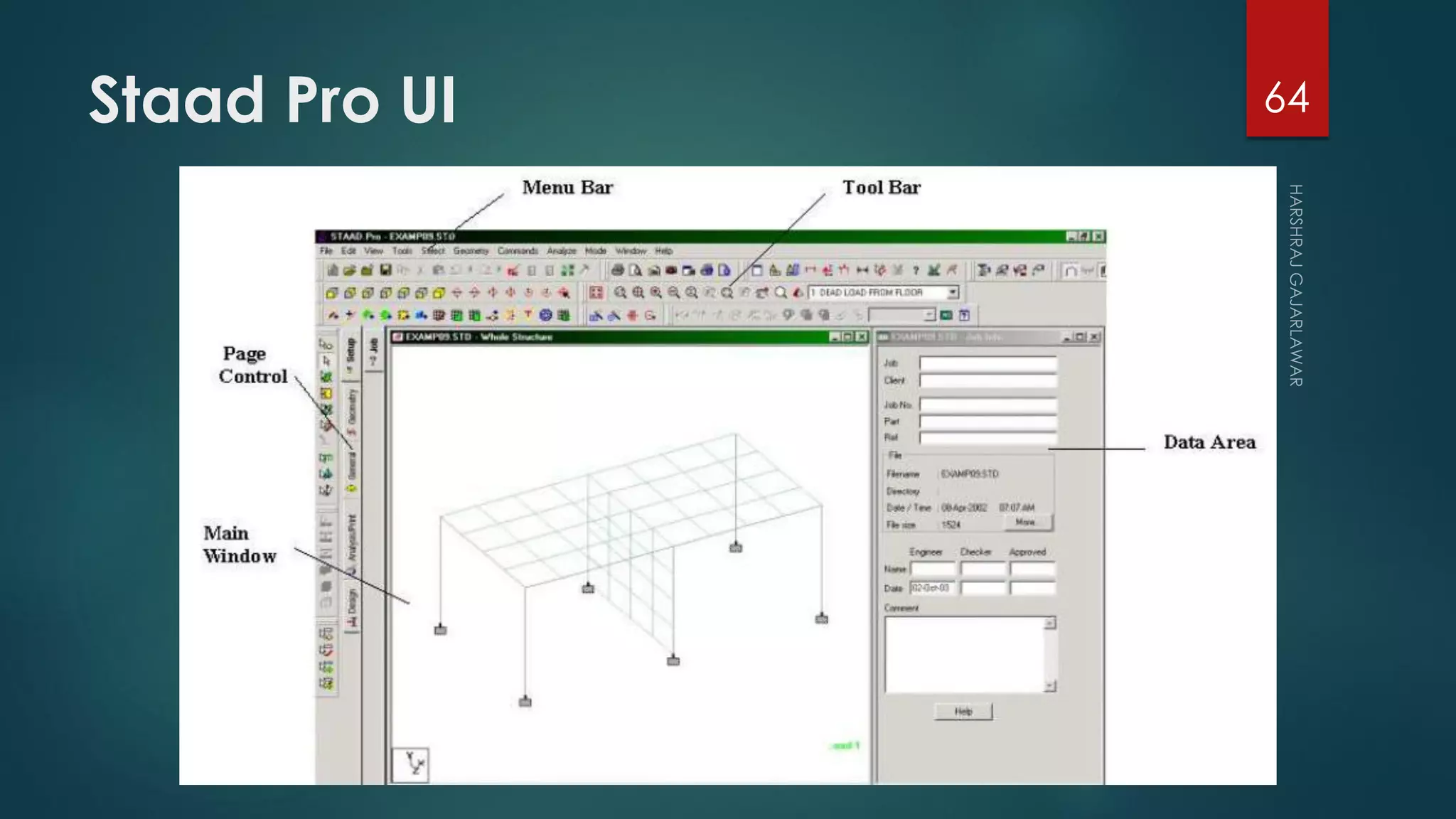
Staad Pro UI 64
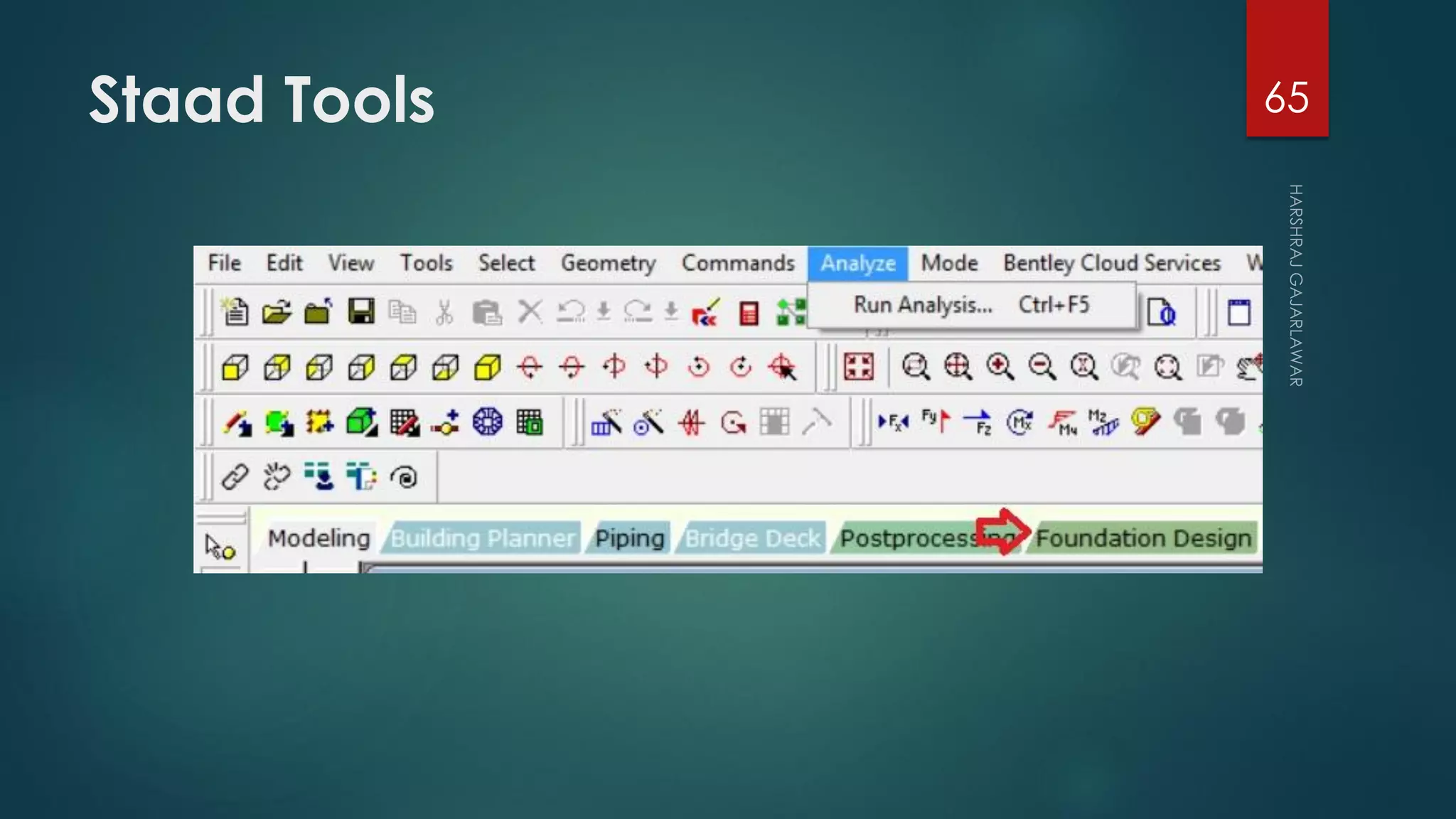
Staad Tools 65
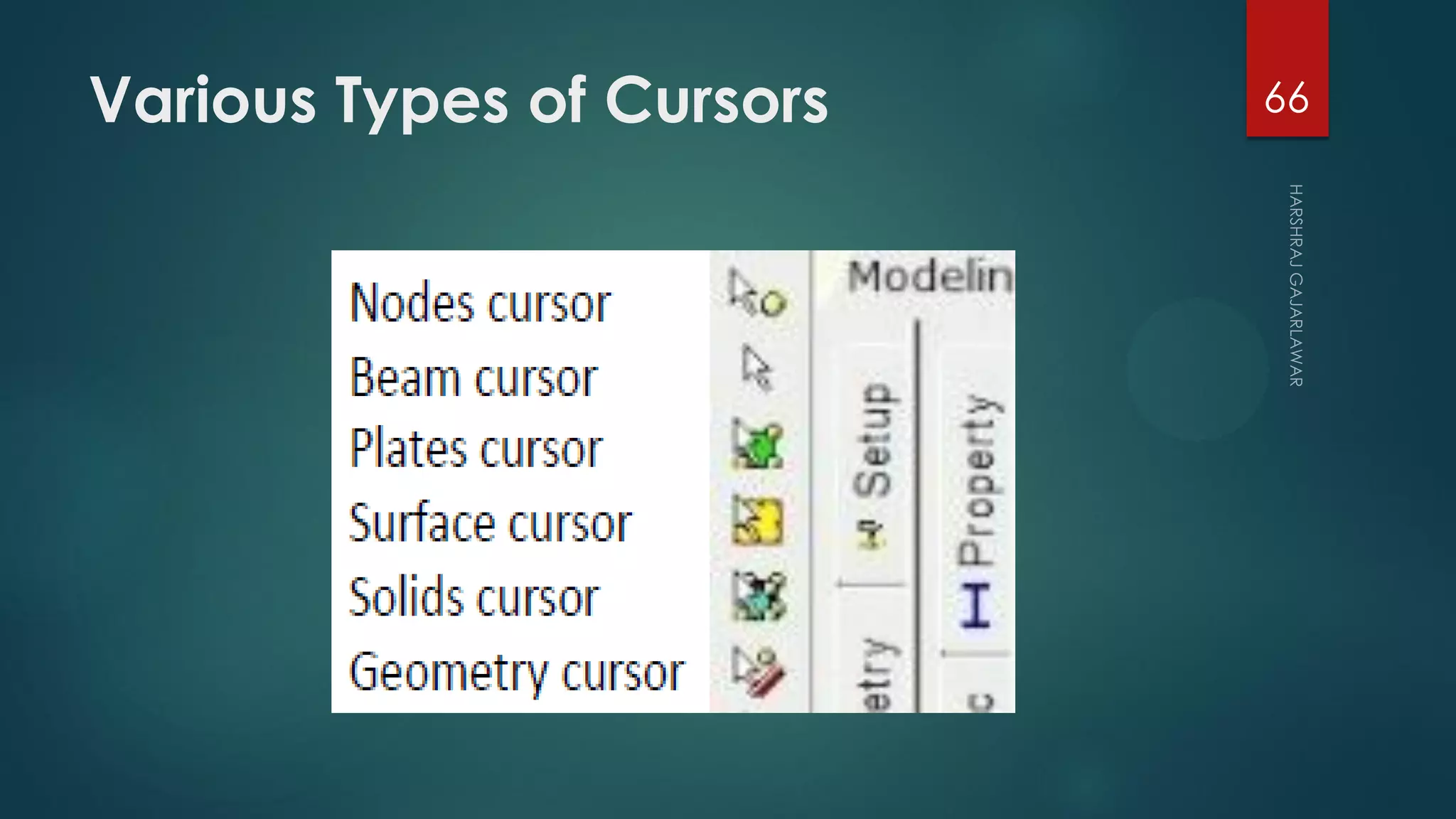
Various Types of Cursors 66
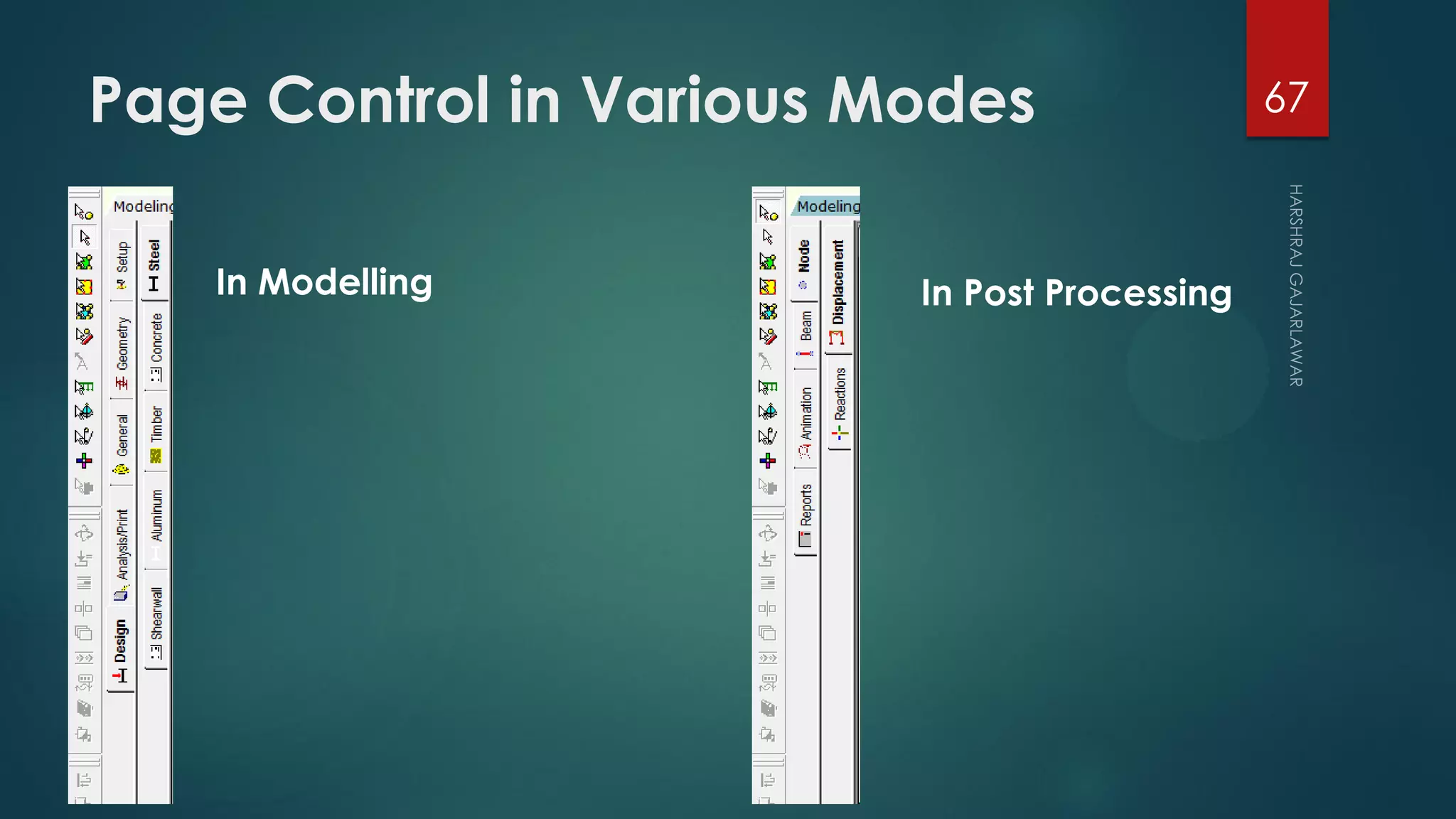
Page Control in Various Modes
In Modelling In Post Processing
67
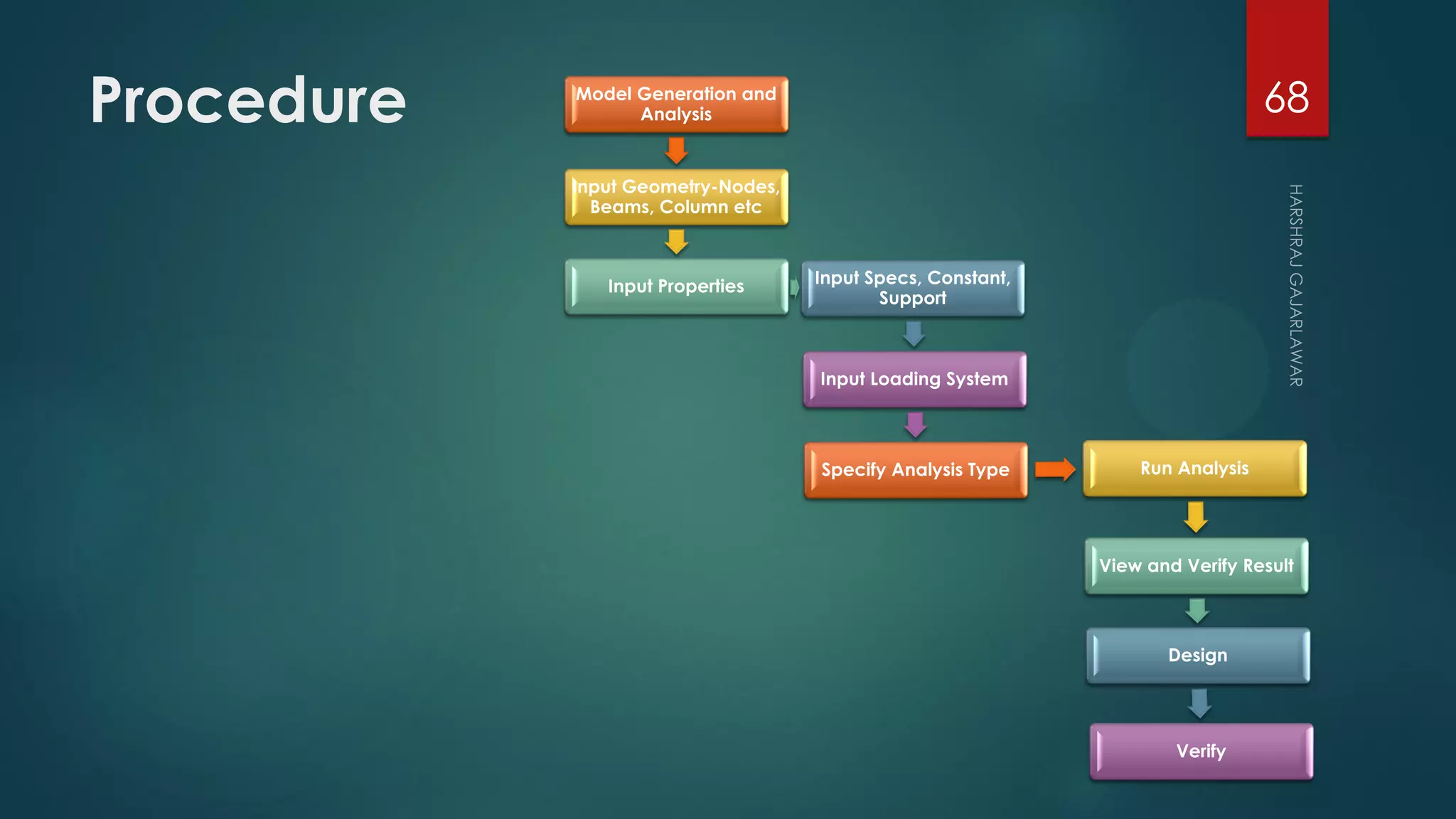
Procedure Model Generation and
Analysis
Input Geometry-Nodes,
Beams, Column etc
Input Properties Input Specs, Constant,
Support
Input Loading System
Specify Analysis Type Run Analysis
View and Verify Result
Design
Verify
68
MODEL GENERATION
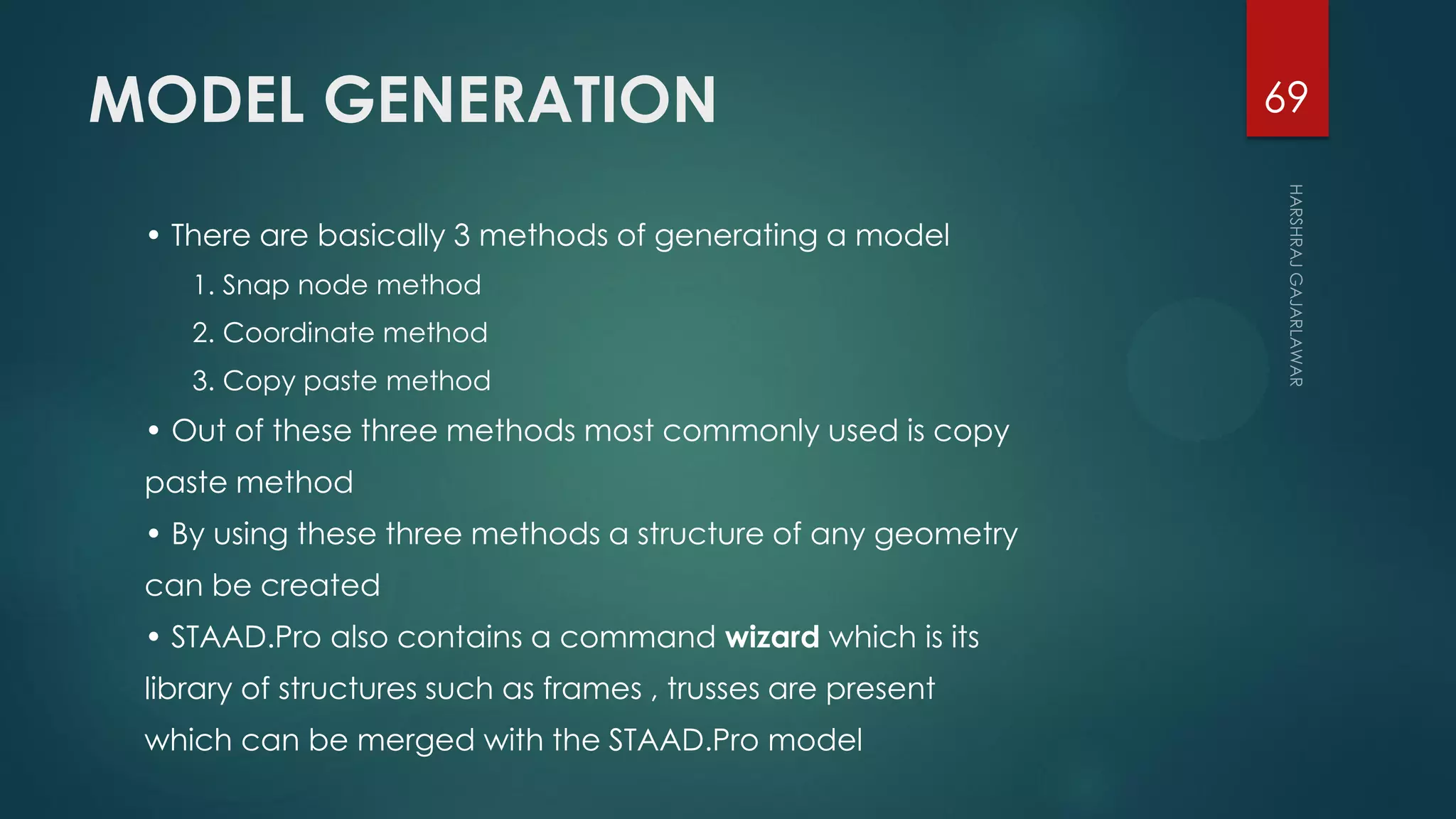
• There are basically 3 methods of generating a model
1. Snap node method
2. Coordinate method
3. Copy paste method
• Out of these three methods most commonly used is copy
paste method
• By using these three methods a structure of any geometry
can be created
• STAAD.Pro also contains a command wizard which is its
library of structures such as frames , trusses are present
which can be merged with the STAAD.Pro model
69
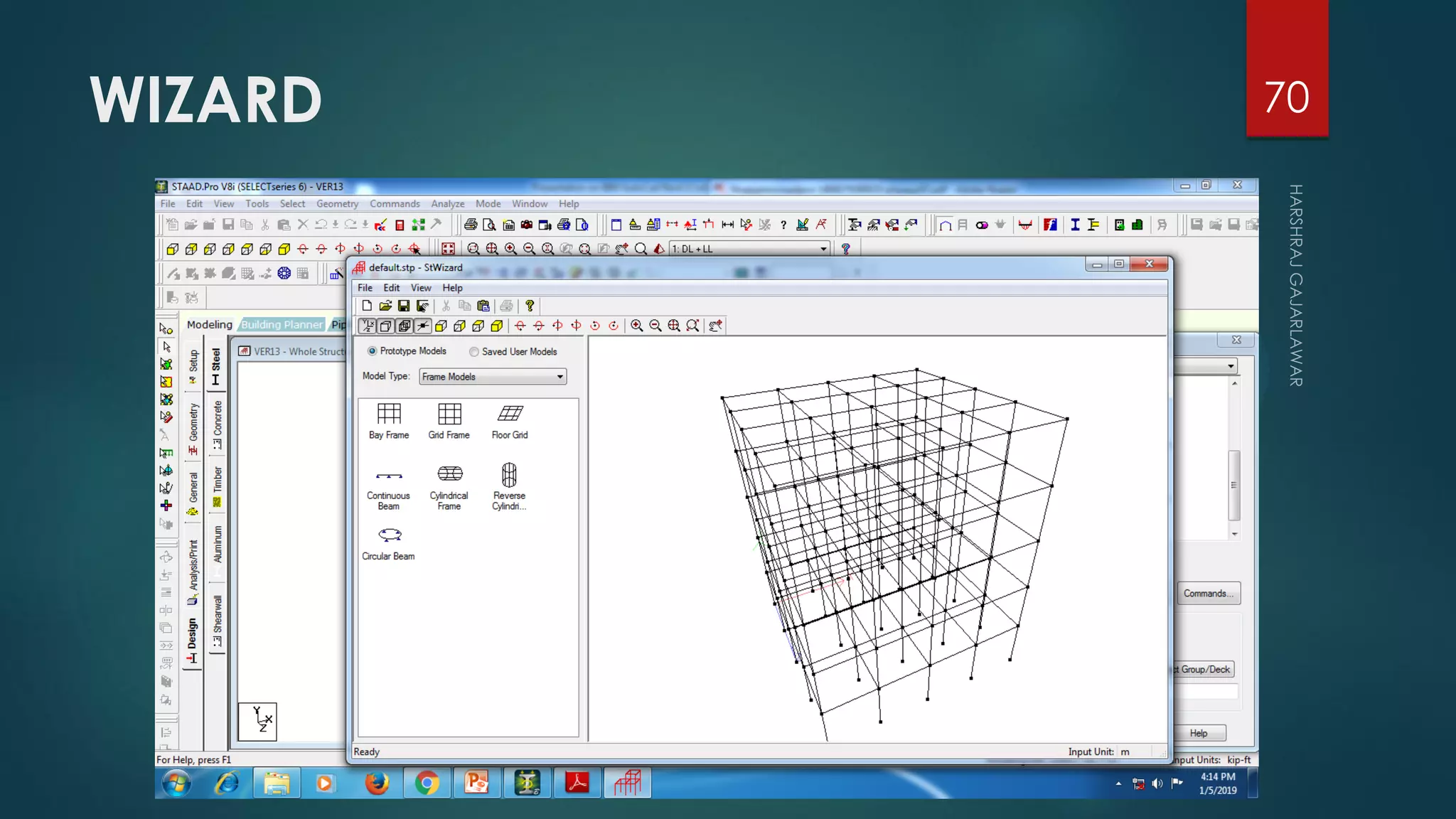
WIZARD 70
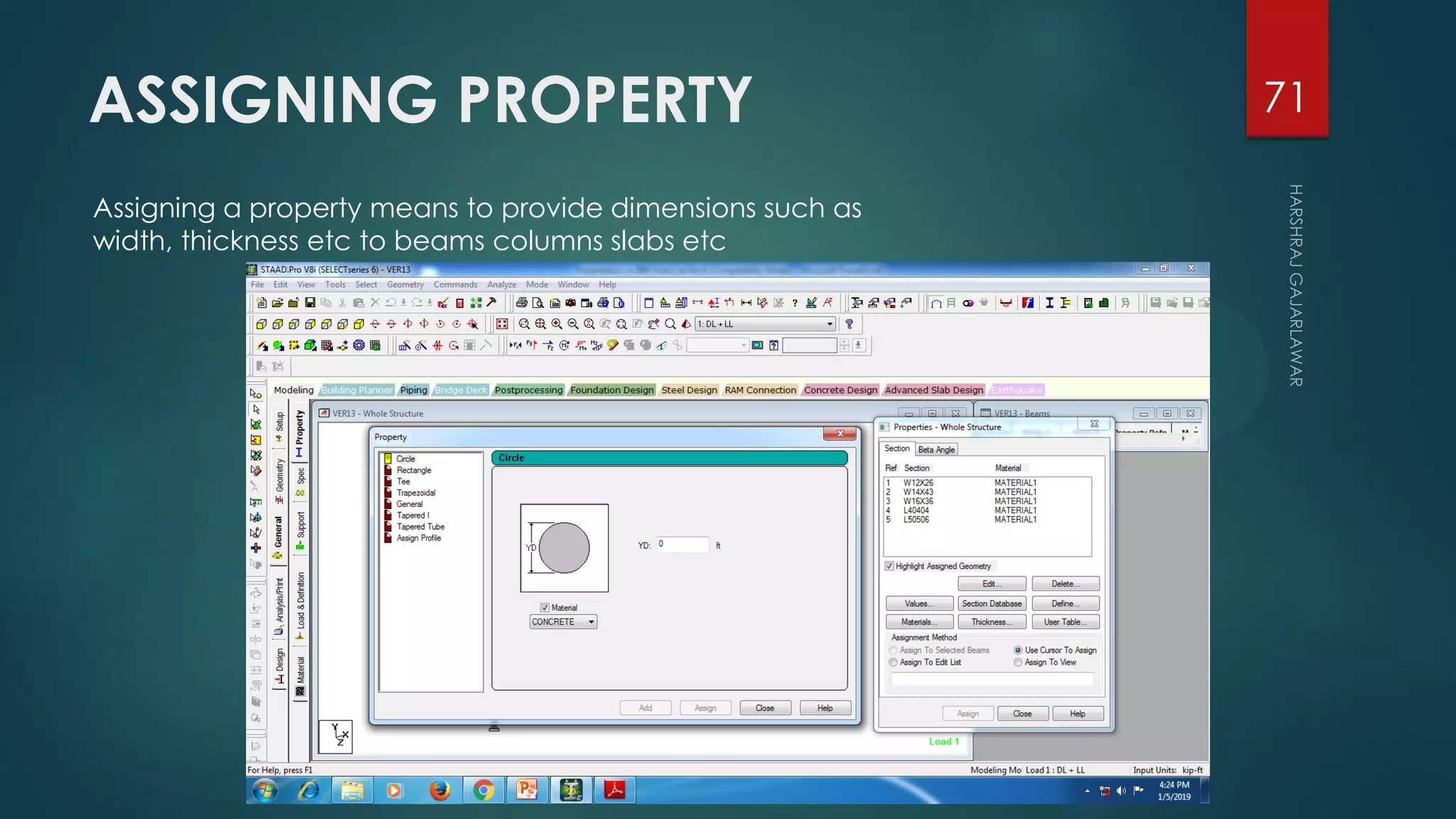
ASSIGNING PROPERTY
Assigning a property means to provide dimensions such as
width, thickness etc to beams columns slabs etc
71
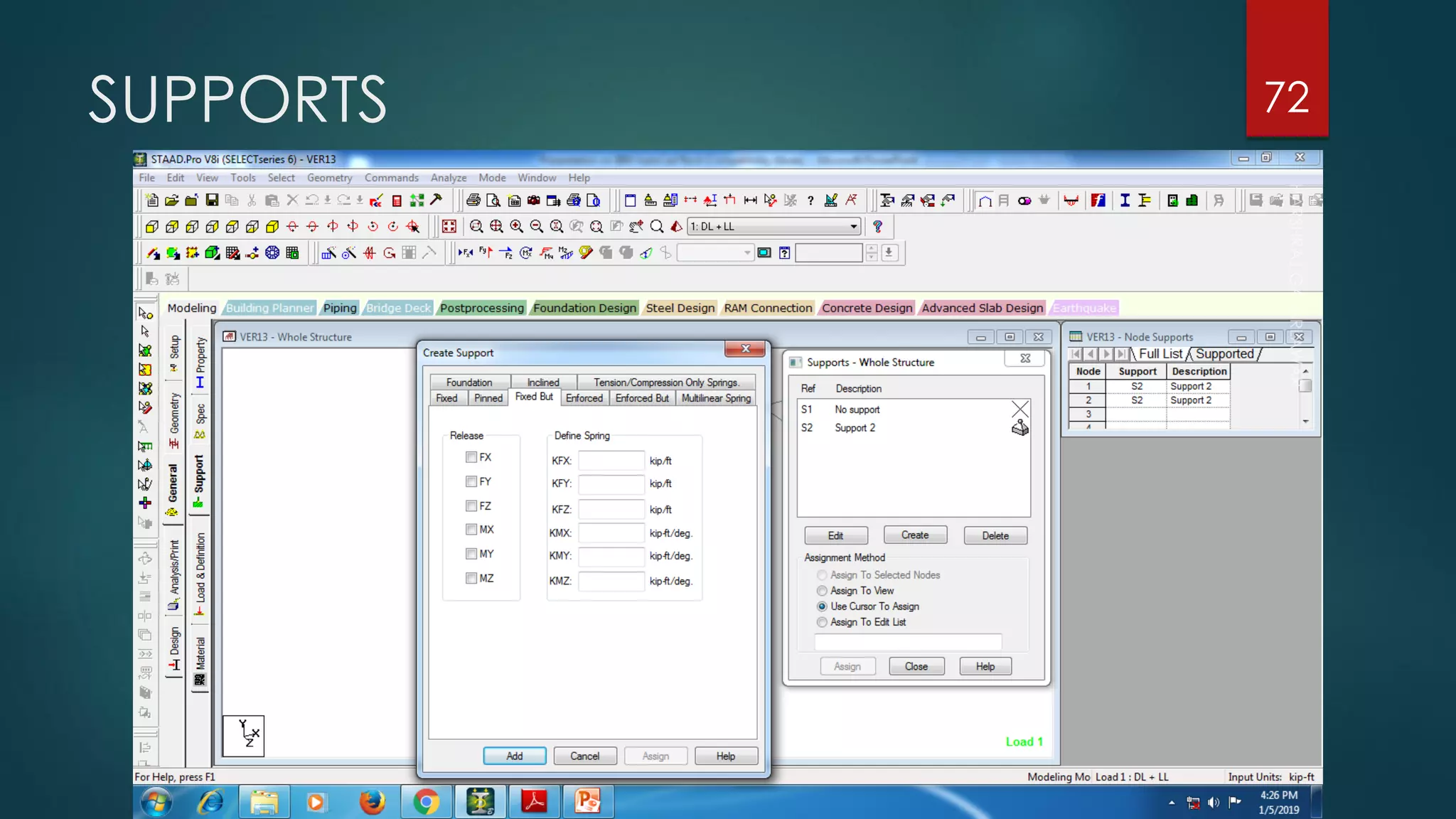
SUPPORTS 72
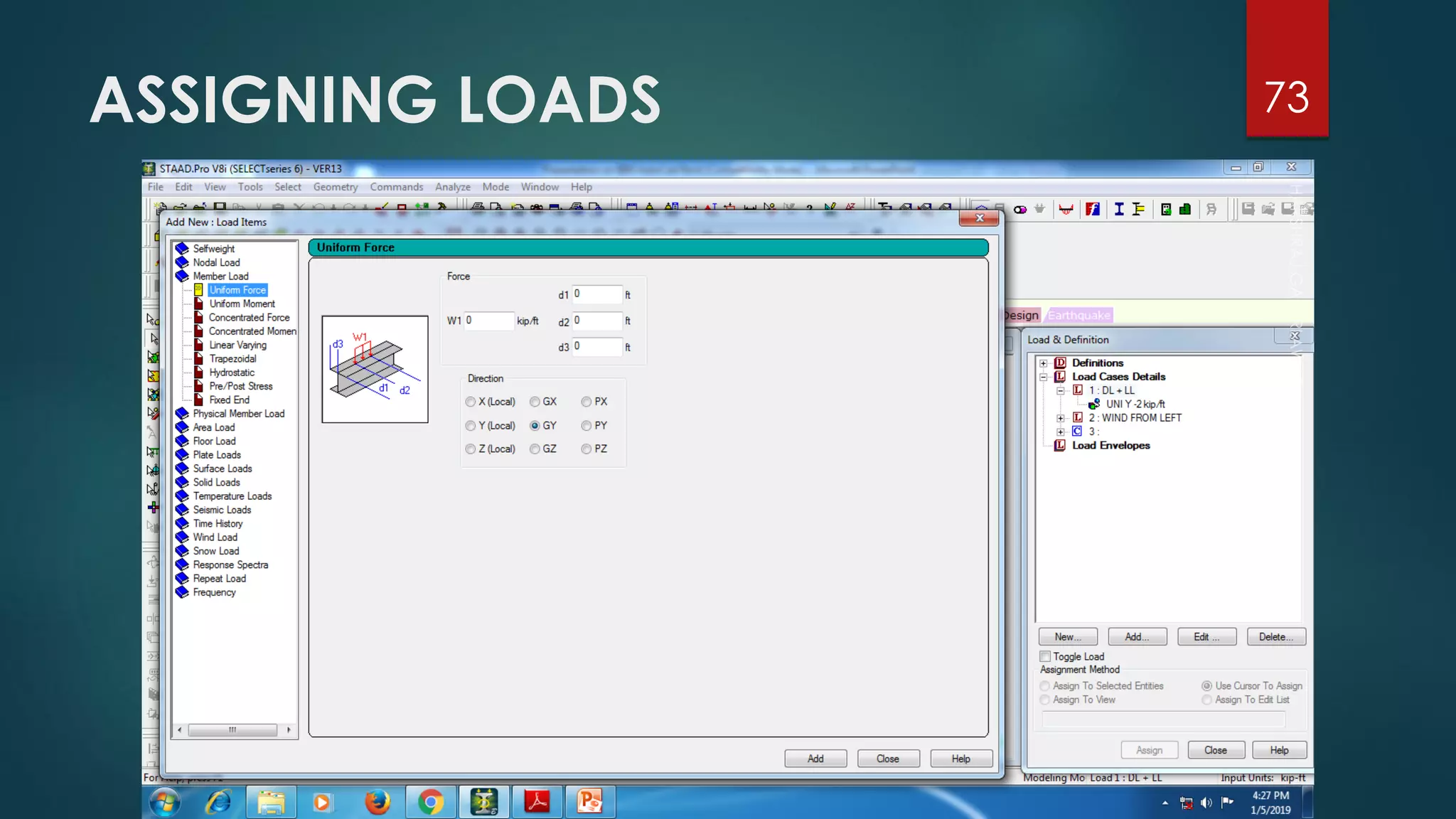
ASSIGNING LOADS 73
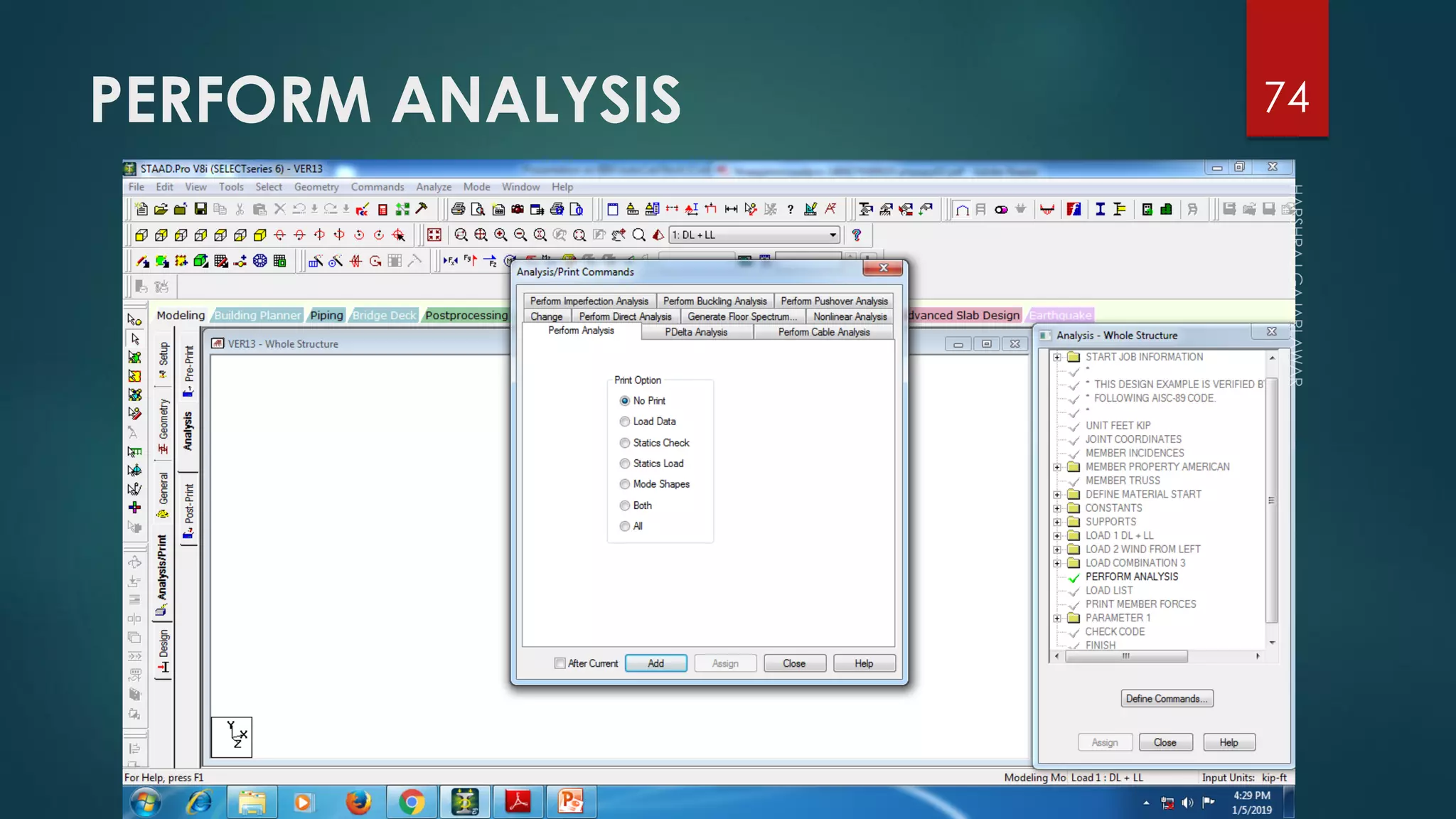
PERFORM ANALYSIS 74
RUN ANALYSIS 75
DESIGN
• After analysis a structure has to be designed to carry loads
acting on it considering a certain factor of safety .
• In India structures are designed by using various Indian codes
for both concrete and steel structures.
• The design in STAAD.Pro supports over 70 international codes
and over 20 U.S. codes in 7 languages.
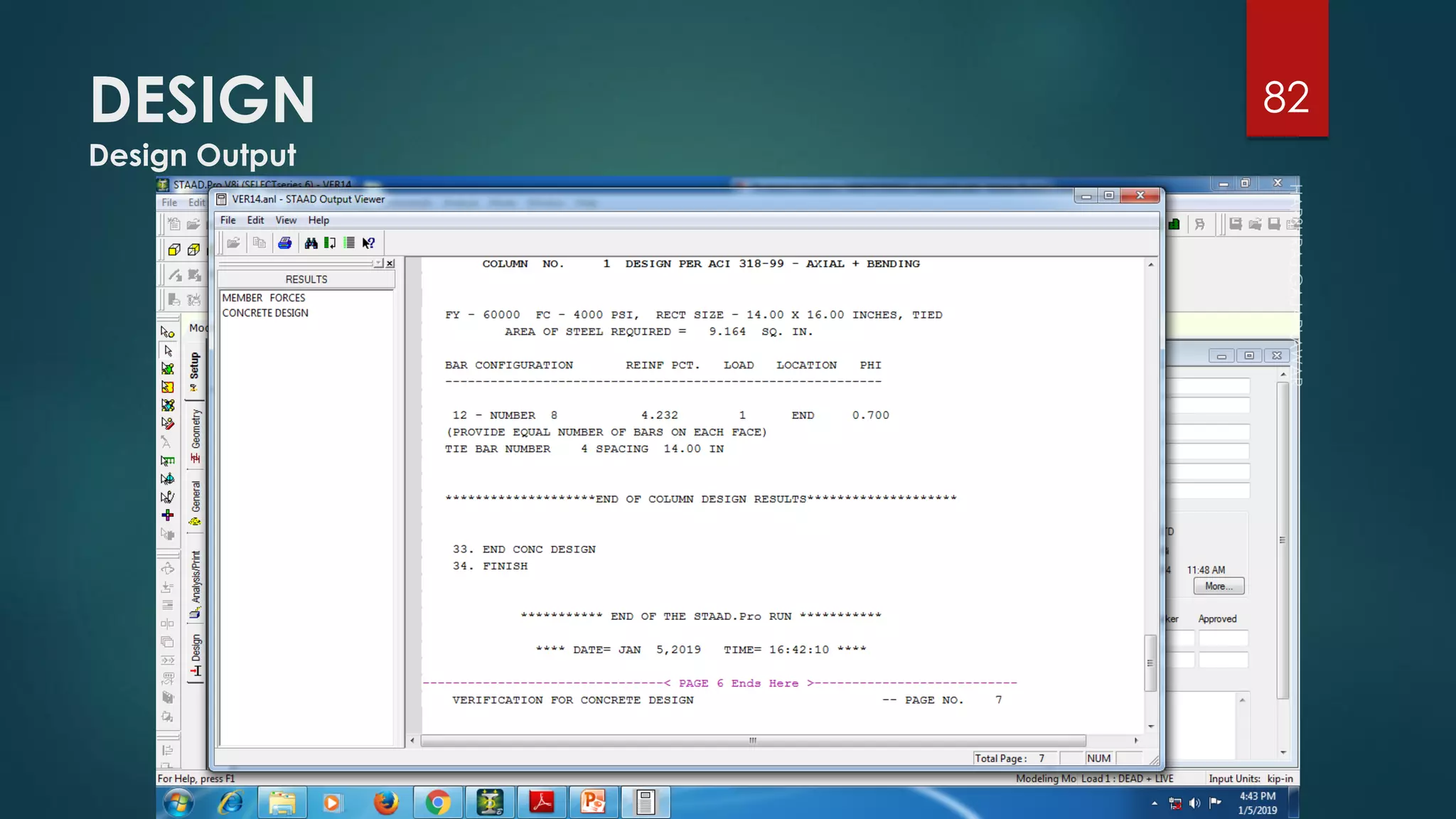
• After designing the structure it is again analyzed and results of
analysis for each beam and column is shown in the output file
76
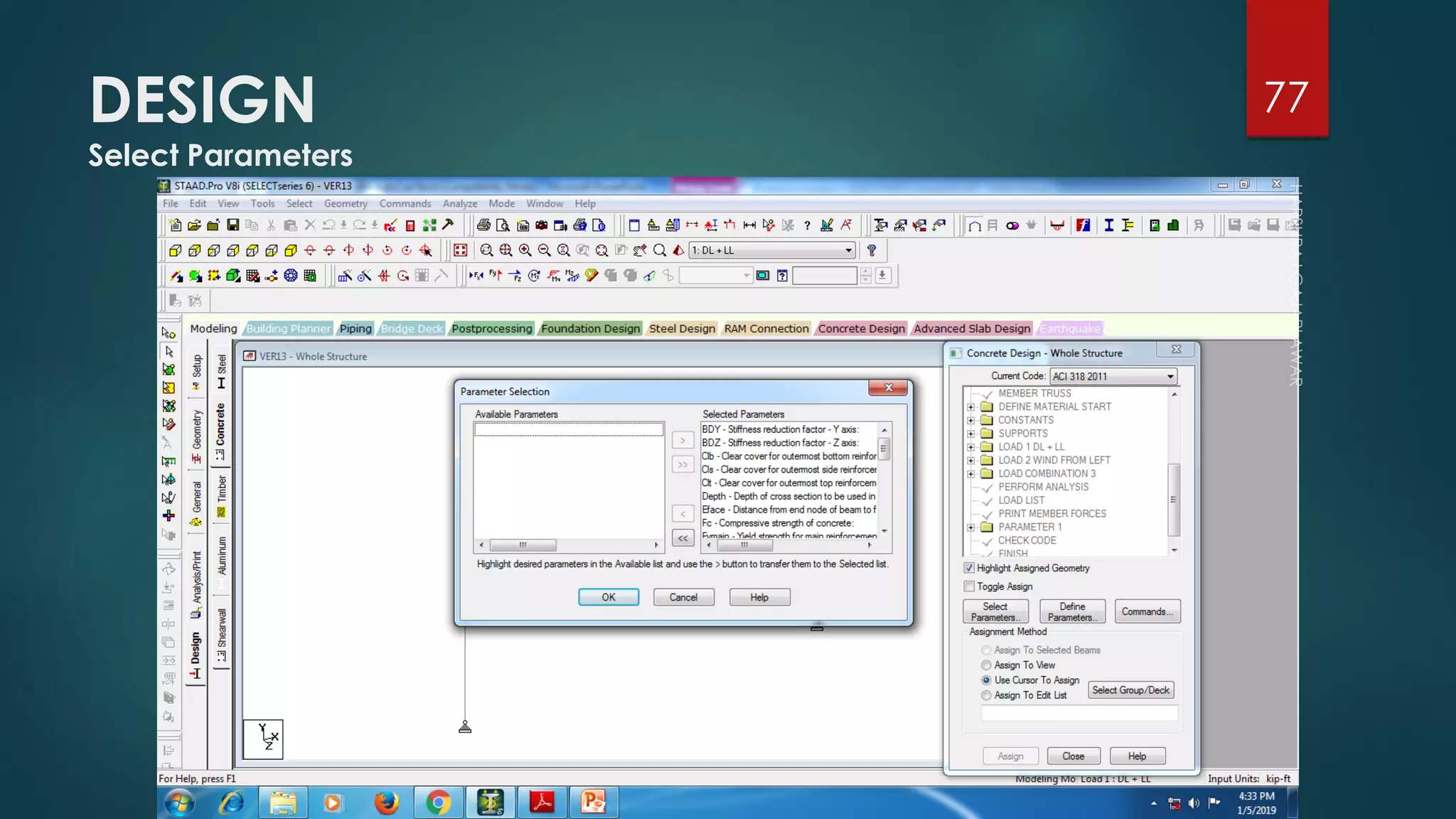
DESIGN
Select Parameters
77
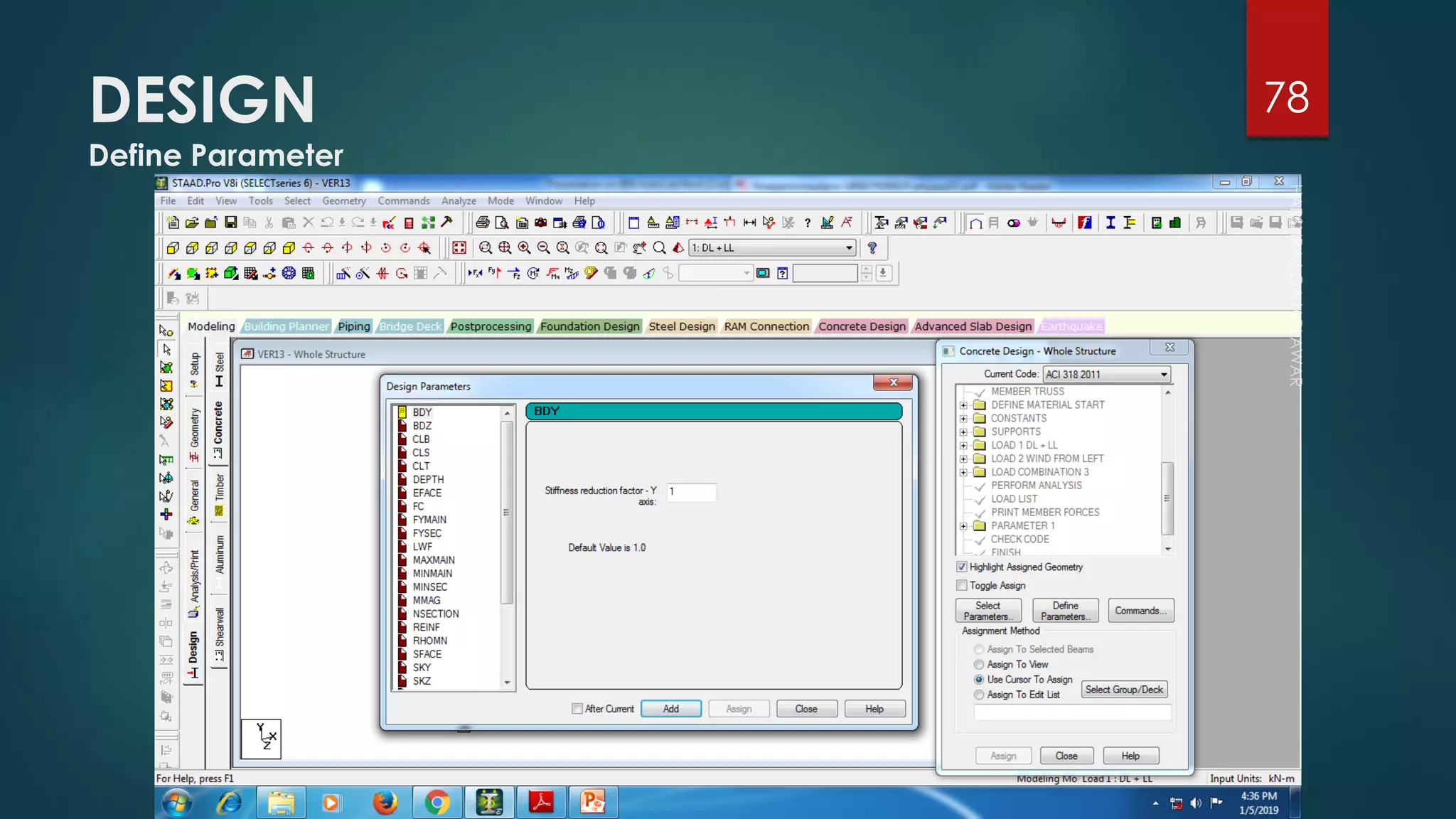
DESIGN
Define Parameter
78
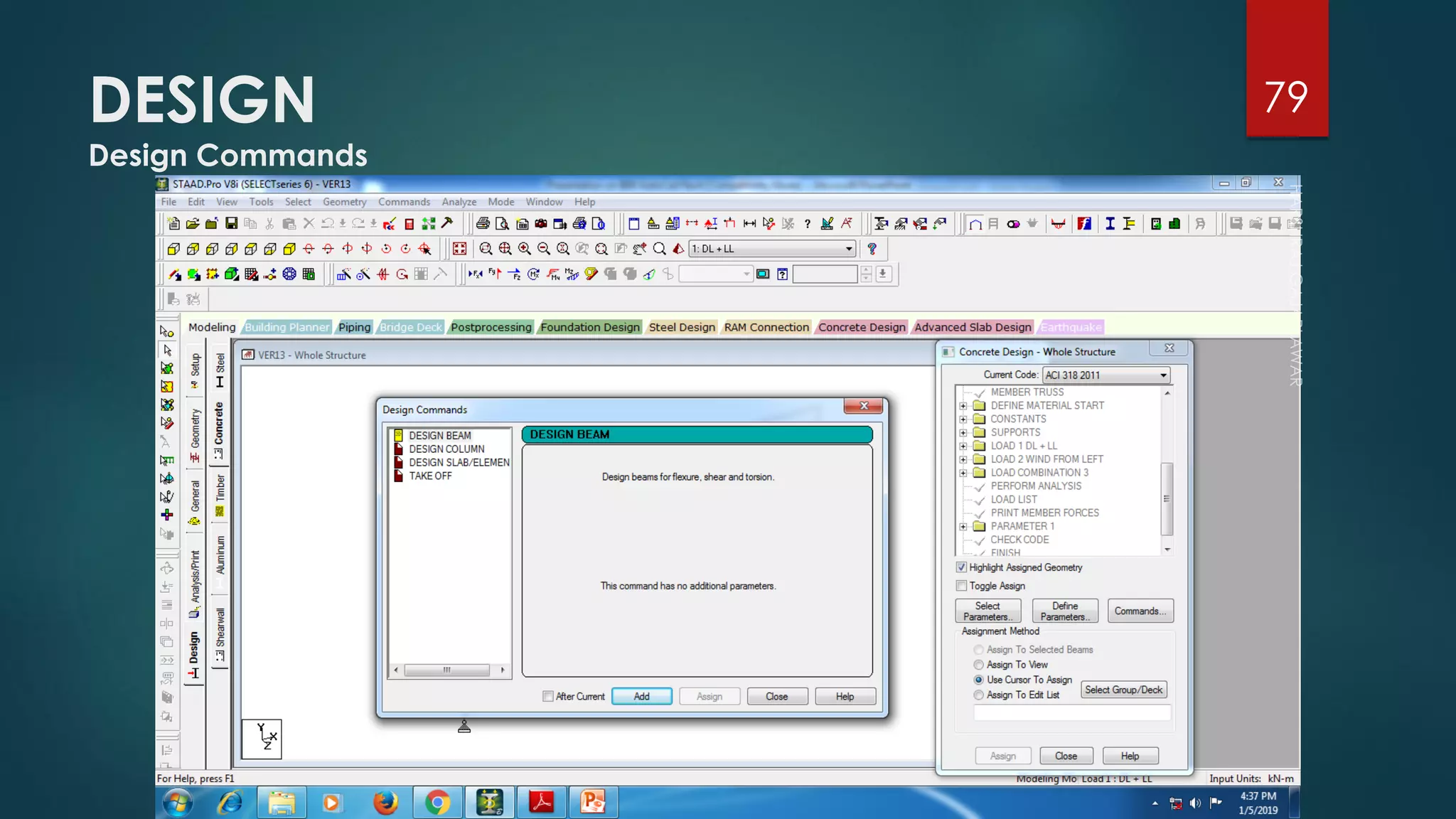
DESIGN
Design Commands
79
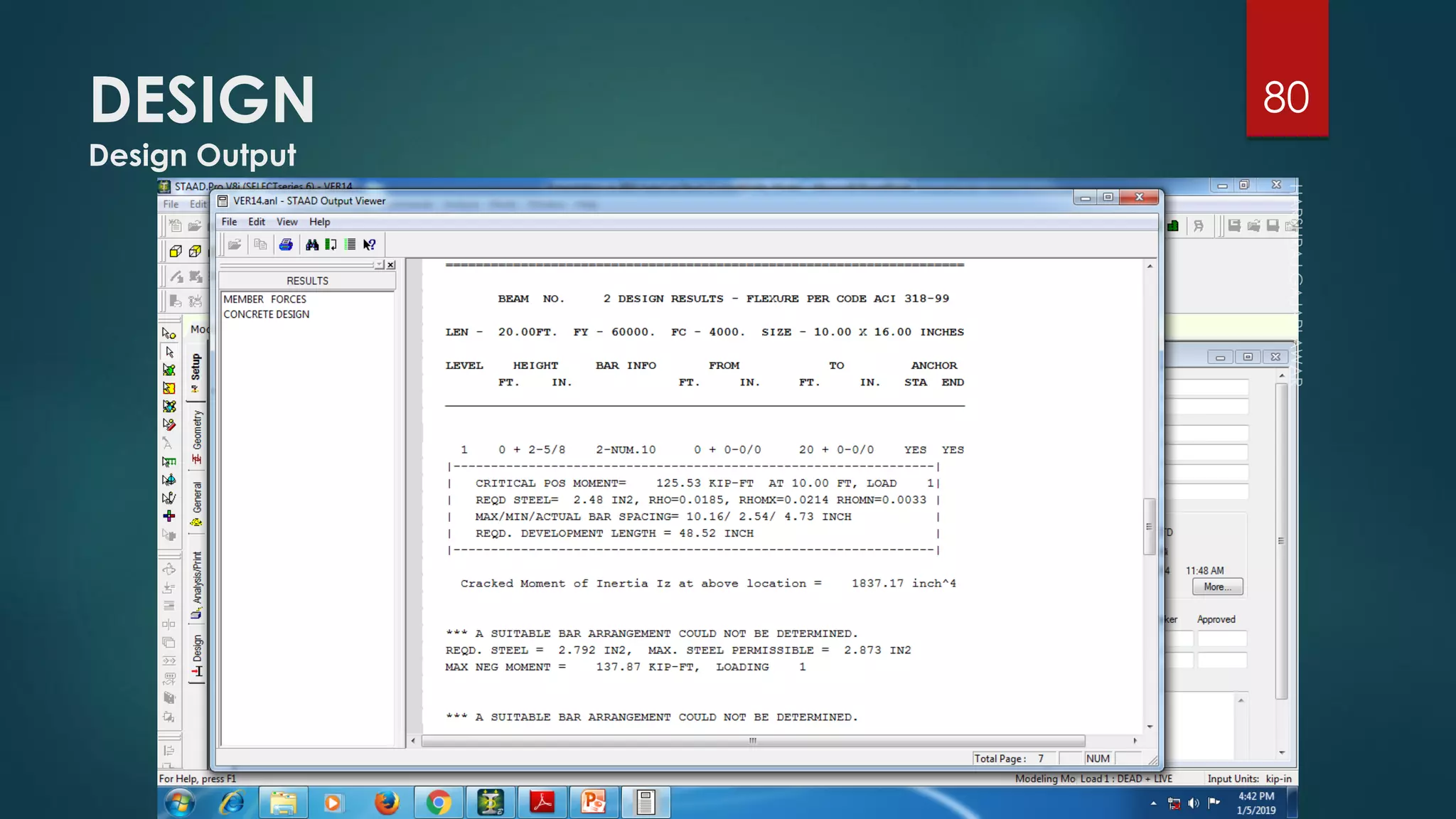
DESIGN
Design Output
80
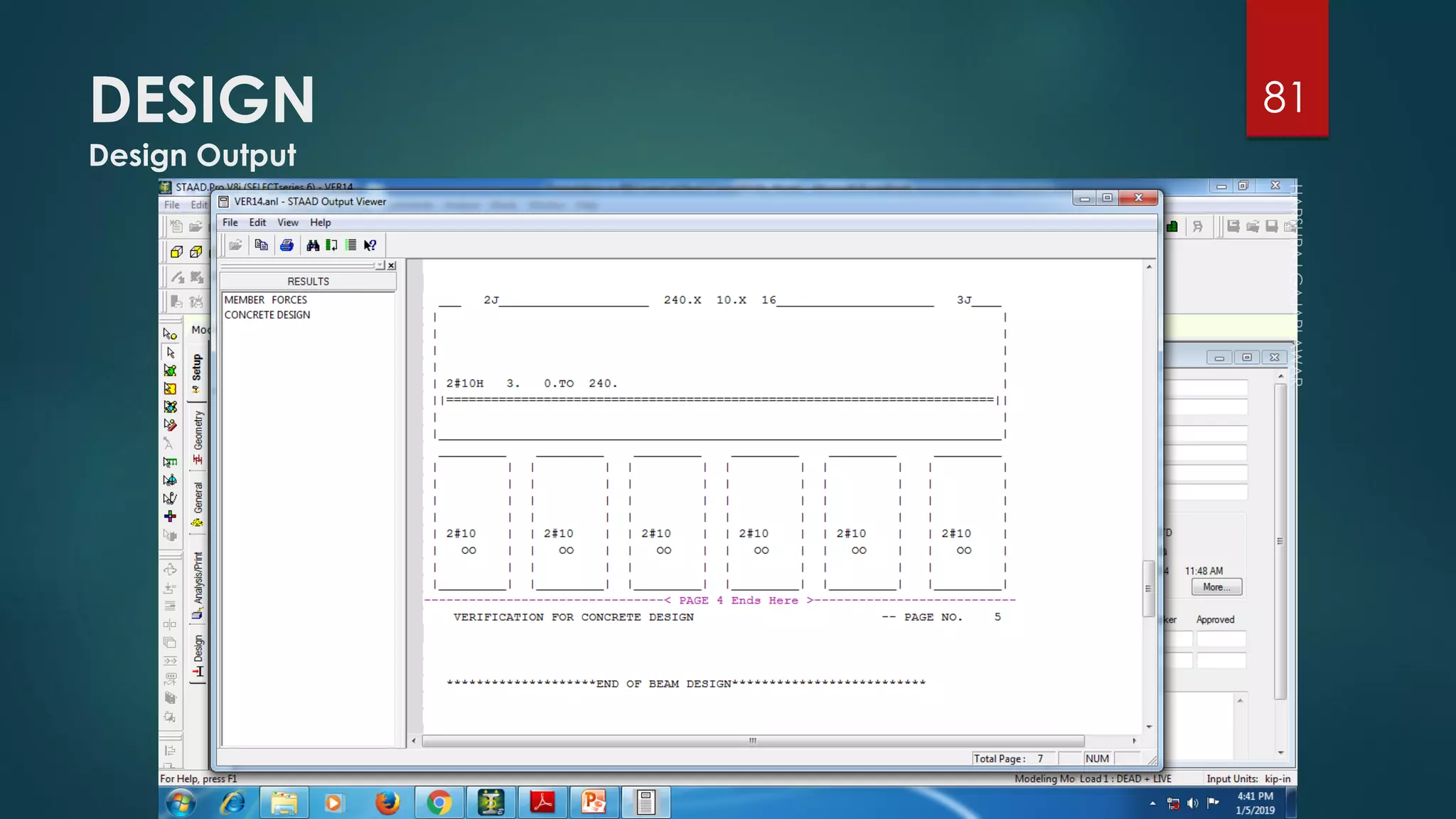
DESIGN
Design Output
81
DESIGN
Design Output
82
ADVANTAGES OF STAAD.Pro
Following are the advantages of STAAD.Pro
 1. Covers all aspects of structural engineering
 2. Broad spectra of design codes
 3. International codes
 4. Quality assurance
 5. Reports and documentation
83
84
85

Presentation on bim auto cad revit and staad pro

  • 1.
    Presentation on AutoCad, BIM, RevitArchitecture and Staad Pro AUTHOR :HARSHRAJ S. GAJARLAWAR
  • 2.
    Content  History ofDesign  AutoCAD  BIM  Revit Architecture  Staad Pro 2
  • 3.
  • 4.
  • 5.
    History of AutoCAD AutoCAD was derived from a program begun in 1977 and released in 1979 called Interact CAD, also referred to in early Autodesk documents as MicroCAD, which was written prior to Autodesk's (then Marinchip Software Partners) formation by Autodesk cofounder Michael Riddle.  The company was founded in 1982 by John Walker, a coauthor of the first versions of AutoCAD, the company's flagship computer-aided design (CAD) software.  The first version by the Autodesk Company was demonstrated at the 1982 Comdex and released that December.  The 2019 release marked the 33rd major release for the AutoCAD for Windows. 5
  • 6.
  • 7.
    AutoCAD What is AutoCAD? AutoCADis a commercial software application for 2D and 3D computer- aided design (CAD) and drafting — available since 1982 as a desktop application and since 2010 as a mobile web- and cloud-based app marketed as AutoCAD 360. 7
  • 8.
    AutoCAD Features :- 1. Storageand accessibility 2. 3D View 3. Revisions and modifications 4. Speed 5. Accuracy 8
  • 9.
  • 10.
  • 11.
  • 12.
  • 13.
    AutoCAD AutoCAD Applications :- 1)As an architectural planning tool 2) As an engineering drafting tool 3) As a graphic design tool 4) AutoCAD in 3D Printing 5) AutoCAD in the fashion industry 6) AutoCAD as industrial design tool 13
  • 14.
    AutoCAD Careers Related toCivil Engineers :-  Architects. Architects plan and design houses, factories, office buildings, and other structures.  Civil Engineering Technicians. ...  Construction Managers. ...  Environmental Engineers. ...  Landscape Architects. ...  Surveyors. ...  Urban and Regional Planners. 14
  • 15.
    The AutoCAD Advantage SolidWorks / Solid Edge / Inventor Compatibility  Industry Standard Translators  Reduced Training Time/Cost  Rapid Product Advancements 15
  • 16.
  • 17.
  • 18.
    BIM What is BIM? BuildingInformation Modelling is digital representation of physical and functional characteristics of a facility creating a shared knowledge resource for information about it forming a reliable basis for decisions during its life cycle, from earliest conception to demolition.  Building Information Modelling  Building Information Model  Building Information Management 18
  • 19.
  • 20.
  • 21.
    BIM Building Information Modelling – A Process (not software) – A New Way of Doing Things  – Not CAD (2D line-based drafting / no inherent intelligence)  – Production of Reliable & Coordinated Documentation  – “Data-Rich” Virtual 3D Model of a Project – the “i” in BIM  – Recording all Vital Design Information in a Single Database  – Used by all Stakeholders throughout the Projects Lifecycle 21
  • 22.
  • 23.
  • 24.
    Revit What is Revit? AutodeskRevit is building information modeling software for architects, landscape architects, structural engineers, MEP engineers, designers and contractors. The original software was developed by Charles River Software, founded in 1997, renamed Revit Technology Corporation in 2000, and acquired by Autodesk in 2002. 24
  • 25.
    Revit Architecture What isRevit Architecture?  Autodesk Revit® Architecture is a robust architectural design and documentation software application created by Autodesk for architects and building professionals.  The tools and features that make up Revit® Architecture are specifically designed to support Building Information Modeling (BIM) workflows. 25
  • 26.
    Revit Architecture  Thereare many categories of objects ('families' in Revit terminology), which divide into three groups:  System Families, such as walls, floors, roofs and ceilings which are built inside a project  Loadable Families / Components, which are built with primitives (extrusions, sweeps, etc.) separately from the project and loaded into a project for use  In-Place Families, which are built in-situ within a project with the same toolset as loadable components. 26
  • 27.
  • 28.
  • 29.
  • 30.
  • 31.
  • 32.
  • 33.
  • 34.
  • 35.
  • 36.
  • 37.
  • 38.
  • 39.
  • 40.
  • 41.
  • 42.
  • 43.
  • 44.
  • 45.
  • 46.
  • 47.
  • 48.
  • 49.
  • 50.
  • 51.
  • 52.
  • 53.
  • 54.
  • 55.
  • 56.
  • 57.
    Revit Architecture This programis designed for-  Architecture students  Engineering students  Construction professionals in Architecture  Construction consultants 57
  • 58.
  • 59.
    CONTENTS  • INTRODUCTIONTO STAAD.Pro  • HISTORY OF STAAD.Pro  • STRUCTURE  • TYPES OF STRUCTURE  • STAAD WINDOW  • TOOLS USED  • VARIOUS TYPES OF CURSORS  • PAGE CONTROL IN VARIOUS MODES  • MODEL GENERATION  • WIZARD  • ASSIGNING PROPERTY  • SUPPORTS  • ASSIGNING LOADS  • ANALYSIS  • DESIGN  • ADVANTAGES OF STAAD.Pro  • CONCLUSION 59
  • 60.
    INTRODUCTION  • STAAD.Prois a structural analysis design program software.  • It includes a state of the art user interface, visualization tools and international design codes.  • It is used for 3D model generation, analysis and multi-material design.  • The commercial version of STAAD.Pro supports several steel concrete and timber design codes.  • It is one of the software applications created to help structural engineers to automate their tasks and to remove the tedious and long procedures of the manual methods. 60
  • 61.
    HISTORY OF STAAD.Pro • STAAD.Pro was originally developed in 1997 by Research Engineers International in Yorba Linda, CA.  • In late 2005, Research Engineer International was bought by Bentley Systems. 61
  • 62.
    STRUCTURE  • ASTRUCTURE can be defined as an assemblage of elements. STAAD is capable of analyzing and designing structures consisting of both frame, and Finite elements. Almost any type of structure can be analyzed by STAAD.  Frame elements – Beam elements – 2 nodes  Finite elements – 1.) Plate – 3 or 4 nodes  2.) Solid – 4 to 8 nodes  • In case of STAAD Node becomes Joint it has a number and xyz coordinates Beam becomes Member it has a number and nodes at its ends Plate becomes Element it has a number and node at its corners 62
  • 63.
    TYPES OF STRUCTURE •A TRUSS structure consists of truss members which can have only axial member forces and no bending in the members • A PLANE structure is bound by a global X-Y coordinate system with loads in the same plane • A SPACE structure, which is a three dimensional framed structure with loads applied in any plane, is the most general. • A FLOOR structure is a two or three dimensional structure having no horizontal (global X or Z) movement of the structure [FX, FZ & MY are restrained at every joint]. The floor framing (in global X-Z plane) of a building is an ideal example of a FLOOR structure. Columns can also be modelled with the floor in a FLOOR structure as long as the structure has no horizontal loading. If there is any horizontal load, it must be analyzed as a SPACE structure. 63
  • 64.
  • 65.
  • 66.
    Various Types ofCursors 66
  • 67.
    Page Control inVarious Modes In Modelling In Post Processing 67
  • 68.
    Procedure Model Generationand Analysis Input Geometry-Nodes, Beams, Column etc Input Properties Input Specs, Constant, Support Input Loading System Specify Analysis Type Run Analysis View and Verify Result Design Verify 68
  • 69.
    MODEL GENERATION • Thereare basically 3 methods of generating a model 1. Snap node method 2. Coordinate method 3. Copy paste method • Out of these three methods most commonly used is copy paste method • By using these three methods a structure of any geometry can be created • STAAD.Pro also contains a command wizard which is its library of structures such as frames , trusses are present which can be merged with the STAAD.Pro model 69
  • 70.
  • 71.
    ASSIGNING PROPERTY Assigning aproperty means to provide dimensions such as width, thickness etc to beams columns slabs etc 71
  • 72.
  • 73.
  • 74.
  • 75.
  • 76.
    DESIGN • After analysisa structure has to be designed to carry loads acting on it considering a certain factor of safety . • In India structures are designed by using various Indian codes for both concrete and steel structures. • The design in STAAD.Pro supports over 70 international codes and over 20 U.S. codes in 7 languages. • After designing the structure it is again analyzed and results of analysis for each beam and column is shown in the output file 76
  • 77.
  • 78.
  • 79.
  • 80.
  • 81.
  • 82.
  • 83.
    ADVANTAGES OF STAAD.Pro Followingare the advantages of STAAD.Pro  1. Covers all aspects of structural engineering  2. Broad spectra of design codes  3. International codes  4. Quality assurance  5. Reports and documentation 83
  • 84.
  • 85.