AutoCAD is a commercial computer-aided design
(CAD) and drafting software application. AutoCAD is
use to made 2D images. In civil Engineering it plays a
great role for planning. In hand drawing it takes a lot
of time to make a plan but in AutoCAD we draw a
plan in very less time. So engineer use to prefer proper
planning. AutoCAD provides a proper planning for a
plan.
Advantages:
 Save time and money
 Reduce error and enhance accuracy for work
 Provides alternatives
 Makes transfer of data copy
 Reduce problem in design before it exists in reality
 Controllable and manageable
 Provides custom solutions
 Helps in creating proper database
 Standardized drawings
 Improved quality of design
Plan working in AutoCAD
Ground Floor:
i. Sitting Area
ii. Master Bad Room
iii. Bad Room
iv. Parking Area
First Floor
i. Kitchen
ii. Dining Area
iii. Master Bad Room
iv. Pooja Room
Second Floor:
i. Sitting Area
ii. Bed Room
iii. Store Room
Roof:
Structural engineering are responsible for engineering design and analysis.
Entry-level structural engineers may design the individual structural elements
of a structure, for example the beam, columns, and floors of a building. More
experienced engineers would be responsible for the structural design and
integrity of an entire system, such as building.
Advantages:
Flexible modeling environment
Availability of a wide range of design code
Interconnected and open architecture
Contains all features of structure engineering
Easy to use
Plans for working:
• First Floor
• Second Floor
• Roof
Designing
Geometry: Modelling of the structure geometry consists of two steps:
o Identification and description of joints or nodes.
o Modelling of members or elements through specification of connectivity
between joints.
Geometry:
Defining Properties: Property is the shape given to each member
of the structure. The rectangular property is given to the structure
to give more strength to each member to bear load.
Properties:
Supports:
Supports is given to the structure to give it a strength. A fixed support is given to
the structure.
Load and Definition:
There are many types of loads which are given in structure with the help of
Indian Standard code which are IS 875:1987 part 1 for dead load, IS 875: 1987 part 2
for live load, and combination load with factor of safety.
Support and loads defined:
Analyses:
An analysis is use for performing all commands given to the structure due to
which we can check our property, loads, supports etc. work or will not work.
In image given below we shown BMD and SFD of a members:
Plates:
Plates are made instead of floor which are more beneficial then a normal slab.
Concrete Design:
IS 456:2000 is used for concrete designing. In concrete designing we gives value
of FC (Characteristic Strength of concrete), Fy (Yield Strength of steel) Main, Fy
Secondary, Design beam, Design column, Design elements, etc.
STAAD Foundation is an exhaustive analysis, design and drafting solution for
a variety of foundations. These include general foundation types such as
isolated, combined footings, mat foundation, pile caps, octagonal, strap and
slab on piles as well as plant foundation such as vertical vessel and heat
exchanger foundations.
Isolated Footing
Load acting on footing
Combine footing
Mat foundation
slab on piles
Advantages:
• Easily model complex or simple footings, such as plant foundations supporting
vertical vessels, horizontal vessels, tanks and other footings.
• Quickly model common foundation such as isolated, combined, strip, pile caps, and
many more.
• Simplify challenging scenarios such as vibrating machine foundation, lateral analyses
of piers, or mat design using FEA (Finite Element Analysis).
• Efficiently use your structural model with the foundation model through integration
with STAAD Pro., including automatically synced changes in both models.
Foundation Made in STAAD Foundation
Result Summary
Footing No.
Left Overhang
(m)
Right Overhang
(m)
Length
(m)
Width
(m)
Thickness
(m)
1 1.125 1.125 11.165 2.750 0.500
2 1.000 1.000 10.915 2.500 0.500
3 1.000 1.000 10.915 2.500 0.500
4 1.000 1.000 10.915 2.500 0.500
Footing No. Footing Reinforcement
- Main Steel Top Main Steel Bottom Secondary Steel Top Secondary Steel Bottom
1 Ø12 @ 55 mm c/c Ø12 @ 185 mm c/c Ø12 @ 185 mm c/c Ø12 @ 185 mm c/c
2 Ø12 @ 130 mm c/c Ø12 @ 180 mm c/c Ø12 @ 185 mm c/c Ø12 @ 185 mm c/c
3 Ø12 @ 65 mm c/c Ø12 @ 180 mm c/c Ø12 @ 185 mm c/c Ø12 @ 185 mm c/c
4 Ø12 @ 95 mm c/c Ø12 @ 180 mm c/c Ø12 @ 185 mm c/c Ø12 @ 185 mm c/c
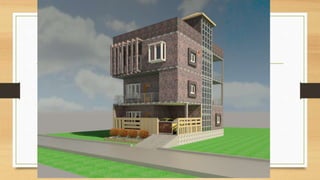
Autodesk Revit is building information modeling software for architects,
landscape architects, structure engineering and contractors developed by
Autodesk. It allows users to design a building and structure and its components
in 3D, annotate the model with 2D drafting elements, and access building
information from the building models database.
Advantages:
Preview the future home in 3D BIM (Building Information Modeling) modeling
Quick changes to Design, No repetitive Tasks
Vast Library of Parametric building components
High quality construction documents
Accurate estimation of qualities and cost
Improved coordinates
High quality of flexibilities.
Elevation view
Furniture's:
A design engineer’s responsibility should include assuring the structural safety
of the design, details, checking shop drawing. The detailing is very important
not only for the proper execution of the structure but also for the safety of the
structures. Detailing is necessary not only for the steel structures but also for
the RCC members as it is the translated result of all the mathematical
expressions and equations.
Design of beam
Designing of Column:
The process of measuring quantities of material from drawings and
specifications prepared by architects, engineers, and other designers is known as
quantity takeoff. Traditionally, construction cost estimators have used paper-
based method to perform digital quantity takeoff, which is faster, easier and
more accurate than paper-based methods.
Training on Structural designing by CADD centre

Training on Structural designing by CADD centre

  • 4.
    AutoCAD is acommercial computer-aided design (CAD) and drafting software application. AutoCAD is use to made 2D images. In civil Engineering it plays a great role for planning. In hand drawing it takes a lot of time to make a plan but in AutoCAD we draw a plan in very less time. So engineer use to prefer proper planning. AutoCAD provides a proper planning for a plan.
  • 5.
    Advantages:  Save timeand money  Reduce error and enhance accuracy for work  Provides alternatives  Makes transfer of data copy  Reduce problem in design before it exists in reality  Controllable and manageable  Provides custom solutions  Helps in creating proper database  Standardized drawings  Improved quality of design
  • 6.
    Plan working inAutoCAD Ground Floor: i. Sitting Area ii. Master Bad Room iii. Bad Room iv. Parking Area
  • 7.
    First Floor i. Kitchen ii.Dining Area iii. Master Bad Room iv. Pooja Room
  • 9.
    Second Floor: i. SittingArea ii. Bed Room iii. Store Room
  • 11.
  • 13.
    Structural engineering areresponsible for engineering design and analysis. Entry-level structural engineers may design the individual structural elements of a structure, for example the beam, columns, and floors of a building. More experienced engineers would be responsible for the structural design and integrity of an entire system, such as building.
  • 14.
    Advantages: Flexible modeling environment Availabilityof a wide range of design code Interconnected and open architecture Contains all features of structure engineering Easy to use
  • 15.
    Plans for working: •First Floor • Second Floor • Roof
  • 16.
    Designing Geometry: Modelling ofthe structure geometry consists of two steps: o Identification and description of joints or nodes. o Modelling of members or elements through specification of connectivity between joints.
  • 17.
  • 18.
    Defining Properties: Propertyis the shape given to each member of the structure. The rectangular property is given to the structure to give more strength to each member to bear load.
  • 19.
  • 20.
    Supports: Supports is givento the structure to give it a strength. A fixed support is given to the structure. Load and Definition: There are many types of loads which are given in structure with the help of Indian Standard code which are IS 875:1987 part 1 for dead load, IS 875: 1987 part 2 for live load, and combination load with factor of safety.
  • 21.
  • 22.
    Analyses: An analysis isuse for performing all commands given to the structure due to which we can check our property, loads, supports etc. work or will not work.
  • 23.
    In image givenbelow we shown BMD and SFD of a members:
  • 24.
    Plates: Plates are madeinstead of floor which are more beneficial then a normal slab. Concrete Design: IS 456:2000 is used for concrete designing. In concrete designing we gives value of FC (Characteristic Strength of concrete), Fy (Yield Strength of steel) Main, Fy Secondary, Design beam, Design column, Design elements, etc.
  • 28.
    STAAD Foundation isan exhaustive analysis, design and drafting solution for a variety of foundations. These include general foundation types such as isolated, combined footings, mat foundation, pile caps, octagonal, strap and slab on piles as well as plant foundation such as vertical vessel and heat exchanger foundations.
  • 29.
    Isolated Footing Load actingon footing Combine footing Mat foundation slab on piles
  • 30.
    Advantages: • Easily modelcomplex or simple footings, such as plant foundations supporting vertical vessels, horizontal vessels, tanks and other footings. • Quickly model common foundation such as isolated, combined, strip, pile caps, and many more. • Simplify challenging scenarios such as vibrating machine foundation, lateral analyses of piers, or mat design using FEA (Finite Element Analysis). • Efficiently use your structural model with the foundation model through integration with STAAD Pro., including automatically synced changes in both models.
  • 31.
    Foundation Made inSTAAD Foundation
  • 32.
    Result Summary Footing No. LeftOverhang (m) Right Overhang (m) Length (m) Width (m) Thickness (m) 1 1.125 1.125 11.165 2.750 0.500 2 1.000 1.000 10.915 2.500 0.500 3 1.000 1.000 10.915 2.500 0.500 4 1.000 1.000 10.915 2.500 0.500 Footing No. Footing Reinforcement - Main Steel Top Main Steel Bottom Secondary Steel Top Secondary Steel Bottom 1 Ø12 @ 55 mm c/c Ø12 @ 185 mm c/c Ø12 @ 185 mm c/c Ø12 @ 185 mm c/c 2 Ø12 @ 130 mm c/c Ø12 @ 180 mm c/c Ø12 @ 185 mm c/c Ø12 @ 185 mm c/c 3 Ø12 @ 65 mm c/c Ø12 @ 180 mm c/c Ø12 @ 185 mm c/c Ø12 @ 185 mm c/c 4 Ø12 @ 95 mm c/c Ø12 @ 180 mm c/c Ø12 @ 185 mm c/c Ø12 @ 185 mm c/c
  • 34.
    Autodesk Revit isbuilding information modeling software for architects, landscape architects, structure engineering and contractors developed by Autodesk. It allows users to design a building and structure and its components in 3D, annotate the model with 2D drafting elements, and access building information from the building models database.
  • 35.
    Advantages: Preview the futurehome in 3D BIM (Building Information Modeling) modeling Quick changes to Design, No repetitive Tasks Vast Library of Parametric building components High quality construction documents Accurate estimation of qualities and cost Improved coordinates High quality of flexibilities.
  • 38.
  • 39.
  • 41.
    A design engineer’sresponsibility should include assuring the structural safety of the design, details, checking shop drawing. The detailing is very important not only for the proper execution of the structure but also for the safety of the structures. Detailing is necessary not only for the steel structures but also for the RCC members as it is the translated result of all the mathematical expressions and equations.
  • 42.
  • 43.
  • 45.
    The process ofmeasuring quantities of material from drawings and specifications prepared by architects, engineers, and other designers is known as quantity takeoff. Traditionally, construction cost estimators have used paper- based method to perform digital quantity takeoff, which is faster, easier and more accurate than paper-based methods.