VIRTUAL MACHINE
Presented by : Zain Raza
Discipline : Information Technology
5th Semester
OUTLINE
 History of Virtual Machine
 Virtual Machine (VM) mean?
 Types
 Use of VM
 Virtual Machine Application
 Pros & Cons of VM
HISTORY OF VM
 VM is a family of IBM virtual machine operating
systems used on IBM mainframes System/370.
 The first version, released in 1972, was VM/370.
 This was a System/370 reimplementation of earlier
CP/CMS operating system.
VIRTUAL MACHINE MEAN?
• A virtual machine (VM) is a software program or
operating system that not only exhibits the behavior
of a separate computer, but is also capable of
performing tasks such as running applications and
programs like a separate computer.
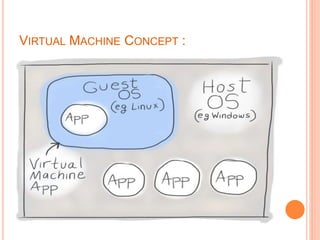
• A virtual machine, usually known as a guest is
created within another computing environment
referred as a "host." Multiple virtual machines can
exist within a single host at one time.
• A virtual machine is also known as a guest.
VIRTUAL MACHINE CONCEPT :
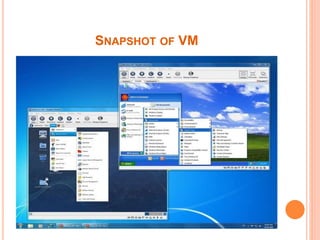
SNAPSHOT OF VM
TYPES OF VIRTUAL MACHINE
There are two main types of virtual machines :
One, which is called a system virtual machine, is
used to mimic all the processes and components of
an actual computer.
The other, which is known as a process virtual
machine, is used to run only a single application
and disappears when that application is closed.
SYSTEM VIRTUAL MACHINES :
 It allow a person to use a single server as if it were many
different computers.
 Using system machines also allows a user to run multiple
operating systems on the same machine.
 This allows a user to run programs that are only available on
one type of operating system.
 It also makes it possible to test a program across multiple
platforms without switching machines.
 System virtual machines (also known as full
virtualization VMs) provide a complete substitute for the
targeted real machine and a level of functionality required for
the execution of a complete operating system.
PROCESS VIRTUAL MACHINES :
 They are used to run a single program in isolation from
the physical computer’s operating system.
 This allows a user to run a program that might otherwise
be incompatible with the normal operating system.
 Each process machine is created to run a specific
program and exists only while the program is running.
 Closing the program it is running will make a process
machine disappear, and opening that program again will
create a new virtual machine.
USES OF VIRTUAL MACHINE :
 Virtual machines allow user to run an multiple operating
system on his windows desktop.
 VM use to run different software on an operating system.
 By using VM we can try different new operating systems on
your O/S.
 By using VM you can try your new software or web apps or
even site design by just building virtual machines and running
the tests there.
 When you get ready to move from XP to Vista, you can use
VMWare to make a backup of your old system.
VIRTUAL MACHINE APPLICATIONS :
There are three major virtual machine applications that run
on all three major computer operating systems
(Windows, Mac OS, and Linux).
The three virtual machine applications are:
 Parallels
 VMware
 Qemu
 KVM
 Xen
 TeamViewer
 VirtualBox.
THE MAIN PROS & CONS OF VM :
Pros :
 You can run other programs in a VM that may not
necessarily be in the same OS as the host machine.
 Ability to run more than one OS simultaneously.
 You can install/reinstall/backup/move your guest OS
easily.
 You can manage allocation of resource (Memory, Hard
disk), and etc.
THE MAIN PROS & CONS OF VM :
Cons :
 Performance drop. Usually much slower due to
the workload on the system by running virtual
machines.
 Virtual machine is not that efficient as a real one
when accessing the hardware.

Presentation of Virtual Macines slides

  • 1.
    VIRTUAL MACHINE Presented by: Zain Raza Discipline : Information Technology 5th Semester
  • 2.
    OUTLINE  History ofVirtual Machine  Virtual Machine (VM) mean?  Types  Use of VM  Virtual Machine Application  Pros & Cons of VM
  • 3.
    HISTORY OF VM VM is a family of IBM virtual machine operating systems used on IBM mainframes System/370.  The first version, released in 1972, was VM/370.  This was a System/370 reimplementation of earlier CP/CMS operating system.
  • 4.
    VIRTUAL MACHINE MEAN? •A virtual machine (VM) is a software program or operating system that not only exhibits the behavior of a separate computer, but is also capable of performing tasks such as running applications and programs like a separate computer. • A virtual machine, usually known as a guest is created within another computing environment referred as a "host." Multiple virtual machines can exist within a single host at one time. • A virtual machine is also known as a guest.
  • 5.
  • 6.
  • 7.
    TYPES OF VIRTUALMACHINE There are two main types of virtual machines : One, which is called a system virtual machine, is used to mimic all the processes and components of an actual computer. The other, which is known as a process virtual machine, is used to run only a single application and disappears when that application is closed.
  • 8.
    SYSTEM VIRTUAL MACHINES:  It allow a person to use a single server as if it were many different computers.  Using system machines also allows a user to run multiple operating systems on the same machine.  This allows a user to run programs that are only available on one type of operating system.  It also makes it possible to test a program across multiple platforms without switching machines.  System virtual machines (also known as full virtualization VMs) provide a complete substitute for the targeted real machine and a level of functionality required for the execution of a complete operating system.
  • 9.
    PROCESS VIRTUAL MACHINES:  They are used to run a single program in isolation from the physical computer’s operating system.  This allows a user to run a program that might otherwise be incompatible with the normal operating system.  Each process machine is created to run a specific program and exists only while the program is running.  Closing the program it is running will make a process machine disappear, and opening that program again will create a new virtual machine.
  • 10.
    USES OF VIRTUALMACHINE :  Virtual machines allow user to run an multiple operating system on his windows desktop.  VM use to run different software on an operating system.  By using VM we can try different new operating systems on your O/S.  By using VM you can try your new software or web apps or even site design by just building virtual machines and running the tests there.  When you get ready to move from XP to Vista, you can use VMWare to make a backup of your old system.
  • 11.
    VIRTUAL MACHINE APPLICATIONS: There are three major virtual machine applications that run on all three major computer operating systems (Windows, Mac OS, and Linux). The three virtual machine applications are:  Parallels  VMware  Qemu  KVM  Xen  TeamViewer  VirtualBox.
  • 12.
    THE MAIN PROS& CONS OF VM : Pros :  You can run other programs in a VM that may not necessarily be in the same OS as the host machine.  Ability to run more than one OS simultaneously.  You can install/reinstall/backup/move your guest OS easily.  You can manage allocation of resource (Memory, Hard disk), and etc.
  • 13.
    THE MAIN PROS& CONS OF VM : Cons :  Performance drop. Usually much slower due to the workload on the system by running virtual machines.  Virtual machine is not that efficient as a real one when accessing the hardware.