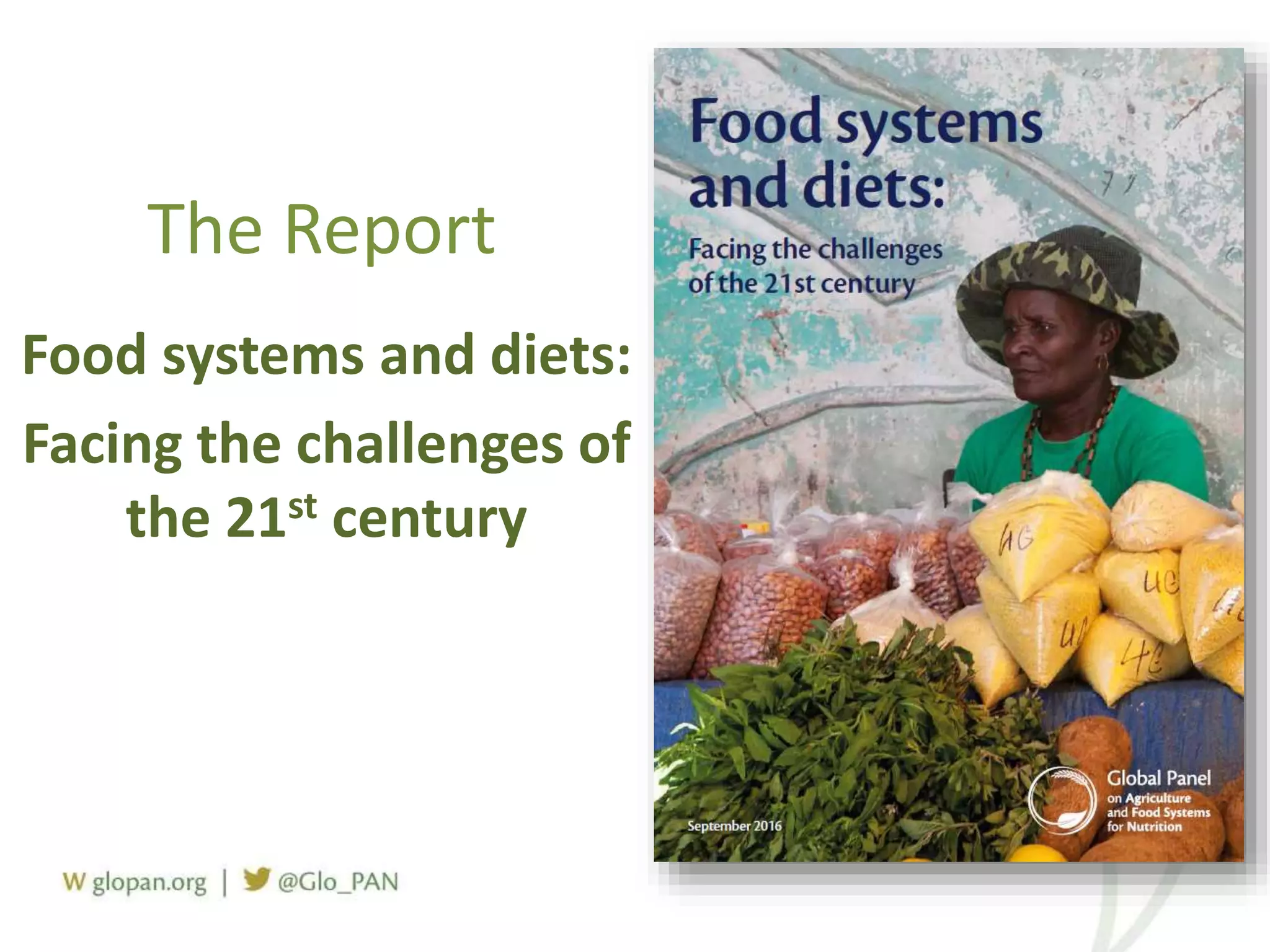
The Report
Food systems and diets:
Facing the challenges of
the 21st century
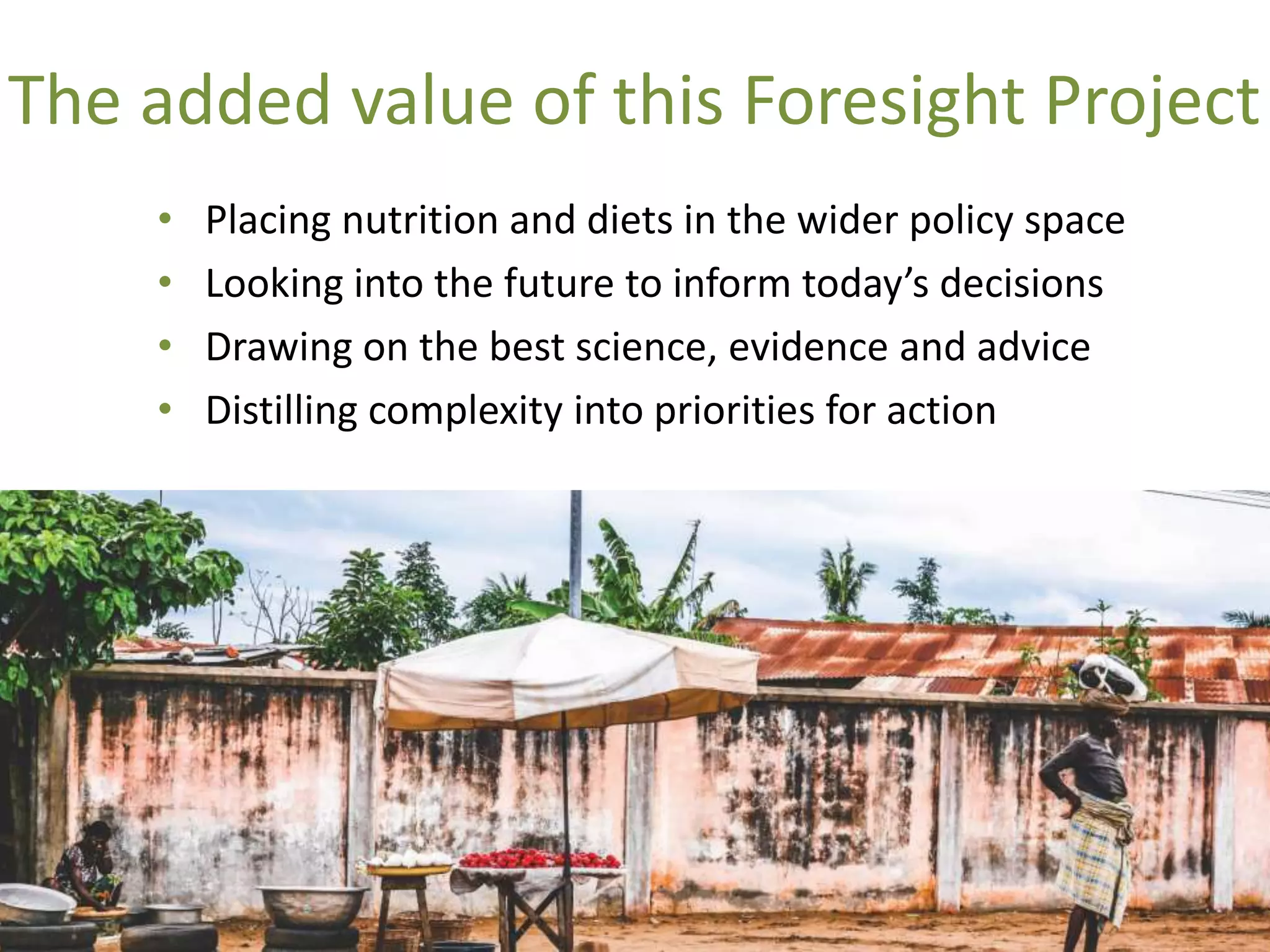
The added value of this Foresight Project
• Placing nutrition and diets in the wider policy space
• Looking into the future to inform today’s decisions
• Drawing on the best science, evidence and advice
• Distilling complexity into priorities for action
The Problem
Malnutrition is pervasive and increasing
• Malnutrition affects all 193 countries
• Malnutrition affects 1 in 3 people will rise to 1 in
2 people if current trends continue
• 800 million are hungry, 2 billion have
micronutrient deficiency, 1.9 billion are overweight
or obese
• Overweight/obesity rates are rising in every country
• Undernutrition rates decreasing too slowly
• Burdens of malnutrition are high (and will get higher)
• 45% of all under 5 deaths
• stunted children 33% more likely to live in poverty as
adults
• in China, 16% of household income lost due to type 2
diabetes
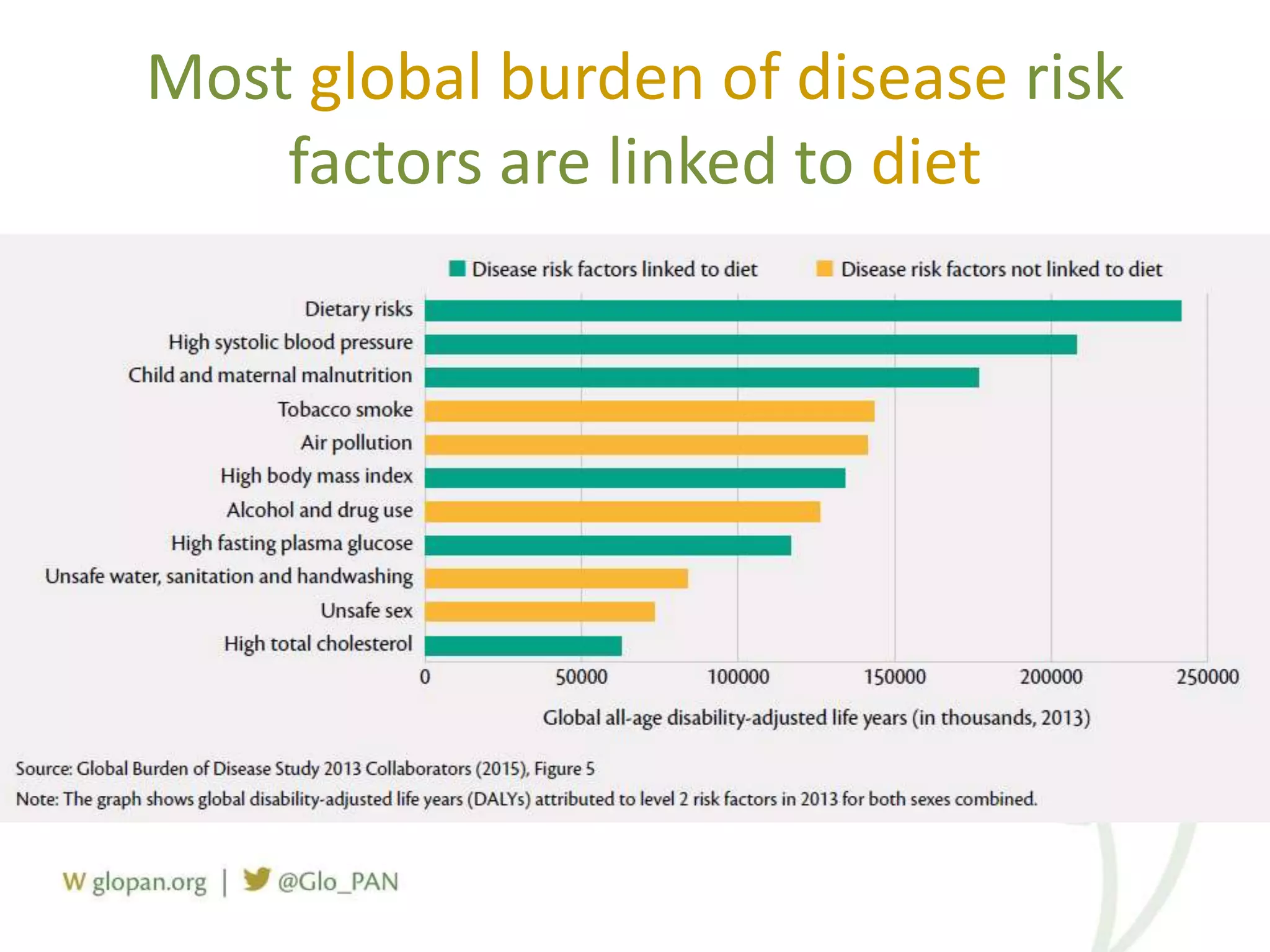
• Low quality diets are the number one risk factor
contributing to the global burden of disease
Malnutrition has severe consequences
Most global burden of disease risk
factors are linked to diet
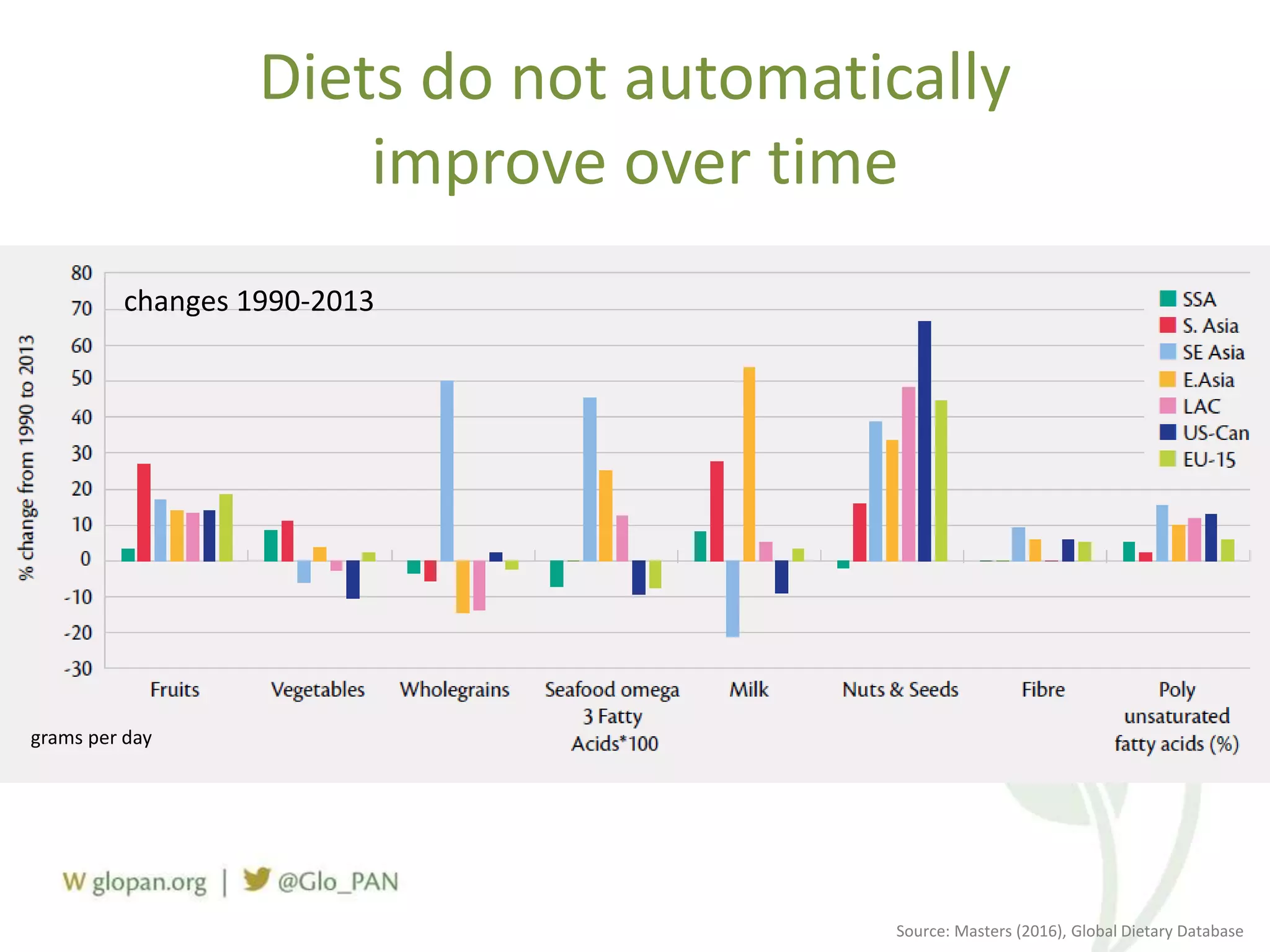
Diets do not automatically
improve over time
Source: Masters (2016), Global Dietary Database
grams per day
changes 1990-2013
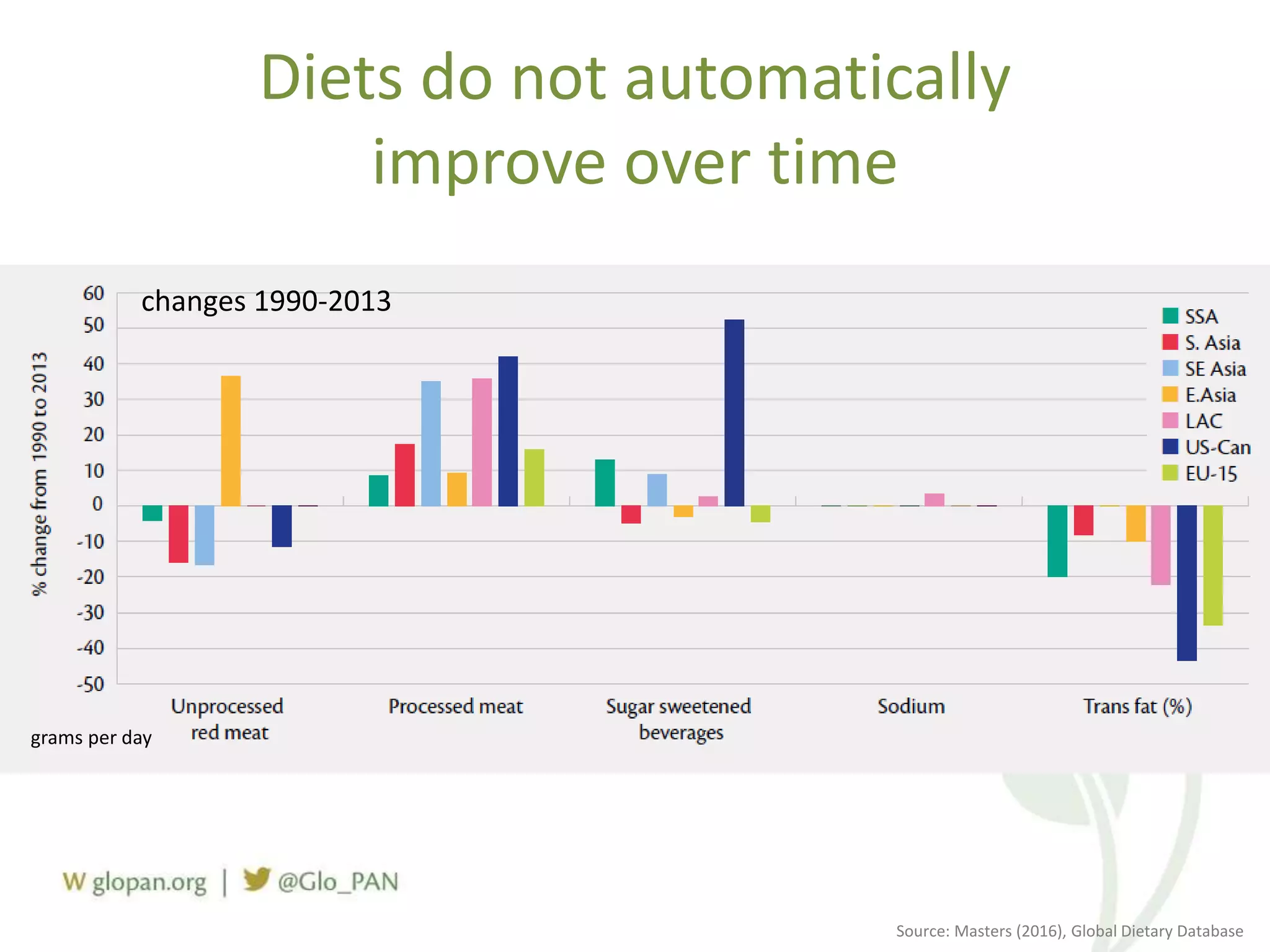
Diets do not automatically
improve over time
Source: Masters (2016), Global Dietary Database
grams per day
changes 1990-2013
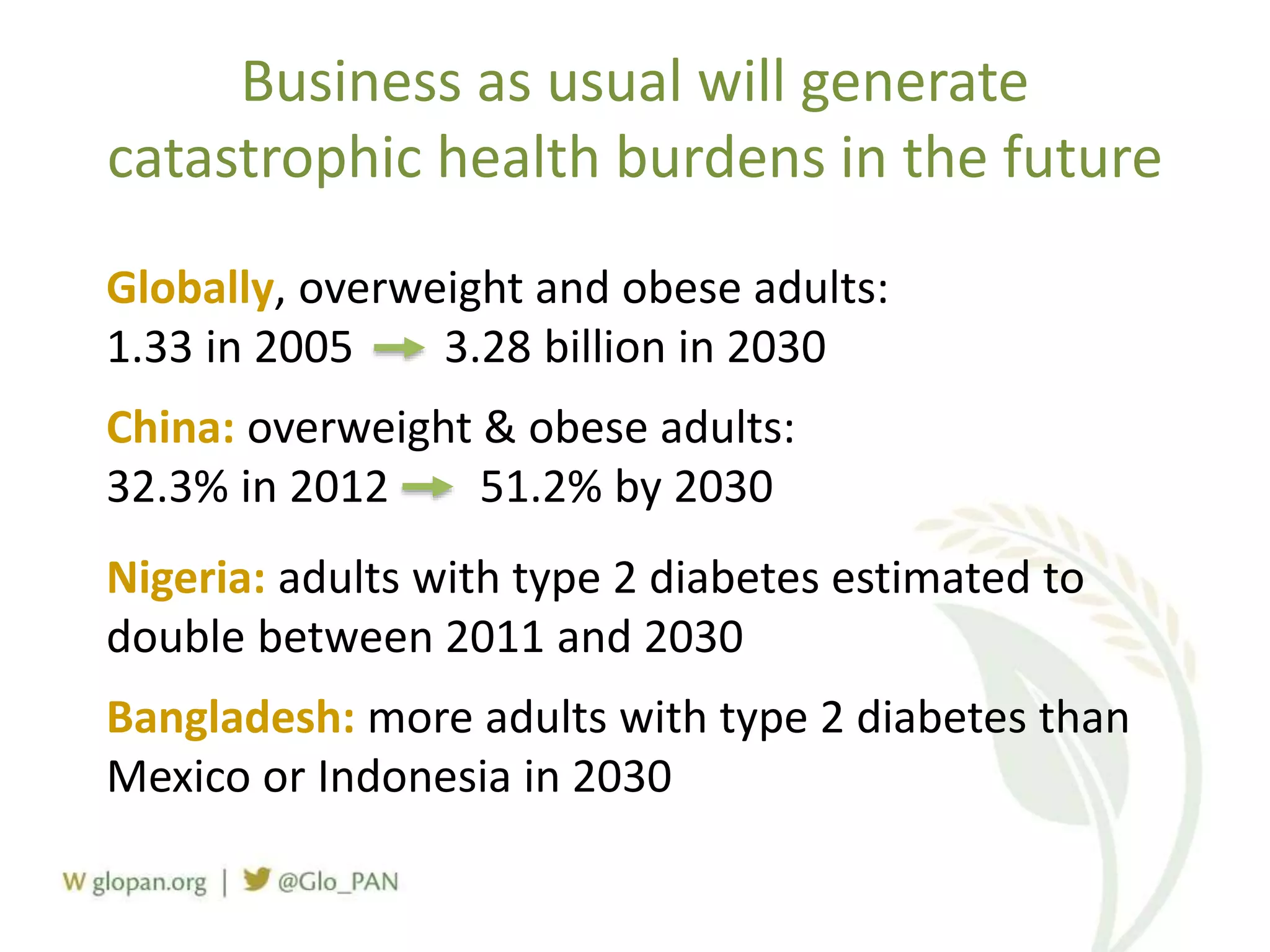
Business as usual will generate
catastrophic health burdens in the future
Globally, overweight and obese adults:
1.33 in 2005 3.28 billion in 2030
China: overweight & obese adults:
32.3% in 2012 51.2% by 2030
Nigeria: adults with type 2 diabetes estimated to
double between 2011 and 2030
Bangladesh: more adults with type 2 diabetes than
Mexico or Indonesia in 2030
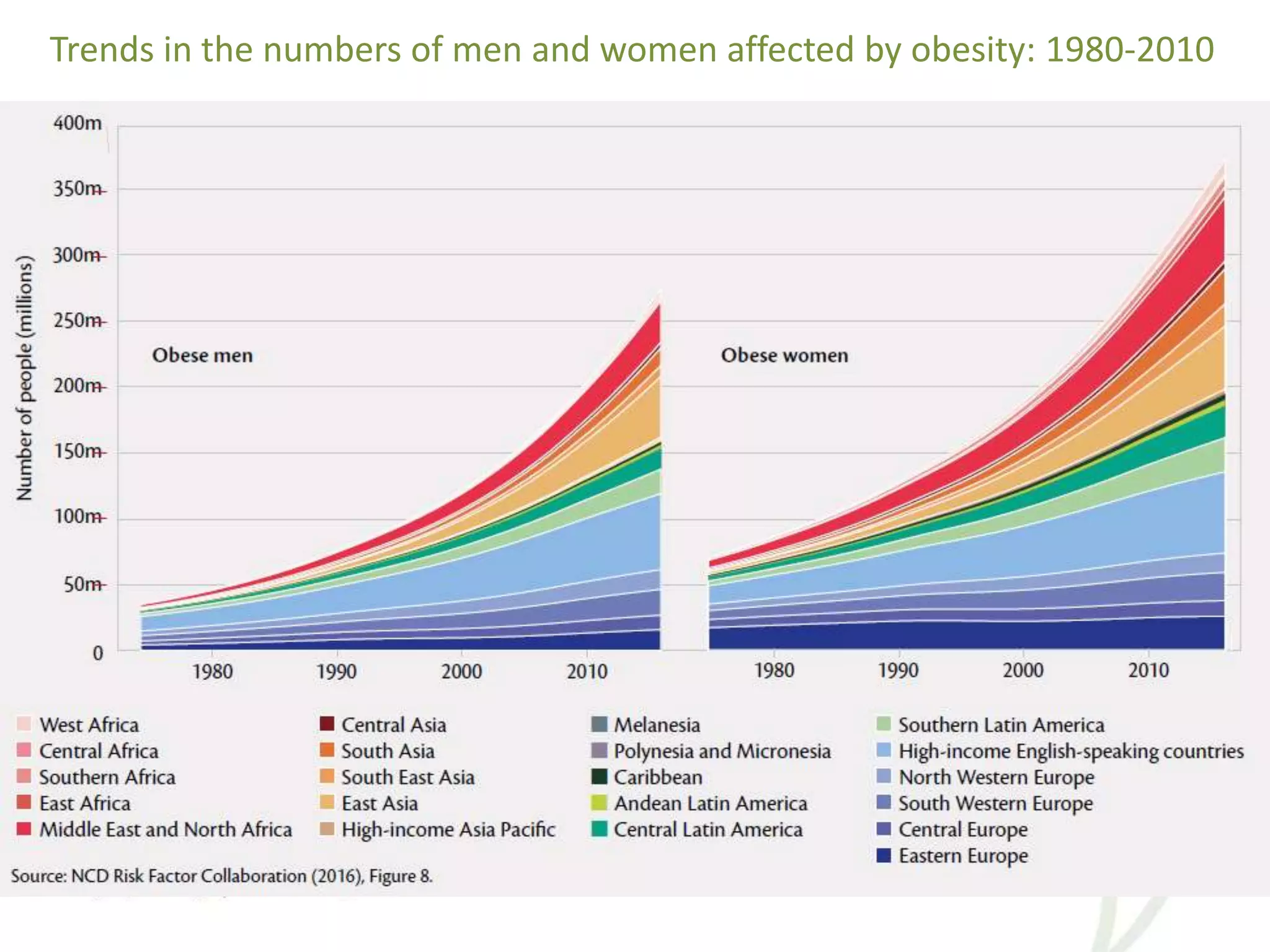
Trends in the numbers of men and women affected by obesity: 1980-2010
Recommended diets look similar
around the world
Recommended diets (WHO and National Food Based
Dietary Guidelines) include:
• Diversity of foods and food groups
• Plenty of fruits, vegetables, pulses, nuts…
• Animal source foods at recommended levels
• Moderate consumption of “ultra-processed” foods
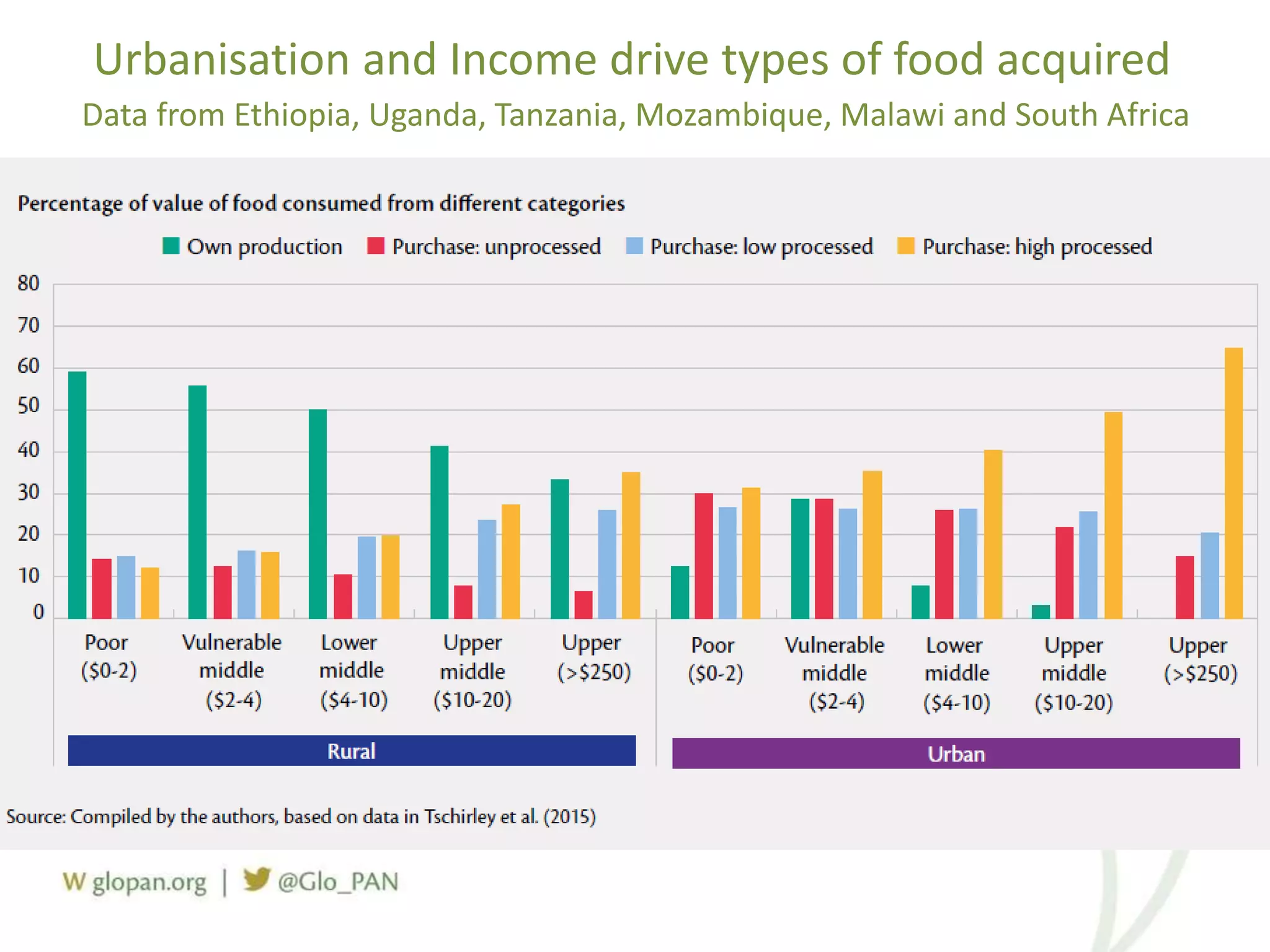
Urbanisation and Income drive types of food acquired
Data from Ethiopia, Uganda, Tanzania, Mozambique, Malawi and South Africa
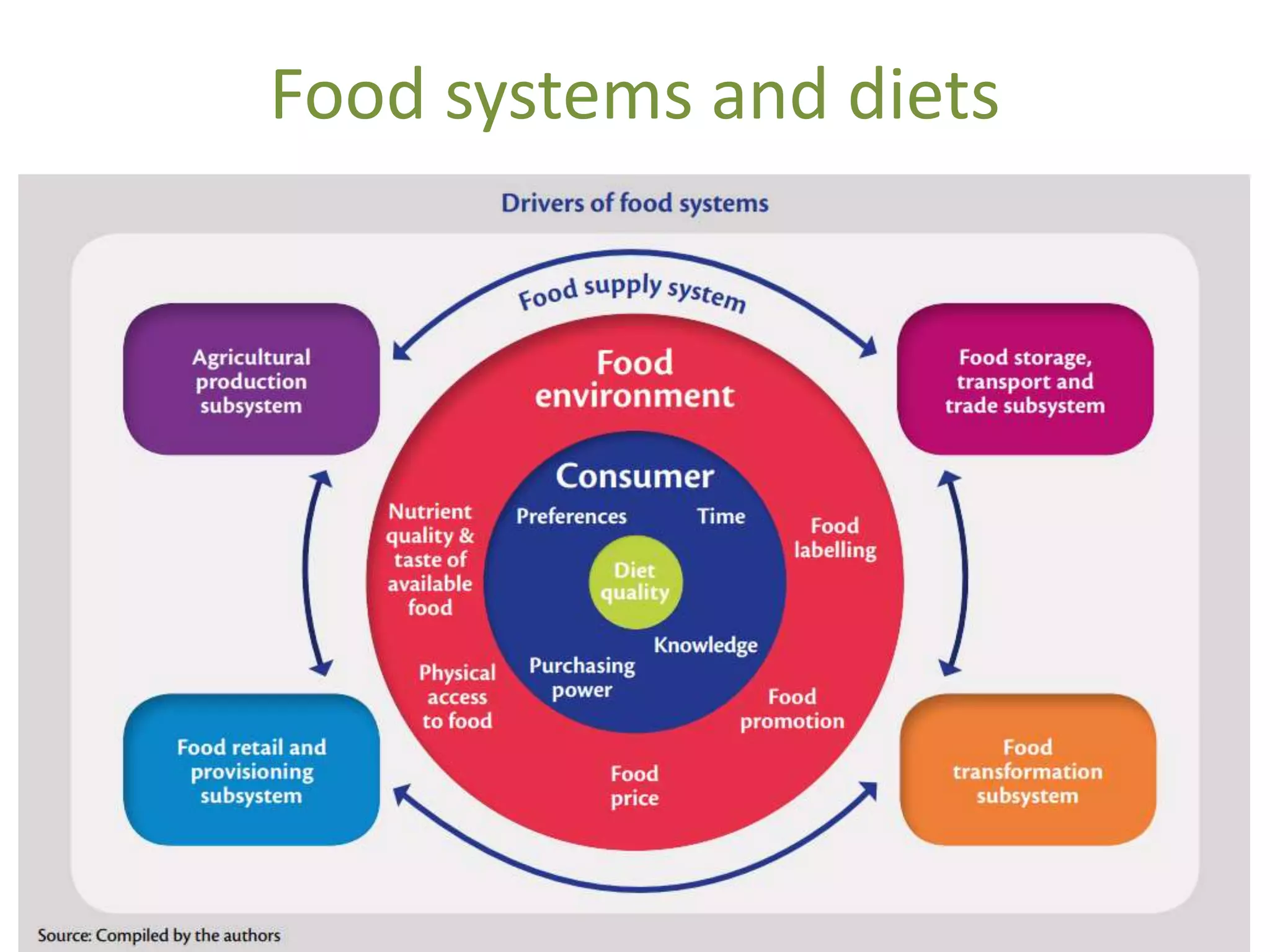
What are food systems?
Food systems go well BEYOND PRODUCTION
to storage, transpor, trade, transformation,
provisioning and retail.
Food systems GOVERN the safety, nutrition
quality and affordability of food.
Food systems and diets
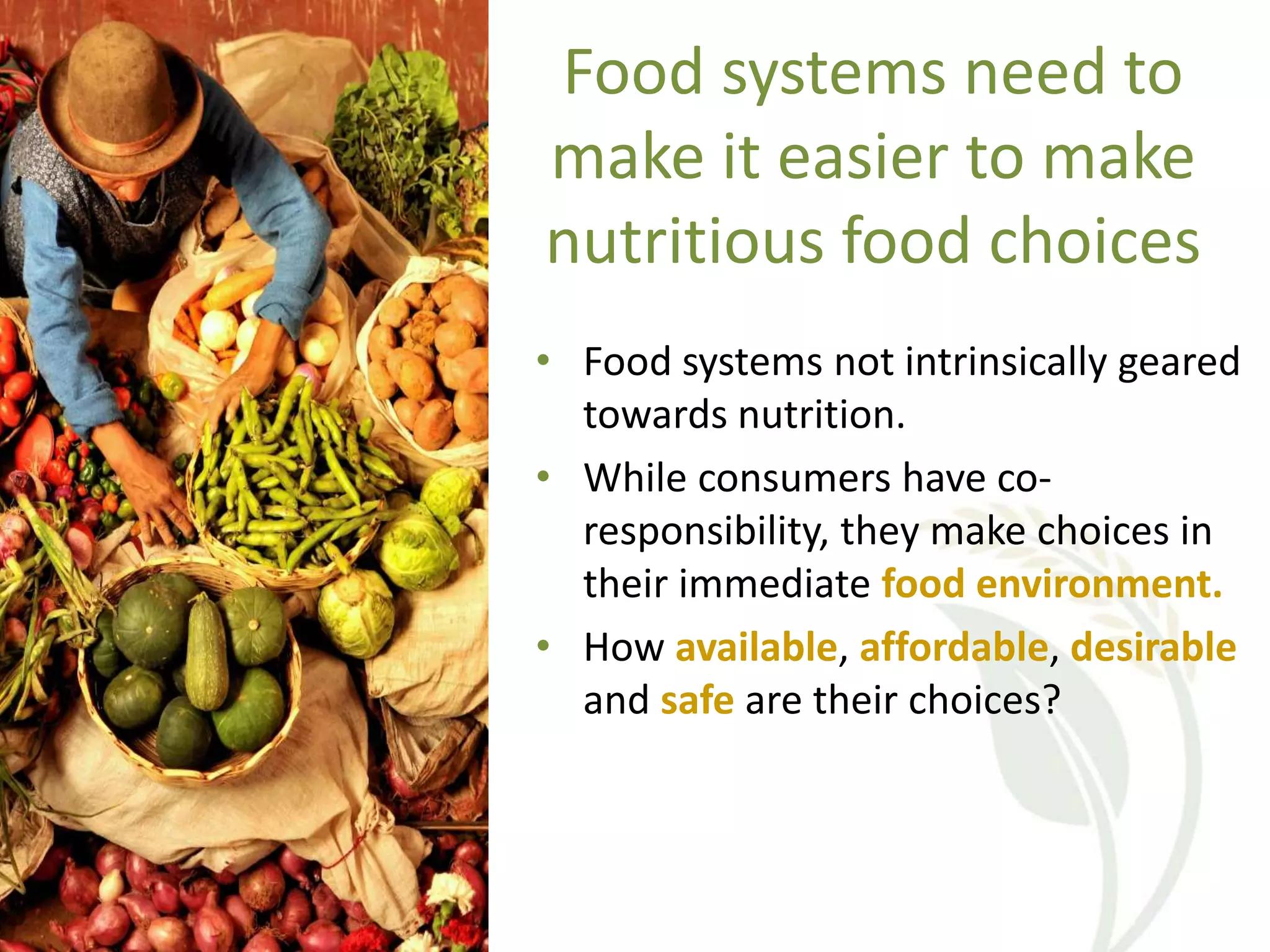
Food systems need to
make it easier to make
nutritious food choices
• Food systems not intrinsically geared
towards nutrition.
• While consumers have co-
responsibility, they make choices in
their immediate food environment.
• How available, affordable, desirable
and safe are their choices?
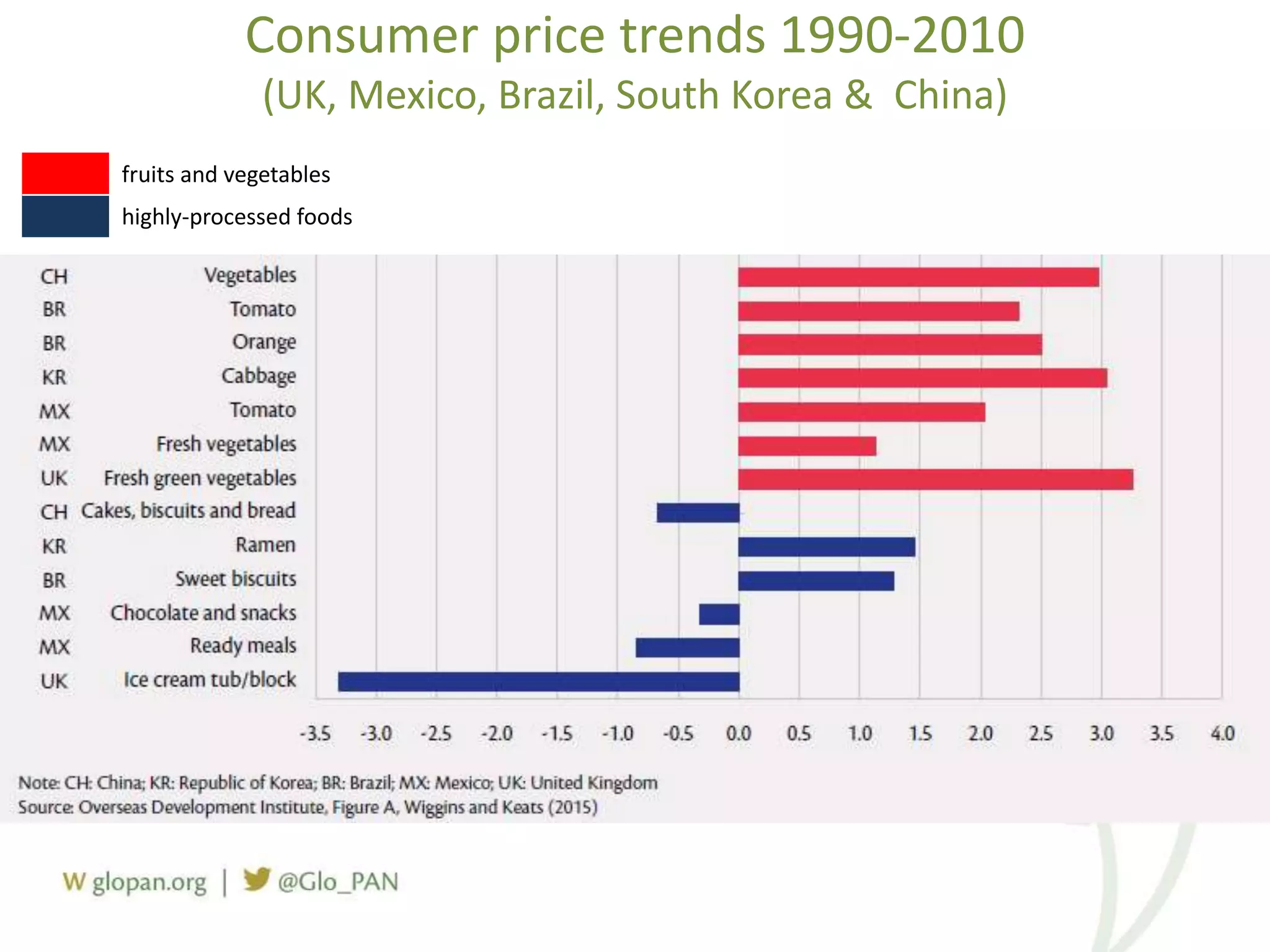
Consumer price trends 1990-2010
(UK, Mexico, Brazil, South Korea & China)
fruits and vegetables
highly-processed foods
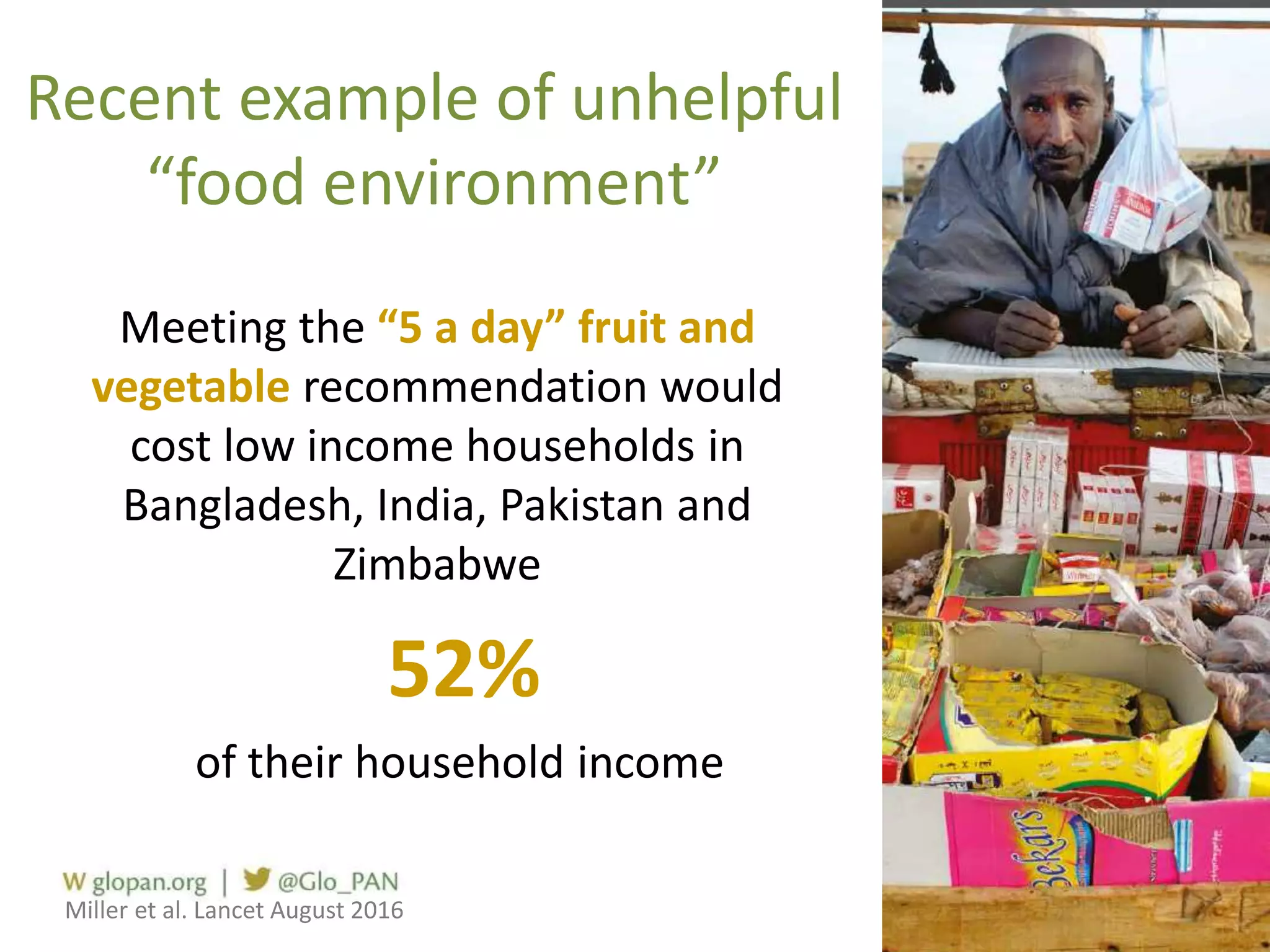
Recent example of unhelpful
“food environment”
Meeting the “5 a day” fruit and
vegetable recommendation would
cost low income households in
Bangladesh, India, Pakistan and
Zimbabwe
52%
of their household income
Miller et al. Lancet August 2016
The Opportunity
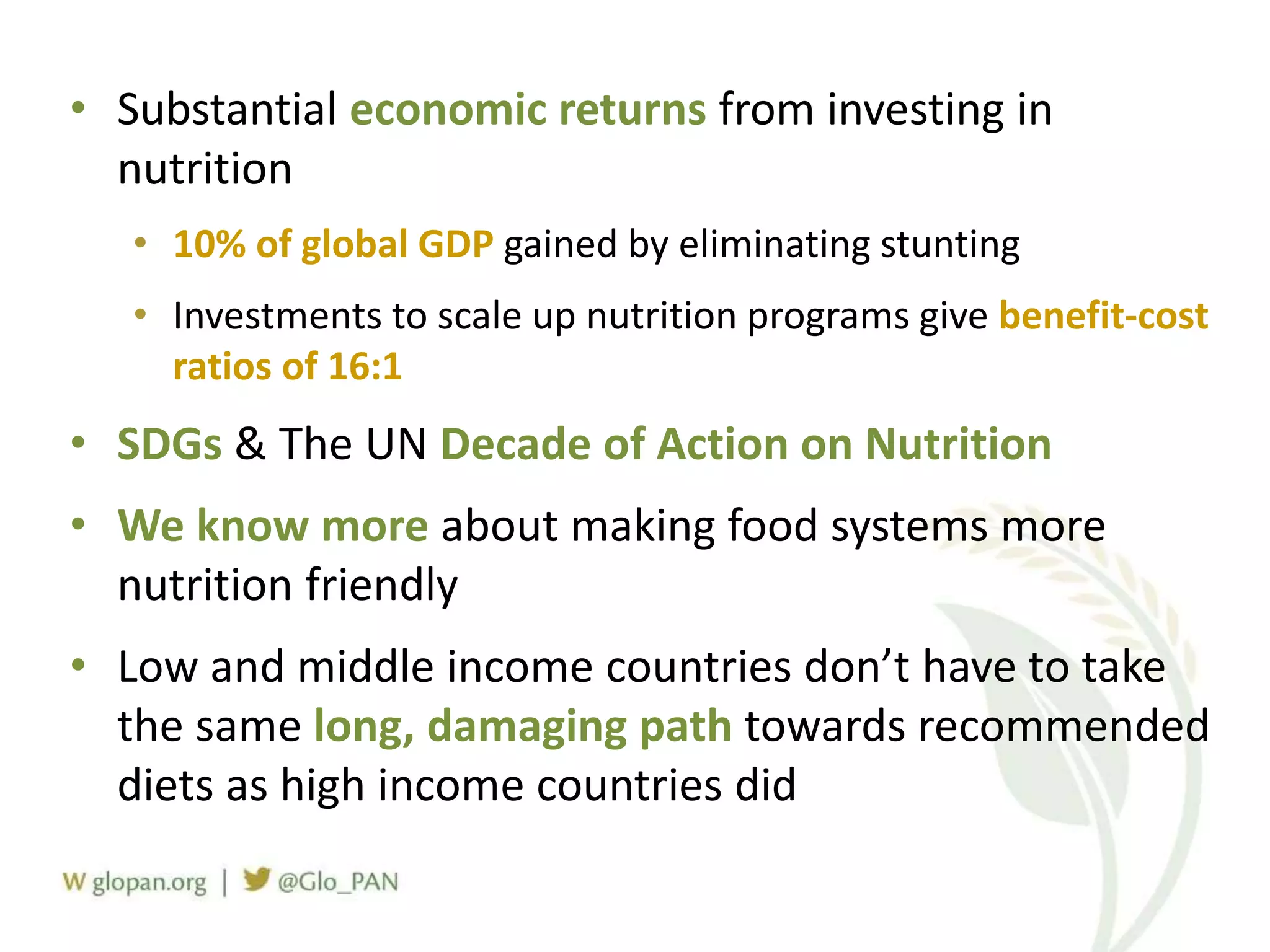
• Substantial economic returns from investing in
nutrition
• 10% of global GDP gained by eliminating stunting
• Investments to scale up nutrition programs give benefit-cost
ratios of 16:1
• SDGs & The UN Decade of Action on Nutrition
• We know more about making food systems more
nutrition friendly
• Low and middle income countries don’t have to take
the same long, damaging path towards recommended
diets as high income countries did
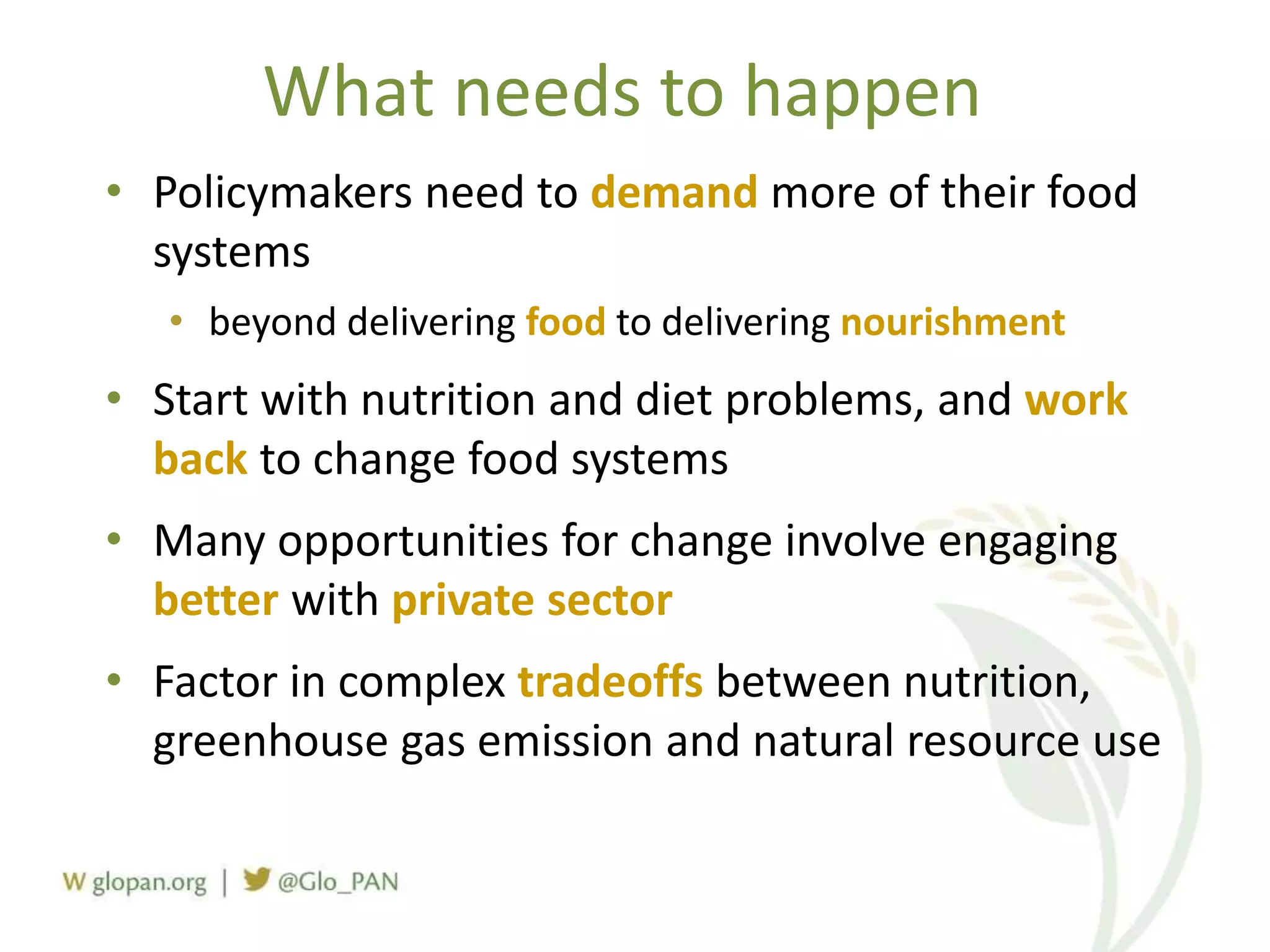
What needs to happen
• Policymakers need to demand more of their food
systems
• beyond delivering food to delivering nourishment
• Start with nutrition and diet problems, and work
back to change food systems
• Many opportunities for change involve engaging
better with private sector
• Factor in complex tradeoffs between nutrition,
greenhouse gas emission and natural resource use
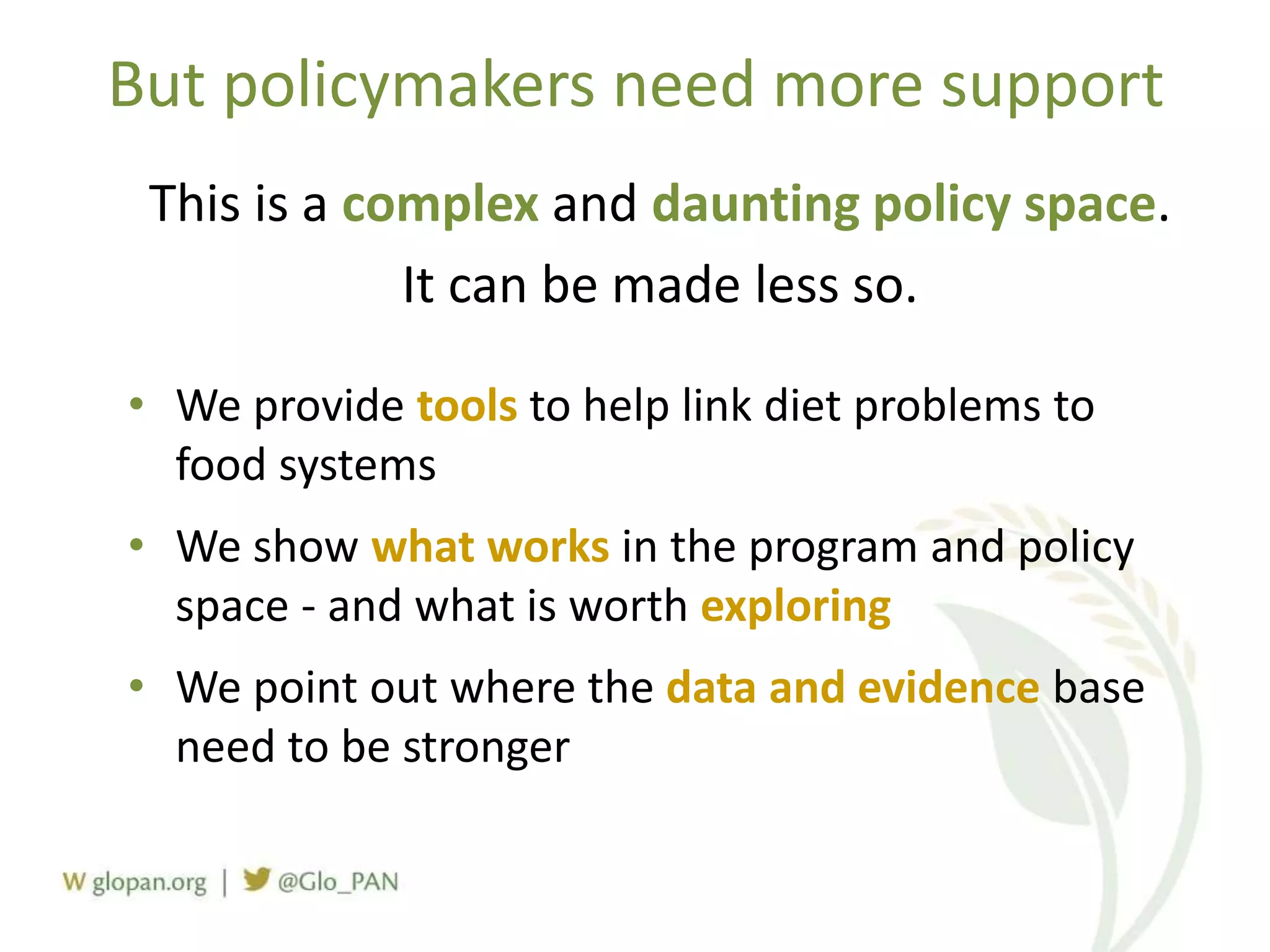
But policymakers need more support
This is a complex and daunting policy space.
It can be made less so.
• We provide tools to help link diet problems to
food systems
• We show what works in the program and policy
space - and what is worth exploring
• We point out where the data and evidence base
need to be stronger
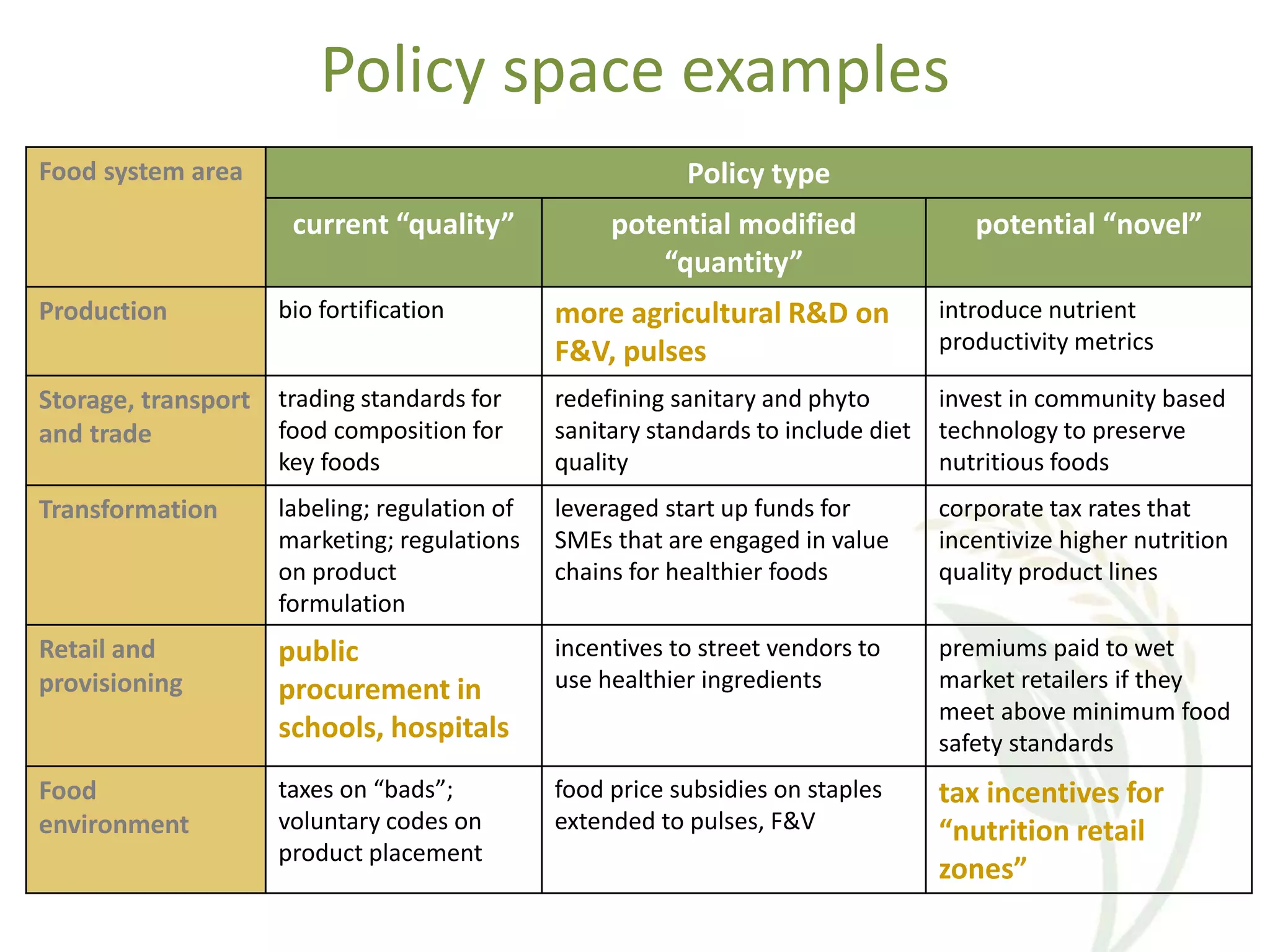
Policy space examples
Food system area Policy type
current “quality” potential modified
“quantity”
potential “novel”
Production bio fortification more agricultural R&D on
F&V, pulses
introduce nutrient
productivity metrics
Storage, transport
and trade
trading standards for
food composition for
key foods
redefining sanitary and phyto
sanitary standards to include diet
quality
invest in community based
technology to preserve
nutritious foods
Transformation labeling; regulation of
marketing; regulations
on product
formulation
leveraged start up funds for
SMEs that are engaged in value
chains for healthier foods
corporate tax rates that
incentivize higher nutrition
quality product lines
Retail and
provisioning
public
procurement in
schools, hospitals
incentives to street vendors to
use healthier ingredients
premiums paid to wet
market retailers if they
meet above minimum food
safety standards
Food
environment
taxes on “bads”;
voluntary codes on
product placement
food price subsidies on staples
extended to pulses, F&V
tax incentives for
“nutrition retail
zones”
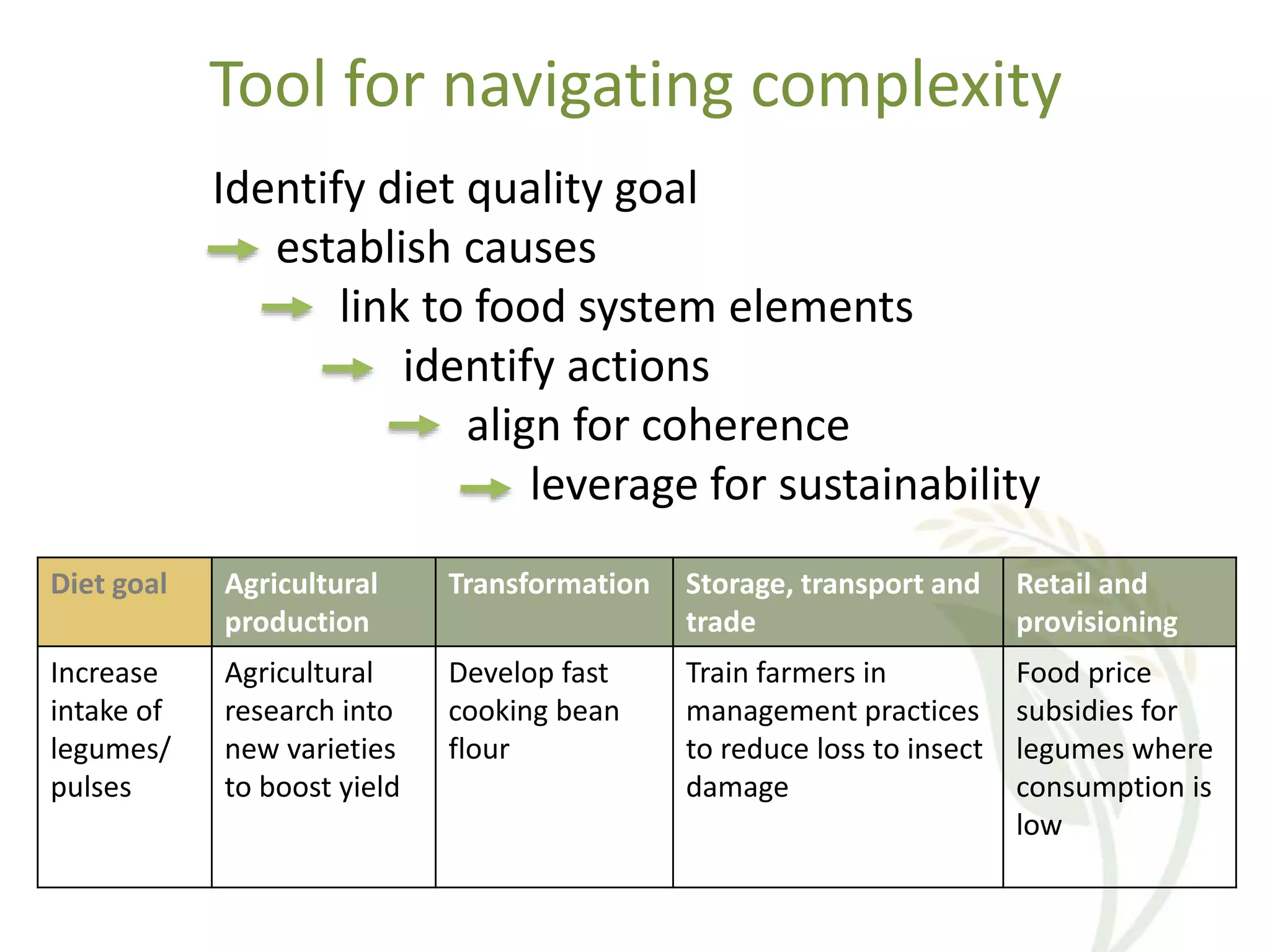
Tool for navigating complexity
Identify diet quality goal
establish causes
link to food system elements
identify actions
align for coherence
leverage for sustainability
Diet goal Agricultural
production
Transformation Storage, transport and
trade
Retail and
provisioning
Increase
intake of
legumes/
pulses
Agricultural
research into
new varieties
to boost yield
Develop fast
cooking bean
flour
Train farmers in
management practices
to reduce loss to insect
damage
Food price
subsidies for
legumes where
consumption is
low
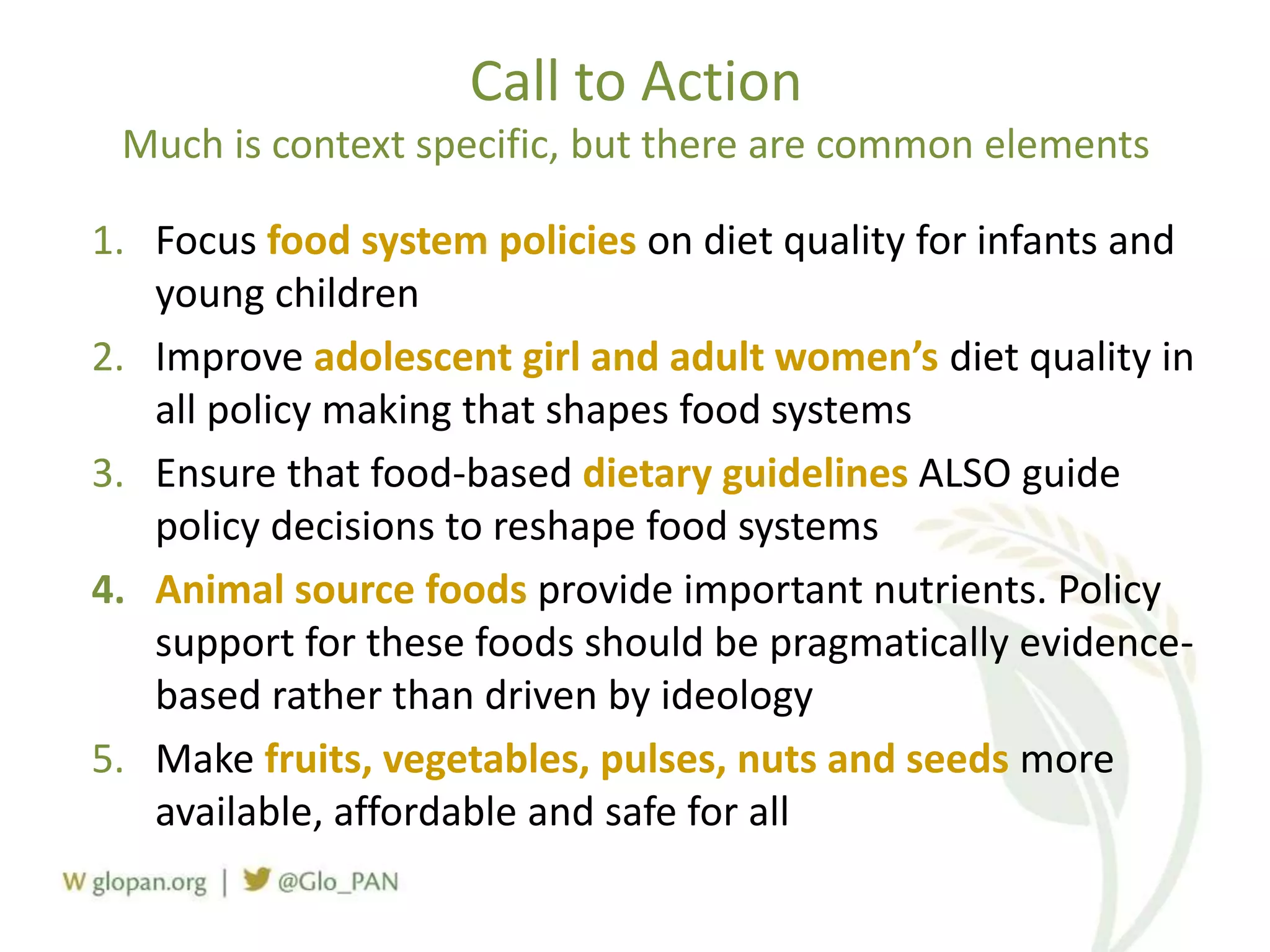
Call to Action
Much is context specific, but there are common elements
1. Focus food system policies on diet quality for infants and
young children
2. Improve adolescent girl and adult women’s diet quality in
all policy making that shapes food systems
3. Ensure that food-based dietary guidelines ALSO guide
policy decisions to reshape food systems
4. Animal source foods provide important nutrients. Policy
support for these foods should be pragmatically evidence-
based rather than driven by ideology
5. Make fruits, vegetables, pulses, nuts and seeds more
available, affordable and safe for all
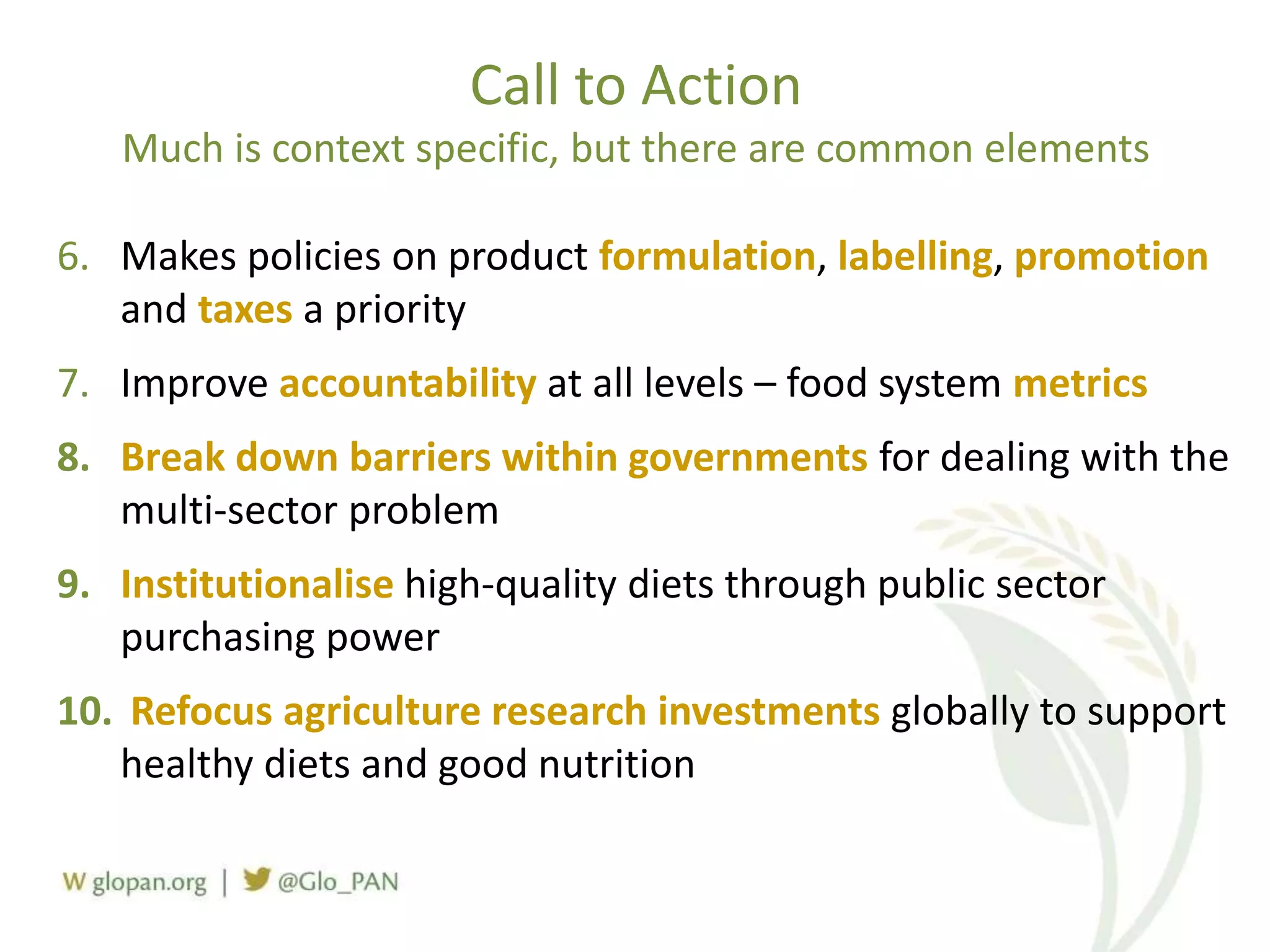
Call to Action
Much is context specific, but there are common elements
6. Makes policies on product formulation, labelling, promotion
and taxes a priority
7. Improve accountability at all levels – food system metrics
8. Break down barriers within governments for dealing with the
multi-sector problem
9. Institutionalise high-quality diets through public sector
purchasing power
10. Refocus agriculture research investments globally to support
healthy diets and good nutrition
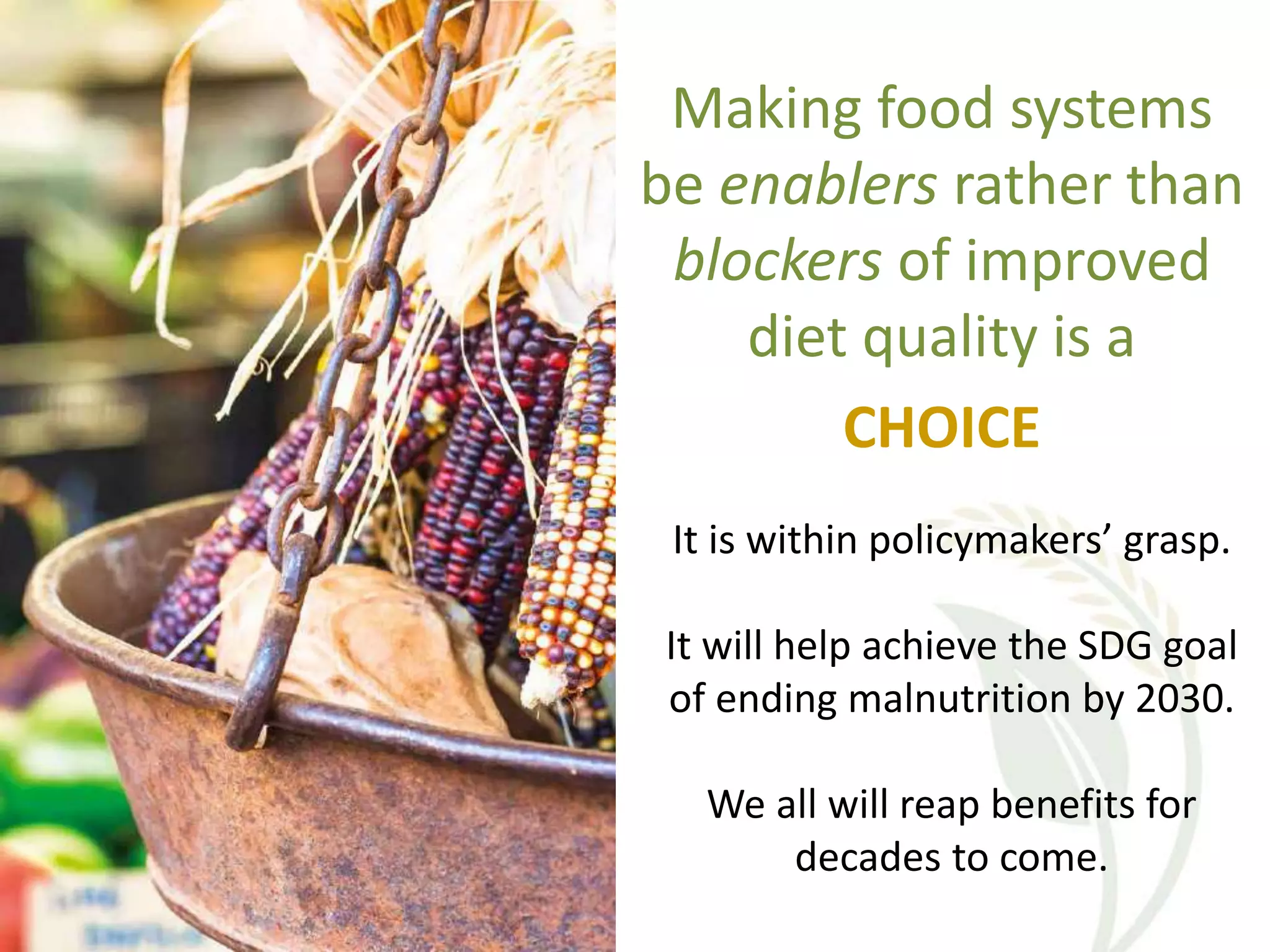
Making food systems
be enablers rather than
blockers of improved
diet quality is a
CHOICE
It is within policymakers’ grasp.
It will help achieve the SDG goal
of ending malnutrition by 2030.
We all will reap benefits for
decades to come.

Foresight Report on food systems and diets: Facing the challenges of the 21st century

  • 1.
    The Report Food systemsand diets: Facing the challenges of the 21st century
  • 2.
    The added valueof this Foresight Project • Placing nutrition and diets in the wider policy space • Looking into the future to inform today’s decisions • Drawing on the best science, evidence and advice • Distilling complexity into priorities for action
  • 3.
  • 4.
    Malnutrition is pervasiveand increasing • Malnutrition affects all 193 countries • Malnutrition affects 1 in 3 people will rise to 1 in 2 people if current trends continue • 800 million are hungry, 2 billion have micronutrient deficiency, 1.9 billion are overweight or obese • Overweight/obesity rates are rising in every country • Undernutrition rates decreasing too slowly
  • 5.
    • Burdens ofmalnutrition are high (and will get higher) • 45% of all under 5 deaths • stunted children 33% more likely to live in poverty as adults • in China, 16% of household income lost due to type 2 diabetes • Low quality diets are the number one risk factor contributing to the global burden of disease Malnutrition has severe consequences
  • 6.
    Most global burdenof disease risk factors are linked to diet
  • 7.
    Diets do notautomatically improve over time Source: Masters (2016), Global Dietary Database grams per day changes 1990-2013
  • 8.
    Diets do notautomatically improve over time Source: Masters (2016), Global Dietary Database grams per day changes 1990-2013
  • 9.
    Business as usualwill generate catastrophic health burdens in the future Globally, overweight and obese adults: 1.33 in 2005 3.28 billion in 2030 China: overweight & obese adults: 32.3% in 2012 51.2% by 2030 Nigeria: adults with type 2 diabetes estimated to double between 2011 and 2030 Bangladesh: more adults with type 2 diabetes than Mexico or Indonesia in 2030
  • 10.
    Trends in thenumbers of men and women affected by obesity: 1980-2010
  • 11.
    Recommended diets looksimilar around the world Recommended diets (WHO and National Food Based Dietary Guidelines) include: • Diversity of foods and food groups • Plenty of fruits, vegetables, pulses, nuts… • Animal source foods at recommended levels • Moderate consumption of “ultra-processed” foods
  • 12.
    Urbanisation and Incomedrive types of food acquired Data from Ethiopia, Uganda, Tanzania, Mozambique, Malawi and South Africa
  • 13.
    What are foodsystems? Food systems go well BEYOND PRODUCTION to storage, transpor, trade, transformation, provisioning and retail. Food systems GOVERN the safety, nutrition quality and affordability of food.
  • 14.
  • 15.
    Food systems needto make it easier to make nutritious food choices • Food systems not intrinsically geared towards nutrition. • While consumers have co- responsibility, they make choices in their immediate food environment. • How available, affordable, desirable and safe are their choices?
  • 16.
    Consumer price trends1990-2010 (UK, Mexico, Brazil, South Korea & China) fruits and vegetables highly-processed foods
  • 17.
    Recent example ofunhelpful “food environment” Meeting the “5 a day” fruit and vegetable recommendation would cost low income households in Bangladesh, India, Pakistan and Zimbabwe 52% of their household income Miller et al. Lancet August 2016
  • 18.
  • 19.
    • Substantial economicreturns from investing in nutrition • 10% of global GDP gained by eliminating stunting • Investments to scale up nutrition programs give benefit-cost ratios of 16:1 • SDGs & The UN Decade of Action on Nutrition • We know more about making food systems more nutrition friendly • Low and middle income countries don’t have to take the same long, damaging path towards recommended diets as high income countries did
  • 20.
    What needs tohappen • Policymakers need to demand more of their food systems • beyond delivering food to delivering nourishment • Start with nutrition and diet problems, and work back to change food systems • Many opportunities for change involve engaging better with private sector • Factor in complex tradeoffs between nutrition, greenhouse gas emission and natural resource use
  • 21.
    But policymakers needmore support This is a complex and daunting policy space. It can be made less so. • We provide tools to help link diet problems to food systems • We show what works in the program and policy space - and what is worth exploring • We point out where the data and evidence base need to be stronger
  • 22.
    Policy space examples Foodsystem area Policy type current “quality” potential modified “quantity” potential “novel” Production bio fortification more agricultural R&D on F&V, pulses introduce nutrient productivity metrics Storage, transport and trade trading standards for food composition for key foods redefining sanitary and phyto sanitary standards to include diet quality invest in community based technology to preserve nutritious foods Transformation labeling; regulation of marketing; regulations on product formulation leveraged start up funds for SMEs that are engaged in value chains for healthier foods corporate tax rates that incentivize higher nutrition quality product lines Retail and provisioning public procurement in schools, hospitals incentives to street vendors to use healthier ingredients premiums paid to wet market retailers if they meet above minimum food safety standards Food environment taxes on “bads”; voluntary codes on product placement food price subsidies on staples extended to pulses, F&V tax incentives for “nutrition retail zones”
  • 23.
    Tool for navigatingcomplexity Identify diet quality goal establish causes link to food system elements identify actions align for coherence leverage for sustainability Diet goal Agricultural production Transformation Storage, transport and trade Retail and provisioning Increase intake of legumes/ pulses Agricultural research into new varieties to boost yield Develop fast cooking bean flour Train farmers in management practices to reduce loss to insect damage Food price subsidies for legumes where consumption is low
  • 24.
    Call to Action Muchis context specific, but there are common elements 1. Focus food system policies on diet quality for infants and young children 2. Improve adolescent girl and adult women’s diet quality in all policy making that shapes food systems 3. Ensure that food-based dietary guidelines ALSO guide policy decisions to reshape food systems 4. Animal source foods provide important nutrients. Policy support for these foods should be pragmatically evidence- based rather than driven by ideology 5. Make fruits, vegetables, pulses, nuts and seeds more available, affordable and safe for all
  • 25.
    Call to Action Muchis context specific, but there are common elements 6. Makes policies on product formulation, labelling, promotion and taxes a priority 7. Improve accountability at all levels – food system metrics 8. Break down barriers within governments for dealing with the multi-sector problem 9. Institutionalise high-quality diets through public sector purchasing power 10. Refocus agriculture research investments globally to support healthy diets and good nutrition
  • 26.
    Making food systems beenablers rather than blockers of improved diet quality is a CHOICE It is within policymakers’ grasp. It will help achieve the SDG goal of ending malnutrition by 2030. We all will reap benefits for decades to come.

Editor's Notes

  • #5 Malnutrition is pervasive -- and income growth is not going to diminish it Malnutrition affects all 193 countries Malnutrition affects 1 in 3 people  will rise to 1 in 2 people if current trends continue 800 million are hungry, 2 billion have micronutrient deficiency, 1.9 billion are overweight or obese Overweight/obesity rates are rising in every country driven by income growth, urbanisation and globalisation, mediated by the food system
  • #6  Malnutrition rates decreasing very slowly e.g. women’s anemia target will only be met in 2084 (instead of 2025) at current rates of progress Burdens of malnutrition are high (and will get higher). 45% of all under 5 deaths stunted children 33% more likely to live in poverty as adults effects on people: in China, 16% of household income lost due to diabetes Low quality diets are the number one risk factor contributing to the global burden of disease
  • #10 Business as usual will generate Catastrophic health burdens Globally, if current trends continue, the combined number of overweight and obese adults will increase from 1.33 billion in 2005 to 3.28 billion in 2030 In China, the combined rate of overweight and obese adults has gone from 14.6% in 1992 to 32.3% in 2012 and is projected to rise to 51.2% by 2030 In Nigeria, the number of adults with diabetes is estimated to double between 2011 and 2030: from 3.1 million to 6.1 million In 2030, Bangladesh will have more adults with diabetes than Mexico or Indonesia
  • #12 Malnutrition results from the interaction of poor quality diet and unhealthy environments Based on WHO guidelines and Food Based Dietary Guidelines from around the world, recommended diets include: Diversity of food groups needed for healthy growth and development Plenty of fruits and vegetables, pulses, nuts, whole grains, seafood Where animal source foods are below recommended levels, increase them, especially for vulnerable groups like young children, adolescent girls and women of reproductive age Where animal source foods are above recommended levels, reduce or moderate them (high levels of red meat seems especially problematic for health and green house gas emissions) Moderate the consumption of most “ultra-processed” foods
  • #16 Food systems are not intrinsically geared towards nutrition. Profit and nutrition do not automatically overlap. Consumers have a co-responsibility, but they make choices in their immediate food environment: how available, affordable, desirable and safe/nutritious are the foods they can choose from? Food environments do not make it easy for consumers to make healthy choices
  • #18 Meeting “5 a day” consumption recommendations of 3 vegetable and 2 fruit servings per day for each household member would cost low income households in Bangladesh, India, Pakistan and Zimbabwe 52% of their household income. Miller et al. Lancet August 2016.
  • #21 Policymakers need to demand more of their food systems. Need to go beyond simply delivering food and incentivize delivery of food that promotes health and nutrition. Start with nutrition and diet problems and work back to look for opportunities to change things in the food system—there are many opportunities. Many opportunities for change involve engaging with private sector. Nutrition community cannot afford to stick our head in the sand any longer. But proceed with eyes open. Factor in tradeoffs between nutrition, greenhouse gas emission and natural resource use. They are not as straightforward as they may seem.
  • #22 This is a complex and daunting policy space. It can be made less so. We need tools to help policymakers link nutrition and diet problems to food systems. What works in the programme and policy space and what is worth exploring? The data and evidence base is very weak—it needs strengthening in a dramatic way.
  • #25 The global panel’s foresight recommendaitons ar esumamrised in a call to action with 10 recommendation:
  • #27  It is a choice that is well within policymakers grasp. It is a choice that will help achieve the SDG goal of ending malnutrition in all its forms by 2030. It is a choice that will reap benefits for decades to come, for all people, in all countries.