Introduction to Electric
Vehicles
CONTENTS
1. Introduction to Hybrid and Electric Vehicles:
2. History of hybrid and electric vehicles,
3. Need for hybrid and electric vehicles and their limitations.
4. Social and environmental importance of hybrid and electric vehicles.
5. Impact of modern drive-trains on energy supplies.
6. Specifications of hybrid and electric vehicles.
Introduction
DEFINITION : An EV is an electric vehicle, battery operated only. Sole
propulsion by electric motor.
HISTORICAL DEVELOPMENT OF AUTOMOBILES
 1900 - Steam technology was advanced to produce steam-powered
cars
Advantages
• High performance in terms of power and speed.
Disadvantages
• Poor fuel economy
• Need to “fire up the boiler” before driving.
• Feed water was a necessary input for steam engine. Could not tolerate
the loss of fresh water.
Introduction
 1900 : Gasoline cars
Disadvantages
• Noisy, Dirty, Smelly, Cantankerous, and Unreliable.
 1890 : Jacob Lohner, a coach builder in Vienna, Austria,
commissioned a design for an electric vehicle, less noisy than the new gas-
powered cars.
Ferdinand Porsche’s (from Vienna Technical College) first version of the
electric car used a pair of electric motors mounted in the front wheel hubs
of a conventional car.
Introduction
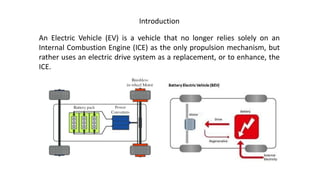
An Electric Vehicle (EV) is a vehicle that no longer relies solely on an
Internal Combustion Engine (ICE) as the only propulsion mechanism, but
rather uses an electric drive system as a replacement, or to enhance, the
ICE.
Introduction
INVENTION OF HYBRID VEHICLE
1900 : Porsche showed his hybrid car at the Paris Exposition.
A gasoline engine was used to power a generator which, in turn,
drove a small series of motors.
The electric engine was used to give the car a little bit of extra
power.
1990 : Automakers took a renewed interest in the hybrid, seeking a solution
to dwindling energy supplies and environmental concerns and
created modern history of hybrid car .
2000 : Toyota Prius and Honda Insight became the first mass market hybrids
to go on sale in the United States, with dozens of models following in
the next decade.
Introduction
Motivating factors in the search for alternative road transportation
propulsion systems.
1. Growing concerns over the limited supply of fossil-based fuels
2. Regulatory pressures to reduce
a) Urban pollution,
b) CO2 emissions and
c) City noise
Electric vehicles a very attractive choice as the alternative to the internal
combustion engine
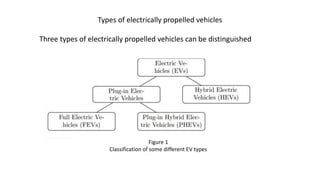
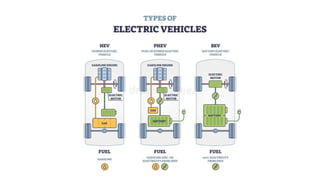
Types of electrically propelled vehicles
Three types of electrically propelled vehicles can be distinguished
Figure 1
Classification of some different EV types
Benefits and Challenges
Various environmental and health improvements
1. Price: EVs have, to date, been expensive, even when subsidized. A major
factor in the cost of such vehicles is the cost of the battery.
2. Vehicle size: EVs are sometimes small with limited luggage space to
reduce energy consumption, or to accommodate batteries (in some
hybrid vehicles).
3. Long charging times: Charging times for plug-in EVs can be long.
Benefits and Challenges
4. Limited range: Maximum ranges of less than 300 km in favorable
conditions and this reduces significantly when air-conditioning or heating
is switched on. Hence, the range is not only limited but to a certain
degree also unpredictable.
5. Charging (from the perspective of generation distributors): Power quality
issues when not regulated.
6. Traffic management: Force the drivers to recharge before the end of the
journey.
7. Charging Infrastructure: Availability and distribution of charging stations.
Not being able to access a charge point when needed.
8. Electromagnetic emissions: Green Car Programme
Benefits and Challenges
4. Battery related issues:
a)Sourcing lithium to build batteries to construct enough vehicles to
replace the existing passenger vehicle fleet.
b)Transportation of batteries.
c) Battery size and performance currently represent one of the major
determinants in the design of EVs today.

Presentation Lecture 1 Introduction to Electric Vehicles.pptxV

  • 1.
  • 2.
    CONTENTS 1. Introduction toHybrid and Electric Vehicles: 2. History of hybrid and electric vehicles, 3. Need for hybrid and electric vehicles and their limitations. 4. Social and environmental importance of hybrid and electric vehicles. 5. Impact of modern drive-trains on energy supplies. 6. Specifications of hybrid and electric vehicles.
  • 3.
    Introduction DEFINITION : AnEV is an electric vehicle, battery operated only. Sole propulsion by electric motor. HISTORICAL DEVELOPMENT OF AUTOMOBILES  1900 - Steam technology was advanced to produce steam-powered cars Advantages • High performance in terms of power and speed. Disadvantages • Poor fuel economy • Need to “fire up the boiler” before driving. • Feed water was a necessary input for steam engine. Could not tolerate the loss of fresh water.
  • 4.
    Introduction  1900 :Gasoline cars Disadvantages • Noisy, Dirty, Smelly, Cantankerous, and Unreliable.  1890 : Jacob Lohner, a coach builder in Vienna, Austria, commissioned a design for an electric vehicle, less noisy than the new gas- powered cars. Ferdinand Porsche’s (from Vienna Technical College) first version of the electric car used a pair of electric motors mounted in the front wheel hubs of a conventional car.
  • 5.
    Introduction An Electric Vehicle(EV) is a vehicle that no longer relies solely on an Internal Combustion Engine (ICE) as the only propulsion mechanism, but rather uses an electric drive system as a replacement, or to enhance, the ICE.
  • 6.
    Introduction INVENTION OF HYBRIDVEHICLE 1900 : Porsche showed his hybrid car at the Paris Exposition. A gasoline engine was used to power a generator which, in turn, drove a small series of motors. The electric engine was used to give the car a little bit of extra power. 1990 : Automakers took a renewed interest in the hybrid, seeking a solution to dwindling energy supplies and environmental concerns and created modern history of hybrid car . 2000 : Toyota Prius and Honda Insight became the first mass market hybrids to go on sale in the United States, with dozens of models following in the next decade.
  • 7.
    Introduction Motivating factors inthe search for alternative road transportation propulsion systems. 1. Growing concerns over the limited supply of fossil-based fuels 2. Regulatory pressures to reduce a) Urban pollution, b) CO2 emissions and c) City noise Electric vehicles a very attractive choice as the alternative to the internal combustion engine
  • 8.
    Types of electricallypropelled vehicles Three types of electrically propelled vehicles can be distinguished Figure 1 Classification of some different EV types
  • 10.
    Benefits and Challenges Variousenvironmental and health improvements 1. Price: EVs have, to date, been expensive, even when subsidized. A major factor in the cost of such vehicles is the cost of the battery. 2. Vehicle size: EVs are sometimes small with limited luggage space to reduce energy consumption, or to accommodate batteries (in some hybrid vehicles). 3. Long charging times: Charging times for plug-in EVs can be long.
  • 11.
    Benefits and Challenges 4.Limited range: Maximum ranges of less than 300 km in favorable conditions and this reduces significantly when air-conditioning or heating is switched on. Hence, the range is not only limited but to a certain degree also unpredictable. 5. Charging (from the perspective of generation distributors): Power quality issues when not regulated. 6. Traffic management: Force the drivers to recharge before the end of the journey. 7. Charging Infrastructure: Availability and distribution of charging stations. Not being able to access a charge point when needed. 8. Electromagnetic emissions: Green Car Programme
  • 12.
    Benefits and Challenges 4.Battery related issues: a)Sourcing lithium to build batteries to construct enough vehicles to replace the existing passenger vehicle fleet. b)Transportation of batteries. c) Battery size and performance currently represent one of the major determinants in the design of EVs today.