

Leadership in
Engineering Management – Taking
Your Career to the Next Level
David Tennant, PE, PMP

www.windward.ws

1
Contents
Why do I want to be in
Engineering Management?
How do I get there?
What are the skills
needed?
What role does leadership
play?
2
Is Management for You?

How many want to move into
a management role?
How many are already in a
management role?

How many want to move into
an executive management
role?

3
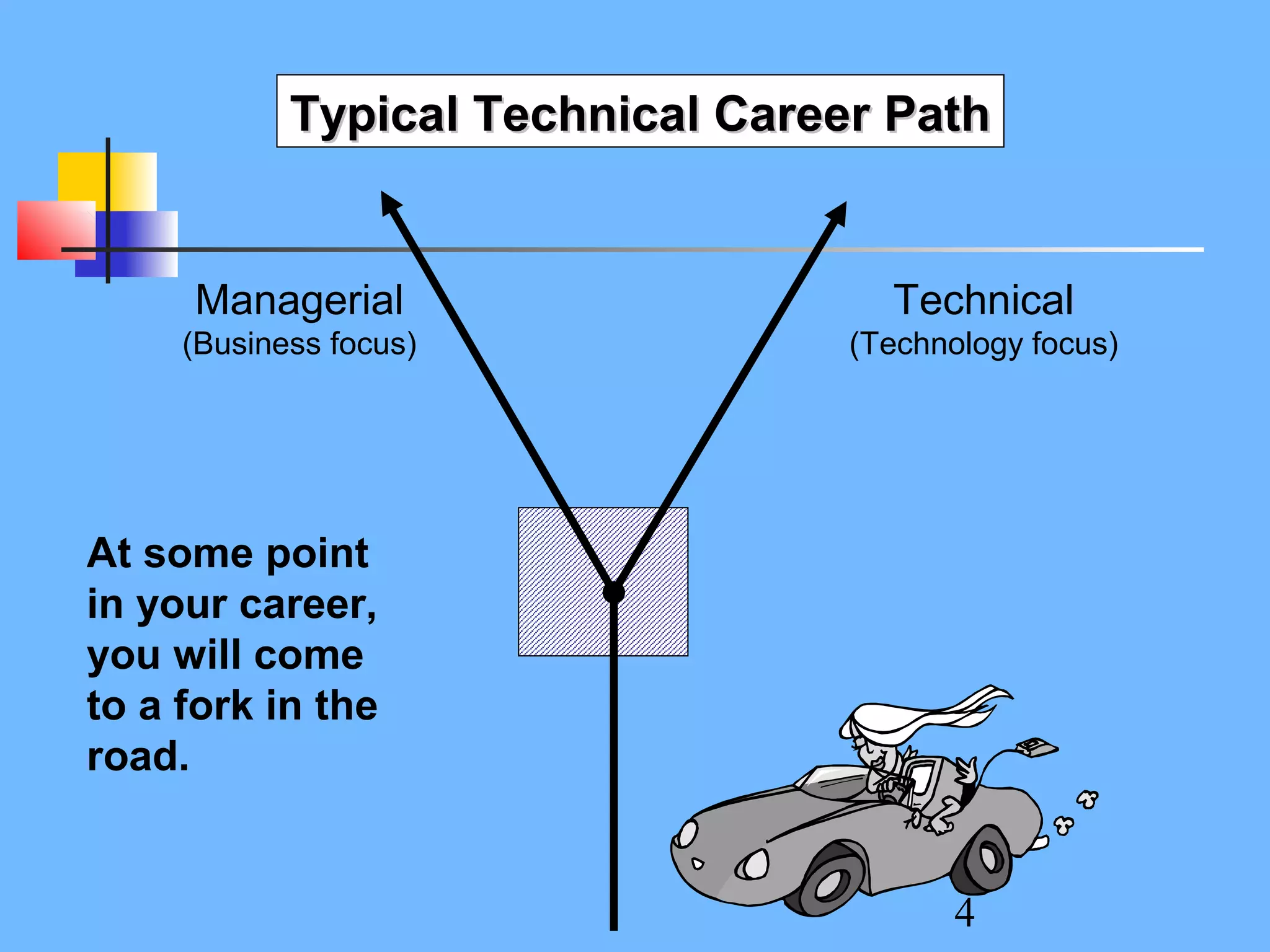
Typical Technical Career Path

Managerial

Technical

(Business focus)

(Technology focus)

At some point
in your career,
you will come
to a fork in the
road.

4
Is Management for You?
Have you considered project management?
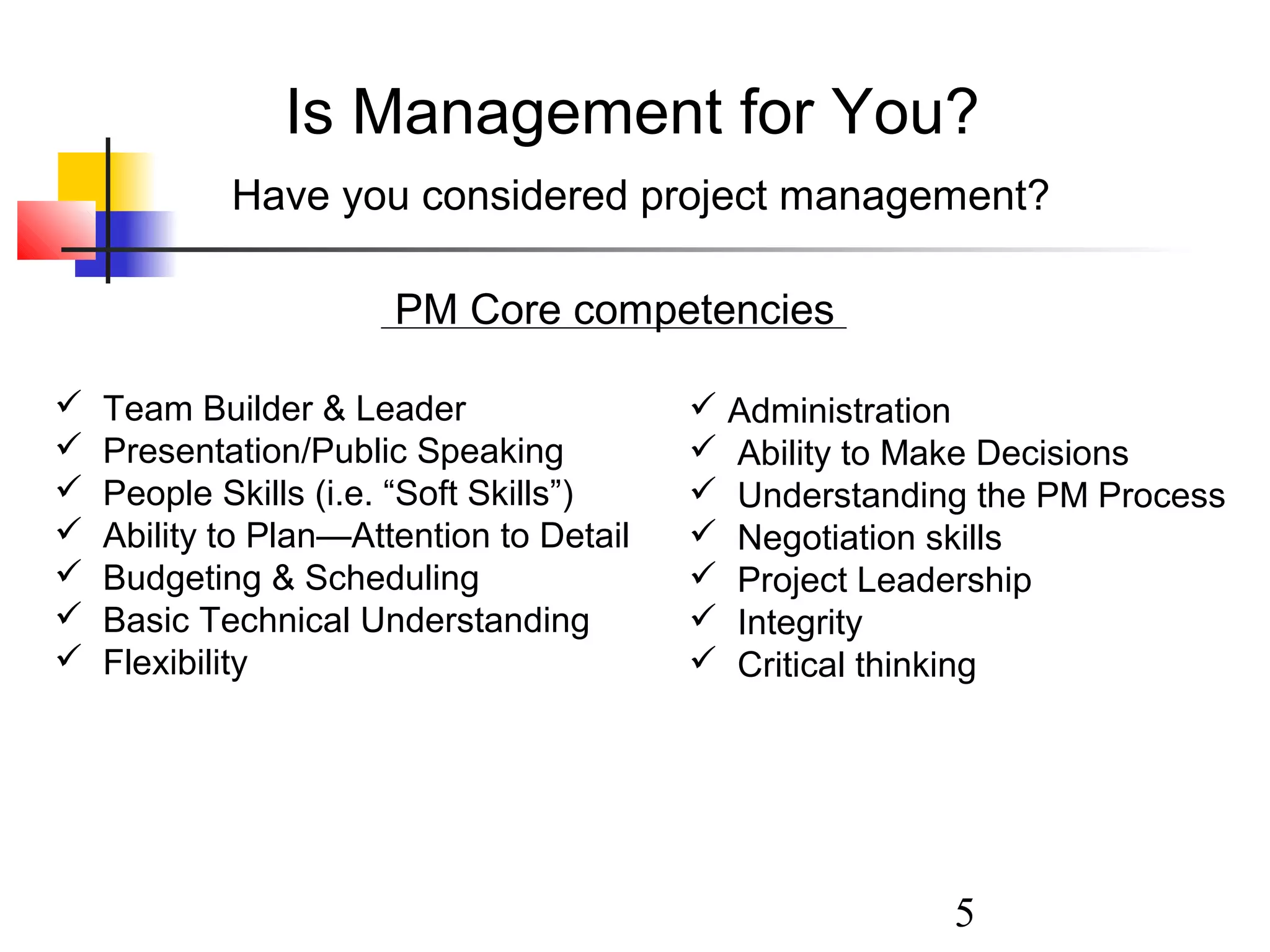
PM Core competencies








Team Builder & Leader
Presentation/Public Speaking
People Skills (i.e. “Soft Skills”)
Ability to Plan—Attention to Detail
Budgeting & Scheduling
Basic Technical Understanding
Flexibility

 Administration
 Ability to Make Decisions
 Understanding the PM Process
 Negotiation skills
 Project Leadership
 Integrity
 Critical thinking

5
Is Management for You?
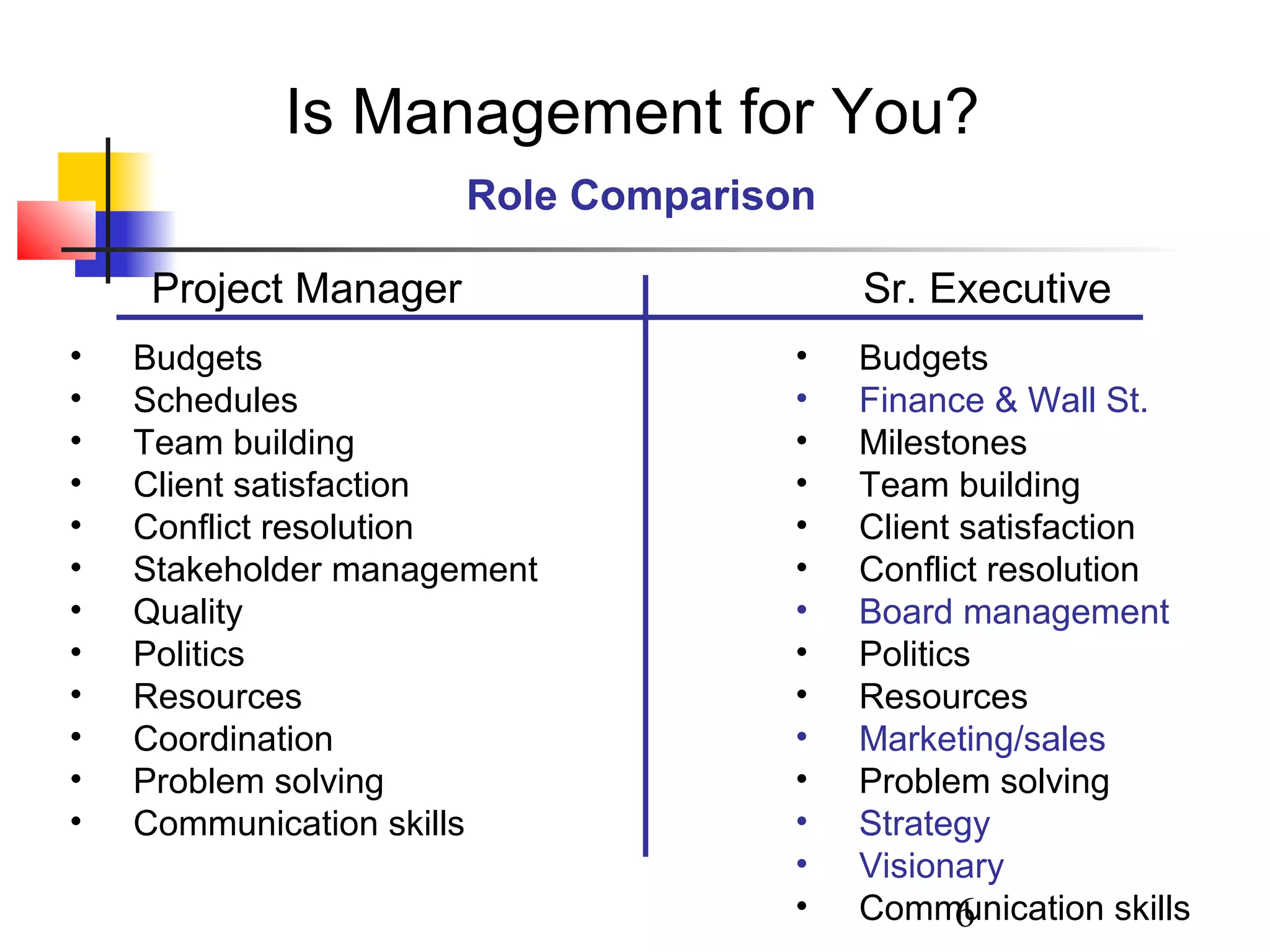
Role Comparison
Project Manager
•
•
•
•
•
•
•
•
•
•
•
•

Budgets
Schedules
Team building
Client satisfaction
Conflict resolution
Stakeholder management
Quality
Politics
Resources
Coordination
Problem solving
Communication skills

Sr. Executive
•
•
•
•
•
•
•
•
•
•
•
•
•
•

Budgets
Finance & Wall St.
Milestones
Team building
Client satisfaction
Conflict resolution
Board management
Politics
Resources
Marketing/sales
Problem solving
Strategy
Visionary
Communication skills
6
Is Management for You?
Have you considered project management?

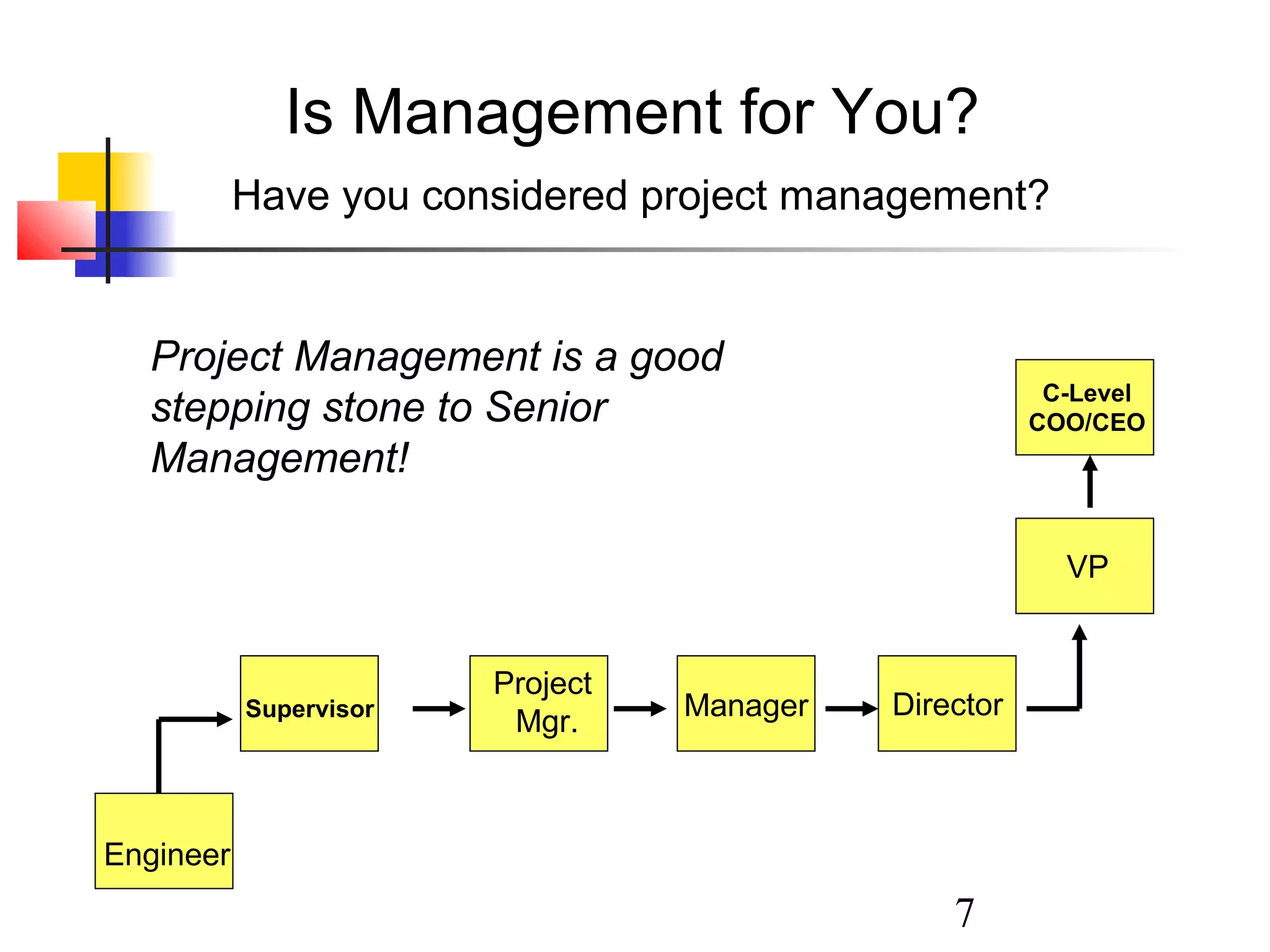
Project Management is a good
stepping stone to Senior
Management!

C-Level
COO/CEO

VP

Supervisor

Project
Mgr.

Manager

Director

Engineer

7
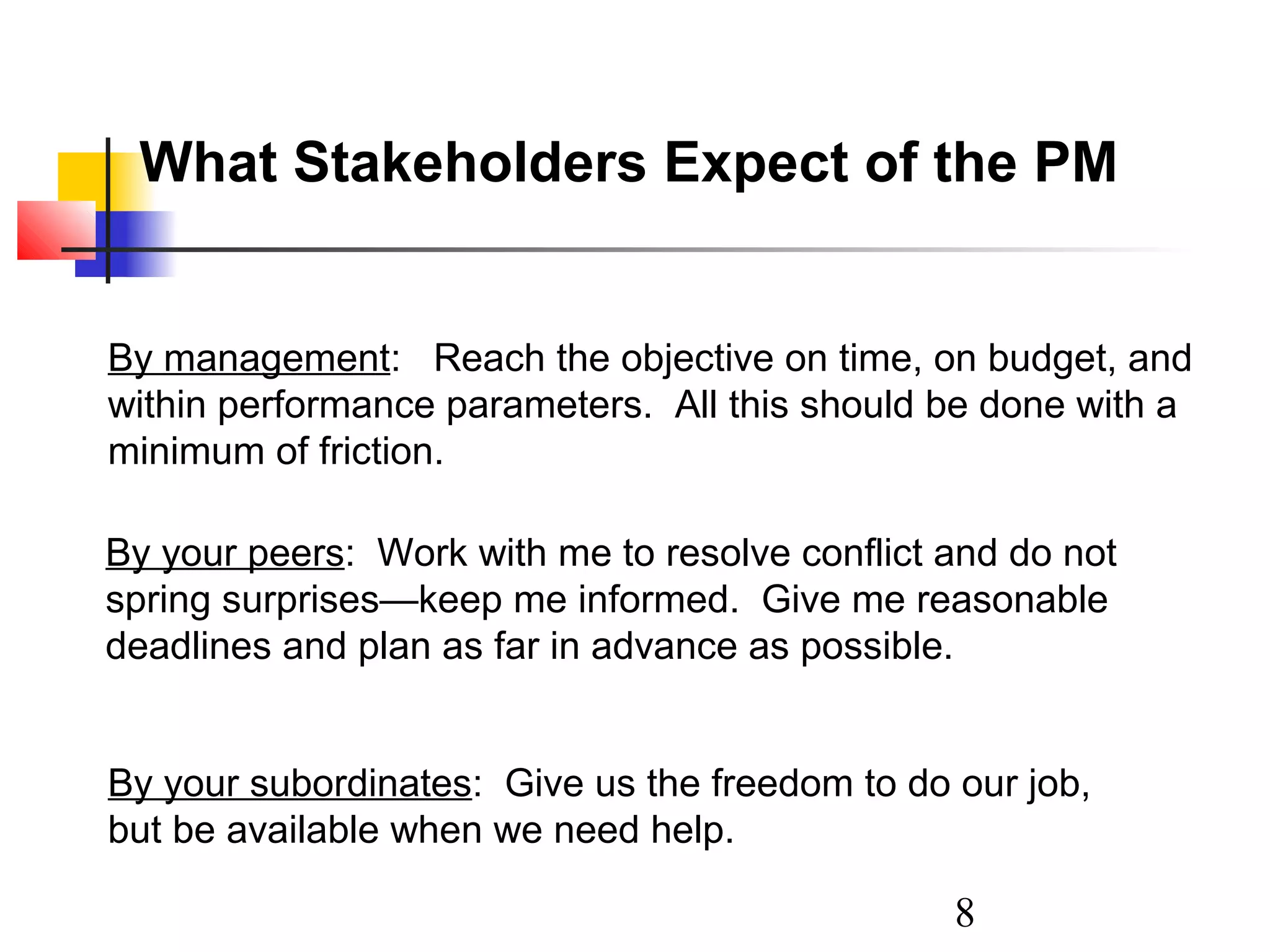
What Stakeholders Expect of the PM

By management: Reach the objective on time, on budget, and
within performance parameters. All this should be done with a
minimum of friction.
By your peers: Work with me to resolve conflict and do not
spring surprises—keep me informed. Give me reasonable
deadlines and plan as far in advance as possible.
By your subordinates: Give us the freedom to do our job,
but be available when we need help.

8
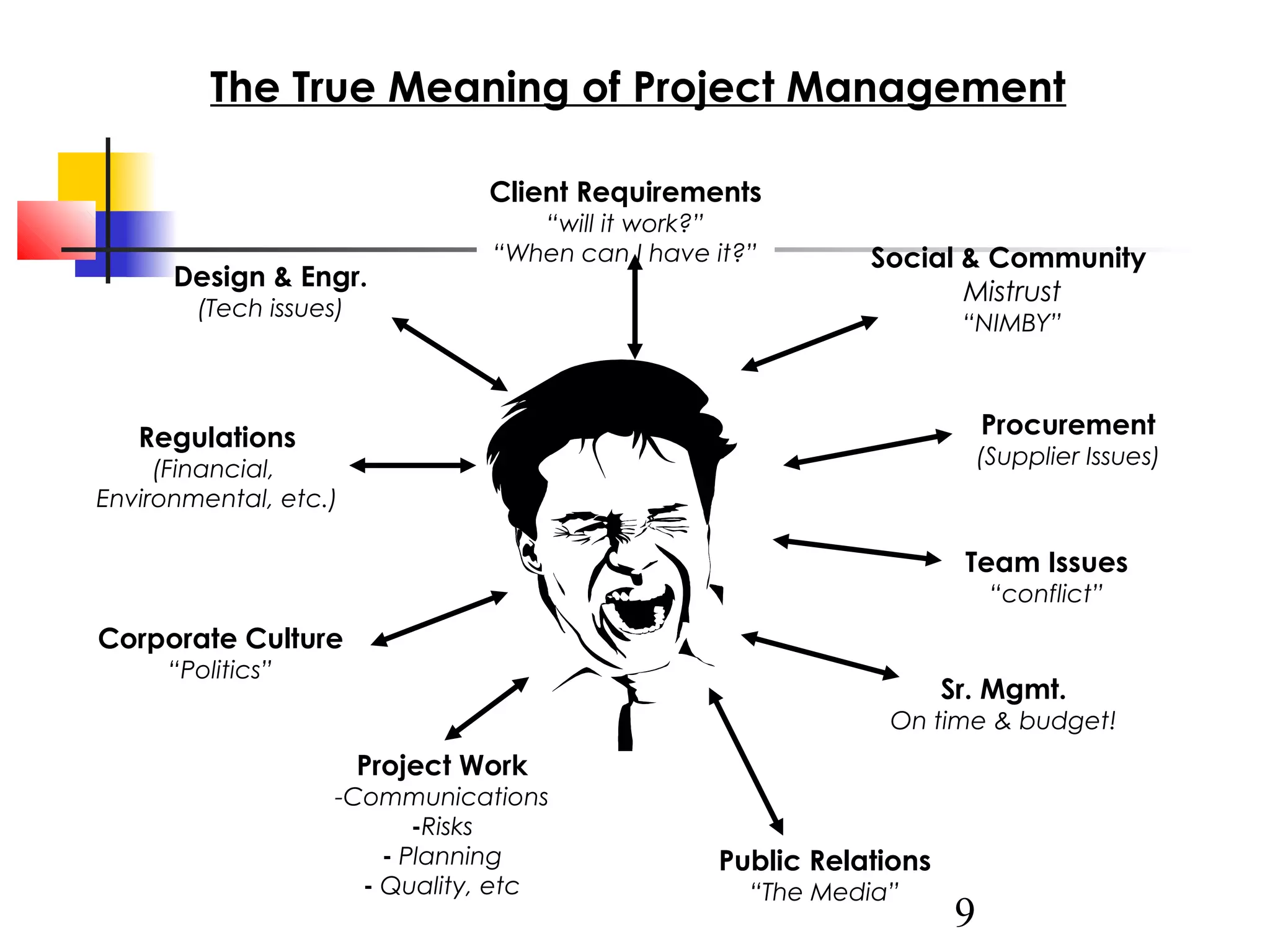
The True Meaning of Project Management
Client Requirements
Design & Engr.

“will it work?”
“When can I have it?”

(Tech issues)

Social & Community
Mistrust
“NIMBY”

Procurement

Regulations

(Supplier Issues)

(Financial,
Environmental, etc.)

Team Issues
“conflict”

Corporate Culture
“Politics”

Sr. Mgmt.
On time & budget!

Project Work

-Communications
-Risks
- Planning
- Quality, etc

Public Relations
“The Media”

9
Leadership
Can you define “Leadership?”
What does this mean to you?

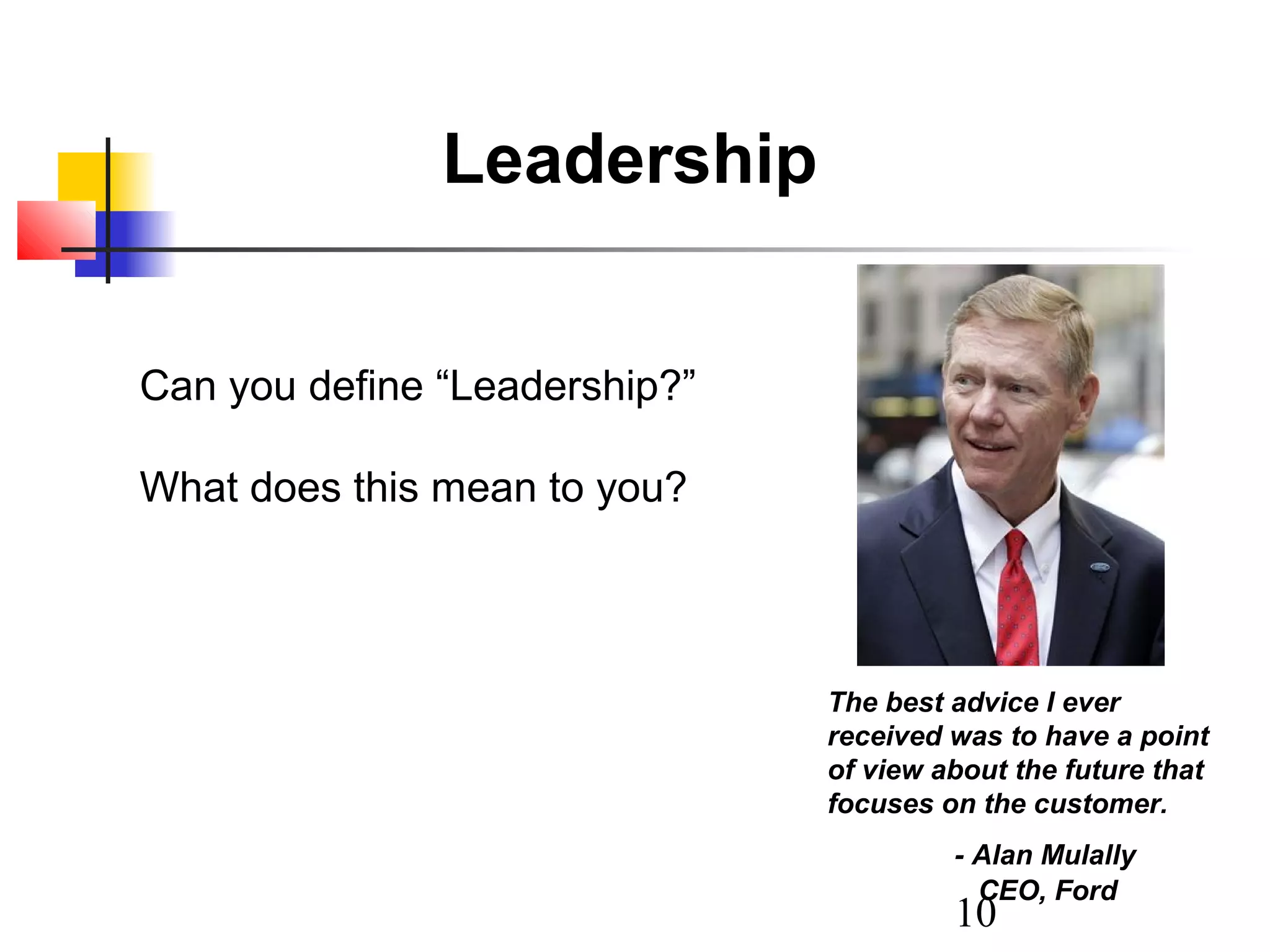
The best advice I ever
received was to have a point
of view about the future that
focuses on the customer.
- Alan Mulally
CEO, Ford

10
Leadership
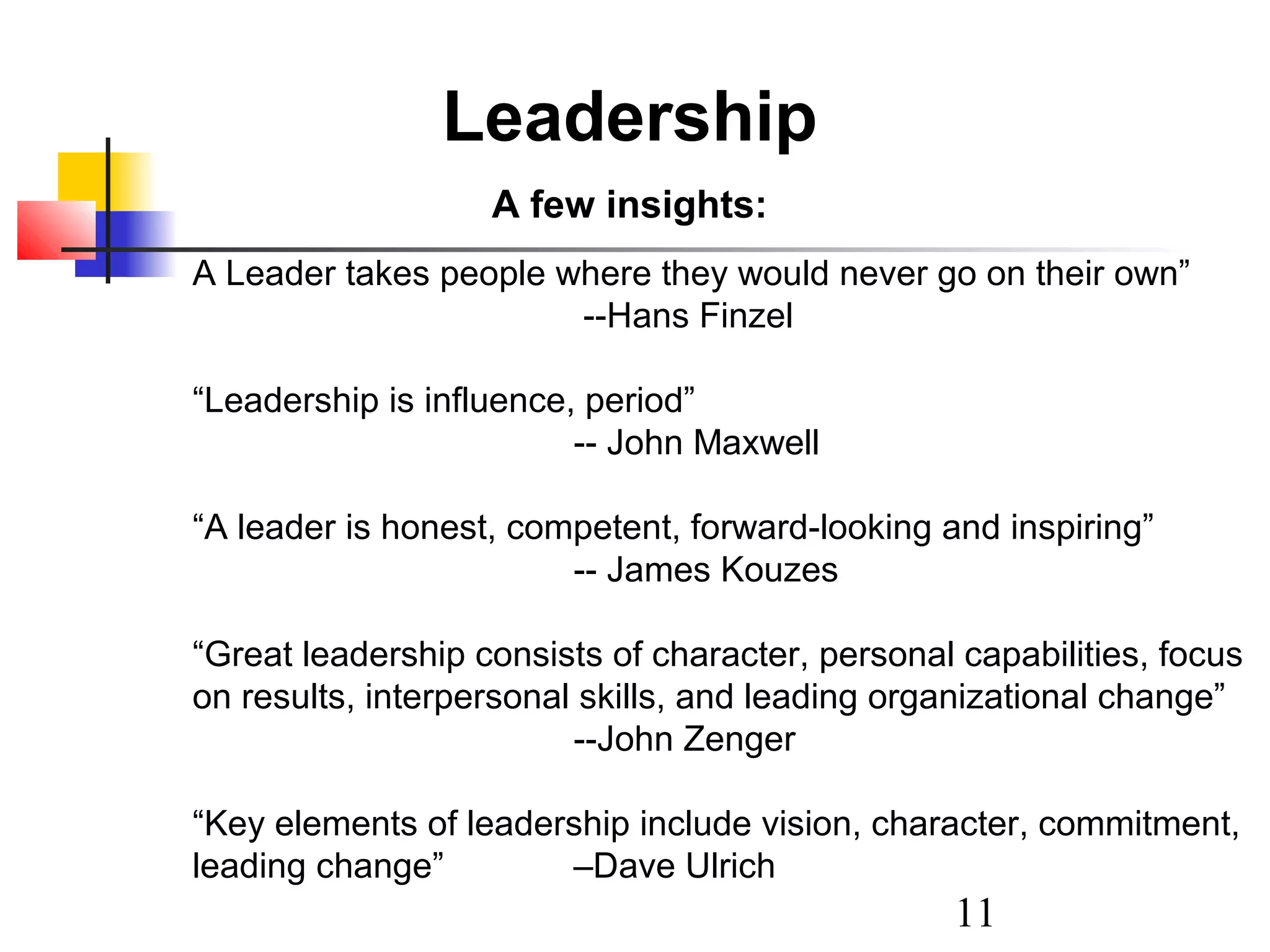
A few insights:
A Leader takes people where they would never go on their own”
--Hans Finzel
“Leadership is influence, period”
-- John Maxwell
“A leader is honest, competent, forward-looking and inspiring”
-- James Kouzes
“Great leadership consists of character, personal capabilities, focus
on results, interpersonal skills, and leading organizational change”
--John Zenger
“Key elements of leadership include vision, character, commitment,
leading change”
–Dave Ulrich

11
Leadership
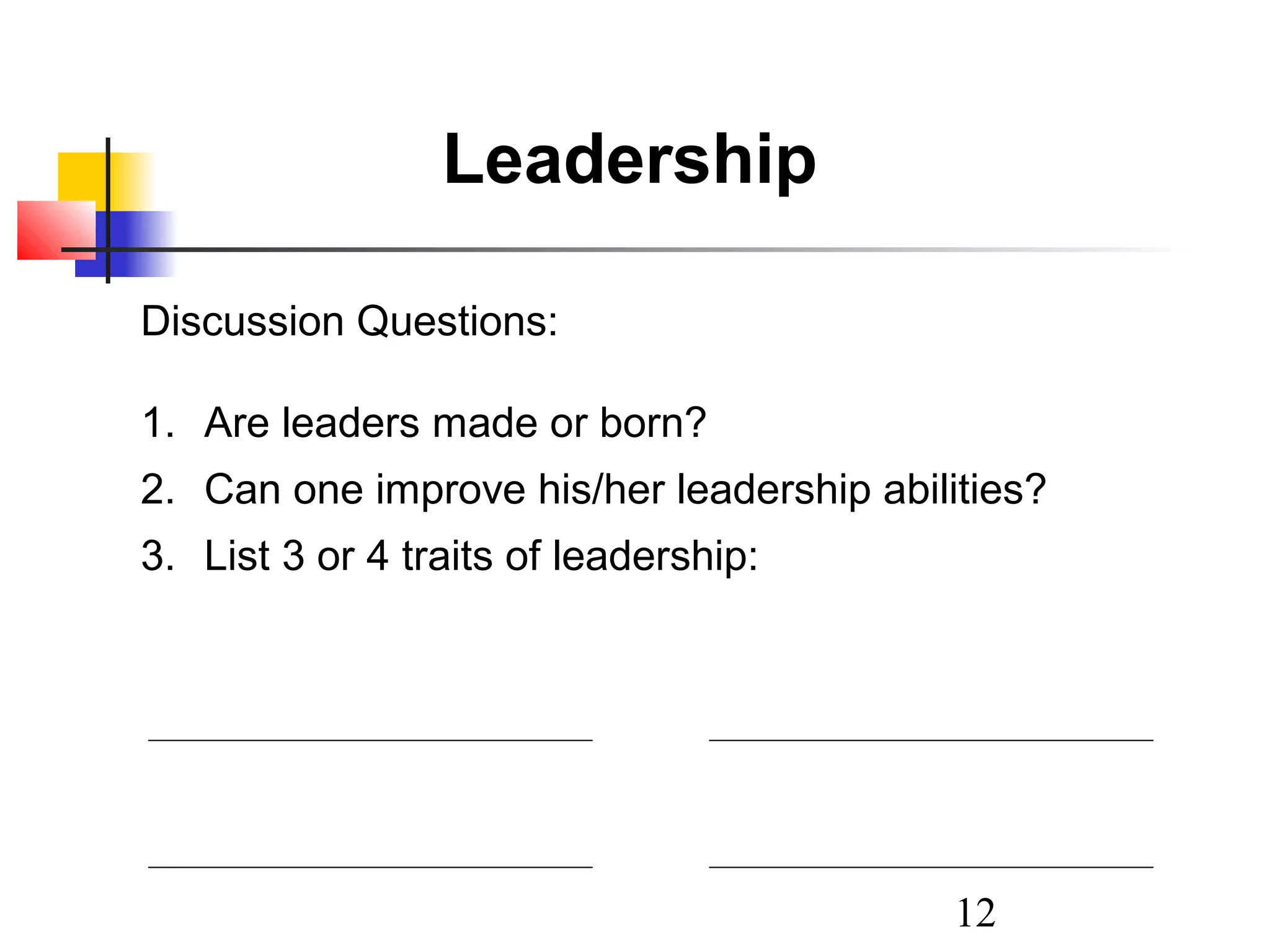
Discussion Questions:
1. Are leaders made or born?
2. Can one improve his/her leadership abilities?
3. List 3 or 4 traits of leadership:

12
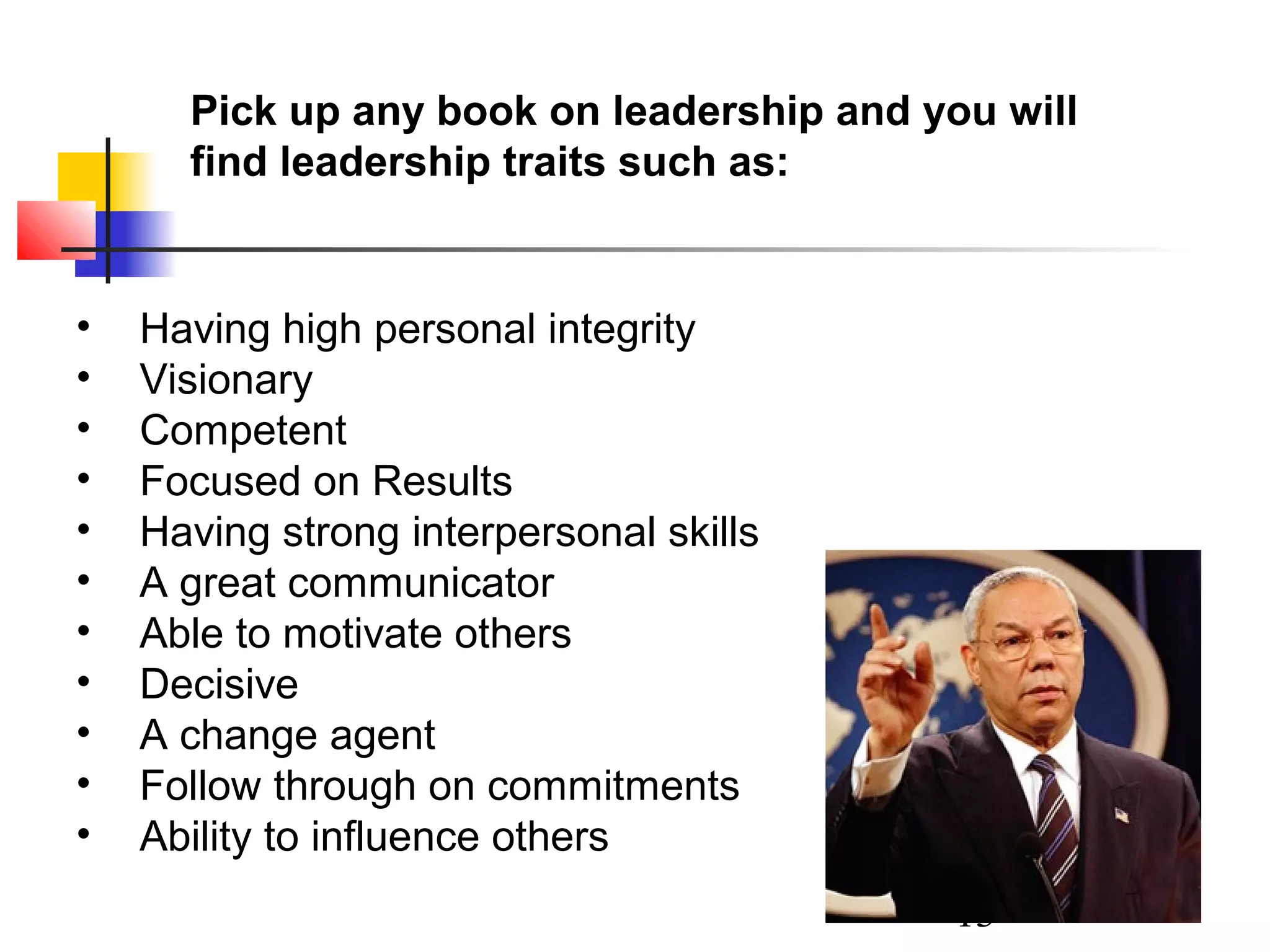
Pick up any book on leadership and you will
find leadership traits such as:

•
•
•
•
•
•
•
•
•
•
•

Having high personal integrity
Visionary
Competent
Focused on Results
Having strong interpersonal skills
A great communicator
Able to motivate others
Decisive
A change agent
Follow through on commitments
Ability to influence others
13
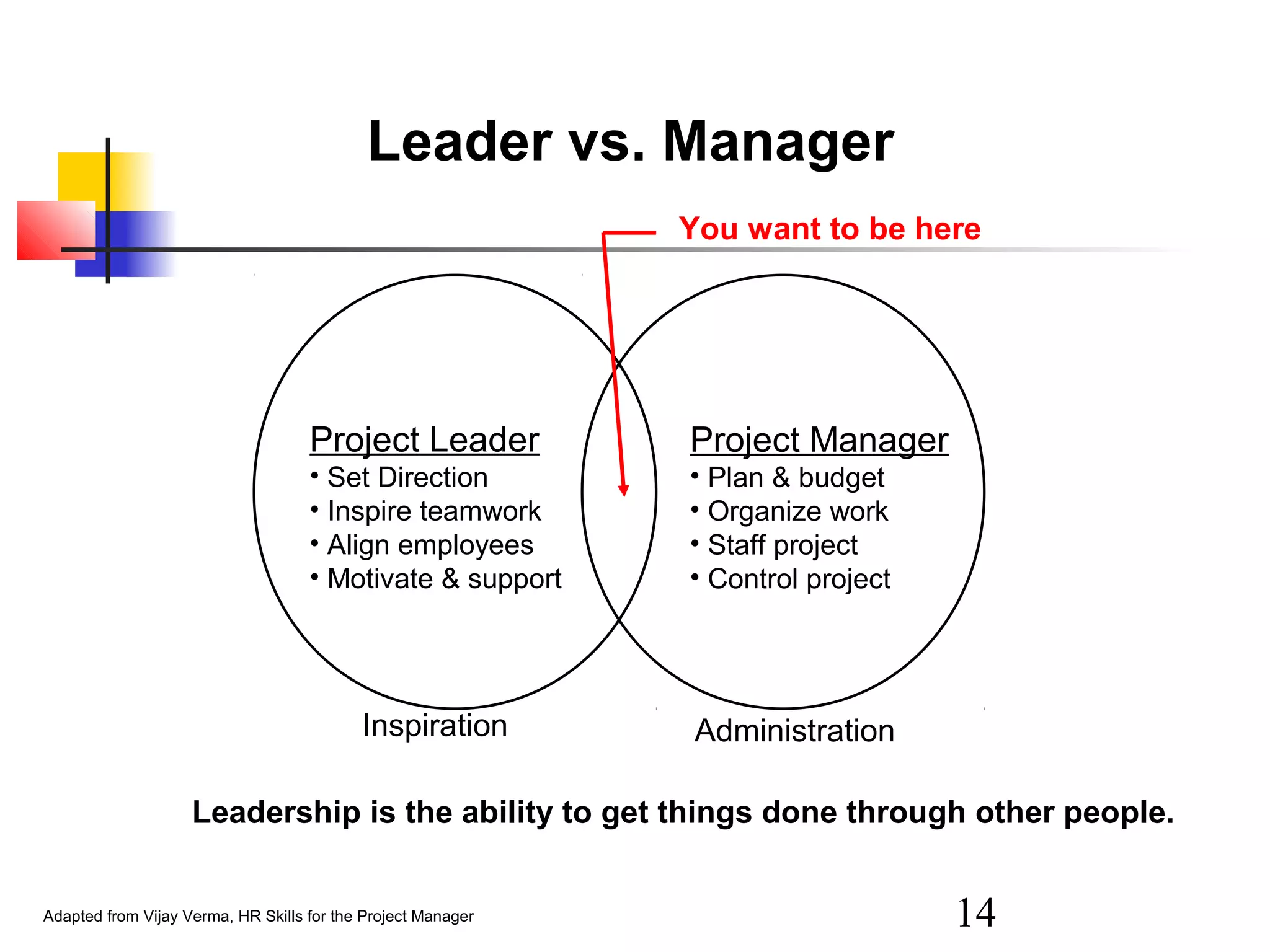
Leader vs. Manager
You want to be here

Project Leader

Project Manager

• Set Direction
• Inspire teamwork
• Align employees
• Motivate & support

• Plan & budget
• Organize work
• Staff project
• Control project

Inspiration

Administration

Leadership is the ability to get things done through other people.
Adapted from Vijay Verma, HR Skills for the Project Manager

14
How Do Leaders Go Wrong?










Abusive and arrogant
Dictatorship in decision making
Egocentric manner
Poor interpersonal skills
Absence of praise or affirmation
Lack of delegation
Poor communicator
Oblivious to the corporate culture
Poor listener
15
How Do Leaders Go Wrong?
Some leaders fail because they are oblivious to the
corporate culture (see previous list). Can you imagine
an outsider coming in to run your company?
Can you write down your company’s mission statement?
It’s core values? Why is this important?
Would an outsider understand this? Why do companies
sometimes bring in outsiders to run a firm?
16
America’s Worst Business Leaders
What went wrong?
Top 20
The 20 Worst American CEOs
of all time?
CNBC assembled a panel of
professors from top business
schools to rank the records of
CEOs, Those listed here most
effectively destroyed value and
innovation, while displaying the
worst management skills
throughout their tenure.

1.
2.
3.
4.
5.
6.
7.
8.
9.
10.

Dick Fuld – Lehman Bros
Angelo Mozilo – Countrywide
Ken Lay – Enron
Jimmy Cayne – Bear Stearns
Bernie Ebbers – Worldcom
Al Dunlop – Sunbeam
Fred Joseph – Drexel
Jay Gould – (Railroads, 1890’s)
John Patterson – NCR (1920,s)
John Akers – IBM

17
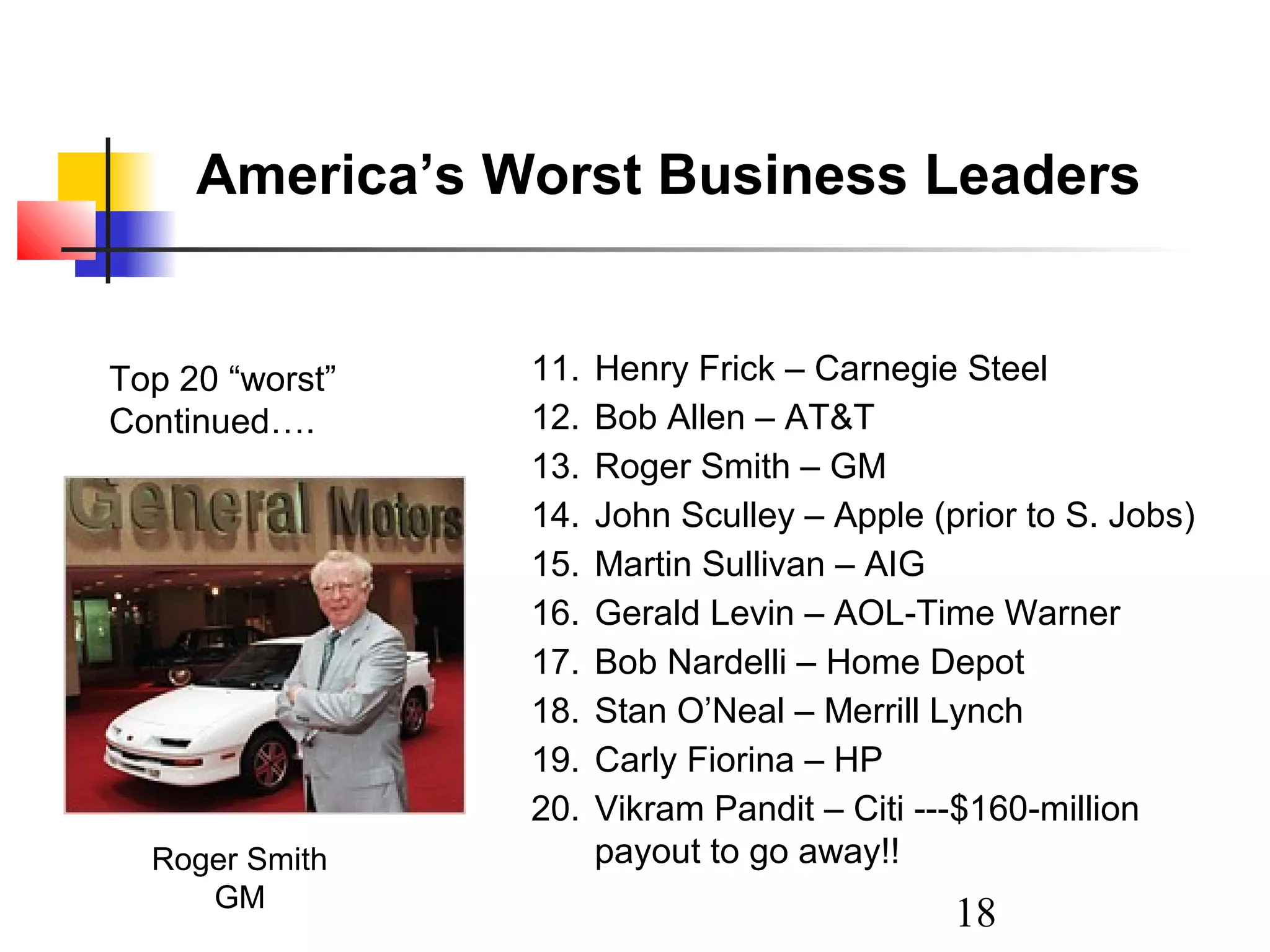
America’s Worst Business Leaders

Top 20 “worst”
Continued….

Roger Smith
GM

11.
12.
13.
14.
15.
16.
17.
18.
19.
20.

Henry Frick – Carnegie Steel
Bob Allen – AT&T
Roger Smith – GM
John Sculley – Apple (prior to S. Jobs)
Martin Sullivan – AIG
Gerald Levin – AOL-Time Warner
Bob Nardelli – Home Depot
Stan O’Neal – Merrill Lynch
Carly Fiorina – HP
Vikram Pandit – Citi ---$160-million
payout to go away!!

18
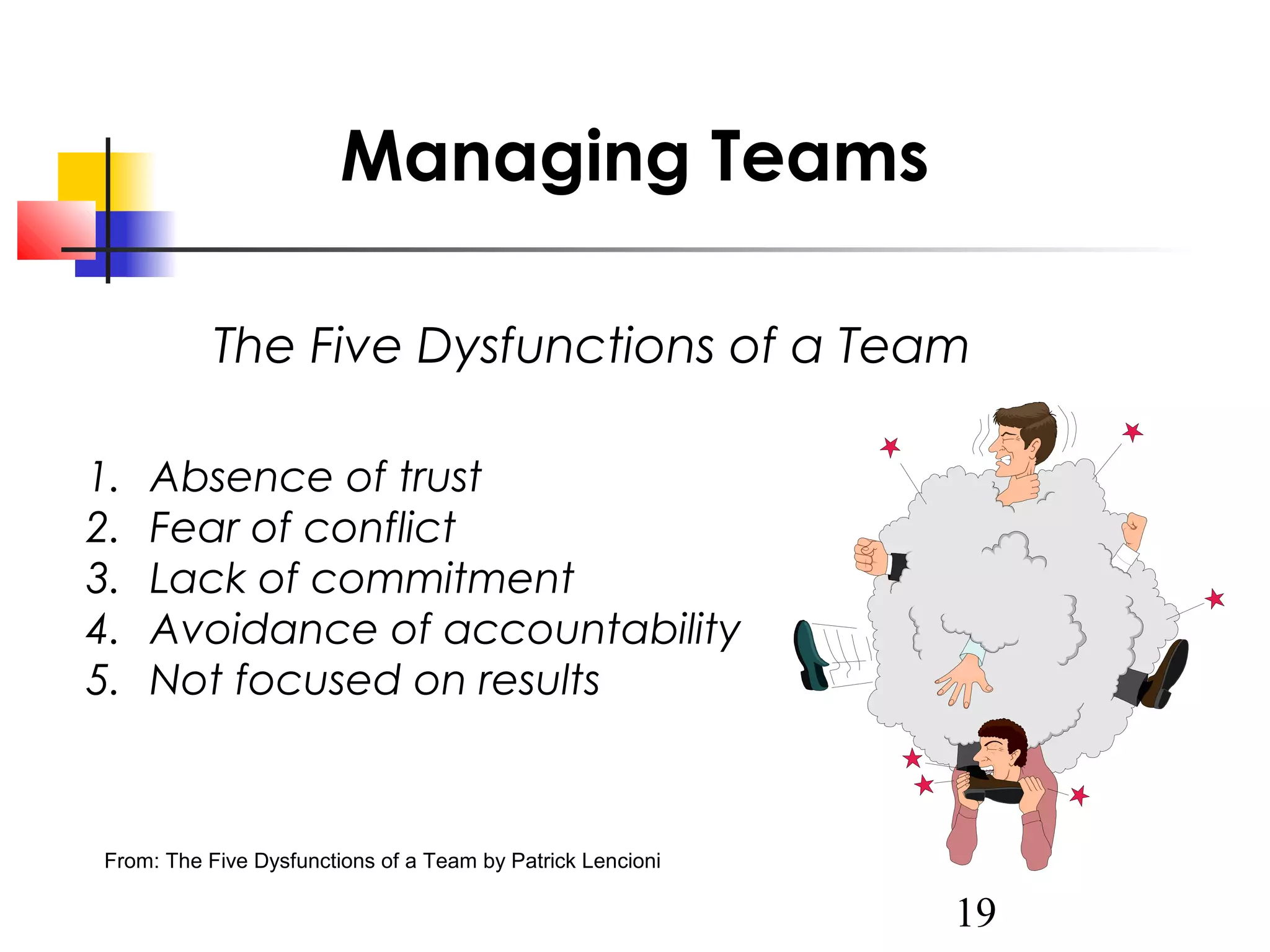
Managing Teams
The Five Dysfunctions of a Team
1.
2.
3.
4.
5.

Absence of trust
Fear of conflict
Lack of commitment
Avoidance of accountability
Not focused on results

From: The Five Dysfunctions of a Team by Patrick Lencioni

19
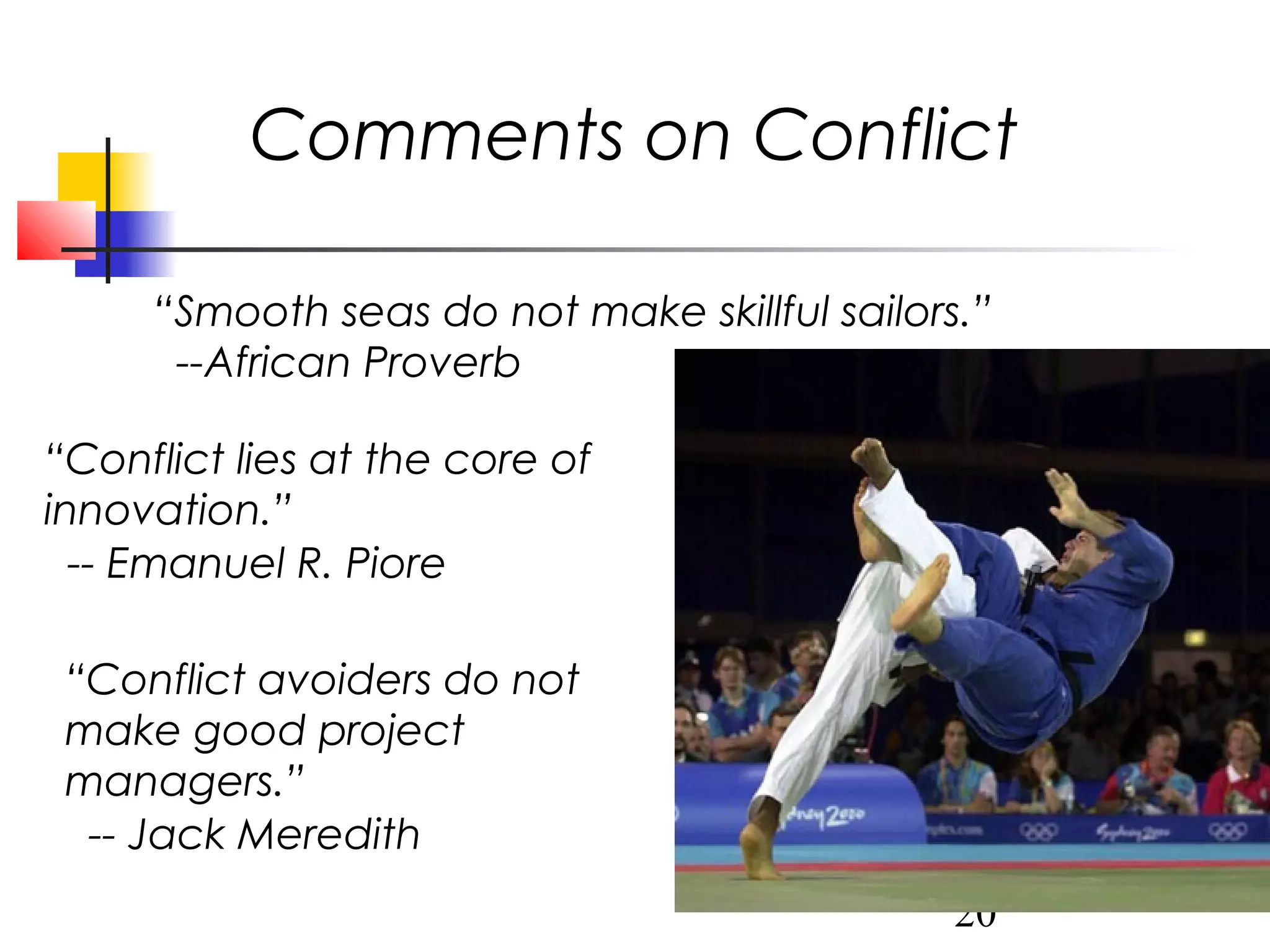
Comments on Conflict
“Smooth seas do not make skillful sailors.”
--African Proverb
“Conflict lies at the core of
innovation.”
-- Emanuel R. Piore
“Conflict avoiders do not
make good project
managers.”
-- Jack Meredith
20
How Can I Become a Better Leader?

1. Develop/display high personal
character
2. Develop new skills
(take a course, attend a seminar).

3. Find a coach or mentor
4. Always follow through on
commitments
5. Identify your strengths &
weaknesses
21
How Can I Become a Better Leader?

6. Observe how leaders conduct
themselves
7. Work to become better at
negotiation and influencing others.
8. Avoid the “mistakes” that leaders
make discussed earlier (arrogance,
dictatorial, poor listener, etc.)
9. Learn from your mistakes.

22
Tips I Have Picked Up Along the Way
Everyone has strengths and weaknesses
Not everyone is a team player
You can’t do it all yourself – learn to delegate
Stay focused on the objectives
Hold people accountable
Never stop learning
Leave the technical stuff behind
23
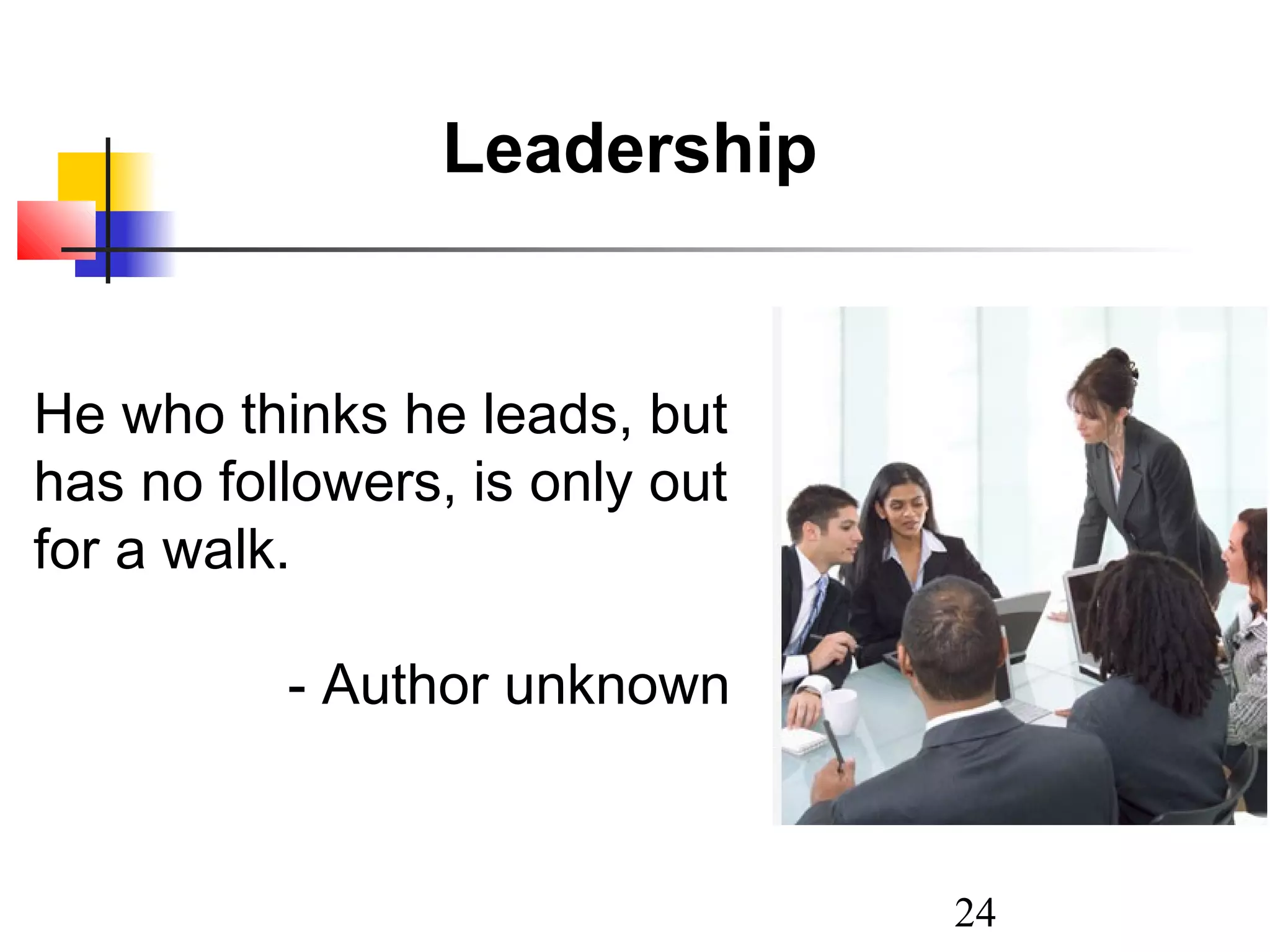
Leadership

He who thinks he leads, but
has no followers, is only out
for a walk.
- Author unknown

24
Thank You!

www.windward.ws

25

Presentation leadership & engineering mgmt.

  • 1.
    Leadership in Engineering Management– Taking Your Career to the Next Level David Tennant, PE, PMP www.windward.ws 1
  • 2.
    Contents Why do Iwant to be in Engineering Management? How do I get there? What are the skills needed? What role does leadership play? 2
  • 3.
    Is Management forYou? How many want to move into a management role? How many are already in a management role? How many want to move into an executive management role? 3
  • 4.
    Typical Technical CareerPath Managerial Technical (Business focus) (Technology focus) At some point in your career, you will come to a fork in the road. 4
  • 5.
    Is Management forYou? Have you considered project management? PM Core competencies        Team Builder & Leader Presentation/Public Speaking People Skills (i.e. “Soft Skills”) Ability to Plan—Attention to Detail Budgeting & Scheduling Basic Technical Understanding Flexibility  Administration  Ability to Make Decisions  Understanding the PM Process  Negotiation skills  Project Leadership  Integrity  Critical thinking 5
  • 6.
    Is Management forYou? Role Comparison Project Manager • • • • • • • • • • • • Budgets Schedules Team building Client satisfaction Conflict resolution Stakeholder management Quality Politics Resources Coordination Problem solving Communication skills Sr. Executive • • • • • • • • • • • • • • Budgets Finance & Wall St. Milestones Team building Client satisfaction Conflict resolution Board management Politics Resources Marketing/sales Problem solving Strategy Visionary Communication skills 6
  • 7.
    Is Management forYou? Have you considered project management? Project Management is a good stepping stone to Senior Management! C-Level COO/CEO VP Supervisor Project Mgr. Manager Director Engineer 7
  • 8.
    What Stakeholders Expectof the PM By management: Reach the objective on time, on budget, and within performance parameters. All this should be done with a minimum of friction. By your peers: Work with me to resolve conflict and do not spring surprises—keep me informed. Give me reasonable deadlines and plan as far in advance as possible. By your subordinates: Give us the freedom to do our job, but be available when we need help. 8
  • 9.
    The True Meaningof Project Management Client Requirements Design & Engr. “will it work?” “When can I have it?” (Tech issues) Social & Community Mistrust “NIMBY” Procurement Regulations (Supplier Issues) (Financial, Environmental, etc.) Team Issues “conflict” Corporate Culture “Politics” Sr. Mgmt. On time & budget! Project Work -Communications -Risks - Planning - Quality, etc Public Relations “The Media” 9
  • 10.
    Leadership Can you define“Leadership?” What does this mean to you? The best advice I ever received was to have a point of view about the future that focuses on the customer. - Alan Mulally CEO, Ford 10
  • 11.
    Leadership A few insights: ALeader takes people where they would never go on their own” --Hans Finzel “Leadership is influence, period” -- John Maxwell “A leader is honest, competent, forward-looking and inspiring” -- James Kouzes “Great leadership consists of character, personal capabilities, focus on results, interpersonal skills, and leading organizational change” --John Zenger “Key elements of leadership include vision, character, commitment, leading change” –Dave Ulrich 11
  • 12.
    Leadership Discussion Questions: 1. Areleaders made or born? 2. Can one improve his/her leadership abilities? 3. List 3 or 4 traits of leadership: 12
  • 13.
    Pick up anybook on leadership and you will find leadership traits such as: • • • • • • • • • • • Having high personal integrity Visionary Competent Focused on Results Having strong interpersonal skills A great communicator Able to motivate others Decisive A change agent Follow through on commitments Ability to influence others 13
  • 14.
    Leader vs. Manager Youwant to be here Project Leader Project Manager • Set Direction • Inspire teamwork • Align employees • Motivate & support • Plan & budget • Organize work • Staff project • Control project Inspiration Administration Leadership is the ability to get things done through other people. Adapted from Vijay Verma, HR Skills for the Project Manager 14
  • 15.
    How Do LeadersGo Wrong?          Abusive and arrogant Dictatorship in decision making Egocentric manner Poor interpersonal skills Absence of praise or affirmation Lack of delegation Poor communicator Oblivious to the corporate culture Poor listener 15
  • 16.
    How Do LeadersGo Wrong? Some leaders fail because they are oblivious to the corporate culture (see previous list). Can you imagine an outsider coming in to run your company? Can you write down your company’s mission statement? It’s core values? Why is this important? Would an outsider understand this? Why do companies sometimes bring in outsiders to run a firm? 16
  • 17.
    America’s Worst BusinessLeaders What went wrong? Top 20 The 20 Worst American CEOs of all time? CNBC assembled a panel of professors from top business schools to rank the records of CEOs, Those listed here most effectively destroyed value and innovation, while displaying the worst management skills throughout their tenure. 1. 2. 3. 4. 5. 6. 7. 8. 9. 10. Dick Fuld – Lehman Bros Angelo Mozilo – Countrywide Ken Lay – Enron Jimmy Cayne – Bear Stearns Bernie Ebbers – Worldcom Al Dunlop – Sunbeam Fred Joseph – Drexel Jay Gould – (Railroads, 1890’s) John Patterson – NCR (1920,s) John Akers – IBM 17
  • 18.
    America’s Worst BusinessLeaders Top 20 “worst” Continued…. Roger Smith GM 11. 12. 13. 14. 15. 16. 17. 18. 19. 20. Henry Frick – Carnegie Steel Bob Allen – AT&T Roger Smith – GM John Sculley – Apple (prior to S. Jobs) Martin Sullivan – AIG Gerald Levin – AOL-Time Warner Bob Nardelli – Home Depot Stan O’Neal – Merrill Lynch Carly Fiorina – HP Vikram Pandit – Citi ---$160-million payout to go away!! 18
  • 19.
    Managing Teams The FiveDysfunctions of a Team 1. 2. 3. 4. 5. Absence of trust Fear of conflict Lack of commitment Avoidance of accountability Not focused on results From: The Five Dysfunctions of a Team by Patrick Lencioni 19
  • 20.
    Comments on Conflict “Smoothseas do not make skillful sailors.” --African Proverb “Conflict lies at the core of innovation.” -- Emanuel R. Piore “Conflict avoiders do not make good project managers.” -- Jack Meredith 20
  • 21.
    How Can IBecome a Better Leader? 1. Develop/display high personal character 2. Develop new skills (take a course, attend a seminar). 3. Find a coach or mentor 4. Always follow through on commitments 5. Identify your strengths & weaknesses 21
  • 22.
    How Can IBecome a Better Leader? 6. Observe how leaders conduct themselves 7. Work to become better at negotiation and influencing others. 8. Avoid the “mistakes” that leaders make discussed earlier (arrogance, dictatorial, poor listener, etc.) 9. Learn from your mistakes. 22
  • 23.
    Tips I HavePicked Up Along the Way Everyone has strengths and weaknesses Not everyone is a team player You can’t do it all yourself – learn to delegate Stay focused on the objectives Hold people accountable Never stop learning Leave the technical stuff behind 23
  • 24.
    Leadership He who thinkshe leads, but has no followers, is only out for a walk. - Author unknown 24
  • 25.