Conferenza GARR 2010
Cloud Computing and the Internet
© 2010 Cisco and/or its affiliates. All rights reserved. Cisco ConfidentialGarr 2010 2
Cloud Computing
 The current “buzzword” ;-)
 Your computing is in the cloud!
 Provide computing as a utility
Similar to Electricity, Water, Phone service, etc.
 The Internet is the delivery infrastructure
 Limited or no capital expenditure
Consumption-based billing, or
Usage-based billing
 The model is applicable both inside a company and
as a public service
© 2010 Cisco and/or its affiliates. All rights reserved. Cisco ConfidentialGarr 2010 3
Key Building Blocks
 The Internet
 Virtualization
 Provisioning portal
 Provisioning/Monitoring/Management software
© 2010 Cisco and/or its affiliates. All rights reserved. Cisco ConfidentialGarr 2010 4
Differences/Similarities
with previous efforts
 Client–server model – Client–server computing
refers broadly to any distributed application that
distinguishes between service providers (servers)
and service requesters (clients)
 Grid computing — a form of distributed computing
and parallel computing, whereby a 'super and
virtual computer' is composed of a cluster of
networked, loosely coupled computers acting in
concert to perform very large tasks
 Utility computing — the packaging of computing
resources, such as computation and storage, as a
metered service similar to a traditional public utility,
such as electricity
© 2010 Cisco and/or its affiliates. All rights reserved. Cisco ConfidentialGarr 2010 5
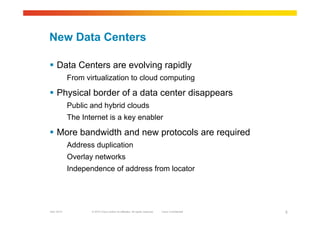
New Data Centers
 Data Centers are evolving rapidly
From virtualization to cloud computing
 Physical border of a data center disappears
Public and hybrid clouds
The Internet is a key enabler
 More bandwidth and new protocols are required
Address duplication
Overlay networks
Independence of address from locator
© 2010 Cisco and/or its affiliates. All rights reserved. Cisco ConfidentialGarr 2010 6
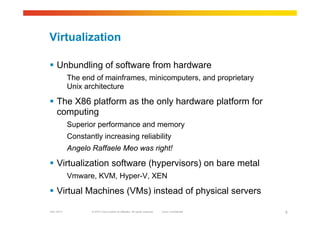
Virtualization
 Unbundling of software from hardware
The end of mainframes, minicomputers, and proprietary
Unix architecture
 The X86 platform as the only hardware platform for
computing
Superior performance and memory
Constantly increasing reliability
Angelo Raffaele Meo was right!
 Virtualization software (hypervisors) on bare metal
Vmware, KVM, Hyper-V, XEN
 Virtual Machines (VMs) instead of physical servers
© 2010 Cisco and/or its affiliates. All rights reserved. Cisco ConfidentialGarr 2010 7
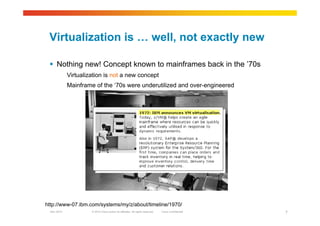
http://www-07.ibm.com/systems/my/z/about/timeline/1970/
Virtualization is … well, not exactly new
 Nothing new! Concept known to mainframes back in the ’70s
Virtualization is not a new concept
Mainframe of the ‘70s were underutilized and over-engineered
© 2010 Cisco and/or its affiliates. All rights reserved. Cisco ConfidentialGarr 2010 8
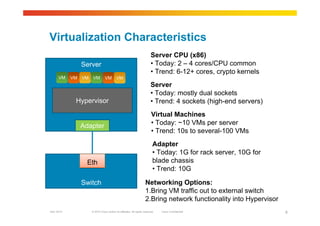
Virtualization Characteristics
Server
Hypervisor
VM VMVM VM VMVM
Adapter
Switch
EthEth
Server CPU (x86)
• Today: 2 – 4 cores/CPU common
• Trend: 6-12+ cores, crypto kernels
Server
• Today: mostly dual sockets
• Trend: 4 sockets (high-end servers)
Virtual Machines
• Today: ~10 VMs per server
• Trend: 10s to several-100 VMs
Adapter
• Today: 1G for rack server, 10G for
blade chassis
• Trend: 10G
Networking Options:
1.Bring VM traffic out to external switch
2.Bring network functionality into Hypervisor
© 2010 Cisco and/or its affiliates. All rights reserved. Cisco PublicGarr-2010 9
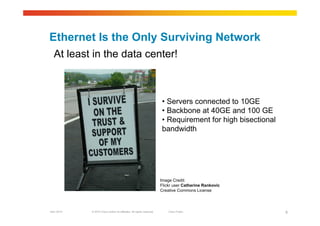
Ethernet Is the Only Surviving Network
At least in the data center!
Image Credit:
Flickr user Catherine Rankovic
Creative Commons License
• Servers connected to 10GE
• Backbone at 40GE and 100 GE
• Requirement for high bisectional
bandwidth
© 2010 Cisco and/or its affiliates. All rights reserved. Cisco ConfidentialGarr 2010 10
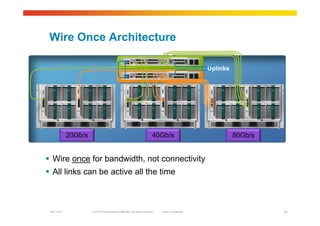
Wire Once Architecture
 Wire once for bandwidth, not connectivity
 All links can be active all the time
Uplinks
20Gb/s 40Gb/s 80Gb/s
© 2010 Cisco and/or its affiliates. All rights reserved. Cisco ConfidentialGarr 2010 11
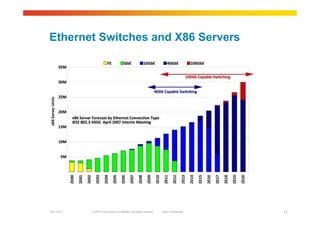
Ethernet Switches and X86 Servers
© 2010 Cisco and/or its affiliates. All rights reserved. Cisco ConfidentialGarr 2010 12
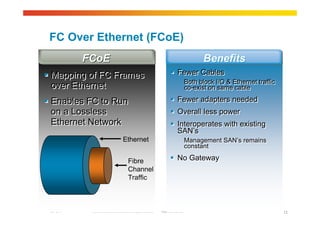
FC Over Ethernet (FCoE)
 Mapping of FC Frames
over Ethernet
 Enables FC to Run
on a Lossless
Ethernet Network
 Mapping of FC Frames
over Ethernet
 Enables FC to Run
on a Lossless
Ethernet Network
 Fewer Cables
Both block I/O & Ethernet traffic
co-exist on same cable
 Fewer adapters needed
 Overall less power
 Interoperates with existing
SAN’s
Management SAN’s remains
constant
 No Gateway
 Fewer Cables
Both block I/O & Ethernet traffic
co-exist on same cable
 Fewer adapters needed
 Overall less power
 Interoperates with existing
SAN’s
Management SAN’s remains
constant
 No Gateway
FCoEFCoE BenefitsBenefits
Fibre
Channel
Traffic
Ethernet
© 2010 Cisco and/or its affiliates. All rights reserved. Cisco ConfidentialGarr 2010 13
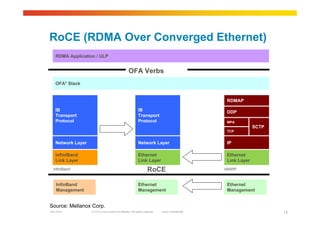
RoCE (RDMA Over Converged Ethernet)
Source: Mellanox Corp.
OFA Verbs
Interface
IB
Transport
Protocol
Network Layer
InfiniBand
Link Layer
InfiniBand
OFA* Stack
InfinBand
Management
RDMA Application / ULP
RDMAP
DDP
IP
SCTP
MPA
TCP
Ethernet
Link Layer
iWARP
Ethernet
Management
RoCE
Ethernet
Link Layer
Ethernet
Management
IB
Transport
Protocol
Network Layer
© 2010 Cisco and/or its affiliates. All rights reserved. Cisco ConfidentialGarr 2010 14
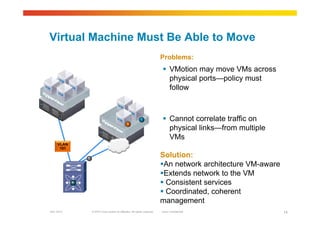
Virtual Machine Must Be Able to Move
Problems:
Solution:
An network architecture VM-aware
Extends network to the VM
 Consistent services
 Coordinated, coherent
management
 VMotion may move VMs across
physical ports—policy must
follow
• Impossible to view or apply
policy to locally switched traffic
 Cannot correlate traffic on
physical links—from multiple
VMs
VLAN
101
© 2010 Cisco and/or its affiliates. All rights reserved. Cisco ConfidentialGarr 2010 15
VM movement corollaries
 VMs move and keep their MAC and IP addresses
Large Layer 2 network in the datacenter
 VM cloning (move and keep the original)
Duplicated MAC and IP addresses
Different VLANs?
 VM move across datacenter
Huge bandwidth requirement (need to move storage also)
Layer 2 networks must span multiple data centers
OTV, VPLS
© 2010 Cisco and/or its affiliates. All rights reserved. Cisco ConfidentialGarr 2010 16
Cloud types
 Private (a flexible computing infrastructure inside a
company)
 Public (a public provider of VMs)
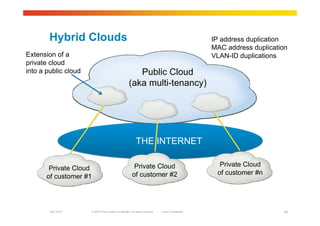
 Hybrid (a part of a private cloud that is off-sourced
to a public cloud)
© 2010 Cisco and/or its affiliates. All rights reserved. Cisco ConfidentialGarr 2010 17
Example of public clouds
 Amazon Elastic Compute Cloud (EC2)
 IBM's Blue Cloud
 Oracle Cloud Computing
 Google AppEngine
 Windows Azure Services Platform.
© 2010 Cisco and/or its affiliates. All rights reserved. Cisco ConfidentialGarr 2010 18
THE INTERNETTHE INTERNET
Hybrid Clouds
Public Cloud
(aka multi-tenancy)
Private Cloud
of customer #1
Private Cloud
of customer #2
Private Cloud
of customer #n
Extension of a
private cloud
into a public cloud
IP address duplication
MAC address duplication
VLAN-ID duplications
© 2010 Cisco and/or its affiliates. All rights reserved. Cisco ConfidentialGarr 2010 19
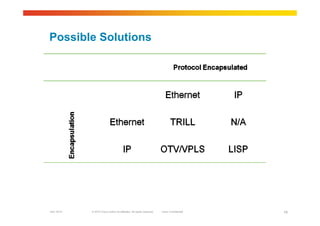
Possible Solutions
© 2010 Cisco and/or its affiliates. All rights reserved. Cisco ConfidentialGarr 2010 20
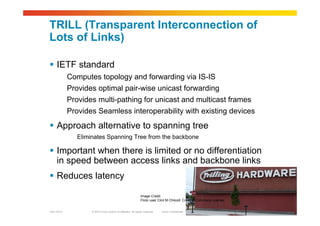
TRILL (Transparent Interconnection of
Lots of Links)
 IETF standard
Computes topology and forwarding via IS-IS
Provides optimal pair-wise unicast forwarding
Provides multi-pathing for unicast and multicast frames
Provides Seamless interoperability with existing devices
 Approach alternative to spanning tree
Eliminates Spanning Tree from the backbone
 Important when there is limited or no differentiation
in speed between access links and backbone links
 Reduces latency
Image Credit:
Flickr user Clint M Chilcott
Creative Commons License
© 2010 Cisco and/or its affiliates. All rights reserved. Cisco ConfidentialGarr 2010 21
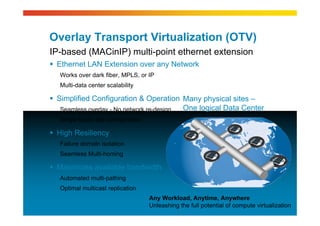
 Ethernet LAN Extension over any Network
Works over dark fiber, MPLS, or IP
Multi-data center scalability
 Simplified Configuration & Operation
Seamless overlay - No network re-design
Single touch site configuration
 High Resiliency
Failure domain isolation
Seamless Multi-homing
 Maximizes available bandwidth
Automated multi-pathing
Optimal multicast replication
Overlay Transport Virtualization (OTV)
IP-based (MACinIP) multi-point ethernet extension
Many physical sites –
One logical Data Center
Any Workload, Anytime, Anywhere
Unleashing the full potential of compute virtualization
© 2010 Cisco and/or its affiliates. All rights reserved. Cisco ConfidentialGarr 2010 22
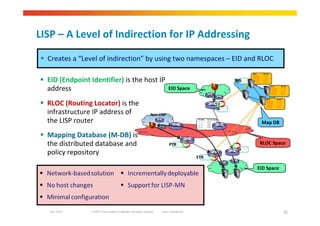
MS
ITR
PTR
ETR
ETR
Non‐LISP
EID SpaceEID Space
EID SpaceEID Space
RLOC SpaceRLOC Space
Map DBMap DB
 EID (Endpoint Identifier) is the host IP 
address
 Creates a “Level of indirection” by using two namespaces – EID and RLOC
 RLOC (Routing Locator) is the 
infrastructure IP address of 
the LISP router
 Mapping Database (M‐DB) is 
the distributed database and 
policy repository
LISP – A Level of Indirection for IP Addressing
© 2010 Cisco and/or its affiliates. All rights reserved. Cisco ConfidentialGarr 2010 23
Do I use clouds?
 Sure, my last tax return was done on a cloud
application
 I am thinking to run a version server on Amazon to
write a new book with two other authors located
around the world
I don’t have enough uplink bandwidth at my house to run a
server myself
 I use a cloud application to share files over the
Internet
© 2010 Cisco and/or its affiliates. All rights reserved. Cisco ConfidentialGarr 2010 24
Conclusions
 Cloud Computing is a new application of The
Internet
It promises to reduce computing costs, in particular capital
expenditure
 It requires to standardize on the X86 platform
(either Windows or Linux)
 It requires significant bandwidth
 It requires new network technologies especially for
hybrid clouds and multi-tenancy
Presentation   cloud computing and the internet

Presentation cloud computing and the internet

  • 1.
    Conferenza GARR 2010 CloudComputing and the Internet
  • 2.
    © 2010 Ciscoand/or its affiliates. All rights reserved. Cisco ConfidentialGarr 2010 2 Cloud Computing  The current “buzzword” ;-)  Your computing is in the cloud!  Provide computing as a utility Similar to Electricity, Water, Phone service, etc.  The Internet is the delivery infrastructure  Limited or no capital expenditure Consumption-based billing, or Usage-based billing  The model is applicable both inside a company and as a public service
  • 3.
    © 2010 Ciscoand/or its affiliates. All rights reserved. Cisco ConfidentialGarr 2010 3 Key Building Blocks  The Internet  Virtualization  Provisioning portal  Provisioning/Monitoring/Management software
  • 4.
    © 2010 Ciscoand/or its affiliates. All rights reserved. Cisco ConfidentialGarr 2010 4 Differences/Similarities with previous efforts  Client–server model – Client–server computing refers broadly to any distributed application that distinguishes between service providers (servers) and service requesters (clients)  Grid computing — a form of distributed computing and parallel computing, whereby a 'super and virtual computer' is composed of a cluster of networked, loosely coupled computers acting in concert to perform very large tasks  Utility computing — the packaging of computing resources, such as computation and storage, as a metered service similar to a traditional public utility, such as electricity
  • 5.
    © 2010 Ciscoand/or its affiliates. All rights reserved. Cisco ConfidentialGarr 2010 5 New Data Centers  Data Centers are evolving rapidly From virtualization to cloud computing  Physical border of a data center disappears Public and hybrid clouds The Internet is a key enabler  More bandwidth and new protocols are required Address duplication Overlay networks Independence of address from locator
  • 6.
    © 2010 Ciscoand/or its affiliates. All rights reserved. Cisco ConfidentialGarr 2010 6 Virtualization  Unbundling of software from hardware The end of mainframes, minicomputers, and proprietary Unix architecture  The X86 platform as the only hardware platform for computing Superior performance and memory Constantly increasing reliability Angelo Raffaele Meo was right!  Virtualization software (hypervisors) on bare metal Vmware, KVM, Hyper-V, XEN  Virtual Machines (VMs) instead of physical servers
  • 7.
    © 2010 Ciscoand/or its affiliates. All rights reserved. Cisco ConfidentialGarr 2010 7 http://www-07.ibm.com/systems/my/z/about/timeline/1970/ Virtualization is … well, not exactly new  Nothing new! Concept known to mainframes back in the ’70s Virtualization is not a new concept Mainframe of the ‘70s were underutilized and over-engineered
  • 8.
    © 2010 Ciscoand/or its affiliates. All rights reserved. Cisco ConfidentialGarr 2010 8 Virtualization Characteristics Server Hypervisor VM VMVM VM VMVM Adapter Switch EthEth Server CPU (x86) • Today: 2 – 4 cores/CPU common • Trend: 6-12+ cores, crypto kernels Server • Today: mostly dual sockets • Trend: 4 sockets (high-end servers) Virtual Machines • Today: ~10 VMs per server • Trend: 10s to several-100 VMs Adapter • Today: 1G for rack server, 10G for blade chassis • Trend: 10G Networking Options: 1.Bring VM traffic out to external switch 2.Bring network functionality into Hypervisor
  • 9.
    © 2010 Ciscoand/or its affiliates. All rights reserved. Cisco PublicGarr-2010 9 Ethernet Is the Only Surviving Network At least in the data center! Image Credit: Flickr user Catherine Rankovic Creative Commons License • Servers connected to 10GE • Backbone at 40GE and 100 GE • Requirement for high bisectional bandwidth
  • 10.
    © 2010 Ciscoand/or its affiliates. All rights reserved. Cisco ConfidentialGarr 2010 10 Wire Once Architecture  Wire once for bandwidth, not connectivity  All links can be active all the time Uplinks 20Gb/s 40Gb/s 80Gb/s
  • 11.
    © 2010 Ciscoand/or its affiliates. All rights reserved. Cisco ConfidentialGarr 2010 11 Ethernet Switches and X86 Servers
  • 12.
    © 2010 Ciscoand/or its affiliates. All rights reserved. Cisco ConfidentialGarr 2010 12 FC Over Ethernet (FCoE)  Mapping of FC Frames over Ethernet  Enables FC to Run on a Lossless Ethernet Network  Mapping of FC Frames over Ethernet  Enables FC to Run on a Lossless Ethernet Network  Fewer Cables Both block I/O & Ethernet traffic co-exist on same cable  Fewer adapters needed  Overall less power  Interoperates with existing SAN’s Management SAN’s remains constant  No Gateway  Fewer Cables Both block I/O & Ethernet traffic co-exist on same cable  Fewer adapters needed  Overall less power  Interoperates with existing SAN’s Management SAN’s remains constant  No Gateway FCoEFCoE BenefitsBenefits Fibre Channel Traffic Ethernet
  • 13.
    © 2010 Ciscoand/or its affiliates. All rights reserved. Cisco ConfidentialGarr 2010 13 RoCE (RDMA Over Converged Ethernet) Source: Mellanox Corp. OFA Verbs Interface IB Transport Protocol Network Layer InfiniBand Link Layer InfiniBand OFA* Stack InfinBand Management RDMA Application / ULP RDMAP DDP IP SCTP MPA TCP Ethernet Link Layer iWARP Ethernet Management RoCE Ethernet Link Layer Ethernet Management IB Transport Protocol Network Layer
  • 14.
    © 2010 Ciscoand/or its affiliates. All rights reserved. Cisco ConfidentialGarr 2010 14 Virtual Machine Must Be Able to Move Problems: Solution: An network architecture VM-aware Extends network to the VM  Consistent services  Coordinated, coherent management  VMotion may move VMs across physical ports—policy must follow • Impossible to view or apply policy to locally switched traffic  Cannot correlate traffic on physical links—from multiple VMs VLAN 101
  • 15.
    © 2010 Ciscoand/or its affiliates. All rights reserved. Cisco ConfidentialGarr 2010 15 VM movement corollaries  VMs move and keep their MAC and IP addresses Large Layer 2 network in the datacenter  VM cloning (move and keep the original) Duplicated MAC and IP addresses Different VLANs?  VM move across datacenter Huge bandwidth requirement (need to move storage also) Layer 2 networks must span multiple data centers OTV, VPLS
  • 16.
    © 2010 Ciscoand/or its affiliates. All rights reserved. Cisco ConfidentialGarr 2010 16 Cloud types  Private (a flexible computing infrastructure inside a company)  Public (a public provider of VMs)  Hybrid (a part of a private cloud that is off-sourced to a public cloud)
  • 17.
    © 2010 Ciscoand/or its affiliates. All rights reserved. Cisco ConfidentialGarr 2010 17 Example of public clouds  Amazon Elastic Compute Cloud (EC2)  IBM's Blue Cloud  Oracle Cloud Computing  Google AppEngine  Windows Azure Services Platform.
  • 18.
    © 2010 Ciscoand/or its affiliates. All rights reserved. Cisco ConfidentialGarr 2010 18 THE INTERNETTHE INTERNET Hybrid Clouds Public Cloud (aka multi-tenancy) Private Cloud of customer #1 Private Cloud of customer #2 Private Cloud of customer #n Extension of a private cloud into a public cloud IP address duplication MAC address duplication VLAN-ID duplications
  • 19.
    © 2010 Ciscoand/or its affiliates. All rights reserved. Cisco ConfidentialGarr 2010 19 Possible Solutions
  • 20.
    © 2010 Ciscoand/or its affiliates. All rights reserved. Cisco ConfidentialGarr 2010 20 TRILL (Transparent Interconnection of Lots of Links)  IETF standard Computes topology and forwarding via IS-IS Provides optimal pair-wise unicast forwarding Provides multi-pathing for unicast and multicast frames Provides Seamless interoperability with existing devices  Approach alternative to spanning tree Eliminates Spanning Tree from the backbone  Important when there is limited or no differentiation in speed between access links and backbone links  Reduces latency Image Credit: Flickr user Clint M Chilcott
Creative Commons License
  • 21.
    © 2010 Ciscoand/or its affiliates. All rights reserved. Cisco ConfidentialGarr 2010 21  Ethernet LAN Extension over any Network Works over dark fiber, MPLS, or IP Multi-data center scalability  Simplified Configuration & Operation Seamless overlay - No network re-design Single touch site configuration  High Resiliency Failure domain isolation Seamless Multi-homing  Maximizes available bandwidth Automated multi-pathing Optimal multicast replication Overlay Transport Virtualization (OTV) IP-based (MACinIP) multi-point ethernet extension Many physical sites – One logical Data Center Any Workload, Anytime, Anywhere Unleashing the full potential of compute virtualization
  • 22.
    © 2010 Ciscoand/or its affiliates. All rights reserved. Cisco ConfidentialGarr 2010 22 MS ITR PTR ETR ETR Non‐LISP EID SpaceEID Space EID SpaceEID Space RLOC SpaceRLOC Space Map DBMap DB  EID (Endpoint Identifier) is the host IP  address  Creates a “Level of indirection” by using two namespaces – EID and RLOC  RLOC (Routing Locator) is the  infrastructure IP address of  the LISP router  Mapping Database (M‐DB) is  the distributed database and  policy repository LISP – A Level of Indirection for IP Addressing
  • 23.
    © 2010 Ciscoand/or its affiliates. All rights reserved. Cisco ConfidentialGarr 2010 23 Do I use clouds?  Sure, my last tax return was done on a cloud application  I am thinking to run a version server on Amazon to write a new book with two other authors located around the world I don’t have enough uplink bandwidth at my house to run a server myself  I use a cloud application to share files over the Internet
  • 24.
    © 2010 Ciscoand/or its affiliates. All rights reserved. Cisco ConfidentialGarr 2010 24 Conclusions  Cloud Computing is a new application of The Internet It promises to reduce computing costs, in particular capital expenditure  It requires to standardize on the X86 platform (either Windows or Linux)  It requires significant bandwidth  It requires new network technologies especially for hybrid clouds and multi-tenancy