DCNA 
Technology Update 
© 2006 Cisco Systems, Presentation_ID Inc. All rights reserved. 1
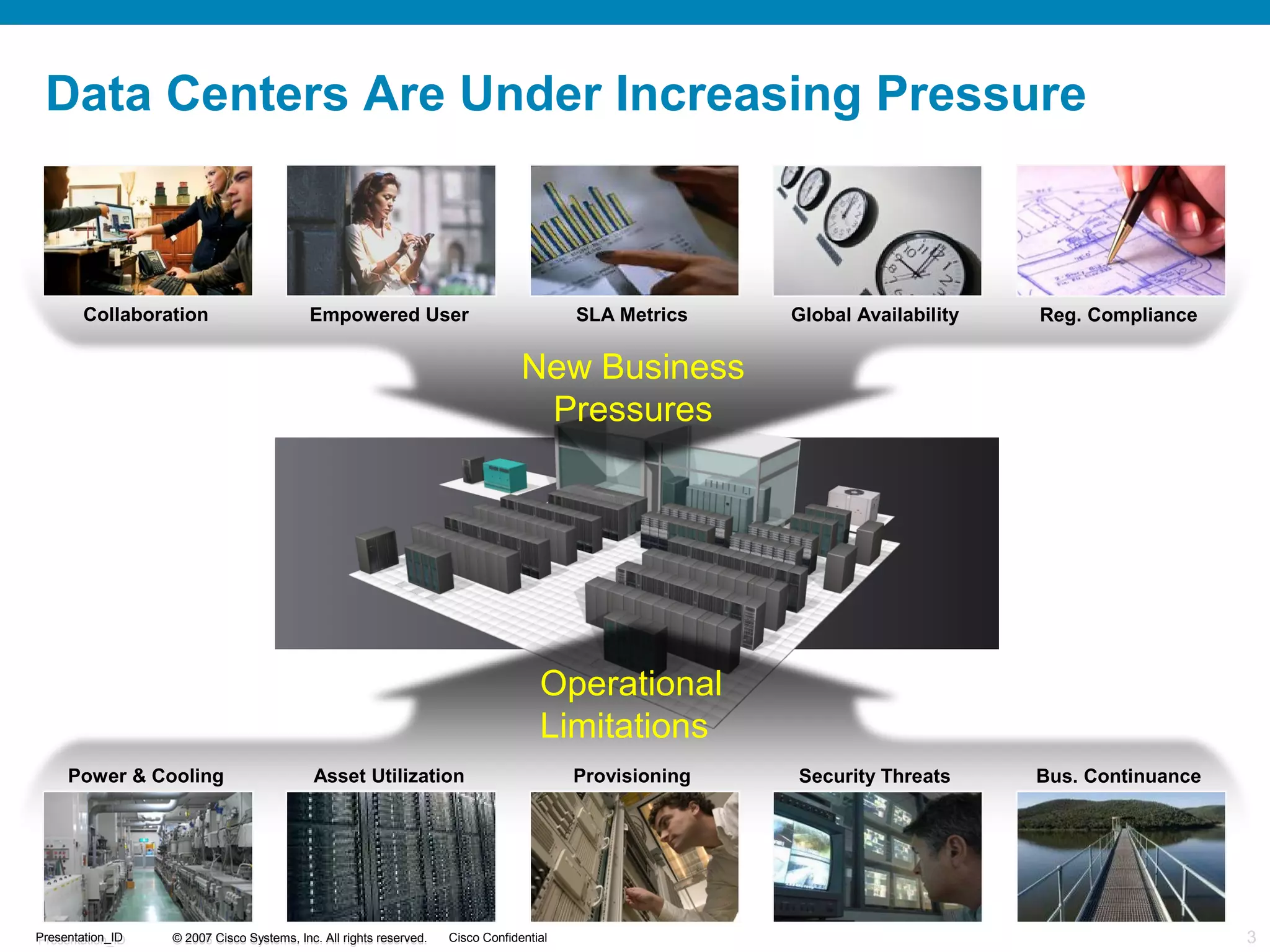
Data Centers Are Under Increasing Pressure 
Collaboration Empowered User SLA Metrics Global Availability Reg. Compliance 
New Business 
Pressures 
Operational 
Limitations 
Power & Cooling Asset Utilization Provisioning Security Threats Bus. Continuance 
© 2006 Cisco Systems, PPrreesseennttaattioionn__IIDD © 2007 Cisco Systems, IInncc.. AAllll rriigghhttss rreesseerrvveedd.. Cisco Confidential 3 3
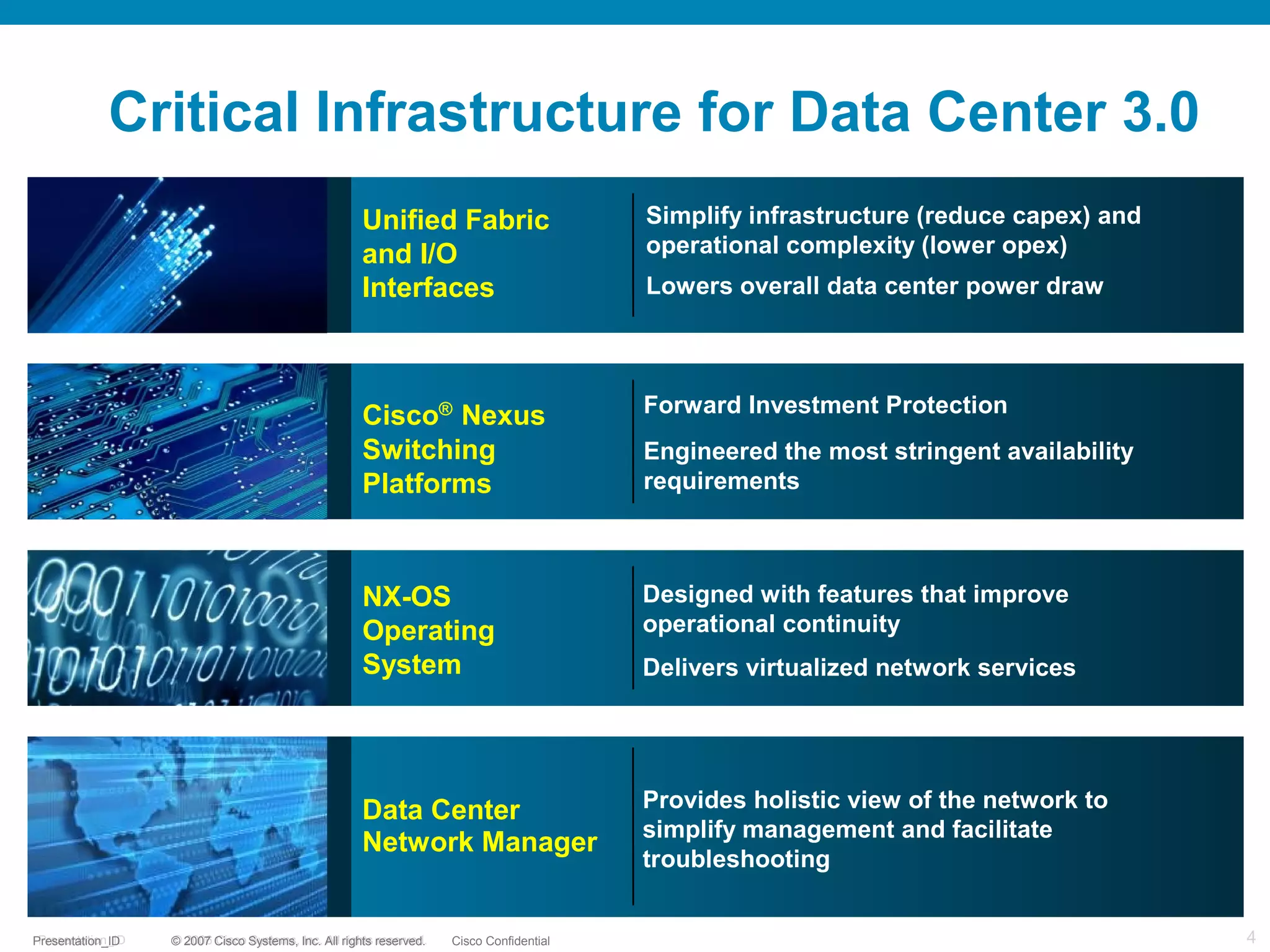
Critical Infrastructure for Data Center 3.0 
Unified Fabric 
and I/O 
Interfaces 
Cisco® Nexus 
Switching 
Platforms 
NX-OS 
Operating 
System 
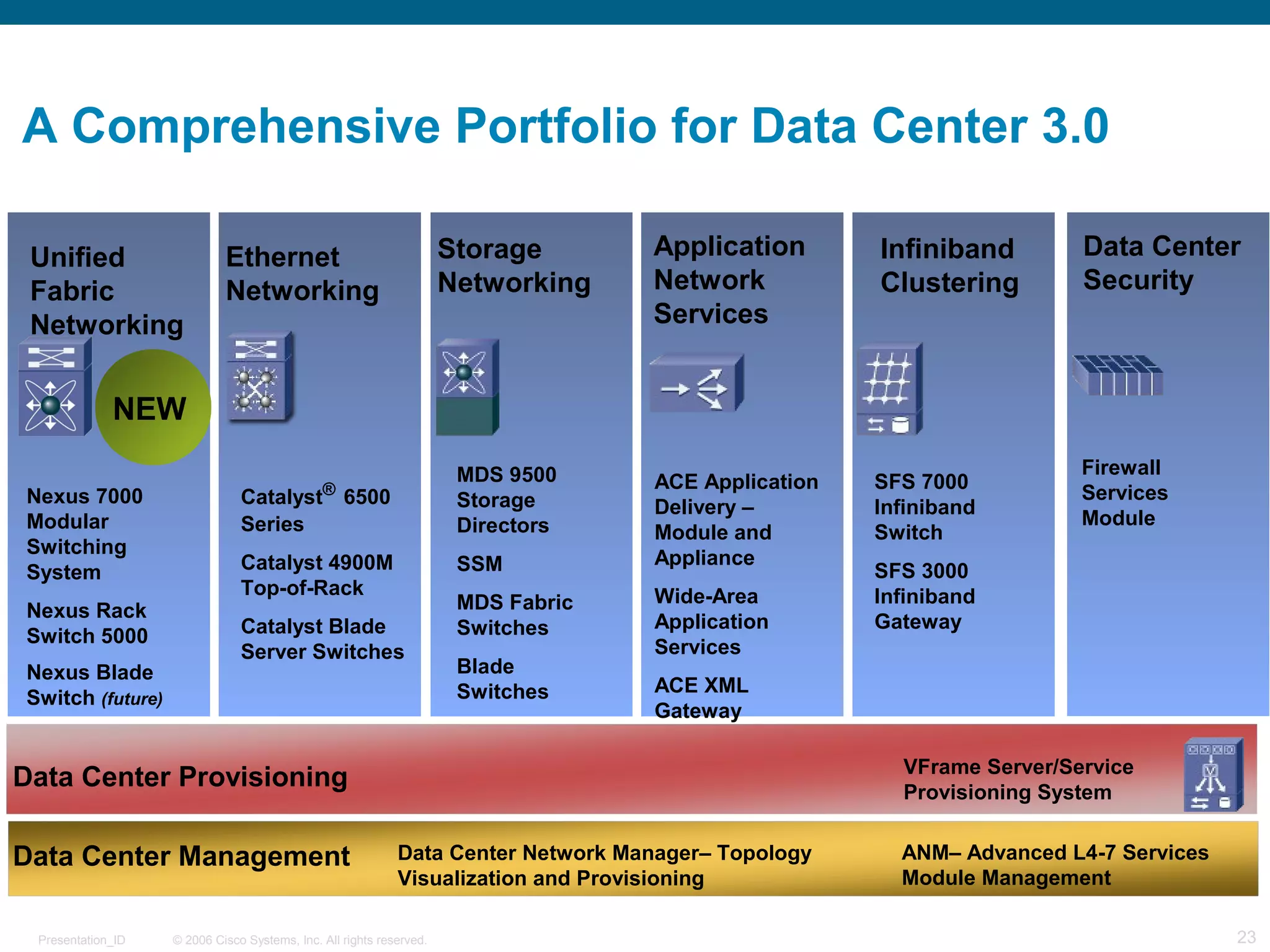
Data Center 
Network Manager 
Simplify infrastructure (reduce capex) and 
operational complexity (lower opex) 
Lowers overall data center power draw 
Forward Investment Protection 
Engineered the most stringent availability 
requirements 
Designed with features that improve 
operational continuity 
Delivers virtualized network services 
Provides holistic view of the network to 
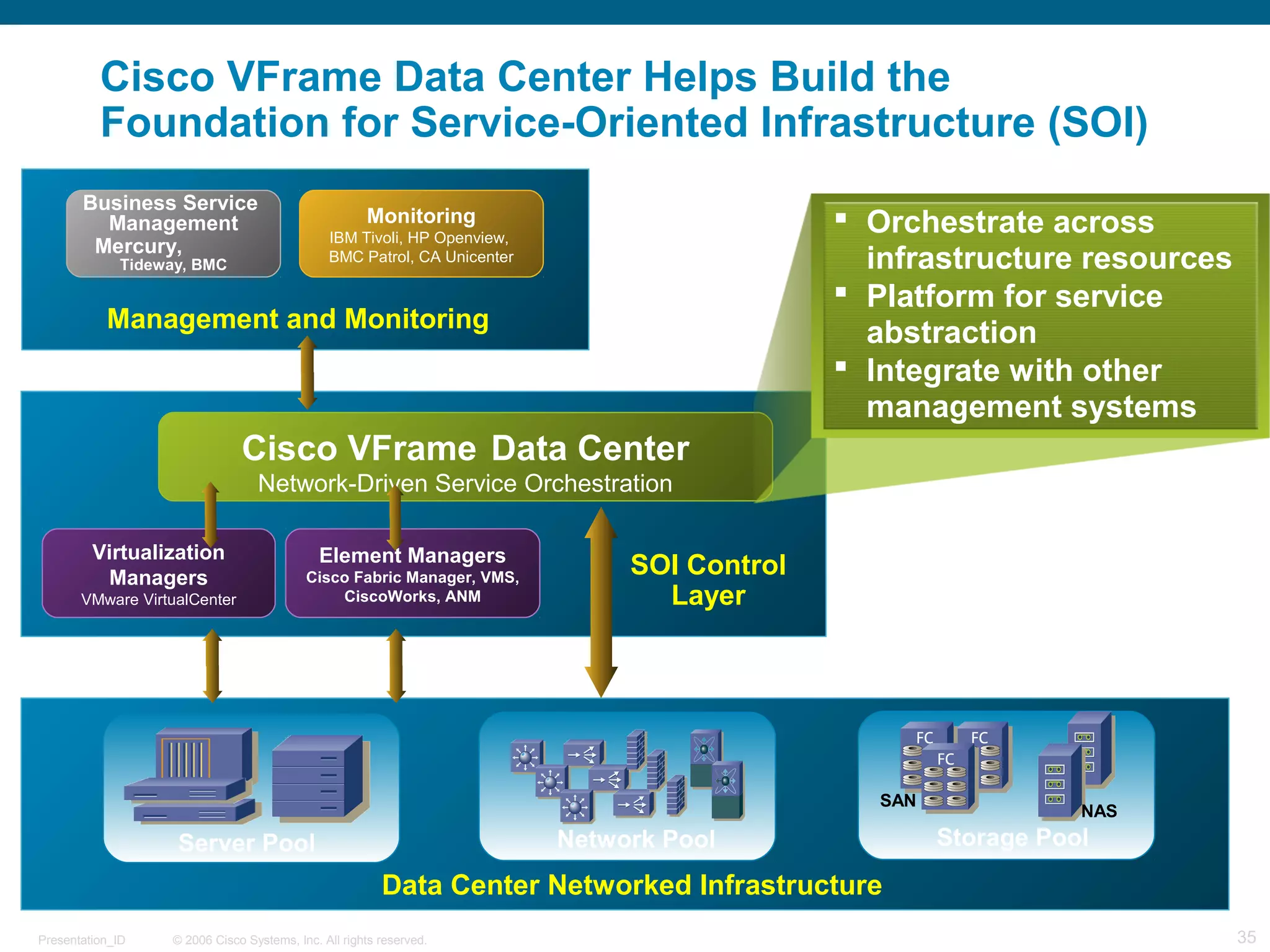
simplify management and facilitate 
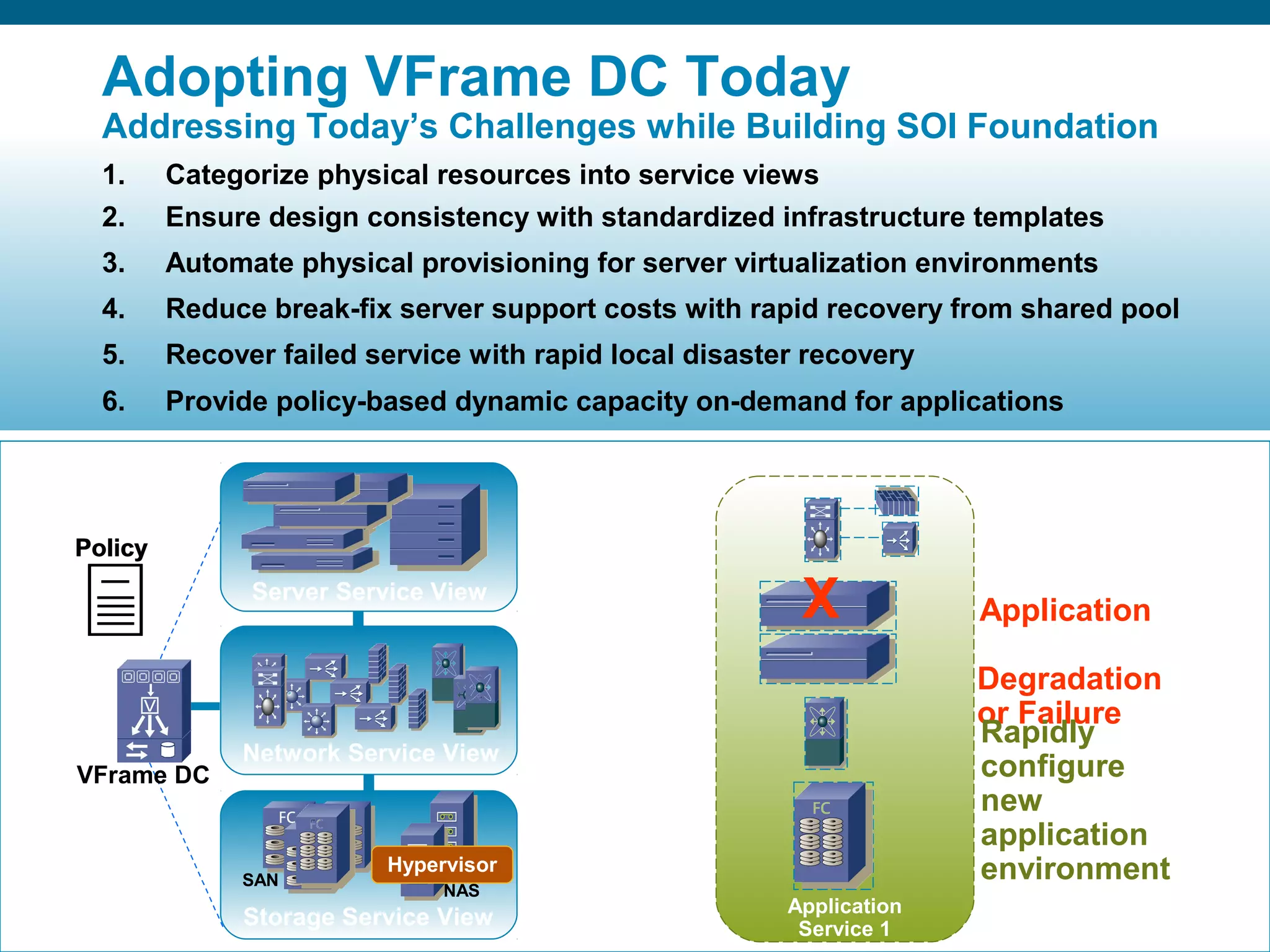
troubleshooting 
© 2006 Cisco Systems, PPreresseenntatatitoionn__IDID 2007 IInncc.. AAllll rriigghhttss rreesseerrvveedd.. Cisco Confidential 4 4
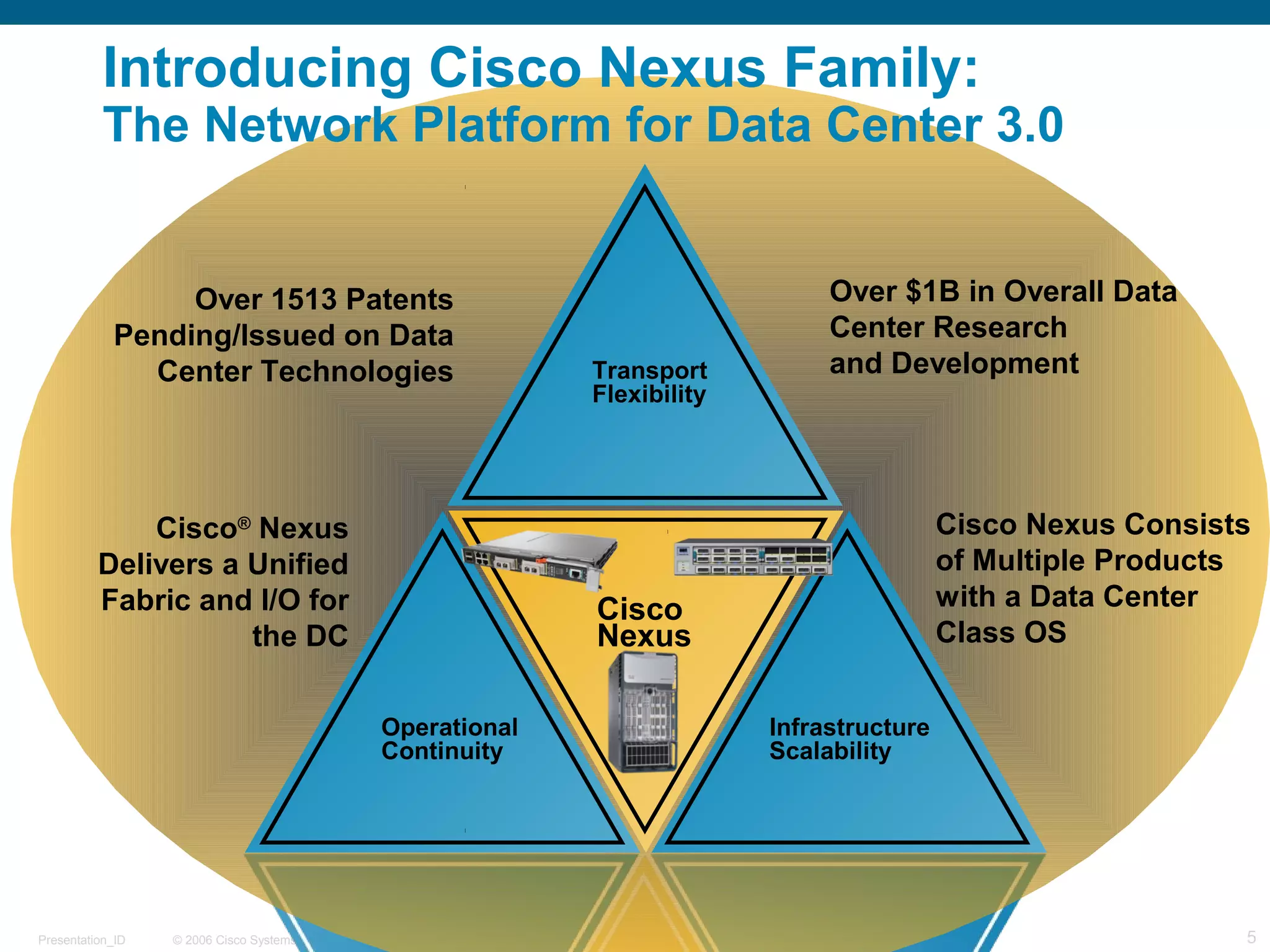
Introducing Cisco Nexus Family: 
The Network Platform for Data Center 3.0 
Over 1513 Patents 
Pending/Issued on Data 
Center Technologies 
Over $1B in Overall Data 
Center Research 
and Development 
Cisco Nexus Consists 
of Multiple Products 
with a Data Center 
Class OS 
Transport 
Flexibility 
Cisco 
Nexus 
Infrastructure 
Scalability 
Operational 
Continuity 
Cisco® Nexus 
Delivers a Unified 
Fabric and I/O for 
the DC 
© 2006 Cisco Systems, Presentation_ID Inc. All rights reserved. 5
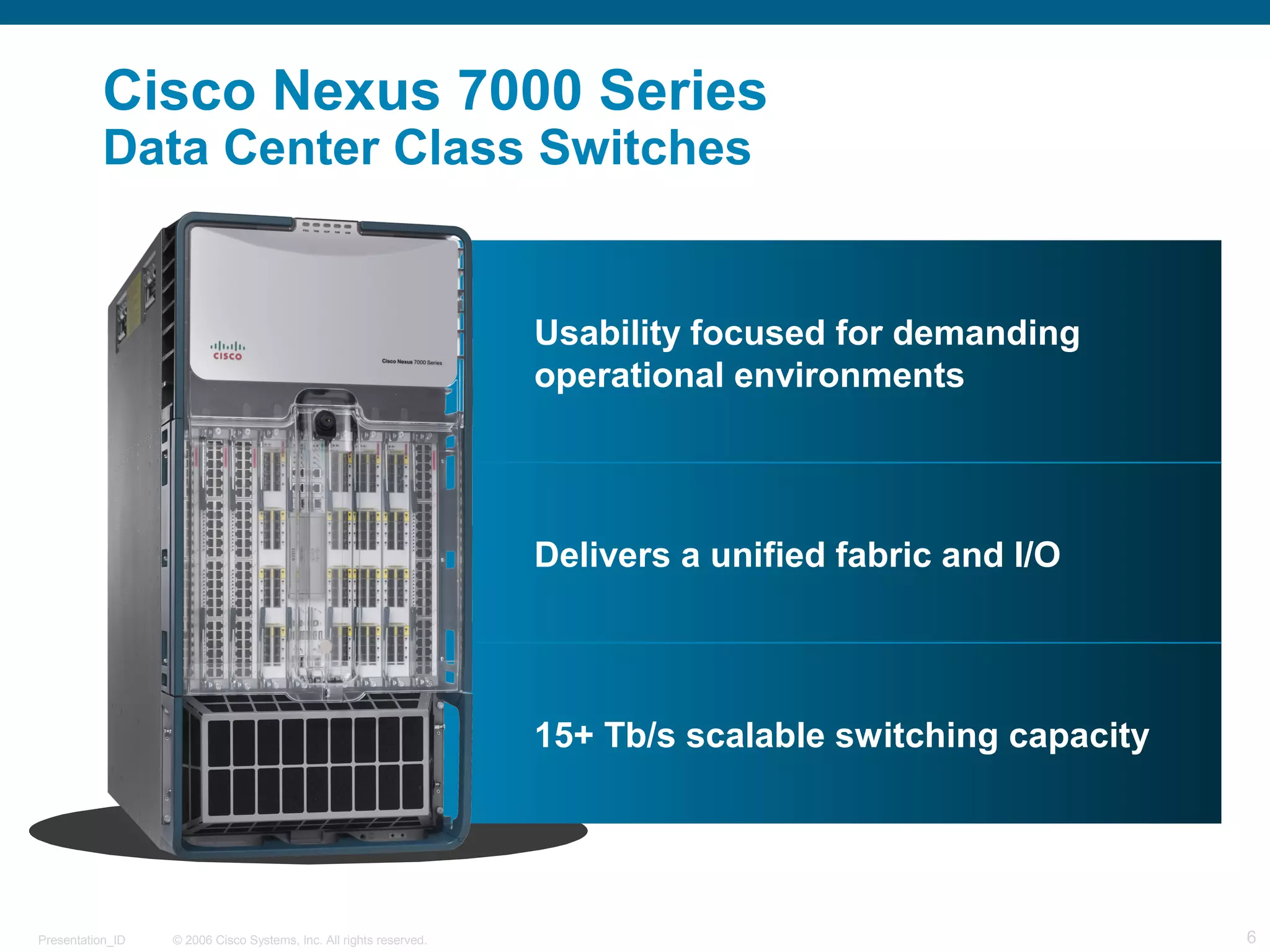
Cisco Nexus 7000 Series 
Data Center Class Switches 
Usability focused for demanding 
operational environments 
Delivers a unified fabric and I/O 
15+ Tb/s scalable switching capacity 
© 2006 Cisco Systems, Presentation_ID Inc. All rights reserved. 6
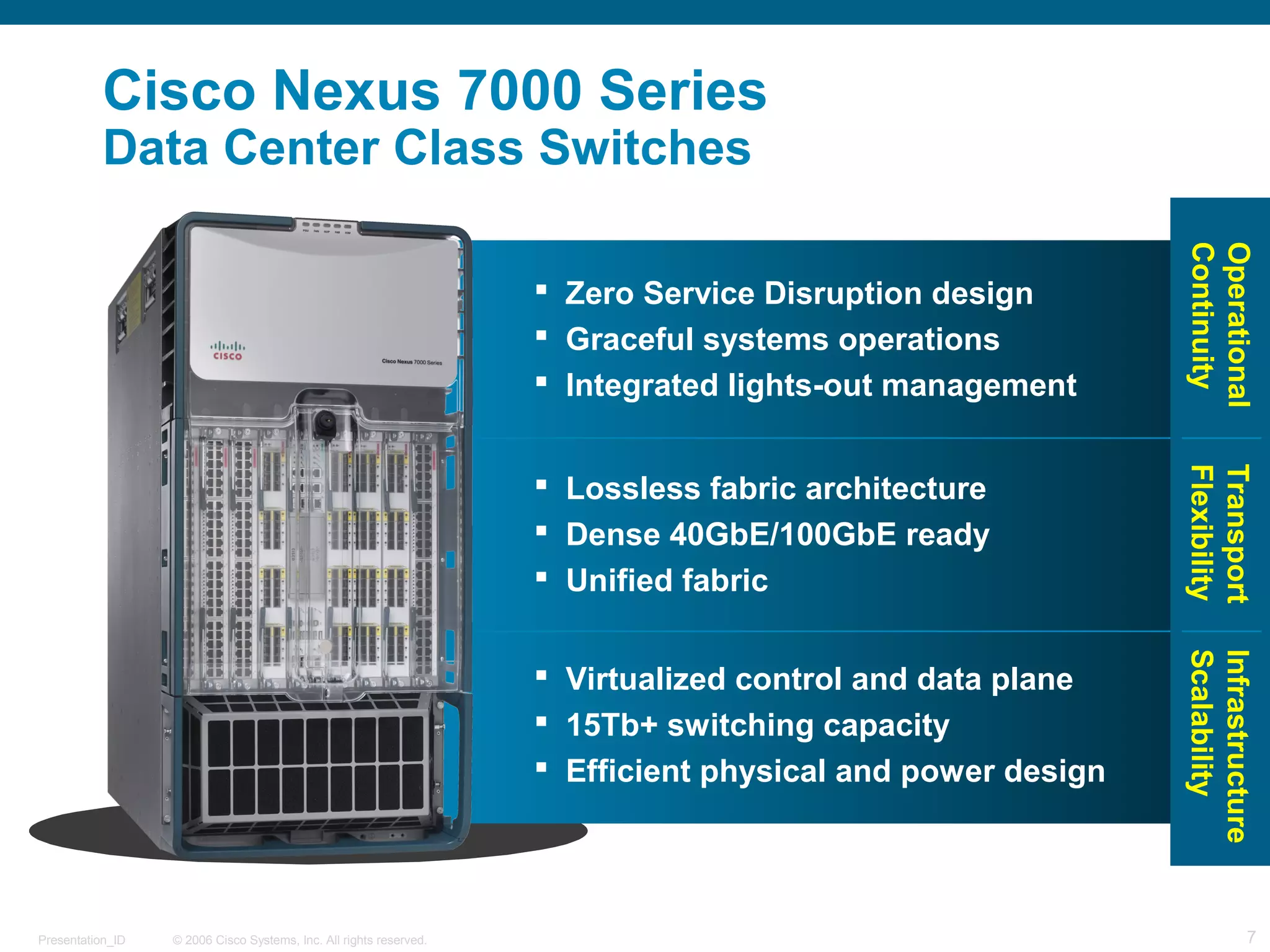
Cisco Nexus 7000 Series 
Data Center Class Switches 
 Zero Service Disruption design 
 Graceful systems operations 
 Integrated lights-out management 
 Lossless fabric architecture 
 Dense 40GbE/100GbE ready 
 Unified fabric 
 Virtualized control and data plane 
 15Tb+ switching capacity 
 Efficient physical and power design 
Continuity 
Operational 
Flexibility 
Transport 
Scalability 
Infrastructure 
© 2006 Cisco Systems, Presentation_ID Inc. All rights reserved. 7
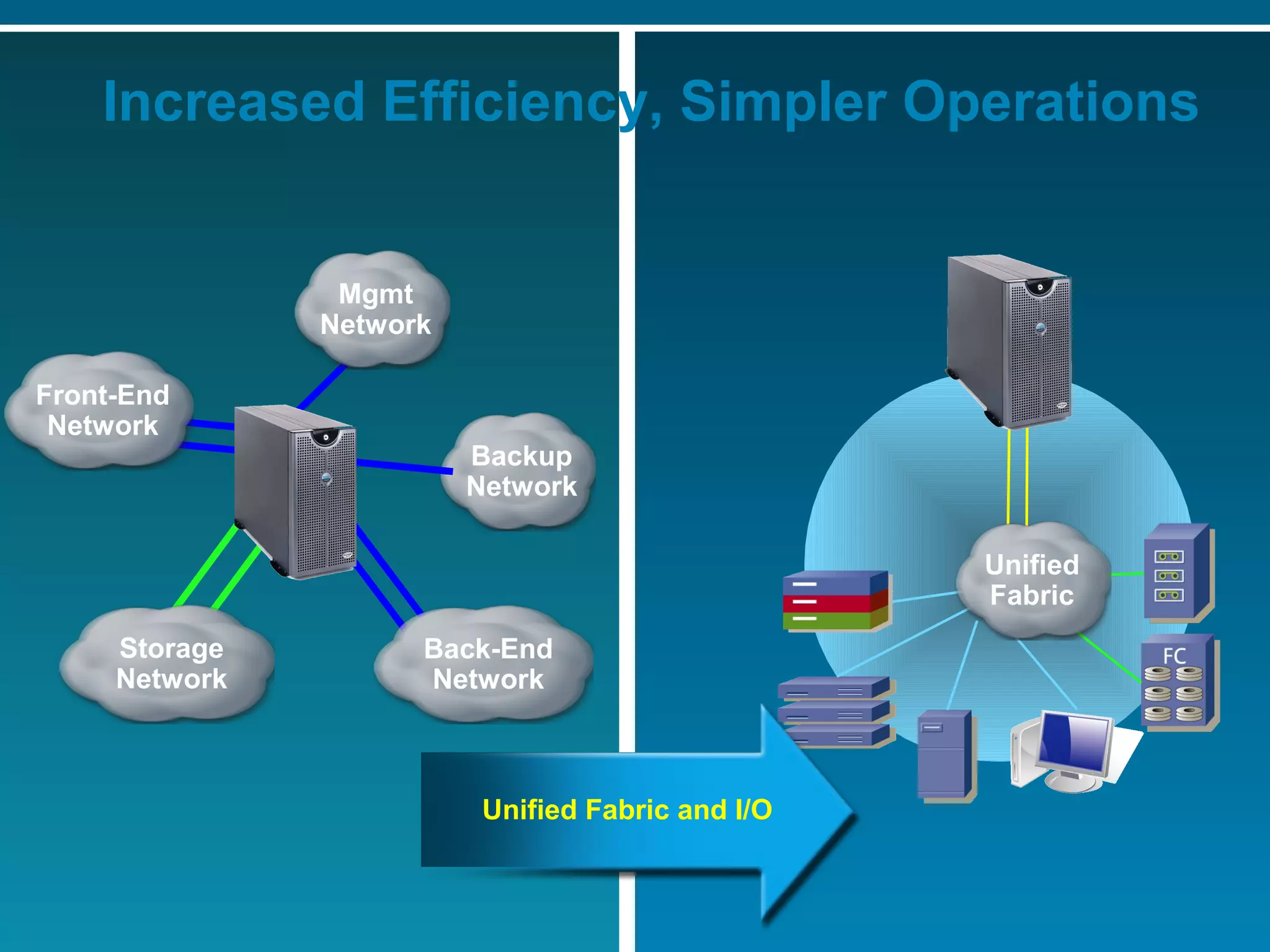
Increased Efficiency, Simpler Operations 
Unified 
Fabric 
Backup 
Network 
Back-End 
Network 
Unified Fabric and I/O 
Front-End 
Network 
Storage 
Network 
Mgmt 
Network 
© 2006 Cisco Systems, Presentation_ID Inc. All rights reserved. 8
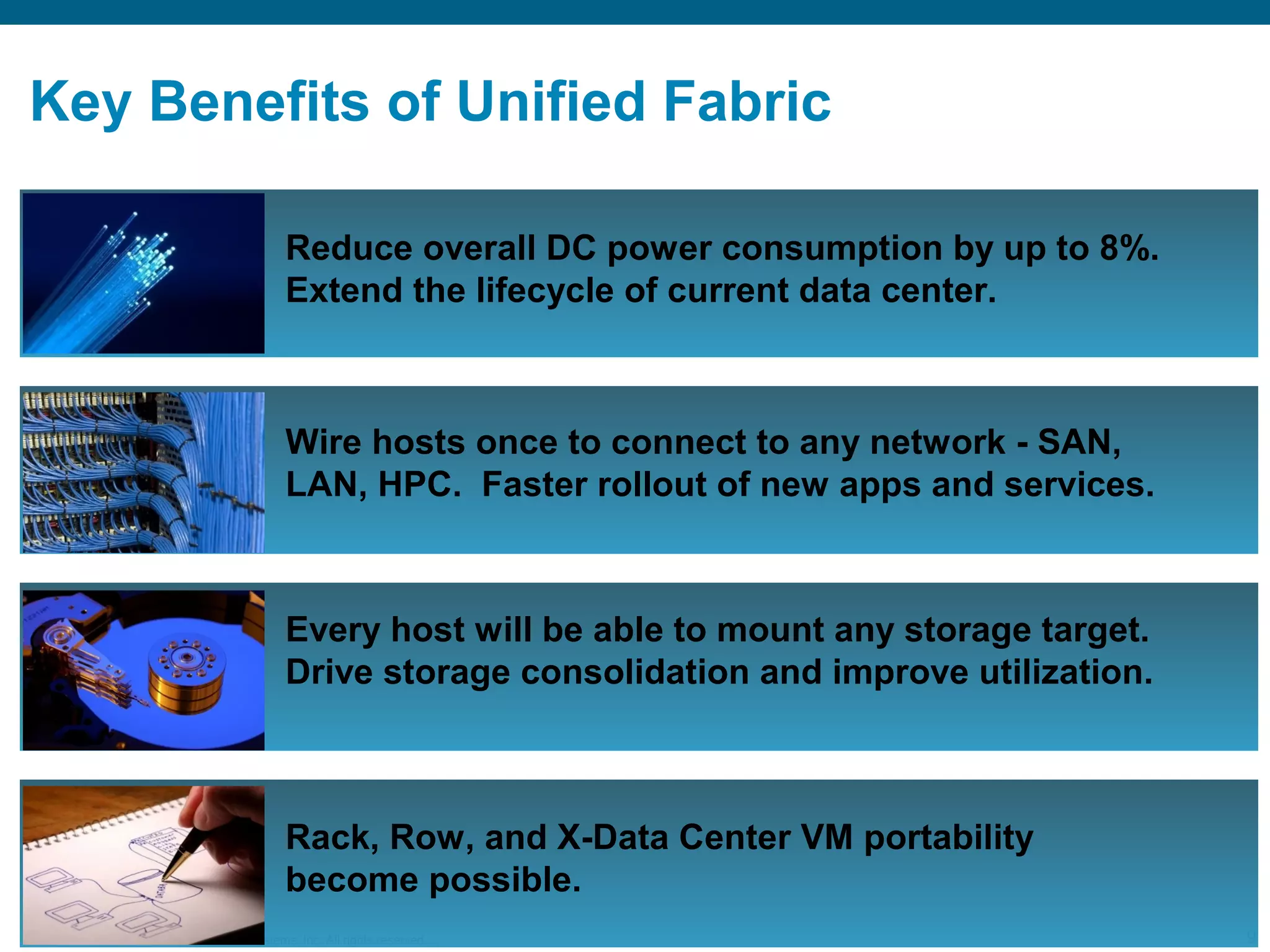
Key Benefits of Unified Fabric 
Reduce overall DC power consumption by up to 8%. 
Extend the lifecycle of current data center. 
Wire hosts once to connect to any network - SAN, 
LAN, HPC. Faster rollout of new apps and services. 
Every host will be able to mount any storage target. 
Drive storage consolidation and improve utilization. 
Rack, Row, and X-Data Center VM portability 
become possible. 
© 2006 Cisco Systems, Presentation_ID Inc. All rights reserved. 9
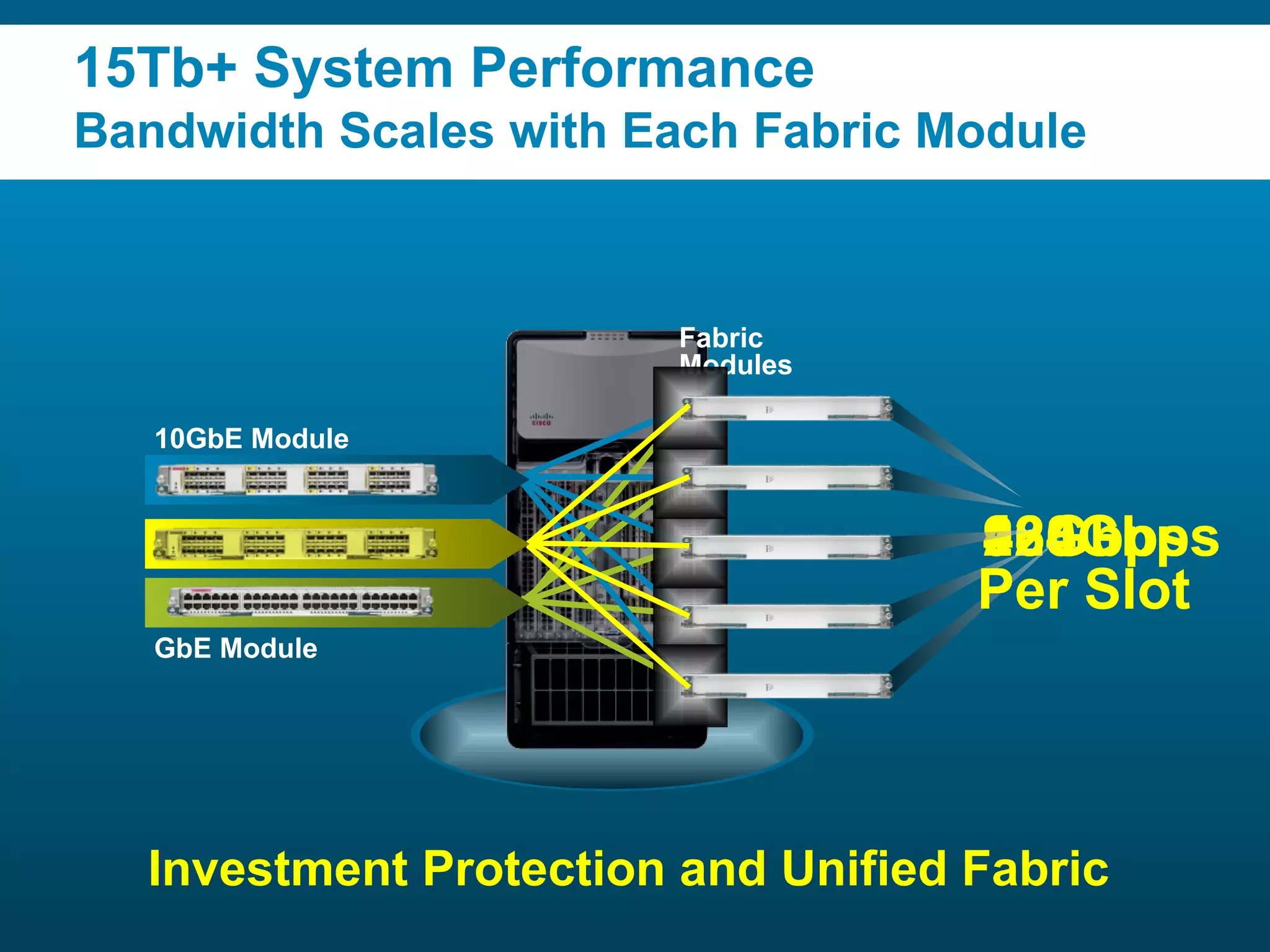
15Tb+ System Performance 
Bandwidth Scales with Each Fabric Module 
10GbE Module 
GbE Module 
Fabric 
Modules 
1124923368048GGGGGbbbbbpppppsssss 
Per Slot 
Investment Protection and Unified Fabric 
© 2006 Cisco Systems, Presentation_ID Inc. All rights reserved. 10
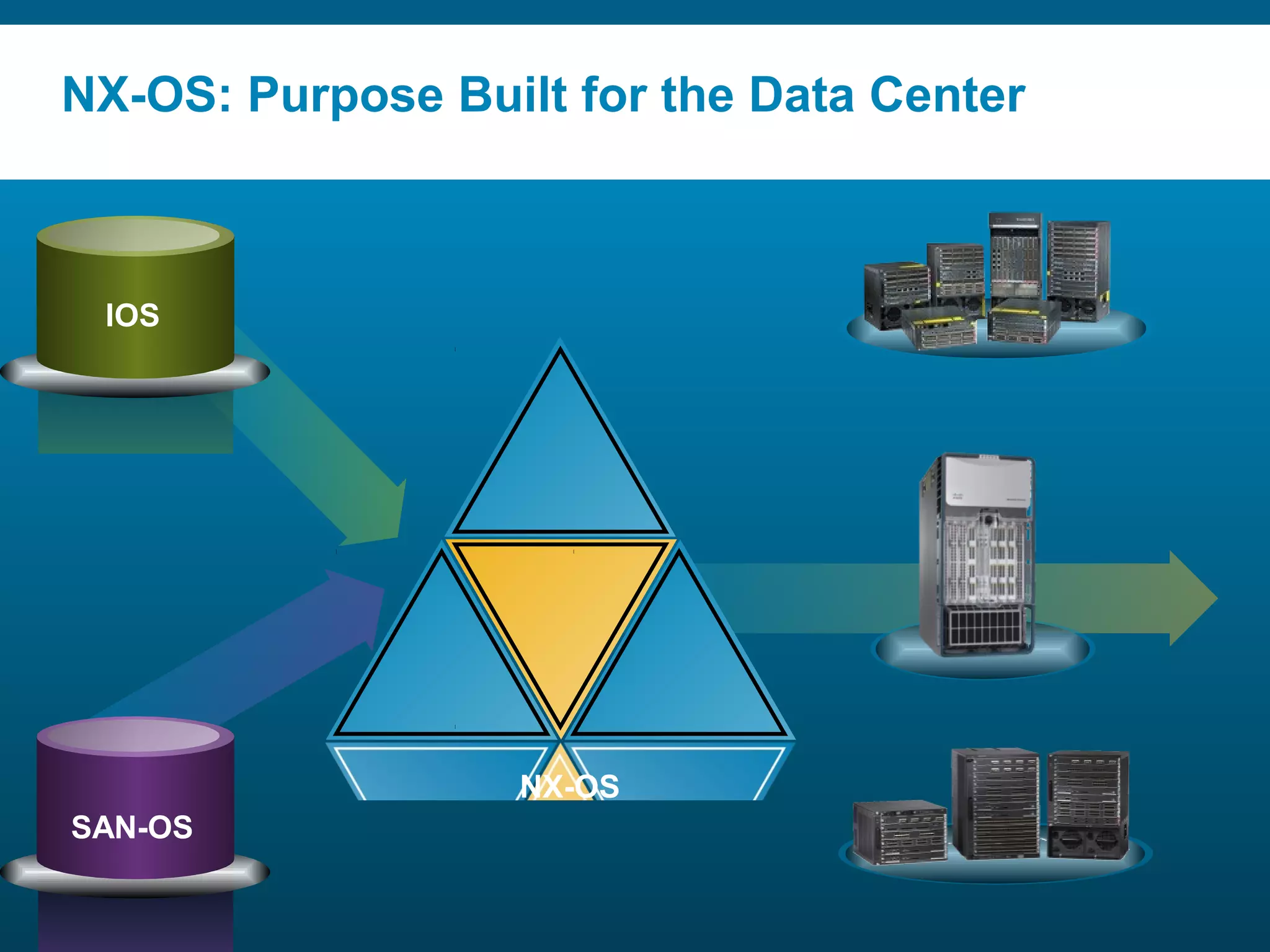
NX-OS: Purpose Built for the Data Center 
NX-OS 
IOS 
SAN-OS 
© 2006 Cisco Systems, Presentation_ID Inc. All rights reserved. 11
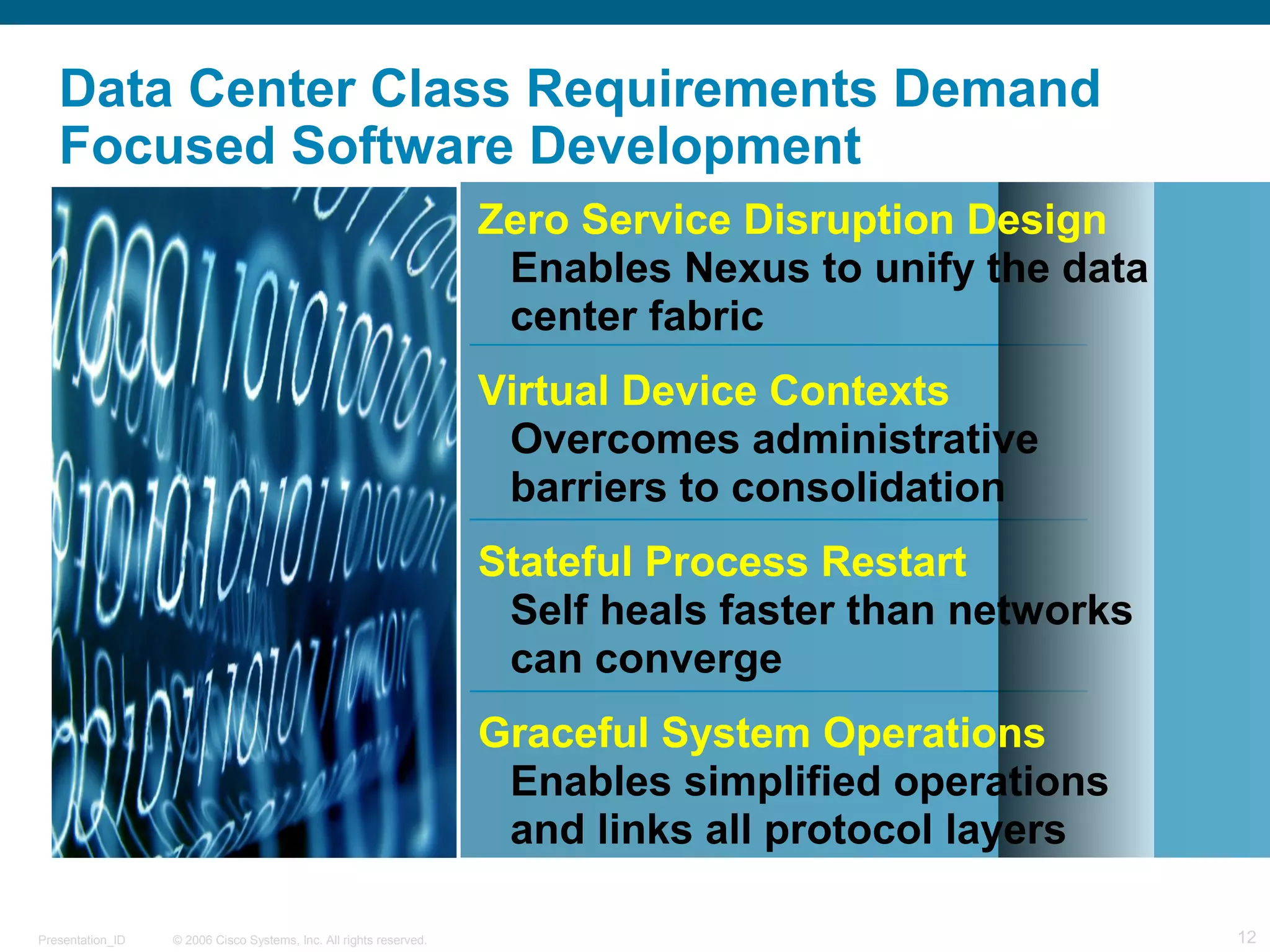
Data Center Class Requirements Demand 
Focused Software Development 
Zero Service Disruption Design 
Enables Nexus to unify the data 
center fabric 
Virtual Device Contexts 
Overcomes administrative 
barriers to consolidation 
Stateful Process Restart 
Self heals faster than networks 
can converge 
Graceful System Operations 
Enables simplified operations 
and links all protocol layers 
© 2006 Cisco Systems, Presentation_ID Inc. All rights reserved. 12
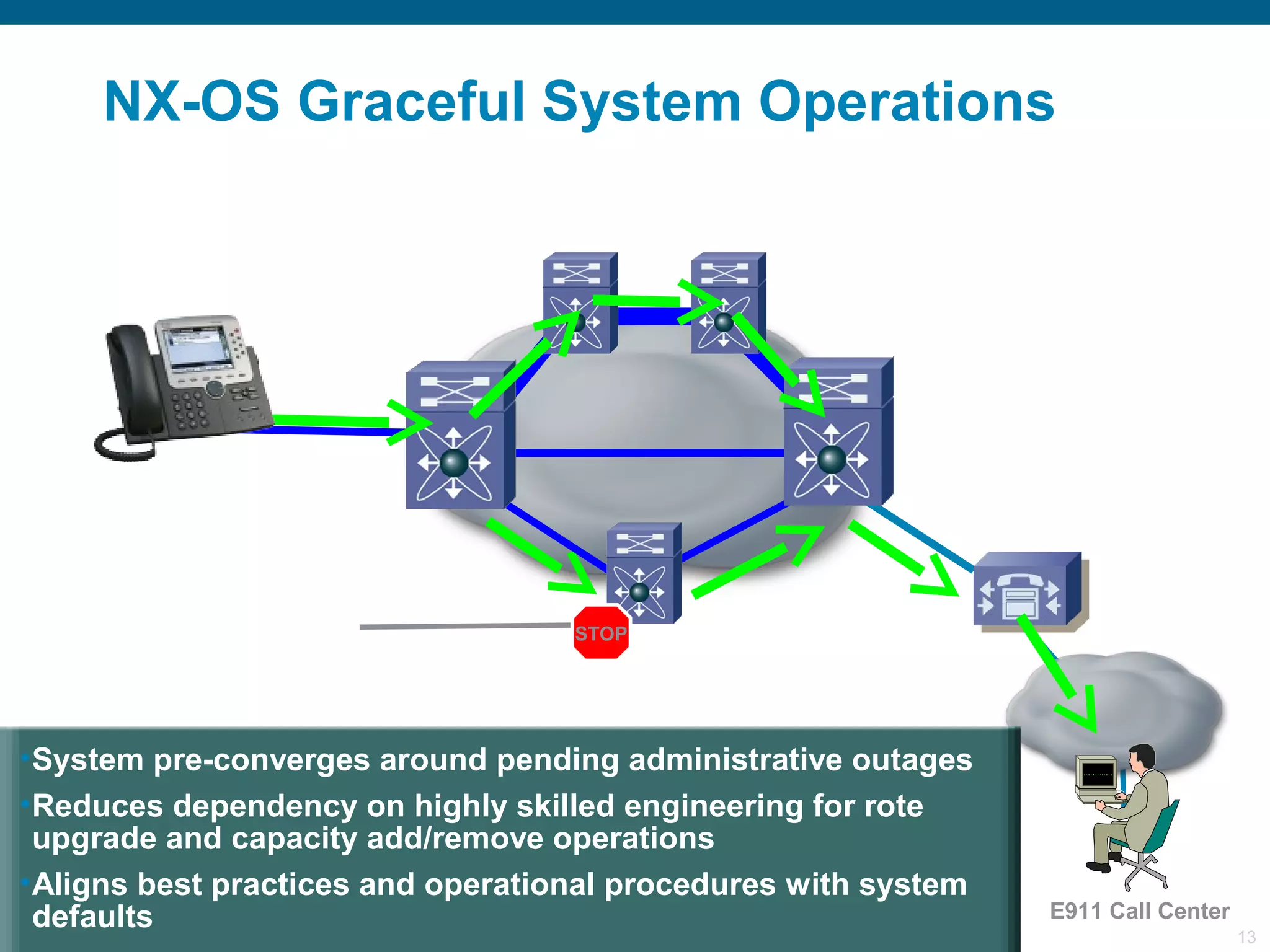
NX-OS Graceful System Operations 
Network pre-converges 
around pending administrative 
outage 
E911 Call Center 
911 Call In Progress 
Admin signals system to reload 
Nexus signals 
that it is 
reloading 
STOP 
•System pre-converges around pending administrative outages 
•Reduces dependency on highly skilled engineering for rote 
upgrade and capacity add/remove operations 
•Aligns best practices and operational procedures with system 
defaults 
© 2006 Cisco Systems, Presentation_ID Inc. All rights reserved. 13
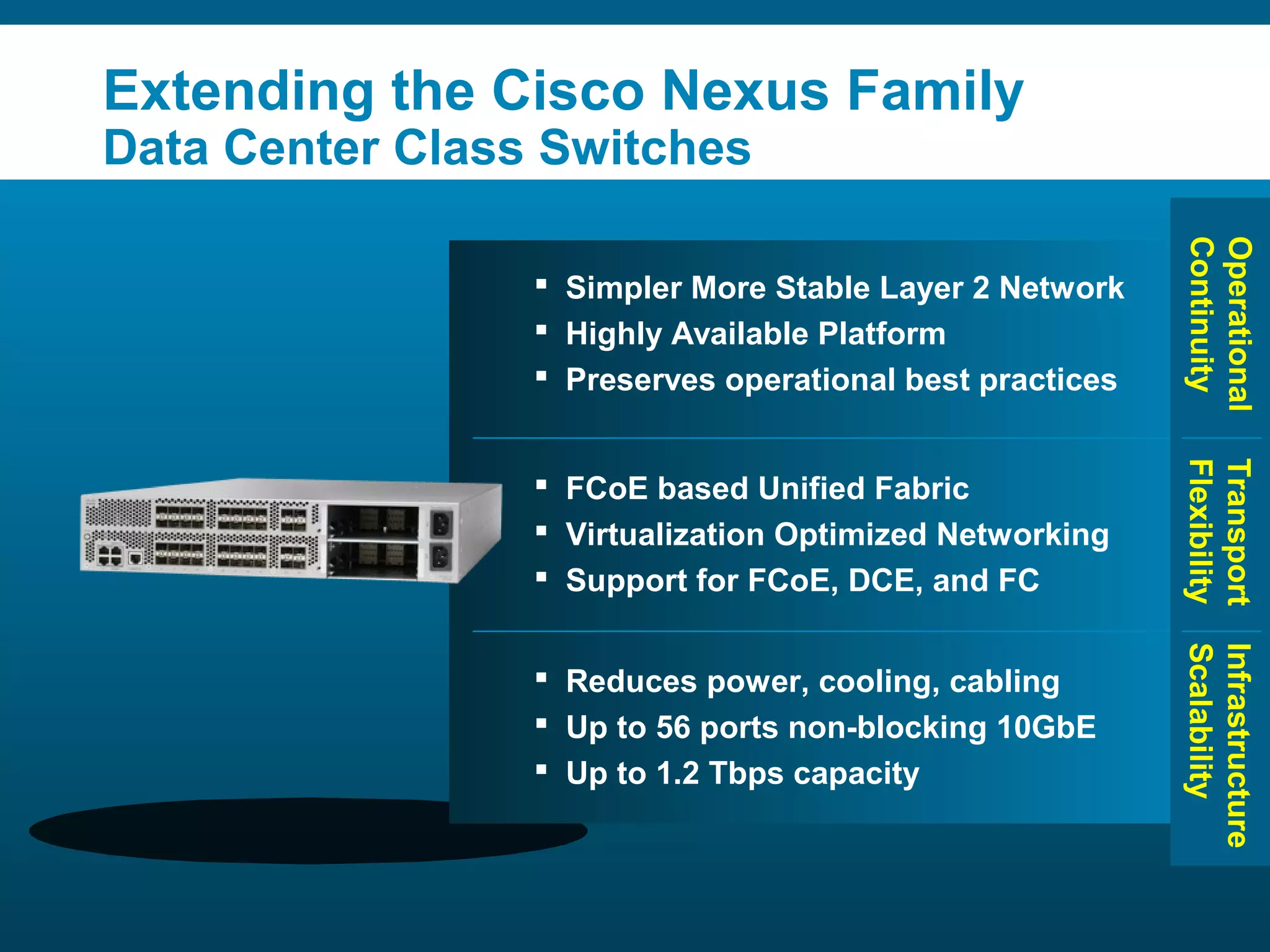
Extending the Cisco Nexus Family 
Data Center Class Switches 
 Simpler More Stable Layer 2 Network 
 Highly Available Platform 
 Preserves operational best practices 
 FCoE based Unified Fabric 
 Virtualization Optimized Networking 
 Support for FCoE, DCE, and FC 
 Reduces power, cooling, cabling 
 Up to 56 ports non-blocking 10GbE 
 Up to 1.2 Tbps capacity 
Continuity 
Operational 
Flexibility 
Transport 
Scalability 
Infrastructure 
© 2006 Cisco Systems, Presentation_ID Inc. All rights reserved. 14
OS 
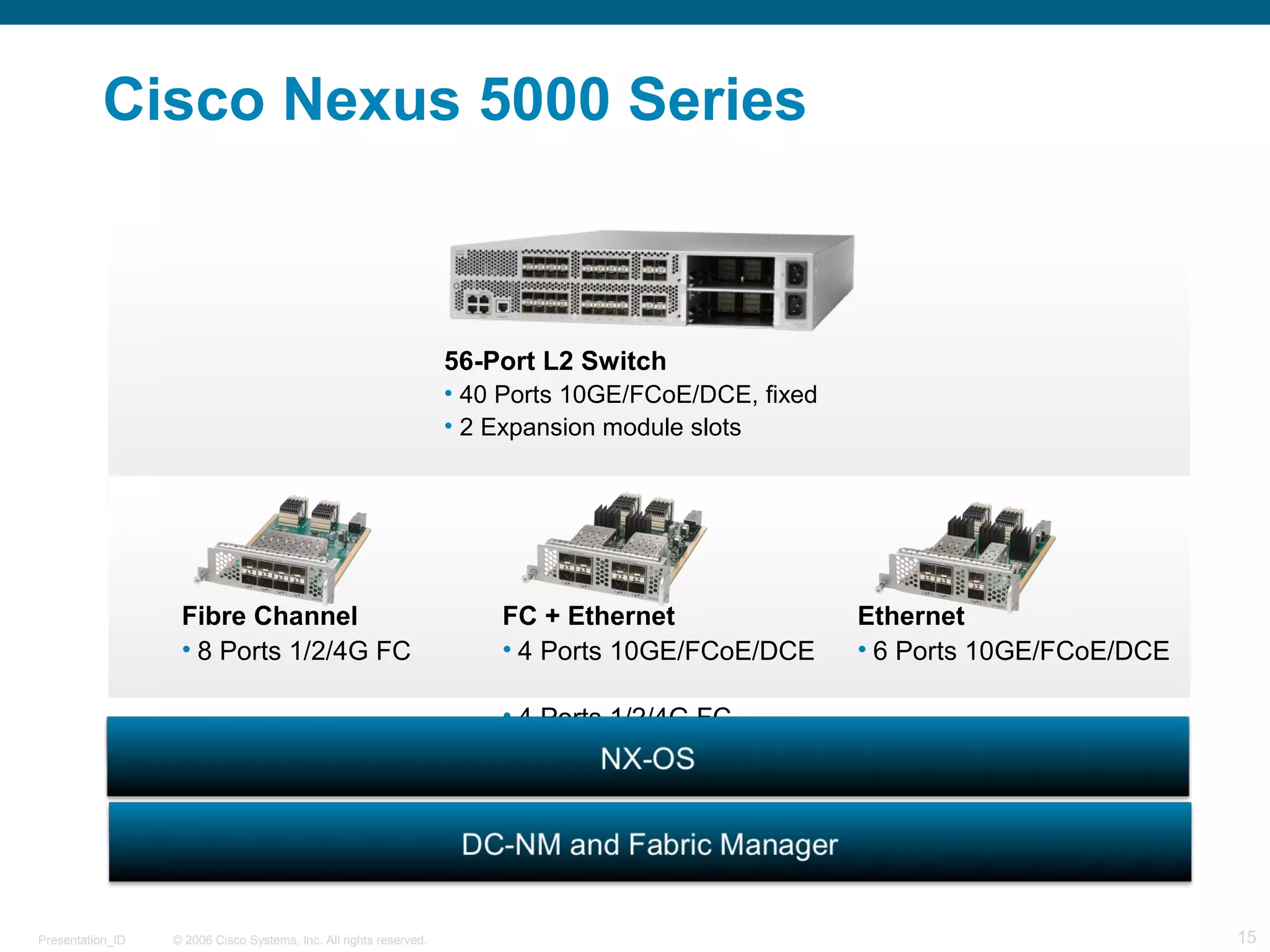
Cisco Nexus 5000 Series 
56-Port L2 Switch 
• 40 Ports 10GE/FCoE/DCE, fixed 
• 2 Expansion module slots 
FC + Ethernet 
• 4 Ports 10GE/FCoE/DCE 
• 4 Ports 1/2/4G FC 
Cisco DC-OS 
Cisco DC-OS 
Fibre Channel 
• 8 Ports 1/2/4G FC 
Ethernet 
• 6 Ports 10GE/FCoE/DCE 
Cisco Fabric Manager and Cisco Data Center Manager 
Mgmt 
© 2006 Cisco Systems, Presentation_ID Inc. All rights reserved. 15
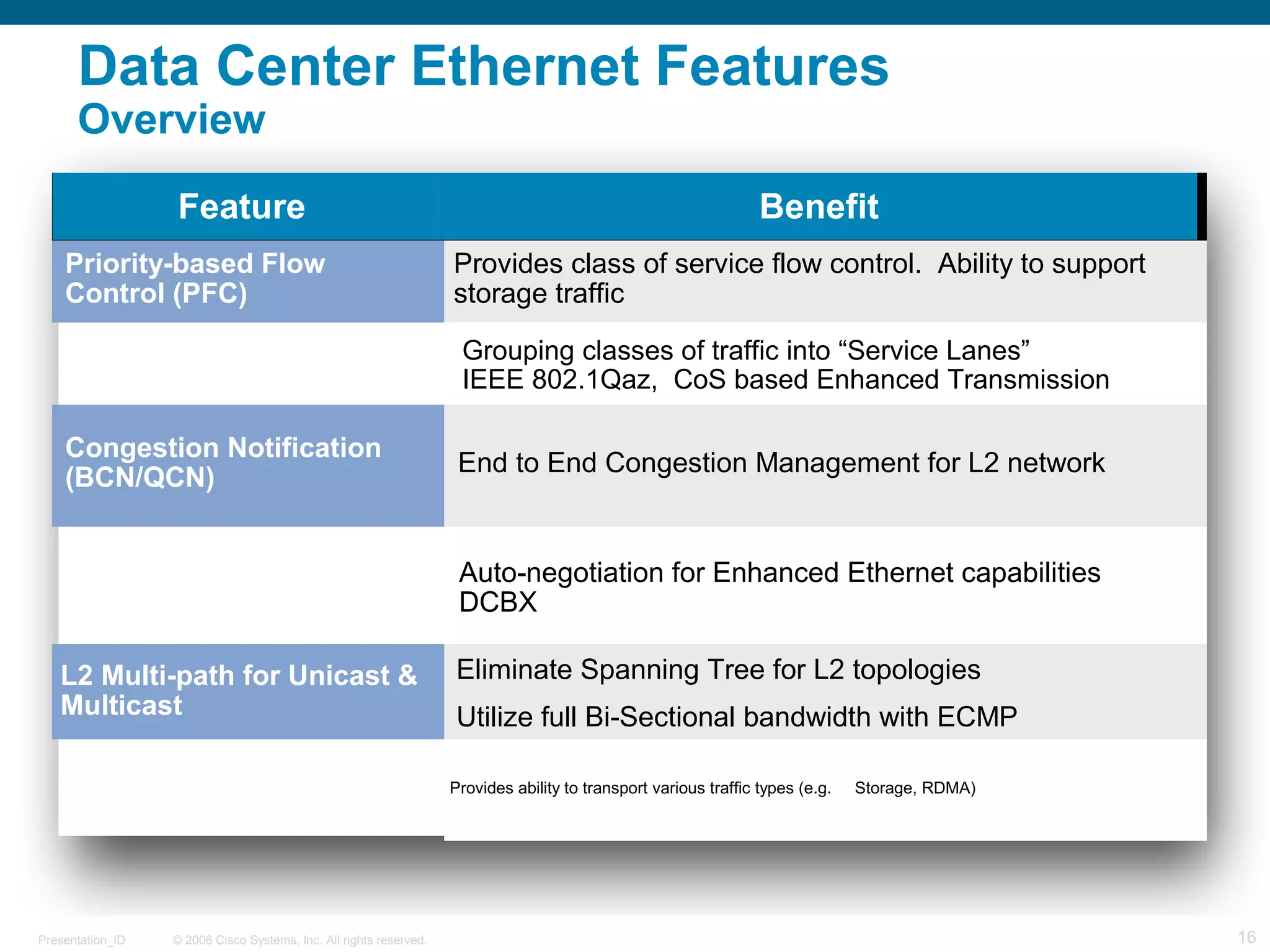
Data Center Ethernet Features 
Overview 
Feature Benefit 
Provides class of service flow control. Ability to support 
storage traffic 
Grouping classes of traffic into “Service Lanes” 
IEEE 802.1Qaz, CoS based Enhanced Transmission 
Priority-based Flow 
Control (PFC) 
CoS Based BW 
Management 
Congestion Notification End to End Congestion Management for L2 network 
(BCN/QCN) 
Auto-negotiation for Enhanced Ethernet capabilities 
DCBX 
Eliminate Spanning Tree for L2 topologies 
Utilize full Bi-Sectional bandwidth with ECMP 
Data Center Bridging 
Capability Exchange 
Protocol 
L2 Multi-path for Unicast & 
Multicast 
Lossless Service Provides ability to transport various traffic types (e.g. Storage, RDMA) 
© 2006 Cisco Systems, Presentation_ID Inc. All rights reserved. 16
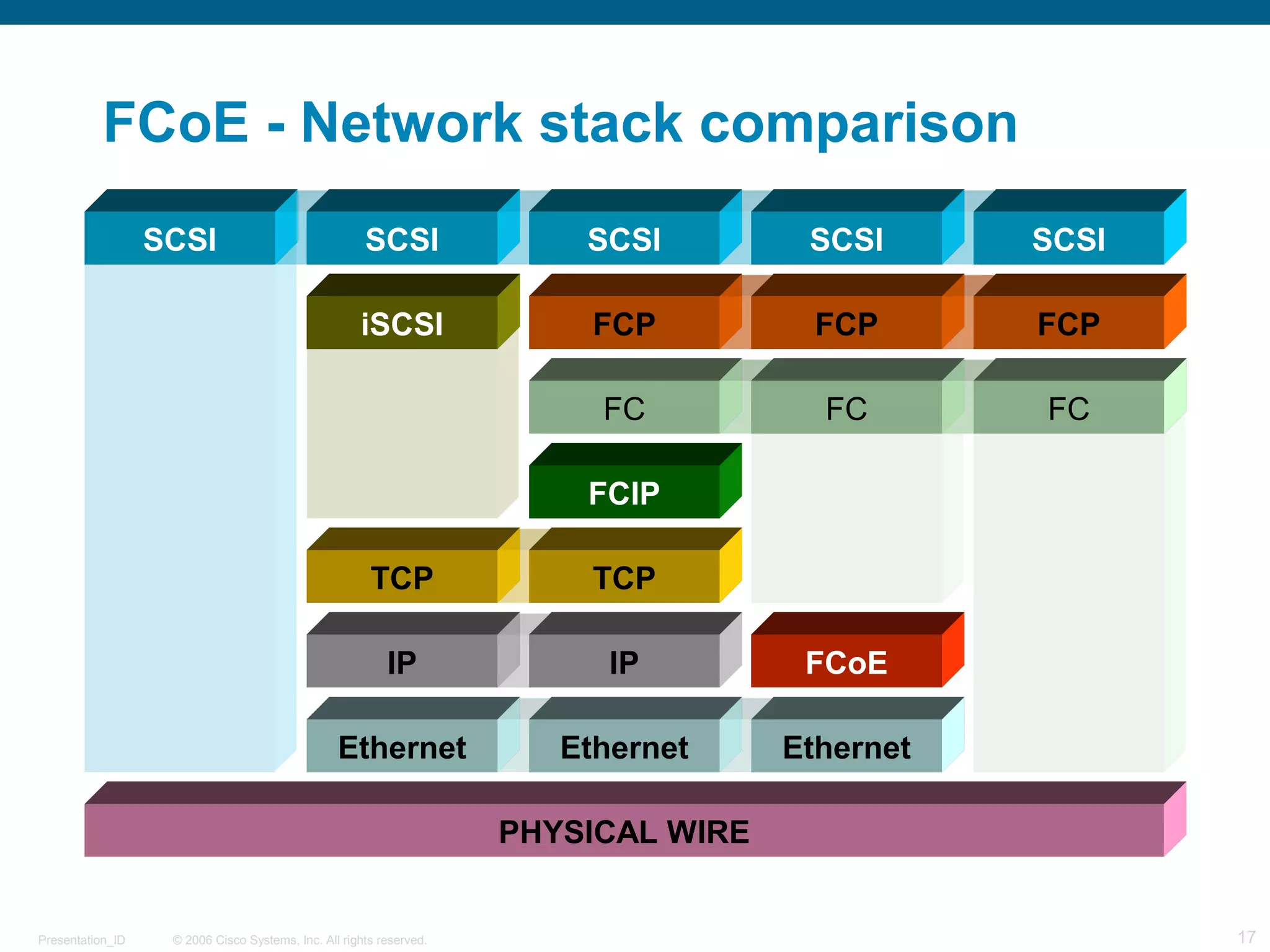
FCoE - Network stack comparison 
SCSI SCSI SCSI SCSI 
iSCSI 
TCP 
IP 
Ethernet 
FCP 
FC 
FCIP 
FCP FCP 
FC FC 
FCoE 
TCP 
IP 
Ethernet Ethernet 
PHYSICAL WIRE 
SCSI 
© 2006 Cisco Systems, Presentation_ID Inc. All rights reserved. 17
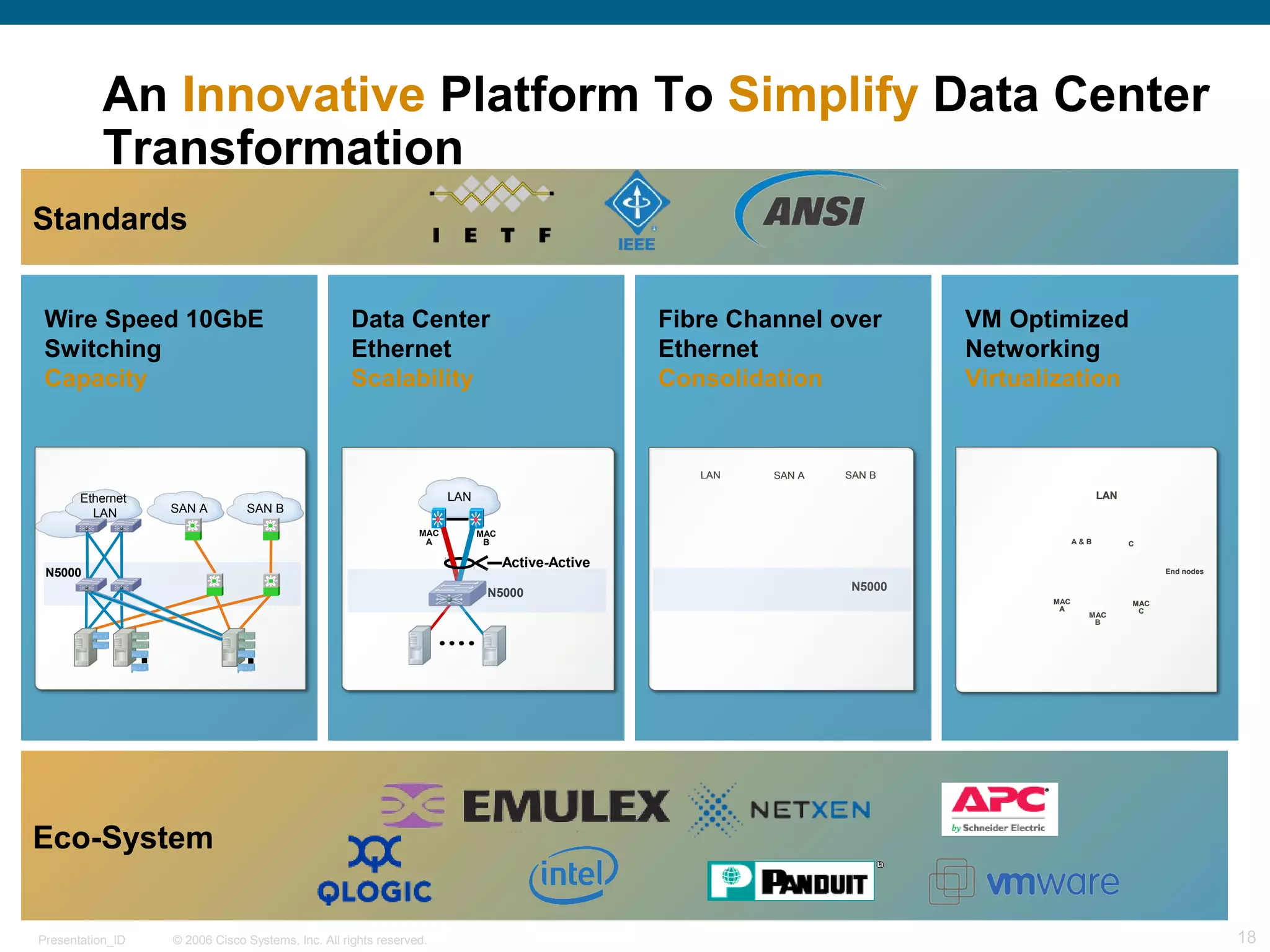
An Innovative Platform To Simplify Data Center 
Transformation 
Standards 
Wire Speed 10GbE 
Switching 
Capacity 
Ethernet 
LAN SAN A SAN B 
N5000 
Data Center 
Ethernet 
Scalability 
LAN 
Active-Active 
MAC 
B 
N5000 
MAC 
A 
Fibre Channel over 
Ethernet 
Consolidation 
LLAANN SSAANN AA SSAANN BB 
N5000 
VM Optimized 
Networking 
Virtualization 
LAN 
A & B C 
MAC 
B 
MAC 
A 
MAC 
C 
End nodes 
Eco-System 
© 2006 Cisco Systems, Presentation_ID Inc. All rights reserved. 18
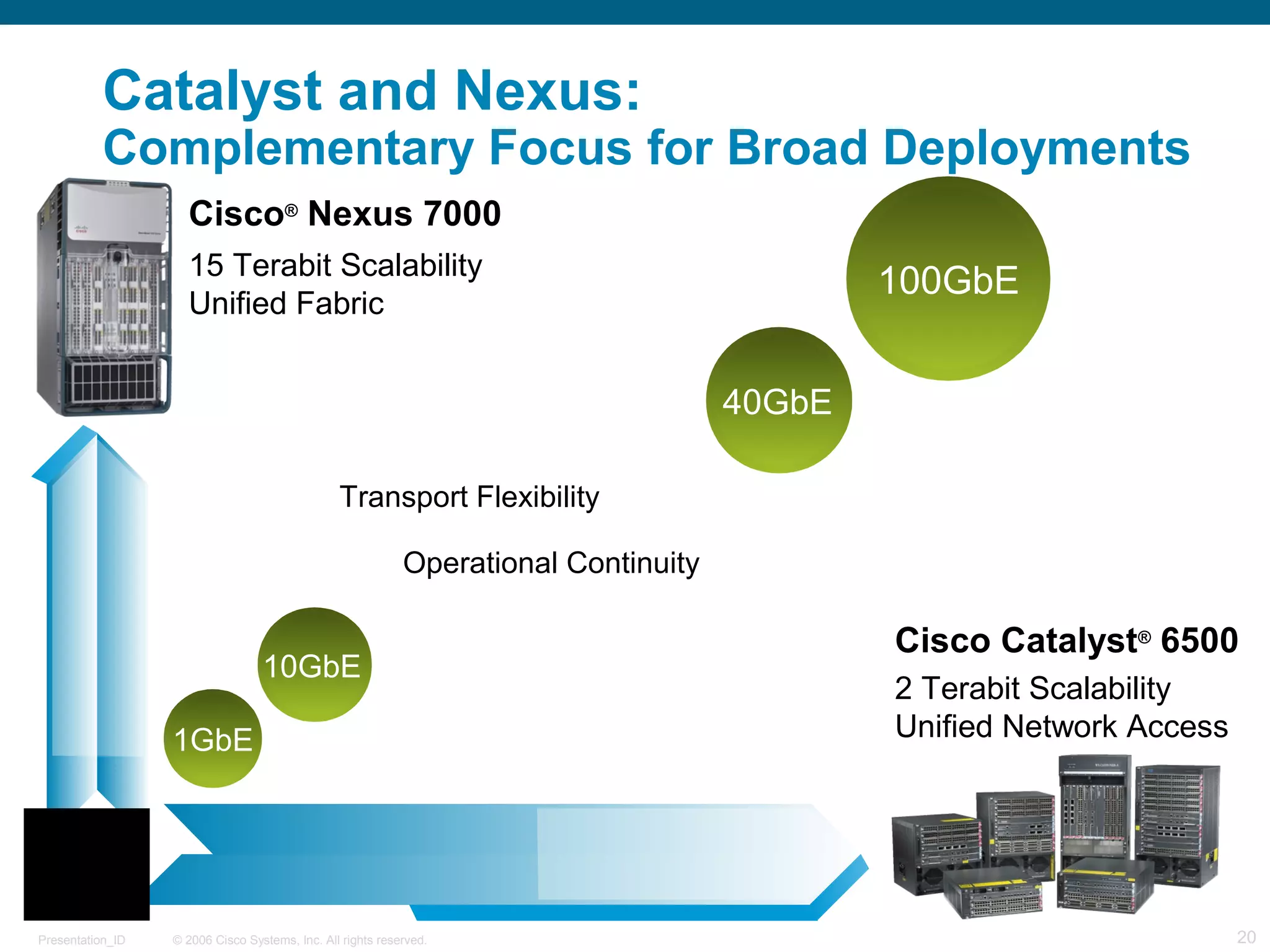
Catalyst and Nexus: 
Complementary Focus for Broad Deployments 
Cisco® Nexus 7000 
15 Terabit Scalability 
Unified Fabric 100GbE 
Cisco Catalyst® 6500 
2 Terabit Scalability 
Unified Network Access 
40GbE 
Transport Flexibility 
Operational Continuity 
10GbE 
1GbE 
© 2006 Cisco Systems, Presentation_ID Inc. All rights reserved. 20
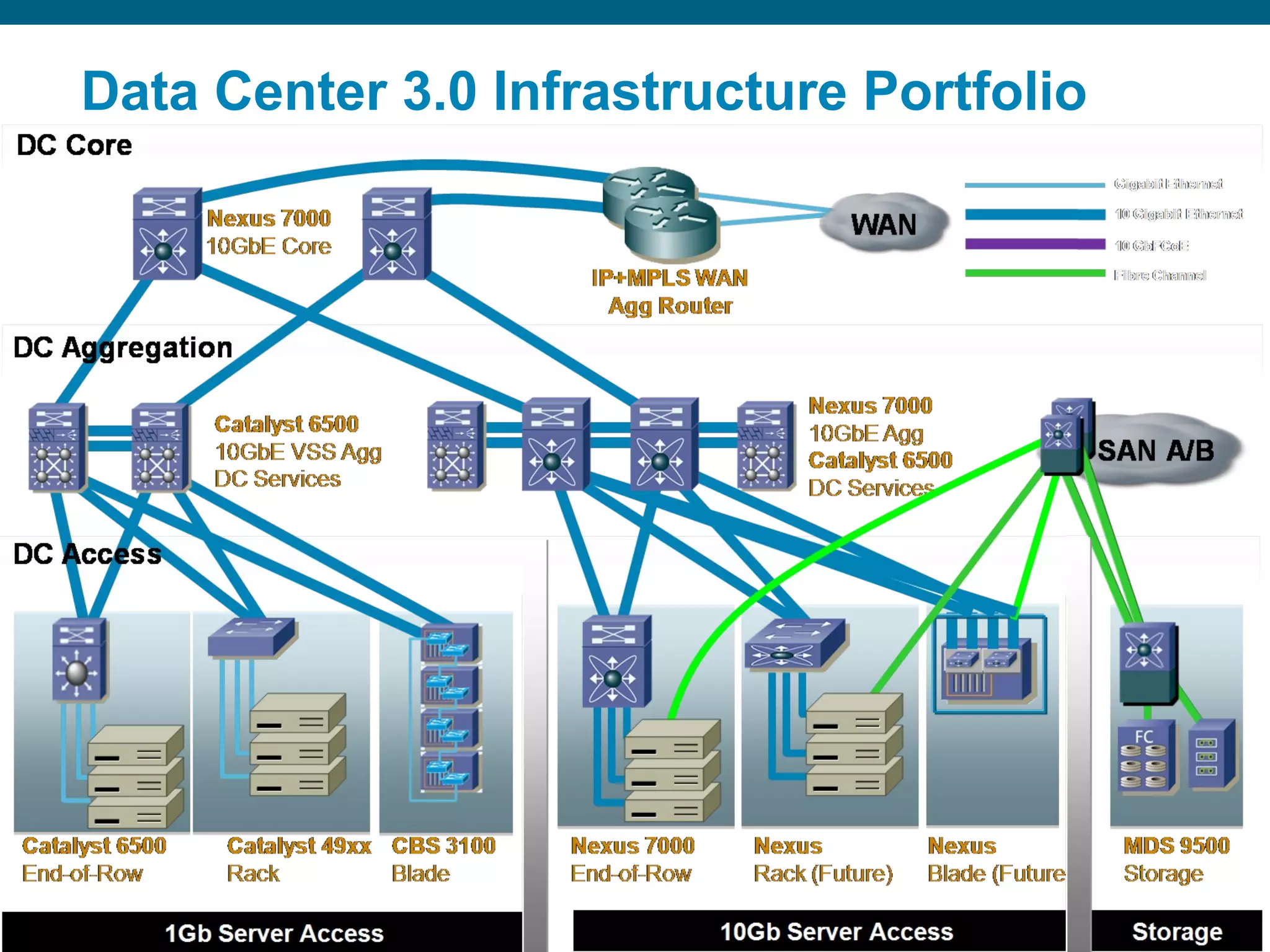
Data Center 3.0 Infrastructure Portfolio 
© 2006 Cisco Systems, Presentation_ID Inc. All rights reserved. 21
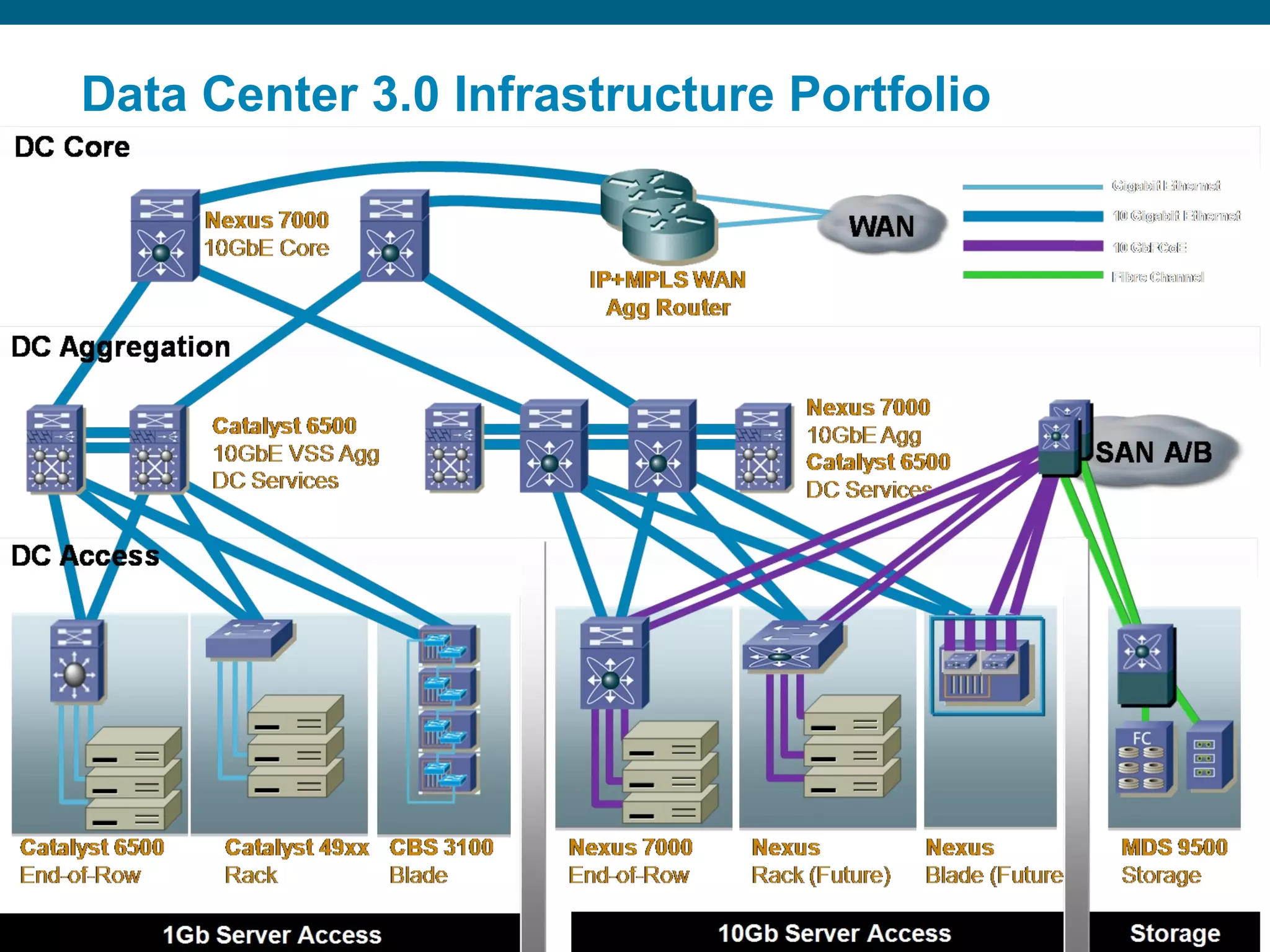
Data Center 3.0 Infrastructure Portfolio 
© 2006 Cisco Systems, Presentation_ID Inc. All rights reserved. 22
A Comprehensive Portfolio for Data Center 3.0 
Data Center 
Security 
Firewall 
Services 
Module 
Application 
Network 
Services 
ACE Application 
Delivery – 
Module and 
Appliance 
Wide-Area 
Application 
Services 
ACE XML 
Gateway 
Storage 
Networking 
MDS 9500 
Storage 
Directors 
SSM 
MDS Fabric 
Switches 
Blade 
Switches 
Infiniband 
Clustering 
SFS 7000 
Infiniband 
Switch 
SFS 3000 
Infiniband 
Gateway 
Ethernet 
Networking 
Catalyst® 6500 
Series 
Catalyst 4900M 
Top-of-Rack 
Catalyst Blade 
Server Switches 
Unified 
Fabric 
Networking 
NEW 
Nexus 7000 
Modular 
Switching 
System 
Nexus Rack 
Switch 5000 
Nexus Blade 
Switch (future) 
Data Center Provisioning 
Data Center Management 
VFrame Server/Service 
Provisioning System 
Data Center Network Manager– Topology 
Visualization and Provisioning 
ANM– Advanced L4-7 Services 
Module Management 
© 2006 Cisco Systems, Presentation_ID Inc. All rights reserved. 23
Agenda 
DC 3.0 Infrastructure Transformation 
(Nexus 7K/5K) 
Optimizing Branch IT Services (WoW) 
Automation (vFrame) 
© 2006 Cisco Systems, Presentation_ID Inc. All rights reserved. 24
Windows on WAAS 
Optimizing Branch IT 
Services 
Microsoft and Cisco Vision for 
Optimizing IT Services in the Branch 
© 2006 Cisco Systems, Presentation_ID Inc. All rights reserved. 25
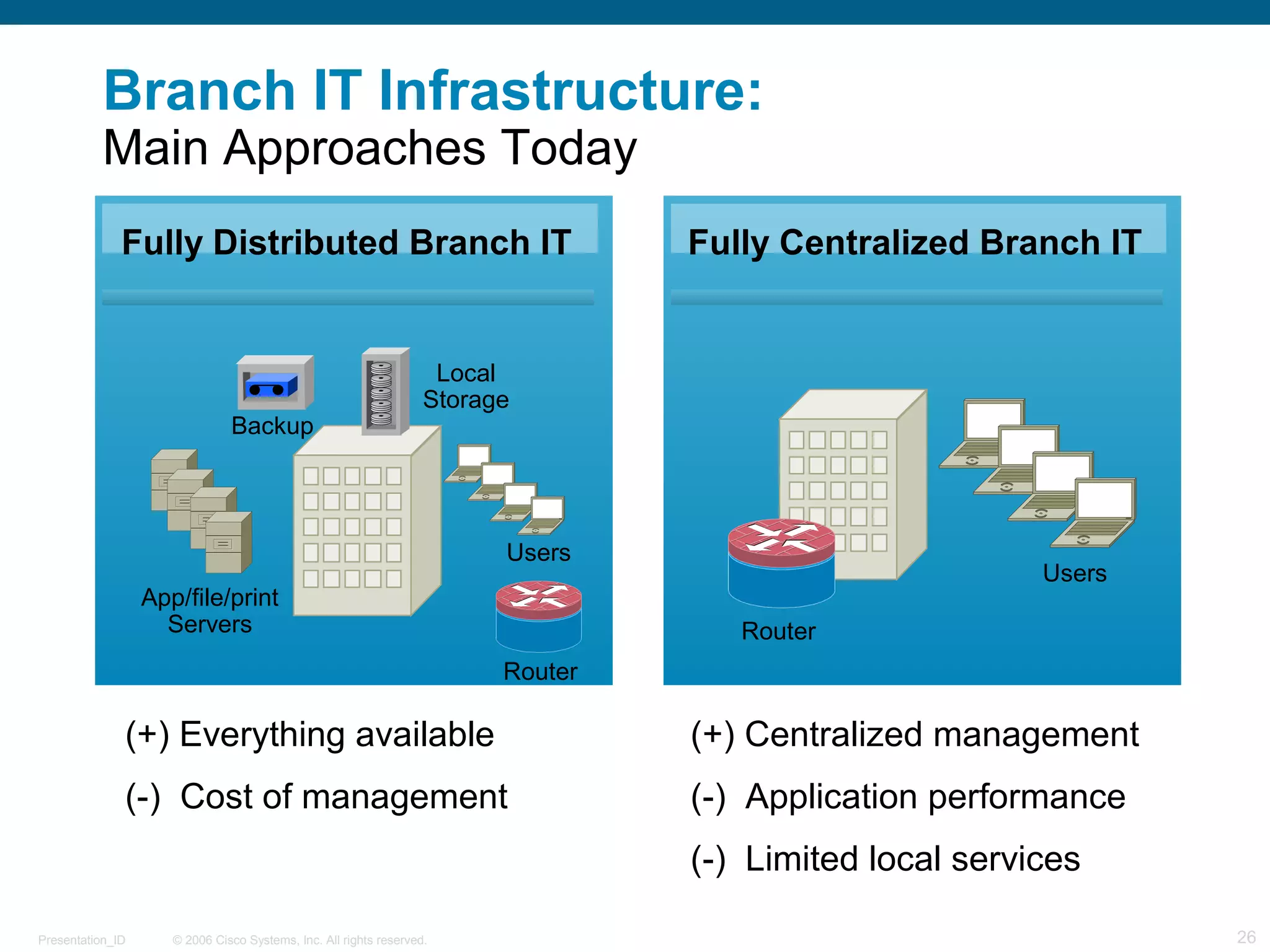
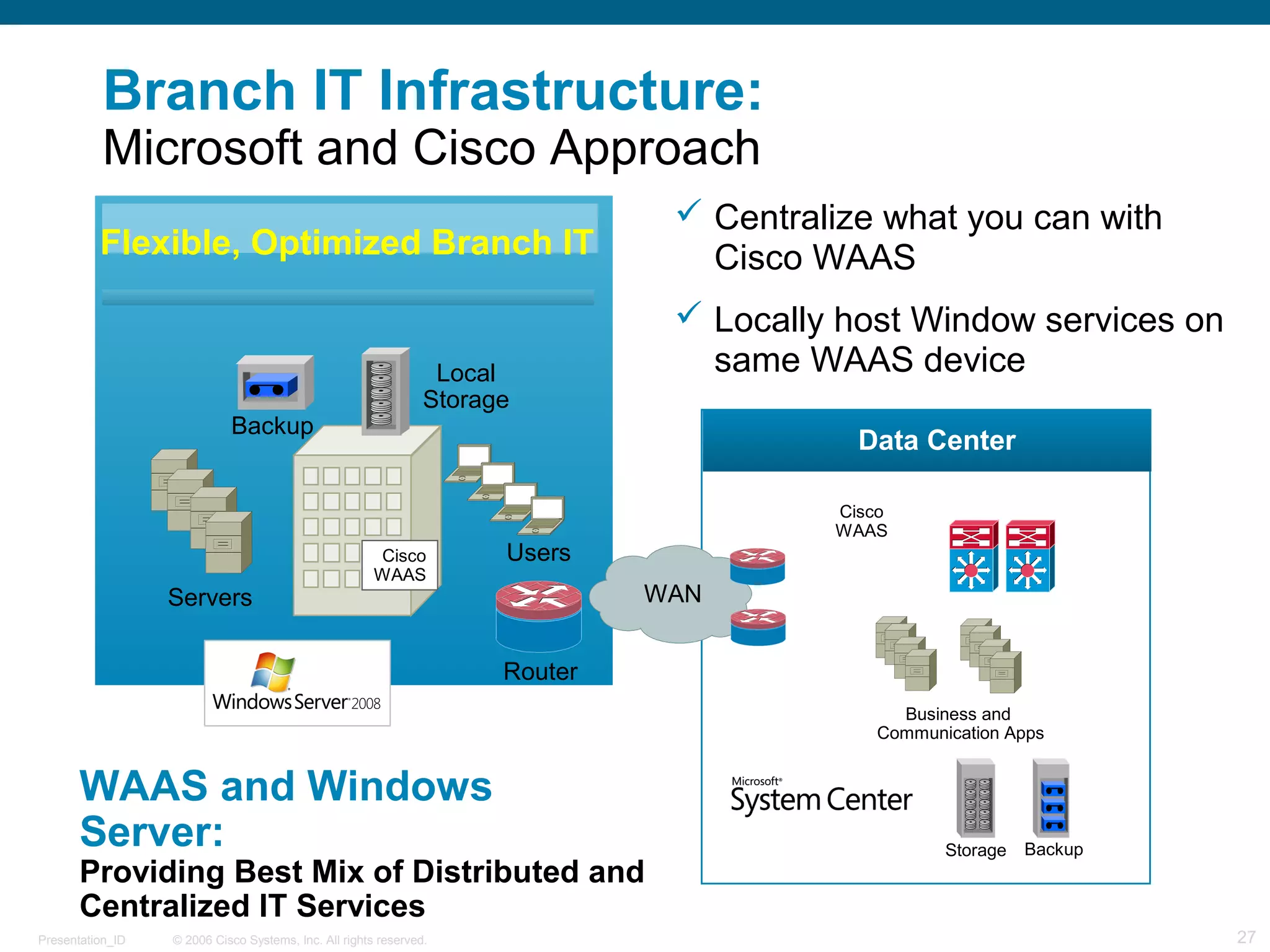
Branch IT Infrastructure: 
Main Approaches Today 
Fully Distributed Branch IT Fully Centralized Branch IT 
Backup 
App/file/print 
Servers 
Local 
Storage 
Users 
Router 
(+) Everything available 
(-) Cost of management 
Router 
Users 
(+) Centralized management 
(-) Application performance 
(-) Limited local services 
© 2006 Cisco Systems, Presentation_ID Inc. All rights reserved. 26
Branch IT Infrastructure: 
Microsoft and Cisco Approach 
 Centralize what you can with 
Cisco WAAS 
 Locally host Window services on 
same WAAS device 
Data Center 
Business and 
Cisco 
WAAS 
Communication Apps 
Storage Backup 
Flexible, Optimized Branch IT 
Backup 
Servers 
Local 
Storage 
Users 
Router 
WAN 
Cisco 
WAAS 
WAAS and Windows 
Server: 
Providing Best Mix of Distributed and 
Centralized IT Services 
© 2006 Cisco Systems, Presentation_ID Inc. All rights reserved. 27
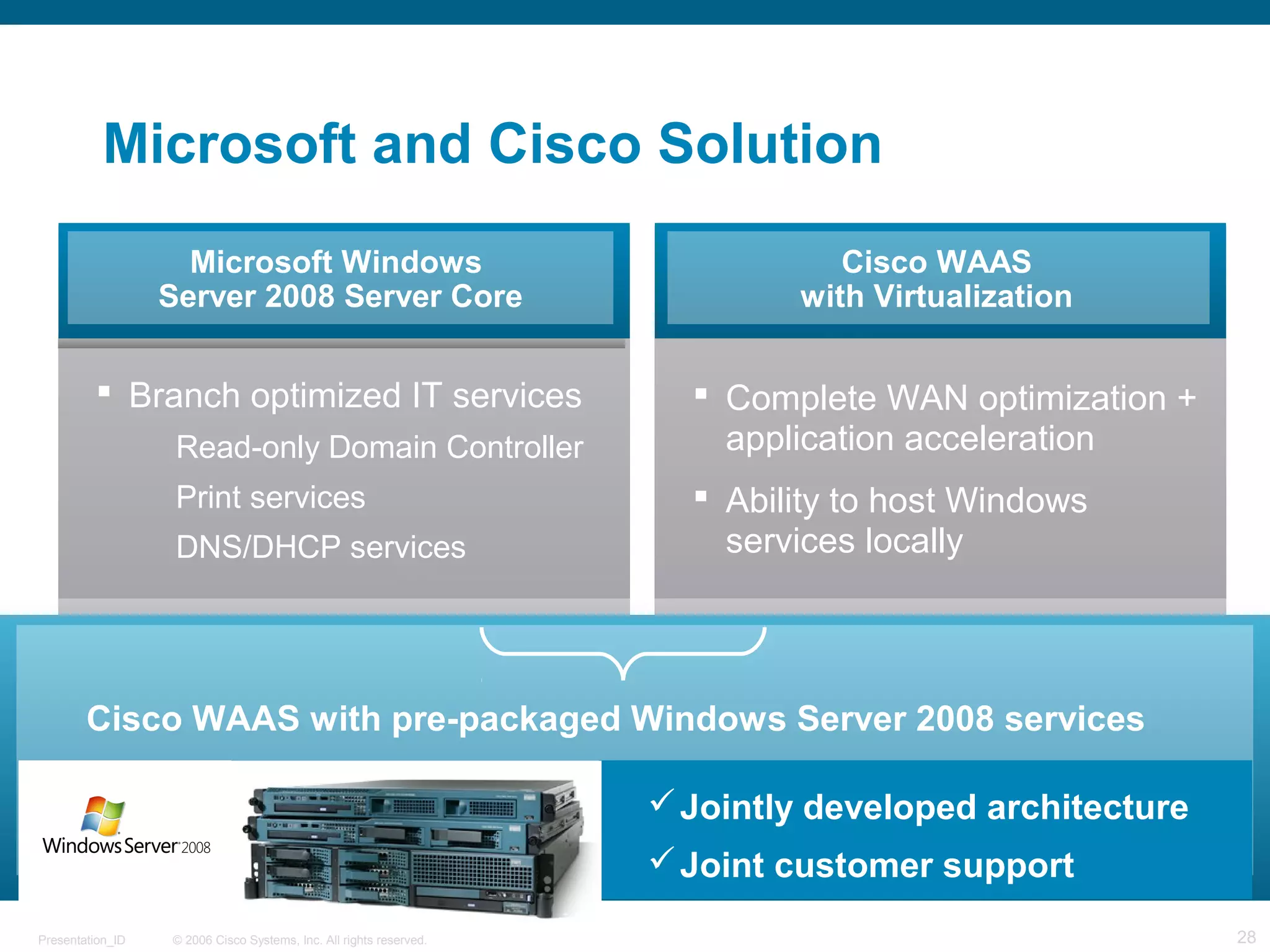
Microsoft and Cisco Solution 
Cisco WAAS 
with Virtualization 
Microsoft Windows 
Server 2008 Server Core 
 Branch optimized IT services 
Read-only Domain Controller 
Print services 
DNS/DHCP services 
 Complete WAN optimization + 
application acceleration 
 Ability to host Windows 
services locally 
Cisco WAAS with pre-packaged Windows Server 2008 services 
Jointly developed architecture 
Joint customer support 
© 2006 Cisco Systems, Presentation_ID Inc. All rights reserved. 28
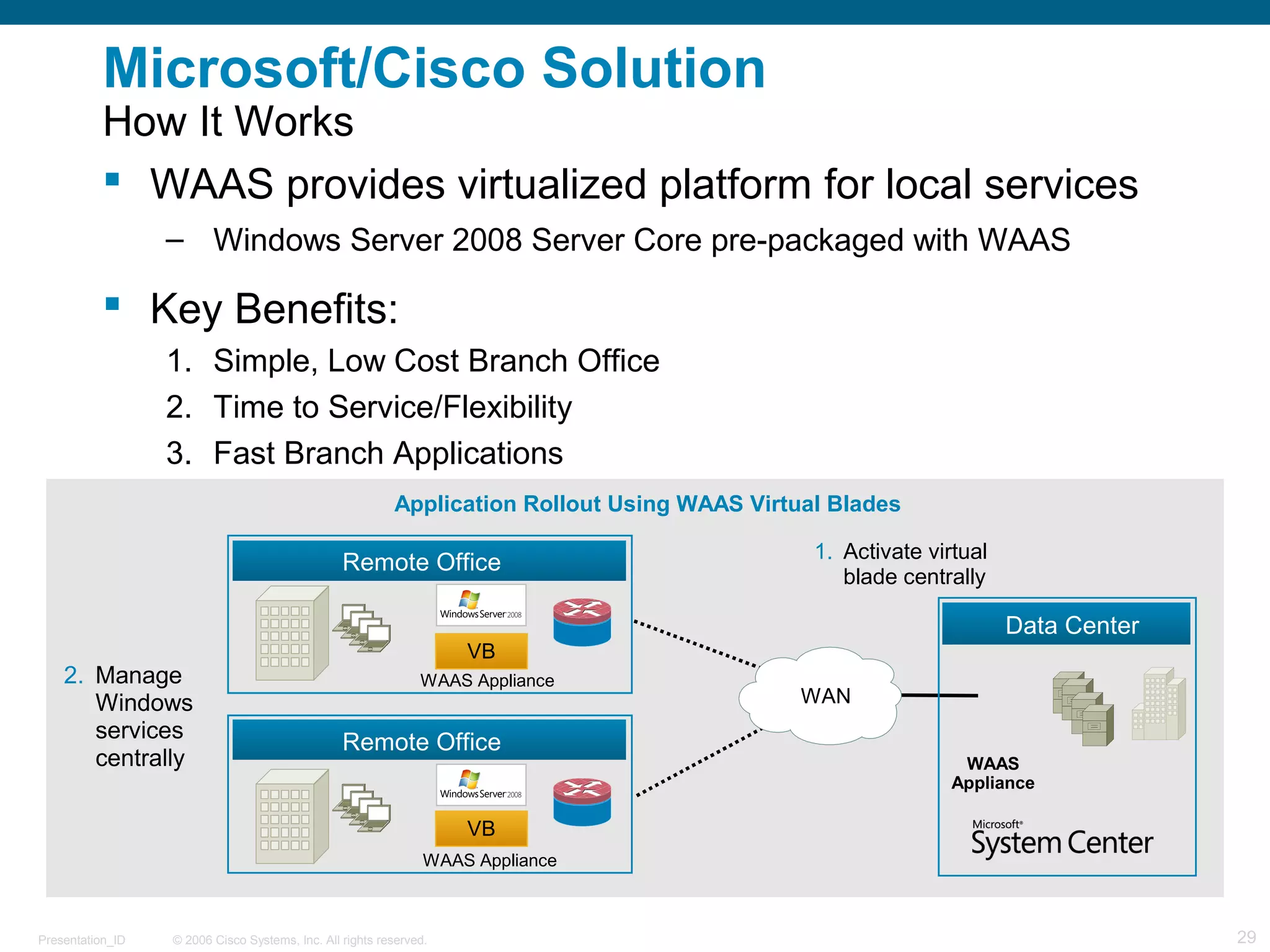
Microsoft/Cisco Solution 
How It Works 
 WAAS provides virtualized platform for local services 
– Windows Server 2008 Server Core pre-packaged with WAAS 
 Key Benefits: 
1. Simple, Low Cost Branch Office 
2. Time to Service/Flexibility 
3. Fast Branch Applications 
2. Manage 
Windows 
services 
centrally 
Application Rollout Using WAAS Virtual Blades 
Remote Office 
VB 
WAAS Appliance 
Remote Office 
VB 
WAAS Appliance 
1. Activate virtual 
blade centrally 
WAN 
Data Center 
WAAS 
Appliance 
© 2006 Cisco Systems, Presentation_ID Inc. All rights reserved. 29
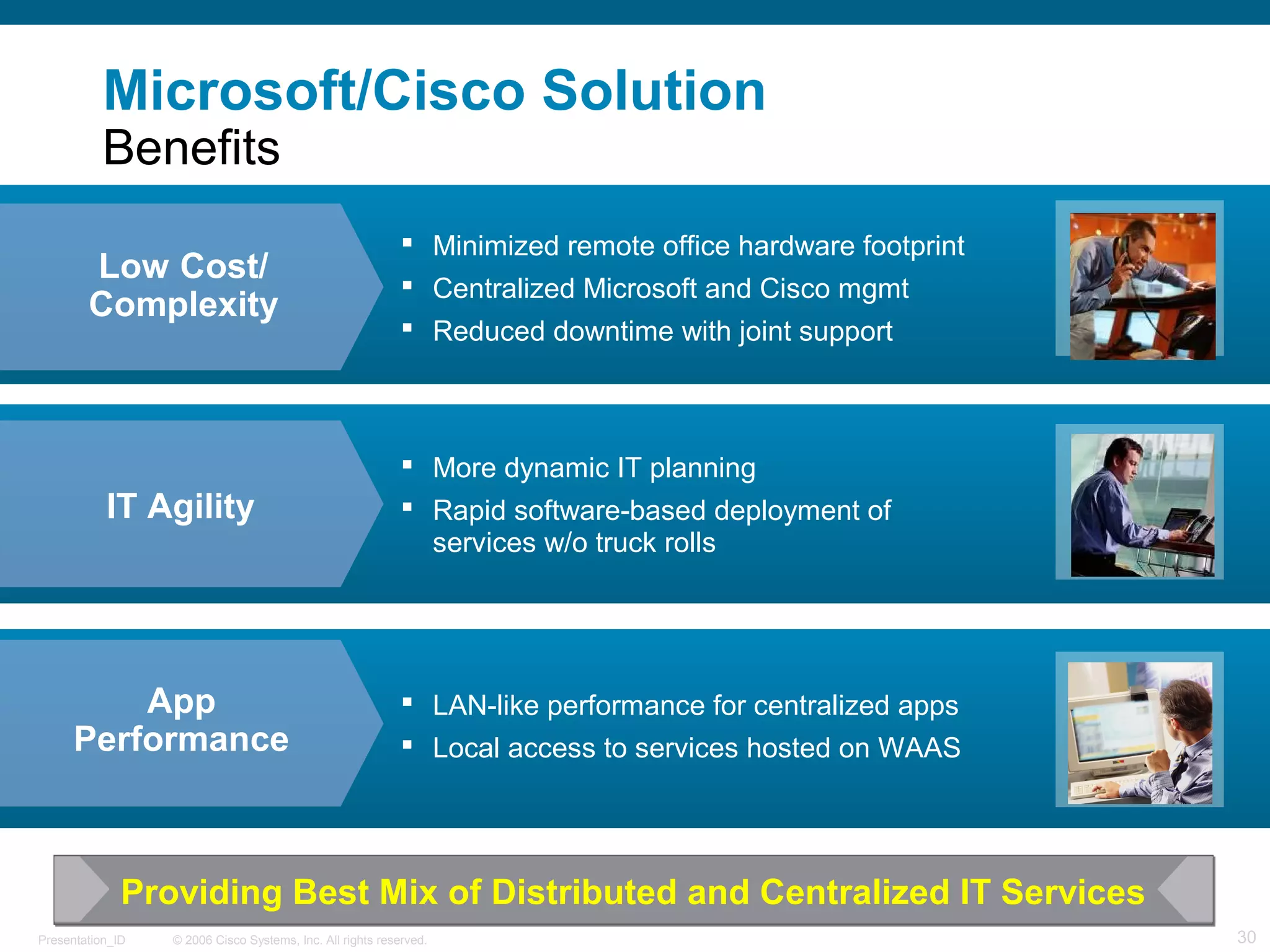
Microsoft/Cisco Solution 
Benefits 
 Minimized remote office hardware footprint 
 Centralized Microsoft and Cisco mgmt 
 Reduced downtime with joint support 
 More dynamic IT planning 
 Rapid software-based deployment of 
services w/o truck rolls 
 LAN-like performance for centralized apps 
 Local access to services hosted on WAAS 
Low Cost/ 
Complexity 
IT Agility 
App 
Performance 
PPrroovviiddiinngg BBeesstt MMiixx ooff DDiissttrriibbuutteedd aanndd CCeennttrraalliizzeedd IITT SSeerrvviicceess 
© 2006 Cisco Systems, Presentation_ID Inc. All rights reserved. 30
Agenda 
DC 3.0 Infrastructure Transformation 
(Nexus 7K/5K) 
Optimizing Branch IT Services (WoW) 
Automation (vFrame) 
© 2006 Cisco Systems, Presentation_ID Inc. All rights reserved. 31
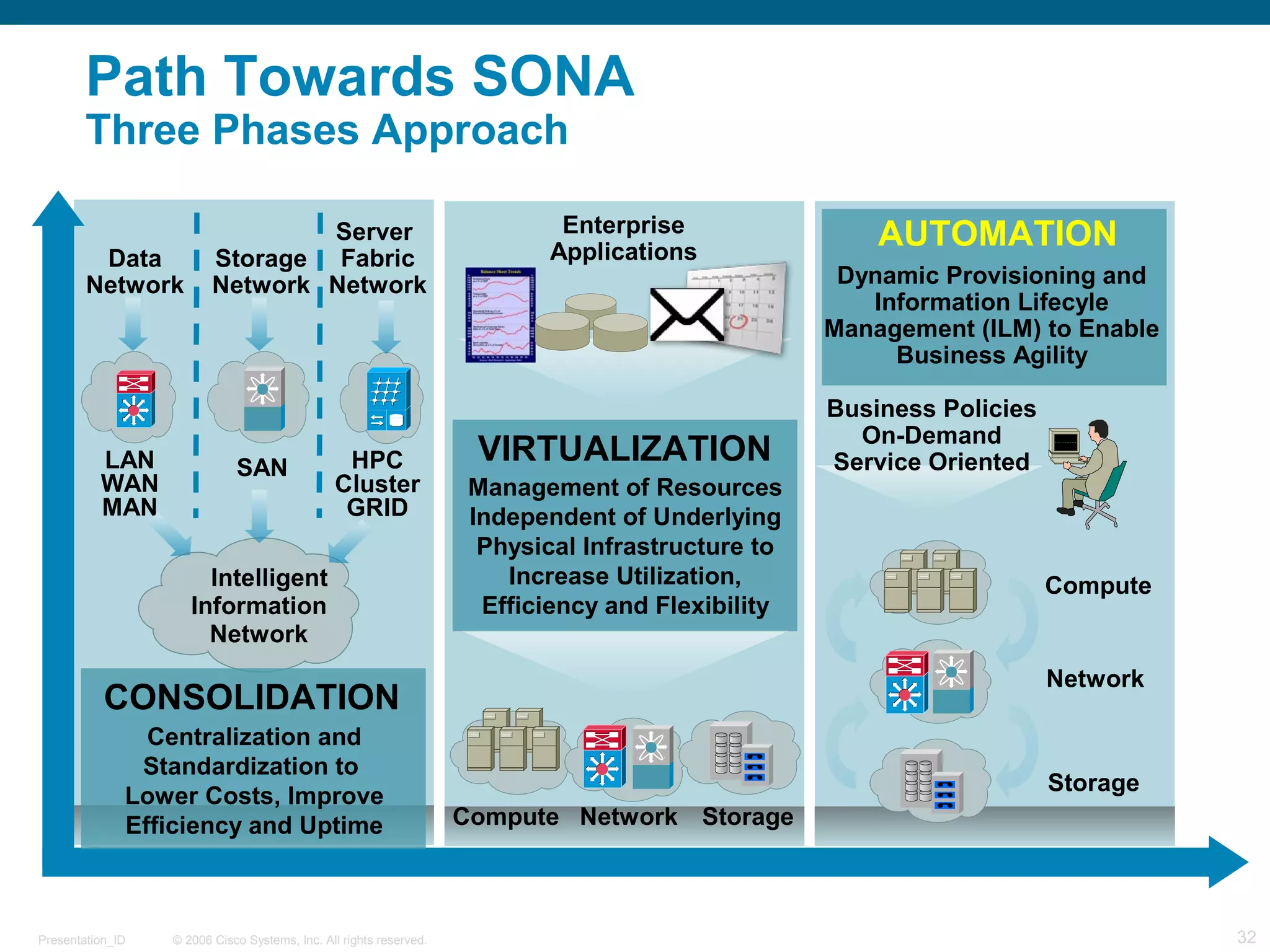
Path Towards SONA 
Three Phases Approach 
AUTOMATION 
Dynamic Provisioning and 
Information Lifecyle 
Management (ILM) to Enable 
Business Agility 
Compute 
Network 
Storage 
Business Policies 
On-Demand 
Enterprise 
Applications 
VIRTUALIZATION Service Oriented 
Management of Resources 
Independent of Underlying 
Physical Infrastructure to 
Increase Utilization, 
Efficiency and Flexibility 
Compute Network Storage 
Data 
Network 
Server 
Fabric 
Network 
LAN 
WAN 
MAN 
Storage 
Network 
SAN 
Intelligent 
Information 
Network 
HPC 
Cluster 
GRID 
CONSOLIDATION 
Centralization and 
Standardization to 
Lower Costs, Improve 
Efficiency and Uptime 
© 2006 Cisco Systems, Presentation_ID Inc. All rights reserved. 32
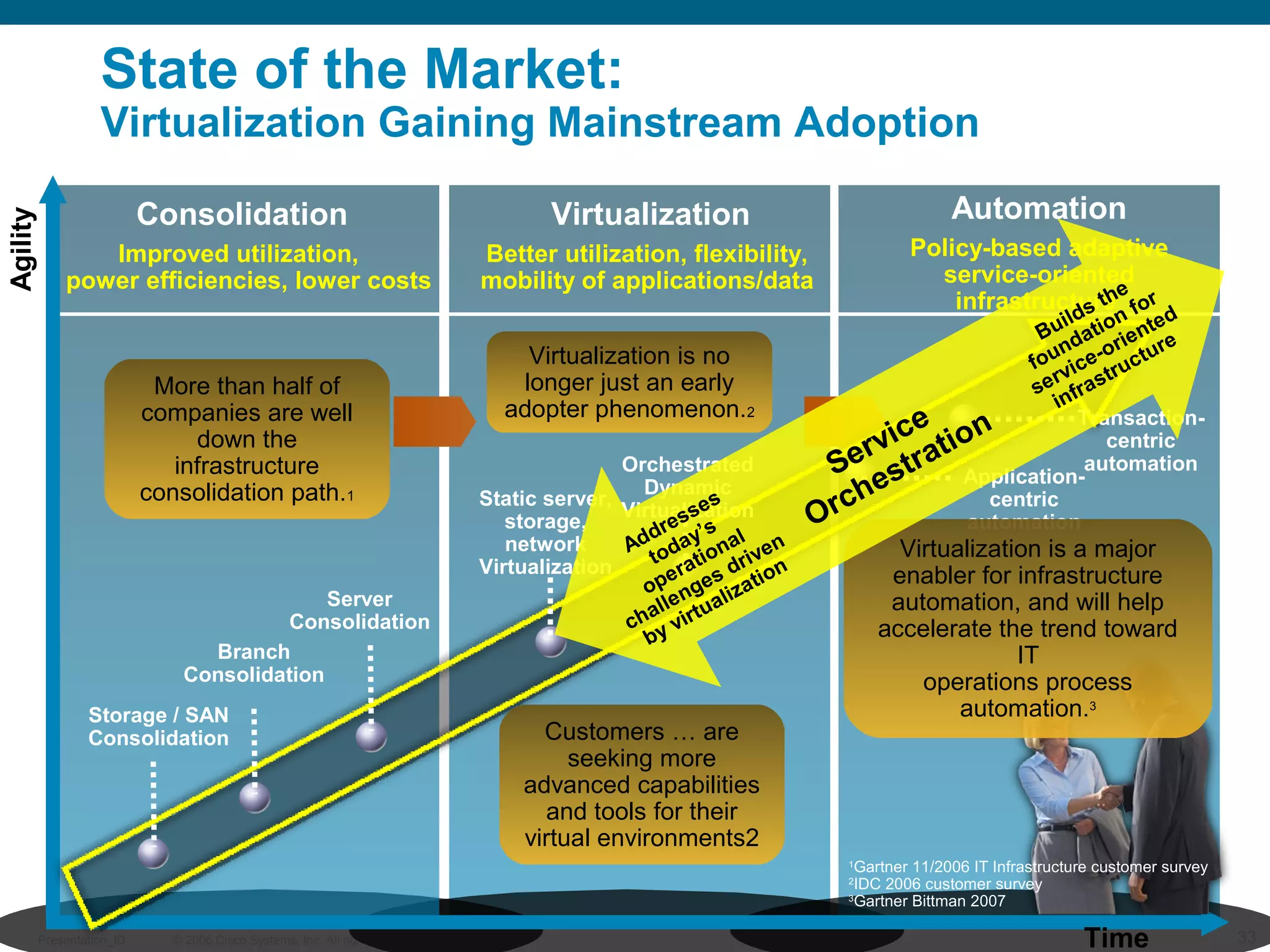
State of the Market: 
Virtualization Gaining Mainstream Adoption 
Virtualization 
Agility Time 
Better utilization, flexibility, 
mobility of applications/data 
Automation 
Policy-based adaptive 
service-oriented 
Builds the 
foundation for 
service-oriented 
infrastructure 
infrastructure 
Consolidation 
Improved utilization, 
power efficiencies, lower costs 
More than half of 
companies are well 
down the 
infrastructure 
consolidation path.1 
Consolidation 
Branch 
Consolidation 
Storage / SAN 
Consolidation 
Server 
Virtualization is no 
longer just an early 
adopter phenomenon.2 
Static server, 
storage, 
network 
Virtualization 
Orchestrated 
Dynamic 
Virtualization 
Transaction-centric 
automation 
Service 
Orchestration 
Application-centric 
automation 
Virtualization is a major 
enabler for infrastructure 
automation, and will help 
accelerate the trend toward 
IT 
operations process 
automation.3 
1Gartner 11/2006 IT Infrastructure customer survey 
2IDC 2006 customer survey 
3Gartner Bittman 2007 
Addresses 
today’s 
operational 
challenges driven 
by virtualization 
Customers … are 
seeking more 
advanced capabilities 
and tools for their 
virtual environments2 
© 2006 Cisco Systems, Presentation_ID Inc. All rights reserved. 33
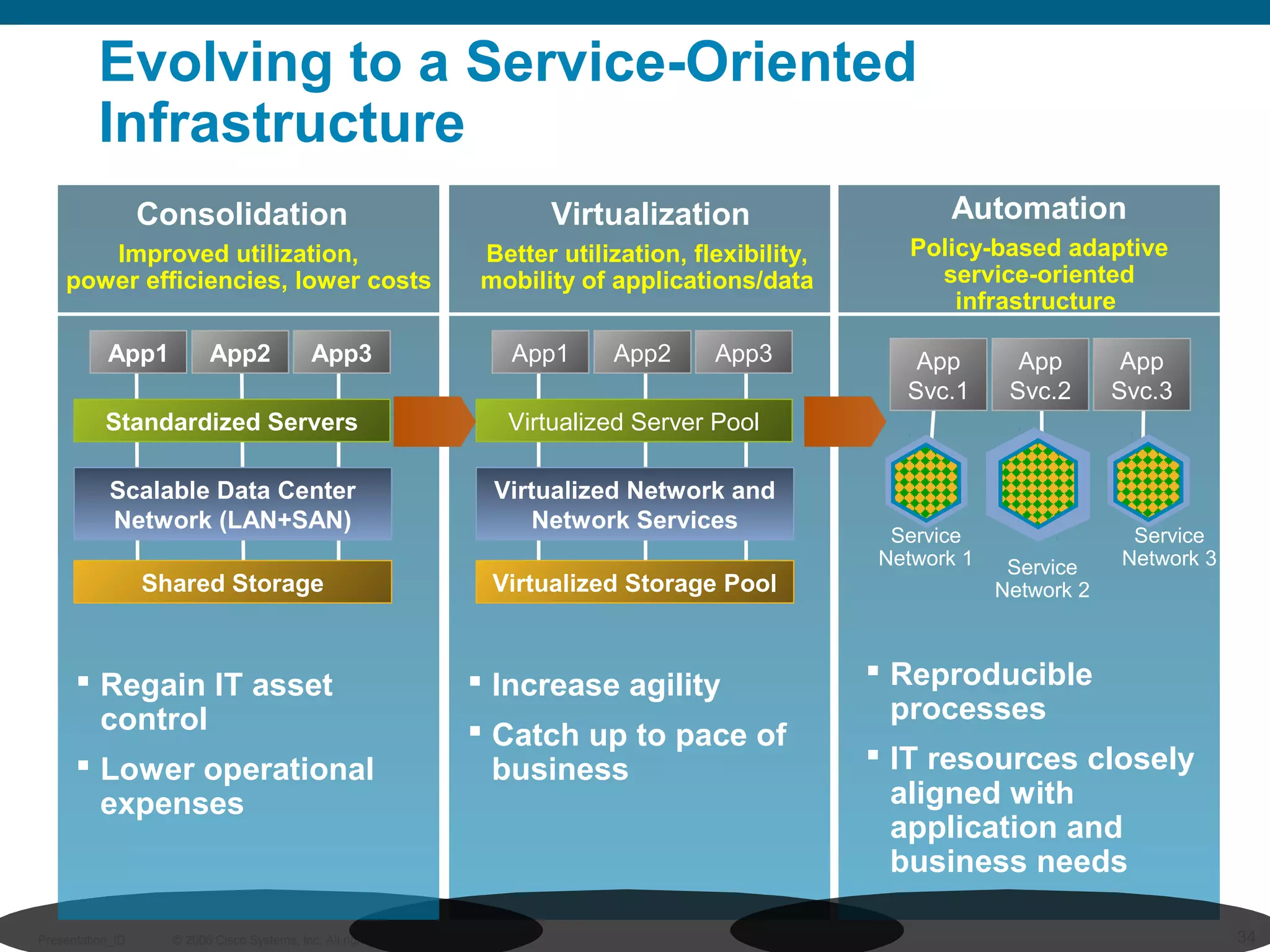
Evolving to a Service-Oriented 
Infrastructure 
Virtualization 
Better utilization, flexibility, 
mobility of applications/data 
App1 
App2 App3 
Virtualized Server Pool 
Virtualized Network and 
Network Services 
Virtualized Storage Pool 
 Increase agility 
 Catch up to pace of 
business 
Automation 
Policy-based adaptive 
service-oriented 
infrastructure 
App 
Svc.1 
App 
Svc.2 
App 
Svc.3 
Service 
Network 1 Service 
Network 2 
Service 
Network 3 
 Reproducible 
processes 
 IT resources closely 
aligned with 
application and 
business needs 
Consolidation 
Improved utilization, 
power efficiencies, lower costs 
App1 
App2 App3 
Standardized Servers 
Scalable Data Center 
Network (LAN+SAN) 
Shared Storage 
 Regain IT asset 
control 
 Lower operational 
expenses 
© 2006 Cisco Systems, Presentation_ID Inc. All rights reserved. 34
Cisco VFrame Data Center Helps Build the 
Foundation for Service-Oriented Infrastructure (SOI) 
Monitoring 
IBM Tivoli, HP Openview, 
BMC Patrol, CA Unicenter 
Business Service 
Management 
Mercury, 
Tideway, BMC 
Management and Monitoring 
Cisco VFrame Data Center 
Network-Driven Service Orchestration 
SOI Control 
Layer 
 Orchestrate across 
infrastructure resources 
 Platform for service 
abstraction 
 Integrate with other 
management systems 
SAN NAS 
Storage Pool 
Element Managers 
Cisco Fabric Manager, VMS, 
CiscoWorks, ANM 
Virtualization 
Managers 
VMware VirtualCenter 
Server Pool Network Pool 
Data Center Networked Infrastructure 
© 2006 Cisco Systems, Presentation_ID Inc. All rights reserved. 35
Adopting VFrame DC Today 
Addressing Today’s Challenges while Building SOI Foundation 
1. Categorize physical resources into service views 
2. Ensure design consistency with standardized infrastructure templates 
3. Automate physical provisioning for server virtualization environments 
4. Reduce break-fix server support costs with rapid recovery from shared pool 
5. Recover failed service with rapid local disaster recovery 
6. Provide policy-based dynamic capacity on-demand for applications 
Server Service View 
Network Service View 
Hypervisor 
Hypervisor 
SAN NAS 
Traditional silos 
Slow 
application 
performance 
PPoolliiccyy 
VFrame DC 
Storage Service View 
X 
XV V V V 
V V V V 
Application 
Service 1 
Application 
Degradation 
oRra Fpaidilluyr e 
configure 
new 
application 
environment 
© 2006 Cisco Systems, Presentation_ID Inc. All rights reserved. 36
© 2006 Cisco Systems, Presentation_ID Inc. All rights reserved. 37

Dcna technology update

  • 1.
    DCNA Technology Update © 2006 Cisco Systems, Presentation_ID Inc. All rights reserved. 1
  • 2.
    Data Centers AreUnder Increasing Pressure Collaboration Empowered User SLA Metrics Global Availability Reg. Compliance New Business Pressures Operational Limitations Power & Cooling Asset Utilization Provisioning Security Threats Bus. Continuance © 2006 Cisco Systems, PPrreesseennttaattioionn__IIDD © 2007 Cisco Systems, IInncc.. AAllll rriigghhttss rreesseerrvveedd.. Cisco Confidential 3 3
  • 3.
    Critical Infrastructure forData Center 3.0 Unified Fabric and I/O Interfaces Cisco® Nexus Switching Platforms NX-OS Operating System Data Center Network Manager Simplify infrastructure (reduce capex) and operational complexity (lower opex) Lowers overall data center power draw Forward Investment Protection Engineered the most stringent availability requirements Designed with features that improve operational continuity Delivers virtualized network services Provides holistic view of the network to simplify management and facilitate troubleshooting © 2006 Cisco Systems, PPreresseenntatatitoionn__IDID 2007 IInncc.. AAllll rriigghhttss rreesseerrvveedd.. Cisco Confidential 4 4
  • 4.
    Introducing Cisco NexusFamily: The Network Platform for Data Center 3.0 Over 1513 Patents Pending/Issued on Data Center Technologies Over $1B in Overall Data Center Research and Development Cisco Nexus Consists of Multiple Products with a Data Center Class OS Transport Flexibility Cisco Nexus Infrastructure Scalability Operational Continuity Cisco® Nexus Delivers a Unified Fabric and I/O for the DC © 2006 Cisco Systems, Presentation_ID Inc. All rights reserved. 5
  • 5.
    Cisco Nexus 7000Series Data Center Class Switches Usability focused for demanding operational environments Delivers a unified fabric and I/O 15+ Tb/s scalable switching capacity © 2006 Cisco Systems, Presentation_ID Inc. All rights reserved. 6
  • 6.
    Cisco Nexus 7000Series Data Center Class Switches  Zero Service Disruption design  Graceful systems operations  Integrated lights-out management  Lossless fabric architecture  Dense 40GbE/100GbE ready  Unified fabric  Virtualized control and data plane  15Tb+ switching capacity  Efficient physical and power design Continuity Operational Flexibility Transport Scalability Infrastructure © 2006 Cisco Systems, Presentation_ID Inc. All rights reserved. 7
  • 7.
    Increased Efficiency, SimplerOperations Unified Fabric Backup Network Back-End Network Unified Fabric and I/O Front-End Network Storage Network Mgmt Network © 2006 Cisco Systems, Presentation_ID Inc. All rights reserved. 8
  • 8.
    Key Benefits ofUnified Fabric Reduce overall DC power consumption by up to 8%. Extend the lifecycle of current data center. Wire hosts once to connect to any network - SAN, LAN, HPC. Faster rollout of new apps and services. Every host will be able to mount any storage target. Drive storage consolidation and improve utilization. Rack, Row, and X-Data Center VM portability become possible. © 2006 Cisco Systems, Presentation_ID Inc. All rights reserved. 9
  • 9.
    15Tb+ System Performance Bandwidth Scales with Each Fabric Module 10GbE Module GbE Module Fabric Modules 1124923368048GGGGGbbbbbpppppsssss Per Slot Investment Protection and Unified Fabric © 2006 Cisco Systems, Presentation_ID Inc. All rights reserved. 10
  • 10.
    NX-OS: Purpose Builtfor the Data Center NX-OS IOS SAN-OS © 2006 Cisco Systems, Presentation_ID Inc. All rights reserved. 11
  • 11.
    Data Center ClassRequirements Demand Focused Software Development Zero Service Disruption Design Enables Nexus to unify the data center fabric Virtual Device Contexts Overcomes administrative barriers to consolidation Stateful Process Restart Self heals faster than networks can converge Graceful System Operations Enables simplified operations and links all protocol layers © 2006 Cisco Systems, Presentation_ID Inc. All rights reserved. 12
  • 12.
    NX-OS Graceful SystemOperations Network pre-converges around pending administrative outage E911 Call Center 911 Call In Progress Admin signals system to reload Nexus signals that it is reloading STOP •System pre-converges around pending administrative outages •Reduces dependency on highly skilled engineering for rote upgrade and capacity add/remove operations •Aligns best practices and operational procedures with system defaults © 2006 Cisco Systems, Presentation_ID Inc. All rights reserved. 13
  • 13.
    Extending the CiscoNexus Family Data Center Class Switches  Simpler More Stable Layer 2 Network  Highly Available Platform  Preserves operational best practices  FCoE based Unified Fabric  Virtualization Optimized Networking  Support for FCoE, DCE, and FC  Reduces power, cooling, cabling  Up to 56 ports non-blocking 10GbE  Up to 1.2 Tbps capacity Continuity Operational Flexibility Transport Scalability Infrastructure © 2006 Cisco Systems, Presentation_ID Inc. All rights reserved. 14
  • 14.
    OS Cisco Nexus5000 Series 56-Port L2 Switch • 40 Ports 10GE/FCoE/DCE, fixed • 2 Expansion module slots FC + Ethernet • 4 Ports 10GE/FCoE/DCE • 4 Ports 1/2/4G FC Cisco DC-OS Cisco DC-OS Fibre Channel • 8 Ports 1/2/4G FC Ethernet • 6 Ports 10GE/FCoE/DCE Cisco Fabric Manager and Cisco Data Center Manager Mgmt © 2006 Cisco Systems, Presentation_ID Inc. All rights reserved. 15
  • 15.
    Data Center EthernetFeatures Overview Feature Benefit Provides class of service flow control. Ability to support storage traffic Grouping classes of traffic into “Service Lanes” IEEE 802.1Qaz, CoS based Enhanced Transmission Priority-based Flow Control (PFC) CoS Based BW Management Congestion Notification End to End Congestion Management for L2 network (BCN/QCN) Auto-negotiation for Enhanced Ethernet capabilities DCBX Eliminate Spanning Tree for L2 topologies Utilize full Bi-Sectional bandwidth with ECMP Data Center Bridging Capability Exchange Protocol L2 Multi-path for Unicast & Multicast Lossless Service Provides ability to transport various traffic types (e.g. Storage, RDMA) © 2006 Cisco Systems, Presentation_ID Inc. All rights reserved. 16
  • 16.
    FCoE - Networkstack comparison SCSI SCSI SCSI SCSI iSCSI TCP IP Ethernet FCP FC FCIP FCP FCP FC FC FCoE TCP IP Ethernet Ethernet PHYSICAL WIRE SCSI © 2006 Cisco Systems, Presentation_ID Inc. All rights reserved. 17
  • 17.
    An Innovative PlatformTo Simplify Data Center Transformation Standards Wire Speed 10GbE Switching Capacity Ethernet LAN SAN A SAN B N5000 Data Center Ethernet Scalability LAN Active-Active MAC B N5000 MAC A Fibre Channel over Ethernet Consolidation LLAANN SSAANN AA SSAANN BB N5000 VM Optimized Networking Virtualization LAN A & B C MAC B MAC A MAC C End nodes Eco-System © 2006 Cisco Systems, Presentation_ID Inc. All rights reserved. 18
  • 18.
    Catalyst and Nexus: Complementary Focus for Broad Deployments Cisco® Nexus 7000 15 Terabit Scalability Unified Fabric 100GbE Cisco Catalyst® 6500 2 Terabit Scalability Unified Network Access 40GbE Transport Flexibility Operational Continuity 10GbE 1GbE © 2006 Cisco Systems, Presentation_ID Inc. All rights reserved. 20
  • 19.
    Data Center 3.0Infrastructure Portfolio © 2006 Cisco Systems, Presentation_ID Inc. All rights reserved. 21
  • 20.
    Data Center 3.0Infrastructure Portfolio © 2006 Cisco Systems, Presentation_ID Inc. All rights reserved. 22
  • 21.
    A Comprehensive Portfoliofor Data Center 3.0 Data Center Security Firewall Services Module Application Network Services ACE Application Delivery – Module and Appliance Wide-Area Application Services ACE XML Gateway Storage Networking MDS 9500 Storage Directors SSM MDS Fabric Switches Blade Switches Infiniband Clustering SFS 7000 Infiniband Switch SFS 3000 Infiniband Gateway Ethernet Networking Catalyst® 6500 Series Catalyst 4900M Top-of-Rack Catalyst Blade Server Switches Unified Fabric Networking NEW Nexus 7000 Modular Switching System Nexus Rack Switch 5000 Nexus Blade Switch (future) Data Center Provisioning Data Center Management VFrame Server/Service Provisioning System Data Center Network Manager– Topology Visualization and Provisioning ANM– Advanced L4-7 Services Module Management © 2006 Cisco Systems, Presentation_ID Inc. All rights reserved. 23
  • 22.
    Agenda DC 3.0Infrastructure Transformation (Nexus 7K/5K) Optimizing Branch IT Services (WoW) Automation (vFrame) © 2006 Cisco Systems, Presentation_ID Inc. All rights reserved. 24
  • 23.
    Windows on WAAS Optimizing Branch IT Services Microsoft and Cisco Vision for Optimizing IT Services in the Branch © 2006 Cisco Systems, Presentation_ID Inc. All rights reserved. 25
  • 24.
    Branch IT Infrastructure: Main Approaches Today Fully Distributed Branch IT Fully Centralized Branch IT Backup App/file/print Servers Local Storage Users Router (+) Everything available (-) Cost of management Router Users (+) Centralized management (-) Application performance (-) Limited local services © 2006 Cisco Systems, Presentation_ID Inc. All rights reserved. 26
  • 25.
    Branch IT Infrastructure: Microsoft and Cisco Approach  Centralize what you can with Cisco WAAS  Locally host Window services on same WAAS device Data Center Business and Cisco WAAS Communication Apps Storage Backup Flexible, Optimized Branch IT Backup Servers Local Storage Users Router WAN Cisco WAAS WAAS and Windows Server: Providing Best Mix of Distributed and Centralized IT Services © 2006 Cisco Systems, Presentation_ID Inc. All rights reserved. 27
  • 26.
    Microsoft and CiscoSolution Cisco WAAS with Virtualization Microsoft Windows Server 2008 Server Core  Branch optimized IT services Read-only Domain Controller Print services DNS/DHCP services  Complete WAN optimization + application acceleration  Ability to host Windows services locally Cisco WAAS with pre-packaged Windows Server 2008 services Jointly developed architecture Joint customer support © 2006 Cisco Systems, Presentation_ID Inc. All rights reserved. 28
  • 27.
    Microsoft/Cisco Solution HowIt Works  WAAS provides virtualized platform for local services – Windows Server 2008 Server Core pre-packaged with WAAS  Key Benefits: 1. Simple, Low Cost Branch Office 2. Time to Service/Flexibility 3. Fast Branch Applications 2. Manage Windows services centrally Application Rollout Using WAAS Virtual Blades Remote Office VB WAAS Appliance Remote Office VB WAAS Appliance 1. Activate virtual blade centrally WAN Data Center WAAS Appliance © 2006 Cisco Systems, Presentation_ID Inc. All rights reserved. 29
  • 28.
    Microsoft/Cisco Solution Benefits  Minimized remote office hardware footprint  Centralized Microsoft and Cisco mgmt  Reduced downtime with joint support  More dynamic IT planning  Rapid software-based deployment of services w/o truck rolls  LAN-like performance for centralized apps  Local access to services hosted on WAAS Low Cost/ Complexity IT Agility App Performance PPrroovviiddiinngg BBeesstt MMiixx ooff DDiissttrriibbuutteedd aanndd CCeennttrraalliizzeedd IITT SSeerrvviicceess © 2006 Cisco Systems, Presentation_ID Inc. All rights reserved. 30
  • 29.
    Agenda DC 3.0Infrastructure Transformation (Nexus 7K/5K) Optimizing Branch IT Services (WoW) Automation (vFrame) © 2006 Cisco Systems, Presentation_ID Inc. All rights reserved. 31
  • 30.
    Path Towards SONA Three Phases Approach AUTOMATION Dynamic Provisioning and Information Lifecyle Management (ILM) to Enable Business Agility Compute Network Storage Business Policies On-Demand Enterprise Applications VIRTUALIZATION Service Oriented Management of Resources Independent of Underlying Physical Infrastructure to Increase Utilization, Efficiency and Flexibility Compute Network Storage Data Network Server Fabric Network LAN WAN MAN Storage Network SAN Intelligent Information Network HPC Cluster GRID CONSOLIDATION Centralization and Standardization to Lower Costs, Improve Efficiency and Uptime © 2006 Cisco Systems, Presentation_ID Inc. All rights reserved. 32
  • 31.
    State of theMarket: Virtualization Gaining Mainstream Adoption Virtualization Agility Time Better utilization, flexibility, mobility of applications/data Automation Policy-based adaptive service-oriented Builds the foundation for service-oriented infrastructure infrastructure Consolidation Improved utilization, power efficiencies, lower costs More than half of companies are well down the infrastructure consolidation path.1 Consolidation Branch Consolidation Storage / SAN Consolidation Server Virtualization is no longer just an early adopter phenomenon.2 Static server, storage, network Virtualization Orchestrated Dynamic Virtualization Transaction-centric automation Service Orchestration Application-centric automation Virtualization is a major enabler for infrastructure automation, and will help accelerate the trend toward IT operations process automation.3 1Gartner 11/2006 IT Infrastructure customer survey 2IDC 2006 customer survey 3Gartner Bittman 2007 Addresses today’s operational challenges driven by virtualization Customers … are seeking more advanced capabilities and tools for their virtual environments2 © 2006 Cisco Systems, Presentation_ID Inc. All rights reserved. 33
  • 32.
    Evolving to aService-Oriented Infrastructure Virtualization Better utilization, flexibility, mobility of applications/data App1 App2 App3 Virtualized Server Pool Virtualized Network and Network Services Virtualized Storage Pool  Increase agility  Catch up to pace of business Automation Policy-based adaptive service-oriented infrastructure App Svc.1 App Svc.2 App Svc.3 Service Network 1 Service Network 2 Service Network 3  Reproducible processes  IT resources closely aligned with application and business needs Consolidation Improved utilization, power efficiencies, lower costs App1 App2 App3 Standardized Servers Scalable Data Center Network (LAN+SAN) Shared Storage  Regain IT asset control  Lower operational expenses © 2006 Cisco Systems, Presentation_ID Inc. All rights reserved. 34
  • 33.
    Cisco VFrame DataCenter Helps Build the Foundation for Service-Oriented Infrastructure (SOI) Monitoring IBM Tivoli, HP Openview, BMC Patrol, CA Unicenter Business Service Management Mercury, Tideway, BMC Management and Monitoring Cisco VFrame Data Center Network-Driven Service Orchestration SOI Control Layer  Orchestrate across infrastructure resources  Platform for service abstraction  Integrate with other management systems SAN NAS Storage Pool Element Managers Cisco Fabric Manager, VMS, CiscoWorks, ANM Virtualization Managers VMware VirtualCenter Server Pool Network Pool Data Center Networked Infrastructure © 2006 Cisco Systems, Presentation_ID Inc. All rights reserved. 35
  • 34.
    Adopting VFrame DCToday Addressing Today’s Challenges while Building SOI Foundation 1. Categorize physical resources into service views 2. Ensure design consistency with standardized infrastructure templates 3. Automate physical provisioning for server virtualization environments 4. Reduce break-fix server support costs with rapid recovery from shared pool 5. Recover failed service with rapid local disaster recovery 6. Provide policy-based dynamic capacity on-demand for applications Server Service View Network Service View Hypervisor Hypervisor SAN NAS Traditional silos Slow application performance PPoolliiccyy VFrame DC Storage Service View X XV V V V V V V V Application Service 1 Application Degradation oRra Fpaidilluyr e configure new application environment © 2006 Cisco Systems, Presentation_ID Inc. All rights reserved. 36
  • 35.
    © 2006 CiscoSystems, Presentation_ID Inc. All rights reserved. 37

Editor's Notes

  • #4 <number> This slide shows how the enterprise is being squeezed by shifting business pressures and operational limitations. While enterprises gear up to meet demands for greater collaboration, quicker access to applications and information and compliance with ever-stricter regulatory compliance -- they are being pinched by issues relating to power and cooling, efficient asset utilization, escalating security and provisioning needs, and business continuance. All these concerns are data center centric.
  • #6 <number> Take brag bullets from 7 to this one…. Put picture of all platforms into Nexus Yellow triangle Shrink pointiness maybe… if it lets us use larger font sizes… Nexus will support multiple formfactors with a common OS
  • #7 <number>
  • #8 <number>
  • #9 <number>
  • #10 <number>
  • #11 <number> Fix color
  • #12 <number>
  • #13 <number>
  • #14 <number>
  • #17 <number>
  • #20 <number> Virtualization itself is evolving, even while many businesses are still trying to figure it out. Many today believe that it only applies to servers. But critical areas of the overall data center like storage and networks can also be virtualized. From a business standpoint, virtualization of the network is important because it can drive increased efficiencies in power draw and cooling/heat dissipation in the data center.  It is also important because, as we all know, networks link everything together. In a dynamically virtualized model, time is critical. The faster a re-provisioning event can occur, the more responsive the application can be to the business.  When it takes minutes, the main problem solved is the elimination of human-errors and the assurance of compliance with corporate and regulatory policy. As re-provisioning time goes to 30 seconds, or even better, under 10 seconds, real-time and dynamic changes to the IT workload become more responsive, ensuring user experiences and IT service levels are maintained.
  • #21 <number>
  • #22 <number>
  • #23 <number>
  • #24 <number> Change to our normal portfolio slide
  • #31 <number>
  • #33 Customers’ data center infrastructures are evolving rapidly in order to meet three main goals: Reduced OpEx; Rapid response to changing business priorities and application requirements; and Business Continuance implementations to meet regulatory requirements and industry best practices. Cisco is uniquely positioned to provide customers with an Intelligent Information Network (IIN) infrastructure that can meet all these requirements. We see the data center evolution taking place in 3 phases. First is a consolidation of the front-end data networking and back-end storage networking infrastructures. Cisco is in a unique position (vis-à-vis our competitors) to be able to provide this end-to-end integrated intelligent information network. On the front end, we have the Catalyst 6500 with its integrated intelligent services modules for security (firewalls and intrusion detection), load balancing, etc., our core routing products and optical line for long distance connectivity and on the back end, we have the MDS intelligent SAN switch family for consolidated SAN networks. The glue that ties this all together is a common set of intelligent services across the front-end data network and the back-end storage network. These services include security, QoS, availability and manageability. By integrating intelligent services across the entire data and storage networking infrastructure, our customers are benefiting from administrative efficiency which is the most important factor in lowering their total cost of ownership. Greater productivity, resulting from an integrated, intelligent information network, results in significant TCO reductions. The next phase is the Virtualization of the data center. The virtualization phase enables enterprises to reduce cost of ownership, improve resilience, and increase the agility of both the network infrastructure and the data center overall. Cisco has begun this process with technologies such as VLAN, VSAN, and MPLS. Cisco is also beginning to virtualize integrated intelligent services. For example, virtualization on the firewall service module for the Catalyst 6500 can support one hundred separate instances of firewalls on a single physical infrastructure. It enables cost-effective firewall services between any two applications or application tiers. This capability leads to better infrastructure utilization while reducing capex. We are also in a unique position to integrate intelligent services that traditionally have been provided on the storage and server systems themselves. These intelligent services include storage virtualization, data replication and application oriented services like application brokers in the future. Cisco supports computing virtualization with support for utility models such as EMC VMware, clustering, and GRID technologies from several computing vendors. With virtualization, the underlying network infrastructure can achieve much better utilization and better/faster/cheaper alignment of network resources with business goals, applications and changing business processes. The final phase is automation. This emphasizes technology to improve operational efficiencies by enabling easier provisioning, faster troubleshooting and recovery and self defense of the network and the resources hosted on the network. By taking a systems approach to the network, the network will be able to achieve higher levels of automation. An example of this is the Network Admission Control initiative, that was recently announced for ensuring that hosts with out-of-date patches and antivirus can be shunted to a separate non-production network. Another very important aspect of automation is the ability to provide a standards-based interface to data center management frameworks and policy tools. This includes capabilities such as SMI-S based on CIM/XML protocols, easing the integration of the network into the complete infrastructure framework. Clearly this requires the network to provide an abstraction layer that simplifies the job of provisioning, monitoring and troubleshooting.
  • #34 <number> Customers are at various points along this adoption spectrum. Most customers have made steps to move beyond the traditional siloed model. QUESTION: Along this adoption spectrum – where do you consider your company is located? Where do you plan to be in 12 months time? What are the key data center infrastructure project that you have completed in the last 12 months – and which are planned for the next 12 month? * Many customers have consolidation projects well underway, with more than 50% having carried out some level of standardization and rationalization of their data center infrastructures, according to Gartner. This would include some level of storage consolidation, data center consolidation, server standardization and branch consolidation. Virtualization has moved beyond early adopter stage, especially with regards server virtualization. Customers ar beginning to adopt hypervisor technology into production systems, and experimenting with ways to leverage this technology to move applications from one physical environment to another transparently. At the same time customers are recognizing the need for more advanced tools and processes for ensuring that virtualization technologies can be implemented into production environments without increasing operational complexity Virtualization is widely viewed as a major requirement for introducing automation capabilities. While virtualization brings many benefits – it also provides IT organizations with some new operational challenges. Service orchestration solutions help customers address some of the challenges associated with maintaining separate physical and virtualization operational domains, while also helping customers move towards a more automated service oriented infrastructure. Let’s look more closely at some of the key operational challenges specific to the virtualization phase that many customers are now facing.
  • #35 <number> Cisco recognizes that the next-generation data center is best achieved through a phased approach, and is developing data center networking technologies and solutions that allow customers to evolve their data center infrastructures through consolidation, virtualization, and automation phases. • Consolidation—Integration of network, server, application, and storage services into a shared infrastructure that enhances scalability and manageability while reducing cost and complexity. Projects include data center consolidation, branch consolidation, server and storage consolidation. Technologies that fall into this phase include Modular re-deployable hardware (x86 rack optimized + blades) Scalable, shared, heterogeneous storage area network (SAN) High-density, scalable SAN + LAN with shared network services • Virtualization—Network-enabled virtualization of computing and storage resources, as well as virtual network services, provide an abstraction between the physical infrastructure and the applications running on that infrastructure. At the first stage, this offers greater resource utilization, but ultimately allows much greater flexibility in the choice, management, provisioning of resources in order to better support changing business applications. Technologies that fall into this phase include: Hypervisors and virtual machines Network-hosted storage virtualization Virtualized LAN, SAN, and network services • Automation—The dynamic monitoring, provisioning, and orchestration of data center infrastructure resources increase overall IT agility while minimizing operational requirements. Technologies that fall into this phase include: Service networks comprised of virtualized server, storage, network resources. Policy-based dynamic response to changes and disruptions Automated administrative tasks Reconfiguration and scaling without “rewiring”
  • #36 <number> Cisco VFrame Data Center (DC) 1.1 enables the coordinated provisioning and reuse of physical and virtualized computing, storage and network resources on demand from shared pools. IT administrators can use VFrame DC to provide service abstraction in order to rapidly commission infrastructure environments for new applications as well as provide dynamic modification of existing infrastructures as application requirements change or as a response to unplanned disruptions. Cisco VFrame DC is designed to be interoperable and fully integrated with most commonly deployed server, storage and network platforms. This interoperability applies to underlying server, storage, and network resources and, through the Web Services interface, to packaged and in-house management and automation tools. The Web services interface can be used for integration with other systems, such as data center provisioning, change management and virtualization management systems.
  • #37 For example here we can see a number for near term challenges that Vframe DC can help address. In fact typically, the first VFrame DC project solves a specific operational or budget issue. QUESTION: Which of the following are near term issues that you are currently challenges with ? (click) The ability to view either all or just a subset of the physical networked server, network and storage resources as shared pools that can be categorized according to performance, capacity, redundancy etc. (click) The ability to ensure design consistency across the different technology groups by defining standard templates that each of the groups can contribute to collaboratively. This helps ensure SLA consistency and I/O design compliancy of any servers hosted through VFrame DC with standardized templates and well structured and pre- packaged configuration modules. (click) Expansion of VMware Virtual Infrastructure (ESX) server pools on demand with network driven VI server builds. Enable the fast and seamless deployment of physical servers from a pool of bare-metal servers for the deployment of virtual servers – such as VMware ESX or Virtual Infrastructure environments. Alternativel automating VMware ESX to Virtual Infrastructure bare metal server migrations with two API interactions, including VM migration within Virtual Center, and ESX to Virtual Infrastructure migration by VFrame DC.  (click) Eliminating the expense of rapid break-fix support contracts with automated remapping of operating system and application images on an active stand-by server from a shared pool. (click) Reducing total cost of ownership of maintaining redundant servers per application by creating a shared pool that any application can rapidly use. Localized disaster recovery of server racks and localized equipment failures with the ability to quickly recover failed applications on alternative server racks. (click) Using policies to automatically adjust resources according to application performance Each of these projects can help address near term issues, while bringing the infrastructure closer to a SOI.