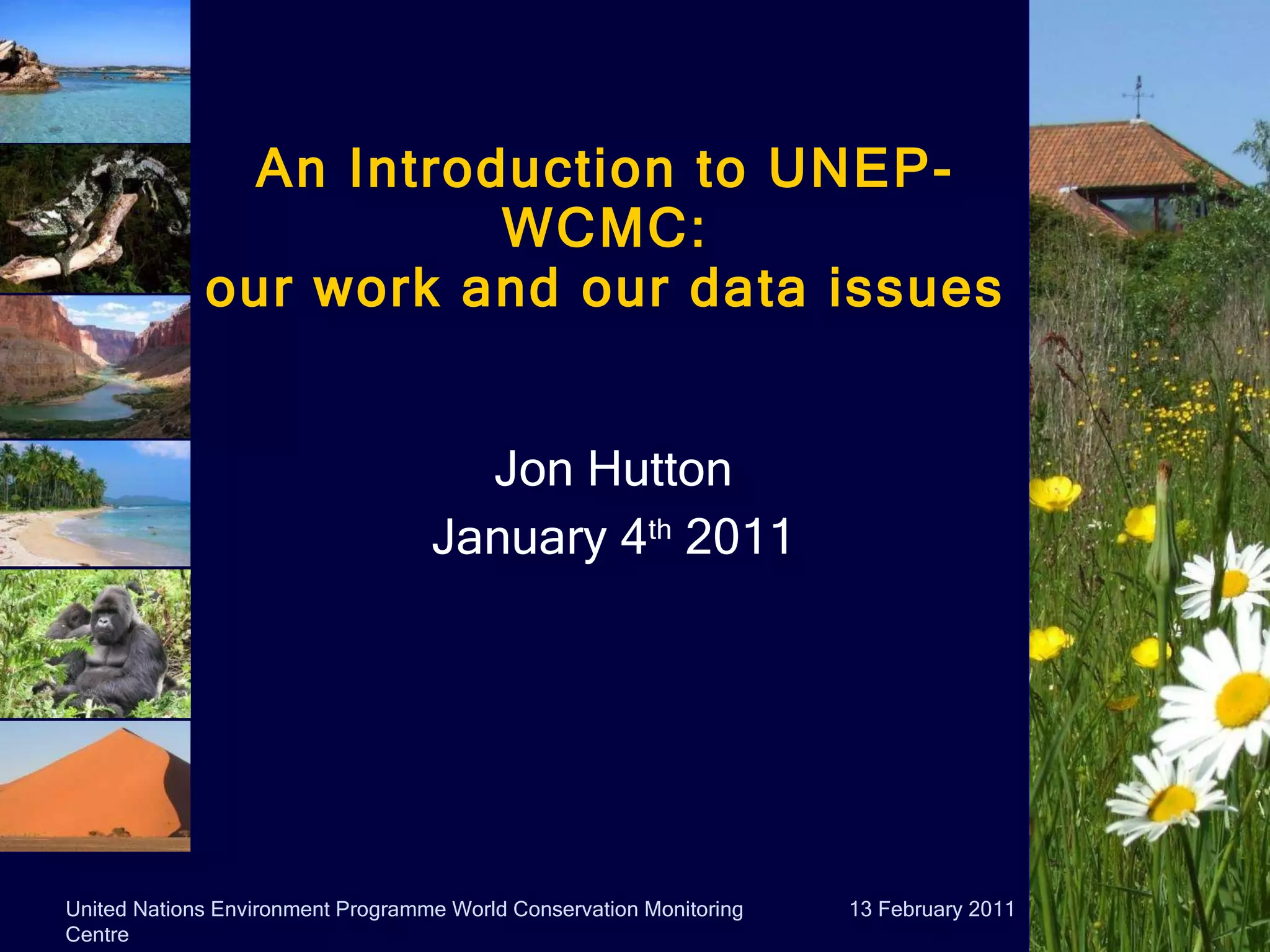
An Introduction to UNEP-WCMC: our work and our data issues Jon Hutton January 4 th  2011 13 February 2011 United Nations Environment Programme World Conservation Monitoring Centre
UNEP-WCMC is UNEP’s  Specialist Biodiversity Assessment Centre We are a flexible hybrid… We  deliver policy relevant analysis to support decision-making We have strong convening and facilitating power and use this to create strategic partnerships    UNEP-WCMC
A 30 year history A complex, but illustrious past Started by IUCN Then governed by IUCN, UNEP & WWF  Became an ‘integral part of UNEP’ in 2000 Responsible for much of the conservation infrastructure we are familiar with..........
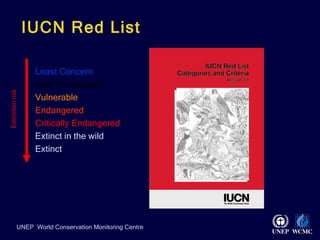
UNEP  World Conservation Monitoring Centre IUCN Red List  Least Concern Near Threatened Vulnerable Endangered Critically Endangered Extinct in the wild Extinct  Extinction risk
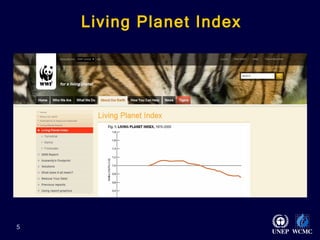
Living Planet Index
UNEP-WCMC is part of UNEP
Mandates    The UNEP Governing Council adopted WCMC as UNEP’s “ Specialist Biodiversity Information and Assessment Centre ” (Decision GC 22/1/III).  Other mandates derive from the Conferences of the Parties of the biodiversity-related conventions; the World Parks Congress…. and elsewhere…
Our Mission…  To evaluate and highlight the many values of biodiversity and put authoritative biodiversity knowledge at the centre of decision-making
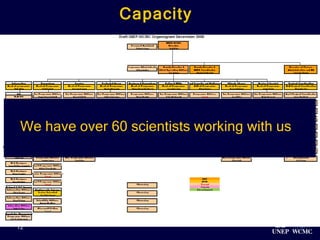
Capacity We have over 60 scientists working with us
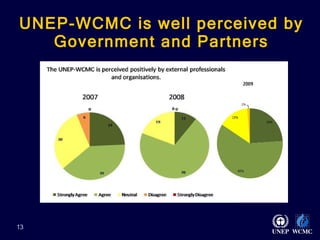
UNEP-WCMC is well perceived by Government and Partners
 
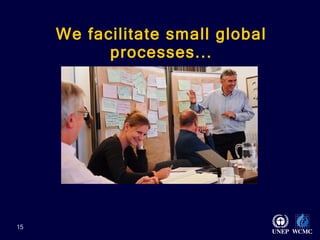
We facilitate small global processes...
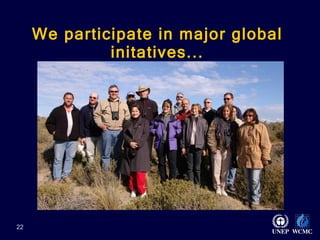
We participate in major global initatives...
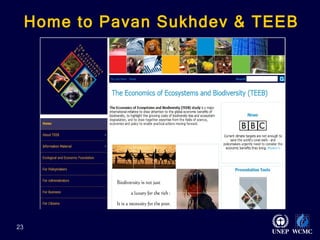
Home to Pavan Sukhdev & TEEB
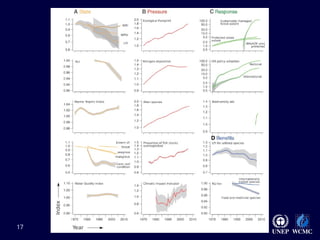
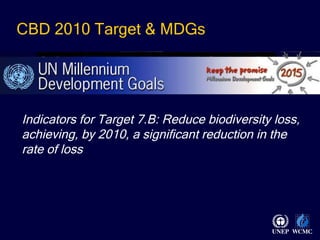
CBD 2010 Target & MDGs Indicators for Target 7.B: Reduce biodiversity loss, achieving, by 2010, a significant reduction in the rate of loss
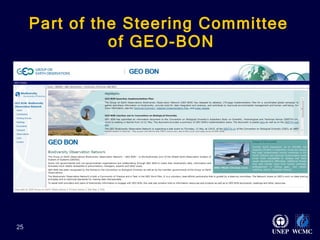
Part of the Steering Committee  of GEO-BON
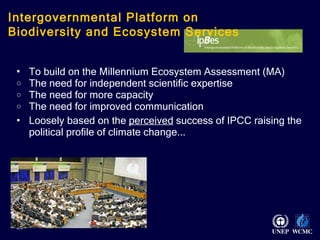
To build on the Millennium Ecosystem Assessment (MA) The need for independent scientific expertise  The need for more capacity The need for improved communication Loosely based on the  perceived  success of IPCC raising the political profile of climate change...   Intergovernmental Platform on Biodiversity and Ecosystem Services
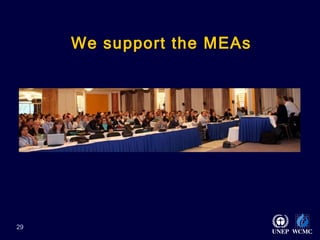
We support the MEAs
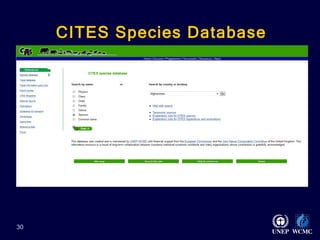
CITES Species Database
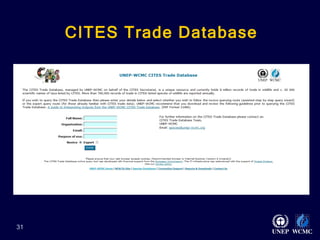
CITES Trade Database
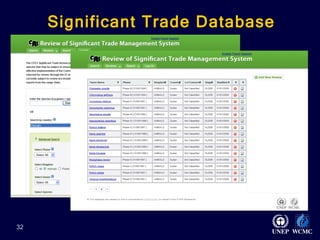
Significant Trade Database
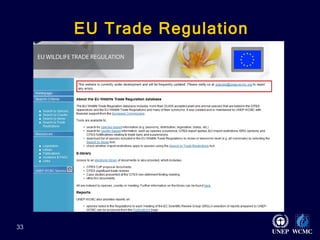
EU Trade Regulation
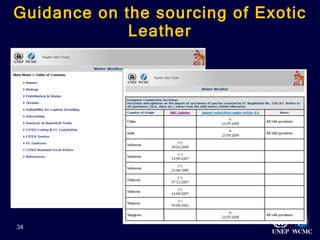
Guidance on the sourcing of Exotic Leather
We are involved in a number of productive partnerships...
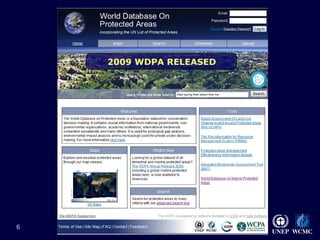
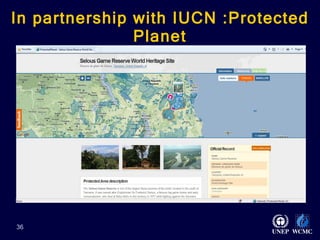
In partnership with IUCN :Protected Planet
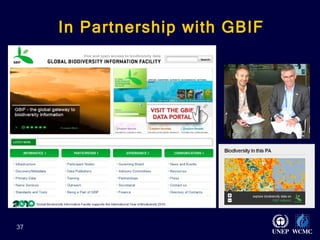
In Partnership with GBIF
 
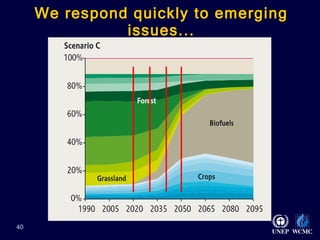
We respond quickly to emerging issues...
  A world where biodiversity counts http://wcmcwaa1.miniserver.com/~unepwcmc/
An analysis of the barriers to the sharing of biodiversity data, with recommendations of feasible measures to lower these   by Martin Jenkins Working draft of October 2010
Understanding information and those producing it... Information in its widest sense exists in different forms -  as words, numbers, symbols, images or artefacts – and can be stored in different places: It is held by many different kinds of people in different capacities and for different purposes which may include: personal interest research – often leading to publication resource management because of some mandate (e.g. through CITES, FAO) as  a public good
Information may be available to: the person(s) who originated or collected it/ & their immediate colleagues or peers more widely within a particular organisation or institution those outside the holding institution or organisation under restrictions (license agreements, fees, conditions of use etc.) freely, to anybody
The extent to which it is actually accessible to anyone other than its originator depends on:  whether a potential user knows that it actually exists  whether it is in a form, and at a place, that they can access it whether it is incorporated into tools that increase its accessibility and value whether the potential user can fulfil conditions placed on access by the originator
Barriers to the free interchange of information may be:  Behavioural Related to the nature of the information itself Technical and/or practical Resource constraints Due to complexities arising from multiple communities of practice
1. Behavioural – the reluctance to disclose or share information... Career advancement :  For academics sharing knowledge, without at first having extracted as much personal value as possible from it is unproductive or counterproductive in career terms.  Concerns about inappropriate use :  People don’t share because they fear information might be misinterpreted, altered or used in ways which they do not agree with.  Sensitivity :  Information may be withheld because those in possession of them think there is a risk of harm occurring if they share them with others.  Concerns about fairness, recognition and attribution :  Those who do not share often sense that someone else will profit unfairly, or they will not be properly recognised for their work. Perceived financial value :  Information may be perceived to have direct financial value.
2. The nature of the information itself Languages and translation:  The use of many different languages worldwide is the most obvious barrier to access information  Differing taxonomies and classification systems:  It can be hard to agree what we are referring to: Taxonomies for organisms Habitat and ecosystem terms and systems of classification Taxonomies of threats and impacts Standard vocabularies and glossaries Difficulties in applying norms and standards:  Suppliers of information may not wish to adhere to standards because they do not agree with them scientifically or because they do not fit well with their own information needs Contextual and explanatory information:  This key to understanding any piece of information or dataset, but ‘metadata’ is much neglected.
3. Technical or Practical Storage:  The lack of obvious, widely accessible repositories in the case of those potentially willing to provide it Discovery:  The lack of effective ways of finding data and information in the case of potential users (sounds odd in the world of Google!) Transfer:  Effective ways of transferring data and information  from one party to another. [ A vast amount of work has been carried out in this area – in the pre-electronic era in the development of knowledge management,  classification and archiving systems and now in the electronic world in terms of data exchange protocols, metadata formats and standards].
4.  Resource constraints   Cost recovery:   It is difficult to get a fair price for environmental information and it is not easy equitably to allocate sums recovered between different providers Mandatory funding through taxation:   There is inadequate attention to biodiversity data and its management on the part of governments and international agencies Donor funding:   It is often hard to demonstrate the impact of data and information activities and data/information incur significant recurrent costs which donors are traditionally reluctant to defray Voluntary contributions:   Not straight forward... it is difficult to direct effort where it is most useful it is difficult to control quality of inputs
5. complexities arising from multiple communities of practice Sharing across Communities of Practice : Successful conservation requires engagement from an enormous range of individuals in different communities – requiring connections and cooperation across potentially wide gaps in understanding, perspective and behaviour However, paradoxically, while communities can be very successful at sharing information amongst themselves, this very success, by reinforcing a sense of community, may serve to isolate them from other communities
Lifting the Barriers – Some suggestions
Changes focused on publishers and publications Providing background data and information:  Many journals already make it a requirement of publication that background data are made available, either as subsidiary files and documents on the web-site, or by request from the authors. This should be further encouraged, with the former option generally preferable Increasing open-access:   In recent years there has been a considerable shift towards free-access web publication of academic articles, with some on-line journals entirely free and many others having partially free access Releasing archives:   Old papers may contain useful information - most journals have now posted their archival copies, or a considerable proportion of them, online

Changes focused on donors and others providing support Building knowledge management and dissemination into projects and programmes:   Donors of all stripes should be strongly encouraged to make it a condition of funding that all recipients have a knowledge management and dissemination plan built into the project or programme Getting commitment to long-term funding of knowledge management/dissemination:   Donors should be encouraged to adopt a longer-term approach in supporting knowledge management and dissemination activities Tying research funding and research permissions to return of data and information:  When funding or permission is given by anyone for research and monitoring activities, for example by a government or a protected area manager, that permission should be contingent on providing access to all related data, information and knowledge
Changes focused on academics and research institutions  Creating incentives for academics to increase access to data:  Creating incentives to make academics more willing to share their knowledge in all its forms is challenging, but should be attempted...
Changes focused on governments Encourage commitment to freedom of information:  Governments find themselves under conflicting pressures to enforce or strengthen intellectual property rights on one hand and to enable open access to information on the other. They should be encouraged to follow the latter course as far as practicable   Encourage continuation of funding for information resources:  Governments need to be reminded of the long-term importance of data and information, and the value of more effective and efficient use of data, information and knowledge needs to be communicated
Changes focused on ‘knowledge brokers’ – “Friends of the Commons” Setting an example   The Friends should consider changing their management paradigm so that by default all data, information and knowledge are made freely available - and establish self assessment and reporting Preparing ”What does it mean” and “ How to?” guides:  The Friends should interpret and elaborate on the Principles and develop benchmarks and indicators of compliance based on studies of best practice in regard to their practical implementation Creating better road maps:   Tracking down useful information on the web is still laborious and hit-and-miss despite search engines... Establishing and maintaining easy-to-use repositories:   Many more people might make resources available if there was somewhere obvious to put them and they could put them there with minimum effort

Presentation at the Master in Global Environmental Change by Jon Hutton

  • 1.
    An Introduction toUNEP-WCMC: our work and our data issues Jon Hutton January 4 th 2011 13 February 2011 United Nations Environment Programme World Conservation Monitoring Centre
  • 2.
    UNEP-WCMC is UNEP’s Specialist Biodiversity Assessment Centre We are a flexible hybrid… We deliver policy relevant analysis to support decision-making We have strong convening and facilitating power and use this to create strategic partnerships UNEP-WCMC
  • 3.
    A 30 yearhistory A complex, but illustrious past Started by IUCN Then governed by IUCN, UNEP & WWF Became an ‘integral part of UNEP’ in 2000 Responsible for much of the conservation infrastructure we are familiar with..........
  • 4.
    UNEP WorldConservation Monitoring Centre IUCN Red List Least Concern Near Threatened Vulnerable Endangered Critically Endangered Extinct in the wild Extinct Extinction risk
  • 5.
  • 6.
  • 7.
  • 8.
    Mandates The UNEP Governing Council adopted WCMC as UNEP’s “ Specialist Biodiversity Information and Assessment Centre ” (Decision GC 22/1/III). Other mandates derive from the Conferences of the Parties of the biodiversity-related conventions; the World Parks Congress…. and elsewhere…
  • 9.
    Our Mission… To evaluate and highlight the many values of biodiversity and put authoritative biodiversity knowledge at the centre of decision-making
  • 10.
  • 11.
  • 12.
    Capacity We haveover 60 scientists working with us
  • 13.
    UNEP-WCMC is wellperceived by Government and Partners
  • 14.
  • 15.
    We facilitate smallglobal processes...
  • 16.
  • 17.
  • 18.
  • 19.
  • 20.
  • 21.
  • 22.
    We participate inmajor global initatives...
  • 23.
    Home to PavanSukhdev & TEEB
  • 24.
    CBD 2010 Target& MDGs Indicators for Target 7.B: Reduce biodiversity loss, achieving, by 2010, a significant reduction in the rate of loss
  • 25.
    Part of theSteering Committee of GEO-BON
  • 26.
  • 27.
  • 28.
    To build onthe Millennium Ecosystem Assessment (MA) The need for independent scientific expertise The need for more capacity The need for improved communication Loosely based on the perceived success of IPCC raising the political profile of climate change... Intergovernmental Platform on Biodiversity and Ecosystem Services
  • 29.
  • 30.
  • 31.
  • 32.
  • 33.
  • 34.
    Guidance on thesourcing of Exotic Leather
  • 35.
    We are involvedin a number of productive partnerships...
  • 36.
    In partnership withIUCN :Protected Planet
  • 37.
  • 38.
  • 39.
  • 40.
    We respond quicklyto emerging issues...
  • 41.
    Aworld where biodiversity counts http://wcmcwaa1.miniserver.com/~unepwcmc/
  • 42.
    An analysis ofthe barriers to the sharing of biodiversity data, with recommendations of feasible measures to lower these   by Martin Jenkins Working draft of October 2010
  • 43.
    Understanding information andthose producing it... Information in its widest sense exists in different forms - as words, numbers, symbols, images or artefacts – and can be stored in different places: It is held by many different kinds of people in different capacities and for different purposes which may include: personal interest research – often leading to publication resource management because of some mandate (e.g. through CITES, FAO) as a public good
  • 44.
    Information may beavailable to: the person(s) who originated or collected it/ & their immediate colleagues or peers more widely within a particular organisation or institution those outside the holding institution or organisation under restrictions (license agreements, fees, conditions of use etc.) freely, to anybody
  • 45.
    The extent towhich it is actually accessible to anyone other than its originator depends on: whether a potential user knows that it actually exists whether it is in a form, and at a place, that they can access it whether it is incorporated into tools that increase its accessibility and value whether the potential user can fulfil conditions placed on access by the originator
  • 46.
    Barriers to thefree interchange of information may be: Behavioural Related to the nature of the information itself Technical and/or practical Resource constraints Due to complexities arising from multiple communities of practice
  • 47.
    1. Behavioural –the reluctance to disclose or share information... Career advancement : For academics sharing knowledge, without at first having extracted as much personal value as possible from it is unproductive or counterproductive in career terms. Concerns about inappropriate use : People don’t share because they fear information might be misinterpreted, altered or used in ways which they do not agree with. Sensitivity : Information may be withheld because those in possession of them think there is a risk of harm occurring if they share them with others. Concerns about fairness, recognition and attribution : Those who do not share often sense that someone else will profit unfairly, or they will not be properly recognised for their work. Perceived financial value : Information may be perceived to have direct financial value.
  • 48.
    2. The natureof the information itself Languages and translation: The use of many different languages worldwide is the most obvious barrier to access information Differing taxonomies and classification systems: It can be hard to agree what we are referring to: Taxonomies for organisms Habitat and ecosystem terms and systems of classification Taxonomies of threats and impacts Standard vocabularies and glossaries Difficulties in applying norms and standards: Suppliers of information may not wish to adhere to standards because they do not agree with them scientifically or because they do not fit well with their own information needs Contextual and explanatory information: This key to understanding any piece of information or dataset, but ‘metadata’ is much neglected.
  • 49.
    3. Technical orPractical Storage: The lack of obvious, widely accessible repositories in the case of those potentially willing to provide it Discovery: The lack of effective ways of finding data and information in the case of potential users (sounds odd in the world of Google!) Transfer: Effective ways of transferring data and information from one party to another. [ A vast amount of work has been carried out in this area – in the pre-electronic era in the development of knowledge management, classification and archiving systems and now in the electronic world in terms of data exchange protocols, metadata formats and standards].
  • 50.
    4. Resourceconstraints Cost recovery: It is difficult to get a fair price for environmental information and it is not easy equitably to allocate sums recovered between different providers Mandatory funding through taxation: There is inadequate attention to biodiversity data and its management on the part of governments and international agencies Donor funding: It is often hard to demonstrate the impact of data and information activities and data/information incur significant recurrent costs which donors are traditionally reluctant to defray Voluntary contributions: Not straight forward... it is difficult to direct effort where it is most useful it is difficult to control quality of inputs
  • 51.
    5. complexities arisingfrom multiple communities of practice Sharing across Communities of Practice : Successful conservation requires engagement from an enormous range of individuals in different communities – requiring connections and cooperation across potentially wide gaps in understanding, perspective and behaviour However, paradoxically, while communities can be very successful at sharing information amongst themselves, this very success, by reinforcing a sense of community, may serve to isolate them from other communities
  • 52.
    Lifting the Barriers– Some suggestions
  • 53.
    Changes focused onpublishers and publications Providing background data and information: Many journals already make it a requirement of publication that background data are made available, either as subsidiary files and documents on the web-site, or by request from the authors. This should be further encouraged, with the former option generally preferable Increasing open-access: In recent years there has been a considerable shift towards free-access web publication of academic articles, with some on-line journals entirely free and many others having partially free access Releasing archives: Old papers may contain useful information - most journals have now posted their archival copies, or a considerable proportion of them, online
  • 54.
    Changes focused ondonors and others providing support Building knowledge management and dissemination into projects and programmes: Donors of all stripes should be strongly encouraged to make it a condition of funding that all recipients have a knowledge management and dissemination plan built into the project or programme Getting commitment to long-term funding of knowledge management/dissemination: Donors should be encouraged to adopt a longer-term approach in supporting knowledge management and dissemination activities Tying research funding and research permissions to return of data and information: When funding or permission is given by anyone for research and monitoring activities, for example by a government or a protected area manager, that permission should be contingent on providing access to all related data, information and knowledge
  • 55.
    Changes focused onacademics and research institutions Creating incentives for academics to increase access to data: Creating incentives to make academics more willing to share their knowledge in all its forms is challenging, but should be attempted...
  • 56.
    Changes focused ongovernments Encourage commitment to freedom of information: Governments find themselves under conflicting pressures to enforce or strengthen intellectual property rights on one hand and to enable open access to information on the other. They should be encouraged to follow the latter course as far as practicable   Encourage continuation of funding for information resources: Governments need to be reminded of the long-term importance of data and information, and the value of more effective and efficient use of data, information and knowledge needs to be communicated
  • 57.
    Changes focused on‘knowledge brokers’ – “Friends of the Commons” Setting an example The Friends should consider changing their management paradigm so that by default all data, information and knowledge are made freely available - and establish self assessment and reporting Preparing ”What does it mean” and “ How to?” guides: The Friends should interpret and elaborate on the Principles and develop benchmarks and indicators of compliance based on studies of best practice in regard to their practical implementation Creating better road maps: Tracking down useful information on the web is still laborious and hit-and-miss despite search engines... Establishing and maintaining easy-to-use repositories: Many more people might make resources available if there was somewhere obvious to put them and they could put them there with minimum effort

Editor's Notes

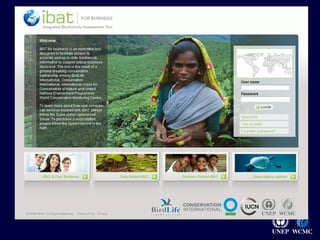
  • #39 Important Bird Areas, Alliance for Zero Extinction sites & CI regions’ KBAs