
Mahfuzul Haque, Ph D
(Former Secretary, Government of Bangladesh)
Adjunct Faculty, Dept of Development
Studies, University of Dhaka

13 December 2013
Knowledge Sources
 Scientific Information: Scientific knowledge on CC is available






with various sectoral agencies on salinity, rainfall, wind
direction, cyclone, tidal surges, drought, flood, water resources,
health and sanitation etc. Data on disaster risk reduction,
flooding pattern, water logging also exist with the development
projects officials
Besides, UNFCCC COP, Int Org, Universities, R&D bodies also
generate and disseminate data
Officials Reports and Documents: BCCSAP, NAPA, NAMA,
Climate Change Policies, Reports of sectoral agencies
Community Knowledge: Indigenous knowledge and practices on
climate resilience and change, adaptation practices exist among
the farmers, fishermen, villagers and coastal community
Media regularly reports on CC
Global Scenario
 UNEP- RISO Centre (URC) on Energy, Climate and

Sustainable Development established in Denmark with the
objectives of promoting and facilitating incorporation of
environmental and developmental aspects into energy
policy and planning worldwide, especially in the
developing countries
 UNEP RISO Centre hosts the “CDM Bazaar” in close
cooperation with UNFCCC Secretariat
 Asian Institute of Technology (AIT), Bangkok has been
partnering with UNEP’s Climate Technology Centre and
Network (CTCN) aiming at establishing an information
platform for improved sharing of knowledge related to
climate technologies
Data Quality
 Users-friendly
 Demand driven
 Reliable
 Updated
 Accessible

 Uniform
Felt Need in CCKM
 A single and common platform is badly needed to

disseminate climate change related information in an
users-friendly way
 Different organizations and institutes involved in
climate resilience and change need an easy way to
disseminate their data
 End users need easy access to data generated by
various organizations and bodies
 Accessing data available in indigenous knowledge and
practices, which are mostly unwritten and
undocumented
Stakeholders
 Sectoral Ministries and departments dealing with agriculture,








fisheries, livestock, disaster management, health and
sanitation, water, irrigation, weather, environment and forests
Academicians, R & D bodies, Development Partners, UN
Agencies, Media
Members of the Parliament, local government, UP members
Officials of NGOs, civil society bodies and vulnerable
communities
Farmers, fishermen, agriculturists, boatmen, women, health
workers, disaster risk reduction volunteers
Chambers, Business community, Insurance companies, Banks
Way out
 Database/Knowledge Bank
 Web-Portal
 Mobile-SMS based Applications
 Radio Messages

 Call-Centre
 Information Centre
Database/ Knowledge Bank
 A comprehensive CC related database (Knowledge

Bank) to be established to incorporate all CC related
knowledge
 Activities include: collection of data from all sources;
analysis and sorting of data; common formatting;
updating; checking reliability and authenticity
 Sources of data: scientific data available at various
government offices (Met office, Agriculture and
fisheries offices, water resources), Research and
Academic Institutions; community knowledge
available with NGOs; popular articles in media etc.
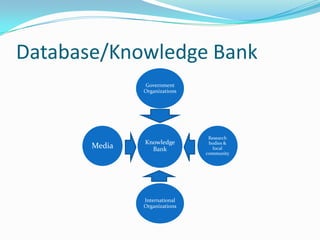
Database/Knowledge Bank
Government
Organizations

Media

Knowledge
Bank

International
Organizations

Research
bodies &
local
community
Web-Portal
 An interactive web-portal (e.g., Yahoo, MSN, Google etc) to

be developed based on the Knowledge Bank)
 Activities are to assess the requirements; design and
application of data architecture and users interface;
develop a Content Management System (CMS); develop
Frequently Asked Questions (FAQs) and to provide access
to concerned authorities
 Main features are to develop a CMS for multi level access
control and archiving system; uploading daily news,
research and policy documents; interactive data and maps;
graphs and reports; linking various blogs and social media
Web-Portal
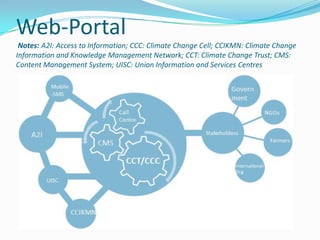
 A Climate Change Information and Knowledge

Management Network (CCIKMN) Web-portal has been
established under Comprehensive Disaster Management
Programme (CDMP), being implemented by the Ministry
of Relief and Disaster Management with UNDP assistance
 Similar Web-Portal has been suggested under “Climate
Change Capacity Building & Knowledge Management (TA
7848: BAN) TA project of ADB being implemented by the
Ministry of Environment and Forests
 We can draw on experience of these existing and proposed
web-portals
Web-Portal
Notes: A2I: Access to Information; CCC: Climate Change Cell; CCIKMN: Climate Change
Information and Knowledge Management Network; CCT: Climate Change Trust; CMS:
Content Management System; UISC: Union Information and Services Centres
Web-Portal
 This Web-portal would be connected to super-highway

with “Access to Information (A2I)” programme
established at the Prime Minister’s Office
 A2I aims to ensuring national e-Governance in the
context of local best practices
Mobile-Based SMS
 People will get access to information/data not only by

visiting the web-portal, but also though mobile based
SMS services, to be integrated with web-portal
knowledge bank
 Under CDMP, an Interactive Voice Response (IVR) has
been established and people can get information
concerning flood, cyclone warning, weather forecast,
warning for marine fishermen by using cell phones
through dialing 10941
 We can develop and update IVR, instead of creating a
new one
Radio Message
 Access to CC information related to agriculture, seeds,

irrigation, fertilizer, floods, cyclone warnings, disasters
through Radio stations
 “Radio Listeners’ Club” helps disseminate CC
information
 People of 16 cyclone-prone districts could access such
information through local radio stations. Such
programmes exist in CDMP
Call Centre
 A Call-Centre could be established and likely place

could be at CDMP or Climate Change Unit at the
MOEF, where call centre people will be equipped with
climate resilience and change related knowledge and
information
 Call Centre will be intended to provide information
services on agriculture, fisheries, weather, salinity,
drought, adaptation measures and community
knowledge and practices
Information Centre
 Knowledge Bank will tie up with the existing

Information Centres (e.g., Union Information and
Services Centres (UISC) which has physical existence
in rural areas
 Climate Change Unit will share information with these
centres, so that the local community can obtain
information from these centres on agriculture,
fisheries, rainfall pattern, weather forecast etc.
Future Challenges
 Where to host CCKM Centre?
 Climate Change Trust (CCT) under the Ministry of

Environment and Forests could host such a network
 Perhaps, CCKN recently established at the “Climate
Change Cell” of the DOE could be a viable candidate
for such hosting
 How to connect National CC Web-portal with “Access
to Information (A2I)” established at the Prime
Minister’s Office
 Data: Easy access to data; Reliability and updating of
data; Data targeting users’ demand and requirements
Future Challenges
 Policies and Strategies: How to access BCCSAP; How to

make BCCSAP a readers-friendly one; How to access the
CC Fund and other funds; Where to find information on
Funding Mechanism?
 Community Knowledge: How to reach the community, the
vulnerable groups; how to access and document
indigenous knowledge and practices as they are mostly
unwritten and undocumented
 Capacity Building of the Organizations to be ensured
 CCKM Centre to be mainstreamed for its sustainability with
continuous flow of funds from Revenue Budget
THANKS

Climate Change Knowledge Management (CCKM)

  • 1.
    Mahfuzul Haque, PhD (Former Secretary, Government of Bangladesh) Adjunct Faculty, Dept of Development Studies, University of Dhaka 13 December 2013
  • 2.
    Knowledge Sources  ScientificInformation: Scientific knowledge on CC is available     with various sectoral agencies on salinity, rainfall, wind direction, cyclone, tidal surges, drought, flood, water resources, health and sanitation etc. Data on disaster risk reduction, flooding pattern, water logging also exist with the development projects officials Besides, UNFCCC COP, Int Org, Universities, R&D bodies also generate and disseminate data Officials Reports and Documents: BCCSAP, NAPA, NAMA, Climate Change Policies, Reports of sectoral agencies Community Knowledge: Indigenous knowledge and practices on climate resilience and change, adaptation practices exist among the farmers, fishermen, villagers and coastal community Media regularly reports on CC
  • 3.
    Global Scenario  UNEP-RISO Centre (URC) on Energy, Climate and Sustainable Development established in Denmark with the objectives of promoting and facilitating incorporation of environmental and developmental aspects into energy policy and planning worldwide, especially in the developing countries  UNEP RISO Centre hosts the “CDM Bazaar” in close cooperation with UNFCCC Secretariat  Asian Institute of Technology (AIT), Bangkok has been partnering with UNEP’s Climate Technology Centre and Network (CTCN) aiming at establishing an information platform for improved sharing of knowledge related to climate technologies
  • 4.
    Data Quality  Users-friendly Demand driven  Reliable  Updated  Accessible  Uniform
  • 5.
    Felt Need inCCKM  A single and common platform is badly needed to disseminate climate change related information in an users-friendly way  Different organizations and institutes involved in climate resilience and change need an easy way to disseminate their data  End users need easy access to data generated by various organizations and bodies  Accessing data available in indigenous knowledge and practices, which are mostly unwritten and undocumented
  • 6.
    Stakeholders  Sectoral Ministriesand departments dealing with agriculture,      fisheries, livestock, disaster management, health and sanitation, water, irrigation, weather, environment and forests Academicians, R & D bodies, Development Partners, UN Agencies, Media Members of the Parliament, local government, UP members Officials of NGOs, civil society bodies and vulnerable communities Farmers, fishermen, agriculturists, boatmen, women, health workers, disaster risk reduction volunteers Chambers, Business community, Insurance companies, Banks
  • 7.
    Way out  Database/KnowledgeBank  Web-Portal  Mobile-SMS based Applications  Radio Messages  Call-Centre  Information Centre
  • 8.
    Database/ Knowledge Bank A comprehensive CC related database (Knowledge Bank) to be established to incorporate all CC related knowledge  Activities include: collection of data from all sources; analysis and sorting of data; common formatting; updating; checking reliability and authenticity  Sources of data: scientific data available at various government offices (Met office, Agriculture and fisheries offices, water resources), Research and Academic Institutions; community knowledge available with NGOs; popular articles in media etc.
  • 9.
  • 10.
    Web-Portal  An interactiveweb-portal (e.g., Yahoo, MSN, Google etc) to be developed based on the Knowledge Bank)  Activities are to assess the requirements; design and application of data architecture and users interface; develop a Content Management System (CMS); develop Frequently Asked Questions (FAQs) and to provide access to concerned authorities  Main features are to develop a CMS for multi level access control and archiving system; uploading daily news, research and policy documents; interactive data and maps; graphs and reports; linking various blogs and social media
  • 11.
    Web-Portal  A ClimateChange Information and Knowledge Management Network (CCIKMN) Web-portal has been established under Comprehensive Disaster Management Programme (CDMP), being implemented by the Ministry of Relief and Disaster Management with UNDP assistance  Similar Web-Portal has been suggested under “Climate Change Capacity Building & Knowledge Management (TA 7848: BAN) TA project of ADB being implemented by the Ministry of Environment and Forests  We can draw on experience of these existing and proposed web-portals
  • 12.
    Web-Portal Notes: A2I: Accessto Information; CCC: Climate Change Cell; CCIKMN: Climate Change Information and Knowledge Management Network; CCT: Climate Change Trust; CMS: Content Management System; UISC: Union Information and Services Centres
  • 13.
    Web-Portal  This Web-portalwould be connected to super-highway with “Access to Information (A2I)” programme established at the Prime Minister’s Office  A2I aims to ensuring national e-Governance in the context of local best practices
  • 14.
    Mobile-Based SMS  Peoplewill get access to information/data not only by visiting the web-portal, but also though mobile based SMS services, to be integrated with web-portal knowledge bank  Under CDMP, an Interactive Voice Response (IVR) has been established and people can get information concerning flood, cyclone warning, weather forecast, warning for marine fishermen by using cell phones through dialing 10941  We can develop and update IVR, instead of creating a new one
  • 15.
    Radio Message  Accessto CC information related to agriculture, seeds, irrigation, fertilizer, floods, cyclone warnings, disasters through Radio stations  “Radio Listeners’ Club” helps disseminate CC information  People of 16 cyclone-prone districts could access such information through local radio stations. Such programmes exist in CDMP
  • 16.
    Call Centre  ACall-Centre could be established and likely place could be at CDMP or Climate Change Unit at the MOEF, where call centre people will be equipped with climate resilience and change related knowledge and information  Call Centre will be intended to provide information services on agriculture, fisheries, weather, salinity, drought, adaptation measures and community knowledge and practices
  • 17.
    Information Centre  KnowledgeBank will tie up with the existing Information Centres (e.g., Union Information and Services Centres (UISC) which has physical existence in rural areas  Climate Change Unit will share information with these centres, so that the local community can obtain information from these centres on agriculture, fisheries, rainfall pattern, weather forecast etc.
  • 18.
    Future Challenges  Whereto host CCKM Centre?  Climate Change Trust (CCT) under the Ministry of Environment and Forests could host such a network  Perhaps, CCKN recently established at the “Climate Change Cell” of the DOE could be a viable candidate for such hosting  How to connect National CC Web-portal with “Access to Information (A2I)” established at the Prime Minister’s Office  Data: Easy access to data; Reliability and updating of data; Data targeting users’ demand and requirements
  • 19.
    Future Challenges  Policiesand Strategies: How to access BCCSAP; How to make BCCSAP a readers-friendly one; How to access the CC Fund and other funds; Where to find information on Funding Mechanism?  Community Knowledge: How to reach the community, the vulnerable groups; how to access and document indigenous knowledge and practices as they are mostly unwritten and undocumented  Capacity Building of the Organizations to be ensured  CCKM Centre to be mainstreamed for its sustainability with continuous flow of funds from Revenue Budget
  • 20.