Remapping the Global and the
        Local in Knowledge Production:
             Roles of Open Access

Global participation in e-research and   Leslie Chan
scholarly communication: Open access     Bioline International
strategies for African institutions      Centre for Critical Development Studies
University of Cape Town, Aug. 10, 2012   University of Toronto Scarborough
Key points
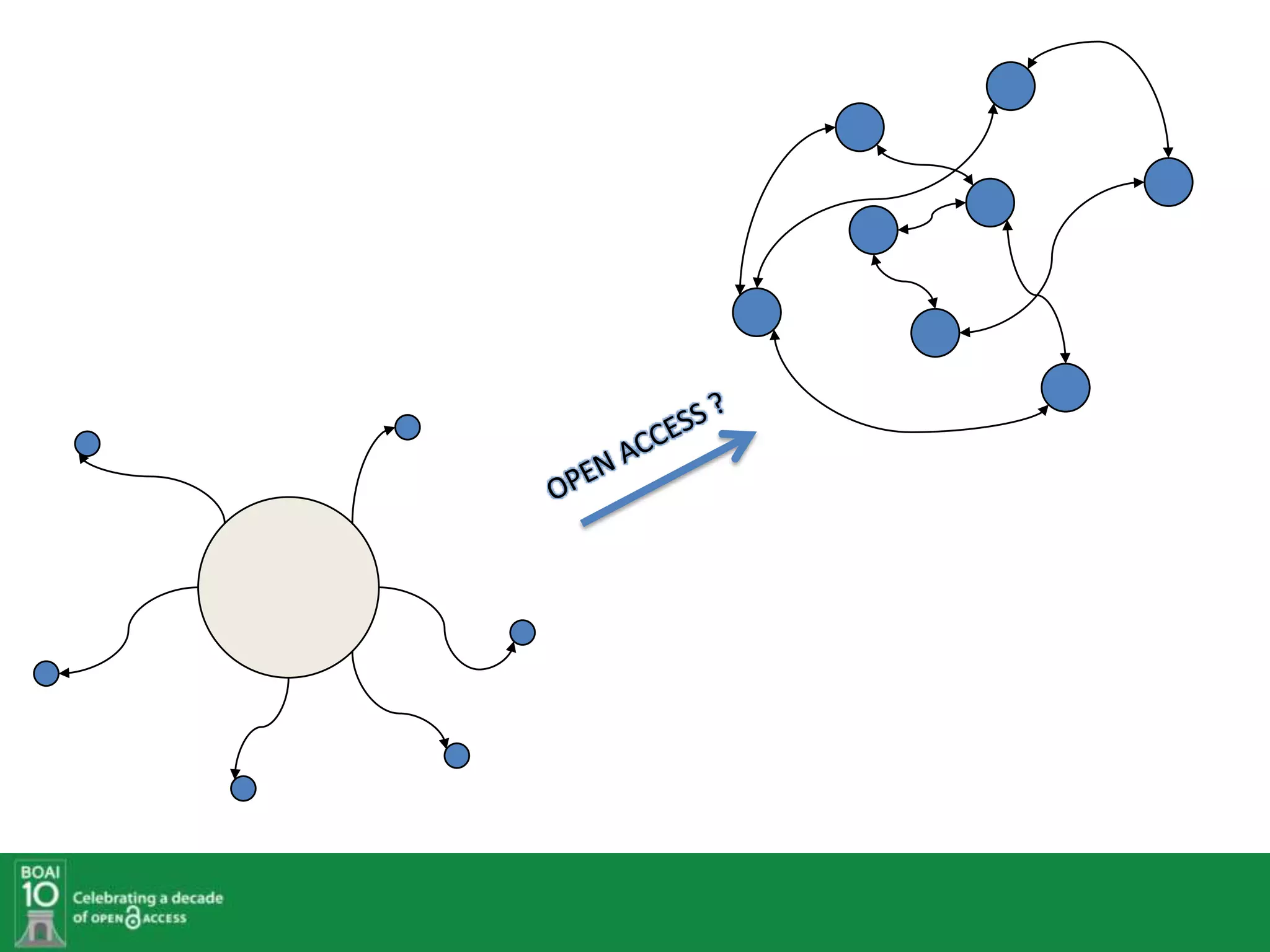
• Open Access as an enabler
• “Journal” no longer serves the needs of
  networked scholarship
• From Wealth of Nations to Wealth of Networks
• Need to rethink measurements of “impact” and
  values, especially for development
• Innovations are happening in the “peripheries”
  but there are gatekeepers and structural
  barriers
• Aligning funding and reward policies with new
  value frameworks
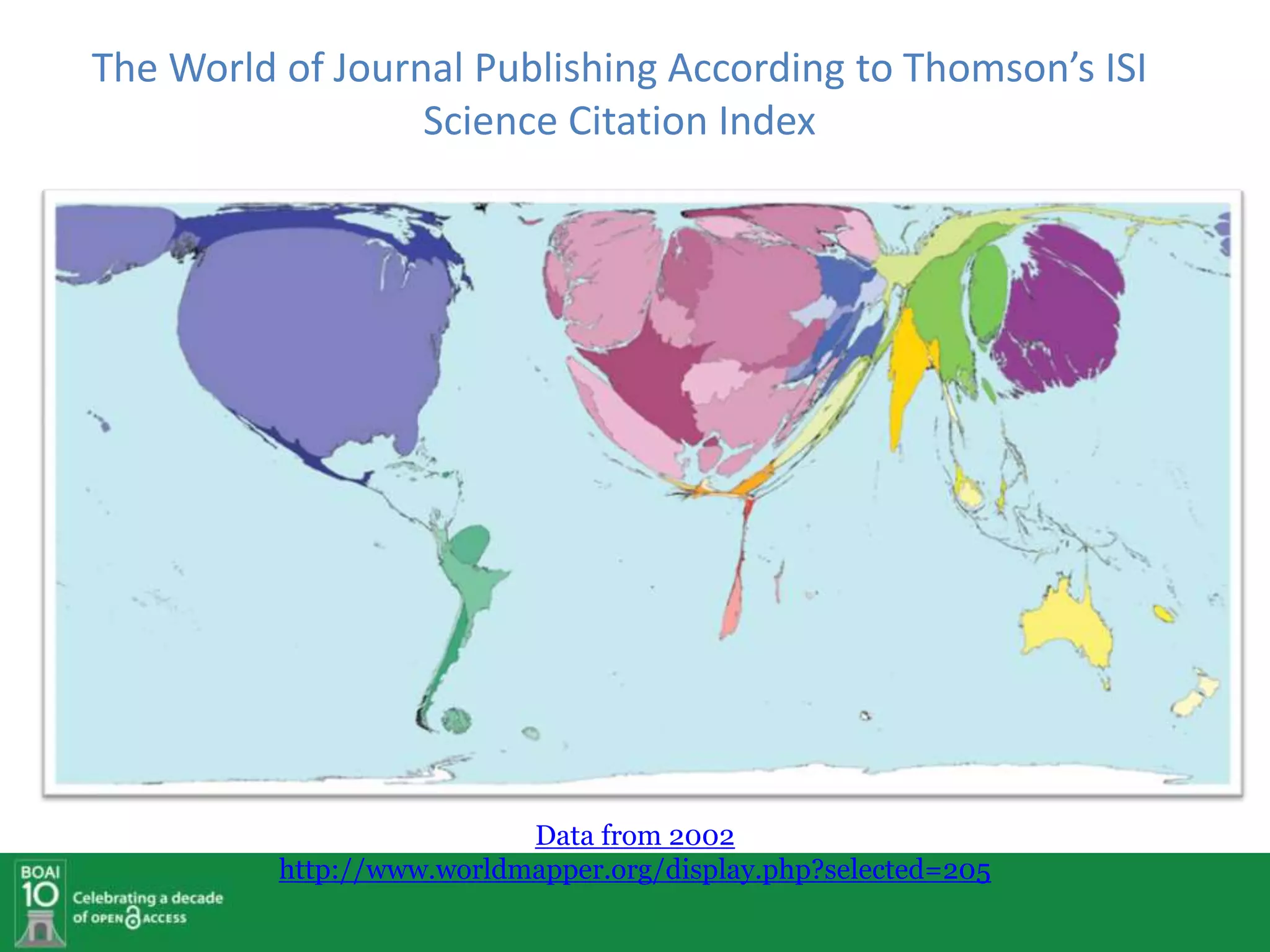
The World of Journal Publishing According to Thomson’s ISI
                  Science Citation Index


                           Data from 2002
          http://www.worldmapper.org/display.php?selected=205
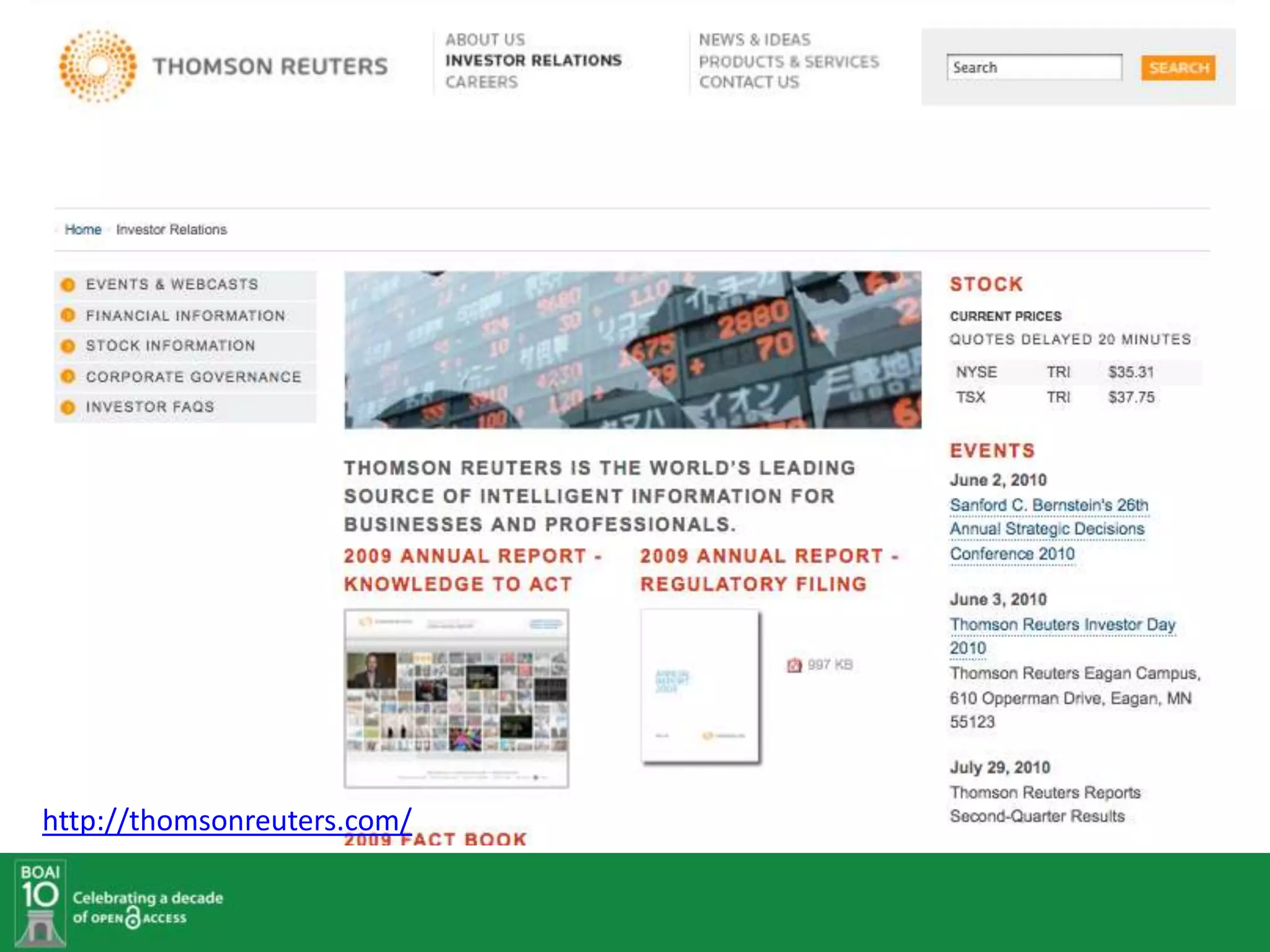
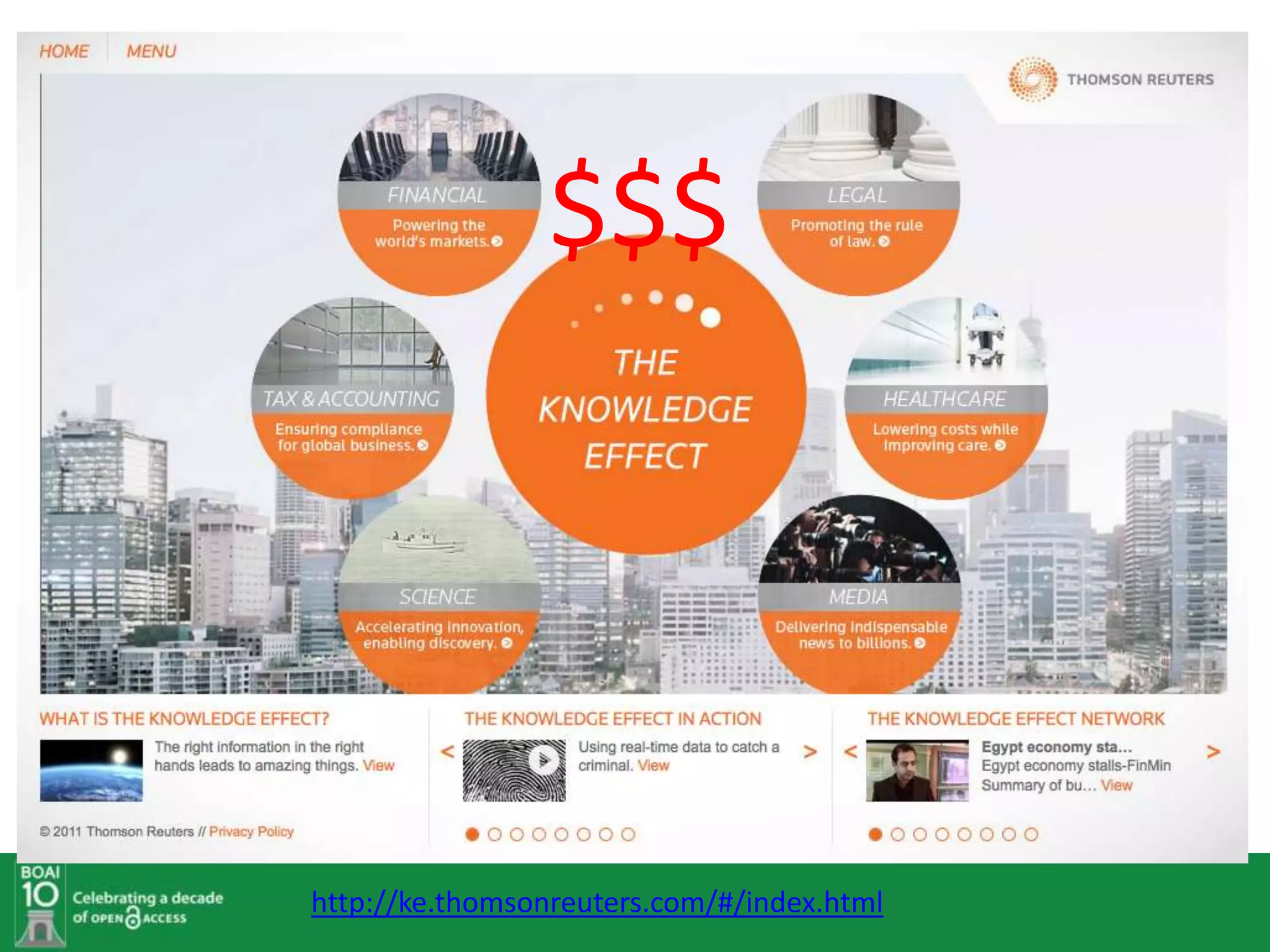
http://thomsonreuters.com/
$$$


http://ke.thomsonreuters.com/#/index.html
“… at a recent editorial team meeting, we discussed a research
paper from a LMIC author. The science was well done and with a
little editing for English, the paper was potentially publishable. But
should we send it out for review? The question we were wrestling
with was whether its findings were sufficiently new to make it
worthy of page space in the journal. This is always a consideration
for all manuscripts, since competition for space is intense and a
priority is to publish interesting research that adds something new
to the field, rather than too many replications of studies already
done. So the initial response when deciding whether to send the
paper out for peer review was: Reject. We already know this, don't
we?”
“No journal can afford to devote all or even most
of its precious page space to studies essentially
finding again what others already found, with only
the places changing. And this may be a good place
to remind authors that we almost never publish
prevalence studies, unless they are truly the first
ever done (and sometimes not even then), since
they tend to be of interest primarily in the
countries within which they were conducted.”
So who decide on what is “new” and
      legitimate knowledge?
               And
Who have access to that knowledge?
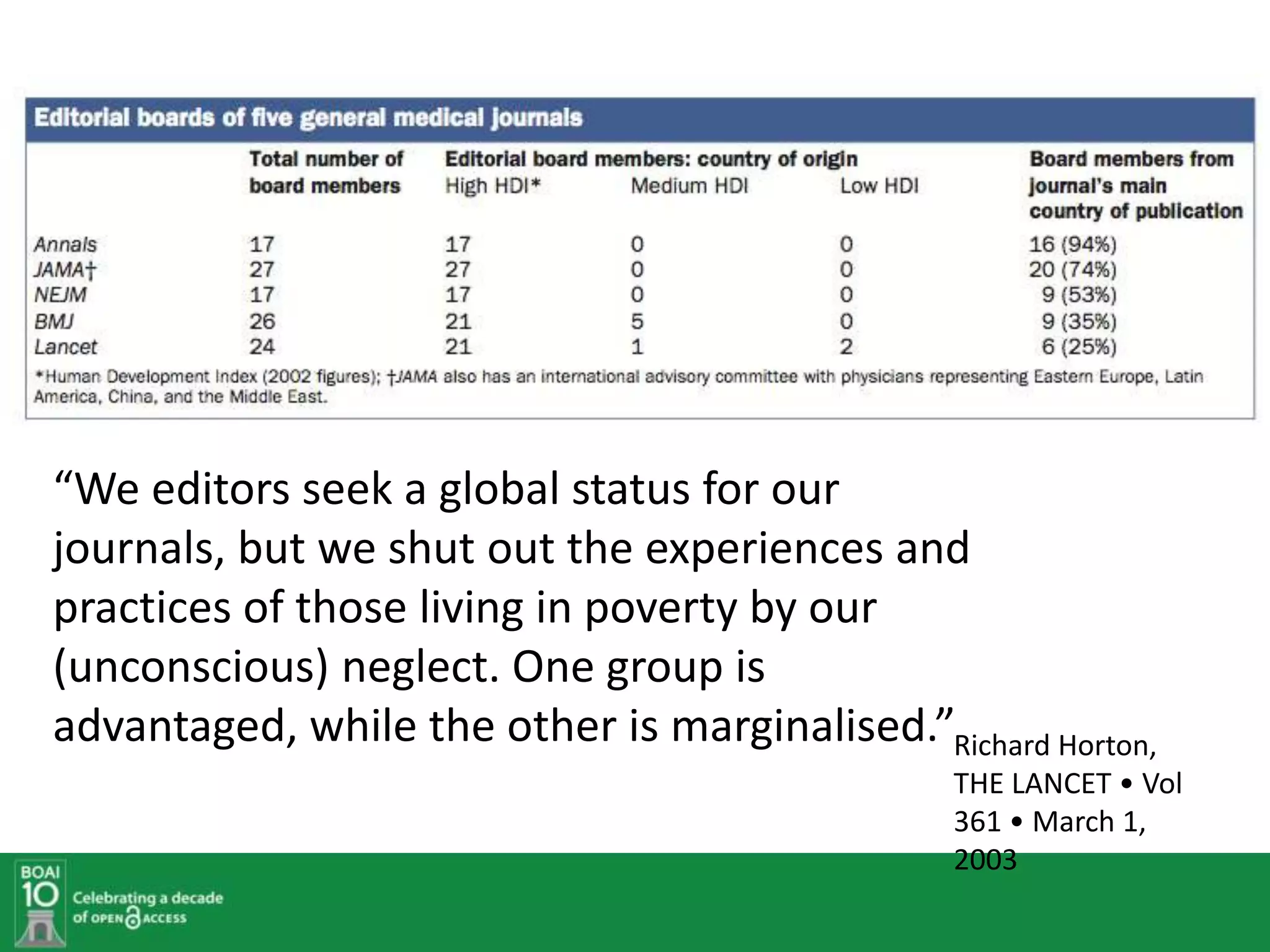
“We editors seek a global status for our
journals, but we shut out the experiences and
practices of those living in poverty by our
(unconscious) neglect. One group is
advantaged, while the other is marginalised.”Richard Horton,
                                                THE LANCET • Vol
                                                361 • March 1,
                                                2003
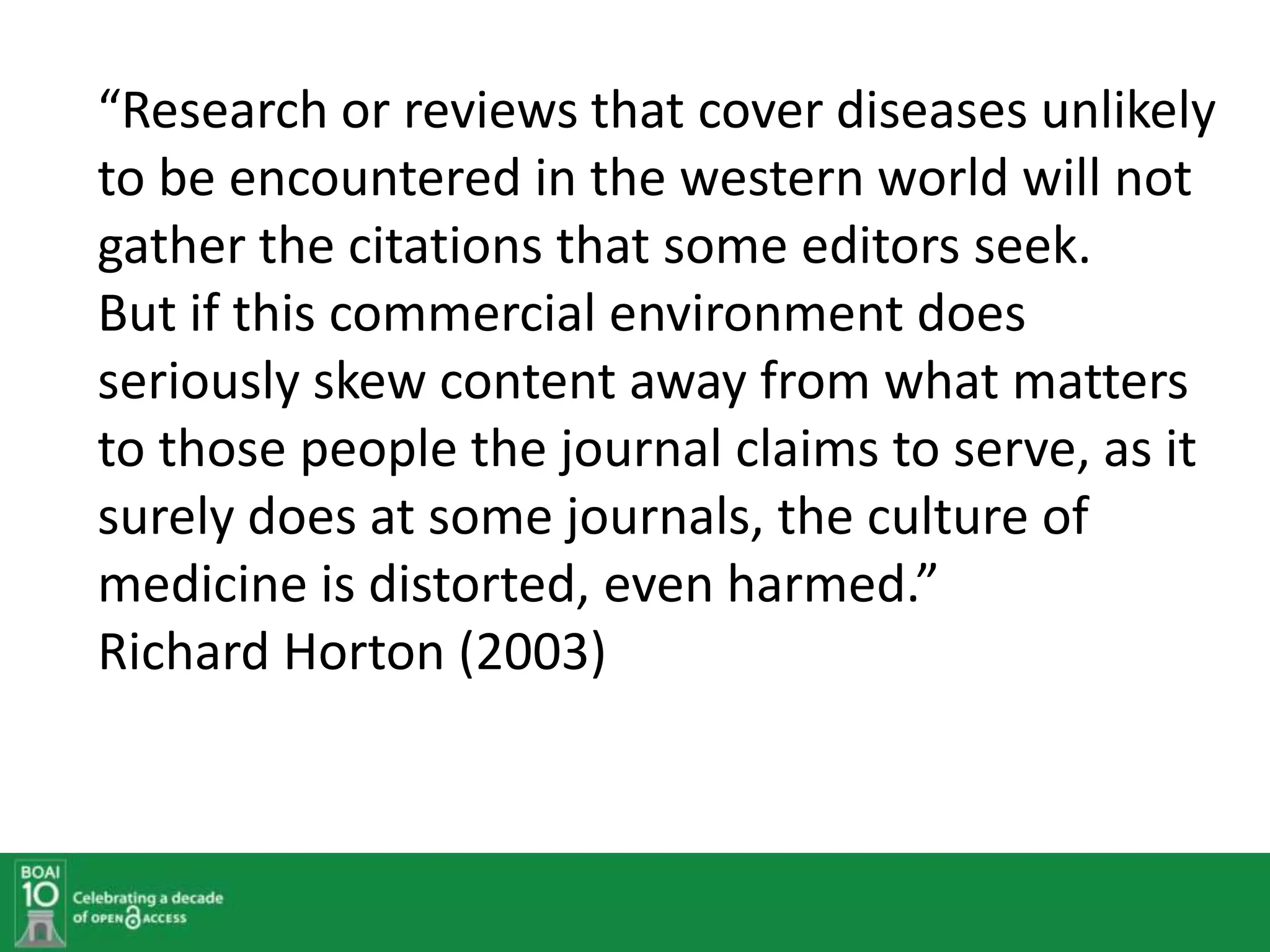
“Research or reviews that cover diseases unlikely
to be encountered in the western world will not
gather the citations that some editors seek.
But if this commercial environment does
seriously skew content away from what matters
to those people the journal claims to serve, as it
surely does at some journals, the culture of
medicine is distorted, even harmed.”
Richard Horton (2003)
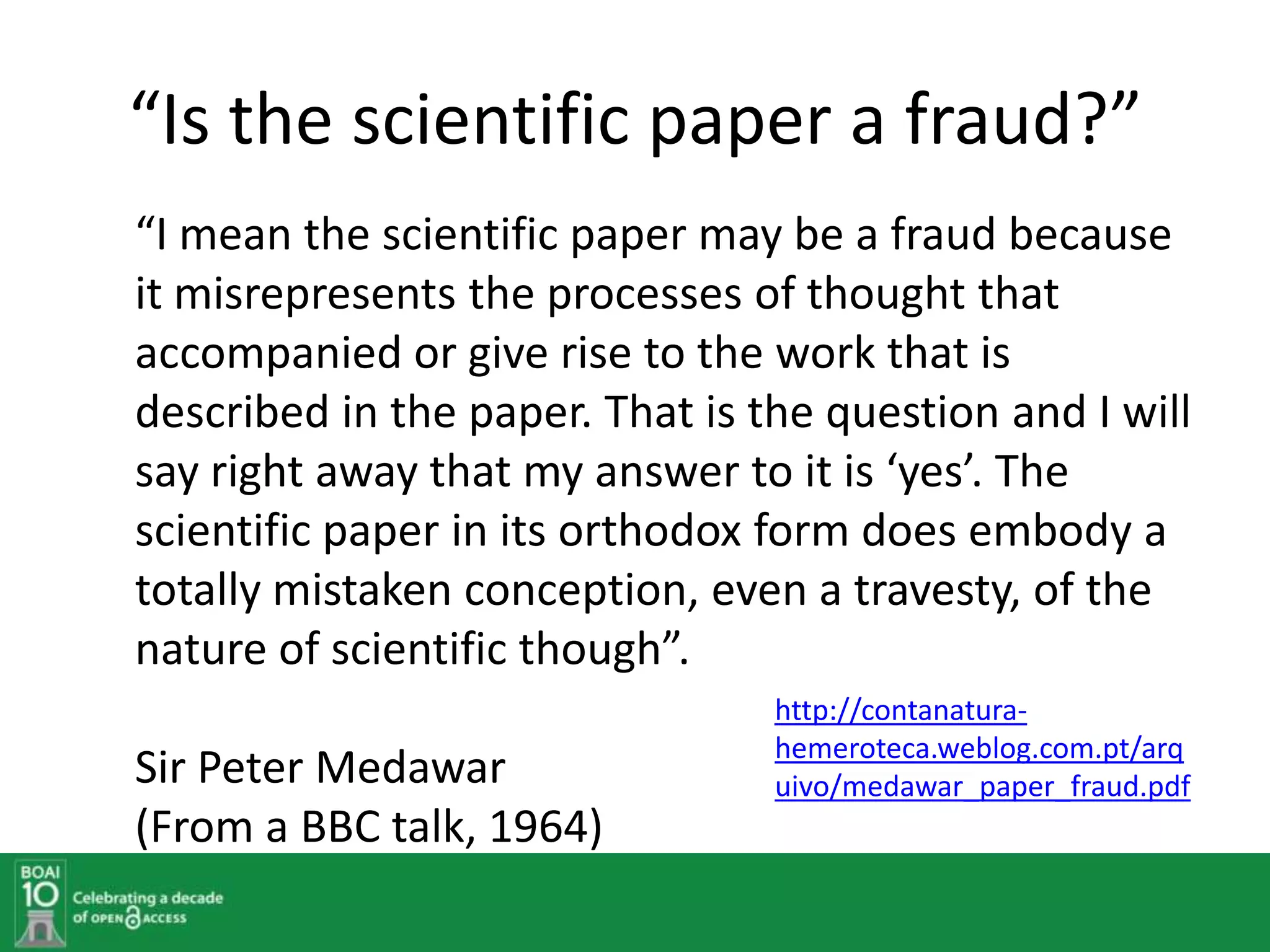
“Is the scientific paper a fraud?”
“I mean the scientific paper may be a fraud because
it misrepresents the processes of thought that
accompanied or give rise to the work that is
described in the paper. That is the question and I will
say right away that my answer to it is ‘yes’. The
scientific paper in its orthodox form does embody a
totally mistaken conception, even a travesty, of the
nature of scientific though”.
                                 http://contanatura-
                                 hemeroteca.weblog.com.pt/arq
Sir Peter Medawar                uivo/medawar_paper_fraud.pdf
(From a BBC talk, 1964)
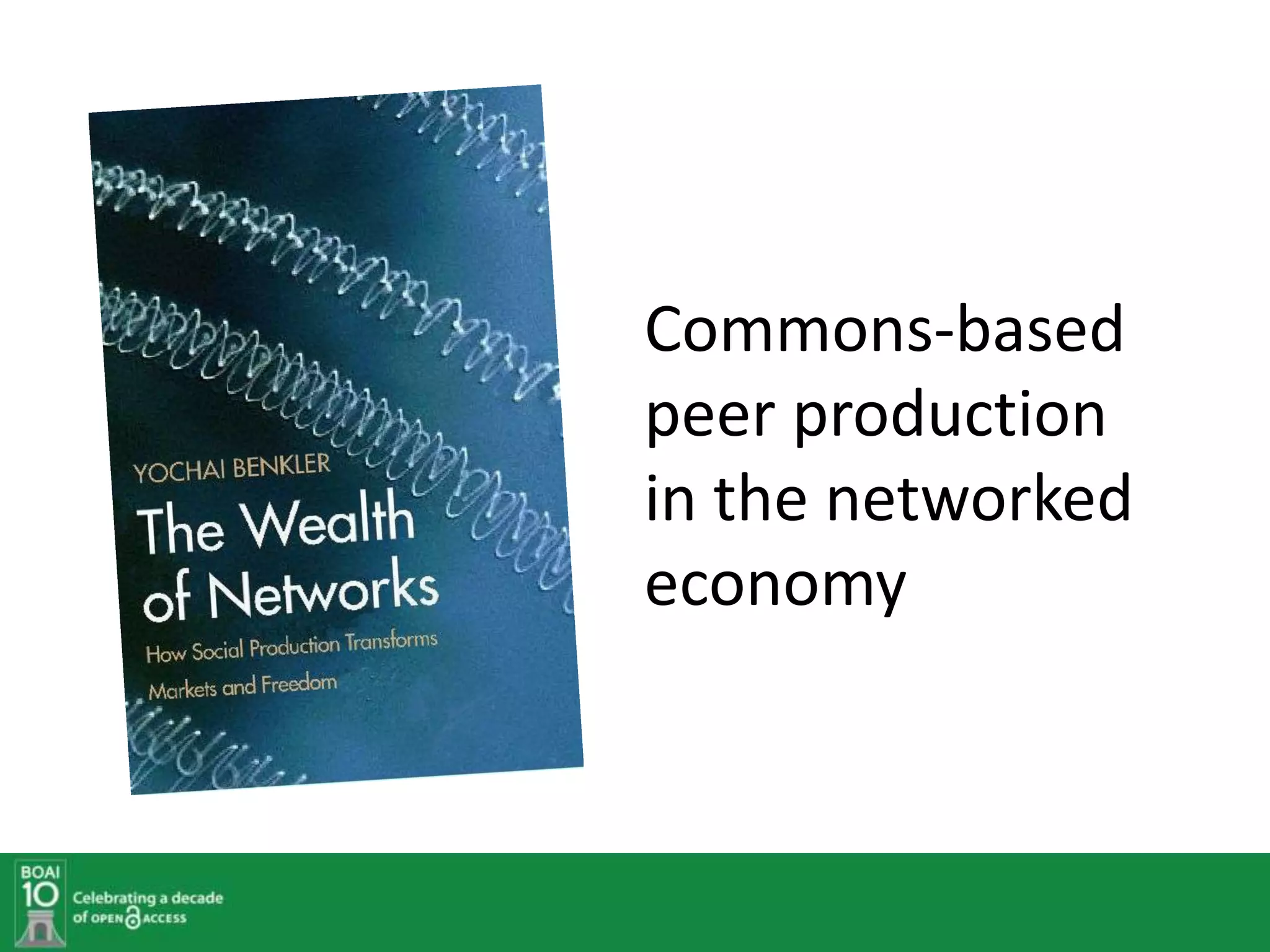
Commons-based
peer production
in the networked
economy
"commons-based peer production refers to any
coordinated, (chiefly) internet-based effort whereby
volunteers contribute project components, and there
exists some process to combine them to produce a
unified intellectual work. CBPP covers many different
types of intellectual output, from software to libraries of
quantitative data to human-readable documents
(manuals, books, encyclopedias, reviews, blogs,
periodicals, and more)”
Krowne, Aaron (March 1, 2005). "The FUD based encyclopedia:
Dismantling the Fear, Uncertainty and Doubt aimed at Wikipedia
and other free knowledge sources". Free Software Magazine.
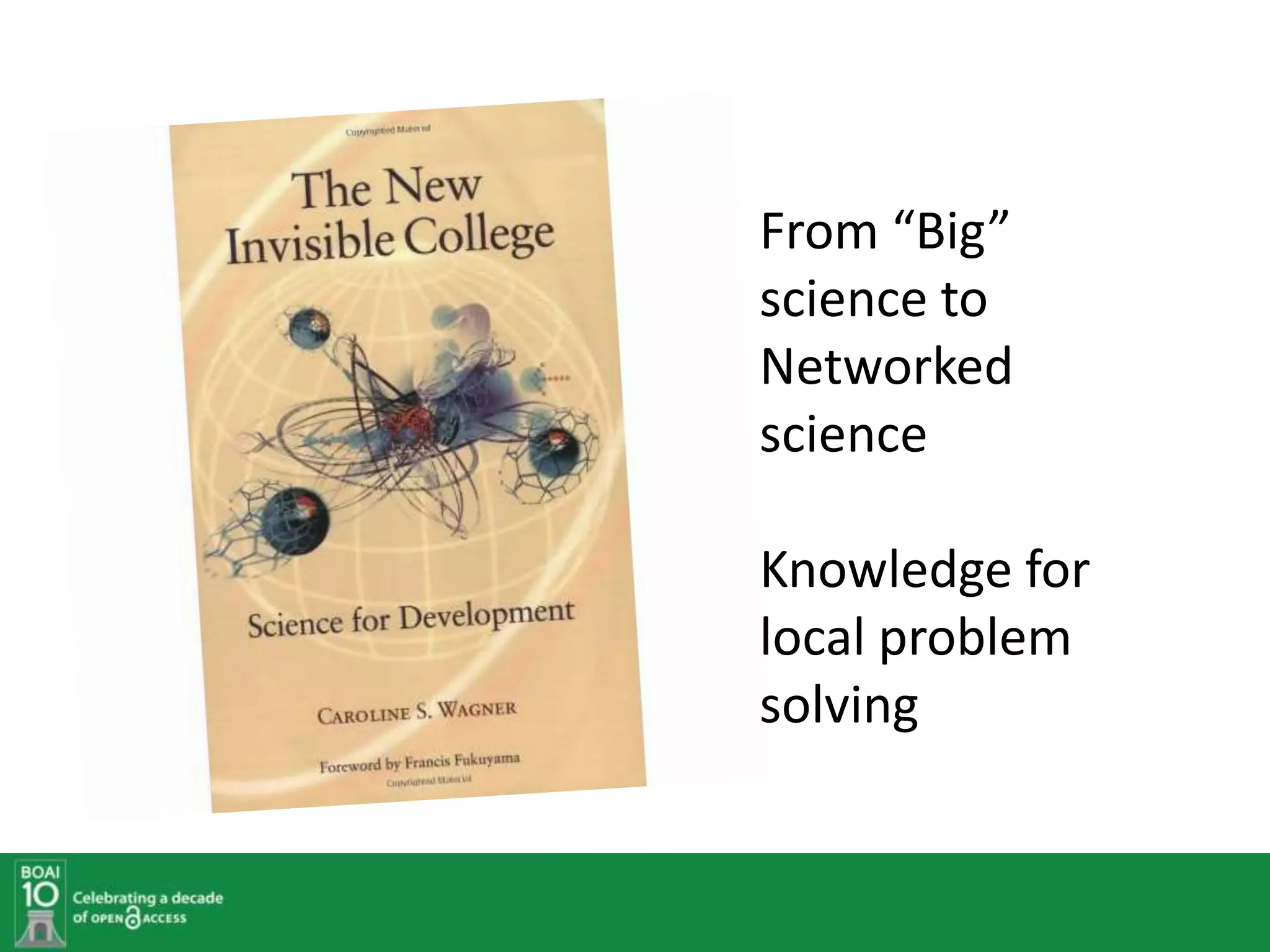
From “Big”
science to
Networked
science

Knowledge for
local problem
solving
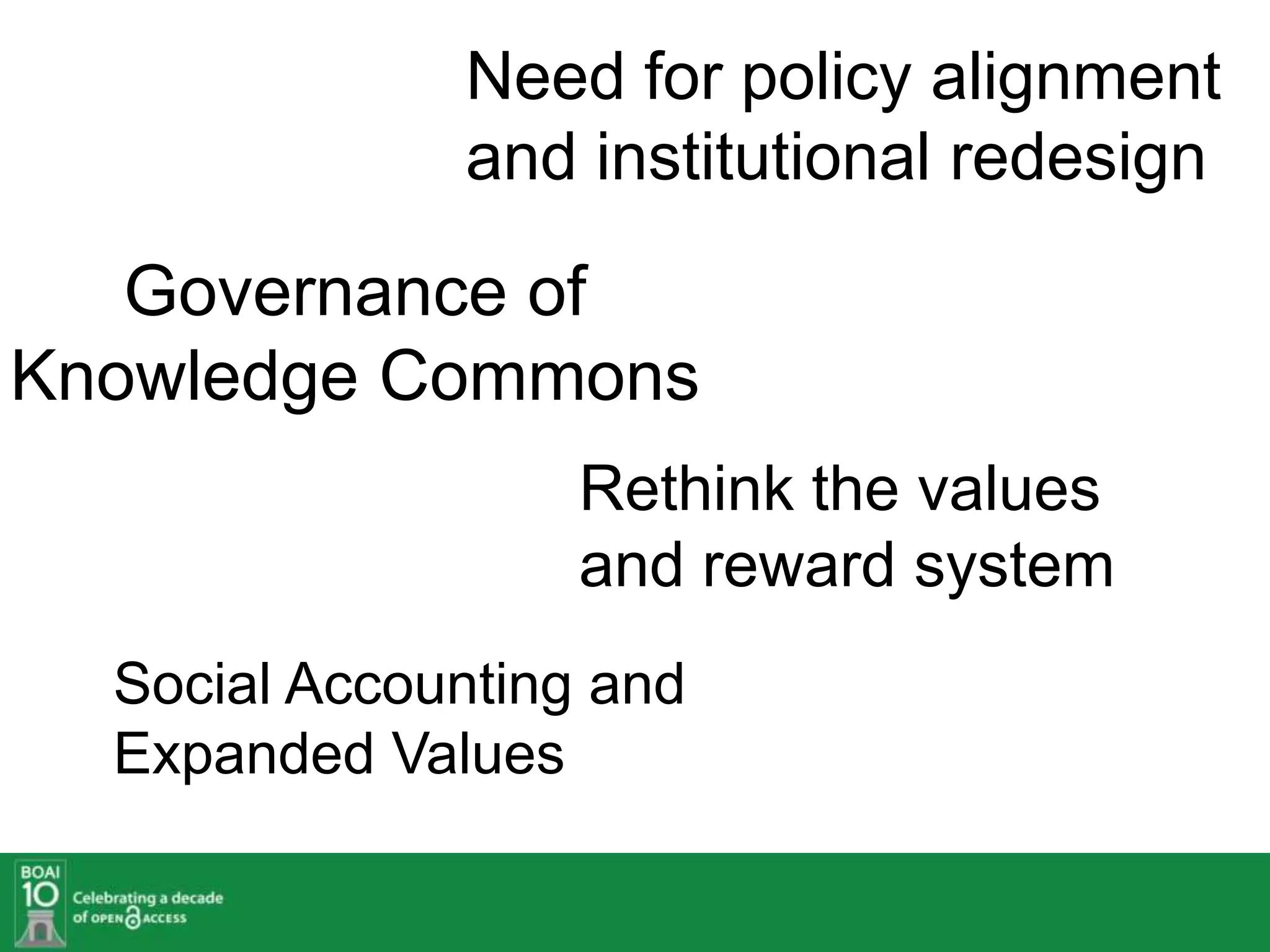
Need for policy alignment
              and institutional redesign

   Governance of
Knowledge Commons
                   Rethink the values
                   and reward system
  Social Accounting and
  Expanded Values
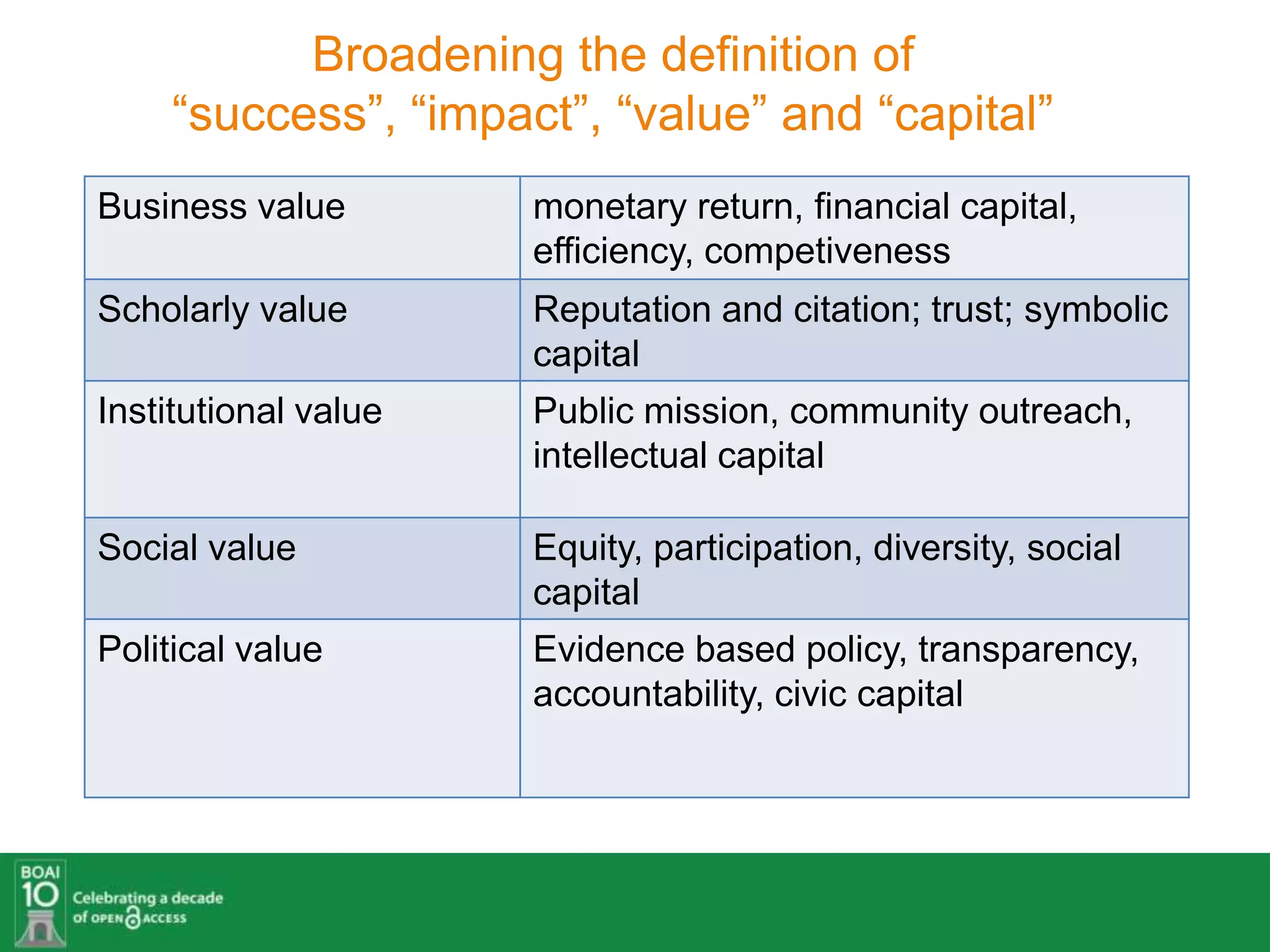
Broadening the definition of
    “success”, “impact”, “value” and “capital”
Business value        monetary return, financial capital,
                      efficiency, competiveness
Scholarly value       Reputation and citation; trust; symbolic
                      capital
Institutional value   Public mission, community outreach,
                      intellectual capital

Social value          Equity, participation, diversity, social
                      capital
Political value       Evidence based policy, transparency,
                      accountability, civic capital
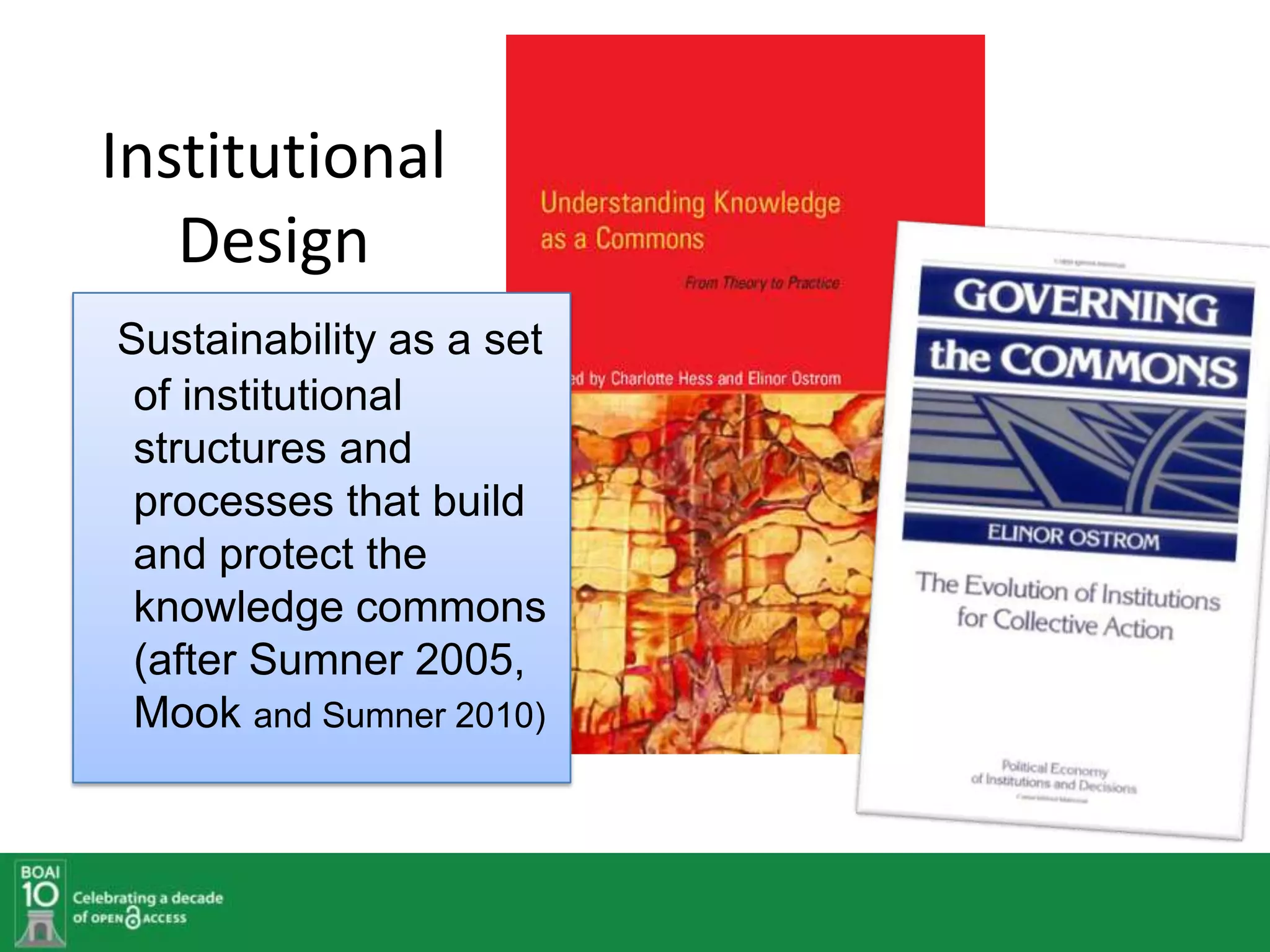
Institutional
   Design
Sustainability as a set
 of institutional
 structures and
 processes that build
 and protect the
 knowledge commons
 (after Sumner 2005,
 Mook and Sumner 2010)
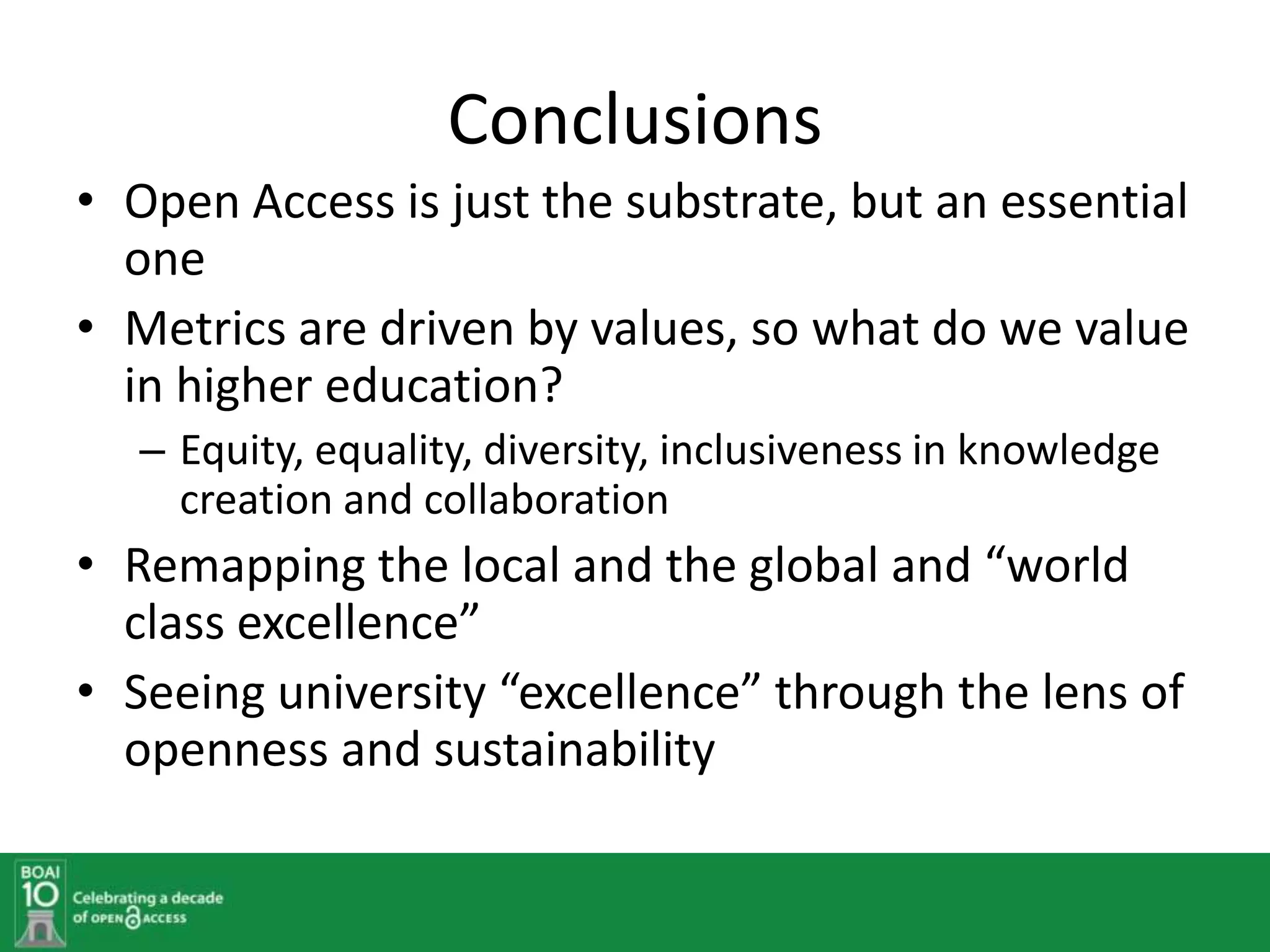
Conclusions
• Open Access is just the substrate, but an essential
  one
• Metrics are driven by values, so what do we value
  in higher education?
   – Equity, equality, diversity, inclusiveness in knowledge
     creation and collaboration
• Remapping the local and the global and “world
  class excellence”
• Seeing university “excellence” through the lens of
  openness and sustainability
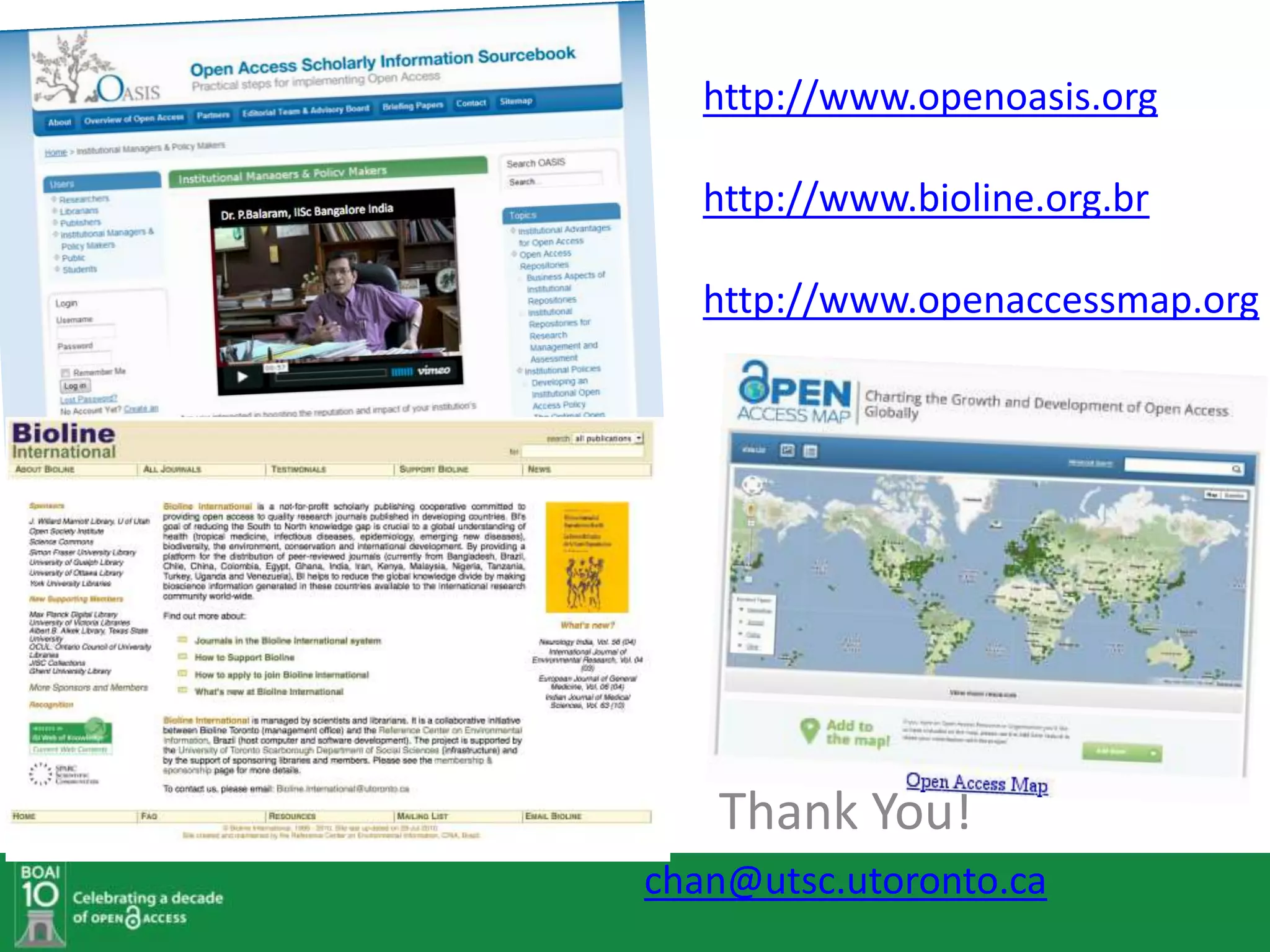
http://www.openoasis.org

   http://www.bioline.org.br

   http://www.openaccessmap.org


   Thank You!
chan@utsc.utoronto.ca

Remapping the Global and Local in Knowledge Production: Roles of Open Access

  • 1.
    Remapping the Globaland the Local in Knowledge Production: Roles of Open Access Global participation in e-research and Leslie Chan scholarly communication: Open access Bioline International strategies for African institutions Centre for Critical Development Studies University of Cape Town, Aug. 10, 2012 University of Toronto Scarborough
  • 2.
    Key points • OpenAccess as an enabler • “Journal” no longer serves the needs of networked scholarship • From Wealth of Nations to Wealth of Networks • Need to rethink measurements of “impact” and values, especially for development • Innovations are happening in the “peripheries” but there are gatekeepers and structural barriers • Aligning funding and reward policies with new value frameworks
  • 3.
    The World ofJournal Publishing According to Thomson’s ISI Science Citation Index Data from 2002 http://www.worldmapper.org/display.php?selected=205
  • 4.
  • 5.
  • 10.
    “… at arecent editorial team meeting, we discussed a research paper from a LMIC author. The science was well done and with a little editing for English, the paper was potentially publishable. But should we send it out for review? The question we were wrestling with was whether its findings were sufficiently new to make it worthy of page space in the journal. This is always a consideration for all manuscripts, since competition for space is intense and a priority is to publish interesting research that adds something new to the field, rather than too many replications of studies already done. So the initial response when deciding whether to send the paper out for peer review was: Reject. We already know this, don't we?”
  • 11.
    “No journal canafford to devote all or even most of its precious page space to studies essentially finding again what others already found, with only the places changing. And this may be a good place to remind authors that we almost never publish prevalence studies, unless they are truly the first ever done (and sometimes not even then), since they tend to be of interest primarily in the countries within which they were conducted.”
  • 12.
    So who decideon what is “new” and legitimate knowledge? And Who have access to that knowledge?
  • 13.
    “We editors seeka global status for our journals, but we shut out the experiences and practices of those living in poverty by our (unconscious) neglect. One group is advantaged, while the other is marginalised.”Richard Horton, THE LANCET • Vol 361 • March 1, 2003
  • 14.
    “Research or reviewsthat cover diseases unlikely to be encountered in the western world will not gather the citations that some editors seek. But if this commercial environment does seriously skew content away from what matters to those people the journal claims to serve, as it surely does at some journals, the culture of medicine is distorted, even harmed.” Richard Horton (2003)
  • 15.
    “Is the scientificpaper a fraud?” “I mean the scientific paper may be a fraud because it misrepresents the processes of thought that accompanied or give rise to the work that is described in the paper. That is the question and I will say right away that my answer to it is ‘yes’. The scientific paper in its orthodox form does embody a totally mistaken conception, even a travesty, of the nature of scientific though”. http://contanatura- hemeroteca.weblog.com.pt/arq Sir Peter Medawar uivo/medawar_paper_fraud.pdf (From a BBC talk, 1964)
  • 16.
  • 17.
    "commons-based peer productionrefers to any coordinated, (chiefly) internet-based effort whereby volunteers contribute project components, and there exists some process to combine them to produce a unified intellectual work. CBPP covers many different types of intellectual output, from software to libraries of quantitative data to human-readable documents (manuals, books, encyclopedias, reviews, blogs, periodicals, and more)” Krowne, Aaron (March 1, 2005). "The FUD based encyclopedia: Dismantling the Fear, Uncertainty and Doubt aimed at Wikipedia and other free knowledge sources". Free Software Magazine.
  • 18.
  • 21.
    Need for policyalignment and institutional redesign Governance of Knowledge Commons Rethink the values and reward system Social Accounting and Expanded Values
  • 22.
    Broadening the definitionof “success”, “impact”, “value” and “capital” Business value monetary return, financial capital, efficiency, competiveness Scholarly value Reputation and citation; trust; symbolic capital Institutional value Public mission, community outreach, intellectual capital Social value Equity, participation, diversity, social capital Political value Evidence based policy, transparency, accountability, civic capital
  • 23.
    Institutional Design Sustainability as a set of institutional structures and processes that build and protect the knowledge commons (after Sumner 2005, Mook and Sumner 2010)
  • 24.
    Conclusions • Open Accessis just the substrate, but an essential one • Metrics are driven by values, so what do we value in higher education? – Equity, equality, diversity, inclusiveness in knowledge creation and collaboration • Remapping the local and the global and “world class excellence” • Seeing university “excellence” through the lens of openness and sustainability
  • 25.
    http://www.openoasis.org http://www.bioline.org.br http://www.openaccessmap.org Thank You! chan@utsc.utoronto.ca

Editor's Notes

  • #2 Reframing the Global and the Local in Knowledge Production: Roles of Open Access  It is generally acknowledged that researchers and institutions in the Global South suffer from knowledge isolation because of poor infrastructure and lack of access to key resources, including the current literature. The remedy is therefore capacity building and the transfer of not only knowledge, but also the institutional framework of knowledge creation from the North to the South. In this context, Open Access to the scholarly literature is seen as a means of bridging the global knowledge gap.  In this presentation, I argue that a key contributor to the continual knowledge divide and the invisibility of knowledge from the Global South is the persistence and dominance of Northern frameworks of research evaluation and quality metrics, coupled with outmoded national and international innovation policies based on exclusion and competitiveness. These narrow measures have tended to skew international research agenda and undermine locally relevant research.  A great opportunity that Open Access provides is the means to develop alternative metrics of research uptake and impact that are more inclusive of knowledge from the South, particularly those with development outcomes. In particular, it is important to re-conceptualize and re-design the metrics of research impact to reflect new scholarly practices and the diverse means of engagement enabled by OA and the new wave of social media tools. At the same time, appropriate policies need to be developed to reward open scholarship and to encourage research sharing — issues of particular importance for ending knowledge isolation. Examples of the new kinds of “invisible college” enabled by networking tools and OA will be presented, and particular attention will be paid to innovations emanating from the periphery.  
  • #4 metrics of total publications and citations.Top 15 countries account for 82% of total publicationsAuthor with African institutional affiliation account for less than 1% of global output, and S. Africa has the highest output. The rest are “invisible”Consequence of trying to publish in “International” journal results in neglect of important local problems and solutions that are appropriate for local conditions.
  • #5 Consequences of publishing in “internatioanlly” indexed journals
  • #15 information, research, and publication capacities are intimately linked. Investigators, publishers, editors, and editorial organisations all have important parts to play in solving this global information poverty.Horton R. North and South: bridging the information gap. Lancet 2000; 355: 2331–36.““institutional racism” has a very precise meaning. According to the UK’s Commission for Racial Equality, institutional racism “occurs when the policies and practices of an organisation result in different outcomes for people from different racial groups”. The term, if one accepts that it is appropriate for medical journals, does not mean that individual editors are racist. It does mean that the scientific, medical, and public-health priorities of the rich world are presented as the norm.”
  • #19 he New Invisible College, Caroline Wagner combines quantitative data and extensive interviews to map the emergence of global science networks and trace the dynamics driving their growth. She argues that the shift from big science to global networks creates unprecedented opportunities for developing countries to tap science's potential. Rather than squander resources in vain efforts to mimic the scientific establishments of the twentieth century, developing country governments can leverage networks by creating incentives for top-notch scientists to focus on research that addresses their concerns and by finding ways to tie knowledge to local problem solving. T