Principle 1: Enable significant work within communities of learnersTeaching for Social Justice
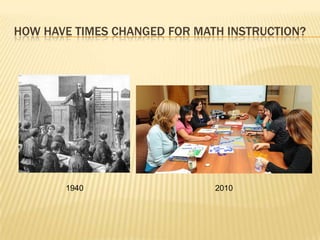
How have times changed for math instruction?19402010
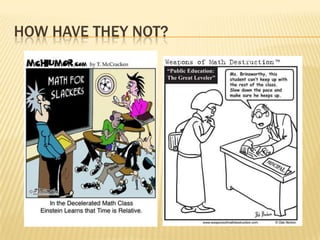
How have they Not?
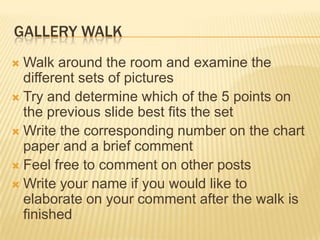
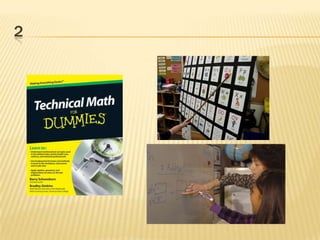
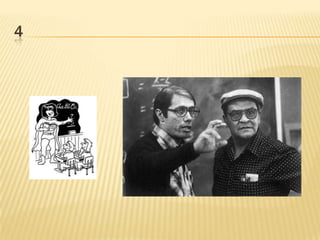
Key Points of principle 1Assume that all students are capable of dealing with complex ideasTranslate and represent knowledge appropriately for studentsProvide opportunities for students to learn academically challenging knowledge and skillsHigh expectations for oneself as a teacherFostering shared sense of responsibility for learning within collaborative groupings
Gallery WalkWalk around the room and examine the different sets of picturesTry and determine which of the 5 points on the previous slide best fits the setWrite the corresponding number on the chart paper and a brief commentFeel free to comment on other postsWrite your name if you would like to elaborate on your comment after the walk is finished
1
2
3
4
5
Think of a personal experience or situation in any math class where you have witnessed this principle in action (either positive or negative)Write the situation on a piece of paper and put it in the bag.  Do not write your name on it!You do not have to share anything if you don’t feel comfortable doing soSharing circle
Sharing circle contd…Now choose another topic from the bag, read it and feel free to share it with the rest of the class.If you pick your own, you may put it back in and choose again.
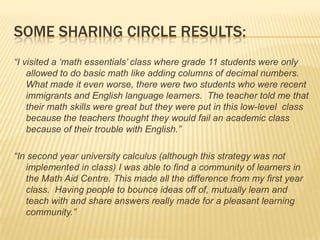
Some sharing circle results:“I visited a ‘math essentials’ class where grade 11 students were only allowed to do basic math like adding columns of decimal numbers.  What made it even worse, there were two students who were recent immigrants and English language learners.  The teacher told me that their math skills were great but they were put in this low-level  class because the teachers thought they would fail an academic class because of their trouble with English.”“In second year university calculus (although this strategy was not implemented in class) I was able to find a community of learners in the Math Aid Centre. This made all the difference from my first year class.  Having people to bounce ideas off of, mutually learn and teach with and share answers really made for a pleasant learning community.”
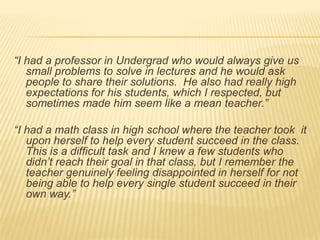
“I had a professor in Undergrad who would always give us small problems to solve in lectures and he would ask people to share their solutions.  He also had really high expectations for his students, which I respected, but sometimes made him seem like a mean teacher.”“I had a math class in high school where the teacher took  it upon herself to help every student succeed in the class.  This is a difficult task and I knew a few students who didn’t reach their goal in that class, but I remember the teacher genuinely feeling disappointed in herself for not being able to help every single student succeed in their own way.”

Presentation

  • 1.
    Principle 1: Enablesignificant work within communities of learnersTeaching for Social Justice
  • 2.
    How have timeschanged for math instruction?19402010
  • 3.
  • 4.
    Key Points ofprinciple 1Assume that all students are capable of dealing with complex ideasTranslate and represent knowledge appropriately for studentsProvide opportunities for students to learn academically challenging knowledge and skillsHigh expectations for oneself as a teacherFostering shared sense of responsibility for learning within collaborative groupings
  • 5.
    Gallery WalkWalk aroundthe room and examine the different sets of picturesTry and determine which of the 5 points on the previous slide best fits the setWrite the corresponding number on the chart paper and a brief commentFeel free to comment on other postsWrite your name if you would like to elaborate on your comment after the walk is finished
  • 6.
  • 7.
  • 8.
  • 9.
  • 10.
  • 11.
    Think of apersonal experience or situation in any math class where you have witnessed this principle in action (either positive or negative)Write the situation on a piece of paper and put it in the bag. Do not write your name on it!You do not have to share anything if you don’t feel comfortable doing soSharing circle
  • 12.
    Sharing circle contd…Nowchoose another topic from the bag, read it and feel free to share it with the rest of the class.If you pick your own, you may put it back in and choose again.
  • 13.
    Some sharing circleresults:“I visited a ‘math essentials’ class where grade 11 students were only allowed to do basic math like adding columns of decimal numbers. What made it even worse, there were two students who were recent immigrants and English language learners. The teacher told me that their math skills were great but they were put in this low-level class because the teachers thought they would fail an academic class because of their trouble with English.”“In second year university calculus (although this strategy was not implemented in class) I was able to find a community of learners in the Math Aid Centre. This made all the difference from my first year class. Having people to bounce ideas off of, mutually learn and teach with and share answers really made for a pleasant learning community.”
  • 14.
    “I had aprofessor in Undergrad who would always give us small problems to solve in lectures and he would ask people to share their solutions. He also had really high expectations for his students, which I respected, but sometimes made him seem like a mean teacher.”“I had a math class in high school where the teacher took it upon herself to help every student succeed in the class. This is a difficult task and I knew a few students who didn’t reach their goal in that class, but I remember the teacher genuinely feeling disappointed in herself for not being able to help every single student succeed in their own way.”