By: LaToya Mallory
3rd Grade Teacher (MATH)

Hot Onion Review

1
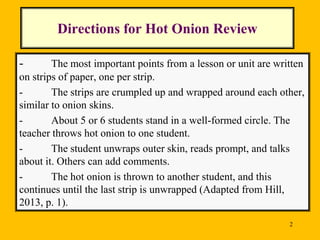
Directions for Hot Onion Review
-

The most important points from a lesson or unit are written
on strips of paper, one per strip.
The strips are crumpled up and wrapped around each other,
similar to onion skins.
About 5 or 6 students stand in a well-formed circle. The
teacher throws hot onion to one student.
The student unwraps outer skin, reads prompt, and talks
about it. Others can add comments.
The hot onion is thrown to another student, and this
continues until the last strip is unwrapped (Adapted from Hill,
2013, p. 1).
2
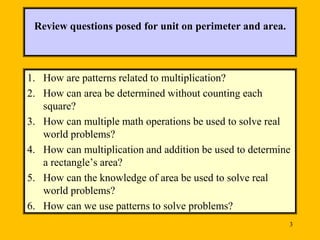
Review questions posed for unit on perimeter and area.

1. How are patterns related to multiplication?
2. How can area be determined without counting each
square?
3. How can multiple math operations be used to solve real
world problems?
4. How can multiplication and addition be used to determine
a rectangle’s area?
5. How can the knowledge of area be used to solve real
world problems?
6. How can we use patterns to solve problems?
3
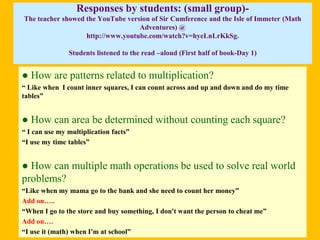
Responses by students: (small group)The teacher showed the YouTube version of Sir Cumference and the Isle of Immeter (Math
Adventures) @
http://www.youtube.com/watch?v=hyeLnLrKkSg.
Students listened to the read –aloud (First half of book-Day 1)

● How are patterns related to multiplication?
“ Like when I count inner squares, I can count across and up and down and do my time
tables”

● How can area be determined without counting each square?
“ I can use my multiplication facts”
“I use my time tables”

● How can multiple math operations be used to solve real world
problems?
“Like when my mama go to the bank and she need to count her money”
Add on…..
“When I go to the store and buy something, I don't want the person to cheat me”
Add on….
“I use it (math) when I'm at school”

4
Responses by students:
• What is area?
“The space in something”
“How much space on a floor”
“How much space on a flat… um……….sa…surface”

• How does knowing the area of a square or rectangle relate to
knowing multiplication facts?
“ So I can count fast”
Add on…..
“When I count inner squares… I can use arrays in my head”
“I can use my time tables when I count arrays”

5
Reflection
The students loved moving around during the review and
ESPECIALLY TOSSING THE PARER AROUND! It
seemed that they were a bit more eager to pick up a question
to read and give a good response. I only used the select
questions because we are not fully done with this particular
unit. By incorporating an aligned picture book in this lesson,
it will help “to expand vocabulary (especially in math),
improve reading comprehension and increase independent
reading” (Cary, 2007, p. 46) for my minority students.

6
Cultural Relevance

Takes place as an outcome of:

• A person’s life
experiences
• Practices
7
Reference
• Cary, Stephen. (2007). Working with English language
learners: Answers to teachers’ ten top questions (2nd ed).
Portsmouth, NH: Heinemann.
• Hill, K. (2013). Interactive Peer-to-peer oral techniques(IPOTs). PhD, MAEd/ESL. University of Alabama at
Birmingham.

8

Mallory.hill.tech tools

  • 1.
    By: LaToya Mallory 3rdGrade Teacher (MATH) Hot Onion Review 1
  • 2.
    Directions for HotOnion Review - The most important points from a lesson or unit are written on strips of paper, one per strip. The strips are crumpled up and wrapped around each other, similar to onion skins. About 5 or 6 students stand in a well-formed circle. The teacher throws hot onion to one student. The student unwraps outer skin, reads prompt, and talks about it. Others can add comments. The hot onion is thrown to another student, and this continues until the last strip is unwrapped (Adapted from Hill, 2013, p. 1). 2
  • 3.
    Review questions posedfor unit on perimeter and area. 1. How are patterns related to multiplication? 2. How can area be determined without counting each square? 3. How can multiple math operations be used to solve real world problems? 4. How can multiplication and addition be used to determine a rectangle’s area? 5. How can the knowledge of area be used to solve real world problems? 6. How can we use patterns to solve problems? 3
  • 4.
    Responses by students:(small group)The teacher showed the YouTube version of Sir Cumference and the Isle of Immeter (Math Adventures) @ http://www.youtube.com/watch?v=hyeLnLrKkSg. Students listened to the read –aloud (First half of book-Day 1) ● How are patterns related to multiplication? “ Like when I count inner squares, I can count across and up and down and do my time tables” ● How can area be determined without counting each square? “ I can use my multiplication facts” “I use my time tables” ● How can multiple math operations be used to solve real world problems? “Like when my mama go to the bank and she need to count her money” Add on….. “When I go to the store and buy something, I don't want the person to cheat me” Add on…. “I use it (math) when I'm at school” 4
  • 5.
    Responses by students: •What is area? “The space in something” “How much space on a floor” “How much space on a flat… um……….sa…surface” • How does knowing the area of a square or rectangle relate to knowing multiplication facts? “ So I can count fast” Add on….. “When I count inner squares… I can use arrays in my head” “I can use my time tables when I count arrays” 5
  • 6.
    Reflection The students lovedmoving around during the review and ESPECIALLY TOSSING THE PARER AROUND! It seemed that they were a bit more eager to pick up a question to read and give a good response. I only used the select questions because we are not fully done with this particular unit. By incorporating an aligned picture book in this lesson, it will help “to expand vocabulary (especially in math), improve reading comprehension and increase independent reading” (Cary, 2007, p. 46) for my minority students. 6
  • 7.
    Cultural Relevance Takes placeas an outcome of: • A person’s life experiences • Practices 7
  • 8.
    Reference • Cary, Stephen.(2007). Working with English language learners: Answers to teachers’ ten top questions (2nd ed). Portsmouth, NH: Heinemann. • Hill, K. (2013). Interactive Peer-to-peer oral techniques(IPOTs). PhD, MAEd/ESL. University of Alabama at Birmingham. 8