FROM INVESTMENT POLICY DESIGN TO IMPLEMENTATION:
MAKING INVESTMENT CLIMATE REFORMS HAPPEN
COLLABORATION BETWEEN
THE OECD AND WBG
April 20, 2015
Outline
I. OECD’s Investment Work
II. WBG Trade and Competitiveness Investment Policy & Promotion Work
III. OECD and WBG Collaboration
1
Outline
I. OECD’s Investment Work
II. WBG Trade and Competitiveness Investment Policy & Promotion Work
III. OECD and WBG Collaboration
2
Improving the Investment Climate – OECD Investment
Work
Policy Framework for Investment
Investment Policy Reviews
Regional cooperation on investment reform
• Southern African Development Community (SADC)
• Association of Southeast Asian Nations (ASEAN)
Sectoral work
• Policy Guidance for Investment in Clean Energy Infrastructure
• Private Participation on infrastructure investment
3
Horizontal
issues
Investment
policy
Investment
promotion and
facilitation
Trade
Competition
Tax
Corporate
governance
Policies for
enabling
responsible
business
conduct
Developing
human
resources for
investment
Public
governance
Infrastructure
investment
Investment
framework for
green growth
Financing
investment
A tool for investment climate
reform taking into account
different dimensions of
development
Social
Environmental
Economic
The 2015
Policy
Framework for
Investment
4
Our Objective – A Sound Enabling Environment for
Domestic and Foreign Investment
Mitigating
investor risk
A sound enabling environment
Integrated
frameworks
Participatory
approaches for
better policy
coherence
Full country-
ownership
Investment Policy Review: Recommendation
5
OECD Support to Investment Climate Reform
Toward Implementation
OECD assessment – Investment Policy Reviews
• Peer learning (regional, across regions, OECD
non-OECD)
• Translation of recommendations into operation
activities
• Measuring and Monitoring: Development of
indicators
=> Partnership with development partners to
support and execute reforms
6
Outline
I. OECD’s Investment Work
II. WBG Trade and Competitiveness Investment Policy & Promotion Work
III. OECD and WBG Collaboration
7
Investment Policy and Promotion (IPP): Three Key Ideas
Investment policy is not about choosing between foreign and
domestic investment
It is about connecting them through global value chains. Trade and investment are
two sides of the same coin.
1
Foreign investment is not a transaction; it is a relationship
An investment policy strategy should not only pursue attraction, but also enable the
establishment, retention and linkages with the domestic productive sector, thereby
maximizing benefits from investment.
2
Not all types of investment are the same
Different types of investment have different effects on socio-economic development
and thus require different policies. Countries should align the type of investment with
different policies
3
8
Investment Cycle
Vision and Strategy
Investment AttractionLinkages
Investment Entry &
Establishment
Retaining Investment
• Investment
promotion
• Locational incentives
• Eliminating barriers
to FDI
• Streamlining entry
procedures
• Elimination of
performance
requirement
• Opening FDI in
services
• Behavioral
incentives
• Non-equity modes
of investment
(NEM)
• Upgrading
investment
protection
guarantees
• Mechanizing
investment retention
and confidence
• Improving
investment aftercare
9
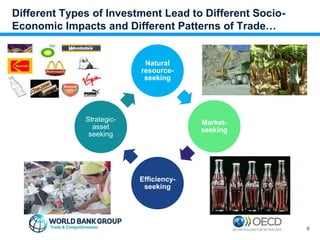
Different Types of Investment Lead to Different Socio-
Economic Impacts and Different Patterns of Trade…
Natural
resource-
seeking
Market-
seeking
Efficiency-
seeking
Strategic-
asset
seeking
9
Assistance Delivery Model
Outcomes
• Updating regulatory
frameworks
• Streamlining
administrative and
regulatory frameworks
• Developing systems that
foster transparency and
predictability.
• Incorporation of new
technologies to improve
government delivery of
services
Activities
• Assisting governments
in identifying and
prioritizing investment
policy and promotion
measures
• Concrete
recommendations
• Supervision/implement
ation support
Impacts
• Increase in generation
of domestic and
foreign investment
• Increase in investment
retained
• Cost savings for
investors and host
countries resulting
from reforms
• Greater regulatory
transparency and
strengthening of rule of
law
10
Our mission is to catalyze investment climate reforms that foster business
competitiveness, connect firms to global markets, maximize the benefits of
private investment, and create jobs.
WBG Instruments of Support
• Developing FDI strategy
• Reducing investment
restrictions, barriers and
procedures
• Investment
promotion/facilitation
• Improving effectiveness of
investment incentives
• Strengthening investor
protection and aftercare to help
retain and expand FDI
• Maximizing linkages and
positive spillovers to local
economy
• Promoting freer regional
investment flows
• Implementation of international
agreements to improve
investment climate
Technical Assistance
• Investment Reform Map:
Providing a logical framework
enabling clients to visualize the
different types of FDI and
setting priorities to design
coherent and concrete
investment policy and
promotion reform agendas
• Rapid IC Advisory: Supporting
IC reforms leveraging
benchmarks and indicators
 Doing Business
 FDI regulations
 Investor motivation surveys
 World Investment and
Political Risk Indicators
 Enterprise surveys
Diagnostics
• Mozambique Competitiveness
and PSD Project ($25million):
 Focusing on business
environment/investment
climate reforms, SME
matching grant facility,
training institutes capacity,
etc.
 IC TA program to government
for the design and
implementation of licensing
reforms in key sectors
(industry and commerce).
• Ethiopia ($250million):
Contributing to job creation by
attracting investments and
improving enterprise
competitiveness in the target
industrial zones and linked
domestic enterprises.
Lending
(Development Policy Operations
and Investment Lending)
11
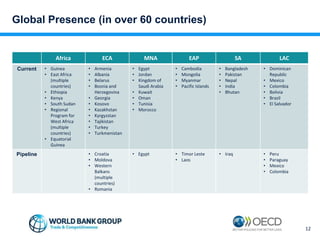
Global Presence (in over 60 countries)
Africa ECA MNA EAP SA LAC
Current • Guinea
• East Africa
(multiple
countries)
• Ethiopia
• Kenya
• South Sudan
• Regional
Program for
West Africa
(multiple
countries)
• Equatorial
Guinea
• Armenia
• Albania
• Belarus
• Bosnia and
Herzegovina
• Georgia
• Kosovo
• Kazakhstan
• Kyrgyzstan
• Tajikistan
• Turkey
• Turkmenistan
• Egypt
• Jordan
• Kingdom of
Saudi Arabia
• Kuwait
• Oman
• Tunisia
• Morocco
• Cambodia
• Mongolia
• Myanmar
• Pacific Islands
• Bangladesh
• Pakistan
• Nepal
• India
• Bhutan
• Dominican
Republic
• Mexico
• Colombia
• Bolivia
• Brazil
• El Salvador
Pipeline • Croatia
• Moldova
• Western
Balkans
(multiple
countries)
• Romania
• Egypt • Timor Leste
• Laos
• Iraq • Peru
• Paraguay
• Mexico
• Colombia
12
Outline
I. OECD’s Investment Work
II. WBG Trade and Competitiveness Investment Policy & Promotion Work
III. OECD and WBG Collaboration
13
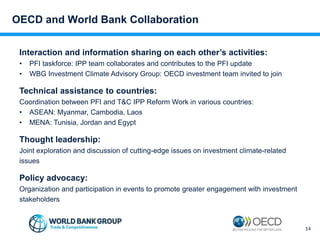
OECD and World Bank Collaboration
Interaction and information sharing on each other’s activities:
• PFI taskforce: IPP team collaborates and contributes to the PFI update
• WBG Investment Climate Advisory Group: OECD investment team invited to join
Technical assistance to countries:
Coordination between PFI and T&C IPP Reform Work in various countries:
• ASEAN: Myanmar, Cambodia, Laos
• MENA: Tunisia, Jordan and Egypt
Thought leadership:
Joint exploration and discussion of cutting-edge issues on investment climate-related
issues
Policy advocacy:
Organization and participation in events to promote greater engagement with investment
stakeholders
14
Examples: OECD - World Bank Group Cooperation in
Myanmar
• OECD introduces
Myanmar investment
climate counterparts
to WBG
• WBG participation in
assessment, task
force meetings
• WBG participation in
public launching of
the IPR of Myanmar
Myanmar IPR
• WBG formulation
of a technical
assistance
programme
based on the IPR
recommendations
and previous
cooperation
Identification of
areas of
implementation
• Roll-out of WBG
and implemented
country
programme
• OECD contributes
to specific
elements of the
programme
Program
implementation
Work starting in
Lao PDR and
Cambodia in 2015
15
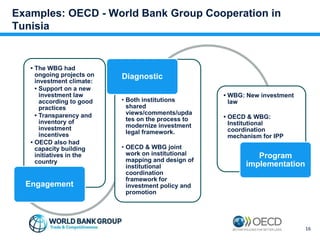
Examples: OECD - World Bank Group Cooperation in
Tunisia
• The WBG had
ongoing projects on
investment climate:
• Support on a new
investment law
according to good
practices
• Transparency and
inventory of
investment
incentives
• OECD also had
capacity building
initiatives in the
country
Engagement
• Both institutions
shared
views/comments/upda
tes on the process to
modernize investment
legal framework.
• OECD & WBG joint
work on institutional
mapping and design of
institutional
coordination
framework for
investment policy and
promotion
Diagnostic
• WBG: New investment
law
• OECD & WBG:
Institutional
coordination
mechanism for IPP
Program
implementation
16
Looking Forward
17
Creating an international platform on Investment for Development
• Post-2015 agenda – aid alone does not suffice
Roundtable on implementing policy reform for investment
• Convened by the WBG, the OECD, in conjunction with other
international organizations (October 2015)
THANK YOU

World Bank Group-OECD presentation on making investment climate reforms happen

  • 1.
    FROM INVESTMENT POLICYDESIGN TO IMPLEMENTATION: MAKING INVESTMENT CLIMATE REFORMS HAPPEN COLLABORATION BETWEEN THE OECD AND WBG April 20, 2015
  • 2.
    Outline I. OECD’s InvestmentWork II. WBG Trade and Competitiveness Investment Policy & Promotion Work III. OECD and WBG Collaboration 1
  • 3.
    Outline I. OECD’s InvestmentWork II. WBG Trade and Competitiveness Investment Policy & Promotion Work III. OECD and WBG Collaboration 2
  • 4.
    Improving the InvestmentClimate – OECD Investment Work Policy Framework for Investment Investment Policy Reviews Regional cooperation on investment reform • Southern African Development Community (SADC) • Association of Southeast Asian Nations (ASEAN) Sectoral work • Policy Guidance for Investment in Clean Energy Infrastructure • Private Participation on infrastructure investment 3
  • 5.
    Horizontal issues Investment policy Investment promotion and facilitation Trade Competition Tax Corporate governance Policies for enabling responsible business conduct Developing human resourcesfor investment Public governance Infrastructure investment Investment framework for green growth Financing investment A tool for investment climate reform taking into account different dimensions of development Social Environmental Economic The 2015 Policy Framework for Investment 4
  • 6.
    Our Objective –A Sound Enabling Environment for Domestic and Foreign Investment Mitigating investor risk A sound enabling environment Integrated frameworks Participatory approaches for better policy coherence Full country- ownership Investment Policy Review: Recommendation 5
  • 7.
    OECD Support toInvestment Climate Reform Toward Implementation OECD assessment – Investment Policy Reviews • Peer learning (regional, across regions, OECD non-OECD) • Translation of recommendations into operation activities • Measuring and Monitoring: Development of indicators => Partnership with development partners to support and execute reforms 6
  • 8.
    Outline I. OECD’s InvestmentWork II. WBG Trade and Competitiveness Investment Policy & Promotion Work III. OECD and WBG Collaboration 7
  • 9.
    Investment Policy andPromotion (IPP): Three Key Ideas Investment policy is not about choosing between foreign and domestic investment It is about connecting them through global value chains. Trade and investment are two sides of the same coin. 1 Foreign investment is not a transaction; it is a relationship An investment policy strategy should not only pursue attraction, but also enable the establishment, retention and linkages with the domestic productive sector, thereby maximizing benefits from investment. 2 Not all types of investment are the same Different types of investment have different effects on socio-economic development and thus require different policies. Countries should align the type of investment with different policies 3 8
  • 10.
    Investment Cycle Vision andStrategy Investment AttractionLinkages Investment Entry & Establishment Retaining Investment • Investment promotion • Locational incentives • Eliminating barriers to FDI • Streamlining entry procedures • Elimination of performance requirement • Opening FDI in services • Behavioral incentives • Non-equity modes of investment (NEM) • Upgrading investment protection guarantees • Mechanizing investment retention and confidence • Improving investment aftercare 9
  • 11.
    Different Types ofInvestment Lead to Different Socio- Economic Impacts and Different Patterns of Trade… Natural resource- seeking Market- seeking Efficiency- seeking Strategic- asset seeking 9
  • 12.
    Assistance Delivery Model Outcomes •Updating regulatory frameworks • Streamlining administrative and regulatory frameworks • Developing systems that foster transparency and predictability. • Incorporation of new technologies to improve government delivery of services Activities • Assisting governments in identifying and prioritizing investment policy and promotion measures • Concrete recommendations • Supervision/implement ation support Impacts • Increase in generation of domestic and foreign investment • Increase in investment retained • Cost savings for investors and host countries resulting from reforms • Greater regulatory transparency and strengthening of rule of law 10 Our mission is to catalyze investment climate reforms that foster business competitiveness, connect firms to global markets, maximize the benefits of private investment, and create jobs.
  • 13.
    WBG Instruments ofSupport • Developing FDI strategy • Reducing investment restrictions, barriers and procedures • Investment promotion/facilitation • Improving effectiveness of investment incentives • Strengthening investor protection and aftercare to help retain and expand FDI • Maximizing linkages and positive spillovers to local economy • Promoting freer regional investment flows • Implementation of international agreements to improve investment climate Technical Assistance • Investment Reform Map: Providing a logical framework enabling clients to visualize the different types of FDI and setting priorities to design coherent and concrete investment policy and promotion reform agendas • Rapid IC Advisory: Supporting IC reforms leveraging benchmarks and indicators  Doing Business  FDI regulations  Investor motivation surveys  World Investment and Political Risk Indicators  Enterprise surveys Diagnostics • Mozambique Competitiveness and PSD Project ($25million):  Focusing on business environment/investment climate reforms, SME matching grant facility, training institutes capacity, etc.  IC TA program to government for the design and implementation of licensing reforms in key sectors (industry and commerce). • Ethiopia ($250million): Contributing to job creation by attracting investments and improving enterprise competitiveness in the target industrial zones and linked domestic enterprises. Lending (Development Policy Operations and Investment Lending) 11
  • 14.
    Global Presence (inover 60 countries) Africa ECA MNA EAP SA LAC Current • Guinea • East Africa (multiple countries) • Ethiopia • Kenya • South Sudan • Regional Program for West Africa (multiple countries) • Equatorial Guinea • Armenia • Albania • Belarus • Bosnia and Herzegovina • Georgia • Kosovo • Kazakhstan • Kyrgyzstan • Tajikistan • Turkey • Turkmenistan • Egypt • Jordan • Kingdom of Saudi Arabia • Kuwait • Oman • Tunisia • Morocco • Cambodia • Mongolia • Myanmar • Pacific Islands • Bangladesh • Pakistan • Nepal • India • Bhutan • Dominican Republic • Mexico • Colombia • Bolivia • Brazil • El Salvador Pipeline • Croatia • Moldova • Western Balkans (multiple countries) • Romania • Egypt • Timor Leste • Laos • Iraq • Peru • Paraguay • Mexico • Colombia 12
  • 15.
    Outline I. OECD’s InvestmentWork II. WBG Trade and Competitiveness Investment Policy & Promotion Work III. OECD and WBG Collaboration 13
  • 16.
    OECD and WorldBank Collaboration Interaction and information sharing on each other’s activities: • PFI taskforce: IPP team collaborates and contributes to the PFI update • WBG Investment Climate Advisory Group: OECD investment team invited to join Technical assistance to countries: Coordination between PFI and T&C IPP Reform Work in various countries: • ASEAN: Myanmar, Cambodia, Laos • MENA: Tunisia, Jordan and Egypt Thought leadership: Joint exploration and discussion of cutting-edge issues on investment climate-related issues Policy advocacy: Organization and participation in events to promote greater engagement with investment stakeholders 14
  • 17.
    Examples: OECD -World Bank Group Cooperation in Myanmar • OECD introduces Myanmar investment climate counterparts to WBG • WBG participation in assessment, task force meetings • WBG participation in public launching of the IPR of Myanmar Myanmar IPR • WBG formulation of a technical assistance programme based on the IPR recommendations and previous cooperation Identification of areas of implementation • Roll-out of WBG and implemented country programme • OECD contributes to specific elements of the programme Program implementation Work starting in Lao PDR and Cambodia in 2015 15
  • 18.
    Examples: OECD -World Bank Group Cooperation in Tunisia • The WBG had ongoing projects on investment climate: • Support on a new investment law according to good practices • Transparency and inventory of investment incentives • OECD also had capacity building initiatives in the country Engagement • Both institutions shared views/comments/upda tes on the process to modernize investment legal framework. • OECD & WBG joint work on institutional mapping and design of institutional coordination framework for investment policy and promotion Diagnostic • WBG: New investment law • OECD & WBG: Institutional coordination mechanism for IPP Program implementation 16
  • 19.
    Looking Forward 17 Creating aninternational platform on Investment for Development • Post-2015 agenda – aid alone does not suffice Roundtable on implementing policy reform for investment • Convened by the WBG, the OECD, in conjunction with other international organizations (October 2015)
  • 20.

Editor's Notes

  • #6 The Policy Framework for Investment is the backbone of OECD investment work. It is a tool for improving the investment climate, looking at 12 policy areas identified as crucial to the policy environment for investors. It takes into account the social, environmental and economic aspects of investment Originally developed in 2006, the PFI has been updated in 2014-2015, to provide the most up-to-date policy options for investment climate reform. The 2015 PFI has been reviewed under the guidance of a global Task Force, co-chaired by Myanmar and Finland through an inclusive multi-stakeholder process, involving governments, like those present, business, civil society and labour organisations. We are pleased to have both co-chairs with us today. The final updated Framework will be released at the OECD Ministerial Council meeting in June 2015. It
  • #7 Integrated frameworks: No single policy can make a difference on its own Mitigating investor risk: investor protection (both domestic and foreign), good domestic financial system, good HR policies (skills, health, working conditions) Holistic approaches: Cross-government models to reforms and implementation lead to better policy coherence; e.g.: A transparent and efficient tax system is good for the investment climate Coherence in trade and investment policy can contribute to GVC integration: higher quality inputs produced by MNEs and local suppliers lead to more competitive exports. Good standards of responsible business conduct in home economies can lead to more responsible investment in host economies through MNEs applying this standards Full country-ownership These are embodied in the Policy Framework for Investment
  • #18 Three-step approach of OECD- WBG group work, where both parties work in close cooperation from the beginning of the OECD Investment Policy Review
  • #19 Three-step approach of OECD- WBG group work, where both parties work in close cooperation from the beginning of the OECD Investment Policy Review
  • #20 Three-step approach of OECD- WBG group work, where both parties work in close cooperation from the beginning of the OECD Investment Policy Review