SME DEVELOPMENT STRATEGY IN LIBYA
Project Steering Committee
& Short Term Action Plan
Tunis, 8 December 2016
• Highlights from the report SMEs in Libya’s
Reconstruction. Preparing for a post-conflict
economy
• Project update
• Questions to PSC members
3
Libya’s economy is over-dependent on hydrocarbons and
dominated by the public sector, with a small private sector
• Oil, gas and related sectors
represented 65% of GDP, 95% of
exports and 96% of budget revenues.
• Before 2011 about 80% of the labour
force was employed in the public
sector.
• 26% of the population is under 15,
while youth unemployment was 48.7%
• The private sector was estimated to
account for 5% of Libya’s GDP.
4
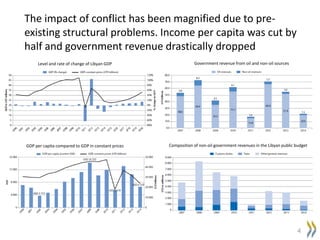
Level and rate of change of Libyan GDP
GDP per capita compared to GDP in constant prices
Government revenue from oil and non-oil sources
Composition of non-oil government revenues in the Libyan public budget
The impact of conflict has been magnified due to pre-
existing structural problems. Income per capita was cut by
half and government revenue drastically dropped
Economic diversification is a long term goal that
should be embedded even in short term measures
5
A revealed comparative advantage analysis of product community classifications
Mechanism Status Way forward
Credit
guarantee
scheme
• Libyan Guarantee Lending Fund (2008):
Ministry of Ec. & Libya Enterprise. Not
fully operational. High default rates. 6-7
years for recovery in case of default. Not
an independent entity.
• Establish a credit guarantee
agency
• Good practices: Caisse Centrale
de Garantie (Morocco); Kafalat
(Lebanon)
Microfinance
• No regulatory framework
• Rural Bank
• IsDB and Ministry of Economy USD 50
million on Islamic microfinance to
unemployed Libyan youth
• Good practices: Morocco; Egypt
Concessional
financing
• Libyan Loan Fund (2010): EUR 188mn.
Under National Council for Economic and
Social Development.
• LLIDF & ESDF: But focus on large
projects.
• Institutionally independent
• Clear strategic value
• Commercial criteria when
possible
Regional SME
funds
• 5 Regional Investment Funds (Tripoli,
Benghazi, Misrata, Dernia and Sebha):
USD 150 million each. Leverage local
banks and include business co-funding.
Not operational.
• Independence and clear
structure
Venture capital • No private equity or venture capital • Incentives
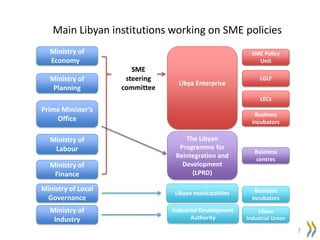
Main Libyan institutions working on SME policies
7
Ministry of
Economy
Ministry of
Planning
Ministry of
Labour
Ministry of
Finance
SME
steering
committee
Libya Enterprise
The Libyan
Programme for
Reintegration and
Development
(LPRD)
Prime Minister’s
Office
SME Policy
Unit
LGLF
Business
centres
LECs
Business
incubators
Ministry of Local
Governance
Ministry of
Industry
Libyan municipalities
Industrial Development
Authority
Business
incubators
Libyan
Industrial Union
8
Sequencing will be critical when planning for economic
recovery
Long term
Strategic action and more sophisticated planning
Developing a vibrant private sector and diversifying the economy
Medium term
Rebuilding the institutions and regulatory framework
Rebuilding the SMEs fabric
Short term
Stabilizing the system and allowing normal operations to resume
Supporting survival of companies
9
The list of policies needed to support SMEs and private
sector is long. Prioritizing for the short term is needed.
Finance
• Ensure payments
system
• Complete dual
banking reform
Inclusion
• Create jobs for youth
and ex-combatants
• Ensure regional
balance
Markets
• SME procurement in
reconstruction
• Trade agreements
and export programs
Regulatory framework
• Real Estate Register
• Regional business
registration one-stop
shops
Capacities
• Government officials
• Entrepreneurs and
businesses
• Highlights from the report SMEs in Libya’s
Reconstruction. Preparing for a post-conflict
economy
• Project update
• Questions to PSC members
Component 2:
Short-Term
Action Plan
• Produce Short-
Term Action
Plan to support
SME policies
with Libyan &
international
stakeholders.
Component 3:
Legal framework
• Broad
consultation of
stakeholders
and good
practices.
• Peer review
and sharing
international
examples.
Component 4:
Assistance in
implementation
• Assistance
implementing
the Short-Term
Action Plan
through
capacity
building.
Component 5:
Access to
finance for SMEs
• Assessment
and assistance
for the
establishment
of an SME
funding
mechanism.
Project end date: September 2018
Phase II: Restructured components
• Highlights from the report SMEs in Libya’s
Reconstruction. Preparing for a post-conflict
economy
• Project update
• Questions to PSC members
• Do you have any suggestions on the components of the
project under Phase II?
• Are there ongoing initiatives with potential synergies for the
OECD’s project?
• Should the OECD include additional institutions or
stakeholders in the project?
• How can the project mitigate the risks related to the current
uncertain political context?
Questions to Project Steering Committee
ANNEX

OECD SME DEVELOPMENT STRATEGY IN LIBYA

  • 1.
    SME DEVELOPMENT STRATEGYIN LIBYA Project Steering Committee & Short Term Action Plan Tunis, 8 December 2016
  • 2.
    • Highlights fromthe report SMEs in Libya’s Reconstruction. Preparing for a post-conflict economy • Project update • Questions to PSC members
  • 3.
    3 Libya’s economy isover-dependent on hydrocarbons and dominated by the public sector, with a small private sector • Oil, gas and related sectors represented 65% of GDP, 95% of exports and 96% of budget revenues. • Before 2011 about 80% of the labour force was employed in the public sector. • 26% of the population is under 15, while youth unemployment was 48.7% • The private sector was estimated to account for 5% of Libya’s GDP.
  • 4.
    4 Level and rateof change of Libyan GDP GDP per capita compared to GDP in constant prices Government revenue from oil and non-oil sources Composition of non-oil government revenues in the Libyan public budget The impact of conflict has been magnified due to pre- existing structural problems. Income per capita was cut by half and government revenue drastically dropped
  • 5.
    Economic diversification isa long term goal that should be embedded even in short term measures 5 A revealed comparative advantage analysis of product community classifications
  • 6.
    Mechanism Status Wayforward Credit guarantee scheme • Libyan Guarantee Lending Fund (2008): Ministry of Ec. & Libya Enterprise. Not fully operational. High default rates. 6-7 years for recovery in case of default. Not an independent entity. • Establish a credit guarantee agency • Good practices: Caisse Centrale de Garantie (Morocco); Kafalat (Lebanon) Microfinance • No regulatory framework • Rural Bank • IsDB and Ministry of Economy USD 50 million on Islamic microfinance to unemployed Libyan youth • Good practices: Morocco; Egypt Concessional financing • Libyan Loan Fund (2010): EUR 188mn. Under National Council for Economic and Social Development. • LLIDF & ESDF: But focus on large projects. • Institutionally independent • Clear strategic value • Commercial criteria when possible Regional SME funds • 5 Regional Investment Funds (Tripoli, Benghazi, Misrata, Dernia and Sebha): USD 150 million each. Leverage local banks and include business co-funding. Not operational. • Independence and clear structure Venture capital • No private equity or venture capital • Incentives
  • 7.
    Main Libyan institutionsworking on SME policies 7 Ministry of Economy Ministry of Planning Ministry of Labour Ministry of Finance SME steering committee Libya Enterprise The Libyan Programme for Reintegration and Development (LPRD) Prime Minister’s Office SME Policy Unit LGLF Business centres LECs Business incubators Ministry of Local Governance Ministry of Industry Libyan municipalities Industrial Development Authority Business incubators Libyan Industrial Union
  • 8.
    8 Sequencing will becritical when planning for economic recovery Long term Strategic action and more sophisticated planning Developing a vibrant private sector and diversifying the economy Medium term Rebuilding the institutions and regulatory framework Rebuilding the SMEs fabric Short term Stabilizing the system and allowing normal operations to resume Supporting survival of companies
  • 9.
    9 The list ofpolicies needed to support SMEs and private sector is long. Prioritizing for the short term is needed. Finance • Ensure payments system • Complete dual banking reform Inclusion • Create jobs for youth and ex-combatants • Ensure regional balance Markets • SME procurement in reconstruction • Trade agreements and export programs Regulatory framework • Real Estate Register • Regional business registration one-stop shops Capacities • Government officials • Entrepreneurs and businesses
  • 10.
    • Highlights fromthe report SMEs in Libya’s Reconstruction. Preparing for a post-conflict economy • Project update • Questions to PSC members
  • 11.
    Component 2: Short-Term Action Plan •Produce Short- Term Action Plan to support SME policies with Libyan & international stakeholders. Component 3: Legal framework • Broad consultation of stakeholders and good practices. • Peer review and sharing international examples. Component 4: Assistance in implementation • Assistance implementing the Short-Term Action Plan through capacity building. Component 5: Access to finance for SMEs • Assessment and assistance for the establishment of an SME funding mechanism. Project end date: September 2018 Phase II: Restructured components
  • 12.
    • Highlights fromthe report SMEs in Libya’s Reconstruction. Preparing for a post-conflict economy • Project update • Questions to PSC members
  • 13.
    • Do youhave any suggestions on the components of the project under Phase II? • Are there ongoing initiatives with potential synergies for the OECD’s project? • Should the OECD include additional institutions or stakeholders in the project? • How can the project mitigate the risks related to the current uncertain political context? Questions to Project Steering Committee
  • 14.