UPDATING THE POLICY
FRAMEWORK FOR
INVESTMENT
2014-2015
• OECD Initiative on Investment for Development launched in
Johannesburg in November 2003;
• PFI developed by 60 OECD and non-OECD participants in a task force
established under the aegis of the OECD Investment Committee with
inputs from 8 OECD committees (horizontal);
• A set principles underpinning a healthy environment for all investors
(Monterrey Consensus);
• Neither prescriptive nor binding, emphasises fundamental principles of rule
of law, transparency, non-discrimination and the protection of property
rights; One size does not fit all;
• The PFI stresses good governance:
• laws and regulations
• design, implementation and evaluation
• Contributes to implementing the OECD Strategy on Development;
• Has been used in various ways: OECD Investment Policy Reviews, in
regional investment programmes, for seminars and capacity building
From principles to a framework
Investment
policy
Investment
promotion and
facilitation
Trade
Competition
Tax
Corporate
governance
Policies for
promoting
responsible
business conduct
Human
resource
development
Infrastructure and
financial sector
development
Public
governance
• A multilaterally-backed
instrument to improve
the investment climate
building on good
practices in OECD and
non-OECD economies
• 82 questions in 10 policy
areas
The PFI is….
Roughly 200 questions grouped into 82 topics in 10 policy areas.
• A checklist, not a questionnaire
• PFI Toolkit to accompany the instrument (www.oecd.org/investment/toolkit)
Comprehensive
• Covering many areas affecting investment and all types of investors: public
& private, foreign & domestic, large & MSME, formal & informal
Non-prescriptive
• No single, uniform approach for all economies at all points in time and
under all conditions.
• Policy decisions involve trade-offs.
Governance
• A sound business environment is a process as much as an outcome.
– Policy design, implementation/enforcement, evaluation/review
– Transparency, stability/predictability, coherence, effectiveness
Policy Framework for Investment (PFI)
– Investment policy
– Investment promotion &
facilitation
– Trade policy
– Competition policy
– Tax policy
– Corporate governance
– Responsible business
conduct
– Human resource
development
– Finance & infrastructure
– Public governance
Policy Framework for Investment - PFI
Policy areas affect investment through the
following channels:
Market opportunities: removing impediments,
including those created by competitors
Costs, availability and quality of inputs
• Capital, labour, infrastructure
• Economies of scale
• Cost of doing business
• Transactions and information costs
Risk and return: policy predictability, stability
and transparency; tax policy
Quality:
• Raising both the economic & social returns
from investment for development
• Ensuring that all stakeholders benefit
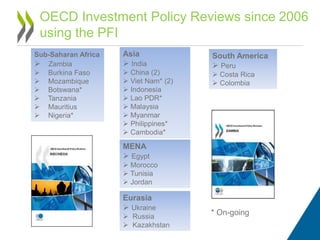
OECD Investment Policy Reviews since 2006
using the PFI
Sub-Saharan Africa
 Zambia
 Burkina Faso
 Mozambique
 Botswana*
 Tanzania
 Mauritius
 Nigeria*
Asia
 India
 China (2)
 Viet Nam* (2)
 Indonesia
 Lao PDR*
 Malaysia
 Myanmar
 Philippines*
 Cambodia*
MENA
 Egypt
 Morocco
 Tunisia
 Jordan
South America
 Peru
 Costa Rica
 Colombia
Eurasia
 Ukraine
 Russia
 Kazakhstan
* On-going
Updating the PFI
• Global landscape of investment has changed since 2006
• New policy challenges
• New players, new priorities, new partners
• Some 30 countries and various regional economic communities
have and are using the PFI
• Need to update the instrument, incorporate new dimensions and
receive users’ feedback!
• Through: Task Force meetings in regions and OECD Headquarters,
meetings of the Advisory Group on Investment and Development,
technical revisions in OECD committees, web-based consultations.
• Task Force co-chaired by Finland and Myanmar
• Task Force meetings to-date: Bali, March 2014 and Pretoria, July
2014
• Objective: Complete by 2015
Existing chapters
– Are there areas within each existing chapter which are missing?
– Are the principles underlying the questions clear?
– Do the questions adequately highlight trade-offs?
– Are the links across policy areas clear?
Development dimension
Gender considerations
Investment in support of green growth: mitigation & adaptation,
renewable energy, energy efficiency
SMEs and informal sector, role of innovation
Global value chains
Indicators, benchmarking, statistics
Dedicated infrastructure investment chapter
What is missing from the PFI?
Policy Framework for Investment (and User’s Toolkit)
www.oecd.org/investment/pfi.htm
www.oecd.org/investment/toolkit/
For further information

Policy Framework for Investment Update

  • 1.
    UPDATING THE POLICY FRAMEWORKFOR INVESTMENT 2014-2015
  • 2.
    • OECD Initiativeon Investment for Development launched in Johannesburg in November 2003; • PFI developed by 60 OECD and non-OECD participants in a task force established under the aegis of the OECD Investment Committee with inputs from 8 OECD committees (horizontal); • A set principles underpinning a healthy environment for all investors (Monterrey Consensus); • Neither prescriptive nor binding, emphasises fundamental principles of rule of law, transparency, non-discrimination and the protection of property rights; One size does not fit all; • The PFI stresses good governance: • laws and regulations • design, implementation and evaluation • Contributes to implementing the OECD Strategy on Development; • Has been used in various ways: OECD Investment Policy Reviews, in regional investment programmes, for seminars and capacity building From principles to a framework
  • 3.
    Investment policy Investment promotion and facilitation Trade Competition Tax Corporate governance Policies for promoting responsible businessconduct Human resource development Infrastructure and financial sector development Public governance • A multilaterally-backed instrument to improve the investment climate building on good practices in OECD and non-OECD economies • 82 questions in 10 policy areas The PFI is….
  • 4.
    Roughly 200 questionsgrouped into 82 topics in 10 policy areas. • A checklist, not a questionnaire • PFI Toolkit to accompany the instrument (www.oecd.org/investment/toolkit) Comprehensive • Covering many areas affecting investment and all types of investors: public & private, foreign & domestic, large & MSME, formal & informal Non-prescriptive • No single, uniform approach for all economies at all points in time and under all conditions. • Policy decisions involve trade-offs. Governance • A sound business environment is a process as much as an outcome. – Policy design, implementation/enforcement, evaluation/review – Transparency, stability/predictability, coherence, effectiveness Policy Framework for Investment (PFI)
  • 5.
    – Investment policy –Investment promotion & facilitation – Trade policy – Competition policy – Tax policy – Corporate governance – Responsible business conduct – Human resource development – Finance & infrastructure – Public governance Policy Framework for Investment - PFI Policy areas affect investment through the following channels: Market opportunities: removing impediments, including those created by competitors Costs, availability and quality of inputs • Capital, labour, infrastructure • Economies of scale • Cost of doing business • Transactions and information costs Risk and return: policy predictability, stability and transparency; tax policy Quality: • Raising both the economic & social returns from investment for development • Ensuring that all stakeholders benefit
  • 6.
    OECD Investment PolicyReviews since 2006 using the PFI Sub-Saharan Africa  Zambia  Burkina Faso  Mozambique  Botswana*  Tanzania  Mauritius  Nigeria* Asia  India  China (2)  Viet Nam* (2)  Indonesia  Lao PDR*  Malaysia  Myanmar  Philippines*  Cambodia* MENA  Egypt  Morocco  Tunisia  Jordan South America  Peru  Costa Rica  Colombia Eurasia  Ukraine  Russia  Kazakhstan * On-going
  • 7.
    Updating the PFI •Global landscape of investment has changed since 2006 • New policy challenges • New players, new priorities, new partners • Some 30 countries and various regional economic communities have and are using the PFI • Need to update the instrument, incorporate new dimensions and receive users’ feedback! • Through: Task Force meetings in regions and OECD Headquarters, meetings of the Advisory Group on Investment and Development, technical revisions in OECD committees, web-based consultations. • Task Force co-chaired by Finland and Myanmar • Task Force meetings to-date: Bali, March 2014 and Pretoria, July 2014 • Objective: Complete by 2015
  • 8.
    Existing chapters – Arethere areas within each existing chapter which are missing? – Are the principles underlying the questions clear? – Do the questions adequately highlight trade-offs? – Are the links across policy areas clear? Development dimension Gender considerations Investment in support of green growth: mitigation & adaptation, renewable energy, energy efficiency SMEs and informal sector, role of innovation Global value chains Indicators, benchmarking, statistics Dedicated infrastructure investment chapter What is missing from the PFI?
  • 9.
    Policy Framework forInvestment (and User’s Toolkit) www.oecd.org/investment/pfi.htm www.oecd.org/investment/toolkit/ For further information