





U n i t e d N a t i o n s C o n f e r e n c e o n T r a d e A n d D e v e l o p m e n t
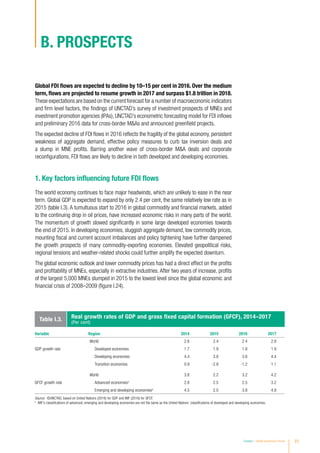
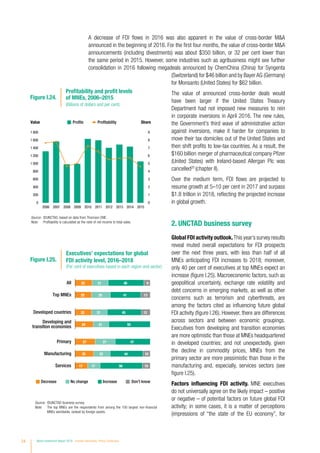
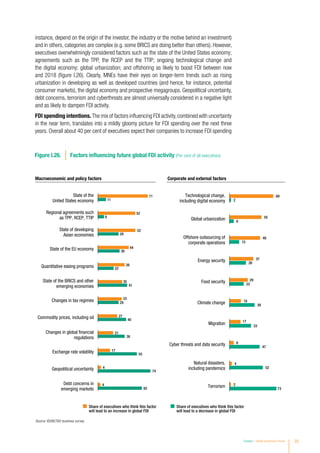
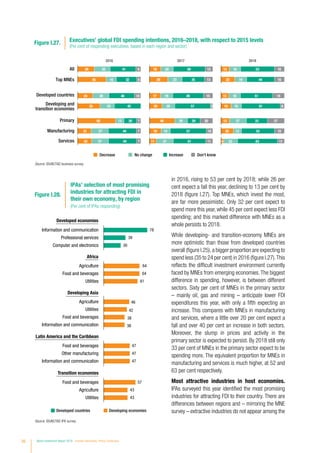
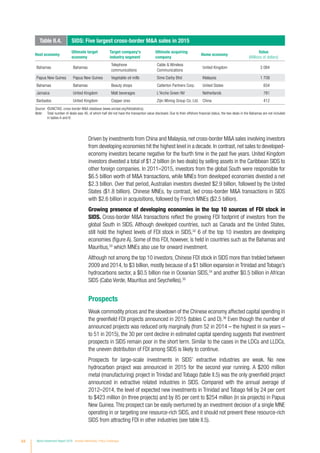
WORLD
INVESTMENT
REPORT
Investor Nationality: Policy Challenges
2016
note
UNITED NATIONS PUBLICATION
Sales No. E.16.II.D.4
ISBN 978-92-1-112902-1
eISBN 978-92-1-058162-2
Copyright © United Nations, 2016
All rights reserved
Printed at United Nations, Geneva
The Division on Investment and Enterprise of UNCTAD serves as the
focal point for all matters related to foreign direct investment and
multinational enterprises in the United Nations System. It builds on
more than four decades of experience and international expertise in
research and policy analysis on investment and enterprise development,
fosters intergovernmental consensus-building, and provides technical
assistance to over 150 countries.
The copyright of the material in this publication rests with UNCTAD.
It may be freely quoted or reprinted,but acknowledgement is requested,
together with a reference to UNCTAD and this Report. A copy of the
publication containing the quotation or reprint should be sent to the
UNCTAD Secretariat (e-mail: diaeinfo@unctad.org).
BAN Ki-moon
Secretary-General of the United Nations
preface
In 2015, global flows of foreign direct investment rose by about 40 per cent, to
$1.8 trillion,the highest level since the global economic and financial crisis began
in 2008. However, this growth did not translate into an equivalent expansion in
productive capacity in all countries.This is a troubling development in light of the
investment needs associated with the newly adopted Sustainable Development
Goals and the ambitious action envisaged in the landmark Paris Agreement on
climate change. This latest World Investment Report presents an Investment
Facilitation Action Package to further enhance the enabling environment for
investment in sustainable development.
The Addis Ababa Action Agenda calls for reorienting the national and
international investment regime towards sustainable development. UNCTAD
plays an important role within the United Nations system in supporting these
endeavours. Its Investment Policy Framework and the Road Map for International
Investment Agreements Reform have been used by more than 100 countries in
reviewing their investment treaty networks and formulating a new generation of
international investment policies.
Regulations on the ownership and control of companies are essential in the
investment regime of most countries. But in an era of complex multinational
ownership structures, the rationale and effectiveness of this policy instrument
needs a comprehensive re-assessment. This Report provides insights on the
ownership structures of multinational enterprises (MNEs), and maps the global
network of corporate entities using data on millions of parents and affiliates. It
analyses national and international investment policy practices worldwide, and
proposes a new framework for handling ownership issues.
This latest edition of the World Investment Report is being issued as the world
embarks on the crucial work of implementing the landmark 2030 Agenda for
Sustainable Development and the Paris Agreement on climate change. The
key findings and policy recommendations of the Report are far reaching and
can contribute to our efforts to uphold the promise to leave no one behind and
build a world of dignity for all. I therefore commend this Report to a wide global
audience.
iv World Investment Report 2016 Investor Nationality: Policy Challenges
ABBREVIATIONS
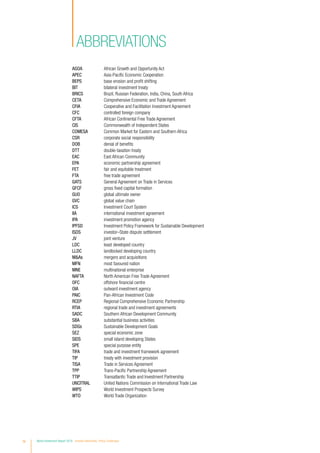
AGOA	 African Growth and Opportunity Act
APEC	 Asia-Pacific Economic Cooperation
BEPS	 base erosion and profit shifting
BIT	 bilateral investment treaty
BRICS	 Brazil, Russian Federation, India, China, South Africa
CETA	 Comprehensive Economic and Trade Agreement
CFIA	 Cooperative and Facilitation Investment Agreement
CFC	 controlled foreign company
CFTA	 African Continental Free Trade Agreement
CIS	 Commonwealth of Independent States
COMESA	 Common Market for Eastern and Southern Africa
CSR	 corporate social responsibility
DOB	 denial of benefits
DTT	 double-taxation treaty
EAC	 East African Community
EPA	 economic partnership agreement
FET	 fair and equitable treatment
FTA	 free trade agreement
GATS	 General Agreement on Trade in Services
GFCF	 gross fixed capital formation
GUO	 global ultimate owner
GVC	 global value chain
ICS	 Investment Court System
IIA	 international investment agreement
IPA	 investment promotion agency
IPFSD	 Investment Policy Framework for Sustainable Development
ISDS	 investor–State dispute settlement
JV	 joint venture
LDC	 least developed country
LLDC	 landlocked developing country
M&As	 mergers and acquisitions
MFN	 most favoured nation
MNE	 multinational enterprise
NAFTA	 North American Free Trade Agreement
OFC	 offshore financial centre
OIA	 outward investment agency
PAIC	 Pan-African Investment Code
RCEP	 Regional Comprehensive Economic Partnership
RTIA	 regional trade and investment agreements
SADC	 Southern African Development Community
SBA	 substantial business activities
SDGs	 Sustainable Development Goals
SEZ	 special economic zone
SIDS	 small island developing States
SPE	 special purpose entity
TIFA	 trade and investment framework agreement
TIP	 treaty with investment provision
TISA	 Trade in Services Agreement
TPP	 Trans-Pacific Partnership Agreement
TTIP	 Transatlantic Trade and Investment Partnership
UNCITRAL	 United Nations Commission on International Trade Law
WIPS	 World Investment Prospects Survey
WTO	 World Trade Organization
vWorld Investment Report 2016 Investor Nationality: Policy Challenges
acknowledgements
The World Investment Report 2016 (WIR16) was prepared by a team led by
James  X. Zhan. The team members included Richard Bolwijn, Bruno Casella,
Joseph Clements, Hamed El Kady, Kumi Endo, Michael Hanni, Joachim Karl, Hee
Jae Kim, Ventzislav Kotetzov, Guoyong Liang, Hafiz Mirza, Shin Ohinata, Diana
Rosert, Astrit Sulstarova, Claudia Trentini, Elisabeth Tuerk, Joerg Weber and Kee
Hwee Wee.
Research support and inputs were provided by Eleonora Alabrese, Dafina
Atanasova, Jorun Baumgartner, Giannakopoulos Charalampos, Malvika Monga,
Francesco Tenuta and Linli Yu. Contributions were also made by Thomas van
Giffen, Natalia Guerra, Isya Kresnadi, Kálmán Kalotay, Abraham Negash, Elizabeth
Odunlami, Jacqueline Salguero Huaman, Ilan Strauss, Tadelle Taye and Paul
Wessendorp.
Statistical assistance was provided by Bradley Boicourt, Mohamed Chiraz Baly and
Lizanne Martinez.
The manuscript was edited with the assistance of Caroline Lambert and copy-
edited by Lise Lingo; it was typeset by Laurence Duchemin and Teresita Ventura.
Pablo Cortizo was responsible for the overall design of the report, including charts,
tables, maps and infographics, as well as DTP. Sophie Combette and Nadège
Hadjemian designed the cover. Production and dissemination of WIR16 were
supported by Elisabeth Anodeau-Mareschal, Anne Bouchet, Rosalina Goyena,
Peter Navarette and Katia Vieu.
At various stages of preparation, in particular during the experts meetings
organized to discuss drafts of WIR16, the team benefited from comments and
inputs received from these experts: Rolf Adlung, Carlo Altomonte, Paul Beamish,
Nathalie Bernasconi, Martin Brauch, Jansen Calamita, Jeremy Clegg, Davide
Del Prete, Henrik Dellestrand, Chantal Dupasquier, Xiaolan Fu, Masataka Fujita,
Thomas Jost, Markus Krajewski, John Lee, Hemant Merchant, Loukas Mistelis,
Premila Nazareth, Sheila Page, Svein Parnas, Markus Perkams, Sergey Ripinsky,
Leslie Robinson,Armando Rungi, Pierre Sauvé, Boštjan Skalar, Roger Strange and
Jan van den Tooren. The report also benefitted from the discussions of the G20
Trade and Investment Working Group and the UNCTAD Expert Meeting “Taking
Stock of IIA Reform”, as well as comments received from the WAIPA Secretariat.
Also acknowledged are comments received from other UNCTAD divisions as
part of the internal peer review process, as well as comments from the Office
of the Secretary-General as part of the clearance process. The United Nations
Cartographic Section provided advice for the regional maps.
Numerous officials of central banks, government agencies, international
organizations and non-governmental organizations also contributed to WIR16. In
addition, UNCTAD appreciates the support of all the MNE and IPA executives who
responded to its 2016 World Investment Prospects and Investment Promotion
Agencies surveys. The financial support of the Governments of Finland, Sweden
and Switzerland is gratefully acknowledged.
viiWorld Investment Report 2016 Investor Nationality: Policy Challenges
table of
contents
PREFACE. . . . . . . . . . . . . . . . . . . . . . . . . . . . . . . . . . . . . . . . . . . . . . . . . . . iii
ABBREVIATIONS . . . . . . . . . . . . . . . . . . . . . . . . . . . . . . . . . . . . . . . . . . . . . iv
ACKNOWLEDGEMENTS. . . . . . . . . . . . . . . . . . . . . . . . . . . . . . . . . . . . . . . . v
KEY MESSAGES. . . . . . . . . . . . . . . . . . . . . . . . . . . . . . . . . . . . . . . . . . . . . x
CHAPTER I. GLOBAL INVESTMENT TRENDS . . . . . . . . . . . . . . . . . . . . . . . 1
A.	 CURRENT TRENDS. . . . . . . . . . . . . . . . . . . . . . . . . . . . . . . . . . . . . . . . . 2
1.	 FDI by geography . . . . . . . . . . . . . . . . . . . . . . . . . . . . . . . . . . . . . . . . . . 3
2.	 FDI by sector and industry. . . . . . . . . . . . . . . . . . . . . . . . . . . . . . . . . . . 13
3.	 Investment flows through offshore financial hubs . . . . . . . . . . . . . . . . . . 19
B.	PROSPECTS. . . . . . . . . . . . . . . . . . . . . . . . . . . . . . . . . . . . . . . . . . . . . 23
1.	 Key factors influencing future FDI flows . . . . . . . . . . . . . . . . . . . . . . . . . 23
2.	 UNCTAD business survey. . . . . . . . . . . . . . . . . . . . . . . . . . . . . . . . . . . . 24
C.	INTERNATIONAL PRODUCTION . . . . . . . . . . . . . . . . . . . . . . . . . . . . . . . 29
CHAPTER II. REGIONAL INVESTMENT TRENDS. . . . . . . . . . . . . . . . . . . . 35
INTRODUCTION. . . . . . . . . . . . . . . . . . . . . . . . . . . . . . . . . . . . . . . . . . . . . 36
DEVELOPING ECONOMIES . . . . . . . . . . . . . . . . . . . . . . . . . . . . . . . . . . . . 38
1.	Africa . . . . . . . . . . . . . . . . . . . . . . . . . . . . . . . . . . . . . . . . . . . . . . . . . .38
2.	 Developing Asia . . . . . . . . . . . . . . . . . . . . . . . . . . . . . . . . . . . . . . . . . . 43
3.	 Latin America and the Caribbean . . . . . . . . . . . . . . . . . . . . . . . . . . . . . . 51
4.	 Transition economies . . . . . . . . . . . . . . . . . . . . . . . . . . . . . . . . . . . . . . 57
5.	 Developed countries. . . . . . . . . . . . . . . . . . . . . . . . . . . . . . . . . . . . . . . 64
STRUCTURALLY WEAK, VULNERABLE AND SMALL ECONOMIES . . . . . . . . 71
1.	 Least developed countries. . . . . . . . . . . . . . . . . . . . . . . . . . . . . . . . . . . 71
2.	 Landlocked developing countries . . . . . . . . . . . . . . . . . . . . . . . . . . . . . . 76
3.	 Small Island developing states. . . . . . . . . . . . . . . . . . . . . . . . . . . . . . . . 81
viii World Investment Report 2016 Investor Nationality: Policy Challenges
CHAPTER III. RECENT POLICY DEVELOPMENTS AND KEY ISSUES . . . . . . 89
A.	NATIONAL INVESTMENT POLICIES . . . . . . . . . . . . . . . . . . . . . . . . . . . . 90
1.	 Overall trends . . . . . . . . . . . . . . . . . . . . . . . . . . . . . . . . . . . . . . . . . . . . 90
2.	 Foreign investment and national security-related policies . . . . . . . . . . . . 94
B.	INTERNATIONAL INVESTMENT POLICIES . . . . . . . . . . . . . . . . . . . . . . 101
1.	 Recent developments in the IIA regime. . . . . . . . . . . . . . . . . . . . . . . . . 101
2.	 Investment dispute settlement . . . . . . . . . . . . . . . . . . . . . . . . . . . . . . . 104
3.	 IIA reform: taking stock and charting the way forward. . . . . . . . . . . . . . 108
C.	INVESTMENT FACILITATION: FILLING A SYSTEMIC GAP . . . . . . . . . . . . 117
CHAPTER IV. INVESTOR NATIONALITY: POLICY CHALLENGES . . . . . . . . 123
A.	INTRODUCTION: THE INVESTOR NATIONALITY CONUNDRUM. . . . . . . . 124
1.	 Complex ownership and investor nationality . . . . . . . . . . . . . . . . . . . . . 124
2.	 The importance of ownership and nationality in investment policy. . . . . . 125
3.	A new perspective on MNE ownership structures
for investment policymakers. . . . . . . . . . . . . . . . . . . . . . . . . . . . . . . . . 126
B.	COMPLEXITY IN MNE OWNERSHIP STRUCTURES . . . . . . . . . . . . . . . . 129
1.	 Mapping MNE ownership structures . . . . . . . . . . . . . . . . . . . . . . . . . . 129
2.	 Characteristics of highly complex MNEs . . . . . . . . . . . . . . . . . . . . . . . . 134
3.	 Determinants of complexity in MNE ownership structures . . . . . . . . . . . 136
4.	 Looking ahead: trends in ownership complexity. . . . . . . . . . . . . . . . . . . 141
C.	COMPLEX OWNERSHIP OF AFFILIATES AND
THE BLURRING OF INVESTOR NATIONALITY . . . . . . . . . . . . . . . . . . . . 144
1.	 A new «bottom-up» perspective on ownership structures . . . . . . . . . . . 144
2.	 The ownership matrix and the investor nationality mismatch index. . . . . 147
3.	 A bottom-up map of affiliate ownership. . . . . . . . . . . . . . . . . . . . . . . . .153
ixWorld Investment Report 2016 Investor Nationality: Policy Challenges
D. Complex ownership: investment policy implications . . . . . . . 159
1.	 Complex ownership and investor nationality: policy implications . . . . . . . 159
2.	 Ownership and control in national investment policies. . . . . . . . . . . . . . 161
3.	 Ownership and control in international investment policies. . . . . . . . . . . 171
E. Rethinking ownership-based investment policies . . . . . . . . . . 182
1. National investment policy: the effectiveness of ownership rules. . . . . . . 182
2. International investment policy: the systemic implications
of complex ownership. . . . . . . . . . . . . . . . . . . . . . . . . . . . . . . . . . . . . .185
REFERENCES . . . . . . . . . . . . . . . . . . . . . . . . . . . . . . . . . . . . . . . . . . . . 190
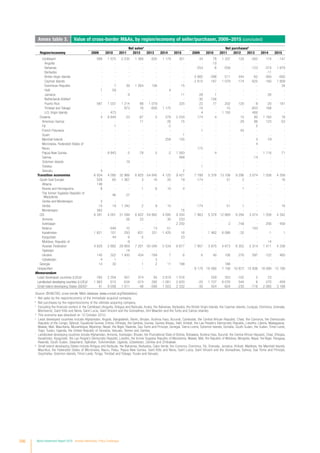
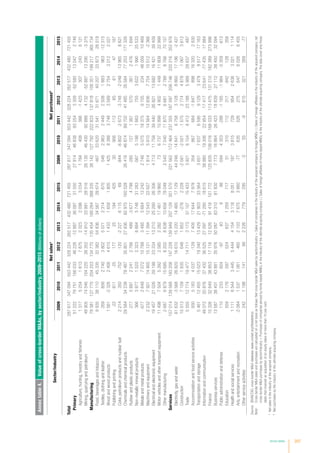
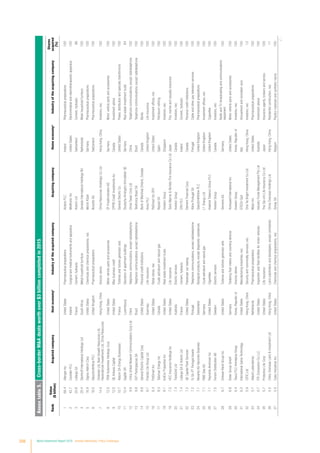
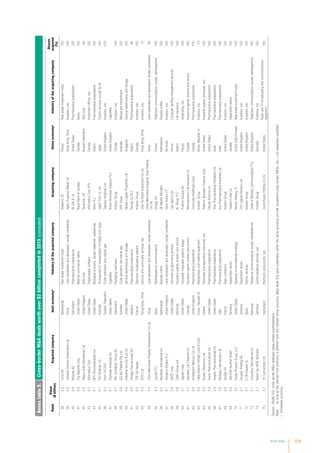
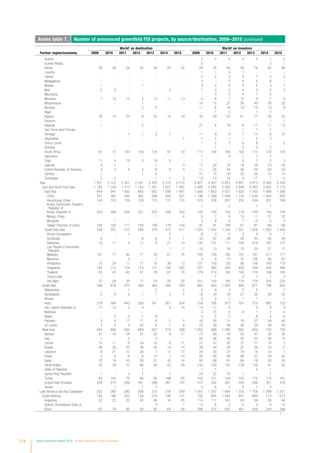
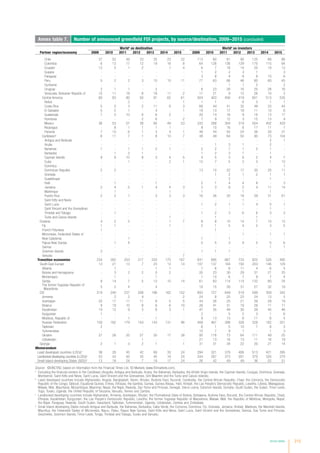
ANNEX TABLES . . . . . . . . . . . . . . . . . . . . . . . . . . . . . . . . . . . . . . . . . . . 195
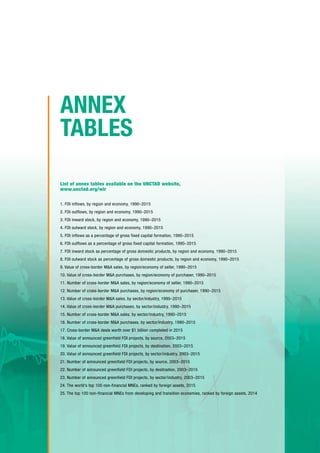
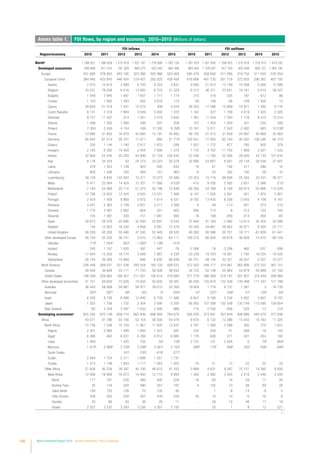
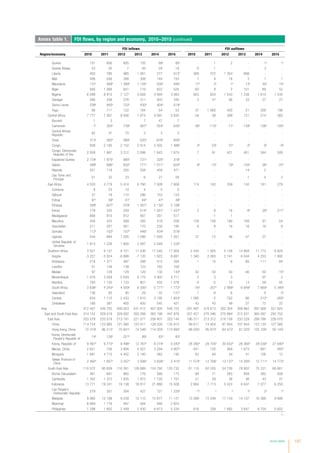
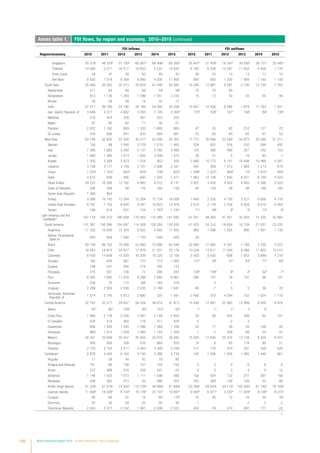
Annex table 1. FDI flows, by region and economy, 2010–2015. . . . . . . . . . .  196
Annex table 2. FDI stock, by region and economy, 2000, 2010 and 2015. . .  200
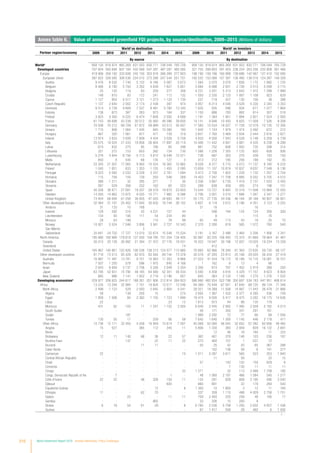
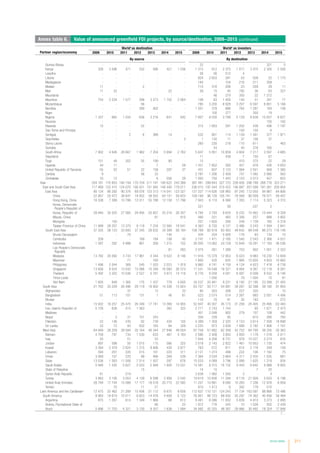
Annex table 3. Value of cross-border MAs, by region/economy
of seller/purchaser, 2009–2015. . . . . . . . . . . . . . . . . . . . . .  204
Annex table 4. Value of cross-border MAs,
by sector/industry, 2009–2015. . . . . . . . . . . . . . . . . . . . . . . 207
Annex table 5. Cross-border MA deals worth over
$3 billion completed in 2015. . . . . . . . . . . . . . . . . . . . . . . . .  208
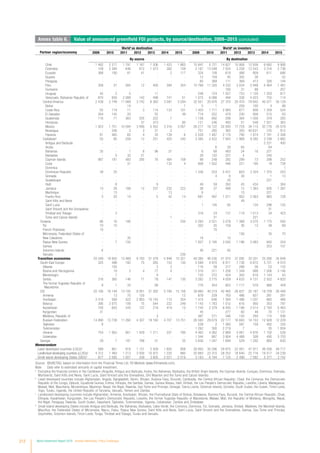
Annex table 6. Value of announced greenfield FDI projects,
by source/destination, 2009–2015. . . . . . . . . . . . . . . . . . . .  210
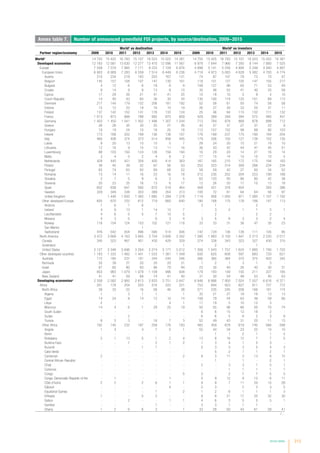
Annex table 7. Number of announced greenfield FDI projects,
by source/destination, 2009–2015. . . . . . . . . . . . . . . . . . . .  213
KEY MESSAGES
GLOBAL INVESTMENT TRENDS
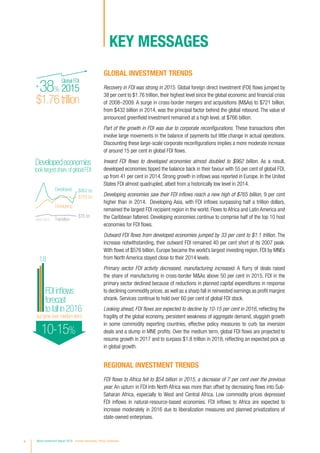
Recovery in FDI was strong in 2015. Global foreign direct investment (FDI) flows jumped by
38 per cent to $1.76 trillion, their highest level since the global economic and financial crisis
of 2008–2009. A surge in cross-border mergers and acquisitions (MAs) to $721 billion,
from $432 billion in 2014, was the principal factor behind the global rebound. The value of
announced greenfield investment remained at a high level, at $766 billion.
Part of the growth in FDI was due to corporate reconfigurations. These transactions often
involve large movements in the balance of payments but little change in actual operations.
Discounting these large-scale corporate reconfigurations implies a more moderate increase
of around 15 per cent in global FDI flows.
Inward FDI flows to developed economies almost doubled to $962 billion. As a result,
developed economies tipped the balance back in their favour with 55 per cent of global FDI,
up from 41 per cent in 2014. Strong growth in inflows was reported in Europe. In the United
States FDI almost quadrupled, albeit from a historically low level in 2014.
Developing economies saw their FDI inflows reach a new high of $765 billion, 9 per cent
higher than in 2014. Developing Asia, with FDI inflows surpassing half a trillion dollars,
remained the largest FDI recipient region in the world. Flows to Africa and Latin America and
the Caribbean faltered. Developing economies continue to comprise half of the top 10 host
economies for FDI flows.
Outward FDI flows from developed economies jumped by 33 per cent to $1.1 trillion. The
increase notwithstanding, their outward FDI remained 40 per cent short of its 2007 peak.
With flows of $576 billion, Europe became the world’s largest investing region. FDI by MNEs
from North America stayed close to their 2014 levels.
Primary sector FDI activity decreased, manufacturing increased. A flurry of deals raised
the share of manufacturing in cross-border MAs above 50 per cent in 2015. FDI in the
primary sector declined because of reductions in planned capital expenditures in response
to declining commodity prices, as well as a sharp fall in reinvested earnings as profit margins
shrank. Services continue to hold over 60 per cent of global FDI stock.
Looking ahead, FDI flows are expected to decline by 10-15 per cent in 2016, reflecting the
fragility of the global economy, persistent weakness of aggregate demand, sluggish growth
in some commodity exporting countries, effective policy measures to curb tax inversion
deals and a slump in MNE profits. Over the medium term, global FDI flows are projected to
resume growth in 2017 and to surpass $1.8 trillion in 2018, reflecting an expected pick up
in global growth.
REGIONAL INVESTMENT TRENDS
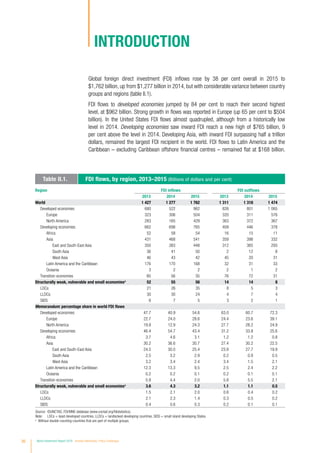
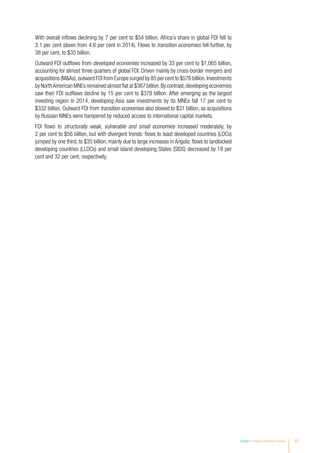
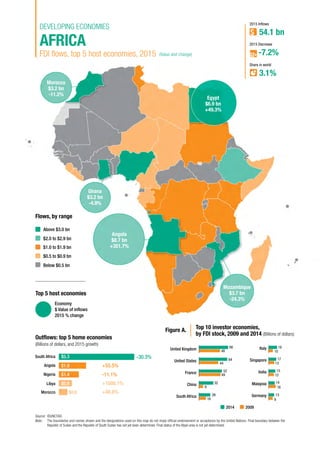
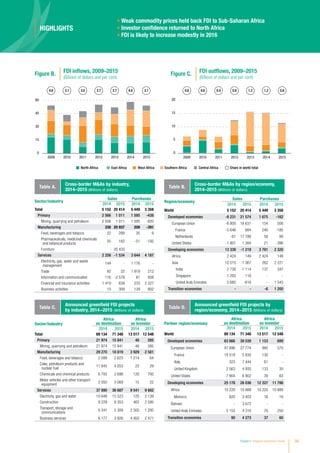
FDI flows to Africa fell to $54 billion in 2015, a decrease of 7 per cent over the previous
year. An upturn in FDI into North Africa was more than offset by decreasing flows into Sub-
Saharan Africa, especially to West and Central Africa. Low commodity prices depressed
FDI inflows in natural-resource-based economies. FDI inflows to Africa are expected to
increase moderately in 2016 due to liberalization measures and planned privatizations of
state-owned enterprises.
annualrecord
ISDScases
$1.76trillion
chaper1-2
GlobalFDI
2015
Developedeconomies
tooklargestshareofglobalFDI
Developed $962 bn
Developing
$765 bn
Transition
$35 bn
2005–2015
largestinvestor
regionin2015
Europe
$576bn
38%+
annualrecord
$1.76trillion
chaper1-2
GlobalFDI
2015
Developedeconomies
tooklargestshareofglobalFDI
Developed $962 bn
Developing
$765 bn
Transition
$35 bn
2005–2015
largestinvestor
regionin2015
Europe
$576bn
38%+
$1.76trillion
FDIinflows
forecast
tofallin2016
1.8
10-15%
Developedeconomies
tooklargestshareofglobalFDI
Developed $962 bn
Developing
$765 bn
Transition
$35 bn
2005–2015
largestinvestor
regionin2015
Europe
$576bn
butgrowovermedium-term
$54bn
Africa
2015
x World Investment Report 2016 Investor Nationality: Policy Challenges
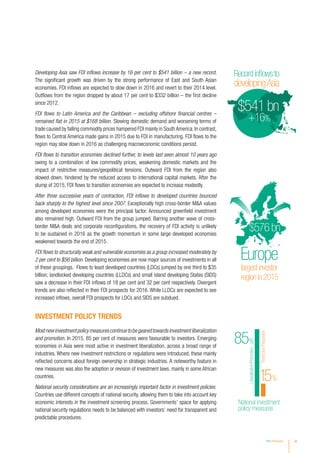
Developing Asia saw FDI inflows increase by 16 per cent to $541 billion – a new record.
The significant growth was driven by the strong performance of East and South Asian
economies. FDI inflows are expected to slow down in 2016 and revert to their 2014 level.
Outflows from the region dropped by about 17 per cent to $332 billion – the first decline
since 2012.
FDI flows to Latin America and the Caribbean – excluding offshore financial centres –
remained flat in 2015 at $168 billion. Slowing domestic demand and worsening terms of
trade caused by falling commodity prices hampered FDI mainly in SouthAmerica.In contrast,
flows to Central America made gains in 2015 due to FDI in manufacturing. FDI flows to the
region may slow down in 2016 as challenging macroeconomic conditions persist.
FDI flows to transition economies declined further, to levels last seen almost 10 years ago
owing to a combination of low commodity prices, weakening domestic markets and the
impact of restrictive measures/geopolitical tensions. Outward FDI from the region also
slowed down, hindered by the reduced access to international capital markets. After the
slump of 2015, FDI flows to transition economies are expected to increase modestly.
After three successive years of contraction, FDI inflows to developed countries bounced
back sharply to the highest level since 2007. Exceptionally high cross-border MA values
among developed economies were the principal factor. Announced greenfield investment
also remained high. Outward FDI from the group jumped. Barring another wave of cross-
border MA deals and corporate reconfigurations, the recovery of FDI activity is unlikely
to be sustained in 2016 as the growth momentum in some large developed economies
weakened towards the end of 2015.
FDI flows to structurally weak and vulnerable economies as a group increased moderately by
2 per cent to $56 billion. Developing economies are now major sources of investments in all
of these groupings. Flows to least developed countries (LDCs) jumped by one third to $35
billion; landlocked developing countries (LLDCs) and small island developing States (SIDS)
saw a decrease in their FDI inflows of 18 per cent and 32 per cent respectively. Divergent
trends are also reflected in their FDI prospects for 2016. While LLDCs are expected to see
increased inflows, overall FDI prospects for LDCs and SIDS are subdued.
INVESTMENT POLICY TRENDS
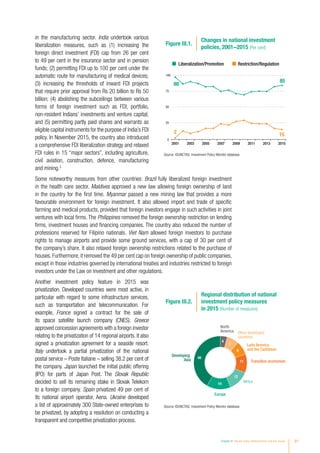
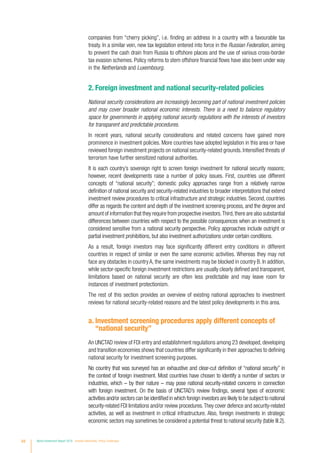
Mostnewinvestmentpolicymeasurescontinuetobegearedtowardsinvestmentliberalization
and promotion. In 2015, 85 per cent of measures were favourable to investors. Emerging
economies in Asia were most active in investment liberalization, across a broad range of
industries. Where new investment restrictions or regulations were introduced, these mainly
reflected concerns about foreign ownership in strategic industries. A noteworthy feature in
new measures was also the adoption or revision of investment laws, mainly in some African
countries.
National security considerations are an increasingly important factor in investment policies.
Countries use different concepts of national security, allowing them to take into account key
economic interests in the investment screening process. Governments’ space for applying
national security regulations needs to be balanced with investors’ need for transparent and
predictable procedures.
3,304
annualrecord
ISDScases
70New
$1.76trillion
chaper1-2
GlobalFDI
2015
1.8
Developedeconomies
tooklargestshareofglobalFDI
Developed $962 bn
Developing
$765 bn
Transition
$35 bn
2005–2015
largestinvestor
regionin2015
Europe
$576bn
38%+
Inflowsto
Developed
economies
attheirhighest
levelsince2007
Recordinflowsto
$541bn
+16%
developingAsia
Complexownership:
100MNEs
500affiliates
50countries
85%
15%
Restriction/Regulation
Liberalisation/Promotion
National investment
policy measures
chaper3
xiKey Messages
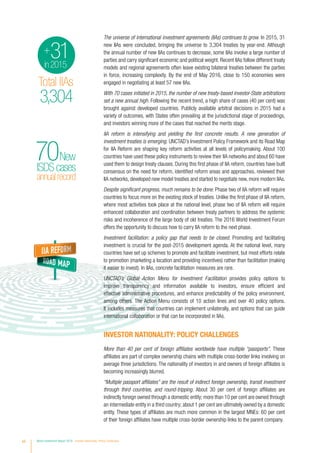
The universe of international investment agreements (IIAs) continues to grow. In 2015, 31
new IIAs were concluded, bringing the universe to 3,304 treaties by year-end. Although
the annual number of new IIAs continues to decrease, some IIAs involve a large number of
parties and carry significant economic and political weight. Recent IIAs follow different treaty
models and regional agreements often leave existing bilateral treaties between the parties
in force, increasing complexity. By the end of May 2016, close to 150 economies were
engaged in negotiating at least 57 new IIAs.
With 70 cases initiated in 2015, the number of new treaty-based investor-State arbitrations
set a new annual high. Following the recent trend, a high share of cases (40 per cent) was
brought against developed countries. Publicly available arbitral decisions in 2015 had a
variety of outcomes, with States often prevailing at the jurisdictional stage of proceedings,
and investors winning more of the cases that reached the merits stage.
IIA reform is intensifying and yielding the first concrete results. A new generation of
investment treaties is emerging. UNCTAD’s Investment Policy Framework and its Road Map
for IIA Reform are shaping key reform activities at all levels of policymaking. About 100
countries have used these policy instruments to review their IIA networks and about 60 have
used them to design treaty clauses. During this first phase of IIA reform, countries have built
consensus on the need for reform, identified reform areas and approaches, reviewed their
IIA networks, developed new model treaties and started to negotiate new, more modern IIAs.
Despite significant progress, much remains to be done. Phase two of IIA reform will require
countries to focus more on the existing stock of treaties. Unlike the first phase of IIA reform,
where most activities took place at the national level, phase two of IIA reform will require
enhanced collaboration and coordination between treaty partners to address the systemic
risks and incoherence of the large body of old treaties. The 2016 World Investment Forum
offers the opportunity to discuss how to carry IIA reform to the next phase.
Investment facilitation: a policy gap that needs to be closed. Promoting and facilitating
investment is crucial for the post-2015 development agenda. At the national level, many
countries have set up schemes to promote and facilitate investment, but most efforts relate
to promotion (marketing a location and providing incentives) rather than facilitation (making
it easier to invest). In IIAs, concrete facilitation measures are rare.
UNCTAD’s Global Action Menu for Investment Facilitation provides policy options to
improve transparency and information available to investors, ensure efficient and
effective administrative procedures, and enhance predictability of the policy environment,
among others. The Action Menu consists of 10 action lines and over 40 policy options.
It includes measures that countries can implement unilaterally, and options that can guide
international collaboration or that can be incorporated in IIAs.
INVESTOR NATIONALITY: POLICY CHALLENGES
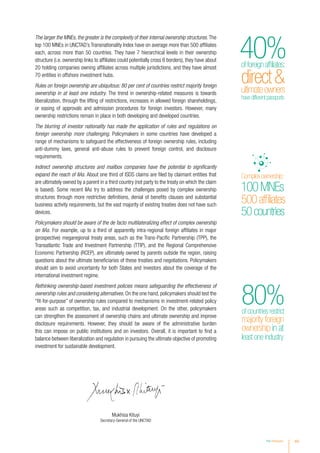
More than 40 per cent of foreign affiliates worldwide have multiple “passports”. These
affiliates are part of complex ownership chains with multiple cross-border links involving on
average three jurisdictions. The nationality of investors in and owners of foreign affiliates is
becoming increasingly blurred.
“Multiple passport affiliates” are the result of indirect foreign ownership, transit investment
through third countries, and round-tripping. About 30 per cent of foreign affiliates are
indirectly foreign owned through a domestic entity; more than 10 per cent are owned through
an intermediate entity in a third country; about 1 per cent are ultimately owned by a domestic
entity. These types of affiliates are much more common in the largest MNEs: 60 per cent
of their foreign affiliates have multiple cross-border ownership links to the parent company.
Total IIAs
3,304
31in2015
+
annualrecord
ISDScases
70New
$1.76trillion
chaper1-2
GlobalFDI
2015
Developedeconomies
tooklargestshareofglobalFDI
Developed $962 bn
Developing
$765 bn
Transition
$35 bn
2005–2015
38%+
National investment
policy measures
Total IIAs
3,304
31in2015
+
annualrecord
ISDScases
70New
$1.76trillion
chaper1-2
GlobalFDI
2015
Developedeconomies
tooklargestshareofglobalFDI
Developed $962 bn
Developing
$765 bn
Transition
$35 bn
2005–2015
$576bn
38%+
xii World Investment Report 2016 Investor Nationality: Policy Challenges
The larger the MNEs, the greater is the complexity of their internal ownership structures. The
top 100 MNEs in UNCTAD’s Transnationality Index have on average more than 500 affiliates
each, across more than 50 countries. They have 7 hierarchical levels in their ownership
structure (i.e. ownership links to affiliates could potentially cross 6 borders), they have about
20 holding companies owning affiliates across multiple jurisdictions, and they have almost
70 entities in offshore investment hubs.
Rules on foreign ownership are ubiquitous: 80 per cent of countries restrict majority foreign
ownership in at least one industry. The trend in ownership-related measures is towards
liberalization, through the lifting of restrictions, increases in allowed foreign shareholdings,
or easing of approvals and admission procedures for foreign investors. However, many
ownership restrictions remain in place in both developing and developed countries.
The blurring of investor nationality has made the application of rules and regulations on
foreign ownership more challenging. Policymakers in some countries have developed a
range of mechanisms to safeguard the effectiveness of foreign ownership rules, including
anti-dummy laws, general anti-abuse rules to prevent foreign control, and disclosure
requirements.
Indirect ownership structures and mailbox companies have the potential to significantly
expand the reach of IIAs. About one third of ISDS claims are filed by claimant entities that
are ultimately owned by a parent in a third country (not party to the treaty on which the claim
is based). Some recent IIAs try to address the challenges posed by complex ownership
structures through more restrictive definitions, denial of benefits clauses and substantial
business activity requirements, but the vast majority of existing treaties does not have such
devices.
Policymakers should be aware of the de facto multilateralizing effect of complex ownership
on IIAs. For example, up to a third of apparently intra-regional foreign affiliates in major
(prospective) megaregional treaty areas, such as the Trans-Pacific Partnership (TPP), the
Transatlantic Trade and Investment Partnership (TTIP), and the Regional Comprehensive
Economic Partnership (RCEP), are ultimately owned by parents outside the region, raising
questions about the ultimate beneficiaries of these treaties and negotiations. Policymakers
should aim to avoid uncertainty for both States and investors about the coverage of the
international investment regime.
Rethinking ownership-based investment policies means safeguarding the effectiveness of
ownership rules and considering alternatives. On the one hand, policymakers should test the
“fit-for-purpose” of ownership rules compared to mechanisms in investment-related policy
areas such as competition, tax, and industrial development. On the other, policymakers
can strengthen the assessment of ownership chains and ultimate ownership and improve
disclosure requirements. However, they should be aware of the administrative burden
this can impose on public institutions and on investors. Overall, it is important to find a
balance between liberalization and regulation in pursuing the ultimate objective of promoting
investment for sustainable development.
of countries restrict
majority foreign
ownership in at
least one industry
80%
Inflowsto
Developed
economies
attheirhighest
levelsince2007
Recordinflowsto
$541bn
+16%
developingAsia
Complexownership:
100MNEs
500affiliates
50countries
directultimateowners
havedifferentpassports
offoreignaffiliates:
40%
directultimateowners
havedifferentpassports
offoreignaffiliates:
xiiiKey Messages
Mukhisa Kituyi
Secretary-General of the UNCTAD
CHAPTER I
GLOBAL
INVESTMENT
TRENDS
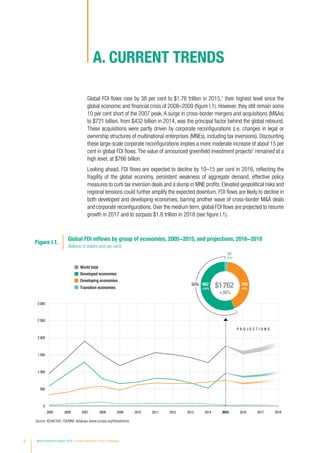
Global FDI flows rose by 38 per cent to $1.76 trillion in 2015,1
their highest level since the
global economic and financial crisis of 2008–2009 (figure I.1). However, they still remain some
10 per cent short of the 2007 peak. A surge in cross-border mergers and acquisitions (MAs)
to $721 billion, from $432 billion in 2014, was the principal factor behind the global rebound.
These acquisitions were partly driven by corporate reconfigurations (i.e. changes in legal or
ownership structures of multinational enterprises (MNEs), including tax inversions). Discounting
these large-scale corporate reconfigurations implies a more moderate increase of about 15 per
cent in global FDI flows. The value of announced greenfield investment projects2
remained at a
high level, at $766 billion.
Looking ahead, FDI flows are expected to decline by 10–15 per cent in 2016, reflecting the
fragility of the global economy, persistent weakness of aggregate demand, effective policy
measures to curb tax inversion deals and a slump in MNE profits. Elevated geopolitical risks and
regional tensions could further amplify the expected downturn. FDI flows are likely to decline in
both developed and developing economies, barring another wave of cross-border MA deals
and corporate reconfigurations. Over the medium term, global FDI flows are projected to resume
growth in 2017 and to surpass $1.8 trillion in 2018 (see figure I.1).
A. CURRENT TRENDS
Developed economies
World total
Transition economies
Developing economies
Figure I.1.
Global FDI inflows by group of economies, 2005−2015, and projections, 2016−2018
(Billions of dollars and per cent)
0
500
1 000
1 500
2 000
2 500
3 000
2005 20102006 2007 2008 2009 2011 2012 2013 2014 2015 2016 2017 2018
$1762
+38%
35
962
+84%
-38%
765
+9%
55%
P R O J E C T I O N S
Source: ©UNCTAD, FDI/MNE database (www.unctad.org/fdistatistics).
2 World Investment Report 2016 Investor Nationality: Policy Challenges
1. FDI by geography
a. FDI inflows
FDI recovery was strong in 2015, but lacked productive impact. Global FDI flows
jumped by 38 per cent to $1,762 billion. The rise in FDI was somewhat at odds with the
global macroeconomic environment, which was dominated by slowing growth in emerging
markets and a sharp decline in commodity prices. The principal explanation for this seeming
inconsistency was a surge in cross-border MAs, especially in developed economies.
Although FDI through cross-border MAs can boost productive investments, a number of deals
concluded in 2015 can be attributed to corporate reconfiguration, including tax inversions. Such
reconfigurations often involve large movements in the balance of payments but little change in
actual MNE operations.This trend was especially apparent in the United States and Europe, but
was also noticeable in the developing world. In Hong Kong (China), a part of the sharp uptick in
inward FDI can be attributed to the restructuring of two large conglomerates (chapter II).
Discounting these deals implies, however, a more moderate increase of about 15 per cent in
global FDI flows. In 2015, announced greenfield investments reached $766 billion – an 8 per
cent rise from the previous year. The rise was more pronounced in developed economies (up
12 per cent), signalling a potential rebound in FDI in productive assets as macroeconomic and
financial conditions improve.
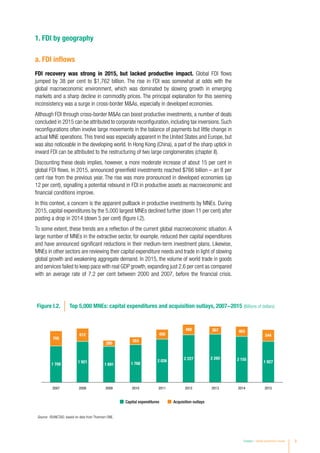
In this context, a concern is the apparent pullback in productive investments by MNEs. During
2015, capital expenditures by the 5,000 largest MNEs declined further (down 11 per cent) after
posting a drop in 2014 (down 5 per cent) (figure I.2).
To some extent, these trends are a reflection of the current global macroeconomic situation. A
large number of MNEs in the extractive sector, for example, reduced their capital expenditures
and have announced significant reductions in their medium-term investment plans. Likewise,
MNEs in other sectors are reviewing their capital expenditure needs and trade in light of slowing
global growth and weakening aggregate demand. In 2015, the volume of world trade in goods
and services failed to keep pace with real GDP growth, expanding just 2.6 per cent as compared
with an average rate of 7.2 per cent between 2000 and 2007, before the financial crisis.
Source:	 ©UNCTAD, based on data from Thomson ONE.
Figure I.2. Top 5,000 MNEs: capital expenditures and acquisition outlays, 2007−2015 (Billions of dollars)
1 708
705
2007
1 921
612
2008
1 691
280
2009
1 768
353
2010
2 026
456
2011
2 227
488
2012
2 260
367
2013
2 155
463
2014
1 927
544
2015
Capital expenditures Acquisition outlays
Chapter I Global Investment Trends 3
The meagre growth in trade volumes after the financial crisis, while in part explained by weaker
economic growth and fixed capital formation, has also been partly attributed to a significant
slowdown in the pace of international vertical specialization.
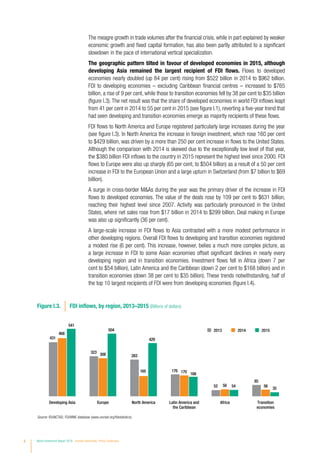
The geographic pattern tilted in favour of developed economies in 2015, although
developing Asia remained the largest recipient of FDI flows. Flows to developed
economies nearly doubled (up 84 per cent) rising from $522 billion in 2014 to $962 billion.
FDI to developing economies – excluding Caribbean financial centres – increased to $765
billion, a rise of 9 per cent, while those to transition economies fell by 38 per cent to $35 billion
(figure I.3).The net result was that the share of developed economies in world FDI inflows leapt
from 41 per cent in 2014 to 55 per cent in 2015 (see figure I.1), reverting a five-year trend that
had seen developing and transition economies emerge as majority recipients of these flows.
FDI flows to North America and Europe registered particularly large increases during the year
(see figure I.3). In North America the increase in foreign investment, which rose 160 per cent
to $429 billion, was driven by a more than 250 per cent increase in flows to the United States.
Although the comparison with 2014 is skewed due to the exceptionally low level of that year,
the $380 billion FDI inflows to the country in 2015 represent the highest level since 2000. FDI
flows to Europe were also up sharply (65 per cent, to $504 billion) as a result of a 50 per cent
increase in FDI to the European Union and a large upturn in Switzerland (from $7 billion to $69
billion).
A surge in cross-border MAs during the year was the primary driver of the increase in FDI
flows to developed economies. The value of the deals rose by 109 per cent to $631 billion,
reaching their highest level since 2007. Activity was particularly pronounced in the United
States, where net sales rose from $17 billion in 2014 to $299 billion. Deal making in Europe
was also up significantly (36 per cent).
A large-scale increase in FDI flows to Asia contrasted with a more modest performance in
other developing regions. Overall FDI flows to developing and transition economies registered
a modest rise (6 per cent). This increase, however, belies a much more complex picture, as
a large increase in FDI to some Asian economies offset significant declines in nearly every
developing region and in transition economies. Investment flows fell in Africa (down 7 per
cent to $54 billion), Latin America and the Caribbean (down 2 per cent to $168 billion) and in
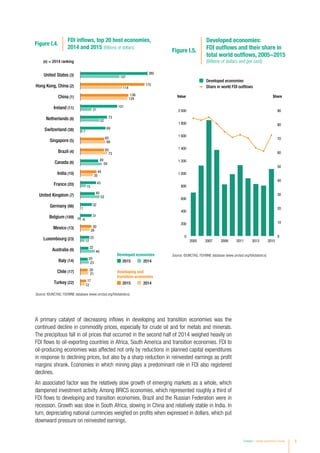
transition economies (down 38 per cent to $35 billion). These trends notwithstanding, half of
the top 10 largest recipients of FDI were from developing economies (figure I.4).
Source: ©UNCTAD, FDI/MNE database (www.unctad.org/fdistatistics).
Figure I.3. FDI inflows, by region, 2013–2015 (Billions of dollars)
2013 2014 2015
Developing Asia North AmericaEurope Transition
economies
Latin America and
the Caribbean
Africa
431
323
283
176
52
85
468
306
165 170
58 56
541
504
429
168
54
35
4 World Investment Report 2016 Investor Nationality: Policy Challenges
A primary catalyst of decreasing inflows in developing and transition economies was the
continued decline in commodity prices, especially for crude oil and for metals and minerals.
The precipitous fall in oil prices that occurred in the second half of 2014 weighed heavily on
FDI flows to oil-exporting countries in Africa, South America and transition economies. FDI to
oil-producing economies was affected not only by reductions in planned capital expenditures
in response to declining prices, but also by a sharp reduction in reinvested earnings as profit
margins shrank. Economies in which mining plays a predominant role in FDI also registered
declines.
An associated factor was the relatively slow growth of emerging markets as a whole, which
dampened investment activity. Among BRICS economies, which represented roughly a third of
FDI flows to developing and transition economies, Brazil and the Russian Federation were in
recession. Growth was slow in South Africa, slowing in China and relatively stable in India. In
turn, depreciating national currencies weighed on profits when expressed in dollars, which put
downward pressure on reinvested earnings.
Source: ©UNCTAD, FDI/MNE database (www.unctad.org/fdistatistics).
FDI inflows, top 20 host economies,
2014 and 2015 (Billions of dollars)
Figure I.4.
Developed economies
Developing and
transition economies
20142015
20142015
(x) = 2014 ranking
380
175
136
101
73
69
65
65
49
44
43
40
32
31
30
25
22
20
20
17
107
114
129
31
52
7
68
73
59
35
15
52
1
-9
26
12
40
23
21
12
United States (3)
Hong Kong, China (2)
China (1)
Ireland (11)
Netherlands (8)
Switzerland (38)
Singapore (5)
Brazil (4)
Canada (6)
India (10)
France (20)
United Kingdom (7)
Germany (98)
Belgium (189)
Mexico (13)
Luxembourg (23)
Australia (9)
Italy (14)
Chile (17)
Turkey (22)
Figure I.5.
Developed economies:
FDI outflows and their share in
total world outflows, 2005−2015
(Billions of dollars and per cent)
ShareValue
Developed economies
Share in world FDI outflows
0
10
20
30
40
50
60
70
80
90
0
200
400
600
800
1 000
1 200
1 400
1 600
1 800
2 000
2005 2007 2009 2011 2013 2015
Source: ©UNCTAD, FDI/MNE database (www.unctad.org/fdistatistics).
Chapter I Global Investment Trends 5
b. FDI outflows
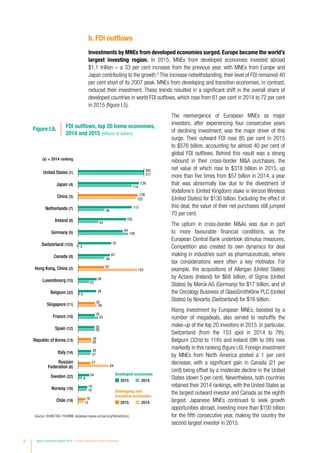
Investments by MNEs from developed economies surged. Europe became the world’s
largest investing region. In 2015, MNEs from developed economies invested abroad
$1.1 trillion – a 33 per cent increase from the previous year, with MNEs from Europe and
Japan contributing to the growth.3
This increase notwithstanding, their level of FDI remained 40
per cent short of its 2007 peak. MNEs from developing and transition economies, in contrast,
reduced their investment. These trends resulted in a significant shift in the overall share of
developed countries in world FDI outflows, which rose from 61 per cent in 2014 to 72 per cent
in 2015 (figure I.5).
The reemergence of European MNEs as major
investors, after experiencing four consecutive years
of declining investment, was the major driver of this
surge. Their outward FDI rose 85 per cent in 2015
to $576 billion, accounting for almost 40 per cent of
global FDI outflows. Behind this result was a strong
rebound in their cross-border MA purchases, the
net value of which rose to $318 billion in 2015, up
more than five times from $57 billion in 2014, a year
that was abnormally low due to the divestment of
Vodafone’s (United Kingdom) stake in Verizon Wireless
(United States) for $130 billion. Excluding the effect of
this deal, the value of their net purchases still jumped
70 per cent.
The upturn in cross-border MAs was due in part
to more favourable financial conditions, as the
European Central Bank undertook stimulus measures.
Competition also created its own dynamics for deal
making in industries such as pharmaceuticals, where
tax considerations were often a key motivator. For
example, the acquisitions of Allergan (United States)
by Actavis (Ireland) for $68 billion, of Sigma (United
States) by Merck AG (Germany) for $17 billion, and of
the Oncology Business of GlaxoSmithKline PLC (United
States) by Novartis (Switzerland) for $16 billion.
Rising investment by European MNEs, boosted by a
number of megadeals, also served to reshuffle the
make-up of the top 20 investors in 2015. In particular,
Switzerland (from the 153 spot in 2014 to 7th),
Belgium (32nd to 11th) and Ireland (9th to 5th) rose
markedly in this ranking (figure I.6). Foreign investment
by MNEs from North America posted a 1 per cent
decrease, with a significant gain in Canada (21 per
cent) being offset by a moderate decline in the United
States (down 5 per cent). Nevertheless, both countries
retained their 2014 rankings, with the United States as
the largest outward investor and Canada as the eighth
largest. Japanese MNEs continued to seek growth
opportunities abroad, investing more than $100 billion
for the fifth consecutive year, making the country the
second largest investor in 2015.
Source: ©UNCTAD, FDI/MNE database (www.unctad.org/fdistatistics).
317
114
123
56
43
106
-3
56
125
23
5
39
43
35
28
27
64
9
18
12
300
129
128
113
102
94
70
67
55
39
39
35
35
35
28
28
27
24
19
16
FDI outflows, top 20 home economies,
2014 and 2015 (Billions of dollars)
Figure I.6.
Developed economies
Developing and
transition economies
20142015
20142015
(x) = 2014 ranking
United States (1)
Japan (4)
China (3)
Netherlands (7)
Ireland (9)
Germany (5)
Switzerland (153)
Canada (8)
Hong Kong, China (2)
Luxembourg (15)
Belgium (32)
Singapore (11)
France (10)
Spain (12)
Republic of Korea (13)
Italy (14)
Russian
Federation (6)
Sweden (22)
Norway (16)
Chile (19)
6 World Investment Report 2016 Investor Nationality: Policy Challenges
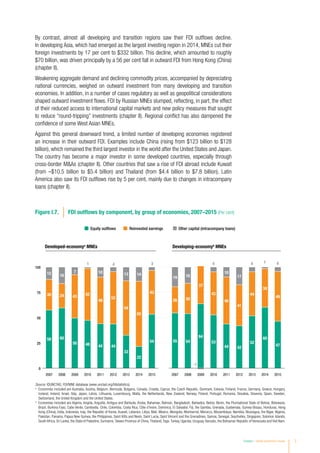
By contrast, almost all developing and transition regions saw their FDI outflows decline.
In developing Asia, which had emerged as the largest investing region in 2014, MNEs cut their
foreign investments by 17 per cent to $332 billion. This decline, which amounted to roughly
$70 billion, was driven principally by a 56 per cent fall in outward FDI from Hong Kong (China)
(chapter II).
Weakening aggregate demand and declining commodity prices, accompanied by depreciating
national currencies, weighed on outward investment from many developing and transition
economies. In addition, in a number of cases regulatory as well as geopolitical considerations
shaped outward investment flows. FDI by Russian MNEs slumped, reflecting, in part, the effect
of their reduced access to international capital markets and new policy measures that sought
to reduce “round-tripping” investments (chapter II). Regional conflict has also dampened the
confidence of some West Asian MNEs.
Against this general downward trend, a limited number of developing economies registered
an increase in their outward FDI. Examples include China (rising from $123 billion to $128
billion), which remained the third largest investor in the world after the United States and Japan.
The country has become a major investor in some developed countries, especially through
cross-border MAs (chapter II). Other countries that saw a rise of FDI abroad include Kuwait
(from –$10.5 billion to $5.4 billion) and Thailand (from $4.4 billion to $7.8 billion). Latin
America also saw its FDI outflows rise by 5 per cent, mainly due to changes in intracompany
loans (chapter II).
Equity outflows Reinvested earnings Other capital (intracompany loans)
Figure I.7. FDI outflows by component, by group of economies, 2007–2015 (Per cent)
Developed-economya
MNEs Developing-economyb
MNEs
54
43
3
22
65
14
33
54
13
44
52
4
44
46
10
48
52
1
50
43
7
60
24
16
58
30
12
47
49
4
60
38
1
52
44
4
42
41
17
44
46
10
53
43
4
64
37
54
30
16
55
26
19
-1
0
25
50
75
100
2007 2008 2009 2010 2011 2012 2013 2014 2015 2007 2008 2009 2010 2011 2012 2013 2014 2015
Source: ©UNCTAD, FDI/MNE database (www.unctad.org/fdistatistics).
a
	Economies included are Australia, Austria, Belgium, Bermuda, Bulgaria, Canada, Croatia, Cyprus, the Czech Republic, Denmark, Estonia, Finland, France, Germany, Greece, Hungary,
Iceland, Ireland, Israel, Italy, Japan, Latvia, Lithuania, Luxembourg, Malta, the Netherlands, New Zealand, Norway, Poland, Portugal, Romania, Slovakia, Slovenia, Spain, Sweden,
Switzerland, the United Kingdom and the United States.
b
	 Economies included are Algeria, Angola, Anguilla, Antigua and Barbuda, Aruba, Bahamas, Bahrain, Bangladesh, Barbados, Belize, Benin, the Plurinational State of Bolivia, Botswana,
Brazil, Burkina Faso, Cabo Verde, Cambodia, Chile, Colombia, Costa Rica, Côte d’Ivoire, Dominica, El Salvador, Fiji, the Gambia, Grenada, Guatemala, Guinea-Bissau, Honduras, Hong
Kong (China), India, Indonesia, Iraq, the Republic of Korea, Kuwait, Lebanon, Libya, Mali, Mexico, Mongolia, Montserrat, Morocco, Mozambique, Namibia, Nicaragua, the Niger, Nigeria,
Pakistan, Panama, Papua New Guinea, the Philippines, Saint Kitts and Nevis, Saint Lucia, Saint Vincent and the Grenadines, Samoa, Senegal, Seychelles, Singapore, Solomon Islands,
South Africa, Sri Lanka, the State of Palestine, Suriname,Taiwan Province of China,Thailand,Togo,Turkey, Uganda, Uruguay,Vanuatu, the Bolivarian Republic of Venezuela and Viet Nam.
Chapter I Global Investment Trends 7
The shift in outward FDI trends of MNEs from developed economies relative to that of their peers
in developing economies was also apparent in the composition of flows. In 2015, over half of
FDI outflows by developed-country MNEs came in the form of new equity investments, reflecting
the surge in cross-border acquisitions (figure I.7). For MNEs from developing economies, in
contrast, the share of new equity investments slumped – falling from 60 per cent to 47 per
cent – in line with lower cross-border acquisitions and limited openings of new affiliates abroad.
The vast majority of their outward FDI for the year was in the form of reinvested earnings, with
the exception of Chinese MNEs.
c. FDI in major economic groups
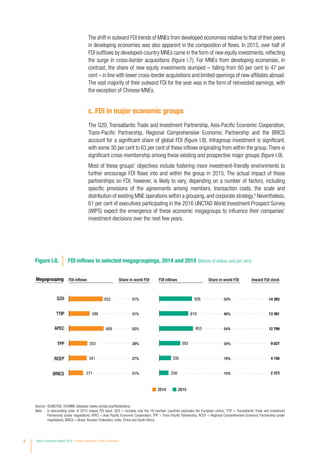
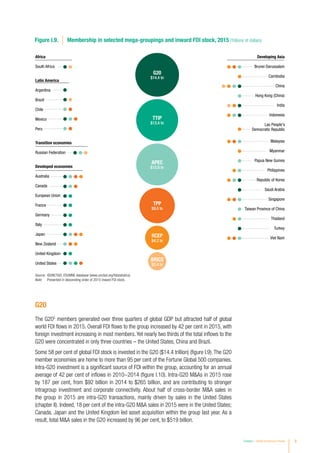
The G20, Transatlantic Trade and Investment Partnership, Asia-Pacific Economic Cooperation,
Trans-Pacific Partnership, Regional Comprehensive Economic Partnership and the BRICS
account for a significant share of global FDI (figure I.8). Intragroup investment is significant,
with some 30 per cent to 63 per cent of these inflows originating from within the group.There is
significant cross-membership among these existing and prospective major groups (figure I.9).
Most of these groups’ objectives include fostering more investment-friendly environments to
further encourage FDI flows into and within the group in 2015. The actual impact of these
partnerships on FDI, however, is likely to vary, depending on a number of factors, including
specific provisions of the agreements among members, transaction costs, the scale and
distribution of existing MNE operations within a grouping, and corporate strategy.4
Nevertheless,
61 per cent of executives participating in the 2016 UNCTAD World Investment Prospect Survey
(WIPS) expect the emergence of these economic megagroups to influence their companies’
investment decisions over the next few years.
Figure I.8. FDI inflows in selected megagroupings, 2014 and 2015 (Billions of dollars and per cent)
Megagrouping FDI inflows Share in world FDI Share in world FDIFDI inflows Inward FDI stock
652
353
341
271
G20
TPP
RCEP
BRICS
926
593
330
256
20152014
51%
28%
27%
21%
53%
34%
19%
15%
399TTIP 81931% 46%
669APEC 95352% 54%
14 393
9 037
4 156
2 373
13 361
12 799
Source:	 ©UNCTAD, FDI/MNE database (www.unctad.org/fdistatistics).
Note:	 In descending order of 2015 inward FDI stock. G20 = includes only the 19 member countries (excludes the European Union); TTIP = Transatlantic Trade and Investment
Partnership (under negotiation); APEC = Asia-Pacific Economic Cooperation; TPP = Trans-Pacific Partnership; RCEP = Regional Comprehensive Economic Partnership (under
negotiation); BRICS = Brazil, Russian Federation, India, China and South Africa.
8 World Investment Report 2016 Investor Nationality: Policy Challenges
G20
The G205
members generated over three quarters of global GDP but attracted half of global
world FDI flows in 2015. Overall FDI flows to the group increased by 42 per cent in 2015, with
foreign investment increasing in most members. Yet nearly two thirds of the total inflows to the
G20 were concentrated in only three countries – the United States, China and Brazil.
Some 58 per cent of global FDI stock is invested in the G20 ($14.4 trillion) (figure I.9).The G20
member economies are home to more than 95 per cent of the Fortune Global 500 companies.
Intra-G20 investment is a significant source of FDI within the group, accounting for an annual
average of 42 per cent of inflows in 2010−2014 (figure I.10). Intra-G20 MAs in 2015 rose
by 187 per cent, from $92 billion in 2014 to $265 billion, and are contributing to stronger
intragroup investment and corporate connectivity. About half of cross-border MA sales in
the group in 2015 are intra-G20 transactions, mainly driven by sales in the United States
(chapter II). Indeed, 18 per cent of the intra-G20 MA sales in 2015 were in the United States;
Canada, Japan and the United Kingdom led asset acquisition within the group last year. As a
result, total MA sales in the G20 increased by 96 per cent, to $519 billion.
Figure I.9. Membership in selected mega-groupings and inward FDI stock, 2015 (Trillions of dollars)
Africa
South Africa
Latin America
Argentina
Brazil
Chile
Mexico
Peru
Transition economies
Russian Federation
Developed economies
Australia
Canada
European Union
France
Germany
Italy
Japan
New Zealand
United Kingdom
United States
Developing Asia
Brunei Darussalam
Cambodia
China
Hong Kong (China)
India
Indonesia
Lao People's
Democratic Republic
Malaysia
Myanmar
Papua New Guinea
Philippines
Taiwan Province of China
Thailand
Turkey
Viet Nam
Republic of Korea
Saudi Arabia
Singapore
TTIP
$13.4 tn
TPP
$9.0 tn
APEC
$12.8 tn
RCEP
$4.2 tn
BRICS
$2.4 tn
G20
$14.4 tn
Source:	 ©UNCTAD, FDI/MNE database (www.unctad.org/fdistatistics).
Note:	 Presented in descending order of 2015 inward FDI stock.
Chapter I Global Investment Trends 9
Transatlantic Trade and Investment Partnership (TTIP)
With $13.4 trillion in FDI stock in 2015, the TTIP initiative is the second largest holder of FDI
stock after the G20, and received 46 per cent of worldwide FDI flows (figure I.8). Yet the group
generated a much smaller proportion of global GDP than the G20. FDI flows to members of
this proposed group rose by 106 per cent in 2015 to $819 billion, due to a significant rise in
inflows to the United States and selected EU countries (Belgium, France, Germany, Ireland and
the Netherlands) (chapter II). Negotiations for a TTIP agreement are still under way.
The proposed partnership – home to about half of the Fortune Global 500 companies, as well as
smaller MNEs – already exhibits strong corporate connectivity. Intra-TTIP FDI flows accounted
for 63 per cent of total inflows to the group in 2010−2014, by far the largest proportion among
all major partnerships and forums (figure I.10). Cross-border MA transactions within the TTIP
rose to $331 billion in 2015 – 46 per cent of the world total – driven by several very large
transatlantic deals (chapter II). The proposed transatlantic partnership, depending on the scope
and depth of the arrangement, will impact corporate connectivity, FDI flows and cross-border
MAs to and within the group (section A.1.a).6
Asia Pacific Economic Cooperation (APEC)
In 2015, APEC7
was the largest recipient of global FDI flows, attracting 54 per cent of the
total (figure I.8), which was roughly in line with its share of world GDP. APEC economies held
about $12.8 trillion FDI stock in 2015, the third largest among major existing and prospective
groupings. FDI flows to APEC, which rose by 42 per cent to $953 billion in 2015, are also highly
concentrated: almost 80 per cent went to the United States, China, Hong Kong (China) and
Singapore. Intragroup investment is significant in APEC, accounting for 47 per cent of the total
in 2010−2014 (figure I.10) and reflecting increasingly connected economies.
MNEs headquartered inAPEC member economies have been actively investing within the group.
MNEs from Japan, the Republic of Korea,ASEAN member economies, China, Hong Kong (China)
and Taiwan Province of China have a significant presence in other Asian APEC members, while
United States8
and Canadian MNEs are heavily invested in the NAFTA subregion.Taken together,
these MNEs are contributing to a wide production network and to inter- and intraregional value
chains across the Pacific.
Trans-Pacific Partnership (TPP)
The TPP9
receives a significant share of global FDI inflows (34 per cent) (figure I.8), largely in
line with its weight in world GDP. In 2015, FDI to the partnership rose by 68 per cent to $593
billion, reflecting a significant rebound of investment to the United States from an atypical low
point of $107 billion in 2014 to $380 billion in 2015 (chapter II).Within the group, NAFTA, which
accounted for 75 per cent of the TPP’s GDP in 2015, remains the largest recipient subgroup,
attracting about 80 per cent of FDI flows to the TPP. The partnership’s FDI stock in 2015 was
$9 trillion, about the size of the economies of Australia, Belgium, Canada, France, Germany and
Sweden combined.
Intra-TPP investment accounted for an average 36 per cent of total inflows to the group between
2010 and 2014 (figure I.10). Unlike in other major groups, however, intra-TPP cross-border
MA sales in 2015 increased by 7 per cent to $113 billion. TPP partner countries acquired
46 per cent more assets in the United States than in 2014. FDI into and within TPP continues
to be highly concentrated, with the United States and Singapore both the main recipients and
sources.
10 World Investment Report 2016 Investor Nationality: Policy Challenges
Although the TPP agreement has not yet entered into force, its conclusion and signing on
4 February 2016 may impact on FDI flows into the group,which offers a large combined market,
prospects of further liberalization, easier movement of goods and services, and complementary
locational advantages among member economies (chapter III). As the TPP agreement gets
implemented, some MNE production networks could be reconfigured and consolidated, as
parts and components become easier and cheaper to source through intrafirm and interfirm
arrangements.10
Yet it remains difficult to quantify the impact on FDI, which will vary according
to industries and value chain segments, and specific tariff reductions.
Regional Comprehensive Economic Partnership (RCEP)
The RCEP is a proposed free trade agreement involving
the 10 members of ASEAN11
and six other partner
countries.12
FDI flows to the RCEP declined by 3 per
cent to $330 billion in 2015, reflecting a fall in inflows
to a majority of partner countries. Negotiations to
establish the RCEP are still under way. Together, the
RCEP countries generated about 31 per cent of world
GDP in 2015 but accounted for a much lower 19 per
cent share of global FDI inflows (figure I.8). FDI in the
RCEP partners is dominated by ASEAN and China – the
two largest recipients in the developing world (chapter
II) – which together held 70 per cent of the group’s FDI
stock in 2015.
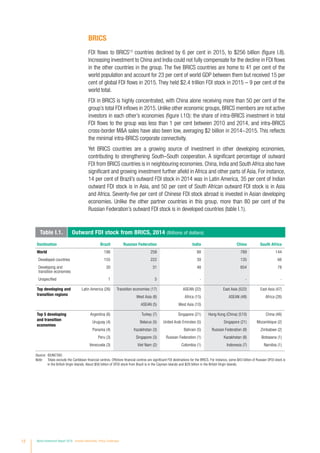
Intra-RCEP investment accounts for about 30 per cent
of FDI flows to the prospective group (figure I.10) and is
expected to remain a major source of FDI. Intra-RCEP
MAs (sales) have been significant – at $18 billion in
2015, representing 43 per cent of total RCEP cross-
border MA sales. The strong level of intra-RCEP
MAs is also contributing to a greater interconnection
of corporate activities in the proposed partnership.
The prospective RCEP member countries are
increasingly interconnected through trade, investment
and regional production networks: many Japanese,
Korean, ASEAN and Chinese MNEs, for instance, have
already established a strong presence in other RCEP
partner countries. These connections could become
stronger when a negotiated RCEP agreement is signed
and implemented. ASEAN is a key player in the RCEP,
as the largest recipient of intragroup investment; it
also established the ASEAN Economic Community on
31 December 2015 as a single market and production
base. The rise in intra-ASEAN investment and regional
value chains is further strengthening the connectivity
of firms and countries within this subgroup and with
other RCEP countries (ASEAN Secretariat and UNCTAD,
2014).
Source:	©UNCTAD.
Note:	 Latest period in which intragroup investment data are available.
Figure I.10.
Major groups: total and intragroup
FDI flows, annual average,
2010–2014 (Billions of dollars and per cent)
Share of intragroup investment
36
TPP
$424 bn
G20 42
$780 bn
RCEP
30
$331 bn
TTIP
63
$561 bn
47
APEC
$713 bn
BRICS
0.5
$271 bn
Chapter I Global Investment Trends 11
BRICS
FDI flows to BRICS13
countries declined by 6 per cent in 2015, to $256 billion (figure I.8).
Increasing investment to China and India could not fully compensate for the decline in FDI flows
in the other countries in the group. The five BRICS countries are home to 41 per cent of the
world population and account for 23 per cent of world GDP between them but received 15 per
cent of global FDI flows in 2015. They held $2.4 trillion FDI stock in 2015 – 9 per cent of the
world total.
FDI in BRICS is highly concentrated, with China alone receiving more than 50 per cent of the
group’s total FDI inflows in 2015. Unlike other economic groups, BRICS members are not active
investors in each other’s economies (figure I.10): the share of intra-BRICS investment in total
FDI flows to the group was less than 1 per cent between 2010 and 2014, and intra-BRICS
cross-border MA sales have also been low, averaging $2 billion in 2014−2015. This reflects
the minimal intra-BRICS corporate connectivity.
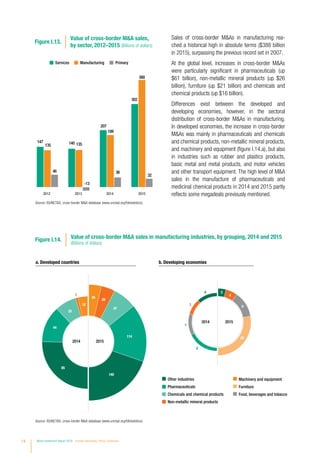
Yet BRICS countries are a growing source of investment in other developing economies,
contributing to strengthening South–South cooperation. A significant percentage of outward
FDI from BRICS countries is in neighbouring economies. China, India and South Africa also have
significant and growing investment further afield in Africa and other parts of Asia. For instance,
14 per cent of Brazil’s outward FDI stock in 2014 was in Latin America, 35 per cent of Indian
outward FDI stock is in Asia, and 50 per cent of South African outward FDI stock is in Asia
and Africa. Seventy-five per cent of Chinese FDI stock abroad is invested in Asian developing
economies. Unlike the other partner countries in this group, more than 80 per cent of the
Russian Federation’s outward FDI stock is in developed countries (table I.1).
Destination Brazil Russian Federation India China South Africa
World 186 258 88 789 144
Developed countries 155 222 39 135 66
Developing and
transition economies
30 31 48 654 78
Unspecified 1 5 - - -
Top developing and
transition regions
Latin America (26) Transition economies (17) ASEAN (22) East Asia (522) East Asia (47)
West Asia (8) Africa (15) ASEAN (48) Africa (26)
ASEAN (5) West Asia (10)
Top 5 developing
and transition
economies
Argentina (6) Turkey (7) Singapore (21) Hong Kong (China) (510) China (46)
Uruguay (4) Belarus (5) United Arab Emirates (5) Singapore (21) Mozambique (2)
Panama (4) Kazakhstan (3) Bahrain (5) Russian Federation (9) Zimbabwe (2)
Peru (3) Singapore (3) Russian Federation (1) Kazakhstan (8) Botswana (1)
Venezuela (3) Viet Nam (2) Colombia (1) Indonesia (7) Namibia (1)
Source: ©UNCTAD.
Note: Totals exclude the Caribbean financial centres. Offshore financial centres are significant FDI destinations for the BRICS. For instance, some $43 billion of Russian OFDI stock is
in the British Virgin Islands. About $56 billion of OFDI stock from Brazil is in the Cayman Islands and $28 billion in the British Virgin Islands.
Table I.1. Outward FDI stock from BRICS, 2014 (Billions of dollars)
12 World Investment Report 2016 Investor Nationality: Policy Challenges
2. FDI by sector and industry
a. The sectoral distribution of global FDI
The services sector accounts for almost two thirds of global FDI stock. In 2014, the
latest year for which sectoral breakdown estimates are available, services accounted for 64 per
cent of global FDI stock, followed by manufacturing (27 per cent) and the primary sector (7 per
cent), with 2 per cent unspecified (figure I.11).
The overall sectoral patterns of inward investment are similar in developed and developing
economies, but variations among developing regions are pronounced (figure I.12). The share
of the primary sector in FDI to Africa and to Latin America and the Caribbean – 28 and 22 per
cent, respectively – was much higher than the 2 per cent recorded in developing Asia, largely
reflecting the weight of extractive industries. In developing Asia, in contrast, services accounted
for a considerable share of FDI, mainly owing to their predominance in Hong Kong (China).14
The recent collapse of commodity prices has started to
significantly affect the structural pattern of FDI flows to
the developing world in general, and to Africa and Latin
America and the Caribbean in particular.
In 2015, cross-border MAs in manufacturing
soared, with developed and developing eco-
nomies exhibiting different industrial patterns.
The total value of cross-border MAs, as well as
their sectoral breakdown, has changed significantly
over the past few years (figure I.13). Although the
combined amount of cross-border MAs in ser-
vices increased by $95 billion in 2015, the balance
tilted in favour of manufacturing, which accounted
for 54 per cent of all cross-border MAs, compared
with 41 per cent in 2012, and 28 per cent in 2009. Source: ©UNCTAD, FDI/MNE database (www.unctad.org/fdistatistics).
Figure I.11.
Global inward FDI stock, by sector,
2014 (Trillions of dollars and per cent)
Manufacturing
Primary
Services
Unspecified
7
27
64
$26 tn
2
Figure I.12. Global inward FDI stock, sectoral distribution by grouping and region, 2014 (Per cent)
UnspecifiedPrimaryManufacturingServices
7 27 64 2World
6 27 65 2Developed countries
8 27 64 2Developing economies
28 20 51 2Africa
22 31 42 5
Latin America
and the Caribbean
15 15 70Transition economies
26 70 2Developing Asia 2
Source: ©UNCTAD, FDI/MNE database (www.unctad.org/fdistatistics).
Chapter I Global Investment Trends 13
Sales of cross-border MAs in manufacturing rea-
ched a historical high in absolute terms ($388 billion
in 2015), surpassing the previous record set in 2007.
At the global level, increases in cross-border MAs
were particularly significant in pharmaceuticals (up
$61 billion), non-metallic mineral products (up $26
billion), furniture (up $21 billion) and chemicals and
chemical products (up $16 billion).
Differences exist between the developed and
developing economies, however, in the sectoral
distribution of cross-border MAs in manufacturing.
In developed economies, the increase in cross-border
MAs was mainly in pharmaceuticals and chemicals
and chemical products, non-metallic mineral products,
and machinery and equipment (figure I.14.a), but also
in industries such as rubber and plastics products,
basic metal and metal products, and motor vehicles
and other transport equipment. The high level of MA
sales in the manufacture of pharmaceuticals and
medicinal chemical products in 2014 and 2015 partly
reflects some megadeals previously mentioned.
Figure I.13.
Value of cross-border MA sales,
by sector, 2012–2015 (Billions of dollars)
PrimaryManufacturingServices
2015
302
388
32
2014
207
189
36
2013
140 135
-13
2012
147
135
46
Source: ©UNCTAD, cross-border MA database (www.unctad.org/fdistatistics).
2014 2015
Figure I.14. Value of cross-border MA sales in manufacturing industries, by grouping, 2014 and 2015
(Billions of dollars)
a. Developed countries b. Developing economies
140
114
47
28
26
3
44
25
12
85
2014 2015
Other industries
Chemicals and chemical products
Pharmaceuticals
Non-metallic mineral products
Machinery and equipment
Furniture
Food, beverages and tobacco
20
9
3
3
4
4
6
4
Source: ©UNCTAD, cross-border MA database (www.unctad.org/fdistatistics).
14 World Investment Report 2016 Investor Nationality: Policy Challenges
In developing economies, in contrast, the increase in cross-border manufacturing MAs was
driven by large acquisitions in a limited number of industries, such as furniture, food and
beverages, and non-metallic mineral products (figure I.14.b). At the same time, large-scale
divestments were recorded in pharmaceuticals and in machinery and equipment. A major
divestment in pharmaceuticals involved Daiichi Sankyo (Japan) selling its stake in for example,
Ranbaxy Laboratories (India) to Sun Pharmaceutical Industries (India) for $3 billion.
b. The impact of commodity prices on FDI in the primary sector
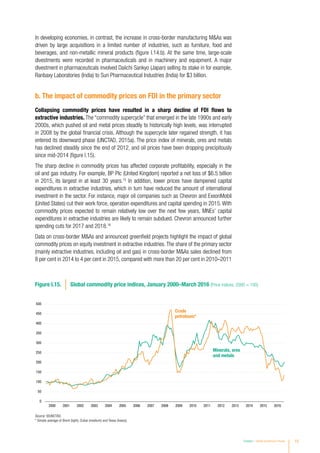
Collapsing commodity prices have resulted in a sharp decline of FDI flows to
extractive industries. The “commodity supercycle” that emerged in the late 1990s and early
2000s, which pushed oil and metal prices steadily to historically high levels, was interrupted
in 2008 by the global financial crisis. Although the supercycle later regained strength, it has
entered its downward phase (UNCTAD, 2015a). The price index of minerals, ores and metals
has declined steadily since the end of 2012, and oil prices have been dropping precipitously
since mid-2014 (figure I.15).
The sharp decline in commodity prices has affected corporate profitability, especially in the
oil and gas industry. For example, BP Plc (United Kingdom) reported a net loss of $6.5 billion
in 2015, its largest in at least 30 years.15
In addition, lower prices have dampened capital
expenditures in extractive industries, which in turn have reduced the amount of international
investment in the sector. For instance, major oil companies such as Chevron and ExxonMobil
(United States) cut their work force, operation expenditures and capital spending in 2015. With
commodity prices expected to remain relatively low over the next few years, MNEs’ capital
expenditures in extractive industries are likely to remain subdued. Chevron announced further
spending cuts for 2017 and 2018.16
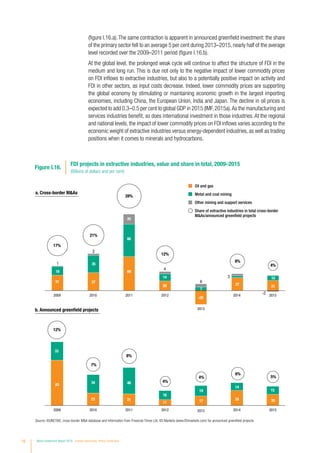
Data on cross-border MAs and announced greenfield projects highlight the impact of global
commodity prices on equity investment in extractive industries. The share of the primary sector
(mainly extractive industries, including oil and gas) in cross-border MAs sales declined from
8 per cent in 2014 to 4 per cent in 2015, compared with more than 20 per cent in 2010–2011
Figure I.15. Global commodity price indices, January 2000–March 2016 (Price indices, 2000 = 100)
0
50
100
150
200
250
300
350
400
450
500
2000 2001 2002 2003 2004 2005 2006 2007 2008 2009 2010 2011 2012 2013 2014 2015 2016
Minerals, ores
and metals
Crude
petroleum*
Source: ©UNCTAD.
* Simple average of Brent (light), Dubai (medium) and Texas (heavy).
Chapter I Global Investment Trends 15
(figure I.16.a).The same contraction is apparent in announced greenfield investment: the share
of the primary sector fell to an average 5 per cent during 2013–2015, nearly half of the average
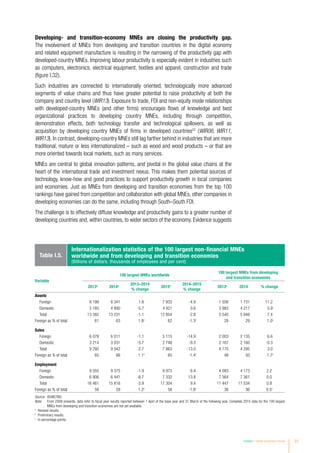
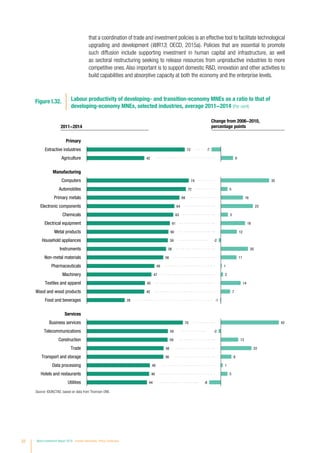
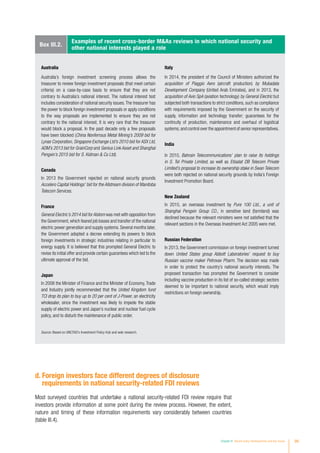
level recorded over the 2009–2011 period (figure I.16.b).
At the global level, the prolonged weak cycle will continue to affect the structure of FDI in the
medium and long run. This is due not only to the negative impact of lower commodity prices
on FDI inflows to extractive industries, but also to a potentially positive impact on activity and
FDI in other sectors, as input costs decrease. Indeed, lower commodity prices are supporting
the global economy by stimulating or maintaining economic growth in the largest importing
economies, including China, the European Union, India and Japan. The decline in oil prices is
expected to add 0.3–0.5 per cent to global GDP in 2015 (IMF,2015a).As the manufacturing and
services industries benefit, so does international investment in those industries. At the regional
and national levels, the impact of lower commodity prices on FDI inflows varies according to the
economic weight of extractive industries versus energy-dependent industries, as well as trading
positions when it comes to minerals and hydrocarbons.
Figure I.16.
FDI projects in extractive industries, value and share in total, 2009–2015
(Billions of dollars and per cent)
Oil and gas
Metal and coal mining
Other mining and support services
Share of extractive industries in total cross-border
MAs/announced greenfield projects
a. Cross-border MAs
b. Announced greenfield projects
28%
21%
17%
12%
8%
4%
8%
7%
12%
4%
4%
6%
5%
2009 2010 2011 2012
2013
2014 2015
21
10
4
27
3
7
6
-2
-28
4
3
1
14
35
20
37
18
31
20
66
69
2009 2010 2011 2012 2013 2014 2015
20
15
28
14
17
19
11
34
16
23
33
83
21
48
Source: ©UNCTAD, cross-border MA database and information from Financial Times Ltd, fDi Markets (www.fDimarkets.com) for announced greenfield projects.
16 World Investment Report 2016 Investor Nationality: Policy Challenges
FDI inflows to commodity-exporting countries in Africa, Latin America and the Caribbean, and
West Asia have been strongly and adversely affected (chapter II). Economies whose exports
and FDI inflows rely heavily on oil and metals are in a particularly challenging situation. In Latin
America and the Caribbean, for instance, FDI inflows to the oil and gas industry in Colombia and
Ecuador declined by 66 per cent and 50 per cent, respectively, in 2015. In Africa, FDI inflows
to the metal mining industry decreased significantly
in major metal exporting countries, such as Guinea
and Zambia. In Asian economies relying heavily on
extractive industries, the situation is similar. FDI
flows to Mongolia, which depends heavily on mining,
dropped from 50 per cent of GDP to less than 5 per
cent, which had a considerable impact on job creation
and economic growth.
c. FDI in infrastructure industries
in the wake of the Sustainable
Development Goals
The United Nations Summit for the adoption of the
post-2015 development agenda was held in New
York in September 2015. At the high-level plenary
meeting of the General Assembly, countries adopted
the 2030 Agenda for Sustainable Development
together with the set of Sustainable Development
Goals (SDGs) to be achieved over the next 15 years.
The SDGs carry significant implications for resources
worldwide, including for public and private investment
in infrastructure. UNCTAD has estimated that achieving
the SDGs by 2030 in developing countries alone will
require investment in the range of $3.3–$4.5 trillion
annually (or about $2.5 trillion over and above the
amount currently being invested), mainly in basic
infrastructure (power, telecommunications, transport,
and water and sanitation) and infrastructure related
to specific goals (e.g. food security, climate change
mitigation and adaptation, health and education)
(WIR14).
The scale of the necessary resources, even allowing
for a significant increase in public and domestic private
investment, requires a much larger contribution by
MNEs in infrastructure FDI. At the moment, social
infrastructure (education and health) and other SDG
sectors attract little FDI. Even in areas such as power,
telecommunications, transport and water, FDI in
developing countries remains consistently small (figure
I.17). However, FDI numbers underestimate MNE
participation in developing-country infrastructure, as
much of it occurs through non-equity modes such as
build-own-operate and other concession arrangements
(WIR08,WIR10). In addition,greenfield announcements
Figure I.17.
Electricity, gas and water Transport and storage
Information and communication
19
12
12
2010
16
14
14
2011
12
9
11
2012
16
12
14
2013
12
12
9
2014
Developing economies:
FDI inflows in infrastructure
industries, 2010–2014
(Billions of dollars)
Source: ©UNCTAD, FDI/MNE database (www.unctad.org/fdistatistics).
Figure I.18.
Electricity,
gas and water
Transport, storage
and communications
Developing economies: announced
greenfield investment projects in
infrastructure industries,
2010–2015 (Billions of dollars)
32
29
2010
36
38
2011
32
25
2012
71
57
2013
43
43
2014
104
28
2015
Source: 	©UNCTAD, based on information from the Financial Times Ltd, fDi Markets
(www.fDimarkets.com).
Chapter I Global Investment Trends 17
suggest that FDI in infrastructure is picking up (figure I.18).Yet existing investment still accounts
for only a small fraction of the resources needed to meet the SDGs.
With the SDG targets and indicators agreed only in 2015, policies and processes to encourage
further investment are not yet fully in place; and businesses, including MNEs, are just beginning
to take on board the implications of the post-2015 development agenda. Several developments
suggest that an increase in infrastructure FDI may be forthcoming. For instance, there is some
evidence of MNEs’ contribution to low-carbon activities related to climate change through
greenfield investment projects, although this has partly stalled since the onset of the financial
and economic crisis (figure I.19). Moreover, infrastructure financing is increasingly becoming
available. Lenders are also increasingly applying sustainability measures when considering
projects in these industries. This is the case for private banks, existing multilateral banks and
emerging new ones,such as the New Development Bank and theAsian Infrastructure Investment
Bank (WIR14). Nevertheless, achieving the post-2015 development goals will require far more
significant commitments from MNEs from developed economies as well as from developing and
transition economies, and a corresponding expansion in large-scale investment in SDG sectors,
including infrastructure.
In the follow-up to the SDG adoption, the international community is trying to establish
monitoring mechanisms (including the related data requirements) to measure and monitor
progress towards the goals, and UNCTAD is playing its part (Inter-Agency Task Force, 2016).
Figure I.19. Announced greenfield projects in selected low-carbon business
areas, by group of host economies, 2003–2015 (Billions of dollars)
0
20
40
60
80
100
2003 2004 2005 2006 2007 2008 2009 2010 2011 2012 2013 2014 2015
Developed economies Transition economiesDeveloping economies
Source:	©UNCTAD, based on information from the Financial Times Ltd, fDi Markets (www.fDimarkets.com).
Note:	 Low-carbon business areas include alternative/renewable energy, recycling and manufacturing of environmental technology.
18 World Investment Report 2016 Investor Nationality: Policy Challenges
3. Investment flows through offshore financial hubs
Investment flows to offshore financial hubs declined but remain significant. The
volatility of investment flows to offshore financial hubs – including those to offshore financial
centres and special purpose entities (SPEs)17
– increased in 2015.These flows, which UNCTAD
excludes from its FDI data, remain high.
Offshore financial hubs offer low tax rates or beneficial fiscal treatment of cross-border financial
transactions, extensive bilateral investment and double taxation treaty networks, and access to
international financial markets,which make them attractive to companies large and small.Flows
through these hubs are frequently associated with intrafirm financial operations – including the
raising of capital in international markets – as well as holding activities, including of intangible
assets such as brands and patents.
Investment flows through SPEs surged in volume in 2015. Investment flows to SPEs,
which represent the majority of offshore investment flows, registered significant volatility in
2015. Financial flows through SPEs surged in volume during much of the year. The magnitude
of quarterly flows through SPEs, in terms of absolute value, rose sharply compared with 2014,
reaching the levels registered in 2012–2013. Pronounced volatility, with flows swinging from
large-scale net investment during the first three quarters to a huge net divestment during the
last quarter, tempered the annual 2015 results (figure I.20).
The primary recipient of SPE-related investment flows in 2015 was Luxembourg. Flows to SPEs
located in Luxembourg were associated with funds’ financing investments in the United States.
This was especially apparent in the first quarter of the year, when SPE inflows rose to $129
billion. SPE outflows in the same quarter reached $155 billion, which in turn was reflected in
data from the United States, where inward FDI from Luxembourg topped $153 billion (77 per
cent of total inflows). After surging for three quarters, more than tripling their 2014 levels for
the same period, SPE inflows turned negative in the last three months of the year, recording a
net divestment of roughly $115 billion, as SPEs in the country paid down intracompany loans
to the tune of $207 billion.
Figure I.20. Investment flows to and from SPEs, 2006 Q1–2015 Q4 (Billions of dollars)
-300
-200
-100
100
0
200
300
400
2006 2007 2008 2009 2010 2011 2012 2013 2014 2015
Inflows
Outflows
Source:	 ©UNCTAD.
Note:	 SPEs include all countries that publish SPE data.
Chapter I Global Investment Trends 19
After registering a sharp decline in 2014,SPE-related inflows in the Netherlands initially showed
signs of a rebound in 2015, rising from $2 billion in the first quarter to $148 billion in the
third quarter (their highest quarterly level since the third quarter of 2007). As in Luxembourg,
these flows retreated sharply in the fourth quarter, with a net divestment of equity capital and
reinvested earnings of roughly $200 billion. An analysis of the geographical breakdown of total
investment flows suggests that this trend was driven by investors from Luxembourg and the
United Kingdom. Reflecting the pass-through nature of these flows, outward investment flows
by SPEs also tumbled in the fourth quarter, led by declines in overall investments targeting
Luxembourg and the United Kingdom. The tight
interrelation between SPE flows in Luxembourg and
the Netherlands highlights the existence of dense and
complex networks of these entities in both countries,
with capital flowing rapidly among them in response to
financing needs and tax planning considerations.
Recent policy changes may be responsible for the
most recent decline in investment flows to SPEs. The
Netherlands, for instance, adopted new substance
requirements for group financing and licensing
companies; these requirements also allowed for the
automatic exchange of information about entities that
have little or no substance in the country with tax treaty
partners and other EU countries. In Luxembourg, the
authorities enacted a number of changes in their tax
framework, including greater substance requirements,
a revision of transfer pricing rules and a reform of
the process and substance of tax rulings. In addition,
in late 2015 both countries enacted general anti-
abuse rules, as required by the amended EU Parent
Subsidiary Directive, which seeks to eliminate abuse of
the benefits of the directive for purposes of obtaining
a tax advantage.18
Given the volatile nature of offshore
financial flows,the actual impact of these policy changes
will become clearer over the next few years.
Investment flows to Caribbean financial centres
slowed but remain at a high level.Flows to Caribbean
offshore financial centres continued to decline from their
2013 record levels, when a single large cross-border
MA had caused them to surge markedly. Compared
with that year, inflows in these economies were down
45 per cent, to an estimated $72 billion in 2015, in line
with the average for 2008–2012 (figure I.21).
Although MNEs from developed economies, in particular
fromtheUnitedStates,traditionallyhavedominatedflows
to these jurisdictions, in recent years rising investment
flows from developing and transition economies have
played an important role. Between 2010 and 2014,
Hong Kong (China), the Russian Federation, China and
Brazil accounted for 65 per cent of investment flows to
the two largest Caribbean financial centres, the British
Virgin Islands and the Cayman Islands (figure I.22).
Figure I.21.
Investment flows to Caribbean
offshore financial centres,
2005−2015 (Billions of dollars)
The British Virgin Islands
and the Cayman Islands
Other Caribbean offshore
financial centres
0
20
40
60
80
100
120
140
2005 2006 2007 2008 2009 2010 2011 2012 2013 2014 2015
Source:	©UNCTAD.
Figure I.22.
Geographical origin of investment
flows to the British Virgin Islands
and the Cayman Islands, sum of
2010–2014 values
(Billions of dollars and per cent)
93
148
33%
21%
17%
14%
10%
5%
23
45
64
77
Hong Kong,
China
United States
Russian
Federation
China
Brazil
Other
economies
Source:	©UNCTAD.
20 World Investment Report 2016 Investor Nationality: Policy Challenges
High concentration of FDI income in low-tax, often offshore, jurisdictions. A key
concern for policymakers globally is the potential for a substantial disconnect between productive
investments and income generation by MNEs with implications for sustainable development in
their economies. As UNCTAD’s work for WIR15 found, fiscal losses due to MNEs’ tax practices
are sizable. The significant share of MNEs’ total FDI income booked in low-tax, often offshore,
jurisdictions remains therefore problematic.
The ratios of income attributed to the foreign affiliates of outward-investing countries to the GDP
of the economy where those affiliates are resident reveal profits that are out of line with economic
fundamentals. For example, MNEs from a sample of 25 developed countries registered more
profits in Bermuda ($44 billion) than in China ($36 billion) in 2014 (table I.2). Unsurprisingly, the
share of their profits relative to the size of Bermuda’s economy is an impressive 779.4 per cent
of GDP, compared with less than 1 per cent of GDP in a number of countries. Elevated ratios
of FDI income to GDP can also be observed in other countries. For example, the FDI income of
foreign affiliates (as reported by their home countries) in the Netherlands, Luxembourg, Ireland
and Singapore relative to the GDPs of those countries all exceed the weighted world average
by a substantial margin.
High ratios of FDI income to GDP reflect the emergence of holding companies as major
aggregators of MNEs’ foreign profits. In the case of Bermuda, the outsized profits of foreign
affiliates in the country largely reflect income attributed to investors from the United States.
According to statistics from the United States, the majority of the outward direct investment
position in Bermuda is in holding companies, which likely serve to channel investment to other
countries as well as aggregate income – in line with the controlled foreign corporation (CFC)
rules of the income tax code of the United States – from these investments for tax purposes.
Taking a longer term view, data from the United States highlights a significant shift in the
sources of overall FDI income since the global economic and financial crisis (figure I.23). Before
the crisis, most FDI income was generated from entities other than holding companies, the
latter accounting for an average 4 per cent of total quarterly income between 2003 and 2008.
In the aftermath of the crisis, however, the share of FDI income attributed to holding companies
has steadily risen to a quarterly average of 52 per cent in 2015. The growing importance of
holding companies is due to a number of factors, including the greater reliance on regional
centres to coordinate activities in host countries, but their frequent location in jurisdictions with
low tax rates or favourable fiscal regimes suggests that tax motivations play a key role.
Figure I.23. United States: FDI income on outward investment, 2003 Q1–2015 Q4 (Billions of dollars)
0
10
20
30
40
50
60
70
Holding companies (non-bank)
Other companies
2006 2007 2008 2009 20102003 2004 2005 2011 2012 2013 2014 2015
Source: ©UNCTAD, based on data from the United States Bureau of Economic Analysis (BEA).
Chapter I Global Investment Trends 21
Table I.2.
Income booked in foreign
affiliates, 2014 (Billions of dollars)
Partner economy
Outward FDI income
(25 economies)
Value
Share
of total
Relative
to GDP
Netherlands 155 12.3 17.6
United States 114 9.1 0.7
United Kingdom 98 7.8 3.3
Luxembourg 74 5.9 114.4
Switzerland 62 5.0 8.9
Ireland 61 4.9 24.3
Singapore 57 4.6 18.6
Bermuda 44 3.5 779.4
Canada 41 3.3 2.3
China 36 2.9 0.3
Germany 32 2.6 0.8
Brazil 32 2.5 1.3
Cayman Islands 30 2.4 874.9
Belgium 26 2.1 4.9
Australia 24 1.9 1.7
Hong Kong, China 23 1.9 8.0
Spain 21 1.7 1.5
Japan 18 1.4 0.4
Russian Federation 18 1.4 1.0
France 17 1.4 0.6
Sweden 15 1.2 2.7
Mexico 15 1.2 1.2
Norway 13 1.0 2.6
Qatar 12 1.0 5.9
Austria 12 1.0 2.8
Memorandum
208 economies 1 258 100.0 1.6
Source: ©UNCTAD, based on data from OECD and the United Nations Statistics
Division.
This shift towards holding companies as the principal aggregators of earnings has also increased
the geographical concentration of where FDI income is ultimately booked. The economies that
each accounted for 5 per cent or more of the United States’ outward FDI stock in holding
companies in 2014 – Bermuda, Ireland, Luxembourg, the Netherlands, the United Kingdom,and
the United Kingdom Islands, Caribbean19
– generated an average 40 per cent of FDI outward
income between 2005 and 2008. In 2015, this share had risen to a quarterly average of 59 per
cent, an increase of nearly 20 percentage points in the span of less than a decade.
The urgent need for international tax and investment policy coordination. Efforts
to stem offshore financial flows have been under way at both the national and international
levels. Besides the policy reforms in the Netherlands and Luxembourg mentioned above, and
the European Commission anti-tax avoidance package, the United States has been gradually
implementing the Foreign Account Tax Compliance Act (FATCA), which largely classifies as
foreign financial institutions (FFIs) the affiliates of non-financial MNEs from the United States
that are involved in group financing or holdings and thus triggers new compliance obligations.
There has also been momentum towards tighter international cooperation in tax affairs, such as
the Base Erosion Profit Shifting (BEPS) initiative launched by the G20 and the Organization for
Economic Cooperation and Development (OECD) in 2013.
Revelations that firms large and small have been using
offshore financial centres and jurisdictions to evade
or avoid taxes have provided additional impetus to
policy reforms in these areas. More efforts are indeed
necessary, and the persistence of investment flows
routed through offshore finance centres, as well as the
level of profits booked in these jurisdictions, highlight
the pressing need to create greater coherence among
tax and investment policies at the global level. A lack
of coordination between these two crucial policy areas
will limit positive spillovers from one to the other,
limiting potential gains in tax compliance as well as
productive investment.
In WIR15, UNCTAD proposed a set of guidelines for
coherent international tax and investment policies that
could help realize the synergies between investment
policy and initiatives to counter tax avoidance. Key
objectives include removing aggressive tax planning
opportunities as investment promotion levers;
considering the potential impact of anti-avoidance
measures on investment; taking a partnership approach
in recognition of shared responsibilities between host,
home and conduit countries; managing the interaction
between international investment and tax agreements;
and strengthening the role of both investment and
fiscal revenues in sustainable development as well as
the capabilities of developing countries to address tax
avoidance issues.
22 World Investment Report 2016 Investor Nationality: Policy Challenges
Global FDI flows are expected to decline by 10–15 per cent in 2016. Over the medium
term, flows are projected to resume growth in 2017 and surpass $1.8 trillion in 2018.
These expectations are based on the current forecast for a number of macroeconomic indicators
and firm level factors, the findings of UNCTAD’s survey of investment prospects of MNEs and
investment promotion agencies (IPAs), UNCTAD’s econometric forecasting model for FDI inflows
and preliminary 2016 data for cross-border MAs and announced greenfield projects.
The expected decline of FDI flows in 2016 reflects the fragility of the global economy, persistent
weakness of aggregate demand, effective policy measures to curb tax inversion deals and
a slump in MNE profits. Barring another wave of cross-border MA deals and corporate
reconfigurations, FDI flows are likely to decline in both developed and developing economies.
1. Key factors influencing future FDI flows
The world economy continues to face major headwinds, which are unlikely to ease in the near
term. Global GDP is expected to expand by only 2.4 per cent, the same relatively low rate as in
2015 (table I.3). A tumultuous start to 2016 in global commodity and financial markets, added
to the continuing drop in oil prices, have increased economic risks in many parts of the world.
The momentum of growth slowed significantly in some large developed economies towards
the end of 2015. In developing economies, sluggish aggregate demand, low commodity prices,
mounting fiscal and current account imbalances and policy tightening have further dampened
the growth prospects of many commodity-exporting economies. Elevated geopolitical risks,
regional tensions and weather-related shocks could further amplify the expected downturn.
The global economic outlook and lower commodity prices has had a direct effect on the profits
and profitability of MNEs, especially in extractive industries. After two years of increase, profits
of the largest 5,000 MNEs slumped in 2015 to the lowest level since the global economic and
financial crisis of 2008–2009 (figure I.24).
Variable Region 2014 2015 2016 2017
World 2.6 2.4 2.4 2.8
GDP growth rate Developed economies 1.7 1.9 1.8 1.9
Developing economies 4.4 3.8 3.8 4.4
Transition economies 0.9 -2.8 -1.2 1.1
World 3.8 2.2 3.2 4.2
GFCF growth rate Advanced economiesa
2.8 2.5 2.5 3.2
Emerging and developing economiesa
4.5 2.0 3.8 4.8
Source: ©UNCTAD, based on United Nations (2016) for GDP and IMF (2016) for GFCF.
a
IMF’s classifications of advanced, emerging and developing economies are not the same as the United Nations’ classifications of developed and developing economies.
Table I.3. Real growth rates of GDP and gross fixed capital formation (GFCF), 2014–2017
(Per cent)
B. PROSPECTS
Chapter I Global Investment Trends 23
ShareValue
Figure I.24.
Profitability and profit levels
of MNEs, 2006–2015
(Billions of dollars and per cent)
Profits Profitability
0
1
2
3
4
5
6
7
8
9
0
200
400
600
800
1 000
1 200
1 400
1 600
1 800
2006 2007 2008 2009 2010 2011 2012 2013 2014 2015
Source:	 ©UNCTAD, based on data from Thomson ONE.
Note: 	 Profitability is calculated as the ratio of net income to total sales.
A decrease of FDI flows in 2016 was also apparent in the value of cross-border MA
announced in the beginning of 2016. For the first four months, the value of cross-border MA
announcements (including divestments) was about $350 billion, or 32 per cent lower than
the same period in 2015. However, some industries such as agribusiness might see further
consolidation in 2016 following megadeals announced by ChemChina (China) for Syngenta
(Switzerland) for $46 billion and by Bayer AG (Germany)
for Monsanto (United States) for $62 billion.
The value of announced cross-border deals would
have been larger if the United States Treasury
Department had not imposed new measures to rein
in corporate inversions in April 2016. The new rules,
the Government’s third wave of administrative action
against inversions, make it harder for companies to
move their tax domiciles out of the United States and
then shift profits to low-tax countries. As a result, the
$160 billion merger of pharmaceutical company Pfizer
(United States) with Ireland-based Allergan Plc was
cancelled20
(chapter II).
Over the medium term, FDI flows are projected to
resume growth at 5–10 per cent in 2017 and surpass
$1.8 trillion in 2018, reflecting the projected increase
in global growth.
2. UNCTAD business survey
Global FDI activity outlook.This year’s survey results
reveal muted overall expectations for FDI prospects
over the next three years, with less than half of all
MNEs anticipating FDI increases to 2018; moreover,
only 40 per cent of executives at top MNEs expect an
increase (figure I.25). Macroeconomic factors, such as
geopolitical uncertainty, exchange rate volatility and
debt concerns in emerging markets, as well as other
concerns such as terrorism and cyberthreats, are
among the factors cited as influencing future global
FDI activity (figure I.26). However, there are differences
across sectors and between economic groupings.
Executives from developing and transition economies
are more optimistic than those at MNEs headquartered
in developed countries; and not unexpectedly, given
the decline in commodity prices, MNEs from the
primary sector are more pessimistic than those in the
manufacturing and, especially, services sectors (see
figure I.25).
Factors influencing FDI activity. MNE executives
do not universally agree on the likely impact – positive
or negative – of potential factors on future global FDI
activity; in some cases, it is a matter of perceptions
(impressions of “the state of the EU economy”, for
23 21 48 9
22 25 41 13
22 21 45 12
24 21 55
27 27 47
25 22 44 10
17 17 56 10
Don't knowDecrease No change Increase
Figure I.25.
Executives’ expectations for global
FDI activity level, 2016–2018
(Per cent of executives based in each region and sector)
All
Top MNEs
Primary
Manufacturing
Services
Developed countries
Developing and
transition economies
Source: 	©UNCTAD business survey.
Note: 	 The top MNEs are the respondents from among the 100 largest non-financial
MNEs worldwide, ranked by foreign assets.
24 World Investment Report 2016 Investor Nationality: Policy Challenges
instance, depend on the origin of the investor, the industry or the motive behind an investment)
and in others, categories are complex (e.g. some BRICS are doing better than others). However,
executives overwhelmingly considered factors such as the state of the United States economy;
agreements such as the TPP, the RCEP and the TTIP; ongoing technological change and
the digital economy; global urbanization; and offshoring as likely to boost FDI between now
and 2018 (figure I.26). Clearly, MNEs have their eyes on longer-term trends such as rising
urbanization in developing as well as developed countries (and hence, for instance, potential
consumer markets), the digital economy and prospective megagroups. Geopolitical uncertainty,
debt concerns, terrorism and cyberthreats are almost universally considered in a negative light
and as likely to dampen FDI activity.
FDI spending intentions.The mix of factors influencing FDI activity,combined with uncertainty
in the near term, translates into a mildly gloomy picture for FDI spending over the next three
years. Overall about 40 per cent of executives expect their companies to increase FDI spending
Figure I.26. Factors influencing future global FDI activity (Per cent of all executives)
Share of executives who think this factor
will lead to a decrease in global FDI
Share of executives who think this factor
will lead to an increase in global FDI
Macroeconomic and policy factors Corporate and external factors
71
11
State of the
United States economy
52
9
Regional agreements such
as TPP, RCEP, TTIP
52
29
State of developing
Asian economies
44
30State of the EU economy
38
22Quantitative easing programs
35
41
State of the BRICS and other
emerging economies
33
29Changes in tax regimes
27
40Commodity prices, including oil
21
38
Changes in global financial
regulations
17
55Exchange rate volatility
4
74Geopolitical uncertainty
4
62
Debt concerns in
emerging markets
69
2
Technological change,
including digital economy
50
6
Global urbanization
48
15
Offshore outsourcing of
corporate operations
37
26
Energy security
29
22
Food security
18
39
Climate change
17
33
Migration
6
47
Cyber threats and data security
4
52
Natural disasters,
including pandemics
2
73
Terrorism
Source: ©UNCTAD business survey.
Chapter I Global Investment Trends 25
in 2016, rising to 53 per cent by 2018; while 26 per
cent expect a fall this year, declining to 13 per cent by
2018 (figure I.27). Top MNEs, which invest the most,
are far more pessimistic. Only 32 per cent expect to
spend more this year, while 45 per cent expect less FDI
spending; and this marked difference with MNEs as a
whole persists to 2018.
While developing- and transition-economy MNEs are
more optimistic than those from developed countries
overall (figure I.25),a bigger proportion are expecting to
spend less (35 to 24 per cent) in 2016 (figure I.27).This
reflects the difficult investment environment currently
faced by MNEs from emerging economies.The biggest
difference in spending, however, is between different
sectors. Sixty per cent of MNEs in the primary sector
– mainly oil, gas and mining – anticipate lower FDI
expenditures this year, with only a fifth expecting an
increase. This compares with MNEs in manufacturing
and services, where a little over 20 per cent expect a
fall and over 40 per cent an increase in both sectors.
Moreover, the slump in prices and activity in the
primary sector is expected to persist. By 2018 still only
33 per cent of MNEs in the primary sector expect to be
spending more. The equivalent proportion for MNEs in
manufacturing and services is much higher, at 52 and
63 per cent respectively.
Most attractive industries in host economies.
IPAs surveyed this year identified the most promising
industries for attracting FDI to their country. There are
differences between regions and – mirroring the MNE
survey – extractive industries do not appear among the
24
35
60
21
22
26
23
13
27
27
40
42
20
44
44
10
7
7
7
17
20
40
19
11
19
20
20
14
27
49
57
20
57
51
15
3
20
10
11
13
16
13
20
4
18
16
27
13
22
51
61
33
52
63
18
6
27
15
11
26 25 41 8 18 20 50 12 13 18 53 16
45 16 32 6 29 23 35 13 22 19 44 16
Figure I.27. Executives’ global FDI spending intentions, 2016–2018, with respect to 2015 levels
(Per cent of responding executives, based in each region and sector)
Don't knowDecrease No change Increase
2016 20182017
All
Top MNEs
Developed countries
Developing and
transition economies
Primary
Manufacturing
Services
Source: ©UNCTAD business survey.
Figure I.28.
IPAs’ selection of most promising
industries for attracting FDI in
their own economy, by region
(Per cent of IPAs responding)
78
39
30
64
64
61
46
42
38
38
47
47
47
57
43
43
Information and communication
Professional services
Computer and electronics
Agriculture
Food and beverages
Utilities
Agriculture
Utilities
Food and beverages
Information and communication
Food and beverages
Other manufacturing
Information and communication
Food and beverages
Agriculture
Utilities
Developed economies
Africa
Developing Asia
Latin America and the Caribbean
Transition economies
Developing economiesDeveloped countries
Source: ©UNCTAD IPA survey.
26 World Investment Report 2016 Investor Nationality: Policy Challenges
most promising in any region. Information and communication is identified as one of the top
promising industries in three regions – developed countries, developing Asia and Latin America
and the Caribbean (figure I.28).
The industries regarded as most promising by IPAs in each region reflect the regional level of
development, economic endowments and specialization. Thus, in addition to information and
communication, IPAs in developed countries also select professional services and computers
and electronics as being among the most promising for attracting FDI, while for developing
and transition regions, industries most commonly chosen by IPAs are agriculture, food and
beverages, and utilities.
For a large, middle-income region such as Latin America and the Caribbean, it is not
surprising that food and beverages are deemed a promising industry; but the selection of
“other manufacturing” by local IPAs, which includes everything from jewellery to medical
equipment, indicates that there is a degree of niche specialization in the region. Developing
Asia includes a very large number of countries, with vastly different endowments, from least
developed countries to highly advanced, rich economies. The most promising industries in
this region reflect this diversity: agriculture (a major
endowment in some countries), utilities (necessary for
the region’s development goals), food and beverages
(as a whole, a burgeoning, urbanizing consumer
market) and information and communication (both for
development per se, but also because of major pockets
of sophisticated specialization).
Prospective top investing economies. The most
promising sources of investment, from the perspective
of IPAs, is little changed from previous years, e.g.
compared with 2015 India has moved up, as has
Canada, while Japan has moved down and Spain has
dropped out of the list.A number of potential investors,
especially from developing economies, are perhaps
magnified in terms of expectations, compared with
their actual investments (figure I.29), but this probably
reflects IPAs awareness of South–South and regional
proximity and trends. Thus, three quarters of African
agencies have identified China as their most promising
investor, despite its slowing economy and decreasing
demand for oil and minerals. Similarly, increased
investment by India and Turkey (including in transition
economies and landlocked countries in both cases;
chapter II) has been observed; and although South
Africa is investing less than in the past, it remains a big
source in Southern Africa.
Prospective top destinations. MNEs’ three top
prospective host countries – China, India and the
United States – remain unchanged in this year’s survey
compared with recent years, though the order has
changed since last year (figure I.30). However, lower
down in the ranking there has been some change. In
particular Hong Kong (China) and Singapore do not
rank in the top 14, while the Philippines and Myanmar
52
50
25
22
15
14
11
10
9
7
7
6
6
6
4
(x) = 2014 ranking
Figure I.29.
IPAs’ selection of most promising
home economies for 2016–2018
(Per cent of IPA respondents selecting
economy as a top source of FDI)
Developing economies
Developed countries
China (2)
United States (1)
United Kingdom (2)
Germany (4)
France (6)
India (7)
Netherlands (10)
Japan (5)
Canada (13)
Italy (10)
Turkey (13)
Australia (13)
South Africa (13)
United Arab Emirates (8)
Norway (18)
Source: ©UNCTAD IPA survey.
Chapter I Global Investment Trends 27
Developing economies
Developed countries
(x) = 2014 ranking
Figure I.30.
MNEs’ top prospective host
economies for 2016–2018
(Per cent of executives responding)
47
21
19
15
13
13
11
11
8
5
5
5
5
4
4
United States (2)
China (1)
India (3)
United Kingdom (4)
Germany (7)
Japan (10)
Brazil (4)
Mexico (8)
Indonesia (14)
Malaysia (14)
Philippines (-)
France (10)
Australia (10)
Myanmar (-)
Viet Nam (18)
Source:	 ©UNCTAD business survey.
Note:	 Percentage of respondents selecting a country (each executive was asked to
select the three most promising prospective host countries).
have entered the list. Eight of the top prospective host
countries are developing economies inAsia and in Latin
America and the Caribbean, which reflects the longer-
term prospects of these two regions. Interestingly,
the list does not include major destinations of inward
investment in 2015 (and recent years), including
Belgium, Canada, Ireland, Luxembourg and the
Netherlands (as well as Hong Kong (China) and
Singapore) (section A.1).
28 World Investment Report 2016 Investor Nationality: Policy Challenges
International production continues to expand. Sales and value added of MNEs’ foreign
affiliates rose in 2015 by 7.4 per cent and 6.5 per cent, respectively. Employment of foreign
affiliates reached 79.5 million (table I.4). However, the return on FDI of foreign affiliates in host
economies worsened, falling from 6.7 per cent in 2014 to 6.0 per cent in 2015.
The foreign operations of the top 100 MNEs retreated in the wake of falling commodity
prices, although employment increased. Virtually all MNEs in extractive industries such
as oil, gas and mining, which make up over a fifth of the top global ranking, reduced their
operations abroad in terms of assets and sales; for instance, in the case of oil companies, lower
prices reduced sales revenues by more than 10 per cent. Moreover, a number of global factors,
including currency volatility and weaker demand, have unfavourably affected some companies’
Table I.4.
Selected indicators of FDI and international production,
2015 and selected years
Item
Value at current prices (Billions of dollars)
1990
2005–2007
(pre-crisis average)
2013 2014 2015
FDI inflows 207 1 418 1 427 1 277 1 762
FDI outflows 242 1 445 1 311 1 318 1 474
FDI inward stock 2 077 14 500 24 533 25 113 24 983
FDI outward stock 2 091 15 104 24 665 24 810 25 045
Income on inward FDIa
75 1 025 1 526 1 595 1 404
Rate of return on inward FDIb
4.4 7.3 6.5 6.7 6.0
Income on outward FDIa
122 1 101 1 447 1 509 1 351
Rate of return on outward FDIb
5.9 7.5 6.1 6.3 5.6
Cross-border MAs 98 729 263 432 721
Sales of foreign affiliates 5 101 20 355 31 865 34 149c
36 668c
Value added (product) of foreign affiliates 1 074 4 720 7 030 7 419c
7 903c
Total assets of foreign affiliates 4 595 40 924 95 671 101 254c
105 778c
Exports of foreign affiliates 1 444 4 976 7 469 7 688d
7 803d
Employment by foreign affiliates (thousands) 21 454 49 565 72 239 76 821c
79 505c
Memorandum
GDPe
22 327 51 288 75 887 77 807 73 152
Gross fixed capital formatione
5 072 11 801 18 753 19 429 18 200
Royalties and licence fee receipts 29 172 298 311 299
Exports of goods and servicese
4 107 15 034 23 158 23 441 20 861
Source: ©UNCTAD.
Note: Not included in this table are the value of worldwide sales by foreign affiliates associated with their parent firms through non-equity relationships and of the sales of the parent
firms themselves.Worldwide sales, gross product, total assets, exports and employment of foreign affiliates are estimated by extrapolating the worldwide data of foreign affiliates
of MNEs from Australia, Austria, Belgium, Canada, the Czech Republic, Finland, France, Germany, Greece, Israel, Italy, Japan, Latvia, Lithuania, Luxembourg, Portugal, Slovenia,
Sweden and the United States for sales; those from the Czech Republic, France, Israel, Japan, Portugal, Slovenia, Sweden and the United States for value added (product); those
from Austria, Germany, Japan and the United States for assets; those from the Czech Republic, Japan, Portugal, Slovenia, Sweden and the United States for exports; and those
from Australia, Austria, Belgium, Canada, the Czech Republic, Finland, France, Germany, Italy, Japan, Latvia, Lithuania, Luxembourg, Macao (China), Portugal, Slovenia, Sweden,
Switzerland and the United States for employment, on the basis of the share of those countries in worldwide outward FDI stock.
a
Based on data from 174 countries for income on inward FDI and 143 countries for income on outward FDI in 2015, in both cases representing more than 90 per cent of global inward
and outward stocks.
b
Calculated only for countries with both FDI income and stock data.
c
Data for 2014 and 2015 are estimated based on a fixed-effects panel regression of each variable against outward stock and a lagged dependent variable for the period 1980–
2012.
d
For 1998–2015, the share of exports of foreign affiliates in world exports in 1998 (33.3 per cent) was applied to obtain values. Data for 1995–1997 are based on a linear regression
of exports of foreign affiliates against inward FDI stock for the period 1982–1994.
e
Data from IMF (2016).
C. INTERNATIONAL
PRODUCTION
Chapter I Global Investment Trends 29
business, especially firms in consumer goods.These adverse effects on the top MNEs were only
partly offset by the impact of the digital economy and active corporate consolidation in 2015.21
The top 100 largest non-financial MNEs’ foreign operations fell in terms of foreign assets (down
4.9 per cent in 2015 over 2014), sales (down 14.9 per cent), while employment increased by
6.4 per cent (table I.5). With their domestic operations performing better, the foreign share of
MNEs’ total assets, sales and employment fell between 1.4 and 1.7 per cent (table I.5).
Weaker revenues have prompted other companies to refocus on their core business and
domestic market, which has led to some divestments. A notable example is General Electric
(United States) divesting from its finance businesses during 2015 (Antares, GE Capital, GE
Capital Fleet, GE Commercial Lending and Synchrony), resulting in a reduction of the company’s
total assets of more than $250 billion (almost a quarter of its 2014 value) and of its foreign
assets by 15 per cent.
MNEs from developing and transition economies displayed different characteristics. They are
more dynamic, with a higher number of new entrants each year and, consequently, more
exits. With fewer oil MNEs in their ranking, foreign activities of top MNEs from developing and
transition economies have been expanding, with assets, sales and employment up by 11.2, 6.6
and 2.2 per cent respectively. However, these data cover only 2014, and data for 2015 may well
display a trend similar to that observed for top MNEs worldwide.
Digital-economy companies increasingly feature among the top 100 MNEs, led by
United States software giants and Asian equipment manufacturers. The growing
impact of the digital economy is becoming evident, driven by innovation; consumers’ hunger for
new devices and life styles linked to the digital economy; and companies’ rapid uptake of new
technologies. This is apparent in the rankings: 10 digital-economy MNEs – including two from
developing economies – were part of the list of top MNEs by foreign assets in 2015, double the
number in 2006 (figure I.31).
Yetrankingsbasedonforeignassetsmayunderestimate
the significance of companies in the digital economy.
Apart from companies involved in hardware production,
the MNEs most active in the digital economy – which
includes e-commerce and e-business, as well as
supporting infrastructure (equipment/hardware,
software and telecommunications) – are typically“asset
light”. Ranking companies by foreign sales is therefore
more representative. On this basis, digital-economy
MNEs account for 14 of the top 100, with technology
giants such as Alphabet (United States) and Amazon
(United States) appearing in the list. Furthermore,
using foreign sales instead of assets also emphasizes
the technological advance of emerging economies
in recent years. The top “digital” companies includes
five MNEs from developing and transition economies,
including Samsung Electronics (Republic of Korea),
Hon Hai Precision Industries (Taiwan Province of China)
and Huawei Technologies (China).
Figure I.31.
By foreign assets By foreign sales
Number of MNEs in the digital
economy among the top 100 MNEs,
by foreign assets and sales,
2006 and 2015
5
9
10
14
20152006
Source:	 ©UNCTAD, based on data from Thomson ONE.
Note:	 The digital economy includes computer, electronic components and
communication equipment production, computer and data processing
services and e-retailing.
30 World Investment Report 2016 Investor Nationality: Policy Challenges
Developing- and transition-economy MNEs are closing the productivity gap.
The involvement of MNEs from developing and transition countries in the digital economy
and related equipment manufacture is resulting in the narrowing of the productivity gap with
developed-country MNEs. Improving labour productivity is especially evident in industries such
as computers, electronics, electrical equipment, textiles and apparel, construction and trade
(figure I.32).
Such industries are connected to internationally oriented, technologically more advanced
segments of value chains and thus have greater potential to raise productivity at both the
company and country level (WIR13). Exposure to trade, FDI and non-equity mode relationships
with developed-country MNEs (and other firms) encourages flows of knowledge and best
organizational practices to developing country MNEs, including through competition,
demonstration effects, both technology transfer and technological spillovers, as well as
acquisition by developing country MNEs of firms in developed countries22
(WIR06, WIR11,
WIR13). In contrast, developing-country MNEs still lag farther behind in industries that are more
traditional, mature or less internationalized – such as wood and wood products – or that are
more oriented towards local markets, such as many services.
MNEs are central to global innovation patterns, and pivotal in the global value chains at the
heart of the international trade and investment nexus. This makes them potential sources of
technology, know-how and good practices to support productivity growth in local companies
and economies. Just as MNEs from developing and transition economies from the top 100
rankings have gained from competition and collaboration with global MNEs, other companies in
developing economies can do the same, including through South–South FDI.
The challenge is to effectively diffuse knowledge and productivity gains to a greater number of
developing countries and, within countries, to wider sectors of the economy. Evidence suggests
Table I.5.
Internationalization statistics of the 100 largest non-financial MNEs
worldwide and from developing and transition economies
(Billions of dollars, thousands of employees and per cent)
Variable
100 largest MNEs worldwide
100 largest MNEs from developing
and transition economies
2013a
2014a 2013–2014
% change
2015b 2014–2015
% change
2013a
2014 % change
Assets
Foreign 8 198 8 341 1.8 7 933 -4.9 1 556 1 731 11.2
Domestic 5 185 4 890 -5.7 4 921 0.6 3 983 4 217 5.9
Total 13 382 13 231 -1.1 12 854 -2.8 5 540 5 948 7.4
Foreign as % of total 61 63 1.8c
62 -1.3c
28 29 1.0c
Sales
Foreign 6 078 6 011 -1.1 5 115 -14.9 2 003 2 135 6.6
Domestic 3 214 3 031 -5.7 2 748 -9.3 2 167 2 160 -0.3
Total 9 292 9 042 -2.7 7 863 -13.0 4 170 4 295 3.0
Foreign as % of total 65 66 1.1c
65 -1.4c
48 50 1.7c
Employment
Foreign 9 555 9 375 -1.9 9 973 6.4 4 083 4 173 2.2
Domestic 6 906 6 441 -6.7 7 332 13.8 7 364 7 361 0.0
Total 16 461 15 816 -3.9 17 304 9.4 11 447 11 534 0.8
Foreign as % of total 58 59 1.2c
58 -1.6c
36 36 0.5c
Source: ©UNCTAD.
Note: From 2009 onwards, data refer to fiscal year results reported between 1 April of the base year and 31 March of the following year. Complete 2015 data for the 100 largest
MNEs from developing and transition economies are not yet available.
a
Revised results.
b
Preliminary results.
c
In percentage points.
Chapter I Global Investment Trends 31
2011−2014
Change from 2006−2010,
percentage points
Figure I.32. Labour productivity of developing- and transition-economy MNEs as a ratio to that of
developing-economy MNEs, selected industries, average 2011−2014 (Per cent)
72
42
74
72
68
64
63
61
60
59
58
56
49
47
42
42
28
70
59
59
56
56
46
46
44
-7
9
35
5
16
23
5
18
12
-2
20
11
1
2
14
7
-1
42
-2
13
22
8
1
5
-8
Primary
Extractive industries
Agriculture
Manufacturing
Computers
Automobiles
Primary metals
Electronic components
Chemicals
Electrical equipment
Metal products
Household appliances
Instruments
Non-metal materials
Pharmaceuticals
Machinery
Textiles and apparel
Wood and wood products
Food and beverages
Services
Business services
Telecommunications
Construction
Trade
Transport and storage
Data processing
Hotels and restaurants
Utilities
Source: ©UNCTAD, based on data from Thomson ONE.
that a coordination of trade and investment policies is an effective tool to facilitate technological
upgrading and development (WIR13; OECD, 2015a). Policies that are essential to promote
such diffusion include supporting investment in human capital and infrastructure, as well
as sectoral restructuring seeking to release resources from unproductive industries to more
competitive ones. Also important is to support domestic RD, innovation and other activities to
build capabilities and absorptive capacity at both the economy and the enterprise levels.
32 World Investment Report 2016 Investor Nationality: Policy Challenges
notes
1
	 FDI data may differ from one WIR issue to another as data are continually revised, updated and corrected by
the responsible authorities, such as central banks and statistical offices, that provide FDI data to UNCTAD.
2
	 Greenfield investment projects data refer to announced projects. The value of such a project indicates the
capital expenditure planned by the investor at the time of the announcement. Data can differ substantially from
the official FDI data as companies can raise capital locally and phase their investments over time, and a project
may be cancelled or may not start in the year when it is announced.
3
	 There are differences in value between global FDI inflows and global FDI outflows, and these flows do not
necessarily move in parallel. This is mainly because home and host economies may use different methods to
collect data and different times for recording FDI transactions. For this year, the difference is more pronounced
because of different methodologies used for recording transactions related to tax inversion deals.
4
	 Tariff reductions may or may not affect FDI decisions. Much depends on their extent and the net effect on
the overall transaction costs of investing and operating in a group. If most-favoured-nation (MFN) tariffs are
already low, further reductions are unlikely to have a significant impact on FDI. Deep tariff cuts on high starting
rates, by contrast, are more likely to encourage “FDI diversion” as well as “FDI creation” effects.
5
	 Member economies are Argentina, Australia, Brazil, Canada, China, France, Germany, India, Indonesia, Italy,
Japan, the Republic of Korea, Mexico, the Russian Federation, Saudi Arabia, South Africa, Turkey, the United
Kingdom, the United States and the European Union.
6
	 The negotiation of the proposed TTIP agreement is already influencing corporate plans. More than 25 per cent
of companies surveyed by A.T. Kearney (2014) said they had already changed their investment plans because
of the prospective TTIP, and more than 50 per cent plan to do so once the agreement is finalized and ratified.
7
	 Consists of 21 Pacific Rim economies: Australia, Brunei Darussalam, Canada, Chile, China, Hong Kong (China),
Indonesia, Japan, the Republic of Korea, Malaysia, Mexico, New Zealand, Papua New Guinea, Peru, the
Philippines, the Russian Federation, Singapore, Taiwan Province of China, Thailand, the United States and Viet
Nam.
8
	 MNEs from the United States also have a significant presence in the Asian partner economies.
9
	 Australia, Brunei Darussalam, Canada, Chile, Japan, Malaysia, Mexico, New Zealand, Peru, Singapore, the
United States and Viet Nam.
10
	A few studies indicate that some investors have begun taking into account the expected establishment of the
TPP trade agreement in their investment decisions. For instance, Japanese companies in the United States
and Canada plan to use the TPP to conduct their import-export activities in the rest of the group (JETRO,
2015a, 2015b). About 22 per cent of the 300 executives surveyed by AT Kearney (2014) indicated that the
prospect of the TPP had already affected their corporate FDI decisions in favour of the 12 Pacific Rim member
countries, while over 50 per cent suggested that the agreement, if implemented, will influence their investment
decisions.
11
	Brunei Darussalam, Cambodia, Indonesia, the Lao People’s Democratic Republic, Malaysia, Myanmar, the
Philippines, Singapore, Thailand and Viet Nam.
12
	Australia, China, India, Japan, the Republic of Korea and New Zealand.
13
	Brazil, the Russian Federation, India, China and South Africa.
14
	Hong Kong (China) accounted for 38 per cent of investment in services in developing economies and 12 per
cent of the world total in 2014.
15
	See e.g. Rakteem Katakey, “BP profit tumbles 91 per cent amid oil slump, falling short of estimates”,
Bloomberg, 2 February 2016.
16
	Dan Molinski, “Offshore drillers’ problem: few oil firms need their rigs”, Wall Street Journal, 28 April 2015.
17
	Although there is no specific definition of an SPE, they are characterized by little or no real connection to the
economy in which they are resident but serve an important role within an MNE’s web of affiliates by holding
assets or liabilities or by raising capital.
18
	Council Directive (EU) 2015/121 of 27 January 2015, amending Directive 2011/96/EU, on the common
system of taxation applicable in the case of parent companies and subsidiaries of member States.
19
	The “United Kingdom Islands, Caribbean” includes the British Virgin Islands, the Cayman Islands, Montserrat,
and the Turks and Caicos Islands.
20
	“Pfizer Walks Away From Allergan Deal”, Wall Street Journal, 6 April 2016.
Chapter I Global Investment Trends 33
21
	For example, the inclusion in the top rankings of the pharmaceutical company Allergan (Ireland) after the
inversion deal with Actavis, and of the software provider SAP SE (Germany) after its acquisition at the end of
2014 of Concur Technologies Inc. (United States).
22
	Such investments seek to access, obtain or create technology assets to enhance innovation capabilities.
Technology assets are strategic assets critical to firms’ long-term competitiveness (Dunning and Narula,1995;
WIR06; WIR14; Lyles, Li and Yan, 2014).
34 World Investment Report 2016 Investor Nationality: Policy Challenges
CHAPTER II
Regional
Investment
Trends
36 World Investment Report 2016 Investor Nationality: Policy Challenges
Region FDI inflows FDI outflows
2013 2014 2015 2013 2014 2015
World 1 427 1 277 1 762 1 311 1 318 1 474
Developed economies 680 522 962 826 801 1 065
Europe 323 306 504 320 311 576
North America 283 165 429 363 372 367
Developing economies 662 698 765 409 446 378
Africa 52 58 54 16 15 11
Asia 431 468 541 359 398 332
East and South-East Asia 350 383 448 312 365 293
South Asia 36 41 50 2 12 8
West Asia 46 43 42 45 20 31
Latin America and the Caribbean 176 170 168 32 31 33
Oceania 3 2 2 2 1 2
Transition economies 85 56 35 76 72 31
Structurally weak, vulnerable and small economiesa
52 55 56 14 14 8
LDCs 21 26 35 8 5 3
LLDCs 30 30 24 4 7 4
SIDS 6 7 5 3 2 1
Memorandum: percentage share in world FDI flows
Developed economies 47.7 40.9 54.6 63.0 60.7 72.3
Europe 22.7 24.0 28.6 24.4 23.6 39.1
North America 19.8 12.9 24.3 27.7 28.2 24.9
Developing economies 46.4 54.7 43.4 31.2 33.8 25.6
Africa 3.7 4.6 3.1 1.2 1.2 0.8
Asia 30.2 36.6 30.7 27.4 30.2 22.5
East and South-East Asia 24.5 30.0 25.4 23.8 27.7 19.9
South Asia 2.5 3.2 2.9 0.2 0.9 0.5
West Asia 3.2 3.4 2.4 3.4 1.5 2.1
Latin America and the Caribbean 12.3 13.3 9.5 2.5 2.4 2.2
Oceania 0.2 0.2 0.1 0.2 0.1 0.1
Transition economies 5.9 4.4 2.0 5.8 5.5 2.1
Structurally weak, vulnerable and small economiesa
3.6 4.3 3.2 1.1 1.1 0.5
LDCs 1.5 2.1 2.0 0.6 0.4 0.2
LLDCs 2.1 2.3 1.4 0.3 0.5 0.2
SIDS 0.4 0.6 0.3 0.2 0.1 0.1
Source: ©UNCTAD, FDI/MNE database (www.unctad.org/fdistatistics).
Note: LDCs = least developed countries, LLDCs = landlocked developing countries, SIDS = small island developing States.
a
Without double-counting countries that are part of multiple groups.
Table II.1. FDI flows, by region, 2013–2015 (Billions of dollars and per cent)
INTRODUCTION
Global foreign direct investment (FDI) inflows rose by 38 per cent overall in 2015 to
$1,762 billion, up from $1,277 billion in 2014, but with considerable variance between country
groups and regions (table II.1).
FDI flows to developed economies jumped by 84 per cent to reach their second highest
level, at $962 billion. Strong growth in flows was reported in Europe (up 65 per cent to $504
billion). In the United States FDI flows almost quadrupled, although from a historically low
level in 2014. Developing economies saw inward FDI reach a new high of $765 billion, 9
per cent above the level in 2014. Developing Asia, with inward FDI surpassing half a trillion
dollars, remained the largest FDI recipient in the world. FDI flows to Latin America and the
Caribbean – excluding Caribbean offshore financial centres – remained flat at $168 billion.
Chapter II Regional Investment Trends 37
With overall inflows declining by 7 per cent to $54 billion, Africa’s share in global FDI fell to
3.1 per cent (down from 4.6 per cent in 2014). Flows to transition economies fell further, by
38 per cent, to $35 billion.
Outward FDI outflows from developed economies increased by 33 per cent to $1,065 billion,
accounting for almost three quarters of global FDI. Driven mainly by cross-border mergers and
acquisitions (MAs),outward FDI from Europe surged by 85 per cent to $576 billion.Investments
by NorthAmerican MNEs remained almost flat at $367 billion.By contrast,developing economies
saw their FDI outflows decline by 15 per cent to $378 billion. After emerging as the largest
investing region in 2014, developing Asia saw investments by its MNEs fall 17 per cent to
$332 billion. Outward FDI from transition economies also slowed to $31 billion, as acquisitions
by Russian MNEs were hampered by reduced access to international capital markets.
FDI flows to structurally weak, vulnerable and small economies increased moderately, by
2 per cent to $56 billion, but with divergent trends: flows to least developed countries (LDCs)
jumped by one third, to $35 billion, mainly due to large increases in Angola; flows to landlocked
developing countries (LLDCs) and small island developing States (SIDS) decreased by 18 per
cent and 32 per cent, respectively.
38 World Investment Report 2016 Investor Nationality: Policy Challenges
Angola
$8.7 bn
+351.7%
Egypt
$6.9 bn
+49.3%
Ghana
$3.2 bn
-4.9%
Mozambique
$3.7 bn
-24.3%
Morocco
$3.2 bn
-11.2%
-30.3%$5.3
$1.9
$1.4
$0.9
$0.6
+55.5%
-11.1%
+1008.1%
+48.8%
Outflows: top 5 home economies
(Billions of dollars, and 2015 growth)
Above $3.0 bn
$2.0 to $2.9 bn
$1.0 to $1.9 bn
$0.5 to $0.9 bn
Below $0.5 bn
Top 5 host economies
Economy
$ Value of inflows
2015 % change
FDI flows, top 5 host economies, 2015 (Value and change)
AFRICA
-7.2%
2015 Decrease
54.1 bn
2015 Inflows
3.1%
Share in world
Flows, by range
South Africa
Angola
Nigeria
Morocco
Libya
Top 10 investor economies,
by FDI stock, 2009 and 2014 (Billions of dollars)
48
66
13
17
12
15
9
13
44
64
49
52
10
19United Kingdom
United States
France
China
South Africa
Italy
Singapore
India
Malaysia
Germany
9 16
32 14
16
26
Figure A.
20092014
DEVELOPING ECONOMIES
Source: 	©UNCTAD.
Note: 	 The boundaries and names shown and the designations used on this map do not imply official endorsement or acceptance by the United Nations. Final boundary between the
Republic of Sudan and the Republic of South Sudan has not yet been determined. Final status of the Abyei area is not yet determined.
Chapter II Regional Investment Trends 39
Sector/industry
Sales Purchases
2014 2015 2014 2015
Total 5 152 20 414 5 449 3 358
Primary 2 566 1 011 1 595 -438
Mining, quarrying and petroleum 2 556 1 011 1 595 -820
Manufacturing 330 20 937 209 -391
Food, beverages and tobacco 22 289 35 9
Pharmaceuticals, medicinal chemicals
and botanical products
55 182 -51 -192
Furniture - 20 433 - -
Services 2 256 -1 534 3 644 4 187
Electricity, gas, water and waste
management
144 - 1 176 -
Trade 92 22 1 919 212
Information and communication 116 -2 578 81 938
Financial and insurance activities 1 419 639 233 2 227
Business activities 15 309 129 802
Table A.
Cross-border MAs by industry,
2014–2015 (Millions of dollars)
Sector/industry
Africa
as destination
Africa
as investor
2014 2015 2014 2015
Total 89 134 71 348 13 517 12 548
Primary 21 974 15 841 48 285
Mining, quarrying and petroleum 21 974 15 841 48 285
Manufacturing 29 270 18 819 3 929 2 581
Food, beverages and tobacco 2 099 2 623 1 214 64
Coke, petroleum products and
nuclear fuel
11 845 4 053 22 29
Chemicals and chemical products 6 705 2 698 120 700
Motor vehicles and other transport
equipment
2 050 3 069 15 22
Services 37 890 36 687 9 541 9 682
Electricity, gas and water 10 648 15 523 125 2 139
Construction 9 229 8 353 462 2 595
Transport, storage and
communications
6 341 5 309 2 305 1 295
Business services 6 177 3 926 4 950 2 471
Table C.
Announced greenfield FDI projects
by industry, 2014−2015 (Millions of dollars)
Partner region/economy
Africa
as destination
Africa
as investor
2014 2015 2014 2015
World 89 134 71 348 13 517 12 548
Developed economies 63 866 39 039 1 153 699
European Union 47 896 27 774 980 570
France 19 519 5 830 130 -
Italy 323 7 444 61 -
United Kingdom 2 563 4 935 133 30
United States 7 904 6 902 39 63
Developing economies 25 178 28 036 12 327 11 788
Africa 10 220 10 889 10 220 10 889
Morocco 820 3 403 16 16
Bahrain - 3 672 - -
United Arab Emirates 5 153 4 310 76 250
Transition economies 90 4 273 37 60
Table D.
Announced greenfield FDI projects by
region/economy, 2014−2015 (Millions of dollars)
Region/economy
Sales Purchases
2014 2015 2014 2015
World 5 152 20 414 5 449 3 358
Developed economies -8 231 21 574 1 675 -162
European Union -6 800 18 631 154 506
France -5 648 684 246 -180
Netherlands -61 17 788 58 99
United States -1 801 1 384 21 -396
Developing economies 13 339 -1 219 3 781 2 320
Africa 2 424 149 2 424 149
Asia 10 515 -1 367 262 2 221
India 2 730 -1 114 137 347
Singapore 1 293 118 - -
United Arab Emirates 5 685 -616 - 1 543
Transition economies - - -6 1 200
Table B.
Cross-border MAs by region/economy,
2014–2015 (Millions of dollars)
HIGHLIGHTS
• Weak commodity prices held back FDI to Sub-Saharan Africa
• Investor confidence returned to North Africa
• FDI is likely to increase modestly in 2016
4.6 3.1 3.0 3.7 3.7 4.6 3.1
0
15
30
45
60
2009 2010 2011 2012 2013 2014 2015
0.6 0.6 0.4 0.9 1.2 1.2 0.8
2009 2010 2011 2012 2013 2014 2015
Share in world totalNorth Africa East Africa West Africa Southern Africa Central Africa
0
5
10
15
20
Figure B. FDI inflows, 2009–2015
(Billions of dollars and per cent)
Figure C. FDI outflows, 2009–2015
(Billions of dollars and per cent)
40 World Investment Report 2016 Investor Nationality: Policy Challenges
FDI flows to Africa fell to $54 billion in 2015, a decrease of 7 per cent over the previous year.
An upturn in investment into North African economies such as Egypt was offset by decreasing
flows into Sub-Saharan Africa, especially in natural-resource-based economies in West and
Central Africa. Lacklustre economic performance pushed FDI to a low level in South Africa,
traditionally one of the top recipients in the region. Despite the depressed global economic
environment, FDI inflows to Africa are expected to rise in 2016, due to liberalization measures
in the region and some privatization of State-owned enterprises.
Inflows
Dynamic investment into Egypt boosted FDI inflows to North Africa. A degree of
investor confidence appears to have returned to North Africa as FDI flows rose by 9 per cent to
$12.6 billion in 2015. Much of the growth was due to investments in Egypt, where FDI flows
increased by 49 per cent to $6.9 billion, driven mainly by the expansion of foreign affiliates in
the financial industry (CIB Bank and Citadel Capital) and pharmaceuticals (Pfizer).Egypt’s inward
FDI also benefitted from sizable investments in telecommunications, such as the purchase of
Mobile Towers Services by Eaton Towers (United Kingdom) and continuing investment in the
gas industry by Eni (Italy). FDI flows to Morocco remained sizable at $3.2 billion in 2015. The
country continues to serve as a major manufacturing base for foreign investors in Africa: in
2015 it attracted large amounts of FDI in the automotive industry, especially from France.
Real estate developments in the country also attracted FDI from West Asia. FDI flows to Sudan
increased by 39 per cent to $1.7 billion, thanks to continued investment from Chinese oil major
CNPC.
Weak commodity prices weighed on FDI to Sub-Saharan Africa. In contrast to North
Africa, FDI inflows to West Africa declined by 18 per cent to $9.9 billion, largely because of
a slump in investment to Nigeria, the largest economy in the continent. Weighed down by
lower commodity prices, a faltering local currency and some delays in major projects (such as
Royal Dutch Shell’s multibillion-dollar offshore oil operations), FDI flows to the country fell from
$4.7 billion in 2014 to $3.1 billion in 2015. Yet despite bleak economic conditions, consumer
spending remained strong, which attracted FDI inflows. The German pharmaceutical company
Merck, for example, opened its first office in Nigeria as part of a broader African expansion.
Outside Nigeria, high cocoa prices drove FDI inflows to the region’s major exporters, such as
Ghana and Côte d’Ivoire. French chocolatier Cémoi established its first chocolate processing
factory in Côte d’Ivoire.
FDI flows to Central Africa fell by 36 per cent to $5.8 billion, as flows to the two commodity-
rich countries declined significantly. In the Congo, flows dropped to $1.5 billion after the
unusually high $5.5 billion value recorded in 2014. In the Democratic Republic of the Congo,
flows declined by 9 per cent to $1.7 billion, and large investors such as Glencore (Switzerland)
suspended their operations.
East Africa received $7.8 billion in FDI in 2015 – a 2 per cent decrease from 2014. Textile and
garments firms from Bangladesh, China and Turkey seeking alternative production bases for
export to the European Union (EU) and North America invested $2.2 billion in Ethiopia last year,
especially because of its privileged exports under theAfrican Growth and OpportunityAct (AGOA)
and economic partnership agreements (EPAs) (chapter III). Shaoxing Mina Textile (China), for
example, announced the establishment of a textile and garment factory there to supply African
and international markets. FDI flows to Kenya reached a record level of $1.4 billion in 2015,
resulting from renewed investor interest and confidence in the country’s business climate and
booming domestic consumer market. Kenya is becoming a favoured business hub, not only
for oil and gas exploration but also for manufacturing exports, as well as consumer goods and
services. For instance, the upmarket hotel group Carlson Rezidor (United States) expanded its
Chapter II Regional Investment Trends 41
presence in Nairobi. In contrast, flows to the United Republic of Tanzania decreased by 25 per
cent to $1.5 billion. In an effort to attract more foreign investors, both the United Republic of
Tanzania and Kenya now allow 100 per cent foreign ownership of companies listed on their
stock exchanges.
In Southern Africa, FDI flows increased by 2 per cent to $17.9 billion, mainly driven by
large inflows in Angola. After several years of negative flows, that country attracted a record
$8.7 billion of FDI in 2015, becoming the largest recipient in Africa. This jump was largely due
to loans provided to local affiliates by their foreign parents. Declining oil prices – oil accounts
for roughly 52 per cent of government revenues and 95 per cent of export earnings – as
well as the depreciating national currency and rising inflation have severely affected Angola’s
economy. Consequently, foreign affiliates in the country increased their borrowing from their
parent companies to strengthen their balance sheets. Nevertheless, expansion in energy-
related infrastructure continued to occur: Puma Energy (Singapore) opened one of the world’s
largest conventional buoy mooring systems in Luanda Bay.
FDI into South Africa, by contrast, decreased markedly by 69 per cent to $1.8 billion – the
lowest level in 10 years – owing to factors such as lacklustre economic performance, lower
commodity prices and higher electricity costs. Divestments during the first quarter from non-
core assets in manufacturing, mining, consulting services and telecommunications contributed
to the decline in FDI. Even excluding divestments, however, inflows were considerably lower
than in 2014, owing to the economy’s continued reliance on mineral-based exports.1
After years of record inflows, FDI to Mozambique declined in 2015. Yet the country attracted
a still considerable $3.7 billion, which – though 24 per cent lower than 2014 inflows – still
made it the third largest FDI recipient in Africa. The decline was due primarily to uncertainty
related to the 2015 elections and low gas prices. In addition, the mining giant Anglo-American
(United Kingdom) closed its office in Mozambique in 2015, 18 months after cancelling the $380
million purchase of a majority stake in a coal asset in the country. Intra-African FDI, however,
helped support investment to the country: for example, Sasol (South Africa) announced it
would build a second loop line to move gas from Mozambique to industrial customers in South
Africa. FDI flows in Zambia declined by 48 per cent to $1.7 billion, as electricity shortages and
uncertainties related to the mining tax regime continued to constrain FDI into the mining sector.
Lower prices for copper (which accounts for over 80 per cent of Zambia’s exports), the collapse
of the national currency and surging inflation all affected reinvested earnings.
MNEs from developing economies were increasingly active in Africa, but those from
developed countries remained major players. Reflecting recent global trends of rising FDI
flows from emerging markets observed in developing countries, half of the top 10 investors in
Africa were from developing economies, including three BRICS countries: China, South Africa
and India (figure A). China’s FDI stock increased more than threefold from 2009 to 2014, as
China overtook South Africa as the largest investor from a developing country in the region.
Developed economies, led by the United Kingdom, the United States and France, remain the
largest investors in the continent.
Outflows
FDI outflows from Africa fell by 25 per cent to $11.3 billion. Investors from South Africa,
Nigeria and Angola reduced their investment abroad largely because of lower commodity prices,
weaker demand from main trading partners and depreciating national currencies. South Africa,
which continues to be the continent’s largest investor, reduced its FDI outflows by 30 per cent
to $5.3 billion. Similarly, investors from Angola reduced their investment abroad by 56 per cent
to $1.9 billion, down from $4.3 billion in 2014. In both countries, there was a marked decline in
42 World Investment Report 2016 Investor Nationality: Policy Challenges
intracompany loans, as parent firms withdrew funds or their foreign affiliates paid back loans to
strengthen corporate balance sheets at home. Equity investment from South Africa continued to
be high, however, reflecting large acquisitions abroad, such as Naspers’ (South Africa) purchase
of the Russian company Kekh eKommerts for $1.2 billion.
North African firms are playing an active role in outward FDI. Outward investment increased
from Libya and Morocco. In Algeria, State-owned Sonatrach, the largest oil-and-gas company
in Africa with operations in Mali, Niger, Libya and Egypt, as well as in Europe, was mostly
responsible for outward FDI from that country. The increased outward FDI from Morocco is
largely intra-African and reflects the increasing capabilities of Moroccan firms in financial
services, telecommunications and manufacturing.
Prospects
FDI inflows to Africa could return to a growth path in 2016, increasing by an average
of 6 per cent to $55–60 billion. This bounce-back is already becoming visible in announced
greenfield projects in Africa. In the first quarter of 2016, their value was $29 billion, 25 per
cent higher than the same period in 2015. The biggest rise in prospective investments are
in North African economies such as Egypt and Morocco, but a more optimistic scenario also
prevails more widely, for example in Mozambique, Ethiopia, Rwanda and the United Republic
of Tanzania.
Depressed conditions in oil and gas and in mining continue to weigh significantly on GDP growth
and investment across Africa.The rise in FDI inflows, judging by 2015 announcements,will mostly
occur in services (electricity, gas and water, construction, and transport primarily), followed by
manufacturing industries, such as food and beverages and motor vehicles (table C). MNEs are
indeed showing great interest in the African auto industry, with announced greenfield capital
expenditure into the industry amounting to $3.1 billion in 2015. Investment into Africa’s auto
industry is driven by industrial policies in countries such as Morocco, growing urban consumer
markets, improved infrastructure, and favourable trade agreements. Major automotive firms are
expected to continue to expand into Africa: PSA Peugeot-Citroen and Renault (France) and Ford
(United States) have all announced investments in Morocco; Volkswagen and BMW (Germany)
in South Africa; Honda (Japan) in Nigeria; Toyota (Japan) in Kenya; and Nissan (Japan) in Egypt.
To reduce the vulnerability of Africa to commodity price developments, countries are reviewing
policies to support FDI into the manufacturing sector. East Africa has already become more
attractive in this sector as a source and investment location, especially in light manufacturing.
MNEs are therefore investing across Africa for market-seeking and efficiency-seeking reasons.
Proximity can be beneficial, so Bahrain, France, Italy, the United Arab Emirates and the United
Kingdom remain prominent as investors (table D); but closeness to major markets in Europe
and West Asia is also attracting export-oriented investors from East, South and South-East Asia,
which are focusing on locations in North and East Africa such as Ethiopia.
Liberalization of investment regimes and privatization of State-owned commodity assets should
also provide a boost to inflows. In Algeria, for example, Sonatrach SPA, the State-owned oil and
gas company, intends to sell its interest in 20 oil and gas fields located in the country. Similarly
in Zambia, the Government is bundling State-owned businesses into a holding company and
trying to attract foreign buyers.
Other liberalization measures include the removal of further restrictions on foreign investments
in most African countries (chapter III). Kenya has moved to abolish restrictions on foreign
shareholding in listed companies as competition for capital heats up among Africa’s top capital
markets. The move comes just a year after the United Republic of Tanzania lifted a 60 per cent
restriction on foreign ownership of listed companies, permitting full foreign control.
FDI flows, top 5 host economies, 2015 (Value and change) +15.6%
2015 Increase
540.7 bn
2015 Inflows
30.7%
Share in world
+3.6%
-55.9%
-9.3%
China
Hong Kong,
China
Singapore
Taiwan Province
of China
Republic of Korea
$127.6
$55.1
$35.5
$27.6
$14.8
-1.4%
+16.2%
Outflows: top 5 home economies
(Billions of dollars, and 2015 growth)
Flows, by range
Above $50 bn
$10 to $49 bn
$1.0 to $9.9 bn
$0.1 to $0.9 bn
Below $0.1 bn
Top 5 host economies
Economy
$ Value of inflows
2015 % change
Top 10 investor economies,
by FDI stock, 2009 and 2014 (Billions of dollars)
Figure A.
DEVELOPING ASIA
Hong Kong, China
$174.9 bn
+53.3%
Singapore
$65.3 bn
-4.7%
India
$44.2 bn
+27.8%
Turkey
$16.5 bn
+36.0%
China
$135.6 bn
+5.5%
20092014
819
513
430
414
257
200
110
87
86
77
431
371
302
264
135
167
73
59
57
53
Hong Kong, China
China
United States
Japan
Singapore
United Kingdom
Germany
Taiwan Province of China
Republic of Korea
France
Source: 	©UNCTAD.
Note: 	 The boundaries and names shown and the designations used on this map do not imply official endorsement or acceptance by the United Nations. Dotted line represents
approximately the Line of Control in Jammu and Kashmir agreed upon by India and Pakistan.The final status of Jammu and Kashmir has not yet been agreed upon by the parties.
44 World Investment Report 2016 Investor Nationality: Policy Challenges
Sector/industry
Developing
Asia
as destination
Developing
Asia
as investor
2014 2015 2014 2015
Total 268 776 323 271 190 622 243 389
Primary 6 270 8 598 5 846 2 349
Mining, quarrying and petroleum 6 270 8 598 5 824 2 349
Manufacturing 135 231 135 054 86 854 94 507
Chemicals and chemical products 16 029 17 813 7 293 10 081
Electrical and electronic equipment 22 236 34 394 18 069 23 161
Motor vehicles and other transport
equipment
35 319 16 959 21 606 11 078
Services 127 274 179 618 97 922 146 534
Electricity, gas and water 20 405 72 215 15 431 60 121
Construction 31 440 43 080 38 162 50 132
Transport, storage and
communications
18 054 14 294 10 511 9 442
Finance 18 499 14 776 11 117 8 862
Business services 23 633 16 574 12 752 6 541
Table C.
Announced greenfield FDI projects
by industry, 2014−2015 (Millions of dollars)
Partner region/economy
Developing
Asia
as destination
Developing
Asia
as investor
2014 2015 2014 2015
World 268 776 323 271 190 622 243 389
Developed economies 152 583 147 187 39 291 30 677
European Union 57 204 59 476 17 512 15 469
United States 40 926 41 952 13 904 7 792
Japan 34 817 32 187 2 601 2 030
Developing economies 114 079 171 542
140
440
194
709
Asia 111 803 170 013
111
803
170
013
China 21 073 39 879 28 965 25 422
India 8 913 6 100 6 890 27 960
Korea, Republic of 17 942 18 863 6 730 6 584
Singapore 12 483 22 370 1 431 985
United Arab Emirates 10 030 10 303 8 768 3 881
Transition economies 2 114 4 542 10 891 18 003
Table D.
Announced greenfield FDI projects by
region/economy, 2014−2015 (Millions of dollars)
Region/economy
Sales Purchases
2014 2015 2014 2015
World 96 188 46 398 140 880 110 342
Developed economies 19 505 10 460 48 581 71 789
European Union 15 033 -2 995 19 294 29 840
United Kingdom 7 259 -6 586 7 380 16 094
United States 24 1 456 13 175 27 195
Japan 6 772 10 030 2 110 1 286
Developing economies 74 966 35 594 90 929 35 346
Asia 74 421 33 425 74 421 33 425
China 10 305 14 051 52 575 6 454
Hong Kong, China 53 323 8 297 16 603 12 287
Malaysia -850 87 91 2 192
Singapore 10 711 3 164 1 724 1 528
Transition economies 256 -1 305 1 369 3 206
Table B.
Cross-border MAs by region/economy,
2014–2015 (Millions of dollars)
Sector/industry
Sales Purchases
2014 2015 2014 2015
Total 96 188 46 398 140 880 110 342
Primary 173 6 287 14 702 13 032
Mining, quarrying and petroleum -154 4 694 15 017 7 828
Manufacturing 14 599 1 962 47 104 1 504
Food, beverages and tobacco 4 030 2 249 -2 491 1 307
Pharmaceuticals, medicinal
chemicals and botanical products
2 790 -2 371 2 232 4 771
Computer, electronic, optical
products and electrical equipment
976 1 168 1 539 4 775
Machinery and equipment 63 -3 052 1 181 -726
Services 81 417 38 149 79 075 95 805
Transportation and storage 3 693 3 504 775 4 136
Information and communication 2 946 -7 061 9 040 -8 732
Financial and insurance activities 54 103 19 793 57 183 81 870
Business activities 10 553 18 219 6 392 10 700
Table A.
Cross-border MAs by industry,
2014–2015 (Millions of dollars)
HIGHLIGHTS
• Developing Asia remains the world’s largest FDI recipient
• Outflows declined, but remain at their third highest level ever
• FDI inflows are expected to fall in 2016
27.5 29.7 27.2 27.1 30.2 36.6 30.7
2009 2010 2011 2012 2013 2014 2015
20.2 20.9 20.5 23.1 27.4 30.2 22.5
2009 2010 2011 2012 2013 2014 2015
Share in world totalEast Asia South-East Asia South Asia West Asia
0
200
400
600
0
200
400
Figure B. FDI inflows, 2009–2015
(Billions of dollars and per cent)
Figure C. FDI outflows, 2009–2015
(Billions of dollars and per cent)
Chapter II Regional Investment Trends 45
Developing Asia, with its FDI inflows surpassing half a trillion dollars, remained the largest FDI
recipient region in the world. The 16 per cent growth was pulled by the strong performance
of East and South Asian economies. Flows remained flat in South-East Asia while declining
further in West Asia. Hong Kong (China) saw its FDI inflows jump by 53 per cent to $175
billion, partly due to corporate reconfiguration. FDI to India and Turkey increased by more than
a quarter in 2015, while flows to China reached $136 billion – a 6 per cent increase. After
the unusually high jump in values recorded in 2015, FDI inflows are expected to revert to their
previous level of 2014. Despite the decline of outflows from developing Asia by 17 per cent to
$332 billion, they remain the third highest recorded in the region.
Inflows
Developing Asia is the largest recipient region of FDI
inflows in the world,but a major part of FDI inflows are
in relatively high-income and/or large economies in the
region. In 2015, the four largest recipients – namely
Hong Kong (China), China, Singapore and India –
received more than three quarters of total inflows to
developing Asia. However, inward FDI into other Asian
economies is not small compared with the levels
prevailing in other developing and transition regions,
with countries such as Turkey, Indonesia and Viet Nam
also receiving significant levels of FDI (figure II.1).
East Asia: huge inflows into Hong Kong (China)
and China drove up FDI.Total inflows to the subregion
rose by 25 per cent to $322 billion (figure II.2).
With $175 billion in inflows in 2015, a 53 per cent
increase over 2014, Hong Kong (China) became the
second largest FDI recipient in the world after the
United States. This increase was mainly due to a rise
in equity investment, which resulted in part from a
major corporate restructuring involving Cheung Kong
Holdings and Hutchison Whampoa, under the control
of the Li family (box II.1).
In China, inflows rose by 6 per cent to $136 billion and
continuedtoshifttowardsservices,whichaccountedfor
a new record of 61 per cent of FDI. Inflows to the sector
expanded by 17 per cent, while FDI into manufacturing
stagnated, resulting in its share of FDI flows dropping
to 31 per cent. Rising wages and production costs,
particularly in the coastal region, have put an end to the
significant edge that China once held in manufacturing
in general and labour-intensive production in particular.
In some highly competitive manufacturing industries,
however, Chinese companies have grown their market
shares and moved up along the value chain. In 2015,
domestic brands accounted for nearly four fifths of the
production of smartphones in China,for instance.At the
same time, market-seeking investment has become
more important for foreign MNEs, as exemplified by Source: ©UNCTAD, FDI/MNE database (www.unctad.org/fdistatistics).
Figure II.2.
Developing Asia: FDI inflows,
by subregion, 2014 and 2015
(Billions of dollars)
258
322
125 126
41 50 43 42
East Asia South-East
Asia
South Asia West Asia
2014 2015
Source: ©UNCTAD, FDI/MNE database (www.unctad.org/fdistatistics).
Figure II.1.
Developing Asia: FDI inflows,
top 10 host economies, 2015
(Billions of dollars)
175
136
65
44
17
16
12
11
11
11
Hong Kong, China
China
Singapore
India
Turkey
Indonesia
Viet Nam
Malaysia
United Arab Emirates
Thailand
46 World Investment Report 2016 Investor Nationality: Policy Challenges
the automotive industry, in which MNEs continue to invest heavily, as the Chinese car market –
already the largest in the world – becomes increasingly central to their global strategy. In this
industry, foreign automakers’ investments are increasingly targeting populous inland regions.2
FDI inflows to the Republic of Korea, another major recipient, declined by 46 per cent to $5 billion,
due to a major divestment byTesco (United Kingdom).To consolidate its global operation and focus
more on the home market, the foreign supermarket chain sold its Korean affiliate to a group of
investors led by the local private equity firm MBK Partners for $6 billion in August 2015.3
South-East Asia: FDI to low-income economies soared but was offset by the
lacklustre performance of higher-income countries. FDI inflows to South-East
Asia (10 ASEAN member States and Timor-Leste) increased slightly, by 1 per cent, to
$126 billion in 2015. Inflows to Singapore, the leading recipient country in ASEAN,
Through a sweeping restructuring in 2015, the conglomerate under the control of Li Ka-shing and his family has reshuffled its main
businesses and switched its base of incorporation from Hong Kong (China) to the Cayman Islands. The restructuring involved previous
Cheung Kong Holdings and Hutchison Whampoa, the two flagship companies, which had a total market capitalization of HK$660 billion.
According to the restructuring plan, all real estate businesses of the two companies were injected into a new entity, Cheung Kong
Property Holdings, to be listed separately in the Hong Kong Stock Exchange. All other businesses, including energy, ports, retail and
telecommunications, were put into the newly formed CK Hutchison Holdings (CKH Holdings), incorporated in the Cayman Islands
(box figure II.1.1).
A number of MA transactions were involved in this process. For instance, Cheung Kong Holdings paid $24 billion in stock to buy
out Hutchison Whampoa and spun off its property assets. Investors had to swap their shares in Cheung Kong Holdings for stakes in
CKH Holdings.
Through this reconfiguration, the “layered holding structure” has been removed. More important, the conglomerate has been separated into
a property business in Hong Kong (China) and a diversified business with a growing portfolio of assets located in more than 50 countries. As
both companies became incorporated in the Cayman Islands, this restructuring led to a significant increase in FDI inflows into Hong Kong
(China) in statistical terms in 2015.
Source: ©UNCTAD.
Box II.1.
Restructuring of Cheung Kong Holdings and Hutchison Whampoa in Hong Kong,
China
Box figure II.1.1.
Restructuring of Cheung Kong Holdings and Hutchison Whampoa,
structures before and after transactions
Before
restructuring
After
restructuring
Business
Incorporation
Cheung Kong
Holdings
Hutchison
Whampoa Cheung Kong
Property
CKH Holdings
Diversified Real estate Diversified
(without real estate)
Hong Kong (China) Cayman Islands
Source: ©UNCTAD, based on company press releases and media accounts.
Chapter II Regional Investment Trends 47
dropped by 5 per cent to $65 billion, and the total amount of announced greenfield
investments by MNEs in the country decreased from $12 billion in 2014 to $8 billion in
2015. Short-term economic uncertainties led to a decline of FDI inflows to Indonesia by
29 per cent to $16 billion. In contrast, inflows to Thailand tripled, reaching $11 billion, although
that amount is still much lower than those recorded in 2012 and 2013.
Low-income countries in ASEAN continued to perform well. In particular, FDI inflows to
Myanmar soared by almost 200 per cent, to about $3 billion. In August 2015, the Governments
of Myanmar and Thailand signed an agreement to develop the Dawei Special Economic Zone
in the former, for a total investment of $8.6 billion, to be implemented in two phases. FDI
flows to Myanmar are therefore set to continue performing well, as the construction of such
foreign-invested industrial zones will help boost FDI into both infrastructure and manufacturing.
FDI flows to Viet Nam remained on an upward trend, as leading MNEs in the electronics
industries continued to expand their production facilities in the country. After establishing a
$1.4 billion production facility in the Saigon Hi-Tech Park in Ho Chi Minh City, Samsung –
already the largest investor in Viet Nam – announced a $600 million expansion plan in late
2015.4
As a result of such investment in recent years, Samsung already produces more mobile
phones in Viet Nam than in China.
South Asia: an increase of FDI thanks to an upswing of flows to India. As a result of
rising FDI in India, total inflows to South Asia increased by about 22 per cent to $50 billion –
surpassing FDI into West Asia. India became the fourth largest recipient of FDI in developing
Asia and the tenth largest in the world, with inflows reaching $44 billion. New liberalization
steps enacted since the inauguration of the new Government have contributed to attracting
FDI from all quarters. In 2015, the top sources of equity investment (equivalent to 88 per
cent of FDI in 2015) were Singapore, Mauritius, the United States, the Netherlands, Japan,
Germany, the United Kingdom, China, Hong Kong (China) and the United Arab Emirates, in that
order. Singapore and Mauritius alone accounted for nearly three fifths of total foreign equity
investment in India, including rising connections with MNE affiliates located in the former and
round-tripping FDI through the latter.5
At the same time, India is maintaining FDI inflows from
developed-country sources, especially Europe and the United States.
Thanks to rising FDI in labour-intensive manufacturing, inflows to Bangladesh jumped by 44 per
cent to $2.2 billion, a historically high level. However, inflows to Pakistan and Sri Lanka declined,
to $865 million and $681 million, respectively. In the Islamic Republic of Iran, FDI inflows have
declined for three consecutive years, to $2 billion in 2015; but the lifting of sanctions should
prove an impetus for further FDI flows. In Nepal, FDI inflows rose by 74 per cent to $51 million
in 2015.
West Asia: rising inflows to Turkey partly offset the impact of commodity prices on
oil-producing economies. Overall FDI to West Asia decreased by 2 per cent to $42 billion.
Inflows to Turkey, the largest recipient in the subregion, rose by 36 per cent to $17 billion.
The significant increase, boosted by a surge in cross-border MAs, has made Turkey the fifth
largest FDI recipient in developing Asia as a whole. Financial services became a major industry
target, as highlighted by a $2.5 billion acquisition of Turkiye Garanti Bankasi AS by Banco
Bilbao Vizcaya (Spain). Investors from Qatar accounted for a high share of cross-border MA
sales: Mayhoola bought a 31 per cent stake in Boyner Perakende (a Turkish retailer) for $330
million; Bein Media Group acquired Digiturk (Turkey’s biggest pay-television network) for an
undisclosed amount.
Depressed oil prices and geopolitical uncertainty continued to affect FDI to oil-producing West
Asian countries, with inflows remaining at low levels in Qatar and Saudi Arabia. In Bahrain,
inflows declined from $1.5 billion in 2014 to a negative $1.5 billion in 2015, reflecting major
foreign divestments. FDI flows to the United Arab Emirates were stable at $11 billion.
48 World Investment Report 2016 Investor Nationality: Policy Challenges
Outflows
Combined FDI outflows from developing Asia dropped by about 17 per cent to $332 billion
in 2015. Despite declining overall outflows across the four subregions, FDI expanded from
a number of Asian economies, including China and Thailand. In 2015, the largest investing
economies – China, Hong Kong (China), Singapore and the Republic of Korea (in that order) –
accounted for three quarters of total outflows from developing Asia (figure II.3).
East Asia: China’s foreign investment broke new records, while divestments weigh
on FDI from Hong Kong (China). FDI outflows from East Asia dropped by 22 per cent to
$226 billion in 2015 (figure II.4). Outward investment from China rose by about 4 per cent to
$128 billion. As a result, China remained the third-largest investing country worldwide, after
the United States and Japan. It has emerged as a
leading investor in developed economies, undertaking
a number of cross-border MA megadeals (box II.2).
In the developing world, China has become a leading
investor in African countries: in the United Republic
of Tanzania, for example, it has become the second
largest foreign investor, with Chinese MNEs having
invested $2.5 billion in about 500 projects, 70 per cent
of which are in manufacturing.
After a surge of outward FDI in 2014, investment
from Hong Kong (China) more than halved, to $55
billion. Over the past few years, FDI by conglomerates
in Hong Kong (China) has become a major source
of investment in the United Kingdom, particularly in
infrastructure industries such as electricity, water and
telecommunications. The Li family’s conglomerate
alone owns about $45 billion in assets in the United
Kingdom. The conglomerate, however, has divested an
estimated $13 billion from real estate in China, partly
associated with its strategic corporate restructuring
(see box II.2). This operation contributed to the sharp
decline of outflows from Hong Kong (China) in 2015, as
divestment is normally recorded as negative outflows
in FDI statistics.
Outflows from the Republic of Korea remained at $28
billion. The global expansion of major Korean MNEs,
such as Samsung,continues to translate into significant
outflows, increasingly to low-income economies within
the region,especially inViet Nam.Meanwhile,FDI flows
from Taiwan Province of China rose significantly, by 16
per cent to $15 billion, reflecting further expansion by
its advanced manufacturing MNEs in mainland China.
South-East Asia: outward investment was
mainly concentrated in Asia. FDI outflows from
South-East Asia decreased by 11 per cent to $67
billion. After a large increase in FDI outflows in 2014,
investments from Singapore, the leading outward
investing economy in the subregion, declined by 9 per
cent to $35 billion – still the third highest on record.Source: ©UNCTAD, FDI/MNE database (www.unctad.org/fdistatistics).
Figure II.4.
Developing Asia: FDI outflows,
by subregion, 2014 and 2015
(Billions of dollars)
2014 2015
290
75
20
12
226
67
31
8
East Asia South-East
Asia
West AsiaSouth Asia
Source: ©UNCTAD, FDI/MNE database (www.unctad.org/fdistatistics).
Figure II.3.
Developing Asia: FDI outflows,
top 10 home economies, 2015
(Billions of dollars)
128
55
35
28
15
10
9
8
8
6
China
Hong Kong, China
Singapore
Republic of Korea
Taiwan Province of China
Malaysia
United Arab Emirates
Thailand
India
Indonesia
Chapter II Regional Investment Trends 49
In addition to major destinations such as China, Indonesia, Malaysia and Thailand, Singaporean
investors increasingly targetted lower-income countries: between April 2015 and March 2016,
approved FDI projects by Singaporean investors in Myanmar amounted to more than $4.3 billion.
Thailand’s outward investment soared by 76 per cent to $8 billion, driven by large greenfield
investments in infrastructure and industrial zones in neighbouring countries. Announcements
of planned investments suggest this trend is likely to continue. Large cross-border MAs also
contributed to the growth.
South Asia: after a boom in 2014, FDI outflows declined sharply. Outward FDI from India,
the dominant investor in the subregion, dropped by more than one third to $7.5 billion – which
resulted in an overall 36 per cent decline of outflows from South Asia to $8 billion. The decline
in commodity prices and problems of overcapacity in industries such as steel have negatively
affected some of the largest Indian conglomerates’ motivation and ability to invest abroad.
FDI outflows from Bangladesh rose slightly to $46 million, while those from the Islamic Republic
of Iran jumped from $89 million in 2014 to $139 million in 2015. For the latter country, the end
of sanctions means access to more than $50 billion in frozen assets and rising oil incomes,
which could help boost outward FDI.
West Asia: outward FDI resumed an upward trend. Outflows from West Asia soared
by 54 per cent to $31 billion, mainly due to the turnaround by Kuwait, a major investor in
the subregion. Outflows from the United Arab Emirates rose by 3 per cent to $9.3 billion,
while those from Saudi Arabia increased by 2 per cent, remaining above $5 billion. Regional
tensions may have hampered outward FDI flows from Turkish MNEs, which fell by 28 per cent to
$4.8 billion.
China has become one of the largest investing countries in some developed countries. This position was further consolidated as Chinese
companies undertook a number of megadeals in 2015 and early 2016:
•	 Haier’s acquisition of GE Appliances (United States). The largest home appliance maker in China, privately owned Haier
generated $30 billion in global revenues in 2015.The company has been active in the United States for 18 years, but its sales there stood at
$500 million, only 2 per cent of the market.To enlarge its market share in the United States, Haier acquired GE Appliances – which generated
$6 billion in revenues in 2014 – for $5.4 billion.This was significantly higher than the price offered by Electrolux (Sweden) in 2014.
•	 Wanda’s purchases in the United States. Privately owned Wanda Group has undertaken a series of large acquisitions in the
entertainment industry in the United States. After the purchase of AMC Theaters for $2.6 billion in 2012, Wanda acquired Legendary
Entertainment for $3.5 billion in January 2016.Two months later, the newly acquired AMC announced that it would buy Carmike Cinemas
for $1.1 billion, further strengthening Wanda’s market position in the United States.
•	 ChemChina’s purchases in Europe. Chinese companies have become more and more active in Europe as well. For instance,
ChemChina bought into Pirelli PECI.MI (Italy) in a €7 billion transaction in late 2015.The State-owned company also agreed a deal to buy
Syngenta (Switzerland) for $44 billion in February 2016.
•	 COSCO’s deal for Piraeus Port. In 2016, shipping company COSCO bought a stake in Piraeus Port, the largest harbour in Greece. Under
the agreement, COSCO will acquire 67 per cent of the listed Piraeus Port Authority, invest €350 million over the next decade and pay an
annual fee to the Greek Government to run the port.
Source: ©UNCTAD.
Box II.2. Chinese companies are proactively pursuing MAs in developed countries
50 World Investment Report 2016 Investor Nationality: Policy Challenges
Prospects
Hindered by the current global and regional economic slowdown, FDI inflows to Asia
are expected to decline in 2016 by about 15 per cent, reverting to their 2014 level.
Data on cross-border MA sales and announced greenfield investment projects support the
expected decline. For instance, cross-border MAs in the region announced in the first quarter
of 2016 were $5 billion, only 40 per cent of the same period in 2015. In addition, the number
of greenfield projects announced in 2015 was 5 per cent lower than in 2014.
There are indications that intraregional investments are rising: 53 per cent of announced
greenfield projects in developing Asia by value in 2015 were intraregional, especially from
China,India,the Republic of Korea and Singapore (table D).Among the most important industries
driving this intraregional development are infrastructure and electronics (table C). The rise of
investments from Singapore to India exemplify this trend.
FDI flows to some Asian economies such as China, India, Myanmar and Viet Nam are likely to
see a moderate increase in inflows in 2016. During the first four months of 2016, FDI inflows
in non-financial sectors in China amounted to $45 billion, 5 per cent up from the same period
in 2015. In India, the large increase of announced greenfield investments in manufacturing
industries (figure II.5) may provide further impetus to FDI into the country.
Viet Nam is expected to continue strengthening its position in regional production networks
in industries such as electronics, while Myanmar is likely to receive increasing levels of FDI
inflows in infrastructure, labour-intensive manufacturing and extractive industries. Announced
greenfield projects in Myanmar totalled $11 billion in 2015 and $2 billion in the first quarter of
2016, pointing to sustained FDI inflows in the near future.6
In addition, on the basis of greenfield
announcements in 2015, a number of other economies may perform better, including Bhutan,
the Islamic Republic of Iran and Pakistan.
2014 2015
Figure II.5.
India: industry distribution of announced greenfield investments in manufacturing,
2014 and 2015 (Billions of dollars)
Motor vehicles and other transport equipment
Coke, petroleum products and nuclear fuel
Machinery and equipment
Electrical and electronic equipment
Other manufacturing
Metals and metal products
1.2
2.1
2.4
3.6
5.9
13.5
0.8
4.1
3.8
1.2
1.1
Source: ©UNCTAD, based on information from Financial Times Ltd, fDi Markets (www.fDimarkets.com).
Chile
Mexico
Colombia
Brazil
Argentina
Chile
$20.2 bn
-5.0%
Argentina
$11.7 bn
+130.1%
Brazil
$64.6 bn
-11.5%
Colombia
$12.1 bn
-25.8%
Mexico
$30.3 bn
+18.0%
FDI flows, top 5 host economies, 2015 (Value and change)
LATIN AMERICA
 THE CARIBBEAN
+31.4%$15.5
$8.1
$4.2
$3.1
$1.1
-2.8%
+8.2%
+37.7%
-40.7%
Flows, by range
Above $10 bn
$5.0 to $9.9 bn
$1 to $4.9 bn
$0.1 to $0.9 bn
Below $0.1 bn
Top 5 host economies
Outflows: top 5 home economies
(Billions of dollars, and 2015 growth)
Economy
$ Value of inflows
2015 % change
-1.6%
2015 Decrease
167.6 bn
2015 Inflows
9.5%
Share in world
United States
Spain
Canada
United Kingdom
Belgium
France
Japan
Mexico
Netherlands
Germany
Top 10 investor economies,
by FDI stock, 2009 and 2014 (Billions of dollars)
Figure A.
354
165
37
45
11
39
37
26
24
28
403
165
60
54
52
50
45
40
39
37
20092014
Source: 	©UNCTAD.
Note: 	 The boundaries and names shown and the designations used on this map do not imply official endorsement or acceptance by the United Nations.
52 World Investment Report 2016 Investor Nationality: Policy Challenges
Sector/industry
LAC
as destination
LAC
as investor
2014 2015 2014 2015
Total 88 866 73 496 8 675 8 656
Primary 11 097 1 594 22 22
Manufacturing 33 022 35 048 3 601 3 710
Food, beverages and tobacco 2 859 2 967 1 470 1 269
Coke, petroleum products and nuclear fuel 1 280 6 873 269 65
Non-metallic mineral products 464 1 419 167 1 166
Electrical and electronic equipment 2 665 2 206 86 77
Motor vehicles and other transport
equipment
17 265 12 038 263 170
Services 44 746 36 853 5 052 4 923
Electricity, gas and water 11 663 16 733 453 430
Trade 2 550 2 085 1 059 853
Transport, storage and
communications
18 141 8 748 2 215 1 752
Finance 4 110 3 471 962 652
Table C.
Announced greenfield FDI projects
by industry, 2014−2015 (Millions of dollars)
Partner region/economy
LAC
as destination
LAC
as investor
2014 2015 2014 2015
World 88 866 73 496 8 675 8 656
Developed economies 68 559 59 613 1 852 1 824
Spain 9 684 9 803 80 150
United Kingdom 5 020 1 347 334 119
Canada 10 358 3 301 - 18
United States 23 856 21 061 1 257 1 244
Developing economies 20 198 13 747 6 745 6 832
China 8 072 3 700 282 179
Korea, Republic of 3 813 2 508 14 60
Latin America and the Caribbean 6 178 5 635 6 178 5 635
South America 3 250 3 417 4 294 4 462
Central America 2 648 1 992 1 120 772
Transition economies 109 136 78 -
Table D.
Announced greenfield FDI projects by
region/economy, 2014−2015 (Millions of dollars)
Table B.
Cross-border MAs by region/economy,
2014–2015 (Millions of dollars)
Sector/industry
Sales Purchases
2014 2015 2014 2015
Total 25 565 12 134 8 490 5 340
Primary 392 638 -2 756 1 607
Mining, quarrying and petroleum 188 631 -2 571 1 607
Manufacturing 3 050 9 572 3 690 5 072
Food, beverages and tobacco -31 5 042 1 963 4 674
Coke and refined petroleum products -5 317 - - -24
Basic metal and metal products 40 1 671 52 -
Non-metallic mineral products 300 2 432 1 375 -58
Services 22 122 1 924 7 557 -1 339
Electricity, gas, water and waste
management
4 805 3 961 840 1 141
Transportation and storage 5 510 682 400 355
Information and communication 2 483 -6 555 219 -7 060
Financial and insurance activities 5 994 1 198 5 241 3 820
Table A.
Cross-border MAs by industry,
2014–2015 (Millions of dollars)
Region/economy
Sales Purchases
2014 2015 2014 2015
World 25 565 12 134 8 490 5 340
Developed economies 17 987 6 278 8 131 733
Europe -1 548 -6 860 4 214 -4 331
North America 11 115 11 143 3 916 3 458
Other developed countries 8 420 1 995 - 1 606
Developing economies 6 861 5 296 359 4 607
Africa 1 094 -50 400 -
Latin America and the Caribbean -201 4 497 -201 4 497
South America 288 3 540 -1 041 3 753
Central America -488 922 840 666
Asia and Oceania 5 968 849 160 110
South, East and South-East
Asia
4 968 849 - 110
Transition economies 601 556 - -
HIGHLIGHTS
• FDI flows to South America dipped as its terms of trade further weakened
•	Manufacturing FDI made gains in Central America
• Flows set to decline in 2016
7.1 12.0 12.3 12.6 12.3 13.3 9.5
2009 2010 2011 2012 2013 2014 2015
1.1 4.1 3.1 3.2 2.5 2.4 2.2
2009 2010 2011 2012 2013 2014 2015
Share in world totalCentral America Caribbean, excluding financial centresSouth America
0
50
100
150
200
0
35
70
Figure B. FDI inflows, 2009–2015
(Billions of dollars and per cent)
Figure C. FDI outflows, 2009–2015
(Billions of dollars and per cent)
Chapter II Regional Investment Trends 53
FDI flows to Latin America and the Caribbean – excluding the Caribbean offshore financial
centres – registered little change, as significant declines in the region’s largest recipient –
Brazil – and in Colombia were offset by increases in Mexico and Argentina. Slowing domestic
demand and a worsening of the terms of trade caused by plummeting commodities prices
hampered FDI flows. Net cross-border MAs sales registered a significant retreat (down 53 per
cent), largely due to a sizeable telecommunications divestment in Brazil. During the year a
clear gap opened between FDI in South America and in Central America, the latter performing
significantly better in terms of economic growth and investment. FDI prospects remain muted
in the region and may fall further in 2016.
Inflows
FDI to Latin America and the Caribbean – excluding the Caribbean offshore financial centres –
stayed flat in 2015 at $168 billion.
FDI flows to Central America made gains in 2015, rising 14 per cent to $42 billion,
mainly into manufacturing. Strong flows to Mexico (up 18 per cent to $30 billion) were the
principal motor of FDI growth in Central America. FDI in automotive manufacturing continued
to rise (up 31 per cent to $6 billion), reflecting the realization of at least some of the $26 billion
in greenfield projects announced between 2012 and 2014. Cross-border MA sales in the
country rose significantly on the back of the completion of a number of megadeals, including
the purchase of Grupo Lusacell SA de CV, a wireless telecommunications provider, by ATT
(United States) for $2.5 billion and the acquisition of Vitro SAB de CV, a glass and plastic bottling
manufacturer, by Owens-Illinois Inc. (United States) for $2 billion. FDI flows in mining in Mexico
retreated, falling from $2 billion to a net divestment of $29 million in 2015, reflecting the
continued decline in minerals and metals prices (chapter I), as well as the sector’s adjustment
to a new fiscal framework that took effect at the beginning of the year.
AlthoughFDIflowsheldsteadyordippedslightlyinotherCentralAmericancountries,manufacturing
investment proved to be resilient across the subregion,bolstered by continued growth in the United
States, the primary trade partner. In El Salvador, despite a sharp decline in FDI in the information
and communications industries, FDI flows rose by 38 per cent as FDI in manufacturing tripled. In
Guatemala,in contrast,slowing FDI in the primary sector and a slump in FDI in retail and wholesale
trade were largely responsible for the decline in inflows (down 13 per cent). Flows to Honduras
rose moderately (up 5 per cent), with lower FDI across a number of sectors being offset by an
increase in maquila-related manufacturing and a near doubling in financial and business services.
Elsewhere in Central America, FDI flows to Costa Rica rose slightly (by 4 per cent) as an increase
in FDI in manufacturing and agriculture (from $64 million in 2014 to $467 million) was offset by
a sharp reduction in FDI in real estate, which had accounted for more than a quarter of inflows
in 2014. In Panama, rising reinvested earnings and greater inflows of intracompany loans to
non-financial enterprises supported a 17 per cent increase in FDI inflows.
South America saw its FDI flows fall by 6 per cent to $121 billion, reflecting slowing
domestic demand and worsening terms of trade caused by plummeting commodity
prices. Investment in the region’s extractive sector tapered in line with the deterioration of the
prices of the region’s principal commodities exports. To some extent, this reflected a slowdown
in project execution, especially as MNEs in the sector grappled with the high levels of debt
they had taken on during the boom years. However, FDI flows into the sector – and in South
America more generally – were strongly affected by a decline in reinvested earnings, reflecting
the impact of lower prices on profit margins. Governments in the region have taken a number
of measures to bolster production and investment, reflecting the importance of the sector as a
source of investment, foreign exchange and public revenues (box II.3).
54 World Investment Report 2016 Investor Nationality: Policy Challenges
FDI flows to Brazil, the region’s principal recipient, fell 12 per cent to $65 billion. Overall
investment activity in Brazil − measured by gross fixed capital formation – plummeted
throughout the year, registering a cumulative decline of 14 per cent in real terms by the end
of 2015. With the economy tipping into recession and corporate profits declining, reinvested
earnings tumbled 33 per cent. FDI equity inflows were resilient, posting a modest 4 per cent
gain. Despite a slump in car production, equity investment in the automotive industry rose
sharply, as previously announced projects moved forward. FDI in the health care industry also
surged, with equity inflows rising from $16 million to $1.3 billion, in response to the adoption
of Law 13.097 in January, which created new opportunities for foreign investors. The falling
value of the real also created opportunities to buy Brazilian assets at a discount. British America
Tobacco Plc (United Kingdom), for example, purchased the outstanding shares that it did not
own in its affiliate Souza Cruz S.A. for $2.45 billion. Nonetheless, significant declines in equity
investment were registered in industries related to infrastructure.
An acceleration in the decline of minerals and metals prices significantly affected flows to Chile
(down 5 per cent) and Peru (down 13 per cent). In Chile, the fall in FDI reflected a significant
decline in new equity, due in part to unusually high activity in 2014 – when four acquisitions in
excess of $1 billion were recorded. In Colombia, the overall decline in FDI (down 26 per cent)
was driven by falling flows in the petroleum sector and in mining, which was softened by rising
FDI in retail trade. Flows to the Plurinational State of Bolivia likewise retreated, falling 22 per
cent, as FDI in the country’s hydrocarbons sector declined in line with lower export prices.
FDI in the oil sector in Ecuador halved in 2015, but overall inflows rose 37 per cent on the
back of significant flows in business services and manufacturing (principally due to a large
investment from Peru). Likewise, in the Bolivarian Republic of Venezuela, despite FDI to the
country’s oil sector falling to a net divestment, overall inflows rose sharply led by an increase in
intracompany loans to the non-oil sector.
InArgentina,FDIsurged130percent,althoughthisisinpartduetocomparisonwiththeabnormally
low flows in 2014 when the Government compensated Repsol (Spain) for the nationalization of its
majority-owned subsidiary YPF S.A. Excluding that transaction, inflows posted a more moderate
increase of 15 per cent. FDI flows to Paraguay dipped 18 per cent, driven by lower equity inflows,
In an effort to boost production, South American governments actively stepped up their FDI attraction and retention efforts in the extractive
sector during 2015. At the end of 2014, the Government of Argentina had revised tax rates for hydrocarbons exports again, adopting a new
sliding scale for certain products, including crude oil, to bolster the competitiveness of domestic producers. Under the new system, exporters
pay a tax rate of only 1 per cent when the price of Brent crude is below $79, compared with rates of up to 13 per cent under the regime
adopted earlier in 2014. In February 2015, the Government announced the creation of the Crude Oil Production Stimulus Program (Programa
de Estimulo a la Producción de Petróleo Crudo), through which it was set to pay production and export subsidies, up to $6 per barrel, during
the 2015 calendar year.
In October, the Government of Ecuador presented a portfolio of 25 new mining exploration areas, as well as 17 oil blocks, as part of an
effort to attract greater investment, especially foreign investment, in exploration and production during the 2016–2020 period. In December,
the Government of the Plurinational State of Bolivia enacted a law for the promotion of investment in the exploration and exploitation of
hydrocarbons (Ley de Promoción para Inversión en Exploración y Explotación Hidrocarburífera). The law stipulates that a portion of the
revenues generated from the Direct Hydrocarbons Tax (IDH) will be deposited in a fund to finance production incentives meant to promote
greater investment, and increase the country’s reserves and output of hydrocarbons.
Some of these efforts have already generated substantial FDI commitments. In Argentina, for example, Chevron Corporation (United States)
and Petronas (Malaysia) have initiated projects – both with FDI in excess of $1 billion over the lifetime of the projects – to further explore oil
and shale gas in the country’s Vaca Muerta formation.Total (France) and BG Gas (United Kingdom) have also announced plans to invest $1.1
billion to expand exploration and production of natural gas in the Plurinational State of Bolivia in the coming years.
Source: ©UNCTAD.
Box II.3. Investment promotion efforts for the extractive industry in South America
Chapter II Regional Investment Trends 55
which more than halved.Uruguay also experienced a decline in FDI (down 25 per cent),largely due
to lower investment in real estate and in the purchase of land.
FDI flows to Caribbean economies retreated 12 per cent, led by a sharp decline in
Trinidad and Tobago. The decline of inflows in the country (down 35 per cent), the largest
recipient of FDI in the subregion, reflected the unusually high level of FDI in 2014 owing to the
sale of Methanol Holdings Trinidad Limited for $1.2 billion. Excluding this transaction, flows fell
a more moderate 9 per cent. FDI in the Dominican Republic was largely unchanged (up 0.6 per
cent), with a doubling of flows in tourism and real estate offsetting declining flows into electricity
generation. In Jamaica the rise of inflows by 34 per cent was associated with activity in the
hotel sector as well as FDI in infrastructure and business process outsourcing.
Outflows
Decelerating economic growth and depreciating currencies strongly affected the
composition of outward FDI flows from the region. During the past decade, the region’s
MNEs internationalized significantly, in many cases thanks to cheap financing in United States
dollars. Debt issuance by companies from Brazil, Chile, Colombia, Mexico and Peru jumped
between 2007 and 2014 (IMF, 2015b). As regional economic growth slows and national
currencies tumble relative to the dollar, debt repayments are now beginning to rise, often at the
expense of capital expenditures and acquisitions. New equity investments – which encompass
MAs as well as the establishment of new affiliates and projects – evaporated throughout the
year, falling from $10 billion in the first quarter to just $2 billion in the last quarter of the year.
Likewise, the value of cross-border MAs carried out by the region’s MNEs fell 37 per cent in
value to $5 billion, its lowest level since 2008.
Despite this difficult context, FDI outflows from the region rose 5 per cent to $33 billion in 2015,
driven principally by changes in debt flows. In Brazil outward FDI rose a surprisingly strong 38
per cent, despite a marked decline in equity investment. This increase predominantly reflected
a significant reduction in reverse investment by Brazilian foreign affiliates. In recent years,
these subsidiaries raised significant debt in international markets and funnelled the proceeds
to their Brazilian parents through intracompany loans (Central Bank of Brazil, 2015). These
transactions, which subtract from outflows when calculated on a directional basis, totalled $24
billion in 2014, before falling to $11 billion in 2015. Given their magnitude, these flows have
strongly affected the region’s overall trends in outward FDI.
In Chile, outflows rose 31 per cent to $16 billion, due entirely to a large increase in the provision
of intracompany loans to foreign affiliates; equity investment and reinvested earnings both fell
sharply. Chilean MNEs, especially in retail, had rapidly expanded their operations in Argentina
and Brazil in recent years, where the deterioration in economic and financial conditions has
weighed heavily on the operations of affiliates. For example, Cencosud (Chile) loaned $350
million to its subsidiary in Brazil, where interest rates are increasing, so that the latter could pay
off its domestic debts. Intracompany loans were also boosted by a strong pass-through effect
in the third quarter of the year, when debt inflows spiked to $7.7 billion and debt outflows to
$9.4 billion.
Prospects
UNCTAD forecasts that FDI inflows in Latin America and the Caribbean could decline
by 10 per cent in 2016, falling to $140–160 billion. Macroeconomic conditions will remain
challenging, with the region projected to slip further into recession in 2016 (IMF, 2016). Weak
domestic demand led by softening private consumption, coupled with the potential for further
56 World Investment Report 2016 Investor Nationality: Policy Challenges
currency depreciation, will weigh on investment in domestic manufacturing as well as in the
services sector. A further decline in the prices of the region’s principal export commodities will
likely serve to delay investment projects in the extractive industry as well as crimp reinvested
earnings.
The value of announced greenfield projects dropped 17 per cent from 2014, to $73 billion, led
by an 86 per cent decline in the extractive sector in 2015 (table C). This largely accords with
the capital expenditure plans of the region’s major State-owned oil companies – Petrobras
(Brazil), Ecopetrol (Colombia) and Pemex (Mexico) – which also foresee a sharp reduction in
their investment outlays in the medium term. Lower project announcement values were also
registered in the services sector, due principally to a significant pullback in transportation and
communications as well as in retail and wholesale trade. Preliminary data for the first quarter of
2016 suggest that greenfield investments will continue to be weak, with the number of projects
falling 19 per cent and their value sliding 18 per cent, compared with the same period in the
previous year. MA activity in the first part of 2016 was also well below the quarterly average
in previous years.
These trends notwithstanding,a number of factors point to an uptick in FDI inflows.For example,
national currency depreciation may motivate the acquisition of assets in the region. Cross-
border MAs in the first quarter of 2016 were up sharply (80 per cent), thanks to higher net
sales in Brazil, Chile and Colombia, though the comparison is somewhat skewed by what was
an extremely weak first quarter in 2015.
Chapter II Regional Investment Trends 57
FDI flows, top 5 host economies, 2015 (Value and change)
$26.6
$3.3
Russian Fed.
Azerbaijan
Kazakhstan
Serbia
Georgia
$0.6
$0.3
$0.1
-58.6%
+0.9%
-83.1%
-2.7%
-65.3%
Outflows: top 5 home economies
(Billions of dollars, and 2015 growth)
Flows, by range
Above $5.0 bn
$1.0 to $4.9 bn
$0.5 to $0.9 bn
Below $0.5 bn
Top 5 host economies
Economy
$ Value of inflows
2015 % change
TRANSITION ECONOMIES
-38%
2015 Decrease
35 bn
2015 Inflows
2%
Share in world
20092014
Top 10 investor economies,
by FDI stock, 2009 and 2014 (Billions of dollars)
Figure A.
Russian Federation
$9.8 bn
-66.3%
Kazakhstan
$4.0 bn
-52.2%
Azerbaijan
$4.0 bn
-8.6%
Ukraine
$3.0 bn
+622.2%
Turkmenistan
$4.3 bn
+2.1%
Cyprus
United States
Ireland
France
Russian Federation
United Kingdom
Germany
Austria
Switzerland
China
125
31
27
25
24
22
22
20
18
8
143
29
0.5
17
14
14
25
17
9
4
Source: 	©UNCTAD.
Note: 	 The boundaries and names shown and the designations used on this map do not imply official endorsement or acceptance by the United Nations.
58 World Investment Report 2016 Investor Nationality: Policy Challenges
Sector/industry
Transition
economies
as destination
Transition
economies
as investor
2014 2015 2014 2015
Total 25 290 35 648 5 948 15 321
Primary 391 1 273 931 44
Mining, quarrying and petroleum 391 1 273 931 44
Manufacturing 15 215 21 434 1 719 9 480
Food, beverages and tobacco 1 738 5 246 376 168
Coke, petroleum products and nuclear fuel 126 5 481 171 7 731
Metals and metal products 601 2 771 123 154
Motor vehicles and other transport
equipment
4 311 1 156 319 522
Services 9 684 12 941 3 298 5 797
Electricity, gas and water 3 172 1 466 355 962
Construction 1 458 6 533 97 -
Transport, storage and
communications
1 437 2 013 1 121 3 692
Finance 1 798 570 1 042 326
Table C.
Announced greenfield FDI projects
by industry, 2014−2015 (Millions of dollars)
Partner region/economy
Transition
economies
as destination
Transition
economies
as investor
2014 2015 2014 2015
World 25 290 35 648 5 948 15 321
Developed economies 12 286 13 491 1 637 2 310
European Union 9 562 10 933 1 473 2 005
Germany 2 044 1 622 118 142
United Kingdom 748 1 401 2 108
United States 1 747 981 34 200
Developing economies 11 006 18 097 2 313 8 951
Asia 10 891 18 003 2 114 4 542
China 8 338 4 745 805 738
United Arab Emirates 122 5 629 45 129
Viet Nam 64 3 734 7 140
Transition economies 1 998 4 059 1 998 4 059
Russian Federation 1 618 3 470 51 194
Table D.
Announced greenfield FDI projects by
region/economy, 2014−2015 (Millions of dollars)
Region/economy
Sales Purchases
2014 2015 2014 2015
World 4 125 9 421 1 558 4 358
Developed economies 1 719 6 214 -251 6 419
European Union 439 6 380 2 184 5 589
Cyprus 5 034 850 20 7
Netherlands -1 284 -491 - 23
United Kingdom -1 013 5 780 - 5 384
United States 487 -200 -2 414 -10
Developing economies 1 363 4 406 857 -749
South Africa -6 1 200 - -
China 1 642 1 121 - -
Malaysia - 2 250 - -
Transition economies 953 -1 312 953 -1 312
Russian Federation 1 096 -1 288 -173 93
Table B.
Cross-border MAs by region/economy,
2014–2015 (Millions of dollars)
Sector/industry
Sales Purchases
2014 2015 2014 2015
Total 4 125 9 421 1 558 4 358
Primary 2 907 7 953 2 526 3 859
Mining, quarrying and petroleum 2 907 7 949 2 526 3 858
Manufacturing 1 309 -355 -2 491 -304
Coke and refined petroleum products 134 -300 59 -300
Pharmaceuticals, medicinal chemicals
and botanical products
379 96 - -
Basic metal and metal products 24 5 -2 406 -4
Motor vehicles and other transport
equipment
750 -171 - -
Services -91 1 822 1 524 803
Electricity, gas, water and waste
management
-1 267 244 - 281
Transportation and storage 57 159 13 3
Financial and insurance activities -251 4 1 475 1 250
Business activities 1 361 1 201 - -755
Table A.
Cross-border MAs by industry,
2014–2015 (Millions of dollars)
HIGHLIGHTS
• FDI flows to transition economies fell to their lowest level since 2005
• Reduced access to international capital markets hindered outward FDI
• Inflows are expected to increase modestly in 2016
5.2 4.6 5.1 4.3 5.9 4.4 2.0
2011 2012 2013 2014 2015
3.5 3.6 3.6 2.5 5.8 5.5 2.1
2009 2010 2011 2012 2013 2014 2015
Figure B. FDI inflows, 2009–2015
(Billions of dollars and per cent)
Figure C. FDI outflows, 2009–2015
(Billions of dollars and per cent)
Share in world totalGeorgiaCommonwealth of Independent States South-East Europe
0
25
50
75
100
0
20
40
60
80
2009 2010
Chapter II Regional Investment Trends 59
In 2015, FDI flows to and from transition economies declined further, to levels last seen almost
10 years ago. In the Commonwealth of Independent States (CIS), FDI inflows continued to
contract sharply in a situation of low commodity prices, weakening domestic markets,
regulatory changes, and the direct and indirect impacts of geopolitical tensions. South-East
Europe recorded a modest rise of inflows, mainly in the manufacturing sector. Outward FDI
from transition economies also slowed down, with acquisitions by Russian MNEs − the region’s
largest investors − hampered by sanctions and reduced access to international capital markets.
After this slump, FDI flows to transition economies are expected to increase moderately, as
large privatization plans announced in some CIS countries, if realized, will open new avenues
for foreign investment.
Inflows
Reduced investment in the Russian Federation and Kazakhstan resulted in the lowest
levels of FDI in transition economies in almost a decade. In 2015, FDI flows to transition
economies fell by 38 per cent to $35 billion. The FDI performance of transition subgroups
differed: in South-East Europe, FDI inflows increased by 6 per cent to $4.8 billion, as better
macroeconomic situations and the EU accession process continued to improve investors’ risk
perception. In contrast, FDI flows to the CIS and Georgia declined by 42 per cent to $30 billion.
The Russian Federation and Kazakhstan saw their FDI flows more than halve from their 2014
level, while flows to Belarus declined slightly. FDI to Ukraine, by contrast, increased more than
seven times, to $3 billion.
The Russian Federation recorded FDI flows of $9.8 billion, a 66 per cent contraction from the
previous year. FDI flows were mainly in the form of reinvested earnings, as new FDI flows almost
dried up (figure II.6). Falling oil prices and geopolitical tensions continued to damage economic
Source: ©UNCTAD, FDI/MNE database (www.unctad.org/fdistatistics).
Figure II.6. Russian Federation: FDI inflows, total and by component, 2006–2015
(Billions of dollars)
Equity
Reinvested earnings
Other capital
Inflow
37
55
76
28
32
37
30
53
29
10
2006 2007 2008 2009 2010 2011 2012 2013 2014 2015 -0.4
-0.7
1
33
35
7
5
22
27
15
15
5
15
19
3
10
21
6
10
24
7 6
20
22
11
22
118
8
60 World Investment Report 2016 Investor Nationality: Policy Challenges
growth prospects and erode investor interest in the country.The scaling back of operations and
a string of divestment deals resulted in negative equity flows. Likewise, intracompany loans
declined from $6.4 billion in 2014 to −$0.4 billion in 2015 and may have also responded
to currency movements. With consumer confidence weakening, some large MNEs reduced
their presence in the country, especially in manufacturing (for example, General Motors (United
States)) and banking (for example, Deutsche Bank (Germany) and Raiffeisen Bank (Austria)).
Others completed their retreat from the country altogether (box II.4). A new law that limits
FDI in all media to 20 per cent also triggered a string of divestment deals (Pearson (United
Kingdom) and Dow Jones (United States), for example, sold their stakes in the Russian business
newspaper Vedemosti, and the German group Axel Springer withdrew from the market).
The economic crisis and regulatory changes in the Russian Federation have also reduced the
scale and scope of round-tripping FDI. Within less than two years, from 2013 to September
2015, FDI stock from Cyprus − the largest investor in, and recipient of, FDI from Russia −
decreased by 50 per cent. Besides the depreciating currency, this contraction also reflects the
economic difficulties affecting Russian investors that use Cyprus as an offshore base to reinvest
back in the country. A new Russian anti-offshore law adopted at the end of 2014 is also biting.
In addition, some of the investments in offshore centres are transhipped to third countries, rather
than recycled back into the home country.This trend is the main reason for the drop in 2015 of the
British Virgin Islands to eighth place in the ranking of the largest foreign investors in the Russian
Federation (down from second in 2009), although the territory still remains the second largest
destination of Russian outward FDI stock, according to the Bank of Russia (figure II.7).
In other resource-based economies in the CIS, the combined effects of a drop in energy prices,
the deepening economic crisis in the region and economic slowdowns in major trading partners
also had adverse effects. FDI flows to Kazakhstan more than halved, to $4 billion in 2015,
reflecting the challenge of adjusting to a large terms-of-trade shock in a context of declining
domestic and external demand. Foreign MNEs, mainly in the oil and gas industry, have shelved
their spending on new projects, while low energy prices have shrunk their profits, resulting in
negative reinvested earnings for the first time. FDI flows declined also in other Central Asian
countries, as Russian investors reduced their presence in the region. In contrast, FDI flows
to Ukraine increased from $410 million in 2014 to $3 billion in 2015, mainly owing to large
recapitalization needs in the banking sector and the privatization of the 3G mobile network
through licence sales.
In 2015, ConocoPhillips (United States), one of the pioneers of foreign investment in the Russian oil and gas industry, completed a full
divestment from the country by selling its share of the Polar Lights joint venture with Rosneft. Conoco’s decision to leave the Russian
Federation after more than 25 years highlights the challenges facing foreign investors in the country’s energy sector, which has been hit by
political tensions and a fall in oil prices.
Conoco’s withdrawal was also the result of a string of disappointing investments in the country and a change of the company’s strategic
focus toward developed countries, and North America in particular. Before its merger with Phillips, Conoco was one of the earliest Western oil
groups to invest in the Russian Federation, having started negotiations before the collapse of the Soviet Union. Its Polar Lights joint venture,
registered in 1992, made it the largest foreign investor in the Russian energy sector in the early 1990s. In 2004, the company increased
its commitment in the country, taking an 8 per cent stake in Lukoil, one of the country’s largest oil producers, which it later raised to 20 per
cent. However, the investment failed to give Conoco the access to the vast Russian oil and gas reserves that it had hoped for, and by 2011,
it had sold off its stake. It also retreated from other parts of the region, selling a 30 per cent stake in a joint venture with Lukoil in 2012 and
its stake in Kazakhstan’s Kashagan field in 2013.
Source: ©UNCTAD, based on “Conoco quits Russia after 25 years”, Financial Times, 22 December 2015.
Box II.4. The divestment of ConocoPhillips from the Russian Federation
Chapter II Regional Investment Trends 61
However, some foreign investors continued to invest in the primary sector in CIS economies. For
example, Gaetano Ltd. (United Kingdom), a private equity firm, acquired Kumi Oil OOO in the
Russian Federation, and the Malaysian State-owned Petronas acquired a 15.5 per cent stake
in Azerbaijan Gas Supply Co. for $2.25 billion. A Kazakh-Chinese investment fund was also
established in 2015 with the participation of the China-Eurasia Economic Cooperation Fund (50
per cent) and Kazakhstan’s National Holding Baiterek (50 per cent).The Fund, which has an initial
capital of $500 million, will invest in Kazakhstan’s economy to finance investments in industries
such as steel, non-ferrous metals, sheet glass, oil refining, hydropower and automobiles.
FDI in the CIS also declined drastically in some manufacturing activities, such as automotive
production. In the past decade, the increase of FDI inflows in the transition economies’
automotive industries was fuelled by foreign manufacturers’ search for low-cost, high-skilled
labour and access to a growing market. An industrial assembly policy allowing zero customs
duties on a long list of auto parts also encouraged many key players in the international car-
manufacturing market to open production facilities in transition economies. In 2015, for the first
time since 2000, the share of cars produced by foreign companies in the Russian Federation
declined by four percentage points from the preceding year (from 75 per cent to 71 per cent).
Much of this drop was due to the closure of the General Motors (United States) factory in
Saint Petersburg, but the one-quarter contraction of the Niva SUV output also played a part. In
contrast, Ford (United States) opened a new $275 million engine plant in Yelabuga to supply its
Ford Sollers joint venture and its own plant in the Saint Petersburg region.
In South-East Europe, the rise of FDI flows was mainly driven by European investors,
although the presence of investors from the South is growing. FDI flows in the subregion
Russian Federation: top 10 investors and recipients by FDI stock, 2013 and 2015
(Billions of dollars)
Figure II.7.
201320155
6
19
14
13
30
19
32
49
183
8
9
10
10
13
14
14
21
36
92
Ireland
Switzerland
British Virgin
Islands
France
Luxembourg
Bermuda
Germany
Bahamas
Netherlands
Cyprus
Investors Recipients
5
21
5
8
10
12
26
45
74
153
6
6
6
8
11
17
22
37
38
96
Turkey
United States
Spain
United
Kingdom
Germany
Switzerland
Austria
Netherlands
British Virgin
Islands
Cyprus
Source: ©UNCTAD, based on data from the Central Bank of Russia.
Note: As of 30 September 2015. Including data for Caribbean offshore financial centres and special purpose entities.
62 World Investment Report 2016 Investor Nationality: Policy Challenges
were largely directed towards manufacturing industries, such as food and tobacco, chemicals,
textiles and garments, automobiles and pharmaceutical industries. FDI flows rose in Serbia and
Montenegro, while those to Albania remained above $1 billion. In the former Yugoslav Republic
of Macedonia, FDI flows declined. While eurozone countries (Austria, the Netherlands, Greece
and Italy) remained the major investors in the subgroup, investors from developing countries
such as the United Arab Emirates and China are increasingly active.
Outflows
MNEs from transition economies more than halved their investment abroad.
Sanctions, sharp currency depreciation and constraints in the capital markets reduced
outward FDI to $31 billion in 2015.As in previous years, Russian MNEs accounted for most of
the region’s outflows, followed by MNEs from Azerbaijan. Flows from the Russian Federation
slumped to $27 billion in 2015, a value last recorded in 2005. Similar to inflows, investments
to Cyprus, the largest destination for Russian FDI, contracted sharply ($6.6 billion in 2015,
compared with $23 billion in 2014). Investments from Russian MNEs also decreased in
major developed countries such as the United States, the United Kingdom, Germany and the
Netherlands. However, significant acquisitions still took place in 2015: Sacturino Ltd (Russian
Federation), for example, acquired the remaining shares of Polyus Gold International Ltd
(United Kingdom) for $1 billion.
Prospects
After the slump in 2015, FDI flows to transition economies are expected to increase
in the range of $37–47 billion in 2016, barring any further escalation of geopolitical
conflicts in the region. In South-East Europe, the EU integration process and increasing
regional cooperation will likely support FDI inflows. In the CIS, FDI is expected to increase,
as some companies with hefty debt burdens and reduced access to the international capital
market are forced to sell equity stakes; for example, Rosneft, the largest Russian oil producer,
decided to sell 29.9 per cent of its Taas-Yuriakh subsidiary, which operates one of the largest
oil and gas fields in eastern Siberia, to a consortium of three Indian companies: Oil India,
Indian Oil and Bharat PetroResources. Furthermore, several countries, including Kazakhstan,
the Russian Federation and Uzbekistan, have announced large privatization plans in response
to ballooning current account deficits and depleted foreign exchange reserves, resulting from
the depreciation of their currencies and low energy prices (box II.5).
Greenfield investments announced in 2015 support projections of a moderate FDI rebound
over the next few years. Investment projects in the primary sector and related manufacturing
industries, and in construction, as well as in food, beverages and tobacco, supported a 41 per
cent increase compared with 2014, compensating the decline in the automotive industry
(table C). Investors from developing countries, particularly from the United Arab Emirates and
Viet Nam,were responsible for the increasing value in greenfield investment in 2015,overtaking
developed-country investors (table D). For example, the TH Group, one of Viet Nam’s leading
milk suppliers, is expected to invest $2.7 billion in a cow breeding and dairy processing facility
in Moscow.
Prospects for outward FDI will depend on the ability of Russian MNEs to improve their financial
standing. The value of greenfield projects announced by MNEs from transition economies
almost tripled in 2015, largely driven by energy-related manufacturing and to a lesser extent
by services (see table C). Most of this investment is directed at developing and transition
economies (see table D).
Chapter II Regional Investment Trends 63
The deepening economic crisis has galvanized policymakers to revive or accelerate privatization plans in some CIS countries.
At the end of 2015, the Government of Kazakhstan announced the largest privatization of State-owned companies since the country
became independent in 1991. Large industrial companies including the oil and gas group KazMunaiGas (KMG), Kazakhtelecom (the main
telecommunication operator), Kazakhstan Temir Zholy (the national railway), Kazatomprom (the nuclear holding company) and Samruk Energy
(an energy business), are set to sell equity stakes to foreign investors ahead of planned stock market listings. With State assets accounting
for 40 per cent of Kazakhstan’s GDP, privatization is expected to attract foreign investment. Also included among 60 companies planned
for privatization are the Government’s 40 per cent stake in Eurasian Resources Group (the miner formerly known as ENRC), Air Astana (the
flag carrier part-owned by BAE), Astana airport, the Caspian Sea port of Aktau and smaller groups such as a sanatorium in Almaty and the
operator of an international free trade zone by the Chinese border.
In November 2015, Uzbekistan also announced plans to privatize 68 large companies – including Kizilkumcement, the country’s biggest
cement maker, chemical producer Ferganaazot and electronics plant Foton – to attract strategic investors who can bring new technology and
capital equipment, and introduce modern production methods and competitive products. Initially, foreign investors will be able to buy only
minority stakes, which will nonetheless give them priority rights to buy out the firms completely in the future.
In the same vein, the Russian Government announced in 2016 new privatization measures of significant State-owned companies, including
50 per cent of the oil firm Bashneft, as well as a 10.9 per cent stake in both the diamond miner Alrosa and VTB bank.
Source: ©UNCTAD.
Box II.5. The revival of privatization plans in CIS countries
64 World Investment Report 2016 Investor Nationality: Policy Challenges
FDI flows, top 5 host economies, 2015 (Value and change)
United States
$379.9 bn
+256.3%
Canada
$48.6 bn
-16.9%
Netherlands
$72.6 bn
+39.2%
Ireland
$100.5 bn
+222.9%
Switzerland
$68.8 bn
+937.5%
2 031
1 360
856
820
780
720
596
471
412
258
1 541
1 591
872
823
837
525
412
319
307
178
$300
$128.7
$113.4
$101.6
$94.3
+13.3%
+102.7%
+135.6%
-11.2%
Outflows: top 5 home economies
(Billions of dollars, and 2015 growth)
Top 5 host economies
Economy
$ Value of inflows
2015 % change
2015 Increase
2015 Inflows
Share in world
+84.4%
962.5 bn
54.6%
DEVELOPED COUNTRIES
Flows, by range
Above $100 bn
$50 to $99 bn
$10 to $ 49 bn
$1 to $9 bn
Below $1 bn
-5.2%United States
Japan
Netherlands
Ireland
Germany
Top 10 investor economies,
by FDI stock, 2009 and 2014 (Billions of dollars)
Figure A.
20092014
United States
United Kingdom
France
Germany
Netherlands
Switzerland
Japan
Canada
Belgium
Ireland
Source: 	©UNCTAD.
Note: 	 The boundaries and names shown and the designations used on this map do not imply official endorsement or acceptance by the United Nations.
Chapter II Regional Investment Trends 65
55.4 50.4 52.2 52.1 47.7 40.9 54.6
2009 2010 2011 2012 2013 2014 2015
74.7 70.7 72.4 70.1 63.0 60.7 72.3
2009 2010 2011 2012 2013 2014 2015
Share in world totalNorth America Other developed EuropeOther developed countries European Union
0
300
600
900
1 200
0
400
800
1 200
Figure B. FDI inflows, 2009–2015
(Billions of dollars and per cent)
Figure C. FDI outflows, 2009–2015
(Billions of dollars and per cent)
Sector/industry
Developed
countries
as destination
Developed
countries
as investor
2014 2015 2014 2015
Total 232 808 261 466 487 287 485 585
Primary 1 865 7 741 34 772 32 348
Mining, quarrying and petroleum 1 865 7 741 34 772 32 348
Manufacturing 104 705 112 080 221 602 212 205
Textiles, clothing and leather 18 919 17 453 23 734 21 938
Chemicals and chemical products 15 246 17 596 32 652 29 627
Electrical and electronic equipment 6 482 10 665 14 560 26 034
Motor vehicles and other transport
equipment
22 453 27 565 59 194 49 013
Services 126 239 141 645 230 912 241 032
Electricity, gas and water 17 332 27 950 47 635 70 236
Construction 21 385 27 784 25 267 33 990
Transport, storage and
communications
19 006 14 511 46 828 28 763
Business services 37 774 44 737 56 081 59 383
Table C.
Announced greenfield FDI projects
by industry, 2014−2015 (Millions of dollars)
Partner region/economy
Developed
countries
as destination
Developed
countries
as investor
2014 2015 2014 2015
World 232 808 261 466 487 287 485 585
Developed economies 188 875 225 842 188 875 225 842
Europe 112 023 142 369 106 687 133 743
North America 56 350 57 115 62 231 71 642
Other developed countries 20 502 26 357 19 957 20 458
Developing economies 42 296 33 314 286 126 246 252
Africa 1 153 699 63 866 39 039
Asia 39 291 30 677 152 583 147 187
China 20 581 9 185 46 427 32 814
India 2 844 6 997 18 387 35 345
Latin America and the Caribbean 1 852 1 824 68 559 59 613
Oceania - 115 1 119 414
Transition economies 1 637 2 310 12 286 13 491
Table D.
Announced greenfield FDI projects by
region/economy, 2014−2015 (Millions of dollars)
Region/economy
Sales Purchases
2014 2015 2014 2015
World 301 171 630 853 256 853 585 860
Developed economies 225 619 541 720 225 619 541 720
Europe 47 113 302 135 189 176 259 136
North America 126 834 192 963 18 666 274 624
Other developed countries 51 672 46 621 17 778 7 960
Developing economies 59 424 72 361 29 514 37 926
Africa 1 675 -162 -8 231 21 574
Latin America and the Caribbean 8 131 733 17 987 6 278
Asia 48 581 71 789 19 505 10 460
China 25 444 27 387 1 909 3 035
Hong Kong, China 8 405 9 924 506 11 440
Oceania 1 037 - 253 -385
Transition economies -251 6 419 1 719 6 214
Table B.
Cross-border MAs by region/economy,
2014–2015 (Millions of dollars)
Sector/industry
Sales Purchases
2014 2015 2014 2015
Total 301 171 630 853 256 853 585 860
Primary 30 050 15 661 -3 019 -15 315
Mining, quarrying and petroleum 28 496 14 232 -3 276 -15 847
Manufacturing 169 951 354 495 150 585 359 853
Chemicals and chemical products 25 405 47 208 27 218 18 991
Pharmaceuticals, medicinal chemicals
and botanical products
44 136 114 154 45 264 144 955
Computer, electronic, optical products
and electrical equipment
24 199 25 135 14 841 34 642
Non-metallic mineral products 2 542 27 780 42 25 288
Services 101 170 260 697 109 286 241 322
Transportation and storage 11 960 29 038 8 336 12 661
Information and communication -76 849 34 683 -86 774 32 738
Financial and insurance activities 30 151 79 784 100 162 172 631
Business activities 70 210 70 598 31 808 21 106
Table A.
Cross-border MAs by industry,
2014–2015 (Millions of dollars)
HIGHLIGHTS
• FDI inflows bounced back to their highest level since 2007
• Europe became the world’s largest investor region
• The recovery of FDI is unlikely to be sustained in 2016
66 World Investment Report 2016 Investor Nationality: Policy Challenges
After three successive years of contraction, FDI inflows to developed countries bounced back
sharply to $962 billion in 2015, the highest level since 2007. Buoyant cross-border MAs
within developed economies, in particular acquisitions of assets in the United States by foreign
MNEs, were the major contributing factor. Strategic considerations, but also tax optimization,
drove acquisitions and corporate restructuring in industries such as pharmaceuticals. At the
same time, sluggish commodity prices weighed on FDI in the primary sector in Australia and
Canada. Outward FDI from developed countries also performed well, leaping to $1.1 trillion in
2015. Europe became the world’s largest investor region, while foreign acquisition of assets by
financial MNEs from Canada and Japan played a big role in FDI outflows from both countries.
The recovery of FDI activity, however, is unlikely to be sustained in 2016, primarily owing to
global uncertainty and lacklustre economic prospects.
Inflows
Cross-border MAs drive an FDI rebound in Europe. Regaining much of the ground lost
during the three preceding years, inflows to Europe rose to $504 billion, accounting for 29 per
cent of global inflows. This rebound was driven by large increases in a relatively few countries
such as Ireland (a threefold increase) and Switzerland (a 10-fold increase), which more than
offset declining inflows in 19 economies. These two economies and the Netherlands became
the three largest recipients in Europe. Other major recipients were France and Germany, both
of which recovered sharply from the low points in 2014. Inflows into the United Kingdom – the
largest recipient in 2014 – fell back to $40 billion but remained among the largest in Europe.
Cross-border MA sales in Europe rose to $295 billion, the highest level since 2007. Reflecting
the overall FDI pattern in Europe, these sales were largely concentrated in a few countries
and declined in the majority of European countries. In the two largest target countries in
2014, the United Kingdom and France, cross-border MA sales increased substantially
(to $71 billion in the United Kingdom and $44 billion in France). Nevertheless, Ireland became
the second-largest target country in 2015 with $48 billion. In sectoral terms, cross-border
MA sales in manufacturing more than doubled, to $166 billion. Corporate inversion deals
played a key part in this increase, but assets in a range of industries in France, Switzerland and
the United Kingdom also became major acquisition targets. Corporate strategy to restructure
asset profiles motivated many of those transactions (chapter I). In Europe’s services sector,
cross-border MA sales declined by 16 per cent to $115 billion, due primarily to a $30 billion
fall in telecommunications. MNEs from developed countries were the main acquirers of assets
in Europe, with Europe accounting for 38 per cent and North America, 47 per cent. Among
developing economies, China and Hong Kong (China) together accounted for 6.6 per cent.
In Ireland, inflows more than trebled from 2014 to $101 billion. Intracompany loans rose by
$37 billion, accounting for much of the increase. MA sales were boosted by the Medtronic-
Covidien inversion megadeal (chapter I.A). In the Netherlands, inflows rose by 39 per cent
to $73 billion, of which equity investments were $61 billion – more than trebling from the
year before. However, cross-border MA sales in the country increased by just $2 billion to
$15.5 billion.
France’s inflows almost trebled, to $43 billion, most of which was accounted for by the
equity component of inflows, which rose to $37 billion. MA sales reached a record high at
$44 billion. Major transactions included the merger of the cement manufacturer Lafarge with its
Swiss rival Holcim in a deal worth $21 billion, and the acquisition of Alstom’s energy business
by GE (United States) for $11 billion. Cross-border MA sales in the United Kingdom almost
doubled in 2015, to $71 billion, with pharmaceuticals ($17 billion) and real estate ($12 billion)
being the largest target industries. Chinese investors were active in the latter. Supported by a
robust economic performance, especially compared with other European economies, equity
Chapter II Regional Investment Trends 67
and reinvested earnings of FDI inflows made strong gains in the United Kingdom, rising by
31 per cent. Nevertheless, total FDI inflows declined by 25 per cent to $40 billion, due to a fall
in intracompany loans, from $8 billion to −$19 billion.
In Germany, cross-border MA sales fell and so did the equity component of FDI. Nevertheless,
total FDI inflows rose to $32 billion (from less than $1 billion in 2014) as intracompany loans
recovered by more than $42 billion. FDI inflows to Italy declined by 13 per cent to $20 billion as
the sharp fall in equity FDI was partly offset by a recovery in intracompany loans. In the 11 Central
and Eastern European member countries of the EU, combined inflows almost halved, to
$19 billion.The decline was particularly pronounced in 2014’s larger recipients such as Poland
(down 40 per cent to $7.5 billion), Hungary (down 83 per cent to $1.3 billion) and the Czech
Republic (down 78 per cent to $1.2 billion). Bulgaria and Romania, however, maintained their
levels of inflows. In 2015, Chevron and ConocoPhillips (United States) stopped their shale
gas exploration in Poland, following the lead of ExxonMobil (United States), Total (France) and
Marathon Oil (United States), which had withdrawn from the country in recent years. Hopes for
the potential of shale gas in Poland had been raised in 2011, but establishing commercially
viable shale gas operations turned out to be more difficult than initially anticipated. In Hungary,
there were a string of divestments in infrastructure businesses in 2015. Moreover, the relatively
high level of inflows in 2013 and 2014 had been the result of one-off factors such as the
recapitalization of foreign-owned banks that had sustained losses.
FDI inflows in North America reached a record high. In 2015, North America received
inflows worth $429 billion – a quarter of global FDI flows – surpassing the record high of
2000. The United States accounted for most of this, with record inflows worth $380 billion, an
increase of more than 250 per cent.This performance partly reflects the exceptionally low level
of inflows to the United States in 2014, a result of the Vodafone-Verizon divestment deal, which
was worth $130 billion. In addition, a sizable part of the inflows in 2015 were consequences
of large corporate inversions, such as the Medtronic-Covidien and Mylan-Abbott deals. In the
United States, almost 70 per cent of FDI inflows were in manufacturing; 9 per cent were in
finance and insurance. Europe accounted for 77 per cent of inflows. Other developed countries
such as Japan (11 per cent) and Canada (7 per cent) were also major sources.
Cross-border MA sales in the United States amounted to $299 billion – a record high – 60 per
cent of them in the manufacturing sector. In particular, the pharmaceutical industry accounted
for over a quarter of total MA sales. The largest deal completed in 2015 was the takeover of
the United States pharmaceutical company Allergan by Actavis, which is incorporated in Ireland.
Services accounted for 40 per cent of cross-border MA sales, with finance and insurance
receiving 17 per cent. In April 2015, the United States conglomerate GE announced its plan
to sell most its financial services operations, worth about $200 billion. In the United States,
this resulted in cross-border MA sales with a combined value of $28 billion, all to Canadian
investors (see discussion of outflows below). The geographical distribution of cross-border
MNEs that acquired assets in North America largely reflects that of FDI inflows. However, the
role of developing-economy MNEs is more visible, with a share of 11 per cent. China and Hong
Kong (China) accounted for 6 per cent. Other large investor economies were Singapore (with a
share of 3 per cent), Qatar (1.2 per cent) and the United Arab Emirates (0.8 per cent).
In Canada, inflows fell 17 per cent to $49 billion. Declines were more pronounced in energy
and mining (down 59 per cent) as well as in manufacturing (down 47 per cent). Three quarters
of inflows to Canada were from the United States.
FDI to developed countries in Asia-Pacific failed to recover. Inflows to Australia, which
had been stable until 2013 despite the downturn in the commodities markets, began to recede
in 2014, falling by 30 per cent to $40 billion. In 2015 the decline accelerated, with inflows being
nearly halved, to $22 billion. Australia’s lacklustre performance was partly due to divestment
in the oil and gas industries. In addition, more resource and energy projects were delayed or
68 World Investment Report 2016 Investor Nationality: Policy Challenges
deferred.7
As foreign MNEs are extensively involved in those projects, these delays contributed
to a fall in FDI. Japanese inflows fell, to a net divestment, as European MNEs withdrew funds.
Outflows
Europe became the world’s largest investing region. FDI by MNEs in Europe shot up by
85 per cent to $576 billion,accounting for more than one third of the world total.The Netherlands
became the largest investor country in Europe, with outflows worth $113 billion, followed by
Ireland where outflows more than doubled, to $102 billion. Germany remained a top investor
country, despite its outflows falling by 11 per cent to $94 billion. The increase in outflows from
Switzerland was the largest among developed countries (an increase of $74 billion). Other
major investor countries in Europe were Luxembourg (up 68 per cent to $39 billion), Belgium
(a more than sixfold increase to $39 billion) and France (down 18 per cent to $35 billion).
Outflows from the United Kingdom rose by $20 billion but remained negative at −$61 billion.
Cross-border MA purchases by European MNEs amounted to $318 billion, of which 76 per
cent were in manufacturing. This was largely driven by deals in the pharmaceutical industry,
which accounted for 40 per cent of the total. The financial and insurance industry attracted
another 18 per cent. At the same time, a number of industries recorded a net divestment,
including some related to mining and utilities. European MNEs invested in other developed
economies: of their total cross-border MA purchases, one third went to acquisitions in Europe
and two thirds to acquisitions in North America. In developing regions, European MNEs made
a net divestment of assets in Asia as well as in Latin America. The share of Africa in MNEs’
investments was 6 per cent.
Ireland and the Netherlands led the rise in FDI outflows from Europe. Corporate inversion deals
were largely responsible for this performance, as large United States MNEs became affiliates of
newly created parent companies in these economies, thereby boosting their outward FDI (box
II.6). In a similar vein, the Netherlands was a preferred site of incorporation for South Africa
based retailer Steinhoff, which took advantage of a reverse takeover by Genesis International
Holdings, incorporated in the Netherlands, to relocate to Europe. The holding company was
renamed Steinhoff International Holdings N.V. before the transaction was finalized. Steinhoff,
while retaining its operational headquarters in South Africa, transferred ownership of its assets
to this holding company in the Netherlands and moved its primary listing to Frankfurt.
Declining overseas earnings dented FDI outflows from the United States, but
Canadian outward investment increased by 21 per cent. At $367 billion, FDI from North
America remained at a level similar to 2014. A 5 per cent decline in FDI from the United States
was offset by a large increase of investment by Canadian MNEs. Reinvested earnings have
dominated outward FDI from the United States in recent years: they accounted for 91 per cent
of outflows in 2015. Compared with 2014, reinvested earnings, though still high, declined by
16 per cent to $274 billion.
Regulatory changes enacted in September 2014 in the United States to curb tax inversions
have begun to have impacts. In October 2014, AbbVie (United States) called off its $54 billion
acquisition of Shire (Ireland), citing the new guidelines as a key reason. However, a number
of inversion deals were announced in 2015, including the $27 billion merger of Coca-Cola
Enterprises (United States) with its counterparts in Germany and Spain,to create a new company
headquartered in the United Kingdom. In response, the United States Government announced
additional measures to tighten loopholes in November 2015 and April 2016 (chapter III). After
the last announcement, Pfizer abandoned its proposed $160 billion merger with Ireland-based
Allergan (box II.6).
Chapter II Regional Investment Trends 69
FDI flows from Canada rose by 21 per cent to $67 billion,driven by investment in the finance and
insurance industry, which shot up fivefold. Pension funds were extensively involved in Canadian
outward FDI. Of 22 overseas acquisitions worth more than $1 billion by Canadian investors,
pension funds were involved in 9. Canada’s 10 largest public pension funds collectively manage
over $1.1 trillion in assets, of which $500 billion is thought to be invested abroad. The funds
run a network of offices outside Canada to seek additional investment opportunities.8
Their
preferred approach to asset management is to invest directly (rather than in publicly traded
stocks) and manage internally at low cost.9
About one third of their assets are invested in
alternative classes (e.g. infrastructure, private equity, real estate), which accounts for the
pattern of their cross-border acquisitions. In the financial industry, Canada’s big banks were
also looking for investment opportunities abroad as the growth of the domestic banking markets
slowed. Acquisitions of assets divested by GE were among the largest deals completed by
Canadian investors in finance and insurance in 2015, including the acquisition of GE Antares
Capital (United States) for $12 billion. A Canadian pension fund was also a joint partner in
the acquisition of the 99-year lease of Australian State-owned TransGrid, an operator of an
electricity transmission network, for $7.4 billion.
Financial MNEs led Japan’s FDI expansion. In Asia-Pacific, Japanese MNEs, beset by
limited prospects in their home market, continued to seek growth opportunities abroad.
Outflows reached $129 billion, exceeding $100 billion for the fifth consecutive year. Two thirds
of Japanese outflows targeted developed countries, with North America accounting for 35 per
cent and Europe 25 per cent. The share of Asia was 24 per cent. Outflows in the finance and
insurance industry doubled from 2014, to $32 billion, representing a quarter of all Japanese
outflows. Insurance companies were particularly active, making acquisitions most notably in
the United States but also in Asia. This illustrates the growing importance of developing Asia
economies not merely as production bases but as growing consumer markets. For instance, the
share of services in Japanese FDI stock in China at the end of 2014 was less than one third.
In contrast, services accounted for 40 per cent of Japanese FDI flows to China both in 2014
and in 2015.
Acquisitions in the pharmaceuticals industry over the past few years illustrate the strategic and tax considerations that have been driving the
MA surge in developed economies (chapter I).
In 2012, Actavis, a Swiss pharmaceutical group, was acquired by Watson (United States), which had grown rapidly through a series of
acquisitions in the United States. The following year, the merged entity – which retained the name Actavis – acquired Ireland-based Warner
Chilcott. In addition to diversifying Actavis’s product range, this deal carried two advantages. First, at the time of the deal’s announcement,
competitors Valeant (Canada) and Mylan (United States at the time) were targeting Actavis for a takeover. Actavis was able to fend off such
threats by making itself larger. Second, Actavis was able to relocate its headquarters to Ireland, thus benefiting from the country’s lower tax
rate. In 2014,Actavis made further acquisitions, including Forest Laboratories (United States) for $25 billion.Acting as a white knight,Actavis
then acquired Allergan (United States), which was the target of a hostile bid from Valeant (Canada). After the takeover, the Ireland-based
company renamed itself Allergan.
Frenetic deal making around Allergan and its competitors continued after the completion of the Actavis-Allergan deal. In November 2015,
the United States pharmaceutical giant Pfizer announced a merger agreement with Allergan worth $160 billion, which would have allowed
Pfizer to relocate to Ireland: however, this plan was dropped following regulatory changes in the United States in April 2016.This was Pfizer’s
second failed attempt in as many years to achieve inversion: in May 2014, it had abandoned its $110 billion bid for AstraZeneca (United
Kingdom), owing to political pressure and changes in the United States tax inversion regulations (chapter III).
Separately, in July 2015, Teva (Israel) agreed to buy Allergan’s generics unit (Actavis Generics) for $41 billion, pending approval from the
regulatory authorities.Teva had previously been in pursuit of Mylan.The latter, while fending off this hostile bid, concluded a deal to purchase
the assets of Abbott Laboratories outside the United States in 2015, thereby shifting its headquarters to the Netherlands.
Source: ©UNCTAD.
Box II.6. Megadeals and corporate inversions in the pharmaceuticals industry
70 World Investment Report 2016 Investor Nationality: Policy Challenges
Prospects
Levels of FDI into developed countries are unlikely to be sustained. The recovery of FDI
in developed countries is unlikely to be sustained in 2016. UNCTAD forecasts indicate that
FDI flows to developed countries will be in the range of $830–880 billion, with the median
falling by 11 per cent. Apart from continued sluggish growth and weak aggregate demand,
the unusually high level of MA activity is unlikely to be sustained in the wake of regulatory
measures to reduce inversion deals and also because rising interest rates will reduce the
incentive for debt-based financing of deals (chapters I and III). Uncertainty over whether the
United Kingdom will exit the EU is also likely to weigh on FDI to the country in 2016 – and
beyond, if a “Brexit” materializes.
The third wave of administrative action against tax inversions by the United States Treasury
Department in 2016 should make it harder for companies to move their tax domiciles out of
the United States and shift profits to low-tax countries. For instance, the $160 billion merger
of drug maker Pfizer (United States) with Ireland-based Allergan was dropped in April 2016.
Although announced greenfield investment projects
in developed countries in 2015 were up across many
industries and from a range of source countries,especially
Europe (tables C and D), cross-border MA data on deals
announced over the period January–April 2016 probably
provide a better indication of prospects for 2016 as a
whole. In this period, $292 billion worth of MA deals
targeting assets in developed countries were announced;
compared with the year before, cross-border MA deals
made a much slower start. In the same period in 2015,
the value of announced deals amounted to $423 billion.
The decline would have been much more pronounced
had it not been for a flurry of deals announced by Chinese
MNEs which were worth $93 billion, representing 32 per
cent of the total (figure II.8). The largest announced deal
was the proposed takeover of the agribusiness MNE
Syngenta (Switzerland) by ChemChina (China) for $44
billion. Agribusiness might see further consolidation with
the German pharmaceutical MNE Bayer launching a $62
billion bid for Monsanto (United States) in May 2016.
In addition to announced deals, the transactions completed in the first four months of 2016
provide some pointers. In Europe, MAs will be boosted by Royal Dutch Shell (Netherlands/
United Kingdom) takeover of the gas exploration and production company BG Group (United
Kingdom) for $69 billion. However, the subdued 2015 level of MA sales in telecommunications
in Europe might decline further in 2016. The merger of two mobile operators in the United
Kingdom, BT and EE, resulted in divestments of stakes in EE by Orange (France) and Deutsche
Telecom (Germany) amounting to −$19 billion. By contrast, foreign investors may make
substantial inroads into Japan in 2016, with high-profile deals such as the acquisition of the
electronics group Sharp and a concession to operate airports in Kansai.
Source: ©UNCTAD, cross-border MA database (www.unctad.org/fdistatistics).
Figure II.8.
Developed economies: announced
cross-border MA sales,
by major acquirer economies,
January–April 2016 (Billions of dollars)
China
United States
Canada
Germany
Japan
Hong Kong, China
United Kingdom 5
6
7
15
32
46
88
FDI flows, top 5 host economies, 2015 (Value and change)
Angola
Togo
Dem. Rep.
of Congo
-55.5%$1.89
$0.51
$0.20
$0.05
$0.05
+47.8%
-44.7%
-41.0%
+9.8%
Flows, by range
Above $2.0 bn
$1.0 to $1.9 bn
$0.5 to $0.9 bn
$0.1 to $0.4 bn
Below $0.1 bn
Outflows: top 5 home economies
(Billions of dollars, and 2015 growth)
Top 5 host economies
Economy
$ Value of inflows
2015 % change
+33.4%
2015 Increase
35.1 bn
2015 Inflows
2.0%
Share in world
LEAST DEVELOPED COUNTRIES
Niger
Cambodia
STRUCTURALLY WEAK,VULNERABLE AND SMALL ECONOMIES
Ethiopia
$2.2 bn
+1.7%
Mozambique
$3.7 bn
-24.3%
Angola
$8.7 bn
+351.7%
Bangladesh
$2.2 bn
+44.1% Myanmar
$2.8 bn
+198.4%
China
United States
Norway
Republic of Korea
Hong Kong, China
Thailand
France
Portugal
South Africa
Brazil
Top 10 investor economies,
by FDI stock, 2009 and 2014 (Billions of dollars)
Figure A.
6
6
4
3
5
1
0
2
2
0
27
9
6
6
5
5
3
3
2
1
20092014
Source: 	©UNCTAD.
Note: 	 The boundaries and names shown and the designations used on this map do not imply official endorsement or acceptance by the United Nations. Final boundary between
the Republic of Sudan and the Republic of South Sudan has not yet been determined. Final status of the Abyei area is not yet determined. Dotted line in Jammu and Kashmir
represents approximately the Line of Control agreed upon by India and Pakistan. The final status of Jammu and Kashmir has not yet been agreed upon by the parties.
72 World Investment Report 2016 Investor Nationality: Policy Challenges
Sector/industry
LDCs
as destination
LDCs
as investor
2014 2015 2014 2015
Total 48 256 49 717 1 605 808
Primary 17 165 6 338 - -
Mining, quarrying and petroleum 17 165 6 338 - -
Manufacturing 9 662 11 780 294 31
Food, beverages and tobacco 1 307 2 251 - -
Coke, petroleum products and nuclear
fuel
1 246 4 147 - -
Non-metallic mineral products 1 952 2 483 - -
Services 21 429 31 600 1 311 777
Electricity, gas and water 948 13 834 - -
Construction 6 802 10 555 - 283
Transport, storage and
communications
3 528 3 261 15 8
Finance 2 279 1 483 639 411
Business services 4 823 1 328 624 24
Table C.
Announced greenfield FDI projects
by industry, 2014−2015 (Millions of dollars)
Partner region/economy
LDCs
as destination
LDCs
as investor
2014 2015 2014 2015
World 48 256 49 717 1 605 808
Developed economies 32 483 17 452 77 116
European Union 24 446 8 861 67 116
United States 4 515 3 005 10 -
Japan 1 304 3 460 - -
Developing economies 15 773 28 068 1 508 658
Africa 6 477 4 851 1 045 168
Asia 9 228 22 871 182 490
China 1 199 2 468 81 162
India 1 153 3 511 - -
Thailand 1 006 8 341 - 283
Transition economies - 4 197 21 34
Russian Federation - 4 000 21 34
Table D.
Announced greenfield FDI projects by
region/economy, 2014−2015 (Millions of dollars)
Region/economy
Sales Purchases
2014 2015 2014 2015
World 3 819 1 016 23 -
Developed economies -1 115 874 25 -
European Union -1 275 -7 25 -
Canada -3 -447 - -
United States 12 27 - -
Australia - 294 - -
Japan - 1 007 - -
Developing economies 4 869 142 -2 -
Africa -18 67 2 -
Asia 4 487 75 -4 -
India 2 702 45 - -
Singapore 1 333 - - -
Sri Lanka - 19 -4 -
Table B.
Cross-border MAs by region/economy,
2014–2015 (Millions of dollars)
Sector/industry
Sales Purchases
2014 2015 2014 2015
Total 3 819 1 016 23 -
Primary 2 661 2 2 -
Mining, quarrying and petroleum 2 661 2 2 -
Manufacturing 120 631 - -
Food, beverages and tobacco 12 586 - -
Chemicals and chemical products - 19 - -
Pharmaceuticals, medicinal chemicals
and botanical products
51 26 - -
Services 1 038 383 20 -
Electricity, gas, water and waste
management
- 19 - -
Accommodation and food service
activities
- 302 - -
Transportation and storage 400 - - -
Information and communication 112 - - -
Financial and insurance activities 516 62 25 -
Table A.
Cross-border MAs by industry,
2014–2015 (Millions of dollars)
HIGHLIGHTS
• FDI inflows jumped by one third
•	China now holds the largest stock of FDI
• FDI prospects are subdued
Share in world totalAsiaLatin America and the Caribbean Africa Oceania
0.3 1.0 1.1 0.70.70.71.52.2 1.2 1.4 1.7 1.4 1.5 1.5 2.1 2.0
2000 2001 2002 2003 2004 2005 2006 2007 2008 2009 2010 2011 2012 2013 2014 2015
0
10
20
30
40
Figure B. FDI inflows, 2000–2015 (Billions of dollars and per cent)
Chapter II Regional Investment Trends 73
Although many LDCs were hit by the commodity bust, total FDI inflows to LDCs rose by 33 per
cent to $35 billion. An upturn in Angola more than compensated for the drop in FDI in other
LDCs, contributing to the record high. Cross-border MA sales in mining and quarrying were
thin, and net sales value plummeted from a peak of $3.8 billion in 2014 to $1 billion in 2015.
Measured by FDI stock, China has become the largest investor in LDCs, ahead of the United
States. Announced greenfield FDI projects suggest that MNEs from developing economies are
likely to play a greater role in the primary and services sectors in LDCs.
Inflows
Despite weak commodity prices, FDI to LDCs hit a record high, bolstered by loans
to foreign affiliates based in Angola. FDI inflows reached $35 billion, representing 2 per
cent of global FDI and 5 per cent of FDI in all developing economies. Yet declining commodity
prices (chapter I) discouraged new energy and mining investments in the majority of LDCs, and
even resulted in operations shutting down or being suspended in a number of African countries.
Sluggish transactions in mining and quarrying also contributed to a slump in the net sales value
of cross-border MAs in LDCs (table A). The largest fall in FDI flows was observed in a number
of resource-rich LDCs in Africa, even though some continued to attract MNEs’ interest in large-
scale greenfield projects in hydrocarbons and mining (table II.2).
FDIflowstotheLDCsremainsconcentratedintheextractiveindustriesandrelatedmanufacturing
activities, although the amounts received by countries have varied considerably depending on
the goods and services they export (UNCTAD, 2015b) (figure II.9). Since 2011, seven mineral
exporters10
in Africa have been the largest recipients of FDI flows to LDCs, but in line with the
downward pressure on mineral commodity prices, their FDI fell by more than 25 per cent; and
FDI to three of them – the Democratic Republic of the Congo, Mozambique and Zambia –
showed negative growth.
By contrast, the majority of fuel exporters11
reported positive gains. Angola (up 352 per cent to
$8.7 billion) became the largest FDI recipient among LDCs in 2015. However, its performance
was largely due to an influx of loans ($6.7 billion in 2015, compared with −$1.6 billion
in 2014) provided to struggling foreign affiliates in the country by their parents abroad.
Table II.2. LDCs: 10 largest greenfield projects announced in 2015
Host economy Industry segment Parent company Home economy
Estimated capital
expenditure
(Millions of dollars)
Uganda Petroleum refineries
Russian Technologies State
Corporation (Rostec)
Russian Federation 4 000
Myanmar
Fossil fuel electric power
and hydroelectric power
Electricity Generating Authority
of Thailand (EGAT)
Thailand 3 326a
Myanmar Fossil fuel electric power Toyo-Thai Thailand 2 800
Angola Oil and gas extraction Total France 2 236
Myanmar
Industrial building
construction
Nippon Steel  Sumikin Bussan
Corporation
Japan 1 600
Bangladesh Fossil fuel electric power Adani Enterprises Ltd. India 1 500
Bangladesh Fossil fuel electric power Reliance Power India 1 500
Mozambique Crop production Al-Bader Group Kuwait 1 500
Cambodia Residential building construction HLH Group Singapore 1 332a
Guinea Bauxite mining Alcoa United States 1 000
Source: ©UNCTAD, based on information from the Financial Times Ltd, fDi Markets (www.fDimarkets.com).
a
Total of three projects.
74 World Investment Report 2016 Investor Nationality: Policy Challenges
While divestments from South Sudan and Yemen continued (but at a lower level than in 2014),
FDI flows to Chad bounced back from −$676 million in 2014 to $600 million, and those to the
Sudan rebounded to $1.7 billion – the highest level in three years.
Total FDI in the small group of food and agricultural exporters12
increased by 14 per cent in
2015. Services exporters,13
which make up nearly one third of the 48 countries in the grouping,
registered growth of 9 per cent. The performance of the larger FDI hosts in this group was
modest – Ethiopia (up 2 per cent to $2.2 billion, representing 43 per cent of flows to this group)
and Uganda (down 0.1 per cent to $1.1 billion). The performance in others – e.g. Liberia (up
85 per cent to $512 million) and Madagascar (up 48 per cent to $517 million) – bounced back.
FDI to Rwanda maintained its upward trajectory (up 3 per cent to a record high of $471 million).
Strong FDI in Asia drove inflows to manufactures and mixed exporters. Five
manufactures exporters14
reported 18 per cent growth in FDI flows, thanks to record flows
to Bangladesh (up 44 per cent to over $2.2 billion). FDI in the textile and garments industries
remains strong in Bangladesh, as does FDI in power generation.15
Reinvested earnings in the
country continued to rise, exceeding the value of the equity component. Bangladesh became
the largest FDI host in this subgroup of exporters, as flows into Cambodia fell slightly (down
1 per cent to $1.7 billion). Although the majority of mixed exporters16
in Africa, including the
United Republic of Tanzania, reported losses, overall FDI into this group rose by 20 per cent
to $7.4 billion (see figure II.9). Prospects of deeper economic integration in the ASEAN region
spurred investments into two Asian LDC economies: the Lao People’s Democratic Republic (up
69 per cent to a record high of $1.2 billion) and Myanmar (up 198 per cent to $2.8 billion, the
highest in five years).
In cross-border MA sales, two large deals in Cambodia ($302 million in a hotel resort complex
by an Australian MNE) and Myanmar ($560 million in malt beverages by a Japanese MNE)
together accounted for 85 per cent of net MA sales in all LDCs (table B). The saturation of the
domestic economy has forced many Japanese brewers to seek new markets with high-growth
potential overseas.17
China has become the largest source of investment in LDCs. From 2009 to 2014 (the
latest year available), MNEs from China more than quadrupled their FDI stock in LDCs (figure
A). FDI from China in the three ASEAN LDCs grew from $2.9 billion in 2009 to $11.6 billion in
Figure II.9. FDI Inflows to the LDCs, by export specialization, 2006–2015 (Billions of dollars)
Mixed
exporters
Fuel
exporters
Mineral
exporters
Services
exporters
Manufactures
exporters
Food and agricultural
exporters
-5
0
5
10
15
Source: ©UNCTAD, FDI/MNE database (www.unctad.org/fdistatistics).
Chapter II Regional Investment Trends 75
2014. In Africa, where Chinese FDI stock jumped from $3.6 billion to $13.3 billion in 2014,
fuel- and mineral-exporting LDCs, primarily Zambia, the Democratic Republic of the Congo and
the Sudan, took the lion’s share. Likewise, more than 70 per cent of the United States’ FDI stock
in LDCs was concentrated in two African fuel exporters:Angola and Equatorial Guinea. Norway’s
FDI stock in LDCs was also focused in Africa (more than 90 per cent of the total), particularly
in Angola (66 per cent in 2014). Similarly, a 281 per cent growth in investments in the three
ASEAN LDCs contributed to a fivefold increase in Thai MNEs’ FDI stock in the group as a whole.
Prospects
Natural resources still largely determine LDCs’ FDI prospects. Although the number of
greenfield projects in LDCs announced in 2015 fell by 6 per cent, the number of those targeting
the mining, quarry and petroleum industries more than doubled, to a three-year high. The
10 largest greenfield projects announced in 2015 (see table II.2) highlight MNEs’ intentions to
pursue large-scale hydrocarbon projects in resource-rich African LDCs, despite weak energy
prices and deteriorating short-term profitability.
Long-term greenfield project data suggest that LDCs are diversifying their FDI portfolios away
from extractive industries towards the services sector, but many MNEs are still focused mainly
on investment opportunities in untapped or underdeveloped natural resources. As a result, FDI
over the next few years looks set to remain highly concentrated in the larger resource-rich
economies, which have already become major FDI recipients by attracting large investments in
the extractive industries, as well as in electricity, construction and other associated projects in
the services sector. FDI in Myanmar, for instance, is expected to keep growing and diversifying:
approved FDI projects for 2015 totalled $9.5 billion, of which more than 50 per cent was
attributed to the oil and gas industry and 20 per cent to transport and communications.18
For fiscal year 2016/2017, Myanmar aims to secure $8 billion of new FDI in agriculture, trade
and infrastructure to accelerate its economic development.19
MNEs from the South are actively seeking investment opportunities in LDCs. For
instance, during 2015, the Indian State-owned Oil and Natural Gas Corporation (ONGC), which
concluded a $2.6 billion acquisition deal in oil and gas extraction in Mozambique in 2014,
announced plans to double its investment in oil and gas projects in Africa (where the company
has already invested $8 billion).20
Chinese investors plan to maintain their interests in LDCs
in Africa. Though about half of their capital spending plans announced in 2015 ($1.3 billion
in 14 projects) targeted Asian LDCs, including Nepal, more than 40 per cent of total spending
plans targeted Liberia, where Wuhan Iron and Steel announced investments valued at $865
million in construction and $179 million in metal manufacturing.
In the services sector, greenfield project data points to a strong growth in FDI from MNEs
based in developing Asian economies. The estimated capital spending on greenfield projects
announced by Asian investors more than doubled in 2015 (table D). Thai investors increased
their capital spending plans in LDCs by eight times from 2014 to 2015 to $8 billion (from
22 to 33 projects, of which 30 are in ASEAN LDCs). Almost all projects in Myanmar listed in
table II.2 are linked to the public-private partnership for developing the Dawei SEZ (box II.6,
WIR14), which finally got going during 2015. 
Capital spending plans by Indian MNEs in 2015
(in 20 projects) were boosted by two proposed large-scale electricity projects in Bangladesh but
remained below the peak of $4.8 billion (in 39 projects) announced in 2011.
LDCs in Asia and East Africa will continue to benefit from FDI from Asian MNEs by attracting a
largeramountofFDI,aswellaspublicandprivatecapitalin(regional)infrastructuredevelopment.
In contrast, smaller and more fragile LDCs still face challenges in attracting steady flows of FDI.
76 World Investment Report 2016 Investor Nationality: Policy Challenges
FDI flows, top 5 host economies, 2015 (Value and change)
Azerbaijan
Kazakhstan
Niger
Burkina Faso
Zimbabwe
Azerbaijan
$4 bn
-8.6%
Zambia
$1.7 bn
-48.3%
Ethiopia
$2.2 bn
+1.7%
Kazakhstan
$4 bn
-52.2%
Turkmenistan
$4.3 bn
+2.1%
-83.1%
$3.3
$0.6
$0.1
$0.03
$0.02
-41.0%
-59.8%
-69.4%
Flows, by range
Above $1 bn
$0.5 to $0.9 bn
$0.1 to $0.5 bn
$10 to $99 mn
Below $10 mn
Outflows: top 5 home economies
(Billions of dollars, and 2015 growth)
Top 5 host economies
Economy
$ Value of inflows
2015 % change
LANDLOCKED
DEVELOPING COUNTRIES -17.6%
2015 Decrease
24.5 bn
2015 Inflows
1.4%
Share in world
+0.9%
China
United States
Turkey
Russian Federation
South Africa
Canada
Germany
Norway
Italy
Republic of Korea
Top 10 investor economies,
by FDI stock, 2009 and 2014 (Billions of dollars)
Figure A.
6
10
5
5
2
3
1
3
1
2
26
17
8
6
3
3
2
2
2
2
20092014
Source: 	©UNCTAD.
Note: 	 The boundaries and names shown and the designations used on this map do not imply official endorsement or acceptance by the United Nations. Final boundary between
the Republic of Sudan and the Republic of South Sudan has not yet been determined. Final status of the Abyei area is not yet determined. Dotted line in Jammu and Kashmir
represents approximately the Line of Control agreed upon by India and Pakistan. The final status of Jammu and Kashmir has not yet been agreed upon by the parties.
Chapter II Regional Investment Trends 77
Sector/industry
LLDCs
as destination
LLDCs
as investor
2014 2015 2014 2015
Total 16 517 34 239 1 220 880
Primary 402 8 307 - -
Mining, quarrying and
petroleum
402 8 307 - -
Manufacturing 8 697 18 286 654 111
Coke, petroleum products and nuclear
fuel
320 11 487 44 -
Non-metallic mineral products 2 488 1 899 - -
Metals and metal products 738 2 245 - -
Services 7 418 7 646 566 769
Electricity, gas and water 982 2 210 - 22
Construction 407 1 864 - 283
Transport, storage and
communications
1 275 1 370 399 197
Finance 1 526 617 149 77
Business services 922 832 7 51
Table C.
Announced greenfield FDI projects
by industry, 2014−2015 (Millions of dollars)
Partner region/economy
LLDCs
as destination
LLDCs
as investor
2014 2015 2014 2015
World 16 517 34 239 1 220 880
Developed economies 6 173 16 242 56 67
European Union 2 444 13 722 34 57
France 554 2 615 - -
United Kingdom 413 7 597 - 2
Developing economies 8 796 10 438 1 076 712
Africa 2 991 1 758 611 394
Asia 5 296 8 547 465 295
China 1 893 3 818 395 12
India 810 1 132 - -
Thailand 444 1 286 - 283
Transition economies 1 548 7 559 89 102
Russian Federation 1 414 7 288 - 102
Table D.
Announced greenfield FDI projects by
region/economy, 2014−2015 (Millions of dollars)
Region/economy
Sales Purchases
2014 2015 2014 2015
World -1 081 2 620 270 -459
Developed economies -2 366 497 14 848
Cyprus - 500 - -
Netherlands -1 374 -326 - -
United Kingdom -1 067 -23 - -
Canada 1 207 - -
United States 7 206 - -
Developing economies 109 3 253 257 -1 308
China 526 1 121 - -
Hong Kong, China -614 -170 - -
Malaysia - 2 250 - -
Transition economies 1 177 -1 219 -1 1
Russian Federation 1 147 -1 219 -1 1
Table B.
Cross-border MAs by region/economy,
2014–2015 (Millions of dollars)
Sector/industry
Sales Purchases
2014 2015 2014 2015
Total -1 081 2 620 270 -459
Primary -60 2 285 -250 -1 304
Mining, quarrying and petroleum -70 2 285 -250 -1 305
Manufacturing 285 51 57 -
Food, beverages and tobacco 12 41 - -
Pharmaceuticals, medicinal chemicals
and botanical products
51 26 - -
Non-metallic mineral products 314 -35 -1 -
Services -1 305 284 463 845
Electricity, gas, water and waste
management
-1 193 180 - -
Trade 8 40 - -
Transportation and storage 30 15 13 3
Financial and insurance activities -158 48 450 818
Business services 8 - - 24
Table A.
Cross-border MAs by industry,
2014–2015 (Millions of dollars)
HIGHLIGHTS
• FDI flows fall for the fourth consecutive year
• Asian State-owned enterprises made some strategic investments
in extractives industries
• Investment prospects are positive
Figure B. FDI inflows, 2000–2015 (Billions of dollars and per cent)
Share in world totalAsia and OceaniaTransition economies Africa Latin America and the Caribbean
0.3 0.9 1.3 0.80.80.71.81.6 1.7 2.2 1.9 2.3 2.3 2.1 2.3 1.4
2000 2001 2002 2003 2004 2005 2006 2007 2008 2009 2010 2011 2012 2013 2014 2015
0
10
20
30
40
78 World Investment Report 2016 Investor Nationality: Policy Challenges
FDI inflows to the LLDCs fell dramatically in 2015, mainly because of reduced investor
interest in Kazakhstan. Flows dropped by 18 per cent from $29.7 billion to $24.5 billion,
the fourth consecutive yearly decline for this group of economies. This left Turkmenistan
as the largest recipient of FDI inflows among the LLDCs; flows there increased from $4.2
billion to $4.3 billion. Asian State-owned enterprises made a number of strategic investments
in extractives industries, accounting for the majority of cross-border MAs and announced
greenfield investments by value. This reflects the trend of rising interest from investors based
in developing and transition economies. Several Asian and African LLDCs received significant
FDI flows in the manufacturing and services sectors, namely in the construction and banking
industries.Although commodity prices and geopolitical considerations will continue to weigh on
FDI prospects, a surge in announced greenfield investments should support higher inflows over
the next few years. Extractive industries are expected to still attract the largest share of FDI,
but increasing domestic demand for consumer products and services could generate investor
interest.
Inflows
Among the transition economy subgroup of LLDCs, Turkmenistan was the largest recipient of
inflows, followed by Azerbaijan, as the hydrocarbon sector continued to attract foreign investors
in both countries. FDI flows to Kazakhstan plunged by over half, from $8.4 billion to $4 billion.
FDI in the country has been negatively affected by the weakened economic performance
of the Russian Federation, Kazakhstan’s largest trading partner. However, most of this fall
was accounted for by a reversal in reinvested earnings, from almost $5 billion in 2014 to
−$200 million last year; equity inflows into the country actually increased, from −$300 million
in 2014 to $2.2 billion, sounding a note of optimism for FDI in the economy. The move to a
free-floating exchange rate in August immediately devalued the tenge by a third against the
United States dollar and thus contributed to the reduction in the value of inward FDI stock in
Kazakhstan, although this may also have the effect of accelerating investor plans.
Among the African subgroup of LLDCs, Ethiopia continued to attract foreign investments, with
inflows rising slightly to almost $2.2 billion, making it the fourth largest LLDC recipient. FDI to
Uganda remained the same as in 2014, mainly accounted for by a large increase in reinvested
earnings (up 253 per cent) which displaced equity inflows as the largest FDI component.
FDI to Zambia collapsed by almost 50 per cent, to $1.7 billion.The decline is linked to the price
of copper, which fell to its lowest level since 2009.
FDI flows to the Asian subgroup of LLDCs increased by 26 per cent to $1.5 billion, mainly due
to the Lao People’s Democratic Republic’s upward FDI trajectory, as the country continued to
attract investment from Vietnamese,Thai and Chinese investors. Inflows to the country reached
$1.2 billion, up 69 per cent on 2014. FDI in Mongolia dropped again, to $195 million, a shadow
of its position just four years ago, despite the announcement by Rio Tinto (United Kingdom) of a
$5 billion investment in the Oyu Tolgoi copper and gold mine. Equity inflows have been on the
decline, and reinvested earnings have been negative for the past three years, indicating that
investors are taking money out of the country.
On the upside, cross-border MAs in the LLDCs rebounded in 2015. Following net
negative sales (down $1 billion) in 2014, cross-border MAs in the grouping jumped to
$2.6 billion last year. This was driven mainly by FDI in the primary sector, and in particular
the mining industry (table A). State-owned firms from Malaysia and China continued to seek
strategic investments despite the decline in commodity prices (table B). Nevertheless, the
strength of the MA rebound was offset by divestments by firms from the Russian Federation
valued at $1.2 billion as well as continued divestment by firms based in the Netherlands.
Chapter II Regional Investment Trends 79
Large, strategic FDI from Asian State-owned MNEs, mainly in the extractive sector,
dominated MA and greenfield activity in the LLDCs. To an extent, this trend reflects the
fact that large hydrocarbon firms in Asia are State-owned. Nevertheless, as exploration of the
Caspian Basin oil and gas fields continues to drive regional investment in Central Asia, State-
owned foreign investors have been active in acquiring assets. State-owned Sinopec Group
(China), the world’s largest company by revenue, concluded a deal to buy the remaining 50 per
cent stake in a joint partnership with Caspian Investments Resources Ltd., owned by the Kazakh
affiliate of Lukoil OAO.21
Simultaneous transactions by State-owned Petronas (Malaysia) to
buy a 15.5 per cent stake in Shah Deniz  the South Caucasus Pipeline from Statoil ASA
(Azerbaijan) and a 12.4 per cent stake in Azerbaijan Gas Supply Company from Statoil ASA
(Norway) were together valued at $2.25 billion. In a deal worth $565 million, minority State-
owned Tibet Summit Industrial Co. Ltd. (China) acquired 100 per cent of the shares in Tajikistan
China Mining Co. Ltd. (Tajikistan), a lead and zinc ore exploration company. Although these
deals do not represent new FDI (they essentially involve assets changing hands from one
foreign owner to another), they do represent the largest MAs in the LLDCs by a significant
margin, accounting for almost 70 per cent of gross MAs by value in 2015, and they illustrate
the growing strategic presence of Asian State-owned firms in the region (figure II.10).
LLDCs were targets for greenfield investment in the construction and banking
industries. The African LLDCs of Uganda, Ethiopia, Zimbabwe, Burundi, Malawi and Zambia
were all targets for the expansion of banking services, mainly by Equity Bank and Diamond Trust
Bank (both Kenya). Intra-African investment was also strong in the communications sector.22
In Asia, with the exception of timber, the Lao People’s Democratic Republic has few natural
resources and suffers from the structural disadvantages common to other LLDCs. However, the
rise in FDI last year was driven by greenfield investment in the manufacturing sector, particularly
in construction and chemicals, where announced greenfield investments totalled $2.2 billion
(see also LDCs, this section). Three notable deals in the cement industry accounted for almost
$700 million of announced investment in Nepal, Zambia and Uganda.
Firms from developing and transition economies
hold increasing shares in FDI stock in the LLDCs.
They have been active in both greenfield and MA
deals in recent years and now account for half of the
top 10 investors in the LLDCs. China has increased
its FDI stock in the LLDCs fourfold since 2009, and
Turkey’s FDI stock in the grouping has risen by 70 per
cent (figure A). Although the Netherlands reports holding
more than $40 billion of FDI stock in the LLDCs – 90
per cent of which is invested in Kazakhstan – it does
not appear in the chart: almost all the country’s stock
is invested by special purpose entities (SPEs), which
UNCTAD excludes from its FDI data.
Prospects
A rise in the value of announced greenfield
investments in the LLDCs provides signs of
optimism. More than half of announced greenfield
investments by value, in 2015, was targeted at the
manufacturing sector. In LLDCs, manufacturing has
consistently accounted for about 50 per cent of greenfield
investments since the global financial crisis, with the
Figure II.10.
Share of FDI projects, by value,
undertaken by State-owned
enterprises in LLDCs, 2015
Announced
greenfield projects
25%
Cross-border MAs
70%
Source: 	©UNCTAD, cross-border MA database and information from Financial Times
Ltd, fDi Markets (www.fDimarkets.com) for announced greenfield projects.
80 World Investment Report 2016 Investor Nationality: Policy Challenges
exception of 2013. Much of this was in the extractive sector value chain (table II.3). The other
half of announced greenfield investments was split equally between the services and primary
sectors (table C), which accounted for some of the largest deals in the LLDCs, heralding a
potential investment recovery in countries such as Mongolia.
The impact of sanctions on the Russian Federation, combined with increasing tensions between
regional powers in Central Asia and the continuing fall in the price of oil, may further affect
investments in Kazakhstan, the grouping’s largest FDI host country (by stock). These factors
may also continue to weigh on other large hydrocarbon-based exporters, such as Turkmenistan
and Azerbaijan. Kazakhstan depends on the Black Sea route through the Bosporus for most
of its hydrocarbon exports but has been exploring options for rail access to a southern port
in the Islamic Republic of Iran at Chabahar, following the opening of the Iran–Turkmenistan–
Kazakhstan railway, as well as agreements with other countries. Abandoning a reliance on
pipelines, which are used exclusively for the export of oil and gas, the country now intends to
invest in a blue-water (ocean-going) fleet. Kazakhstan is betting that maritime trade (combined
with extensive regional rail links) can eventually help increase its imports of consumer goods
and exports of manufactures, and attract investors.23
Table II.3. LLDCs: 10 largest greenfield projects announced in 2015
Host economy Industry segment Parent company Home economy
Estimated capital
expenditure
(Millions of dollars)
Mongolia Metals; copper, nickel, lead and zinc mining Rio Tinto Group United Kingdom 5 000
Uganda
Coal, oil and natural gas;
petroleum refineries
Russian Technologies
State Corporation
Russian Federation 4 000
Uzbekistan
Coal, oil and natural gas; natural, liquefied
and compressed gas
Lukoil Russian Federation 3 054
Bolivia, Plurinational
State of
Coal, oil and natural gas; natural, liquefied
and compressed gas
Total France 1 200
Kazakhstan Metals; iron and steel mills and ferroalloy
Eurasian Resources
Group
Luxembourg 1 200
Kazakhstan
Coal, oil and natural gas; natural, liquefied
and compressed gas
CompactGTL United Kingdom 1 048
Turkmenistan Metals; iron and steel mills and ferroalloy
Pohang Iron  Steel
(POSCO)
Korea, Republic of 1 000
Bolivia, Plurinational
State of
Coal, oil and natural gas; natural, liquefied
and compressed gas
Total France 980
Kyrgyzstan Metals; gold ore and silver ore mining Zijin Mining Group China 902
Rwanda
Real estate; commercial and institutional
building construction
Taaleritehdas Finland 865
Source: ©UNCTAD, based on information from the Financial Times Ltd, fDi Markets (www.fDimarkets.com).
FDI flows, top 5 host economies, 2015
Flows, by range
Above $1 bn
$500 to $999 mn
$100 to $499 mn
$50 to $99 mn
Below $50 mn
Outflows: top 5 home economies
(Millions of dollars, and 2015 growth)
Top 5 host economies
Economy
$ Value of inflows
2015 % change
SMALL ISLAND
DEVELOPING STATES
4.8 bn
2015 Inflows
0.3%
Share in world
-25.1%$955
$174
$158
$86
$54
..
-60.2%
-486.1%
-40.7%
-31.7%
2015 Decrease
Trinidad and
Tobago
Papua New
Guinea
Bahamas
Barbados
Mauritius
(Value and change)
Trinidad
and Tobago
$1.6 bn
-35.0%
Bahamas
$0.4 bn
-75.9%
Fiji
$0.3 bn
-3.0%
Jamaica
$0.8 bn
+34.3%
Maldives
$0.3 bn
-2.9%
Canada
United States
Brazil
India
Singapore
South Africa
Malaysia
United Kingdom
Thailand
Russian Federation
Top 10 investor economies,
by FDI stock, 2009 and 2014 (Billions of dollars)
Figure A.
64
42
11
11
12
7
5
2
1
4
62
60
23
14
13
12
8
7
6
5
20092014
Source: 	©UNCTAD.
Note: 	 The boundaries and names shown and the designations used on this map do not imply official endorsement or acceptance by the United Nations. Final boundary between
the Republic of Sudan and the Republic of South Sudan has not yet been determined. Final status of the Abyei area is not yet determined.Dotted line in Jammu and Kashmir
represents approximately the Line of Control agreed upon by India and Pakistan. The final status of Jammu and Kashmir has not yet been agreed upon by the parties.
82 World Investment Report 2016 Investor Nationality: Policy Challenges
Partner region/economy
SIDS
as destination
SIDS
as investor
2014 2015 2014 2015
World 5 377 3 742 2 021 2 519
Developed economies 2 499 2 689 81 121
European Union 1 981 672 2 115
Canada 1 520 37 -
United States 464 1 355 7 -
Developing economies 2 877 1 052 1 941 2 365
Africa 59 15 1 720 2 039
Nigeria - - 1 148 1 298
Asia 2 773 816 - 104
China 2 429 203 - 81
Macao, China - 277 - -
Latin America and the Caribbean 45 221 221 221
Transition economies - - - 34
Region/economy
Sales Purchases
2014 2015 2014 2015
World 1 503 2 332 2 065 3 168
Developed economies 74 -773 1 149 1 835
European Union 3 307 -403 -328 453
Netherlands 526 781 - -
United Kingdom 2 -1 183 2 220
Switzerland -125 - - 1 035
Canada -109 -300 - 54
Developing economies 1 428 3 105 916 1 333
Africa 1 175 - 12 6
Asia 253 2 931 9 1 256
China - 710 -10 501
India - - 10 683
Malaysia - 1 593 - -
Sector/industry
Sales Purchases
2014 2015 2014 2015
Total 1 503 2 332 2 065 3 168
Primary 5 103 - -
Mining, quarrying and petroleum 5 103 - -
Manufacturing 1 175 1 708 - -
Food, beverages and tobacco - 1 708 - -
Chemicals and chemical products 1 175 - - -
Services 323 521 2 065 3 168
Transportation and storage 258 155 -81 -
Financial and insurance activities 68 355 -183 2 428
Business activities - - 12 806
Public administration and defence;
compulsory social security
- - 1 116 -
Human health and social work activities - - - -66
Arts, entertainment and recreation - 11 - -
Sector/industry
SIDS
as destination
SIDS
as investor
2014 2015 2014 2015
Total 5 377 3 742 2 021 2 519
Primary 22 - - -
Agriculture, hunting, forestry and fisheries 22 - - -
Manufacturing 477 494 262 19
Food, beverages and tobacco 261 57 259 -
Textiles, clothing and leather - 6 - 16
Metals and metal products 160 200 - -
Services 4 878 3 248 1 760 2 500
Electricity, gas and water 1 298 148 125 -
Hotels and restaurants 234 2 049 - -
Transport, storage and communications 808 105 1 369 559
Finance 186 68 67 241
Business services 252 574 161 1 700
Table C.
Announced greenfield FDI projects
by industry, 2014−2015 (Millions of dollars)
Table D.
Announced greenfield FDI projects by
region/economy, 2014−2015 (Millions of dollars)
Table B.
Cross-border MAs by region/economy,
2014–2015 (Millions of dollars)
Table A.
Cross-border MAs by industry,
2014–2015 (Millions of dollars)
HIGHLIGHTS
• Inflows dropped to a five year low
• Developing economies account for a majority of the top 10 investors
• FDI prospects are expected to decrease in 2016
Figure B. FDI inflows, 2000–2015 (Billions of dollars and per cent)
Share in world totalAsiaLatin America and the Caribbean Africa Oceania
0
2
4
6
8
10
0.2 0.4 0.4 0.40.40.50.50.6 0.6 0.4 0.3 0.4 0.4 0.4 0.6 0.3
2000 2001 2002 2003 2004 2005 2006 2007 2008 2009 2010 2011 2012 2013 2014 2015
Chapter II Regional Investment Trends 83
Combined FDI inflows to the SIDS dipped to a five-year low of $4.8 billion – or 0.3 per cent
of global FDI inflows – due to the significant retreat of foreign investment in the Bahamas
and in Trinidad and Tobago, two FDI host economies in the group. Yet the net value of cross-
border MAs in SIDS (excluding the Caribbean offshore centres) increased by 55 per cent to
$2.3 billion, boosted by deals in food manufacturing, banking and mining from MNEs in the
global South. Developing economies now account for the majority of the top 10 investors in
SIDS, although developed economies still accounted for the majority of planned investments
announced in 2015. Overall FDI prospects remain subdued, even though the hotel industry
attracted a record-high announced greenfield investment.
Inflows
The commodity downturn hit the largest SIDS host economy, Trinidad and Tobago.
The slowdown of energy MNEs’ activities contributed to a 35 per cent contraction in FDI flows to
Trinidad and Tobago, where more than 80 per cent of FDI stock is held in mining, quarrying and
petroleum. In Jamaica, where mining and fuels generated nearly 70 per cent of merchandise
exports in 2014, FDI grew by 34 per cent to $794 million, making it the second largest FDI host
economy in the group in 2015. Unlike in Trinidad and Tobago, Jamaica’s FDI portfolio is more
diversified and depends more on the services sector, and the growing tourism industry helped
the latter SIDS attract more foreign capital not only in tourism but also in other industries.24
FDI flows into the Bahamas, the second largest FDI recipient in 2014, tumbled by 76 per
cent from $1.6 billion in 2014 to $385 million in 2015, the lowest in 13 years. Intercompany
loans to tourism-related construction projects, which supported FDI growth in 2013 and 2014,
contracted by nearly $1 billion,25
and equity investment fell from $325 million in 2014 to
$97 million in 2015. FDI flows into Barbados fell by 48 per cent, to $254 million. As a result,
FDI flows to the 10 Caribbean SIDS contracted by 37 per cent to $3.6 billion.
In all other regions, leading FDI hosts saw their FDI inflows shrink. In Africa, five SIDS
reported a 35 per cent reduction in FDI flows (from $815 million in 2014 to $531 million in
2015) as they were suffering from lower investment in the tourism sector. FDI flows to Mauritius
contracted by 50 per cent to $208 million,although this is likely to be only a hiatus.For instance,
a record high investment of $1.9 billion (for the next five years) was recently approved.26
Inadditiontoweakerinvestmentflowstohotelsandrestaurants,27
aslowdownintheconstruction
industry28
suggests reduced foreign investments in high-end real-estate projects, where more
than 40 per cent of FDI flows had been generated. Seychelles also registered negative FDI
growth (down 15 per cent to $195 million).
In Asia and Oceania, where the scale of FDI flows is much smaller in relation to official
development flows,29
reductions in FDI flows were less significant (down 4 per cent to
$367 million and up 124 per cent to $323 million, respectively). Maldives ($324 million) and
Fiji ($332 million) both reported a decline of 3 per cent from 2014 to 2015. FDI in Papua New
Guinea, where mining, quarrying and petroleum accounts for nearly 90 per cent of FDI stock,
remained negative at −$28 million.
Despite the overall FDI decline, the net sales value of cross-border MAs in SIDS
(excluding the Caribbean offshore centres) increased by 55 per cent. The largest deal
of the year, a $3 billion acquisition of Bahamas-based Columbus International by Cable 
Wireless Communications (CWC) (United Kingdom) (table II.4), was followed by a takeover offer
to CWC by another major MNE, Liberty Global (United Kingdom). CWC, listed in London but
headquartered in Miami (United States), has been active in the Caribbean SIDS, mainly through
two brands: LIME (excluding the Bahamas) and BTC (Bahamas).30
Large deals were recorded in
the manufacturing sector for two consecutive years (table A). In 2015 Sime Darby, a Malaysian
State-owned enterprise, acquired Papua New Guinea’s largest agribusiness company,
New Britain Palm Oil, for $1.7 billion.31
84 World Investment Report 2016 Investor Nationality: Policy Challenges
Driven by investments from China and Malaysia, net cross-border MA sales involving investors
from developing economies hit the highest level in a decade. In contrast, net sales to developed-
economy investors became negative for the fourth time in the past five years. United Kingdom
investors divested a total of $1.2 billion (in two deals) by selling assets in the Caribbean SIDS to
other foreign companies. In 2011–2015, investors from the global South were responsible for
$6.5 billion worth of MA transactions, while MNEs from developed economies divested a net
$2.3 billion. Over that period, Australian investors divested $2.9 billion, followed by the United
States ($1.8 billion). Chinese MNEs, by contrast, led cross-border MA transactions in SIDS
with $2.6 billion in acquisitions, followed by French MNEs ($2.5 billion).
Growing presence of developing economies in the top 10 sources of FDI stock in
SIDS. Cross-border MA transactions reflect the growing FDI footprint of investors from the
global South in SIDS. Although developed countries, such as Canada and the United States,
still hold the highest levels of FDI stock in SIDS,32
6 of the top 10 investors are developing
economies (figure A). Some of this FDI, however, is held in countries such as the Bahamas and
Mauritius,33
which MNEs also use for onward investment.
Although not among the top 10 investors, Chinese FDI stock in SIDS more than trebled between
2009 and 2014, to $3 billion, mostly because of a $1 billion expansion in Trinidad and Tobago’s
hydrocarbons sector, a $0.5 billion rise in Oceanian SIDS,34
and another $0.5 billion in African
SIDS (Cabo Verde, Mauritius and Seychelles).35
Prospects
Weak commodity prices and the slowdown of the Chinese economy affected capital spending in
the greenfield FDI projects announced in 2015 (tables C and D).36
Even though the number of
announced projects was reduced only marginally (from 52 in 2014 – the highest in six years –
to 51 in 2015), the 30 per cent decline in estimated capital spending suggests that investment
prospects in SIDS remain poor in the short term. Similar to the cases in the LDCs and LLDCs,
the uneven distribution of FDI among SIDS is likely to continue.
Prospects for large-scale investments in SIDS’ extractive industries are weak. No new
hydrocarbon project was announced in 2015 for the second year running. A $200 million
metal (manufacturing) project in Trinidad and Tobago (table II.5) was the only greenfield project
announced in extractive related industries in SIDS. Compared with the annual average of
2012–2014, the level of expected new investments in Trinidad and Tobago fell by 24 per cent
to $423 million (in three projects) and by 85 per cent to $254 million (in six projects) in Papua
New Guinea. This prospect can be easily overturned by an investment decision of a single MNE
operating in or targeting one resource-rich SIDS, and it should not prevent these resource-rich
SIDS from attracting FDI in other industries (see table II.5).
Table II.4. SIDS: Five largest cross-border MA sales in 2015
Host economy
Ultimate target
economy
Target company's
industry segment
Ultimate acquiring
company
Home economy
Value
(Millions of dollars)
Bahamas Bahamas
Telephone
communications
Cable  Wireless
Communications
United Kingdom 3 084
Papua New Guinea Papua New Guinea Vegetable oil mills Sime Darby Bhd Malaysia 1 708
Bahamas Bahamas Beauty shops Catterton Partners Corp. United States 834
Jamaica United Kingdom Malt beverages L'Arche Green NV Netherlands 781
Barbados United Kingdom Copper ores Zijin Mining Group Co. Ltd. China 412
Source: ©UNCTAD, cross-border MA database (www.unctad.org/fdistatistics).
Note: Total number of deals was 40, of which half did not have the transaction value disclosed. Due to their offshore financial status, the two deals in the Bahamas are not included
in tables A and B.
Chapter II Regional Investment Trends 85
Table II.5. SIDS: 10 largest greenfield projects announced in 2015
Host economy Industry segment Parent company Home economy
Estimated capital
expenditure
(Millions of dollars)
Jamaica Hotels Karisma Hotels  Resorts United States 1 010a
Antigua and Barbuda Hotels Sunwing Travel Group Canada 400
Cabo Verde Gambling industries Macau Legend Development Macao, China 277
Trinidad and Tobago
Data processing, hosting and
related services
Digicel Jamaica 221
Trinidad and Tobago Metals Bosai Minerals China 200
Maldives Hotels Hayleys Sri Lanka 183
Papua New Guinea Hotels InterContinental Hotels Group (IHG) United Kingdom 183
Maldives Hotels RIU Hotels  Resorts Spain 152a
Saint Lucia Hotels Sunwing Travel Group Canada 120
Samoa Wired telecommunication carriers Amper SA Spain 107
Source: ©UNCTAD, based on information from the Financial Times Ltd, fDi Markets (www.fDimarkets.com).
a
Total of three projects.
Jamaica, by contrast, made a huge leap by attracting 14 announced greenfield investment
projects with a value of $1.4 billion (compared with the annual average of $0.6 billion in
6 projects in 2012–2014). Nearly 40 per cent of announced greenfield investment in all SIDS
($3.7 billion in 51 projects) went to this country, thanks primarily to capital investment plans by
United States MNEs in hotels (table II.5) and customer contact centres. In terms of the number
of announced projects attracted, Mauritius (eight projects or 16 per cent of total) and Fiji (five
projects or 10 per cent of total) continued doing well by attracting diverse but small projects
in the services sector and in light manufacturing (such as automotive OEM from Tata Motors
(India) in Mauritius, and manufacturing of clothing and accessories in Fiji).
With prospects subdued overall, the services sector – primarily tourism – remains the focus of
foreign investors’ plans in SIDS (table C). A record high level of greenfield investment was
announced in the hotel industry in 2015, driven by a surge in prospective capital spending by
MNEs from developed countries (table II.5): the value of planned projects announced (over $2
billion in 10 projects) was almost 10 times greater than in 2014 ($234 million in four projects)
(see table A). Lower fuel prices helped boost foreign investor sentiment in tourism-related projects
to raise capacities in SIDS to accommodate the projected growth in tourism in the coming years.
The third largest greenfield project announced by an MNE based in Macao, China (table II.5), also
concerns tourism (namely, the construction of a resort and gambling complex).37
Business services also registered robust growth in 2015, with the number of projects hitting
a record high of 15 (compared with 10 in 2014). Yet the growth in outward investment plans
from this industry (including fixed-line telecommunication carriers and data processing) is
noteworthy (see table C), as it has risen from an annual average of $0.6 billion in 2012–2014
to $1.7 billion in eight projects in 2015. The dominant investors in outward greenfield projects
are those based in Mauritius targeting Africa, and Nigeria in particular (table D).
Securing the necessary resources and technical assistance to tackle climate change adaptation
and mitigation has also been a priority for most countries within the group. Effective global action
following the Paris Agreement, adopted at the Conference of the Parties to the United Nations
Framework Convention on Climate Change in December 2015, is expected to improve SIDS’
access to additional development finance, but this will take time. FDI by MNEs can be a major
source of external private capital to SIDS and a provider of technology and skills. Implementation
of already announced alternative or renewable energy projects in SIDS could be accelerated by
stronger partnerships with governments and the international community,where active investment
policies can maximize the development impact of private capital flows (WIR14).
86 World Investment Report 2016 Investor Nationality: Policy Challenges
notes
1
	 Although cross-border MA activity into South Africa leaped to nearly $21 billion, this figure reflects one very
large deal involving Steinhoff International’s acquisition of the entire share capital of its affiliate in South Africa
for the exceptionally large amount of $20.4 billion in a stock swap transaction through a reverse takeover.
2
	 For instance,Volkswagen (Germany) is investing €22 billion in order to boost its Chinese production to 5 million
vehicles; most of the investment will be in inland provinces, such as Hunan.
3
	 This deal dragged net MA sales in the Republic of Korea to a negative $4 billion.
4
	 Mai Nguzen,“Samsung ups investment in southern Vietnam project to $2 billion”, Reuters, 29 December 2015.
5
	 The level of round-tripping is likely to decrease when a protocol signed by the Indian and Mauritian Governments
amending the Double Taxation Avoidance Agreement comes into effect in April 2017. Under one of its provisions
the Indian Government will impose capital gains tax on investment from Mauritius.
6
	 The Government of Myanmar is targeting $8 billion foreign investment in fiscal year 2016/2017, and in order
to do so it has been encouraging more FDI in agriculture, infrastructure and trade. See Nay Pyi Taw, “Myanmar
targets $8 billion foreign investment”, Business Standard, 9 May 2016.
7
	 Australia, Department of Industry, Innovation and Science (2015).
8
	 “Canadian pension funds putting down roots abroad”, Pension  Investments, 7 July 2014.
9
	 The Boston Consulting Group, “Measuring Impact of Canadian Pension Funds”, October 2015. http://files.
newswire.ca/29/ENG_Top_Ten_Report.pdf.
10
	The Democratic Republic of the Congo, Eritrea, Guinea, Mali, Mauritania, Mozambique and Zambia.
11
	Angola, Chad, Equatorial Guinea, South Sudan, the Sudan and Yemen.
12
	Guinea-Bissau, Malawi, Solomon Islands and Somalia.
13
	 Afghanistan, Burundi, the Comoros, Djibouti, Ethiopia, the Gambia, Liberia, Madagascar, Nepal, Rwanda, Sao Tome
and Principe, Timor-Leste, Tuvalu, Uganda and Vanuatu.
14
	Bangladesh, Bhutan, Cambodia, Haiti and Lesotho.
15
	“FDI picture mixed”, 26 April 2016, www.thedailystar.net.
16
	 Benin, Burkina Faso, the Central African Republic, Kiribati, the Lao People’s Democratic Republic, Myanmar, the
Niger, Senegal, Sierra Leon, Togo and the United Republic of Tanzania.
17
	 “Japan brewers buying assets abroad as home market shrinks”, 20 April 2016, www.asianikkei.com.
18
	“Foreign investment in Myanmar jumps 18 per cent amid political transition”, 20 April 2016, Nikkei Asian
Review.
19
	“Myanmar targets $8 billion foreign investment”, Business Standard, 9 May 2016.
20
	“ONGC Videsh to double Africa investments to $16 bn in 3 years”, Business Standard, 28 October 2015.
21
	“Sinopec buys Kazakhstan Oil Assets from Lukoil for $1.09 Billion”, Bloomberg, 20 August 2015, www.
bloomberg.com.
22
	In the services sector, Orange (France) announced an investment in wireless communications in Botswana
worth $150 million. Announced investments by MTN Group (South Africa) and East Africa Capital Partners
(Kenya), also in wireless communications as well as data processing, were valued at $150 million each.
23
	“Land-locked Kazakhstan plans to build a blue-water commercial fleet”, Jamestown Foundation, www.
jamestown.org.
24
	IMF, Jamaica Country Report, No. 15/343, December 2015; “Jamaica’s trailblazing tourism growth in 2015”,
Caribbean Journal, 29 December 2015.
25
	Central Bank of the Bahamas, The Quarterly Economic Review, 24 (4), December 2015.
26
	“Mauritius investment flows tail off despite record-high deals”, Bloomberg, 12 April 2016, www.bloomberg.com.
27
	“Foreign investment in Mauritius falls 29 pct in first 9 months”, Reuters, 15 December 2015, http://af.reuters.com.
28
	IMF, Mauritius Country Report, No. 16/89, 22 March 2016.
29
	See figure II.28, WIR15.
30
	“Columbus International Inc. closes upon its acquisition by CWC”, 31 March 2015, http://finance.yahoo.com/news.
31
	“Sime Darby expansion to follow takeover of Papua New Guinea’s New Britain Palm Oil”, Business Advantage
PNG, 4 March 2015.
Chapter II Regional Investment Trends 87
32
	 Both Canada and the United States report their large stock holdings in the Caribbean offshore centres. In 2014,
90 per cent of FDI stock from Canada was held in Barbados, and nearly 80 per cent of the United States’ stock
was held in Barbados and the Bahamas.
33
	For example, in both 2009 and 2014, almost all FDI stock from Brazil to SIDS was composed of Brazil’s stock
holding in the Bahamas; thus, a jump in this country’s stock holding in SIDS is explained by the growth in the
FDI stock in the Bahamas, from $10.5 billion in 2009 to $22.8 billion in 2014.
34
	In 2014, nearly 80 per cent of stock in the Oceanian SIDS was held in Papua New Guinea (compared with
72 per cent in 2009).
35
	 Mauritius has been the largest destination of Chinese FDI stock among the African SIDS (more than 80 per cent
in 2014, compared with 95 per cent in 2009).
36
	 Although the number of projects announced by Chinese investors during 2015 fell only from three in 2014 to two,
the value of announced greenfield projects slumped, as presented in table D, from $2.4 billion to $0.2 billion.
37
	The construction has already started and is scheduled to be complete in three years (“Macau Legend breaks
ground on casino in Cape Verde”, 12 February 2016, http://calvinayre.com).
CHAPTER III
Recent policy
developments
and key issues
A. National
Investment Policies
1. Overall trends	
National investment policies continue to be geared towards investment liberalization and
promotion.
In 2015,46 countries and economies adopted 96 policy measures affecting foreign investment.1
Of these measures,71 related to liberalization,promotion and facilitation of investment,while 13
introduced new restrictions or regulations on investment (table III.1). The share of liberalization
and promotion reached 85 per cent, which is above the average between 2010 and 2014
(76 per cent) (figure III.1).
Nearly half (42 per cent) of all policy measures were undertaken byAsian developing economies.
Countries in Europe, Africa and the transition economies also introduced numerous policy
measures (figure III.2). Those in Africa, Asia and North America were most active in liberalizing,
promoting or facilitating foreign investment. Some countries in Oceania and some in Latin
America and the Caribbean were more restrictive, mainly because of concerns about foreign
ownership of land and natural resources.
a. Investment liberalization predominant in 2015
In 2015, 47 policy measures were related to partial or full investment liberalization in individual
economic sectors.2
The largest emerging economies in Asia – China and India – were most active in opening up
various industries to foreign investors. For example, China allowed foreign companies to set
up bank card clearing companies and loosened restrictions on foreign investment in the real
estate market. It also allowed full ownership of e-commerce business and designated Beijing
for a pilot program for opening up certain service sectors. China also revised its “Catalogue for
the Guidance of Foreign Investment Industries”, which stipulates in which of over 400 industry
sectors foreign investment is “encouraged”, “restricted” or “prohibited”. Compared with its
predecessor, the new Catalogue reduces the number of investment restrictions, in particular
Table III.1. Changes in national investment policies, 2001–2015 (Number of measures)
Item 2001 2002 2003 2004 2005 2006 2007 2008 2009 2010 2011 2012 2013 2014 2015
Number of countries that
introduced changes
51 43 59 79 77 70 49 40 46 54 51 57 60 41 46
Number of regulatory
changes
97 94 125 164 144 126 79 68 89 116 86 92 88 72 96
Liberalization/promotion 85 79 113 142 118 104 58 51 61 77 62 65 64 52 71
Restriction/regulation 2 12 12 20 25 22 19 15 24 33 21 21 21 11 13
Neutral/indeterminatea
10 3 - 2 1 - 2 2 4 6 3 6 3 9 12
Source: ©UNCTAD, Investment Policy Monitor database.
a
In some cases, the expected impact of the policy measures on the investment is undetermined.
90 World Investment Report 2016 Investor Nationality: Policy Challenges
in the manufacturing sector. India undertook various
liberalization measures, such as (1) increasing the
foreign direct investment (FDI) cap from 26 per cent
to 49 per cent in the insurance sector and in pension
funds; (2) permitting FDI up to 100 per cent under the
automatic route for manufacturing of medical devices;
(3) increasing the thresholds of inward FDI projects
that require prior approval from Rs 20 billion to Rs 50
billion; (4) abolishing the subceilings between various
forms of foreign investment such as FDI, portfolio,
non-resident Indians’ investments and venture capital;
and (5) permitting partly paid shares and warrants as
eligible capital instruments for the purpose of India’s FDI
policy. In November 2015, the country also introduced
a comprehensive FDI liberalization strategy and relaxed
FDI rules in 15 “major sectors”, including agriculture,
civil aviation, construction, defence, manufacturing
and mining.3
Some noteworthy measures from other countries: Brazil fully liberalized foreign investment
in the health care sector. Maldives approved a new law allowing foreign ownership of land
in the country for the first time. Myanmar passed a new mining law that provides a more
favourable environment for foreign investment. It also allowed import and trade of specific
farming and medical products, provided that foreign investors engage in such activities in joint
ventures with local firms. The Philippines removed the foreign ownership restriction on lending
firms, investment houses and financing companies. The country also reduced the number of
professions reserved for Filipino nationals. Viet Nam allowed foreign investors to purchase
rights to manage airports and provide some ground services, with a cap of 30 per cent of
the company’s share. It also relaxed foreign ownership restrictions related to the purchase of
houses. Furthermore, it removed the 49 per cent cap on foreign ownership of public companies,
except in those industries governed by international treaties and industries restricted to foreign
investors under the Law on Investment and other regulations.
Another investment policy feature in 2015 was
privatization. Developed countries were most active, in
particular with regard to some infrastructure services,
such as transportation and telecommunication. For
example, France signed a contract for the sale of
its space satellite launch company (CNES). Greece
approved concession agreements with a foreign investor
relating to the privatization of 14 regional airports. It also
signed a privatization agreement for a seaside resort.
Italy undertook a partial privatization of the national
postal service – Poste Italiane – selling 38.2 per cent of
the company. Japan launched the initial public offering
(IPO) for parts of Japan Post. The Slovak Republic
decided to sell its remaining stake in Slovak Telekom
to a foreign company. Spain privatized 49 per cent of
its national airport operator, Aena. Ukraine developed
a list of approximately 300 State-owned enterprises to
be privatized, by adopting a resolution on conducting a
transparent and competitive privatization process.
Source: ©UNCTAD, Investment Policy Monitor database.
Figure III.2.
Regional distribution of national
investment policy measures
in 2015 (Number of measures)
4
7
8
11
12
14
40
North
America Other developed
countries
Latin America
and the Caribbean
Transition economies
Africa
Europe
Developing
Asia
Figure III.1.
Changes in national investment
policies, 2001−2015 (Per cent)
0
25
50
75
100
2
98
85
15
Liberalization/Promotion Restriction/Regulation
2001 2003 2005 2007 2009 2011 2013 2015
Source: ©UNCTAD, Investment Policy Monitor database.
Chapter III Recent policy developments and key issues 91
In 2016, Indonesia introduced its new “Negative Investment List”. It generally permits or
increases the allowed ceiling for foreign investment in various industries, including tourism,
film, health care and airport services.The list also adds new restrictions to foreign investment in
a number of industries. Zimbabwe allowed foreign investors to own up to 49 per cent – up from
40 per cent – of companies listed on the Zimbabwe Stock Exchange. The European Union and
the United States lifted some economic sanctions against the Islamic Republic of Iran, allowing,
inter alia, individuals and companies to invest in the oil, gas and petrochemical industries.
b. Investment promotion and facilitation continues to be
prominent
Numerous countries adopted policies to promote or facilitate investment. One element of such
policies was the introduction of new investment laws. Chile promulgated a new Framework Law
for Foreign Investment. It establishes a Foreign Investment Promotion Agency and guarantees
investors access to the formal foreign exchange market, the free remittance of capital and
earnings,protection against discrimination,and exemption from sales and service tax on imports
of capital goods that comply with certain requirements. Egypt amended its investment law,
creating alternative out-of-court forums to amicably settle investor-State disputes and granting
incentives for investment in specific sectors or regions. Guinea adopted a new investment code
providing new tax and customs exemptions, as well as protections for investments. Myanmar
passed a new investment law, consolidating and replacing the 2012 Foreign Investment Law
and the 2013 Citizens Investment Law. One aim of the new law is to pave the way for speedier
investment approvals. Rwanda enacted a new investment code which includes additional tax
incentives. The code also includes the principles of national treatment, free transfer of funds
and protection in case of expropriation. Serbia introduced a new investment law, which, inter
alia, provides for equal treatment of foreign and domestic investors, and differentiates between
investments of special importance and those of local importance. It also provides investment
incentives and includes investment protection provisions. South Africa adopted the Promotion
and Protection of Investment Act. It confirms, inter alia, commitments on national treatment,
security of investments and transfer of funds while preserving the Government’s right to pursue
legitimate public policy objectives. It may serve as an alternative to bilateral investment treaties
(BITs), unless there are compelling economic and political reasons for having them.
Meanwhile, the Plurinational State of Bolivia adopted a new conciliation and arbitration law,
incorporating mechanisms of alternative dispute resolution for both domestic and foreign
investors. At the same time, the law stipulates that investment disputes involving the State will
be subject to Bolivian jurisdiction. In 2016, Myanmar enacted a new arbitration law, providing a
comprehensive legal framework for the conduct of domestic and international arbitration.
A couple of countries improved business licensing procedures. Angola enacted new legislation
to reduce the bureaucracy surrounding the procedures for the admission of eligible investments.
Indonesia introduced a three-hour licensing process for certain categories of investors planning
to open businesses. To be able to use the quick licensing program, investors must invest at
least Rp 100 billion and/or employ at least 1,000 workers. Ukraine adopted a law on licensing
of commercial activities which aims to simplify licensing procedures in a number of activities.
In 2016, Kazakhstan introduced a one-stop shop, enabling investors to apply for more than
360 permits and licenses without having to visit various ministries or government agencies.
Some countries introduced special economic zones (SEZs) or revised policies related to existing
SEZs. Djibouti established a free trade zone to attract investments and stimulate economic
activities in the manufacturing and services sectors. Kazakhstan adopted a law on the Astana
International Financial Centre, offering tax incentives and work permits, among other benefits.
Kenya enacted a law on SEZs, providing investment incentives such as tax benefits and granting
92 World Investment Report 2016 Investor Nationality: Policy Challenges
additional work permits for skilled foreign employees. The Republic of Korea eased employment
regulations for foreign investment in the Saemangeum region. Portugal adopted a new regime
for the International Business Centre of Madeira, which offers a reduced corporate tax rate and
withholding tax exemptions on dividend payments,among other incentives.The Russian Federation
designated the port of Vladivostok and some other municipalities as a free port zone. In addition, it
approved the establishment of five areas of priority socioeconomic development in the Far Eastern
Federal District. Investors in these areas will benefit from a number of incentives.
Some countries provided various kinds of other incentives. For example, Argentina adopted
a crude oil production stimulus program providing financial subsidies for oil production and
exports. The Plurinational State of Bolivia adopted a law on the promotion of investment in
exploration and exploitation of hydrocarbons that regulates the general framework for the
granting of economic incentives. The Czech Republic amended the Investment Incentives Act
and other related acts. Inter alia, the amendment introduces an exemption from real estate tax,
expands the range of supported activities and reduces the eligibility requirements for investors.
Indonesia expanded the economic sectors designated as pioneer industries eligible for tax
holidays. The Republic of Korea allowed small foreign companies to hire more non-Korean
employees during the first two years of operations. The Russian Federation set up a procedure
for Special Investment Contracts, covering investment in certain industries over a minimum
investment amount of Rub 750 million. It provides investors with various support measures,
including financial incentives. The United States passed a law easing tax on foreign investment
in United States real estate. Under the new law, foreign pension funds receive the same tax
treatment as their United States counterparts for real estate investment.
c. New investment restrictions or regulations reflect concerns
about strategic industries
Almost all of the newly adopted restrictive or regulatory measures related to the entry and
establishment of investments. The share of new investment restrictions or regulations among
all new policy measures was higher in developed countries than in developing or transition
economies.
Most of the newly adopted investment restrictions and regulations reflect concerns about foreign
investment in strategic industries or national security considerations (the latter are discussed in
subsection 2). For instance, Argentina enacted a law requiring the government to get approval in
Congress to sell the State’s stakes in key Argentine companies. Australia reformed the foreign
investment screening framework significantly to provide stronger enforcement of the rules,a better
resourced system and clearer rules for foreign investments. Key changes include a lowering of the
agricultural and agribusiness thresholds. This means more investors are required to come to the
Foreign Investment Review Board for approval for agricultural investments. However, the threshold
for developed commercial land has been lifted so that acquisitions below $A 252 million generally
do not require screening.As before,the framework seeks to ensure that proposed acquisitions are
not contrary to the national interests. Hungary restricted the purchase by foreigners of privatized
plots of State-owned farmland. Poland adopted a law requiring investors to get approval from
the Government to buy a stake of 20 per cent or higher in strategic industries such as power
generation, chemicals and telecommunication. In 2016, the Russian Federation lowered the
foreign ownership cap in media companies from 50 per cent to 20 per cent.
Several countries undertook measures to counter tax evasion by investors. One policy has
been to curb corporate tax inversions (chapter II). For example, the United States has taken a
series of actions to rein in inversions and reduce the ability of companies to avoid taxes through
earnings stripping. The change will make it harder for United States companies to buy a firm in
another country and locate the combined entity’s address there.The new rules also discourage
Chapter III Recent policy developments and key issues 93
companies from “cherry picking”, i.e. finding an address in a country with a favourable tax
treaty. In a similar vein, new tax legislation entered into force in the Russian Federation, aiming
to prevent the cash drain from Russia to offshore places and the use of various cross-border
tax evasion schemes. Policy reforms to stem offshore financial flows have also been under way
in the Netherlands and Luxembourg.
2. Foreign investment and national security-related policies
National security considerations are increasingly becoming part of national investment policies
and may cover broader national economic interests. There is a need to balance regulatory
space for governments in applying national security regulations with the interests of investors
for transparent and predictable procedures.
In recent years, national security considerations and related concerns have gained more
prominence in investment policies. More countries have adopted legislation in this area or have
reviewed foreign investment projects on national security-related grounds. Intensified threats of
terrorism have further sensitized national authorities.
It is each country’s sovereign right to screen foreign investment for national security reasons;
however, recent developments raise a number of policy issues. First, countries use different
concepts of “national security”; domestic policy approaches range from a relatively narrow
definition of national security and security-related industries to broader interpretations that extend
investment review procedures to critical infrastructure and strategic industries. Second, countries
differ as regards the content and depth of the investment screening process, and the degree and
amount of information that they require from prospective investors.Third,there are also substantial
differences between countries with respect to the possible consequences when an investment is
considered sensitive from a national security perspective. Policy approaches include outright or
partial investment prohibitions, but also investment authorizations under certain conditions.
As a result, foreign investors may face significantly different entry conditions in different
countries in respect of similar or even the same economic activities. Whereas they may not
face any obstacles in country A, the same investments may be blocked in country B. In addition,
while sector-specific foreign investment restrictions are usually clearly defined and transparent,
limitations based on national security are often less predictable and may leave room for
instances of investment protectionism.
The rest of this section provides an overview of existing national approaches to investment
reviews for national security-related reasons and the latest policy developments in this area.
a. Investment screening procedures apply different concepts of
“national security”
An UNCTAD review of FDI entry and establishment regulations among 23 developed, developing
and transition economies shows that countries differ significantly in their approaches to defining
national security for investment screening purposes.
No country that was surveyed has an exhaustive and clear-cut definition of “national security” in
the context of foreign investment. Most countries have chosen to identify a number of sectors or
industries, which – by their nature – may pose national security-related concerns in connection
with foreign investment. On the basis of UNCTAD’s review findings, several types of economic
activities and/or sectors can be identified in which foreign investors are likely to be subject to national
security-related FDI limitations and/or review procedures.They cover defence and security-related
activities, as well as investment in critical infrastructure. Also, foreign investments in strategic
economic sectors may sometimes be considered a potential threat to national security (table III.2).
94 World Investment Report 2016 Investor Nationality: Policy Challenges
The broad concept of “national security” also translates into a variety of criteria that national
authorities consider in their investment screening procedures. These criteria include, inter alia,
the impact of a proposed transaction on public safety, social order, plurality of the media,
strategic national interests, foreign relations, disclosure of State secrets, territorial integrity,
independence of the State, protection of rights and freedoms of citizens, continuity of public
procurements or terrorism related concerns.
b. Foreign investment screening for national security reasons on
the rise
Over the past decade there has been an increase in laws and regulations concerning investment-
related national security reviews.
Since 2006, at least eight developed, developing and transition economies have enacted
legislation on foreign investment reviews on national security grounds (i.e. Canada (2009),
China (2011 and 2015), Finland (2012), Germany (2009), Italy (2012), the Republic of Korea
(2006), Poland (2015), and the Russian Federation (2008)).
During the same period, various countries have revised their mechanisms for the national
security-related review of foreign investment through the addition of new sectors, guidelines
or thresholds (box III.1). The majority of these amendments tended towards adding further
restrictions on investment, while some countries also clarified procedural requirements, thereby
improving the overall transparency of their national security-related review mechanisms.
Table III.2.
Illustrative list of activities subject to FDI limitations and/
or review procedures, by country
Defence industry, land
purchase in security zones
Critical
infrastructurea
Strategic economic
sectorsb
Algeriac
x x x
Argentina x
Brazil x x x
Canada
Chile x x
China x x x
Egypt x x
Ethiopia x x
Finland x x
France x x
Germany x
India x x
Indonesia x x x
Italy x x
Japan x x
Korea, Rep. of x x x
Mexico x x x
Myanmar x x
Poland x x
Russian Federation x x x
Turkey x x
United Kingdom x
United States x
Source: ©UNCTAD, based on Investment Policy Monitor database and web research.
a
e.g. electricity, water and gas distribution; health and education services; transportation; communications.
b
e.g. natural resources.
c
Algeria has a foreign ownership restriction of 49 per cent for all domestic companies.
x = Industry-specific restriction.
= Country with a cross-sectoral review potentially encompassing all transactions in any industry.
Chapter III Recent policy developments and key issues 95
Box III.1.
Examples of recent policy changes in existing national security-related
review mechanisms
Canada
In 2015, amendments were introduced to the Investment Canada
Regulations and the National Security Review of Investments
Regulations. These amendments required investors to provide
more information with their filings in order to assist in the review
process and extended the length of certain time periods for the
Government to carry out national security reviews under the
Investment Canada Act.
China
On 1 July 2015, the National Security Law came into effect. As a
framework law, it lays down the general principles and obligations of
the State in maintaining security in the country.Article 59 of the Law
allows the State to establish, inter alia, a national security review
and oversight mechanism to conduct a national security review of
foreign commercial investment, special items and technologies,
internet services, and other major projects and activities that might
affect national security. The framework for such reviews based on
national security considerations had first been established in 2011.
In April 2015, trial procedures for a national security review of
foreign investment in the free trade zones in Shanghai, Tianjin, and
the provinces of Guangdong and Fujian were published by the State
Council’s general office.
France
In2014,theMinisterofEconomyissuedadecreeamendingthelistof
activities subject to review for foreign investors equipment, services
and products that are essential to safeguard national interests in
public order, public security and national defence, as follows: (i)
sustainability, integrity and safety of energy supply (electricity, gas,
hydrocarbons or other sources of energy); (ii) sustainability, integrity
and safety of water supply; (iii) sustainability, integrity and safety
of transport networks and services; (iv) sustainability, integrity and
safety of electronic communications networks and services; (v)
operation of a building or installations of vital importance as defined
in articles L. 1332-1 and L.1332-2 of the Code of Defence; and (vi)
protection of public health.
Germany
In 2009,Germany amended its legislation to be able to exceptionally
prohibit investments by investors from outside the European Union
(EU) and the European Free Trade Association that threaten to
impair public security or public order.
Italy
In 2012 (and the subsequent years), Italy established a new
mechanism for government review of transactions regarding
assets of companies operating in the sectors of defence or national
security, as well as in strategic activities in the energy, transport and
communications industries.
Japan
In 2007, Japan expanded the coverage of the prior notification
requirement for foreigners acquiring a stake in companies in
designated industries. Amendments of the Cabinet Order on Inward
Direct Investment and other rules adjusted the list of industries
covered to include those that produce sensitive products (such as
arms, nuclear reactors and dual-use products), as well as industries
that produce sensitive products or provide related services. The
stated purpose of the amendments is to prevent the proliferation
of weapons of mass destruction and damage to the defence
production and technology infrastructure.
Republic of Korea
In 2008, the Ministry of Commerce, Industry and Energy made an
amendment to the Enforcement Decree of the Foreign Investment
Promotion Act by Presidential Decree No. 20646. The amendment
aims to provide more clarity on the bases and procedures for
restricting foreign investment on the basis of national security
concerns and to provide legal stability to both foreign and domestic
investors by allowing them to request a preliminary investigation on
whether a certain investment is subject to restriction for national
security reasons.
Russian Federation
In 2014 amendments were made to the Federal Law “On the
Procedures of Foreign Investments in the Business Entities of
Strategic Importance for National Defence and State Security”
(No. 57-FZ) by adding three types of activities deemed to be of
such strategic importance: (i) evaluation of the vulnerability of
transport infrastructure facilities and the means of transport
by specialized organizations, (ii) the protection of transport
infrastructure facilities (iii) the means of transport by transport
security units from acts of unlawful intervention; and (iv) the
support to certification of transportation security by the certifying
authorities. Other amendments that were made to Federal Law
No. 57-FZ exempt certain operations from the remit of the Law on
Strategic Entities, but bring property classified as production assets
of a strategic company – valued at more than 25 per cent of the
strategic entity’s balance sheet assets – under the law’s scope.
United States
In 2007, the United States adopted the Foreign Investment and
National Security Act, which amends the primary vehicle for
screening foreign acquisitions on the basis of national security:
the Defense Production Act of 1950. The Act expands, inter alia,
the membership of and senior-level accountability within the
Committee on Foreign Investment in the United States (CFIUS), adds
to the illustrative list of national security factors for the CFIUS and
the President to consider, requires the CFIUS to monitor and enforce
compliance with mitigation measures and to track withdrawn
notices, and allows the CFIUS to re-open a review if the parties
made a material omission or misstatement to the CFIUS, or if the
parties intentionally and materially breach a mitigation agreement.
Source: Based on UNCTAD’s Investment Policy Hub and web research.
96 World Investment Report 2016 Investor Nationality: Policy Challenges
Also, during this period, some countries have adopted new foreign ownership restrictions in
industries that may raise national security-related concerns or otherwise affect national interests.
For example, in 2014, Mozambique amended its petroleum law, requiring investors who apply for
oil and gas exploration licenses to form partnerships with the State. In 2014, Myanmar prohibited
FDI in electric power generation projects of less than 10 MW and required that pharmaceuticals,
health and postal services be undertaken through joint ventures with the recommendation of
relevant Ministries. In 2009, the Bolivarian Republic of Venezuela enacted legislation under which
new projects of basic and intermediate petro-chemistry cannot be carried out by entities that are
not mixed companies with a State participation of at least 50 per cent (previously, no limitation
existed).
In addition, there has been an increase in administrative decisions on the admission (or rejection)
of foreign investment in national security-related screening procedures.Box III.2 provides a sample
of recent cross-border mergers and acquisitions (MAs) that have raised concerns related to
national security and other national interests in host States.Where reviews focus on the protection
of national interests, it has become increasingly difficult to distinguish between decisions based
explicitly on national security and those based on broader economic considerations.
Finally, at least 16 national security-related investment cases have been examined by
international investment arbitration tribunals. In addition, over one third (277 cases) of all
known international investment arbitration cases involve investments in industries that may
affect a country’s national interests.These include critical infrastructure and strategic economic
industries (mining of minerals, exploration of oil and gas, energy generation and transmission,
water supply).
In national security-related cases, national security arguments were used by the respondent
State as a justification for measures taken against the investor (i.e. expropriations of investment
through the adoption of legislative acts, cancellation of licenses or state contracts, or conduct of
police investigations). Most of these cases (10) involved claims filed by investors from the United
States, France and the United Kingdom against Argentina in response to Government measures
in the gas, sanitation and insurance industries undertaken during the 2001–2002 financial
crisis. In all these cases, the issue at the heart of the dispute was whether the emergency
measures taken by Argentina at a time of severe economic crisis fell within the scope of a
national security exception in a BIT or if they could be justified by the customary international
law defence of necessity. In three cases the tribunals held that the Government measures
were justified for a certain period of time, with the consequence that Argentina could not be
held responsible for losses suffered by the foreign investor during that time. In the seven other
cases, tribunals did not accept Argentina’s defence and held it liable for compensation.
c. Countries have different types of FDI regulations for national
security and related reasons
Surveyed countries have adopted different types of investment regulations to protect their
national security interests relative to foreign investment (table III.3).These include (1) prohibiting,
fully or partially,foreign investment in certain sensitive sectors; (2) maintaining State monopolies
in sensitive sectors; and (3) maintaining a foreign investment review mechanism for a list of
pre-defined sectors or across the board. Some countries maintain two types of FDI review
mechanisms – a sector-specific review procedure (e.g. in the defence industry) complemented
by a separate cross-sectoral review mechanism for other foreign investments. The latter may
subject all FDI proposals to entry and establishment approval procedures or may only require
approval of FDI proposals that meet certain monetary thresholds. Some cross-sectoral review
mechanisms do not require any prior notifications by investors and are instead initiated at the
discretion of national authorities.
Chapter III Recent policy developments and key issues 97
Full or partial foreign ownership restrictions exist in the defence industry (production of
weapons and war materials); the purchase of real estate by foreigners in border areas or near
other sensitive sites; air and maritime cabotage services and air traffic control. Sometimes
restrictions also concern electricity power grids and exchanges, seaport or airport management,
and oil and gas extraction activities.
State monopolies exist in sectors and for activities necessary to ensure basic public services
and communications within a State, such as railway transport and infrastructure maintenance,
landline telecommunications, oil and gas transportation, and electricity and water transmission.
Review mechanisms in pre-defined sectors or activities focus on critical infrastructure
(e.g. electricity water, and gas distribution; health and education services; transportation;
communications) or on specific industries such as defence industries, mineral extraction,
real estate acquisition in border areas, and petroleum-related activities.
As illustrated in table III.3, many surveyed countries have elected to use more than one type of
foreign investment control mechanism for national security and related reasons. These policies
have their pros and cons. From a foreign investor’s perspective, sector-specific investment
restrictions have the advantage of clarity and transparency. From a government perspective
such methods may lack flexibility. A cross-sectoral review mechanism, together with general
criteria defining the concept of “national security”, gives governments more discretion in
the investment screening process. This, in turn, can lead to investor uncertainty as to the
final outcome of the review. Governments therefore need to find a balance between these
two policy approaches.
Table III.3.
Illustrative list of types of FDI regulations for national
security and related reasons, by country
Full and/or partial FDI
restriction in a given
sector, area or activity
State
monopoly
Review mechanism in
pre-defined sectors
and/or activities
Cross-sectoral
review mechanism
Algeria x x
Argentina x x
Brazil x x x
Canada x
Chile x x
China x x x
Egypt x x
Ethiopia x x x
Finland x x x
France x x
Germany x x x
India x x
Indonesia x x
Italy x x
Japan x
Korea, Rep. of x x x x
Mexico x x x x
Myanmar x x x
Poland x
Russian Federation x x x
Turkey x x x
United Kingdom x x
United States x x
Source: ©UNCTAD, based on Investment Policy Monitor database and web research.
x = Existing restriction.
98 World Investment Report 2016 Investor Nationality: Policy Challenges
Box III.2.
Examples of recent cross-border MAs reviews in which national security and
other national interests played a role
Australia
Australia’s foreign investment screening process allows the
treasurer to review foreign investment proposals (that meet certain
criteria) on a case-by-case basis to ensure that they are not
contrary to Australia’s national interest. The national interest test
includes consideration of national security issues.The treasurer has
the power to block foreign investment proposals or apply conditions
to the way proposals are implemented to ensure they are not
contrary to the national interest. It is very rare that the treasurer
would block a proposal. In the past decade only a few proposals
have been blocked (China Nonferrous Metal Mining’s 2009 bid for
Lynas Corporation, Singapore Exchange Ltd’s 2010 bid for ASX Ltd,
ADM’s 2013 bid for GrainCorp and Genius Link Asset and Shanghai
Pengxin’s 2015 bid for S. Kidman  Co Ltd).
Canada
In 2013 the Government rejected on national security grounds
Accelero Capital Holdings’ bid for the Allstream division of Manitoba
Telecom Services.
France
General Electric’s 2014 bid for Alstom was met with opposition from
the Government,which feared job losses and transfer of the national
electric power generation and supply systems. Several months later,
the Government adopted a decree extending its powers to block
foreign investments in strategic industries relating in particular to
energy supply. It is believed that this prompted General Electric to
revise its initial offer and provide certain guarantees which led to the
ultimate approval of the bid.
Japan
In 2008 the Minister of Finance and the Minister of Economy, Trade
and Industry jointly recommended that the United Kingdom fund
TCI drop its plan to buy up to 20 per cent of J-Power, an electricity
wholesaler, since the investment was likely to impede the stable
supply of electric power and Japan’s nuclear and nuclear fuel cycle
policy, and to disturb the maintenance of public order.
Italy
In 2014, the president of the Council of Ministers authorized the
acquisition of Piaggio Aero (aircraft production) by Mubadala
Development Company (United Arab Emirates), and in 2013, the
acquisition of Avio SpA (aviation technology) by General Electric but
subjected both transactions to strict conditions, such as compliance
with requirements imposed by the Government on the security of
supply, information and technology transfer; guarantees for the
continuity of production, maintenance and overhaul of logistical
systems; and control over the appointment of senior representatives.
India
In 2010, Bahrain Telecommunications’ plan to raise its holdings
in S. Tel Private Limited, as well as Etisalat DB Telecom Private
Limited’s proposal to increase its ownership stake in Swan Telecom
were both rejected on national security grounds by India’s Foreign
Investment Promotion Board.
New Zealand
In 2015, an overseas investment by Pure 100 Ltd., a unit of
Shanghai Pengxin Group CO., in sensitive land (farmland) was
declined because the relevant ministers were not satisfied that the
relevant sections in the Overseas Investment Act 2005 were met.
Russian Federation
In 2013, the Government commission on foreign investment turned
down United States group Abbott Laboratories’ request to buy
Russian vaccine maker Petrovax Pharm. The decision was made
in order to protect the country’s national security interests. The
proposed transaction has prompted the Government to consider
including vaccine production in its list of so-called strategic sectors
deemed to be important to national security, which would imply
restrictions on foreign ownership.
Source: Based on UNCTAD’s Investment Policy Hub and web research.
d. Foreign investors face different degrees of disclosure
requirements in national security-related FDI reviews
Most surveyed countries that undertake a national security-related FDI review require that
investors provide information at some point during the review process. However, the extent,
nature and timing of these information requirements vary considerably between countries
(table III.4).
Chapter III Recent policy developments and key issues 99
Besidesbasicinformationontheidentityandnationalityoftheinvestor(e.g.throughthedisclosure
of business relationships, the structure of the group, links with foreign governments), many
countries seek additional information, such as the investing company’s financial statements,
origin of funds, methods of financing, list of people on the board of directors, agreements
to act in concert, business plans, future intentions and sometimes even the reasons for the
investment.
Table III.4.
Illustrative list of investor disclosure requirements in
national security–related FDI reviews, by country
Investor identity,
including ultimate
ownership
Financial information
concerning the
transaction
Links to foreign
governments
Rationale of the
transaction, future
intentions, business plans
Canada x x x x
China x x x
Finland x x
France x x
Japan x x x
Italy x x x
Korea, Rep. of x
Mexico x x x
Myanmar x x
Poland x x x
Russian Federation x x x x
United Kingdoma
x x x
United States x x x
Source: ©UNCTAD, based on Investment Policy Monitor database and web research.
a
Disclosures are voluntary and are part of the ordinary merger control (competition rules). No special disclosure for national security reasons.
x = Existing requirement.
e. Conclusion
In recent years, national security-related concerns have gained more prominence in the
investment policies of numerous countries. Different approaches exist to reviewing and
eventually restricting foreign investment on national security-related grounds. These range
from formal investment restrictions to complex review mechanisms with broad definitions and
broad scope of application to provide host country authorities with ample discretion in the
review process. Although national security is a legitimate public policy concern, countries may
wish to consider giving more clarity to the concept and scope of national security in their
investment-related legislation. In addition, in cases where countries use a broad concept of
national security, they may want to consider whether there is room for using alternative policy
approaches (chapter IV).
100 World Investment Report 2016 Investor Nationality: Policy Challenges
B.inTERNATIONAL
INVESTMENT POLICIES
1. Recent developments in the IIA regime 	
The IIA universe continues to grow.
a. Trends in the conclusion and termination of IIAs
The year 2015 saw the conclusion of 31 new IIAs – 20 bilateral investment treaties (BITs)
and 11 treaties with investment provisions (TIPs) (box III.3), bringing the IIA universe to
3,304 agreements (2,946 BITs and 358 TIPs) by year-end (figure III.3).
Countries most active in concluding IIAs in 2015 were Brazil with six, Japan and the Republic of
Korea with four each, and China with three. Brazil is taking a new approach to BITs, focusing on
investment promotion and facilitation, dispute prevention and alternatives to arbitration instead
of traditional investment protection and investor-State dispute settlement (ISDS).
The first four months of 2016 saw the conclusion of nine new IIAs (seven BITs and two TIPs),
including the Trans-Pacific Partnership (TPP) Agreement, which involves 12 countries.4
By
the end of May 2016, close to 150 economies were engaged in negotiating at least 57 IIAs
(including megaregional treaties such as the Transatlantic Trade and Investment Partnership
(TTIP) and the Regional Comprehensive Economic Partnership (RCEP)) (WIR14). Although the
numbers of new IIAs and of countries concluding them are continuing to go down, some IIAs
involve a large number of parties and carry significant economic and political weight.
Some countries terminated their IIAs in 2015. Typically, by virtue of survival clauses, however,
investments made before the termination of these IIAs will remain protected for periods ranging
0
50
100
150
200
250
300
350
Annual TIPs All IIAs cumulativeAnnual BITs
Annual
number of IIAs
1981 1983 1985 1987 1989 1991 1993 1995 1997 1999 2001 2003 2005 2007 2009 2011 2013 2015
Figure III.3. Trends in IIAs signed, 1980−2015
Cumulative
number of IIAs
3304
Source: 	©UNCTAD, IIA Navigator.
Note: 	 For a list of IIAs as of end 2015 by economy, see the Report website (unctad/diae/wir).
Chapter III Recent policy developments and key issues 101
from 10 to 20 years, depending on the relevant provisions of each agreement and the terms
of terminations.
In 2015, the termination of 8 Indonesian BITs became effective5
and the country sent notices
of termination for 10 more BITs, to take effect in 2016.6
In June 2015, the European Commission initiated infringement proceedings against five
EU member States (Austria, the Netherlands, Romania, Slovakia and Sweden), seeking the
termination of their BITs with other EU member States. At the same time, the Commission
requested information from and initiated an administrative dialogue with all other member
States except Italy and Ireland, which had already terminated all of their intra-EU BITs.7
In
February 2016, Poland announced its intention to terminate its 23 BITs with other EU member
States. Similarly, Denmark, which has 10 intra-EU BITs in force,8
proposed to the other
EU member States the mutual termination of their existing treaties.9
In April 2016, and further to an informal technical meeting of EU member States and the
Commission held in October 2015, the delegations from Austria, Finland, France, Germany and
the Netherlands submitted a non-paper with observations on intra-EU investment treaties to
the Trade Policy Committee of the Council of the European Union. The non-paper proposes, as
a possible compromise solution, the conclusion of an agreement among all EU member States
in order to coordinate the phasing out of existing intra-EU BITs, to codify existing investor rights
under EU law, and to provide protection to EU investors further to the termination of these BITs,
including a binding and enforceable settlement mechanism for investment disputes as a last
resort to mediation and domestic litigation.10
In December 2015, Ecuador’s Citizen Audit Commission presented its preliminary conclusions
on the legitimacy and legality of Ecuador’s BITs,11
recommending that Ecuador denounce its
BITs and negotiate new instruments, whether State contracts or IIAs, based on a new model that
is being developed. This outcome is in line with the Ecuadorian Constitutional Court judgments
between 2010 and 2013 declaring 12 BITs unconstitutional.12
Treaties with investment provisions (TIPs), previously referred to as “other IIAs”, encompass a variety of international agreements with investment
protection, promotion and/or cooperation provisions – other than BITs.TIPs include free trade agreements (FTAs), regional trade and investment
agreements (RTIAs), economic partnership agreements (EPAs), cooperation agreements, association agreements, economic complementation
agreements, closer economic partnership arrangements, agreements establishing free trade areas, and trade and investment framework
agreements (TIFAs). Unlike BITs,TIPs may also cover plurilateral agreements involving more than two contracting parties.
The 358 TIPs in existence today differ greatly in the extent to which and the manner in which they contain investment-related commitments.
Of these, there are
•	 132 TIPs that include obligations commonly found in BITs, including substantive standards of investment protection and ISDS. Among
the TIPs concluded in 2015, nine belong in this category: the Australia–China FTA, the China–Republic of Korea FTA, the Eurasian
Economic Union (Armenia, Belarus, Kazakhstan, Kyrgyzstan and the Russian Federation)–Viet Nam FTA,a
the Honduras–Peru FTA, the
Japan–Mongolia EPA, the Republic of Korea–New Zealand FTA, the Republic of Korea–Turkey Investment Agreement, the Republic of
Korea–Viet Nam FTA, and the Singapore–Turkey FTA.
•	 32 TIPs that include limited investment provisions. Among the TIPs concluded in 2015, the EU–Kazakhstan Enhanced Partnership and
Cooperation Agreement is an example of an agreement that provides limited investment-related provisions (e.g. national treatment with
respect to commercial presence or free movement of capital relating to direct investments).
•	 194 TIPs that establish an institutional framework between the parties to promote and cooperate on investment. Examples include the
Armenia–United States TIFA (2015).
The complete list of TIPs and their texts can be found on UNCTAD’s IIA Navigator at the Investment Policy Hub (http://investmentpolicyhub.
unctad.org/IIA).
Source: ©UNCTAD.
a
Chapter 8, “Trade in Services, Investment and Movement of Natural Persons”, applies only between the Russian Federation and Viet Nam.
Box III.3. What are treaties with investment provisions (TIPs)?
102 World Investment Report 2016 Investor Nationality: Policy Challenges
In December 2014, Italy notified its withdrawal from the Energy Charter Treaty,13
taking effect
in January 2016.
In October 2013, Botswana, through a Presidential Directive, issued a moratorium on BITs
owing to implementation challenges.
b. Other developments in international investment policymaking
In July 2015, the Third UN International Conference on Financing for Development adopted
the Addis Ababa Action Agenda. The Agenda emphasizes the need for governments to
establish the signals and enabling environments that can effectively catalyse and harness
investment, channelling it into areas essential for achieving the Sustainable Development
Goals (SDGs) and away from areas that are inconsistent with that agenda. Paragraph 91 of
the Action Agenda is devoted to IIAs:
The goal of protecting and encouraging investment should not affect our ability to pursue public
policy objectives. We will endeavour to craft trade and investment agreements with appropriate
safeguards so as not to constrain domestic policies and regulation in the public interest. We will
implement such agreements in a transparent manner. We commit to supporting capacity-building
including through bilateral and multilateral channels, in particular to least developed countries, in
order to benefit from opportunities in international trade and investment agreements. We request
UNCTAD to continue its existing programme of meetings and consultations with Member States
on investment agreements.
The SDGs, adopted at the United Nations Sustainable Development Summit on 25 September
2015, set out a new vision for the world by outlining priorities for inclusive and sustainable
growth and development.The 17 goals and 169 targets comprehensively address the economic,
environmental and social dimensions of sustainable development and point to the fundamental
roles of public and private capital in achieving those objectives.According to WIR14, developing
countries alone face an annual investment gap of $2.5 trillion for meeting SDG-implied resource
demands. IIAs can play a role in promoting and facilitating investment for the SDGs.
In early 2016,under the Chinese Presidency,the G20 launched a new work stream on trade and
investment, and asked UNCTAD, the World Bank, the Organisation for Economic Cooperation
and Development (OECD) and the WorldTrade Organization (WTO) to support this work.UNCTAD
coordinated the interagency working group on investment. The G20 is an important player in
international investment matters (see chapter I) and G20 member countries are party to 43
per cent of IIAs. UNCTAD has a long-standing role in supporting the G20’s work on investment
in the context of its contributions to the Development Working Group (food security, private
investment and job creation) and the work streams on investment and infrastructure, as well
as the work stream on green investment. UNCTAD also monitors G20 investment policymaking
developments (together with the OECD).
Sixteen States14
signed and one State, Mauritius, ratified the United Nations Convention on
Transparency in Treaty-based Investor-State Arbitration. The Convention was opened for
signature on 17 March 2015; it will enter into force once three ratification instruments have been
deposited.The United Nations Commission for InternationalTrade Law (UNCITRAL)Transparency
Rules set out procedures for greater transparency in investor-State arbitrations conducted
under the UNCITRAL Arbitration Rules15
and provide for a “Transparency Registry”, which will
be a central repository for the publication of information and documents in treaty-based ISDS
cases.16
The Rules are already applicable to a number of IIAs concluded after 1 April 2014.17
The Convention enables States, as well as regional economic integration organizations (REIOs),
to make the UNCITRAL Transparency Rules applicable to ISDS proceedings brought under their
IIAs concluded prior to 1 April 2014 and regardless of whether the arbitration was initiated
under the UNCITRAL Arbitration Rules.18
Chapter III Recent policy developments and key issues 103
In 2015,the Convention on the Settlement of Investment Disputes between States and Nationals
of Other States (the ICSID Convention) entered into force for San Marino and Iraq. Andorra,
Comoros, the Democratic Republic of the Congo and the State of Palestine became parties to
the 1958 Convention on the Recognition and Enforcement of Foreign Arbitral Awards (the New
York Convention).
Negotiations for a Trade in Services Agreement (TISA) are being conducted by 23 members of
the WTO. Several negotiating rounds took place in 2015 and 2016, accompanied by substantial
intersession work. Negotiators worked to “stabilize” some of the most important chapters –
domestic regulation, transparency in legislative processes, and financial services – and aim to
have the Agreement text finalized by September 2016.
2. Investment dispute settlement
a. Latest trends in ISDS
The number of new treaty-based ISDS cases reached a record high, with a continued large
share of cases against developed countries.
New cases brought
In 2015, investors initiated 70 known ISDS cases pursuant to IIAs, which is the highest
number of cases ever filed in a single year (figure III.4; see also UNCTAD, 2016 forthcoming).
As arbitrations can be kept confidential under certain circumstances, the actual number of
disputes filed for this and previous years is likely to be higher.
As of 1 January 2016, the total number of publicly known ISDS claims had reached 696. So far,
107 countries have been respondents to one or more known ISDS claims.
Figure III.4. Known ISDS cases, annual and cumulative, 1987−2015
Annual
number of cases
1987 1993 1995 1997 1999 2001 2003 2005 2007 2009 2011 2013 2015
0
10
20
30
40
50
60
70
696
Cumulative number
of known ISDS cases
ICSID Non-ICSID
Source: 	©UNCTAD, ISDS Navigator.
Note: 	 Information about 2015 claims has been compiled on the basis of public sources, including specialized reporting services. UNCTAD’s statistics do not cover investor-State cases
that are based exclusively on investment contracts (State contracts) or national investment laws, or cases in which a party has signalled its intention to submit a claim to ISDS
but has not commenced the arbitration. Annual and cumulative case numbers are continuously adjusted as a result of verification and may not exactly match case numbers
reported in previous years.
104 World Investment Report 2016 Investor Nationality: Policy Challenges
Respondent States
As in the two preceding years, the relative share of cases against developed countries remained
at about 40 per cent. Prior to 2013, fewer cases were brought against developed countries. In
all, 35 countries faced new claims last year. Spain was the most frequent respondent in 2015,
followed by the Russian Federation (figure III.5). Six countries – Austria, Cameroon, Cabo Verde,
Kenya, Mauritius and Uganda – faced their first (known) ISDS claims.
Home States of claimants
Developed-country investors brought most of the 70 known cases in 2015. This follows the
historical trend in which developed-country investors have been the main ISDS users,accounting
for over 80 per cent of all known claims. The most frequent home States in ISDS in 2015 were
the United Kingdom, followed by Germany, Luxembourg and the Netherlands (figure III.6).
Intra-EU disputes
Similarly to the two preceding years, intra-EU cases accounted for about one third of investment
arbitrations initiated in 2015. These are proceedings initiated by an investor from one EU
member State against another member State. The overwhelming majority – 19 of 26 – were
brought pursuant to the Energy Charter Treaty and the rest on the basis of intra-EU BITs.
The overall number of known intra-EU investment arbitrations totalled 130 by the end of 2015,
i.e. approximately 19 per cent of all known cases globally.
Applicable investment treaties
Whereas the majority of investment arbitrations in 2015 were brought under BITs, the Energy
Charter Treaty was invoked in about one third of the new cases. Looking at the overall trend,
the Energy Charter Treaty is by far the most frequently invoked IIA (87 cases), followed by the
North American Free Trade Agreement (NAFTA) (56 cases). Among BITs, the Argentina–United
States BIT (20 cases) remains the agreement most frequently relied upon by foreign investors.
1
3
7
1
2
2
1
15
3
3
India
Ukraine
Poland
Russian Federation
Ecuador
Mexico
Canada
Egypt
Spain
Czech Republic
Bolivarian Republic of Venezuela
Argentina 59
36
33
29
26
25
23
22
21
20
19
17
Figure III.5. Most frequent respondent States, total as of end 2015
(Number of known cases)
1987–2014 2015
Source: ©UNCTAD, ISDS Navigator.
Chapter III Recent policy developments and key issues 105
In addition to the Energy Charter Treaty (23 new cases), three other treaties were invoked more
than once in 2015:
•	 Russian Federation–Ukraine BIT (6 cases)
•	 NAFTA (3 cases)
•	 Czech Republic–United Kingdom BIT (2 cases)
Some TIPs invoked by claimants in 2015 included the Commonwealth of Independent States
(CIS) Investor Rights Convention (1997), the Unified Agreement for the Investment of Arab
Capital in the Arab States (1980) and the Investment Agreement of the Organization of the
Islamic Conference (1981). In one case, the claimants relied on four legal instruments at once,
including the WTO General Agreement on Trade in Services (GATS).This is the first known ISDS
case invoking GATS as a basis for the tribunal’s jurisdiction.19
Measures challenged
Investors in 2015 most frequently challenged four types of State conduct:
•	 Legislative reforms in the renewable energy sector (at least 20 cases)
•	 Alleged direct expropriations of investments (at least 6 cases)
•	 Alleged discriminatory treatment (at least 6 cases)
•	 Revocation or denial of licenses or permits (at least 5 cases)
Other challenged measures included cancellations or alleged violations of contracts or conces-
sions, measures related to taxation and placement of enterprises under external administration,
as well as bankruptcy proceedings. Some of the 2015 cases concerned environmental issues,
indigenous protected areas, anti-corruption and taxation. In several cases, information about
governmental measures challenged by the claimant is not publicly available.
Figure III.6.
1987–2014 2015
2
1
1
2
9
3
4
3
9
10
9
3
Cyprus
Turkey
Switzerland
Italy
Luxembourg
Spain
France
Canada
Germany
United Kingdom
Netherlands
United States 138
80
59
51
39
38
34
31
30
23
19
18
Most frequent home States of claimants, total as of end 2015
(Number of known cases)
Source: ©UNCTAD, ISDS Navigator.
106 World Investment Report 2016 Investor Nationality: Policy Challenges
2015 decisions and outcomes
In 2015, ISDS tribunals rendered at least 51 decisions
in investor-State disputes, 31 of which are in the
public domain (at the time of writing).20
Of these public
decisions, most of the decisions on jurisdictional issues
were decided in favour of the State, while those on
merits were mostly decided in favour of the investor.
More specifically:
•	 Ten decisions principally addressed jurisdictional
issues, with one upholding the tribunal’s jurisdiction
(at least in part) and nine denying jurisdiction.
•	 Fifteen decisions on the merits were rendered in
2015, with 12 accepting at least some of investors’
claims, and 3 dismissing all of the claims. In the
decisions holding the State liable, tribunals most
frequently found breaches of the fair and equitable
treatment (FET) provision and the expropriation
provision.
•	 Six publicly known decisions related to annulments.
ICSID ad hoc committees rejected five applications
for annulment and partially annulled one award.
Overall outcomes
By the end of 2015, a total of 444 ISDS proceedings
are known to have been concluded. About one third
of all concluded cases were decided in favour of the
State (claims dismissed either on jurisdictional grounds
or on the merits) and about one quarter were decided
in favour of the investor, with monetary compensation
awarded.Twenty-six per cent of cases were settled; the
specific terms of settlements often remain confidential
(figure III.7).
Of the cases that ended in favour of the State, about
half were dismissed for lack of jurisdiction.21
Looking
at the totality of decisions on the merits (i.e. where
a tribunal made a determination of whether the
challenged governmental measure breached any of the
IIA’s substantive obligations), 60 per cent were decided
in favour of the investor and 40 per cent in favour of
the State (figure III.8).
b. ISDS outcomes
Publicly available arbitral decisions issued in 2015 had a variety of outcomes, with States often
prevailing at the jurisdictional stage of the proceedings, and investors winning more of the
cases that reached the merits stage.
Figure III.7.
Results of concluded cases, 
total as of end 2015
(Per cent)
Decided in
favour of State
Decided in favour of investor
Settled
Discontinued
9
2
26
27
36
Breach but
no damages*
Source: ©UNCTAD, ISDS Navigator.
*Decided in favour of neither party (liability found but no damages awarded).
Figure III.8.
Results of decisions on the
merits, total as of end 2015
(Per cent)
Decided
in favour
of investor
Decided
in favour
of State60
40
Source: 	©UNCTAD, ISDS Navigator.
Note: 	 Excluding cases (1) dismissed by tribunals for lack of jurisdiction, (2)
settled, (3) discontinued for reasons other than settlement (or for unknown
reasons) and (4) decided in favour of neither party (liability found but no
damages awarded).
Chapter III Recent policy developments and key issues 107
3. IIA reform: taking stock and charting the way forward
IIA reform is intensifying and yielding the first concrete results.
a. IIA reform – addressing five reform areas and taking actions
at four levels of policymaking
UNCTAD’s Policy Framework and Road Map for IIA Reform are shaping reform objectives and
approaches.
Reform to bring the IIA regime in line with today’s sustainable development imperative is
well under way. Today, the question is not about whether to reform, but about the what, how
and extent of such reform. UNCTAD’s advocacy for systemic and sustainable development-
oriented investment policymaking started in 2010 (box III.4). It culminated in 2015, when the
WIR laid out a road map for such reform, providing six guidelines for reform, addressing five
areas of reform, and providing options for actions at four levels of policymaking (figure III.9).
The UNCTAD Road Map sets out concrete actions that can be pursued and outcomes that can
be achieved for each level of policymaking. As confirmed by a recent UNCTAD survey, both
developed and developing countries consider all of these areas of reform important and are
pursuing them through different types of reform actions. The following section takes stock of
IIA reform efforts at the national, bilateral, regional and multilateral levels.
Box III.4. UNCTAD’s policy advocacy for IIA reform
UNCTAD’s advocacy for systemic and sustainable development-oriented reform of the IIA regime started in 2010. It covers all three pillars of
UNCTAD’s activities: research and policy analysis, technical assistance and intergovernmental consensus building.
In terms of policy research and policy development:
•	 WIR10 built on UNCTAD’s long-standing experience with its Work Programme on IIAs and highlights the need to reflect broader policy
considerations in IIAs, with a view to formulating new generation investment policies.
•	 WIR12 launched UNCTAD’s Investment Policy Framework for Sustainable Development,which offers guidance and options for modernizing
investment policies at national and international levels.
•	 WIR13 responded to concerns about the ISDS system and proposes five paths of reform for investor-State arbitration, building on
UNCTAD’s longstanding human and institutional capacity building work on managing ISDS in developing countries. In fact, as early as
2009 UNCTAD spearheaded the possibility of establishing an Advisory Facility on International Investment Law and ISDS for Latin America.
•	 WIR14 presented four pathways of reform for the IIA regime that were emerging from State practice. WIR14 linked these pathways to the
overall objective of mobilizing foreign investment and channelling it to key SDG sectors.
•	 WIR15 laid out a comprehensive Road Map for IIA Reform.
•	 In July 2015, an update of the Investment Policy Framework was launched at the Third UN Conference on Financing for Development, in
Addis Ababa (UNCTAD, 2015c).
•	 In 2016, UNCTAD launched its Action Menu for Investment Facilitation, based on its 2012 Policy Framework and its 2008 study on
investment promotion provisions in IIAs. The Action Menu also draws on UNCTAD’s rich experiences and lessons learned in investment
promotion and facilitation efforts worldwide over the past decades.
The catalytic role of UNCTAD’s work on IIA reform is evident from a stakeholder survey conducted at the end of 2015:
•	 Roughly half of the respondents confirmed that the UNCTAD Policy Framework had triggered policy change or reform actions in their
countries.
•	 More than 60 per cent of respondents noted that UNCTAD’s work on investment policymaking for sustainable development is reflected in
their country’s investment policymaking (e.g. a model IIA or recently concluded treaties).
•	 About 85 per cent of respondents considered UNCTAD’s Road Map for IIA Reform to be highly relevant.
Source: ©UNCTAD.
108 World Investment Report 2016 Investor Nationality: Policy Challenges
b. National level
Numerous countries are reviewing their IIA network and/or developing a new treaty model.
Frequently, their actions are based on UNCTAD policy guidance.
National-level reform options include national IIA reviews and action plans resulting, among
others, in new model treaties.A large number of countries are engaged in national-level reform
activities (box III.5).
About 100 countries, including those that undertook a review as part of the REIO they are a
member of, have used the UNCTAD Policy Framework when reviewing their IIA networks.About
60 of these have used the UNCTAD Policy Framework when designing their treaty clauses.
National-level IIA reform covering different areas has produced modernized content in recent
model treaties. A review of recent models shows that most of them strive to safeguard the
right to regulate while ensuring protection of investors, as well as to improve investment
dispute settlement. For example, all recent models reviewed refine the definition of investment,
include exceptions to the free transfer of funds obligation and limit access to ISDS. Nine of the
10 models reviewed include a clarification of what does and does not constitute an indirect
expropriation, and 8 models include clauses to ensure responsible investment (e.g. a CSR
clause or a “not lowering of standards” clause), while only 2 models have specific proactive
provisions on investment promotion and/or facilitation (table III.5). The inclusion of specific
reform-oriented clauses in model IIAs – as shown in the table – is not fully indicative of the
scope and depth of the reform aspect in the relevant provision (which can vary from one model
to another) or of the overall extent of reform in the model in question.
Multilateral
Regional
Bilateral
National
Harness IIAs for SD
Focus on critical reform areas
Act at all levels
Sequence properly
Inclusive / transparent process
Multilateral support structure
6 Guidelines 5 Areas 4 Levels
Safeguarding the right
to regulate, while providing
protection
Promoting
and facilitating
investment
Enhancing
systemic
consistency
Reforming
investment
dispute
settlement
Ensuring
responsible
investment
Figure III.9. UNCTAD’s Road Map for IIA Reform
Source: ©UNCTAD.
Chapter III Recent policy developments and key issues 109
c. Bilateral level
The most prominent bilateral reform action is the negotiation of new IIAs. Most of the recently
concluded treaties include sustainable-development-friendly clauses.
Newly concluded IIAs display important reform-oriented provisions and represent the most
prominent reform action at the bilateral level. Other bilateral-level reform actions include joint
IIA consultations and plans for a joint course of action.Another action, a joint IIA review, aims to
take stock of the situation and assess the impact and the risks of the bilateral IIA relationship,
and to identify reform needs. The review is undertaken bilaterally and can result in joint
interpretations by the contracting parties of a treaty, as well as renegotiations, amendments
and the conclusion of new IIAs.
Box III.5. IIA reform – actions and outcomes at the national level, selected examples
Brazil developed a new BIT model focusing on investment promotion and facilitation. The new model has been used in Cooperation and
Facilitation Investment Agreements (CFIAs) concluded with Angola, Chile, Colombia, Malawi, Mexico and Mozambique, and is the basis for
the country’s negotiations with Peru.
Canada continuously updates its IIA policy on the basis of emerging issues and arbitral decisions. Most recent changes (set out in the legal
review of the Canada-EU Comprehensive Economic and Trade Agreement (CETA)) include stronger provisions on the right to regulate and the
creation of a new Investment Court System (ICS) (box III.6).
Colombia is reviewing its 2011 model BIT. The review is expected to continue the earlier trend of strengthening the right to regulate and
ensuring responsible investment.
Egypt’s updated model BIT is awaiting release after a comprehensive review that involved all concerned stakeholders. The update aims
to balance investment protection and the State’s right to regulate and includes provisions on combating corruption, SDG consideration,
investors’ responsibilities and a refined ISDS mechanism.
India approved a new model BIT which includes a chapter on investor obligations, requiring investors to comply with host State legislation and
voluntarily adhere to internationally recognized standards of corporate social responsibility (CSR). In addition, it includes an ISDS mechanism
that provides, amongst others, for exhaustion of local remedies prior to commencing arbitration and strict timeframes for the submission of
a dispute to arbitration.
Indonesia’s draft model BIT is being finalized.The draft version is characterized by carve-outs, safeguards and clarifications aimed at striking
a balance between the right of the State to regulate and the rights of investors, while maintaining its policy space.
The Netherlands has recently reviewed its international investment policy engagement. This resulted in a decision to revise the current
portfolio of Dutch IIAs, subject to consultations with concerned stakeholders and the authorization of the European Commission.
Mongolia established a working committee in January 2016 to develop a new BIT model that aligns its IIA policy with its national laws and
development strategy. Mongolia will then embark on amending or renegotiating its previous BITs with partner countries to align them with
the model.
Norway’s draft model BIT was presented for public consultation in May 2015.With more than 900 inputs received, the review is ongoing.The
draft model contains a clause on the right to regulate and a section with exceptions, including general exceptions and exceptions for essential
security interests, cultural policy, prudential regulations and taxation.
South Africa is reshaping its investment policy in accordance with its objectives of sustainable development and inclusive economic growth.
The country adopted a new Promotion and Protection of Investment Act (see also section III.1).
Slovakia’s new model BIT, adopted in 2014 and currently available in its draft 2016 version, introduced a number of provisions aimed at
balancing investment protection while maintaining the right to regulate. It is a “living document” based on the country’s experience with
investment arbitrations and follows the EU’s new investment approach.
Switzerland regularly updates its model BIT provisions (most recently in 2012). In February 2015 an interdepartmental working group took
up its work to review provisions where necessary.
The United States’ 2012 model BIT builds on the country’s earlier model from 2004 and benefited from inputs from Congress, private sector,
business associations, labour and environmental groups and academics (ongoing review).
Source: ©UNCTAD, based on UNCTAD (2016).
110 World Investment Report 2016 Investor Nationality: Policy Challenges
Reform actions aimed at changing the stock of treaties are undertaken comparatively less
frequently than, for example, efforts to update a country’s model BIT. A recent survey indicated
that relatively few countries are renegotiating, amending or interpreting existing IIAs. Little
information is available in general or on the specifics of these reform activities.Yet, engagement
in renegotiation, amendment or interpretation of IIAs is the most pressing issue when pursuing
comprehensive IIA reform and dealing with the stock of existing IIA commitments.
The most visible results of bilateral-level reform actions are the modernized treaty provisions
found in newly concluded IIAs.A review of the 21 bilateral IIAs concluded in 2015 for which texts
are available shows that most include elements addressing the reform areas. These elements
mirror and are in line with the content of the new model IIAs described in the preceding section.
For example, most of the IIAs that include key traditional protection standards have refined
them with a view to circumscribing their scope and clarifying their meaning and/or have
Source: ©UNCTAD. “Draft” model means that the model has not been adopted by the country yet or that it is continually being updated.
1 2 3 4 5 6 7 8 9 10 11
Austria Model BIT (2008)
Azerbaijan Model BIT (2016)
Brazil Model CFIA (2015)
Canada Model BIT (2014)
Egypt draft Model BIT (2015)
India Model BIT (2015)
Serbia Model BIT (2014)
Slovakia draft Model BIT (2016)
Turkey draft Model BIT (2016)
United States Model BIT (2012)
1 References to the protection of health and safety, labour rights,
environment or sustainable development in the treaty preamble
2 Refined definition of investment (e.g. reference to characteristics
of investment; exclusion of portfolio investment, sovereign debt
obligations or claims to money arising solely from commercial
contracts)
3 Circumscribed fair and equitable treatment (equated to the
minimum standard of treatment of aliens under customary
international law and/or clarification with a list of State obligations)
4 Clarification of what does and does not constitute an indirect
expropriation
5 Detailed exceptions from the free-transfer-of-funds obligation,
including balance-of-payments difficulties and/or enforcement of
national laws
6 Omission of the so-called “umbrella” clause
7 General exceptions, e.g. for the protection of human, animal or
plant life or health; or the conservation of exhaustible natural
resources
8 Explicit recognition that parties should not relax health, safety or
environmental standards to attract investment
9 Promotion of Corporate and Social Responsibility standards by
incorporating a separate provision into the IIA or as a general
reference in the treaty preamble
10 Limiting access to ISDS (e.g. limiting treaty provisions subject
to ISDS, excluding policy areas from ISDS, limiting time period to
submit claims, no ISDS mechanism)
11 Specific proactive provisions on investment promotion and/or
facilitation
Selected aspects of IIAs
Yes No Not applicableThe scope and depth of commitments in each provision varies from one IIA to another.
Table III.5. Reform-oriented provisions in selected model IIAs
Chapter III Recent policy developments and key issues 111
complemented them with provisions that cater to other public policy objectives. Several new
IIAs include clauses aimed at fixing the ISDS system; several others omit ISDS. Many new
IIAs also omit the so-called umbrella clause. Several of the recent IIAs include provisions that
promote responsible investment, through the inclusion of CSR clauses and/or the “not lowering
of standards” clauses. About half have specific proactive provisions on investment promotion
and/or facilitation (table III.6). The inclusion of specific reform-oriented clauses in IIAs – as
shown in the table – is not fully indicative of the scope and depth of the reform aspect in the
relevant provision or of the overall extent of reform in the treaty on question.
Evidence of IIA reform is particularly pronounced when comparing treaties over time. Table III.7
shows the prevalence of modern treaty clauses, focusing on some of those IIA clauses that are
particularly relevant for the reform area of preserving the right to regulate, while maintaining
protection of foreign investors.
d. Regional level	
Regional-level IIA reform actions can have significant impacts. They can expand the use of
modern IIA clauses and help consolidate the existing treaty network.
Regional-level IIA reform actions include collective treaty reviews and IIA action plans, which
can result in common IIA models, joint interpretations, renegotiations, and/or the consolidation
of treaties. A regional IIA model can significantly contribute to IIA reform by guiding a block of
countries (instead of a single one) and regional organizations, and by influencing negotiations
of megaregional agreements. Megaregional agreements could consolidate and streamline the
IIA regime and help enhance the systemic consistency of the IIA regime, provided they replace
prior bilateral IIAs between the parties (WIR14).
Regional reform-oriented action is prevalent in Africa, Europe and South-East Asia.
In Africa the African Union (AU) is working on the development of a Pan-African Investment
Code (PAIC), which is expected to include innovative provisions aimed at balancing the rights
and obligations of African host States and investors.
Modern IIA elements are also expected to be included in the second phase of negotiations of
the African Continental Free Trade Agreement (CFTA)22
as well as in the revision of the Common
Market for Eastern and Southern Africa (COMESA) Investment Treaty (2007).
A draft regional model for the East African Community (EAC) was submitted to the Sectoral
Council on Trade, Industry, Finance and Investment for adoption and guidance in autumn 2015.
The model includes carefully drafted national treatment and most-favoured-nation provisions,
and replaces FET with a provision focusing on administrative, legislative and judicial processes.
The Southern African Development Community (SADC) member States are reviewing the 2012
Model Bilateral Investment Treaty Template, as contemplated when the model was completed.
The model, launched shortly after the UNCTAD Policy Framework, contains numerous reform-
oriented features. SADC is also revising Annex 1 of its Protocol on Finance and Investment with
refinements to the definition of investment, clarifications to FET and a provision on the right
to regulate. In addition, SADC is in the final stages of developing a Regional Investment Policy
Framework (IPF).
InAsia,between 2008 and 2014,theAssociation of SoutheastAsian Nations (ASEAN) concluded
five TIPs with third parties (India, China, the Republic of Korea, Australia and New Zealand, and
Japan, in chronological order) that include reform-oriented provisions. Reform aspects relate,
for instance, to the granting of special and differential treatment to ASEAN member States, in
recognition of their different levels of economic development, through technical assistance and
112 World Investment Report 2016 Investor Nationality: Policy Challenges
Source: 	©UNCTAD.
Note: 	 Based on bilateral IIAs concluded in 2015 for which the text is available; does not include “framework agreements” without substantive investment provisions. Available IIA texts
can be accessed at UNCTAD’s IIA Navigator at http://investmentpolicyhub.unctad.org/IIA.
Selected aspects of IIAs
1 2 3 4 5 6 7 8 9 10 11
Angola–Brazil CFIA
Australia–China FTA
Azerbaijan–San Marino BIT
Brazil–Chile CFIA
Brazil–Colombia CFIA
Brazil–Malawi CFIA
Brazil–Mexico CFIA
Brazil–Mozambique CFIA
Burkina Faso–Canada BIT
Cambodia–Russian Federation BIT
China–Republic of Korea FTA
Denmark–Macedonia FYRO BIT
Guinea-Bissau–Morocco BIT
Honduras–Peru FTA
Japan–Mongolia EPA
Japan–Oman BIT
Japan–Ukraine BIT
Japan–Uruguay BIT
New Zealand–Republic of Korea FTA
Republic of Korea–Turkey Investment Agreement
Republic of Korea–Viet Nam FTA
Yes No Not applicableThe scope and depth of commitments in each provision varies from one IIA to another.
Table III.6. Selected aspects of IIAs signed in 2015
1 References to the protection of health and safety, labour rights,
environment or sustainable development in the treaty preamble
2 Refined definition of investment (e.g. reference to characteristics
of investment; exclusion of portfolio investment, sovereign debt
obligations or claims to money arising solely from commercial
contracts)
3 Circumscribed fair and equitable treatment (equated to the
minimum standard of treatment of aliens under customary
international law and/or clarification with a list of State obligations)
4 Clarification of what does and does not constitute an indirect
expropriation
5 Detailed exceptions from the free-transfer-of-funds obligation,
including balance-of-payments difficulties and/or enforcement of
national laws
6 Omission of the so-called “umbrella” clause
7 General exceptions, e.g. for the protection of human, animal or
plant life or health; or the conservation of exhaustible natural
resources
8 Explicit recognition that parties should not relax health, safety or
environmental standards to attract investment
9 Promotion of Corporate and Social Responsibility standards by
incorporating a separate provision into the IIA or as a general
reference in the treaty preamble
10 Limiting access to ISDS (e.g. limiting treaty provisions subject
to ISDS, excluding policy areas from ISDS, limiting time period to
submit claims, no ISDS mechanism)
11 Specific proactive provisions on investment promotion and/or
facilitation
Chapter III Recent policy developments and key issues 113
capacity building or to the promotion and facilitation of investment through specific and well-
defined activities.
In Europe, much policy attention has been given by the European Commission to developing
a new approach to investment protection, with a particular emphasis on the right to regulate
and the establishment of a permanent investment court (box III.6). This new approach was
implemented in the EU–Viet Nam FTA (negotiations concluded in December 2015) and the
Canada–EU CETA (legal review concluded in February 2016).
In the trans-Pacific context, the investment chapter of the 12-party TPP, which builds on the
2012 United States model BIT, contains a number of reform-oriented features. For example, it
includes provisions to ensure the right of governments to regulate in the public interest,including
on health, safety and environmental protection; and an ISDS mechanism with safeguards to
prevent abusive and frivolous claims. In addition, several contracting parties have made use of
side letters to clarify, reserve or carve out certain issues, including with respect to ISDS.
Finally, regional agreements have the potential to consolidate the IIA regime if the parties opt to
phase out the BITs between them (WIR14).Conversely,the parallel existence of existing BITs and
any subsequent regional agreements poses a number of systemic legal and policy questions,
adds to the“spaghetti bowl”of intertwined treaties and complicates countries’ abilities to pursue
coherent, focused international engagement on investment policy issues (WIR13). The EU–Viet
Nam FTA overlaps with 21 BITs (between EU member States and Viet Nam), while the CETA
overlaps with 7 BITs (between EU member States and Canada), respectively. The TPP overlaps
with 39 bilateral or regional IIAs among TPP parties. Although the new EU FTAs are expected to
Table III.7.
Evidence of reform in recent IIAs: preserving the right to regulate,
while maintaining protection
Treaty provisions
Options for IIA Reform
UNCTAD Policy
Framework
Earlier BITs
(1962–2011)
(1,372)
Recent BITs
(2012–2014)
(40)
Preamble
Refer to the protection of health and safety, labour rights, environment
or sustainable development
1.1.2 11% 63%
Definition of covered investment
Expressly exclude portfolio investment, sovereign debt obligations or claims
to money arising solely from commercial contracts
2.1.1 6% 45%
Definition of covered investor
Include “denial of benefits” clause
2.2.2 7% 58%
Most-favoured-nation treatment
Specify that such treatment is not applicable to other IIAs’ ISDS provisions
4.2.2 3% 33%
Fair and equitable treatment
Refer to minimum standard of treatment under customary international law
4.3.1 2% 35%
Indirect expropriation
Clarify what does and does not constitute an indirect expropriation
4.5.1 20% 53%
Free transfer of funds
Include exceptions for balance-of-payments difficulties and/or enforcement
of national laws
4.7.2
4.7.3
20% 83%
Public policy exceptions
Include general exceptions, e.g. for the protection of human, animal or
plant life, or health; or the conservation of exhaustible natural resources
5.1.1 12% 58%
Source: ©UNCTAD.
Note: The numbering refers to the policy options set out in table III.1. “Policy Options for IIAs: Part A”, in the 2015 Version of UNCTAD’s Investment Policy Framework for Sustainable
Development. Data derived from UNCTAD’s IIA Mapping Project. The Mapping Project is an UNCTAD-led collaboration of more than 25 universities around the globe.
Over 1,400 IIAs have been mapped to date, for over 100 features each. The Project’s results will be available at http://investmentpolicyhub.unctad.org/IIA/.
114 World Investment Report 2016 Investor Nationality: Policy Challenges
replace existing IIAs between EU member States and the other parties, the TPP does not include
provisions on the termination of existing IIAs between the 12 parties.23
e. Multilateral level
Stepping up multilateral reform activities can help avoid fragmentation and ensure that reform
efforts deliver benefits to all stakeholders.
Multilateral IIA reform is the most challenging reform dimension. The UNCTAD Road Map
identifies several possible options for multilateral IIA reform with different levels of intensity,
depth and character of engagement. Extensive and in-depth discussions have been conducted
at UNCTAD, and certain reform actions are being undertaken in UNCITRAL and the UN
Human Rights framework. In addition, international organizations traditionally less focused on
international investment policymaking (e.g. the United Nations Environment Programme, the
World Health Organization Framework Convention on Tobacco Control) have started to look at
IIA reform within their respective areas of competence.
The importance of multilateral consultations on IIAs in the pursuit of today’s sustainable
development agenda has been recognized in the Addis Ababa Action Agenda, the outcome
document of the Third UN Conference on Financing for Development, held in July 2015. In the
Box III.6. A new Investment Court System (ICS)
In 2015, the EU set out its new approach to substantive IIA clauses and ISDS. A key feature of this new approach is the establishment in all
EU trade and investment agreements of a new Investment Court System (ICS), consisting of a first instance tribunal and an appeal tribunal,
both composed of individuals appointed as “judges” by the contracting parties and subject to strict ethical standards.
This new approach has since been implemented with some slight variations, in the EU–Viet Nam FTA (for which negotiations were concluded
in December 2015), and in the CETA (February 2016 text emanating from the legal review, following the conclusion of negotiations in 2014).
The proposal has also been submitted by the EU to the negotiations for the TTIP (November 2015) and is part of ongoing EU negotiations
with a number of other countries.
The ICS proposal is designed to
•	 Improve legitimacy and impartiality, by establishing in each EU trade and investment agreement an institutionalized dispute settlement
system with independent and permanent judges
•	 Enhance the consistency and predictability of law, including by introducing an appeals facility, with the power to review with an eye to
annul and/or correct a first-instance decision, on the basis of errors in the application or interpretation of applicable law, manifest errors
in the appreciation of the facts, or ICSID grounds for annulment
Some critics note, however, that the ICS maintains a number of aspects of the current ISDS system and does not go far enough in addressing
ISDS-related concerns. Others point to a number of potential challenges:
•	 Procedural challenges, such as those relating to efficiency, ease of access, and choice, appointment and remuneration of judges
•	 Systemic challenges, such as those relating to interpretative coherence
•	 Development challenges, e.g. how to ensure that “rule-taking” States are not overburdened by multiple coexisting dispute settlement
mechanisms such as ICS and ISDS in their IIAs
The ICS is an important ISDS reform option that represents a critical step towards improving the dispute settlement system. Although it
addresses a number of key concerns about ISDS, for the ICS to become fully operational and effective, a number of procedural and systemic
challenges will need to be overcome.
Moreover, as part of its overall policy approach, the EU has also proposed to pursue with interested countries the establishment of a future
Multilateral Investment Court to replace the existing ISDS mechanisms in current and future IIAs.The objective would be to address systemic
challenges resulting from the current coexistence of multiple dispute settlement systems, such as interpretative coherence across IIAs, issues
of cost efficiency and the legitimacy of the investment dispute settlement system.
Source: ©UNCTAD, based on UNCTAD (2016) as well as the September 2015 EU Internal Proposal, the November 2015 EU TTIP Proposal to the United States, the February
2016 EU–Viet Nam FTA text and the February 2016 CETA (revised) text.
Chapter III Recent policy developments and key issues 115
Agenda, Member States mandated UNCTAD “to continue its existing programme of meetings
and consultations with Member States on investment agreements”.
f. Concluding remarks
UNCTAD’s 2016 World Investment Forum offers the opportunity to discuss how to carry IIA
reform to the next level.
The overview suggests that sustainable development-oriented IIA reform has entered the
mainstream of international investment policymaking:
•	 Numerous countries are engaging in national-level reform actions and implementing the
results in bilateral negotiations and new treaties.
•	 Most of today’s new IIAs include refined language that aims to preserve the right to
regulate while maintaining protection of investors, as well as at improving the existing ISDS
mechanism (with several treaties omitting the international arbitration option altogether).
•	 Innovative ideas for improving investment dispute settlement define today’s discourse on IIA
reform and are making their way into new IIA negotiations.
During this first phase of IIA reform, countries have built consensus on the need for reform,
identified reform areas and approaches, reviewed their IIA networks, developed new model
treaties and started to negotiate new, more modern IIAs. Despite significant progress, much
remains to be done.
First, comprehensive reform requires a two-pronged approach: modernizing existing treaties
and formulating new ones. Although new treaty design is yielding important results for IIA
regime reform, dealing with the existing stock of IIAs remains the key challenge. This holds
especially true for developing countries and least developed countries.
Second, reform has to address the challenge of increasing fragmentation. Although the
continuing experimentation in treaty making is beneficial, ultimately only coordinated activity at
all levels (national,bilateral and regional,as well as multilateral) will deliver an IIA regime in which
stability, clarity and predictability serve the objectives of all stakeholders: effectively harnessing
international investment relations for the pursuit of sustainable development. In the absence
of such a coordinated approach, the risk is that IIA reform efforts will become fragmented
and incoherent.
Unlike the first phase of IIA reform, in which most activities took place at the national level,
phase two of IIA reform will require countries to intensify collaboration and coordination
between treaty partners to address the systemic risks and incoherence of the large body of old
treaties. UNCTAD stands ready to provide the investment and development community with the
necessary backstopping in this regard. UNCTAD’s Road Map for IIA Reform and its Action Menu
on Investment are key guidance for reform. UNCTAD’s 2016 World Investment Forum offers the
opportunity to discuss how to carry IIA reform to the next level.
116 World Investment Report 2016 Investor Nationality: Policy Challenges
Facilitating investment is crucial for the post-2015 development agenda. To date, national and
international investment policies have paid relatively little attention to investment facilitation.
UNCTAD’s Global Action Menu for Investment Facilitation provides options to adapt and adopt
for national and international policy needs. Any investment facilitation initiative cannot be
considered in isolation from the broader investment for development agenda.
Facilitating investment is crucial for the post-2015 development agenda, with developing
countries facing an annual SDG-financing gap of $2.5 trillion (WIR14). Facilitating investment is
also one of the five areas of reform outlined in the UNCTAD Road Map.
Investment promotion and facilitation work hand in hand. However, they are two different types
of activities. One is about promoting a location as an investment destination (and is therefore
often country-specific and competitive in nature), while the other is about making it easy for
investors to establish or expand their investments, as well as to conduct their day-to-day
business in host countries.
Investment facilitation covers a wide range of areas, all with the ultimate objective of attracting
investment, allowing investment to flow efficiently, and enabling host countries to benefit
effectively.Transparency, investor services, simplicity and efficiency of procedures, coordination
and cooperation, and capacity building are among the important principles. It interacts at all
stages of investment,from the pre-establishment phase (such as facilitating regulatory feasibility
studies), through investment installation, to services throughout the lifespan of an investment
project.To date, however, national and international investment policies have paid relatively little
attention to investment facilitation.
At the national level, many countries have set up policy schemes to promote foreign investment.
Between 2010 and 2015, at least 173 new investment promotion and facilitation policies were
introduced around the world. Almost half of these measures related to investment incentives,24
followed by special economic zones25
and only 23 per
cent related to investment facilitation specifically26
(figure III.10).
Overall, the number of investment facilitation measures
adopted by countries over the past six years remains
relatively low compared with the numbers of other
investment promotion measures. In addition, only
about 20 per cent of the 111 investment laws analyzed
by UNCTAD deal with specific aspects of investment
facilitation, such as one-stop shops.
At the international level, in the most common
international instruments for investment, relatively little
attention is being paid to ground-level obstacles to
investment, such as a lack of transparency on legal
or administrative requirements faced by investors, lack
of efficiency in the operating environment and other
factors causing high costs of doing business.
C. Investment facilitation:
filling a systemic gap
Figure III.10.
Categories of promotion
and facilitation policies,
2010–2015 (Per cent)
23
2
48
27
Investment
facilitation
Investment
incentives
Special
economic zone
Other
Source: ©UNCTAD, Investment Policy Monitor Database.
Chapter III Recent policy developments and key issues 117
In the overwhelming majority of the existing 3,304 IIAs, concrete investment facilitation actions
are either absent or weak.27
A review of a sample of recent model IIAs and IIAs concluded in
2015 (see tables III.5 and III.6) show that investment facilitation provisions are not as prevalent
as other major provisions. Even those agreements that explicitly deal with investment facilitation
issues use general treaty language. Brazil’s new CFIAs are an exception (see table III.6).
It is therefore crucial to expand the investment facilitation dimension of IIAs together with
national policy tools, and to target them towards foreign investment that is capable of promoting
sustainable development.
To respond to this systemic gap, in January 2016 UNCTAD launched an Action Menu on
Investment Facilitation.28
The Action Menu aims to help countries address ground-level
obstacles to investment such as a lack of transparency on legal or administrative requirements
facedbyinvestors,alackofefficiencyintheoperatingenvironmentandotherfactorscausinghigh
costs of doing business. By focusing on these obstacles, the Action Menu aims to complement
existing investment policies. It therefore excludes policy measures aimed at the protection of
investment, which are well-established in the existing national regulatory frameworks and IIAs.
Similarly, the Action Menu does not propose direct investment support measures such as fiscal
or financial investment incentives.
The Action Menu consists of actions to support investment facilitation for development in low-
income countries. Its 10 action lines provide a series of options for investment policymakers
to adapt and adopt for national and international policy needs: the package includes actions
that countries can choose to implement unilaterally and options that can guide international
collaboration or that can be incorporated in IIAs.
Action line 1 proposes promoting accessibility and transparency in the formulation of investment
policies and regulations and procedures relevant to investors, with the following actions:
•	 Provide clear and up-to-date information on the investment regime.
•	 Adopt a centralized registry of laws and regulations and make this available electronically.
•	 Establish a single window or special enquiry point for all enquiries concerning investment
policies and applications to invest.
•	 Maintain a mechanism for providing timely and relevant notice of changes in procedures,
applicable standards, technical regulations and conformance requirements.
•	 Make widely available screening guidelines and clear definitions of criteria for assessing
investment proposals.
•	 Publicize outcomes of periodic reviews of the investment regime.
Action line 2 suggests enhancing predictability and consistency in the application of invest-
ment policies, as follows:
•	 Systematize and institutionalize common application of investment regulations.
•	 Give equal treatment in the operation of laws and regulations on investment, and avoid
discriminatory use of bureaucratic discretion.
•	 Establish clear criteria and transparent procedures for administrative decisions including
with respect to investment project screening, appraisal and approval mechanisms.
•	 Establish amicable dispute settlement mechanisms, including mediation, to facilitate
investment dispute prevention and resolution.
Action line 3 proposes improving the efficiency and effectiveness of investment administrative
procedures through the following actions:
•	 Shorten the processing time and simplify procedures for investment and license applications,
investor registration and tax-related procedures.
•	 Promote the use of time-bound approval processes or no objections within defined time
limits to speed up processing times, where appropriate.
118 World Investment Report 2016 Investor Nationality: Policy Challenges
•	 Provide timely and relevant administrative advice; keep applicants informed about the
status of their applications.
•	 Encourageandfosterinstitutionalcooperationandcoordination.Whereappropriate,establish
online one-stop approval authority; clarify roles and accountabilities between different levels
of government or where more than one agency screens or authorizes investment proposals.
•	 Keep the costs to the investor in the investment approval process to a minimum.
•	 Facilitate entry and sojourn of investment project personnel (facilitating visas, dismantling
bureaucratic obstacles).
•	 Simplify the process for connecting to essential services infrastructure.
•	 Conduct periodic reviews of investment procedures, ensuring they are simple, transparent
and low-cost.
•	 Establish mechanisms to expand good administrative practices applied or piloted in special
economic zones to the wider economy.
Action line 4 advocates building constructive stakeholder relationships in investment policy
practice, as follows:
•	 Maintain mechanisms for regular consultation and effective dialogue with investment
stakeholders throughout the life cycle of investments, including approval and impact
assessment stages and post-establishment stages, to identify and address issues
encountered by investors and affected stakeholders.
•	 To the extent possible, establish a mechanism to provide interested parties (including
the business community and investment stakeholders) with an opportunity to comment
on proposed new laws, regulations and policies or changes to existing ones prior to their
implementation.
•	 Promote improved standards of corporate governance and responsible business conduct.
Action line 5 proposes designating a lead agency or investment facilitator with a mandate to,
e.g.:
•	 Address suggestions or complaints by investors and their home states.
•	 Track and take timely action to prevent, manage and resolve disputes.
•	 Provide information on relevant legislative and regulatory issues.
•	 Promote greater awareness of and transparency in investment legislation and procedures.
Inform relevant government institutions about recurrent problems faced by investors which
may require changes in investment legislation or procedures.
Actionline6 suggestsestablishingmonitoringandreviewmechanismsforinvestmentfacilitation:
•	 Adopt diagnostic tools and indicators on the effectiveness and efficiency of administrative
procedures for investors to identify priority areas for investment facilitation interventions.
•	 Benchmark and measure performance of institutions involved in facilitating investment or
in providing administrative services to investors, including in line with international good
practices.
Action line 7 advocates enhancing international cooperation for investment facilitation. Possible
mechanisms include the following:
•	 Establish regular consultations between relevant authorities, or investment facilitation
partnerships, to
  Monitor the implementation of specific facilitation measures (e.g. related to dismantling
bureaucratic obstacles).
  Address specific concerns of investors.
  Design, implement and monitor progress on investment facilitation work plans.
•	 Collaborate on anti-corruption in the investment process.
•	 Arrange for regulatory and institutional exchanges of expertise.
Chapter III Recent policy developments and key issues 119
Action line 8 proposes strengthening investment facilitation efforts in developing-country
partners, through support and technical assistance to:
•	 Bolster efforts towards transparent, effective and efficient administrative processes for busi-
ness and investors, including tools and techniques for the documentation and simplification
of procedures (e.g.UNCTAD’s eRegulations,eRegistration and Business Facilitation Services).
•	 Increase capacity in IPAs and relevant authorities on business and investor facilitation
services, including support in administrative and compliance processes.
•	 Build capacity for the preparation or facilitation of regulatory feasibility studies for potential
investment projects (including environmental and social impact assessments and regulatory
and administrative requirements).
•	 Maintain mechanisms for regular consultation and effective dialogue with the private sector
and investment stakeholders throughout the investment life cycle, including with a view to
preventing the escalation of investment disputes.
•	 Enhance the role of policy advocacy within IPAs or investment authorities as a means
of supporting investment climate reforms and of addressing specific problems raised
by investors.
Action line 9 suggests enhancing investment policy and proactive investment attraction in
developing-country partners, through the following actions:
•	 Build expertise in IPAs (or relevant agencies) for investment project proposal development
and project appraisal, and for the development of pipelines of directly investable projects.
•	 Build expertise in IPAs (or relevant agencies) for the promotion of sustainable-development-
focused investments such as green investments and social impact investments.
•	 Build capacity to provide post-investment or aftercare services, including for the expansion
of existing operations.
•	 Strengthen capacities to maximize positive impacts of investment, e.g. to
Facilitate linkages between foreign affiliates and local enterprises.
Promote and support programs for certification and compliance with standards
relating to, e.g. product quality or safety, to enable firms to engage in linkages with
foreign affiliates.
Adopt frameworks to promote responsible business conduct by international investors.
Action line 10 advocates enhancing international cooperation for investment promotion for
development, including through provisions in IIAs. Possible mechanisms include the following:
•	 Encourage home countries to provide outward investment support, e.g. political risk
coverage, investment insurance and guarantees, or facilitation services.
•	 Encourage high standards of corporate governance and responsible business conduct by
outward investors.
•	 Establish regular consultations between relevant authorities,or formal collaboration between
outward investment agencies (OIAs) and IPAs.
The Action Menu is based on UNCTAD’s Investment Policy Framework – which proposed action
on investment facilitation in its first edition in 2012 – and the rich experiences and practices of
investment promotion and facilitation efforts worldwide over the past decades.
An investment facilitation package could form the basis for formulating a legal instrument,
or serve as an informative or guidance instrument, reflecting a collaborative spirit and best
endeavour. Importantly, any investment facilitation initiative cannot be considered in isolation
from the broader investment for development agenda. Effective investment facilitation efforts
should support the mobilization and channelling of investment towards sustainable development,
including the build-up of productive capacities and critical infrastructure. It should be an integral
part of the overall investment policy framework, aimed at maximizing the benefits of investment
and minimizing negative side effects or externalities.
120 World Investment Report 2016 Investor Nationality: Policy Challenges
1
	 The sources for the following investment measures can be found in UNCTAD’s Investment Policy Hub (see
http://investmentpolicyhub.unctad.org).
2
	 Some of these measures were also of a promoting nature.
3
	 In addition to these measures, India has raised the investment ceiling in the primary market and stock
exchanges to a certain degree for at least 30 individual companies.
4
	 Australia, Brunei Darussalam, Canada, Chile, Japan, Malaysia, Mexico, New Zealand, Peru, Singapore, the
United States and Viet Nam.
5
	 BITs with Bulgaria, China, France, Italy, the Lao People’s Democratic Republic, Malaysia, the Netherlands and
Slovakia.
6
	 BITs with Argentina, Cambodia, Hungary, India, Pakistan, Romania, Singapore, Switzerland, Turkey and Viet Nam.
7
	http://europa.eu/rapid/press-release_IP-15-5198_en.htm.
8
	 BITs with Bulgaria, Croatia, Estonia, Hungary, Latvia, Lithuania, Poland, Romania, Slovakia and Slovenia.
9
	 For more information, see https://www.iareporter.com/.
10
	http://www.bmwi.de/BMWi/Redaktion/PDF/I/intra-eu-investment-treaties,property=pdf,bereich=bmwi2012,
sprache=de,rwb=true.pdf.
11
	 Those with Argentina, the Bolivarian Republic of Venezuela, Bolivia, Canada, Chile, China, Italy, the Netherlands,
Peru, Spain, Switzerland and the United States. See http://unctad-worldinvestmentforum.org/wp-content/
uploads/2016/03/Statement-Ecuador.pdf.
12
	https://issuu.com/periodicodiagonal/docs/recomendaciones_caitisa/1?e=6636556/33004953.
13
	http://www.energycharter.org/who-we-are/members-observers/countries/italy/.
14
	Belgium, Canada, the Democratic Republic of the Congo, Finland, France, Gabon, Germany, Italy, Luxembourg,
Madagascar, Mauritius, Sweden, Switzerland, the Syrian Arab Republic, the United Kingdom and the United
States.
15
	The Transparency Rules came into effect on 1 April 2014 and are incorporated into the latest version of the
UNCITRAL Arbitration Rules.
16
	The Transparency Rules foresee the UN Secretary-General performing the repository function of published
information. Information is to be published on the ‘Transparency Registry’, hosted by UNCITRAL (see http://
www.uncitral.org/transparency-registry/registry/index.jspx).
17
	For example, the Canada–Côte d’Ivoire BIT (2014), Canada–Mali BIT (2014), Canada–Nigeria BIT (2014),
Canada–Senegal BIT (2014), Canada–Serbia BIT (2014) (entered into force), Canada–Republic of Korea FTA
(2014) (entered into force), Colombia–France BIT (2014), Colombia–Turkey BIT (2014), Egypt–Mauritius BIT
(2014), Republic of Korea–Australia FTA (2014) (entered into force), Japan–Kazakhstan BIT (2014), Japan–
Uruguay BIT (2015) and Japan–Ukraine BIT (2015). See also http://www.uncitral.org/uncitral/en/uncitral_texts/
arbitration/2014Transparency_Rules_status.html.
18
	In the absence of reservations by the signatories, the Convention will apply to disputes where (i) both the
respondent State and the home State of the claimant investor are parties to the Convention; and (ii) only the
respondent State is party to the Convention but the claimant investor agrees to the application of the Rules.
19
	Menzies Middle East and Africa S.A. and Aviation Handling Services International Ltd. v. Republic of Senegal
(ICSID Case No. ARB/15/21). The claimants invoked two BITs, a national investment law of the host State and
the WTO GATS. One of the two claimants is a company incorporated in Luxembourg, which does not have an
IIA with the respondent State (Senegal). This claimant argues, however, that it qualifies as a “service supplier”
under the GATS, and that the GATS’ MFN clause entitles it to benefit from the Netherlands–Senegal BIT,
including the right to bring ISDS proceedings. In other words, the claimant does not allege any breaches of the
GATS itself, but uses the GATS as a bridge to a BIT that would otherwise be unavailable to it.
20
	This number includes decisions (awards) on jurisdiction and awards on liability and damages (partial and
final) as well as follow-on decisions such as decisions rendered in ICSID annulment proceedings and ICSID
resubmission proceedings. It does not include decisions on provisional measures, disqualification of arbitrators,
procedural orders, discontinuance orders, settlement agreements or decisions of domestic courts.
21
	 These are cases in which a tribunal found, for example, that the asset/transaction did not constitute a “covered
investment”, that the claimant was not a “covered investor”, that the dispute arose before the treaty entered
into force or fell outside the scope of the ISDS clause, that the investor had failed to comply with certain IIA-
imposed conditions (e.g. the mandatory local litigation requirement) or other reasons that deprived the tribunal
of the competence to decide the case on the merits.
notes
Chapter III Recent policy developments and key issues 121
22
	http://www.au.int/en/sites/default/files/newsevents/workingdocuments/12582-wd-update_on_the_report_
on_the_continental_free_trade_en.pdf.
23
	Australia and Peru agreed that their existing BIT (dated 7 December 1995) will be terminated upon entry into
force of the TPP.
24
	There is no uniform definition of what constitutes an investment incentive. Investment incentives are typically
the form of financial incentives, such as outright grants and loans at concessionary rates, fiscal incentives
such as tax holidays and reduced tax rates or other incentives, including subsidized infrastructure or services,
market preferences and regulatory concessions, including exemptions from labour or environmental standards
(UNCTAD, 2004).
25
	A special economic zone (SEZ) is a geographically demarcated region where investors receive specific
privileges, such as duty-free enclaves, tax privileges or access to high-quality infrastructure.
26
	Investment facilitation are mechanisms that expedite or accelerate investment. Common mechanisms that
are the reduction of red tape or the establishment of one-stop shops designed to help investors through all
necessary administrative, regulatory and legal steps to start or expand a business and accelerate the granting
of permits and licences. This allows investors to save both time and money.
27
	Based on a representative sample of over 1,400 IIAs for which UNCTAD’s IIA Mapping Project has mapped
treaty content, as well as specific research on investment promotion provisions in IIAs.
28
	http://investmentpolicyhub.unctad.org/Blog/Index/51.
122 World Investment Report 2016 Investor Nationality: Policy Challenges
CHAPTER IV
Investor
Nationality:
Policy
Challenges
A. Introduction:
the investor nationality
conundrum
1. Complex ownership and investor nationality
Firms, and especially affiliates of multinational enterprises (MNEs), are often controlled through
hierarchical webs of ownership involving a multitude of entities. More than 40 per cent of
foreign affiliates are owned through complex vertical chains with multiple cross-border links
involving on average three jurisdictions. Corporate nationality, and with it the nationality of
investors in and owners of foreign affiliates, is becoming increasingly blurred.
Complex corporate structures have become increasingly notorious in recent years. They
feature prominently in the debate on tax avoidance by MNEs, because investment schemes
involving offshore financial centres, special purpose entities and transit FDI have proved to
be an important tool in MNE tax minimization efforts (WIR15). They are also central to the
discussion on illicit financial flows because they enable, channel or launder the proceeds of tax
evasion, corruption or criminal activities.As a result, complex ownership structures are at times
portrayed as suspect and contrary to good corporate governance practices.
At the same time, with the increasing integration of the world economy and the growth of global
value chains (GVCs, see WIR13) the international production networks of MNEs have become
more and more complex.This growing complexity is inevitably reflected in corporate structures.
•	 MNEs see continued growth. They exploit economies of scale and scope and competitive
advantages over smaller rivals to expand, enter new markets, and add new businesses,
often at a rapid pace.
•	 The increasing fragmentation of production in GVCs leads MNEs governing such chains to
break up their business in smaller parts in order to place each part in the most advantageous
location, or to dispose of certain parts deemed non-core and focus on others.
•	 Modern production methods require component parts of production networks to be nimble
and to engage with third parties in non-equity relationships, joint ventures, or other forms
of partnership.
•	 The dynamics of global markets are further causing MNEs to frequently reassess their
portfolio of activities and engage in mergers and acquisitions (MAs),often causing affiliates
to change hands, moving from one corporate structure to form part of another.
The result is ever “deeper” corporate structures (with affiliates ever further removed from
corporate headquarters in chains of ownership), dispersed shareholdings of affiliates (with
individual affiliates being owned indirectly through multiple shareholders), cross-shareholdings
(with affiliates owning shares in each other), and shared ownerships (e.g. in joint ventures).
It follows that complexity in corporate structures is often the result of growth, fragmentation,
partnerships, and MAs, and not necessarily in and of itself a sign of corporate malfeasance.
Nonetheless, MNEs will endeavour to affect any change in ownership structures in the most
advantageous manner possible, especially from a fiscal and risk management perspective.
They may thus add further elements of complexity to any transaction.Thus, business- and non-
business-driven elements of complexity in corporate structures often go hand in hand and can
be difficult to separate.
124 World Investment Report 2016 Investor Nationality: Policy Challenges
Whether elements of complexity in corporate structures are motivated by legitimate business
considerations or are rather a sign of excessive tax planning, of deliberate attempts to
obfuscate beneficial ownership, of opaque governance or of any other not strictly business-
driven consideration is not the primary concern of this chapter. Whatever the reasons for the
increasing complexity in the internal ownership structures of MNEs, it is undeniably the case
that more and more entities residing in more and more countries are ultimately involved in
owning and controlling more and more foreign affiliates.
To illustrate the point, figure IV.1 shows how about 41 per cent of foreign affiliates worldwide
are ultimately owned by their corporate parent through an ownership chain with at least one
intermediate affiliate based in a country different from that of the ultimate owner. Moreover,
these affiliates tend to be larger than directly owned affiliates (which are often part of smaller
MNEs) and account for almost 50 per cent in revenue terms. On average, the same foreign
affiliates are owned by entities located in three jurisdictions. Corporate nationality, and with it
the nationality of investors in and owners of foreign affiliates, is becoming increasingly blurred.
2. The importance of ownership and nationality in investment policy
The blurring of investor nationality has important implications for national and international
investment policies. Most countries have investment rules and promotion tools that are
conditional on ownership and nationality. Almost 80 per cent of countries worldwide prohibit
majority foreign ownership in at least one industry.Bilateral and regional investment agreements
aim to provide benefits only to investors originating in the jurisdictions of treaty partners.
Investment policy deals with the attraction and retention of foreign investors through promotion
and facilitation, with degrees of openness to foreign investment and the regulation of investor
behaviour, and with standards of protection and treatment of foreign investors. Each of these
aspects, in national investment policies and in international investment agreements (IIAs), is
premised on policymakers and their agents being able to establish clearly and unequivocally
Figure IV.1. Complex ownership of MNE foreign affiliates
(Share of foreign affiliates, per cent)
100
41
Economic weight:
~50%
Average number of
countries in ownership
chains: 2.5
Share at 60% for foreign
affiliates of largest MNEs
Cross-border
ownership links
between direct
owner and
ultimate owner
Direct owner
and ultimate
owner in same
country
Directly owned by
ultimate owner
Direct owner
different from
ultimate owner
MNE foreign
affiliates
Blurring of investor
nationality…
44
56 15
Source: ©UNCTAD analysis based on Orbis data (November 2015).
Note: 	 Analysis based on a global sample of 720,000 foreign affiliates. The economic weight is computed using reported revenues. The share at 60 per cent for the largest MNEs is
calculated based on foreign affiliates of UNCTAD’s Top 100 MNEs (the largest MNEs ranked by transnationality, i.e. foreign assets, foreign sales and foreign employment).
Chapter IV Investor Nationality: Policy Challenges 125
the “foreignness” of an investment, in the context of national policy rules that discriminate
between foreign and domestic investors (positively or negatively), and the specific nationality of
the investor, in the context of eligibility for treaty benefits.
Moreover, in considering the foreign origin of investors, investment policy tends to focus on
the direct owners of an affiliate, (a) because a perspective on ownership at this level has
traditionally been sufficient in light of its primary concern with the attraction of foreign capital,
and (b) because concrete investment policy measures – e.g.ownership restrictions,joint venture
requirements, or eligibility criteria for facilitation – tend to operate at the direct ownership level.
Investment policies “triggered” by nationality and
ownership are ubiquitous. Looking at national
investment policies, for example, almost 80 per
cent of countries worldwide prohibit majority foreign
ownership in at least one industry (figure IV.2). In
international investment agreements, 90 per cent of
the more than 3,000 existing treaties are bilateral,
and the remainder regional, with treaty benefits clearly
reserved to investors originating in the jurisdictions of
treaty partners.
The fact that corporate structures are complex and
that consequently investor nationality is becoming less
and less clear in practice has important implications
for national and international investment policies. The
effectiveness of foreign ownership restrictions, for
example, is called into question if a domestic majority
owner is itself owned by other foreign investors;
international agreements negotiated based on one
bilateral dimension lose focus if treaty benefits de facto
accrue to many nationalities.
3. A new perspective on MNE ownership structures for investment
policymakers
In designing national investment policies and in negotiating investment agreements,
policymakers need to consider carefully the effectiveness and suitability of ownership-based
measures, as well as the practical implications for their application and enforcement.
This chapter aims to provide insights on the global “map” of ownership and control in the
international production networks of MNEs, and to distil relevant implications for national and
international investment policy. The key questions the chapter aims to answer are as follows:
What types of “complex” cross-border ownership structures do MNEs employ? Why do MNEs
create complexity in ownership structures, and what trends does this imply for the coming
years? How widespread are complex ownership structures,and what are the implications for the
global map of investments by investor origin or nationality? How do the concepts of ownership
and control feature in national and international investment policies today? What are the
implications of increased complexity in MNE corporate structures for investment policymaking?
The following points delimit the scope of the analysis and discussion in this chapter:
•	 The chapter focuses on the internal ownership structures of MNEs, i.e. the ownership links
between the parent or headquarters of the MNE and its subsidiaries and affiliates. It does
not consider so-called ultimate beneficial ownership, i.e. the ownership by individuals,
financial institutions or funds “above” the MNE parent entity.1
Source: ©UNCTAD analysis based on the World Bank’s Investing Across Borders
database, covering 104 countries.
Figure IV.2.
Foreign ownership restrictions
Share of countries with foreign equity
limitations below 50 per cent in at least
one industry, by region
33%
76%
64%
87%
93%
73%
100%
90%
78%Global
Developed economies
Europe
Others
Developing economies
Africa
Asia
Latin America and
the Caribbean
Transition economies
126 World Investment Report 2016 Investor Nationality: Policy Challenges
•	 The chapter distinguishes ownership and control to indicate the difference between direct
shareholdings in foreign affiliates and ultimate ownership or control within MNE corporate
structures, taking into account indirect ownership links and chains, and joint and cross-
shareholdings. The focus is therefore on control within the boundaries of MNEs. Clearly,
looking more broadly at the concepts of ownership and control in international production
networks there are other, non-equity levers of control, which have been the subject of
past WIRs (see box IV.1, as well as WIR11 and WIR13). The common theme of these past
research efforts concerns the governance of international production and the separation of
ownership and control. This chapter focuses on formal equity ownership links and refers
to past WIRs for policy implications regarding the governance of international production.
•	 The chapter focuses specifically on those aspects of ownership and control in MNEs that are
relevant from an investment policy perspective, i.e. on elements of complexity in corporate
structures that alter perspectives on the origin of investors (or that make it more difficult to
establish origin), and the attendant consequences. It does not aim to provide an exhaustive
account of the implications of different types of ownership structures for tax, illicit financial
flows or competition policies (although some investment-related policy areas are discussed).
The structure of the remainder of the chapter is as follows:
Section B provides a glossary of ownership complexity and insights on ownership structures in
MNEs taking a “top-down” perspective, looking at entire corporate structures from the parent
company down.This section also aims to identify the drivers and determinants of MNE ownership
structures, i.e. the key factors behind management decisions regarding shareholding structures
within corporate groups. The determinants of ownership structures also allow some inferences
about the likely future evolution of MNE ownership complexity.
Section C changes the perspective and takes a “bottom-up” approach, looking at ownership
chains from foreign affiliates up to their ultimate owners or parents, in order to show how
investor nationality can become blurred if complex ownership of investments is taken into
account. This section contains the key analytical results from a detailed study of firm-level
data on some 4.5 million companies and more than 700,000 foreign affiliates, using Bureau
Box IV.1. Ownership and control in MNEs and the governance of international production
Past editions of WIR have dealt with various aspects of governance in international production by MNEs, including integrated international
production networks (WIR93) and GVCs (WIR13),and with governance modalities,including numerous non-equity modes (WIR11).Governance
in international production refers to the ability of MNEs to coordinate activities, flows of goods and services, and access to tangible and
intangible assets across disparate networks of firms, including their own affiliates as well as partners, suppliers and service providers.
A common approach to studying control in such networks revolves around the question of what to own (and what not to own).Which tangible
and intangible assets should be held strictly under MNE control through ownership, and which can be shared. Which activities should be
done in-house, which can be outsourced (make or buy). These questions are at the heart of the concepts of ownership and internalization
advantages in the economic theory of international production.
Different governance levers (including non-ownership levers) in international production and GVCs,such as contracts,licenses and technology,
access to markets, bargaining power, and the like have important implications for investment and development policy. However, the focus
in this chapter is not on the question of what to own, but how to own it. Given the affiliates that an MNE owns, how do MNEs structure the
ownership of affiliates, i.e. through direct shareholding by the parent company, through indirect shareholdings and intermediate subsidiaries,
through multiple ownership links, or through joint or cross-shareholdings.
The chapter thus examines ownership and imputed control as concepts in investment rules and in IIAs, focusing on formal shareholdings and
control as a corporate governance concept, i.e. the legal rights to an asset and the income derived from it, the right to make strategic and
capital allocation decisions, and the right to dispose of the asset.
Source: ©UNCTAD.
Chapter IV Investor Nationality: Policy Challenges 127
van Dijk’s Orbis database. It presents indicators of complexity in MNE structures, a “mismatch
index” of complex investor origin, and facts and figures for various geographical areas and
industries.
Section D discusses current investment policies for which investor nationality and ownership
and control issues are important. It provides an overview of ownership-conditioned national
investment policies, such as foreign equity restrictions, joint venture requirements, operational
restrictions or requirements applicable only to foreign investors, and incentives or facilitation
schemes accessible only to foreign investors.It includes examples of how investment authorities
apply such rules, and how they determine the ownership structure of investors.The section also
discusses how ownership and control issues feature in IIAs, what impact they have in investor-
State dispute settlement (ISDS), and what approaches have been adopted by IIA negotiators to
tackling the challenges posed by complex ownership structures.
Section E assesses the wider systemic implications of complex corporate structures for
investment policymaking. Policy recommendations revisit the overall purpose and objectives
of national rules and regulations on foreign ownership. They also point at the multilateralizing
effect of ownership complexity on IIAs, highlight the need for greater predictability for States and
investors about the coverage of IIAs, and indicate scope for greater international collaboration.
128 World Investment Report 2016 Investor Nationality: Policy Challenges
1. Mapping MNE ownership structures
Common types of complexity in internal MNE ownership structures are lengthy ownership
chains with multiple cross-border links, ownership hubs and shared ownership structures.
Ownership of affiliates is expressed in shareholdings, which provide cash flow rights and voting
rights. Control is the ability to exercise voting rights to affect strategic management decisions.
In the internal ownership structure of MNEs, control generally coincides with (direct or indirect)
majority ownership. However, MNEs can exercise control over affiliates even when they have a
minority stake.
MNE ownership structures are made up of a parent entity and its affiliate companies, which
can be in the MNE home country or in host countries, and ownership links with varying levels
of equity ownership that determine the degree of control that the parent entity can ultimately
exercise over each affiliate. Figure IV.3 shows a hypothetical ownership structure of an MNE
that illustrates the most important building blocks that are referred to throughout the analysis
in this chapter.
The parent company A in the example is the ultimate owner of affiliates B through M. The
jurisdiction of incorporation of the parent company determines the nationality of the corporate
group. All affiliates in the example can, of course, be located in different jurisdictions, which is
what defines the group as an MNE (i.e. at least one of the affiliates must be outside the home
country of the parent).
At the first hierarchical level in the example, the parent company directly owns affiliates B, C,
D and E. The affiliates are fully owned by the parent, i.e. the parent owns 100 per cent of their
equity. (For simplicity and to maintain consistency in terminology, this chapter uses the term
affiliate rather than subsidiary; the latter applies to majority-owned affiliates and could therefore
be substituted here.)
Affiliate B is a straightforward example of an affiliate directly and fully owned by its parent
company, with no further ownership links.This simple structure is by far the most common type
across the universe of MNEs and characterizes most small and medium-sized MNEs.
Elements of complexity in MNE ownership structures
Vertical complexity and cross-border ownership chains.At lower levels in the hierarchy,company
A owns affiliates F through M.The hierarchical depth of the group (or the maximum hierarchical
distance between affiliates and parent) in this example is three levels, as in the case of C-F-H
or D-G-K (affiliate M is owned through affiliate E, which is the shorter ownership chain). This
allows for a critical element of complexity in the stylized example – particularly relevant from
an FDI and investment policy perspective – which is multiple cross-border ownership links
between affiliate and parent, and thus different locations of the direct owner of an affiliate and
its ultimate owner.
Horizontal complexity or multiple direct ownership links. Affiliate M is an example of a company
that is controlled through multiple ownership links at the direct shareholder level. Through the
B. Complexity in
MNE ownership structures
Chapter IV Investor Nationality: Policy Challenges 129
equity shares held by E, J and K the parent company ultimately owns a majority stake in affiliate
M of 60 per cent and thus fully controls it. (The remaining equity in M is held by outside investors.)
Shared ownership or joint ventures (JVs). Affiliate L is an example of a partnership with an
independent outside company. It is not fully controlled by parent company A in this example, as
both partners hold 50 per cent of the shares. JVs do not necessarily have an equal division of
shares (one partner can be the controlling partner), and they can involve more than two partners.
JOINT VENTURE L
HOST COUNTRY 50%
FINANCIAL INSTITUTIONS
Figure IV.3. A stylized example of an MNE ownership structure
AFFILIATE M
HOST COUNTRY 60%
Scope of WIR16
INDIVIDUALS/FAMILIES STOCK MARKETS
HOME COUNTRY
PARENT COMPANY A
THIRD PARTY
Portfolio Participation
50%
50%
100%
100%
100% 100% 100%
100% 100% 100% 100%
60%
10%
15%15%
30%
40%
AFFILIATE F
HOST COUNTRY 100%
AFFILIATE G
HOST COUNTRY 100%
AFFILIATE H
HOST COUNTRY 100%
AFFILIATE I
HOST COUNTRY 100%
AFFILIATE J
HOST COUNTRY 100%
AFFILIATE K
HOST COUNTRY 100%
AFFILIATE B
HOST COUNTRY 100%
AFFILIATE C
HOST COUNTRY 100%
AFFILIATE D
HOST COUNTRY 100%
AFFILIATE E
HOST COUNTRY 100%
Source: 	©UNCTAD, based on the T-Rank visualization methodology.
Note:	 The percentages with the arrows show equity shares. The percentages inside the affiliate boxes show the extent to which the affiliate is controlled by the subject of analysis (the
parent company A in this example).
130 World Investment Report 2016 Investor Nationality: Policy Challenges
Ownership hubs. Affiliate F in the example is an “ownership hub”, or an affiliate that controls
several other affiliates. Such a hub can be a holding company in a host country controlling
several operating companies in the same host country; it can be a regional headquarters
controlling companies in neighbouring countries; it can be a divisional headquarters controlling
companies in the same line of business; or it can be an intermediate entity performing specific
functions for its controlled entities, often financing functions in offshore financial centres (OFCs).
Cross-shareholdings. Affiliates D, G and K show an example of cross- or circular shareholdings,
where G owns a stake in K, and K owns a stake in G. As a result, although D nominally owns
only 40 per cent of the equity in G, it fully controls both G and K. Cross-shareholdings can also
be found among more than two companies in highly complex networks.
Table IV.1 summarizes the key elements of complexity in the internal ownership structures of
MNEs.Vertical complexity stands out as the most common type. It is also the most relevant type
of complexity from an investment policy perspective, as it often results in multiple cross-border
ownership links between affiliate and parent, and thus in different locations of the direct owner
of an affiliate and its ultimate owner. For these reasons, while this section provides a general
overview of all types of complexity in MNE ownership structures, section C focuses entirely on
vertical complexity and cross-border ownership chains.
In the example, affiliate I owns a non-controlling stake of less than 10 per cent in an outside
company, which must be considered a portfolio investment. For the purpose of the discussion
here, in line with definitions commonly adopted for FDI, all stakes below 10 per cent are
considered portfolio investments and fall outside the scope of the analysis.
As parent companyA is a legal and not a natural person
it must, in turn, be owned. Publicly listed MNEs have
relatively dispersed shareholdings with shares traded
on stock markets. Most MNEs will have large blocs
of shares held by financial institutions, institutional
investors and governments.And many MNEs are partly
owned by individuals or families, often founders who
maintain a stake in the business. Individual and family
shareholders, governments and institutional investors
are the so-called ultimate beneficial owners,the owners
to whom the income generated by the MNE ultimately
accrues in the form of dividends and capital gains.
Figure IV.4 shows the predominant ultimate beneficial
owners in UNCTAD’s Top 100 MNEs (the largest
MNEs ranked by transnationality, i.e. foreign assets,
foreign sales and foreign employment). However, for
the purpose of this chapter the analysis stops at the
parent company or corporate headquarters; ultimate
beneficial ownership is not considered.
Mapping ownership versus control
Section A narrowed the scope of analysis to ownership and ownership-based control (excluding
non-equity forms of control). Control does not always map directly to ownership. Ownership
of affiliates is expressed in shareholdings, which provide not only the rights to the dividends
distributed by the affiliate (cash flow rights), but also voting rights. Control is the ability to
exercise the voting rights associated with the shares to affect strategic management decisions.
The degree to which companies higher up in the ownership hierarchy, including the ultimate
Source: ©UNCTAD analysis based on Orbis data and various sources.
Figure IV.4.
Predominant ultimate beneficial
owners in UNCTAD’s Top 100 MNEs
(Per cent)
5
1
12
12
18
52
Individuals/
families only
States only
Fragmented/
dispersed
Financial institutions
and States
Financial institutions and
Individuals/families
Financial
institutions
only
Chapter IV Investor Nationality: Policy Challenges 131
owner, actually control affiliates can be higher or lower than the number of shares held. In the
stylized example above, nominal ownership percentages differ from actual control of voting
rights only in one case (D, G, K) owing to a relatively simple cross-shareholding structure.
However in extreme cases, complex cross-shareholding links may confer control even with very
limited nominal stakes, as shown in figure IV.5.
Beyond cross-shareholdings, there are principally two other cases in which ownership-based
control can differ from nominal equity stakes:
•	 Departures from the one-share-one-vote principle. Actual degrees of control can be made
completely independent of the distribution of shareholdings through the use of nonvoting
shares, preferential or dual classes of shares, multiple voting rights, golden shares,
voting-right ceilings and similar constructions.2
This phenomenon is difficult to include in
the analysis in this chapter, as data on preferential shares is not systematically available.
Source: 	©UNCTAD.
Note: 	 The estimates in the right-hand columns anticipate some key results of the empirical analysis showing the relevance of the various complexity elements. The estimates are not
directly comparable as they employ different analytical approaches that will be elaborated in the rest of this chapter, but at this stage they are useful to provide a first prioritization
of the complexity elements (percentages rounded to 5 percentage points). FA = foreign affiliate.
Table IV.1. Elements of complexity in internal MNE ownership structures
Types of complex structures Description Impact Relevance
Overall Large MNEs
Verticalcomplexity
Ownership
chains
Long ownership
chains; multiple
steps between
affiliate and ultimate
owner (hierarchical
distance 1)
Direct owner differs
from ultimate owner
55% of FAs are
not directly owned
by their ultimate
owner; 40% of FAs
have direct owners
and ultimate
owners in different
jurisdictions
75% of FAs of
large MNEs are not
directly owned by
their ultimate owner;
60% of FAs have
direct owners and
ultimate owners in
different jurisdictions
Cross-border
ownership chains
Long ownership
chains with multiple
cross-border steps
and entities in
multiple jurisdictions
Jurisdiction of the
direct owner differs
from that of ultimate
owner: nationality
mismatch
Horizontalcomplexity
Multiple
ownership
within MNE
Affiliate is controlled
through multiple
stakes held by other
group entities that add
up to a majority stake
MNE parent control
over affiliates
based on complex
network relationships
between affiliates
90% of FAs have
a single majority
shareholder
75% of affiliates
of large MNEs have
a single majority
shareholder; 25% are
controlled through
multiple entities
within the group
Joint ventures with
external partners
Two or more
shareholders from
different groups jointly
own all or a majority
of shares of an entity
Definition of a
unique controller
is challenging;
control can be
achieved through
dominant stakes or
voting coalitions
Otherelementsofcomplexity
Ownership hubs One entity in the MNE
structure directly owns
multiple affiliates
Ownership hubs
create nodes within
ownership structures
or networks
65% of MNEs have
only one FA; almost
90% of MNEs have
fewer than 5 FAs
The largest MNEs
have on average more
than 500 affiliates,
including 20 holding
companies (hubs);
cross-shareholdings
limited even in the
largest MNEs (fewer
than 1% of affiliates)
Cross-shareholdings One entity is
participated by the
same entity in which
it owns a stake
Presence of loops
makes it difficult to
define a unique control
path; control can
be exerted through
very limited stakes
High relevance Low relevance
132 World Investment Report 2016 Investor Nationality: Policy Challenges
However, studies have shown that the use of preferential shares is mostly restricted to
the level of beneficial ownership (e.g. with individuals or families aiming to maintain
management influence disproportionate to their actual shareholdings) and is relatively rare
inside MNE ownership structures.3
•	 Coalition-dependent majorities or dominant shareholdings. MNEs can exercise a degree
of control in affiliates in which they own a minority of the shares through the use of voting
blocs or coalitions that may depend on the structure and level of concentration of remaining
shareholders. If, for example, an MNE owns a dominant minority stake that cannot be
excluded from any viable coalition of voting shares in order to come to a decision,it exercises
de facto control. Conversely, if an MNE owns 40 per cent of a company that has two other
shareholders each with 30 per cent, its de facto level of control is only one third, i.e. lower
than its equity stake. (This finds a specific application in the next subsection.)
Combinations of cross-shareholdings, preferential shares and the use of voting blocs are not
common inside most MNEs (i.e. below the parent company level).4
They are used relatively
more in MNEs where founding individuals or families are actively engaged in management, as
an instrument to increase their voting power. They are also more common in conglomerates or
business groups,such as the keiretsu in Japan,the chaebol in Korea or the grupos economicos in
LatinAmerica.5
These are networks of companies maintaining long-term business relationships,
usually including a web of cross-shareholdings around a financial institution. However, the
phenomenon of asymmetrical ownership and control is generally restricted to the beneficial
ownership level and higher levels in ownership hierarchies. In practice, within MNE ownership
structures, lines of control map directly to ownership links in the vast majority of cases.
Figure IV.5. Control with minority stakes through cross-shareholding loops
ARMINDO CARVALHO DO VALE LUIS FILIPE CARVALHO VALE JOSE JOAQUIM CARVALHO VALE
95%
24%
5%
5%
95% 70%
2% 2% 2%
33.33% 33.33% 33.33%
GRUPO SANTOS  VALE, SGPS, S.A.
PORTUGAL 100%
SANTOS  VALE - NORTE - TRANSPORTES, LDA
PORTUGAL 82.99%
SANTOS  VALE, LDA
PORTUGAL 92.25%
Source: 	Orbis, T-Rank visualization (March 2016).
Note: 	 The percentages with the arrows show equity shares. The percentages inside the boxes show the accumulated (direct and indirect) stake that each entity owns in the target
company (Santos  Vale, LDA). Santos  Vale, LDA indirectly owns 92.25 per cent of itself. Each of the three individuals at the top indirectly controls 33.33 per cent of Santos 
Vale LDA (collectively they fully control it), through a mere 2 per cent direct stake in Grupo Santos  Vale, SGPS, S.A.
Chapter IV Investor Nationality: Policy Challenges 133
2. Characteristics of highly complex MNEs
The universe of MNEs is highly skewed: a very large group of MNEs is simple, with few affiliates
directly and fully owned by the parent company. A very small group of MNEs accounts for a
large share of foreign affiliates. Less than one per cent of MNEs have more than 100 affiliates,
but these account for more than 30 per cent of all foreign affiliates and almost 60 per cent
of global MNE value added. The top 100 MNEs in UNCTAD’s Transnationality Index have on
average more than 500 affiliates across more than 50 countries.
The public attention to convoluted and often opaque corporate structures in the media leaves
the impression that all MNEs employ complex ownership schemes. This is not the case. Most
MNEs are simple, with direct full or majority ownership links between parents and affiliates.This
is especially true for the vast majority of MNEs, in number, which have only very few foreign
affiliates. Empirical analysis performed on a very large sample of MNEs shows that almost 70
per cent of MNEs have only one foreign affiliate, and almost 90 per cent of MNEs have fewer
than 5 affiliates (figure IV.6).
Clearly, the scope for complexity in MNE ownership structures increases exponentially with the
number of affiliates. The larger MNEs with more affiliates where complex ownership structures
play out in full are relatively few in number. However, they account for an important share of
foreign affiliates, and an even more disproportionate share in value terms, as each individual
affiliate is on average larger (in value added terms) than those of smaller MNEs. Less than 1 per
cent of MNEs have more than 100 affiliates, but this group accounts for more than 30 per cent
of the total number of foreign affiliates, and more than 60 per cent of total MNE value added.
FigureIV.6suggeststhat,forthepurposeofstudyingcomplexinternalMNEownershipstructures,
a focus on the largest MNEs is justified.The UNCTAD Top 100 MNEs is thus a relevant sample of
MNEs, representing a category that accounts for a significant share of international production.
Table IV.2 provides key complexity indicators for this group.
Source: 	©UNCTAD analysis based on Orbis data (November 2015); adapted and updated from Altomonte and Rungi (2013).
Note: 	 Based on a sample of 320,000 MNEs with at least one affiliate abroad: total affiliates are 1,116,000, of which 774,000 foreign. Estimates for value added are based on 220,000
affiliates and unconsolidated financial accounts.The perimeter of 320,000 MNEs is a globally representative universe resulting from a massive extraction of firm-level information
from Orbis (based on an initial sample of 22 million firms reporting ownership information) after several computational and cleaning steps. The identification of the MNE corporate
boundaries, and the computational effort of mapping a total of nearly 40 million ownership links, uses the algorithmic approach developed in Rungi et al. (2016).
Figure IV.6. Distribution of MNEs by size class (Per cent)
Distribution by MNE value addedDistribution by MNE number
1 2–5 21–100 101–500 5006–20
66.5%
21.7%
9.8%
1.3%
0.6% 0.1%
4%
6.7%
10%
20.2%
28.1%
31.0%
Number of affiliates
134 World Investment Report 2016 Investor Nationality: Policy Challenges
On average, the Top 100 have more than 500 affiliates, more than two thirds of which are
overseas. The average hierarchical depth of the largest MNEs is 7 levels, with peaks for some
MNEs up to 15 levels. This does not imply that all affiliates of the Top 100 MNEs are at such
extreme hierarchical distances from their parents.The average hierarchical distance for affiliates
is at three steps from the parent.
The number of countries in which MNEs in the Top 100 are physically present ranges from
fewer than 10 to more than 130, with an average of more than 50 countries; the Top 100
MNEs tend to be truly global MNEs.Among these, about 50 jurisdictions are OFCs, including tax
havens and investment hubs that route FDI flows from their origin to a third destination country
(see WIR15 for a full analysis of investment hubs and transit FDI). On average, 70 of the more
than 370 foreign affiliates of these MNEs (or about one fifth) are located in OFCs.
The use of ownership hubs is also common. The average MNE in the Top 100 list has almost
20 holding companies that perform investment-related activities on behalf of the group. Holding
companies are often used to create international ownership structures, in which case they tend
to be located in jurisdictions that provide certain fiscal benefits to investors or that offer other
regulatory or institutional advantages. Holding companies are also used as bridgeheads in large
economies to create local networks of foreign affiliates.
The total number of some 55,000 affiliates for the Top 100 MNEs that can be derived from table
IV.2 includes all affiliates that are either directly or indirectly majority owned (i.e. with an equity
stake above 50 per cent) by the 100 parent companies. About 75 per cent of these affiliates
can be identified following a direct ownership chain (with a majority owner at each step) from
the affiliate to the parent. The other 25 per cent are ultimately controlled through a majority
stake that is the result of multiple ownership links where the aggregate shareholding exceeds
50 per cent (figure IV.7).6
It is possible to identify an additional set of affiliates that is theoretically controlled by parents
in the Top 100, through dominant shareholdings or voting blocs. In an expansive interpretation
of corporate boundaries, a further 3,000 companies could be considered as within the control
perimeter of the Top 100 MNEs, because one of these MNEs owns a dominant stake and the
remaining shareholdings in these companies are fragmented in such a way that it would be
unlikely that any viable voting coalition could be formed without the participation of the MNE
parent.7
ThesefiguresareafirstindicationthatcomplexityintheownershipstructuresofthelargestMNEs
is generated mostly by vertical depth, i.e. multiple steps, often across multiple borders, from
the parent to the affiliate, but through relatively straightforward full or majority ownership links.
Multiple ownership “paths” from affiliates to parents, where the aggregate ownership adds up
to a controlling stake, are a minority, albeit a sizeable one.
Table IV.2. Ownership complexity in the UNCTAD Top 100 MNEs
Key indicators
Indicators at the group level Average Minimum Median Maximum
Number of affiliates
- all
- foreign affiliates
549
370
118
41
451
321
2 082
1 454
Hierarchical depth (number of hierarchical levels) 7 3 6 15
Number of countries in the network 56 8 54 133
Number of affiliates in OFCs 68 7 55 329
Number of holding companies 19 0 15 155
Source: ©UNCTAD analysis based on Orbis data (November 2015).
Note: The identification of the corporate boundaries of the 100 MNEs, and the computational effort, uses the algorithmic approach developed in Rungi et al. (2016). The perimeter of
jurisdictions qualifying as OFCs includes tax havens and major offshore investment hubs (see WIR15 on OFCs and offshore investment hubs).
Chapter IV Investor Nationality: Policy Challenges 135
Because the scope for complexity is highest in the largest MNEs with the most affiliates, it can
be assumed that the level of complexity found in the Top 100 represents the extreme end of
the scale.
3. Determinants of complexity in MNE ownership structures
MNE ownership structures are often the result of historical accident or haphazard growth
patterns. Where MNEs deliberately incorporate elements of complexity (e.g. lengthy ownership
chains, multiple owners at the direct shareholder level, or different locations of direct versus
ultimate owners), these are most often dictated by governance rules and risk management,
financing, tax, and other institutional or policy-related considerations. Investment policy is one
of several policy drivers behind complex ownership structures.
SectionA distinguished MNE decisions on what to own in their international production networks
from decisions regarding how to own it; it explained that this chapter concerns itself with the
study of complex ownership structures of MNE assets, not with the choice of assets or the way
they are managed and deployed.
Similarly, the study of MNE ownership structures should be clearly distinguished from that of
organizational structures. The use of the term hierarchies in this chapter to denote layers of
ownership does not imply that mid-level affiliates in ownership chains necessarily direct the
affiliates they own at the next level, with those in turn directing the level immediately below.
There may be logic to this, as each level will consolidate financial accounts of the level below,
and for reasons of governance, accounting simplicity and the incentivization of managers
involved at each level it may make sense for MNEs to establish direct lines of management
along ownership paths. But there is no inherent reason why this should be so; a manager at
a higher hierarchical level can choose directly to instruct managers of affiliates several levels
down; a manager of a large and strategically important affiliate at the bottom rung ranks higher
than a manager of a functional financing hub that formally owns his company. The difference
Figure IV.7. Ownership-based control types in the UNCTAD Top 100 MNEs (Number of affiliates and per cent)
Conservative
perimeter
Extended
perimeter
Affiliates controlled
through dominant stakes
or voting coalitions
Affiliates controlled through
aggregations of equity
stakes adding to 50%
Affiliates directly
controlled through
50% equity stakes
Focus of the analysis
(~75%)
(~25%)
40 000
15 000
55 000
3 000 58 000
Source: 	©UNCTAD analysis based on Orbis data (November 2015).
Note: 	 Figures rounded.
136 World Investment Report 2016 Investor Nationality: Policy Challenges
between formal ownership structures and operational logic is one of the reasons for the parallel
existence of financial and management reporting.
That is not to say that operational logic does not play a role at all in ownership structures as
they are found in MNEs. However, even where they do, ownership structures can be changed,
if there is a compelling reason to do so, without significant impact on operational structures.
(Box IV.2 illustrates a special case of opportunistic adaptations of an MNE ownership structure
in anticipation of restrictive measures.)
Table IV.3 provides an overview of the determinants of complexity in MNE ownership structures.
The table distinguishes two groups of determinants. First, it lists “endogenous” determinants
that are specific to MNEs and the implicit result of MNE growth patterns, either because
they are underpinned by operational logic or because they are based on governance or risk
management decisions. Second, it lists “exogenous” and location-specific determinants that
are ultimately based on policy or institutional factors, such as fiscal and financial governance
rules and investment policies. Whereas the former group of determinants drives, for the most
part, elements of complexity that are the natural or necessary result of the development of
a business, the latter group is mostly responsible for complex ownership structures that are
purposely created to incorporate entities in specific jurisdictions in the ownership chain between
affiliates and parents.
The two sets of determinants cannot be seen in isolation. Different determinants tend to operate
simultaneously. For example, when MNEs create affiliates or engage in mergers or acquisitions
to expand their operations, they consider options to structure such transactions in the most
favourable manner from a fiscal and financial perspective. Similarly, when an MNE needs to
set up an entity as a vehicle to attract outside financing or as an umbrella entity to house a JV
with a third party, where possible, it will aim to do so in a jurisdiction that provides an attractive
institutional environment.
Table IV.3. Determinants of complexity in MNE ownership structures
Determinants Mechanism Elements of complexity affected
MNE-specific drivers
Growth patterns and
historical accident
Ownership links resulting from older affiliates setting
up or acquiring new affiliates at the next hierarchical
level, and from cumulative administrative heritage
Mainly affects vertical complexity
Operational logic
Ownership links between affiliates that transact with
each other in supply chains and/or that are part of
regional or industry sub-groups within MNE structures
Mainly drives vertical complexity and
hubs; can affect shared ownership of
affiliates
Governance
Ownership structures created as levers of control, to
manage business combinations (mergers) or JVs, or
structures aimed at limiting MNE liability
Drives all types of complexity, including
cross-shareholdings
Location-specific drivers:
policies and institutions
Financial rules and
institutions
Entities and ownership links created to facilitate or
enable outside financing, often in jurisdictions that
provide better access to finance
Drives all types of complexity
Tax and tax treaties
Ownership links created to incorporate an entity in a
jurisdiction to benefit from favourable tax treatment or
a tax treaty
Drives all types of complexity
National investment
policy and IIAs
Shared ownership of affiliates as a result of foreign
ownership restrictions, or incorporation of entities in
the ownership chain to gain access to an IIA
Mostly drives vertical complexity and
shared ownership structures
Source: ©UNCTAD; see also Lewellen and Robinson (2013).
Note: Elements of complexity refer to the elements discussed in section IV.B.1.
Chapter IV Investor Nationality: Policy Challenges 137
MNE-specific drivers
Many MNEs grow haphazardly and opportunistically. Early in the development of an MNE,
affiliates are more likely to be established in the home and neighbouring countries. Affiliates in
those neighbouring countries might grow and, being familiar with their surrounding markets,
might capture opportunities in those markets.The MNE might spread at a regional level, before
spreading its wings in other regions in the world. At each level, it is likely to be nearby affiliates
that play a role in identifying opportunities for growth (whether through greenfield investment
or by acquisition), in setting up the new operation, in arranging financing and legal status, and
in supplying initial-phase directors.As a result, a series of pictures taken over time of an MNE’s
ownership structure might resemble the growth of mushrooms, first in a nearby circle, and then
expanding in intersecting circles. (The same logic of geographical expansion might be applied
to business lines in divisional structures.)
Despite the fact that ownership structures, especially at the affiliate level, can be changed over
time – and as MNEs grow larger and more complex, they do change them – growth patterns
and historic coincidence do appear to explain a significant part of the ownership complexity
story. For example, the median age of affiliates of the Top 100 MNEs decreases at each rung
of the hierarchy ladder.8
This is most likely explained by the fact that affiliates at each level are
involved in setting up affiliates at the next level. Therefore, hierarchical levels are not generally
constructed artificially with new affiliates being inserted mid-way, or multiple affiliates being
created simultaneously according to a pre-planned scheme.
Administrative heritage is a well-researched phenomenon that can explain the gradual
“sedimentation” of layers of ownership in MNEs.9
Systematic restructuring and rationalization
of the ownership structure of an MNE can be costly, mostly because changes in ownership
structures would normally require actual transactions (the sale and purchase of shares) to take
place, potentially triggering capital gains taxes in addition to other taxes and transactions costs.
Box IV.2.
Changes in ownership structure in response to restrictive measures:
the Sogaz case
In reaction to the Russian Federation’s policy on the Ukraine, the EU, the United States and other countries adopted restrictive measures
against several Russian individuals and entities in order to restrict investment and business owned or controlled by blacklisted Russian
persons (individuals/entities).
Bank Rossiya (Russian Federation) was put on the list of those companies to which the restrictive measures would apply on 20 March 2014.
Before March 2014, 51 per cent of the insurance company Sogaz belonged to Rossiya through a wholly owned subsidiary called Abros.
Therefore, under the rules, Sogaz would have fallen under the restrictive measure as an entity that is majority-owned by an affected party.
But Rossiya transferred a 2.5 per cent stake to Sogaz Realty, a subsidiary of Sogaz itself, the week before the restrictive measures were
imposed. With Rossiya’s stake now below 50 per cent, Sogaz announced that it was not subject to restrictive measures. The transaction let
Sogaz avoid restrictive measures because a firm controlled by several affected entities was not itself subject to restrictive measures if none
of them individually owned 50 per cent of it.
Subsequently, the United States issued a new rule on 13 August 2014, which provides among other things that a firm is blacklisted if the
stakes of affected individuals add up to 50 per cent or more.The EU has a similar rule. Under the new rules, Sogaz should have been subject
to restrictive measures because of its links to both Bank Rossiya and Kordeks, a 12.5 per cent shareholder reportedly controlled by another
person, whom the United States had blacklisted several months earlier. However, Rossiya cut its stake two days before the issuance of the
new rules, to the effect that Sogaz avoided restrictive measures once more.
Sogaz announced in late August 2014 that Abros held only 32.3 per cent of its stake, following a transaction which had taken place on 6
August and been registered on 11 August, just before the issuance of the new rules on 13 August. Gazprom, on its part, offloaded 16.2 per
cent of its stake in its subsidiary.This brought Sogaz’s total stake in the affected parties to 44.8 per cent (Abros 32.3 per cent, Kordeks 12.5
per cent), well below the threshold.
Source: The Economist, 14 February 2015.
138 World Investment Report 2016 Investor Nationality: Policy Challenges
Such restructurings are thus carried out only if there are significant financial benefits to be
gained. Complexity caused by MA transactions can often not be unwound at all because of
legal and tax constraints, and arrangements with banks and financiers.Thus, even where MNEs
attempt so-called “entity reduction programmes”, they are rarely successful in simplifying
complex ownership structures.
Where ownership chains are deliberately created to correspond to organizational and
management structures or operational logic, it must be the case that the hierarchical structure
itself confers a benefit to the MNE. Any consideration of operational logic as a driver for
ownership structures is therefore, again, largely correlated with vertical ownership chains, and
in some (far fewer) cases with shared ownership structures where the parent wishes to push
formal collaboration between affiliates or with outside partners. It is unlikely to find reflection
in more intricate complexities such as cross-shareholdings or fragmented shareholdings with
small stakes shared among many affiliates.
As determinants of ownership complexity, historical growth patterns and operational logic
are closely related. Affiliates that transact with each other in supply chains, with one affiliate
supplying intermediate products to be incorporated by another in final goods, might grow as
the natural result of the gradual fragmentation of production processes. The same process
that explains the rapid growth of GVCs (see WIR13) also explains how MNE affiliates in certain
industries may set up or buy their own suppliers when they consider it convenient to own that
supplier rather than outsource the process, or to spin out a part of their production process into
a separate company in which they maintain ownership. This process would naturally lead to
vertical ownership chains mirroring the supply chain.
As stated above, nothing obliges an MNE to maintain
the ownership structure resulting from such a process.
Ownership of all affiliates could be put directly in
the hands of the ultimate parent, or of any holding
or financing company, without affecting the supply
relationship between the respective affiliates. However,
there is some evidence that supply chains are reflected
in vertical ownership chains. Figure IV.8 shows a
relationship between hierarchies in vertical ownership
and position along the supply chain for affiliates of the
UNCTAD Top 100 MNEs; affiliates closer to the parents
in the vertical structure (lower hierarchical distance)
tend to perform activities closer to the parent in the
supply chain.
Growth patterns of MNEs naturally require raising
financial resources from third parties or on the market,
engaging in partnerships and joint ventures, and
entering new markets with varying degrees of risk.
These factors often lead MNEs to create ownership
structures tailored to solving specific governance
issues where, for example, cross-shareholdings are
used to achieve levels of control disproportionate to
nominal shareholding levels or as levers of control in
partnerships with minority shareholdings. They might
tailor structures to financing needs, for example, where
shared ownership and minority shareholdings are
accepted to enable financing structures supported by
outside investors – this is often the case in structures
Source: 	©UNCTAD analysis, based on the approach developed in Del Prete and Rungi
(2015).
Note: 	 The distance along the supply chain between parents and affiliates is calculated
as the difference in absolute value between the “downstreamness” of the affiliate’s
economic activity and its parent’s activity; the downstreamness indicator measures
the relative distance of an economic activity or industry from the final consumer
(Antràs and Chor, 2013).
Figure IV.8.
Vertical ownership hierarchies
and supply chains in the
UNCTAD Top 100 MNEs
HD ≥ 5
HD = 4
HD = 3
HD = 2
HD = 1
0.14
0.15
0.13
0.11
0.12
Hierarchical distance
(HD) from the parent
Average distance (from the parent)
along the supply chain
Chapter IV Investor Nationality: Policy Challenges 139
resulting from MAs. And they might create legal entities for risk management purposes where
the desire to limit legal and financial liabilities might induce an MNE to insert intermediate
“firewall” companies.
Whereas business development and operational logic are determinants that are generally decided
by the strategy and operations part of MNE management structures, governance issues are for
the most part the domain of legal and finance departments.Thus,where vertical ownership chains
may have some bearing on operational management, other complexities in ownership structures
tend to be decided separately.Often,the optimal structures recommended by finance departments
and legal counsel depend on location-specific institutions, rules and regulations.
Location-specific drivers: policies and institutions
Whatever the business driver for the setting up of new affiliates or the creation of new ownership
links as a result of MAs, partnerships and joint ventures, these operations take place against
the backdrop of country-specific institutional and policy environments. These environments by
themselves often determine the shape of ownership structures, as MNEs will aim to design
such structures in such a way as to incorporate specific jurisdictions and their associated
advantages in ownership chains.
When MNEs set up financing vehicles or financial holding companies in ownership chains, they
tend to place such activities in jurisdictions with strong institutions, highly developed financial
systems and investor friendly legislation. Analysis of the affiliates of the Top 100 MNEs shows
that 65 per cent of financial holding companies are placed in jurisdictions that rank in the top
decile of the World Bank’s Rule of Law Index; 92 per cent of holding companies are located
within the first quartile of the Index. This compares with an overall distribution of affiliates of
37 and 86 per cent, respectively.
Fiscal advantages offered in individual jurisdictions are among the most important determinants
of complex ownership structures.Table IV.2 showed that large MNEs,on average,own almost 70
affiliates in OFCs. A number of studies have shown that MNEs with affiliates in OFCs pay lower
effective corporate tax rates at the group level than other MNEs.10
WIR15 detailed how certain
well-known tax avoidance schemes (for example the notorious “Double Irish-Dutch Sandwich”)
operate through ownership structures that are tailored around OFCs. These jurisdictions act as
major investment hubs, typically featuring as intermediate locations in ownership structures
and acting as investment conduits. A significant part of profit shifting by MNEs takes place by
means of direct investment links, including equity participation, to and from OFCs.
In cross-border mergers, decisions on the ownership structure of the resulting entity often
depend on tax considerations; for example, the choice of which of the merging firms becomes
the parent company of the combined entity may depend on the approach to taxation of foreign
dividends in the countries involved.11
Tax has even become a driving force of MA transactions
per se (in addition to the resulting ownership structures), as witnessed by inversion deals in
which United States MNEs redomicile through a transaction with a foreign company, making
the foreign company the new parent entity. Such inversions – of which there have been 23
since 2012 according to the United States Congressional Research Service – can provide
access to significantly lower corporate taxes than the United States rate, and allow utilization
of retained earnings held outside the United States. The recent cancellation of pharmaceutical
firm Pfizer’s $160 billion merger with Allergan (based in Ireland), after the introduction of new
rules designed to undercut tax inversion deals, is proof of the fundamental role of fiscal policy
in driving ownership structures.
Tax treaties are also important factors behind ownership links between affiliates. More than
80 per cent of ownership links (both direct and ultimate ownership) are covered by double-
140 World Investment Report 2016 Investor Nationality: Policy Challenges
taxation treaties (DTTs). Investments in countries with relatively high withholding tax rates are
often structured through intermediate entities in jurisdictions that have a DTT in place with the
intended host country (see WIR15 for a detailed discussion).
Finally, investment policies, at both the national and international levels, also play a role in
determining ownership structures. National investment policy may dictate certain structures
through ownership limitations or JV requirements, making shared ownership of foreign affiliates
with domestic shareholders a necessity.
Similarly, the coverage of investment treaties can drive
ownership structures. Figure IV.9 shows that IIAs cover
60 per cent of FDI stocks, but more than 70 per cent
of direct ownership links. This can be explained by the
fact that countries where MNEs deem IIA coverage
more important tend to be less developed countries
that receive lower absolute amounts of investment.
Interestingly, the coverage of ultimate ownership links
is somewhat lower (at 67 per cent) than the coverage
of direct ownership links, suggesting that MNEs gain in
coverage through the use of indirect ownership links,
often through major investment hubs, such as the
Netherlands, Luxembourg, Singapore or Hong Kong,
China, which have extensive networks of BITs.12
The relationship between MNE ownership structures
and national and international investment policies is
examined in detail in section D.
4. Looking ahead: trends in ownership complexity
The long-term trend that causes an increasing share of international production to be
concentrated in the largest MNEs is also likely to bring continued growth in MNE ownership
complexity worldwide, because complexity is disproportionally present in the corporate
structures, and especially the foreign operations, of the largest MNEs. The growing importance
of digital-economy MNEs is likely to further accelerate this process. Policy and institutional
determinants might act as a brake on growing ownership complexity.
The key determinants of MNE structures can provide some insight into the possible future
evolution of ownership complexity. Section A highlighted a number of factors that have caused
complexity in MNE ownership structures to increase to its current level, including the growth
of international production and with it the growth of MNEs; the increasing fragmentation of
production that is causing MNEs continuously to reconfigure international supply chains;
and the modalities of MNE growth through mergers and acquisitions and through JVs and
partnerships between firms. These factors are still at play, affecting in particular the MNE-
specific determinants discussed above.
Given the finding in this section that complex ownership structures are disproportionally present
in a relatively small group of very large MNEs, i.e. they concentrate at the extreme end of
the MNE distribution curve, one important factor that has contributed to increasing ownership
complexity in the universe of MNEs is the increase in the relative importance of the largest MNEs
in that universe. This is compounded by the fact that ownership complexity, and in particular
the length of ownership chains, is higher for foreign affiliates than for the domestic part of
MNEs (for example, the average hierarchical distance from the parent of foreign affiliates of the
Top 100 is 3.0, compared with 2.4 for their domestic affiliates). Therefore the increasing level
Source: ©UNCTAD analysis; UNCTAD bilateral FDI database; Orbis data (November
2015); IIA database.
Figure IV.9.
Coverage by IIAs of FDI stock,
direct ownership links, ultimate
ownership links (Per cent)
67%
72%
60%
Ultimate ownership links
Direct ownership links
FDI stock
Chapter IV Investor Nationality: Policy Challenges 141
of internationalization of MNEs and the relative size of their foreign business is an additional
important factor behind the growing ownership complexity.
Basic statistics of international production for the Top 100 MNEs, published every year in the
WIR, show how the size and level of internationalization of the largest MNEs have significantly
increased over the last 20 years (table IV.4).13
The assets of the largest MNEs have grown far
more rapidly than the overall economy and stayed ahead of international production indicators,
and the share of foreign assets, sales and employees has increased from less than half to about
60 per cent over the last two decades.
The growth of very large MNEs, and the level of internationalization of MNEs, does not appear
to have reached saturation point.The pace of growth in internationalization of the largest MNEs
is not slowing down. At most, there is a shift in balance between, on the one hand, the growth
rates of international (physical) assets and employees, which may slow down earlier, and on
the other hand, international sales, which will continue to grow as new technologies make it
possible to reach international markets with fewer physical operations. (In fact, assets overseas
include a growing share of intangible assets.) However, in most cases, this will not diminish the
need to create legal entities and ownership links.
The opposite is probably true. New technologies and the growing importance of e-business
pervade each of the factors behind increasing complexity highlighted above. They cause new
types of MNEs to grow to international scale at faster speed than ever; they provide new
opportunities to separate production from consumption and to break up value chains; and they
accelerate the process of creation and renewal of enterprises that form technology partnerships
and engage in deal making at unprecedented levels.
Paradoxically, digital-economy firms are often regarded as potentially flatter in their organization
structures than traditional companies. Judging from an analysis of digital-economy firms in the
Top 100 MNEs (e.g. Alphabet, Apple, Microsoft), this can be mostly ascribed to the fact that
they are younger and have not yet developed lengthy ownership chains to the same extent as
older MNEs. However, they do not obviously make less use of complex elements, especially
ownership hubs, than traditional MNEs. The frequent confrontations between digital-economy
companies and public authorities in numerous countries related to their indirect ownership of
affiliates through entities in OFCs are an indication that, if anything, these companies have
more opportunities to design fiscally and financially optimal ownership structures, almost
unconstrained by physical operating structures. Alphabet’s recent corporate restructuring,
overlaying a holding structure on top of the Google business, is further evidence that the same
forces of growth and governance apply to traditional as well as digital-economy MNEs.
Table IV.4. Evolution of internationalization statistics for the top 100 MNEs
(Index 1995 = 100)
1995 2000 2005 2010 2015
Total assets 100 151 212 291 314
Foreign as % of total 41% 50% 54% 61% 62%
Total sales 100 113 158 184 187
Foreign as % of total 48% 50% 57% 63% 65%
Total employment 100 118 126 134 144
Foreign as % of total 48% 48% 53% 58% 58%
Memorandum
World GDP 100 109 153 213 252
World Gross Fixed Capital Formation 100 108 154 213 265
Source: ©UNCTAD analysis.
Note: Trends on Top 100 MNEs are derived from UNTAD’s WIR (different years); data on GDP and GFCF are from IMF (2015).
142 World Investment Report 2016 Investor Nationality: Policy Challenges
The institutional and policy determinants of MNE ownership structures can provide further
incentives for increasing ownership complexity, but they can also slow down ownership
complexity (or even push towards simplification). Looking back at the past decade, there is
clear evidence of an explosion in cross-border tax planning and transit investment schemes.
WIR15 showed that the share of global FDI through tax havens doubled from 5 per cent to 10
per cent between the beginning and the end of the 2000s. The share of global investment
flows through offshore hubs including special purpose entities, often used for cross-border
financing structures, increased from 19 to 27 per cent over the same period. Differences in the
fiscal and institutional environments between economies and specific advantages offered by
individual jurisdictions can be exploited by MNEs through the incorporation in ownership chains
of intermediate entities.To date, these differences and location-specific advantages have acted
to vastly increase ownership complexity.
Differences between jurisdictions will not disappear any time soon. However, the extent to
which they can be exploited with relative ease by MNEs is being curtailed through initiatives
such as the OECD’s Base Erosion and Profit Shifting (BEPS) plan, the Agreement on Exchange
of Information on Tax Matters, and legislative action at national and regional levels (e.g. the
European Union’s amended Parent Subsidiary Directive, and other legislative initiatives such
as the recently proposed anti-avoidance package).14
The increased attention by authorities and
the public to overly complex corporate structures designed solely for the purpose of obtaining
certain institutional or policy benefits (especially fiscal benefits) is likely to drive further policy
initiatives aiming to simplify corporate structures and to render them more transparent.
Chapter IV Investor Nationality: Policy Challenges 143
1. A new “bottom-up” perspective on ownership structures
Insights on the ownership structures of MNEs as a whole (top-down perspective) are useful
to show overall complexity. However, for investment policymakers, a bottom-up perspective
looking at the ownership chain starting from the foreign affiliate, through its direct owners, up to
its ultimate owner can be more helpful. For WIR16, UNCTAD has developed a firm-level dataset
based on Orbis including some 4.5 million companies that enables a bottom-up approach.
Affiliates at lower levels in ownership hierarchies can have one or more direct shareholders
and numerous indirect shareholders in addition to the ultimate owner or parent company; these
companies may be located in as many countries (see figure IV.1 in section A).
The distinction between the direct and the ultimate shareholder levels is important when
examining ownership structures through an investment policy lens. The traditional approach to
studying ownership structures is a top-down approach, looking at all possible ownership links
in a given corporate group, i.e. starting from the parent company.15
The stylized structure in
figure IV.3 in the preceding section is an example of a top-down perspective on the ownership
“pyramid” of an MNE.
For the investment policymaker, starting from the affiliate – the foreign participated company
in the host country – is a critical perspective. It is not necessary to see the full complexity
of all affiliates within a corporate group; the focus is primarily on the direct owner and the
ultimate owner and, for some specific purposes, the ownership chain. For that reason, this
Report introduces an innovative approach to the analysis of MNE ownership structures, the
“bottom-up” perspective.
The two approaches have different entry points and answer different questions. The top-down
approach is helpful in describing the ownership structure of individual MNEs, in illustrating
elements of complexity in corporate structures, and in exploring the drivers and determinants of
ownership structures. The bottom-up approach is helpful in describing the shareholder space
for individual affiliates, in mapping the ownership chain from the direct shareholder level to
the ultimate owner, and in assessing the “depth”, “width” and “transnationality” of ownership
networks for large aggregates of companies (e.g. by country, by region, by industry). The two
approaches present different analytical challenges, but both rely on detailed firm-level data.
The bottom-up approach starts from the individual affiliate and analyses its shareholder space
(see figure IV.10). Unlike in the top-down (parent-driven) approach employed in section B, the
perimeter of analysis is defined by the affiliate: it includes all the companies that directly or
indirectly own a stake in the target affiliate. Since it is computationally unfeasible to map the
wider shareholder space for a globally representative sample of firms, the bottom-up approach
focuses on the analysis of the two layers that are more relevant from a policy perspective: (i)
the direct shareholder level, and (ii) the ultimate shareholder level. The path that leads to the
identification of the ultimate owners (grey path in the figure) is a chain of majority shares,
where the first element in the chain is the direct owner and the last element is the global
ultimate owner (or GUO – adopting Orbis terminology). As the analysis focuses on corporate
C. Complex ownership of
affiliates and the blurring
of investor nationality
144 World Investment Report 2016 Investor Nationality: Policy Challenges
shareholders, the GUO is a corporate entity (including corporate industrial, corporate financial,
foundations/nonprofit and public entities); specifically it is defined as the highest corporate
shareholder in the shareholder space of the subject company such that each link from the
subject company to the GUO has a qualified share above 50 per cent.16
Despite the focus on
direct and ultimate shareholder levels, it is possible to compute some indicators of vertical
complexity of the wider shareholder space, including the number of links from the affiliate
to its GUO (hierarchical distance) and the number of jurisdictions transited by the majority
ownership chain.
The bottom-up analysis developed for WIR16 required a massive extraction of firm-level ownership
information from Bureau van Dijk’s Orbis database,followed by a number of cleaning and elaboration
steps to create a workable dataset. Box IV.3 describes the construction of the database.
Source: ©UNCTAD.
Note: “50+” indicates a majority ownership link.
Figure IV.10.
A bottom-up perspective on MNE ownership structures:
the view from the host country
Wider shareholder space
50+
50+
50+
50+
50+
Direct
owner First shareholder level
Ultimate shareholder level
Boundaries of the shareholder space: visible portion
of the MNE from the vantage point of the affiliate
Global
ultimate
owner
Affiliate
(unit of analysis)
Focus of the analysis
Box IV.3. The firm-level ownership database used in WIR16
The firm-level database constructed for the bottom-up analysis of MNE ownership structures in WIR16 is based on Bureau van Dijk’s
Orbis database, the largest and most widely used database of its kind, covering 136 million active companies (at the time of extraction, in
November 2015) across more than 200 countries and territories, and containing firm-level data sourced from national business registries,
chambers of commerce and various other official sources.
The overall Orbis dataset was narrowed down to various subsets needed for different analytical purposes, and to a final dataset on
4.5 million companies, through a series of steps (see box figure IV.3.1).
/...
Chapter IV Investor Nationality: Policy Challenges 145
Box IV.3. The firm-level ownership database used in WIR16 (concluded)
Step 1: Extraction of companies with ownership information. This step (the initial data extraction from Orbis) captures all companies that
have at least one reported shareholder with a non-zero stake. In the process, it removes branches and nearly all sole traders and
proprietorships, as well as filtering out companies for which information is missing.
Step 2: Companies with full shareholder information. This step cleans the dataset to include only companies with complete information on
location and stakes of direct shareholders, and a sum of direct shares above 50 per cent (for about 80 per cent of selected companies
the aggregate share is 100 per cent).
Step 3: Companies belonging to corporate groups. This step selects companies that have shareholders of the following types only: corporate
industrial, corporate financial, foundations/nonprofit, and public entities. It removes companies with individual or family shareholders
and any remaining self-employed and marginal groups.
Step 4: Companies with a clear corporate global ultimate owner. This step narrows the dataset down to companies that have complete and
consistent information on the GUO and on the path to the GUO (controlling shareholders). The resulting database thus includes a
relatively homogeneous set of companies that have (i) direct corporate shareholders and (ii) full information on direct shareholders
and global ultimate owners.These conditions restrict the perimeter to affiliates of corporate groups, in line with the scope of the WIR.
(Foreign affiliates are a subset of the 4.5 million companies, with direct or ultimate foreign ownership.)
There are some objective limits to the coverage of firm-level information. Despite the fact that Orbis is acknowledged as the most
comprehensive provider of global firm-level information, the coverage in some developing countries, in particular in Africa, is poor, both in
terms of the number of companies reported and in terms of the information available for each company. Some features of the dataset and
analyses employed in this chapter mitigate such coverage issues:
a. Unlike most firm-level studies that focus on financials or operating performance, the analysis here focuses on shareholder information, for
which Orbis coverage is significantly better. For developing countries, almost 1 million companies report complete shareholder information
(shares and location). Of these, only some 150,000 report all key financials (revenues, assets and employment). For Africa, the most
problematic region for data availability, about 40,000 companies report complete shareholder information, only 5,000 of which report any
information on financials.
b. Coverage of shareholder information is much better for companies with corporate shareholders than those with individual and/or family
shareholders. Almost 95 per cent of the corporate-owned companies (with known shareholders) also report information on shares and
location of the shareholders. The share decreases to 60 per cent for family-owned companies.
c. Coverage of companies with foreign shareholders is relatively higher for developing countries than for developed countries (about 50 per
cent of the sample against a global average of 15 per cent). Foreign affiliates are more prominent in the sample of reporting firms in
developing countries because they are generally larger, and because thresholds for reporting tend to be higher (i.e. relatively fewer
domestic companies report).This suggests that the coverage of the database for the purpose of studying foreign affiliates is generally good.
To fully exploit these advantages, the descriptive statistics in this chapter are based mainly on numbers of firms, and carefully calibrated
to avoid interpretations influenced or biased by coverage. For the key results, a revenue-weighted version is also provided, based on the
subsample of companies that report revenues (about 940,000 firms out of the 4.5 million firms in the perimeter of analysis). Revenue figures
used for calculations are in general unconsolidated; consolidated figures are employed only for those firms where unconsolidated ones are
not reported.
Source: ©UNCTAD.
Box figure IV.3.1. Construction of the WIR16 firm-level ownership database based on Orbis
136
million firms
4.5
million
5.2
million
15
million
22
millionStep 1 Step 2 Step 3 Step 4
WIR16 firm-level
ownership database
Initial pool Firm-level
ownership database
after cleaning
Corporate
ownership
database
Reference
perimeter for
bottom-up
analysis
Firms with ownership
informationb
Universe of firms
(registered entities)a
Firms with full information
on direct shareholders
(location and shares)
Firms with
corporate direct
shareholders only
Firms with identified
corporate global
ultimate owners
a
Total number of active firms reported by Orbis as of November 2015.
b
For each company the following information was collected: name, location, type, key financials (assets, revenues, employees, value added),
shareholders (SHs) names, SHs stakes, SHs types, SHs location. Availability of data subject to Orbis coverage limitations.
146 World Investment Report 2016 Investor Nationality: Policy Challenges
2. The ownership matrix and the investor
nationality mismatch index
Comparing domestic and foreign direct owners and ultimate owners (in a two-by-two ownership
matrix) leads to the identification of ownership scenarios relevant to investment policy in which
the direct owners and ultimate owners of an affiliate are based in different jurisdictions. These
nationality “mismatch” cases account for 41 per cent of all foreign affiliates, and 50 per cent
when measured by revenues.About 29 per cent of foreign affiliates are indirectly foreign owned
(through a domestic entity); 11 per cent are owned through an intermediate entity in a third
country; about 1 per cent are ultimately owned by a domestic entity (round-tripping investment).
The investor nationality “mismatch index” is considerably higher for the largest MNEs: 60 per
cent of their foreign affiliates have multiple cross-border ownership links to the parent company.
The focus on direct versus ultimate ownership, facilitated by the bottom-up analytical approach,
is a helpful simplification tool to illustrate the“investor nationality conundrum”facing investment
policymakers. Comparing the location of the direct and the ultimate owners for all companies
(i.e. including domestic ones) yields a two-by-two matrix that contains all possible investor-
nationality scenarios (figure IV.11).
In the figure, the bottom-left quadrant (4) contains purely domestic companies. Although all
companies can be plotted in the matrix,making the sample very large (4.5 million),and although
the WIR16 dataset specifically focuses on the relevant perimeter of corporations (excluding
companies owned by individuals, sole proprietors, etc.), the distribution across the quadrants
may still be influenced by the relative coverage of different types of firms in the sample.
Direct vs. ultimate owner and foreign vs. domestic Cases
ForeignDomestic
ForeignDomestic
Ultimateowner
Direct owner
Figure IV.11. The ownership matrix
Different countries
Same country
1
1
2a
3
2b
4
2a
3
2b
4
Domestic direct owner and
foreign ultimate owner
Foreign direct owner and
foreign ultimate owner
from different countries
Foreign direct owner and
domestic ultimate owner
Direct owner and ultimate
owner from same country
(In most cases the
direct owner is the same
as the ultimate owner)
$3.0 mn
426,427
$6.6 mn
78,722
Median revenues: $4.0 mn
3,749,281
$1.0 mn
7,903
$4.7 mn
Number of firms: 209,229
Ultimate owner Foreign affiliateDirect owner
Source: 	©UNCTAD analysis based on Orbis data (November 2015).
Note: 	 All the firms mapped in the matrix report one direct shareholder with a majority stake above 50 per cent (the direct owner on the x-axis).The ultimate owner on the y-axis coincides
with the direct owner when the direct owner does not report a majority direct shareholder (hierarchical distance 1). Otherwise the ultimate owner is the last corporate entity of
the majority ownership chain, i.e. the chain of majority shareholders with the direct owner as first node. mn = millions.
Chapter IV Investor Nationality: Policy Challenges 147
This affects in particular the large number of purely domestic firms. The remainder of the
analysis here focuses on foreign affiliates. For the purpose of this chapter, the companies in the
remaining three quadrants of the matrix (1, 2 and 3), i.e. with either a foreign direct owner or a
foreign ultimate owner, are considered foreign affiliates.17
Within the group of foreign affiliates, a distinction should be made between the companies
labelled 1, 2a and 3, on the one hand, and 2b on the other.The 2b companies either are directly
owned by their ultimate owner (the majority of cases), or have a direct owner that is located
in the same country as the ultimate owner. This case is less interesting, from an investment
policy perspective, than the others, where there is a “mismatch” between the nationality of the
direct owner and the ultimate owner. (In the matrix, the mismatch cases are contained in the
green sections.)
The top left quadrant of the matrix (1) contains companies that are directly owned by another
affiliate in the same host country, which is ultimately owned by an MNE parent in another
country.This group contains many companies that are part of host-country corporate structures
in which the foreign investor owns a holding company which in turn owns various operating
companies in that market. It also contains cases in which a foreign investor may have acquired
a host-country firm with its own (pre-established or subsequently created) affiliates.
The half-quadrant 2a includes companies that are part of vertical ownership chains in MNEs,
with intermediate and ultimate owners in different countries. As observed above, this structure
is very common, for example, where MNEs make use of ownership hubs.
The bottom-right quadrant contains cases of round-tripping. It may occur where MNEs acquire
or merge with another MNE based overseas that itself already owned affiliates in the home
country of the acquirer (see figure IV.12). Or it may occur where MNEs deploy ownership
structures organized on a divisional basis, with a divisional headquarters based outside the
home country owning companies belonging to its line of business inside the home country. Or it
may be driven by non-business reasons, e.g. where domestic companies use offshore locations
to channel investments back to their own country.
The policy-relevant cases (1, 2a and 3) can often be found in the same MNE, as shown in the
example in figure IV.13.Whereas in a traditional top-down approach all affiliates in the example
belong to the same analytical object (the business group as defined by the parent), in the
bottom-up approach each affiliates defines a shareholder space that can result in a different
positioning in the ownership matrix. From the point of view of the host countries where each
affiliate operates this is, in general, the perspective with more relevant policy implications.
The shared characteristics of cases 1, 2a and 3 are an ownership chain containing at least
two steps (i.e. hierarchical distance equal to or greater than 2), and multiple countries (and in
the case of 2a and 3, multiple border crossings) between the affiliate and its ultimate owner.
Affiliates at hierarchical level one, i.e. directly owned by the parent company, cannot manifest
situations of divergence between the direct owner and the ultimate owner (and their respective
jurisdictions), that present a challenge for nationality-based investment policies. Figure IV.1
already illustrated the relative importance of these complex cases.They represent about 41 per
cent of the universe of MNE foreign affiliates, but about 50 per cent of the revenues generated
by foreign affiliates (figure IV.14).
The relative weight of the three cases varies significantly.The most common case is 1, about 29
per cent of all foreign affiliates, particularly relevant in large, developed countries where MNEs
tend to create in-country ownership networks. Case 2a involving at least two foreign countries
corresponds to 11 per cent of foreign affiliates, whereas case 3 (round-tripping) is confined
to only 1 per cent of foreign affiliates. The relative importance of the cases does not change
significantly if weighted by revenues.
148 World Investment Report 2016 Investor Nationality: Policy Challenges
Rubinstein Audio BV
Netherlands 100%
Earbooks AB
Sweden 100%
Storyside AB
Sweden 100%
Sweden
STORYTEL AB
100%
100% 100%
45%
Storytel AG
Switzerland 100%
Storytel NL BV
Netherlands 100%
Storytel Sweden AB
Sweden 100%
Massolit Förlag AB
Sweden 100%
Massolit Förlagsgrupp AB
Sweden 100%
Omega Film AB
Sweden 45%
100% 100%
100%
Barnbolaget i Örebro AB
Sweden 100%
100%
100%
100%
Figure IV.13. Combination of all mismatch cases in one MNE
Source: 	Orbis, T-Rank visualization (March 2016).
Note: 	 The example shows a common MNE ownership structure that combines all three relevant cases (1, 2a and 3) of figure IV.11. Case 1. Rubinstein Audio B.V. is incorporated in
the Netherlands with a domestic direct owner (Storytel NL BV) but a foreign ultimate owner (STORYTELL AB) from Sweden. Case 2a. Storytell NL B.V. has foreign direct owner
(Storytell AG) and a foreign ultimate owner (STORYTELL AB) from different countries, Switzerland and Sweden respectively. Case 3. Storytell Sweden AB has a foreign direct owner
from Switzerland (Storytel AG) and a domestic ultimate owner (STORYTELL AB). Note that all four affiliates at the first hierarchical level in the ownership structure (at hierarchical
distance 1 from the parent) belong to the cases that are less relevant from a policy perspective (either 2b or 4).
Source: 	Orbis, T-Rank visualization (March 2016).
Note: 	 The example shows a case of round-tripping by means of an MA operation. In 2014, YANKEE CANDLE ITALY srl, subsidiary of US YANKEE CANDLE COMPANY, INC, and part
of United States consumer good giant Jarden corporation, bought from private equity APE sgr the Italian candle company MILLEFIORI spa through its holding Emozione srl. As
part of the acquisition Yankee Candle absorbed One Thousand West Inc, United States subsidiary of Millefiori srl, giving rise to a United States–United States round-tripping case
through Italy.This example shows a case of round-tripping through (inorganic) growth, very different in nature from round-tripping motivated by financial and tax planning reasons.
WO = wholly owned.
100%
Figure IV.12. Round-tripping through MA growth
Yankee Candle, sro
Czech Republic 98%
YANKEE CANDLE ITALY SRL
Italy 98%
Yankee Candle Deutschland GmbH
Germany 98%
United States
YANKEE CANDLE COMPANY, INC. (THE)
WO
YANKEE CANDLE COMPANY (EUROPE) LIMITED
United Kingdom 98%
EMOZIONE SPA
Italy 98%
100%
MILLEFIORI SRL
Italy 98%
100%
ONE THOUSAND WEST INC.
United States 98%
100%100% 100%
Chapter IV Investor Nationality: Policy Challenges 149
Clearly, complex structures are more frequently found in larger MNEs, and their affiliates on
average are larger. The fact that complex structures are a phenomenon of larger MNEs, with
larger affiliates, is clearly illustrated in figure IV.15.
This figure further breaks down the complex cases (1,2a and 3) in groups ranked by hierarchical
distance from the ultimate owner. The longer the ownership chain from each company to its
ultimate owner, the larger the incidence of complex cases. By definition, the 41 per cent of
complex cases are all found in foreign affiliates with a hierarchical distance higher than 1.
As expected, while the number of companies decreases rapidly with hierarchical distance,
the share of complex cases increases, from an average 74 per cent for foreign affiliates
with a hierarchical distance higher than 1 to 93 per cent of cases for foreign affiliates with a
hierarchical distance above 5. At the same time, the average revenues increase significantly,
which explains why the revenues-weighted average share of complex cases in figure IV.14 is
higher. This appears to belie the notion that the bottom of MNE ownership pyramids would be
populated mostly by smaller companies; the effect (in the data) of belonging to a large corporate
group is evidently stronger than the effect of being placed low in the hierarchy.
The distribution of companies by hierarchical distance indicates that the universe of affiliates is
highly skewed.There is a large number of affiliates with simple ownership links to their parents.
There is an exceedingly small number of affiliates with highly complex ownership paths to their
ultimate owner, with hierarchical depths of more than five levels, but these affiliates account
for a disproportionate share of economic value. This is a general feature of the distribution of
complexity in business groups observed also in other analysis (see for example the distribution
of MNEs by number of affiliates in figure IV.6).
Figure IV.14. The investor nationality mismatch indexForeignDomestic
ForeignDomestic
Ultimateowner
Direct owner
1 2a
3
2b
4
Mismatch index (share of policy-relevant cases)
Share in number 7%
Share in value – revenues 14%
Share in number 41%
Share in value – revenues 50%
Foreign affiliates (cases 1-2-3)
All firms
Type 1 Type 2a Type 3
Main focus of the analysis
Source: 	©UNCTAD analysis based on Orbis data (November 2015).
Note: 	 Shares in number are based on 4,471,562 companies for the main sample and on 722,281 companies for the group of foreign affiliates, corresponding to cases 1, 2 and 3.
Shares in value are based on the subset of companies that report revenues (or sales if revenues unavailable); this includes 937,812 of which 257,242 are foreign affiliates.
150 World Investment Report 2016 Investor Nationality: Policy Challenges
The number of countries transited in the ownership chain is not particularly sensitive to increases
in the hierarchical distance. The average number of countries passed through from affiliate to
ultimate owner is 2.5 on average and, with exceptions, it does not tend to increase much
beyond that even as the space for additional intermediate countries grows at the same pace as
the hierarchical distance. This indicates that even within complex chains, multiple ownership
links often take place within a single country, be it the host country, a conduit jurisdiction or the
home country of the parent. The case examples above (figures IV.12 and IV.13) clearly show
how the number of countries crossed from the bottom to the top is often significantly lower than
the number of steps.
Figure IV.15 also contains the same data for foreign affiliates of the largest MNEs (UNCTAD’s
Top 100 MNEs). The share of foreign affiliates with a nationality mismatch between direct
and ultimate owners increases from 41 per cent in the overall sample to 60 per cent. This
is mostly driven by a different distribution of the affiliates by hierarchical distance; for larger
MNEs the distribution is smoother and less skewed toward simple cases. The share of foreign
affiliates with multiple links to the ultimate owner is higher (at 75 per cent against 56), and this
remains the case systematically at all levels of hierarchical distance. Interestingly, the incidence
of complex cases by level of hierarchical distance is substantially the same for the two samples.
However, the revenue data show the opposite of the picture for all foreign affiliates. As the
hierarchical distance increases the average size of affiliates decreases, in line with the idea that
within each group companies at the bottom of the hierarchy tend to be smaller; in the context
of the largest MNEs, the effect of belonging to a large group observed in the main sample, does
not play a role. Finally, also for the largest MNEs, the average number of countries transited
along the ownership chain does not change significantly with hierarchical distance; for each
level of hierarchical distance it is substantially the same as for the average group.
5
9
16
30
56
100
157
152
136
125
114
100
96%
93%
87%
82%
77%
60%
3.1
2.9
2.8
2.6
2.5
2.5
Breakdown of MNE foreign affiliates by hierarchical distanceFigure IV.15.
9
18
33
53
75
100
All foreign affiliates Foreign affiliates of the largest MNEs (UNCTAD Top 100)
Share of FAs
HD 5
HD 4
HD 3
HD 2
HD 1
All
93%
91%
88%
82%
74%
41%
3.1
2.9
2.8
2.6
2.5
2.5
Average number
of countries
Mismatch
index
Average revenues
(indexed to 100) Share of FAs
Average number
of countries
Mismatch
index
Average revenues
(indexed to 100)
60
51
56
69
83
100
Source: 	©UNCTAD analysis based on Orbis data (November 2015).
Note: 	 The calculation of the average number of countries crossed is based on the sub-set of affiliates corresponding to the mismatch cases (direct and ultimate owners from different
countries). HD = hierarchical distance from affiliate to the parent.
Chapter IV Investor Nationality: Policy Challenges 151
The blurring of investor nationality does not only impact investment policies at the firm-level;
it also affects global patterns of corporate ownership. Figure IV.16 shows how intraregional
ownership figures may change depending on the perspective adopted, from the direct owner or
from the ultimate owner.This is particularly true for African and Latin American foreign affiliates,
where the share of direct owners from the region (at 18 and 19 per cent, respectively) is much
higher than the share of ultimate owners (8 and 11 per cent). This divergence between the
direct ownership and ultimate ownership of foreign affiliates in developing regions may have
important development implications. The picture of intraregional FDI and South-South FDI that
emerges at first sight from macro data, which focuses on direct links, may be overstated when
taking into account ultimate ownership.
The complexity indicators reported in figure IV.15 (the mismatch index and other related
complexity indicators) are conservative. Their purpose is to illustrate the relevance of the issue
of the blurring of investor nationality by setting a lower bound.Actual MNE ownership complexity
is likely to be higher, for two main reasons:
•	 The role of OFCs. It is well known that OFCs usually play a conduit role in complex MNE
structures (see also WIR15). However in the bottom-up analysis they often feature as GUO
jurisdictions. This is because many of them do not report shareholder information, thus
breaking the ownership information flow along the chain. This de facto excludes a portion
of the relevant shareholder space (above the OFCs) from the ownership analysis, returning
an overly simplified picture.
•	 The role of individual and/or family GUOs. The bottom-up exploration of the shareholder
space stops at the corporate GUOs. This is due to a methodological choice to focus on
corporate headquarters of MNEs as ultimate owners or parents. However there may be
further levels of complexity at the beneficial shareholder level and through individual or
family owners.
Figure IV.16. Direct versus ultimate ownership of foreign affiliates by region (Per cent)
Share of ultimate owners from the regionShare of direct owners from the region
United States and
European Union
84%
72%
Latin America
and the Caribbean
19%
11%
Developing Asia
29%
24%
Africa
18%
8%
Source: ©UNCTAD analysis based on Orbis data (November 2015).
152 World Investment Report 2016 Investor Nationality: Policy Challenges
The phenomenon of round-tripping provides an example of how the bottom-up approach may
underestimate ownership complexity. Round-tripping typically involves setting up companies in
offshore jurisdictions to channel domestic capital back labelled as foreign investment. In the
majority of cases, this capital consists of private wealth or is directly controlled by individuals
(rather than companies). Such practices are often used to conceal the ultimate beneficial
ownership of assets and to benefit from fiscal and other types of advantages. Many of the
schemes exposed by the recent revelation of the Panama Papers fall in the category of round-
tripping of private wealth.
Because of both limitations indicated above – the lack of transparency on ownership in OFCs,and
the methodological choice to focus on corporate groups rather than individuals – the complexity
of these cases is not captured by the bottom-up approach. This explains the marginal weight
of round-tripping in the ownership matrix and its limited contribution to the mismatch index (at
about 1 per cent for foreign affiliates). However, the relatively low significance of round-tripping
in this picture is probably an accurate reflection of reality within MNE ownership structures.
3. A bottom-up map of affiliate ownership
At the direct shareholder level, 90 per cent of foreign affiliates are simply majority or fully owned
by a direct owner. About 7 per cent of affiliates are mixed domestic-foreign joint ventures.
Such partnerships are more common in countries with foreign ownership restrictions. Given the
relative simplicity of the ownership structures of individual affiliates, most nationality mismatch
cases are generated by vertical ownership chains. Mismatches involve almost half of foreign
affiliates in developed economies, and more than a quarter in developing economies. Whereas
in developed countries most mismatches are caused by multi-layered ownership structures
within host countries, in developing countries they are more often the result of investments
transiting through third countries.
As discussed above, the focus of the bottom-up approach is the direct shareholder level, the
ultimate shareholder level, and the comparison between the two. This section focuses on
insights that can be distilled from the bottom-up analysis that are particularly relevant for the
blurring of investor nationality: (i) dispersed ownership at the direct shareholder level and (ii)
nationality mismatches between direct and ultimate owners.
Mapping the direct shareholder level
The total number of countries involved in the ownership structure of foreign affiliates does not
depend solely on the vertical ownership chain leading to the ultimate owner. The number can
increase where affiliates have multiple direct shareholders or even multiple ownership chains
leading to the ultimate owner. The “horizontal complexity” of the direct shareholder space of
foreign affiliates is thus potentially interesting. The analysis in this subsection is part of the
bottom-up approach; it stops at the first level and explores it in all its “width” (as opposed to
following the ownership path up to the ultimate shareholder level).18
The structure of the direct shareholder level appears exceedingly simple. Fully 73 per cent of
foreign affiliates have an ownership structure with one direct shareholder owning 100 per cent
of the affiliate (figure IV.17). Another 17 per cent have a direct majority (foreign) shareholder
owning more than 50 per cent of shares. Only about 10 per cent of foreign affiliates have more
complex direct shareholding structures. It appears that, for the vast majority of foreign affiliates,
the complexity in ownership structures derives from the vertical ownership chain up to the
parent, not from horizontal complexity.
Chapter IV Investor Nationality: Policy Challenges 153
Mixed domestic-foreign
Only foreign
Only domestic
4
26
70
Figure IV.17. Mapping the direct shareholder level of foreign affiliates (Per cent)
Total FAs
100
73
17
10 8
2
8
90% of FAs with dominant foreign owner
FAs with only one
direct owner (100%)
FAs with one foreign
majority direct owner
(50%)
Fragmented
ownership
Joint venturesFAs with multiple
ownership
Source: 	©UNCTAD analysis based on Orbis data (November 2015).
Note: 	 Joint ventures: companies with at least two direct shareholders with a share of 20 per cent or higher. By this definition, some joint ventures (about 25,000 firms) can be found
also in the subset of foreign affiliates with one foreign majority owner (second component in the waterfall). Adding this group, the total number of joint ventures is some 80,000
companies, or just over 10 per cent of the total number of foreign affiliates. FA = foreign affiliate.
Among the foreign affiliates with fragmented ownership at the direct shareholder level, the
majority would conform to a definition of JVs as at least two partners, each owning a minimum
equity stake of 20 per cent.19
Some 70 per cent of the JVs identified in this manner are
partnerships between host-country firms and foreign investors.
Figure IV.18 maps the group of domestic-foreign JVs according to the shareholding distribution.
By far the largest category of these JVs are 50-50 partnerships between foreign investors and
domestic firms. The 49-51 combinations are the next most relevant, likely driven by either
partner insisting on a controlling stake or by foreign equity limitations in investment policy rules.
Other combinations also occur frequently, especially at round numbers.
Figure IV.19 shows the countries with the highest shares of mixed domestic-foreign JVs in
the set of foreign affiliates, by economic grouping. The penetration of mixed JVs is highest in
transition economies, while it is relatively limited in developing economies. Among developing
economies, countries with a heavier presence of mixed JVs are concentrated in West Asia and
in South-East Asia, and are often characterized by a significant numbers of investment policy
restrictions and JV requirements.
154 World Investment Report 2016 Investor Nationality: Policy Challenges
12%
12%
13%
13%
14%
14%
15%
15%
16%
18%
United Arab Emirates
8%
7%
8%
9%
9%
10%
11%
13%
15%
17%
18%
4%
3%
3%
9%
12%
12%
13%
13%
15%
17%
21%
13%
Countries with the highest share of mixed joint ventures
Top 10 countries by economic grouping, share of domestic-foreign JVs in total number of FAs (Per cent)
Figure IV.19.
Average
Developed economies Developing economies Transition economies
Sri Lanka
Jordan
Bahrain
Malaysia
Kuwait
Oman
Qatar
Saudi Arabia
Thailand Macedonia, FYR
Kazakhstan
Georgia
Albania
Bosnia and Herzegovina
Montenegro
Russian Federation
Uzbekistan
Ukraine
Serbia
Greece
Czech Rep.
Australia
Iceland
Latvia
Bulgaria
Romania
Germany
Austria
Italy
Source: 	©UNCTAD analysis based on Orbis data (November 2015).
Note:	 FA = foreign affiliate.
Figure IV.18. Mapping mixed domestic-foreign joint ventures (Per cent)
15
25
35
45
55
65
75
85
15 25 35 45 55 65 75 85
Foreign share
Domestic share 2%
2%
3%
3%
3%
3%
3%
3%
4%
20%
Top 10 combinations
Domestic share Foreign share Share of mixed JVs
50 50
20 80
49 51
51 49
40 60
75 25
25 75
30 70
60 40
80 20
Source: 	©UNCTAD analysis based on Orbis data (November 2015).
Note: 	 Analysis based on some 52,000 foreign affiliates, corresponding to the mixed domestic-foreign joint ventures in the sample.
Chapter IV Investor Nationality: Policy Challenges 155
Mapping direct shareholders to ultimate owners
The largest group of global ultimate owners consists of industrial companies (86 per cent of
GUOs). Financial companies (companies engaged in financing activities) correspond to 9 per
cent, while banks and institutional investors cover 4 per cent of foreign affiliates.The remaining
marginal part is shared between public authorities and foundations.20
For the sample of 720,000 foreign affiliates there are 173,000 GUOs, corresponding to an
average number of foreign affiliates per GUO slightly above 4. However, the size of GUOs varies
significantly by type, from an average of 3.7 foreign affiliates per GUO for industrial companies
to 45 for public authorities, States or governments, for which the ratio is influenced by few very
large global State-owned MNEs.21
The geographic distribution of GUOs roughly reflects the macro picture of global investment
patterns. The vast majority of GUOs are in developed economies, about 80 per cent, which
corresponds almost exactly to the share of developed countries in global outward FDI stock.
GUOs from developing economies (19 per cent) are prevalent in Asia (8 per cent). GUOs from
developed countries are also larger, controlling on average 4.3 foreign affiliates against 3.7
controlled by GUOs in developing countries. In particular the size of GUOs from Japan and the
United States stands out, with an average number of controlled foreign affiliates of 11 and 6,
respectively.
Mismatch cases with different nationalities between direct owner and GUO concern almost
half of the foreign affiliates in developed economies and more than a quarter in developing
economies (figure IV.20). The composition is different. Developed economies see a strong
predominance of cases with a domestic direct owner and foreign GUO (case 1 in the ownership
matrix, figure IV.11), accounting for more than 75 per cent of mismatch cases.This type implies
the establishment of a local network of affiliates and it is more common in mature and large
economies, such as those of the larger EU members and in particular the United States. It
can also emerge as the result of MA operations whereby local affiliates of an MNE acquire
companies operating in the host country.
In developing economies, mismatch cases mainly involve foreign direct owners and foreign
ultimate owners from different countries (case 2a in the ownership matrix; almost 60 per cent
of cases). This situation arises as a result of transit investments, e.g. when an MNE establishes
a presence in a developing country through a global financial hub, often for tax reasons; foreign
direct investment in Africa through the regional hub of Mauritius is an example. MA operations
are also relatively less common in developing countries, which have a higher incidence of
greenfield investment.
On average, the cases with foreign direct owners and foreign GUOs from different countries
involve a larger number of countries along the controlling chain (at least three). Instead, cases
with domestic direct owners and foreign GUOs may be simple, with only two countries involved:
the country of the GUO and the host country of the foreign affiliate (where the direct owner
also operates). As a consequence, the average number of countries involved in complex cases
is higher in developing economies (2.9) than in developed economies (2.4). Finally, as already
observed at the aggregate level, the weight of cases of round-tripping (case 3 in the ownership
matrix) is very limited, at 3 per cent of the total number of mismatch cases. As expected, the
Caribbean represents an exception, with the share of round-tripping at 20 per cent; this share
could be larger if entities in OFCs consistently reported shareholder information.
The analysis of the mismatch index for G-20 countries confirms the pattern observed at the
regional level (figure IV.21). Developed economies are relatively more affected by cases of
domestic direct owners and foreign ultimate owners, while developing economies are more
exposed to investment involving an intermediate third country. In the comparison of the G-20
156 World Investment Report 2016 Investor Nationality: Policy Challenges
economies, a few countries, in particular Australia and the United States, stand out for high
shares of mismatch cases (more than 70 per cent), almost all falling in case 1 of the ownership
matrix (domestic direct owner and foreign ultimate owner).
The mismatch index at the industry level reveals significant variability. The industry with the
highest share is mining, where 57 per cent of foreign affiliates exhibit a mismatch between the
nationality of the direct owner and that of the ultimate owner. At 47 per cent the manufacturing
sector is slightly above the average (44 per cent) while the share of the services sector varies
with the specific industry; it is high in accommodation and food services (55 per cent), electricity
(54 per cent) and financial services (49 per cent), and low in information and communication
(40 per cent), construction (40 per cent) and wholesale and retail (34 per cent).
Figure IV.20. The investor nationality mismatch index by region
Global 2.541%
Developed economies 2.447%
Developing economies 2.927%
Developing Asia 2.927%
Africa 2.926%
Latin America 2.926%
Caribbean 2.826%
Transition economies 2.530%
Share of foreign affiliates with direct and ultimate
owners from different countries (mismatch index)
Average number of
countries crossed
Foreign direct owner and foreign
ultimate owner (different nationalities)
Foreign direct owner and
domestic ultimate owner
Domestic direct owner
and foreign ultimate owner
Source: ©UNCTAD analysis based on Orbis data (November 2015).
Chapter IV Investor Nationality: Policy Challenges 157
Figure IV.21. The investor nationality mismatch index by country, G20
Argentina 27%
Australia 71%
Brazil 26%
Canada 34%
China 30%
France 48%
Germany 39%
India 22%
Indonesia 29%
Italy 42%
Japan 22%
Korea, Rep. of 18%
Mexico 24%
Russian Federation 29%
Saudi Arabia 22%
South Africa 37%
Turkey 31%
United Kingdom 60%
United States 71%
European Union 43%
Share of foreign affiliates with direct and ultimate
owners from different countries (mismatch index)
Average number of
countries crossed
2.5
3.2
2.4
2.8
2.5
3.0
2.5
2.5
3.0
3.0
2.6
2.7
3.2
2.8
2.4
2.8
2.7
3.0
2.4
2.2
Foreign direct owner and foreign
ultimate owner (different nationalities)
Foreign direct owner and
domestic ultimate owner
Domestic direct owner
and foreign ultimate owner
Source: ©UNCTAD analysis based on Orbis data (November 2015).
158 World Investment Report 2016 Investor Nationality: Policy Challenges
1. Complex ownership and investor nationality: policy implications
a. The role of ownership and control in investment policy
National and international investment policy measures that differentiate between domestic and
foreign companies or between foreign investors of different nationality include entry restrictions
and ownership caps, operating restrictions or performance requirements, investment facilitation
and incentives, and investment protection. These measures are most often driven by national
security concerns; protection of national and strategic assets; industrial development and
competition policies; social, cultural or political concerns; and regional integration policies.
Ownership and control matter in investment policymaking because they are an instrument for
the assessment of investor nationality. What matters in investment policy is
•	 Foreign ownership (of a company or investment project) – for national investment policy
measures that discriminate, positively or negatively, between domestic and foreign investors
•	 Nationality of the investor – where legal consequences or benefits are applicable only to
investors from specific jurisdictions, as in the case of investment treaties and regional
economic integration agreements (or economic sanctions on specific countries)
Investment policy measures that differentiate between domestic and foreign investors, or
between foreign investors of different nationality, include the following:
•	 Entry restrictions and ownership caps that limit the amount of equity that foreign investors
can hold in domestic companies, often applying to specific industries or assets
•	 Operating restrictions,levies or performance requirements applying specifically to foreigners
•	 Investment facilitation and financial, fiscal or regulatory incentives applying specifically to
foreign investors
•	 Investment protection, as set out in national law or in international treaties, conferring rights
and allowing access to a dispute settlement mechanism for foreign investors (or foreign
investors of certain nationalities) only.
There are different reasons or rationales for investment policy measures to differentiate between
domestic and foreign companies, or between foreign investors of different nationality:
•	 National security concerns: e.g. limitations on foreign involvement in defence industries, in
critical infrastructure or in strategic sectors
•	 Natural resources: e.g. limitations or restrictions applying to foreign investors with respect
to land acquisitions or in extractive industries
•	 Industrial development: e.g. limitations on foreign investment to support the build-up of
domestic productive capacity; entry restrictions for foreign investors to prevent dominant
market positions of large MNEs, or crowding out of small domestic firms
•	 Social concerns: limitations on foreign investment in sectors with a public service
responsibility (e.g. critical infrastructure, transportation, water or energy supply), or in
sectors critical for livelihoods (e.g. employing large segments of the population) or food
security (e.g. agriculture)
D. Complex ownership:
investment policy
implications
Chapter IV Investor Nationality: Policy Challenges 159
•	 Cultural concerns: e.g. limitations on foreign involvement in media or filmmaking
•	 Geopolitical reasons: limitations connected to economic sanctions or embargos against
certain foreign countries
•	 Regional integration: e.g. liberalization for investors from member states of a region (e.g. EU,
NAFTA) or parties to free trade agreements that provide for investment liberalization
These drivers of rules and regulations on foreign ownership are relevant for both national
and international policies. Ownership-based rules and regulations, as well as promotion and
facilitation measures, are generally in the domain of national investment policies.They translate
into international investment agreements (IIAs) mostly as carve-outs or reservations through
which treaty partners aim to retain the option to keep in place sector-specific measures in their
national policy frameworks.
b. Complex ownership: key investment policy challenges
Complex ownership structures and investor nationality mismatches make the application of
rules and regulations on foreign ownership more complex. They also raise important questions
about the coverage of IIAs. For national investment policies, the distinction between domestic
and foreign investment is important. Therefore, the most relevant nationality mismatches are
investments that are indirectly foreign owned through a domestic entity, and round-tripping
investments. For IIAs the distinction between different nationalities of investors is important.
Therefore, the most relevant mismatch cases are transit investments through third countries
and, again, round-tripping investments.
Complex ownership of investment projects or of foreign participated companies – i.e. multiple
cross-border ownership links to the ultimate owner through intermediate entities – requires
regulators (or arbitrators in the case of investor-State dispute settlement (ISDS) procedures)
to decide where along the ownership chain to stop for the purpose of determining investor
nationality. At a minimum, they make the application of rules and regulations on foreign
ownership more challenging.
TableIV.5showsthedirectrelevanceofcomplexownershipstructuresandtheinvestornationality
mismatches described in the preceding section for various investment policy areas that rely on
the identification of investor origin. For national investment policy, the most critical nationality
mismatch types (quadrants in the ownership matrix) are indirect foreign ownership through
domestic companies and, to a lesser degree, round-tripping. For international investment policy
the most critical quadrants are transit investments through third countries and, again, round-
tripping.
The challenges arising from complex ownership structures for investment policymakers are
often found at the level of practical implementation and enforcement. In national investment
policies, they raise these questions:
•	 How to implement ownership restrictions (and rules and regulations applying specifically
to foreigners) effectively, given the complexity of ownership of foreign-invested companies
(investments) and investors; i.e. how to assess direct and indirect ownership links
adequately?
•	 Where the objective of any ownership restriction is to prevent foreign control over national
assets, how to avoid foreign investors exercising effective control even with minority
shareholdings that might comply with foreign equity limitations, e.g. through preferential
shares, company by-laws or non-equity forms of control?
•	 Where specific benefits are granted to foreign investors, such as incentives or certain
standards of protection in investment laws, how to avoid nationals gaining access to such
benefits through indirect ownership links?
160 World Investment Report 2016 Investor Nationality: Policy Challenges
In international investment policies, the challenges for IIA negotiators include these questions:
•	 How to effectively define treaty coverage,or how to avoid granting treaty benefits to investors
that were not intended to be covered by the treaty, including investors from the host State
(in round-tripping arrangements)?
•	 How to avoid investors using artificial entities (mailbox companies) that legally own an
investment to unduly gain access to treaty benefits?
•	 How to avoid MNEs, with their multitude of entities worldwide, restructuring ownership of
assets solely for the purpose of gaining access to treaty benefits?
This section first provides an overview of the role of ownership and control in national investment
policies and summarizes how policymakers across the world are dealing with the challenges
raised by ownership complexity. It then looks at challenges for IIA negotiators.
The impact of the growing complexity in MNE ownership structures on the effectiveness of rules
and regulations on foreign ownership at the national level and on the coverage of IIAs has wider,
systemic implications beyond the operational level. These are discussed in section E.
2. Ownership and control in national investment policies
In national investment policy, an assessment of the relevance of ownership and control – and
ownership-based policies – naturally focuses on foreign ownership restrictions, for which the
ownership chains and nationality mismatches identified in the previous sections are critical.
Restrictions can potentially be circumvented or made ineffective through indirect foreign
ownership and domestic intermediate entities, or through mechanisms that allow foreign
investors to exercise a level of control disproportionate to their nominal equity stakes in
domestic companies.
Table IV.5. Nationality mismatches: investment policy implications
Investment policy implications
National International
Renders the application
of foreign ownership
restrictions more complex;
may lead to circumvention
of ownership restrictions
No effect on treaty
coverage or application
Limited relevance, as the
focus is on “foreignness”,
not nationality
Leads to important questions
of treaty coverage and
jurisdiction of arbitral tribunals
in investor-State disputes
Relevant only to the
extent that nationals
gain access to benefits
(e.g. incentives) reserved
for foreign investors
Leads to important questions of
treaty coverage and jurisdiction
of arbitral tribunals in investor-
State disputes, specifically
related to nationals bringing
claims against their own State
High relevance Low relevance
Cases
ign
ies
ame country
1
2A
3
2B
4
2b
Domestic direct owner and
foreign ultimate owner
Foreign direct owner and
foreign ultimate owner
from different countries
Foreign direct owner and
domestic ultimate owner
Direct owner and ultimate
owner from same country
(In most cases the
direct owner is the same
as the ultimate owner)
$3.0 mn
426,427
Ultimate owner Foreign affiliateDirect owner
Cases
ign
ies
ame country
1
2A
3
2B
4
2b
Domestic direct owner and
foreign ultimate owner
Foreign direct owner and
foreign ultimate owner
from different countries
Foreign direct owner and
domestic ultimate owner
Direct owner and ultimate
owner from same country
(In most cases the
direct owner is the same
as the ultimate owner)
$3.0 mn
426,427
Ultimate owner Foreign affiliateDirect owner
Cases
ign
ies
ame country
1
2A
3
2B
4
2b
Domestic direct owner and
foreign ultimate owner
Foreign direct owner and
foreign ultimate owner
from different countries
Foreign direct owner and
domestic ultimate owner
Direct owner and ultimate
owner from same country
(In most cases the
direct owner is the same
as the ultimate owner)
$3.0 mn
426,427
Ultimate owner Foreign affiliateDirect owner
Source: ©UNCTAD.
2a 2b
Chapter IV Investor Nationality: Policy Challenges 161
An additional issue is domestic investors round-tripping through a foreign location to obtain
benefits reserved for foreign investors.The empirical findings in the preceding sections indicate
that such round-tripping is relatively rare for corporates (more common for family-owned
or individual-owned entities) and mostly confined to a limited number of countries. (Policy
concerns related to round-tripping are examined in more depth in the section on international
investment policies.)
a. Rules and regulations on foreign ownership
At the national policy level, rules and regulations on foreign ownership are widespread. Services
are relatively more affected by foreign equity limitations, in particular in media, transportation,
communication, utilities, and financial and business services. Extractive industries and
agriculture are also frequently regulated through ownership restrictions. The trend since 2010
in ownership-related measures is towards liberalization, through the lifting of restrictions,
increases in allowed foreign shareholdings, easing of approvals and admission, and greater
access to land for foreign investors. However, many ownership restrictions remain in place in
both developing and developed countries.
According to data from the World Bank, only about a quarter of countries around the world
have few or no sector-specific restrictions on foreign ownership of companies.22
Developing
countries tend to have ownership restrictions covering a wider range of sectors compared with
developed economies but, as noted in the introduction to this chapter, almost all developed
economies also restrict foreign investment in a selected set of industries (see figure IV.2).
Source: 	©UNCTAD National Investment Policy database.
Note: 	 Asian measures include 41 measures in India alone (other measures
distributed across more than 20 countries).
Figure IV.22.
Investment policy measures
related to ownership restrictions,
2010–2015 (Number of measures)
Restriction
Liberalization
Developed
countries
Developing
countries
Transition
economies
Latin America
and the Caribbean
Asia
Africa
5
11
81
6
98
18
6
6
13
7
26
21
UNCTAD’s monitoring of investment policy measures
indicates that ownership-related policies since
2010 have moved in the direction of liberalization.23
The majority of measures, especially in developing
countries, have concerned increases of foreign
ownership percentages allowed, easing of approvals or
admission procedures, or greater access to land for
foreign investors.UNCTAD identified 98 such measures
in developing countries, compared with 26 measures
in the direction of restriction or regulation (figure IV.22).
Despite the trend towards greater openness, many
restrictions remain in place. By region the picture is
varied, based on World Bank data:
•	 Developed economies have relatively fewer
limitations on foreign equity ownership, although
limitations on foreign ownership of companies
in specific services industries are widespread, in
particular in transportation. Foreign ownership
of airlines is capped below 50 per cent in most
developed countries (see box IV.4). Utilities and
media also have restrictions in a number of
developed economies.
•	 Developing countries have more foreign ownership restrictions, across a broader range of sectors. However, many
limitations on foreign equity participation do allow majority foreign ownership and foreign control,effectively translating
into JV requirements. East and South-East Asian economies have the highest number of limitations.
•	 Transition economies tend to be relatively open to foreign equity ownership. Many countries in the group allow full
foreign ownership of companies even in sectors considered sensitive elsewhere, such as banking, health care, retail,
tourism and waste management. Media ownership is relatively more restricted.
162 World Investment Report 2016 Investor Nationality: Policy Challenges
The use of ownership-related policies varies significantly by sector and industry. Although the
services sector accounts for more than two thirds of global FDI, foreign ownership of companies
is more restricted in that sector than in the primary and manufacturing sectors. Worldwide,
restrictions on foreign ownership are most common and severe in the transportation, media,
electricity, and telecommunications industries (see figure IV.23).
UNCTAD’s monitoring of policy measures indicates that, over the 2010–2015 period, more than
half the newly introduced measures in transportation, mining and oil and gas, and agriculture
and forestry were in the direction of restriction. Other industries moved in the direction of
liberalization; in particular wholesale and retail trade and financial services (despite the recent
financial crisis) saw a significant amount of policy measures lifting or easing foreign ownership
restrictions.
Box IV.4. Ownership restrictions in in the Air Transport sector: United States and EU
In the United States, an authorization from the Department of Transportation is needed to provide air transport services. The applicant must
establish that it is owned and controlled by United States citizens. Qualifying as United States citizens are corporations of which the president
and at least two thirds of the board of directors and other managing officers are citizens of the United States, which are under the actual
control of citizens of the United States and in which at least 75 per cent of the voting interest is owned and controlled by persons who are
citizens of the United States.
When filing for an authorization, applicants must list all persons who own or control at least 10 per cent of the company’s stock, indicating
for each the number of voting shares and the corresponding percentage of the total shares outstanding that are held, along with address,
citizenship, and principal business. If there are several layers of ownership (e.g. holding or parent companies), information must be provided
for each layer until the ultimate individual shareholders are reached. If the applicant’s stock is held for the benefit or account of a third party,
the name, address, and principal business of that person must be provided.
In evaluating the degree of foreign involvement, the Department of Transportation considers the total amount of voting stock and equity
interest in the air transport company. In some instances, up to 49 per cent of total foreign equity ownership has been approved, provided that,
by statute, foreigners cannot own, individually or in the aggregate, more than 25 per cent of the voting stock.The Department also examines
to what extent the foreign interests have power to veto or control the management structure, or if there is a United States citizen’s interest
that can vitiate the foreign control.The Department also considers whether the foreign investor has the right to name members of the board,
if there are provisions in the agreements that would permit the foreigner to cause a reorganization of the carrier, and if the agreements include
buy-out provisions of the United States investor and/or owner by either the carrier or the foreign investor. Finally, the Department may examine
whether there are any significant business relations between the foreign investor and the air carrier (e.g. whether the foreign investor has
loaned or guaranteed loans to the air carrier).
In the European Union (EU), regulation (EC) No. 1008/2008 governs the licensing of air carriers. In order to obtain an air transport license,
all undertakings established in the Community must satisfy certain operational, corporate and financial requirements. In particular, all
undertakings’ principal place of business (head office or registered office within which the principal functions and operational control are
exercised) must be located in the member State issuing the licence. In addition, member States and/or nationals of member States must
own more than 50 per cent of the undertaking and effectively control it, whether directly or indirectly through one or more intermediate
undertakings, except as provided for in an agreement with a third party to which the Community is a party. “Effective control” is defined as
the ability to exercise a decisive influence on an undertaking, in particular by (1) the right to use all or part of the assets of an undertaking, or
(2) rights or contracts which confer a decisive influence on the composition, voting or decisions of the bodies of an undertaking or otherwise
confer a decisive influence on the running of the business of the undertaking.
An air carrier licensing request must be submitted to the competent licensing authority of an individual member State. Investor information
disclosure requirements in front of the competent licensing authority include: shareholder details (including nationality and type of shares to
be held); articles of association; if the undertaking is part of a group, information on the relationship between the different entities; details
of existing and projected source of finance; and internal management accounts. In addition, the Community air carrier must notify the
competent licensing authority (1) in advance of any intended mergers and acquisitions; and (2) within 14 days of any change in the ownership
of any single shareholding which represents 10 per cent or more of the total shareholding value of the Community air carrier or of its parent
or ultimate holding company. The competent licensing authority is also authorized to suspend or revoke an operating license, if any of the
operational, corporate or financial requirements are not complied with.
Source: ©UNCTAD, based on information published by the United States Department of Transportation and Regulation EC No. 1008/2008.
Chapter IV Investor Nationality: Policy Challenges 163
b. Ownership screening and
investment approval procedures
Determination of investor nationality is part of foreign
investment registration and approval procedures;
sector-specific licensing (when foreign ownership
restrictions apply); and national security–related foreign
investment reviews. Approval procedures covering all
sectors, including those without ownership restrictions,
exist in many countries. Disclosure requirements
for investors vary by country; not all regulators and
authorities require disclosure of ultimate ownership.
National security reviews tend to examine the full
ownership structure of MNEs.
Ownership-based rules and regulations, in particular
foreign ownership restrictions, require administrative
procedures for the registration and approval of
investments that can be both onerous for investors
and costly to implement for governments. Approaches
to determining investors’ ownership structures differ
significantly by country, largely depending on the
general degree of openness to investment of the
country involved. Broadly, three levels of intensity can
be distinguished.
FDI approval processes
Many developing countries, in particular those with a significant number of sectoral restrictions,
have specific laws and regulations governing administrative procedures for FDI registration and
approval.They also tend to have a dedicated national authority that approves and monitors FDI.
In most cases, special authorization requirements are triggered if an investment is planned in
restricted sectors or above a certain threshold,sometimes followed by screening procedures that
evaluate the impact of the investment and/or the compliance with sector-specific regulations.
The investment law may contain provisions covering both the establishment and the post-
establishment phase of investments. Any potential modification of the investment – for
example, an increase in the share of foreign participation – may require further submissions
to the government authority. Some countries may require foreign companies to send a list
of shareholders on a periodic basis after the initial investment (see the example of Algeria,
box IV.5); others require only a description of the corporate structure of foreign investor
companies at the time of applying for an authorization and subsequently when changes in the
corporate structure take place.
When screening procedures are triggered in restricted sectors, investment authorities may
assess not only the observance of the maximum percentage of foreign participation,but also the
overall economic viability of proposed investment projects,contributions to local employment and
potential technology transfers. This is then reflected in the information requested from foreign
investors. In addition to the basic information (on the identity of the direct foreign investor and
shareholders of the company, extracts of the articles of incorporation or association, the location
of the project and a description of the foreign investor’s existing economic activities),a significant
number of host countries require the disclosure of detailed financial and operating information.
Further information disclosure may consist of copies of JV or business cooperation contracts,
trademarks and technology transfer agreements (see box IV.6 on India’s FDI approval process).
Source: ©UNCTAD analysis based on the World Bank’s Investing Across Borders
database, covering 104 countries.
Transportation
Media
Electricity
Telecommunication
Mining, oil and gas
Agriculture and forestry
Financial services
Waste management
and water supply
Accounting
Education
Figure IV.23.
Ownership restrictions by industry
Number of countries with foreign equity
limitations
Countries with general foreign ownership restrictions
Countries that specifically prohibit majority foreign ownership
57
51
30
20
20
16
15
13
8
7
5
25
7
4
5
4
3
6
6
6
164 World Investment Report 2016 Investor Nationality: Policy Challenges
Such information is generally requested to assess the economic and fiscal impact of the
investment; it also provides an indication of the degree of non-ownership-based control that a
foreign investor may exert over the investment project or company.
Registration and approval mechanisms for foreign investment and dedicated investment
authorities are very common in developing countries. The vast majority of developing countries
and transition economies also have dedicated foreign investment laws. Many require foreign
investment approval across all sectors, including sectors that may not be subject to specific
foreign ownership restrictions.
UNCTAD’s review of 111 investment laws in 109 countries shows how nationality and ownership
and control issues are principally addressed in the definition of “investor”, and “investment”
contained in such laws. Most laws (87) include a broad definition of “investor” or “foreign
investor”, in which legal persons qualify if they are registered or incorporated in the immediate
home country. Some countries specify that foreign investors must have their real seat, or
effective place of management,in their home country (where they are also incorporated).Another
Box IV.5. The FDI approval process in Algeria
Foreign investments in Algeria must be declared to the National Investment Development Agency.This agency is an autonomous government
body tasked with promoting foreign investment; it ensures that foreign investment is undertaken through a partnership with domestic
investors, who must always conserve a majority interest in the capital of the project (minimum of 51 per cent). The 51/49 rule applies
to all economic activities for the production of goods or services. It must also be observed by Algerian public companies that engage in
partnerships with foreign investors.
The declaration to the National Investment Development Commission includes a detailed description of the proposed investment project
together with information on shareholders (identity, nationality and address) and source of finance. Any subsequent change of information in
the original declaration, or any change in the commercial register, must be submitted to the Agency. Importantly, foreign investor companies
that hold shares in Algerian companies must communicate, every year, the list of their shareholders as identified in the foreign trade register.
In addition, when a foreign investor or a domestic partner wishes to sell its stake in the company to foreigners, its offer must first be presented
to the Government of Algeria, which has three months to exercise its pre-emption rights. Finally, the Government of Algeria must also be
consulted for the sale to foreigners of shares in Algerian companies that hold shares in domestic-foreign partnerships.
Source: Ordonnance n° 2001-03.
Box IV.6. The FDI approval process in India
FDI is permitted in Indian companies, partnership firms, venture capital funds and limited liability partnerships.These entities may receive FDI
under the automatic route or the government route, depending on the economic activity/sector.
FDI in activities not covered under the automatic route requires prior Government approval. Investment proposals are considered by the
Foreign Investment Promotion Board (FIPB), a Government body that offers single-window clearance for foreign investments in the country
that are not allowed access through the automatic route.
Information disclosure requirements with the FIPB include the name and address of the Indian company, a description of the existing and
proposed activities of the company and a description of the capital structure of the company, as well as its proposed borrowings, export
commitments, employment opportunities, amount of foreign equity investment and foreign technology agreements. Additional documents
to be submitted to the FIPB include descriptions of Indian JV partners indicating their percentage share, group companies and affiliates;
information on the activities of the downstream companies; copies of the JV and/or shareholders agreement and technology transfer and/
or trademark agreements; pre- and post-investment shareholding structure of the investee and the investing companies; and, in cases of
indirect investment through Indian companies, details on the indirect investment and its shareholders.
The consolidated FDI Policy stipulates that in all sectors with sectoral caps, the balance equity, i.e. beyond the sectoral foreign investment
cap, has to be beneficially owned by resident Indian citizens and Indian companies owned or controlled by resident Indian citizens.
Source: “Consolidated FDI Policy 2015”, Department of Industrial Policy and Promotion, Ministry of Commerce and Industry.
Chapter IV Investor Nationality: Policy Challenges 165
possible limitation to the definition of investors includes a minimum level of foreign participation
in the company in order for investors to be eligible for protection under the investment law.
None of the laws reviewed requires that covered investors have real economic activities in their
home country (i.e. so-called mailbox companies are not excluded from the coverage of the law).
With respect to the definition of investments, eight laws require that the investor own or control
the investment, while only one law specifies that this control can be either direct or indirect.
Sector-specific licensing
Wherecountriesimposesector-specificlicensingrequirements,theprocessofdetermininginvestor
origin is generally carried out by the sector regulator, which may require detailed information on
the full ownership structure up to the ultimate beneficial owners of the investing entity.
Most developed countries, and developing countries with relatively few foreign ownership
restrictions, may not have a dedicated FDI authorization procedure or an investment authority.
The establishment of companies with foreign investment tends to follow the normal business
registration and/or licensing process, and any subsequent modification of the value of FDI in
the company through the purchase or sale of shares is treated as an ordinary commercial
transaction.
The absence of a formal administrative procedure for the monitoring of FDI in such relatively
open countries means that foreign investor disclosure requirements are reduced in scope and
detail. Legislation tends to refer to the normal company registration process which does not
seek to determine ultimate investor identity, nor does it require detailed financial analysis of the
investment project. However, for sectors in which foreign ownership limitations do apply, the
procedures to determine nationality and ownership links of foreign investors, as implemented
by sectoral authorities, are often more demanding. In addition to basic information on the
identity and nationality of the direct and ultimate owner or investor (e.g. through the disclosure
of business relationships, the investing group’s structure, links with foreign governments),
countries seek further information, such as the origin of funds, members of the board of
directors, or agreements to act in concert.
National security reviews
Countries conducting national security-related investment reviews − a cross-sectoral or sector-
specific review − demand particularly detailed information from foreign investors during the
screening process. The extent, nature and timing of these information requirements vary
considerably between countries (for details, see the dedicated section in chapter III), but
investigations tend to reconstruct the full ownership structure of investing corporations in order
to assess intermediate ultimate controllers.
c. Challenges arising from complex ownership and policy
responses
Ownership complexity has made the effective implementation and enforcement of ownership
restrictionsandownership-basedrulesandregulationsdifficultandburdensome.Keychallenges
for national investment policymakers are (i) how to assess aggregate direct and indirect
ownership, (ii) how to prevent de facto foreign control, and (iii) how to avoid undue access to
benefits reserved for foreign investors by host State nationals. Policymakers in some countries
have developed a range of mechanisms to safeguard the effectiveness of foreign ownership
rules, including anti-dummy laws, general “anti-abuse” rules to prevent foreign control, and
disclosure requirements aimed at monitoring ownership- and non-ownership-based control.
166 World Investment Report 2016 Investor Nationality: Policy Challenges
The importance of indirect ownership of foreign affiliates and the increasing complexity of MNE
ownership structures is leading to significant challenges for national investment policymakers
concerning the effective implementation and enforcement of ownership restrictions and
ownership-based rules and regulations. Table IV.6 summarizes the challenges and indicates
policy measures that various countries have developed in response.
Table IV.6.
Complex ownership structures: national investment policy challenges
and policy responses
Challenges Policy responses
Indirect foreign ownership Methods to assess aggregate direct and indirect ownership
De facto foreign control Methods to prevent effective foreign control through minority stakes
Round-tripping Methods to check ultimate ownership by host State nationals
Source: ©UNCTAD.
(i) Assessing aggregate direct and indirect ownership
Methods to determine the ownership chain and ultimate ownership of investors differ by country,
mostly depending on the specific objectives of foreign ownership restrictions.
Countries have adopted a range of mechanisms to avoid circumvention of sector-specific foreign
ownership limits by foreign investors through indirect ownership structures. Most countries
that maintain specific laws governing foreign investment and foreign ownership restrictions
distinguish direct FDI (through a foreign entity) from indirect FDI (through a domestic entity).
When screening investment proposals, these countries will equate indirect FDI to direct FDI
in cases in which foreigners control the investing domestic enterprise, typically if foreigners
have more than 50 per cent of voting shares. The Russian Federation explicitly prohibits any
investments from domestic companies in the media sector if the investing company itself
has more than 20 per cent of foreign shares. In Indonesia, resident companies with foreign
participation are named,or labelled,differently from purely domestic companies,and companies
with the foreign-ownership label are considered as foreign investors in any approval procedures
for new investments. In Turkey, legal ownership limits in media are modified depending on
whether there is only direct foreign investment (50 per cent foreign ownership allowed) or
whether there is also indirect participation (less than 50 per cent foreign ownership allowed).
Similar approaches are taken in general investment laws and in sector-specific regulations, as
applicable (see figure IV.24 for a common approach).
As a second step, a number of countries have explicitly clarified how aggregate ownership –
direct plus indirect shareholdings – is calculated for the purpose of foreign ownership restrictions
and regulations. In most cases, such clarifications indicate when domestic investments are
considered indirect foreign investments (when the domestic investor is itself majority foreign
owned). They may also detail whether foreign shares should be considered in aggregate (for
multiple foreign investors) or separate (which may involve different thresholds), and whether
they should consider all equity or voting stock only.
Finally, countries generally impose disclosure requirements as part of screening and approval
procedures, in the investment application. The extent to which disclosure requirements
enquire into full ownership chains, ultimate ownership and ultimate beneficial ownership
varies significantly. As indicated above, national security–related reviews tend to investigate
full corporate ownership structures. Sectoral reviews also tend to require disclosure of full
ownership structures. General FDI screening and approval procedures do so in some countries;
in others they remain at the level of directly investing companies (direct owners).
Chapter IV Investor Nationality: Policy Challenges 167
(ii) Preventing effective foreign control through minority stakes
Where countries consider it sufficient that domestic businesses own a stake in a venture,
they may impose JV requirements but allow majority foreign ownership (i.e. foreign control) to
minimize the potential negative effect on foreign investment attraction. For the enforcement of
rules guaranteeing a degree of domestic ownership it may be sufficient in investment approval
processes to examine the direct ownership level of investment projects. For example, Oman,
which has a uniform foreign ownership limitation allowing a maximum of 70 per cent foreign
participation, prevents the circumvention of ownership rules through very general approval
criteria for FDI proposals (e.g. “adequate” domestic participation).
Where countries aim to prevent foreign control, more stringent requirements are set; at a
minimum, these take the form of foreign equity limitations to less than 50 per cent. Again, the
specific objective of ownership limitations is set out in general investment laws as well as in
sector-specific legislation (as shown in figure IV.25). However, these countries may go beyond
the assessment of aggregate direct and indirect shares to verify compliance with foreign
equity limitations.
1
2
Figure IV.24. Assessing direct and indirect foreign ownership: policy practices
Stipulate that
restrictions apply to
direct and indirectly
foreign owned
companies
In the investment law
(general)
In sector-specific
regulations
Clarify methods to calculate aggregate
direct and indirect foreign ownership
3 Improve disclosure requirements as
part of screening/approval processes
OR
AND
AND
1a
1b
Source: ©UNCTAD.
In sector-specific regulations
1
1a
1b
2
Explicitly state the
objective of ownership
restrictions: prevention of
effective foreign control
In the investment law
(general)
3
4
OR
AND
AND
AND
Improve disclosure requirements as
part of screening/approval processes
Sanction nationals or intermediate entities
acting as proxies, leaving effective control
to foreign investors (optional)
Clarify that restrictions apply also to
investors exercising control through
Preferential shares or vetos
Non-equity forms of control (e.g. contracts
or “significant business relations”)
Figure IV.25. Preventing effective foreign control: policy practices
Source: ©UNCTAD.
168 World Investment Report 2016 Investor Nationality: Policy Challenges
Given the many levers that international investors have to exert higher levels of control than
their nominal equity stake in investment projects, as a second step some countries have
clarified that restrictions or regulations also apply to investors exercising control through other
means, including preferential shares and non-equity modes of control. A number of countries
have included in their investment laws general “anti-abuse” provisions stipulating that foreign
participation limits cannot be surpassed through mechanisms such as trusts, contracts,
partnerships or by-law agreements granting higher levels of control than those established
(e.g. see Mexico’s investment law, box IV.7). Other countries go further and collect information
to assess the capacity of domestic partners to effectively control a venture (e.g. see India’s
investment law, box IV.6).
Reference to non-equity modes of control is also made in a number of cases. For example, the
United States air transport authorities examine “significant business relations”, including loans
or loan guarantees, that would give the foreign investor decisive influence over a venture. EU
air transport regulations define “effective control” of a foreign investor as the ability to exercise
a decisive influence on an undertaking, including through “rights or contracts which confer a
decisive influence on the composition, voting or decisions of the bodies of an undertaking or
otherwise confer a decisive influence on the running of the business of the undertaking”.24
Finally, as a fourth step, additional policy measures and mechanisms can be put in place to
prevent the circumvention of majority ownership limitations, such as so-called “anti-dummy
laws”, which prevent nationals from posing as controlling shareholders while leaving actual
control to foreign investors (see box IV.8 on the Philippines anti-dummy law).
(iii) Checking ultimate ownership by host-State nationals
As demonstrated in section C, round-tripping investments are relatively rare in the internal
ownership structures of MNEs; only about 1 per cent of affiliates with a direct foreign owner
are ultimately owned by a parent company in the same country as the affiliate. Round-tripping
is generally more relevant as a means for investors to gain access to investment and tax
treaties. However, it can be an issue in national investment policy for countries that provide
Box IV.7. FDI restrictions and approval processes in Mexico
Mexico’s Foreign Investment Law subjects FDI to prior approval when the foreign investor (1) aims to own or acquire a stake higher than
49 per cent in an economic activity in selected industries, or (2) aims to own or acquire (directly or indirectly) a stake higher than 49 per cent
in a Mexican company in any sector when the value of the assets of that company, at the date of acquisition, exceeds a threshold set by the
National Foreign Investment Commission ($262 million in 2014).
The National Foreign Investment Commission, under the Secretariat of the Economy, is the government authority that determines whether an
investment in restricted sectors may move forward. It comprises various federal ministries and agencies, including the Secretariats of Internal
Affairs, Finance, Social Development, Environment and Natural Resources, Energy, and Communications and Transport. The Commission
has 45 business days to make a decision; otherwise the transaction is considered to be automatically approved. Information disclosure
requirements for foreign investors include their name, domicile and date of incorporation; the percentage of their proposed interest; the
amount of subscribed or payable capital stock; details of the investment project; and a detailed description of the existing or future corporate
structure, including ultimate ownership and all affiliates.
The Foreign investment Law imposes several supplementary sectoral foreign ownership limitations (e.g. 10 per cent in cooperative
companies, 25 per cent in domestic air transport, 49 per cent in arms manufacturing). These foreign investment participation limits cannot
be surpassed directly nor through trusts, contracts, partnerships or by-law agreements, or other mechanisms granting any control or a higher
participation than the one established. Nevertheless, the Ministry of Economy may authorize Mexican companies to issue “neutral investment
instruments”, which are not taken into account for the calculation of the percentage of foreign investment in the capital stock of Mexican
companies. Neutral investments solely grant pecuniary or corporate rights to their holders, without granting their holders voting rights in
regular shareholder meetings.
Source: Foreign Investment Law 1993, last amended in 2014.
Chapter IV Investor Nationality: Policy Challenges 169
specific treatment to foreign investors, such as protection standards under an investment law,
or specific benefits reserved for foreign investors, such as fiscal incentives. In most cases,
these countries experience round-tripping investment by their own nationals at the level of
individuals or families, which set up entities offshore and channel investment back to their
home State. (Such ownership links were excluded from calculations in section C as part of the
methodological choice to focus on MNEs.)
In countries where round-tripping is a concern, the focus of countermeasures is generally on
tax policy measures (and revisions in tax treaties). Investment laws and regulations can contain
specific measures to prevent nationals from gaining unwarranted access to benefits reserved for
foreign investors. They can explicitly deny such benefits to nationals or to companies ultimately
owned by nationals, either in investment laws or in the qualifying criteria for incentives. They
may clarify that the exclusion specifically applies to ultimate beneficial owners (individuals
and families), and they can improve disclosure requirements on full corporate structures and
beneficial owners as part of investment or incentive application processes (figure IV.26).
Box IV.8. The “anti-dummy” law in the Philippines
Philippine law prohibits foreign control of public utilities, the exploitation of natural resources and the practice of a number of professions.
The Anti-Dummy Law (or Commonwealth Act No. 108, as amended) prohibits Philippine nationals from participating in evading national
ownership laws. It also prohibits foreigners from intervening in the management, operation, administration or control of any nationalized
activity.
Dummy status is indicated by the following criteria:
•	 Where the foreign investor provides practically all the funds for a joint investment undertaken with a Philippine national
•	 Where a foreign investor undertakes to provide practically all the technological support for the joint venture
•	 Where foreign investors, while minority stockholders, in practice manage the company
Source: “Understanding the Anti-Dummy Law”, http://news.abs-cbn.com/.
1
2
Figure IV.26. Checking undue access to investor benefis by nationals: policy practices
Deny benefits reserved
for foreign investors to
companies ultimately
owned by nationals
In the investment law
(general)
In specific measures
(e.g. incentives)
Clarify that ultimate ownership
includes ultimate beneficial owners
(including natural persons)
3 Improve disclosure requirements
as a condition to receive benefits
OR
AND
AND
1a
1b
Source: ©UNCTAD.
170 World Investment Report 2016 Investor Nationality: Policy Challenges
3. Ownership and control in international investment policies
a. Complex ownership, IIA coverage and ISDS exposure
In international investment policymaking, ownership chains have the potential to significantly
expand the reach of IIAs. About one third of investor-State dispute settlement (ISDS) claims are
filed by claimant entities that are ultimately owned by a parent in a third country (not party to
the treaty on which the claim is based). More than a quarter of these claimants do not have
substantial operations in the treaty country – this share can increase to up to 75 per cent when
considering claims based on treaties concluded by major ownership hub locations.
MNE ownership structures affect the coverage and reach of IIAs, which aim to protect
investments and investors from the contracting parties. Complex indirect ownership structures,
combined with the broad protection of indirect investments offered in IIAs, have the potential
to significantly expand coverage and provide access to treaty benefits to investors from other
countries by means of indirect ownership through legal entities within the contracting parties.
Nationality mismatch cases are highly relevant in ISDS. Since 2010, about one third of claims
for which relevant information is available were filed by claimant entities that are ultimately
owned by a parent in a third country (i.e. not party to the treaty on which the claim is based)
or in the respondent State (figure IV.27). The share of intermediate entities acting as claimants
increases significantly for cases based on treaties with countries that are major ownership
hubs and offshore investment hubs: in such cases, up to 75 per cent of claimant companies
are ultimately foreign owned.25
In international investment policy, the terms “ownership” and “control” take on meanings that
are different from their use in the analysis of ownership complexity in the preceding sections.
First, in IIAs, the meaning of the term “ownership” is usually limited to direct (legal) ownership
of the investor. Where the preceding sections refer to indirect ownership, IIAs typically refer to
(indirect) control. Over time, arbitral tribunals have given comparatively less attention to the
question of ownership and more to control (where they have also discussed issues of indirect
ownership). Second, in international investment policy, to date, relatively little attention has been
paid to ultimate ownership or control.26
Usually, for an entity to benefit from treaty coverage,
direct or indirect (but not necessarily ultimate) control of the investment by a national of a
contracting State is sufficient. Thus, an intermediate entity anywhere along an MNE ownership
chain may well qualify for treaty protection.
Moreover, on the rare occasions that IIAs or ISDS tribunals specify the meaning of control, they
stipulate conditions that can frequently be met by the direct owner (e.g. majority shareholding in
the investment or the right to select directors of the foreign invested company). Even where IIAs
use the concept of “effective” control, this generally does not require the ultimate controller to
be based in a contracting party. ISDS tribunals address these issues in jurisdictional decisions
(i.e. deciding whether they have competence to adjudicate the dispute) (box IV.9). Only a few
tribunals have investigated ultimate control (see box IV.11). Conditioning treaty protection on
the nationality of the ultimate controller of a qualifying investment has not been a policy priority
for IIA rule-making.
Over time, complex MNE ownership structures and growing numbers of ISDS claims brought by
intermediate entities in ownership chains have raised important policy questions. Policymakers
have started to tackle the most pressing questions by means of issue-specific solutions. Initial
policy responses are emerging, to different degrees, for (i) claims brought by nationals of the
host State of the investment aiming to qualify through round-tripping, (ii) the use of mailbox
companies to bring claims and (iii) occasions when investors engage in corporate restructuring
specifically for the purpose of qualifying for protection under a treaty.
Chapter IV Investor Nationality: Policy Challenges 171
Figure IV.27.
ISDS claimants and their ultimate owners
Breakdown and profiles of claimants in known treaty-based ISDS cases, 2010–2015 (Per cent)
100%
32%
68%
48%
20%
Principal
corporate
claimants
Claimants
without ownership
information and
inactive claimants
Active
claimants
with ownership
information
Claimants that are
ultimate owners
or based in the
same country
Claimants
owned by parents
in third countries
≈1/3
Netherlands
Spain
United
Kingdom
Luxembourg
Cyprus
Others
No substantial
operations
No financial
or operating
information
Substantial
operations
27
20
53
Profile of
claimants
25
18
12
12
4
29
Claimants
by country
Source: 	©UNCTAD analysis based on UNCTAD’s ISDS Navigator and Orbis for ownership data.
Note: 	 Based on 254 known treaty-based ISDS cases initiated during the 2010–2015 period. Corporate claimants only; individual claimants are excluded. In cases brought by more
than one claimant company, a principal claimant company was identified where possible. Non-substantial operations are defined as companies with fewer than 10 employees
or with zero assets where employee numbers are not available.
b. Ownership and control in IIAs: relevant treaty clauses
IIAs typically refer to ownership and/or control (and to direct and indirect ownership) in four
types of treaty provisions that determine the range of protected investments and investors
(“investor standing”) along a corporate ownership chain. More specifically:
(i)	 The “definition of investor” sets out criteria that entities must meet in order to qualify
for treaty protection.
(ii)	 These entities must not fall within one of the categories of investors to whom benefits
can be denied by means of a “denial of benefits” (DoB) clause (should the IIA have
such a clause).
(iii)	 These entities need to have made a qualifying investment; the manner in which this
should be done can be part of the IIA’s “definition of investment”.
(iv)	 At all these stages, the meaning of the terms “ownership” and/or “control” determine
whether a given entity qualifies for protection.
A treaty-specific combination of options determines whether a treaty covers a broad or narrow
category of corporate entities.
172 World Investment Report 2016 Investor Nationality: Policy Challenges
(i) Definition of investor
IIAs use a number of approaches to defining qualifying corporate investors (the definition of
natural persons is excluded here):
•	 Incorporation approach: The treaty protects corporate entities that are legally constituted or
incorporated in a contracting party. Such treaties offer a broad scope, extending protection
to investors by the mere fact of incorporation. This is the most common approach in the IIA
universe.
•	 Control approach: The treaty protects corporate entities, wherever established, that are
controlled (directly or indirectly) by nationals of a contracting party. Such treaties provide
protection to legal entities – incorporated in the host State or in a non-contracting party –
whose controllers are natural or legal persons holding the nationality of the other contracting
party.27
•	 Seat approach: The treaty protects corporate entities that have their seat in a contracting
party (where they are typically also incorporated). Such treaties extend protection only to
investors that have their effective place of management or principal place of business in the
contracting party whose nationality they claim.
The control approach refers to controlling entities and also considers indirect ownership.
However, rather than narrowing the scope of a treaty to grant protection only to investors whose
ultimate owner is based in a contracting party, the control approach is generally used to broaden
the scope of treaties (i) by including it in addition to the incorporation approach (or more rarely
in addition to the seat approach), and (ii) by providing the option to arbitral tribunals to examine
the full ownership chain of an investment until a qualifying controlling entity is found (i.e. the
control approach does not impose the obligation to continue the enquiry into the nationality of
the controller up to the level of the ultimate owner) (UNCTAD, 2011).
Box IV.9. Arbitral decisions related to ownership and control
In about one third of the available decisions denying jurisdiction (rendered between 2000 and 2015), this
outcome was explicitly due to issues related to ownership and control and corporate structures (box figure IV.9.1.).
(Questions of ownership and control have also been addressed in a significant number of decisions in which the
tribunal decided to assume jurisdiction.) In their decisions, tribunals have arrived at settled approaches to some
of these questions; decisions on others remain inconsistent, creating legal uncertainty for host States and foreign
investors alike. In recent IIAs, there has been a growing tendency to clarify relevant clauses and concepts with a
view to circumscribing treaty coverage.
Source: 	©UNCTAD analysis.
Figure IV.9.1. Ownership and control in jurisdictional decisions
Known treaty-based ISDS cases, decisions declining jurisdiction, 2000-2015
ISDS decisions
declining jurisdiction
Not publicly
available
Not strictly related to
ownership/control
Related to
ownership/control
78
22
9
47
≈1/3
Chapter IV Investor Nationality: Policy Challenges 173
When understanding “seat” as the MNE’s corporate headquarters, the seat approach would
appear to limit treaty coverage to controlling entities and require tribunals to enquire into
investor nationality up to the ultimate ownership level. In practice, however, seat is understood
in the legal manner as the seat of the entity in question (including an intermediate entity).
Accordingly, the seat approach merely requires intermediate entities to demonstrate significant
management engagement with the foreign invested company and has not shifted the focus
towards ultimate ownership. Moreover, in treaty practice this approach is becoming less
common (ILA, German Branch, 2011).
Some more recent treaties add another criterion: they require the covered investor to have
substantial business activities (SBA) (or sometimes “real economic activities”) in the contracting
party whose nationality it claims. This approach is typically combined with the incorporation
approach or the seat approach. The SBA requirement is much more common in recent treaties
(see figure IV.28).
(ii) Denial of benefits clauses
DoB clauses, which are becoming widely used in modern treaty practice, allow the host State to
deny the benefits of the treaty to certain corporate entities incorporated in the other contracting
party. Specifically, a DoB clause may come into play when the investor is owned or controlled
by nationals of a third State or of the host State itself. In DoB clauses this is typically one of
a number of cumulative requirements (e.g. the claimant must also lack substantial business
activities in the contracting party, i.e. be a “mailbox” company).
(iii) Definition of investment
In addition to describing or listing assets covered, the definition of investment in IIAs typically
specifies the nature of the link between the investor and the investment required to qualify
for IIA protection and ISDS access (the investor is typically required to own or control the
investment). IIAs take different approaches to this question:
•	 One approach defines investment as assets “owned or controlled, directly or indirectly, by
an investor” of the other contracting party. It expressly permits indirect ownership or control
of the investment through multiple or various ownership layers.
•	 Another approach is silent on the type of link required. Prevailing arbitral interpretation
under this approach allows both direct and indirect ownership or control. This is the case in
the majority of older IIAs.
Figure IV.28. SBA requirements: treaty practice over time (Per cent)
a. Share of BITs containing SBA
requirements in their definition of investor
b. Share of BITs containing a DoB
clause that includes SBA requirements
5%
55%
Earlier sample
(1962–2011)
Recent sample
(2012–2014)
16%
30%
Earlier sample
(1962–2011)
Recent sample
(2012–2014)
Source: ©UNCTAD analysis. Data derived from UNCTAD’s IIA Mapping Project.
174 World Investment Report 2016 Investor Nationality: Policy Challenges
(iv) Definition of ownership and control
Some IIAs define ownership and control, again following different approaches:
•	 Ownership. Some treaties refer to the share of legal ownership rights and define ownership
of an enterprise as requiring “more than 50 per cent of the equity interest”.
•	 Control. Some treaties leave open or are ambiguous as to whether control can be legal
(e.g. legal capacity to exercise control over the company) or must be effective, resulting in
diverging arbitral interpretations. Other treaties provide clear guidance, noting that control
must be effective.
c. Key policy challenges and responses
IIAs increasingly circumscribe their coverage in response to three specific challenges: claims
brought (i) by entities controlled by a third-country or host-State entity (round-tripping), (ii) by
mailbox companies, or (iii) by entities with ownership links to the investment that were purposely
created in anticipation of a claim (time-sensitive restructuring). They can do so through more
restrictive definitions and through denial of benefits (DoB) clauses. In addition, IIAs can clarify
the meaning of effective control, if necessary urging tribunals to ascertain the ultimate owner
controlling the relevant investment. To rule out claims by mailbox companies, IIAs can require
that claimants have substantial business activities (SBA) and provide indicators for what might
constitute SBA. Finally, IIAs can deny ISDS access to entities that have restructured at a time
when a dispute had already arisen or was foreseeable. However, only half of the new IIAs (those
concluded since 2012) and hardly any of the older IIAs include DoB clauses.
The broad definition of investor typically contained in IIAs, combined with the complexity of
ownership and control in corporate structures and the ease of incorporation in many jurisdictions,
results in a situation in which the actual coverage of a particular IIA may be far larger than
initially anticipated. Table IV.7 summarizes the challenges and indicates the policy responses
developed in IIAs. Some of these challenges resemble issues that have also been dealt with in
the international tax community; the OECD Base Erosion and Profit Shifting (BEPS) outcome can
provide useful background (box IV.10).
Table IV.7. Complex ownership structures: IIA challenges and policy responses
Challenges Policy responses
Excluding treaty coverage/denying access to treaty benefits for…
Indirect ownership (e.g. round-tripping) Corporate entities effectively controlled by a host-State or third-country entity
Mailbox companies Corporate entities without SBA (“mailbox” companies)
Time-sensitive restructuring
Corporate entities with ownership links to the investment that have resulted from restructuring in anticipation
of potential disputes with the host States (“time-sensitive restructuring”)
Source: ©UNCTAD.
(i) Corporate entities effectively controlled by a host-State or third-country entity
As illustrated above, about one third of ISDS claims are filed by entities that are ultimately owned
by parent companies in countries that are not party to the treaty on which the claim is based.
Some recent IIAs have narrowed the scope of IIA protection by explicitly excluding investors that
are owned or controlled by third- or host-State nationals. IIA negotiators have a number of policy
options to this end (figure IV.29).
First, IIAs can limit protection to investments and investors owned or effectively controlled
by nationals of a contracting party, either through the definition of investment and investor
clauses (e.g. Macao, Special Administrative Region (SAR)–Netherlands BIT (2008)), or by way of
reserving the right to deny benefits.
Chapter IV Investor Nationality: Policy Challenges 175
Box IV.10. Complex ownership structures and BEPS: relevance for IIAs
Tax policies are a major determinant of complexity in MNE ownership structures. As a result, recent efforts to improve international taxation
and tackle tax avoidance by international investors, in particular the OECD Base Erosion and Profit Shifting (BEPS) project (and the BEPS
Action Plan promoted by the G20) have grappled with many of the issues facing international investment policymakers today. Key elements
in the final BEPS recommendations published in 2015 that are relevant for IIAs in the context of complex ownership issues fall under two
actions:
•	 Action 3: CFC Rules. Controlled foreign company (CFC) rules apply to foreign companies that are controlled by shareholders in the parent
jurisdiction. The BEPS recommendations set out how to determine when shareholders have sufficient influence over a foreign company
for that company to be a CFC. Regarding the definition of control, the BEPS recommendations focus on two elements: (i) the type of control
that is required and (ii) the level of that control.They recommend a control test that includes at least legal and economic control, and note
that countries could supplement this with a de facto control test or a test based on consolidation for accounting purposes. Regarding level
of control, the BEPS project recommends treating a CFC as controlled when residents (including corporate entities, individuals or others)
hold more than 50 per cent of shares.The recommendations note, however, that countries may set their control threshold at a lower level.
The BEPS project recommends using one of three approaches to aggregate shareholders for purposes of the control test: an “acting-in-
concert” test, aggregation of related parties or a concentrated ownership test. The recommendations state that CFC rules should apply
when there is either direct or indirect control.
•	 Action 6: Preventing treaty abuse. To prevent the use of mailbox companies, the BEPS project recommends including in treaties (i) a
statement on the intention to avoid opportunities for non-taxation, (ii) limitations-on-benefits (LOB) rules limiting the availability of treaty
benefits to entities that meet certain criteria and (iii) a general anti-abuse rule based on the principal purpose test. Regarding LOB to
avoid treaty abuse, the BEPS project proposes a series of tests to determine whether an entity is eligible for treaty benefits. The tests are
based on characteristics such as legal structure, ownership or activities, ensuring a link between the entity and the residence state. The
LOB rules are to be included in the OECD model tax treaty.A simplified version of the LOB rule is also proposed, combined with a general
“principal purpose test” to capture cases not caught by the simplified rule. The latter test states that treaty benefits can be denied when
it is reasonable to conclude that obtaining treaty benefits was one of the principal purposes of any arrangement that resulted directly or
indirectly in that benefit (e.g. when the principal purpose of an intermediate entity is to obtain coverage under a treaty).
Importantly, the LOB rule contains provisions dealing specifically with indirect ownership; the indirect ownership rule would require that each
intermediate owner of the entity being tested be a resident of either contracting State (i.e. all intermediate entities in an ownership chain
would need to be eligible for treaty benefits). The indirect ownership rules are bracketed: countries may consider this indirect ownership
requirement to be unduly restrictive and prefer to omit such a rule in the treaties or treaty models.
Source: OECD (2015b and 2015c).
Source: ©UNCTAD analysis.
Figure IV.29. Indirect investments and round-tripping: IIA options
As a ground for invoking the DoB clause
specify conditions for invoking DoB
clause (IPFSD option 2.2.2)
1
1a
1b
2
Limit protection to
investors and investments
owned and effectively
controlled by companies
of a contracting party
As part of the definition
of investor and investment
3
4
OR
AND
AND
AND
Make this definition applicable to all
provisions in the treaty
including potential consent under
Art. 25(2)(b) ICSID Convention
Render the policy options effective
by requiring the investor to disclose its
corporate structure
by putting the burden of proof on the investor
Clarify the meaning of control
as effective (not merely legal) control
by giving indicators (optional)
and specifically for
round-tripping
deny protection to
companies owned or
controlled by nationals
of the host State of the
investment
176 World Investment Report 2016 Investor Nationality: Policy Challenges
Box IV.11. Clarifying the meaning of effective control
Policymakers seeking to clarify the meaning of “effective control” can find guidance in certain IIAs and decisions by arbitral tribunals. They
may also be inspired by the controlled foreign companies (CFCs) rules proposed in Action 3 of the BEPS recommendations.
Some IIAs have clarified what is meant by effective control by providing a non-exhaustive list of factors to be considered by tribunals. They
include factors such as owning more than 50 per cent of the entity’s capital or equity participation, voting rights that allow for a decisive
position in the entity’s managing bodies and the right to select or exercise substantial influence over the selection of the entity’s managing
bodies. In the context of the definition of effective control, legal factors (voting rights, right to select members of the entity’s managing bodies)
are relevant, but not necessarily sufficient for the tribunal to find the existence of control (which will depend on the circumstances of the case).
Arbitral interpretations also provide guidance on the meaning of effective control. Tribunals have considered that majority shareholdings
would normally imply the existence of control (see e.g. Aucoven v. Venezuela (2001)).a
Tribunals have also inquired into effective control in
cases where ownership did not lead to a straightforward answer (in Pac Rim v. El Salvador (2012)).
When deciding on the existence of effective control, tribunals have considered a variety of factors, including:
•	 The ability to effectively decide and implement the key decisions of the business activity of an enterprise (e.g. initiate the investment
operation, authorize expenditures, approve budget and dividend payment, decide on branding and marketing strategy, receive reports on
the controlled entity’s activities)
•	 Participation in the day-to-day management of the entity (e.g. conduct of meetings on behalf of the company; being the effective
addressee of relevant correspondence – such as legal advice – regarding the company’s operations); appearance of being the effective
decision maker in minutes from management body meetings
•	 Access to know-how (e.g. access to technology, supplies and machines, selection of the suppliers, expertise regarding the expected
return on the investment); access to capital (such as initial expenditures)
•	 Authoritative reputation
(See e.g. Philip Morris v.Australia (2015), Vacuum Salt v. Ghana (1994) (contract-based case, but relevant for the definition of foreign control
under Art 25(2)(b) ICSID Convention), Thunderbird v. Mexico (2006), Caratube v. Kazakhstan (I) (2012), CECFT v. Gabon (2005) (contract-
based case).
On occasion, tribunals have also pierced through corporate layers to ascertain the ultimate corporation or national entity controlling the
relevant investor or investment (e.g. TSA Spectrum v. Argentina (2008), National Gas v. Egypt (2014)).
Source: ©UNCTAD.
a
However, this presumption can be rebutted (as in Caratube v. Kazakhstan (I) (2012)).
However, as indicated above, in stipulating the criteria of effective control by nationals of a
contracting party, IIAs generally do not intend to limit qualifying investors to ultimate owners or
parent companies only. The purpose of provisions requiring effective control is usually merely
to avoid investors gaining access to treaty benefits through artificial corporate structures and
entities without substance. Whereas there are specific policy options for dealing with mailbox
companies (discussed separately below) a particular challenge resulting from indirect ownership
structures is the case of investment round-tripping (i.e. investment effectively or ultimately
owned or controlled by a host State beneficiary). Some ISDS claims have been filed by entities
controlled by a host State national. This raises questions related to the customary international
law (CIL) principle that a national cannot bring international action against its own State.Arbitral
opinions diverge in their approaches to these situations.
In order to avoid coverage for round-tripping investment in particular, IIAs can require effective
foreign ownership and/or control (i.e. by the contracting parties other than the host state) or
deny benefits to entities owned or effectively controlled by host-State nationals.
A second step, which brings additional predictability, is to clarify the meaning of effective control
(box IV.11). When choosing indicators or criteria for effective control, policymakers need to
strike a balance between objectivity and sensitivity to different circumstances.
Chapter IV Investor Nationality: Policy Challenges 177
Given the cross-cutting relevance of the concept of control in IIAs, any definition of control
that is adopted in an IIA – whether in the scope and definition, or DoB or any other provision –
should be applicable to all clauses contained in that IIA. This would also extend to the meaning
of “foreign control” under Article 25(2)(b) of the ICSID Convention, if the IIA contains such a
jurisdictional clause.
Finally, policymakers can decide to render these options more effective by requiring investors
to disclose their corporate structure and/or by allocating the burden of proof of effective control
to the investor. Both can help remedy the information asymmetry between the investor and the
respondent State.
With respect to disclosure, no IIA has such requirements related to corporate structures.
Disclosure mechanisms used in the context of BEPS (Action 12) could provide useful guidance
to investment policymakers.28
As far as the DoB clause is concerned, the general rules on
burden of proof would require the party invoking the clause – i.e. the respondent (host) State
– to prove the facts. However, tribunals have asked the investor to provide evidence that it is
entitled to benefits (Lee, 2015). Consideration could be given to build on such practice and to
include a specific reference in the DoB clauses of IIAs for claims allegedly involving mailbox
companies and round-tripping investment.
(ii) Corporate entities without SBA (mailbox companies)
Of the ISDS claims filed by claimants whose ultimate owners have a different nationality, more
than a quarter do not engage in SBA in the country whose nationality they claim (for cases
initiated between 2010 and 2015). In other words, they are mailbox companies (figure IV.27).
Arbitral tribunals mostly concur in their approach to mailbox companies acting as claimants:
unless the treaty contains a SBA or similar requirement, mailbox companies incorporated in the
other contracting party have been recognized as protected investors, even if they are owned or
controlled by host-State or third-State nationals (unless they were inserted into the ownership
chain after the dispute arose or in anticipation of such a dispute, as discussed in the next
subsection).
Some recent IIAs that require SBA in order to benefit from treaty protections reflect an emerging
policy response. Comparing treaties over time shows that this approach is becoming more
frequent: whereas earlier BITs required SBA in their definition of investor clause in only 16 per
cent of analyzed treaties, the share rises to 30 per cent in the sample of recent BITs (those
concluded since the launch of UNCTAD’s Policy Framework, which includes this policy option;
see figure IV.28). In addition, 55 per cent of recent BITs contain DoB clauses with a SBA
requirement, as compared with a mere 5 per cent of earlier BITs.
In order to preclude mailbox companies from using ISDS, IIA negotiators have a number of
options. Figure IV.30 summarizes the policy options, some of which can be found in recent
treaty practice.
The first option, which has already made its way solidly into treaty practice, requires a company
to engage in SBA in order to qualify for protection under an IIA (Feldman, 2012). If included in
the “definition of investor” clause (e.g. in the Canada–EU CETA (negotiations concluded) and the
Iran–Japan BIT (2016)), the SBA requirement is a necessary condition for an investor to benefit
from IIA protection. If included in the DoB clause (e.g. as in the ECT (1994) and the Canada–
Republic of Korea FTA (2014)), the SBA requirement becomes relevant only if the defending
State invokes the DoB clause.29
A second step, bringing additional predictability, is to clarify the content of SBA (box IV.12).
When choosing indicators or criteria for SBA, policymakers need to strike a balance between
objectivity and sensitivity to different circumstances. Purely objective criteria, e.g. minimum years
of establishment, bring predictability and clarity but also risk being perceived as unduly rigid.
178 World Investment Report 2016 Investor Nationality: Policy Challenges
Another set of options builds on the fact that such mailbox companies typically would not qualify
as the seat of corporate structures (a company’s seat implies the location of real operations,
e.g. of administrative or managerial nature). In the absence of other options, taking the “seat
approach” – i.e. conditioning IIA coverage on an investor having its seat in a contracting
party (as in the Afghanistan–Germany BIT (2005) and the Albania–France BIT (1995)) can
help preclude coverage of mailbox companies. Defining the seat as or referring directly to the
“place of management”, as done in the BLEU–United Arab Emirates BIT (2004) or the ASEAN
Agreement for the Promotion and Protection of Investments (1987), can help make this option
effective.
Finally,policymakers may decide to render both of the above options more effective by allocating
the burden of proof to the investor (i.e. in case of doubt, the investor is required to prove that it
has SBA or an effective seat).
(iii) Corporate restructuring in anticipation of potential
disputes (“time-sensitive restructuring”)
Some investors engage in restructuring specifically for the purpose of bringing an ISDS case
(sometimes in anticipation of a disadvantageous government action). Host States regularly
contest the permissibility of such corporate transactions as a means to gain access to IIA rights.
Arbitral tribunals have considered this issue as early as in 2005 (Aguas del Tunari SA v. Bolivia
(2005)). Since then this issue has become increasingly common in ISDS cases. Of the 78 cases
in which jurisdiction was denied (between 2000 and 2015), time-sensitive restructuring was
an issue in at least 8.
The most recent and prominent example is the jurisdictional decision in Philip Morris v.Australia
(2015). In that case, the Hong Kong–based claimant, Philip Morris Asia Ltd, had acquired all the
shares in an Australian company that wholly owned another Australian company, Philip Morris
Ltd (PML). PML was the holder of the allegedly expropriated rights, acquired from a Swiss-
incorporated company that is part of the Philip Morris group (Switzerland does not currently
have an IIA with Australia). The tribunal considered that the commencement of the arbitration
shortly after the claimant’s restructuring in Hong Kong (China) constituted an abuse of rights
and declined jurisdiction.
1
2
Figure IV.30. Mailbox companies: IIA options
Require SBA in the
country whose
nationality the investor
claims as a condition
for treaty coverage
As part of the
definition of investor
As a ground for invoking the DoB clause
specify conditions for invoking DoB
clause (IPFSD option 2.2.2)
Clarify the meaning of SBA
by giving indicators
3
4
Limit IIA protection to investors having
their seat in the contracting party
clarify that seat means principal place
of business (optional)
by giving indicators (optional)
Render the policy options effective
by putting the burden of proof on the investor
OR
AND/OR
AND
AND
1a
1b
Source: ©UNCTAD analysis.
Chapter IV Investor Nationality: Policy Challenges 179
Box IV.12. Clarifying the meaning of substantial business activities (SBA)
Policymakers seeking to clarify the meaning of SBA can find guidance in existing IIAs, model treaties and decisions by arbitral tribunals.They
may also be inspired by initiatives in other policy areas grappling with similar concerns stemming from complex ownership structures, notably
the OECD’s BEPS plan, which in Action 6 of its recommendations suggests options for limitations on benefits.
Thus far, only a few IIAs clarify the meaning of SBA. These IIAs are typically negotiated in a specific context (e.g. the China–Hong Kong, SAR
CEPA (2003), the China–Macao, SAR CEPA (2004)) and include clarifying indicators in the “rules of origin” for trade in services (covering such
trade through commercial presence (Fink and Nikomborirak, 2007)). General indicators include factors related to:
•	 The entity’s business itself (the nature and scope of business, number and type of clients and contracts, amount of sales, turnover from
tax returns, payment of profit tax under local law, years of establishment or the requirement to exercise a similar activity in the home as
in the host country)
•	 The entity’s employees (the number of employees, share of employees having permanent residence in or nationality of the home country)
•	 The physical presence of the entity (ownership or rental of premises, costs for maintenance of physical location, phone and fax numbers
offered to clients and other third parties for contact with the company)
These IIAs also include sector-specific criteria (e.g. for legal, construction, banking, insurance and other financial services: three or five years
of operations; for transportation services: share of ships, calculated in tonnage, registered in the home country). A memorandum from the
German Federal Ministry for Economic Affairs and Energy on a model BIT for developed countries with a functioning legal system (BMWi,
2015) provides an indicative list of factors for ascertaining the existence of SBA. They include (i) a recognizable physical presence, (ii) actual
economic activities and (iii) a considerable number of employees. This model, as well as the Indian draft model BIT (July 2015 version), also
expressly exclude certain activities, such as the passive holding of stock, from the definition of SBA.
Arbitral tribunals have used indicators for ascertaining the existence of SBA. In the absence of specific treaty language, tribunals have
considered:
•	 The place where the board of directors meets and whether the board’s minutes were available (in Pac Rim v. El Salvador (2012))
•	 The existence of a continuous physical presence (in Amto v. Ukraine (2008) and Pac Rim v. El Salvador)
•	 The existence of permanent staff (in Amto v. Ukraine)
•	 The active holding of shares in the entity’s subsidiaries (in Pac Rim v. El Salvador)
Source: ©UNCTAD.
Arbitral interpretations on these issues have evolved – with time – into an increasingly
consolidated approach: structuring an investment in order to take advantage of IIAs concluded
by the host State is generally acceptable. However, restructuring leads to a denial of jurisdiction
if at that time the dispute already existed or to an abuse of rights if it was sufficiently foreseeable
by the investor (Baumgartner, forthcoming).30
IIA negotiators have two main options to deny treaty protection in case of time-sensitive
restructuring (figure IV.31). Recent IIAs and negotiating documents offer initial responses to
build on.
First, IIAs can deny ISDS access to entities that have restructured themselves to gain such
access at a time when a dispute had already arisen or was foreseeable (e.g. as in the EU–Viet
Nam FTA (negotiations concluded) and the EU’s November 2015TTIP proposal).In distinguishing
between good faith restructuring and abusive practices, focusing on the objective criterion of
time is preferable to focusing on the main goal or purpose of the restructuring (as included
in the EU–Viet Nam FTA (negotiations concluded), the EU’s November 2015 TTIP proposal
and India’s December 2015 model BIT). This helps overcome the problem of establishing the
purpose or goal of structuring a corporation, which is an inherently subjective enquiry (and
which can be rendered moot by invoking additional, e.g. tax, reasons for the restructuring).This
policy option can be pursued through a specific provision or through the DoB clause (then also
specifying conditions for invoking the DoB clause; see earlier discussion).
180 World Investment Report 2016 Investor Nationality: Policy Challenges
Second, IIAs can explicitly refer to the legal doctrine of abuse of process (derived from the
abuse of rights) (e.g. as in the CETA), which tribunals have typically used to deny ISDS access
to entities that obtained protection as a result of last-minute corporate restructuring.
Figure IV.31. Time-sensitive restructuring: IIA options
Deny ISDS access to entities that
have (re)structured, gaining such
access at a time when a dispute
had arisen or was foreseeable
As a specific provision
As a ground for invoking the DoB clause
specify conditions for invoking DoB
clause (IPFSD option 2.2.2)
Clarify that no claim amounting
to an abuse of process can be
submitted to ISDS
1 2OR AND/OR
1a
1b
Source: ©UNCTAD analysis.
Chapter IV Investor Nationality: Policy Challenges 181
1. National investment policy: the effectiveness of ownership rules
a. Evaluate where rules and regulations on foreign ownership are
fit for purpose
The increasing complexity of MNE ownership networks is largely a natural consequence of
globalization.Thepracticaldifficultyofdeterminingultimateownershipofandcontroloverforeign
affiliates call into question the effectiveness of some ownership-based investment policies.
Policymakers should evaluate the rationale for rules and regulations on foreign ownership and
assess their relative effectiveness and “fit-for-purpose” compared with alternative policies
(such as competition or industrial development policies), where this is feasible and appropriate.
Some countries may require assistance, including by international organizations, to build the
necessary regulatory and institutional capacity.
Ownership complexity challenges policy effectiveness
Ownership and control are fundamental concepts in investment policy and investment-related
policy areas. They have become basic ingredients for policies aimed at building domestic
productive capacity and harnessing the economic benefits of foreign investment; for policies
aimed at keeping strategic resources in national hands; for policies protecting sectors with
a public service responsibility and basic infrastructure industries; and for national security
policies, among others.
The new data presented in this chapter on ownership structures of MNEs and their foreign
affiliates, and the review of ownership and control in existing investment rules, lead to new
perspectives on ownership-based investment policies. For more than 40 per cent of foreign
affiliates worldwide, investor nationality is not what it seems. Affiliates are sometimes directly
owned by a foreign company but actually controlled (ultimately owned) by a domestic company;
they are often directly owned by a domestic company but actually controlled by a foreign
company; they are frequently directly owned by a company in foreign country A but ultimately
controlled by a company in foreign country B (see figure IV.11). Moreover, ownership and control
are sometimes extremely dispersed – affiliates are owned by direct and indirect shareholders
within the same MNE spread across on average three jurisdictions – and investor nationality
has become more difficult to ascertain, affecting the practical application of nationality-based
policy measures.
Furthermore, ownership is just one means to exercise control, and the relationship between
nominal ownership and control is not always linear. As demonstrated in this chapter, even
minority ownership stakes can be sufficient to exercise control, through the use of cross-
shareholdings, preferential shares or voting blocs. And there are non-equity forms of control
(such as contracts and licensing agreements, or control over key inputs, distribution channels,
brands, patents, trademarks, etc.) that cannot be deduced from company shareholder registers
and often remain invisible to investment authorities and regulators (see WIR11).
E. Rethinking
ownership-based
investment policies
182 World Investment Report 2016 Investor Nationality: Policy Challenges
Yet, the design of many national investment policies is still largely based on a world of
predominantly straightforward direct ownership relationships. Since foreign ownership
limitations are not a guarantee against foreign control, policymakers have to prevent the
circumvention of ownership restrictions and put in place administrative procedures to verify
direct and indirect ownership links of foreign invested companies. Such procedures can be
costly for States to implement and cumbersome for investors to comply with, to the point of
negatively affecting a country’s investment climate.
Alternative and complementary policies
The effectiveness of ownership-based investment policies is called into question not only
because of the complexity and dispersion of ownership links, and the availability of alternative
levers of control for MNEs, but also because ownership-based policies may not be sufficient by
themselves to achieve their stated objectives.
Insomepolicyareas,e.g.nationalsecurity,thereisnocrediblealternativetoownershiprestrictions
(chapter III). However, in other policy areas, alternative or complementary approaches may exist.
For example, if the ultimate objective of ownership restrictions is to avoid excessive market
power of a foreign investor, competition policy may provide a more suitable solution. If the
objective is industrial development and productive capacity building, government procurement,
requirements and/or incentives to achieve economic outcomes (to the degree that they are
permitted under a country’s international commitments), or business linkages programmes may
be an alternative. If the ultimate objective of ownership restrictions is to safeguard access to
and affordability of public services, then mandatory supply rules, price caps or subsidies for the
poor may be alternate solutions. If the goal is to protect domestic cultural heritage, there may
be a case for rules on local media content.
Naturally, pursuing alternative policy solutions requires having the necessary regulatory and
institutional capacity in place. For example, effective competition policy requires strong laws
and sufficient capacity to enforce them; e.g. in order to address crowding-out concerns and
prevent large MNEs from capturing a dominant position in a fragmented market. In addition,
antitrust authorities must be able to prove that an investment is anti-competitive and prepared
to defend their decision before the court. Foreign ownership rules, in contrast, can simply be
imposed, do not require justification and must be accepted by investors. Similarly, ownership
restrictions may be considered an easier way of dealing with administratively burdensome
regulation of private investors providing otherwise public services. Shifting from foreign
ownership restrictions to alternative policy options may require developing the necessary
administrative and regulatory capacity. Some countries, in particular the least developed
countries, may need assistance, including by international organizations, to build the required
regulatory and institutional capacity (such as, for example, the capacity building provided by
UNCTAD in the area of competition law and policy).
However, using foreign ownership restrictions as an enforcement mechanism for other public
policy concerns comes at a cost, especially where foreign investors are needed to supply capital
or technology or to provide access to overseas markets, and where domestic owners may lack
the capacity to effectively serve or develop the market.The pros and cons of replacing ownership
restrictions with alternative policy solutions should hence be evaluated on a sector-specific basis,
in light of the existing regulatory framework and the available enforcement capacity.
Fit-for-purpose test
For assessing the viability of alternative policy solutions, policymakers should conduct a
“fit-for-purpose test” on ownership-based national investment policy measures, asking two sets
of questions:
Chapter IV Investor Nationality: Policy Challenges 183
(1) How functional are ownership-based policies for the ultimate policy objective?
•	 Is the prevention of foreign control per se the ultimate policy objective, or is it a tool to
achieve broader policy objectives?
•	 To what extent are existing ownership restrictions achieving their stated objectives?
•	 Are there alternative, more direct policy tools available to achieve the objective? What are
the relative costs and benefits of such alternatives as compared with ownership-based
policies?
(2) What is my country’s implementation capacity?
•	 What capabilities are there for the analysis of ownership chains,shareholding structures and
complex control transfer arrangements or non-equity modes of control of existing investors?
•	 What are the capacities for administering and enforcing alternative policy approaches, such
as competition laws or sector-specific regulations?
•	 What is my country’s capacity to synergize competition, tax and other authorities?
b. Improve disclosure requirements and approval procedures
Where ownership-based policies are considered necessary, investment authorities can improve
disclosure requirements to assess ownership chains and ultimate ownership. They should be
aware of the administrative burden this can impose on public institutions and on investors.
Synergies with other agencies in policy areas that investigate ownership chains, such as
competition authorities and tax authorities, should be exploited.
Rules and regulations on foreign ownership will continue to play a significant role in national
investment policies. As shown in section D, policymakers have a range of options to safeguard
the effectiveness of ownership rules – to avoid circumvention of restrictions, to prevent de
facto foreign control and to preclude unwarranted access to benefits exceptionally reserved
for foreign investors by nationals. The examples of mechanisms that have been put in place by
countries illustrate the key elements of the policy response to complex ownership:
•	 Clarify the objectives of ownership rules. Where the objective is the prevention of foreign
control, broaden the scope of screening and approval procedures or ownership reviews
beyond direct shareholdings to include complex shareholding structures and non-equity
relationships.
•	 Strengthen procedures for discovery of ownership chains and ultimate ownership and
introduce more stringent disclosure requirements, including (where relevant for round-
tripping) of ultimate beneficial owners.
•	 Strengthen measures aimed at preventing circumvention of ownership rules, including anti-
dummy laws and general anti-abuse measures.
The mechanisms described in section D also make clear that the application of rules and
regulations on foreign ownership can make approval procedures increasingly onerous.
Policymakers should aim to apply these procedures more selectively to minimize the
administrative burden and costs for the State and the investors. They should consider, e.g.
•	 Rationalizing approval procedures where there are no ownership limitations. The costs
and benefits of such additional procedures over and above normal business registration
processes should be evaluated.
•	 Introducing thresholds (e.g. minimum foreign equity stake and/or investment value) for
approval procedures.
It should be noted that, for MNEs, strengthened disclosure requirements on full ownership
structures up to ultimate owners may constitute a relatively limited additional administrative
burden. For them, the trend towards greater transparency is already a reality in some policy
areas and in many jurisdictions, and is becoming part of the cost of doing business in a “new
184 World Investment Report 2016 Investor Nationality: Policy Challenges
normal”. The impact of increased transparency on ultimate beneficial ownership will be more
strongly felt among individual owners and corporations acting as a vehicle for private wealth.
Finally,governments investigate ultimate ownership and control also in other investment-related
policy areas. These include fiscal policy, competition policy and policies dealing with illicit
financial flows. Tax policy looks at ownership structures to evaluate international transfers and
to assess withholding taxes. Competition policy is concerned with ownership links (potentially
leading to collusion) between different players in the market; and illicit financial flows need to be
traced to ultimate beneficial owners to be tackled or sanctioned effectively. These policy areas
have in common that, by their nature, they often examine the extended ownership structure of
legal entities with foreign participation, often up to ultimate and beneficial owners. Investment
authorities are not alone in dealing with the challenges associated with complex ownership
of affiliates. There are potential synergies from information sharing and in the imposition
of disclosure requirements. Realizing such synergies, using a single-window approach, is
important in the context of global efforts to facilitate international investment in productive
assets (UNCTAD’s Investment Facilitation Package, chapter III).
2. International investment policy: the systemic implications of
complex ownership
a. Anticipate the multilateralizing effect arising from ownership
complexity
At the international level, policymakers should be aware of the de facto multilateralizing effect
of ownership complexity. The broad definition of investors/investments in investment treaties,
combined with the extensive networks of affiliates of large MNEs and the ease of establishing
legal entities in many jurisdictions, significantly extend the protective coverage of IIAs. This is
highly relevant also for regional treaties and treaty negotiations: between one seventh (TTIP)
and one third (TPP) of apparently intraregional foreign affiliates in major megaregional treaty
areas are ultimately owned by parents outside the region, raising questions as to the ultimate
beneficiaries of these treaties.
The notions of ownership and control have systemic relevance for the IIA universe and its
coverage of FDI. The broad investor definition typically contained in IIAs, combined with the
complexity of corporate structures, the ease of incorporation in many jurisdictions and the
relative ease with which ownership structures can be changed, reveal that the actual coverage
of a particular IIA could be far larger than initially anticipated. Essentially, as long as a country
has one (broadly worded) IIA, an investor from any country could potentially benefit from that
IIA by structuring its investment into the country concerned through an entity established in the
other contracting party.
Investors can engage in “treaty shopping” based on existing treaties. In addition, new treaties
provide protection to existing corporate structures, thus covering existing investments that may
be ultimately owned by investors in third countries. For many countries this is not a cause
of concern because they consider that, independent from their ultimate ownership, these
investments provide economic benefits (e.g. paying taxes, creating employment, generating
exports) like any other domestic or contracting-party owned investment. However, third-party
ultimate ownership may give rise to “free-riding” or strategic concerns; and such free-riding
can be significant. For example, a substantial share of foreign affiliates in major megaregional
treaty areas that at the direct ownership level appear to be intraregional are ultimately owned
by parents outside the region, i.e. the benefits of the treaty in question accrue (or would accrue)
also to third parties (figure IV.32).
Chapter IV Investor Nationality: Policy Challenges 185
When negotiating new treaties, negotiators generally do not evaluate the ownership patterns
of MNEs in the territories of the contracting partners. They also tend not to take explicitly into
consideration the ease with which companies can be incorporated in treaty-partner jurisdictions.
As a result, protection may be offered to a much larger pool of companies than anticipated.
This issue becomes even more important when negotiating treaties with pre-establishment
provisions.
b. Engage in international collaboration to reduce uncertainty
about IIA coverage
Policymakers should aim to avoid uncertainty for both States and investors about the coverage
of the international investment regime and its multitude of bilateral, regional and megaregional
treaties. International collaboration could aim to build a common understanding of “effective
control” and a common set of criteria for substantial business activity and for identifying the
origin of investors, as a basis for a more consistent interpretation of investment rules and treaty
coverage, and as an integral part of global efforts to facilitate international investment.
In the absence of a multilateral approach to investment rulemaking, the challenges arising
from ownership complexity will persist. Section D described a number of options that IIA
negotiators have adopted in recent treaties to address the most pressing issues stemming from
complex ownership structures: round-tripping, mailbox companies and time-sensitive corporate
restructuring. These options
•	 Limit protection to investors and investments effectively controlled by companies of a
contracting party.
•	 Require SBA in the country whose nationality the investor claims as a condition for treaty
coverage.
•	 Strengthen DoB clauses to deny protection to investors without SBA, investors ultimately
owned by host-State nationals and investors that engaged in restructuring for the purpose
of obtaining treaty coverage.
Figure IV.32. Ownership of foreign affiliates in TTIP, RCEP and TPP
Origin of direct and ultimate owners of foreign affiliates
Direct and ultimate owner outside
the region: fully extraregional
(typically not covered by IIAs)
Direct owner outside, but
ultimate owner inside the region
(typically covered by IIAs)
Direct and ultimate owner within
the region: fully intraregional
(typically covered by IIAs)
Direct owner within, but
ultimate owner outside the region
(typically covered by IIAs)
14% 16%
32%
71%
25%
38%
1%
3%
2%
14%
56%
28%
RCEPTTIP TPP
Source: ©UNCTAD analysis based on Orbis data (November 2015).
186 World Investment Report 2016 Investor Nationality: Policy Challenges
With the multitude of options available to IIA negotiators to use alone or in combination, treaties
will continue to incorporate diverging practices. Adding the varying interpretations by arbitral
tribunals, there is a risk of persistent uncertainty as to the coverage of treaties.
A first step towards more consistent interpretation of investment rules could be collaborative
efforts at the international level, with the support of international organizations, to find a
common understanding of “effective control” and a common set of criteria for SBA and for
identifying the origin of investors. Such efforts would resemble recent progress made in the
area of international taxation, where similar issues resulting from complex ownership structures
have been addressed (see box IV.10 in section D) in work on preventing the granting of treaty
benefits in inappropriate circumstances.
Such an understanding could be reflected in new treaties or form the basis of an interpretative
statement for existing treaties. Both could help reduce uncertainty for States and investors as to
the coverage of the IIA regime and complement efforts to improve the global investment policy
environment.
* * *
In conclusion, the overarching objective of investment policy is to make investment work for
sustainable development, maximizing its benefits and minimizing its negative effects. Complex
ownership structures call into question the effectiveness of ownership-based policy tools widely
used for this purpose, both nationally and internationally. This requires a re-evaluation of these
tools for the pursuit of the common goal.
One approach is to improve the application of ownership-based regulations by enhancing
disclosure requirements and procedures to identify the ultimate owner of an investment.
Another approach is to replace, where feasible and appropriate, ownership-based regulations
with other policies such as competition, taxation, industrial development, public services or
cultural policies.It is important to find the right policy mix,effective and proportionate.Whichever
approach is chosen, a balance between liberalization and regulation must be found in pursuing
the ultimate objective of promoting investment for sustainable development.
To help policymakers chart a way forward, WIR16 provides insights on the global map of
ownership links in MNEs, and on how national and international policymakers around the world
can respond to the challenges posed by complex ownership structures.The new data, empirical
analysis, and policy responses presented here can inspire further research to support better
informed policy decisions. They also make a strong case for targeted technical assistance
and capacity building, and for more international consensus-building. UNCTAD will continue to
support these efforts.
Chapter IV Investor Nationality: Policy Challenges 187
1
	 Ownership links looking upward from corporate parents, i.e. including beneficial ownership, have been
examined in other studies with different research objectives, e.g. aiming to establish the level of concentration
of corporate control (La Porta et al., 1999; Glattfelder, 2010), or aiming to show relationships between
business groups such as in Japanese keiretsu or in Korean chaebol groups (Prowse, 1992; Gedajlovic and
Shapiro, 2002; Chang, 2003).
2
	 Other common constructions used to separate legal and economic rights include foundations, which may
exercise legal control and issue certificates embodying economic rights. Foundations are, again, rare in the
internal ownership structure of MNEs, and more commonly used by individual/family owners.
3
	 Empirical studies indicate that in most countries corporations tend not to skew voting rights, maintaining the
one-share-one-vote principle which states that ownership percentages yield identical percentages of voting
rights (La Porta et al., 1999; Deminor Group, 2005; Goergen et al., 2005; Glattfelder, 2010).
4
	 Based on a screening of over 80,000 examples of complex MNE ownership structures, less than 1 per cent
display instances of cross-shareholdings.Where cross-shareholdings exist in the internal ownership structures
of MNEs they are generally not considered desirable by the MNE itself; they can be the result of unforeseen
commercial or legal circumstances and past MA transactions. There have also been instances of affiliates
purchasing shares in listed parents to support the stock price or in share buy-back schemes, resulting in cross-
shareholdings.
5
	 There is a significant body of literature on cross-ownership relations: La Porta et al. (1999); O’Brien and Salop
(1999); Claessens and Djankov (2000); Dore (2002); Chapelle (2005); Gilo et al. (2006); Almeida et al. (2007);
Trivieri (2007).
6
	 The first set of affiliates can be identified directly in Orbis by setting ownership thresholds at 50 per cent.
The second set of affiliates cannot be derived directly in Orbis but has been generated here following the
aggregation methodology developed in Rungi et al. (2016).
7
	 The number of this group varies depending on an exogenously determined “probability threshold”. A level of
probability that an alternative voting bloc could emerge, however unlikely, has to be accepted. For the set of
companies identified here the probability of control of Top 100 parents is higher than 50 per cent. This set
has been excluded from the analyses in this section. The control-probabilities method for the calculation of
corporate boundaries is developed in Rungi et al. (2016).
8
	 Lewellen and Robinson (2013) find that historical coincidence is a statistically significant determinant of
ownership complexity. With the database used for the analysis in this chapter it is not possible to fully test this
hypothesis (although some observed, overly complex and chaotic ownership structures seem to support it).
Unlike Lewellen and Robinson, who use data at the group level, this chapter uses data at the individual affiliate
level, where the information available is the date of incorporation of each affiliate and not the date on which the
affiliate was actually annexed to the group. In the context of the largest MNEs, which actively acquire affiliates
through MAs, this is a critical limitation.
9
	 See Bartlett and Ghoshal (1990); Bartlett and Beamish (2011).
10
	Several studies analyze the relationship between MNEs effective tax rate and presence of affiliates in OFCs
(e.g. Desai et al., 2006a; Desai et al.,2006b; Maffini, 2009); for an extensive literature review, see Fuest and
Riedel (2009). WIR15 focuses on the impact of FDI through OFCs for host countries’ domestic revenues.
11
	Huizinga and Voget (2009) show evidence on tax as a determining factor behind the choice of parent entity in
cross-border mergers. Other studies confirm the importance of tax as a driver for corporate structures. Lewellen
and Robinson (2013) find that tax motives feature prominently as determinants of ownership structures.
12
	 The relevance of international investment treaties, specifically BITs, is also confirmed by Lewellen and Robinson
(2013) showing that affiliates located in countries with more extensive investment treaty networks are more
likely to be owners.
13
	The evidence of the increasing complexity of MNE ownership structures is confirmed by other studies. Based
on a large sample of United States MNEs, Lewellen and Robinson (2013) document that the average complexity
of complex MNEs has been increasing since 1994, although the share of complex MNEs has decreased (the
distribution curve has become steeper). This work is particularly relevant to the discussion in this chapter as it
explores complexity in the ownership structure of firms’ operations abroad. “Complex” MNEs in this study are
measured by cross-border links between their foreign affiliates.The analysis shows that the number of complex
MNEs has declined from 52 per cent of the sample in 1994 to 45 per cent in 2009; at the same time, the share
of assets organized in chains for complex MNEs has increased from 40 per cent to 60 per cent over the same
period; similarly the average chain length increased, from 2 to 2.5.
14
	See http://ec.europa.eu/taxation_customs/taxation/company_tax/anti_tax_avoidance/index_en.htm for the
proposed anti-avoidance package.
notes
188 World Investment Report 2016 Investor Nationality: Policy Challenges
15
	 The top-down approach is followed in many major studies of corporate groups, including some using firm-level
data, e.g. La Porta et al. (1999); Altomonte and Rungi (2013); Lewellen and Robinson (2013); Altomonte et al.
(2014). For a literature review, see also Khanna and Yafeh (2007).
16
	 GUOs are reported by Orbis as part of the ownership information provided at the firm level.Above the corporate
GUO there may be non-corporate owners, fragmented ownership or unknown shareholders due to a break in
the ownership information. (The latter case is common when GUOs are in tax havens, where information on
shareholders is typically not available.) In cases where no shareholder reaches a majority stake, the GUO is not
defined and the company is excluded from the perimeter of analysis. A strict majority condition for ownership
reflects a conservative approach: it restricts the analysis to companies with unique direct and ultimate owners.
Some ownership complexities may therefore be lost. However, in the vast majority of cases (about 90 per cent)
corporate ownership follows a strict majority ownership path, so the impact is limited.
17
	This approach differs conceptually from the definition of foreign affiliates normally used in FDI and foreign
affiliates statistics (FATS), which is based on foreign ownership of 10 per cent or more. The standard definition,
due to its low threshold, is likely to be slightly more expansive. However, given the predominance of relatively
simple direct shareholding structures in practice, the results coincide almost completely.
18
	Because the objective of the analysis is different, the relevant perimeter of foreign affiliates for the analysis of
the direct shareholder level differs from the one used to compute the mismatch index. In this subsection, the
set of foreign affiliates is not based on the nationality of the ultimate owner but only on the characteristics of
the direct shareholders; a foreign affiliate is defined as any entity with an aggregate direct foreign share above
10 per cent. This definition of foreign affiliates includes all cases 2 and 3 in the ownership matrix and does not
fully exclude cases 1 and 4. The choice to depart from the 50 per cent plus threshold allows the inclusion of
a larger number of relevant cases, characterized by fragmented direct shareholder structures. For the same
reason, this analysis also relaxes the condition of fully corporate direct shareholders, allowing also for mixed
ownership between corporate shareholders and other types of shareholders, e.g. individuals and/or families
(the share of mixed cases is limited, at about 15 per cent).
19
	The 20 per cent threshold is in line with International Accounting Standard provisions related to Investments
in Associates and Joint Ventures, which establish that an entity exerts significant influence on the investee if it
holds directly or indirectly 20 per cent or more of the voting power. The notion of “significant influence” defines
the scope of investment in associates and joint ventures: “Significant influence is the power to participate in the
financial and operating policy decisions of the investee but is not control or joint control of those policies”. The
same 20 per cent threshold is also generally used in other studies on JVs; e.g. Dhanaraj and Beamish (2004).
20
	This picture differs notably from other studies in the field that assign a far more prominent role to banks and
financial institutions in the ownership and control of international production. That is because this chapter
describes the ownership relationships within MNEs, where industrial companies play a leading role, whereas
others target ultimate beneficial ownership, where institutional investors and financial institutions necessarily
end up with the lion’s share. See Glattfelder (2010).
21
	The bottom-up approach yields a distribution of GUOs by number of foreign affiliates that is highly skewed
toward the simplest one-company-one-GUO ownership structure, corresponding to almost 70 per cent of
GUOs.A small share of very large GUOs (0.5 per cent with more than 100 foreign affiliates) control a significant
share of foreign affiliates (30 per cent of the total). These findings are consistent with the results discussed in
section B, derived through the top-down approach.
22
	See the World Bank’s Investing Across Borders database.
23
	Ownership-related policies refer to all measures under “Entry and establishment” in the UNCTAD Investment
Policy Monitor database. “Entry and establishment” includes the sub-categories “Ownership and control”,
“Access to land”, “Approval and admission”, and “Other”. The sources can be found on UNCTAD’s Investment
Policy Hub (see http://investmentpolicyhub.unctad.org).
24
	In practice, however, such rules have not stopped partnerships such as those between Alitalia and Etihad, in
which Etihad owns 49 per cent of the venture; without its backing the Italian venture may not have survived.
25
	See also UNCTAD (2015d).
26
	Also the World Trade Organization (WTO) General Agreement on Trade in Services (GATS), covering trade in
services through commercial presence, focuses on direct ownership and does not consider ultimate ownership.
27
	The “control” approach is typical in Dutch IIAs and used in some Austrian, French, Swedish and Swiss IIAs.
28
	Certain IIAs contain transparency provisions for investors, with varying degrees of robustness or stringency.
Some IIAs (e.g. NAFTA (1994), Republic of Korea-Viet Nam (2015),TPP (2016)) reserve the host State’s right to
request information concerning an investment, after its establishment, for informational or statistical purposes.
Other IIAs (e.g. Azerbaijan–San Marino (2015); Azerbaijan–Croatia (2008)) contain more demanding provisions
that reserve the host State’s right to seek information from potential investors (or their home State) regarding
their corporate governance history and practices.
29
	It is important to specify the time frame within which the host State can invoke the DoB clause (see option
2.2.2, UNCTAD Policy Framework, 2015).
30
	Phoenix Action v. Czech Republic (2009), Mobil v. Venezuela (2010), Pac Rim v. El Salvador (2012), Philip
Morris v. Australia (2015).
Chapter IV Investor Nationality: Policy Challenges 189
References
A.T. Kearney (2014). “The 2014 A.T. Kearney Foreign Direct Investment Confidence Index®: Ready for Takeoff”.
www.atkearney.ch/documents/10192/4572735/Ready+for+Takeoff+-+FDICI+2014.pdf/e921968a-5bfe-
4860-ac51-10ec5c396e95.
Almeida, H., S.Y. Park, M. Subrahmanyam and D. Wolfenzon (2007). “Beyond Cash Flow and Voting Rights:
Valuation and Performance of Firms in Complex Ownership Structures”, Working Paper. New York: New York
University Stern School of Business.
Altomonte, C. and A. Rungi (2013). “Business Groups as Hierarchies of Firms: Determinants of Vertical Integration
and Performance”, ECB Working Paper, No. 1554. Frankfurt am Main: European Central Bank.
Altomonte, C.,T.Aquilante, G. Békés and G.I.P. Ottaviano (2014).“Internationalisation and innovation of firms: give
them one roof”, VoxEu.org, 21 March. http://voxeu.org/article/internationalisation-innovation-and-productivity-
firms.
Antràs, P. and D. Chor (2013). “Organizing the Global Value Chain”, Econometrica, 81(6): 2127–2204.
Anukoonwattaka, W. and A. Saggu (2016). “Trade Performance of Asian Landlocked Developing Economies: State
of Play and the Way Forward”, Trade, Investment and Innovation Working Paper Series, No. 01, April. Bangkok:
UN ESCAP.
ASEAN Secretariat and UNCTAD (2014). ASEAN Investment Report 2013–2014: FDI Development and Regional
Value Chains. Jakarta: ASEAN Secretariat and Geneva: UNCTAD.
Australia, Department of Industry, Innovation and Science (2015). “Resources and Energy Major Projects”,
October.
Bartlett, C.A. and P.W. Beamish (2011). Transnational Management: Text, Cases  Readings in Cross-Border
Management, 6th ed. Burr Ridge, IL: McGraw-Hill/Irwin.
Bartlett, C.A. and S. Ghoshal (1990). “Administrative Heritage”, McKinsey Quarterly, Winter: 31–41.
Baumgartner, J.K. (forthcoming). Treaty Shopping in International Investment Law. Oxford: Oxford University Press.
Bundesministerium für Wirtschaft und Energie (BMWi) (2015). “Modell-Investitionsschutzvertrag mit Inves-
tor-Staat Schiedsverfahren für Industriestaaten unter Berücksichtigung der USA“. www.bmwi.de/BMWi/Redak-
tion/PDF/M-O/modell-investitionsschutzvertrag-mit-investor-staat-schiedsverfahren-gutachten,property=pdf,be-
reich=bmwi2012,sprache=de,rwb=true.pdf.
Central Bank of Brazil (2015). “Emissões de Subsidiárias de Matrizes Brasileiras no Mercado Internacional”,
Inflation Report, March. Brasília: Central Bank of Brazil.
Chang, S. J. (2003). “Ownership Structure, Expropriation, and Performance of Group-Affiliated Companies in
Korea”, The Academy of Management Journal, 46(2): 238–253.
Chapelle, A. (2005). “Separation of ownership and control: where do we stand?”, Corporate Ownership and
Control, 2(2): 91–101.
Claessens, S. and S. Djankov (2000). “The separation of ownership and control in East Asian Corporations”,
Journal of Financial Economics, 58(1–2): 81–112.
Del Prete, D. and A. Rungi (2015). “Organizing the Global Value Chain: a firm-level test”, EIC Working Paper
Series, No 04. Lucca: IMT Institute for Advanced Studies.
Deminor Group (2005).“Application of the one share – one vote principle in Europe”, technical report commissioned
by the Association of British Insurers. Brussels: Deminor Group.
Desai, M., F. Foley and J. Hines (2006a). “Do tax havens divert economic activity?”, Economics Letters, 90(2):
219–224.
Desai, M., F. Foley and J. Hines (2006b). “The demand for tax haven operations”, Journal of Public Economics,
90(3): 513–531.
Dhanaraj, C. and P.W. Beamish (2004). “Effect of equity ownership on the survival of international joint ventures”,
Strategic Management Journal, 25(3): 295–305.
190 World Investment Report 2016 Investor Nationality: Policy Challenges
Does de Willebois, E. van der, E.M. Halter, R.A. Harrison, J.W. Park, J.C. Sharman (2013). The Puppet Masters:
How the Corrupt Use Legal Structures to Hide Stolen Assets and What to Do About It. Washington, D.C.: Stolen
Asset Recovery Initiative, World Bank and UNODC.
Dore, R. (2002). “Stock Market Capitalism vs. Welfare Capitalism”, New Political Economy, 7(1): 115–127.
Dunning, J.H. and R. Narula (1995). “The RD activities of foreign firms in the United States”, International
Studies of Management  Organization, 25 (1/2): 39–74.
Feldman, M. (2012). “Setting limits on corporate nationality planning in investment treaty arbitration”, ICSID
Review, 27(2): 281–302.
Fink C. and D. Nikomborirak (2007). “Rules of Origin in Services: a Case Study of Five ASEAN Countries”, World
Bank Policy Research Working Paper, No. 4130, February. http://elibrary.worldbank.org/doi/abs/10.1596/1813-
9450-4130.
Fuest, C. and N. Riedel (2009).“Tax evasion, tax avoidance and tax expenditures in developing countries: a review
of the literature”, Working Paper, No. 10/12. Oxford: Oxford University Centre for Business Taxation.
Gedajlovic, E. and D.M. Shapiro (2002). “Ownership Structure and Firm Profitability in Japan”, The Academy of
Management Journal, 45(3): 565–575.
Gilo, D.,Y. Moshe and Y. Spiegel (2006).“Partial cross ownership and tacit collusion”, RAND Journal of Economics,
37(1): 81–99.
Glattfelder, J. B. (2010). “Ownership Networks and Corporate Control: Mapping Economic Power in a Globalized
World”, PhD thesis, Dissertation No. 19274. Zürich: ETH Zürich.
Goergen, M., M. Martynova and L. Renneboog (2005). “Corporate Governance Convergence: Evidence from
Takeover Regulation Reforms in Europe”, Oxford Review of Economic Policy, 21(2): 243–268.
Huizinga, H.P. and J. Voget (2009). “International Taxation and the Direction and Volume of Cross-Border MAs”,
The Journal of Finance, 64(3): 1217–1249.
ILA, German Branch (2011). “The Determination of the Nationality of Investors under Investment Protection
Treaties”, Beiträge zum Transnationalen Wirtschaftsrecht, No. 106, March. http://telc.jura.uni-halle.de/sites/
default/files/BeitraegeTWR/Heft%20106.pdf.
IMF (2015a). World Economic Outlook: Adjusting to Lower Commodity Prices. Washington, D.C.: International
Monetary Fund.
IMF (2015b). Global Financial Stability Report: Vulnerabilities, Legacies, and Policy Challenges: Risks Rotating to
Emerging Markets. Washington, D.C.: International Monetary Fund.
IMF (2016). World Economic Outlook, April 2016. Washington, D.C.: International Monetary Fund.
Inter-agency Task Force (2016). Addis Ababa Action Agenda: Monitoring Commitments and Actions: Inaugural
Report 2016. New York: United Nations Inter-agency Task Force on Financing for Development.
JETRO (2015a). “2015 JETRO Survey on Business Conditions of Japanese Companies in North America”, 26
November. https://www.jetro.go.jp/ext_images/en/reports/survey/pdf/rp_firms_us201511.pdf.
JETRO (2015b). “TPP gaining attention: Results of JETRO’s 2015 Survey on Business Conditions of Japanese
Companies in the US and Canada”, JETRO News and Updates, 26 November. https://www.jetro.go.jp/en/news/
releases/2015/4e32ded65283c4d8.html.
Khanna, T. and Y. Yafeh (2007). “Business Groups in Emerging Markets: Paragons or Parasites?”, Journal of
Economic Literature, 45(2): 331–372.
La Porta, R., F. Lopez de Silanes and A. Shleifer (1999). “Corporate Ownership Around the World”, Journal of
Finance, 54(2): 471–517.
Lee, J. (2015). “Resolving concerns of treaty shopping in international investment arbitration”, Journal of
International Dispute Settlement, 6(2): 355–379.
Lewellen, K. and L. Robinson (2013). “Internal Ownership Structure of Multinational Firms”, Colloquium on Tax
Policy and Public Finance, New York University School of Law, 26 March. http://www.law.nyu.edu/sites/default/
files/ECM_PRO_075236.pdf.
Lyles, M., D. Li and H. Yan (2014). “Chinese Outward Foreign Direct Investment Performance: the Role of
Learning”, Management and Organization Review, 10(3): 411–437.
References 191
Maffini, G. (2009). “Tax Payments of Multinational Groups with Operations in Tax Havens”. Oxford: Oxford
University Centre for Business Taxation, mimeo.
O’Brien, D.P. and S.C. Salop (1999). “Competitive Effects of Partial Ownership: Financial Interest and Corporate
Control”, Antitrust Law Journal, 67(3): 559–614.
OECD (2010). Identification Of Foreign Investors: a Fact Finding Survey of Investment Review Procedures.
Paris: OECD Publishing.
OECD (2015a). The Future of Productivity. Paris: OECD Publishing.
OECD (2015b).“Designing Effective Controlled Foreign Company Rules”,Action 3 - 2015 Final Report, OECD/G20
Base Erosion and Profit Shifting Project, Paris: OECD Publishing. http://dx.doi.org/10.1787/9789264241152-en
OECD (2015c). “Preventing the Granting of Treaty Benefits in Inappropriate Circumstances”, Action 6 - 2015
Final Report, OECD/G20 Base Erosion and Profit Shifting Project, Paris: OECD Publishing. http://dx.doi.
org/10.1787/9789264241695-en.
Prowse, S.D. (1992). “The Structure of Corporate Ownership in Japan”, The Journal of Finance, 47(3): 1121–
1140.
Rungi A., G. Morrison and F. Pammolli (2016). “Corporate boundaries of Multinational Enterprises: a network
approach”. Lucca: IMT Institute for Advanced Studies, mimeo.
Trivieri, F. (2007).“Does cross-ownership affect competition? Evidence from the Italian banking industry”, Journal
of International Financial Markets, Institutions  Money, 17(1): 79–101.
UNCTAD (2004). Incentives. UNCTAD Series on Issues in International Investment Agreements. New York and
Geneva: United Nations.
UNCTAD (2011). Scope and Definition, a Sequel. UNCTAD Series on Issues in International Investment Agreements
II. New York and Geneva: United Nations.
UNCTAD (2015a). Report of the Global Commodities Forum 2015: Trade in Commodities: Challenges and
Opportunities. New York and Geneva: United Nations.
UNCTAD (2015b). The Least Developed Countries Report 2015: Transforming Rural Economies. New York and
Geneva: United Nations.
UNCTAD (2015c). Investment Policy Framework for Sustainable Development. New York and Geneva: United
Nations.
UNCTAD (2015d). “Treaty-based ISDS cases brought under Dutch IIAs: An overview”, Study by UNCTAD/DIAE, com-
missioned by the Directorate General, Foreign Economic Relations, Ministry of Foreign Affairs, the Netherlands.
http://investmentpolicyhub.unctad.org/Publications/ Details/135.
UNCTAD (2016). “Taking Stock of IIA Reform”, IIA Issues Note, No. 1. New York and Geneva: United Nations.
UNCTAD (2016, forthcoming).“Investor-State Dispute Settlement: Review of Developments in 2015”, IIA Issues Note,
No. 2, New York and Geneva: United Nations.
United Nations (2016). World Economic Situation and Prospects 2016. New York: United Nations.
WIR93. World Investment Report 1993: Transnational Corporations and Integrated International Production. New
York and Geneva: United Nations.
WIR06. World Investment Report 2006: FDI from Developing and Transition Economies: Implications for
Development. New York and Geneva: United Nations.
WIR08. World Investment Report 2008: Transnational Corporations and the Infrastructure Challenge. New York
and Geneva: United Nations.
WIR10. World Investment Report 2010: Investing in a Low-Carbon Economy. New York and Geneva: United
Nations.
WIR11. World Investment Report 2011: Non-Equity Modes of International Production and Development. New
York and Geneva: United Nations.
WIR12. World Investment Report 2012: Towards a New Generation of Investment Policies. New York and Geneva:
United Nations.
WIR13. World Investment Report 2013: Global Value Chains: Investment and Trade for Development. New York
and Geneva: United Nations.
192 World Investment Report 2016 Investor Nationality: Policy Challenges
WIR14. World Investment Report 2014: Investing in the SDGs: An Action Plan. New York and Geneva: United
Nations.
WIR15. World Investment Report 2015: Reforming International Investment Governance. New York and Geneva:
United Nations.
World Bank (2010). Investing Across Borders. Washington, D.C.: World Bank.
References 193
195 World Investment Report 2016 Investor Nationality: Policy Challenges
List of annex tables available on the UNCTAD website,
www.unctad.org/wir
1. FDI inflows, by region and economy, 1990–2015
2. FDI outflows, by region and economy, 1990–2015
3. FDI inward stock, by region and economy, 1990–2015
4. FDI outward stock, by region and economy, 1990–2015
5. FDI inflows as a percentage of gross fixed capital formation, 1990–2015
6. FDI outflows as a percentage of gross fixed capital formation, 1990–2015
7. FDI inward stock as percentage of gross domestic products, by region and economy, 1990–2015
8. FDI outward stock as percentage of gross domestic products, by region and economy, 1990–2015
9. Value of cross-border MA sales, by region/economy of seller, 1990–2015
10. Value of cross-border MA purchases, by region/economy of purchaser, 1990–2015
11. Number of cross-border MA sales, by region/economy of seller, 1990–2015
12. Number of cross-border MA purchases, by region/economy of purchaser, 1990–2015
13. Value of cross-border MA sales, by sector/industry, 1990–2015
14. Value of cross-border MA purchases, by sector/industry, 1990–2015
15. Number of cross-border MA sales, by sector/industry, 1990–2015
16. Number of cross-border MA purchases, by sector/industry, 1990–2015
17. Cross-border MA deals worth over $1 billion completed in 2015
18. Value of announced greenfield FDI projects, by source, 2003–2015
19. Value of announced greenfield FDI projects, by destination, 2003–2015
20. Value of announced greenfield FDI projects, by sector/industry, 2003–2015
21. Number of announced greenfield FDI projects, by source, 2003–2015
22. Number of announced greenfield FDI projects, by destination, 2003–2015
23. Number of announced greenfield FDI projects, by sector/industry, 2003–2015
24. The world’s top 100 non-financial MNEs, ranked by foreign assets, 2015
25. The top 100 non-financial MNEs from developing and transition economies, ranked by foreign assets, 2014
ANNEX
TABLES
196 World Investment Report 2016 Investor Nationality: Policy Challenges
Annex table 1. FDI flows, by region and economy, 2010−2015 (Millions of dollars)
FDI inflows FDI outflows
Region/economy 2010 2011 2012 2013 2014 2015 2010 2011 2012 2013 2014 2015
Worlda
1 388 821 1 566 839 1 510 918 1 427 181 1 276 999 1 762 155 1 391 918 1 557 640 1 308 820 1 310 618 1 318 470 1 474 242
Developed economies 699 889 817 415 787 359 680 275 522 043 962 496 983 405 1 128 047 917 783 825 948 800 727 1 065 192
Europe 431 688 478 063 483 195 323 366 305 988 503 569 585 478 558 656 411 395 319 734 311 033 576 254
European Union 384 945 425 843 446 454 319 457 292 025 439 458 478 906 491 730 351 719 272 925 296 362 487 150
Austria 2 575 10 616 3 989 5 720 9 324 3 837 9 585 21 913 13 109 15 568 5 065 12 399
Belgium 43 231 78 258 6 516 13 682 -8 703 31 029 -8 312 46 371 33 821 18 161 5 010 38 547
Bulgaria 1 549 2 945 1 697 1 837 1 777 1 774 313 316 325 187 613 86
Croatia 1 153 1 692 1 493 922 3 678 174 68 146 -56 -169 1 935 13
Cyprus 39 604 -21 419 7 341 -12 574 308 4 534 38 203 -17 096 10 869 -10 971 1 265 9 718
Czech Republic 6 141 2 318 7 984 3 639 5 492 1 223 1 167 -327 1 790 4 019 1 620 2 305
Denmark -9 157 11 437 414 1 051 3 474 3 642 1 381 11 254 7 355 7 176 8 410 13 214
Estonia 1 509 1 005 1 565 546 507 208 167 -1 454 1 054 431 -230 306
Finland 7 359 2 550 4 154 -169 17 302 8 290b
10 167 5 011 7 543 -2 402 -563 -10 538b
France 13 890 31 642 16 979 42 892 15 191 42 883 48 155 51 415 31 639 24 997 42 869 35 069
Germany 65 642 67 514 28 181 11 671 880 31 719c
125 451 77 930 62 164 40 362 106 246 94 313c
Greece 330 1 144 1 740 2 817 1 670 -289 1 557 1 772 677 -785 905 379
Hungary 2 193 6 300 14 409 3 404 7 490 1 270 1 172 4 702 11 703 1 869 3 521 1 533
Ireland 42 804 23 545 45 259 44 899 31 134 100 542 22 348 -1 165 22 565 29 026 43 133 101 616
Italy 9 178 34 324 93 24 273 23 223 20 279 32 685 53 667 8 007 25 134 26 539 27 607
Latvia 379 1 453 1 109 903 595 643 19 61 192 411 286 16
Lithuania 800 1 446 700 469 -157 863 -6 55 392 192 59 -10
Luxembourg 39 129 8 843 143 003 15 371 12 073 24 596 23 253 10 716 89 806 25 283 23 437 39 371
Malta 5 471 22 064 14 424 12 201 11 580 9 532b
-410 9 700 2 592 2 651 2 366 -215b
Netherlands -7 184 24 368 20 114 51 375 52 198 72 649 68 358 34 789 6 169 69 974 55 966 113 429
Poland 12 796 15 925 12 424 3 625 12 531 7 489 6 147 1 026 2 901 -451 1 974 2 901
Portugal 2 424 7 428 8 869 2 672 7 614 6 031 -9 782 13 435 -8 206 -2 043 4 108 8 167
Romania 3 041 2 363 3 199 3 601 3 211 3 389 6 -28 -114 -281 -373 310
Slovakia 1 770 3 491 2 982 -604 -331 803 946 713 8 -313 -123 -183
Slovenia 105 1 087 339 -151 1 061 993 -18 198 -259 -214 264 -65
Spain 39 873 28 379 25 696 32 935 22 891 9 243 37 844 41 164 -3 982 13 814 35 304 34 586
Sweden 140 12 923 16 334 4 858 3 561 12 579 20 349 29 861 28 952 30 071 8 564 23 717
United Kingdom 58 200 42 200 55 446 47 592 52 449 39 533 48 092 95 586 20 701 -18 771 -81 809 -61 441
Other developed Europe 46 744 52 220 36 741 3 910 13 963 64 111 106 572 66 926 59 676 46 809 14 670 89 104
Gibraltar 710b
7 554b
952b
-1 082b
-1 106b
-412b
- - - - - -
Iceland 245 1 107 1 025 397 447 -76 -2 368 18 -3 206 460 -257 -599
Norway 17 044 15 250 18 774 3 949 7 987 -4 239 23 239 18 763 19 561 7 792 18 254 19 426
Switzerland 28 744 28 309 15 989 646 6 635 68 838 85 701 48 145 43 321 38 557 -3 327 70 277
North America 226 449 269 531 231 538 283 254 165 120 428 537 312 502 448 717 374 061 362 806 372 237 367 151
Canada 28 400 39 669 43 111 71 753 58 506 48 643 34 723 52 148 55 864 54 879 55 688 67 182
United States 198 049 229 862 188 427 211 501 106 614 379 894 277 779 396 569 318 197 307 927 316 549 299 969
Other developed economies 41 751 69 820 72 626 73 655 50 935 30 391 85 426 120 674 132 326 143 408 117 457 121 788
Australia 36 443 58 908 58 981 56 977 39 615 22 264 19 804 1 716 6 737 1 581 3 -16 739
Bermuda 287d
-287d
48d
93d
-3d
-204d
-14d
-337d
240d
51d
120d
-84d
Israel 6 335 8 728 8 468 12 449 6 739 11 566 8 657 9 166 3 256 5 502 3 667 9 743
Japan -1 252 -1 758 1 732 2 304 2 090 -2 250 56 263 107 599 122 549 135 749 113 595 128 654
New Zealand -62 4 229 3 397 1 832 2 495 -986 716 2 530 -456 525 73 214
Developing economiesa
625 330 670 149 658 774 662 406 698 494 764 670 358 029 373 931 357 844 408 886 445 579 377 938
Africa 43 571 47 786 55 156 52 154 58 300 54 079 8 670 6 122 12 386 15 543 15 163 11 325
North Africa 15 746 7 548 15 759 11 961 11 625 12 647 4 781 1 490 3 098 392 770 1 831
Algeria 2 301 2 580 1 499 1 693 1 507 -587 220 534 -41 -268 -18 103
Egypt 6 386 -483 6 031 4 256 4 612 6 885 1 176 626 211 301 253 182
Libya 1 909 - 1 425 702 50b
726b
2 722 131 2 509 6 78b
864b
Morocco 1 574d
2 568d
2 728d
3 298d
3 561d
3 162d
589d
179d
406d
332d
436d
649d
South Sudan - - 161b
-793b
-419b
-277b
- - - - - -
Sudan 2 064 1 734 2 311 1 688 1 251 1 737 - - - - - -
Tunisia 1 513 1 148 1 603 1 117 1 063 1 002 74 21 13 22 22 33
Other Africa 27 826 40 238 39 397 40 193 46 675 41 432 3 889 4 631 9 287 15 151 14 392 9 493
West Africa 12 008 18 956 16 873 14 493 12 115 9 894 1 305 2 582 3 504 2 218 2 246 2 030
Benin 177 161 230 360 405 229 -18 60 19 59 17 26
Burkina Faso 35 144 329 490 357 167 -4 102 73 58 69 28
Cabo Verde 159 155 126 70 135 95 - 1 -8 -14 -9 -3
Côte d'Ivoire 339 302 330 407 439 430 25 15 14 -6 16 8
Gambia 20 66 93 38 28 11 - 58 10 48 17 19
Ghana 2 527 3 237 3 293 3 226 3 357 3 192 - 25 1 9 12 221
/...
Annex tables 197
Annex table 1. FDI flows, by region and economy, 2010−2015 (continued)
FDI inflows FDI outflows
Region/economy 2010 2011 2012 2013 2014 2015 2010 2011 2012 2013 2014 2015
Guinea 101 956 605 135 68b
85b
- 1 2 - 1b
1b
Guinea-Bissau 33 25 7 20 29 18 6 1 - - 3 -
Liberia 450 785 985 1 061 277 512b
369 372 1 354 698 - -
Mali 406 556 398 308 144 153 7 4 16 3 1 1
Mauritania 131b
589b
1 389b
1 126b
500b
495b
17b
2b
1b
13b
30b
15b
Niger 940 1 066 841 719 822 525 -60 9 2 101 89 52
Nigeria 6 099 8 915 7 127 5 608 4 694 3 064 923 824 1 543 1 238 1 614 1 435
Senegal 266 338 276 311 403 345 2 47 56 33 27 27
Sierra Leone 238b
950b
722b
430b
404b
519b
- - - - - -
Togo 86 711 122 184 54 53 37 1 060 420 -21 358 198
Central Africa 7 777 7 367 8 948 7 874 9 091 5 830 -34 -38 399 121 214 360
Burundi 1 3 - 7 47 7 - - - - - -
Cameroon -1b
355b
739b
567b
554b
620b
-36b
-110b
-71b
-138b
-106b
-105b
Central African
Republic
62 37 70 2 3 3 - - - - - -
Chad 313b
282b
580b
520b
-676b
600b
- - - - - -
Congo 928 2 180 2 152 2 914 5 502 1 486b
4b
53b
-31b
-2b
6b
-9b
Congo, Democratic
Republic of the
2 939 1 687 3 312 2 098 1 843 1 674 7 91 421 401 344 508
Equatorial Guinea 2 734b
1 975b
985b
731b
320b
316b
- - - - - -
Gabon 499b
696b
832b
771b
1 011b
624b
-9b
-72b
79b
-155b
-36b
-37b
Rwanda 251 119 255 258 459 471 - - - 14 2 -
Sao Tome and
Principe
51 32 23 6 27 28 - - - 1 4 3
East Africa 4 520 4 779 5 474 6 790 7 928 7 808 174 162 259 142 161 279
Comoros 8 23 10 4 5 5 - - - - - -
Djibouti 37 79 110 286 153 124 - - - - - -
Eritrea 91b
39b
41b
44b
47b
49b
- - - - - -
Ethiopia 288b
627b
279b
1 281b
2 132b
2 168b
- - - - - -
Kenya 178 335 259 514b
1 051b
1 437b
2 9 16 6b
28b
217b
Madagascar 808 810 812 567 351 517 - -1 1 - - -
Mauritius 430 433 589 293 418 208 129 158 180 168 91 54
Seychelles 211 207 261 170 230 195 6 8 16 16 16 8
Somalia 112b
102b
107b
446b
434b
516b
- - - - - -
Uganda 544 894 1 205 1 096 1 059 1 057 37 -12 46 -47 27 -
United Republic of
Tanzania
1 813 1 229 1 800 2 087 2 049 1 532b
- - - - - -
Southern Africa 3 521 9 137 8 101 11 036 17 540 17 900 2 444 1 925 5 126 12 669 11 772 6 824
Angola -3 227 -3 024 -6 898 -7 120 1 922 8 681 1 340 2 093 2 741 6 044 4 253 1 892
Botswana 218 1 371 487 398 515 394 -1 10 -8 -85 -111 -84
Lesotho 51 149 138 123 162 169 - - - - - -
Malawi 97 129 129 120 130 143b
42 50 50 -46 -50 -15b
Mozambique 1 018 3 559 5 629 6 175 4 902 3 711 2 3 3 - 97 2
Namibia 793 1 120 1 133 801 432 1 078 -4 -5 12 13 58 -55
South Africa 3 636d
4 243d
4 559d
8 300d
5 771d
1 772d
-76d
-257d
2 988d
6 649d
7 669d
5 349d
Swaziland 136 93 90 29 -32 -121b
1 -9 -6 - -4 -3b
Zambia 634 1 110 2 433 1 810 3 195 1 653b
1 095 -2 -702 66 -212b
-283b
Zimbabwe 166 387 400 400 545 421 43 43 49 27 72 22
Asia 412 407 426 702 409 553 431 412 467 935 540 722 291 487 318 613 302 354 358 862 397 568 331 825
East and South-East Asia 314 152 329 518 329 582 350 266 383 199 447 876 257 421 275 346 270 884 312 031 365 097 292 752
East Asia 203 579 233 579 213 191 221 577 258 407 322 144 196 311 213 312 216 158 233 229 289 766 226 070
China 114 734 123 985 121 080 123 911 128 500 135 610 68 811 74 654 87 804 107 844 123 120 127 560
Hong Kong, China 72 319c
96 212c
70 841c
74 546c
114 055c
174 892c
88 025c
95 972c
84 072c
81 025c
125 109c
55 143c
Korea, Democratic
People's Republic of
14b
126b
221b
89b
63b
83b
- - - - - -
Korea, Republic of 9 497d
9 773d
9 496d
12 767d
9 274d
5 042d
28 280d
29 705d
30 632d
28 360d
28 039d
27 640d
Macao, China 2 831 726 3 894 4 527 3 294 3 907b
-441 120 469 1 673 681 942b
Mongolia 1 691 4 715 4 452 2 140 382 195 62 94 44 41 106 12
Taiwan Province of
China
2 492d
-1 957d
3 207d
3 598d
2 839d
2 415d
11 574d
12 766d
13 137d
14 285d
12 711d
14 773d
South-East Asia 110 572 95 939 116 391 128 689 124 792 125 732 61 110 62 035 54 726 78 802 75 331 66 681
Brunei Darussalam 481 691 865 776 568 173 -84 71 283 859 382 508
Cambodia 1 342 1 372 1 835 1 872 1 720 1 701 21 29 36 46 43 47
Indonesia 13 771 19 241 19 138 18 817 21 866 15 508 2 664 7 713 5 422 6 647 7 077 6 250
Lao People's
Democratic Republic
279 301 294 427 721 1 220b
-1b
-b
-b
1b
2b
1b
Malaysia 9 060 12 198 9 239 12 115 10 877 11 121 13 399 15 249 17 143 14 107 16 369 9 899
Myanmar 6 669 1 118 497 584 946 2 824 - - - - - -
Philippines 1 298 1 852 2 449 2 430 6 813 5 234 616 339 1 692 3 647 6 754 5 602
/...
198 World Investment Report 2016 Investor Nationality: Policy Challenges
Annex table 1. FDI flows, by region and economy, 2010−2015 (continued)
FDI inflows FDI outflows
Region/economy 2010 2011 2012 2013 2014 2015 2010 2011 2012 2013 2014 2015
Singapore 55 076d
48 329d
57 150d
66 067d
68 496d
65 262d
35 407d
31 459d
18 341d
39 592d
39 131d
35 485d
Thailand 14 568 3 271 16 517 16 652 3 537 10 845 8 162 6 258 10 597 11 934 4 409 7 776
Timor-Leste 29 47 39 50 49 43 26 -33 13 13 13 13
Viet Nam 8 000 7 519 8 368 8 900 9 200 11 800 900 950 1 200 1 956 1 150 1 100
South Asia 35 069 44 352 32 413 35 629 41 446 50 485 16 294 12 861 8 901 2 156 12 105 7 762
Afghanistan 211 83 94 69 54b
58b
72 70 65 - - -
Bangladesh 913 1 136 1 293 1 599 1 551 2 235 15 13 43 34 44 46
Bhutan 76 29 49 14 32 12 - - - - - -
India 27 417 36 190 24 196 28 199 34 582 44 208 15 947 12 456 8 486 1 679 11 783 7 501
Iran, Islamic Republic of 3 649 4 277 4 662 3 050 2 105 2 050b
170b
226b
161b
166b
89b
139b
Maldives 216 424 228 361 333 324 - - - - - -
Nepal 87 95 92 71 30 51 - - - - - -
Pakistan 2 022 1 162 859 1 333 1 865 865 47 35 82 212 121 23
Sri Lanka 478 956 941 933 894 681 43 60 64 65 67 53
West Asia 63 186 52 832 47 558 45 517 43 290 42 362 17 772 30 406 22 569 44 675 20 366 31 311
Bahrain 156 98 1 545 3 729 1 519 -1 463 334 -920 516 532 -394 497
Iraq 1 396 1 882 3 400 5 131 4 782 3 469 125 366 490 227 242 153
Jordan 1 689 1 486 1 513 1 805 2 009 1 275 28 31 5 16 83 1
Kuwait 1 305 3 259 2 873 1 434 953 293 5 890 10 773 6 741 16 648 -10 468 5 407
Lebanon 3 748 3 177 3 159 2 701 2 906 2 341 487 958 1 012 1 965 1 213 619
Oman 1 243d
1 753d
850d
876d
739d
822b
1 498d
1 222d
884d
10d
1 670d
855b
Qatar 4 670 939 396 -840 1 040 1 071 1 863 10 109 1 840 8 021 6 748 4 023
Saudi Arabia 29 233 16 308 12 182 8 865 8 012 8 141 3 907 3 430 4 402 4 943 5 396 5 520
State of Palestine 206 349 58 176 160 120 84 -128 29 -48 188 185
Syrian Arab Republic 1 469 804 - - - - - - - - - -
Turkey 9 086 16 142 13 284 12 284 12 134 16 508 1 469 2 330 4 105 3 527 6 658 4 778
United Arab Emirates 8 797 7 152 8 828 9 491 10 823 10 976 2 015 2 178 2 536 8 828 9 019 9 264
Yemen 189 -518 -531 -134 -1 787b
-1 191b
71b
58b
8b
5b
12b
8b
Latin America and the
Caribbeana 167 118 193 315 190 509 176 002 170 285 167 582 57 251 48 264 41 501 32 293 31 435 32 992
South America 131 387 156 599 154 697 114 928 128 284 120 930 41 970 34 310 16 604 16 709 21 057 23 035
Argentina 11 333 10 840 15 324 9 822 5 065 11 655 965 1 488 1 055 890 1 921 1 139
Bolivia, Plurinational
State of
643 859 1 060 1 750 648 503 -29 - - - - -
Brazil 83 749 96 152 76 098 53 060 73 086 64 648 22 060 11 062 -5 301 -1 180 2 230 3 072
Chile 16 583 16 674 24 977 17 878 21 231 20 176 10 534 13 617 17 040 8 388 11 803 15 513
Colombia 6 430 14 648 15 039 16 209 16 325 12 108 5 483 8 420 -606 7 652 3 899 4 218
Ecuador 165 644 567 727 773 1 060 131b
59b
41b
63b
77b
60b
Guyana 198 247 294 214 255 122 - - - - - -
Paraguay 216 557 738 72 346 283 128d
-109d
8d
2d
-32d
-7b
Peru 8 455 7 665 11 918 9 298 7 885 6 861 266 147 78 137 96 127
Suriname -248 70 174 188 163 276 - 3 -1 - - -
Uruguay 2 289 2 504 2 536 3 032 2 188 1 647 -60 -7 -3 5 39 33
Venezuela, Bolivarian
Republic of
1 574 5 740 5 973 2 680 320 1 591 2 492 -370 4 294 752 1 024 -1 119
Central America 32 752 32 271 29 647 56 334 36 614 41 913 15 426 12 897 22 962 13 999 8 929 8 976
Belize 97d
95d
189d
95d
153d
65d
1d
1d
1d
1d
2d
-
Costa Rica 1 466 2 178 2 258 3 091 2 748 2 850 25 58 455 308 83 141
El Salvador -230 219 482 179 311 429 -5 - -2 3 - -
Guatemala 806 1 026 1 245 1 296 1 389 1 208 24 17 39 34 106 93
Honduras 969 1 014 1 059 1 060 1 144 1 204 -1 2 208 68 24 91
Mexico 26 431 23 649 20 437 45 855 25 675 30 285 15 050 12 636 22 470 13 138 8 304 8 072
Nicaragua 490 936 768 816 884 835 16 8 65 116 80 51
Panama 2 723 3 153 3 211 3 943 4 309 5 039 317 176 -274 331 329 528
Caribbeana
2 979 4 445 6 164 4 740 5 388 4 739 -145 1 056 1 936 1 585 1 449 981
Anguilla 11 39 44 42 79 85 - - - - - -
Antigua and Barbuda 101 68 138 101 155 154 5 3 4 6 6 6
Aruba 237 489 -316 226 247 -23 6 3 3 4 9 10
Bahamas 1 148 1 533 1 073 1 111 1 596 385 150 524 132 277 397 158
Barbados 446 362 313 -35 486 254 343 389 -129 108 -22 86
British Virgin Islands 51 226b
57 576b
74 502b
112 128b
49 986b
51 606b
53 356b
59 934b
54 110b
103 290b
81 192b
76 169b
Cayman Islands 11 948b
19 026b
8 104b
18 176b
23 731b
18 987b
9 400b
6 971b
3 222b
11 029b
8 738b
8 273b
Curaçao 89 69 57 18 69 175b
15 -30 12 -16 44 35b
Dominica 43 35 59 25 35 36 1 - - 2 2 2
Dominican Republic 2 024 2 277 3 142 1 991 2 208 2 222 -204 -79 274 -391 177 22
/...
Annex tables 199
Annex table 1. FDI flows, by region and economy, 2010−2015 (concluded)
FDI inflows FDI outflows
Region/economy 2010 2011 2012 2013 2014 2015 2010 2011 2012 2013 2014 2015
Grenada 64 45 34 114 38 61 3 3 3 1 1 1
Haiti 178 119 156 160 99 104 - - - - - -
Jamaica 228d
218d
413d
595d
591d
794d
58d
75d
-18d
-86d
-2d
4d
Montserrat 4 2 3 4 6 4 - - - - - -
Saint Kitts and Nevis 119 112 110 139 120 78 3 2 2 2 2 2
Saint Lucia 127 100 78 95 93 95 5 4 4 3 3 3
Saint Vincent and the
Grenadines
97 86 115 160 110 121 - - - - - -
Sint Maarten 33 -48 14 34 47 11b
3 1 -4 4 -1 -1b
Trinidad and Tobago 549 1 831 2 453 1 994 2 489 1 619b
- 1 060 1 681 2 061 1 275 955b
Oceania 2 235 2 346 3 556 2 837 1 974 2 287 621 932 1 603 2 188 1 413 1 796
Cook Islands - - 1b
3b
- 1b
540b
814b
1 307b
2 033b
1 304b
1 548b
Fiji 350 402 376 264 343 332b
6 1 2 4 38 -44b
French Polynesia 64 131 155 99 45 83b
38 27 43 65 30 39b
Kiribati -7d
1d
-3d
1d
8d
2b
- 1d
-d
-d
8d
2b
Marshall Islands 89b
150b
-18b
156b
-299b
-54b
-46b
29b
31b
13b
-46b
-1b
Micronesia, Federated
States of
1b
1b
1b
1b
1b
1b
- - - - - -
New Caledonia 1 439 1 715 2 831 2 171 1 782 1 879b
76 40 109 61 62 64b
Palau 3 8 22 18 40 -9b
- - - - - -
Papua New Guinea 29 -310 25 18 -30 -28 - 1 89 - - 174
Samoa - 15 26 14 23 16 - 1 11 - 4 2
Solomon Islands 166 120 24 53 21 21 2 4 3 3 1 5
Tonga 25b
44b
31b
51b
56b
13b
3b
16b
7b
7b
11b
5b
Tuvalu 1b
- 2b
1b
1b
1b
- - - - - -
Vanuatu 60d
70d
78d
-19d
-18d
29d
1d
1d
1d
-d
1d
2d
Transition economies 63 601 79 275 64 786 84 500 56 463 34 988 50 484 55 662 33 193 75 784 72 164 31 112
South-East Europe 4 600 7 890 3 606 4 758 4 576 4 832 317 403 438 482 477 443
Albania 1 051 876 855 1 266 1 110 1 003 6 30 23 40 33 38
Bosnia and Herzegovina 406 496 395 302 502 249 46 18 62 42 15 21
Serbia 1 686 4 932 1 299 2 053 1 996 2 347 185 318 331 329 356 346
Montenegro 760 558 620 447 497 699 29 17 27 17 27 12
The former Yugoslav
Republic of Macedonia
213 479 143 335 272 174 5 - -26 30 10 -15
CIS 58 187 70 336 60 269 78 793 50 137 28 806 50 032 55 112 32 458 75 183 71 280 30 528
Armenia 529 653 497 380 404 181 8 216 16 27 16 11
Azerbaijan 563 1 465 2 005 2 632 4 430 4 048 232 533 1 192 1 490 3 230 3 260
Belarus 1 393 4 002 1 429 2 230 1 828 1 584 51 126 121 246 39 118
Kazakhstan 11 551 13 973 13 337 10 321 8 406 4 021 7 885 5 390 1 481 2 287 3 639 616
Kyrgyzstan 438 694 293 626 248 404 - - - - - -
Moldova, Republic of 208 288 195 243 201 229 4 21 20 29 42 17
Russian Federation 31 668 36 868 30 188 53 397 29 152 9 825 41 116 48 635 28 423 70 685 64 203 26 558
Tajikistan 74 160 232 105 263 227b
- - - - - -
Turkmenistan 3 632b
3 391b
3 130b
3 732b
4 170b
4 259b
- - - - - -
Ukraine 6 495 7 207 8 401 4 499 410 2 961 736 192 1 206 420 111 -51
Uzbekistan 1 636b
1 635b
563b
629b
626b
1 068b
- - - - - -
Georgia 814 1 048 911 949 1 750 1 350 135 147 297 120 407 141
Memorandum
Least developed countries
(LDCs)e 23 763 21 917 23 408 21 366 26 311 35 107 3 090 4 081 4 683 7 527 5 199 2 599
Landlocked developing countries
(LLDCs)f 26 187 36 343 34 968 30 313 29 674 24 466 9 529 6 411 2 320 3 998 6 895 3 613
Small island developing states
(SIDS)g 4 742 6 213 6 625 5 810 7 056 4 819 695 2 247 2 023 2 587 1 793 1 436
Source: ©UNCTAD, FDI/MNE database (www.unctad.org/fdistatistics).
a
	Excluding the financial centers in the Caribbean (Anguilla, Antigua and Barbuda, Aruba, the Bahamas, Barbados, the British Virgin Islands, the Cayman Islands, Curaçao, Dominica, Grenada,
Montserrat, Saint Kitts and Nevis, Saint Lucia, Saint Vincent and the Grenadines, Sint Maarten and the Turks and Caicos Islands).
b
	Estimates.
c
	Directional basis calculated from asset/liability basis.
d
	Asset/liability basis.
e
	Least developed countries include Afghanistan, Angola, Bangladesh, Benin, Bhutan, Burkina Faso, Burundi, Cambodia, the Central African Republic, Chad, the Comoros, the Democratic
Republic of the Congo, Djibouti, Equatorial Guinea, Eritrea, Ethiopia, the Gambia, Guinea, Guinea-Bissau, Haiti, Kiribati, the Lao People’s Democratic Republic, Lesotho, Liberia, Madagascar,
Malawi, Mali, Mauritania, Mozambique, Myanmar, Nepal, the Niger, Rwanda, Sao Tome and Principe, Senegal, Sierra Leone, Solomon Islands, Somalia, South Sudan, the Sudan, Timor-Leste,
Togo, Tuvalu, Uganda, the United Republic of Tanzania, Vanuatu, Yemen and Zambia.
f
	Landlocked developing countries include Afghanistan, Armenia, Azerbaijan, Bhutan, the Plurinational State of Bolivia, Botswana, Burkina Faso, Burundi, the Central African Republic, Chad,
Ethiopia, Kazakhstan, Kyrgyzstan, the Lao People’s Democratic Republic, Lesotho, the former Yugoslav Republic of Macedonia, Malawi, Mali, the Republic of Moldova, Mongolia, Nepal,
the Niger, Paraguay, Rwanda, South Sudan, Swaziland, Tajikistan, Turkmenistan, Uganda, Uzbekistan, Zambia and Zimbabwe.
g
	Small island developing States include Antigua and Barbuda, the Bahamas, Barbados, Cabo Verde, the Comoros, Dominica, Fiji, Grenada, Jamaica, Kiribati, Maldives, the Marshall Islands,
Mauritius, the Federated States of Micronesia, Nauru, Palau, Papua New Guinea, Saint Kitts and Nevis, Saint Lucia, Saint Vincent and the Grenadines, Samoa, Sao Tome and Príncipe,
Seychelles, Solomon Islands, Timor-Leste, Tonga, Trinidad and Tobago, Tuvalu and Vanuatu.
200 World Investment Report 2016 Investor Nationality: Policy Challenges
Annex table 2. FDI stock, by region and economy, 2000, 2010 and 2015 (Millions of dollars)
FDI inward stock FDI outward stock
Region/economy 2000 2010 2015 2000 2010 2015
Worlda
7 488 449 20 189 655 24 983 214 7 436 836 20 803 737 25 044 916
Developed economies 5 791 254 13 443 850 16 007 398 6 682 413 17 424 490 19 440 805
Europe 2 466 199 8 171 968 8 782 483 3 157 136 10 249 006 10 649 249
European Union 2 345 798 7 357 768 7 772 956 2 890 286 9 007 230 9 341 790
Austria 31 165 160 615 164 784 24 821 181 639 208 263
Belgium .. 873 315 468 710 .. 950 885 458 794
Belgium and Luxembourg 195 219 - - 179 773 - -
Bulgaria 2 704 47 231 42 106 67 2 583 3 083
Croatia 2 664 31 510 26 375 760 4 472 5 448
Cyprus 2 846 212 576 138 263 557 197 433 133 134
Czech Republic 21 644 128 504 113 057 738 14 923 18 481
Denmark 73 574 96 984 100 858b
73 100 165 375 190 608b
Estonia 2 645 15 551 18 914 259 5 545 6 063
Finland 24 273 86 698 92 340b
52 109 137 663 94 852b
France 184 215 630 710 772 030b
365 871 1 172 994 1 314 158b
Germany 470 938 955 881 1 121 288b
483 946 1 364 565 1 812 469b
Greece 14 113 35 026 17 688 6 094 42 623 26 487
Hungary 22 870 90 845 92 132 1 280 22 314 38 503
Ireland 127 089 285 575 435 490 27 925 340 114 793 418
Italy 122 533 328 058 335 335 169 957 491 208 466 594
Latvia 1 691 10 935 14 549 19 895 1 230
Lithuania 2 334 13 271 14 440 29 2 086 2 235
Luxembourg .. 172 257 205 029b
.. 187 027 169 570b
Malta 2 263 129 770 163 522b
193 60 596 67 930b
Netherlands 243 733 588 078 707 043 305 461 968 142 1 074 289
Poland 33 477 187 602 213 071b
268 16 407 27 838b
Portugal 34 224 114 994 114 220 19 417 62 286 63 565
Romania 6 953 68 093 69 112 136 1 511 589
Slovakia 6 970 50 328 48 163 555 3 457 2 562
Slovenia 2 389 10 667 11 847 772 8 147 5 473
Spain 156 348 628 341 533 306 129 194 653 236 472 116
Sweden 93 791 347 163 281 876 123 618 374 399 345 907
United Kingdom 463 134 1 057 188 1 457 408 923 367 1 574 707 1 538 133
Other developed Europe 120 400 814 200 1 009 528 266 850 1 241 775 1 307 458
Gibraltar 2 834b
14 247b
20 153b
- - -
Iceland 497 11 784 7 273 663 11 466 7 153
Norway 30 265 177 318 149 150 34 026 188 996 162 124
Switzerland 86 804 610 851 832 952b
232 161 1 041 313 1 138 182b
North America 3 108 255 4 406 182 6 344 007 3 136 637 5 808 053 7 061 120
Canada 325 020 983 889 756 038 442 623 998 466 1 078 333
United States 2 783 235 3 422 293 5 587 969 2 694 014 4 809 587 5 982 787
Other developed economies 216 800 865 699 880 907 388 640 1 367 431 1 730 437
Australia 121 686 527 064 537 351 92 508 449 740 396 431
Bermuda 265b
2 837c
2 432c
108b
925c
843c
Israel 20 426 61 180 104 370 9 091 68 972 89 347
Japan 50 322 214 880 170 698 278 442 831 076 1 226 554
New Zealand 24 101 59 738 66 056 8 491 16 717 17 262
Developing economiesa
1 644 215 6 042 538 8 374 428 734 811 3 008 790 5 296 346
Africa 153 484 594 608 740 436 38 885 133 030 249 376
North Africa 45 328 201 104 244 279 3 199 25 777 34 608
Algeria 3 379b
19 540b
26 232 205b
1 513b
1 822
Egypt 19 955 73 095 94 266 655 5 448 7 731
Libya 471b
16 334b
17 762b
1 903b
16 615b
20 203b
Morocco 8 842b
45 082c
48 696c
402b
1 914c
4 555c
Sudan 1 136 15 690 24 412 - - -
Tunisia 11 545 31 364 32 911 33 287 297
Other Africa 108 156 393 504 496 157 35 687 107 253 214 768
West Africa 33 010 94 756 158 545 6 381 10 550 19 501
Benin 213 604 1 666 11 21 168
Burkina Faso 28 354 1 682 - 8 283
Cabo Verde 192b
1 252 1 486 - 1 ..d
Côte d'Ivoire 2 483 6 978 7 318 9 94 116
Gambia 216 323 350b
- - -
/...
Annex tables 201
Annex table 2. FDI stock, by region and economy, 2000, 2010 and 2015 (continued)
FDI inward stock FDI outward stock
Region/economy 2000 2010 2015 2000 2010 2015
Ghana 1 554b
10 080 26 397b
- 83 351b
Guinea 263b
486 2 171b
12b
144 69b
Guinea-Bissau 38 63 134 - 5 7
Liberia 3 247b
4 956 7 056b
2 188b
4 714 4 345b
Mali 132 1 964 2 893 1 18 36
Mauritania 146b
2 372b
6 470b
4b
26b
86b
Niger 45 2 251 5 161 1 9 223
Nigeria 23 786 60 327 89 735 4 144 5 041 11 694
Senegal 295 1 699 2 808 22 263 375
Sierra Leone 284b
482b
1 848b
- - -
Togo 87 565 1 367 ..d
126 1 761
Central Africa 5 736 40 194 78 801 721 1 696 3 034
Burundi 47b
6b
70b
2b
1b
1b
Cameroon 1 600b
4 488b
7 621b
254b
679b
447b
Central African Republic 104 511 626 43 43 43
Chad 576b
3 595b
4 901b
70b
70b
70b
Congo 1 893b
9 262b
23 496b
40b
64b
82b
Congo, Democratic Republic of the 617 9 368 19 982 34 229 1 992
Equatorial Guinea 1 060b
9 413b
13 739b
..b, d
3b
3b
Gabon ..b, d
2 871b
6 805b
280b
573b
352b
Rwanda 55 422 1 183 - 13 15b
Sao Tome and Principe 11b
260b
376b
- 21b
29b
East Africa 7 202 34 688 63 966 387 1 480 2 397
Comoros 21b
60b
107b
- - -
Djibouti 40 878 1 629 - - -
Eritrea 337b
666b
886b
- - -
Ethiopia 941b
4 206b
10 692b
- - -
Kenya 932 2 282b
5 878b
115b
290b
566b
Madagascar 141 4 383 6 795b
9b
13b
14b
Mauritius 683 4 658 3 706b
132b
864 1 449b
Seychelles 515 1 701 2 762b
130 247 288b
Somalia 4b
566b
2 172b
- - -
Uganda 807 5 575 10 887 - 66 81
United Republic of Tanzania 2 781 9 712 18 453b
- - -
Southern Africa 62 208 223 865 194 846 28 198 93 526 189 836
Angola 7 977 16 063 9 623 ..d
6 209 23 232
Botswana 1 827 3 351 4 760 517 1 007 802
Lesotho 330 3 625 251 - - -
Malawi 358 1 150 1 486b
..d
90 10b
Mozambique 1 249 4 605 28 768 1 3 10
Namibia 1 276 5 334 3 707 45 51 207
South Africa 43 451c
179 565c
124 940c
27 328c
83 249c
162 841c
Swaziland 536 927 799b
87 91 90b
Zambia 3 966 7 433 16 544b
- 2 531 2 134b
Zimbabwe 1 238 1 814 3 967 234 297 509
Asia 1 027 614 3 876 876 5 886 453 590 118 2 465 301 4 481 478
East and South-East Asia 927 585 3 016 308 4 794 031 572 800 2 200 209 4 028 991
East Asia 695 043 1 872 155 3 089 140 495 206 1 599 142 3 115 642
China 193 348 587 817b
1 220 903b
27 768b
317 211 1 010 202b
Hong Kong, China 435 417e
1 067 228e
1 572 606e
379 285e
943 646e
1 485 663e
Korea, Democratic People's Republic of 55b
82b
664b
- - -
Korea, Republic of 43 738c
135 500c
174 573c
21 497c
144 032c
278 395c
Macao, China 2 801b
13 603 31 300b
- 550 4 877b
Mongolia 182 4 949 16 753 - 2 901 377
Taiwan Province of China 19 502c
62 977c
72 341b
66 655c
190 803c
336 127b
South-East Asia 232 542 1 144 153 1 704 891 77 595 601 067 913 349
Brunei Darussalam 3 868 4 140 6 061 484b
543b
2 645b
Cambodia 1 580 6 162 14 739 193 340 531
Indonesia - 160 735 224 843 - 6 672 30 171
Lao People's Democratic Republic 588b
1 888b
4 850b
20b
12b
16b
Malaysia 52 747 101 620 117 644 15 878 96 964 136 892
Myanmar 3 752b
14 507b
20 476b
- - -
Philippines 13 762b
25 896 59 303c
1 032 6 710 41 100c
/...
202 World Investment Report 2016 Investor Nationality: Policy Challenges
Annex table 2. FDI stock, by region and economy, 2000, 2010 and 2015 (continued)
FDI inward stock FDI outward stock
Region/economy 2000 2010 2015 2000 2010 2015
Singapore 110 570c
632 760c
978 411c
56 755c
466 129c
625 259c
Thailand 30 944 139 286 175 442 3 232 21 369 68 058
Timor-Leste - 155 332 - 94 86
Viet Nam 14 730b
57 004b
102 791b
- 2 234b
8 590b
South Asia 30 743 269 422 387 182 2 764 100 385 143 990
Afghanistan 17b
1 392b
1 750b
- - -
Bangladesh 2 162 6 072 12 912 68 98 188
Bhutan 4 52 215 - - -
India 16 339 205 580 282 273 1 733 96 901 138 967
Iran, Islamic Republic of 2 597 28 953 45 097b
414b
1 673b
2 455b
Maldives 128b
1 114b
2 784b
- - -
Nepal 72b
239b
579b
- - -
Pakistan 6 919 19 829 31 600b
489 1 362 1 719b
Sri Lanka 2 505 6 190 9 972 60 351 660
West Asia 69 286 591 146 705 240 14 553 164 707 308 497
Bahrain 5 906 15 154 27 660 1 752 7 883 14 625
Iraq ..d
7 965 26 630b
- 632 2 109b
Jordan 3 135 21 899 29 958 44 473 609
Kuwait 608 11 884 14 604 1 428 28 189 31 577
Lebanon 14 233 44 324 58 608 352 6 831 12 599
Oman 2 577b
14 987b
20 027b
- 2 796b
7 438b
Qatar 1 912b
30 564b 33 169b
74b
12 545b
43 287b
Saudi Arabia 17 577 176 378 224 050 5 285b
26 528 63 251
State of Palestine 1 418b
2 175b
2 486 - 242 352
Syrian Arab Republic 1 244 9 939b
10 743b
- 5 5
Turkey 18 812 187 151 145 471 3 668 22 509 44 656
United Arab Emirates 1 069b
63 869 111 139 1 938b
55 560 87 386b
Yemen 843 4 858b
697b
12b
513b
605b
Latin America and the Caribbeana
460 983 1 554 060 1 718 595 105 541 407 476 554 502
South America 308 949 1 080 750 1 111 254 95 870 278 193 383 616
Argentina 67 601 87 552 93 871b
21 141 30 328 37 289b
Bolivia, Plurinational State of 5 188 6 890 11 710 29 8 52
Brazil 122 250 640 334 485 998 51 946 149 337 181 447
Chile 45 753 154 624 207 827 11 154 51 161 87 415
Colombia 11 157 82 977 149 692 2 989 23 717 47 300
Ecuador 6 337 11 857 15 627 252b
561b
861b
Falkland Islands (Malvinas) 58b
75b
75b
- - -
Guyana 756 1 784 2 915 1 2 2
Paraguay 1 219 3 096 5 774 38b
244b
106b
Peru 11 062 42 976 86 114 505 3 319 2 815
Suriname - - 1 676 - - -
Uruguay 2 088 12 479 21 604 138 345 106
Venezuela, Bolivarian Republic of 35 480 36 107 28 370 7 676 19 171 26 223
Central America 139 668 425 493 533 182 8 598 126 242 160 664
Belize 294c
1 461c
2 055c
42c
49c
67c
Costa Rica 2 709 14 066 27 172b
86 650 2 094b
El Salvador 1 973 7 284 9 158 104 1 2
Guatemala 3 420 6 518 13 176 93 382 671
Honduras 1 392 6 951 12 431 - 49 627
Mexico 121 691 363 791 419 956b
8 273 121 557 151 924b
Nicaragua 1 414 4 681 8 919 - 181 494
Panama 6 775 20 742 40 314 - 3 374 4 784
Caribbeana
12 365 47 817 74 160 1 072 3 041 10 222
Anguilla 231b
968b
1 257b
5b
31b
31b
Antigua and Barbuda 619b
2 371b
2 987b
5b
92b
118b
Aruba 1 161 4 567 3 952b
675 682 712b
Bahamas 3 278b
13 438b
19 136b
452b
2 538b
4 026b
Barbados 308 4 240 6 667 41 3 623 4 020
British Virgin Islands 30 313b
264 934b
610 731b
69 818b
376 160b
750 855b
Cayman Islands 25 585b
136 703b
224 728b
20 377b
82 718b
120 950b
Curaçao .. 527 951b
.. 32 137b
Dominica 275b
643b
833b
3b
33b
40b
Dominican Republic 1 673 18 906 30 978 68 743 751
/...
Annex tables 203
Annex table 2. FDI stock, by region and economy, 2000, 2010 and 2015 (concluded)
FDI inward stock FDI outward stock
Region/economy 2000 2010 2015 2000 2010 2015
Grenada 348b
1 273b
1 565b
2b
45b
52b
Haiti 95 632 1 270 2b
2b
2b
Jamaica 3 317c
10 855c
14 102c
709c
176c
319c
Montserrat 83b
125b
144b
- 1b
1b
Netherlands Antillesf
277 - - 6 - -
Saint Kitts and Nevis 487b
1 598b
2 156b
3b
51b
62b
Saint Lucia 807b
2 161b
2 623b
4b
53b
69b
Saint Vincent and the Grenadines 499b
1 315b
1 906b
- 4b
6b
Sint Maarten .. 256 331b
.. 10 11b
Trinidad and Tobago 7 280b
17 424b
27 810b
293b
2 119b
9 151b
Oceania 2 134 16 993 28 943 267 2 984 10 989
Cook Islands 66b
77b
82b
..b, d
2 029b
9 035b
Fiji 356 2 692 4 077b
39 47 143b
French Polynesia 139b
392b
905b
- 144b
349b
Kiribati - 5c
12b
- 2c
3b
Marshall Islands 219b
2 260b
2 195b
..b, d
64b
90b
Nauru ..b, d
..b, d
..b, d
22b
22b
22b
New Caledonia ..b, d
6 047b
16 425b
2b
321b
658b
Niue 6b
..b, d
..b, d
10b
23b
22b
Palau 173 238 317b
- - -
Papua New Guinea 935 3 748 3 318b
194b
209b
473b
Samoa 77 220 73 - 13 14
Solomon Islands 106 552 522 - 27 50
Tonga 19b
220b
415b
14b
58b
106b
Vanuatu 61b
454c
501c
- 23c
23c
Transition economies 52 980 703 268 601 389 19 611 370 457 307 764
South-East Europe 2 254 43 465 52 838 16 2 899 4 148
Albania 247 3 255 4 826b
- 154 259b
Bosnia and Herzegovina 450 6 709 6 726b
- 195 294b
Serbia 1 017 22 299 28 825 - 1 960 2 870
Montenegro - 4 231 4 344 - 375 390
The former Yugoslav Republic of Macedonia 540 4 351 4 572 16 100 119
CIS 49 965 651 452 536 026 19 477 366 710 301 960
Armenia 513 4 405 4 269 - 122 321
Azerbaijan 1 791 7 648 22 183 1 5 790 15 351
Belarus 1 306 9 904 17 972 24 205 687
Kazakhstan 10 078 82 648 119 833 16 16 212 23 852
Kyrgyzstan 432 1 698 3 887 33 2 2
Moldova, Republic of 449 2 964 3 539 23 68 196
Russian Federation 29 738 464 228 258 402 19 211 336 355 251 979
Tajikistan 136 1 164 2 112b
- - -
Turkmenistan 949b
13 442b
32 124b
- - -
Ukraine 3 875 57 985 61 817 170 7 958 9 572
Uzbekistan 698b
5 366b
9 888b
- - -
Georgia 762 8 350 12 525 118 848 1 656
Memorandum
Least developed countries (LDCs)g
36 833 151 273 266 047 2 668 15 735 36 491
Landlocked developing countries (LLDCs)h
33 846 179 375 309 942 1 127 29 700 44 689
Small island developing states (SIDS)i
20 685 74 890 102 750 2 032 10 426 20 626
Source: ©UNCTAD, FDI/MNE database (www.unctad.org/fdistatistics).
a
	Excluding the financial centers in the Caribbean (Anguilla, Antigua and Barbuda, Aruba, the Bahamas, Barbados, the British Virgin Islands, the Cayman Islands, Curaçao,
Dominica, Grenada, Montserrat, Saint Kitts and Nevis, Saint Lucia, Saint Vincent and the Grenadines, Sint Maarten and the Turks and Caicos Islands).
b
	Estimates.
c
	Asset/liability basis.
d
	Negative stock value. However, this value is included in the regional and global total.
e
	Directional basis calculated from asset/liability basis.
f
	This economy was dissolved on 10 October 2010.
g
	Least developed countries include Afghanistan, Angola, Bangladesh, Benin, Bhutan, Burkina Faso, Burundi, Cambodia, the Central African Republic, Chad, the Comoros, the
Democratic Republic of the Congo, Djibouti, Equatorial Guinea, Eritrea, Ethiopia, the Gambia, Guinea, Guinea-Bissau, Haiti, Kiribati, the Lao People’s Democratic Republic,
Lesotho, Liberia, Madagascar, Malawi, Mali, Mauritania, Mozambique, Myanmar, Nepal, the Niger, Rwanda, Sao Tome and Principe, Senegal, Sierra Leone, Solomon Islands,
Somalia, South Sudan, the Sudan, Timor-Leste, Togo, Tuvalu, Uganda, the United Republic of Tanzania, Vanuatu, Yemen and Zambia.
h
	Landlocked developing countries include Afghanistan, Armenia, Azerbaijan, Bhutan, the Plurinational State of Bolivia, Botswana, Burkina Faso, Burundi, the Central African
Republic, Chad, Ethiopia, Kazakhstan, Kyrgyzstan, the Lao People’s Democratic Republic, Lesotho, the former Yugoslav Republic of Macedonia, Malawi, Mali, the Republic of
Moldova, Mongolia, Nepal, the Niger, Paraguay, Rwanda, South Sudan, Swaziland, Tajikistan, Turkmenistan, Uganda, Uzbekistan, Zambia and Zimbabwe.
i
	 Small island developing States include Antigua and Barbuda, the Bahamas, Barbados, Cabo Verde, the Comoros, Dominica, Fiji, Grenada, Jamaica, Kiribati, Maldives, the
Marshall Islands, Mauritius, the Federated States of Micronesia, Nauru, Palau, Papua New Guinea, Saint Kitts and Nevis, Saint Lucia, Saint Vincent and the Grenadines, Samoa,
Sao Tome and Príncipe, Seychelles, Solomon Islands, Timor-Leste, Tonga, Trinidad and Tobago, Tuvalu and Vanuatu.
204 World Investment Report 2016 Investor Nationality: Policy Challenges
Annex table 3. Value of cross-border MAs, by region/economy of seller/purchaser, 2009−2015 (Millions of dollars)
Net salesa
Net purchasesb
Region/economy 2009 2010 2011 2012 2013 2014 2015 2009 2010 2011 2012 2013 2014 2015
Worldc
287 617 347 094 553 442 328 224 262 517 432 480 721 455 287 617 347 094 553 442 328 224 262 517 432 480 721 455
Developed economies 236 784 259 926 436 926 266 773 230 122 301 171 630 853 191 214 224 759 431 899 183 858 120 683 256 853 585 860
Europe 140 217 127 458 213 654 144 243 138 854 216 478 295 090 132 250 44 262 173 190 41 842 -29 363 56 688 318 047
European Union 120 323 118 187 184 582 128 270 126 585 179 679 260 467 120 347 23 108 142 022 18 998 -33 725 37 821 270 096
Austria 2 067 354 7 002 1 687 -39 3 072 849 3 309 1 525 3 733 1 835 10 721 345 4 771
Belgium 12 375 9 449 3 946 1 786 6 554 3 013 7 647 -9 804 477 7 841 -1 354 13 251 4 460 5 539
Bulgaria 191 24 -96 31 -29 265 6 2 17 - - - 11 -
Croatia - 201 92 81 100 15 659 8 325 - - 5 234 -
Cyprus 47 693 782 51 1 417 1 245 108 647 -562 5 766 8 060 3 618 3 652 1 027
Czech Republic 2 473 -530 725 37 1 617 3 211 2 256 1 573 14 25 474 3 998 1 -7
Denmark 1 270 1 319 7 958 4 759 1 363 3 903 3 824 3 337 -3 570 -133 553 293 3 009 2 198
Estonia 28 3 239 58 -79 23 -38 - 4 -1 1 -36 50 114
Finland 382 336 1 028 1 929 -35 7 862 5 348 641 1 015 2 353 4 116 1 769 -1 958 -7 855
France 609 3 573 23 161 12 013 9 479 25 571 44 104 42 175 6 180 37 090 -3 051 2 810 13 809 23 506
Germany 12 742 10 515 13 440 7 793 17 457 17 884 14 604 26 928 7 025 5 644 15 674 6 674 44 136 46 669
Greece 2 074 283 1 204 35 2 181 1 450 671 387 553 -148 -1 561 -1 015 268 -140
Hungary 1 853 223 1 714 96 -1 107 -285 36 - 799 17 -7 - -31 38
Ireland 1 712 2 127 1 934 12 096 11 162 3 567 48 049 -664 5 124 -5 648 2 629 -3 342 10 578 97 480
Italy 2 335 6 329 15 095 5 286 5 771 14 164 14 269 17 195 -5 190 3 902 -1 633 2 861 -4 504 3 101
Latvia 109 54 1 1 4 49 184 -30 40 -3 - - - -
Lithuania 23 470 386 39 30 79 27 - - 4 -3 10 1 -
Luxembourg 444 2 138 9 495 6 461 177 3 209 13 558 24 1 558 1 110 -716 3 310 22 166 17 352
Malta 13 315 - 96 7 222 15 - 235 -16 25 22 15 2 693
Netherlands 18 114 4 162 14 041 17 637 24 159 13 118 15 540 -3 506 16 418 -4 402 -1 092 -3 142 -1 340 20 275
Poland 666 1 195 9 963 824 402 935 1 287 229 201 511 3 399 302 1 116 524
Portugal 504 2 772 911 8 225 7 557 2 464 1 706 723 -8 965 1 642 -4 735 -578 -602 -378
Romania 331 148 88 151 -45 261 119 7 24 - - - - -
Slovakia 21 - - 126 541 -1 1 003 - 10 -18 -30 - -14 -
Slovenia - 332 51 330 30 495 163 251 -50 -10 - - - -
Spain 31 849 10 348 17 716 4 978 5 098 22 695 9 665 -507 2 898 15 505 -1 621 -7 377 4 766 16 715
Sweden 2 158 527 7 647 5 086 -79 12 583 3 760 9 819 855 -2 381 151 -4 421 9 704 1 519
United Kingdom 25 933 60 826 46 060 36 576 32 893 38 610 71 047 27 605 -3 851 69 638 -2 118 -63 457 -72 050 34 955
Other developed Europe 19 894 9 271 29 072 15 974 12 269 36 799 34 623 11 904 21 154 31 168 22 845 4 362 18 867 47 951
Andorra - - - 12 - - - - - 166 - - 237 -
Faeroe Islands - 85 - - - - - - - - 13 35 - -
Gibraltar - - - 19 50 - 29 253 8 1 757 -527 -48 - -22
Guernsey 1 970 168 9 1 257 17 91 8 807 4 171 10 338 -1 183 1 968 -2 515 -1 844 4 872
Iceland - 14 - 11 - 48 483 -806 -221 -437 -2 559 126 - -
Isle of Man 45 157 -217 44 1 4 982 - 137 852 -736 -162 -800 917 1 867
Jersey 414 81 88 133 - 2 688 326 401 1 054 5 192 3 564 2 064 4 274 -199
Liechtenstein - - - - - - - 12 - - - - 158 -
Monaco - - 30 - - - 3 1 100 16 - 2 - 460
Norway 1 858 7 445 9 517 5 862 7 542 8 850 7 559 133 -3 905 5 661 4 191 -82 5 557 1 002
Switzerland 15 606 1 321 19 647 8 635 4 659 20 140 17 416 7 601 12 928 20 732 16 357 5 579 9 567 39 971
North America 78 194 97 616 179 459 94 203 67 043 51 919 313 368 41 881 120 717 173 653 110 097 90 306 136 534 207 851
Canada 12 364 13 272 33 315 29 450 23 618 34 399 14 629 17 773 35 614 35 922 37 569 30 672 47 561 87 826
United States 65 830 84 344 146 144 64 752 43 424 17 520 298 739 24 108 85 104 137 731 72 528 59 633 88 973 120 024
Other developed countries 18 373 34 853 43 812 28 327 24 226 32 774 22 396 17 082 59 779 85 056 31 920 59 740 63 631 59 963
Australia 22 530 27 172 34 561 23 941 12 404 20 995 9 091 -3 471 15 629 6 453 -7 017 -5 270 6 346 11 527
Bermuda 883 -405 121 905 3 272 1 520 6 614 2 981 2 017 2 557 3 238 4 961 10 647 -1 515
Israel 1 351 1 207 3 663 1 026 3 150 2 232 3 129 183 5 929 8 720 -2 210 875 1 456 3 519
Japan -6 336 7 114 4 671 1 791 4 423 6 637 3 203 17 632 31 271 62 263 37 795 58 275 45 645 50 381
New Zealand -55 -235 797 664 976 1 390 359 -243 4 933 5 063 113 899 -462 -3 950
Developing countriesc
43 899 83 072 83 551 54 626 87 239 127 184 81 181 80 445 100 378 101 277 124 198 127 824 155 979 119 057
Africa 5 903 7 493 8 634 -1 254 3 818 5 152 20 414 2 554 3 792 4 393 629 3 212 5 449 3 358
North Africa 2 520 1 066 1 353 -388 2 969 -82 -2 116 1 004 1 471 17 85 459 228 1 753
Algeria - - - - 10 -180 -2 643 - - - - 312 38 -
Egypt 1 680 120 609 -705 1 837 69 442 76 1 092 - -16 - 190 1 672
Libya 145 91 20 - - - - 601 377 - - - - -
Morocco 691 846 274 296 1 092 11 76 324 - 17 101 147 - 81
Sudan - - 450 - - -13 - - - - - - - -
Tunisia 4 9 - 21 31 30 9 3 2 - - - - -
Other Africa 3 383 6 426 7 281 -865 848 5 234 22 530 1 550 2 322 4 376 543 2 753 5 221 1 605
Angola -471 1 300 - - - - - - - - 69 - 25 -
Botswana 50 - 6 7 - 65 - - - -14 10 3 - -3
Burkina Faso - - - 1 - 12 - - - - - - - -
Cameroon 1 - - - - - - - - - - 1 - -
Congo - - - 7 - - - - - - - 53 - -
Congo, Democratic Republic of the 5 175 - - 1 - - - - - 19 - - -
Côte d'Ivoire 10 - - - - - 56 - - - - 20 - -
Eritrea - 12 -254 -54 - - - - - - - - - -
Ethiopia - - 146 366 - 15 19 - - - - - - -
Ghana - - -3 - 15 - -1 - 1 - - - - -
Kenya - - 19 86 103 1 189 - - -3 - - 1 167
Liberia - 587 - - - 400 - - - - - - - -
Malawi - - - - 20 64 - - - - - - - -
Mali - - - - - - - - - - - 2 - -
Mauritius 37 176 6 13 5 75 - 16 433 -173 -418 65 1 219 1 150
Mozambique - 35 27 3 2 2 758 2 - - - - - - -
Namibia 59 104 40 15 6 - 18 - - - - - - -
/…
Annex tables 205
Annex table 3. Value of cross-border MAs, by region/economy of seller/purchaser, 2009−2015 (continued)
Net salesa
Net purchasesb
Region/economy 2009 2010 2011 2012 2013 2014 2015 2009 2010 2011 2012 2013 2014 2015
Niger - - - - -1 - 25 - - - -185 - - -
Nigeria -197 476 539 -159 537 998 1 040 25 - 1 40 240 2 109 -336
Reunion - - - - - - - - - - - - - 9
Rwanda 9 - - 69 2 1 - - - - - - - -
Senegal - -457 - - 29 - - - - - - - - -
Seychelles - 19 - - - - 103 13 5 -78 189 1 - 68
Sierra Leone - 13 52 - - - - - - - - - - -
South Africa 3 860 3 653 6 673 -968 109 379 20 969 1 497 1 619 4 291 825 2 368 1 864 549
Swaziland - - - - - -101 - - 6 - - - - -
Togo - - - - - 529 35 - - 353 -5 - 2 -
Uganda - - - - 15 - 26 - 257 - - - - -
United Republic of Tanzania 2 60 - 36 - 18 - - - - - - - -
Zambia 11 272 - 8 - - 26 - 2 - - - - -
Zimbabwe 6 - 27 -296 5 22 24 -1 - - - - 1 -
Asia 38 903 37 723 55 967 33 360 47 829 96 188 46 398 69 556 79 865 80 499 92 819 108 511 140 880 110 342
East and South-East Asia 29 197 27 128 31 714 22 320 40 772 85 826 39 432 41 135 67 218 67 641 78 440 99 183 128 854 94 278
East Asia 16 437 17 855 14 072 11 944 33 373 77 450 29 795 36 520 52 810 51 100 61 861 78 433 106 998 65 036
China 11 017 6 758 11 501 9 524 31 066 54 913 9 660 23 402 29 828 36 364 37 908 51 526 40 779 43 653
Hong Kong, China 3 530 12 684 2 125 2 912 2 247 17 158 23 832 6 217 13 318 9 916 16 009 22 804 61 378 17 916
Korea, Republic of 1 962 -2 063 2 537 -1 528 -652 5 501 -3 649 6 601 9 952 4 574 5 714 4 027 3 305 563
Macao, China -57 33 34 30 213 - - -580 52 - 10 - 3 43
Mongolia 344 57 88 82 -58 -80 15 -24 - - - - - -
Taiwan Province of China -360 385 -2 212 925 558 -42 -63 904 -339 247 2 221 76 1 534 2 861
South-East Asia 12 759 9 273 17 642 10 376 7 399 8 376 9 636 4 615 14 407 16 541 16 579 20 750 21 856 29 242
Brunei Darussalam 3 - - - - - -47 10 - - - - -1 -
Cambodia -336 5 50 -100 12 31 303 - - - - - - -
Indonesia 747 1 384 6 828 477 1 838 802 3 083 -2 402 186 165 315 2 217 1 176 2 404
Lao People's Democratic
Republic
- 110 6 - - - - - - - - - - -
Malaysia 354 2 837 4 429 721 -740 273 501 3 292 2 372 3 380 9 105 2 322 1 026 3 788
Myanmar - - - - - - 560 - - - - - - -
Philippines 1 476 329 2 586 411 832 955 449 57 19 479 682 71 3 211 1 479
Singapore 9 871 3 859 1 615 8 023 4 134 5 709 4 977 2 793 8 963 7 948 795 6 531 17 163 21 130
Thailand 351 461 954 -65 14 448 -892 865 2 810 4 569 5 659 9 602 -718 437
Viet Nam 293 289 1 175 908 1 310 157 702 - 57 - 21 7 - 4
South Asia 5 931 5 634 13 090 2 821 4 667 7 607 1 631 456 26 626 6 288 2 989 1 924 1 105 -805
Bangladesh 10 13 - - 13 - 19 - 1 - - - -4 -
Iran, Islamic Republic of - - - 16 - - - - - - - - - -
India 5 877 5 613 12 795 2 805 4 644 7 545 1 407 456 26 642 6 282 2 988 1 922 1 084 -862
Maldives - - - - - - - - -3 - - - - -
Nepal - - 4 - - - - - - - - - - -
Pakistan - - 247 -153 8 -8 157 - -13 - - 2 - 12
Sri Lanka 44 9 44 153 2 70 49 - - 6 1 - 25 45
West Asia 3 775 4 961 11 163 8 219 2 390 2 755 5 335 27 965 -13 979 6 571 11 390 7 405 10 921 16 869
Bahrain - 452 30 - -111 - 2 155 -3 674 -2 723 527 317 -2 131 -649
Iraq - 11 717 1 727 324 - -25 - - - -14 8 - -
Jordan 30 -99 183 22 -5 35 175 - -29 37 -2 - - -
Kuwait -55 460 16 2 230 414 629 868 441 -10 793 2 078 376 258 1 414 731
Lebanon - 642 46 317 - - 14 253 26 836 80 - -63 7
Oman - 388 - -774 - - 110 893 -530 222 354 -6 26 -1 044
Qatar 298 12 28 169 - - - 10 276 626 -790 7 971 3 594 3 966 8 838
Saudi Arabia 42 297 657 1 429 305 235 753 121 2 165 107 294 520 -674 3 333
State of Palestine - - - - - - 8 - - - - - - -
Syrian Arab Republic 2 66 - - - - - - - - - 1 - -
Turkey 3 159 1 958 8 930 2 690 1 121 2 045 2 981 - -38 908 2 012 611 398 469
United Arab Emirates 299 755 556 366 342 -188 450 15 825 -1 732 5 896 -207 2 102 7 984 5 183
Yemen - 20 - 44 - - - - - - - - - -
Latin America and the Caribbeanc
-911 29 013 18 927 22 586 35 587 25 565 12 134 8 160 16 725 16 385 30 735 16 021 8 490 5 340
South America -1 680 18 585 15 535 19 471 18 107 20 673 6 562 4 763 13 698 10 312 23 728 12 672 2 425 2 981
Argentina 97 3 457 -295 343 -53 -5 334 -363 -80 514 102 2 754 99 61 509
Bolivia, Plurinational State of -4 -16 - 1 74 312 - - - - 2 - - -
Brazil 84 10 115 15 107 17 316 10 826 14 208 2 719 2 518 9 030 5 541 7 401 2 956 -2 449 -1 654
Chile 1 534 826 514 -78 2 514 8 694 2 265 1 701 867 628 10 257 2 772 746 2 294
Colombia -1 633 -1 370 -1 220 1 974 3 864 681 206 209 3 210 5 085 3 007 6 540 1 629 1 650
Ecuador 6 357 167 140 108 109 463 - - 40 - - - -
Guyana 1 - 3 - - - - - - - 3 - - -
Paraguay -60 -1 - - - 6 -35 - - - - - - -
Peru 34 612 512 -67 617 1 890 1 307 417 71 171 319 225 1 058 178
Suriname - - - 3 - - - - - - - - - -
Uruguay 2 448 747 89 156 108 - - 7 13 - 22 6 -
Venezuela, Bolivarian Republic of -1 740 4 158 - -249 - - - -2 - -1 268 -16 58 1 372 3
Central America 182 8 853 1 157 1 747 16 846 3 713 5 221 3 354 2 949 4 736 6 887 3 611 5 891 2 506
Belize - 1 - - - - - 2 - - - - - -
Costa Rica - 5 17 120 192 3 6 - - - 354 50 - -
El Salvador 30 43 103 -1 - - - - - - 12 - - 5
Guatemala - 650 100 -213 411 15 - - - - - - - -
Honduras - 1 23 - - - - - - - - 104 - -
Mexico 129 7 989 1 143 1 116 15 896 3 653 4 765 3 187 2 896 4 274 6 504 3 847 5 372 2 393
Nicaragua -1 - 6 - 130 - 5 - - - - - - -
Panama 23 164 -235 725 216 41 446 165 53 462 18 -390 519 108
/…
206 World Investment Report 2016 Investor Nationality: Policy Challenges
Annex table 3. Value of cross-border MAs, by region/economy of seller/purchaser, 2009−2015 (concluded)
Net salesa
Net purchasesb
Region/economy 2009 2010 2011 2012 2013 2014 2015 2009 2010 2011 2012 2013 2014 2015
Caribbeanc
588 1 575 2 235 1 368 635 1 179 351 44 78 1 337 120 -262 174 -147
Anguilla - - - - - - - - -10 - - - - -
Bahamas - - - - - - - -254 -6 -558 - -123 -374 1 879
Barbados - - - - - - - - - - - - -11 -
British Virgin Islands - - - - - - - -2 882 -298 511 444 -62 -360 -692
Cayman Islands - - - - - - - -2 615 167 1 079 -174 -625 -160 1 809
Dominican Republic - 7 39 1 264 156 - 15 - - - - - - 34
Haiti 1 59 - - - 4 - - - - - - - -
Jamaica - - 9 - - - 11 28 1 - - - 26 -
Netherlands Antillesd
- - - - - - - -30 -156 - - - - -
Puerto Rico 587 1 037 1 214 88 1 079 - 325 22 77 202 120 -9 -20 -181
Trinidad and Tobago - - 973 16 -600 1 175 - -10 - -15 - -653 168 -
U.S. Virgin Islands - 473 - - - - - 4 - 1 150 - 400 - -
Oceania 4 8 844 23 -67 5 278 2 234 174 -4 - 15 80 1 160 18
American Samoa - - - 11 - 26 15 - - - -29 86 123 -53
Fiji - 1 - - - -2 - - - - - 2 - -
French Polynesia - - - - - - - 1 - - 44 - - -
Guam - - - - - - 1 - - - - - - -
Marshall Islands - - - - - 258 155 - - - - 3 -79 -
Micronesia, Federated States of - - - - - - - - - - - 4 - -
Nauru - - - - - - - 172 - - - - - -
Papua New Guinea - 8 843 5 -78 5 -2 1 593 - -4 - - - 1 116 71
Samoa - - - - - - 468 - - - - -14 - -
Solomon Islands - - 19 - - - - - - - - - - -
Tokelau - - - - - - - 1 - - - - - -
Vanuatu 4 - - - - - 2 - - - - - - -
Transition economies 6 934 4 095 32 966 6 825 -54 845 4 125 9 421 7 789 5 378 13 108 9 296 3 074 1 558 4 358
South-East Europe 529 65 1 367 3 16 20 19 -174 - 51 2 - - 16
Albania 146 - - - - - - - - - - - - -
Bosnia and Herzegovina 8 - - 1 6 10 4 - - - 1 - - -
The former Yugoslav Republic of
Macedonia
- 46 27 - - - - - - - - - - -
Serbia and Montenegro 3 - - - - - - - - - - - - -
Serbia 10 19 1 340 2 9 10 - -174 - 51 1 - - 16
Montenegro 362 - - - - - 15 - - - - - - -
CIS 6 391 4 001 31 599 6 822 -54 862 4 095 9 204 7 963 5 378 12 869 9 294 3 074 1 558 4 342
Armenia - - 26 23 - 30 233 - - - - - - -
Azerbaijan - - - - - - 2 250 - - 2 748 - 256 -458
Belarus - 649 10 - 13 -51 - - - - - 163 - -
Kazakhstan 1 621 101 293 -831 331 -1 425 16 - 1 462 8 088 -32 - -1 1
Kyrgyzstan - 44 6 -5 - - 23 - - - - - - -
Moldova, Republic of - - -9 - - - - - - - - - 14 -
Russian Federation 4 620 2 882 29 859 7 201 -55 040 5 534 6 677 7 957 3 875 4 673 8 302 2 314 1 411 4 338
Tajikistan - - 14 - - - - - - - - - - -
Ukraine 145 322 1 400 434 -169 7 6 6 40 106 276 597 -122 460
Uzbekistan 4 1 - - 3 - - - - - - - - -
Georgia 14 30 - 1 2 11 198 - - 188 - - - -
Unspecified - - - - - - - 8 170 16 580 7 158 10 872 10 936 18 090 12 180
Memorandum
Least developed countries (LDCs)e
-765 2 204 501 374 93 3 819 1 016 - 259 353 -102 2 23 -
Landlocked developing countries (LLDCs)f
1 983 615 634 -574 392 -1 081 2 620 -25 1 727 8 076 544 6 270 -459
Small island developing States (SIDS)g
41 9 038 1 011 -48 -590 1 503 2 332 -35 424 -824 -230 -716 2 065 3 168
Source: ©UNCTAD, cross-border MA database (www.unctad.org/fdistatistics).
a
	Net sales by the region/economy of the immediate acquired company.
b
	Net purchases by the region/economy of the ultimate acquiring company.
c
	Excluding the financial centers in the Caribbean (Anguilla, Antigua and Barbuda, Aruba, the Bahamas, Barbados, the British Virgin Islands, the Cayman Islands, Curaçao, Dominica, Grenada,
Montserrat, Saint Kitts and Nevis, Saint Lucia, Saint Vincent and the Grenadines, Sint Maarten and the Turks and Caicos Islands).
d
	This economy was dissolved on 10 October 2010.
e
	Least developed countries include Afghanistan, Angola, Bangladesh, Benin, Bhutan, Burkina Faso, Burundi, Cambodia, the Central African Republic, Chad, the Comoros, the Democratic
Republic of the Congo, Djibouti, Equatorial Guinea, Eritrea, Ethiopia, the Gambia, Guinea, Guinea-Bissau, Haiti, Kiribati, the Lao People’s Democratic Republic, Lesotho, Liberia, Madagascar,
Malawi, Mali, Mauritania, Mozambique, Myanmar, Nepal, the Niger, Rwanda, Sao Tome and Principe, Senegal, Sierra Leone, Solomon Islands, Somalia, South Sudan, the Sudan, Timor-Leste,
Togo, Tuvalu, Uganda, the United Republic of Tanzania, Vanuatu, Yemen and Zambia.
f
	 Landlocked developing countries include Afghanistan, Armenia, Azerbaijan, Bhutan, the Plurinational State of Bolivia, Botswana, Burkina Faso, Burundi, the Central African Republic, Chad, Ethiopia,
Kazakhstan, Kyrgyzstan, the Lao People’s Democratic Republic, Lesotho, the former Yugoslav Republic of Macedonia, Malawi, Mali, the Republic of Moldova, Mongolia, Nepal, the Niger, Paraguay,
Rwanda, South Sudan, Swaziland, Tajikistan, Turkmenistan, Uganda, Uzbekistan, Zambia and Zimbabwe.
g
	Small island developing States include Antigua and Barbuda, the Bahamas, Barbados, Cabo Verde, the Comoros, Dominica, Fiji, Grenada, Jamaica, Kiribati, Maldives, the Marshall Islands,
Mauritius, the Federated States of Micronesia, Nauru, Palau, Papua New Guinea, Saint Kitts and Nevis, Saint Lucia, Saint Vincent and the Grenadines, Samoa, Sao Tome and Principe,
Seychelles, Solomon Islands, Timor-Leste, Tonga, Trinidad and Tobago, Tuvalu and Vanuatu.
Annex tables 207
Annextable4.Valueofcross-borderMAs,bysector/industry,2009–2015(Millionsofdollars)
Sector/industry
Netsalesa
Netpurchasesb
20092010201120122013201420152009201020112012201320142015
Total287617347094553442328224262517432480721455287617347094553442328224262517432480721455
Primary512227975115603346226-1288736087315502791446838932543309-52580130472746
Agriculture,hunting,forestryandfisheries13175204181378752023209630341784408366-1423307-2436121
Mining,quarryingandpetroleum499057454615422038352-1491033991285162613046430928884732-5288713290-3375
Manufacturing7938112777520420313477013545418926438833538142127792222833137818108351199217365734
Food,beveragesandtobacco9935381104533532382548363456728674-467336203154131671402073387328019
Textiles,clothingandleather26985627403802507123146705462963244925081883963-12315
Woodandwoodproducts1561-2326240646101433165618051425838837483589275430122021
Publishingandprinting-22811-251772519442530906-112656147167
Coke,petroleumproductsandnuclearfuel2214350-752-120-2227-611569-844-6802-2673-3748-2049-139658621
Chemicalsandchemicalproducts295843423878487308012793682975160528264164687489702414853558477253171326
Rubberandplasticproducts277588122412766489-36774798-285127136757038124761694
Non-metallicmineralproducts3663877152023238884574631283-567519816637553622199025533
Metalsandmetalproducts-67726487072107883485566413242274650751837597052344805910469
Machineryandequipment223279211490515121113941254322627181459101456412836775410512-2366
Electricalandelectronicequipment194572102629198233341321025280263064713117583944026821136821642139409
Motorvehiclesandothertransportequipment114987504539225852282174611986073673710899490214491180922999
Othermanufacturing2687687915685620286381065678049254070401187066612788676670157
Services157014139568193206147228139949207129301570221562172464237355187097206746220216352976
Electricity,gasandwater61632-3568268201661015220144651712944246-1484167583128886017186-2427
Construction10513710918356481852-2762228-2561-2001-15752774487810673612
Trade55551277419477147113173371071543338216104641223188598928637487
Accommodationandfoodserviceactivities93051834037-1297405176447978354867684-1847898163202930
Transportationandstorage546112455150231934013429219033356436517637659591293479951717163
Informationandcommunication4907220876374323652527097-71280186153888019306229541741723641-7743517884
Finance103263264938853171161252691416101772125835138016168033113475131210182389273996
Businessservices135873840143881359765008783310918307773168642642318839271123845032094
Publicadministrationanddefense110233604-9740998-594-4303-288-1165-1984-5359-613
Education5592176597524637125971751310112317-942128358
Healthandsocialservices11118544344554444154311880511873815729954263630211114
Arts,entertainmentandrecreation-208415371061460210376753860-7763552627564760266455
Otherserviceactivities2421198141992226779295-355-9615321269-77
Source:	©UNCTAD,cross-borderMAdatabase(www.unctad.org/fdistatistics).
Note:	Cross-borderMAsalesandpurchasesarecalculatedonanetbasisasfollows:Netcross-borderMAsalesbysector/industry=SalesofcompaniesintheindustryoftheacquiredcompanytoforeignMNEs(-)Salesofforeignaffiliatesintheindustryoftheacquiredcompany;net
cross-borderMApurchasesbysector/industry=Purchasesofcompaniesabroadbyhome-basedMNEs,intheindustryoftheultimateacquiringcompany(-)Salesofforeignaffiliatesofhome-basedMNEs,intheindustryoftheultimateacquiringcompany.Thedatacoveronlythose
dealsthatinvolvedanacquisitionofanequitystakeofmorethan10percent.
a
	Netsalesintheindustryoftheacquiredcompany.
b
	Netpurchasesbytheindustryoftheultimateacquiringcompany.
208 World Investment Report 2016 Investor Nationality: Policy Challenges
Annextable5.Cross-borderMAdealsworthover$3billioncompletedin2015
Rank
Value
($billion)
AcquiredcompanyHosteconomya
IndustryoftheacquiredcompanyAcquiringcompanyHomeeconomya
Industryoftheacquiringcompany
Shares
acquired
(%)
168.4AllerganIncUnitedStatesPharmaceuticalpreparationsActavisPLCIrelandPharmaceuticalpreparations100
242.7CovidienPLCIrelandSurgicalandmedicalinstrumentsandapparatusMedtronicIncUnitedStatesElectromedicalandelectrotherapeuticapparatus100
320.6LafargeSAFranceCement,hydraulicHolcimLtdSwitzerlandCement,hydraulic96
420.4SteinhoffInternationalHoldingsLtdSouthAfricaMetalhouseholdfurnitureGenesisInternationalHoldingsNVNetherlandsMetalhouseholdfurniture100
516.9Sigma-AldrichCorpUnitedStatesChemicalsandchemicalpreparations,necMerckKGaAGermanyPharmaceuticalpreparations100
616.0GlaxoSmithKlinePLCUnitedKingdomPharmaceuticalpreparationsNovartisAGSwitzerlandPharmaceuticalpreparations100
714.0
OndereelLtd,Best-GrowthResourcesLtd,
HavensbrookInvestmentsLtd,ChinaResources
HongKong,ChinaGrocerystoresChinaResources(Holdings)CoLtdHongKong,ChinaInvestors,nec100
812.5TRWAutomotiveHoldingsCorpUnitedStatesMotorvehiclepartsandaccessoriesZFFriedrichshafenAGGermanyMotorvehiclepartsandaccessories100
912.0GEAntaresCapitalUnitedStatesMiscbusinesscreditCPPIBCreditInvestmentsIncCanadaInvestmentadvice100
1010.7AlstomSA-EnergyBusinessesFranceTurbinesandturbinegeneratorsetsGeneralElectricCoUnitedStatesPower,distributionandspecialtytransformers100
1110.4GagfahSALuxembourgOperatorsofapartmentbuildingsDeutscheAnningtonImmobilienSEGermanyRealestateinvestmenttrusts94
129.9ChinaUnitedNetworkCommunicationsCorpLtdChinaTelephonecommunications,exceptradiotelephoneChinaTowerCorpLtdChinaTelephonecommunications,exceptradiotelephone100
139.8GVTParticipacoesSABrazilTelephonecommunications,exceptradiotelephoneTelefonicaBrasilSABrazilTelephonecommunications,exceptradiotelephone100
148.9GeneralElectricCapitalCorpUnitedStatesPersonalcreditinstitutionsBankofMontreal,Ontario,CanadaCanadaBanks100
158.7FriendsLifeGroupLtdGuernseyLifeinsuranceAvivaPLCUnitedKingdomLifeinsurance100
168.4PetSmartIncUnitedStatesRetailstores,necPetSmartIncSPVUnitedStatesInvestmentoffices,nec100
178.3TalismanEnergyIncCanadaCrudepetroleumandnaturalgasRepsolSASpainPetroleumrefining100
188.1IndCorPropertiesIncUnitedStatesRealestateinvestmenttrustsInvestorGroupSingaporeInvestors,nec100
197.5HCCInsuranceHoldingsIncUnitedStatesLifeinsuranceTokioMarineNichidoFireInsuranceCoLtdJapanFire,marineandcasualtyinsurance100
207.4TransGridLtdAustraliaElectricservicesInvestorGroupCanadaInvestors,nec100
217.4LafargeSAHolcimLtdFranceCement,hydraulicCRHPLCIrelandCement,hydraulic100
227.2GECapitalFleetServicesUnitedStatesPassengercarleasingElementFinancialCorpCanadaPersonalcreditinstitutions100
237.2OiSA-PTPortugalAssetsPortugalTelephonecommunications,exceptradiotelephoneAlticePortugalSAPortugalCableandotherpaytelevisionservices100
247.1NovartisAG-VaccinesBusinessSwitzerlandBiologicalproducts,exceptdiagnosticsubstancesGlaxoSmithKlinePLCUnitedKingdomPharmaceuticalpreparations100
257.1RWEDeaAGGermanyCrudepetroleumandnaturalgasL1EnergyLtdUnitedKingdomInvestmentoffices,nec100
267.1ReynoldsAmericanIncUnitedStatesCigarettesImperialTobaccoGroupPLCUnitedKingdomCigarettes100
277.0FortumDistributionABSwedenElectricservicesInvestorGroupCanadaInvestors,nec100
286.7Dresser-RandGroupIncUnitedStatesTurbinesandturbinegeneratorsetsSiemensAGGermany
RadioandTVbroadcastingandcommunications
equipment
100
296.6ElsterGroupGmbHGermanyTotalizingfluidmetersandcountingdevicesHoneywellInternationalIncUnitedStatesMotorvehiclepartsandaccessories100
306.4TescoPLC-HomeplusGroupKorea,RepublicofGrocerystoresInvestorGroupKorea,RepublicofInvestors,nec100
316.2InternationalGameTechnologyUnitedStatesManufacturingindustries,necGTECHSpAItalyAmusementandrecreationsvcs100
325.9CITICLtdHongKong,ChinaSecurityandcommodityservices,necChiaTaiBrightInvestmentCoLtdHongKong,ChinaInvestors,nec12
335.7AbbottLaboratoriesNetherlandsPharmaceuticalpreparationsMylanIncUnitedStatesPharmaceuticalpreparations100
345.7ITRConcessionCoLLCUnitedStatesInspectionandfixedfacilitiesformotorvehiclesIndustryFundsManagementPtyLtdAustraliaInvestmentadvice100
355.7ProtectiveLifeCorpUnitedStatesLifeinsuranceTheDai-ichiLifeInsuranceCoLtdJapanInsuranceagents,brokersandservice100
365.5ChinaOverseasLandInvestmentLtdHongKong,ChinaLandsubdividersanddevelopers,exceptcemeteriesChinaOverseasHoldingsLtdHongKong,ChinaResidentialconstruction,nec17
375.5CytecIndustriesIncUnitedStatesChemicalsandchemicalpreparations,necSolvaySABelgiumPlasticsmaterialsandsyntheticresins100
/…
Annex tables 209
Annextable5.Cross-borderMAdealsworthover$3billioncompletedin2015
Rank
Value
($billion)
AcquiredcompanyHosteconomya
IndustryoftheacquiredcompanyAcquiringcompanyHomeeconomya
Industryoftheacquiringcompany
Shares
acquired
(%)
385.5CorioNVNetherlandsRealestateinvestmenttrustsKlepierreSAFranceRealestateinvestmenttrusts100
395.5CelestialDomainInvestmentsLtdChinaLandsubdividersanddevelopers,exceptcemeteriesAlphaProgressGlobalLtdHongKong,ChinaInvestors,nec100
405.4NovartisAGSwitzerlandPharmaceuticalpreparationsEliLillyCoUnitedStatesPharmaceuticalpreparations100
415.4CityNationalCorpUnitedStatesNationalcommercialbanksRoyalBankofCanadaCanadaBanks100
425.4PolyusGoldInternationalLtdUnitedKingdomGoldoresSacturinoLtdRussianFederationGoldores60
435.2InformaticaCorpUnitedStatesPrepackagedsoftwareInformaticaCorpSPVCanadaInvestmentoffices,nec100
445.1NPSPharmaceuticalsIncUnitedStatesBiologicalproducts,exceptdiagnosticsubstancesShirePLCIrelandPharmaceuticalpreparations100
455.1TollHoldingsLtdAustraliaArrangementoftransportationoffreightandcargoJapanPostCoLtdJapanCourierservices,exceptbyair100
465.0KomiOilOOORussianFederationCrudepetroleumandnaturalgasGaetanoHoldingsLtdUnitedKingdomInvestors,nec100
474.7ReynoldsAmericanIncUnitedStatesCigarettesBritishAmericanTobaccoPLCUnitedKingdomCigarettes-
484.7SIGCombiblocGroupAGSwitzerlandPackagingmachineryInvestorGroupCanadaInvestors,nec100
494.6QCLNGPipelinePtyLtdAustraliaCrudepetroleumandnaturalgasAPAGroupAustraliaNaturalgastransmission100
504.6IndustrialIncomeTrustIncUnitedStatesGeneralwarehousingandstorageGlobalLogisticPropertiesLtdSingaporeGeneralwarehousingandstorage100
514.5OmegaPharmaInvestNVBelgiumPharmaceuticalpreparationsPerrigoCoPLCIrelandPharmaceuticalpreparations96
524.5TDFSA-AssetsFranceTelevisionbroadcastingstationsInvestorGroupCanadaInvestors,nec100
534.4CITICLtdHongKong,ChinaSecurityandcommodityservices,necChiaTaiBrightInvestmentCoLtdHongKong,ChinaInvestors,nec10
544.4ChinaMerchantsPropertyDevelopmentCoLtdChinaLandsubdividersanddevelopers,exceptcemeteries
ChinaMerchantsIndustrialZoneHolding
CoLtd
ChinaLandsubdividersanddevelopers,exceptcemeteries40
554.3JazztelPLCSpainRadiotelephonecommunicationsOrangeSAFranceTelephonecommunications,exceptradiotelephone100
564.2MondelezInternationalIncNetherlandsRoastedcoffeeDEMasterBlendersNetherlandsRoastedcoffee100
574.1SongbirdEstatesPLCUnitedKingdomLandsubdividersanddevelopers,exceptcemeteriesStorkHoldcoLPBermudaInvestors,nec100
583.9iGATECorpUnitedStatesComputerprogrammingservicesCapGeminiSAFranceComputerfacilitiesmanagementservices100
593.8CatlinGroupLtdBermudaInsuranceagents,brokersandserviceXLGroupPLCIrelandLifeinsurance100
603.7SapientCorpUnitedStatesComputerintegratedsystemsdesignPublicisGroupeSAFranceAdvertising,nec100
613.7StandardLifeFinancialIncCanadaInsuranceagents,brokersandserviceManufacturersLifeInsuranceCoCanadaInsuranceagents,brokersandservice100
623.5AmdipharmMercuryCoLtdUnitedKingdomPharmaceuticalpreparationsConcordiaHealthcareCorpCanadaPharmaceuticalpreparations100
633.5HallaVisteonClimateControlCorpKorea,RepublicofRefrigerationandheatingequipmentInvestorGroupKorea,RepublicofInvestors,nec70
643.5ArystaLifescienceLtdIrelandPesticidesandagriculturalchemicals,necPlatformSpecialtyProductsCorpUnitedStatesIndustrialorganicchemicals,nec100
653.4AvanirPharmaceuticalsIncUnitedStatesPharmaceuticalpreparationsOtsukaAmericaIncUnitedStatesPharmaceuticalpreparations100
663.4AuspexPharmaceuticalsIncUnitedStatesPharmaceuticalpreparationsTevaPharmaceuticalIndustriesLtdIsraelPharmaceuticalpreparations100
673.2RanbaxyLaboratoriesLtdIndiaPharmaceuticalpreparationsSunPharmaceuticalIndustriesLtdIndiaPharmaceuticalpreparations100
683.2VeralliaSAFranceGlasscontainersInvestorGroupUnitedStatesInvestors,nec100
693.2GALERIAKaufhofGmbHGermanyDepartmentstoresHudson'sBayCoCanadaDepartmentstores100
703.2ExeterPropertyGroupLLCUnitedStatesOperatorsofnonresidentialbuildingsHenleyHoldingCoUnitedArabEmiratesRealestateinvestmenttrusts100
713.1DouglasHoldingAGGermanyDepartmentstoresCVCCapitalPartnersLtdUnitedKingdomInvestors,nec100
723.1EONEspanaSLSpainElectricservicesInvestorGroupUnitedKingdomInvestors,nec100
733.1ColumbusInternationalIncBahamasTelephonecommunications,exceptradiotelephoneCableWirelessCommunicationsPLCUnitedKingdomTelephonecommunications,exceptradiotelephone100
743.1NokiaOyj-HEREBusinessGermanyCommunicationsservices,necInvestorGroupGermanyInvestors,nec100
753.1TEConnectivityLtdSwitzerlandElectroniccomponents,necCommScopeHoldingCoIncUnitedStates
RadioandTVbroadcastingandcommunications
equipment
100
Source:	©UNCTAD,cross-borderMAdatabase(www.unctad.org/fdistatistics).
Note:	Aslongastheultimatehosteconomyisdifferentfromtheultimatehomeeconomy,MAdealsthatwereundertakenwithinthesameeconomyarestillconsideredcross-borderMAs.nec=notelsewhereclassified.
a
	Immediateeconomy.
(concluded)
210 World Investment Report 2016 Investor Nationality: Policy Challenges
Annex table 6. Value of announced greenfield FDI projects, by source/destination, 2009−2015 (Millions of dollars)
Worlda
as destination Worlda
as investors
Partner region/economy 2009 2010 2011 2012 2013 2014 2015 2009 2010 2011 2012 2013 2014 2015
By source By destination
Worlda
958 130 818 974 865 269 631 003 830 771 706 049 765 729 958 130 818 974 865 269 631 003 830 771 706 049 765 729
Developed countries 707 604 593 694 607 184 432 949 547 287 487 287 485 585 321 755 289 803 291 403 238 224 263 256 232 808 261 466
Europe 419 906 359 192 333 938 242 150 303 918 266 289 277 803 198 190 159 186 160 999 139 686 142 567 127 410 152 580
European Union 387 822 328 085 308 536 224 510 273 288 247 544 251 701 192 532 153 068 157 387 136 490 138 516 124 287 149 328
Austria 9 476 8 532 7 740 5 122 6 166 5 087 5 673 1 565 2 070 3 076 1 656 1 172 1 892 1 725
Belgium 8 466 6 190 5 750 3 352 4 639 7 627 5 801 3 684 6 066 2 931 2 726 3 510 5 048 3 715
Bulgaria 25 120 119 83 259 277 306 4 231 3 201 5 313 2 642 1 472 1 299 1 999
Croatia 148 810 83 172 241 113 132 1 550 2 330 2 133 1 067 1 108 923 629
Cyprus 1 127 954 4 517 3 121 1 273 1 120 1 730 237 718 427 130 156 39 388
Czech Republic 1 137 2 640 2 002 2 174 2 438 397 974 3 957 6 214 4 546 3 528 4 330 2 345 3 353
Denmark 9 514 3 739 9 809 7 537 9 481 5 780 13 345 1 625 935 596 934 671 1 077 1 864
Estonia 138 873 387 263 973 164 337 1 150 886 783 892 814 307 518
Finland 3 823 4 300 6 225 6 474 7 608 2 592 4 689 1 191 1 364 1 951 1 884 2 821 1 524 2 093
France 61 743 48 698 43 238 30 512 35 060 48 396 39 600 14 141 8 946 10 493 8 825 11 009 7 526 9 308
Germany 70 008 70 212 68 709 51 872 59 889 53 513 45 937 17 583 15 534 16 027 11 728 12 579 10 135 12 356
Greece 1 715 908 1 064 1 445 845 10 380 183 1 842 1 124 1 979 1 474 3 492 672 212
Hungary 867 320 1 061 877 471 739 319 3 831 7 760 3 469 2 834 2 444 2 816 2 621
Ireland 13 974 3 833 3 939 7 809 4 434 3 026 5 758 4 833 4 000 7 043 4 528 5 148 5 259 5 739
Italy 25 575 19 024 21 433 18 858 26 904 17 897 20 119 10 406 11 442 4 847 3 981 4 435 6 238 6 289
Latvia 674 832 275 85 166 65 298 861 702 606 1 002 735 298 314
Lithuania 321 272 153 603 382 154 730 1 086 1 226 7 355 1 125 820 608 936
Luxembourg 5 276 4 844 8 156 5 713 4 812 6 546 12 071 738 687 303 276 439 193 150
Malta 850 8 540 66 135 127 3 413 312 185 256 199 192 55
Netherlands 33 355 21 007 17 065 9 950 15 524 16 362 10 862 9 528 8 377 5 715 4 012 11 137 6 180 6 233
Poland 1 045 1 851 833 1 353 1 155 1 455 2 095 13 659 11 107 10 819 10 837 9 637 7 549 6 136
Portugal 9 223 5 092 2 032 2 228 3 337 2 781 1 694 5 473 2 756 1 602 1 228 1 732 1 207 2 754
Romania 115 758 104 139 293 548 269 14 403 7 347 11 708 8 885 9 202 5 705 4 515
Slovakia 388 1 311 32 285 271 7 30 3 336 3 867 5 730 1 419 2 137 1 033 3 455
Slovenia 587 529 356 332 162 65 223 289 638 459 455 274 198 151
Spain 40 208 36 871 27 681 18 207 28 579 19 670 23 820 13 044 13 727 9 845 10 318 11 608 10 869 12 593
Sweden 14 593 14 862 13 975 9 025 10 771 7 965 6 586 2 706 2 001 3 010 1 686 1 267 2 347 2 277
United Kingdom 73 454 68 694 61 258 36 855 47 020 34 693 48 117 55 170 27 735 34 436 46 164 34 168 40 807 56 951
Other developed Europe 32 084 31 107 25 402 17 640 30 630 18 744 26 102 5 657 6 118 3 612 3 196 4 051 3 123 3 252
Andorra 31 133 10 168 - - - 31 16 - - 16 - -
Iceland 129 592 316 42 4 231 157 44 - 598 194 124 124 356 300
Liechtenstein 134 93 106 111 54 234 80 - 8 - - 115 76 -
Monaco 28 63 199 - 110 78 99 65 49 113 43 18 25 70
Norway 10 921 5 524 7 046 3 806 3 561 2 727 10 343 2 370 2 280 819 565 1 572 760 540
San Marino - - - 3 - - - - - - - - - -
Switzerland 20 841 24 702 17 727 13 510 22 674 15 548 15 534 3 191 3 167 2 486 2 464 2 206 1 906 2 341
North America 195 980 160 989 179 818 127 930 159 785 151 254 134 405 92 987 83 325 106 492 73 370 91 669 78 964 81 467
Canada 30 013 20 128 26 992 21 394 21 472 27 176 18 531 16 322 19 947 30 198 12 007 19 025 19 234 13 339
Greenland - - - - - - 14 - 412 - - 8 - -
United States 165 967 140 861 152 826 106 536 138 313 124 077 115 860 76 665 62 966 76 294 61 363 72 635 59 730 68 127
Other developed countries 91 718 73 513 93 428 62 870 83 584 69 744 73 378 30 578 47 293 23 913 25 168 29 020 26 434 27 419
Australia 16 887 11 487 13 781 8 751 10 983 11 353 9 866 21 023 41 434 16 172 18 186 14 170 16 081 16 701
Bermuda 7 507 1 250 578 596 1 975 845 4 168 1 162 6 13 4 66 -
Israel 2 643 6 859 3 137 2 706 3 326 2 049 2 254 3 356 874 787 1 452 2 419 389 293
Japan 63 795 52 931 74 790 49 165 64 580 52 301 56 434 5 593 4 458 4 816 4 329 11 157 8 623 8 904
New Zealand 885 986 1 141 1 652 2 719 3 196 657 605 364 2 132 1 189 1 270 1 276 1 522
Developing economiesa
229 977 206 625 244 617 188 261 251 906 212 814 264 823 586 990 482 934 522 796 355 687 534 183 447 951 468 614
Africa 13 235 13 294 32 984 7 151 19 604 13 517 12 548 84 389 70 449 67 551 47 640 68 725 89 134 71 348
North Africa 2 499 1 123 529 2 593 2 645 2 904 5 541 39 321 18 389 11 506 14 987 11 443 26 478 21 866
Algeria 58 - 138 200 15 - 274 2 605 1 367 1 432 2 377 4 285 536 749
Egypt 1 858 1 006 84 2 382 1 155 1 723 1 690 18 474 9 500 5 417 9 475 3 282 18 175 14 636
Libya 22 - - - - 23 12 1 813 973 44 88 135 179 -
Morocco 431 62 103 11 1 247 1 102 3 505 6 840 2 445 2 892 1 485 2 939 5 182 4 513
South Sudan - - - - - - - 58 171 350 341 291 161 -
Sudan - - 187 - - - - 1 889 2 292 72 77 66 68 1 556
Tunisia 130 55 17 - 229 56 58 7 642 1 640 1 300 1 145 446 2 178 411
Other Africa 10 736 12 171 32 455 4 558 16 959 10 614 7 007 45 068 52 060 56 045 32 652 57 282 62 656 49 482
Angola 15 527 - 365 112 345 11 5 806 1 330 383 2 959 829 16 132 2 691
Benin - - - - - - - - 12 46 18 160 11 333
Botswana 12 11 140 66 36 22 57 362 461 378 146 103 236 187
Burkina Faso - - 137 - 22 11 22 270 460 157 1 537 72 -
Burundi - - - 11 11 - - 55 25 42 20 65 367 288
Cabo Verde - - - - - - - - 102 136 58 6 141 277
Cameroon 22 - - - - - 15 1 011 5 287 3 611 565 523 253 1 840
Central African Republic - - - - - - - - 11 - 58 - 22 15
Chad - - - - - - - 57 - 142 102 150 629 8
Comoros - - - - - - - - - 7 130 11 11 11
Congo - - - - - - 32 1 271 - 32 113 3 489 1 708 180
Congo, Democratic Republic of the - 7 - - - 1 - 48 1 060 2 187 466 1 084 540 1 217
Côte d'Ivoire 22 22 - 46 328 150 11 124 281 828 809 2 195 495 3 540
Djibouti - - - - - 600 - 880 891 - 22 179 284 540
Equatorial Guinea - - - - 12 - 8 1 300 10 1 800 3 12 11 160
Ethiopia 11 - - 62 70 - - 337 309 1 115 498 4 929 2 758 1 751
Gabon - - 22 - - 11 11 709 2 493 225 259 48 195 17
Gambia - - - - 865 - - 33 206 15 200 9 - -
Ghana 6 18 54 61 29 - 8 6 790 2 536 5 708 1 250 2 832 4 837 1 436
Guinea - - - - - - - 67 1 417 556 29 482 6 1 005
/…
Annex tables 211
Annex table 6. Value of announced greenfield FDI projects, by source/destination, 2009−2015 (Millions of dollars)
Worlda
as destination Worlda
as investors
Partner region/economy 2009 2010 2011 2012 2013 2014 2015 2009 2010 2011 2012 2013 2014 2015
By source By destination
Guinea-Bissau - - - - - - - 22 - - - - 321 5
Kenya 326 3 596 471 532 586 421 1 036 1 315 912 2 375 1 017 3 475 2 305 2 556
Lesotho - - - - - - - 26 56 512 4 - - -
Liberia - - - - - - - 824 2 603 281 53 558 22 1 170
Madagascar - - - - - - - 164 - 104 216 211 358 -
Malawi 11 - - 2 - - - 710 316 206 23 559 29 11
Mali 11 22 - - - 22 - 58 15 45 792 36 63 327
Mauritania - - - - - - - - 46 274 350 22 1 312 -
Mauritius 754 2 534 1 577 298 3 273 1 752 2 064 108 63 1 400 140 51 341 77
Mozambique - - - 58 - - - 785 3 200 8 928 3 207 6 597 8 801 5 166
Namibia - - - 289 402 - - 1 501 378 886 764 1 287 184 108
Niger - - - - - - - - 100 277 - 350 19 -
Nigeria 1 337 665 1 034 636 3 216 641 842 7 807 8 030 3 789 5 129 8 838 10 837 8 627
Reunion - - - - - - - - - - - - 150 162
Rwanda 15 - - 22 - - - 315 1 663 591 1 202 438 496 1 197
Sao Tome and Principe - - - - - - - - - - 150 150 6 -
Senegal - - 2 6 389 14 - 532 801 114 1 159 1 491 377 1 971
Seychelles - - - - - - 3 1 130 11 37 156 37 -
Sierra Leone - - - - - - - 260 230 218 110 611 - 463
Somalia - - - - - - - - 34 - 40 378 165 -
South Africa 7 902 4 646 28 667 1 982 7 204 5 694 2 762 5 847 5 951 10 859 4 804 7 217 3 597 4 885
Swaziland - - - - - - - 11 - 439 7 150 67 -
Togo 151 48 302 55 199 80 - 15 - - 410 370 22 29
Uganda 44 11 - - 7 - 59 1 431 7 852 393 421 978 426 4 653
United Republic of Tanzania 55 52 51 22 158 297 37 431 837 3 123 1 064 2 551 569 1 365
Zambia 9 - - 46 33 - - 2 787 1 206 2 409 747 1 092 2 990 562
Zimbabwe 33 12 - - 6 556 29 1 000 750 1 443 3 103 2 073 457 653
Asia 204 181 170 853 190 159 170 704 211 191 190 622 243 389 387 481 299 843 327 723 228 926 298 788 268 776 323 271
East and South-East Asia 117 469 122 415 124 070 106 421 151 945 148 440 179 511 236 015 197 444 210 423 146 887 201 599 191 261 200 954
East Asia 80 134 86 292 90 376 69 076 123 313 114 041 123 327 127 227 114 626 126 960 97 245 112 050 94 987 84 806
China 22 857 20 472 38 647 18 452 39 552 64 101 59 823 109 169 96 128 105 741 78 568 90 009 76 571 59 407
Hong Kong, China 16 538 7 389 10 799 12 011 55 788 12 158 17 796 7 943 6 110 6 566 7 355 7 114 5 323 4 310
Korea, Democratic
People's Republic of
- - - - - - - 221 - 59 - 227 2 -
Korea, Republic of 28 840 30 025 27 560 29 495 20 657 25 216 26 357 4 784 3 793 9 634 6 232 10 462 10 444 9 328
Macao, China - - - - 81 - 810 490 221 483 2 356 257 888 3 802
Mongolia - 150 - - - - - 257 1 655 356 249 1 739 165 5 318
Taiwan Province of China 11 899 28 257 13 370 9 118 7 234 12 565 18 541 4 363 6 720 4 121 2 486 2 243 1 594 2 641
South-East Asia 37 335 36 123 33 693 37 345 28 632 34 399 56 184 108 789 82 818 83 463 49 642 89 549 96 273 116 148
Brunei Darussalam - - 70 - - 140 - 434 204 5 928 176 83 134 75
Cambodia 209 - - 189 184 108 45 3 747 1 471 2 185 1 540 2 543 2 366 4 031
Indonesia 1 097 292 4 998 861 358 1 215 702 26 005 13 062 24 729 13 649 18 291 17 183 38 536
Lao People's Democratic
Republic
- - - - - 81 283 2 074 261 1 289 703 902 1 051 2 322
Malaysia 13 782 20 092 3 743 17 961 4 344 9 522 8 146 11 916 15 379 12 953 6 023 9 983 19 230 13 609
Myanmar - - 71 - 160 - - 1 800 435 625 1 995 15 655 4 833 10 882
Philippines 1 496 2 044 369 545 1 020 2 023 1 919 9 960 4 741 4 159 4 124 4 623 7 418 8 739
Singapore 13 656 9 524 13 042 15 086 15 348 16 560 26 374 11 541 16 548 18 321 9 064 9 267 12 118 8 261
Thailand 5 492 3 322 10 036 2 527 5 781 3 973 14 116 6 776 9 258 4 041 6 097 6 008 8 532 8 146
Timor-Leste - - - - - - - - 1 000 - 79 1 000 10 91
Viet Nam 1 605 848 1 365 175 1 437 778 4 600 34 537 20 461 9 231 6 192 21 195 23 399 21 455
South Asia 21 762 20 229 26 496 29 119 18 902 14 336 15 824 63 707 50 717 54 991 39 287 32 398 39 180 91 954
Afghanistan - - 37 - 13 - 33 80 303 308 227 320 - 10
Bangladesh 51 113 101 131 1 48 81 523 2 574 514 2 267 893 2 051 4 494
Bhutan - - - - - - - 116 70 91 35 183 - 272
India 15 932 19 257 25 475 26 349 17 741 13 389 14 955 52 847 40 307 45 173 31 258 24 405 25 495 63 440
Iran, Islamic Republic of 5 726 638 515 1 563 - 382 322 2 771 2 743 1 744 - 80 1 671 2 473
Maldives - - - - - - - 401 2 048 902 279 107 108 442
Nepal - 3 31 151 243 - - 356 339 95 - 615 390 760
Pakistan 22 146 245 92 739 434 105 4 389 1 359 2 325 4 153 3 614 7 558 18 898
Sri Lanka 32 72 93 832 165 84 329 2 225 973 3 839 1 068 2 182 1 906 1 167
West Asia 64 949 28 209 39 594 35 164 40 344 27 846 48 054 87 758 51 682 62 309 42 752 64 790 38 335 30 363
Bahrain 4 758 797 734 1 530 633 467 4 163 2 086 2 408 3 850 3 950 1 178 1 018 2 011
Iraq 20 - 51 - 53 - - 7 844 4 208 8 731 978 10 227 2 274 816
Jordan 897 598 50 1 015 115 566 325 2 518 2 143 2 822 1 461 10 953 1 730 474
Kuwait 3 394 2 479 2 824 1 215 9 806 430 3 877 763 572 811 614 2 176 249 158
Lebanon 594 291 220 415 181 220 311 2 131 1 274 499 222 106 1 182 75
Oman 3 069 107 220 99 466 269 538 7 364 3 534 3 664 4 311 2 435 1 535 881
Qatar 13 536 1 583 11 508 7 514 1 507 297 676 15 033 4 089 3 796 2 089 1 625 1 219 934
Saudi Arabia 5 946 1 435 5 627 2 033 2 948 1 926 13 531 14 581 8 315 16 152 9 443 6 642 9 988 9 855
State of Palestine - - - 15 - - - 14 15 - - 7 20 -
Syrian Arab Republic 61 - 219 - - - - 3 638 1 992 1 593 3 - 4 -
Turkey 3 883 3 106 3 053 4 139 6 598 2 956 2 542 19 619 10 836 11 294 9 116 21 928 5 633 6 198
United Arab Emirates 28 794 17 744 15 088 17 177 18 018 20 715 22 092 11 257 10 881 9 090 10 263 7 336 12 976 8 959
Yemen - 70 - 11 21 - - 910 1 413 6 302 178 510 -
Latin America and the Caribbeana
12 475 22 462 21 289 10 406 21 112 8 675 8 656 112 837 110 121 124 243 77 734 163 597 88 866 73 496
South America 9 983 19 619 10 011 6 653 14 478 4 658 5 122 76 901 86 723 88 930 55 297 74 362 40 456 39 484
Argentina 875 1 267 614 1 349 1 866 66 613 8 491 6 086 11 652 5 839 4 910 3 273 2 895
Bolivia, Plurinational State of - - - - 66 - 22 1 912 776 243 10 1 028 502 2 439
Brazil 5 896 11 703 4 321 3 130 9 357 1 638 1 994 34 992 42 325 48 397 29 966 30 492 18 324 17 948
/…
(continued)
212 World Investment Report 2016 Investor Nationality: Policy Challenges
Annex table 6. Value of announced greenfield FDI projects, by source/destination, 2009−2015 (Millions of dollars)
Worlda
as destination Worlda
as investors
Partner region/economy 2009 2010 2011 2012 2013 2014 2015 2009 2010 2011 2012 2013 2014 2015
By source By destination
Chile 1 462 2 217 1 791 1 167 1 206 1 423 1 863 15 847 5 721 14 827 10 908 12 939 6 682 9 906
Colombia 109 3 384 846 812 1 073 392 109 3 167 13 048 7 024 3 258 12 543 3 316 2 736
Ecuador 368 190 81 41 - 2 117 324 108 619 488 809 611 686
Guyana - - - - - - - 12 159 45 302 38 - 52
Paraguay - - - - - - - 65 369 111 369 413 326 144
Peru 358 27 265 12 400 394 354 10 768 11 320 4 332 3 034 5 949 5 464 1 491
Suriname - - - - - - - - - 160 31 88 - 257
Uruguay 45 2 5 - 11 - - 248 724 1 027 753 1 129 1 203 817
Venezuela, Bolivarian Republic of 870 830 2 088 142 498 741 51 1 075 6 086 494 338 4 023 755 114
Central America 2 438 2 748 11 069 3 742 6 383 3 597 3 294 32 551 20 976 27 370 20 470 79 842 45 071 30 129
Belize - - 14 - - - 1 5 1 - 259 100 4 88
Costa Rica 55 119 11 3 114 133 101 1 403 1 711 2 983 677 808 1 359 524
El Salvador 264 145 20 - 55 - 49 718 252 479 230 908 515 63
Guatemala 116 71 363 205 222 7 - 1 108 892 299 384 1 058 379 293
Honduras - - - 37 373 - 80 121 246 483 51 549 1 551 363
Mexico 1 923 1 701 10 594 3 490 5 552 3 316 3 057 26 217 16 122 20 593 17 729 34 115 32 776 25 579
Nicaragua - 246 3 3 31 2 - 751 265 362 350 40 631 725 912
Panama 81 465 65 4 35 139 6 2 228 1 487 2 170 790 1 674 7 761 2 308
Caribbeana
55 95 209 12 251 420 240 3 385 2 422 7 943 1 968 9 392 3 338 3 882
Antigua and Barbuda - - - - - - - - - - - - 2 221 400
Aruba - - - - - - - - 6 29 65 - 84 -
Bahamas 35 - 1 8 96 37 - 6 68 483 24 16 221 -
Barbados - 5 32 21 - - - 28 122 227 4 - 240 -
Cayman Islands 987 181 483 295 76 464 109 98 248 282 299 73 298 252
Cuba - - 31 - - 133 4 958 1 552 446 221 195 19 728
Dominica - - - - - - - - - - - - - 1
Dominican Republic 39 25 - - - - - 1 336 253 5 431 603 3 324 1 375 253
Grenada - - - - - - - - 4 6 30 - 1 13
Guadeloupe - - - - - - - - - 25 - - 221 -
Haiti - 8 - - 9 - - 49 59 350 45 434 - 364
Jamaica 13 28 168 12 237 232 222 38 37 489 12 1 363 505 1 387
Martinique - 13 - - - 13 - 6 - - 15 - 221 -
Puerto Rico 3 20 10 - 5 42 14 681 497 1 071 952 2 563 965 728
Saint Kitts and Nevis - - - - - - - - - - 49 - - -
Saint Lucia - - - - - - - 1 145 65 - 134 296 120
Saint Vincent and the Grenadines - - - - - - - - - - - - 31 -
Trinidad and Tobago - 3 - - - - - 316 24 131 118 1 513 34 423
Turks and Caicos Islands - - - - - 1 - - 31 - - 221 - -
Oceania 86 16 185 - - - 230 2 283 2 521 3 278 1 388 3 075 1 175 500
Fiji 70 10 - - - - - 302 35 159 36 12 48 69
French Polynesia 10 - - - - - - - 70 - - - - -
Micronesia, Federated States of - - - - - - - - - - 156 - 35 70
New Caledonia - - 35 - - - - 18 - 10 - - - -
Papua New Guinea - 7 150 - - - - 1 927 2 195 3 045 1 196 3 063 840 254
Samoa - - - - - - - - - - - - 253 107
Solomon Islands 6 - - - - - - 36 221 65 - - - -
Vanuatu - - - - - - 230 - - - - - - -
Transition economies 20 549 18 655 13 469 9 793 31 578 5 948 15 321 49 385 46 236 51 070 37 092 33 331 25 290 35 648
South-East Europe 325 498 182 75 265 153 130 5 589 4 970 6 911 7 736 6 872 5 721 8 570
Albania - 105 - - 3 3 - 116 58 317 288 56 53 132
Bosnia and Herzegovina - 19 3 4 77 4 - 1 316 311 1 258 1 349 888 1 006 3 146
Montenegro - 7 - - 9 - - 120 372 424 350 618 1 143 43
Serbia 316 365 146 71 78 147 130 3 262 3 775 4 059 4 633 4 731 2 552 4 820
The former Yugoslav Republic of
Macedonia
9 1 33 - 99 - - 776 454 853 1 117 579 966 429
CIS 20 195 18 149 13 105 8 951 31 282 5 794 15 156 39 960 40 219 42 465 28 827 25 167 18 709 26 448
Armenia - 13 70 120 - - 12 878 229 763 486 827 281 291
Azerbaijan 3 418 569 422 2 883 10 145 110 354 1 474 646 1 384 1 496 1 037 665 466
Belarus 395 2 075 109 75 544 222 249 1 143 1 783 1 012 616 950 353 787
Kazakhstan 700 693 343 137 219 419 10 1 743 2 379 6 455 1 188 2 514 2 183 5 463
Kyrgyzstan 31 - - - - - - 45 - 277 60 49 70 1 131
Moldova, Republic of - - - - 3 - - 487 271 346 155 294 115 506
Russian Federation 14 890 13 738 11 260 4 307 19 160 4 707 13 751 26 583 29 679 22 177 16 683 14 153 12 928 12 229
Tajikistan 8 - - - - - - 539 2 1 060 587 159 482 330
Turkmenistan - - - - - - - 1 262 300 2 219 7 - 35 1 004
Ukraine 754 1 063 901 1 429 1 211 337 780 4 463 4 062 2 869 3 061 4 876 1 102 539
Uzbekistan - - - - - - - 1 344 867 3 904 4 488 308 495 3 703
Georgia 29 7 181 766 31 - 35 3 836 1 047 1 694 529 1 292 860 630
Memorandum
Least developed countries (LDCs)b
589 861 918 1 131 2 509 1 605 808 28 850 35 296 29 875 22 061 47 917 48 256 49 717
Landlocked developing countries (LLDCs)c
4 312 1 483 1 213 3 500 10 972 1 220 880 20 883 22 315 28 253 18 640 22 716 16 517 34 239
Small island developing States (SIDS)d
877 2 585 1 927 339 3 605 2 021 2 519 3 163 6 194 7 125 2 499 7 582 5 377 3 742
Source: 	©UNCTAD, based on information from the Financial Times Ltd, fDi Markets (www.fDimarkets.com).
Note: 	 Data refer to estimated amounts of capital investment.
a
	Excluding the financial centers in the Caribbean (Anguilla, Antigua and Barbuda, Aruba, the Bahamas, Barbados, the British Virgin Islands, the Cayman Islands, Curaçao, Dominica, Grenada,
Montserrat, Saint Kitts and Nevis, Saint Lucia, Saint Vincent and the Grenadines, Sint Maarten and the Turks and Caicos Islands).
b
	Least developed countries include Afghanistan, Angola, Bangladesh, Benin, Bhutan, Burkina Faso, Burundi, Cambodia, the Central African Republic, Chad, the Comoros, the Democratic
Republic of the Congo, Djibouti, Equatorial Guinea, Eritrea, Ethiopia, the Gambia, Guinea, Guinea-Bissau, Haiti, Kiribati, the Lao People’s Democratic Republic, Lesotho, Liberia, Madagascar,
Malawi, Mali, Mauritania, Mozambique, Myanmar, Nepal, the Niger, Rwanda, Sao Tome and Principe, Senegal, Sierra Leone, Solomon Islands, Somalia, South Sudan, the Sudan, Timor-Leste,
Togo, Tuvalu, Uganda, the United Republic of Tanzania, Vanuatu, Yemen and Zambia.
c
	Landlocked developing countries include Afghanistan, Armenia, Azerbaijan, Bhutan, the Plurinational State of Bolivia, Botswana, Burkina Faso, Burundi, the Central African Republic, Chad,
Ethiopia, Kazakhstan, Kyrgyzstan, the Lao People’s Democratic Republic, Lesotho, the former Yugoslav Republic of Macedonia, Malawi, Mali, the Republic of Moldova, Mongolia, Nepal,
the Niger, Paraguay, Rwanda, South Sudan, Swaziland, Tajikistan, Turkmenistan, Uganda, Uzbekistan, Zambia and Zimbabwe.
d 	
Small island developing States include Antigua and Barbuda, the Bahamas, Barbados, Cabo Verde, the Comoros, Dominica, Fiji, Grenada, Jamaica, Kiribati, Maldives, the Marshall Islands,
Mauritius, the Federated States of Micronesia, Nauru, Palau, Papua New Guinea, Saint Kitts and Nevis, Saint Lucia, Saint Vincent and the Grenadines, Samoa, Sao Tome and Principe,
Seychelles, Solomon Islands, Timor-Leste, Tonga, Trinidad and Tobago, Tuvalu and Vanuatu.
(concluded)
Annex tables 213
Annex table 7. Number of announced greenfield FDI projects, by source/destination, 2009−2015
Worlda
as destination Worlda
as investors
Partner region/economy 2009 2010 2011 2012 2013 2014 2015 2009 2010 2011 2012 2013 2014 2015
Worlda
14 755 15 425 16 783 15 107 16 523 15 022 14 381 14 755 15 425 16 783 15 107 16 523 15 022 14 381
Developed economies 12 163 12 581 13 630 12 277 13 470 12 096 11 567 6 978 7 644 7 966 7 350 8 144 7 880 7 525
Europe 7 508 7 579 7 985 7 171 8 233 7 109 6 876 4 898 5 141 5 258 4 806 5 248 4 940 4 887
European Union 6 903 6 909 7 283 6 559 7 514 6 449 6 236 4 718 4 973 5 083 4 628 5 082 4 793 4 774
Austria 210 234 218 183 203 167 131 74 87 107 78 73 70 47
Belgium 145 157 158 107 147 130 161 118 151 127 105 147 155 217
Bulgaria 4 12 6 6 18 8 9 108 127 96 65 71 53 49
Croatia 9 14 9 9 13 8 10 35 46 52 41 40 33 58
Cyprus 17 29 26 21 41 41 25 10 18 10 5 9 4 10
Czech Republic 14 40 43 60 36 30 34 130 190 174 125 151 89 113
Denmark 217 144 179 152 206 181 192 52 58 61 50 74 58 58
Estonia 15 12 22 19 16 15 19 26 27 30 33 20 31 11
Finland 137 142 152 141 178 133 124 25 46 84 115 132 111 132
France 1 013 873 888 788 992 875 909 429 389 349 394 572 480 457
Germany 1 403 1 450 1 541 1 452 1 496 1 307 1 244 713 784 878 868 878 898 712
Greece 28 28 35 30 25 27 26 43 27 37 27 37 22 9
Hungary 19 19 24 10 18 25 18 112 157 152 98 88 90 103
Ireland 173 168 202 199 136 138 107 176 189 237 175 180 194 204
Italy 460 408 374 373 514 458 445 179 206 150 127 138 152 135
Latvia 9 20 13 10 10 5 7 29 24 20 15 21 19 10
Lithuania 12 16 9 15 13 11 16 36 43 42 44 47 45 51
Luxembourg 88 103 150 124 126 158 194 16 29 20 14 27 16 14
Malta 3 4 5 2 4 8 2 17 15 14 15 10 10 5
Netherlands 429 440 451 359 400 414 363 167 165 215 172 175 194 183
Poland 38 45 39 52 67 56 53 252 323 314 309 268 234 234
Portugal 65 74 63 50 69 68 52 58 59 42 27 60 34 52
Romania 13 14 11 16 23 16 18 212 235 252 204 223 190 189
Slovakia 2 7 5 9 6 3 5 62 103 93 66 80 42 38
Slovenia 20 23 25 16 13 6 17 12 26 20 17 10 13 18
Spain 652 638 647 560 670 518 464 408 421 376 404 393 386
Sweden 329 349 338 303 389 354 313 100 72 81 64 64 56 87
United Kingdom 1 446 1 650 1 493 1 685 1 289 1 278 1 119 956 1 050 971 1 085 1 107 1 192
Other developed Europe 605 670 702 612 719 660 640 180 168 175 178 166 147 113
Andorra 1 6 1 6 - - - 2 1 - - 2 - -
Iceland 4 9 13 1 14 12 7 - 3 2 1 1 3 1
Liechtenstein 4 6 5 5 7 10 5 - 2 - - 2 2 -
Monaco 4 3 5 - 6 3 4 3 5 6 3 3 2 4
Norway 116 104 124 103 102 121 118 33 33 31 36 47 35 23
San Marino - - - 1 - - - - - - - - - -
Switzerland 476 542 554 496 590 514 506 142 124 136 138 111 105 85
North America 3 472 3 669 4 163 3 665 3 704 3 606 3 342 1 580 1 883 2 100 1 947 2 213 2 220 2 017
Canada 345 323 467 401 430 429 329 274 338 343 323 327 430 315
Greenland - - - - - - 1 - 2 - - 1 - -
United States 3 127 3 346 3 696 3 264 3 274 3 177 3 012 1 306 1 543 1 757 1 624 1 885 1 790 1 702
Other developed countries 1 183 1 333 1 482 1 441 1 533 1 381 1 349 500 620 608 597 683 720 621
Australia 172 185 237 191 244 245 246 266 365 364 370 375 420 342
Bermuda 50 39 27 20 20 20 31 1 2 1 3 1 3 -
Israel 67 85 80 83 86 79 94 23 30 40 26 43 30 31
Japan 853 983 1 079 1 079 1 109 996 938 179 193 149 150 211 227 185
New Zealand 41 41 59 68 74 41 40 31 30 54 48 53 40 63
Developing economiesa
2 358 2 582 2 900 2 613 2 833 2 751 2 647 6 946 6 886 7 950 7 024 7 557 6 616 6 371
Africa 201 178 254 203 316 222 221 753 694 923 827 911 727 772
North Africa 39 33 22 16 58 46 38 271 235 245 208 166 161 174
Algeria 1 - 3 1 1 - 1 32 21 27 18 16 13 13
Egypt 14 24 8 14 12 10 14 108 79 54 63 48 59 66
Libya 2 - - - - 4 1 17 19 5 10 12 3 -
Morocco 14 4 6 1 29 25 19 50 55 96 66 50 70 74
South Sudan - - - - - - - 6 6 15 12 18 2 -
Sudan - - 2 - - - - 6 6 5 8 2 3 8
Tunisia 8 5 3 - 16 7 3 52 49 43 31 20 11 13
Other Africa 162 145 232 187 258 176 183 482 459 678 619 745 566 598
Angola 1 4 - 4 7 5 1 52 44 34 23 22 10 10
Benin - - - - - - - - 1 1 2 1 1 5
Botswana 2 1 13 5 1 2 4 13 8 16 12 7 7 5
Burkina Faso - - 7 - 2 1 2 1 3 4 1 5 3 -
Burundi - - - 1 1 - - 5 3 3 3 5 4 3
Cabo Verde - - - - - - - - 5 2 1 1 2 1
Cameroon 2 - - - - - 2 8 3 11 3 13 8 15
Central African Republic - - - - - - - - 1 - 1 - 2 1
Chad - - - - - - - 2 - 3 3 1 5 1
Comoros - - - - - - - - - 1 1 1 1 1
Congo - - - - - - 5 3 - 2 7 7 5 5
Congo, Democratic Republic of the - 1 - - - 1 - 5 9 12 9 12 6 11
Côte d'Ivoire 2 2 - 2 6 1 1 9 9 7 11 20 15 28
Djibouti - - - - - 4 - 2 3 - 2 3 3 5
Equatorial Guinea - - - - 1 - 2 1 2 6 1 1 1 3
Ethiopia 1 - - 5 2 - - 8 8 21 17 20 32 30
Gabon - - 2 - - 1 1 4 6 3 5 5 5 1
Gambia - - - - 1 - - 3 3 1 1 1 - -
Ghana 1 2 6 6 3 - 1 33 28 50 43 61 39 41
/…
214 World Investment Report 2016 Investor Nationality: Policy Challenges
Annex table 7. Number of announced greenfield FDI projects, by source/destination, 2009−2015 (continued)
Worlda
as destination Worlda
as investors
Partner region/economy 2009 2010 2011 2012 2013 2014 2015 2009 2010 2011 2012 2013 2014 2015
Guinea - - - - - - - 2 3 5 2 5 1 2
Guinea-Bissau - - - - - - - 2 - - - - 3 1
Kenya 28 26 28 26 38 22 42 28 35 64 56 78 62 96
Lesotho - - - - - - - 1 1 4 1 - - -
Liberia - - - - - - - 5 5 3 4 1 2 4
Madagascar - - - - - - - 3 - 2 8 5 6 -
Malawi 1 - - 1 - - - 4 4 5 4 2 3 1
Mali 2 2 - - - 2 - 1 3 2 4 3 3 3
Mauritania - - - - - - - - 4 2 4 1 5 -
Mauritius 7 10 12 4 12 11 13 6 6 7 12 4 7 8
Mozambique - - - 1 - - - 10 15 27 30 40 50 32
Namibia - - - 3 5 - - 11 6 16 10 15 10 8
Niger - - - - - - - - 1 3 - 1 2 -
Nigeria 30 15 20 8 25 15 19 43 34 52 61 77 50 53
Reunion - - - - - - - - - - - - 1 1
Rwanda 1 - - 2 - - - 27 6 16 9 17 11 13
Sao Tome and Principe - - - - - - - - - - 1 1 1 -
Senegal - - 1 1 3 1 - 11 9 9 7 14 6 10
Seychelles - - - - - - 1 1 1 1 1 2 3 -
Sierra Leone - - - - - - - 1 2 2 6 8 - 2
Somalia - - - - - - - - 1 - 5 5 2 -
South Africa 61 72 120 109 120 97 79 117 109 169 162 172 120 130
Swaziland - - - - - - - 1 - 9 1 1 2 -
Togo 11 4 19 5 19 5 - 1 - - 2 7 2 3
Uganda 4 1 - - 1 - 3 17 24 15 18 28 23 24
United Republic of Tanzania 4 3 4 3 8 6 4 11 25 44 36 29 20 23
Zambia 1 - - 1 2 - - 17 15 30 20 26 15 13
Zimbabwe 3 2 - - 1 2 3 13 14 14 9 17 7 5
Asia 1 931 2 122 2 351 2 201 2 202 2 310 2 210 4 927 4 927 5 453 4 807 4 913 4 580 4 335
East and South-East Asia 1 182 1 244 1 313 1 163 1 281 1 507 1 492 3 009 3 065 3 265 2 946 3 283 3 052 2 773
East Asia 844 947 1 000 865 902 1 090 1 081 1 685 1 823 2 021 1 625 1 755 1 489 1 288
China 337 363 446 365 390 484 527 1 198 1 368 1 494 1 154 1 249 1 054 876
Hong Kong, China 143 123 139 129 172 172 176 278 228 257 252 244 201 199
Korea, Democratic People's
Republic of
- - - - - - - 1 - 2 - 1 1 -
Korea, Republic of 224 268 244 221 233 256 220 105 120 144 118 149 140 109
Macao, China - - - - 1 - 4 9 7 9 13 11 21 32
Mongolia - 1 - - - - - 3 9 6 7 14 6 4
Taiwan Province of China 140 192 171 150 106 178 154 91 91 109 81 87 66 68
South-East Asia 338 297 313 298 379 417 411 1 324 1 242 1 244 1 321 1 528 1 563 1 485
Brunei Darussalam - - 1 - - 2 - 8 4 6 3 4 4 7
Cambodia 6 - - 9 6 5 1 32 37 39 38 40 40 46
Indonesia 10 11 4 17 9 21 13 120 131 171 190 210 167 173
Lao People's Democratic
Republic
- - - - - 1 1 16 13 16 15 20 21 17
Malaysia 101 77 82 71 76 61 75 165 193 195 191 181 211 171
Myanmar - - 3 - 1 - - 5 5 13 70 126 95 87
Philippines 15 24 11 17 15 39 13 121 100 82 96 156 160 179
Singapore 126 114 124 110 171 193 207 327 362 393 402 436 444 386
Thailand 53 42 60 57 78 67 79 279 214 145 140 176 166 183
Timor-Leste - - - - - - - - 1 - 2 1 1 3
Viet Nam 27 29 28 17 23 28 22 251 182 184 174 178 254 233
South Asia 306 418 475 369 364 285 350 863 904 1 093 869 677 796 832
Afghanistan - - 1 - 2 - 2 5 9 3 2 5 - 1
Bangladesh 2 6 6 7 1 2 1 18 34 18 27 20 28 22
Bhutan - - - - - - - 2 2 3 1 1 - 1
India 279 384 442 326 341 261 324 759 785 973 781 575 687 723
Iran, Islamic Republic of 17 13 3 4 - 4 10 14 11 6 - 3 8 9
Maldives - - - - - - - 3 10 5 4 1 2 4
Nepal - 3 2 1 8 - - 4 5 5 - 6 4 6
Pakistan 5 9 17 11 6 11 5 35 20 31 18 27 28 40
Sri Lanka 3 3 4 20 6 7 8 23 28 49 36 39 39 26
West Asia 443 460 563 669 557 518 368 1 055 958 1 095 992 953 732 730
Bahrain 31 16 24 37 20 9 17 73 59 74 53 47 33 38
Iraq 1 - 2 - 4 - - 24 48 35 34 53 26 15
Jordan 14 11 6 16 10 6 11 27 47 32 27 17 14 7
Kuwait 40 30 55 39 30 14 14 28 34 34 37 38 24 17
Lebanon 8 21 10 29 7 17 17 28 30 27 19 16 10 7
Oman 3 4 6 8 12 7 14 42 40 68 96 57 39 42
Qatar 22 19 43 29 51 32 14 84 68 91 84 78 53 35
Saudi Arabia 32 39 70 80 40 43 25 144 120 167 139 128 91 92
State of Palestine - - - 1 - - - 1 1 - - 2 1 -
Syrian Arab Republic 1 - 3 2 - 1 - 24 22 15 1 - 1 -
Turkey 63 104 75 86 92 108 65 162 151 159 155 170 115 161
United Arab Emirates 228 215 269 341 288 281 191 413 332 391 345 346 321 316
Yemen - 1 - 1 3 - - 5 6 2 2 1 4 -
Latin America and the Caribbeana
222 280 290 209 315 218 209 1 257 1 257 1 564 1 376 1 726 1 299 1 251
South America 156 186 203 158 216 146 141 705 805 1 044 907 985 713 612
Argentina 22 23 20 42 46 16 25 114 117 161 93 99 59 44
Bolivia, Plurinational State of - - - - 4 - 1 14 6 3 4 3 9 12
Brazil 62 79 95 58 82 64 58 288 372 537 491 425 344 288
/…
Annex tables 215
Annex table 7. Number of announced greenfield FDI projects, by source/destination, 2009−2015 (concluded)
Worlda
as destination Worlda
as investors
Partner region/economy 2009 2010 2011 2012 2013 2014 2015 2009 2010 2011 2012 2013 2014 2015
Chile 37 52 49 33 35 23 32 113 60 81 90 125 68 86
Colombia 6 13 17 12 19 16 8 64 126 136 129 170 115 94
Ecuador 12 5 1 2 - 1 4 6 7 18 14 20 10 13
Guyana - - - - - - - 1 2 2 3 1 - 3
Paraguay - - - - - - - 3 8 4 8 9 10 6
Peru 5 2 2 3 10 15 11 77 63 66 46 80 60 45
Suriname - - - - - - - - - 1 1 2 - 2
Uruguay 2 1 1 - 2 - - 8 23 26 16 25 28 16
Venezuela, Bolivarian Republic of 10 11 18 8 18 11 2 17 21 9 12 26 10 3
Central America 60 83 80 50 91 62 61 504 403 456 419 651 513 535
Belize - - 2 - - - 1 1 1 - 6 3 1 1
Costa Rica 5 5 3 2 11 6 3 68 44 41 32 49 33 44
El Salvador 5 2 1 - 4 - 1 19 13 17 18 11 10 6
Guatemala 7 5 10 6 6 2 - 20 14 16 9 16 13 17
Honduras - - - 2 6 - 2 7 9 12 3 15 13 9
Mexico 36 53 57 38 60 49 53 333 268 304 319 504 402 420
Nicaragua - 8 1 1 1 1 - 8 10 16 8 17 11 7
Panama 7 10 6 1 3 4 1 48 44 50 24 36 30 31
Caribbeana
6 11 7 1 8 10 7 48 49 64 50 90 73 104
Antigua and Barbuda - - - - - - - - - - - - 2 1
Aruba - - - - - - - - 1 3 1 - 2 -
Bahamas 1 - 1 1 2 1 - 2 2 7 1 2 1 -
Barbados - 1 2 1 - - - 1 2 3 1 - 1 -
Cayman Islands 9 9 10 8 3 4 5 4 5 3 9 2 4 7
Cuba - - 1 - - 2 1 12 7 5 2 3 1 12
Dominica - - - - - - - - - - - - - 1
Dominican Republic 2 2 - - - - - 13 10 22 17 30 25 11
Grenada - - - - - - - - 1 2 1 2 1 1
Guadeloupe - - - - - - - - - 2 - - 1 -
Haiti - 1 - - 1 - - 2 1 4 4 8 - 3
Jamaica 2 4 5 1 4 4 3 3 3 8 2 4 11 14
Martinique - 1 - - - 1 - 1 - - 1 - 1 -
Puerto Rico 2 2 1 - 3 3 3 16 26 20 18 39 31 61
Saint Kitts and Nevis - - - - - - - - - - 1 - - -
Saint Lucia - - - - - - - 1 2 1 1 4 5 1
Saint Vincent and the Grenadines - - - - - - - - - - - - 1 -
Trinidad and Tobago - 1 - - - - - 1 2 3 6 6 3 3
Turks and Caicos Islands - - - - - 1 - - 1 - - 1 - -
Oceania 4 2 5 - - 1 7 9 8 10 14 7 10 13
Fiji 1 1 - - - 1 - 2 1 5 4 2 3 5
French Polynesia 1 - - - - - - - 1 - - - - -
Micronesia, Federated States of - - - - - - - - - - 1 - 1 1
New Caledonia - - 1 - - - - 1 - 1 - - - -
Papua New Guinea - 1 4 - - - - 5 5 3 9 5 5 6
Samoa - - - - - - - - - - - - 1 1
Solomon Islands 2 - - - - - - 1 1 1 - - - -
Vanuatu - - - - - - 7 - - - - - - -
Transition economies 234 262 253 217 220 175 167 831 895 867 733 822 526 485
South-East Europe 13 21 13 7 23 13 14 107 137 184 192 203 146 129
Albania - 1 - - 1 1 - 7 6 8 11 4 6 5
Bosnia and Herzegovina - 3 2 2 5 2 - 20 23 30 29 31 21 25
Montenegro - 1 - - 1 - - 1 10 6 7 9 7 4
Serbia 8 14 7 5 12 10 14 61 83 114 114 132 80 76
The former Yugoslav Republic of
Macedonia
5 2 4 - 4 - - 18 15 26 31 27 32 19
CIS 219 240 237 208 196 162 152 693 727 649 519 599 359 342
Armenia - 2 2 4 - - 2 24 8 25 23 24 13 5
Azerbaijan 20 17 11 11 8 5 5 44 26 25 21 39 29 19
Belarus 9 19 10 8 6 6 10 26 41 31 19 26 11 11
Kazakhstan 10 12 9 3 8 3 1 47 35 49 30 39 45 46
Kyrgyzstan 1 - - - - - - 2 - 5 2 3 1 6
Moldova, Republic of - - 1 - 1 - - 9 13 13 8 11 6 4
Russian Federation 150 162 179 154 143 131 96 409 467 398 328 328 182 201
Tajikistan 2 - - - - - - 6 1 5 10 7 6 3
Turkmenistan - - - - - - - 10 7 9 1 - 1 3
Ukraine 27 28 25 27 30 17 38 95 116 73 64 111 49 25
Uzbekistan - - - 1 - - - 21 13 16 13 11 16 19
Georgia 2 1 3 2 1 - 1 31 31 34 22 20 21 14
Memorandum
Least developed countries (LDCs)b
36 26 45 42 69 33 24 294 321 379 406 513 421 395
Landlocked developing countries (LLDCs)c
53 43 50 35 45 16 24 344 267 373 291 370 320 270
Small island developing States (SIDS)d
13 18 24 7 18 17 24 26 42 49 49 36 52 51
Source: 	©UNCTAD, based on information from the Financial Times Ltd, fDi Markets (www.fDimarkets.com).
a
	Excluding the financial centers in the Caribbean (Anguilla, Antigua and Barbuda, Aruba, the Bahamas, Barbados, the British Virgin Islands, the Cayman Islands, Curaçao, Dominica, Grenada,
Montserrat, Saint Kitts and Nevis, Saint Lucia, Saint Vincent and the Grenadines, Sint Maarten and the Turks and Caicos Islands).
b
	Least developed countries include Afghanistan, Angola, Bangladesh, Benin, Bhutan, Burkina Faso, Burundi, Cambodia, the Central African Republic, Chad, the Comoros, the Democratic
Republic of the Congo, Djibouti, Equatorial Guinea, Eritrea, Ethiopia, the Gambia, Guinea, Guinea-Bissau, Haiti, Kiribati, the Lao People’s Democratic Republic, Lesotho, Liberia, Madagascar,
Malawi, Mali, Mauritania, Mozambique, Myanmar, Nepal, the Niger, Rwanda, Sao Tome and Principe, Senegal, Sierra Leone, Solomon Islands, Somalia, South Sudan, the Sudan, Timor-Leste,
Togo, Tuvalu, Uganda, the United Republic of Tanzania, Vanuatu, Yemen and Zambia.
c
	Landlocked developing countries include Afghanistan, Armenia, Azerbaijan, Bhutan, the Plurinational State of Bolivia, Botswana, Burkina Faso, Burundi, the Central African Republic, Chad,
Ethiopia, Kazakhstan, Kyrgyzstan, the Lao People’s Democratic Republic, Lesotho, the former Yugoslav Republic of Macedonia, Malawi, Mali, the Republic of Moldova, Mongolia, Nepal,
the Niger, Paraguay, Rwanda, South Sudan, Swaziland, Tajikistan, Turkmenistan, Uganda, Uzbekistan, Zambia and Zimbabwe.
d
	Small island developing States include Antigua and Barbuda, the Bahamas, Barbados, Cabo Verde, the Comoros, Dominica, Fiji, Grenada, Jamaica, Kiribati, Maldives, the Marshall Islands,
Mauritius, the Federated States of Micronesia, Nauru, Palau, Papua New Guinea, Saint Kitts and Nevis, Saint Lucia, Saint Vincent and the Grenadines, Samoa, Sao Tome and Principe,
Seychelles, Solomon Islands, Timor-Leste, Tonga, Trinidad and Tobago, Tuvalu and Vanuatu.
The terms country/economy as used in this Report also refer, as appropriate, to territories
or areas; the designations employed and the presentation of the material do not imply the
expression of any opinion whatsoever on the part of the Secretariat of the United Nations
concerning the legal status of any country, territory, city or area or of its authorities, or
concerning the delimitation of its frontiers or boundaries. In addition, the designations
of country groups are intended solely for statistical or analytical convenience and do not
necessarily express a judgment about the stage of development reached by a particular
country or area in the development process. The major country groupings used in this Report
follow the classification of the United Nations Statistical Office:
•	 Developed countries: the member countries of the OECD (other than Chile, Mexico, the
Republic of Korea and Turkey), plus the new European Union member countries which are
not OECD members (Bulgaria, Croatia, Cyprus, Latvia, Lithuania, Malta and Romania), plus
Andorra, Bermuda, Liechtenstein, Monaco and San Marino.
•	 Transition economies: South-East Europe, the Commonwealth of Independent States and
Georgia.
•	 Developing economies: in general, all economies not specified above. For statistical
purposes, the data for China do not include those for Hong Kong Special Administrative
Region (Hong Kong SAR), Macao Special Administrative Region (Macao SAR) and Taiwan
Province of China.
Methodological details on FDI and MNE statistics can be found on the Report website
(unctad/diae/wir).
Reference to companies and their activities should not be construed as an endorsement by
UNCTAD of those companies or their activities.
The boundaries and names shown and designations used on the maps presented in this
publication do not imply official endorsement or acceptance by the United Nations.
The following symbols have been used in the tables:
•	 Two dots (..) indicate that data are not available or are not separately reported. Rows
in tables have been omitted in those cases where no data are available for any of the
elements in the row.
•	 A dash (–) indicates that the item is equal to zero or its value is negligible.
•	 A blank in a table indicates that the item is not applicable, unless otherwise indicated.
•	 A slash (/) between dates representing years, e.g., 2010/11, indicates a financial year.
•	 Use of a dash (–) between dates representing years, e.g., 2010–2011, signifies the full
period involved, including the beginning and end years. 	
•	 Reference to “dollars” ($) means United States dollars, unless otherwise indicated.
Annual rates of growth or change, unless otherwise stated, refer to annual compound rates.
Details and percentages in tables do not necessarily add to totals because of rounding.
Explanatory
notes
WIR 2015: Reforming International Investment Governance
WIR 2014: Investing in the SDGs: An Action Plan
WIR 2013: Global Value Chains: Investment and Trade for Development
WIR 2012: Towards a New Generation of Investment Policies
WIR 2011: Non-Equity Modes of International Production and Development
WIR 2010: Investing in a Low-carbon Economy
WIR 2009: Transnational Corporations, Agricultural Production and Development
WIR 2008: Transnational Corporations and the Infrastructure Challenge
WIR 2007: Transnational Corporations, Extractive Industries and Development
WIR 2006: FDI from Developing and Transition Economies: Implications for Development
WIR 2005: Transnational Corporations and the Internationalization of RD
WIR 2004: The Shift Towards Services
WIR 2003: FDI Policies for Development: National and International Perspectives
WIR 2002: Transnational Corporations and Export Competitiveness
WIR 2001: Promoting Linkages
WIR 2000: Cross-border Mergers and Acquisitions and Development
WIR 1999: Foreign Direct Investment and the Challenge of Development
WIR 1998: Trends and Determinants
WIR 1997: Transnational Corporations, Market Structure and Competition Policy
WIR 1996: Investment, Trade and International Policy Arrangements
WIR 1995: Transnational Corporations and Competitiveness
WIR 1994: Transnational Corporations, Employment and the Workplace
WIR 1993: Transnational Corporations and Integrated International Production
WIR 1992: Transnational Corporations as Engines of Growth
WIR 1991: The Triad in Foreign Direct Investment
WORLD INVESTMENT REPORT
PAST ISSUES
The sales publications may be purchased from distributors
of United Nations publications throughout the world.
They may also be obtained by contacting:
United Nations Publications Customer Service
c/o National Book Network
15200 NBN Way
PO Box 190
Blue Ridge Summit, PA 17214
email: unpublications@nbnbooks.com
unp.un.org
For further information on the work on foreign
direct investment and multinational enterprises,
please address inquiries to:
Division on Investment and Enterprise
United Nations Conference on Trade and Development
Palais des Nations, Room E-10052
CH-1211 Geneva 10 Switzerland
Telephone: +41 22 917 4533
Fax: +41 22 917 0498
unctad.org/diae
HOW TO OBTAIN THE PUBLICATIONS
worldinvestmentreport.org
World Investment Report
worldinvestmentreport.org
World Investment Forum
unctad-worldinvestmentforum.org
UNCTAD Investment Policy Framework
for Sustainable Development
investmentpolicyhub.unctad.org/ipfsd
UNCTAD Entrepreneurship
Policy Framework
unctad.org/en/PublicationsLibrary/
diaeed2012d1_en.pdf
Sustainable Stock Exchanges Initiative
sseinitiative.org
Business Schools for Impact
business-schools-for-impact.org
Investment Policy Hub
investmentpolicyhub.unctad.org
FDI Statistics
unctad.org/fdistatistics
Investment Trends and Policies Monitors
unctad.org/diae
SELECTED UNCTAD PROGRAMMES
ON investment and enterprise
Internatinal Investment Agreements
unctad.org/iia
Investment Policy Reviews
unctad.org/ipr
ISAR Corporate Transparency Accounting
unctad.org/isar
Transnational Corporations Journal
unctad.org/tnc

WORLD INVESTMENT REPORT 2016

  • 1.
    U n it e d N a t i o n s C o n f e r e n c e o n T r a d e A n d D e v e l o p m e n t WORLD INVESTMENT REPORT Investor Nationality: Policy Challenges 2016
  • 2.
    note UNITED NATIONS PUBLICATION SalesNo. E.16.II.D.4 ISBN 978-92-1-112902-1 eISBN 978-92-1-058162-2 Copyright © United Nations, 2016 All rights reserved Printed at United Nations, Geneva The Division on Investment and Enterprise of UNCTAD serves as the focal point for all matters related to foreign direct investment and multinational enterprises in the United Nations System. It builds on more than four decades of experience and international expertise in research and policy analysis on investment and enterprise development, fosters intergovernmental consensus-building, and provides technical assistance to over 150 countries. The copyright of the material in this publication rests with UNCTAD. It may be freely quoted or reprinted,but acknowledgement is requested, together with a reference to UNCTAD and this Report. A copy of the publication containing the quotation or reprint should be sent to the UNCTAD Secretariat (e-mail: diaeinfo@unctad.org).
  • 3.
    BAN Ki-moon Secretary-General ofthe United Nations preface In 2015, global flows of foreign direct investment rose by about 40 per cent, to $1.8 trillion,the highest level since the global economic and financial crisis began in 2008. However, this growth did not translate into an equivalent expansion in productive capacity in all countries.This is a troubling development in light of the investment needs associated with the newly adopted Sustainable Development Goals and the ambitious action envisaged in the landmark Paris Agreement on climate change. This latest World Investment Report presents an Investment Facilitation Action Package to further enhance the enabling environment for investment in sustainable development. The Addis Ababa Action Agenda calls for reorienting the national and international investment regime towards sustainable development. UNCTAD plays an important role within the United Nations system in supporting these endeavours. Its Investment Policy Framework and the Road Map for International Investment Agreements Reform have been used by more than 100 countries in reviewing their investment treaty networks and formulating a new generation of international investment policies. Regulations on the ownership and control of companies are essential in the investment regime of most countries. But in an era of complex multinational ownership structures, the rationale and effectiveness of this policy instrument needs a comprehensive re-assessment. This Report provides insights on the ownership structures of multinational enterprises (MNEs), and maps the global network of corporate entities using data on millions of parents and affiliates. It analyses national and international investment policy practices worldwide, and proposes a new framework for handling ownership issues. This latest edition of the World Investment Report is being issued as the world embarks on the crucial work of implementing the landmark 2030 Agenda for Sustainable Development and the Paris Agreement on climate change. The key findings and policy recommendations of the Report are far reaching and can contribute to our efforts to uphold the promise to leave no one behind and build a world of dignity for all. I therefore commend this Report to a wide global audience.
  • 4.
    iv World InvestmentReport 2016 Investor Nationality: Policy Challenges ABBREVIATIONS AGOA African Growth and Opportunity Act APEC Asia-Pacific Economic Cooperation BEPS base erosion and profit shifting BIT bilateral investment treaty BRICS Brazil, Russian Federation, India, China, South Africa CETA Comprehensive Economic and Trade Agreement CFIA Cooperative and Facilitation Investment Agreement CFC controlled foreign company CFTA African Continental Free Trade Agreement CIS Commonwealth of Independent States COMESA Common Market for Eastern and Southern Africa CSR corporate social responsibility DOB denial of benefits DTT double-taxation treaty EAC East African Community EPA economic partnership agreement FET fair and equitable treatment FTA free trade agreement GATS General Agreement on Trade in Services GFCF gross fixed capital formation GUO global ultimate owner GVC global value chain ICS Investment Court System IIA international investment agreement IPA investment promotion agency IPFSD Investment Policy Framework for Sustainable Development ISDS investor–State dispute settlement JV joint venture LDC least developed country LLDC landlocked developing country M&As mergers and acquisitions MFN most favoured nation MNE multinational enterprise NAFTA North American Free Trade Agreement OFC offshore financial centre OIA outward investment agency PAIC Pan-African Investment Code RCEP Regional Comprehensive Economic Partnership RTIA regional trade and investment agreements SADC Southern African Development Community SBA substantial business activities SDGs Sustainable Development Goals SEZ special economic zone SIDS small island developing States SPE special purpose entity TIFA trade and investment framework agreement TIP treaty with investment provision TISA Trade in Services Agreement TPP Trans-Pacific Partnership Agreement TTIP Transatlantic Trade and Investment Partnership UNCITRAL United Nations Commission on International Trade Law WIPS World Investment Prospects Survey WTO World Trade Organization
  • 5.
    vWorld Investment Report2016 Investor Nationality: Policy Challenges acknowledgements The World Investment Report 2016 (WIR16) was prepared by a team led by James  X. Zhan. The team members included Richard Bolwijn, Bruno Casella, Joseph Clements, Hamed El Kady, Kumi Endo, Michael Hanni, Joachim Karl, Hee Jae Kim, Ventzislav Kotetzov, Guoyong Liang, Hafiz Mirza, Shin Ohinata, Diana Rosert, Astrit Sulstarova, Claudia Trentini, Elisabeth Tuerk, Joerg Weber and Kee Hwee Wee. Research support and inputs were provided by Eleonora Alabrese, Dafina Atanasova, Jorun Baumgartner, Giannakopoulos Charalampos, Malvika Monga, Francesco Tenuta and Linli Yu. Contributions were also made by Thomas van Giffen, Natalia Guerra, Isya Kresnadi, Kálmán Kalotay, Abraham Negash, Elizabeth Odunlami, Jacqueline Salguero Huaman, Ilan Strauss, Tadelle Taye and Paul Wessendorp. Statistical assistance was provided by Bradley Boicourt, Mohamed Chiraz Baly and Lizanne Martinez. The manuscript was edited with the assistance of Caroline Lambert and copy- edited by Lise Lingo; it was typeset by Laurence Duchemin and Teresita Ventura. Pablo Cortizo was responsible for the overall design of the report, including charts, tables, maps and infographics, as well as DTP. Sophie Combette and Nadège Hadjemian designed the cover. Production and dissemination of WIR16 were supported by Elisabeth Anodeau-Mareschal, Anne Bouchet, Rosalina Goyena, Peter Navarette and Katia Vieu. At various stages of preparation, in particular during the experts meetings organized to discuss drafts of WIR16, the team benefited from comments and inputs received from these experts: Rolf Adlung, Carlo Altomonte, Paul Beamish, Nathalie Bernasconi, Martin Brauch, Jansen Calamita, Jeremy Clegg, Davide Del Prete, Henrik Dellestrand, Chantal Dupasquier, Xiaolan Fu, Masataka Fujita, Thomas Jost, Markus Krajewski, John Lee, Hemant Merchant, Loukas Mistelis, Premila Nazareth, Sheila Page, Svein Parnas, Markus Perkams, Sergey Ripinsky, Leslie Robinson,Armando Rungi, Pierre Sauvé, Boštjan Skalar, Roger Strange and Jan van den Tooren. The report also benefitted from the discussions of the G20 Trade and Investment Working Group and the UNCTAD Expert Meeting “Taking Stock of IIA Reform”, as well as comments received from the WAIPA Secretariat. Also acknowledged are comments received from other UNCTAD divisions as part of the internal peer review process, as well as comments from the Office of the Secretary-General as part of the clearance process. The United Nations Cartographic Section provided advice for the regional maps. Numerous officials of central banks, government agencies, international organizations and non-governmental organizations also contributed to WIR16. In addition, UNCTAD appreciates the support of all the MNE and IPA executives who responded to its 2016 World Investment Prospects and Investment Promotion Agencies surveys. The financial support of the Governments of Finland, Sweden and Switzerland is gratefully acknowledged.
  • 7.
    viiWorld Investment Report2016 Investor Nationality: Policy Challenges table of contents PREFACE. . . . . . . . . . . . . . . . . . . . . . . . . . . . . . . . . . . . . . . . . . . . . . . . . . . iii ABBREVIATIONS . . . . . . . . . . . . . . . . . . . . . . . . . . . . . . . . . . . . . . . . . . . . . iv ACKNOWLEDGEMENTS. . . . . . . . . . . . . . . . . . . . . . . . . . . . . . . . . . . . . . . . v KEY MESSAGES. . . . . . . . . . . . . . . . . . . . . . . . . . . . . . . . . . . . . . . . . . . . . x CHAPTER I. GLOBAL INVESTMENT TRENDS . . . . . . . . . . . . . . . . . . . . . . . 1 A. CURRENT TRENDS. . . . . . . . . . . . . . . . . . . . . . . . . . . . . . . . . . . . . . . . . 2 1. FDI by geography . . . . . . . . . . . . . . . . . . . . . . . . . . . . . . . . . . . . . . . . . . 3 2. FDI by sector and industry. . . . . . . . . . . . . . . . . . . . . . . . . . . . . . . . . . . 13 3. Investment flows through offshore financial hubs . . . . . . . . . . . . . . . . . . 19 B. PROSPECTS. . . . . . . . . . . . . . . . . . . . . . . . . . . . . . . . . . . . . . . . . . . . . 23 1. Key factors influencing future FDI flows . . . . . . . . . . . . . . . . . . . . . . . . . 23 2. UNCTAD business survey. . . . . . . . . . . . . . . . . . . . . . . . . . . . . . . . . . . . 24 C. INTERNATIONAL PRODUCTION . . . . . . . . . . . . . . . . . . . . . . . . . . . . . . . 29 CHAPTER II. REGIONAL INVESTMENT TRENDS. . . . . . . . . . . . . . . . . . . . 35 INTRODUCTION. . . . . . . . . . . . . . . . . . . . . . . . . . . . . . . . . . . . . . . . . . . . . 36 DEVELOPING ECONOMIES . . . . . . . . . . . . . . . . . . . . . . . . . . . . . . . . . . . . 38 1. Africa . . . . . . . . . . . . . . . . . . . . . . . . . . . . . . . . . . . . . . . . . . . . . . . . . .38 2. Developing Asia . . . . . . . . . . . . . . . . . . . . . . . . . . . . . . . . . . . . . . . . . . 43 3. Latin America and the Caribbean . . . . . . . . . . . . . . . . . . . . . . . . . . . . . . 51 4. Transition economies . . . . . . . . . . . . . . . . . . . . . . . . . . . . . . . . . . . . . . 57 5. Developed countries. . . . . . . . . . . . . . . . . . . . . . . . . . . . . . . . . . . . . . . 64 STRUCTURALLY WEAK, VULNERABLE AND SMALL ECONOMIES . . . . . . . . 71 1. Least developed countries. . . . . . . . . . . . . . . . . . . . . . . . . . . . . . . . . . . 71 2. Landlocked developing countries . . . . . . . . . . . . . . . . . . . . . . . . . . . . . . 76 3. Small Island developing states. . . . . . . . . . . . . . . . . . . . . . . . . . . . . . . . 81
  • 8.
    viii World InvestmentReport 2016 Investor Nationality: Policy Challenges CHAPTER III. RECENT POLICY DEVELOPMENTS AND KEY ISSUES . . . . . . 89 A. NATIONAL INVESTMENT POLICIES . . . . . . . . . . . . . . . . . . . . . . . . . . . . 90 1. Overall trends . . . . . . . . . . . . . . . . . . . . . . . . . . . . . . . . . . . . . . . . . . . . 90 2. Foreign investment and national security-related policies . . . . . . . . . . . . 94 B. INTERNATIONAL INVESTMENT POLICIES . . . . . . . . . . . . . . . . . . . . . . 101 1. Recent developments in the IIA regime. . . . . . . . . . . . . . . . . . . . . . . . . 101 2. Investment dispute settlement . . . . . . . . . . . . . . . . . . . . . . . . . . . . . . . 104 3. IIA reform: taking stock and charting the way forward. . . . . . . . . . . . . . 108 C. INVESTMENT FACILITATION: FILLING A SYSTEMIC GAP . . . . . . . . . . . . 117 CHAPTER IV. INVESTOR NATIONALITY: POLICY CHALLENGES . . . . . . . . 123 A. INTRODUCTION: THE INVESTOR NATIONALITY CONUNDRUM. . . . . . . . 124 1. Complex ownership and investor nationality . . . . . . . . . . . . . . . . . . . . . 124 2. The importance of ownership and nationality in investment policy. . . . . . 125 3. A new perspective on MNE ownership structures for investment policymakers. . . . . . . . . . . . . . . . . . . . . . . . . . . . . . . . . 126 B. COMPLEXITY IN MNE OWNERSHIP STRUCTURES . . . . . . . . . . . . . . . . 129 1. Mapping MNE ownership structures . . . . . . . . . . . . . . . . . . . . . . . . . . 129 2. Characteristics of highly complex MNEs . . . . . . . . . . . . . . . . . . . . . . . . 134 3. Determinants of complexity in MNE ownership structures . . . . . . . . . . . 136 4. Looking ahead: trends in ownership complexity. . . . . . . . . . . . . . . . . . . 141 C. COMPLEX OWNERSHIP OF AFFILIATES AND THE BLURRING OF INVESTOR NATIONALITY . . . . . . . . . . . . . . . . . . . . 144 1. A new «bottom-up» perspective on ownership structures . . . . . . . . . . . 144 2. The ownership matrix and the investor nationality mismatch index. . . . . 147 3. A bottom-up map of affiliate ownership. . . . . . . . . . . . . . . . . . . . . . . . .153
  • 9.
    ixWorld Investment Report2016 Investor Nationality: Policy Challenges D. Complex ownership: investment policy implications . . . . . . . 159 1. Complex ownership and investor nationality: policy implications . . . . . . . 159 2. Ownership and control in national investment policies. . . . . . . . . . . . . . 161 3. Ownership and control in international investment policies. . . . . . . . . . . 171 E. Rethinking ownership-based investment policies . . . . . . . . . . 182 1. National investment policy: the effectiveness of ownership rules. . . . . . . 182 2. International investment policy: the systemic implications of complex ownership. . . . . . . . . . . . . . . . . . . . . . . . . . . . . . . . . . . . . .185 REFERENCES . . . . . . . . . . . . . . . . . . . . . . . . . . . . . . . . . . . . . . . . . . . . 190 ANNEX TABLES . . . . . . . . . . . . . . . . . . . . . . . . . . . . . . . . . . . . . . . . . . . 195 Annex table 1. FDI flows, by region and economy, 2010–2015. . . . . . . . . . . 196 Annex table 2. FDI stock, by region and economy, 2000, 2010 and 2015. . . 200 Annex table 3. Value of cross-border MAs, by region/economy of seller/purchaser, 2009–2015. . . . . . . . . . . . . . . . . . . . . . 204 Annex table 4. Value of cross-border MAs, by sector/industry, 2009–2015. . . . . . . . . . . . . . . . . . . . . . . 207 Annex table 5. Cross-border MA deals worth over $3 billion completed in 2015. . . . . . . . . . . . . . . . . . . . . . . . . 208 Annex table 6. Value of announced greenfield FDI projects, by source/destination, 2009–2015. . . . . . . . . . . . . . . . . . . . 210 Annex table 7. Number of announced greenfield FDI projects, by source/destination, 2009–2015. . . . . . . . . . . . . . . . . . . . 213
  • 10.
    KEY MESSAGES GLOBAL INVESTMENTTRENDS Recovery in FDI was strong in 2015. Global foreign direct investment (FDI) flows jumped by 38 per cent to $1.76 trillion, their highest level since the global economic and financial crisis of 2008–2009. A surge in cross-border mergers and acquisitions (MAs) to $721 billion, from $432 billion in 2014, was the principal factor behind the global rebound. The value of announced greenfield investment remained at a high level, at $766 billion. Part of the growth in FDI was due to corporate reconfigurations. These transactions often involve large movements in the balance of payments but little change in actual operations. Discounting these large-scale corporate reconfigurations implies a more moderate increase of around 15 per cent in global FDI flows. Inward FDI flows to developed economies almost doubled to $962 billion. As a result, developed economies tipped the balance back in their favour with 55 per cent of global FDI, up from 41 per cent in 2014. Strong growth in inflows was reported in Europe. In the United States FDI almost quadrupled, albeit from a historically low level in 2014. Developing economies saw their FDI inflows reach a new high of $765 billion, 9 per cent higher than in 2014. Developing Asia, with FDI inflows surpassing half a trillion dollars, remained the largest FDI recipient region in the world. Flows to Africa and Latin America and the Caribbean faltered. Developing economies continue to comprise half of the top 10 host economies for FDI flows. Outward FDI flows from developed economies jumped by 33 per cent to $1.1 trillion. The increase notwithstanding, their outward FDI remained 40 per cent short of its 2007 peak. With flows of $576 billion, Europe became the world’s largest investing region. FDI by MNEs from North America stayed close to their 2014 levels. Primary sector FDI activity decreased, manufacturing increased. A flurry of deals raised the share of manufacturing in cross-border MAs above 50 per cent in 2015. FDI in the primary sector declined because of reductions in planned capital expenditures in response to declining commodity prices, as well as a sharp fall in reinvested earnings as profit margins shrank. Services continue to hold over 60 per cent of global FDI stock. Looking ahead, FDI flows are expected to decline by 10-15 per cent in 2016, reflecting the fragility of the global economy, persistent weakness of aggregate demand, sluggish growth in some commodity exporting countries, effective policy measures to curb tax inversion deals and a slump in MNE profits. Over the medium term, global FDI flows are projected to resume growth in 2017 and to surpass $1.8 trillion in 2018, reflecting an expected pick up in global growth. REGIONAL INVESTMENT TRENDS FDI flows to Africa fell to $54 billion in 2015, a decrease of 7 per cent over the previous year. An upturn in FDI into North Africa was more than offset by decreasing flows into Sub- Saharan Africa, especially to West and Central Africa. Low commodity prices depressed FDI inflows in natural-resource-based economies. FDI inflows to Africa are expected to increase moderately in 2016 due to liberalization measures and planned privatizations of state-owned enterprises. annualrecord ISDScases $1.76trillion chaper1-2 GlobalFDI 2015 Developedeconomies tooklargestshareofglobalFDI Developed $962 bn Developing $765 bn Transition $35 bn 2005–2015 largestinvestor regionin2015 Europe $576bn 38%+ annualrecord $1.76trillion chaper1-2 GlobalFDI 2015 Developedeconomies tooklargestshareofglobalFDI Developed $962 bn Developing $765 bn Transition $35 bn 2005–2015 largestinvestor regionin2015 Europe $576bn 38%+ $1.76trillion FDIinflows forecast tofallin2016 1.8 10-15% Developedeconomies tooklargestshareofglobalFDI Developed $962 bn Developing $765 bn Transition $35 bn 2005–2015 largestinvestor regionin2015 Europe $576bn butgrowovermedium-term $54bn Africa 2015 x World Investment Report 2016 Investor Nationality: Policy Challenges
  • 11.
    Developing Asia sawFDI inflows increase by 16 per cent to $541 billion – a new record. The significant growth was driven by the strong performance of East and South Asian economies. FDI inflows are expected to slow down in 2016 and revert to their 2014 level. Outflows from the region dropped by about 17 per cent to $332 billion – the first decline since 2012. FDI flows to Latin America and the Caribbean – excluding offshore financial centres – remained flat in 2015 at $168 billion. Slowing domestic demand and worsening terms of trade caused by falling commodity prices hampered FDI mainly in SouthAmerica.In contrast, flows to Central America made gains in 2015 due to FDI in manufacturing. FDI flows to the region may slow down in 2016 as challenging macroeconomic conditions persist. FDI flows to transition economies declined further, to levels last seen almost 10 years ago owing to a combination of low commodity prices, weakening domestic markets and the impact of restrictive measures/geopolitical tensions. Outward FDI from the region also slowed down, hindered by the reduced access to international capital markets. After the slump of 2015, FDI flows to transition economies are expected to increase modestly. After three successive years of contraction, FDI inflows to developed countries bounced back sharply to the highest level since 2007. Exceptionally high cross-border MA values among developed economies were the principal factor. Announced greenfield investment also remained high. Outward FDI from the group jumped. Barring another wave of cross- border MA deals and corporate reconfigurations, the recovery of FDI activity is unlikely to be sustained in 2016 as the growth momentum in some large developed economies weakened towards the end of 2015. FDI flows to structurally weak and vulnerable economies as a group increased moderately by 2 per cent to $56 billion. Developing economies are now major sources of investments in all of these groupings. Flows to least developed countries (LDCs) jumped by one third to $35 billion; landlocked developing countries (LLDCs) and small island developing States (SIDS) saw a decrease in their FDI inflows of 18 per cent and 32 per cent respectively. Divergent trends are also reflected in their FDI prospects for 2016. While LLDCs are expected to see increased inflows, overall FDI prospects for LDCs and SIDS are subdued. INVESTMENT POLICY TRENDS Mostnewinvestmentpolicymeasurescontinuetobegearedtowardsinvestmentliberalization and promotion. In 2015, 85 per cent of measures were favourable to investors. Emerging economies in Asia were most active in investment liberalization, across a broad range of industries. Where new investment restrictions or regulations were introduced, these mainly reflected concerns about foreign ownership in strategic industries. A noteworthy feature in new measures was also the adoption or revision of investment laws, mainly in some African countries. National security considerations are an increasingly important factor in investment policies. Countries use different concepts of national security, allowing them to take into account key economic interests in the investment screening process. Governments’ space for applying national security regulations needs to be balanced with investors’ need for transparent and predictable procedures. 3,304 annualrecord ISDScases 70New $1.76trillion chaper1-2 GlobalFDI 2015 1.8 Developedeconomies tooklargestshareofglobalFDI Developed $962 bn Developing $765 bn Transition $35 bn 2005–2015 largestinvestor regionin2015 Europe $576bn 38%+ Inflowsto Developed economies attheirhighest levelsince2007 Recordinflowsto $541bn +16% developingAsia Complexownership: 100MNEs 500affiliates 50countries 85% 15% Restriction/Regulation Liberalisation/Promotion National investment policy measures chaper3 xiKey Messages
  • 12.
    The universe ofinternational investment agreements (IIAs) continues to grow. In 2015, 31 new IIAs were concluded, bringing the universe to 3,304 treaties by year-end. Although the annual number of new IIAs continues to decrease, some IIAs involve a large number of parties and carry significant economic and political weight. Recent IIAs follow different treaty models and regional agreements often leave existing bilateral treaties between the parties in force, increasing complexity. By the end of May 2016, close to 150 economies were engaged in negotiating at least 57 new IIAs. With 70 cases initiated in 2015, the number of new treaty-based investor-State arbitrations set a new annual high. Following the recent trend, a high share of cases (40 per cent) was brought against developed countries. Publicly available arbitral decisions in 2015 had a variety of outcomes, with States often prevailing at the jurisdictional stage of proceedings, and investors winning more of the cases that reached the merits stage. IIA reform is intensifying and yielding the first concrete results. A new generation of investment treaties is emerging. UNCTAD’s Investment Policy Framework and its Road Map for IIA Reform are shaping key reform activities at all levels of policymaking. About 100 countries have used these policy instruments to review their IIA networks and about 60 have used them to design treaty clauses. During this first phase of IIA reform, countries have built consensus on the need for reform, identified reform areas and approaches, reviewed their IIA networks, developed new model treaties and started to negotiate new, more modern IIAs. Despite significant progress, much remains to be done. Phase two of IIA reform will require countries to focus more on the existing stock of treaties. Unlike the first phase of IIA reform, where most activities took place at the national level, phase two of IIA reform will require enhanced collaboration and coordination between treaty partners to address the systemic risks and incoherence of the large body of old treaties. The 2016 World Investment Forum offers the opportunity to discuss how to carry IIA reform to the next phase. Investment facilitation: a policy gap that needs to be closed. Promoting and facilitating investment is crucial for the post-2015 development agenda. At the national level, many countries have set up schemes to promote and facilitate investment, but most efforts relate to promotion (marketing a location and providing incentives) rather than facilitation (making it easier to invest). In IIAs, concrete facilitation measures are rare. UNCTAD’s Global Action Menu for Investment Facilitation provides policy options to improve transparency and information available to investors, ensure efficient and effective administrative procedures, and enhance predictability of the policy environment, among others. The Action Menu consists of 10 action lines and over 40 policy options. It includes measures that countries can implement unilaterally, and options that can guide international collaboration or that can be incorporated in IIAs. INVESTOR NATIONALITY: POLICY CHALLENGES More than 40 per cent of foreign affiliates worldwide have multiple “passports”. These affiliates are part of complex ownership chains with multiple cross-border links involving on average three jurisdictions. The nationality of investors in and owners of foreign affiliates is becoming increasingly blurred. “Multiple passport affiliates” are the result of indirect foreign ownership, transit investment through third countries, and round-tripping. About 30 per cent of foreign affiliates are indirectly foreign owned through a domestic entity; more than 10 per cent are owned through an intermediate entity in a third country; about 1 per cent are ultimately owned by a domestic entity. These types of affiliates are much more common in the largest MNEs: 60 per cent of their foreign affiliates have multiple cross-border ownership links to the parent company. Total IIAs 3,304 31in2015 + annualrecord ISDScases 70New $1.76trillion chaper1-2 GlobalFDI 2015 Developedeconomies tooklargestshareofglobalFDI Developed $962 bn Developing $765 bn Transition $35 bn 2005–2015 38%+ National investment policy measures Total IIAs 3,304 31in2015 + annualrecord ISDScases 70New $1.76trillion chaper1-2 GlobalFDI 2015 Developedeconomies tooklargestshareofglobalFDI Developed $962 bn Developing $765 bn Transition $35 bn 2005–2015 $576bn 38%+ xii World Investment Report 2016 Investor Nationality: Policy Challenges
  • 13.
    The larger theMNEs, the greater is the complexity of their internal ownership structures. The top 100 MNEs in UNCTAD’s Transnationality Index have on average more than 500 affiliates each, across more than 50 countries. They have 7 hierarchical levels in their ownership structure (i.e. ownership links to affiliates could potentially cross 6 borders), they have about 20 holding companies owning affiliates across multiple jurisdictions, and they have almost 70 entities in offshore investment hubs. Rules on foreign ownership are ubiquitous: 80 per cent of countries restrict majority foreign ownership in at least one industry. The trend in ownership-related measures is towards liberalization, through the lifting of restrictions, increases in allowed foreign shareholdings, or easing of approvals and admission procedures for foreign investors. However, many ownership restrictions remain in place in both developing and developed countries. The blurring of investor nationality has made the application of rules and regulations on foreign ownership more challenging. Policymakers in some countries have developed a range of mechanisms to safeguard the effectiveness of foreign ownership rules, including anti-dummy laws, general anti-abuse rules to prevent foreign control, and disclosure requirements. Indirect ownership structures and mailbox companies have the potential to significantly expand the reach of IIAs. About one third of ISDS claims are filed by claimant entities that are ultimately owned by a parent in a third country (not party to the treaty on which the claim is based). Some recent IIAs try to address the challenges posed by complex ownership structures through more restrictive definitions, denial of benefits clauses and substantial business activity requirements, but the vast majority of existing treaties does not have such devices. Policymakers should be aware of the de facto multilateralizing effect of complex ownership on IIAs. For example, up to a third of apparently intra-regional foreign affiliates in major (prospective) megaregional treaty areas, such as the Trans-Pacific Partnership (TPP), the Transatlantic Trade and Investment Partnership (TTIP), and the Regional Comprehensive Economic Partnership (RCEP), are ultimately owned by parents outside the region, raising questions about the ultimate beneficiaries of these treaties and negotiations. Policymakers should aim to avoid uncertainty for both States and investors about the coverage of the international investment regime. Rethinking ownership-based investment policies means safeguarding the effectiveness of ownership rules and considering alternatives. On the one hand, policymakers should test the “fit-for-purpose” of ownership rules compared to mechanisms in investment-related policy areas such as competition, tax, and industrial development. On the other, policymakers can strengthen the assessment of ownership chains and ultimate ownership and improve disclosure requirements. However, they should be aware of the administrative burden this can impose on public institutions and on investors. Overall, it is important to find a balance between liberalization and regulation in pursuing the ultimate objective of promoting investment for sustainable development. of countries restrict majority foreign ownership in at least one industry 80% Inflowsto Developed economies attheirhighest levelsince2007 Recordinflowsto $541bn +16% developingAsia Complexownership: 100MNEs 500affiliates 50countries directultimateowners havedifferentpassports offoreignaffiliates: 40% directultimateowners havedifferentpassports offoreignaffiliates: xiiiKey Messages Mukhisa Kituyi Secretary-General of the UNCTAD
  • 15.
  • 16.
    Global FDI flowsrose by 38 per cent to $1.76 trillion in 2015,1 their highest level since the global economic and financial crisis of 2008–2009 (figure I.1). However, they still remain some 10 per cent short of the 2007 peak. A surge in cross-border mergers and acquisitions (MAs) to $721 billion, from $432 billion in 2014, was the principal factor behind the global rebound. These acquisitions were partly driven by corporate reconfigurations (i.e. changes in legal or ownership structures of multinational enterprises (MNEs), including tax inversions). Discounting these large-scale corporate reconfigurations implies a more moderate increase of about 15 per cent in global FDI flows. The value of announced greenfield investment projects2 remained at a high level, at $766 billion. Looking ahead, FDI flows are expected to decline by 10–15 per cent in 2016, reflecting the fragility of the global economy, persistent weakness of aggregate demand, effective policy measures to curb tax inversion deals and a slump in MNE profits. Elevated geopolitical risks and regional tensions could further amplify the expected downturn. FDI flows are likely to decline in both developed and developing economies, barring another wave of cross-border MA deals and corporate reconfigurations. Over the medium term, global FDI flows are projected to resume growth in 2017 and to surpass $1.8 trillion in 2018 (see figure I.1). A. CURRENT TRENDS Developed economies World total Transition economies Developing economies Figure I.1. Global FDI inflows by group of economies, 2005−2015, and projections, 2016−2018 (Billions of dollars and per cent) 0 500 1 000 1 500 2 000 2 500 3 000 2005 20102006 2007 2008 2009 2011 2012 2013 2014 2015 2016 2017 2018 $1762 +38% 35 962 +84% -38% 765 +9% 55% P R O J E C T I O N S Source: ©UNCTAD, FDI/MNE database (www.unctad.org/fdistatistics). 2 World Investment Report 2016 Investor Nationality: Policy Challenges
  • 17.
    1. FDI bygeography a. FDI inflows FDI recovery was strong in 2015, but lacked productive impact. Global FDI flows jumped by 38 per cent to $1,762 billion. The rise in FDI was somewhat at odds with the global macroeconomic environment, which was dominated by slowing growth in emerging markets and a sharp decline in commodity prices. The principal explanation for this seeming inconsistency was a surge in cross-border MAs, especially in developed economies. Although FDI through cross-border MAs can boost productive investments, a number of deals concluded in 2015 can be attributed to corporate reconfiguration, including tax inversions. Such reconfigurations often involve large movements in the balance of payments but little change in actual MNE operations.This trend was especially apparent in the United States and Europe, but was also noticeable in the developing world. In Hong Kong (China), a part of the sharp uptick in inward FDI can be attributed to the restructuring of two large conglomerates (chapter II). Discounting these deals implies, however, a more moderate increase of about 15 per cent in global FDI flows. In 2015, announced greenfield investments reached $766 billion – an 8 per cent rise from the previous year. The rise was more pronounced in developed economies (up 12 per cent), signalling a potential rebound in FDI in productive assets as macroeconomic and financial conditions improve. In this context, a concern is the apparent pullback in productive investments by MNEs. During 2015, capital expenditures by the 5,000 largest MNEs declined further (down 11 per cent) after posting a drop in 2014 (down 5 per cent) (figure I.2). To some extent, these trends are a reflection of the current global macroeconomic situation. A large number of MNEs in the extractive sector, for example, reduced their capital expenditures and have announced significant reductions in their medium-term investment plans. Likewise, MNEs in other sectors are reviewing their capital expenditure needs and trade in light of slowing global growth and weakening aggregate demand. In 2015, the volume of world trade in goods and services failed to keep pace with real GDP growth, expanding just 2.6 per cent as compared with an average rate of 7.2 per cent between 2000 and 2007, before the financial crisis. Source: ©UNCTAD, based on data from Thomson ONE. Figure I.2. Top 5,000 MNEs: capital expenditures and acquisition outlays, 2007−2015 (Billions of dollars) 1 708 705 2007 1 921 612 2008 1 691 280 2009 1 768 353 2010 2 026 456 2011 2 227 488 2012 2 260 367 2013 2 155 463 2014 1 927 544 2015 Capital expenditures Acquisition outlays Chapter I Global Investment Trends 3
  • 18.
    The meagre growthin trade volumes after the financial crisis, while in part explained by weaker economic growth and fixed capital formation, has also been partly attributed to a significant slowdown in the pace of international vertical specialization. The geographic pattern tilted in favour of developed economies in 2015, although developing Asia remained the largest recipient of FDI flows. Flows to developed economies nearly doubled (up 84 per cent) rising from $522 billion in 2014 to $962 billion. FDI to developing economies – excluding Caribbean financial centres – increased to $765 billion, a rise of 9 per cent, while those to transition economies fell by 38 per cent to $35 billion (figure I.3).The net result was that the share of developed economies in world FDI inflows leapt from 41 per cent in 2014 to 55 per cent in 2015 (see figure I.1), reverting a five-year trend that had seen developing and transition economies emerge as majority recipients of these flows. FDI flows to North America and Europe registered particularly large increases during the year (see figure I.3). In North America the increase in foreign investment, which rose 160 per cent to $429 billion, was driven by a more than 250 per cent increase in flows to the United States. Although the comparison with 2014 is skewed due to the exceptionally low level of that year, the $380 billion FDI inflows to the country in 2015 represent the highest level since 2000. FDI flows to Europe were also up sharply (65 per cent, to $504 billion) as a result of a 50 per cent increase in FDI to the European Union and a large upturn in Switzerland (from $7 billion to $69 billion). A surge in cross-border MAs during the year was the primary driver of the increase in FDI flows to developed economies. The value of the deals rose by 109 per cent to $631 billion, reaching their highest level since 2007. Activity was particularly pronounced in the United States, where net sales rose from $17 billion in 2014 to $299 billion. Deal making in Europe was also up significantly (36 per cent). A large-scale increase in FDI flows to Asia contrasted with a more modest performance in other developing regions. Overall FDI flows to developing and transition economies registered a modest rise (6 per cent). This increase, however, belies a much more complex picture, as a large increase in FDI to some Asian economies offset significant declines in nearly every developing region and in transition economies. Investment flows fell in Africa (down 7 per cent to $54 billion), Latin America and the Caribbean (down 2 per cent to $168 billion) and in transition economies (down 38 per cent to $35 billion). These trends notwithstanding, half of the top 10 largest recipients of FDI were from developing economies (figure I.4). Source: ©UNCTAD, FDI/MNE database (www.unctad.org/fdistatistics). Figure I.3. FDI inflows, by region, 2013–2015 (Billions of dollars) 2013 2014 2015 Developing Asia North AmericaEurope Transition economies Latin America and the Caribbean Africa 431 323 283 176 52 85 468 306 165 170 58 56 541 504 429 168 54 35 4 World Investment Report 2016 Investor Nationality: Policy Challenges
  • 19.
    A primary catalystof decreasing inflows in developing and transition economies was the continued decline in commodity prices, especially for crude oil and for metals and minerals. The precipitous fall in oil prices that occurred in the second half of 2014 weighed heavily on FDI flows to oil-exporting countries in Africa, South America and transition economies. FDI to oil-producing economies was affected not only by reductions in planned capital expenditures in response to declining prices, but also by a sharp reduction in reinvested earnings as profit margins shrank. Economies in which mining plays a predominant role in FDI also registered declines. An associated factor was the relatively slow growth of emerging markets as a whole, which dampened investment activity. Among BRICS economies, which represented roughly a third of FDI flows to developing and transition economies, Brazil and the Russian Federation were in recession. Growth was slow in South Africa, slowing in China and relatively stable in India. In turn, depreciating national currencies weighed on profits when expressed in dollars, which put downward pressure on reinvested earnings. Source: ©UNCTAD, FDI/MNE database (www.unctad.org/fdistatistics). FDI inflows, top 20 host economies, 2014 and 2015 (Billions of dollars) Figure I.4. Developed economies Developing and transition economies 20142015 20142015 (x) = 2014 ranking 380 175 136 101 73 69 65 65 49 44 43 40 32 31 30 25 22 20 20 17 107 114 129 31 52 7 68 73 59 35 15 52 1 -9 26 12 40 23 21 12 United States (3) Hong Kong, China (2) China (1) Ireland (11) Netherlands (8) Switzerland (38) Singapore (5) Brazil (4) Canada (6) India (10) France (20) United Kingdom (7) Germany (98) Belgium (189) Mexico (13) Luxembourg (23) Australia (9) Italy (14) Chile (17) Turkey (22) Figure I.5. Developed economies: FDI outflows and their share in total world outflows, 2005−2015 (Billions of dollars and per cent) ShareValue Developed economies Share in world FDI outflows 0 10 20 30 40 50 60 70 80 90 0 200 400 600 800 1 000 1 200 1 400 1 600 1 800 2 000 2005 2007 2009 2011 2013 2015 Source: ©UNCTAD, FDI/MNE database (www.unctad.org/fdistatistics). Chapter I Global Investment Trends 5
  • 20.
    b. FDI outflows Investmentsby MNEs from developed economies surged. Europe became the world’s largest investing region. In 2015, MNEs from developed economies invested abroad $1.1 trillion – a 33 per cent increase from the previous year, with MNEs from Europe and Japan contributing to the growth.3 This increase notwithstanding, their level of FDI remained 40 per cent short of its 2007 peak. MNEs from developing and transition economies, in contrast, reduced their investment. These trends resulted in a significant shift in the overall share of developed countries in world FDI outflows, which rose from 61 per cent in 2014 to 72 per cent in 2015 (figure I.5). The reemergence of European MNEs as major investors, after experiencing four consecutive years of declining investment, was the major driver of this surge. Their outward FDI rose 85 per cent in 2015 to $576 billion, accounting for almost 40 per cent of global FDI outflows. Behind this result was a strong rebound in their cross-border MA purchases, the net value of which rose to $318 billion in 2015, up more than five times from $57 billion in 2014, a year that was abnormally low due to the divestment of Vodafone’s (United Kingdom) stake in Verizon Wireless (United States) for $130 billion. Excluding the effect of this deal, the value of their net purchases still jumped 70 per cent. The upturn in cross-border MAs was due in part to more favourable financial conditions, as the European Central Bank undertook stimulus measures. Competition also created its own dynamics for deal making in industries such as pharmaceuticals, where tax considerations were often a key motivator. For example, the acquisitions of Allergan (United States) by Actavis (Ireland) for $68 billion, of Sigma (United States) by Merck AG (Germany) for $17 billion, and of the Oncology Business of GlaxoSmithKline PLC (United States) by Novartis (Switzerland) for $16 billion. Rising investment by European MNEs, boosted by a number of megadeals, also served to reshuffle the make-up of the top 20 investors in 2015. In particular, Switzerland (from the 153 spot in 2014 to 7th), Belgium (32nd to 11th) and Ireland (9th to 5th) rose markedly in this ranking (figure I.6). Foreign investment by MNEs from North America posted a 1 per cent decrease, with a significant gain in Canada (21 per cent) being offset by a moderate decline in the United States (down 5 per cent). Nevertheless, both countries retained their 2014 rankings, with the United States as the largest outward investor and Canada as the eighth largest. Japanese MNEs continued to seek growth opportunities abroad, investing more than $100 billion for the fifth consecutive year, making the country the second largest investor in 2015. Source: ©UNCTAD, FDI/MNE database (www.unctad.org/fdistatistics). 317 114 123 56 43 106 -3 56 125 23 5 39 43 35 28 27 64 9 18 12 300 129 128 113 102 94 70 67 55 39 39 35 35 35 28 28 27 24 19 16 FDI outflows, top 20 home economies, 2014 and 2015 (Billions of dollars) Figure I.6. Developed economies Developing and transition economies 20142015 20142015 (x) = 2014 ranking United States (1) Japan (4) China (3) Netherlands (7) Ireland (9) Germany (5) Switzerland (153) Canada (8) Hong Kong, China (2) Luxembourg (15) Belgium (32) Singapore (11) France (10) Spain (12) Republic of Korea (13) Italy (14) Russian Federation (6) Sweden (22) Norway (16) Chile (19) 6 World Investment Report 2016 Investor Nationality: Policy Challenges
  • 21.
    By contrast, almostall developing and transition regions saw their FDI outflows decline. In developing Asia, which had emerged as the largest investing region in 2014, MNEs cut their foreign investments by 17 per cent to $332 billion. This decline, which amounted to roughly $70 billion, was driven principally by a 56 per cent fall in outward FDI from Hong Kong (China) (chapter II). Weakening aggregate demand and declining commodity prices, accompanied by depreciating national currencies, weighed on outward investment from many developing and transition economies. In addition, in a number of cases regulatory as well as geopolitical considerations shaped outward investment flows. FDI by Russian MNEs slumped, reflecting, in part, the effect of their reduced access to international capital markets and new policy measures that sought to reduce “round-tripping” investments (chapter II). Regional conflict has also dampened the confidence of some West Asian MNEs. Against this general downward trend, a limited number of developing economies registered an increase in their outward FDI. Examples include China (rising from $123 billion to $128 billion), which remained the third largest investor in the world after the United States and Japan. The country has become a major investor in some developed countries, especially through cross-border MAs (chapter II). Other countries that saw a rise of FDI abroad include Kuwait (from –$10.5 billion to $5.4 billion) and Thailand (from $4.4 billion to $7.8 billion). Latin America also saw its FDI outflows rise by 5 per cent, mainly due to changes in intracompany loans (chapter II). Equity outflows Reinvested earnings Other capital (intracompany loans) Figure I.7. FDI outflows by component, by group of economies, 2007–2015 (Per cent) Developed-economya MNEs Developing-economyb MNEs 54 43 3 22 65 14 33 54 13 44 52 4 44 46 10 48 52 1 50 43 7 60 24 16 58 30 12 47 49 4 60 38 1 52 44 4 42 41 17 44 46 10 53 43 4 64 37 54 30 16 55 26 19 -1 0 25 50 75 100 2007 2008 2009 2010 2011 2012 2013 2014 2015 2007 2008 2009 2010 2011 2012 2013 2014 2015 Source: ©UNCTAD, FDI/MNE database (www.unctad.org/fdistatistics). a Economies included are Australia, Austria, Belgium, Bermuda, Bulgaria, Canada, Croatia, Cyprus, the Czech Republic, Denmark, Estonia, Finland, France, Germany, Greece, Hungary, Iceland, Ireland, Israel, Italy, Japan, Latvia, Lithuania, Luxembourg, Malta, the Netherlands, New Zealand, Norway, Poland, Portugal, Romania, Slovakia, Slovenia, Spain, Sweden, Switzerland, the United Kingdom and the United States. b Economies included are Algeria, Angola, Anguilla, Antigua and Barbuda, Aruba, Bahamas, Bahrain, Bangladesh, Barbados, Belize, Benin, the Plurinational State of Bolivia, Botswana, Brazil, Burkina Faso, Cabo Verde, Cambodia, Chile, Colombia, Costa Rica, Côte d’Ivoire, Dominica, El Salvador, Fiji, the Gambia, Grenada, Guatemala, Guinea-Bissau, Honduras, Hong Kong (China), India, Indonesia, Iraq, the Republic of Korea, Kuwait, Lebanon, Libya, Mali, Mexico, Mongolia, Montserrat, Morocco, Mozambique, Namibia, Nicaragua, the Niger, Nigeria, Pakistan, Panama, Papua New Guinea, the Philippines, Saint Kitts and Nevis, Saint Lucia, Saint Vincent and the Grenadines, Samoa, Senegal, Seychelles, Singapore, Solomon Islands, South Africa, Sri Lanka, the State of Palestine, Suriname,Taiwan Province of China,Thailand,Togo,Turkey, Uganda, Uruguay,Vanuatu, the Bolivarian Republic of Venezuela and Viet Nam. Chapter I Global Investment Trends 7
  • 22.
    The shift inoutward FDI trends of MNEs from developed economies relative to that of their peers in developing economies was also apparent in the composition of flows. In 2015, over half of FDI outflows by developed-country MNEs came in the form of new equity investments, reflecting the surge in cross-border acquisitions (figure I.7). For MNEs from developing economies, in contrast, the share of new equity investments slumped – falling from 60 per cent to 47 per cent – in line with lower cross-border acquisitions and limited openings of new affiliates abroad. The vast majority of their outward FDI for the year was in the form of reinvested earnings, with the exception of Chinese MNEs. c. FDI in major economic groups The G20, Transatlantic Trade and Investment Partnership, Asia-Pacific Economic Cooperation, Trans-Pacific Partnership, Regional Comprehensive Economic Partnership and the BRICS account for a significant share of global FDI (figure I.8). Intragroup investment is significant, with some 30 per cent to 63 per cent of these inflows originating from within the group.There is significant cross-membership among these existing and prospective major groups (figure I.9). Most of these groups’ objectives include fostering more investment-friendly environments to further encourage FDI flows into and within the group in 2015. The actual impact of these partnerships on FDI, however, is likely to vary, depending on a number of factors, including specific provisions of the agreements among members, transaction costs, the scale and distribution of existing MNE operations within a grouping, and corporate strategy.4 Nevertheless, 61 per cent of executives participating in the 2016 UNCTAD World Investment Prospect Survey (WIPS) expect the emergence of these economic megagroups to influence their companies’ investment decisions over the next few years. Figure I.8. FDI inflows in selected megagroupings, 2014 and 2015 (Billions of dollars and per cent) Megagrouping FDI inflows Share in world FDI Share in world FDIFDI inflows Inward FDI stock 652 353 341 271 G20 TPP RCEP BRICS 926 593 330 256 20152014 51% 28% 27% 21% 53% 34% 19% 15% 399TTIP 81931% 46% 669APEC 95352% 54% 14 393 9 037 4 156 2 373 13 361 12 799 Source: ©UNCTAD, FDI/MNE database (www.unctad.org/fdistatistics). Note: In descending order of 2015 inward FDI stock. G20 = includes only the 19 member countries (excludes the European Union); TTIP = Transatlantic Trade and Investment Partnership (under negotiation); APEC = Asia-Pacific Economic Cooperation; TPP = Trans-Pacific Partnership; RCEP = Regional Comprehensive Economic Partnership (under negotiation); BRICS = Brazil, Russian Federation, India, China and South Africa. 8 World Investment Report 2016 Investor Nationality: Policy Challenges
  • 23.
    G20 The G205 members generatedover three quarters of global GDP but attracted half of global world FDI flows in 2015. Overall FDI flows to the group increased by 42 per cent in 2015, with foreign investment increasing in most members. Yet nearly two thirds of the total inflows to the G20 were concentrated in only three countries – the United States, China and Brazil. Some 58 per cent of global FDI stock is invested in the G20 ($14.4 trillion) (figure I.9).The G20 member economies are home to more than 95 per cent of the Fortune Global 500 companies. Intra-G20 investment is a significant source of FDI within the group, accounting for an annual average of 42 per cent of inflows in 2010−2014 (figure I.10). Intra-G20 MAs in 2015 rose by 187 per cent, from $92 billion in 2014 to $265 billion, and are contributing to stronger intragroup investment and corporate connectivity. About half of cross-border MA sales in the group in 2015 are intra-G20 transactions, mainly driven by sales in the United States (chapter II). Indeed, 18 per cent of the intra-G20 MA sales in 2015 were in the United States; Canada, Japan and the United Kingdom led asset acquisition within the group last year. As a result, total MA sales in the G20 increased by 96 per cent, to $519 billion. Figure I.9. Membership in selected mega-groupings and inward FDI stock, 2015 (Trillions of dollars) Africa South Africa Latin America Argentina Brazil Chile Mexico Peru Transition economies Russian Federation Developed economies Australia Canada European Union France Germany Italy Japan New Zealand United Kingdom United States Developing Asia Brunei Darussalam Cambodia China Hong Kong (China) India Indonesia Lao People's Democratic Republic Malaysia Myanmar Papua New Guinea Philippines Taiwan Province of China Thailand Turkey Viet Nam Republic of Korea Saudi Arabia Singapore TTIP $13.4 tn TPP $9.0 tn APEC $12.8 tn RCEP $4.2 tn BRICS $2.4 tn G20 $14.4 tn Source: ©UNCTAD, FDI/MNE database (www.unctad.org/fdistatistics). Note: Presented in descending order of 2015 inward FDI stock. Chapter I Global Investment Trends 9
  • 24.
    Transatlantic Trade andInvestment Partnership (TTIP) With $13.4 trillion in FDI stock in 2015, the TTIP initiative is the second largest holder of FDI stock after the G20, and received 46 per cent of worldwide FDI flows (figure I.8). Yet the group generated a much smaller proportion of global GDP than the G20. FDI flows to members of this proposed group rose by 106 per cent in 2015 to $819 billion, due to a significant rise in inflows to the United States and selected EU countries (Belgium, France, Germany, Ireland and the Netherlands) (chapter II). Negotiations for a TTIP agreement are still under way. The proposed partnership – home to about half of the Fortune Global 500 companies, as well as smaller MNEs – already exhibits strong corporate connectivity. Intra-TTIP FDI flows accounted for 63 per cent of total inflows to the group in 2010−2014, by far the largest proportion among all major partnerships and forums (figure I.10). Cross-border MA transactions within the TTIP rose to $331 billion in 2015 – 46 per cent of the world total – driven by several very large transatlantic deals (chapter II). The proposed transatlantic partnership, depending on the scope and depth of the arrangement, will impact corporate connectivity, FDI flows and cross-border MAs to and within the group (section A.1.a).6 Asia Pacific Economic Cooperation (APEC) In 2015, APEC7 was the largest recipient of global FDI flows, attracting 54 per cent of the total (figure I.8), which was roughly in line with its share of world GDP. APEC economies held about $12.8 trillion FDI stock in 2015, the third largest among major existing and prospective groupings. FDI flows to APEC, which rose by 42 per cent to $953 billion in 2015, are also highly concentrated: almost 80 per cent went to the United States, China, Hong Kong (China) and Singapore. Intragroup investment is significant in APEC, accounting for 47 per cent of the total in 2010−2014 (figure I.10) and reflecting increasingly connected economies. MNEs headquartered inAPEC member economies have been actively investing within the group. MNEs from Japan, the Republic of Korea,ASEAN member economies, China, Hong Kong (China) and Taiwan Province of China have a significant presence in other Asian APEC members, while United States8 and Canadian MNEs are heavily invested in the NAFTA subregion.Taken together, these MNEs are contributing to a wide production network and to inter- and intraregional value chains across the Pacific. Trans-Pacific Partnership (TPP) The TPP9 receives a significant share of global FDI inflows (34 per cent) (figure I.8), largely in line with its weight in world GDP. In 2015, FDI to the partnership rose by 68 per cent to $593 billion, reflecting a significant rebound of investment to the United States from an atypical low point of $107 billion in 2014 to $380 billion in 2015 (chapter II).Within the group, NAFTA, which accounted for 75 per cent of the TPP’s GDP in 2015, remains the largest recipient subgroup, attracting about 80 per cent of FDI flows to the TPP. The partnership’s FDI stock in 2015 was $9 trillion, about the size of the economies of Australia, Belgium, Canada, France, Germany and Sweden combined. Intra-TPP investment accounted for an average 36 per cent of total inflows to the group between 2010 and 2014 (figure I.10). Unlike in other major groups, however, intra-TPP cross-border MA sales in 2015 increased by 7 per cent to $113 billion. TPP partner countries acquired 46 per cent more assets in the United States than in 2014. FDI into and within TPP continues to be highly concentrated, with the United States and Singapore both the main recipients and sources. 10 World Investment Report 2016 Investor Nationality: Policy Challenges
  • 25.
    Although the TPPagreement has not yet entered into force, its conclusion and signing on 4 February 2016 may impact on FDI flows into the group,which offers a large combined market, prospects of further liberalization, easier movement of goods and services, and complementary locational advantages among member economies (chapter III). As the TPP agreement gets implemented, some MNE production networks could be reconfigured and consolidated, as parts and components become easier and cheaper to source through intrafirm and interfirm arrangements.10 Yet it remains difficult to quantify the impact on FDI, which will vary according to industries and value chain segments, and specific tariff reductions. Regional Comprehensive Economic Partnership (RCEP) The RCEP is a proposed free trade agreement involving the 10 members of ASEAN11 and six other partner countries.12 FDI flows to the RCEP declined by 3 per cent to $330 billion in 2015, reflecting a fall in inflows to a majority of partner countries. Negotiations to establish the RCEP are still under way. Together, the RCEP countries generated about 31 per cent of world GDP in 2015 but accounted for a much lower 19 per cent share of global FDI inflows (figure I.8). FDI in the RCEP partners is dominated by ASEAN and China – the two largest recipients in the developing world (chapter II) – which together held 70 per cent of the group’s FDI stock in 2015. Intra-RCEP investment accounts for about 30 per cent of FDI flows to the prospective group (figure I.10) and is expected to remain a major source of FDI. Intra-RCEP MAs (sales) have been significant – at $18 billion in 2015, representing 43 per cent of total RCEP cross- border MA sales. The strong level of intra-RCEP MAs is also contributing to a greater interconnection of corporate activities in the proposed partnership. The prospective RCEP member countries are increasingly interconnected through trade, investment and regional production networks: many Japanese, Korean, ASEAN and Chinese MNEs, for instance, have already established a strong presence in other RCEP partner countries. These connections could become stronger when a negotiated RCEP agreement is signed and implemented. ASEAN is a key player in the RCEP, as the largest recipient of intragroup investment; it also established the ASEAN Economic Community on 31 December 2015 as a single market and production base. The rise in intra-ASEAN investment and regional value chains is further strengthening the connectivity of firms and countries within this subgroup and with other RCEP countries (ASEAN Secretariat and UNCTAD, 2014). Source: ©UNCTAD. Note: Latest period in which intragroup investment data are available. Figure I.10. Major groups: total and intragroup FDI flows, annual average, 2010–2014 (Billions of dollars and per cent) Share of intragroup investment 36 TPP $424 bn G20 42 $780 bn RCEP 30 $331 bn TTIP 63 $561 bn 47 APEC $713 bn BRICS 0.5 $271 bn Chapter I Global Investment Trends 11
  • 26.
    BRICS FDI flows toBRICS13 countries declined by 6 per cent in 2015, to $256 billion (figure I.8). Increasing investment to China and India could not fully compensate for the decline in FDI flows in the other countries in the group. The five BRICS countries are home to 41 per cent of the world population and account for 23 per cent of world GDP between them but received 15 per cent of global FDI flows in 2015. They held $2.4 trillion FDI stock in 2015 – 9 per cent of the world total. FDI in BRICS is highly concentrated, with China alone receiving more than 50 per cent of the group’s total FDI inflows in 2015. Unlike other economic groups, BRICS members are not active investors in each other’s economies (figure I.10): the share of intra-BRICS investment in total FDI flows to the group was less than 1 per cent between 2010 and 2014, and intra-BRICS cross-border MA sales have also been low, averaging $2 billion in 2014−2015. This reflects the minimal intra-BRICS corporate connectivity. Yet BRICS countries are a growing source of investment in other developing economies, contributing to strengthening South–South cooperation. A significant percentage of outward FDI from BRICS countries is in neighbouring economies. China, India and South Africa also have significant and growing investment further afield in Africa and other parts of Asia. For instance, 14 per cent of Brazil’s outward FDI stock in 2014 was in Latin America, 35 per cent of Indian outward FDI stock is in Asia, and 50 per cent of South African outward FDI stock is in Asia and Africa. Seventy-five per cent of Chinese FDI stock abroad is invested in Asian developing economies. Unlike the other partner countries in this group, more than 80 per cent of the Russian Federation’s outward FDI stock is in developed countries (table I.1). Destination Brazil Russian Federation India China South Africa World 186 258 88 789 144 Developed countries 155 222 39 135 66 Developing and transition economies 30 31 48 654 78 Unspecified 1 5 - - - Top developing and transition regions Latin America (26) Transition economies (17) ASEAN (22) East Asia (522) East Asia (47) West Asia (8) Africa (15) ASEAN (48) Africa (26) ASEAN (5) West Asia (10) Top 5 developing and transition economies Argentina (6) Turkey (7) Singapore (21) Hong Kong (China) (510) China (46) Uruguay (4) Belarus (5) United Arab Emirates (5) Singapore (21) Mozambique (2) Panama (4) Kazakhstan (3) Bahrain (5) Russian Federation (9) Zimbabwe (2) Peru (3) Singapore (3) Russian Federation (1) Kazakhstan (8) Botswana (1) Venezuela (3) Viet Nam (2) Colombia (1) Indonesia (7) Namibia (1) Source: ©UNCTAD. Note: Totals exclude the Caribbean financial centres. Offshore financial centres are significant FDI destinations for the BRICS. For instance, some $43 billion of Russian OFDI stock is in the British Virgin Islands. About $56 billion of OFDI stock from Brazil is in the Cayman Islands and $28 billion in the British Virgin Islands. Table I.1. Outward FDI stock from BRICS, 2014 (Billions of dollars) 12 World Investment Report 2016 Investor Nationality: Policy Challenges
  • 27.
    2. FDI bysector and industry a. The sectoral distribution of global FDI The services sector accounts for almost two thirds of global FDI stock. In 2014, the latest year for which sectoral breakdown estimates are available, services accounted for 64 per cent of global FDI stock, followed by manufacturing (27 per cent) and the primary sector (7 per cent), with 2 per cent unspecified (figure I.11). The overall sectoral patterns of inward investment are similar in developed and developing economies, but variations among developing regions are pronounced (figure I.12). The share of the primary sector in FDI to Africa and to Latin America and the Caribbean – 28 and 22 per cent, respectively – was much higher than the 2 per cent recorded in developing Asia, largely reflecting the weight of extractive industries. In developing Asia, in contrast, services accounted for a considerable share of FDI, mainly owing to their predominance in Hong Kong (China).14 The recent collapse of commodity prices has started to significantly affect the structural pattern of FDI flows to the developing world in general, and to Africa and Latin America and the Caribbean in particular. In 2015, cross-border MAs in manufacturing soared, with developed and developing eco- nomies exhibiting different industrial patterns. The total value of cross-border MAs, as well as their sectoral breakdown, has changed significantly over the past few years (figure I.13). Although the combined amount of cross-border MAs in ser- vices increased by $95 billion in 2015, the balance tilted in favour of manufacturing, which accounted for 54 per cent of all cross-border MAs, compared with 41 per cent in 2012, and 28 per cent in 2009. Source: ©UNCTAD, FDI/MNE database (www.unctad.org/fdistatistics). Figure I.11. Global inward FDI stock, by sector, 2014 (Trillions of dollars and per cent) Manufacturing Primary Services Unspecified 7 27 64 $26 tn 2 Figure I.12. Global inward FDI stock, sectoral distribution by grouping and region, 2014 (Per cent) UnspecifiedPrimaryManufacturingServices 7 27 64 2World 6 27 65 2Developed countries 8 27 64 2Developing economies 28 20 51 2Africa 22 31 42 5 Latin America and the Caribbean 15 15 70Transition economies 26 70 2Developing Asia 2 Source: ©UNCTAD, FDI/MNE database (www.unctad.org/fdistatistics). Chapter I Global Investment Trends 13
  • 28.
    Sales of cross-borderMAs in manufacturing rea- ched a historical high in absolute terms ($388 billion in 2015), surpassing the previous record set in 2007. At the global level, increases in cross-border MAs were particularly significant in pharmaceuticals (up $61 billion), non-metallic mineral products (up $26 billion), furniture (up $21 billion) and chemicals and chemical products (up $16 billion). Differences exist between the developed and developing economies, however, in the sectoral distribution of cross-border MAs in manufacturing. In developed economies, the increase in cross-border MAs was mainly in pharmaceuticals and chemicals and chemical products, non-metallic mineral products, and machinery and equipment (figure I.14.a), but also in industries such as rubber and plastics products, basic metal and metal products, and motor vehicles and other transport equipment. The high level of MA sales in the manufacture of pharmaceuticals and medicinal chemical products in 2014 and 2015 partly reflects some megadeals previously mentioned. Figure I.13. Value of cross-border MA sales, by sector, 2012–2015 (Billions of dollars) PrimaryManufacturingServices 2015 302 388 32 2014 207 189 36 2013 140 135 -13 2012 147 135 46 Source: ©UNCTAD, cross-border MA database (www.unctad.org/fdistatistics). 2014 2015 Figure I.14. Value of cross-border MA sales in manufacturing industries, by grouping, 2014 and 2015 (Billions of dollars) a. Developed countries b. Developing economies 140 114 47 28 26 3 44 25 12 85 2014 2015 Other industries Chemicals and chemical products Pharmaceuticals Non-metallic mineral products Machinery and equipment Furniture Food, beverages and tobacco 20 9 3 3 4 4 6 4 Source: ©UNCTAD, cross-border MA database (www.unctad.org/fdistatistics). 14 World Investment Report 2016 Investor Nationality: Policy Challenges
  • 29.
    In developing economies,in contrast, the increase in cross-border manufacturing MAs was driven by large acquisitions in a limited number of industries, such as furniture, food and beverages, and non-metallic mineral products (figure I.14.b). At the same time, large-scale divestments were recorded in pharmaceuticals and in machinery and equipment. A major divestment in pharmaceuticals involved Daiichi Sankyo (Japan) selling its stake in for example, Ranbaxy Laboratories (India) to Sun Pharmaceutical Industries (India) for $3 billion. b. The impact of commodity prices on FDI in the primary sector Collapsing commodity prices have resulted in a sharp decline of FDI flows to extractive industries. The “commodity supercycle” that emerged in the late 1990s and early 2000s, which pushed oil and metal prices steadily to historically high levels, was interrupted in 2008 by the global financial crisis. Although the supercycle later regained strength, it has entered its downward phase (UNCTAD, 2015a). The price index of minerals, ores and metals has declined steadily since the end of 2012, and oil prices have been dropping precipitously since mid-2014 (figure I.15). The sharp decline in commodity prices has affected corporate profitability, especially in the oil and gas industry. For example, BP Plc (United Kingdom) reported a net loss of $6.5 billion in 2015, its largest in at least 30 years.15 In addition, lower prices have dampened capital expenditures in extractive industries, which in turn have reduced the amount of international investment in the sector. For instance, major oil companies such as Chevron and ExxonMobil (United States) cut their work force, operation expenditures and capital spending in 2015. With commodity prices expected to remain relatively low over the next few years, MNEs’ capital expenditures in extractive industries are likely to remain subdued. Chevron announced further spending cuts for 2017 and 2018.16 Data on cross-border MAs and announced greenfield projects highlight the impact of global commodity prices on equity investment in extractive industries. The share of the primary sector (mainly extractive industries, including oil and gas) in cross-border MAs sales declined from 8 per cent in 2014 to 4 per cent in 2015, compared with more than 20 per cent in 2010–2011 Figure I.15. Global commodity price indices, January 2000–March 2016 (Price indices, 2000 = 100) 0 50 100 150 200 250 300 350 400 450 500 2000 2001 2002 2003 2004 2005 2006 2007 2008 2009 2010 2011 2012 2013 2014 2015 2016 Minerals, ores and metals Crude petroleum* Source: ©UNCTAD. * Simple average of Brent (light), Dubai (medium) and Texas (heavy). Chapter I Global Investment Trends 15
  • 30.
    (figure I.16.a).The samecontraction is apparent in announced greenfield investment: the share of the primary sector fell to an average 5 per cent during 2013–2015, nearly half of the average level recorded over the 2009–2011 period (figure I.16.b). At the global level, the prolonged weak cycle will continue to affect the structure of FDI in the medium and long run. This is due not only to the negative impact of lower commodity prices on FDI inflows to extractive industries, but also to a potentially positive impact on activity and FDI in other sectors, as input costs decrease. Indeed, lower commodity prices are supporting the global economy by stimulating or maintaining economic growth in the largest importing economies, including China, the European Union, India and Japan. The decline in oil prices is expected to add 0.3–0.5 per cent to global GDP in 2015 (IMF,2015a).As the manufacturing and services industries benefit, so does international investment in those industries. At the regional and national levels, the impact of lower commodity prices on FDI inflows varies according to the economic weight of extractive industries versus energy-dependent industries, as well as trading positions when it comes to minerals and hydrocarbons. Figure I.16. FDI projects in extractive industries, value and share in total, 2009–2015 (Billions of dollars and per cent) Oil and gas Metal and coal mining Other mining and support services Share of extractive industries in total cross-border MAs/announced greenfield projects a. Cross-border MAs b. Announced greenfield projects 28% 21% 17% 12% 8% 4% 8% 7% 12% 4% 4% 6% 5% 2009 2010 2011 2012 2013 2014 2015 21 10 4 27 3 7 6 -2 -28 4 3 1 14 35 20 37 18 31 20 66 69 2009 2010 2011 2012 2013 2014 2015 20 15 28 14 17 19 11 34 16 23 33 83 21 48 Source: ©UNCTAD, cross-border MA database and information from Financial Times Ltd, fDi Markets (www.fDimarkets.com) for announced greenfield projects. 16 World Investment Report 2016 Investor Nationality: Policy Challenges
  • 31.
    FDI inflows tocommodity-exporting countries in Africa, Latin America and the Caribbean, and West Asia have been strongly and adversely affected (chapter II). Economies whose exports and FDI inflows rely heavily on oil and metals are in a particularly challenging situation. In Latin America and the Caribbean, for instance, FDI inflows to the oil and gas industry in Colombia and Ecuador declined by 66 per cent and 50 per cent, respectively, in 2015. In Africa, FDI inflows to the metal mining industry decreased significantly in major metal exporting countries, such as Guinea and Zambia. In Asian economies relying heavily on extractive industries, the situation is similar. FDI flows to Mongolia, which depends heavily on mining, dropped from 50 per cent of GDP to less than 5 per cent, which had a considerable impact on job creation and economic growth. c. FDI in infrastructure industries in the wake of the Sustainable Development Goals The United Nations Summit for the adoption of the post-2015 development agenda was held in New York in September 2015. At the high-level plenary meeting of the General Assembly, countries adopted the 2030 Agenda for Sustainable Development together with the set of Sustainable Development Goals (SDGs) to be achieved over the next 15 years. The SDGs carry significant implications for resources worldwide, including for public and private investment in infrastructure. UNCTAD has estimated that achieving the SDGs by 2030 in developing countries alone will require investment in the range of $3.3–$4.5 trillion annually (or about $2.5 trillion over and above the amount currently being invested), mainly in basic infrastructure (power, telecommunications, transport, and water and sanitation) and infrastructure related to specific goals (e.g. food security, climate change mitigation and adaptation, health and education) (WIR14). The scale of the necessary resources, even allowing for a significant increase in public and domestic private investment, requires a much larger contribution by MNEs in infrastructure FDI. At the moment, social infrastructure (education and health) and other SDG sectors attract little FDI. Even in areas such as power, telecommunications, transport and water, FDI in developing countries remains consistently small (figure I.17). However, FDI numbers underestimate MNE participation in developing-country infrastructure, as much of it occurs through non-equity modes such as build-own-operate and other concession arrangements (WIR08,WIR10). In addition,greenfield announcements Figure I.17. Electricity, gas and water Transport and storage Information and communication 19 12 12 2010 16 14 14 2011 12 9 11 2012 16 12 14 2013 12 12 9 2014 Developing economies: FDI inflows in infrastructure industries, 2010–2014 (Billions of dollars) Source: ©UNCTAD, FDI/MNE database (www.unctad.org/fdistatistics). Figure I.18. Electricity, gas and water Transport, storage and communications Developing economies: announced greenfield investment projects in infrastructure industries, 2010–2015 (Billions of dollars) 32 29 2010 36 38 2011 32 25 2012 71 57 2013 43 43 2014 104 28 2015 Source: ©UNCTAD, based on information from the Financial Times Ltd, fDi Markets (www.fDimarkets.com). Chapter I Global Investment Trends 17
  • 32.
    suggest that FDIin infrastructure is picking up (figure I.18).Yet existing investment still accounts for only a small fraction of the resources needed to meet the SDGs. With the SDG targets and indicators agreed only in 2015, policies and processes to encourage further investment are not yet fully in place; and businesses, including MNEs, are just beginning to take on board the implications of the post-2015 development agenda. Several developments suggest that an increase in infrastructure FDI may be forthcoming. For instance, there is some evidence of MNEs’ contribution to low-carbon activities related to climate change through greenfield investment projects, although this has partly stalled since the onset of the financial and economic crisis (figure I.19). Moreover, infrastructure financing is increasingly becoming available. Lenders are also increasingly applying sustainability measures when considering projects in these industries. This is the case for private banks, existing multilateral banks and emerging new ones,such as the New Development Bank and theAsian Infrastructure Investment Bank (WIR14). Nevertheless, achieving the post-2015 development goals will require far more significant commitments from MNEs from developed economies as well as from developing and transition economies, and a corresponding expansion in large-scale investment in SDG sectors, including infrastructure. In the follow-up to the SDG adoption, the international community is trying to establish monitoring mechanisms (including the related data requirements) to measure and monitor progress towards the goals, and UNCTAD is playing its part (Inter-Agency Task Force, 2016). Figure I.19. Announced greenfield projects in selected low-carbon business areas, by group of host economies, 2003–2015 (Billions of dollars) 0 20 40 60 80 100 2003 2004 2005 2006 2007 2008 2009 2010 2011 2012 2013 2014 2015 Developed economies Transition economiesDeveloping economies Source: ©UNCTAD, based on information from the Financial Times Ltd, fDi Markets (www.fDimarkets.com). Note: Low-carbon business areas include alternative/renewable energy, recycling and manufacturing of environmental technology. 18 World Investment Report 2016 Investor Nationality: Policy Challenges
  • 33.
    3. Investment flowsthrough offshore financial hubs Investment flows to offshore financial hubs declined but remain significant. The volatility of investment flows to offshore financial hubs – including those to offshore financial centres and special purpose entities (SPEs)17 – increased in 2015.These flows, which UNCTAD excludes from its FDI data, remain high. Offshore financial hubs offer low tax rates or beneficial fiscal treatment of cross-border financial transactions, extensive bilateral investment and double taxation treaty networks, and access to international financial markets,which make them attractive to companies large and small.Flows through these hubs are frequently associated with intrafirm financial operations – including the raising of capital in international markets – as well as holding activities, including of intangible assets such as brands and patents. Investment flows through SPEs surged in volume in 2015. Investment flows to SPEs, which represent the majority of offshore investment flows, registered significant volatility in 2015. Financial flows through SPEs surged in volume during much of the year. The magnitude of quarterly flows through SPEs, in terms of absolute value, rose sharply compared with 2014, reaching the levels registered in 2012–2013. Pronounced volatility, with flows swinging from large-scale net investment during the first three quarters to a huge net divestment during the last quarter, tempered the annual 2015 results (figure I.20). The primary recipient of SPE-related investment flows in 2015 was Luxembourg. Flows to SPEs located in Luxembourg were associated with funds’ financing investments in the United States. This was especially apparent in the first quarter of the year, when SPE inflows rose to $129 billion. SPE outflows in the same quarter reached $155 billion, which in turn was reflected in data from the United States, where inward FDI from Luxembourg topped $153 billion (77 per cent of total inflows). After surging for three quarters, more than tripling their 2014 levels for the same period, SPE inflows turned negative in the last three months of the year, recording a net divestment of roughly $115 billion, as SPEs in the country paid down intracompany loans to the tune of $207 billion. Figure I.20. Investment flows to and from SPEs, 2006 Q1–2015 Q4 (Billions of dollars) -300 -200 -100 100 0 200 300 400 2006 2007 2008 2009 2010 2011 2012 2013 2014 2015 Inflows Outflows Source: ©UNCTAD. Note: SPEs include all countries that publish SPE data. Chapter I Global Investment Trends 19
  • 34.
    After registering asharp decline in 2014,SPE-related inflows in the Netherlands initially showed signs of a rebound in 2015, rising from $2 billion in the first quarter to $148 billion in the third quarter (their highest quarterly level since the third quarter of 2007). As in Luxembourg, these flows retreated sharply in the fourth quarter, with a net divestment of equity capital and reinvested earnings of roughly $200 billion. An analysis of the geographical breakdown of total investment flows suggests that this trend was driven by investors from Luxembourg and the United Kingdom. Reflecting the pass-through nature of these flows, outward investment flows by SPEs also tumbled in the fourth quarter, led by declines in overall investments targeting Luxembourg and the United Kingdom. The tight interrelation between SPE flows in Luxembourg and the Netherlands highlights the existence of dense and complex networks of these entities in both countries, with capital flowing rapidly among them in response to financing needs and tax planning considerations. Recent policy changes may be responsible for the most recent decline in investment flows to SPEs. The Netherlands, for instance, adopted new substance requirements for group financing and licensing companies; these requirements also allowed for the automatic exchange of information about entities that have little or no substance in the country with tax treaty partners and other EU countries. In Luxembourg, the authorities enacted a number of changes in their tax framework, including greater substance requirements, a revision of transfer pricing rules and a reform of the process and substance of tax rulings. In addition, in late 2015 both countries enacted general anti- abuse rules, as required by the amended EU Parent Subsidiary Directive, which seeks to eliminate abuse of the benefits of the directive for purposes of obtaining a tax advantage.18 Given the volatile nature of offshore financial flows,the actual impact of these policy changes will become clearer over the next few years. Investment flows to Caribbean financial centres slowed but remain at a high level.Flows to Caribbean offshore financial centres continued to decline from their 2013 record levels, when a single large cross-border MA had caused them to surge markedly. Compared with that year, inflows in these economies were down 45 per cent, to an estimated $72 billion in 2015, in line with the average for 2008–2012 (figure I.21). Although MNEs from developed economies, in particular fromtheUnitedStates,traditionallyhavedominatedflows to these jurisdictions, in recent years rising investment flows from developing and transition economies have played an important role. Between 2010 and 2014, Hong Kong (China), the Russian Federation, China and Brazil accounted for 65 per cent of investment flows to the two largest Caribbean financial centres, the British Virgin Islands and the Cayman Islands (figure I.22). Figure I.21. Investment flows to Caribbean offshore financial centres, 2005−2015 (Billions of dollars) The British Virgin Islands and the Cayman Islands Other Caribbean offshore financial centres 0 20 40 60 80 100 120 140 2005 2006 2007 2008 2009 2010 2011 2012 2013 2014 2015 Source: ©UNCTAD. Figure I.22. Geographical origin of investment flows to the British Virgin Islands and the Cayman Islands, sum of 2010–2014 values (Billions of dollars and per cent) 93 148 33% 21% 17% 14% 10% 5% 23 45 64 77 Hong Kong, China United States Russian Federation China Brazil Other economies Source: ©UNCTAD. 20 World Investment Report 2016 Investor Nationality: Policy Challenges
  • 35.
    High concentration ofFDI income in low-tax, often offshore, jurisdictions. A key concern for policymakers globally is the potential for a substantial disconnect between productive investments and income generation by MNEs with implications for sustainable development in their economies. As UNCTAD’s work for WIR15 found, fiscal losses due to MNEs’ tax practices are sizable. The significant share of MNEs’ total FDI income booked in low-tax, often offshore, jurisdictions remains therefore problematic. The ratios of income attributed to the foreign affiliates of outward-investing countries to the GDP of the economy where those affiliates are resident reveal profits that are out of line with economic fundamentals. For example, MNEs from a sample of 25 developed countries registered more profits in Bermuda ($44 billion) than in China ($36 billion) in 2014 (table I.2). Unsurprisingly, the share of their profits relative to the size of Bermuda’s economy is an impressive 779.4 per cent of GDP, compared with less than 1 per cent of GDP in a number of countries. Elevated ratios of FDI income to GDP can also be observed in other countries. For example, the FDI income of foreign affiliates (as reported by their home countries) in the Netherlands, Luxembourg, Ireland and Singapore relative to the GDPs of those countries all exceed the weighted world average by a substantial margin. High ratios of FDI income to GDP reflect the emergence of holding companies as major aggregators of MNEs’ foreign profits. In the case of Bermuda, the outsized profits of foreign affiliates in the country largely reflect income attributed to investors from the United States. According to statistics from the United States, the majority of the outward direct investment position in Bermuda is in holding companies, which likely serve to channel investment to other countries as well as aggregate income – in line with the controlled foreign corporation (CFC) rules of the income tax code of the United States – from these investments for tax purposes. Taking a longer term view, data from the United States highlights a significant shift in the sources of overall FDI income since the global economic and financial crisis (figure I.23). Before the crisis, most FDI income was generated from entities other than holding companies, the latter accounting for an average 4 per cent of total quarterly income between 2003 and 2008. In the aftermath of the crisis, however, the share of FDI income attributed to holding companies has steadily risen to a quarterly average of 52 per cent in 2015. The growing importance of holding companies is due to a number of factors, including the greater reliance on regional centres to coordinate activities in host countries, but their frequent location in jurisdictions with low tax rates or favourable fiscal regimes suggests that tax motivations play a key role. Figure I.23. United States: FDI income on outward investment, 2003 Q1–2015 Q4 (Billions of dollars) 0 10 20 30 40 50 60 70 Holding companies (non-bank) Other companies 2006 2007 2008 2009 20102003 2004 2005 2011 2012 2013 2014 2015 Source: ©UNCTAD, based on data from the United States Bureau of Economic Analysis (BEA). Chapter I Global Investment Trends 21
  • 36.
    Table I.2. Income bookedin foreign affiliates, 2014 (Billions of dollars) Partner economy Outward FDI income (25 economies) Value Share of total Relative to GDP Netherlands 155 12.3 17.6 United States 114 9.1 0.7 United Kingdom 98 7.8 3.3 Luxembourg 74 5.9 114.4 Switzerland 62 5.0 8.9 Ireland 61 4.9 24.3 Singapore 57 4.6 18.6 Bermuda 44 3.5 779.4 Canada 41 3.3 2.3 China 36 2.9 0.3 Germany 32 2.6 0.8 Brazil 32 2.5 1.3 Cayman Islands 30 2.4 874.9 Belgium 26 2.1 4.9 Australia 24 1.9 1.7 Hong Kong, China 23 1.9 8.0 Spain 21 1.7 1.5 Japan 18 1.4 0.4 Russian Federation 18 1.4 1.0 France 17 1.4 0.6 Sweden 15 1.2 2.7 Mexico 15 1.2 1.2 Norway 13 1.0 2.6 Qatar 12 1.0 5.9 Austria 12 1.0 2.8 Memorandum 208 economies 1 258 100.0 1.6 Source: ©UNCTAD, based on data from OECD and the United Nations Statistics Division. This shift towards holding companies as the principal aggregators of earnings has also increased the geographical concentration of where FDI income is ultimately booked. The economies that each accounted for 5 per cent or more of the United States’ outward FDI stock in holding companies in 2014 – Bermuda, Ireland, Luxembourg, the Netherlands, the United Kingdom,and the United Kingdom Islands, Caribbean19 – generated an average 40 per cent of FDI outward income between 2005 and 2008. In 2015, this share had risen to a quarterly average of 59 per cent, an increase of nearly 20 percentage points in the span of less than a decade. The urgent need for international tax and investment policy coordination. Efforts to stem offshore financial flows have been under way at both the national and international levels. Besides the policy reforms in the Netherlands and Luxembourg mentioned above, and the European Commission anti-tax avoidance package, the United States has been gradually implementing the Foreign Account Tax Compliance Act (FATCA), which largely classifies as foreign financial institutions (FFIs) the affiliates of non-financial MNEs from the United States that are involved in group financing or holdings and thus triggers new compliance obligations. There has also been momentum towards tighter international cooperation in tax affairs, such as the Base Erosion Profit Shifting (BEPS) initiative launched by the G20 and the Organization for Economic Cooperation and Development (OECD) in 2013. Revelations that firms large and small have been using offshore financial centres and jurisdictions to evade or avoid taxes have provided additional impetus to policy reforms in these areas. More efforts are indeed necessary, and the persistence of investment flows routed through offshore finance centres, as well as the level of profits booked in these jurisdictions, highlight the pressing need to create greater coherence among tax and investment policies at the global level. A lack of coordination between these two crucial policy areas will limit positive spillovers from one to the other, limiting potential gains in tax compliance as well as productive investment. In WIR15, UNCTAD proposed a set of guidelines for coherent international tax and investment policies that could help realize the synergies between investment policy and initiatives to counter tax avoidance. Key objectives include removing aggressive tax planning opportunities as investment promotion levers; considering the potential impact of anti-avoidance measures on investment; taking a partnership approach in recognition of shared responsibilities between host, home and conduit countries; managing the interaction between international investment and tax agreements; and strengthening the role of both investment and fiscal revenues in sustainable development as well as the capabilities of developing countries to address tax avoidance issues. 22 World Investment Report 2016 Investor Nationality: Policy Challenges
  • 37.
    Global FDI flowsare expected to decline by 10–15 per cent in 2016. Over the medium term, flows are projected to resume growth in 2017 and surpass $1.8 trillion in 2018. These expectations are based on the current forecast for a number of macroeconomic indicators and firm level factors, the findings of UNCTAD’s survey of investment prospects of MNEs and investment promotion agencies (IPAs), UNCTAD’s econometric forecasting model for FDI inflows and preliminary 2016 data for cross-border MAs and announced greenfield projects. The expected decline of FDI flows in 2016 reflects the fragility of the global economy, persistent weakness of aggregate demand, effective policy measures to curb tax inversion deals and a slump in MNE profits. Barring another wave of cross-border MA deals and corporate reconfigurations, FDI flows are likely to decline in both developed and developing economies. 1. Key factors influencing future FDI flows The world economy continues to face major headwinds, which are unlikely to ease in the near term. Global GDP is expected to expand by only 2.4 per cent, the same relatively low rate as in 2015 (table I.3). A tumultuous start to 2016 in global commodity and financial markets, added to the continuing drop in oil prices, have increased economic risks in many parts of the world. The momentum of growth slowed significantly in some large developed economies towards the end of 2015. In developing economies, sluggish aggregate demand, low commodity prices, mounting fiscal and current account imbalances and policy tightening have further dampened the growth prospects of many commodity-exporting economies. Elevated geopolitical risks, regional tensions and weather-related shocks could further amplify the expected downturn. The global economic outlook and lower commodity prices has had a direct effect on the profits and profitability of MNEs, especially in extractive industries. After two years of increase, profits of the largest 5,000 MNEs slumped in 2015 to the lowest level since the global economic and financial crisis of 2008–2009 (figure I.24). Variable Region 2014 2015 2016 2017 World 2.6 2.4 2.4 2.8 GDP growth rate Developed economies 1.7 1.9 1.8 1.9 Developing economies 4.4 3.8 3.8 4.4 Transition economies 0.9 -2.8 -1.2 1.1 World 3.8 2.2 3.2 4.2 GFCF growth rate Advanced economiesa 2.8 2.5 2.5 3.2 Emerging and developing economiesa 4.5 2.0 3.8 4.8 Source: ©UNCTAD, based on United Nations (2016) for GDP and IMF (2016) for GFCF. a IMF’s classifications of advanced, emerging and developing economies are not the same as the United Nations’ classifications of developed and developing economies. Table I.3. Real growth rates of GDP and gross fixed capital formation (GFCF), 2014–2017 (Per cent) B. PROSPECTS Chapter I Global Investment Trends 23
  • 38.
    ShareValue Figure I.24. Profitability andprofit levels of MNEs, 2006–2015 (Billions of dollars and per cent) Profits Profitability 0 1 2 3 4 5 6 7 8 9 0 200 400 600 800 1 000 1 200 1 400 1 600 1 800 2006 2007 2008 2009 2010 2011 2012 2013 2014 2015 Source: ©UNCTAD, based on data from Thomson ONE. Note: Profitability is calculated as the ratio of net income to total sales. A decrease of FDI flows in 2016 was also apparent in the value of cross-border MA announced in the beginning of 2016. For the first four months, the value of cross-border MA announcements (including divestments) was about $350 billion, or 32 per cent lower than the same period in 2015. However, some industries such as agribusiness might see further consolidation in 2016 following megadeals announced by ChemChina (China) for Syngenta (Switzerland) for $46 billion and by Bayer AG (Germany) for Monsanto (United States) for $62 billion. The value of announced cross-border deals would have been larger if the United States Treasury Department had not imposed new measures to rein in corporate inversions in April 2016. The new rules, the Government’s third wave of administrative action against inversions, make it harder for companies to move their tax domiciles out of the United States and then shift profits to low-tax countries. As a result, the $160 billion merger of pharmaceutical company Pfizer (United States) with Ireland-based Allergan Plc was cancelled20 (chapter II). Over the medium term, FDI flows are projected to resume growth at 5–10 per cent in 2017 and surpass $1.8 trillion in 2018, reflecting the projected increase in global growth. 2. UNCTAD business survey Global FDI activity outlook.This year’s survey results reveal muted overall expectations for FDI prospects over the next three years, with less than half of all MNEs anticipating FDI increases to 2018; moreover, only 40 per cent of executives at top MNEs expect an increase (figure I.25). Macroeconomic factors, such as geopolitical uncertainty, exchange rate volatility and debt concerns in emerging markets, as well as other concerns such as terrorism and cyberthreats, are among the factors cited as influencing future global FDI activity (figure I.26). However, there are differences across sectors and between economic groupings. Executives from developing and transition economies are more optimistic than those at MNEs headquartered in developed countries; and not unexpectedly, given the decline in commodity prices, MNEs from the primary sector are more pessimistic than those in the manufacturing and, especially, services sectors (see figure I.25). Factors influencing FDI activity. MNE executives do not universally agree on the likely impact – positive or negative – of potential factors on future global FDI activity; in some cases, it is a matter of perceptions (impressions of “the state of the EU economy”, for 23 21 48 9 22 25 41 13 22 21 45 12 24 21 55 27 27 47 25 22 44 10 17 17 56 10 Don't knowDecrease No change Increase Figure I.25. Executives’ expectations for global FDI activity level, 2016–2018 (Per cent of executives based in each region and sector) All Top MNEs Primary Manufacturing Services Developed countries Developing and transition economies Source: ©UNCTAD business survey. Note: The top MNEs are the respondents from among the 100 largest non-financial MNEs worldwide, ranked by foreign assets. 24 World Investment Report 2016 Investor Nationality: Policy Challenges
  • 39.
    instance, depend onthe origin of the investor, the industry or the motive behind an investment) and in others, categories are complex (e.g. some BRICS are doing better than others). However, executives overwhelmingly considered factors such as the state of the United States economy; agreements such as the TPP, the RCEP and the TTIP; ongoing technological change and the digital economy; global urbanization; and offshoring as likely to boost FDI between now and 2018 (figure I.26). Clearly, MNEs have their eyes on longer-term trends such as rising urbanization in developing as well as developed countries (and hence, for instance, potential consumer markets), the digital economy and prospective megagroups. Geopolitical uncertainty, debt concerns, terrorism and cyberthreats are almost universally considered in a negative light and as likely to dampen FDI activity. FDI spending intentions.The mix of factors influencing FDI activity,combined with uncertainty in the near term, translates into a mildly gloomy picture for FDI spending over the next three years. Overall about 40 per cent of executives expect their companies to increase FDI spending Figure I.26. Factors influencing future global FDI activity (Per cent of all executives) Share of executives who think this factor will lead to a decrease in global FDI Share of executives who think this factor will lead to an increase in global FDI Macroeconomic and policy factors Corporate and external factors 71 11 State of the United States economy 52 9 Regional agreements such as TPP, RCEP, TTIP 52 29 State of developing Asian economies 44 30State of the EU economy 38 22Quantitative easing programs 35 41 State of the BRICS and other emerging economies 33 29Changes in tax regimes 27 40Commodity prices, including oil 21 38 Changes in global financial regulations 17 55Exchange rate volatility 4 74Geopolitical uncertainty 4 62 Debt concerns in emerging markets 69 2 Technological change, including digital economy 50 6 Global urbanization 48 15 Offshore outsourcing of corporate operations 37 26 Energy security 29 22 Food security 18 39 Climate change 17 33 Migration 6 47 Cyber threats and data security 4 52 Natural disasters, including pandemics 2 73 Terrorism Source: ©UNCTAD business survey. Chapter I Global Investment Trends 25
  • 40.
    in 2016, risingto 53 per cent by 2018; while 26 per cent expect a fall this year, declining to 13 per cent by 2018 (figure I.27). Top MNEs, which invest the most, are far more pessimistic. Only 32 per cent expect to spend more this year, while 45 per cent expect less FDI spending; and this marked difference with MNEs as a whole persists to 2018. While developing- and transition-economy MNEs are more optimistic than those from developed countries overall (figure I.25),a bigger proportion are expecting to spend less (35 to 24 per cent) in 2016 (figure I.27).This reflects the difficult investment environment currently faced by MNEs from emerging economies.The biggest difference in spending, however, is between different sectors. Sixty per cent of MNEs in the primary sector – mainly oil, gas and mining – anticipate lower FDI expenditures this year, with only a fifth expecting an increase. This compares with MNEs in manufacturing and services, where a little over 20 per cent expect a fall and over 40 per cent an increase in both sectors. Moreover, the slump in prices and activity in the primary sector is expected to persist. By 2018 still only 33 per cent of MNEs in the primary sector expect to be spending more. The equivalent proportion for MNEs in manufacturing and services is much higher, at 52 and 63 per cent respectively. Most attractive industries in host economies. IPAs surveyed this year identified the most promising industries for attracting FDI to their country. There are differences between regions and – mirroring the MNE survey – extractive industries do not appear among the 24 35 60 21 22 26 23 13 27 27 40 42 20 44 44 10 7 7 7 17 20 40 19 11 19 20 20 14 27 49 57 20 57 51 15 3 20 10 11 13 16 13 20 4 18 16 27 13 22 51 61 33 52 63 18 6 27 15 11 26 25 41 8 18 20 50 12 13 18 53 16 45 16 32 6 29 23 35 13 22 19 44 16 Figure I.27. Executives’ global FDI spending intentions, 2016–2018, with respect to 2015 levels (Per cent of responding executives, based in each region and sector) Don't knowDecrease No change Increase 2016 20182017 All Top MNEs Developed countries Developing and transition economies Primary Manufacturing Services Source: ©UNCTAD business survey. Figure I.28. IPAs’ selection of most promising industries for attracting FDI in their own economy, by region (Per cent of IPAs responding) 78 39 30 64 64 61 46 42 38 38 47 47 47 57 43 43 Information and communication Professional services Computer and electronics Agriculture Food and beverages Utilities Agriculture Utilities Food and beverages Information and communication Food and beverages Other manufacturing Information and communication Food and beverages Agriculture Utilities Developed economies Africa Developing Asia Latin America and the Caribbean Transition economies Developing economiesDeveloped countries Source: ©UNCTAD IPA survey. 26 World Investment Report 2016 Investor Nationality: Policy Challenges
  • 41.
    most promising inany region. Information and communication is identified as one of the top promising industries in three regions – developed countries, developing Asia and Latin America and the Caribbean (figure I.28). The industries regarded as most promising by IPAs in each region reflect the regional level of development, economic endowments and specialization. Thus, in addition to information and communication, IPAs in developed countries also select professional services and computers and electronics as being among the most promising for attracting FDI, while for developing and transition regions, industries most commonly chosen by IPAs are agriculture, food and beverages, and utilities. For a large, middle-income region such as Latin America and the Caribbean, it is not surprising that food and beverages are deemed a promising industry; but the selection of “other manufacturing” by local IPAs, which includes everything from jewellery to medical equipment, indicates that there is a degree of niche specialization in the region. Developing Asia includes a very large number of countries, with vastly different endowments, from least developed countries to highly advanced, rich economies. The most promising industries in this region reflect this diversity: agriculture (a major endowment in some countries), utilities (necessary for the region’s development goals), food and beverages (as a whole, a burgeoning, urbanizing consumer market) and information and communication (both for development per se, but also because of major pockets of sophisticated specialization). Prospective top investing economies. The most promising sources of investment, from the perspective of IPAs, is little changed from previous years, e.g. compared with 2015 India has moved up, as has Canada, while Japan has moved down and Spain has dropped out of the list.A number of potential investors, especially from developing economies, are perhaps magnified in terms of expectations, compared with their actual investments (figure I.29), but this probably reflects IPAs awareness of South–South and regional proximity and trends. Thus, three quarters of African agencies have identified China as their most promising investor, despite its slowing economy and decreasing demand for oil and minerals. Similarly, increased investment by India and Turkey (including in transition economies and landlocked countries in both cases; chapter II) has been observed; and although South Africa is investing less than in the past, it remains a big source in Southern Africa. Prospective top destinations. MNEs’ three top prospective host countries – China, India and the United States – remain unchanged in this year’s survey compared with recent years, though the order has changed since last year (figure I.30). However, lower down in the ranking there has been some change. In particular Hong Kong (China) and Singapore do not rank in the top 14, while the Philippines and Myanmar 52 50 25 22 15 14 11 10 9 7 7 6 6 6 4 (x) = 2014 ranking Figure I.29. IPAs’ selection of most promising home economies for 2016–2018 (Per cent of IPA respondents selecting economy as a top source of FDI) Developing economies Developed countries China (2) United States (1) United Kingdom (2) Germany (4) France (6) India (7) Netherlands (10) Japan (5) Canada (13) Italy (10) Turkey (13) Australia (13) South Africa (13) United Arab Emirates (8) Norway (18) Source: ©UNCTAD IPA survey. Chapter I Global Investment Trends 27
  • 42.
    Developing economies Developed countries (x)= 2014 ranking Figure I.30. MNEs’ top prospective host economies for 2016–2018 (Per cent of executives responding) 47 21 19 15 13 13 11 11 8 5 5 5 5 4 4 United States (2) China (1) India (3) United Kingdom (4) Germany (7) Japan (10) Brazil (4) Mexico (8) Indonesia (14) Malaysia (14) Philippines (-) France (10) Australia (10) Myanmar (-) Viet Nam (18) Source: ©UNCTAD business survey. Note: Percentage of respondents selecting a country (each executive was asked to select the three most promising prospective host countries). have entered the list. Eight of the top prospective host countries are developing economies inAsia and in Latin America and the Caribbean, which reflects the longer- term prospects of these two regions. Interestingly, the list does not include major destinations of inward investment in 2015 (and recent years), including Belgium, Canada, Ireland, Luxembourg and the Netherlands (as well as Hong Kong (China) and Singapore) (section A.1). 28 World Investment Report 2016 Investor Nationality: Policy Challenges
  • 43.
    International production continuesto expand. Sales and value added of MNEs’ foreign affiliates rose in 2015 by 7.4 per cent and 6.5 per cent, respectively. Employment of foreign affiliates reached 79.5 million (table I.4). However, the return on FDI of foreign affiliates in host economies worsened, falling from 6.7 per cent in 2014 to 6.0 per cent in 2015. The foreign operations of the top 100 MNEs retreated in the wake of falling commodity prices, although employment increased. Virtually all MNEs in extractive industries such as oil, gas and mining, which make up over a fifth of the top global ranking, reduced their operations abroad in terms of assets and sales; for instance, in the case of oil companies, lower prices reduced sales revenues by more than 10 per cent. Moreover, a number of global factors, including currency volatility and weaker demand, have unfavourably affected some companies’ Table I.4. Selected indicators of FDI and international production, 2015 and selected years Item Value at current prices (Billions of dollars) 1990 2005–2007 (pre-crisis average) 2013 2014 2015 FDI inflows 207 1 418 1 427 1 277 1 762 FDI outflows 242 1 445 1 311 1 318 1 474 FDI inward stock 2 077 14 500 24 533 25 113 24 983 FDI outward stock 2 091 15 104 24 665 24 810 25 045 Income on inward FDIa 75 1 025 1 526 1 595 1 404 Rate of return on inward FDIb 4.4 7.3 6.5 6.7 6.0 Income on outward FDIa 122 1 101 1 447 1 509 1 351 Rate of return on outward FDIb 5.9 7.5 6.1 6.3 5.6 Cross-border MAs 98 729 263 432 721 Sales of foreign affiliates 5 101 20 355 31 865 34 149c 36 668c Value added (product) of foreign affiliates 1 074 4 720 7 030 7 419c 7 903c Total assets of foreign affiliates 4 595 40 924 95 671 101 254c 105 778c Exports of foreign affiliates 1 444 4 976 7 469 7 688d 7 803d Employment by foreign affiliates (thousands) 21 454 49 565 72 239 76 821c 79 505c Memorandum GDPe 22 327 51 288 75 887 77 807 73 152 Gross fixed capital formatione 5 072 11 801 18 753 19 429 18 200 Royalties and licence fee receipts 29 172 298 311 299 Exports of goods and servicese 4 107 15 034 23 158 23 441 20 861 Source: ©UNCTAD. Note: Not included in this table are the value of worldwide sales by foreign affiliates associated with their parent firms through non-equity relationships and of the sales of the parent firms themselves.Worldwide sales, gross product, total assets, exports and employment of foreign affiliates are estimated by extrapolating the worldwide data of foreign affiliates of MNEs from Australia, Austria, Belgium, Canada, the Czech Republic, Finland, France, Germany, Greece, Israel, Italy, Japan, Latvia, Lithuania, Luxembourg, Portugal, Slovenia, Sweden and the United States for sales; those from the Czech Republic, France, Israel, Japan, Portugal, Slovenia, Sweden and the United States for value added (product); those from Austria, Germany, Japan and the United States for assets; those from the Czech Republic, Japan, Portugal, Slovenia, Sweden and the United States for exports; and those from Australia, Austria, Belgium, Canada, the Czech Republic, Finland, France, Germany, Italy, Japan, Latvia, Lithuania, Luxembourg, Macao (China), Portugal, Slovenia, Sweden, Switzerland and the United States for employment, on the basis of the share of those countries in worldwide outward FDI stock. a Based on data from 174 countries for income on inward FDI and 143 countries for income on outward FDI in 2015, in both cases representing more than 90 per cent of global inward and outward stocks. b Calculated only for countries with both FDI income and stock data. c Data for 2014 and 2015 are estimated based on a fixed-effects panel regression of each variable against outward stock and a lagged dependent variable for the period 1980– 2012. d For 1998–2015, the share of exports of foreign affiliates in world exports in 1998 (33.3 per cent) was applied to obtain values. Data for 1995–1997 are based on a linear regression of exports of foreign affiliates against inward FDI stock for the period 1982–1994. e Data from IMF (2016). C. INTERNATIONAL PRODUCTION Chapter I Global Investment Trends 29
  • 44.
    business, especially firmsin consumer goods.These adverse effects on the top MNEs were only partly offset by the impact of the digital economy and active corporate consolidation in 2015.21 The top 100 largest non-financial MNEs’ foreign operations fell in terms of foreign assets (down 4.9 per cent in 2015 over 2014), sales (down 14.9 per cent), while employment increased by 6.4 per cent (table I.5). With their domestic operations performing better, the foreign share of MNEs’ total assets, sales and employment fell between 1.4 and 1.7 per cent (table I.5). Weaker revenues have prompted other companies to refocus on their core business and domestic market, which has led to some divestments. A notable example is General Electric (United States) divesting from its finance businesses during 2015 (Antares, GE Capital, GE Capital Fleet, GE Commercial Lending and Synchrony), resulting in a reduction of the company’s total assets of more than $250 billion (almost a quarter of its 2014 value) and of its foreign assets by 15 per cent. MNEs from developing and transition economies displayed different characteristics. They are more dynamic, with a higher number of new entrants each year and, consequently, more exits. With fewer oil MNEs in their ranking, foreign activities of top MNEs from developing and transition economies have been expanding, with assets, sales and employment up by 11.2, 6.6 and 2.2 per cent respectively. However, these data cover only 2014, and data for 2015 may well display a trend similar to that observed for top MNEs worldwide. Digital-economy companies increasingly feature among the top 100 MNEs, led by United States software giants and Asian equipment manufacturers. The growing impact of the digital economy is becoming evident, driven by innovation; consumers’ hunger for new devices and life styles linked to the digital economy; and companies’ rapid uptake of new technologies. This is apparent in the rankings: 10 digital-economy MNEs – including two from developing economies – were part of the list of top MNEs by foreign assets in 2015, double the number in 2006 (figure I.31). Yetrankingsbasedonforeignassetsmayunderestimate the significance of companies in the digital economy. Apart from companies involved in hardware production, the MNEs most active in the digital economy – which includes e-commerce and e-business, as well as supporting infrastructure (equipment/hardware, software and telecommunications) – are typically“asset light”. Ranking companies by foreign sales is therefore more representative. On this basis, digital-economy MNEs account for 14 of the top 100, with technology giants such as Alphabet (United States) and Amazon (United States) appearing in the list. Furthermore, using foreign sales instead of assets also emphasizes the technological advance of emerging economies in recent years. The top “digital” companies includes five MNEs from developing and transition economies, including Samsung Electronics (Republic of Korea), Hon Hai Precision Industries (Taiwan Province of China) and Huawei Technologies (China). Figure I.31. By foreign assets By foreign sales Number of MNEs in the digital economy among the top 100 MNEs, by foreign assets and sales, 2006 and 2015 5 9 10 14 20152006 Source: ©UNCTAD, based on data from Thomson ONE. Note: The digital economy includes computer, electronic components and communication equipment production, computer and data processing services and e-retailing. 30 World Investment Report 2016 Investor Nationality: Policy Challenges
  • 45.
    Developing- and transition-economyMNEs are closing the productivity gap. The involvement of MNEs from developing and transition countries in the digital economy and related equipment manufacture is resulting in the narrowing of the productivity gap with developed-country MNEs. Improving labour productivity is especially evident in industries such as computers, electronics, electrical equipment, textiles and apparel, construction and trade (figure I.32). Such industries are connected to internationally oriented, technologically more advanced segments of value chains and thus have greater potential to raise productivity at both the company and country level (WIR13). Exposure to trade, FDI and non-equity mode relationships with developed-country MNEs (and other firms) encourages flows of knowledge and best organizational practices to developing country MNEs, including through competition, demonstration effects, both technology transfer and technological spillovers, as well as acquisition by developing country MNEs of firms in developed countries22 (WIR06, WIR11, WIR13). In contrast, developing-country MNEs still lag farther behind in industries that are more traditional, mature or less internationalized – such as wood and wood products – or that are more oriented towards local markets, such as many services. MNEs are central to global innovation patterns, and pivotal in the global value chains at the heart of the international trade and investment nexus. This makes them potential sources of technology, know-how and good practices to support productivity growth in local companies and economies. Just as MNEs from developing and transition economies from the top 100 rankings have gained from competition and collaboration with global MNEs, other companies in developing economies can do the same, including through South–South FDI. The challenge is to effectively diffuse knowledge and productivity gains to a greater number of developing countries and, within countries, to wider sectors of the economy. Evidence suggests Table I.5. Internationalization statistics of the 100 largest non-financial MNEs worldwide and from developing and transition economies (Billions of dollars, thousands of employees and per cent) Variable 100 largest MNEs worldwide 100 largest MNEs from developing and transition economies 2013a 2014a 2013–2014 % change 2015b 2014–2015 % change 2013a 2014 % change Assets Foreign 8 198 8 341 1.8 7 933 -4.9 1 556 1 731 11.2 Domestic 5 185 4 890 -5.7 4 921 0.6 3 983 4 217 5.9 Total 13 382 13 231 -1.1 12 854 -2.8 5 540 5 948 7.4 Foreign as % of total 61 63 1.8c 62 -1.3c 28 29 1.0c Sales Foreign 6 078 6 011 -1.1 5 115 -14.9 2 003 2 135 6.6 Domestic 3 214 3 031 -5.7 2 748 -9.3 2 167 2 160 -0.3 Total 9 292 9 042 -2.7 7 863 -13.0 4 170 4 295 3.0 Foreign as % of total 65 66 1.1c 65 -1.4c 48 50 1.7c Employment Foreign 9 555 9 375 -1.9 9 973 6.4 4 083 4 173 2.2 Domestic 6 906 6 441 -6.7 7 332 13.8 7 364 7 361 0.0 Total 16 461 15 816 -3.9 17 304 9.4 11 447 11 534 0.8 Foreign as % of total 58 59 1.2c 58 -1.6c 36 36 0.5c Source: ©UNCTAD. Note: From 2009 onwards, data refer to fiscal year results reported between 1 April of the base year and 31 March of the following year. Complete 2015 data for the 100 largest MNEs from developing and transition economies are not yet available. a Revised results. b Preliminary results. c In percentage points. Chapter I Global Investment Trends 31
  • 46.
    2011−2014 Change from 2006−2010, percentagepoints Figure I.32. Labour productivity of developing- and transition-economy MNEs as a ratio to that of developing-economy MNEs, selected industries, average 2011−2014 (Per cent) 72 42 74 72 68 64 63 61 60 59 58 56 49 47 42 42 28 70 59 59 56 56 46 46 44 -7 9 35 5 16 23 5 18 12 -2 20 11 1 2 14 7 -1 42 -2 13 22 8 1 5 -8 Primary Extractive industries Agriculture Manufacturing Computers Automobiles Primary metals Electronic components Chemicals Electrical equipment Metal products Household appliances Instruments Non-metal materials Pharmaceuticals Machinery Textiles and apparel Wood and wood products Food and beverages Services Business services Telecommunications Construction Trade Transport and storage Data processing Hotels and restaurants Utilities Source: ©UNCTAD, based on data from Thomson ONE. that a coordination of trade and investment policies is an effective tool to facilitate technological upgrading and development (WIR13; OECD, 2015a). Policies that are essential to promote such diffusion include supporting investment in human capital and infrastructure, as well as sectoral restructuring seeking to release resources from unproductive industries to more competitive ones. Also important is to support domestic RD, innovation and other activities to build capabilities and absorptive capacity at both the economy and the enterprise levels. 32 World Investment Report 2016 Investor Nationality: Policy Challenges
  • 47.
    notes 1 FDI datamay differ from one WIR issue to another as data are continually revised, updated and corrected by the responsible authorities, such as central banks and statistical offices, that provide FDI data to UNCTAD. 2 Greenfield investment projects data refer to announced projects. The value of such a project indicates the capital expenditure planned by the investor at the time of the announcement. Data can differ substantially from the official FDI data as companies can raise capital locally and phase their investments over time, and a project may be cancelled or may not start in the year when it is announced. 3 There are differences in value between global FDI inflows and global FDI outflows, and these flows do not necessarily move in parallel. This is mainly because home and host economies may use different methods to collect data and different times for recording FDI transactions. For this year, the difference is more pronounced because of different methodologies used for recording transactions related to tax inversion deals. 4 Tariff reductions may or may not affect FDI decisions. Much depends on their extent and the net effect on the overall transaction costs of investing and operating in a group. If most-favoured-nation (MFN) tariffs are already low, further reductions are unlikely to have a significant impact on FDI. Deep tariff cuts on high starting rates, by contrast, are more likely to encourage “FDI diversion” as well as “FDI creation” effects. 5 Member economies are Argentina, Australia, Brazil, Canada, China, France, Germany, India, Indonesia, Italy, Japan, the Republic of Korea, Mexico, the Russian Federation, Saudi Arabia, South Africa, Turkey, the United Kingdom, the United States and the European Union. 6 The negotiation of the proposed TTIP agreement is already influencing corporate plans. More than 25 per cent of companies surveyed by A.T. Kearney (2014) said they had already changed their investment plans because of the prospective TTIP, and more than 50 per cent plan to do so once the agreement is finalized and ratified. 7 Consists of 21 Pacific Rim economies: Australia, Brunei Darussalam, Canada, Chile, China, Hong Kong (China), Indonesia, Japan, the Republic of Korea, Malaysia, Mexico, New Zealand, Papua New Guinea, Peru, the Philippines, the Russian Federation, Singapore, Taiwan Province of China, Thailand, the United States and Viet Nam. 8 MNEs from the United States also have a significant presence in the Asian partner economies. 9 Australia, Brunei Darussalam, Canada, Chile, Japan, Malaysia, Mexico, New Zealand, Peru, Singapore, the United States and Viet Nam. 10 A few studies indicate that some investors have begun taking into account the expected establishment of the TPP trade agreement in their investment decisions. For instance, Japanese companies in the United States and Canada plan to use the TPP to conduct their import-export activities in the rest of the group (JETRO, 2015a, 2015b). About 22 per cent of the 300 executives surveyed by AT Kearney (2014) indicated that the prospect of the TPP had already affected their corporate FDI decisions in favour of the 12 Pacific Rim member countries, while over 50 per cent suggested that the agreement, if implemented, will influence their investment decisions. 11 Brunei Darussalam, Cambodia, Indonesia, the Lao People’s Democratic Republic, Malaysia, Myanmar, the Philippines, Singapore, Thailand and Viet Nam. 12 Australia, China, India, Japan, the Republic of Korea and New Zealand. 13 Brazil, the Russian Federation, India, China and South Africa. 14 Hong Kong (China) accounted for 38 per cent of investment in services in developing economies and 12 per cent of the world total in 2014. 15 See e.g. Rakteem Katakey, “BP profit tumbles 91 per cent amid oil slump, falling short of estimates”, Bloomberg, 2 February 2016. 16 Dan Molinski, “Offshore drillers’ problem: few oil firms need their rigs”, Wall Street Journal, 28 April 2015. 17 Although there is no specific definition of an SPE, they are characterized by little or no real connection to the economy in which they are resident but serve an important role within an MNE’s web of affiliates by holding assets or liabilities or by raising capital. 18 Council Directive (EU) 2015/121 of 27 January 2015, amending Directive 2011/96/EU, on the common system of taxation applicable in the case of parent companies and subsidiaries of member States. 19 The “United Kingdom Islands, Caribbean” includes the British Virgin Islands, the Cayman Islands, Montserrat, and the Turks and Caicos Islands. 20 “Pfizer Walks Away From Allergan Deal”, Wall Street Journal, 6 April 2016. Chapter I Global Investment Trends 33
  • 48.
    21 For example, theinclusion in the top rankings of the pharmaceutical company Allergan (Ireland) after the inversion deal with Actavis, and of the software provider SAP SE (Germany) after its acquisition at the end of 2014 of Concur Technologies Inc. (United States). 22 Such investments seek to access, obtain or create technology assets to enhance innovation capabilities. Technology assets are strategic assets critical to firms’ long-term competitiveness (Dunning and Narula,1995; WIR06; WIR14; Lyles, Li and Yan, 2014). 34 World Investment Report 2016 Investor Nationality: Policy Challenges
  • 49.
  • 50.
    36 World InvestmentReport 2016 Investor Nationality: Policy Challenges Region FDI inflows FDI outflows 2013 2014 2015 2013 2014 2015 World 1 427 1 277 1 762 1 311 1 318 1 474 Developed economies 680 522 962 826 801 1 065 Europe 323 306 504 320 311 576 North America 283 165 429 363 372 367 Developing economies 662 698 765 409 446 378 Africa 52 58 54 16 15 11 Asia 431 468 541 359 398 332 East and South-East Asia 350 383 448 312 365 293 South Asia 36 41 50 2 12 8 West Asia 46 43 42 45 20 31 Latin America and the Caribbean 176 170 168 32 31 33 Oceania 3 2 2 2 1 2 Transition economies 85 56 35 76 72 31 Structurally weak, vulnerable and small economiesa 52 55 56 14 14 8 LDCs 21 26 35 8 5 3 LLDCs 30 30 24 4 7 4 SIDS 6 7 5 3 2 1 Memorandum: percentage share in world FDI flows Developed economies 47.7 40.9 54.6 63.0 60.7 72.3 Europe 22.7 24.0 28.6 24.4 23.6 39.1 North America 19.8 12.9 24.3 27.7 28.2 24.9 Developing economies 46.4 54.7 43.4 31.2 33.8 25.6 Africa 3.7 4.6 3.1 1.2 1.2 0.8 Asia 30.2 36.6 30.7 27.4 30.2 22.5 East and South-East Asia 24.5 30.0 25.4 23.8 27.7 19.9 South Asia 2.5 3.2 2.9 0.2 0.9 0.5 West Asia 3.2 3.4 2.4 3.4 1.5 2.1 Latin America and the Caribbean 12.3 13.3 9.5 2.5 2.4 2.2 Oceania 0.2 0.2 0.1 0.2 0.1 0.1 Transition economies 5.9 4.4 2.0 5.8 5.5 2.1 Structurally weak, vulnerable and small economiesa 3.6 4.3 3.2 1.1 1.1 0.5 LDCs 1.5 2.1 2.0 0.6 0.4 0.2 LLDCs 2.1 2.3 1.4 0.3 0.5 0.2 SIDS 0.4 0.6 0.3 0.2 0.1 0.1 Source: ©UNCTAD, FDI/MNE database (www.unctad.org/fdistatistics). Note: LDCs = least developed countries, LLDCs = landlocked developing countries, SIDS = small island developing States. a Without double-counting countries that are part of multiple groups. Table II.1. FDI flows, by region, 2013–2015 (Billions of dollars and per cent) INTRODUCTION Global foreign direct investment (FDI) inflows rose by 38 per cent overall in 2015 to $1,762 billion, up from $1,277 billion in 2014, but with considerable variance between country groups and regions (table II.1). FDI flows to developed economies jumped by 84 per cent to reach their second highest level, at $962 billion. Strong growth in flows was reported in Europe (up 65 per cent to $504 billion). In the United States FDI flows almost quadrupled, although from a historically low level in 2014. Developing economies saw inward FDI reach a new high of $765 billion, 9 per cent above the level in 2014. Developing Asia, with inward FDI surpassing half a trillion dollars, remained the largest FDI recipient in the world. FDI flows to Latin America and the Caribbean – excluding Caribbean offshore financial centres – remained flat at $168 billion.
  • 51.
    Chapter II RegionalInvestment Trends 37 With overall inflows declining by 7 per cent to $54 billion, Africa’s share in global FDI fell to 3.1 per cent (down from 4.6 per cent in 2014). Flows to transition economies fell further, by 38 per cent, to $35 billion. Outward FDI outflows from developed economies increased by 33 per cent to $1,065 billion, accounting for almost three quarters of global FDI. Driven mainly by cross-border mergers and acquisitions (MAs),outward FDI from Europe surged by 85 per cent to $576 billion.Investments by NorthAmerican MNEs remained almost flat at $367 billion.By contrast,developing economies saw their FDI outflows decline by 15 per cent to $378 billion. After emerging as the largest investing region in 2014, developing Asia saw investments by its MNEs fall 17 per cent to $332 billion. Outward FDI from transition economies also slowed to $31 billion, as acquisitions by Russian MNEs were hampered by reduced access to international capital markets. FDI flows to structurally weak, vulnerable and small economies increased moderately, by 2 per cent to $56 billion, but with divergent trends: flows to least developed countries (LDCs) jumped by one third, to $35 billion, mainly due to large increases in Angola; flows to landlocked developing countries (LLDCs) and small island developing States (SIDS) decreased by 18 per cent and 32 per cent, respectively.
  • 52.
    38 World InvestmentReport 2016 Investor Nationality: Policy Challenges Angola $8.7 bn +351.7% Egypt $6.9 bn +49.3% Ghana $3.2 bn -4.9% Mozambique $3.7 bn -24.3% Morocco $3.2 bn -11.2% -30.3%$5.3 $1.9 $1.4 $0.9 $0.6 +55.5% -11.1% +1008.1% +48.8% Outflows: top 5 home economies (Billions of dollars, and 2015 growth) Above $3.0 bn $2.0 to $2.9 bn $1.0 to $1.9 bn $0.5 to $0.9 bn Below $0.5 bn Top 5 host economies Economy $ Value of inflows 2015 % change FDI flows, top 5 host economies, 2015 (Value and change) AFRICA -7.2% 2015 Decrease 54.1 bn 2015 Inflows 3.1% Share in world Flows, by range South Africa Angola Nigeria Morocco Libya Top 10 investor economies, by FDI stock, 2009 and 2014 (Billions of dollars) 48 66 13 17 12 15 9 13 44 64 49 52 10 19United Kingdom United States France China South Africa Italy Singapore India Malaysia Germany 9 16 32 14 16 26 Figure A. 20092014 DEVELOPING ECONOMIES Source: ©UNCTAD. Note: The boundaries and names shown and the designations used on this map do not imply official endorsement or acceptance by the United Nations. Final boundary between the Republic of Sudan and the Republic of South Sudan has not yet been determined. Final status of the Abyei area is not yet determined.
  • 53.
    Chapter II RegionalInvestment Trends 39 Sector/industry Sales Purchases 2014 2015 2014 2015 Total 5 152 20 414 5 449 3 358 Primary 2 566 1 011 1 595 -438 Mining, quarrying and petroleum 2 556 1 011 1 595 -820 Manufacturing 330 20 937 209 -391 Food, beverages and tobacco 22 289 35 9 Pharmaceuticals, medicinal chemicals and botanical products 55 182 -51 -192 Furniture - 20 433 - - Services 2 256 -1 534 3 644 4 187 Electricity, gas, water and waste management 144 - 1 176 - Trade 92 22 1 919 212 Information and communication 116 -2 578 81 938 Financial and insurance activities 1 419 639 233 2 227 Business activities 15 309 129 802 Table A. Cross-border MAs by industry, 2014–2015 (Millions of dollars) Sector/industry Africa as destination Africa as investor 2014 2015 2014 2015 Total 89 134 71 348 13 517 12 548 Primary 21 974 15 841 48 285 Mining, quarrying and petroleum 21 974 15 841 48 285 Manufacturing 29 270 18 819 3 929 2 581 Food, beverages and tobacco 2 099 2 623 1 214 64 Coke, petroleum products and nuclear fuel 11 845 4 053 22 29 Chemicals and chemical products 6 705 2 698 120 700 Motor vehicles and other transport equipment 2 050 3 069 15 22 Services 37 890 36 687 9 541 9 682 Electricity, gas and water 10 648 15 523 125 2 139 Construction 9 229 8 353 462 2 595 Transport, storage and communications 6 341 5 309 2 305 1 295 Business services 6 177 3 926 4 950 2 471 Table C. Announced greenfield FDI projects by industry, 2014−2015 (Millions of dollars) Partner region/economy Africa as destination Africa as investor 2014 2015 2014 2015 World 89 134 71 348 13 517 12 548 Developed economies 63 866 39 039 1 153 699 European Union 47 896 27 774 980 570 France 19 519 5 830 130 - Italy 323 7 444 61 - United Kingdom 2 563 4 935 133 30 United States 7 904 6 902 39 63 Developing economies 25 178 28 036 12 327 11 788 Africa 10 220 10 889 10 220 10 889 Morocco 820 3 403 16 16 Bahrain - 3 672 - - United Arab Emirates 5 153 4 310 76 250 Transition economies 90 4 273 37 60 Table D. Announced greenfield FDI projects by region/economy, 2014−2015 (Millions of dollars) Region/economy Sales Purchases 2014 2015 2014 2015 World 5 152 20 414 5 449 3 358 Developed economies -8 231 21 574 1 675 -162 European Union -6 800 18 631 154 506 France -5 648 684 246 -180 Netherlands -61 17 788 58 99 United States -1 801 1 384 21 -396 Developing economies 13 339 -1 219 3 781 2 320 Africa 2 424 149 2 424 149 Asia 10 515 -1 367 262 2 221 India 2 730 -1 114 137 347 Singapore 1 293 118 - - United Arab Emirates 5 685 -616 - 1 543 Transition economies - - -6 1 200 Table B. Cross-border MAs by region/economy, 2014–2015 (Millions of dollars) HIGHLIGHTS • Weak commodity prices held back FDI to Sub-Saharan Africa • Investor confidence returned to North Africa • FDI is likely to increase modestly in 2016 4.6 3.1 3.0 3.7 3.7 4.6 3.1 0 15 30 45 60 2009 2010 2011 2012 2013 2014 2015 0.6 0.6 0.4 0.9 1.2 1.2 0.8 2009 2010 2011 2012 2013 2014 2015 Share in world totalNorth Africa East Africa West Africa Southern Africa Central Africa 0 5 10 15 20 Figure B. FDI inflows, 2009–2015 (Billions of dollars and per cent) Figure C. FDI outflows, 2009–2015 (Billions of dollars and per cent)
  • 54.
    40 World InvestmentReport 2016 Investor Nationality: Policy Challenges FDI flows to Africa fell to $54 billion in 2015, a decrease of 7 per cent over the previous year. An upturn in investment into North African economies such as Egypt was offset by decreasing flows into Sub-Saharan Africa, especially in natural-resource-based economies in West and Central Africa. Lacklustre economic performance pushed FDI to a low level in South Africa, traditionally one of the top recipients in the region. Despite the depressed global economic environment, FDI inflows to Africa are expected to rise in 2016, due to liberalization measures in the region and some privatization of State-owned enterprises. Inflows Dynamic investment into Egypt boosted FDI inflows to North Africa. A degree of investor confidence appears to have returned to North Africa as FDI flows rose by 9 per cent to $12.6 billion in 2015. Much of the growth was due to investments in Egypt, where FDI flows increased by 49 per cent to $6.9 billion, driven mainly by the expansion of foreign affiliates in the financial industry (CIB Bank and Citadel Capital) and pharmaceuticals (Pfizer).Egypt’s inward FDI also benefitted from sizable investments in telecommunications, such as the purchase of Mobile Towers Services by Eaton Towers (United Kingdom) and continuing investment in the gas industry by Eni (Italy). FDI flows to Morocco remained sizable at $3.2 billion in 2015. The country continues to serve as a major manufacturing base for foreign investors in Africa: in 2015 it attracted large amounts of FDI in the automotive industry, especially from France. Real estate developments in the country also attracted FDI from West Asia. FDI flows to Sudan increased by 39 per cent to $1.7 billion, thanks to continued investment from Chinese oil major CNPC. Weak commodity prices weighed on FDI to Sub-Saharan Africa. In contrast to North Africa, FDI inflows to West Africa declined by 18 per cent to $9.9 billion, largely because of a slump in investment to Nigeria, the largest economy in the continent. Weighed down by lower commodity prices, a faltering local currency and some delays in major projects (such as Royal Dutch Shell’s multibillion-dollar offshore oil operations), FDI flows to the country fell from $4.7 billion in 2014 to $3.1 billion in 2015. Yet despite bleak economic conditions, consumer spending remained strong, which attracted FDI inflows. The German pharmaceutical company Merck, for example, opened its first office in Nigeria as part of a broader African expansion. Outside Nigeria, high cocoa prices drove FDI inflows to the region’s major exporters, such as Ghana and Côte d’Ivoire. French chocolatier Cémoi established its first chocolate processing factory in Côte d’Ivoire. FDI flows to Central Africa fell by 36 per cent to $5.8 billion, as flows to the two commodity- rich countries declined significantly. In the Congo, flows dropped to $1.5 billion after the unusually high $5.5 billion value recorded in 2014. In the Democratic Republic of the Congo, flows declined by 9 per cent to $1.7 billion, and large investors such as Glencore (Switzerland) suspended their operations. East Africa received $7.8 billion in FDI in 2015 – a 2 per cent decrease from 2014. Textile and garments firms from Bangladesh, China and Turkey seeking alternative production bases for export to the European Union (EU) and North America invested $2.2 billion in Ethiopia last year, especially because of its privileged exports under theAfrican Growth and OpportunityAct (AGOA) and economic partnership agreements (EPAs) (chapter III). Shaoxing Mina Textile (China), for example, announced the establishment of a textile and garment factory there to supply African and international markets. FDI flows to Kenya reached a record level of $1.4 billion in 2015, resulting from renewed investor interest and confidence in the country’s business climate and booming domestic consumer market. Kenya is becoming a favoured business hub, not only for oil and gas exploration but also for manufacturing exports, as well as consumer goods and services. For instance, the upmarket hotel group Carlson Rezidor (United States) expanded its
  • 55.
    Chapter II RegionalInvestment Trends 41 presence in Nairobi. In contrast, flows to the United Republic of Tanzania decreased by 25 per cent to $1.5 billion. In an effort to attract more foreign investors, both the United Republic of Tanzania and Kenya now allow 100 per cent foreign ownership of companies listed on their stock exchanges. In Southern Africa, FDI flows increased by 2 per cent to $17.9 billion, mainly driven by large inflows in Angola. After several years of negative flows, that country attracted a record $8.7 billion of FDI in 2015, becoming the largest recipient in Africa. This jump was largely due to loans provided to local affiliates by their foreign parents. Declining oil prices – oil accounts for roughly 52 per cent of government revenues and 95 per cent of export earnings – as well as the depreciating national currency and rising inflation have severely affected Angola’s economy. Consequently, foreign affiliates in the country increased their borrowing from their parent companies to strengthen their balance sheets. Nevertheless, expansion in energy- related infrastructure continued to occur: Puma Energy (Singapore) opened one of the world’s largest conventional buoy mooring systems in Luanda Bay. FDI into South Africa, by contrast, decreased markedly by 69 per cent to $1.8 billion – the lowest level in 10 years – owing to factors such as lacklustre economic performance, lower commodity prices and higher electricity costs. Divestments during the first quarter from non- core assets in manufacturing, mining, consulting services and telecommunications contributed to the decline in FDI. Even excluding divestments, however, inflows were considerably lower than in 2014, owing to the economy’s continued reliance on mineral-based exports.1 After years of record inflows, FDI to Mozambique declined in 2015. Yet the country attracted a still considerable $3.7 billion, which – though 24 per cent lower than 2014 inflows – still made it the third largest FDI recipient in Africa. The decline was due primarily to uncertainty related to the 2015 elections and low gas prices. In addition, the mining giant Anglo-American (United Kingdom) closed its office in Mozambique in 2015, 18 months after cancelling the $380 million purchase of a majority stake in a coal asset in the country. Intra-African FDI, however, helped support investment to the country: for example, Sasol (South Africa) announced it would build a second loop line to move gas from Mozambique to industrial customers in South Africa. FDI flows in Zambia declined by 48 per cent to $1.7 billion, as electricity shortages and uncertainties related to the mining tax regime continued to constrain FDI into the mining sector. Lower prices for copper (which accounts for over 80 per cent of Zambia’s exports), the collapse of the national currency and surging inflation all affected reinvested earnings. MNEs from developing economies were increasingly active in Africa, but those from developed countries remained major players. Reflecting recent global trends of rising FDI flows from emerging markets observed in developing countries, half of the top 10 investors in Africa were from developing economies, including three BRICS countries: China, South Africa and India (figure A). China’s FDI stock increased more than threefold from 2009 to 2014, as China overtook South Africa as the largest investor from a developing country in the region. Developed economies, led by the United Kingdom, the United States and France, remain the largest investors in the continent. Outflows FDI outflows from Africa fell by 25 per cent to $11.3 billion. Investors from South Africa, Nigeria and Angola reduced their investment abroad largely because of lower commodity prices, weaker demand from main trading partners and depreciating national currencies. South Africa, which continues to be the continent’s largest investor, reduced its FDI outflows by 30 per cent to $5.3 billion. Similarly, investors from Angola reduced their investment abroad by 56 per cent to $1.9 billion, down from $4.3 billion in 2014. In both countries, there was a marked decline in
  • 56.
    42 World InvestmentReport 2016 Investor Nationality: Policy Challenges intracompany loans, as parent firms withdrew funds or their foreign affiliates paid back loans to strengthen corporate balance sheets at home. Equity investment from South Africa continued to be high, however, reflecting large acquisitions abroad, such as Naspers’ (South Africa) purchase of the Russian company Kekh eKommerts for $1.2 billion. North African firms are playing an active role in outward FDI. Outward investment increased from Libya and Morocco. In Algeria, State-owned Sonatrach, the largest oil-and-gas company in Africa with operations in Mali, Niger, Libya and Egypt, as well as in Europe, was mostly responsible for outward FDI from that country. The increased outward FDI from Morocco is largely intra-African and reflects the increasing capabilities of Moroccan firms in financial services, telecommunications and manufacturing. Prospects FDI inflows to Africa could return to a growth path in 2016, increasing by an average of 6 per cent to $55–60 billion. This bounce-back is already becoming visible in announced greenfield projects in Africa. In the first quarter of 2016, their value was $29 billion, 25 per cent higher than the same period in 2015. The biggest rise in prospective investments are in North African economies such as Egypt and Morocco, but a more optimistic scenario also prevails more widely, for example in Mozambique, Ethiopia, Rwanda and the United Republic of Tanzania. Depressed conditions in oil and gas and in mining continue to weigh significantly on GDP growth and investment across Africa.The rise in FDI inflows, judging by 2015 announcements,will mostly occur in services (electricity, gas and water, construction, and transport primarily), followed by manufacturing industries, such as food and beverages and motor vehicles (table C). MNEs are indeed showing great interest in the African auto industry, with announced greenfield capital expenditure into the industry amounting to $3.1 billion in 2015. Investment into Africa’s auto industry is driven by industrial policies in countries such as Morocco, growing urban consumer markets, improved infrastructure, and favourable trade agreements. Major automotive firms are expected to continue to expand into Africa: PSA Peugeot-Citroen and Renault (France) and Ford (United States) have all announced investments in Morocco; Volkswagen and BMW (Germany) in South Africa; Honda (Japan) in Nigeria; Toyota (Japan) in Kenya; and Nissan (Japan) in Egypt. To reduce the vulnerability of Africa to commodity price developments, countries are reviewing policies to support FDI into the manufacturing sector. East Africa has already become more attractive in this sector as a source and investment location, especially in light manufacturing. MNEs are therefore investing across Africa for market-seeking and efficiency-seeking reasons. Proximity can be beneficial, so Bahrain, France, Italy, the United Arab Emirates and the United Kingdom remain prominent as investors (table D); but closeness to major markets in Europe and West Asia is also attracting export-oriented investors from East, South and South-East Asia, which are focusing on locations in North and East Africa such as Ethiopia. Liberalization of investment regimes and privatization of State-owned commodity assets should also provide a boost to inflows. In Algeria, for example, Sonatrach SPA, the State-owned oil and gas company, intends to sell its interest in 20 oil and gas fields located in the country. Similarly in Zambia, the Government is bundling State-owned businesses into a holding company and trying to attract foreign buyers. Other liberalization measures include the removal of further restrictions on foreign investments in most African countries (chapter III). Kenya has moved to abolish restrictions on foreign shareholding in listed companies as competition for capital heats up among Africa’s top capital markets. The move comes just a year after the United Republic of Tanzania lifted a 60 per cent restriction on foreign ownership of listed companies, permitting full foreign control.
  • 57.
    FDI flows, top5 host economies, 2015 (Value and change) +15.6% 2015 Increase 540.7 bn 2015 Inflows 30.7% Share in world +3.6% -55.9% -9.3% China Hong Kong, China Singapore Taiwan Province of China Republic of Korea $127.6 $55.1 $35.5 $27.6 $14.8 -1.4% +16.2% Outflows: top 5 home economies (Billions of dollars, and 2015 growth) Flows, by range Above $50 bn $10 to $49 bn $1.0 to $9.9 bn $0.1 to $0.9 bn Below $0.1 bn Top 5 host economies Economy $ Value of inflows 2015 % change Top 10 investor economies, by FDI stock, 2009 and 2014 (Billions of dollars) Figure A. DEVELOPING ASIA Hong Kong, China $174.9 bn +53.3% Singapore $65.3 bn -4.7% India $44.2 bn +27.8% Turkey $16.5 bn +36.0% China $135.6 bn +5.5% 20092014 819 513 430 414 257 200 110 87 86 77 431 371 302 264 135 167 73 59 57 53 Hong Kong, China China United States Japan Singapore United Kingdom Germany Taiwan Province of China Republic of Korea France Source: ©UNCTAD. Note: The boundaries and names shown and the designations used on this map do not imply official endorsement or acceptance by the United Nations. Dotted line represents approximately the Line of Control in Jammu and Kashmir agreed upon by India and Pakistan.The final status of Jammu and Kashmir has not yet been agreed upon by the parties.
  • 58.
    44 World InvestmentReport 2016 Investor Nationality: Policy Challenges Sector/industry Developing Asia as destination Developing Asia as investor 2014 2015 2014 2015 Total 268 776 323 271 190 622 243 389 Primary 6 270 8 598 5 846 2 349 Mining, quarrying and petroleum 6 270 8 598 5 824 2 349 Manufacturing 135 231 135 054 86 854 94 507 Chemicals and chemical products 16 029 17 813 7 293 10 081 Electrical and electronic equipment 22 236 34 394 18 069 23 161 Motor vehicles and other transport equipment 35 319 16 959 21 606 11 078 Services 127 274 179 618 97 922 146 534 Electricity, gas and water 20 405 72 215 15 431 60 121 Construction 31 440 43 080 38 162 50 132 Transport, storage and communications 18 054 14 294 10 511 9 442 Finance 18 499 14 776 11 117 8 862 Business services 23 633 16 574 12 752 6 541 Table C. Announced greenfield FDI projects by industry, 2014−2015 (Millions of dollars) Partner region/economy Developing Asia as destination Developing Asia as investor 2014 2015 2014 2015 World 268 776 323 271 190 622 243 389 Developed economies 152 583 147 187 39 291 30 677 European Union 57 204 59 476 17 512 15 469 United States 40 926 41 952 13 904 7 792 Japan 34 817 32 187 2 601 2 030 Developing economies 114 079 171 542 140 440 194 709 Asia 111 803 170 013 111 803 170 013 China 21 073 39 879 28 965 25 422 India 8 913 6 100 6 890 27 960 Korea, Republic of 17 942 18 863 6 730 6 584 Singapore 12 483 22 370 1 431 985 United Arab Emirates 10 030 10 303 8 768 3 881 Transition economies 2 114 4 542 10 891 18 003 Table D. Announced greenfield FDI projects by region/economy, 2014−2015 (Millions of dollars) Region/economy Sales Purchases 2014 2015 2014 2015 World 96 188 46 398 140 880 110 342 Developed economies 19 505 10 460 48 581 71 789 European Union 15 033 -2 995 19 294 29 840 United Kingdom 7 259 -6 586 7 380 16 094 United States 24 1 456 13 175 27 195 Japan 6 772 10 030 2 110 1 286 Developing economies 74 966 35 594 90 929 35 346 Asia 74 421 33 425 74 421 33 425 China 10 305 14 051 52 575 6 454 Hong Kong, China 53 323 8 297 16 603 12 287 Malaysia -850 87 91 2 192 Singapore 10 711 3 164 1 724 1 528 Transition economies 256 -1 305 1 369 3 206 Table B. Cross-border MAs by region/economy, 2014–2015 (Millions of dollars) Sector/industry Sales Purchases 2014 2015 2014 2015 Total 96 188 46 398 140 880 110 342 Primary 173 6 287 14 702 13 032 Mining, quarrying and petroleum -154 4 694 15 017 7 828 Manufacturing 14 599 1 962 47 104 1 504 Food, beverages and tobacco 4 030 2 249 -2 491 1 307 Pharmaceuticals, medicinal chemicals and botanical products 2 790 -2 371 2 232 4 771 Computer, electronic, optical products and electrical equipment 976 1 168 1 539 4 775 Machinery and equipment 63 -3 052 1 181 -726 Services 81 417 38 149 79 075 95 805 Transportation and storage 3 693 3 504 775 4 136 Information and communication 2 946 -7 061 9 040 -8 732 Financial and insurance activities 54 103 19 793 57 183 81 870 Business activities 10 553 18 219 6 392 10 700 Table A. Cross-border MAs by industry, 2014–2015 (Millions of dollars) HIGHLIGHTS • Developing Asia remains the world’s largest FDI recipient • Outflows declined, but remain at their third highest level ever • FDI inflows are expected to fall in 2016 27.5 29.7 27.2 27.1 30.2 36.6 30.7 2009 2010 2011 2012 2013 2014 2015 20.2 20.9 20.5 23.1 27.4 30.2 22.5 2009 2010 2011 2012 2013 2014 2015 Share in world totalEast Asia South-East Asia South Asia West Asia 0 200 400 600 0 200 400 Figure B. FDI inflows, 2009–2015 (Billions of dollars and per cent) Figure C. FDI outflows, 2009–2015 (Billions of dollars and per cent)
  • 59.
    Chapter II RegionalInvestment Trends 45 Developing Asia, with its FDI inflows surpassing half a trillion dollars, remained the largest FDI recipient region in the world. The 16 per cent growth was pulled by the strong performance of East and South Asian economies. Flows remained flat in South-East Asia while declining further in West Asia. Hong Kong (China) saw its FDI inflows jump by 53 per cent to $175 billion, partly due to corporate reconfiguration. FDI to India and Turkey increased by more than a quarter in 2015, while flows to China reached $136 billion – a 6 per cent increase. After the unusually high jump in values recorded in 2015, FDI inflows are expected to revert to their previous level of 2014. Despite the decline of outflows from developing Asia by 17 per cent to $332 billion, they remain the third highest recorded in the region. Inflows Developing Asia is the largest recipient region of FDI inflows in the world,but a major part of FDI inflows are in relatively high-income and/or large economies in the region. In 2015, the four largest recipients – namely Hong Kong (China), China, Singapore and India – received more than three quarters of total inflows to developing Asia. However, inward FDI into other Asian economies is not small compared with the levels prevailing in other developing and transition regions, with countries such as Turkey, Indonesia and Viet Nam also receiving significant levels of FDI (figure II.1). East Asia: huge inflows into Hong Kong (China) and China drove up FDI.Total inflows to the subregion rose by 25 per cent to $322 billion (figure II.2). With $175 billion in inflows in 2015, a 53 per cent increase over 2014, Hong Kong (China) became the second largest FDI recipient in the world after the United States. This increase was mainly due to a rise in equity investment, which resulted in part from a major corporate restructuring involving Cheung Kong Holdings and Hutchison Whampoa, under the control of the Li family (box II.1). In China, inflows rose by 6 per cent to $136 billion and continuedtoshifttowardsservices,whichaccountedfor a new record of 61 per cent of FDI. Inflows to the sector expanded by 17 per cent, while FDI into manufacturing stagnated, resulting in its share of FDI flows dropping to 31 per cent. Rising wages and production costs, particularly in the coastal region, have put an end to the significant edge that China once held in manufacturing in general and labour-intensive production in particular. In some highly competitive manufacturing industries, however, Chinese companies have grown their market shares and moved up along the value chain. In 2015, domestic brands accounted for nearly four fifths of the production of smartphones in China,for instance.At the same time, market-seeking investment has become more important for foreign MNEs, as exemplified by Source: ©UNCTAD, FDI/MNE database (www.unctad.org/fdistatistics). Figure II.2. Developing Asia: FDI inflows, by subregion, 2014 and 2015 (Billions of dollars) 258 322 125 126 41 50 43 42 East Asia South-East Asia South Asia West Asia 2014 2015 Source: ©UNCTAD, FDI/MNE database (www.unctad.org/fdistatistics). Figure II.1. Developing Asia: FDI inflows, top 10 host economies, 2015 (Billions of dollars) 175 136 65 44 17 16 12 11 11 11 Hong Kong, China China Singapore India Turkey Indonesia Viet Nam Malaysia United Arab Emirates Thailand
  • 60.
    46 World InvestmentReport 2016 Investor Nationality: Policy Challenges the automotive industry, in which MNEs continue to invest heavily, as the Chinese car market – already the largest in the world – becomes increasingly central to their global strategy. In this industry, foreign automakers’ investments are increasingly targeting populous inland regions.2 FDI inflows to the Republic of Korea, another major recipient, declined by 46 per cent to $5 billion, due to a major divestment byTesco (United Kingdom).To consolidate its global operation and focus more on the home market, the foreign supermarket chain sold its Korean affiliate to a group of investors led by the local private equity firm MBK Partners for $6 billion in August 2015.3 South-East Asia: FDI to low-income economies soared but was offset by the lacklustre performance of higher-income countries. FDI inflows to South-East Asia (10 ASEAN member States and Timor-Leste) increased slightly, by 1 per cent, to $126 billion in 2015. Inflows to Singapore, the leading recipient country in ASEAN, Through a sweeping restructuring in 2015, the conglomerate under the control of Li Ka-shing and his family has reshuffled its main businesses and switched its base of incorporation from Hong Kong (China) to the Cayman Islands. The restructuring involved previous Cheung Kong Holdings and Hutchison Whampoa, the two flagship companies, which had a total market capitalization of HK$660 billion. According to the restructuring plan, all real estate businesses of the two companies were injected into a new entity, Cheung Kong Property Holdings, to be listed separately in the Hong Kong Stock Exchange. All other businesses, including energy, ports, retail and telecommunications, were put into the newly formed CK Hutchison Holdings (CKH Holdings), incorporated in the Cayman Islands (box figure II.1.1). A number of MA transactions were involved in this process. For instance, Cheung Kong Holdings paid $24 billion in stock to buy out Hutchison Whampoa and spun off its property assets. Investors had to swap their shares in Cheung Kong Holdings for stakes in CKH Holdings. Through this reconfiguration, the “layered holding structure” has been removed. More important, the conglomerate has been separated into a property business in Hong Kong (China) and a diversified business with a growing portfolio of assets located in more than 50 countries. As both companies became incorporated in the Cayman Islands, this restructuring led to a significant increase in FDI inflows into Hong Kong (China) in statistical terms in 2015. Source: ©UNCTAD. Box II.1. Restructuring of Cheung Kong Holdings and Hutchison Whampoa in Hong Kong, China Box figure II.1.1. Restructuring of Cheung Kong Holdings and Hutchison Whampoa, structures before and after transactions Before restructuring After restructuring Business Incorporation Cheung Kong Holdings Hutchison Whampoa Cheung Kong Property CKH Holdings Diversified Real estate Diversified (without real estate) Hong Kong (China) Cayman Islands Source: ©UNCTAD, based on company press releases and media accounts.
  • 61.
    Chapter II RegionalInvestment Trends 47 dropped by 5 per cent to $65 billion, and the total amount of announced greenfield investments by MNEs in the country decreased from $12 billion in 2014 to $8 billion in 2015. Short-term economic uncertainties led to a decline of FDI inflows to Indonesia by 29 per cent to $16 billion. In contrast, inflows to Thailand tripled, reaching $11 billion, although that amount is still much lower than those recorded in 2012 and 2013. Low-income countries in ASEAN continued to perform well. In particular, FDI inflows to Myanmar soared by almost 200 per cent, to about $3 billion. In August 2015, the Governments of Myanmar and Thailand signed an agreement to develop the Dawei Special Economic Zone in the former, for a total investment of $8.6 billion, to be implemented in two phases. FDI flows to Myanmar are therefore set to continue performing well, as the construction of such foreign-invested industrial zones will help boost FDI into both infrastructure and manufacturing. FDI flows to Viet Nam remained on an upward trend, as leading MNEs in the electronics industries continued to expand their production facilities in the country. After establishing a $1.4 billion production facility in the Saigon Hi-Tech Park in Ho Chi Minh City, Samsung – already the largest investor in Viet Nam – announced a $600 million expansion plan in late 2015.4 As a result of such investment in recent years, Samsung already produces more mobile phones in Viet Nam than in China. South Asia: an increase of FDI thanks to an upswing of flows to India. As a result of rising FDI in India, total inflows to South Asia increased by about 22 per cent to $50 billion – surpassing FDI into West Asia. India became the fourth largest recipient of FDI in developing Asia and the tenth largest in the world, with inflows reaching $44 billion. New liberalization steps enacted since the inauguration of the new Government have contributed to attracting FDI from all quarters. In 2015, the top sources of equity investment (equivalent to 88 per cent of FDI in 2015) were Singapore, Mauritius, the United States, the Netherlands, Japan, Germany, the United Kingdom, China, Hong Kong (China) and the United Arab Emirates, in that order. Singapore and Mauritius alone accounted for nearly three fifths of total foreign equity investment in India, including rising connections with MNE affiliates located in the former and round-tripping FDI through the latter.5 At the same time, India is maintaining FDI inflows from developed-country sources, especially Europe and the United States. Thanks to rising FDI in labour-intensive manufacturing, inflows to Bangladesh jumped by 44 per cent to $2.2 billion, a historically high level. However, inflows to Pakistan and Sri Lanka declined, to $865 million and $681 million, respectively. In the Islamic Republic of Iran, FDI inflows have declined for three consecutive years, to $2 billion in 2015; but the lifting of sanctions should prove an impetus for further FDI flows. In Nepal, FDI inflows rose by 74 per cent to $51 million in 2015. West Asia: rising inflows to Turkey partly offset the impact of commodity prices on oil-producing economies. Overall FDI to West Asia decreased by 2 per cent to $42 billion. Inflows to Turkey, the largest recipient in the subregion, rose by 36 per cent to $17 billion. The significant increase, boosted by a surge in cross-border MAs, has made Turkey the fifth largest FDI recipient in developing Asia as a whole. Financial services became a major industry target, as highlighted by a $2.5 billion acquisition of Turkiye Garanti Bankasi AS by Banco Bilbao Vizcaya (Spain). Investors from Qatar accounted for a high share of cross-border MA sales: Mayhoola bought a 31 per cent stake in Boyner Perakende (a Turkish retailer) for $330 million; Bein Media Group acquired Digiturk (Turkey’s biggest pay-television network) for an undisclosed amount. Depressed oil prices and geopolitical uncertainty continued to affect FDI to oil-producing West Asian countries, with inflows remaining at low levels in Qatar and Saudi Arabia. In Bahrain, inflows declined from $1.5 billion in 2014 to a negative $1.5 billion in 2015, reflecting major foreign divestments. FDI flows to the United Arab Emirates were stable at $11 billion.
  • 62.
    48 World InvestmentReport 2016 Investor Nationality: Policy Challenges Outflows Combined FDI outflows from developing Asia dropped by about 17 per cent to $332 billion in 2015. Despite declining overall outflows across the four subregions, FDI expanded from a number of Asian economies, including China and Thailand. In 2015, the largest investing economies – China, Hong Kong (China), Singapore and the Republic of Korea (in that order) – accounted for three quarters of total outflows from developing Asia (figure II.3). East Asia: China’s foreign investment broke new records, while divestments weigh on FDI from Hong Kong (China). FDI outflows from East Asia dropped by 22 per cent to $226 billion in 2015 (figure II.4). Outward investment from China rose by about 4 per cent to $128 billion. As a result, China remained the third-largest investing country worldwide, after the United States and Japan. It has emerged as a leading investor in developed economies, undertaking a number of cross-border MA megadeals (box II.2). In the developing world, China has become a leading investor in African countries: in the United Republic of Tanzania, for example, it has become the second largest foreign investor, with Chinese MNEs having invested $2.5 billion in about 500 projects, 70 per cent of which are in manufacturing. After a surge of outward FDI in 2014, investment from Hong Kong (China) more than halved, to $55 billion. Over the past few years, FDI by conglomerates in Hong Kong (China) has become a major source of investment in the United Kingdom, particularly in infrastructure industries such as electricity, water and telecommunications. The Li family’s conglomerate alone owns about $45 billion in assets in the United Kingdom. The conglomerate, however, has divested an estimated $13 billion from real estate in China, partly associated with its strategic corporate restructuring (see box II.2). This operation contributed to the sharp decline of outflows from Hong Kong (China) in 2015, as divestment is normally recorded as negative outflows in FDI statistics. Outflows from the Republic of Korea remained at $28 billion. The global expansion of major Korean MNEs, such as Samsung,continues to translate into significant outflows, increasingly to low-income economies within the region,especially inViet Nam.Meanwhile,FDI flows from Taiwan Province of China rose significantly, by 16 per cent to $15 billion, reflecting further expansion by its advanced manufacturing MNEs in mainland China. South-East Asia: outward investment was mainly concentrated in Asia. FDI outflows from South-East Asia decreased by 11 per cent to $67 billion. After a large increase in FDI outflows in 2014, investments from Singapore, the leading outward investing economy in the subregion, declined by 9 per cent to $35 billion – still the third highest on record.Source: ©UNCTAD, FDI/MNE database (www.unctad.org/fdistatistics). Figure II.4. Developing Asia: FDI outflows, by subregion, 2014 and 2015 (Billions of dollars) 2014 2015 290 75 20 12 226 67 31 8 East Asia South-East Asia West AsiaSouth Asia Source: ©UNCTAD, FDI/MNE database (www.unctad.org/fdistatistics). Figure II.3. Developing Asia: FDI outflows, top 10 home economies, 2015 (Billions of dollars) 128 55 35 28 15 10 9 8 8 6 China Hong Kong, China Singapore Republic of Korea Taiwan Province of China Malaysia United Arab Emirates Thailand India Indonesia
  • 63.
    Chapter II RegionalInvestment Trends 49 In addition to major destinations such as China, Indonesia, Malaysia and Thailand, Singaporean investors increasingly targetted lower-income countries: between April 2015 and March 2016, approved FDI projects by Singaporean investors in Myanmar amounted to more than $4.3 billion. Thailand’s outward investment soared by 76 per cent to $8 billion, driven by large greenfield investments in infrastructure and industrial zones in neighbouring countries. Announcements of planned investments suggest this trend is likely to continue. Large cross-border MAs also contributed to the growth. South Asia: after a boom in 2014, FDI outflows declined sharply. Outward FDI from India, the dominant investor in the subregion, dropped by more than one third to $7.5 billion – which resulted in an overall 36 per cent decline of outflows from South Asia to $8 billion. The decline in commodity prices and problems of overcapacity in industries such as steel have negatively affected some of the largest Indian conglomerates’ motivation and ability to invest abroad. FDI outflows from Bangladesh rose slightly to $46 million, while those from the Islamic Republic of Iran jumped from $89 million in 2014 to $139 million in 2015. For the latter country, the end of sanctions means access to more than $50 billion in frozen assets and rising oil incomes, which could help boost outward FDI. West Asia: outward FDI resumed an upward trend. Outflows from West Asia soared by 54 per cent to $31 billion, mainly due to the turnaround by Kuwait, a major investor in the subregion. Outflows from the United Arab Emirates rose by 3 per cent to $9.3 billion, while those from Saudi Arabia increased by 2 per cent, remaining above $5 billion. Regional tensions may have hampered outward FDI flows from Turkish MNEs, which fell by 28 per cent to $4.8 billion. China has become one of the largest investing countries in some developed countries. This position was further consolidated as Chinese companies undertook a number of megadeals in 2015 and early 2016: • Haier’s acquisition of GE Appliances (United States). The largest home appliance maker in China, privately owned Haier generated $30 billion in global revenues in 2015.The company has been active in the United States for 18 years, but its sales there stood at $500 million, only 2 per cent of the market.To enlarge its market share in the United States, Haier acquired GE Appliances – which generated $6 billion in revenues in 2014 – for $5.4 billion.This was significantly higher than the price offered by Electrolux (Sweden) in 2014. • Wanda’s purchases in the United States. Privately owned Wanda Group has undertaken a series of large acquisitions in the entertainment industry in the United States. After the purchase of AMC Theaters for $2.6 billion in 2012, Wanda acquired Legendary Entertainment for $3.5 billion in January 2016.Two months later, the newly acquired AMC announced that it would buy Carmike Cinemas for $1.1 billion, further strengthening Wanda’s market position in the United States. • ChemChina’s purchases in Europe. Chinese companies have become more and more active in Europe as well. For instance, ChemChina bought into Pirelli PECI.MI (Italy) in a €7 billion transaction in late 2015.The State-owned company also agreed a deal to buy Syngenta (Switzerland) for $44 billion in February 2016. • COSCO’s deal for Piraeus Port. In 2016, shipping company COSCO bought a stake in Piraeus Port, the largest harbour in Greece. Under the agreement, COSCO will acquire 67 per cent of the listed Piraeus Port Authority, invest €350 million over the next decade and pay an annual fee to the Greek Government to run the port. Source: ©UNCTAD. Box II.2. Chinese companies are proactively pursuing MAs in developed countries
  • 64.
    50 World InvestmentReport 2016 Investor Nationality: Policy Challenges Prospects Hindered by the current global and regional economic slowdown, FDI inflows to Asia are expected to decline in 2016 by about 15 per cent, reverting to their 2014 level. Data on cross-border MA sales and announced greenfield investment projects support the expected decline. For instance, cross-border MAs in the region announced in the first quarter of 2016 were $5 billion, only 40 per cent of the same period in 2015. In addition, the number of greenfield projects announced in 2015 was 5 per cent lower than in 2014. There are indications that intraregional investments are rising: 53 per cent of announced greenfield projects in developing Asia by value in 2015 were intraregional, especially from China,India,the Republic of Korea and Singapore (table D).Among the most important industries driving this intraregional development are infrastructure and electronics (table C). The rise of investments from Singapore to India exemplify this trend. FDI flows to some Asian economies such as China, India, Myanmar and Viet Nam are likely to see a moderate increase in inflows in 2016. During the first four months of 2016, FDI inflows in non-financial sectors in China amounted to $45 billion, 5 per cent up from the same period in 2015. In India, the large increase of announced greenfield investments in manufacturing industries (figure II.5) may provide further impetus to FDI into the country. Viet Nam is expected to continue strengthening its position in regional production networks in industries such as electronics, while Myanmar is likely to receive increasing levels of FDI inflows in infrastructure, labour-intensive manufacturing and extractive industries. Announced greenfield projects in Myanmar totalled $11 billion in 2015 and $2 billion in the first quarter of 2016, pointing to sustained FDI inflows in the near future.6 In addition, on the basis of greenfield announcements in 2015, a number of other economies may perform better, including Bhutan, the Islamic Republic of Iran and Pakistan. 2014 2015 Figure II.5. India: industry distribution of announced greenfield investments in manufacturing, 2014 and 2015 (Billions of dollars) Motor vehicles and other transport equipment Coke, petroleum products and nuclear fuel Machinery and equipment Electrical and electronic equipment Other manufacturing Metals and metal products 1.2 2.1 2.4 3.6 5.9 13.5 0.8 4.1 3.8 1.2 1.1 Source: ©UNCTAD, based on information from Financial Times Ltd, fDi Markets (www.fDimarkets.com).
  • 65.
    Chile Mexico Colombia Brazil Argentina Chile $20.2 bn -5.0% Argentina $11.7 bn +130.1% Brazil $64.6bn -11.5% Colombia $12.1 bn -25.8% Mexico $30.3 bn +18.0% FDI flows, top 5 host economies, 2015 (Value and change) LATIN AMERICA THE CARIBBEAN +31.4%$15.5 $8.1 $4.2 $3.1 $1.1 -2.8% +8.2% +37.7% -40.7% Flows, by range Above $10 bn $5.0 to $9.9 bn $1 to $4.9 bn $0.1 to $0.9 bn Below $0.1 bn Top 5 host economies Outflows: top 5 home economies (Billions of dollars, and 2015 growth) Economy $ Value of inflows 2015 % change -1.6% 2015 Decrease 167.6 bn 2015 Inflows 9.5% Share in world United States Spain Canada United Kingdom Belgium France Japan Mexico Netherlands Germany Top 10 investor economies, by FDI stock, 2009 and 2014 (Billions of dollars) Figure A. 354 165 37 45 11 39 37 26 24 28 403 165 60 54 52 50 45 40 39 37 20092014 Source: ©UNCTAD. Note: The boundaries and names shown and the designations used on this map do not imply official endorsement or acceptance by the United Nations.
  • 66.
    52 World InvestmentReport 2016 Investor Nationality: Policy Challenges Sector/industry LAC as destination LAC as investor 2014 2015 2014 2015 Total 88 866 73 496 8 675 8 656 Primary 11 097 1 594 22 22 Manufacturing 33 022 35 048 3 601 3 710 Food, beverages and tobacco 2 859 2 967 1 470 1 269 Coke, petroleum products and nuclear fuel 1 280 6 873 269 65 Non-metallic mineral products 464 1 419 167 1 166 Electrical and electronic equipment 2 665 2 206 86 77 Motor vehicles and other transport equipment 17 265 12 038 263 170 Services 44 746 36 853 5 052 4 923 Electricity, gas and water 11 663 16 733 453 430 Trade 2 550 2 085 1 059 853 Transport, storage and communications 18 141 8 748 2 215 1 752 Finance 4 110 3 471 962 652 Table C. Announced greenfield FDI projects by industry, 2014−2015 (Millions of dollars) Partner region/economy LAC as destination LAC as investor 2014 2015 2014 2015 World 88 866 73 496 8 675 8 656 Developed economies 68 559 59 613 1 852 1 824 Spain 9 684 9 803 80 150 United Kingdom 5 020 1 347 334 119 Canada 10 358 3 301 - 18 United States 23 856 21 061 1 257 1 244 Developing economies 20 198 13 747 6 745 6 832 China 8 072 3 700 282 179 Korea, Republic of 3 813 2 508 14 60 Latin America and the Caribbean 6 178 5 635 6 178 5 635 South America 3 250 3 417 4 294 4 462 Central America 2 648 1 992 1 120 772 Transition economies 109 136 78 - Table D. Announced greenfield FDI projects by region/economy, 2014−2015 (Millions of dollars) Table B. Cross-border MAs by region/economy, 2014–2015 (Millions of dollars) Sector/industry Sales Purchases 2014 2015 2014 2015 Total 25 565 12 134 8 490 5 340 Primary 392 638 -2 756 1 607 Mining, quarrying and petroleum 188 631 -2 571 1 607 Manufacturing 3 050 9 572 3 690 5 072 Food, beverages and tobacco -31 5 042 1 963 4 674 Coke and refined petroleum products -5 317 - - -24 Basic metal and metal products 40 1 671 52 - Non-metallic mineral products 300 2 432 1 375 -58 Services 22 122 1 924 7 557 -1 339 Electricity, gas, water and waste management 4 805 3 961 840 1 141 Transportation and storage 5 510 682 400 355 Information and communication 2 483 -6 555 219 -7 060 Financial and insurance activities 5 994 1 198 5 241 3 820 Table A. Cross-border MAs by industry, 2014–2015 (Millions of dollars) Region/economy Sales Purchases 2014 2015 2014 2015 World 25 565 12 134 8 490 5 340 Developed economies 17 987 6 278 8 131 733 Europe -1 548 -6 860 4 214 -4 331 North America 11 115 11 143 3 916 3 458 Other developed countries 8 420 1 995 - 1 606 Developing economies 6 861 5 296 359 4 607 Africa 1 094 -50 400 - Latin America and the Caribbean -201 4 497 -201 4 497 South America 288 3 540 -1 041 3 753 Central America -488 922 840 666 Asia and Oceania 5 968 849 160 110 South, East and South-East Asia 4 968 849 - 110 Transition economies 601 556 - - HIGHLIGHTS • FDI flows to South America dipped as its terms of trade further weakened • Manufacturing FDI made gains in Central America • Flows set to decline in 2016 7.1 12.0 12.3 12.6 12.3 13.3 9.5 2009 2010 2011 2012 2013 2014 2015 1.1 4.1 3.1 3.2 2.5 2.4 2.2 2009 2010 2011 2012 2013 2014 2015 Share in world totalCentral America Caribbean, excluding financial centresSouth America 0 50 100 150 200 0 35 70 Figure B. FDI inflows, 2009–2015 (Billions of dollars and per cent) Figure C. FDI outflows, 2009–2015 (Billions of dollars and per cent)
  • 67.
    Chapter II RegionalInvestment Trends 53 FDI flows to Latin America and the Caribbean – excluding the Caribbean offshore financial centres – registered little change, as significant declines in the region’s largest recipient – Brazil – and in Colombia were offset by increases in Mexico and Argentina. Slowing domestic demand and a worsening of the terms of trade caused by plummeting commodities prices hampered FDI flows. Net cross-border MAs sales registered a significant retreat (down 53 per cent), largely due to a sizeable telecommunications divestment in Brazil. During the year a clear gap opened between FDI in South America and in Central America, the latter performing significantly better in terms of economic growth and investment. FDI prospects remain muted in the region and may fall further in 2016. Inflows FDI to Latin America and the Caribbean – excluding the Caribbean offshore financial centres – stayed flat in 2015 at $168 billion. FDI flows to Central America made gains in 2015, rising 14 per cent to $42 billion, mainly into manufacturing. Strong flows to Mexico (up 18 per cent to $30 billion) were the principal motor of FDI growth in Central America. FDI in automotive manufacturing continued to rise (up 31 per cent to $6 billion), reflecting the realization of at least some of the $26 billion in greenfield projects announced between 2012 and 2014. Cross-border MA sales in the country rose significantly on the back of the completion of a number of megadeals, including the purchase of Grupo Lusacell SA de CV, a wireless telecommunications provider, by ATT (United States) for $2.5 billion and the acquisition of Vitro SAB de CV, a glass and plastic bottling manufacturer, by Owens-Illinois Inc. (United States) for $2 billion. FDI flows in mining in Mexico retreated, falling from $2 billion to a net divestment of $29 million in 2015, reflecting the continued decline in minerals and metals prices (chapter I), as well as the sector’s adjustment to a new fiscal framework that took effect at the beginning of the year. AlthoughFDIflowsheldsteadyordippedslightlyinotherCentralAmericancountries,manufacturing investment proved to be resilient across the subregion,bolstered by continued growth in the United States, the primary trade partner. In El Salvador, despite a sharp decline in FDI in the information and communications industries, FDI flows rose by 38 per cent as FDI in manufacturing tripled. In Guatemala,in contrast,slowing FDI in the primary sector and a slump in FDI in retail and wholesale trade were largely responsible for the decline in inflows (down 13 per cent). Flows to Honduras rose moderately (up 5 per cent), with lower FDI across a number of sectors being offset by an increase in maquila-related manufacturing and a near doubling in financial and business services. Elsewhere in Central America, FDI flows to Costa Rica rose slightly (by 4 per cent) as an increase in FDI in manufacturing and agriculture (from $64 million in 2014 to $467 million) was offset by a sharp reduction in FDI in real estate, which had accounted for more than a quarter of inflows in 2014. In Panama, rising reinvested earnings and greater inflows of intracompany loans to non-financial enterprises supported a 17 per cent increase in FDI inflows. South America saw its FDI flows fall by 6 per cent to $121 billion, reflecting slowing domestic demand and worsening terms of trade caused by plummeting commodity prices. Investment in the region’s extractive sector tapered in line with the deterioration of the prices of the region’s principal commodities exports. To some extent, this reflected a slowdown in project execution, especially as MNEs in the sector grappled with the high levels of debt they had taken on during the boom years. However, FDI flows into the sector – and in South America more generally – were strongly affected by a decline in reinvested earnings, reflecting the impact of lower prices on profit margins. Governments in the region have taken a number of measures to bolster production and investment, reflecting the importance of the sector as a source of investment, foreign exchange and public revenues (box II.3).
  • 68.
    54 World InvestmentReport 2016 Investor Nationality: Policy Challenges FDI flows to Brazil, the region’s principal recipient, fell 12 per cent to $65 billion. Overall investment activity in Brazil − measured by gross fixed capital formation – plummeted throughout the year, registering a cumulative decline of 14 per cent in real terms by the end of 2015. With the economy tipping into recession and corporate profits declining, reinvested earnings tumbled 33 per cent. FDI equity inflows were resilient, posting a modest 4 per cent gain. Despite a slump in car production, equity investment in the automotive industry rose sharply, as previously announced projects moved forward. FDI in the health care industry also surged, with equity inflows rising from $16 million to $1.3 billion, in response to the adoption of Law 13.097 in January, which created new opportunities for foreign investors. The falling value of the real also created opportunities to buy Brazilian assets at a discount. British America Tobacco Plc (United Kingdom), for example, purchased the outstanding shares that it did not own in its affiliate Souza Cruz S.A. for $2.45 billion. Nonetheless, significant declines in equity investment were registered in industries related to infrastructure. An acceleration in the decline of minerals and metals prices significantly affected flows to Chile (down 5 per cent) and Peru (down 13 per cent). In Chile, the fall in FDI reflected a significant decline in new equity, due in part to unusually high activity in 2014 – when four acquisitions in excess of $1 billion were recorded. In Colombia, the overall decline in FDI (down 26 per cent) was driven by falling flows in the petroleum sector and in mining, which was softened by rising FDI in retail trade. Flows to the Plurinational State of Bolivia likewise retreated, falling 22 per cent, as FDI in the country’s hydrocarbons sector declined in line with lower export prices. FDI in the oil sector in Ecuador halved in 2015, but overall inflows rose 37 per cent on the back of significant flows in business services and manufacturing (principally due to a large investment from Peru). Likewise, in the Bolivarian Republic of Venezuela, despite FDI to the country’s oil sector falling to a net divestment, overall inflows rose sharply led by an increase in intracompany loans to the non-oil sector. InArgentina,FDIsurged130percent,althoughthisisinpartduetocomparisonwiththeabnormally low flows in 2014 when the Government compensated Repsol (Spain) for the nationalization of its majority-owned subsidiary YPF S.A. Excluding that transaction, inflows posted a more moderate increase of 15 per cent. FDI flows to Paraguay dipped 18 per cent, driven by lower equity inflows, In an effort to boost production, South American governments actively stepped up their FDI attraction and retention efforts in the extractive sector during 2015. At the end of 2014, the Government of Argentina had revised tax rates for hydrocarbons exports again, adopting a new sliding scale for certain products, including crude oil, to bolster the competitiveness of domestic producers. Under the new system, exporters pay a tax rate of only 1 per cent when the price of Brent crude is below $79, compared with rates of up to 13 per cent under the regime adopted earlier in 2014. In February 2015, the Government announced the creation of the Crude Oil Production Stimulus Program (Programa de Estimulo a la Producción de Petróleo Crudo), through which it was set to pay production and export subsidies, up to $6 per barrel, during the 2015 calendar year. In October, the Government of Ecuador presented a portfolio of 25 new mining exploration areas, as well as 17 oil blocks, as part of an effort to attract greater investment, especially foreign investment, in exploration and production during the 2016–2020 period. In December, the Government of the Plurinational State of Bolivia enacted a law for the promotion of investment in the exploration and exploitation of hydrocarbons (Ley de Promoción para Inversión en Exploración y Explotación Hidrocarburífera). The law stipulates that a portion of the revenues generated from the Direct Hydrocarbons Tax (IDH) will be deposited in a fund to finance production incentives meant to promote greater investment, and increase the country’s reserves and output of hydrocarbons. Some of these efforts have already generated substantial FDI commitments. In Argentina, for example, Chevron Corporation (United States) and Petronas (Malaysia) have initiated projects – both with FDI in excess of $1 billion over the lifetime of the projects – to further explore oil and shale gas in the country’s Vaca Muerta formation.Total (France) and BG Gas (United Kingdom) have also announced plans to invest $1.1 billion to expand exploration and production of natural gas in the Plurinational State of Bolivia in the coming years. Source: ©UNCTAD. Box II.3. Investment promotion efforts for the extractive industry in South America
  • 69.
    Chapter II RegionalInvestment Trends 55 which more than halved.Uruguay also experienced a decline in FDI (down 25 per cent),largely due to lower investment in real estate and in the purchase of land. FDI flows to Caribbean economies retreated 12 per cent, led by a sharp decline in Trinidad and Tobago. The decline of inflows in the country (down 35 per cent), the largest recipient of FDI in the subregion, reflected the unusually high level of FDI in 2014 owing to the sale of Methanol Holdings Trinidad Limited for $1.2 billion. Excluding this transaction, flows fell a more moderate 9 per cent. FDI in the Dominican Republic was largely unchanged (up 0.6 per cent), with a doubling of flows in tourism and real estate offsetting declining flows into electricity generation. In Jamaica the rise of inflows by 34 per cent was associated with activity in the hotel sector as well as FDI in infrastructure and business process outsourcing. Outflows Decelerating economic growth and depreciating currencies strongly affected the composition of outward FDI flows from the region. During the past decade, the region’s MNEs internationalized significantly, in many cases thanks to cheap financing in United States dollars. Debt issuance by companies from Brazil, Chile, Colombia, Mexico and Peru jumped between 2007 and 2014 (IMF, 2015b). As regional economic growth slows and national currencies tumble relative to the dollar, debt repayments are now beginning to rise, often at the expense of capital expenditures and acquisitions. New equity investments – which encompass MAs as well as the establishment of new affiliates and projects – evaporated throughout the year, falling from $10 billion in the first quarter to just $2 billion in the last quarter of the year. Likewise, the value of cross-border MAs carried out by the region’s MNEs fell 37 per cent in value to $5 billion, its lowest level since 2008. Despite this difficult context, FDI outflows from the region rose 5 per cent to $33 billion in 2015, driven principally by changes in debt flows. In Brazil outward FDI rose a surprisingly strong 38 per cent, despite a marked decline in equity investment. This increase predominantly reflected a significant reduction in reverse investment by Brazilian foreign affiliates. In recent years, these subsidiaries raised significant debt in international markets and funnelled the proceeds to their Brazilian parents through intracompany loans (Central Bank of Brazil, 2015). These transactions, which subtract from outflows when calculated on a directional basis, totalled $24 billion in 2014, before falling to $11 billion in 2015. Given their magnitude, these flows have strongly affected the region’s overall trends in outward FDI. In Chile, outflows rose 31 per cent to $16 billion, due entirely to a large increase in the provision of intracompany loans to foreign affiliates; equity investment and reinvested earnings both fell sharply. Chilean MNEs, especially in retail, had rapidly expanded their operations in Argentina and Brazil in recent years, where the deterioration in economic and financial conditions has weighed heavily on the operations of affiliates. For example, Cencosud (Chile) loaned $350 million to its subsidiary in Brazil, where interest rates are increasing, so that the latter could pay off its domestic debts. Intracompany loans were also boosted by a strong pass-through effect in the third quarter of the year, when debt inflows spiked to $7.7 billion and debt outflows to $9.4 billion. Prospects UNCTAD forecasts that FDI inflows in Latin America and the Caribbean could decline by 10 per cent in 2016, falling to $140–160 billion. Macroeconomic conditions will remain challenging, with the region projected to slip further into recession in 2016 (IMF, 2016). Weak domestic demand led by softening private consumption, coupled with the potential for further
  • 70.
    56 World InvestmentReport 2016 Investor Nationality: Policy Challenges currency depreciation, will weigh on investment in domestic manufacturing as well as in the services sector. A further decline in the prices of the region’s principal export commodities will likely serve to delay investment projects in the extractive industry as well as crimp reinvested earnings. The value of announced greenfield projects dropped 17 per cent from 2014, to $73 billion, led by an 86 per cent decline in the extractive sector in 2015 (table C). This largely accords with the capital expenditure plans of the region’s major State-owned oil companies – Petrobras (Brazil), Ecopetrol (Colombia) and Pemex (Mexico) – which also foresee a sharp reduction in their investment outlays in the medium term. Lower project announcement values were also registered in the services sector, due principally to a significant pullback in transportation and communications as well as in retail and wholesale trade. Preliminary data for the first quarter of 2016 suggest that greenfield investments will continue to be weak, with the number of projects falling 19 per cent and their value sliding 18 per cent, compared with the same period in the previous year. MA activity in the first part of 2016 was also well below the quarterly average in previous years. These trends notwithstanding,a number of factors point to an uptick in FDI inflows.For example, national currency depreciation may motivate the acquisition of assets in the region. Cross- border MAs in the first quarter of 2016 were up sharply (80 per cent), thanks to higher net sales in Brazil, Chile and Colombia, though the comparison is somewhat skewed by what was an extremely weak first quarter in 2015.
  • 71.
    Chapter II RegionalInvestment Trends 57 FDI flows, top 5 host economies, 2015 (Value and change) $26.6 $3.3 Russian Fed. Azerbaijan Kazakhstan Serbia Georgia $0.6 $0.3 $0.1 -58.6% +0.9% -83.1% -2.7% -65.3% Outflows: top 5 home economies (Billions of dollars, and 2015 growth) Flows, by range Above $5.0 bn $1.0 to $4.9 bn $0.5 to $0.9 bn Below $0.5 bn Top 5 host economies Economy $ Value of inflows 2015 % change TRANSITION ECONOMIES -38% 2015 Decrease 35 bn 2015 Inflows 2% Share in world 20092014 Top 10 investor economies, by FDI stock, 2009 and 2014 (Billions of dollars) Figure A. Russian Federation $9.8 bn -66.3% Kazakhstan $4.0 bn -52.2% Azerbaijan $4.0 bn -8.6% Ukraine $3.0 bn +622.2% Turkmenistan $4.3 bn +2.1% Cyprus United States Ireland France Russian Federation United Kingdom Germany Austria Switzerland China 125 31 27 25 24 22 22 20 18 8 143 29 0.5 17 14 14 25 17 9 4 Source: ©UNCTAD. Note: The boundaries and names shown and the designations used on this map do not imply official endorsement or acceptance by the United Nations.
  • 72.
    58 World InvestmentReport 2016 Investor Nationality: Policy Challenges Sector/industry Transition economies as destination Transition economies as investor 2014 2015 2014 2015 Total 25 290 35 648 5 948 15 321 Primary 391 1 273 931 44 Mining, quarrying and petroleum 391 1 273 931 44 Manufacturing 15 215 21 434 1 719 9 480 Food, beverages and tobacco 1 738 5 246 376 168 Coke, petroleum products and nuclear fuel 126 5 481 171 7 731 Metals and metal products 601 2 771 123 154 Motor vehicles and other transport equipment 4 311 1 156 319 522 Services 9 684 12 941 3 298 5 797 Electricity, gas and water 3 172 1 466 355 962 Construction 1 458 6 533 97 - Transport, storage and communications 1 437 2 013 1 121 3 692 Finance 1 798 570 1 042 326 Table C. Announced greenfield FDI projects by industry, 2014−2015 (Millions of dollars) Partner region/economy Transition economies as destination Transition economies as investor 2014 2015 2014 2015 World 25 290 35 648 5 948 15 321 Developed economies 12 286 13 491 1 637 2 310 European Union 9 562 10 933 1 473 2 005 Germany 2 044 1 622 118 142 United Kingdom 748 1 401 2 108 United States 1 747 981 34 200 Developing economies 11 006 18 097 2 313 8 951 Asia 10 891 18 003 2 114 4 542 China 8 338 4 745 805 738 United Arab Emirates 122 5 629 45 129 Viet Nam 64 3 734 7 140 Transition economies 1 998 4 059 1 998 4 059 Russian Federation 1 618 3 470 51 194 Table D. Announced greenfield FDI projects by region/economy, 2014−2015 (Millions of dollars) Region/economy Sales Purchases 2014 2015 2014 2015 World 4 125 9 421 1 558 4 358 Developed economies 1 719 6 214 -251 6 419 European Union 439 6 380 2 184 5 589 Cyprus 5 034 850 20 7 Netherlands -1 284 -491 - 23 United Kingdom -1 013 5 780 - 5 384 United States 487 -200 -2 414 -10 Developing economies 1 363 4 406 857 -749 South Africa -6 1 200 - - China 1 642 1 121 - - Malaysia - 2 250 - - Transition economies 953 -1 312 953 -1 312 Russian Federation 1 096 -1 288 -173 93 Table B. Cross-border MAs by region/economy, 2014–2015 (Millions of dollars) Sector/industry Sales Purchases 2014 2015 2014 2015 Total 4 125 9 421 1 558 4 358 Primary 2 907 7 953 2 526 3 859 Mining, quarrying and petroleum 2 907 7 949 2 526 3 858 Manufacturing 1 309 -355 -2 491 -304 Coke and refined petroleum products 134 -300 59 -300 Pharmaceuticals, medicinal chemicals and botanical products 379 96 - - Basic metal and metal products 24 5 -2 406 -4 Motor vehicles and other transport equipment 750 -171 - - Services -91 1 822 1 524 803 Electricity, gas, water and waste management -1 267 244 - 281 Transportation and storage 57 159 13 3 Financial and insurance activities -251 4 1 475 1 250 Business activities 1 361 1 201 - -755 Table A. Cross-border MAs by industry, 2014–2015 (Millions of dollars) HIGHLIGHTS • FDI flows to transition economies fell to their lowest level since 2005 • Reduced access to international capital markets hindered outward FDI • Inflows are expected to increase modestly in 2016 5.2 4.6 5.1 4.3 5.9 4.4 2.0 2011 2012 2013 2014 2015 3.5 3.6 3.6 2.5 5.8 5.5 2.1 2009 2010 2011 2012 2013 2014 2015 Figure B. FDI inflows, 2009–2015 (Billions of dollars and per cent) Figure C. FDI outflows, 2009–2015 (Billions of dollars and per cent) Share in world totalGeorgiaCommonwealth of Independent States South-East Europe 0 25 50 75 100 0 20 40 60 80 2009 2010
  • 73.
    Chapter II RegionalInvestment Trends 59 In 2015, FDI flows to and from transition economies declined further, to levels last seen almost 10 years ago. In the Commonwealth of Independent States (CIS), FDI inflows continued to contract sharply in a situation of low commodity prices, weakening domestic markets, regulatory changes, and the direct and indirect impacts of geopolitical tensions. South-East Europe recorded a modest rise of inflows, mainly in the manufacturing sector. Outward FDI from transition economies also slowed down, with acquisitions by Russian MNEs − the region’s largest investors − hampered by sanctions and reduced access to international capital markets. After this slump, FDI flows to transition economies are expected to increase moderately, as large privatization plans announced in some CIS countries, if realized, will open new avenues for foreign investment. Inflows Reduced investment in the Russian Federation and Kazakhstan resulted in the lowest levels of FDI in transition economies in almost a decade. In 2015, FDI flows to transition economies fell by 38 per cent to $35 billion. The FDI performance of transition subgroups differed: in South-East Europe, FDI inflows increased by 6 per cent to $4.8 billion, as better macroeconomic situations and the EU accession process continued to improve investors’ risk perception. In contrast, FDI flows to the CIS and Georgia declined by 42 per cent to $30 billion. The Russian Federation and Kazakhstan saw their FDI flows more than halve from their 2014 level, while flows to Belarus declined slightly. FDI to Ukraine, by contrast, increased more than seven times, to $3 billion. The Russian Federation recorded FDI flows of $9.8 billion, a 66 per cent contraction from the previous year. FDI flows were mainly in the form of reinvested earnings, as new FDI flows almost dried up (figure II.6). Falling oil prices and geopolitical tensions continued to damage economic Source: ©UNCTAD, FDI/MNE database (www.unctad.org/fdistatistics). Figure II.6. Russian Federation: FDI inflows, total and by component, 2006–2015 (Billions of dollars) Equity Reinvested earnings Other capital Inflow 37 55 76 28 32 37 30 53 29 10 2006 2007 2008 2009 2010 2011 2012 2013 2014 2015 -0.4 -0.7 1 33 35 7 5 22 27 15 15 5 15 19 3 10 21 6 10 24 7 6 20 22 11 22 118 8
  • 74.
    60 World InvestmentReport 2016 Investor Nationality: Policy Challenges growth prospects and erode investor interest in the country.The scaling back of operations and a string of divestment deals resulted in negative equity flows. Likewise, intracompany loans declined from $6.4 billion in 2014 to −$0.4 billion in 2015 and may have also responded to currency movements. With consumer confidence weakening, some large MNEs reduced their presence in the country, especially in manufacturing (for example, General Motors (United States)) and banking (for example, Deutsche Bank (Germany) and Raiffeisen Bank (Austria)). Others completed their retreat from the country altogether (box II.4). A new law that limits FDI in all media to 20 per cent also triggered a string of divestment deals (Pearson (United Kingdom) and Dow Jones (United States), for example, sold their stakes in the Russian business newspaper Vedemosti, and the German group Axel Springer withdrew from the market). The economic crisis and regulatory changes in the Russian Federation have also reduced the scale and scope of round-tripping FDI. Within less than two years, from 2013 to September 2015, FDI stock from Cyprus − the largest investor in, and recipient of, FDI from Russia − decreased by 50 per cent. Besides the depreciating currency, this contraction also reflects the economic difficulties affecting Russian investors that use Cyprus as an offshore base to reinvest back in the country. A new Russian anti-offshore law adopted at the end of 2014 is also biting. In addition, some of the investments in offshore centres are transhipped to third countries, rather than recycled back into the home country.This trend is the main reason for the drop in 2015 of the British Virgin Islands to eighth place in the ranking of the largest foreign investors in the Russian Federation (down from second in 2009), although the territory still remains the second largest destination of Russian outward FDI stock, according to the Bank of Russia (figure II.7). In other resource-based economies in the CIS, the combined effects of a drop in energy prices, the deepening economic crisis in the region and economic slowdowns in major trading partners also had adverse effects. FDI flows to Kazakhstan more than halved, to $4 billion in 2015, reflecting the challenge of adjusting to a large terms-of-trade shock in a context of declining domestic and external demand. Foreign MNEs, mainly in the oil and gas industry, have shelved their spending on new projects, while low energy prices have shrunk their profits, resulting in negative reinvested earnings for the first time. FDI flows declined also in other Central Asian countries, as Russian investors reduced their presence in the region. In contrast, FDI flows to Ukraine increased from $410 million in 2014 to $3 billion in 2015, mainly owing to large recapitalization needs in the banking sector and the privatization of the 3G mobile network through licence sales. In 2015, ConocoPhillips (United States), one of the pioneers of foreign investment in the Russian oil and gas industry, completed a full divestment from the country by selling its share of the Polar Lights joint venture with Rosneft. Conoco’s decision to leave the Russian Federation after more than 25 years highlights the challenges facing foreign investors in the country’s energy sector, which has been hit by political tensions and a fall in oil prices. Conoco’s withdrawal was also the result of a string of disappointing investments in the country and a change of the company’s strategic focus toward developed countries, and North America in particular. Before its merger with Phillips, Conoco was one of the earliest Western oil groups to invest in the Russian Federation, having started negotiations before the collapse of the Soviet Union. Its Polar Lights joint venture, registered in 1992, made it the largest foreign investor in the Russian energy sector in the early 1990s. In 2004, the company increased its commitment in the country, taking an 8 per cent stake in Lukoil, one of the country’s largest oil producers, which it later raised to 20 per cent. However, the investment failed to give Conoco the access to the vast Russian oil and gas reserves that it had hoped for, and by 2011, it had sold off its stake. It also retreated from other parts of the region, selling a 30 per cent stake in a joint venture with Lukoil in 2012 and its stake in Kazakhstan’s Kashagan field in 2013. Source: ©UNCTAD, based on “Conoco quits Russia after 25 years”, Financial Times, 22 December 2015. Box II.4. The divestment of ConocoPhillips from the Russian Federation
  • 75.
    Chapter II RegionalInvestment Trends 61 However, some foreign investors continued to invest in the primary sector in CIS economies. For example, Gaetano Ltd. (United Kingdom), a private equity firm, acquired Kumi Oil OOO in the Russian Federation, and the Malaysian State-owned Petronas acquired a 15.5 per cent stake in Azerbaijan Gas Supply Co. for $2.25 billion. A Kazakh-Chinese investment fund was also established in 2015 with the participation of the China-Eurasia Economic Cooperation Fund (50 per cent) and Kazakhstan’s National Holding Baiterek (50 per cent).The Fund, which has an initial capital of $500 million, will invest in Kazakhstan’s economy to finance investments in industries such as steel, non-ferrous metals, sheet glass, oil refining, hydropower and automobiles. FDI in the CIS also declined drastically in some manufacturing activities, such as automotive production. In the past decade, the increase of FDI inflows in the transition economies’ automotive industries was fuelled by foreign manufacturers’ search for low-cost, high-skilled labour and access to a growing market. An industrial assembly policy allowing zero customs duties on a long list of auto parts also encouraged many key players in the international car- manufacturing market to open production facilities in transition economies. In 2015, for the first time since 2000, the share of cars produced by foreign companies in the Russian Federation declined by four percentage points from the preceding year (from 75 per cent to 71 per cent). Much of this drop was due to the closure of the General Motors (United States) factory in Saint Petersburg, but the one-quarter contraction of the Niva SUV output also played a part. In contrast, Ford (United States) opened a new $275 million engine plant in Yelabuga to supply its Ford Sollers joint venture and its own plant in the Saint Petersburg region. In South-East Europe, the rise of FDI flows was mainly driven by European investors, although the presence of investors from the South is growing. FDI flows in the subregion Russian Federation: top 10 investors and recipients by FDI stock, 2013 and 2015 (Billions of dollars) Figure II.7. 201320155 6 19 14 13 30 19 32 49 183 8 9 10 10 13 14 14 21 36 92 Ireland Switzerland British Virgin Islands France Luxembourg Bermuda Germany Bahamas Netherlands Cyprus Investors Recipients 5 21 5 8 10 12 26 45 74 153 6 6 6 8 11 17 22 37 38 96 Turkey United States Spain United Kingdom Germany Switzerland Austria Netherlands British Virgin Islands Cyprus Source: ©UNCTAD, based on data from the Central Bank of Russia. Note: As of 30 September 2015. Including data for Caribbean offshore financial centres and special purpose entities.
  • 76.
    62 World InvestmentReport 2016 Investor Nationality: Policy Challenges were largely directed towards manufacturing industries, such as food and tobacco, chemicals, textiles and garments, automobiles and pharmaceutical industries. FDI flows rose in Serbia and Montenegro, while those to Albania remained above $1 billion. In the former Yugoslav Republic of Macedonia, FDI flows declined. While eurozone countries (Austria, the Netherlands, Greece and Italy) remained the major investors in the subgroup, investors from developing countries such as the United Arab Emirates and China are increasingly active. Outflows MNEs from transition economies more than halved their investment abroad. Sanctions, sharp currency depreciation and constraints in the capital markets reduced outward FDI to $31 billion in 2015.As in previous years, Russian MNEs accounted for most of the region’s outflows, followed by MNEs from Azerbaijan. Flows from the Russian Federation slumped to $27 billion in 2015, a value last recorded in 2005. Similar to inflows, investments to Cyprus, the largest destination for Russian FDI, contracted sharply ($6.6 billion in 2015, compared with $23 billion in 2014). Investments from Russian MNEs also decreased in major developed countries such as the United States, the United Kingdom, Germany and the Netherlands. However, significant acquisitions still took place in 2015: Sacturino Ltd (Russian Federation), for example, acquired the remaining shares of Polyus Gold International Ltd (United Kingdom) for $1 billion. Prospects After the slump in 2015, FDI flows to transition economies are expected to increase in the range of $37–47 billion in 2016, barring any further escalation of geopolitical conflicts in the region. In South-East Europe, the EU integration process and increasing regional cooperation will likely support FDI inflows. In the CIS, FDI is expected to increase, as some companies with hefty debt burdens and reduced access to the international capital market are forced to sell equity stakes; for example, Rosneft, the largest Russian oil producer, decided to sell 29.9 per cent of its Taas-Yuriakh subsidiary, which operates one of the largest oil and gas fields in eastern Siberia, to a consortium of three Indian companies: Oil India, Indian Oil and Bharat PetroResources. Furthermore, several countries, including Kazakhstan, the Russian Federation and Uzbekistan, have announced large privatization plans in response to ballooning current account deficits and depleted foreign exchange reserves, resulting from the depreciation of their currencies and low energy prices (box II.5). Greenfield investments announced in 2015 support projections of a moderate FDI rebound over the next few years. Investment projects in the primary sector and related manufacturing industries, and in construction, as well as in food, beverages and tobacco, supported a 41 per cent increase compared with 2014, compensating the decline in the automotive industry (table C). Investors from developing countries, particularly from the United Arab Emirates and Viet Nam,were responsible for the increasing value in greenfield investment in 2015,overtaking developed-country investors (table D). For example, the TH Group, one of Viet Nam’s leading milk suppliers, is expected to invest $2.7 billion in a cow breeding and dairy processing facility in Moscow. Prospects for outward FDI will depend on the ability of Russian MNEs to improve their financial standing. The value of greenfield projects announced by MNEs from transition economies almost tripled in 2015, largely driven by energy-related manufacturing and to a lesser extent by services (see table C). Most of this investment is directed at developing and transition economies (see table D).
  • 77.
    Chapter II RegionalInvestment Trends 63 The deepening economic crisis has galvanized policymakers to revive or accelerate privatization plans in some CIS countries. At the end of 2015, the Government of Kazakhstan announced the largest privatization of State-owned companies since the country became independent in 1991. Large industrial companies including the oil and gas group KazMunaiGas (KMG), Kazakhtelecom (the main telecommunication operator), Kazakhstan Temir Zholy (the national railway), Kazatomprom (the nuclear holding company) and Samruk Energy (an energy business), are set to sell equity stakes to foreign investors ahead of planned stock market listings. With State assets accounting for 40 per cent of Kazakhstan’s GDP, privatization is expected to attract foreign investment. Also included among 60 companies planned for privatization are the Government’s 40 per cent stake in Eurasian Resources Group (the miner formerly known as ENRC), Air Astana (the flag carrier part-owned by BAE), Astana airport, the Caspian Sea port of Aktau and smaller groups such as a sanatorium in Almaty and the operator of an international free trade zone by the Chinese border. In November 2015, Uzbekistan also announced plans to privatize 68 large companies – including Kizilkumcement, the country’s biggest cement maker, chemical producer Ferganaazot and electronics plant Foton – to attract strategic investors who can bring new technology and capital equipment, and introduce modern production methods and competitive products. Initially, foreign investors will be able to buy only minority stakes, which will nonetheless give them priority rights to buy out the firms completely in the future. In the same vein, the Russian Government announced in 2016 new privatization measures of significant State-owned companies, including 50 per cent of the oil firm Bashneft, as well as a 10.9 per cent stake in both the diamond miner Alrosa and VTB bank. Source: ©UNCTAD. Box II.5. The revival of privatization plans in CIS countries
  • 78.
    64 World InvestmentReport 2016 Investor Nationality: Policy Challenges FDI flows, top 5 host economies, 2015 (Value and change) United States $379.9 bn +256.3% Canada $48.6 bn -16.9% Netherlands $72.6 bn +39.2% Ireland $100.5 bn +222.9% Switzerland $68.8 bn +937.5% 2 031 1 360 856 820 780 720 596 471 412 258 1 541 1 591 872 823 837 525 412 319 307 178 $300 $128.7 $113.4 $101.6 $94.3 +13.3% +102.7% +135.6% -11.2% Outflows: top 5 home economies (Billions of dollars, and 2015 growth) Top 5 host economies Economy $ Value of inflows 2015 % change 2015 Increase 2015 Inflows Share in world +84.4% 962.5 bn 54.6% DEVELOPED COUNTRIES Flows, by range Above $100 bn $50 to $99 bn $10 to $ 49 bn $1 to $9 bn Below $1 bn -5.2%United States Japan Netherlands Ireland Germany Top 10 investor economies, by FDI stock, 2009 and 2014 (Billions of dollars) Figure A. 20092014 United States United Kingdom France Germany Netherlands Switzerland Japan Canada Belgium Ireland Source: ©UNCTAD. Note: The boundaries and names shown and the designations used on this map do not imply official endorsement or acceptance by the United Nations.
  • 79.
    Chapter II RegionalInvestment Trends 65 55.4 50.4 52.2 52.1 47.7 40.9 54.6 2009 2010 2011 2012 2013 2014 2015 74.7 70.7 72.4 70.1 63.0 60.7 72.3 2009 2010 2011 2012 2013 2014 2015 Share in world totalNorth America Other developed EuropeOther developed countries European Union 0 300 600 900 1 200 0 400 800 1 200 Figure B. FDI inflows, 2009–2015 (Billions of dollars and per cent) Figure C. FDI outflows, 2009–2015 (Billions of dollars and per cent) Sector/industry Developed countries as destination Developed countries as investor 2014 2015 2014 2015 Total 232 808 261 466 487 287 485 585 Primary 1 865 7 741 34 772 32 348 Mining, quarrying and petroleum 1 865 7 741 34 772 32 348 Manufacturing 104 705 112 080 221 602 212 205 Textiles, clothing and leather 18 919 17 453 23 734 21 938 Chemicals and chemical products 15 246 17 596 32 652 29 627 Electrical and electronic equipment 6 482 10 665 14 560 26 034 Motor vehicles and other transport equipment 22 453 27 565 59 194 49 013 Services 126 239 141 645 230 912 241 032 Electricity, gas and water 17 332 27 950 47 635 70 236 Construction 21 385 27 784 25 267 33 990 Transport, storage and communications 19 006 14 511 46 828 28 763 Business services 37 774 44 737 56 081 59 383 Table C. Announced greenfield FDI projects by industry, 2014−2015 (Millions of dollars) Partner region/economy Developed countries as destination Developed countries as investor 2014 2015 2014 2015 World 232 808 261 466 487 287 485 585 Developed economies 188 875 225 842 188 875 225 842 Europe 112 023 142 369 106 687 133 743 North America 56 350 57 115 62 231 71 642 Other developed countries 20 502 26 357 19 957 20 458 Developing economies 42 296 33 314 286 126 246 252 Africa 1 153 699 63 866 39 039 Asia 39 291 30 677 152 583 147 187 China 20 581 9 185 46 427 32 814 India 2 844 6 997 18 387 35 345 Latin America and the Caribbean 1 852 1 824 68 559 59 613 Oceania - 115 1 119 414 Transition economies 1 637 2 310 12 286 13 491 Table D. Announced greenfield FDI projects by region/economy, 2014−2015 (Millions of dollars) Region/economy Sales Purchases 2014 2015 2014 2015 World 301 171 630 853 256 853 585 860 Developed economies 225 619 541 720 225 619 541 720 Europe 47 113 302 135 189 176 259 136 North America 126 834 192 963 18 666 274 624 Other developed countries 51 672 46 621 17 778 7 960 Developing economies 59 424 72 361 29 514 37 926 Africa 1 675 -162 -8 231 21 574 Latin America and the Caribbean 8 131 733 17 987 6 278 Asia 48 581 71 789 19 505 10 460 China 25 444 27 387 1 909 3 035 Hong Kong, China 8 405 9 924 506 11 440 Oceania 1 037 - 253 -385 Transition economies -251 6 419 1 719 6 214 Table B. Cross-border MAs by region/economy, 2014–2015 (Millions of dollars) Sector/industry Sales Purchases 2014 2015 2014 2015 Total 301 171 630 853 256 853 585 860 Primary 30 050 15 661 -3 019 -15 315 Mining, quarrying and petroleum 28 496 14 232 -3 276 -15 847 Manufacturing 169 951 354 495 150 585 359 853 Chemicals and chemical products 25 405 47 208 27 218 18 991 Pharmaceuticals, medicinal chemicals and botanical products 44 136 114 154 45 264 144 955 Computer, electronic, optical products and electrical equipment 24 199 25 135 14 841 34 642 Non-metallic mineral products 2 542 27 780 42 25 288 Services 101 170 260 697 109 286 241 322 Transportation and storage 11 960 29 038 8 336 12 661 Information and communication -76 849 34 683 -86 774 32 738 Financial and insurance activities 30 151 79 784 100 162 172 631 Business activities 70 210 70 598 31 808 21 106 Table A. Cross-border MAs by industry, 2014–2015 (Millions of dollars) HIGHLIGHTS • FDI inflows bounced back to their highest level since 2007 • Europe became the world’s largest investor region • The recovery of FDI is unlikely to be sustained in 2016
  • 80.
    66 World InvestmentReport 2016 Investor Nationality: Policy Challenges After three successive years of contraction, FDI inflows to developed countries bounced back sharply to $962 billion in 2015, the highest level since 2007. Buoyant cross-border MAs within developed economies, in particular acquisitions of assets in the United States by foreign MNEs, were the major contributing factor. Strategic considerations, but also tax optimization, drove acquisitions and corporate restructuring in industries such as pharmaceuticals. At the same time, sluggish commodity prices weighed on FDI in the primary sector in Australia and Canada. Outward FDI from developed countries also performed well, leaping to $1.1 trillion in 2015. Europe became the world’s largest investor region, while foreign acquisition of assets by financial MNEs from Canada and Japan played a big role in FDI outflows from both countries. The recovery of FDI activity, however, is unlikely to be sustained in 2016, primarily owing to global uncertainty and lacklustre economic prospects. Inflows Cross-border MAs drive an FDI rebound in Europe. Regaining much of the ground lost during the three preceding years, inflows to Europe rose to $504 billion, accounting for 29 per cent of global inflows. This rebound was driven by large increases in a relatively few countries such as Ireland (a threefold increase) and Switzerland (a 10-fold increase), which more than offset declining inflows in 19 economies. These two economies and the Netherlands became the three largest recipients in Europe. Other major recipients were France and Germany, both of which recovered sharply from the low points in 2014. Inflows into the United Kingdom – the largest recipient in 2014 – fell back to $40 billion but remained among the largest in Europe. Cross-border MA sales in Europe rose to $295 billion, the highest level since 2007. Reflecting the overall FDI pattern in Europe, these sales were largely concentrated in a few countries and declined in the majority of European countries. In the two largest target countries in 2014, the United Kingdom and France, cross-border MA sales increased substantially (to $71 billion in the United Kingdom and $44 billion in France). Nevertheless, Ireland became the second-largest target country in 2015 with $48 billion. In sectoral terms, cross-border MA sales in manufacturing more than doubled, to $166 billion. Corporate inversion deals played a key part in this increase, but assets in a range of industries in France, Switzerland and the United Kingdom also became major acquisition targets. Corporate strategy to restructure asset profiles motivated many of those transactions (chapter I). In Europe’s services sector, cross-border MA sales declined by 16 per cent to $115 billion, due primarily to a $30 billion fall in telecommunications. MNEs from developed countries were the main acquirers of assets in Europe, with Europe accounting for 38 per cent and North America, 47 per cent. Among developing economies, China and Hong Kong (China) together accounted for 6.6 per cent. In Ireland, inflows more than trebled from 2014 to $101 billion. Intracompany loans rose by $37 billion, accounting for much of the increase. MA sales were boosted by the Medtronic- Covidien inversion megadeal (chapter I.A). In the Netherlands, inflows rose by 39 per cent to $73 billion, of which equity investments were $61 billion – more than trebling from the year before. However, cross-border MA sales in the country increased by just $2 billion to $15.5 billion. France’s inflows almost trebled, to $43 billion, most of which was accounted for by the equity component of inflows, which rose to $37 billion. MA sales reached a record high at $44 billion. Major transactions included the merger of the cement manufacturer Lafarge with its Swiss rival Holcim in a deal worth $21 billion, and the acquisition of Alstom’s energy business by GE (United States) for $11 billion. Cross-border MA sales in the United Kingdom almost doubled in 2015, to $71 billion, with pharmaceuticals ($17 billion) and real estate ($12 billion) being the largest target industries. Chinese investors were active in the latter. Supported by a robust economic performance, especially compared with other European economies, equity
  • 81.
    Chapter II RegionalInvestment Trends 67 and reinvested earnings of FDI inflows made strong gains in the United Kingdom, rising by 31 per cent. Nevertheless, total FDI inflows declined by 25 per cent to $40 billion, due to a fall in intracompany loans, from $8 billion to −$19 billion. In Germany, cross-border MA sales fell and so did the equity component of FDI. Nevertheless, total FDI inflows rose to $32 billion (from less than $1 billion in 2014) as intracompany loans recovered by more than $42 billion. FDI inflows to Italy declined by 13 per cent to $20 billion as the sharp fall in equity FDI was partly offset by a recovery in intracompany loans. In the 11 Central and Eastern European member countries of the EU, combined inflows almost halved, to $19 billion.The decline was particularly pronounced in 2014’s larger recipients such as Poland (down 40 per cent to $7.5 billion), Hungary (down 83 per cent to $1.3 billion) and the Czech Republic (down 78 per cent to $1.2 billion). Bulgaria and Romania, however, maintained their levels of inflows. In 2015, Chevron and ConocoPhillips (United States) stopped their shale gas exploration in Poland, following the lead of ExxonMobil (United States), Total (France) and Marathon Oil (United States), which had withdrawn from the country in recent years. Hopes for the potential of shale gas in Poland had been raised in 2011, but establishing commercially viable shale gas operations turned out to be more difficult than initially anticipated. In Hungary, there were a string of divestments in infrastructure businesses in 2015. Moreover, the relatively high level of inflows in 2013 and 2014 had been the result of one-off factors such as the recapitalization of foreign-owned banks that had sustained losses. FDI inflows in North America reached a record high. In 2015, North America received inflows worth $429 billion – a quarter of global FDI flows – surpassing the record high of 2000. The United States accounted for most of this, with record inflows worth $380 billion, an increase of more than 250 per cent.This performance partly reflects the exceptionally low level of inflows to the United States in 2014, a result of the Vodafone-Verizon divestment deal, which was worth $130 billion. In addition, a sizable part of the inflows in 2015 were consequences of large corporate inversions, such as the Medtronic-Covidien and Mylan-Abbott deals. In the United States, almost 70 per cent of FDI inflows were in manufacturing; 9 per cent were in finance and insurance. Europe accounted for 77 per cent of inflows. Other developed countries such as Japan (11 per cent) and Canada (7 per cent) were also major sources. Cross-border MA sales in the United States amounted to $299 billion – a record high – 60 per cent of them in the manufacturing sector. In particular, the pharmaceutical industry accounted for over a quarter of total MA sales. The largest deal completed in 2015 was the takeover of the United States pharmaceutical company Allergan by Actavis, which is incorporated in Ireland. Services accounted for 40 per cent of cross-border MA sales, with finance and insurance receiving 17 per cent. In April 2015, the United States conglomerate GE announced its plan to sell most its financial services operations, worth about $200 billion. In the United States, this resulted in cross-border MA sales with a combined value of $28 billion, all to Canadian investors (see discussion of outflows below). The geographical distribution of cross-border MNEs that acquired assets in North America largely reflects that of FDI inflows. However, the role of developing-economy MNEs is more visible, with a share of 11 per cent. China and Hong Kong (China) accounted for 6 per cent. Other large investor economies were Singapore (with a share of 3 per cent), Qatar (1.2 per cent) and the United Arab Emirates (0.8 per cent). In Canada, inflows fell 17 per cent to $49 billion. Declines were more pronounced in energy and mining (down 59 per cent) as well as in manufacturing (down 47 per cent). Three quarters of inflows to Canada were from the United States. FDI to developed countries in Asia-Pacific failed to recover. Inflows to Australia, which had been stable until 2013 despite the downturn in the commodities markets, began to recede in 2014, falling by 30 per cent to $40 billion. In 2015 the decline accelerated, with inflows being nearly halved, to $22 billion. Australia’s lacklustre performance was partly due to divestment in the oil and gas industries. In addition, more resource and energy projects were delayed or
  • 82.
    68 World InvestmentReport 2016 Investor Nationality: Policy Challenges deferred.7 As foreign MNEs are extensively involved in those projects, these delays contributed to a fall in FDI. Japanese inflows fell, to a net divestment, as European MNEs withdrew funds. Outflows Europe became the world’s largest investing region. FDI by MNEs in Europe shot up by 85 per cent to $576 billion,accounting for more than one third of the world total.The Netherlands became the largest investor country in Europe, with outflows worth $113 billion, followed by Ireland where outflows more than doubled, to $102 billion. Germany remained a top investor country, despite its outflows falling by 11 per cent to $94 billion. The increase in outflows from Switzerland was the largest among developed countries (an increase of $74 billion). Other major investor countries in Europe were Luxembourg (up 68 per cent to $39 billion), Belgium (a more than sixfold increase to $39 billion) and France (down 18 per cent to $35 billion). Outflows from the United Kingdom rose by $20 billion but remained negative at −$61 billion. Cross-border MA purchases by European MNEs amounted to $318 billion, of which 76 per cent were in manufacturing. This was largely driven by deals in the pharmaceutical industry, which accounted for 40 per cent of the total. The financial and insurance industry attracted another 18 per cent. At the same time, a number of industries recorded a net divestment, including some related to mining and utilities. European MNEs invested in other developed economies: of their total cross-border MA purchases, one third went to acquisitions in Europe and two thirds to acquisitions in North America. In developing regions, European MNEs made a net divestment of assets in Asia as well as in Latin America. The share of Africa in MNEs’ investments was 6 per cent. Ireland and the Netherlands led the rise in FDI outflows from Europe. Corporate inversion deals were largely responsible for this performance, as large United States MNEs became affiliates of newly created parent companies in these economies, thereby boosting their outward FDI (box II.6). In a similar vein, the Netherlands was a preferred site of incorporation for South Africa based retailer Steinhoff, which took advantage of a reverse takeover by Genesis International Holdings, incorporated in the Netherlands, to relocate to Europe. The holding company was renamed Steinhoff International Holdings N.V. before the transaction was finalized. Steinhoff, while retaining its operational headquarters in South Africa, transferred ownership of its assets to this holding company in the Netherlands and moved its primary listing to Frankfurt. Declining overseas earnings dented FDI outflows from the United States, but Canadian outward investment increased by 21 per cent. At $367 billion, FDI from North America remained at a level similar to 2014. A 5 per cent decline in FDI from the United States was offset by a large increase of investment by Canadian MNEs. Reinvested earnings have dominated outward FDI from the United States in recent years: they accounted for 91 per cent of outflows in 2015. Compared with 2014, reinvested earnings, though still high, declined by 16 per cent to $274 billion. Regulatory changes enacted in September 2014 in the United States to curb tax inversions have begun to have impacts. In October 2014, AbbVie (United States) called off its $54 billion acquisition of Shire (Ireland), citing the new guidelines as a key reason. However, a number of inversion deals were announced in 2015, including the $27 billion merger of Coca-Cola Enterprises (United States) with its counterparts in Germany and Spain,to create a new company headquartered in the United Kingdom. In response, the United States Government announced additional measures to tighten loopholes in November 2015 and April 2016 (chapter III). After the last announcement, Pfizer abandoned its proposed $160 billion merger with Ireland-based Allergan (box II.6).
  • 83.
    Chapter II RegionalInvestment Trends 69 FDI flows from Canada rose by 21 per cent to $67 billion,driven by investment in the finance and insurance industry, which shot up fivefold. Pension funds were extensively involved in Canadian outward FDI. Of 22 overseas acquisitions worth more than $1 billion by Canadian investors, pension funds were involved in 9. Canada’s 10 largest public pension funds collectively manage over $1.1 trillion in assets, of which $500 billion is thought to be invested abroad. The funds run a network of offices outside Canada to seek additional investment opportunities.8 Their preferred approach to asset management is to invest directly (rather than in publicly traded stocks) and manage internally at low cost.9 About one third of their assets are invested in alternative classes (e.g. infrastructure, private equity, real estate), which accounts for the pattern of their cross-border acquisitions. In the financial industry, Canada’s big banks were also looking for investment opportunities abroad as the growth of the domestic banking markets slowed. Acquisitions of assets divested by GE were among the largest deals completed by Canadian investors in finance and insurance in 2015, including the acquisition of GE Antares Capital (United States) for $12 billion. A Canadian pension fund was also a joint partner in the acquisition of the 99-year lease of Australian State-owned TransGrid, an operator of an electricity transmission network, for $7.4 billion. Financial MNEs led Japan’s FDI expansion. In Asia-Pacific, Japanese MNEs, beset by limited prospects in their home market, continued to seek growth opportunities abroad. Outflows reached $129 billion, exceeding $100 billion for the fifth consecutive year. Two thirds of Japanese outflows targeted developed countries, with North America accounting for 35 per cent and Europe 25 per cent. The share of Asia was 24 per cent. Outflows in the finance and insurance industry doubled from 2014, to $32 billion, representing a quarter of all Japanese outflows. Insurance companies were particularly active, making acquisitions most notably in the United States but also in Asia. This illustrates the growing importance of developing Asia economies not merely as production bases but as growing consumer markets. For instance, the share of services in Japanese FDI stock in China at the end of 2014 was less than one third. In contrast, services accounted for 40 per cent of Japanese FDI flows to China both in 2014 and in 2015. Acquisitions in the pharmaceuticals industry over the past few years illustrate the strategic and tax considerations that have been driving the MA surge in developed economies (chapter I). In 2012, Actavis, a Swiss pharmaceutical group, was acquired by Watson (United States), which had grown rapidly through a series of acquisitions in the United States. The following year, the merged entity – which retained the name Actavis – acquired Ireland-based Warner Chilcott. In addition to diversifying Actavis’s product range, this deal carried two advantages. First, at the time of the deal’s announcement, competitors Valeant (Canada) and Mylan (United States at the time) were targeting Actavis for a takeover. Actavis was able to fend off such threats by making itself larger. Second, Actavis was able to relocate its headquarters to Ireland, thus benefiting from the country’s lower tax rate. In 2014,Actavis made further acquisitions, including Forest Laboratories (United States) for $25 billion.Acting as a white knight,Actavis then acquired Allergan (United States), which was the target of a hostile bid from Valeant (Canada). After the takeover, the Ireland-based company renamed itself Allergan. Frenetic deal making around Allergan and its competitors continued after the completion of the Actavis-Allergan deal. In November 2015, the United States pharmaceutical giant Pfizer announced a merger agreement with Allergan worth $160 billion, which would have allowed Pfizer to relocate to Ireland: however, this plan was dropped following regulatory changes in the United States in April 2016.This was Pfizer’s second failed attempt in as many years to achieve inversion: in May 2014, it had abandoned its $110 billion bid for AstraZeneca (United Kingdom), owing to political pressure and changes in the United States tax inversion regulations (chapter III). Separately, in July 2015, Teva (Israel) agreed to buy Allergan’s generics unit (Actavis Generics) for $41 billion, pending approval from the regulatory authorities.Teva had previously been in pursuit of Mylan.The latter, while fending off this hostile bid, concluded a deal to purchase the assets of Abbott Laboratories outside the United States in 2015, thereby shifting its headquarters to the Netherlands. Source: ©UNCTAD. Box II.6. Megadeals and corporate inversions in the pharmaceuticals industry
  • 84.
    70 World InvestmentReport 2016 Investor Nationality: Policy Challenges Prospects Levels of FDI into developed countries are unlikely to be sustained. The recovery of FDI in developed countries is unlikely to be sustained in 2016. UNCTAD forecasts indicate that FDI flows to developed countries will be in the range of $830–880 billion, with the median falling by 11 per cent. Apart from continued sluggish growth and weak aggregate demand, the unusually high level of MA activity is unlikely to be sustained in the wake of regulatory measures to reduce inversion deals and also because rising interest rates will reduce the incentive for debt-based financing of deals (chapters I and III). Uncertainty over whether the United Kingdom will exit the EU is also likely to weigh on FDI to the country in 2016 – and beyond, if a “Brexit” materializes. The third wave of administrative action against tax inversions by the United States Treasury Department in 2016 should make it harder for companies to move their tax domiciles out of the United States and shift profits to low-tax countries. For instance, the $160 billion merger of drug maker Pfizer (United States) with Ireland-based Allergan was dropped in April 2016. Although announced greenfield investment projects in developed countries in 2015 were up across many industries and from a range of source countries,especially Europe (tables C and D), cross-border MA data on deals announced over the period January–April 2016 probably provide a better indication of prospects for 2016 as a whole. In this period, $292 billion worth of MA deals targeting assets in developed countries were announced; compared with the year before, cross-border MA deals made a much slower start. In the same period in 2015, the value of announced deals amounted to $423 billion. The decline would have been much more pronounced had it not been for a flurry of deals announced by Chinese MNEs which were worth $93 billion, representing 32 per cent of the total (figure II.8). The largest announced deal was the proposed takeover of the agribusiness MNE Syngenta (Switzerland) by ChemChina (China) for $44 billion. Agribusiness might see further consolidation with the German pharmaceutical MNE Bayer launching a $62 billion bid for Monsanto (United States) in May 2016. In addition to announced deals, the transactions completed in the first four months of 2016 provide some pointers. In Europe, MAs will be boosted by Royal Dutch Shell (Netherlands/ United Kingdom) takeover of the gas exploration and production company BG Group (United Kingdom) for $69 billion. However, the subdued 2015 level of MA sales in telecommunications in Europe might decline further in 2016. The merger of two mobile operators in the United Kingdom, BT and EE, resulted in divestments of stakes in EE by Orange (France) and Deutsche Telecom (Germany) amounting to −$19 billion. By contrast, foreign investors may make substantial inroads into Japan in 2016, with high-profile deals such as the acquisition of the electronics group Sharp and a concession to operate airports in Kansai. Source: ©UNCTAD, cross-border MA database (www.unctad.org/fdistatistics). Figure II.8. Developed economies: announced cross-border MA sales, by major acquirer economies, January–April 2016 (Billions of dollars) China United States Canada Germany Japan Hong Kong, China United Kingdom 5 6 7 15 32 46 88
  • 85.
    FDI flows, top5 host economies, 2015 (Value and change) Angola Togo Dem. Rep. of Congo -55.5%$1.89 $0.51 $0.20 $0.05 $0.05 +47.8% -44.7% -41.0% +9.8% Flows, by range Above $2.0 bn $1.0 to $1.9 bn $0.5 to $0.9 bn $0.1 to $0.4 bn Below $0.1 bn Outflows: top 5 home economies (Billions of dollars, and 2015 growth) Top 5 host economies Economy $ Value of inflows 2015 % change +33.4% 2015 Increase 35.1 bn 2015 Inflows 2.0% Share in world LEAST DEVELOPED COUNTRIES Niger Cambodia STRUCTURALLY WEAK,VULNERABLE AND SMALL ECONOMIES Ethiopia $2.2 bn +1.7% Mozambique $3.7 bn -24.3% Angola $8.7 bn +351.7% Bangladesh $2.2 bn +44.1% Myanmar $2.8 bn +198.4% China United States Norway Republic of Korea Hong Kong, China Thailand France Portugal South Africa Brazil Top 10 investor economies, by FDI stock, 2009 and 2014 (Billions of dollars) Figure A. 6 6 4 3 5 1 0 2 2 0 27 9 6 6 5 5 3 3 2 1 20092014 Source: ©UNCTAD. Note: The boundaries and names shown and the designations used on this map do not imply official endorsement or acceptance by the United Nations. Final boundary between the Republic of Sudan and the Republic of South Sudan has not yet been determined. Final status of the Abyei area is not yet determined. Dotted line in Jammu and Kashmir represents approximately the Line of Control agreed upon by India and Pakistan. The final status of Jammu and Kashmir has not yet been agreed upon by the parties.
  • 86.
    72 World InvestmentReport 2016 Investor Nationality: Policy Challenges Sector/industry LDCs as destination LDCs as investor 2014 2015 2014 2015 Total 48 256 49 717 1 605 808 Primary 17 165 6 338 - - Mining, quarrying and petroleum 17 165 6 338 - - Manufacturing 9 662 11 780 294 31 Food, beverages and tobacco 1 307 2 251 - - Coke, petroleum products and nuclear fuel 1 246 4 147 - - Non-metallic mineral products 1 952 2 483 - - Services 21 429 31 600 1 311 777 Electricity, gas and water 948 13 834 - - Construction 6 802 10 555 - 283 Transport, storage and communications 3 528 3 261 15 8 Finance 2 279 1 483 639 411 Business services 4 823 1 328 624 24 Table C. Announced greenfield FDI projects by industry, 2014−2015 (Millions of dollars) Partner region/economy LDCs as destination LDCs as investor 2014 2015 2014 2015 World 48 256 49 717 1 605 808 Developed economies 32 483 17 452 77 116 European Union 24 446 8 861 67 116 United States 4 515 3 005 10 - Japan 1 304 3 460 - - Developing economies 15 773 28 068 1 508 658 Africa 6 477 4 851 1 045 168 Asia 9 228 22 871 182 490 China 1 199 2 468 81 162 India 1 153 3 511 - - Thailand 1 006 8 341 - 283 Transition economies - 4 197 21 34 Russian Federation - 4 000 21 34 Table D. Announced greenfield FDI projects by region/economy, 2014−2015 (Millions of dollars) Region/economy Sales Purchases 2014 2015 2014 2015 World 3 819 1 016 23 - Developed economies -1 115 874 25 - European Union -1 275 -7 25 - Canada -3 -447 - - United States 12 27 - - Australia - 294 - - Japan - 1 007 - - Developing economies 4 869 142 -2 - Africa -18 67 2 - Asia 4 487 75 -4 - India 2 702 45 - - Singapore 1 333 - - - Sri Lanka - 19 -4 - Table B. Cross-border MAs by region/economy, 2014–2015 (Millions of dollars) Sector/industry Sales Purchases 2014 2015 2014 2015 Total 3 819 1 016 23 - Primary 2 661 2 2 - Mining, quarrying and petroleum 2 661 2 2 - Manufacturing 120 631 - - Food, beverages and tobacco 12 586 - - Chemicals and chemical products - 19 - - Pharmaceuticals, medicinal chemicals and botanical products 51 26 - - Services 1 038 383 20 - Electricity, gas, water and waste management - 19 - - Accommodation and food service activities - 302 - - Transportation and storage 400 - - - Information and communication 112 - - - Financial and insurance activities 516 62 25 - Table A. Cross-border MAs by industry, 2014–2015 (Millions of dollars) HIGHLIGHTS • FDI inflows jumped by one third • China now holds the largest stock of FDI • FDI prospects are subdued Share in world totalAsiaLatin America and the Caribbean Africa Oceania 0.3 1.0 1.1 0.70.70.71.52.2 1.2 1.4 1.7 1.4 1.5 1.5 2.1 2.0 2000 2001 2002 2003 2004 2005 2006 2007 2008 2009 2010 2011 2012 2013 2014 2015 0 10 20 30 40 Figure B. FDI inflows, 2000–2015 (Billions of dollars and per cent)
  • 87.
    Chapter II RegionalInvestment Trends 73 Although many LDCs were hit by the commodity bust, total FDI inflows to LDCs rose by 33 per cent to $35 billion. An upturn in Angola more than compensated for the drop in FDI in other LDCs, contributing to the record high. Cross-border MA sales in mining and quarrying were thin, and net sales value plummeted from a peak of $3.8 billion in 2014 to $1 billion in 2015. Measured by FDI stock, China has become the largest investor in LDCs, ahead of the United States. Announced greenfield FDI projects suggest that MNEs from developing economies are likely to play a greater role in the primary and services sectors in LDCs. Inflows Despite weak commodity prices, FDI to LDCs hit a record high, bolstered by loans to foreign affiliates based in Angola. FDI inflows reached $35 billion, representing 2 per cent of global FDI and 5 per cent of FDI in all developing economies. Yet declining commodity prices (chapter I) discouraged new energy and mining investments in the majority of LDCs, and even resulted in operations shutting down or being suspended in a number of African countries. Sluggish transactions in mining and quarrying also contributed to a slump in the net sales value of cross-border MAs in LDCs (table A). The largest fall in FDI flows was observed in a number of resource-rich LDCs in Africa, even though some continued to attract MNEs’ interest in large- scale greenfield projects in hydrocarbons and mining (table II.2). FDIflowstotheLDCsremainsconcentratedintheextractiveindustriesandrelatedmanufacturing activities, although the amounts received by countries have varied considerably depending on the goods and services they export (UNCTAD, 2015b) (figure II.9). Since 2011, seven mineral exporters10 in Africa have been the largest recipients of FDI flows to LDCs, but in line with the downward pressure on mineral commodity prices, their FDI fell by more than 25 per cent; and FDI to three of them – the Democratic Republic of the Congo, Mozambique and Zambia – showed negative growth. By contrast, the majority of fuel exporters11 reported positive gains. Angola (up 352 per cent to $8.7 billion) became the largest FDI recipient among LDCs in 2015. However, its performance was largely due to an influx of loans ($6.7 billion in 2015, compared with −$1.6 billion in 2014) provided to struggling foreign affiliates in the country by their parents abroad. Table II.2. LDCs: 10 largest greenfield projects announced in 2015 Host economy Industry segment Parent company Home economy Estimated capital expenditure (Millions of dollars) Uganda Petroleum refineries Russian Technologies State Corporation (Rostec) Russian Federation 4 000 Myanmar Fossil fuel electric power and hydroelectric power Electricity Generating Authority of Thailand (EGAT) Thailand 3 326a Myanmar Fossil fuel electric power Toyo-Thai Thailand 2 800 Angola Oil and gas extraction Total France 2 236 Myanmar Industrial building construction Nippon Steel Sumikin Bussan Corporation Japan 1 600 Bangladesh Fossil fuel electric power Adani Enterprises Ltd. India 1 500 Bangladesh Fossil fuel electric power Reliance Power India 1 500 Mozambique Crop production Al-Bader Group Kuwait 1 500 Cambodia Residential building construction HLH Group Singapore 1 332a Guinea Bauxite mining Alcoa United States 1 000 Source: ©UNCTAD, based on information from the Financial Times Ltd, fDi Markets (www.fDimarkets.com). a Total of three projects.
  • 88.
    74 World InvestmentReport 2016 Investor Nationality: Policy Challenges While divestments from South Sudan and Yemen continued (but at a lower level than in 2014), FDI flows to Chad bounced back from −$676 million in 2014 to $600 million, and those to the Sudan rebounded to $1.7 billion – the highest level in three years. Total FDI in the small group of food and agricultural exporters12 increased by 14 per cent in 2015. Services exporters,13 which make up nearly one third of the 48 countries in the grouping, registered growth of 9 per cent. The performance of the larger FDI hosts in this group was modest – Ethiopia (up 2 per cent to $2.2 billion, representing 43 per cent of flows to this group) and Uganda (down 0.1 per cent to $1.1 billion). The performance in others – e.g. Liberia (up 85 per cent to $512 million) and Madagascar (up 48 per cent to $517 million) – bounced back. FDI to Rwanda maintained its upward trajectory (up 3 per cent to a record high of $471 million). Strong FDI in Asia drove inflows to manufactures and mixed exporters. Five manufactures exporters14 reported 18 per cent growth in FDI flows, thanks to record flows to Bangladesh (up 44 per cent to over $2.2 billion). FDI in the textile and garments industries remains strong in Bangladesh, as does FDI in power generation.15 Reinvested earnings in the country continued to rise, exceeding the value of the equity component. Bangladesh became the largest FDI host in this subgroup of exporters, as flows into Cambodia fell slightly (down 1 per cent to $1.7 billion). Although the majority of mixed exporters16 in Africa, including the United Republic of Tanzania, reported losses, overall FDI into this group rose by 20 per cent to $7.4 billion (see figure II.9). Prospects of deeper economic integration in the ASEAN region spurred investments into two Asian LDC economies: the Lao People’s Democratic Republic (up 69 per cent to a record high of $1.2 billion) and Myanmar (up 198 per cent to $2.8 billion, the highest in five years). In cross-border MA sales, two large deals in Cambodia ($302 million in a hotel resort complex by an Australian MNE) and Myanmar ($560 million in malt beverages by a Japanese MNE) together accounted for 85 per cent of net MA sales in all LDCs (table B). The saturation of the domestic economy has forced many Japanese brewers to seek new markets with high-growth potential overseas.17 China has become the largest source of investment in LDCs. From 2009 to 2014 (the latest year available), MNEs from China more than quadrupled their FDI stock in LDCs (figure A). FDI from China in the three ASEAN LDCs grew from $2.9 billion in 2009 to $11.6 billion in Figure II.9. FDI Inflows to the LDCs, by export specialization, 2006–2015 (Billions of dollars) Mixed exporters Fuel exporters Mineral exporters Services exporters Manufactures exporters Food and agricultural exporters -5 0 5 10 15 Source: ©UNCTAD, FDI/MNE database (www.unctad.org/fdistatistics).
  • 89.
    Chapter II RegionalInvestment Trends 75 2014. In Africa, where Chinese FDI stock jumped from $3.6 billion to $13.3 billion in 2014, fuel- and mineral-exporting LDCs, primarily Zambia, the Democratic Republic of the Congo and the Sudan, took the lion’s share. Likewise, more than 70 per cent of the United States’ FDI stock in LDCs was concentrated in two African fuel exporters:Angola and Equatorial Guinea. Norway’s FDI stock in LDCs was also focused in Africa (more than 90 per cent of the total), particularly in Angola (66 per cent in 2014). Similarly, a 281 per cent growth in investments in the three ASEAN LDCs contributed to a fivefold increase in Thai MNEs’ FDI stock in the group as a whole. Prospects Natural resources still largely determine LDCs’ FDI prospects. Although the number of greenfield projects in LDCs announced in 2015 fell by 6 per cent, the number of those targeting the mining, quarry and petroleum industries more than doubled, to a three-year high. The 10 largest greenfield projects announced in 2015 (see table II.2) highlight MNEs’ intentions to pursue large-scale hydrocarbon projects in resource-rich African LDCs, despite weak energy prices and deteriorating short-term profitability. Long-term greenfield project data suggest that LDCs are diversifying their FDI portfolios away from extractive industries towards the services sector, but many MNEs are still focused mainly on investment opportunities in untapped or underdeveloped natural resources. As a result, FDI over the next few years looks set to remain highly concentrated in the larger resource-rich economies, which have already become major FDI recipients by attracting large investments in the extractive industries, as well as in electricity, construction and other associated projects in the services sector. FDI in Myanmar, for instance, is expected to keep growing and diversifying: approved FDI projects for 2015 totalled $9.5 billion, of which more than 50 per cent was attributed to the oil and gas industry and 20 per cent to transport and communications.18 For fiscal year 2016/2017, Myanmar aims to secure $8 billion of new FDI in agriculture, trade and infrastructure to accelerate its economic development.19 MNEs from the South are actively seeking investment opportunities in LDCs. For instance, during 2015, the Indian State-owned Oil and Natural Gas Corporation (ONGC), which concluded a $2.6 billion acquisition deal in oil and gas extraction in Mozambique in 2014, announced plans to double its investment in oil and gas projects in Africa (where the company has already invested $8 billion).20 Chinese investors plan to maintain their interests in LDCs in Africa. Though about half of their capital spending plans announced in 2015 ($1.3 billion in 14 projects) targeted Asian LDCs, including Nepal, more than 40 per cent of total spending plans targeted Liberia, where Wuhan Iron and Steel announced investments valued at $865 million in construction and $179 million in metal manufacturing. In the services sector, greenfield project data points to a strong growth in FDI from MNEs based in developing Asian economies. The estimated capital spending on greenfield projects announced by Asian investors more than doubled in 2015 (table D). Thai investors increased their capital spending plans in LDCs by eight times from 2014 to 2015 to $8 billion (from 22 to 33 projects, of which 30 are in ASEAN LDCs). Almost all projects in Myanmar listed in table II.2 are linked to the public-private partnership for developing the Dawei SEZ (box II.6, WIR14), which finally got going during 2015.  Capital spending plans by Indian MNEs in 2015 (in 20 projects) were boosted by two proposed large-scale electricity projects in Bangladesh but remained below the peak of $4.8 billion (in 39 projects) announced in 2011. LDCs in Asia and East Africa will continue to benefit from FDI from Asian MNEs by attracting a largeramountofFDI,aswellaspublicandprivatecapitalin(regional)infrastructuredevelopment. In contrast, smaller and more fragile LDCs still face challenges in attracting steady flows of FDI.
  • 90.
    76 World InvestmentReport 2016 Investor Nationality: Policy Challenges FDI flows, top 5 host economies, 2015 (Value and change) Azerbaijan Kazakhstan Niger Burkina Faso Zimbabwe Azerbaijan $4 bn -8.6% Zambia $1.7 bn -48.3% Ethiopia $2.2 bn +1.7% Kazakhstan $4 bn -52.2% Turkmenistan $4.3 bn +2.1% -83.1% $3.3 $0.6 $0.1 $0.03 $0.02 -41.0% -59.8% -69.4% Flows, by range Above $1 bn $0.5 to $0.9 bn $0.1 to $0.5 bn $10 to $99 mn Below $10 mn Outflows: top 5 home economies (Billions of dollars, and 2015 growth) Top 5 host economies Economy $ Value of inflows 2015 % change LANDLOCKED DEVELOPING COUNTRIES -17.6% 2015 Decrease 24.5 bn 2015 Inflows 1.4% Share in world +0.9% China United States Turkey Russian Federation South Africa Canada Germany Norway Italy Republic of Korea Top 10 investor economies, by FDI stock, 2009 and 2014 (Billions of dollars) Figure A. 6 10 5 5 2 3 1 3 1 2 26 17 8 6 3 3 2 2 2 2 20092014 Source: ©UNCTAD. Note: The boundaries and names shown and the designations used on this map do not imply official endorsement or acceptance by the United Nations. Final boundary between the Republic of Sudan and the Republic of South Sudan has not yet been determined. Final status of the Abyei area is not yet determined. Dotted line in Jammu and Kashmir represents approximately the Line of Control agreed upon by India and Pakistan. The final status of Jammu and Kashmir has not yet been agreed upon by the parties.
  • 91.
    Chapter II RegionalInvestment Trends 77 Sector/industry LLDCs as destination LLDCs as investor 2014 2015 2014 2015 Total 16 517 34 239 1 220 880 Primary 402 8 307 - - Mining, quarrying and petroleum 402 8 307 - - Manufacturing 8 697 18 286 654 111 Coke, petroleum products and nuclear fuel 320 11 487 44 - Non-metallic mineral products 2 488 1 899 - - Metals and metal products 738 2 245 - - Services 7 418 7 646 566 769 Electricity, gas and water 982 2 210 - 22 Construction 407 1 864 - 283 Transport, storage and communications 1 275 1 370 399 197 Finance 1 526 617 149 77 Business services 922 832 7 51 Table C. Announced greenfield FDI projects by industry, 2014−2015 (Millions of dollars) Partner region/economy LLDCs as destination LLDCs as investor 2014 2015 2014 2015 World 16 517 34 239 1 220 880 Developed economies 6 173 16 242 56 67 European Union 2 444 13 722 34 57 France 554 2 615 - - United Kingdom 413 7 597 - 2 Developing economies 8 796 10 438 1 076 712 Africa 2 991 1 758 611 394 Asia 5 296 8 547 465 295 China 1 893 3 818 395 12 India 810 1 132 - - Thailand 444 1 286 - 283 Transition economies 1 548 7 559 89 102 Russian Federation 1 414 7 288 - 102 Table D. Announced greenfield FDI projects by region/economy, 2014−2015 (Millions of dollars) Region/economy Sales Purchases 2014 2015 2014 2015 World -1 081 2 620 270 -459 Developed economies -2 366 497 14 848 Cyprus - 500 - - Netherlands -1 374 -326 - - United Kingdom -1 067 -23 - - Canada 1 207 - - United States 7 206 - - Developing economies 109 3 253 257 -1 308 China 526 1 121 - - Hong Kong, China -614 -170 - - Malaysia - 2 250 - - Transition economies 1 177 -1 219 -1 1 Russian Federation 1 147 -1 219 -1 1 Table B. Cross-border MAs by region/economy, 2014–2015 (Millions of dollars) Sector/industry Sales Purchases 2014 2015 2014 2015 Total -1 081 2 620 270 -459 Primary -60 2 285 -250 -1 304 Mining, quarrying and petroleum -70 2 285 -250 -1 305 Manufacturing 285 51 57 - Food, beverages and tobacco 12 41 - - Pharmaceuticals, medicinal chemicals and botanical products 51 26 - - Non-metallic mineral products 314 -35 -1 - Services -1 305 284 463 845 Electricity, gas, water and waste management -1 193 180 - - Trade 8 40 - - Transportation and storage 30 15 13 3 Financial and insurance activities -158 48 450 818 Business services 8 - - 24 Table A. Cross-border MAs by industry, 2014–2015 (Millions of dollars) HIGHLIGHTS • FDI flows fall for the fourth consecutive year • Asian State-owned enterprises made some strategic investments in extractives industries • Investment prospects are positive Figure B. FDI inflows, 2000–2015 (Billions of dollars and per cent) Share in world totalAsia and OceaniaTransition economies Africa Latin America and the Caribbean 0.3 0.9 1.3 0.80.80.71.81.6 1.7 2.2 1.9 2.3 2.3 2.1 2.3 1.4 2000 2001 2002 2003 2004 2005 2006 2007 2008 2009 2010 2011 2012 2013 2014 2015 0 10 20 30 40
  • 92.
    78 World InvestmentReport 2016 Investor Nationality: Policy Challenges FDI inflows to the LLDCs fell dramatically in 2015, mainly because of reduced investor interest in Kazakhstan. Flows dropped by 18 per cent from $29.7 billion to $24.5 billion, the fourth consecutive yearly decline for this group of economies. This left Turkmenistan as the largest recipient of FDI inflows among the LLDCs; flows there increased from $4.2 billion to $4.3 billion. Asian State-owned enterprises made a number of strategic investments in extractives industries, accounting for the majority of cross-border MAs and announced greenfield investments by value. This reflects the trend of rising interest from investors based in developing and transition economies. Several Asian and African LLDCs received significant FDI flows in the manufacturing and services sectors, namely in the construction and banking industries.Although commodity prices and geopolitical considerations will continue to weigh on FDI prospects, a surge in announced greenfield investments should support higher inflows over the next few years. Extractive industries are expected to still attract the largest share of FDI, but increasing domestic demand for consumer products and services could generate investor interest. Inflows Among the transition economy subgroup of LLDCs, Turkmenistan was the largest recipient of inflows, followed by Azerbaijan, as the hydrocarbon sector continued to attract foreign investors in both countries. FDI flows to Kazakhstan plunged by over half, from $8.4 billion to $4 billion. FDI in the country has been negatively affected by the weakened economic performance of the Russian Federation, Kazakhstan’s largest trading partner. However, most of this fall was accounted for by a reversal in reinvested earnings, from almost $5 billion in 2014 to −$200 million last year; equity inflows into the country actually increased, from −$300 million in 2014 to $2.2 billion, sounding a note of optimism for FDI in the economy. The move to a free-floating exchange rate in August immediately devalued the tenge by a third against the United States dollar and thus contributed to the reduction in the value of inward FDI stock in Kazakhstan, although this may also have the effect of accelerating investor plans. Among the African subgroup of LLDCs, Ethiopia continued to attract foreign investments, with inflows rising slightly to almost $2.2 billion, making it the fourth largest LLDC recipient. FDI to Uganda remained the same as in 2014, mainly accounted for by a large increase in reinvested earnings (up 253 per cent) which displaced equity inflows as the largest FDI component. FDI to Zambia collapsed by almost 50 per cent, to $1.7 billion.The decline is linked to the price of copper, which fell to its lowest level since 2009. FDI flows to the Asian subgroup of LLDCs increased by 26 per cent to $1.5 billion, mainly due to the Lao People’s Democratic Republic’s upward FDI trajectory, as the country continued to attract investment from Vietnamese,Thai and Chinese investors. Inflows to the country reached $1.2 billion, up 69 per cent on 2014. FDI in Mongolia dropped again, to $195 million, a shadow of its position just four years ago, despite the announcement by Rio Tinto (United Kingdom) of a $5 billion investment in the Oyu Tolgoi copper and gold mine. Equity inflows have been on the decline, and reinvested earnings have been negative for the past three years, indicating that investors are taking money out of the country. On the upside, cross-border MAs in the LLDCs rebounded in 2015. Following net negative sales (down $1 billion) in 2014, cross-border MAs in the grouping jumped to $2.6 billion last year. This was driven mainly by FDI in the primary sector, and in particular the mining industry (table A). State-owned firms from Malaysia and China continued to seek strategic investments despite the decline in commodity prices (table B). Nevertheless, the strength of the MA rebound was offset by divestments by firms from the Russian Federation valued at $1.2 billion as well as continued divestment by firms based in the Netherlands.
  • 93.
    Chapter II RegionalInvestment Trends 79 Large, strategic FDI from Asian State-owned MNEs, mainly in the extractive sector, dominated MA and greenfield activity in the LLDCs. To an extent, this trend reflects the fact that large hydrocarbon firms in Asia are State-owned. Nevertheless, as exploration of the Caspian Basin oil and gas fields continues to drive regional investment in Central Asia, State- owned foreign investors have been active in acquiring assets. State-owned Sinopec Group (China), the world’s largest company by revenue, concluded a deal to buy the remaining 50 per cent stake in a joint partnership with Caspian Investments Resources Ltd., owned by the Kazakh affiliate of Lukoil OAO.21 Simultaneous transactions by State-owned Petronas (Malaysia) to buy a 15.5 per cent stake in Shah Deniz the South Caucasus Pipeline from Statoil ASA (Azerbaijan) and a 12.4 per cent stake in Azerbaijan Gas Supply Company from Statoil ASA (Norway) were together valued at $2.25 billion. In a deal worth $565 million, minority State- owned Tibet Summit Industrial Co. Ltd. (China) acquired 100 per cent of the shares in Tajikistan China Mining Co. Ltd. (Tajikistan), a lead and zinc ore exploration company. Although these deals do not represent new FDI (they essentially involve assets changing hands from one foreign owner to another), they do represent the largest MAs in the LLDCs by a significant margin, accounting for almost 70 per cent of gross MAs by value in 2015, and they illustrate the growing strategic presence of Asian State-owned firms in the region (figure II.10). LLDCs were targets for greenfield investment in the construction and banking industries. The African LLDCs of Uganda, Ethiopia, Zimbabwe, Burundi, Malawi and Zambia were all targets for the expansion of banking services, mainly by Equity Bank and Diamond Trust Bank (both Kenya). Intra-African investment was also strong in the communications sector.22 In Asia, with the exception of timber, the Lao People’s Democratic Republic has few natural resources and suffers from the structural disadvantages common to other LLDCs. However, the rise in FDI last year was driven by greenfield investment in the manufacturing sector, particularly in construction and chemicals, where announced greenfield investments totalled $2.2 billion (see also LDCs, this section). Three notable deals in the cement industry accounted for almost $700 million of announced investment in Nepal, Zambia and Uganda. Firms from developing and transition economies hold increasing shares in FDI stock in the LLDCs. They have been active in both greenfield and MA deals in recent years and now account for half of the top 10 investors in the LLDCs. China has increased its FDI stock in the LLDCs fourfold since 2009, and Turkey’s FDI stock in the grouping has risen by 70 per cent (figure A). Although the Netherlands reports holding more than $40 billion of FDI stock in the LLDCs – 90 per cent of which is invested in Kazakhstan – it does not appear in the chart: almost all the country’s stock is invested by special purpose entities (SPEs), which UNCTAD excludes from its FDI data. Prospects A rise in the value of announced greenfield investments in the LLDCs provides signs of optimism. More than half of announced greenfield investments by value, in 2015, was targeted at the manufacturing sector. In LLDCs, manufacturing has consistently accounted for about 50 per cent of greenfield investments since the global financial crisis, with the Figure II.10. Share of FDI projects, by value, undertaken by State-owned enterprises in LLDCs, 2015 Announced greenfield projects 25% Cross-border MAs 70% Source: ©UNCTAD, cross-border MA database and information from Financial Times Ltd, fDi Markets (www.fDimarkets.com) for announced greenfield projects.
  • 94.
    80 World InvestmentReport 2016 Investor Nationality: Policy Challenges exception of 2013. Much of this was in the extractive sector value chain (table II.3). The other half of announced greenfield investments was split equally between the services and primary sectors (table C), which accounted for some of the largest deals in the LLDCs, heralding a potential investment recovery in countries such as Mongolia. The impact of sanctions on the Russian Federation, combined with increasing tensions between regional powers in Central Asia and the continuing fall in the price of oil, may further affect investments in Kazakhstan, the grouping’s largest FDI host country (by stock). These factors may also continue to weigh on other large hydrocarbon-based exporters, such as Turkmenistan and Azerbaijan. Kazakhstan depends on the Black Sea route through the Bosporus for most of its hydrocarbon exports but has been exploring options for rail access to a southern port in the Islamic Republic of Iran at Chabahar, following the opening of the Iran–Turkmenistan– Kazakhstan railway, as well as agreements with other countries. Abandoning a reliance on pipelines, which are used exclusively for the export of oil and gas, the country now intends to invest in a blue-water (ocean-going) fleet. Kazakhstan is betting that maritime trade (combined with extensive regional rail links) can eventually help increase its imports of consumer goods and exports of manufactures, and attract investors.23 Table II.3. LLDCs: 10 largest greenfield projects announced in 2015 Host economy Industry segment Parent company Home economy Estimated capital expenditure (Millions of dollars) Mongolia Metals; copper, nickel, lead and zinc mining Rio Tinto Group United Kingdom 5 000 Uganda Coal, oil and natural gas; petroleum refineries Russian Technologies State Corporation Russian Federation 4 000 Uzbekistan Coal, oil and natural gas; natural, liquefied and compressed gas Lukoil Russian Federation 3 054 Bolivia, Plurinational State of Coal, oil and natural gas; natural, liquefied and compressed gas Total France 1 200 Kazakhstan Metals; iron and steel mills and ferroalloy Eurasian Resources Group Luxembourg 1 200 Kazakhstan Coal, oil and natural gas; natural, liquefied and compressed gas CompactGTL United Kingdom 1 048 Turkmenistan Metals; iron and steel mills and ferroalloy Pohang Iron Steel (POSCO) Korea, Republic of 1 000 Bolivia, Plurinational State of Coal, oil and natural gas; natural, liquefied and compressed gas Total France 980 Kyrgyzstan Metals; gold ore and silver ore mining Zijin Mining Group China 902 Rwanda Real estate; commercial and institutional building construction Taaleritehdas Finland 865 Source: ©UNCTAD, based on information from the Financial Times Ltd, fDi Markets (www.fDimarkets.com).
  • 95.
    FDI flows, top5 host economies, 2015 Flows, by range Above $1 bn $500 to $999 mn $100 to $499 mn $50 to $99 mn Below $50 mn Outflows: top 5 home economies (Millions of dollars, and 2015 growth) Top 5 host economies Economy $ Value of inflows 2015 % change SMALL ISLAND DEVELOPING STATES 4.8 bn 2015 Inflows 0.3% Share in world -25.1%$955 $174 $158 $86 $54 .. -60.2% -486.1% -40.7% -31.7% 2015 Decrease Trinidad and Tobago Papua New Guinea Bahamas Barbados Mauritius (Value and change) Trinidad and Tobago $1.6 bn -35.0% Bahamas $0.4 bn -75.9% Fiji $0.3 bn -3.0% Jamaica $0.8 bn +34.3% Maldives $0.3 bn -2.9% Canada United States Brazil India Singapore South Africa Malaysia United Kingdom Thailand Russian Federation Top 10 investor economies, by FDI stock, 2009 and 2014 (Billions of dollars) Figure A. 64 42 11 11 12 7 5 2 1 4 62 60 23 14 13 12 8 7 6 5 20092014 Source: ©UNCTAD. Note: The boundaries and names shown and the designations used on this map do not imply official endorsement or acceptance by the United Nations. Final boundary between the Republic of Sudan and the Republic of South Sudan has not yet been determined. Final status of the Abyei area is not yet determined.Dotted line in Jammu and Kashmir represents approximately the Line of Control agreed upon by India and Pakistan. The final status of Jammu and Kashmir has not yet been agreed upon by the parties.
  • 96.
    82 World InvestmentReport 2016 Investor Nationality: Policy Challenges Partner region/economy SIDS as destination SIDS as investor 2014 2015 2014 2015 World 5 377 3 742 2 021 2 519 Developed economies 2 499 2 689 81 121 European Union 1 981 672 2 115 Canada 1 520 37 - United States 464 1 355 7 - Developing economies 2 877 1 052 1 941 2 365 Africa 59 15 1 720 2 039 Nigeria - - 1 148 1 298 Asia 2 773 816 - 104 China 2 429 203 - 81 Macao, China - 277 - - Latin America and the Caribbean 45 221 221 221 Transition economies - - - 34 Region/economy Sales Purchases 2014 2015 2014 2015 World 1 503 2 332 2 065 3 168 Developed economies 74 -773 1 149 1 835 European Union 3 307 -403 -328 453 Netherlands 526 781 - - United Kingdom 2 -1 183 2 220 Switzerland -125 - - 1 035 Canada -109 -300 - 54 Developing economies 1 428 3 105 916 1 333 Africa 1 175 - 12 6 Asia 253 2 931 9 1 256 China - 710 -10 501 India - - 10 683 Malaysia - 1 593 - - Sector/industry Sales Purchases 2014 2015 2014 2015 Total 1 503 2 332 2 065 3 168 Primary 5 103 - - Mining, quarrying and petroleum 5 103 - - Manufacturing 1 175 1 708 - - Food, beverages and tobacco - 1 708 - - Chemicals and chemical products 1 175 - - - Services 323 521 2 065 3 168 Transportation and storage 258 155 -81 - Financial and insurance activities 68 355 -183 2 428 Business activities - - 12 806 Public administration and defence; compulsory social security - - 1 116 - Human health and social work activities - - - -66 Arts, entertainment and recreation - 11 - - Sector/industry SIDS as destination SIDS as investor 2014 2015 2014 2015 Total 5 377 3 742 2 021 2 519 Primary 22 - - - Agriculture, hunting, forestry and fisheries 22 - - - Manufacturing 477 494 262 19 Food, beverages and tobacco 261 57 259 - Textiles, clothing and leather - 6 - 16 Metals and metal products 160 200 - - Services 4 878 3 248 1 760 2 500 Electricity, gas and water 1 298 148 125 - Hotels and restaurants 234 2 049 - - Transport, storage and communications 808 105 1 369 559 Finance 186 68 67 241 Business services 252 574 161 1 700 Table C. Announced greenfield FDI projects by industry, 2014−2015 (Millions of dollars) Table D. Announced greenfield FDI projects by region/economy, 2014−2015 (Millions of dollars) Table B. Cross-border MAs by region/economy, 2014–2015 (Millions of dollars) Table A. Cross-border MAs by industry, 2014–2015 (Millions of dollars) HIGHLIGHTS • Inflows dropped to a five year low • Developing economies account for a majority of the top 10 investors • FDI prospects are expected to decrease in 2016 Figure B. FDI inflows, 2000–2015 (Billions of dollars and per cent) Share in world totalAsiaLatin America and the Caribbean Africa Oceania 0 2 4 6 8 10 0.2 0.4 0.4 0.40.40.50.50.6 0.6 0.4 0.3 0.4 0.4 0.4 0.6 0.3 2000 2001 2002 2003 2004 2005 2006 2007 2008 2009 2010 2011 2012 2013 2014 2015
  • 97.
    Chapter II RegionalInvestment Trends 83 Combined FDI inflows to the SIDS dipped to a five-year low of $4.8 billion – or 0.3 per cent of global FDI inflows – due to the significant retreat of foreign investment in the Bahamas and in Trinidad and Tobago, two FDI host economies in the group. Yet the net value of cross- border MAs in SIDS (excluding the Caribbean offshore centres) increased by 55 per cent to $2.3 billion, boosted by deals in food manufacturing, banking and mining from MNEs in the global South. Developing economies now account for the majority of the top 10 investors in SIDS, although developed economies still accounted for the majority of planned investments announced in 2015. Overall FDI prospects remain subdued, even though the hotel industry attracted a record-high announced greenfield investment. Inflows The commodity downturn hit the largest SIDS host economy, Trinidad and Tobago. The slowdown of energy MNEs’ activities contributed to a 35 per cent contraction in FDI flows to Trinidad and Tobago, where more than 80 per cent of FDI stock is held in mining, quarrying and petroleum. In Jamaica, where mining and fuels generated nearly 70 per cent of merchandise exports in 2014, FDI grew by 34 per cent to $794 million, making it the second largest FDI host economy in the group in 2015. Unlike in Trinidad and Tobago, Jamaica’s FDI portfolio is more diversified and depends more on the services sector, and the growing tourism industry helped the latter SIDS attract more foreign capital not only in tourism but also in other industries.24 FDI flows into the Bahamas, the second largest FDI recipient in 2014, tumbled by 76 per cent from $1.6 billion in 2014 to $385 million in 2015, the lowest in 13 years. Intercompany loans to tourism-related construction projects, which supported FDI growth in 2013 and 2014, contracted by nearly $1 billion,25 and equity investment fell from $325 million in 2014 to $97 million in 2015. FDI flows into Barbados fell by 48 per cent, to $254 million. As a result, FDI flows to the 10 Caribbean SIDS contracted by 37 per cent to $3.6 billion. In all other regions, leading FDI hosts saw their FDI inflows shrink. In Africa, five SIDS reported a 35 per cent reduction in FDI flows (from $815 million in 2014 to $531 million in 2015) as they were suffering from lower investment in the tourism sector. FDI flows to Mauritius contracted by 50 per cent to $208 million,although this is likely to be only a hiatus.For instance, a record high investment of $1.9 billion (for the next five years) was recently approved.26 Inadditiontoweakerinvestmentflowstohotelsandrestaurants,27 aslowdownintheconstruction industry28 suggests reduced foreign investments in high-end real-estate projects, where more than 40 per cent of FDI flows had been generated. Seychelles also registered negative FDI growth (down 15 per cent to $195 million). In Asia and Oceania, where the scale of FDI flows is much smaller in relation to official development flows,29 reductions in FDI flows were less significant (down 4 per cent to $367 million and up 124 per cent to $323 million, respectively). Maldives ($324 million) and Fiji ($332 million) both reported a decline of 3 per cent from 2014 to 2015. FDI in Papua New Guinea, where mining, quarrying and petroleum accounts for nearly 90 per cent of FDI stock, remained negative at −$28 million. Despite the overall FDI decline, the net sales value of cross-border MAs in SIDS (excluding the Caribbean offshore centres) increased by 55 per cent. The largest deal of the year, a $3 billion acquisition of Bahamas-based Columbus International by Cable Wireless Communications (CWC) (United Kingdom) (table II.4), was followed by a takeover offer to CWC by another major MNE, Liberty Global (United Kingdom). CWC, listed in London but headquartered in Miami (United States), has been active in the Caribbean SIDS, mainly through two brands: LIME (excluding the Bahamas) and BTC (Bahamas).30 Large deals were recorded in the manufacturing sector for two consecutive years (table A). In 2015 Sime Darby, a Malaysian State-owned enterprise, acquired Papua New Guinea’s largest agribusiness company, New Britain Palm Oil, for $1.7 billion.31
  • 98.
    84 World InvestmentReport 2016 Investor Nationality: Policy Challenges Driven by investments from China and Malaysia, net cross-border MA sales involving investors from developing economies hit the highest level in a decade. In contrast, net sales to developed- economy investors became negative for the fourth time in the past five years. United Kingdom investors divested a total of $1.2 billion (in two deals) by selling assets in the Caribbean SIDS to other foreign companies. In 2011–2015, investors from the global South were responsible for $6.5 billion worth of MA transactions, while MNEs from developed economies divested a net $2.3 billion. Over that period, Australian investors divested $2.9 billion, followed by the United States ($1.8 billion). Chinese MNEs, by contrast, led cross-border MA transactions in SIDS with $2.6 billion in acquisitions, followed by French MNEs ($2.5 billion). Growing presence of developing economies in the top 10 sources of FDI stock in SIDS. Cross-border MA transactions reflect the growing FDI footprint of investors from the global South in SIDS. Although developed countries, such as Canada and the United States, still hold the highest levels of FDI stock in SIDS,32 6 of the top 10 investors are developing economies (figure A). Some of this FDI, however, is held in countries such as the Bahamas and Mauritius,33 which MNEs also use for onward investment. Although not among the top 10 investors, Chinese FDI stock in SIDS more than trebled between 2009 and 2014, to $3 billion, mostly because of a $1 billion expansion in Trinidad and Tobago’s hydrocarbons sector, a $0.5 billion rise in Oceanian SIDS,34 and another $0.5 billion in African SIDS (Cabo Verde, Mauritius and Seychelles).35 Prospects Weak commodity prices and the slowdown of the Chinese economy affected capital spending in the greenfield FDI projects announced in 2015 (tables C and D).36 Even though the number of announced projects was reduced only marginally (from 52 in 2014 – the highest in six years – to 51 in 2015), the 30 per cent decline in estimated capital spending suggests that investment prospects in SIDS remain poor in the short term. Similar to the cases in the LDCs and LLDCs, the uneven distribution of FDI among SIDS is likely to continue. Prospects for large-scale investments in SIDS’ extractive industries are weak. No new hydrocarbon project was announced in 2015 for the second year running. A $200 million metal (manufacturing) project in Trinidad and Tobago (table II.5) was the only greenfield project announced in extractive related industries in SIDS. Compared with the annual average of 2012–2014, the level of expected new investments in Trinidad and Tobago fell by 24 per cent to $423 million (in three projects) and by 85 per cent to $254 million (in six projects) in Papua New Guinea. This prospect can be easily overturned by an investment decision of a single MNE operating in or targeting one resource-rich SIDS, and it should not prevent these resource-rich SIDS from attracting FDI in other industries (see table II.5). Table II.4. SIDS: Five largest cross-border MA sales in 2015 Host economy Ultimate target economy Target company's industry segment Ultimate acquiring company Home economy Value (Millions of dollars) Bahamas Bahamas Telephone communications Cable Wireless Communications United Kingdom 3 084 Papua New Guinea Papua New Guinea Vegetable oil mills Sime Darby Bhd Malaysia 1 708 Bahamas Bahamas Beauty shops Catterton Partners Corp. United States 834 Jamaica United Kingdom Malt beverages L'Arche Green NV Netherlands 781 Barbados United Kingdom Copper ores Zijin Mining Group Co. Ltd. China 412 Source: ©UNCTAD, cross-border MA database (www.unctad.org/fdistatistics). Note: Total number of deals was 40, of which half did not have the transaction value disclosed. Due to their offshore financial status, the two deals in the Bahamas are not included in tables A and B.
  • 99.
    Chapter II RegionalInvestment Trends 85 Table II.5. SIDS: 10 largest greenfield projects announced in 2015 Host economy Industry segment Parent company Home economy Estimated capital expenditure (Millions of dollars) Jamaica Hotels Karisma Hotels Resorts United States 1 010a Antigua and Barbuda Hotels Sunwing Travel Group Canada 400 Cabo Verde Gambling industries Macau Legend Development Macao, China 277 Trinidad and Tobago Data processing, hosting and related services Digicel Jamaica 221 Trinidad and Tobago Metals Bosai Minerals China 200 Maldives Hotels Hayleys Sri Lanka 183 Papua New Guinea Hotels InterContinental Hotels Group (IHG) United Kingdom 183 Maldives Hotels RIU Hotels Resorts Spain 152a Saint Lucia Hotels Sunwing Travel Group Canada 120 Samoa Wired telecommunication carriers Amper SA Spain 107 Source: ©UNCTAD, based on information from the Financial Times Ltd, fDi Markets (www.fDimarkets.com). a Total of three projects. Jamaica, by contrast, made a huge leap by attracting 14 announced greenfield investment projects with a value of $1.4 billion (compared with the annual average of $0.6 billion in 6 projects in 2012–2014). Nearly 40 per cent of announced greenfield investment in all SIDS ($3.7 billion in 51 projects) went to this country, thanks primarily to capital investment plans by United States MNEs in hotels (table II.5) and customer contact centres. In terms of the number of announced projects attracted, Mauritius (eight projects or 16 per cent of total) and Fiji (five projects or 10 per cent of total) continued doing well by attracting diverse but small projects in the services sector and in light manufacturing (such as automotive OEM from Tata Motors (India) in Mauritius, and manufacturing of clothing and accessories in Fiji). With prospects subdued overall, the services sector – primarily tourism – remains the focus of foreign investors’ plans in SIDS (table C). A record high level of greenfield investment was announced in the hotel industry in 2015, driven by a surge in prospective capital spending by MNEs from developed countries (table II.5): the value of planned projects announced (over $2 billion in 10 projects) was almost 10 times greater than in 2014 ($234 million in four projects) (see table A). Lower fuel prices helped boost foreign investor sentiment in tourism-related projects to raise capacities in SIDS to accommodate the projected growth in tourism in the coming years. The third largest greenfield project announced by an MNE based in Macao, China (table II.5), also concerns tourism (namely, the construction of a resort and gambling complex).37 Business services also registered robust growth in 2015, with the number of projects hitting a record high of 15 (compared with 10 in 2014). Yet the growth in outward investment plans from this industry (including fixed-line telecommunication carriers and data processing) is noteworthy (see table C), as it has risen from an annual average of $0.6 billion in 2012–2014 to $1.7 billion in eight projects in 2015. The dominant investors in outward greenfield projects are those based in Mauritius targeting Africa, and Nigeria in particular (table D). Securing the necessary resources and technical assistance to tackle climate change adaptation and mitigation has also been a priority for most countries within the group. Effective global action following the Paris Agreement, adopted at the Conference of the Parties to the United Nations Framework Convention on Climate Change in December 2015, is expected to improve SIDS’ access to additional development finance, but this will take time. FDI by MNEs can be a major source of external private capital to SIDS and a provider of technology and skills. Implementation of already announced alternative or renewable energy projects in SIDS could be accelerated by stronger partnerships with governments and the international community,where active investment policies can maximize the development impact of private capital flows (WIR14).
  • 100.
    86 World InvestmentReport 2016 Investor Nationality: Policy Challenges notes 1 Although cross-border MA activity into South Africa leaped to nearly $21 billion, this figure reflects one very large deal involving Steinhoff International’s acquisition of the entire share capital of its affiliate in South Africa for the exceptionally large amount of $20.4 billion in a stock swap transaction through a reverse takeover. 2 For instance,Volkswagen (Germany) is investing €22 billion in order to boost its Chinese production to 5 million vehicles; most of the investment will be in inland provinces, such as Hunan. 3 This deal dragged net MA sales in the Republic of Korea to a negative $4 billion. 4 Mai Nguzen,“Samsung ups investment in southern Vietnam project to $2 billion”, Reuters, 29 December 2015. 5 The level of round-tripping is likely to decrease when a protocol signed by the Indian and Mauritian Governments amending the Double Taxation Avoidance Agreement comes into effect in April 2017. Under one of its provisions the Indian Government will impose capital gains tax on investment from Mauritius. 6 The Government of Myanmar is targeting $8 billion foreign investment in fiscal year 2016/2017, and in order to do so it has been encouraging more FDI in agriculture, infrastructure and trade. See Nay Pyi Taw, “Myanmar targets $8 billion foreign investment”, Business Standard, 9 May 2016. 7 Australia, Department of Industry, Innovation and Science (2015). 8 “Canadian pension funds putting down roots abroad”, Pension Investments, 7 July 2014. 9 The Boston Consulting Group, “Measuring Impact of Canadian Pension Funds”, October 2015. http://files. newswire.ca/29/ENG_Top_Ten_Report.pdf. 10 The Democratic Republic of the Congo, Eritrea, Guinea, Mali, Mauritania, Mozambique and Zambia. 11 Angola, Chad, Equatorial Guinea, South Sudan, the Sudan and Yemen. 12 Guinea-Bissau, Malawi, Solomon Islands and Somalia. 13 Afghanistan, Burundi, the Comoros, Djibouti, Ethiopia, the Gambia, Liberia, Madagascar, Nepal, Rwanda, Sao Tome and Principe, Timor-Leste, Tuvalu, Uganda and Vanuatu. 14 Bangladesh, Bhutan, Cambodia, Haiti and Lesotho. 15 “FDI picture mixed”, 26 April 2016, www.thedailystar.net. 16 Benin, Burkina Faso, the Central African Republic, Kiribati, the Lao People’s Democratic Republic, Myanmar, the Niger, Senegal, Sierra Leon, Togo and the United Republic of Tanzania. 17 “Japan brewers buying assets abroad as home market shrinks”, 20 April 2016, www.asianikkei.com. 18 “Foreign investment in Myanmar jumps 18 per cent amid political transition”, 20 April 2016, Nikkei Asian Review. 19 “Myanmar targets $8 billion foreign investment”, Business Standard, 9 May 2016. 20 “ONGC Videsh to double Africa investments to $16 bn in 3 years”, Business Standard, 28 October 2015. 21 “Sinopec buys Kazakhstan Oil Assets from Lukoil for $1.09 Billion”, Bloomberg, 20 August 2015, www. bloomberg.com. 22 In the services sector, Orange (France) announced an investment in wireless communications in Botswana worth $150 million. Announced investments by MTN Group (South Africa) and East Africa Capital Partners (Kenya), also in wireless communications as well as data processing, were valued at $150 million each. 23 “Land-locked Kazakhstan plans to build a blue-water commercial fleet”, Jamestown Foundation, www. jamestown.org. 24 IMF, Jamaica Country Report, No. 15/343, December 2015; “Jamaica’s trailblazing tourism growth in 2015”, Caribbean Journal, 29 December 2015. 25 Central Bank of the Bahamas, The Quarterly Economic Review, 24 (4), December 2015. 26 “Mauritius investment flows tail off despite record-high deals”, Bloomberg, 12 April 2016, www.bloomberg.com. 27 “Foreign investment in Mauritius falls 29 pct in first 9 months”, Reuters, 15 December 2015, http://af.reuters.com. 28 IMF, Mauritius Country Report, No. 16/89, 22 March 2016. 29 See figure II.28, WIR15. 30 “Columbus International Inc. closes upon its acquisition by CWC”, 31 March 2015, http://finance.yahoo.com/news. 31 “Sime Darby expansion to follow takeover of Papua New Guinea’s New Britain Palm Oil”, Business Advantage PNG, 4 March 2015.
  • 101.
    Chapter II RegionalInvestment Trends 87 32 Both Canada and the United States report their large stock holdings in the Caribbean offshore centres. In 2014, 90 per cent of FDI stock from Canada was held in Barbados, and nearly 80 per cent of the United States’ stock was held in Barbados and the Bahamas. 33 For example, in both 2009 and 2014, almost all FDI stock from Brazil to SIDS was composed of Brazil’s stock holding in the Bahamas; thus, a jump in this country’s stock holding in SIDS is explained by the growth in the FDI stock in the Bahamas, from $10.5 billion in 2009 to $22.8 billion in 2014. 34 In 2014, nearly 80 per cent of stock in the Oceanian SIDS was held in Papua New Guinea (compared with 72 per cent in 2009). 35 Mauritius has been the largest destination of Chinese FDI stock among the African SIDS (more than 80 per cent in 2014, compared with 95 per cent in 2009). 36 Although the number of projects announced by Chinese investors during 2015 fell only from three in 2014 to two, the value of announced greenfield projects slumped, as presented in table D, from $2.4 billion to $0.2 billion. 37 The construction has already started and is scheduled to be complete in three years (“Macau Legend breaks ground on casino in Cape Verde”, 12 February 2016, http://calvinayre.com).
  • 103.
  • 104.
    A. National Investment Policies 1.Overall trends National investment policies continue to be geared towards investment liberalization and promotion. In 2015,46 countries and economies adopted 96 policy measures affecting foreign investment.1 Of these measures,71 related to liberalization,promotion and facilitation of investment,while 13 introduced new restrictions or regulations on investment (table III.1). The share of liberalization and promotion reached 85 per cent, which is above the average between 2010 and 2014 (76 per cent) (figure III.1). Nearly half (42 per cent) of all policy measures were undertaken byAsian developing economies. Countries in Europe, Africa and the transition economies also introduced numerous policy measures (figure III.2). Those in Africa, Asia and North America were most active in liberalizing, promoting or facilitating foreign investment. Some countries in Oceania and some in Latin America and the Caribbean were more restrictive, mainly because of concerns about foreign ownership of land and natural resources. a. Investment liberalization predominant in 2015 In 2015, 47 policy measures were related to partial or full investment liberalization in individual economic sectors.2 The largest emerging economies in Asia – China and India – were most active in opening up various industries to foreign investors. For example, China allowed foreign companies to set up bank card clearing companies and loosened restrictions on foreign investment in the real estate market. It also allowed full ownership of e-commerce business and designated Beijing for a pilot program for opening up certain service sectors. China also revised its “Catalogue for the Guidance of Foreign Investment Industries”, which stipulates in which of over 400 industry sectors foreign investment is “encouraged”, “restricted” or “prohibited”. Compared with its predecessor, the new Catalogue reduces the number of investment restrictions, in particular Table III.1. Changes in national investment policies, 2001–2015 (Number of measures) Item 2001 2002 2003 2004 2005 2006 2007 2008 2009 2010 2011 2012 2013 2014 2015 Number of countries that introduced changes 51 43 59 79 77 70 49 40 46 54 51 57 60 41 46 Number of regulatory changes 97 94 125 164 144 126 79 68 89 116 86 92 88 72 96 Liberalization/promotion 85 79 113 142 118 104 58 51 61 77 62 65 64 52 71 Restriction/regulation 2 12 12 20 25 22 19 15 24 33 21 21 21 11 13 Neutral/indeterminatea 10 3 - 2 1 - 2 2 4 6 3 6 3 9 12 Source: ©UNCTAD, Investment Policy Monitor database. a In some cases, the expected impact of the policy measures on the investment is undetermined. 90 World Investment Report 2016 Investor Nationality: Policy Challenges
  • 105.
    in the manufacturingsector. India undertook various liberalization measures, such as (1) increasing the foreign direct investment (FDI) cap from 26 per cent to 49 per cent in the insurance sector and in pension funds; (2) permitting FDI up to 100 per cent under the automatic route for manufacturing of medical devices; (3) increasing the thresholds of inward FDI projects that require prior approval from Rs 20 billion to Rs 50 billion; (4) abolishing the subceilings between various forms of foreign investment such as FDI, portfolio, non-resident Indians’ investments and venture capital; and (5) permitting partly paid shares and warrants as eligible capital instruments for the purpose of India’s FDI policy. In November 2015, the country also introduced a comprehensive FDI liberalization strategy and relaxed FDI rules in 15 “major sectors”, including agriculture, civil aviation, construction, defence, manufacturing and mining.3 Some noteworthy measures from other countries: Brazil fully liberalized foreign investment in the health care sector. Maldives approved a new law allowing foreign ownership of land in the country for the first time. Myanmar passed a new mining law that provides a more favourable environment for foreign investment. It also allowed import and trade of specific farming and medical products, provided that foreign investors engage in such activities in joint ventures with local firms. The Philippines removed the foreign ownership restriction on lending firms, investment houses and financing companies. The country also reduced the number of professions reserved for Filipino nationals. Viet Nam allowed foreign investors to purchase rights to manage airports and provide some ground services, with a cap of 30 per cent of the company’s share. It also relaxed foreign ownership restrictions related to the purchase of houses. Furthermore, it removed the 49 per cent cap on foreign ownership of public companies, except in those industries governed by international treaties and industries restricted to foreign investors under the Law on Investment and other regulations. Another investment policy feature in 2015 was privatization. Developed countries were most active, in particular with regard to some infrastructure services, such as transportation and telecommunication. For example, France signed a contract for the sale of its space satellite launch company (CNES). Greece approved concession agreements with a foreign investor relating to the privatization of 14 regional airports. It also signed a privatization agreement for a seaside resort. Italy undertook a partial privatization of the national postal service – Poste Italiane – selling 38.2 per cent of the company. Japan launched the initial public offering (IPO) for parts of Japan Post. The Slovak Republic decided to sell its remaining stake in Slovak Telekom to a foreign company. Spain privatized 49 per cent of its national airport operator, Aena. Ukraine developed a list of approximately 300 State-owned enterprises to be privatized, by adopting a resolution on conducting a transparent and competitive privatization process. Source: ©UNCTAD, Investment Policy Monitor database. Figure III.2. Regional distribution of national investment policy measures in 2015 (Number of measures) 4 7 8 11 12 14 40 North America Other developed countries Latin America and the Caribbean Transition economies Africa Europe Developing Asia Figure III.1. Changes in national investment policies, 2001−2015 (Per cent) 0 25 50 75 100 2 98 85 15 Liberalization/Promotion Restriction/Regulation 2001 2003 2005 2007 2009 2011 2013 2015 Source: ©UNCTAD, Investment Policy Monitor database. Chapter III Recent policy developments and key issues 91
  • 106.
    In 2016, Indonesiaintroduced its new “Negative Investment List”. It generally permits or increases the allowed ceiling for foreign investment in various industries, including tourism, film, health care and airport services.The list also adds new restrictions to foreign investment in a number of industries. Zimbabwe allowed foreign investors to own up to 49 per cent – up from 40 per cent – of companies listed on the Zimbabwe Stock Exchange. The European Union and the United States lifted some economic sanctions against the Islamic Republic of Iran, allowing, inter alia, individuals and companies to invest in the oil, gas and petrochemical industries. b. Investment promotion and facilitation continues to be prominent Numerous countries adopted policies to promote or facilitate investment. One element of such policies was the introduction of new investment laws. Chile promulgated a new Framework Law for Foreign Investment. It establishes a Foreign Investment Promotion Agency and guarantees investors access to the formal foreign exchange market, the free remittance of capital and earnings,protection against discrimination,and exemption from sales and service tax on imports of capital goods that comply with certain requirements. Egypt amended its investment law, creating alternative out-of-court forums to amicably settle investor-State disputes and granting incentives for investment in specific sectors or regions. Guinea adopted a new investment code providing new tax and customs exemptions, as well as protections for investments. Myanmar passed a new investment law, consolidating and replacing the 2012 Foreign Investment Law and the 2013 Citizens Investment Law. One aim of the new law is to pave the way for speedier investment approvals. Rwanda enacted a new investment code which includes additional tax incentives. The code also includes the principles of national treatment, free transfer of funds and protection in case of expropriation. Serbia introduced a new investment law, which, inter alia, provides for equal treatment of foreign and domestic investors, and differentiates between investments of special importance and those of local importance. It also provides investment incentives and includes investment protection provisions. South Africa adopted the Promotion and Protection of Investment Act. It confirms, inter alia, commitments on national treatment, security of investments and transfer of funds while preserving the Government’s right to pursue legitimate public policy objectives. It may serve as an alternative to bilateral investment treaties (BITs), unless there are compelling economic and political reasons for having them. Meanwhile, the Plurinational State of Bolivia adopted a new conciliation and arbitration law, incorporating mechanisms of alternative dispute resolution for both domestic and foreign investors. At the same time, the law stipulates that investment disputes involving the State will be subject to Bolivian jurisdiction. In 2016, Myanmar enacted a new arbitration law, providing a comprehensive legal framework for the conduct of domestic and international arbitration. A couple of countries improved business licensing procedures. Angola enacted new legislation to reduce the bureaucracy surrounding the procedures for the admission of eligible investments. Indonesia introduced a three-hour licensing process for certain categories of investors planning to open businesses. To be able to use the quick licensing program, investors must invest at least Rp 100 billion and/or employ at least 1,000 workers. Ukraine adopted a law on licensing of commercial activities which aims to simplify licensing procedures in a number of activities. In 2016, Kazakhstan introduced a one-stop shop, enabling investors to apply for more than 360 permits and licenses without having to visit various ministries or government agencies. Some countries introduced special economic zones (SEZs) or revised policies related to existing SEZs. Djibouti established a free trade zone to attract investments and stimulate economic activities in the manufacturing and services sectors. Kazakhstan adopted a law on the Astana International Financial Centre, offering tax incentives and work permits, among other benefits. Kenya enacted a law on SEZs, providing investment incentives such as tax benefits and granting 92 World Investment Report 2016 Investor Nationality: Policy Challenges
  • 107.
    additional work permitsfor skilled foreign employees. The Republic of Korea eased employment regulations for foreign investment in the Saemangeum region. Portugal adopted a new regime for the International Business Centre of Madeira, which offers a reduced corporate tax rate and withholding tax exemptions on dividend payments,among other incentives.The Russian Federation designated the port of Vladivostok and some other municipalities as a free port zone. In addition, it approved the establishment of five areas of priority socioeconomic development in the Far Eastern Federal District. Investors in these areas will benefit from a number of incentives. Some countries provided various kinds of other incentives. For example, Argentina adopted a crude oil production stimulus program providing financial subsidies for oil production and exports. The Plurinational State of Bolivia adopted a law on the promotion of investment in exploration and exploitation of hydrocarbons that regulates the general framework for the granting of economic incentives. The Czech Republic amended the Investment Incentives Act and other related acts. Inter alia, the amendment introduces an exemption from real estate tax, expands the range of supported activities and reduces the eligibility requirements for investors. Indonesia expanded the economic sectors designated as pioneer industries eligible for tax holidays. The Republic of Korea allowed small foreign companies to hire more non-Korean employees during the first two years of operations. The Russian Federation set up a procedure for Special Investment Contracts, covering investment in certain industries over a minimum investment amount of Rub 750 million. It provides investors with various support measures, including financial incentives. The United States passed a law easing tax on foreign investment in United States real estate. Under the new law, foreign pension funds receive the same tax treatment as their United States counterparts for real estate investment. c. New investment restrictions or regulations reflect concerns about strategic industries Almost all of the newly adopted restrictive or regulatory measures related to the entry and establishment of investments. The share of new investment restrictions or regulations among all new policy measures was higher in developed countries than in developing or transition economies. Most of the newly adopted investment restrictions and regulations reflect concerns about foreign investment in strategic industries or national security considerations (the latter are discussed in subsection 2). For instance, Argentina enacted a law requiring the government to get approval in Congress to sell the State’s stakes in key Argentine companies. Australia reformed the foreign investment screening framework significantly to provide stronger enforcement of the rules,a better resourced system and clearer rules for foreign investments. Key changes include a lowering of the agricultural and agribusiness thresholds. This means more investors are required to come to the Foreign Investment Review Board for approval for agricultural investments. However, the threshold for developed commercial land has been lifted so that acquisitions below $A 252 million generally do not require screening.As before,the framework seeks to ensure that proposed acquisitions are not contrary to the national interests. Hungary restricted the purchase by foreigners of privatized plots of State-owned farmland. Poland adopted a law requiring investors to get approval from the Government to buy a stake of 20 per cent or higher in strategic industries such as power generation, chemicals and telecommunication. In 2016, the Russian Federation lowered the foreign ownership cap in media companies from 50 per cent to 20 per cent. Several countries undertook measures to counter tax evasion by investors. One policy has been to curb corporate tax inversions (chapter II). For example, the United States has taken a series of actions to rein in inversions and reduce the ability of companies to avoid taxes through earnings stripping. The change will make it harder for United States companies to buy a firm in another country and locate the combined entity’s address there.The new rules also discourage Chapter III Recent policy developments and key issues 93
  • 108.
    companies from “cherrypicking”, i.e. finding an address in a country with a favourable tax treaty. In a similar vein, new tax legislation entered into force in the Russian Federation, aiming to prevent the cash drain from Russia to offshore places and the use of various cross-border tax evasion schemes. Policy reforms to stem offshore financial flows have also been under way in the Netherlands and Luxembourg. 2. Foreign investment and national security-related policies National security considerations are increasingly becoming part of national investment policies and may cover broader national economic interests. There is a need to balance regulatory space for governments in applying national security regulations with the interests of investors for transparent and predictable procedures. In recent years, national security considerations and related concerns have gained more prominence in investment policies. More countries have adopted legislation in this area or have reviewed foreign investment projects on national security-related grounds. Intensified threats of terrorism have further sensitized national authorities. It is each country’s sovereign right to screen foreign investment for national security reasons; however, recent developments raise a number of policy issues. First, countries use different concepts of “national security”; domestic policy approaches range from a relatively narrow definition of national security and security-related industries to broader interpretations that extend investment review procedures to critical infrastructure and strategic industries. Second, countries differ as regards the content and depth of the investment screening process, and the degree and amount of information that they require from prospective investors.Third,there are also substantial differences between countries with respect to the possible consequences when an investment is considered sensitive from a national security perspective. Policy approaches include outright or partial investment prohibitions, but also investment authorizations under certain conditions. As a result, foreign investors may face significantly different entry conditions in different countries in respect of similar or even the same economic activities. Whereas they may not face any obstacles in country A, the same investments may be blocked in country B. In addition, while sector-specific foreign investment restrictions are usually clearly defined and transparent, limitations based on national security are often less predictable and may leave room for instances of investment protectionism. The rest of this section provides an overview of existing national approaches to investment reviews for national security-related reasons and the latest policy developments in this area. a. Investment screening procedures apply different concepts of “national security” An UNCTAD review of FDI entry and establishment regulations among 23 developed, developing and transition economies shows that countries differ significantly in their approaches to defining national security for investment screening purposes. No country that was surveyed has an exhaustive and clear-cut definition of “national security” in the context of foreign investment. Most countries have chosen to identify a number of sectors or industries, which – by their nature – may pose national security-related concerns in connection with foreign investment. On the basis of UNCTAD’s review findings, several types of economic activities and/or sectors can be identified in which foreign investors are likely to be subject to national security-related FDI limitations and/or review procedures.They cover defence and security-related activities, as well as investment in critical infrastructure. Also, foreign investments in strategic economic sectors may sometimes be considered a potential threat to national security (table III.2). 94 World Investment Report 2016 Investor Nationality: Policy Challenges
  • 109.
    The broad conceptof “national security” also translates into a variety of criteria that national authorities consider in their investment screening procedures. These criteria include, inter alia, the impact of a proposed transaction on public safety, social order, plurality of the media, strategic national interests, foreign relations, disclosure of State secrets, territorial integrity, independence of the State, protection of rights and freedoms of citizens, continuity of public procurements or terrorism related concerns. b. Foreign investment screening for national security reasons on the rise Over the past decade there has been an increase in laws and regulations concerning investment- related national security reviews. Since 2006, at least eight developed, developing and transition economies have enacted legislation on foreign investment reviews on national security grounds (i.e. Canada (2009), China (2011 and 2015), Finland (2012), Germany (2009), Italy (2012), the Republic of Korea (2006), Poland (2015), and the Russian Federation (2008)). During the same period, various countries have revised their mechanisms for the national security-related review of foreign investment through the addition of new sectors, guidelines or thresholds (box III.1). The majority of these amendments tended towards adding further restrictions on investment, while some countries also clarified procedural requirements, thereby improving the overall transparency of their national security-related review mechanisms. Table III.2. Illustrative list of activities subject to FDI limitations and/ or review procedures, by country Defence industry, land purchase in security zones Critical infrastructurea Strategic economic sectorsb Algeriac x x x Argentina x Brazil x x x Canada Chile x x China x x x Egypt x x Ethiopia x x Finland x x France x x Germany x India x x Indonesia x x x Italy x x Japan x x Korea, Rep. of x x x Mexico x x x Myanmar x x Poland x x Russian Federation x x x Turkey x x United Kingdom x United States x Source: ©UNCTAD, based on Investment Policy Monitor database and web research. a e.g. electricity, water and gas distribution; health and education services; transportation; communications. b e.g. natural resources. c Algeria has a foreign ownership restriction of 49 per cent for all domestic companies. x = Industry-specific restriction. = Country with a cross-sectoral review potentially encompassing all transactions in any industry. Chapter III Recent policy developments and key issues 95
  • 110.
    Box III.1. Examples ofrecent policy changes in existing national security-related review mechanisms Canada In 2015, amendments were introduced to the Investment Canada Regulations and the National Security Review of Investments Regulations. These amendments required investors to provide more information with their filings in order to assist in the review process and extended the length of certain time periods for the Government to carry out national security reviews under the Investment Canada Act. China On 1 July 2015, the National Security Law came into effect. As a framework law, it lays down the general principles and obligations of the State in maintaining security in the country.Article 59 of the Law allows the State to establish, inter alia, a national security review and oversight mechanism to conduct a national security review of foreign commercial investment, special items and technologies, internet services, and other major projects and activities that might affect national security. The framework for such reviews based on national security considerations had first been established in 2011. In April 2015, trial procedures for a national security review of foreign investment in the free trade zones in Shanghai, Tianjin, and the provinces of Guangdong and Fujian were published by the State Council’s general office. France In2014,theMinisterofEconomyissuedadecreeamendingthelistof activities subject to review for foreign investors equipment, services and products that are essential to safeguard national interests in public order, public security and national defence, as follows: (i) sustainability, integrity and safety of energy supply (electricity, gas, hydrocarbons or other sources of energy); (ii) sustainability, integrity and safety of water supply; (iii) sustainability, integrity and safety of transport networks and services; (iv) sustainability, integrity and safety of electronic communications networks and services; (v) operation of a building or installations of vital importance as defined in articles L. 1332-1 and L.1332-2 of the Code of Defence; and (vi) protection of public health. Germany In 2009,Germany amended its legislation to be able to exceptionally prohibit investments by investors from outside the European Union (EU) and the European Free Trade Association that threaten to impair public security or public order. Italy In 2012 (and the subsequent years), Italy established a new mechanism for government review of transactions regarding assets of companies operating in the sectors of defence or national security, as well as in strategic activities in the energy, transport and communications industries. Japan In 2007, Japan expanded the coverage of the prior notification requirement for foreigners acquiring a stake in companies in designated industries. Amendments of the Cabinet Order on Inward Direct Investment and other rules adjusted the list of industries covered to include those that produce sensitive products (such as arms, nuclear reactors and dual-use products), as well as industries that produce sensitive products or provide related services. The stated purpose of the amendments is to prevent the proliferation of weapons of mass destruction and damage to the defence production and technology infrastructure. Republic of Korea In 2008, the Ministry of Commerce, Industry and Energy made an amendment to the Enforcement Decree of the Foreign Investment Promotion Act by Presidential Decree No. 20646. The amendment aims to provide more clarity on the bases and procedures for restricting foreign investment on the basis of national security concerns and to provide legal stability to both foreign and domestic investors by allowing them to request a preliminary investigation on whether a certain investment is subject to restriction for national security reasons. Russian Federation In 2014 amendments were made to the Federal Law “On the Procedures of Foreign Investments in the Business Entities of Strategic Importance for National Defence and State Security” (No. 57-FZ) by adding three types of activities deemed to be of such strategic importance: (i) evaluation of the vulnerability of transport infrastructure facilities and the means of transport by specialized organizations, (ii) the protection of transport infrastructure facilities (iii) the means of transport by transport security units from acts of unlawful intervention; and (iv) the support to certification of transportation security by the certifying authorities. Other amendments that were made to Federal Law No. 57-FZ exempt certain operations from the remit of the Law on Strategic Entities, but bring property classified as production assets of a strategic company – valued at more than 25 per cent of the strategic entity’s balance sheet assets – under the law’s scope. United States In 2007, the United States adopted the Foreign Investment and National Security Act, which amends the primary vehicle for screening foreign acquisitions on the basis of national security: the Defense Production Act of 1950. The Act expands, inter alia, the membership of and senior-level accountability within the Committee on Foreign Investment in the United States (CFIUS), adds to the illustrative list of national security factors for the CFIUS and the President to consider, requires the CFIUS to monitor and enforce compliance with mitigation measures and to track withdrawn notices, and allows the CFIUS to re-open a review if the parties made a material omission or misstatement to the CFIUS, or if the parties intentionally and materially breach a mitigation agreement. Source: Based on UNCTAD’s Investment Policy Hub and web research. 96 World Investment Report 2016 Investor Nationality: Policy Challenges
  • 111.
    Also, during thisperiod, some countries have adopted new foreign ownership restrictions in industries that may raise national security-related concerns or otherwise affect national interests. For example, in 2014, Mozambique amended its petroleum law, requiring investors who apply for oil and gas exploration licenses to form partnerships with the State. In 2014, Myanmar prohibited FDI in electric power generation projects of less than 10 MW and required that pharmaceuticals, health and postal services be undertaken through joint ventures with the recommendation of relevant Ministries. In 2009, the Bolivarian Republic of Venezuela enacted legislation under which new projects of basic and intermediate petro-chemistry cannot be carried out by entities that are not mixed companies with a State participation of at least 50 per cent (previously, no limitation existed). In addition, there has been an increase in administrative decisions on the admission (or rejection) of foreign investment in national security-related screening procedures.Box III.2 provides a sample of recent cross-border mergers and acquisitions (MAs) that have raised concerns related to national security and other national interests in host States.Where reviews focus on the protection of national interests, it has become increasingly difficult to distinguish between decisions based explicitly on national security and those based on broader economic considerations. Finally, at least 16 national security-related investment cases have been examined by international investment arbitration tribunals. In addition, over one third (277 cases) of all known international investment arbitration cases involve investments in industries that may affect a country’s national interests.These include critical infrastructure and strategic economic industries (mining of minerals, exploration of oil and gas, energy generation and transmission, water supply). In national security-related cases, national security arguments were used by the respondent State as a justification for measures taken against the investor (i.e. expropriations of investment through the adoption of legislative acts, cancellation of licenses or state contracts, or conduct of police investigations). Most of these cases (10) involved claims filed by investors from the United States, France and the United Kingdom against Argentina in response to Government measures in the gas, sanitation and insurance industries undertaken during the 2001–2002 financial crisis. In all these cases, the issue at the heart of the dispute was whether the emergency measures taken by Argentina at a time of severe economic crisis fell within the scope of a national security exception in a BIT or if they could be justified by the customary international law defence of necessity. In three cases the tribunals held that the Government measures were justified for a certain period of time, with the consequence that Argentina could not be held responsible for losses suffered by the foreign investor during that time. In the seven other cases, tribunals did not accept Argentina’s defence and held it liable for compensation. c. Countries have different types of FDI regulations for national security and related reasons Surveyed countries have adopted different types of investment regulations to protect their national security interests relative to foreign investment (table III.3).These include (1) prohibiting, fully or partially,foreign investment in certain sensitive sectors; (2) maintaining State monopolies in sensitive sectors; and (3) maintaining a foreign investment review mechanism for a list of pre-defined sectors or across the board. Some countries maintain two types of FDI review mechanisms – a sector-specific review procedure (e.g. in the defence industry) complemented by a separate cross-sectoral review mechanism for other foreign investments. The latter may subject all FDI proposals to entry and establishment approval procedures or may only require approval of FDI proposals that meet certain monetary thresholds. Some cross-sectoral review mechanisms do not require any prior notifications by investors and are instead initiated at the discretion of national authorities. Chapter III Recent policy developments and key issues 97
  • 112.
    Full or partialforeign ownership restrictions exist in the defence industry (production of weapons and war materials); the purchase of real estate by foreigners in border areas or near other sensitive sites; air and maritime cabotage services and air traffic control. Sometimes restrictions also concern electricity power grids and exchanges, seaport or airport management, and oil and gas extraction activities. State monopolies exist in sectors and for activities necessary to ensure basic public services and communications within a State, such as railway transport and infrastructure maintenance, landline telecommunications, oil and gas transportation, and electricity and water transmission. Review mechanisms in pre-defined sectors or activities focus on critical infrastructure (e.g. electricity water, and gas distribution; health and education services; transportation; communications) or on specific industries such as defence industries, mineral extraction, real estate acquisition in border areas, and petroleum-related activities. As illustrated in table III.3, many surveyed countries have elected to use more than one type of foreign investment control mechanism for national security and related reasons. These policies have their pros and cons. From a foreign investor’s perspective, sector-specific investment restrictions have the advantage of clarity and transparency. From a government perspective such methods may lack flexibility. A cross-sectoral review mechanism, together with general criteria defining the concept of “national security”, gives governments more discretion in the investment screening process. This, in turn, can lead to investor uncertainty as to the final outcome of the review. Governments therefore need to find a balance between these two policy approaches. Table III.3. Illustrative list of types of FDI regulations for national security and related reasons, by country Full and/or partial FDI restriction in a given sector, area or activity State monopoly Review mechanism in pre-defined sectors and/or activities Cross-sectoral review mechanism Algeria x x Argentina x x Brazil x x x Canada x Chile x x China x x x Egypt x x Ethiopia x x x Finland x x x France x x Germany x x x India x x Indonesia x x Italy x x Japan x Korea, Rep. of x x x x Mexico x x x x Myanmar x x x Poland x Russian Federation x x x Turkey x x x United Kingdom x x United States x x Source: ©UNCTAD, based on Investment Policy Monitor database and web research. x = Existing restriction. 98 World Investment Report 2016 Investor Nationality: Policy Challenges
  • 113.
    Box III.2. Examples ofrecent cross-border MAs reviews in which national security and other national interests played a role Australia Australia’s foreign investment screening process allows the treasurer to review foreign investment proposals (that meet certain criteria) on a case-by-case basis to ensure that they are not contrary to Australia’s national interest. The national interest test includes consideration of national security issues.The treasurer has the power to block foreign investment proposals or apply conditions to the way proposals are implemented to ensure they are not contrary to the national interest. It is very rare that the treasurer would block a proposal. In the past decade only a few proposals have been blocked (China Nonferrous Metal Mining’s 2009 bid for Lynas Corporation, Singapore Exchange Ltd’s 2010 bid for ASX Ltd, ADM’s 2013 bid for GrainCorp and Genius Link Asset and Shanghai Pengxin’s 2015 bid for S. Kidman Co Ltd). Canada In 2013 the Government rejected on national security grounds Accelero Capital Holdings’ bid for the Allstream division of Manitoba Telecom Services. France General Electric’s 2014 bid for Alstom was met with opposition from the Government,which feared job losses and transfer of the national electric power generation and supply systems. Several months later, the Government adopted a decree extending its powers to block foreign investments in strategic industries relating in particular to energy supply. It is believed that this prompted General Electric to revise its initial offer and provide certain guarantees which led to the ultimate approval of the bid. Japan In 2008 the Minister of Finance and the Minister of Economy, Trade and Industry jointly recommended that the United Kingdom fund TCI drop its plan to buy up to 20 per cent of J-Power, an electricity wholesaler, since the investment was likely to impede the stable supply of electric power and Japan’s nuclear and nuclear fuel cycle policy, and to disturb the maintenance of public order. Italy In 2014, the president of the Council of Ministers authorized the acquisition of Piaggio Aero (aircraft production) by Mubadala Development Company (United Arab Emirates), and in 2013, the acquisition of Avio SpA (aviation technology) by General Electric but subjected both transactions to strict conditions, such as compliance with requirements imposed by the Government on the security of supply, information and technology transfer; guarantees for the continuity of production, maintenance and overhaul of logistical systems; and control over the appointment of senior representatives. India In 2010, Bahrain Telecommunications’ plan to raise its holdings in S. Tel Private Limited, as well as Etisalat DB Telecom Private Limited’s proposal to increase its ownership stake in Swan Telecom were both rejected on national security grounds by India’s Foreign Investment Promotion Board. New Zealand In 2015, an overseas investment by Pure 100 Ltd., a unit of Shanghai Pengxin Group CO., in sensitive land (farmland) was declined because the relevant ministers were not satisfied that the relevant sections in the Overseas Investment Act 2005 were met. Russian Federation In 2013, the Government commission on foreign investment turned down United States group Abbott Laboratories’ request to buy Russian vaccine maker Petrovax Pharm. The decision was made in order to protect the country’s national security interests. The proposed transaction has prompted the Government to consider including vaccine production in its list of so-called strategic sectors deemed to be important to national security, which would imply restrictions on foreign ownership. Source: Based on UNCTAD’s Investment Policy Hub and web research. d. Foreign investors face different degrees of disclosure requirements in national security-related FDI reviews Most surveyed countries that undertake a national security-related FDI review require that investors provide information at some point during the review process. However, the extent, nature and timing of these information requirements vary considerably between countries (table III.4). Chapter III Recent policy developments and key issues 99
  • 114.
    Besidesbasicinformationontheidentityandnationalityoftheinvestor(e.g.throughthedisclosure of business relationships,the structure of the group, links with foreign governments), many countries seek additional information, such as the investing company’s financial statements, origin of funds, methods of financing, list of people on the board of directors, agreements to act in concert, business plans, future intentions and sometimes even the reasons for the investment. Table III.4. Illustrative list of investor disclosure requirements in national security–related FDI reviews, by country Investor identity, including ultimate ownership Financial information concerning the transaction Links to foreign governments Rationale of the transaction, future intentions, business plans Canada x x x x China x x x Finland x x France x x Japan x x x Italy x x x Korea, Rep. of x Mexico x x x Myanmar x x Poland x x x Russian Federation x x x x United Kingdoma x x x United States x x x Source: ©UNCTAD, based on Investment Policy Monitor database and web research. a Disclosures are voluntary and are part of the ordinary merger control (competition rules). No special disclosure for national security reasons. x = Existing requirement. e. Conclusion In recent years, national security-related concerns have gained more prominence in the investment policies of numerous countries. Different approaches exist to reviewing and eventually restricting foreign investment on national security-related grounds. These range from formal investment restrictions to complex review mechanisms with broad definitions and broad scope of application to provide host country authorities with ample discretion in the review process. Although national security is a legitimate public policy concern, countries may wish to consider giving more clarity to the concept and scope of national security in their investment-related legislation. In addition, in cases where countries use a broad concept of national security, they may want to consider whether there is room for using alternative policy approaches (chapter IV). 100 World Investment Report 2016 Investor Nationality: Policy Challenges
  • 115.
    B.inTERNATIONAL INVESTMENT POLICIES 1. Recentdevelopments in the IIA regime The IIA universe continues to grow. a. Trends in the conclusion and termination of IIAs The year 2015 saw the conclusion of 31 new IIAs – 20 bilateral investment treaties (BITs) and 11 treaties with investment provisions (TIPs) (box III.3), bringing the IIA universe to 3,304 agreements (2,946 BITs and 358 TIPs) by year-end (figure III.3). Countries most active in concluding IIAs in 2015 were Brazil with six, Japan and the Republic of Korea with four each, and China with three. Brazil is taking a new approach to BITs, focusing on investment promotion and facilitation, dispute prevention and alternatives to arbitration instead of traditional investment protection and investor-State dispute settlement (ISDS). The first four months of 2016 saw the conclusion of nine new IIAs (seven BITs and two TIPs), including the Trans-Pacific Partnership (TPP) Agreement, which involves 12 countries.4 By the end of May 2016, close to 150 economies were engaged in negotiating at least 57 IIAs (including megaregional treaties such as the Transatlantic Trade and Investment Partnership (TTIP) and the Regional Comprehensive Economic Partnership (RCEP)) (WIR14). Although the numbers of new IIAs and of countries concluding them are continuing to go down, some IIAs involve a large number of parties and carry significant economic and political weight. Some countries terminated their IIAs in 2015. Typically, by virtue of survival clauses, however, investments made before the termination of these IIAs will remain protected for periods ranging 0 50 100 150 200 250 300 350 Annual TIPs All IIAs cumulativeAnnual BITs Annual number of IIAs 1981 1983 1985 1987 1989 1991 1993 1995 1997 1999 2001 2003 2005 2007 2009 2011 2013 2015 Figure III.3. Trends in IIAs signed, 1980−2015 Cumulative number of IIAs 3304 Source: ©UNCTAD, IIA Navigator. Note: For a list of IIAs as of end 2015 by economy, see the Report website (unctad/diae/wir). Chapter III Recent policy developments and key issues 101
  • 116.
    from 10 to20 years, depending on the relevant provisions of each agreement and the terms of terminations. In 2015, the termination of 8 Indonesian BITs became effective5 and the country sent notices of termination for 10 more BITs, to take effect in 2016.6 In June 2015, the European Commission initiated infringement proceedings against five EU member States (Austria, the Netherlands, Romania, Slovakia and Sweden), seeking the termination of their BITs with other EU member States. At the same time, the Commission requested information from and initiated an administrative dialogue with all other member States except Italy and Ireland, which had already terminated all of their intra-EU BITs.7 In February 2016, Poland announced its intention to terminate its 23 BITs with other EU member States. Similarly, Denmark, which has 10 intra-EU BITs in force,8 proposed to the other EU member States the mutual termination of their existing treaties.9 In April 2016, and further to an informal technical meeting of EU member States and the Commission held in October 2015, the delegations from Austria, Finland, France, Germany and the Netherlands submitted a non-paper with observations on intra-EU investment treaties to the Trade Policy Committee of the Council of the European Union. The non-paper proposes, as a possible compromise solution, the conclusion of an agreement among all EU member States in order to coordinate the phasing out of existing intra-EU BITs, to codify existing investor rights under EU law, and to provide protection to EU investors further to the termination of these BITs, including a binding and enforceable settlement mechanism for investment disputes as a last resort to mediation and domestic litigation.10 In December 2015, Ecuador’s Citizen Audit Commission presented its preliminary conclusions on the legitimacy and legality of Ecuador’s BITs,11 recommending that Ecuador denounce its BITs and negotiate new instruments, whether State contracts or IIAs, based on a new model that is being developed. This outcome is in line with the Ecuadorian Constitutional Court judgments between 2010 and 2013 declaring 12 BITs unconstitutional.12 Treaties with investment provisions (TIPs), previously referred to as “other IIAs”, encompass a variety of international agreements with investment protection, promotion and/or cooperation provisions – other than BITs.TIPs include free trade agreements (FTAs), regional trade and investment agreements (RTIAs), economic partnership agreements (EPAs), cooperation agreements, association agreements, economic complementation agreements, closer economic partnership arrangements, agreements establishing free trade areas, and trade and investment framework agreements (TIFAs). Unlike BITs,TIPs may also cover plurilateral agreements involving more than two contracting parties. The 358 TIPs in existence today differ greatly in the extent to which and the manner in which they contain investment-related commitments. Of these, there are • 132 TIPs that include obligations commonly found in BITs, including substantive standards of investment protection and ISDS. Among the TIPs concluded in 2015, nine belong in this category: the Australia–China FTA, the China–Republic of Korea FTA, the Eurasian Economic Union (Armenia, Belarus, Kazakhstan, Kyrgyzstan and the Russian Federation)–Viet Nam FTA,a the Honduras–Peru FTA, the Japan–Mongolia EPA, the Republic of Korea–New Zealand FTA, the Republic of Korea–Turkey Investment Agreement, the Republic of Korea–Viet Nam FTA, and the Singapore–Turkey FTA. • 32 TIPs that include limited investment provisions. Among the TIPs concluded in 2015, the EU–Kazakhstan Enhanced Partnership and Cooperation Agreement is an example of an agreement that provides limited investment-related provisions (e.g. national treatment with respect to commercial presence or free movement of capital relating to direct investments). • 194 TIPs that establish an institutional framework between the parties to promote and cooperate on investment. Examples include the Armenia–United States TIFA (2015). The complete list of TIPs and their texts can be found on UNCTAD’s IIA Navigator at the Investment Policy Hub (http://investmentpolicyhub. unctad.org/IIA). Source: ©UNCTAD. a Chapter 8, “Trade in Services, Investment and Movement of Natural Persons”, applies only between the Russian Federation and Viet Nam. Box III.3. What are treaties with investment provisions (TIPs)? 102 World Investment Report 2016 Investor Nationality: Policy Challenges
  • 117.
    In December 2014,Italy notified its withdrawal from the Energy Charter Treaty,13 taking effect in January 2016. In October 2013, Botswana, through a Presidential Directive, issued a moratorium on BITs owing to implementation challenges. b. Other developments in international investment policymaking In July 2015, the Third UN International Conference on Financing for Development adopted the Addis Ababa Action Agenda. The Agenda emphasizes the need for governments to establish the signals and enabling environments that can effectively catalyse and harness investment, channelling it into areas essential for achieving the Sustainable Development Goals (SDGs) and away from areas that are inconsistent with that agenda. Paragraph 91 of the Action Agenda is devoted to IIAs: The goal of protecting and encouraging investment should not affect our ability to pursue public policy objectives. We will endeavour to craft trade and investment agreements with appropriate safeguards so as not to constrain domestic policies and regulation in the public interest. We will implement such agreements in a transparent manner. We commit to supporting capacity-building including through bilateral and multilateral channels, in particular to least developed countries, in order to benefit from opportunities in international trade and investment agreements. We request UNCTAD to continue its existing programme of meetings and consultations with Member States on investment agreements. The SDGs, adopted at the United Nations Sustainable Development Summit on 25 September 2015, set out a new vision for the world by outlining priorities for inclusive and sustainable growth and development.The 17 goals and 169 targets comprehensively address the economic, environmental and social dimensions of sustainable development and point to the fundamental roles of public and private capital in achieving those objectives.According to WIR14, developing countries alone face an annual investment gap of $2.5 trillion for meeting SDG-implied resource demands. IIAs can play a role in promoting and facilitating investment for the SDGs. In early 2016,under the Chinese Presidency,the G20 launched a new work stream on trade and investment, and asked UNCTAD, the World Bank, the Organisation for Economic Cooperation and Development (OECD) and the WorldTrade Organization (WTO) to support this work.UNCTAD coordinated the interagency working group on investment. The G20 is an important player in international investment matters (see chapter I) and G20 member countries are party to 43 per cent of IIAs. UNCTAD has a long-standing role in supporting the G20’s work on investment in the context of its contributions to the Development Working Group (food security, private investment and job creation) and the work streams on investment and infrastructure, as well as the work stream on green investment. UNCTAD also monitors G20 investment policymaking developments (together with the OECD). Sixteen States14 signed and one State, Mauritius, ratified the United Nations Convention on Transparency in Treaty-based Investor-State Arbitration. The Convention was opened for signature on 17 March 2015; it will enter into force once three ratification instruments have been deposited.The United Nations Commission for InternationalTrade Law (UNCITRAL)Transparency Rules set out procedures for greater transparency in investor-State arbitrations conducted under the UNCITRAL Arbitration Rules15 and provide for a “Transparency Registry”, which will be a central repository for the publication of information and documents in treaty-based ISDS cases.16 The Rules are already applicable to a number of IIAs concluded after 1 April 2014.17 The Convention enables States, as well as regional economic integration organizations (REIOs), to make the UNCITRAL Transparency Rules applicable to ISDS proceedings brought under their IIAs concluded prior to 1 April 2014 and regardless of whether the arbitration was initiated under the UNCITRAL Arbitration Rules.18 Chapter III Recent policy developments and key issues 103
  • 118.
    In 2015,the Conventionon the Settlement of Investment Disputes between States and Nationals of Other States (the ICSID Convention) entered into force for San Marino and Iraq. Andorra, Comoros, the Democratic Republic of the Congo and the State of Palestine became parties to the 1958 Convention on the Recognition and Enforcement of Foreign Arbitral Awards (the New York Convention). Negotiations for a Trade in Services Agreement (TISA) are being conducted by 23 members of the WTO. Several negotiating rounds took place in 2015 and 2016, accompanied by substantial intersession work. Negotiators worked to “stabilize” some of the most important chapters – domestic regulation, transparency in legislative processes, and financial services – and aim to have the Agreement text finalized by September 2016. 2. Investment dispute settlement a. Latest trends in ISDS The number of new treaty-based ISDS cases reached a record high, with a continued large share of cases against developed countries. New cases brought In 2015, investors initiated 70 known ISDS cases pursuant to IIAs, which is the highest number of cases ever filed in a single year (figure III.4; see also UNCTAD, 2016 forthcoming). As arbitrations can be kept confidential under certain circumstances, the actual number of disputes filed for this and previous years is likely to be higher. As of 1 January 2016, the total number of publicly known ISDS claims had reached 696. So far, 107 countries have been respondents to one or more known ISDS claims. Figure III.4. Known ISDS cases, annual and cumulative, 1987−2015 Annual number of cases 1987 1993 1995 1997 1999 2001 2003 2005 2007 2009 2011 2013 2015 0 10 20 30 40 50 60 70 696 Cumulative number of known ISDS cases ICSID Non-ICSID Source: ©UNCTAD, ISDS Navigator. Note: Information about 2015 claims has been compiled on the basis of public sources, including specialized reporting services. UNCTAD’s statistics do not cover investor-State cases that are based exclusively on investment contracts (State contracts) or national investment laws, or cases in which a party has signalled its intention to submit a claim to ISDS but has not commenced the arbitration. Annual and cumulative case numbers are continuously adjusted as a result of verification and may not exactly match case numbers reported in previous years. 104 World Investment Report 2016 Investor Nationality: Policy Challenges
  • 119.
    Respondent States As inthe two preceding years, the relative share of cases against developed countries remained at about 40 per cent. Prior to 2013, fewer cases were brought against developed countries. In all, 35 countries faced new claims last year. Spain was the most frequent respondent in 2015, followed by the Russian Federation (figure III.5). Six countries – Austria, Cameroon, Cabo Verde, Kenya, Mauritius and Uganda – faced their first (known) ISDS claims. Home States of claimants Developed-country investors brought most of the 70 known cases in 2015. This follows the historical trend in which developed-country investors have been the main ISDS users,accounting for over 80 per cent of all known claims. The most frequent home States in ISDS in 2015 were the United Kingdom, followed by Germany, Luxembourg and the Netherlands (figure III.6). Intra-EU disputes Similarly to the two preceding years, intra-EU cases accounted for about one third of investment arbitrations initiated in 2015. These are proceedings initiated by an investor from one EU member State against another member State. The overwhelming majority – 19 of 26 – were brought pursuant to the Energy Charter Treaty and the rest on the basis of intra-EU BITs. The overall number of known intra-EU investment arbitrations totalled 130 by the end of 2015, i.e. approximately 19 per cent of all known cases globally. Applicable investment treaties Whereas the majority of investment arbitrations in 2015 were brought under BITs, the Energy Charter Treaty was invoked in about one third of the new cases. Looking at the overall trend, the Energy Charter Treaty is by far the most frequently invoked IIA (87 cases), followed by the North American Free Trade Agreement (NAFTA) (56 cases). Among BITs, the Argentina–United States BIT (20 cases) remains the agreement most frequently relied upon by foreign investors. 1 3 7 1 2 2 1 15 3 3 India Ukraine Poland Russian Federation Ecuador Mexico Canada Egypt Spain Czech Republic Bolivarian Republic of Venezuela Argentina 59 36 33 29 26 25 23 22 21 20 19 17 Figure III.5. Most frequent respondent States, total as of end 2015 (Number of known cases) 1987–2014 2015 Source: ©UNCTAD, ISDS Navigator. Chapter III Recent policy developments and key issues 105
  • 120.
    In addition tothe Energy Charter Treaty (23 new cases), three other treaties were invoked more than once in 2015: • Russian Federation–Ukraine BIT (6 cases) • NAFTA (3 cases) • Czech Republic–United Kingdom BIT (2 cases) Some TIPs invoked by claimants in 2015 included the Commonwealth of Independent States (CIS) Investor Rights Convention (1997), the Unified Agreement for the Investment of Arab Capital in the Arab States (1980) and the Investment Agreement of the Organization of the Islamic Conference (1981). In one case, the claimants relied on four legal instruments at once, including the WTO General Agreement on Trade in Services (GATS).This is the first known ISDS case invoking GATS as a basis for the tribunal’s jurisdiction.19 Measures challenged Investors in 2015 most frequently challenged four types of State conduct: • Legislative reforms in the renewable energy sector (at least 20 cases) • Alleged direct expropriations of investments (at least 6 cases) • Alleged discriminatory treatment (at least 6 cases) • Revocation or denial of licenses or permits (at least 5 cases) Other challenged measures included cancellations or alleged violations of contracts or conces- sions, measures related to taxation and placement of enterprises under external administration, as well as bankruptcy proceedings. Some of the 2015 cases concerned environmental issues, indigenous protected areas, anti-corruption and taxation. In several cases, information about governmental measures challenged by the claimant is not publicly available. Figure III.6. 1987–2014 2015 2 1 1 2 9 3 4 3 9 10 9 3 Cyprus Turkey Switzerland Italy Luxembourg Spain France Canada Germany United Kingdom Netherlands United States 138 80 59 51 39 38 34 31 30 23 19 18 Most frequent home States of claimants, total as of end 2015 (Number of known cases) Source: ©UNCTAD, ISDS Navigator. 106 World Investment Report 2016 Investor Nationality: Policy Challenges
  • 121.
    2015 decisions andoutcomes In 2015, ISDS tribunals rendered at least 51 decisions in investor-State disputes, 31 of which are in the public domain (at the time of writing).20 Of these public decisions, most of the decisions on jurisdictional issues were decided in favour of the State, while those on merits were mostly decided in favour of the investor. More specifically: • Ten decisions principally addressed jurisdictional issues, with one upholding the tribunal’s jurisdiction (at least in part) and nine denying jurisdiction. • Fifteen decisions on the merits were rendered in 2015, with 12 accepting at least some of investors’ claims, and 3 dismissing all of the claims. In the decisions holding the State liable, tribunals most frequently found breaches of the fair and equitable treatment (FET) provision and the expropriation provision. • Six publicly known decisions related to annulments. ICSID ad hoc committees rejected five applications for annulment and partially annulled one award. Overall outcomes By the end of 2015, a total of 444 ISDS proceedings are known to have been concluded. About one third of all concluded cases were decided in favour of the State (claims dismissed either on jurisdictional grounds or on the merits) and about one quarter were decided in favour of the investor, with monetary compensation awarded.Twenty-six per cent of cases were settled; the specific terms of settlements often remain confidential (figure III.7). Of the cases that ended in favour of the State, about half were dismissed for lack of jurisdiction.21 Looking at the totality of decisions on the merits (i.e. where a tribunal made a determination of whether the challenged governmental measure breached any of the IIA’s substantive obligations), 60 per cent were decided in favour of the investor and 40 per cent in favour of the State (figure III.8). b. ISDS outcomes Publicly available arbitral decisions issued in 2015 had a variety of outcomes, with States often prevailing at the jurisdictional stage of the proceedings, and investors winning more of the cases that reached the merits stage. Figure III.7. Results of concluded cases,  total as of end 2015 (Per cent) Decided in favour of State Decided in favour of investor Settled Discontinued 9 2 26 27 36 Breach but no damages* Source: ©UNCTAD, ISDS Navigator. *Decided in favour of neither party (liability found but no damages awarded). Figure III.8. Results of decisions on the merits, total as of end 2015 (Per cent) Decided in favour of investor Decided in favour of State60 40 Source: ©UNCTAD, ISDS Navigator. Note: Excluding cases (1) dismissed by tribunals for lack of jurisdiction, (2) settled, (3) discontinued for reasons other than settlement (or for unknown reasons) and (4) decided in favour of neither party (liability found but no damages awarded). Chapter III Recent policy developments and key issues 107
  • 122.
    3. IIA reform:taking stock and charting the way forward IIA reform is intensifying and yielding the first concrete results. a. IIA reform – addressing five reform areas and taking actions at four levels of policymaking UNCTAD’s Policy Framework and Road Map for IIA Reform are shaping reform objectives and approaches. Reform to bring the IIA regime in line with today’s sustainable development imperative is well under way. Today, the question is not about whether to reform, but about the what, how and extent of such reform. UNCTAD’s advocacy for systemic and sustainable development- oriented investment policymaking started in 2010 (box III.4). It culminated in 2015, when the WIR laid out a road map for such reform, providing six guidelines for reform, addressing five areas of reform, and providing options for actions at four levels of policymaking (figure III.9). The UNCTAD Road Map sets out concrete actions that can be pursued and outcomes that can be achieved for each level of policymaking. As confirmed by a recent UNCTAD survey, both developed and developing countries consider all of these areas of reform important and are pursuing them through different types of reform actions. The following section takes stock of IIA reform efforts at the national, bilateral, regional and multilateral levels. Box III.4. UNCTAD’s policy advocacy for IIA reform UNCTAD’s advocacy for systemic and sustainable development-oriented reform of the IIA regime started in 2010. It covers all three pillars of UNCTAD’s activities: research and policy analysis, technical assistance and intergovernmental consensus building. In terms of policy research and policy development: • WIR10 built on UNCTAD’s long-standing experience with its Work Programme on IIAs and highlights the need to reflect broader policy considerations in IIAs, with a view to formulating new generation investment policies. • WIR12 launched UNCTAD’s Investment Policy Framework for Sustainable Development,which offers guidance and options for modernizing investment policies at national and international levels. • WIR13 responded to concerns about the ISDS system and proposes five paths of reform for investor-State arbitration, building on UNCTAD’s longstanding human and institutional capacity building work on managing ISDS in developing countries. In fact, as early as 2009 UNCTAD spearheaded the possibility of establishing an Advisory Facility on International Investment Law and ISDS for Latin America. • WIR14 presented four pathways of reform for the IIA regime that were emerging from State practice. WIR14 linked these pathways to the overall objective of mobilizing foreign investment and channelling it to key SDG sectors. • WIR15 laid out a comprehensive Road Map for IIA Reform. • In July 2015, an update of the Investment Policy Framework was launched at the Third UN Conference on Financing for Development, in Addis Ababa (UNCTAD, 2015c). • In 2016, UNCTAD launched its Action Menu for Investment Facilitation, based on its 2012 Policy Framework and its 2008 study on investment promotion provisions in IIAs. The Action Menu also draws on UNCTAD’s rich experiences and lessons learned in investment promotion and facilitation efforts worldwide over the past decades. The catalytic role of UNCTAD’s work on IIA reform is evident from a stakeholder survey conducted at the end of 2015: • Roughly half of the respondents confirmed that the UNCTAD Policy Framework had triggered policy change or reform actions in their countries. • More than 60 per cent of respondents noted that UNCTAD’s work on investment policymaking for sustainable development is reflected in their country’s investment policymaking (e.g. a model IIA or recently concluded treaties). • About 85 per cent of respondents considered UNCTAD’s Road Map for IIA Reform to be highly relevant. Source: ©UNCTAD. 108 World Investment Report 2016 Investor Nationality: Policy Challenges
  • 123.
    b. National level Numerouscountries are reviewing their IIA network and/or developing a new treaty model. Frequently, their actions are based on UNCTAD policy guidance. National-level reform options include national IIA reviews and action plans resulting, among others, in new model treaties.A large number of countries are engaged in national-level reform activities (box III.5). About 100 countries, including those that undertook a review as part of the REIO they are a member of, have used the UNCTAD Policy Framework when reviewing their IIA networks.About 60 of these have used the UNCTAD Policy Framework when designing their treaty clauses. National-level IIA reform covering different areas has produced modernized content in recent model treaties. A review of recent models shows that most of them strive to safeguard the right to regulate while ensuring protection of investors, as well as to improve investment dispute settlement. For example, all recent models reviewed refine the definition of investment, include exceptions to the free transfer of funds obligation and limit access to ISDS. Nine of the 10 models reviewed include a clarification of what does and does not constitute an indirect expropriation, and 8 models include clauses to ensure responsible investment (e.g. a CSR clause or a “not lowering of standards” clause), while only 2 models have specific proactive provisions on investment promotion and/or facilitation (table III.5). The inclusion of specific reform-oriented clauses in model IIAs – as shown in the table – is not fully indicative of the scope and depth of the reform aspect in the relevant provision (which can vary from one model to another) or of the overall extent of reform in the model in question. Multilateral Regional Bilateral National Harness IIAs for SD Focus on critical reform areas Act at all levels Sequence properly Inclusive / transparent process Multilateral support structure 6 Guidelines 5 Areas 4 Levels Safeguarding the right to regulate, while providing protection Promoting and facilitating investment Enhancing systemic consistency Reforming investment dispute settlement Ensuring responsible investment Figure III.9. UNCTAD’s Road Map for IIA Reform Source: ©UNCTAD. Chapter III Recent policy developments and key issues 109
  • 124.
    c. Bilateral level Themost prominent bilateral reform action is the negotiation of new IIAs. Most of the recently concluded treaties include sustainable-development-friendly clauses. Newly concluded IIAs display important reform-oriented provisions and represent the most prominent reform action at the bilateral level. Other bilateral-level reform actions include joint IIA consultations and plans for a joint course of action.Another action, a joint IIA review, aims to take stock of the situation and assess the impact and the risks of the bilateral IIA relationship, and to identify reform needs. The review is undertaken bilaterally and can result in joint interpretations by the contracting parties of a treaty, as well as renegotiations, amendments and the conclusion of new IIAs. Box III.5. IIA reform – actions and outcomes at the national level, selected examples Brazil developed a new BIT model focusing on investment promotion and facilitation. The new model has been used in Cooperation and Facilitation Investment Agreements (CFIAs) concluded with Angola, Chile, Colombia, Malawi, Mexico and Mozambique, and is the basis for the country’s negotiations with Peru. Canada continuously updates its IIA policy on the basis of emerging issues and arbitral decisions. Most recent changes (set out in the legal review of the Canada-EU Comprehensive Economic and Trade Agreement (CETA)) include stronger provisions on the right to regulate and the creation of a new Investment Court System (ICS) (box III.6). Colombia is reviewing its 2011 model BIT. The review is expected to continue the earlier trend of strengthening the right to regulate and ensuring responsible investment. Egypt’s updated model BIT is awaiting release after a comprehensive review that involved all concerned stakeholders. The update aims to balance investment protection and the State’s right to regulate and includes provisions on combating corruption, SDG consideration, investors’ responsibilities and a refined ISDS mechanism. India approved a new model BIT which includes a chapter on investor obligations, requiring investors to comply with host State legislation and voluntarily adhere to internationally recognized standards of corporate social responsibility (CSR). In addition, it includes an ISDS mechanism that provides, amongst others, for exhaustion of local remedies prior to commencing arbitration and strict timeframes for the submission of a dispute to arbitration. Indonesia’s draft model BIT is being finalized.The draft version is characterized by carve-outs, safeguards and clarifications aimed at striking a balance between the right of the State to regulate and the rights of investors, while maintaining its policy space. The Netherlands has recently reviewed its international investment policy engagement. This resulted in a decision to revise the current portfolio of Dutch IIAs, subject to consultations with concerned stakeholders and the authorization of the European Commission. Mongolia established a working committee in January 2016 to develop a new BIT model that aligns its IIA policy with its national laws and development strategy. Mongolia will then embark on amending or renegotiating its previous BITs with partner countries to align them with the model. Norway’s draft model BIT was presented for public consultation in May 2015.With more than 900 inputs received, the review is ongoing.The draft model contains a clause on the right to regulate and a section with exceptions, including general exceptions and exceptions for essential security interests, cultural policy, prudential regulations and taxation. South Africa is reshaping its investment policy in accordance with its objectives of sustainable development and inclusive economic growth. The country adopted a new Promotion and Protection of Investment Act (see also section III.1). Slovakia’s new model BIT, adopted in 2014 and currently available in its draft 2016 version, introduced a number of provisions aimed at balancing investment protection while maintaining the right to regulate. It is a “living document” based on the country’s experience with investment arbitrations and follows the EU’s new investment approach. Switzerland regularly updates its model BIT provisions (most recently in 2012). In February 2015 an interdepartmental working group took up its work to review provisions where necessary. The United States’ 2012 model BIT builds on the country’s earlier model from 2004 and benefited from inputs from Congress, private sector, business associations, labour and environmental groups and academics (ongoing review). Source: ©UNCTAD, based on UNCTAD (2016). 110 World Investment Report 2016 Investor Nationality: Policy Challenges
  • 125.
    Reform actions aimedat changing the stock of treaties are undertaken comparatively less frequently than, for example, efforts to update a country’s model BIT. A recent survey indicated that relatively few countries are renegotiating, amending or interpreting existing IIAs. Little information is available in general or on the specifics of these reform activities.Yet, engagement in renegotiation, amendment or interpretation of IIAs is the most pressing issue when pursuing comprehensive IIA reform and dealing with the stock of existing IIA commitments. The most visible results of bilateral-level reform actions are the modernized treaty provisions found in newly concluded IIAs.A review of the 21 bilateral IIAs concluded in 2015 for which texts are available shows that most include elements addressing the reform areas. These elements mirror and are in line with the content of the new model IIAs described in the preceding section. For example, most of the IIAs that include key traditional protection standards have refined them with a view to circumscribing their scope and clarifying their meaning and/or have Source: ©UNCTAD. “Draft” model means that the model has not been adopted by the country yet or that it is continually being updated. 1 2 3 4 5 6 7 8 9 10 11 Austria Model BIT (2008) Azerbaijan Model BIT (2016) Brazil Model CFIA (2015) Canada Model BIT (2014) Egypt draft Model BIT (2015) India Model BIT (2015) Serbia Model BIT (2014) Slovakia draft Model BIT (2016) Turkey draft Model BIT (2016) United States Model BIT (2012) 1 References to the protection of health and safety, labour rights, environment or sustainable development in the treaty preamble 2 Refined definition of investment (e.g. reference to characteristics of investment; exclusion of portfolio investment, sovereign debt obligations or claims to money arising solely from commercial contracts) 3 Circumscribed fair and equitable treatment (equated to the minimum standard of treatment of aliens under customary international law and/or clarification with a list of State obligations) 4 Clarification of what does and does not constitute an indirect expropriation 5 Detailed exceptions from the free-transfer-of-funds obligation, including balance-of-payments difficulties and/or enforcement of national laws 6 Omission of the so-called “umbrella” clause 7 General exceptions, e.g. for the protection of human, animal or plant life or health; or the conservation of exhaustible natural resources 8 Explicit recognition that parties should not relax health, safety or environmental standards to attract investment 9 Promotion of Corporate and Social Responsibility standards by incorporating a separate provision into the IIA or as a general reference in the treaty preamble 10 Limiting access to ISDS (e.g. limiting treaty provisions subject to ISDS, excluding policy areas from ISDS, limiting time period to submit claims, no ISDS mechanism) 11 Specific proactive provisions on investment promotion and/or facilitation Selected aspects of IIAs Yes No Not applicableThe scope and depth of commitments in each provision varies from one IIA to another. Table III.5. Reform-oriented provisions in selected model IIAs Chapter III Recent policy developments and key issues 111
  • 126.
    complemented them withprovisions that cater to other public policy objectives. Several new IIAs include clauses aimed at fixing the ISDS system; several others omit ISDS. Many new IIAs also omit the so-called umbrella clause. Several of the recent IIAs include provisions that promote responsible investment, through the inclusion of CSR clauses and/or the “not lowering of standards” clauses. About half have specific proactive provisions on investment promotion and/or facilitation (table III.6). The inclusion of specific reform-oriented clauses in IIAs – as shown in the table – is not fully indicative of the scope and depth of the reform aspect in the relevant provision or of the overall extent of reform in the treaty on question. Evidence of IIA reform is particularly pronounced when comparing treaties over time. Table III.7 shows the prevalence of modern treaty clauses, focusing on some of those IIA clauses that are particularly relevant for the reform area of preserving the right to regulate, while maintaining protection of foreign investors. d. Regional level Regional-level IIA reform actions can have significant impacts. They can expand the use of modern IIA clauses and help consolidate the existing treaty network. Regional-level IIA reform actions include collective treaty reviews and IIA action plans, which can result in common IIA models, joint interpretations, renegotiations, and/or the consolidation of treaties. A regional IIA model can significantly contribute to IIA reform by guiding a block of countries (instead of a single one) and regional organizations, and by influencing negotiations of megaregional agreements. Megaregional agreements could consolidate and streamline the IIA regime and help enhance the systemic consistency of the IIA regime, provided they replace prior bilateral IIAs between the parties (WIR14). Regional reform-oriented action is prevalent in Africa, Europe and South-East Asia. In Africa the African Union (AU) is working on the development of a Pan-African Investment Code (PAIC), which is expected to include innovative provisions aimed at balancing the rights and obligations of African host States and investors. Modern IIA elements are also expected to be included in the second phase of negotiations of the African Continental Free Trade Agreement (CFTA)22 as well as in the revision of the Common Market for Eastern and Southern Africa (COMESA) Investment Treaty (2007). A draft regional model for the East African Community (EAC) was submitted to the Sectoral Council on Trade, Industry, Finance and Investment for adoption and guidance in autumn 2015. The model includes carefully drafted national treatment and most-favoured-nation provisions, and replaces FET with a provision focusing on administrative, legislative and judicial processes. The Southern African Development Community (SADC) member States are reviewing the 2012 Model Bilateral Investment Treaty Template, as contemplated when the model was completed. The model, launched shortly after the UNCTAD Policy Framework, contains numerous reform- oriented features. SADC is also revising Annex 1 of its Protocol on Finance and Investment with refinements to the definition of investment, clarifications to FET and a provision on the right to regulate. In addition, SADC is in the final stages of developing a Regional Investment Policy Framework (IPF). InAsia,between 2008 and 2014,theAssociation of SoutheastAsian Nations (ASEAN) concluded five TIPs with third parties (India, China, the Republic of Korea, Australia and New Zealand, and Japan, in chronological order) that include reform-oriented provisions. Reform aspects relate, for instance, to the granting of special and differential treatment to ASEAN member States, in recognition of their different levels of economic development, through technical assistance and 112 World Investment Report 2016 Investor Nationality: Policy Challenges
  • 127.
    Source: ©UNCTAD. Note: Based on bilateral IIAs concluded in 2015 for which the text is available; does not include “framework agreements” without substantive investment provisions. Available IIA texts can be accessed at UNCTAD’s IIA Navigator at http://investmentpolicyhub.unctad.org/IIA. Selected aspects of IIAs 1 2 3 4 5 6 7 8 9 10 11 Angola–Brazil CFIA Australia–China FTA Azerbaijan–San Marino BIT Brazil–Chile CFIA Brazil–Colombia CFIA Brazil–Malawi CFIA Brazil–Mexico CFIA Brazil–Mozambique CFIA Burkina Faso–Canada BIT Cambodia–Russian Federation BIT China–Republic of Korea FTA Denmark–Macedonia FYRO BIT Guinea-Bissau–Morocco BIT Honduras–Peru FTA Japan–Mongolia EPA Japan–Oman BIT Japan–Ukraine BIT Japan–Uruguay BIT New Zealand–Republic of Korea FTA Republic of Korea–Turkey Investment Agreement Republic of Korea–Viet Nam FTA Yes No Not applicableThe scope and depth of commitments in each provision varies from one IIA to another. Table III.6. Selected aspects of IIAs signed in 2015 1 References to the protection of health and safety, labour rights, environment or sustainable development in the treaty preamble 2 Refined definition of investment (e.g. reference to characteristics of investment; exclusion of portfolio investment, sovereign debt obligations or claims to money arising solely from commercial contracts) 3 Circumscribed fair and equitable treatment (equated to the minimum standard of treatment of aliens under customary international law and/or clarification with a list of State obligations) 4 Clarification of what does and does not constitute an indirect expropriation 5 Detailed exceptions from the free-transfer-of-funds obligation, including balance-of-payments difficulties and/or enforcement of national laws 6 Omission of the so-called “umbrella” clause 7 General exceptions, e.g. for the protection of human, animal or plant life or health; or the conservation of exhaustible natural resources 8 Explicit recognition that parties should not relax health, safety or environmental standards to attract investment 9 Promotion of Corporate and Social Responsibility standards by incorporating a separate provision into the IIA or as a general reference in the treaty preamble 10 Limiting access to ISDS (e.g. limiting treaty provisions subject to ISDS, excluding policy areas from ISDS, limiting time period to submit claims, no ISDS mechanism) 11 Specific proactive provisions on investment promotion and/or facilitation Chapter III Recent policy developments and key issues 113
  • 128.
    capacity building orto the promotion and facilitation of investment through specific and well- defined activities. In Europe, much policy attention has been given by the European Commission to developing a new approach to investment protection, with a particular emphasis on the right to regulate and the establishment of a permanent investment court (box III.6). This new approach was implemented in the EU–Viet Nam FTA (negotiations concluded in December 2015) and the Canada–EU CETA (legal review concluded in February 2016). In the trans-Pacific context, the investment chapter of the 12-party TPP, which builds on the 2012 United States model BIT, contains a number of reform-oriented features. For example, it includes provisions to ensure the right of governments to regulate in the public interest,including on health, safety and environmental protection; and an ISDS mechanism with safeguards to prevent abusive and frivolous claims. In addition, several contracting parties have made use of side letters to clarify, reserve or carve out certain issues, including with respect to ISDS. Finally, regional agreements have the potential to consolidate the IIA regime if the parties opt to phase out the BITs between them (WIR14).Conversely,the parallel existence of existing BITs and any subsequent regional agreements poses a number of systemic legal and policy questions, adds to the“spaghetti bowl”of intertwined treaties and complicates countries’ abilities to pursue coherent, focused international engagement on investment policy issues (WIR13). The EU–Viet Nam FTA overlaps with 21 BITs (between EU member States and Viet Nam), while the CETA overlaps with 7 BITs (between EU member States and Canada), respectively. The TPP overlaps with 39 bilateral or regional IIAs among TPP parties. Although the new EU FTAs are expected to Table III.7. Evidence of reform in recent IIAs: preserving the right to regulate, while maintaining protection Treaty provisions Options for IIA Reform UNCTAD Policy Framework Earlier BITs (1962–2011) (1,372) Recent BITs (2012–2014) (40) Preamble Refer to the protection of health and safety, labour rights, environment or sustainable development 1.1.2 11% 63% Definition of covered investment Expressly exclude portfolio investment, sovereign debt obligations or claims to money arising solely from commercial contracts 2.1.1 6% 45% Definition of covered investor Include “denial of benefits” clause 2.2.2 7% 58% Most-favoured-nation treatment Specify that such treatment is not applicable to other IIAs’ ISDS provisions 4.2.2 3% 33% Fair and equitable treatment Refer to minimum standard of treatment under customary international law 4.3.1 2% 35% Indirect expropriation Clarify what does and does not constitute an indirect expropriation 4.5.1 20% 53% Free transfer of funds Include exceptions for balance-of-payments difficulties and/or enforcement of national laws 4.7.2 4.7.3 20% 83% Public policy exceptions Include general exceptions, e.g. for the protection of human, animal or plant life, or health; or the conservation of exhaustible natural resources 5.1.1 12% 58% Source: ©UNCTAD. Note: The numbering refers to the policy options set out in table III.1. “Policy Options for IIAs: Part A”, in the 2015 Version of UNCTAD’s Investment Policy Framework for Sustainable Development. Data derived from UNCTAD’s IIA Mapping Project. The Mapping Project is an UNCTAD-led collaboration of more than 25 universities around the globe. Over 1,400 IIAs have been mapped to date, for over 100 features each. The Project’s results will be available at http://investmentpolicyhub.unctad.org/IIA/. 114 World Investment Report 2016 Investor Nationality: Policy Challenges
  • 129.
    replace existing IIAsbetween EU member States and the other parties, the TPP does not include provisions on the termination of existing IIAs between the 12 parties.23 e. Multilateral level Stepping up multilateral reform activities can help avoid fragmentation and ensure that reform efforts deliver benefits to all stakeholders. Multilateral IIA reform is the most challenging reform dimension. The UNCTAD Road Map identifies several possible options for multilateral IIA reform with different levels of intensity, depth and character of engagement. Extensive and in-depth discussions have been conducted at UNCTAD, and certain reform actions are being undertaken in UNCITRAL and the UN Human Rights framework. In addition, international organizations traditionally less focused on international investment policymaking (e.g. the United Nations Environment Programme, the World Health Organization Framework Convention on Tobacco Control) have started to look at IIA reform within their respective areas of competence. The importance of multilateral consultations on IIAs in the pursuit of today’s sustainable development agenda has been recognized in the Addis Ababa Action Agenda, the outcome document of the Third UN Conference on Financing for Development, held in July 2015. In the Box III.6. A new Investment Court System (ICS) In 2015, the EU set out its new approach to substantive IIA clauses and ISDS. A key feature of this new approach is the establishment in all EU trade and investment agreements of a new Investment Court System (ICS), consisting of a first instance tribunal and an appeal tribunal, both composed of individuals appointed as “judges” by the contracting parties and subject to strict ethical standards. This new approach has since been implemented with some slight variations, in the EU–Viet Nam FTA (for which negotiations were concluded in December 2015), and in the CETA (February 2016 text emanating from the legal review, following the conclusion of negotiations in 2014). The proposal has also been submitted by the EU to the negotiations for the TTIP (November 2015) and is part of ongoing EU negotiations with a number of other countries. The ICS proposal is designed to • Improve legitimacy and impartiality, by establishing in each EU trade and investment agreement an institutionalized dispute settlement system with independent and permanent judges • Enhance the consistency and predictability of law, including by introducing an appeals facility, with the power to review with an eye to annul and/or correct a first-instance decision, on the basis of errors in the application or interpretation of applicable law, manifest errors in the appreciation of the facts, or ICSID grounds for annulment Some critics note, however, that the ICS maintains a number of aspects of the current ISDS system and does not go far enough in addressing ISDS-related concerns. Others point to a number of potential challenges: • Procedural challenges, such as those relating to efficiency, ease of access, and choice, appointment and remuneration of judges • Systemic challenges, such as those relating to interpretative coherence • Development challenges, e.g. how to ensure that “rule-taking” States are not overburdened by multiple coexisting dispute settlement mechanisms such as ICS and ISDS in their IIAs The ICS is an important ISDS reform option that represents a critical step towards improving the dispute settlement system. Although it addresses a number of key concerns about ISDS, for the ICS to become fully operational and effective, a number of procedural and systemic challenges will need to be overcome. Moreover, as part of its overall policy approach, the EU has also proposed to pursue with interested countries the establishment of a future Multilateral Investment Court to replace the existing ISDS mechanisms in current and future IIAs.The objective would be to address systemic challenges resulting from the current coexistence of multiple dispute settlement systems, such as interpretative coherence across IIAs, issues of cost efficiency and the legitimacy of the investment dispute settlement system. Source: ©UNCTAD, based on UNCTAD (2016) as well as the September 2015 EU Internal Proposal, the November 2015 EU TTIP Proposal to the United States, the February 2016 EU–Viet Nam FTA text and the February 2016 CETA (revised) text. Chapter III Recent policy developments and key issues 115
  • 130.
    Agenda, Member Statesmandated UNCTAD “to continue its existing programme of meetings and consultations with Member States on investment agreements”. f. Concluding remarks UNCTAD’s 2016 World Investment Forum offers the opportunity to discuss how to carry IIA reform to the next level. The overview suggests that sustainable development-oriented IIA reform has entered the mainstream of international investment policymaking: • Numerous countries are engaging in national-level reform actions and implementing the results in bilateral negotiations and new treaties. • Most of today’s new IIAs include refined language that aims to preserve the right to regulate while maintaining protection of investors, as well as at improving the existing ISDS mechanism (with several treaties omitting the international arbitration option altogether). • Innovative ideas for improving investment dispute settlement define today’s discourse on IIA reform and are making their way into new IIA negotiations. During this first phase of IIA reform, countries have built consensus on the need for reform, identified reform areas and approaches, reviewed their IIA networks, developed new model treaties and started to negotiate new, more modern IIAs. Despite significant progress, much remains to be done. First, comprehensive reform requires a two-pronged approach: modernizing existing treaties and formulating new ones. Although new treaty design is yielding important results for IIA regime reform, dealing with the existing stock of IIAs remains the key challenge. This holds especially true for developing countries and least developed countries. Second, reform has to address the challenge of increasing fragmentation. Although the continuing experimentation in treaty making is beneficial, ultimately only coordinated activity at all levels (national,bilateral and regional,as well as multilateral) will deliver an IIA regime in which stability, clarity and predictability serve the objectives of all stakeholders: effectively harnessing international investment relations for the pursuit of sustainable development. In the absence of such a coordinated approach, the risk is that IIA reform efforts will become fragmented and incoherent. Unlike the first phase of IIA reform, in which most activities took place at the national level, phase two of IIA reform will require countries to intensify collaboration and coordination between treaty partners to address the systemic risks and incoherence of the large body of old treaties. UNCTAD stands ready to provide the investment and development community with the necessary backstopping in this regard. UNCTAD’s Road Map for IIA Reform and its Action Menu on Investment are key guidance for reform. UNCTAD’s 2016 World Investment Forum offers the opportunity to discuss how to carry IIA reform to the next level. 116 World Investment Report 2016 Investor Nationality: Policy Challenges
  • 131.
    Facilitating investment iscrucial for the post-2015 development agenda. To date, national and international investment policies have paid relatively little attention to investment facilitation. UNCTAD’s Global Action Menu for Investment Facilitation provides options to adapt and adopt for national and international policy needs. Any investment facilitation initiative cannot be considered in isolation from the broader investment for development agenda. Facilitating investment is crucial for the post-2015 development agenda, with developing countries facing an annual SDG-financing gap of $2.5 trillion (WIR14). Facilitating investment is also one of the five areas of reform outlined in the UNCTAD Road Map. Investment promotion and facilitation work hand in hand. However, they are two different types of activities. One is about promoting a location as an investment destination (and is therefore often country-specific and competitive in nature), while the other is about making it easy for investors to establish or expand their investments, as well as to conduct their day-to-day business in host countries. Investment facilitation covers a wide range of areas, all with the ultimate objective of attracting investment, allowing investment to flow efficiently, and enabling host countries to benefit effectively.Transparency, investor services, simplicity and efficiency of procedures, coordination and cooperation, and capacity building are among the important principles. It interacts at all stages of investment,from the pre-establishment phase (such as facilitating regulatory feasibility studies), through investment installation, to services throughout the lifespan of an investment project.To date, however, national and international investment policies have paid relatively little attention to investment facilitation. At the national level, many countries have set up policy schemes to promote foreign investment. Between 2010 and 2015, at least 173 new investment promotion and facilitation policies were introduced around the world. Almost half of these measures related to investment incentives,24 followed by special economic zones25 and only 23 per cent related to investment facilitation specifically26 (figure III.10). Overall, the number of investment facilitation measures adopted by countries over the past six years remains relatively low compared with the numbers of other investment promotion measures. In addition, only about 20 per cent of the 111 investment laws analyzed by UNCTAD deal with specific aspects of investment facilitation, such as one-stop shops. At the international level, in the most common international instruments for investment, relatively little attention is being paid to ground-level obstacles to investment, such as a lack of transparency on legal or administrative requirements faced by investors, lack of efficiency in the operating environment and other factors causing high costs of doing business. C. Investment facilitation: filling a systemic gap Figure III.10. Categories of promotion and facilitation policies, 2010–2015 (Per cent) 23 2 48 27 Investment facilitation Investment incentives Special economic zone Other Source: ©UNCTAD, Investment Policy Monitor Database. Chapter III Recent policy developments and key issues 117
  • 132.
    In the overwhelmingmajority of the existing 3,304 IIAs, concrete investment facilitation actions are either absent or weak.27 A review of a sample of recent model IIAs and IIAs concluded in 2015 (see tables III.5 and III.6) show that investment facilitation provisions are not as prevalent as other major provisions. Even those agreements that explicitly deal with investment facilitation issues use general treaty language. Brazil’s new CFIAs are an exception (see table III.6). It is therefore crucial to expand the investment facilitation dimension of IIAs together with national policy tools, and to target them towards foreign investment that is capable of promoting sustainable development. To respond to this systemic gap, in January 2016 UNCTAD launched an Action Menu on Investment Facilitation.28 The Action Menu aims to help countries address ground-level obstacles to investment such as a lack of transparency on legal or administrative requirements facedbyinvestors,alackofefficiencyintheoperatingenvironmentandotherfactorscausinghigh costs of doing business. By focusing on these obstacles, the Action Menu aims to complement existing investment policies. It therefore excludes policy measures aimed at the protection of investment, which are well-established in the existing national regulatory frameworks and IIAs. Similarly, the Action Menu does not propose direct investment support measures such as fiscal or financial investment incentives. The Action Menu consists of actions to support investment facilitation for development in low- income countries. Its 10 action lines provide a series of options for investment policymakers to adapt and adopt for national and international policy needs: the package includes actions that countries can choose to implement unilaterally and options that can guide international collaboration or that can be incorporated in IIAs. Action line 1 proposes promoting accessibility and transparency in the formulation of investment policies and regulations and procedures relevant to investors, with the following actions: • Provide clear and up-to-date information on the investment regime. • Adopt a centralized registry of laws and regulations and make this available electronically. • Establish a single window or special enquiry point for all enquiries concerning investment policies and applications to invest. • Maintain a mechanism for providing timely and relevant notice of changes in procedures, applicable standards, technical regulations and conformance requirements. • Make widely available screening guidelines and clear definitions of criteria for assessing investment proposals. • Publicize outcomes of periodic reviews of the investment regime. Action line 2 suggests enhancing predictability and consistency in the application of invest- ment policies, as follows: • Systematize and institutionalize common application of investment regulations. • Give equal treatment in the operation of laws and regulations on investment, and avoid discriminatory use of bureaucratic discretion. • Establish clear criteria and transparent procedures for administrative decisions including with respect to investment project screening, appraisal and approval mechanisms. • Establish amicable dispute settlement mechanisms, including mediation, to facilitate investment dispute prevention and resolution. Action line 3 proposes improving the efficiency and effectiveness of investment administrative procedures through the following actions: • Shorten the processing time and simplify procedures for investment and license applications, investor registration and tax-related procedures. • Promote the use of time-bound approval processes or no objections within defined time limits to speed up processing times, where appropriate. 118 World Investment Report 2016 Investor Nationality: Policy Challenges
  • 133.
    • Provide timelyand relevant administrative advice; keep applicants informed about the status of their applications. • Encourageandfosterinstitutionalcooperationandcoordination.Whereappropriate,establish online one-stop approval authority; clarify roles and accountabilities between different levels of government or where more than one agency screens or authorizes investment proposals. • Keep the costs to the investor in the investment approval process to a minimum. • Facilitate entry and sojourn of investment project personnel (facilitating visas, dismantling bureaucratic obstacles). • Simplify the process for connecting to essential services infrastructure. • Conduct periodic reviews of investment procedures, ensuring they are simple, transparent and low-cost. • Establish mechanisms to expand good administrative practices applied or piloted in special economic zones to the wider economy. Action line 4 advocates building constructive stakeholder relationships in investment policy practice, as follows: • Maintain mechanisms for regular consultation and effective dialogue with investment stakeholders throughout the life cycle of investments, including approval and impact assessment stages and post-establishment stages, to identify and address issues encountered by investors and affected stakeholders. • To the extent possible, establish a mechanism to provide interested parties (including the business community and investment stakeholders) with an opportunity to comment on proposed new laws, regulations and policies or changes to existing ones prior to their implementation. • Promote improved standards of corporate governance and responsible business conduct. Action line 5 proposes designating a lead agency or investment facilitator with a mandate to, e.g.: • Address suggestions or complaints by investors and their home states. • Track and take timely action to prevent, manage and resolve disputes. • Provide information on relevant legislative and regulatory issues. • Promote greater awareness of and transparency in investment legislation and procedures. Inform relevant government institutions about recurrent problems faced by investors which may require changes in investment legislation or procedures. Actionline6 suggestsestablishingmonitoringandreviewmechanismsforinvestmentfacilitation: • Adopt diagnostic tools and indicators on the effectiveness and efficiency of administrative procedures for investors to identify priority areas for investment facilitation interventions. • Benchmark and measure performance of institutions involved in facilitating investment or in providing administrative services to investors, including in line with international good practices. Action line 7 advocates enhancing international cooperation for investment facilitation. Possible mechanisms include the following: • Establish regular consultations between relevant authorities, or investment facilitation partnerships, to Monitor the implementation of specific facilitation measures (e.g. related to dismantling bureaucratic obstacles). Address specific concerns of investors. Design, implement and monitor progress on investment facilitation work plans. • Collaborate on anti-corruption in the investment process. • Arrange for regulatory and institutional exchanges of expertise. Chapter III Recent policy developments and key issues 119
  • 134.
    Action line 8proposes strengthening investment facilitation efforts in developing-country partners, through support and technical assistance to: • Bolster efforts towards transparent, effective and efficient administrative processes for busi- ness and investors, including tools and techniques for the documentation and simplification of procedures (e.g.UNCTAD’s eRegulations,eRegistration and Business Facilitation Services). • Increase capacity in IPAs and relevant authorities on business and investor facilitation services, including support in administrative and compliance processes. • Build capacity for the preparation or facilitation of regulatory feasibility studies for potential investment projects (including environmental and social impact assessments and regulatory and administrative requirements). • Maintain mechanisms for regular consultation and effective dialogue with the private sector and investment stakeholders throughout the investment life cycle, including with a view to preventing the escalation of investment disputes. • Enhance the role of policy advocacy within IPAs or investment authorities as a means of supporting investment climate reforms and of addressing specific problems raised by investors. Action line 9 suggests enhancing investment policy and proactive investment attraction in developing-country partners, through the following actions: • Build expertise in IPAs (or relevant agencies) for investment project proposal development and project appraisal, and for the development of pipelines of directly investable projects. • Build expertise in IPAs (or relevant agencies) for the promotion of sustainable-development- focused investments such as green investments and social impact investments. • Build capacity to provide post-investment or aftercare services, including for the expansion of existing operations. • Strengthen capacities to maximize positive impacts of investment, e.g. to Facilitate linkages between foreign affiliates and local enterprises. Promote and support programs for certification and compliance with standards relating to, e.g. product quality or safety, to enable firms to engage in linkages with foreign affiliates. Adopt frameworks to promote responsible business conduct by international investors. Action line 10 advocates enhancing international cooperation for investment promotion for development, including through provisions in IIAs. Possible mechanisms include the following: • Encourage home countries to provide outward investment support, e.g. political risk coverage, investment insurance and guarantees, or facilitation services. • Encourage high standards of corporate governance and responsible business conduct by outward investors. • Establish regular consultations between relevant authorities,or formal collaboration between outward investment agencies (OIAs) and IPAs. The Action Menu is based on UNCTAD’s Investment Policy Framework – which proposed action on investment facilitation in its first edition in 2012 – and the rich experiences and practices of investment promotion and facilitation efforts worldwide over the past decades. An investment facilitation package could form the basis for formulating a legal instrument, or serve as an informative or guidance instrument, reflecting a collaborative spirit and best endeavour. Importantly, any investment facilitation initiative cannot be considered in isolation from the broader investment for development agenda. Effective investment facilitation efforts should support the mobilization and channelling of investment towards sustainable development, including the build-up of productive capacities and critical infrastructure. It should be an integral part of the overall investment policy framework, aimed at maximizing the benefits of investment and minimizing negative side effects or externalities. 120 World Investment Report 2016 Investor Nationality: Policy Challenges
  • 135.
    1 The sourcesfor the following investment measures can be found in UNCTAD’s Investment Policy Hub (see http://investmentpolicyhub.unctad.org). 2 Some of these measures were also of a promoting nature. 3 In addition to these measures, India has raised the investment ceiling in the primary market and stock exchanges to a certain degree for at least 30 individual companies. 4 Australia, Brunei Darussalam, Canada, Chile, Japan, Malaysia, Mexico, New Zealand, Peru, Singapore, the United States and Viet Nam. 5 BITs with Bulgaria, China, France, Italy, the Lao People’s Democratic Republic, Malaysia, the Netherlands and Slovakia. 6 BITs with Argentina, Cambodia, Hungary, India, Pakistan, Romania, Singapore, Switzerland, Turkey and Viet Nam. 7 http://europa.eu/rapid/press-release_IP-15-5198_en.htm. 8 BITs with Bulgaria, Croatia, Estonia, Hungary, Latvia, Lithuania, Poland, Romania, Slovakia and Slovenia. 9 For more information, see https://www.iareporter.com/. 10 http://www.bmwi.de/BMWi/Redaktion/PDF/I/intra-eu-investment-treaties,property=pdf,bereich=bmwi2012, sprache=de,rwb=true.pdf. 11 Those with Argentina, the Bolivarian Republic of Venezuela, Bolivia, Canada, Chile, China, Italy, the Netherlands, Peru, Spain, Switzerland and the United States. See http://unctad-worldinvestmentforum.org/wp-content/ uploads/2016/03/Statement-Ecuador.pdf. 12 https://issuu.com/periodicodiagonal/docs/recomendaciones_caitisa/1?e=6636556/33004953. 13 http://www.energycharter.org/who-we-are/members-observers/countries/italy/. 14 Belgium, Canada, the Democratic Republic of the Congo, Finland, France, Gabon, Germany, Italy, Luxembourg, Madagascar, Mauritius, Sweden, Switzerland, the Syrian Arab Republic, the United Kingdom and the United States. 15 The Transparency Rules came into effect on 1 April 2014 and are incorporated into the latest version of the UNCITRAL Arbitration Rules. 16 The Transparency Rules foresee the UN Secretary-General performing the repository function of published information. Information is to be published on the ‘Transparency Registry’, hosted by UNCITRAL (see http:// www.uncitral.org/transparency-registry/registry/index.jspx). 17 For example, the Canada–Côte d’Ivoire BIT (2014), Canada–Mali BIT (2014), Canada–Nigeria BIT (2014), Canada–Senegal BIT (2014), Canada–Serbia BIT (2014) (entered into force), Canada–Republic of Korea FTA (2014) (entered into force), Colombia–France BIT (2014), Colombia–Turkey BIT (2014), Egypt–Mauritius BIT (2014), Republic of Korea–Australia FTA (2014) (entered into force), Japan–Kazakhstan BIT (2014), Japan– Uruguay BIT (2015) and Japan–Ukraine BIT (2015). See also http://www.uncitral.org/uncitral/en/uncitral_texts/ arbitration/2014Transparency_Rules_status.html. 18 In the absence of reservations by the signatories, the Convention will apply to disputes where (i) both the respondent State and the home State of the claimant investor are parties to the Convention; and (ii) only the respondent State is party to the Convention but the claimant investor agrees to the application of the Rules. 19 Menzies Middle East and Africa S.A. and Aviation Handling Services International Ltd. v. Republic of Senegal (ICSID Case No. ARB/15/21). The claimants invoked two BITs, a national investment law of the host State and the WTO GATS. One of the two claimants is a company incorporated in Luxembourg, which does not have an IIA with the respondent State (Senegal). This claimant argues, however, that it qualifies as a “service supplier” under the GATS, and that the GATS’ MFN clause entitles it to benefit from the Netherlands–Senegal BIT, including the right to bring ISDS proceedings. In other words, the claimant does not allege any breaches of the GATS itself, but uses the GATS as a bridge to a BIT that would otherwise be unavailable to it. 20 This number includes decisions (awards) on jurisdiction and awards on liability and damages (partial and final) as well as follow-on decisions such as decisions rendered in ICSID annulment proceedings and ICSID resubmission proceedings. It does not include decisions on provisional measures, disqualification of arbitrators, procedural orders, discontinuance orders, settlement agreements or decisions of domestic courts. 21 These are cases in which a tribunal found, for example, that the asset/transaction did not constitute a “covered investment”, that the claimant was not a “covered investor”, that the dispute arose before the treaty entered into force or fell outside the scope of the ISDS clause, that the investor had failed to comply with certain IIA- imposed conditions (e.g. the mandatory local litigation requirement) or other reasons that deprived the tribunal of the competence to decide the case on the merits. notes Chapter III Recent policy developments and key issues 121
  • 136.
    22 http://www.au.int/en/sites/default/files/newsevents/workingdocuments/12582-wd-update_on_the_report_ on_the_continental_free_trade_en.pdf. 23 Australia and Peruagreed that their existing BIT (dated 7 December 1995) will be terminated upon entry into force of the TPP. 24 There is no uniform definition of what constitutes an investment incentive. Investment incentives are typically the form of financial incentives, such as outright grants and loans at concessionary rates, fiscal incentives such as tax holidays and reduced tax rates or other incentives, including subsidized infrastructure or services, market preferences and regulatory concessions, including exemptions from labour or environmental standards (UNCTAD, 2004). 25 A special economic zone (SEZ) is a geographically demarcated region where investors receive specific privileges, such as duty-free enclaves, tax privileges or access to high-quality infrastructure. 26 Investment facilitation are mechanisms that expedite or accelerate investment. Common mechanisms that are the reduction of red tape or the establishment of one-stop shops designed to help investors through all necessary administrative, regulatory and legal steps to start or expand a business and accelerate the granting of permits and licences. This allows investors to save both time and money. 27 Based on a representative sample of over 1,400 IIAs for which UNCTAD’s IIA Mapping Project has mapped treaty content, as well as specific research on investment promotion provisions in IIAs. 28 http://investmentpolicyhub.unctad.org/Blog/Index/51. 122 World Investment Report 2016 Investor Nationality: Policy Challenges
  • 137.
  • 138.
    A. Introduction: the investornationality conundrum 1. Complex ownership and investor nationality Firms, and especially affiliates of multinational enterprises (MNEs), are often controlled through hierarchical webs of ownership involving a multitude of entities. More than 40 per cent of foreign affiliates are owned through complex vertical chains with multiple cross-border links involving on average three jurisdictions. Corporate nationality, and with it the nationality of investors in and owners of foreign affiliates, is becoming increasingly blurred. Complex corporate structures have become increasingly notorious in recent years. They feature prominently in the debate on tax avoidance by MNEs, because investment schemes involving offshore financial centres, special purpose entities and transit FDI have proved to be an important tool in MNE tax minimization efforts (WIR15). They are also central to the discussion on illicit financial flows because they enable, channel or launder the proceeds of tax evasion, corruption or criminal activities.As a result, complex ownership structures are at times portrayed as suspect and contrary to good corporate governance practices. At the same time, with the increasing integration of the world economy and the growth of global value chains (GVCs, see WIR13) the international production networks of MNEs have become more and more complex.This growing complexity is inevitably reflected in corporate structures. • MNEs see continued growth. They exploit economies of scale and scope and competitive advantages over smaller rivals to expand, enter new markets, and add new businesses, often at a rapid pace. • The increasing fragmentation of production in GVCs leads MNEs governing such chains to break up their business in smaller parts in order to place each part in the most advantageous location, or to dispose of certain parts deemed non-core and focus on others. • Modern production methods require component parts of production networks to be nimble and to engage with third parties in non-equity relationships, joint ventures, or other forms of partnership. • The dynamics of global markets are further causing MNEs to frequently reassess their portfolio of activities and engage in mergers and acquisitions (MAs),often causing affiliates to change hands, moving from one corporate structure to form part of another. The result is ever “deeper” corporate structures (with affiliates ever further removed from corporate headquarters in chains of ownership), dispersed shareholdings of affiliates (with individual affiliates being owned indirectly through multiple shareholders), cross-shareholdings (with affiliates owning shares in each other), and shared ownerships (e.g. in joint ventures). It follows that complexity in corporate structures is often the result of growth, fragmentation, partnerships, and MAs, and not necessarily in and of itself a sign of corporate malfeasance. Nonetheless, MNEs will endeavour to affect any change in ownership structures in the most advantageous manner possible, especially from a fiscal and risk management perspective. They may thus add further elements of complexity to any transaction.Thus, business- and non- business-driven elements of complexity in corporate structures often go hand in hand and can be difficult to separate. 124 World Investment Report 2016 Investor Nationality: Policy Challenges
  • 139.
    Whether elements ofcomplexity in corporate structures are motivated by legitimate business considerations or are rather a sign of excessive tax planning, of deliberate attempts to obfuscate beneficial ownership, of opaque governance or of any other not strictly business- driven consideration is not the primary concern of this chapter. Whatever the reasons for the increasing complexity in the internal ownership structures of MNEs, it is undeniably the case that more and more entities residing in more and more countries are ultimately involved in owning and controlling more and more foreign affiliates. To illustrate the point, figure IV.1 shows how about 41 per cent of foreign affiliates worldwide are ultimately owned by their corporate parent through an ownership chain with at least one intermediate affiliate based in a country different from that of the ultimate owner. Moreover, these affiliates tend to be larger than directly owned affiliates (which are often part of smaller MNEs) and account for almost 50 per cent in revenue terms. On average, the same foreign affiliates are owned by entities located in three jurisdictions. Corporate nationality, and with it the nationality of investors in and owners of foreign affiliates, is becoming increasingly blurred. 2. The importance of ownership and nationality in investment policy The blurring of investor nationality has important implications for national and international investment policies. Most countries have investment rules and promotion tools that are conditional on ownership and nationality. Almost 80 per cent of countries worldwide prohibit majority foreign ownership in at least one industry.Bilateral and regional investment agreements aim to provide benefits only to investors originating in the jurisdictions of treaty partners. Investment policy deals with the attraction and retention of foreign investors through promotion and facilitation, with degrees of openness to foreign investment and the regulation of investor behaviour, and with standards of protection and treatment of foreign investors. Each of these aspects, in national investment policies and in international investment agreements (IIAs), is premised on policymakers and their agents being able to establish clearly and unequivocally Figure IV.1. Complex ownership of MNE foreign affiliates (Share of foreign affiliates, per cent) 100 41 Economic weight: ~50% Average number of countries in ownership chains: 2.5 Share at 60% for foreign affiliates of largest MNEs Cross-border ownership links between direct owner and ultimate owner Direct owner and ultimate owner in same country Directly owned by ultimate owner Direct owner different from ultimate owner MNE foreign affiliates Blurring of investor nationality… 44 56 15 Source: ©UNCTAD analysis based on Orbis data (November 2015). Note: Analysis based on a global sample of 720,000 foreign affiliates. The economic weight is computed using reported revenues. The share at 60 per cent for the largest MNEs is calculated based on foreign affiliates of UNCTAD’s Top 100 MNEs (the largest MNEs ranked by transnationality, i.e. foreign assets, foreign sales and foreign employment). Chapter IV Investor Nationality: Policy Challenges 125
  • 140.
    the “foreignness” ofan investment, in the context of national policy rules that discriminate between foreign and domestic investors (positively or negatively), and the specific nationality of the investor, in the context of eligibility for treaty benefits. Moreover, in considering the foreign origin of investors, investment policy tends to focus on the direct owners of an affiliate, (a) because a perspective on ownership at this level has traditionally been sufficient in light of its primary concern with the attraction of foreign capital, and (b) because concrete investment policy measures – e.g.ownership restrictions,joint venture requirements, or eligibility criteria for facilitation – tend to operate at the direct ownership level. Investment policies “triggered” by nationality and ownership are ubiquitous. Looking at national investment policies, for example, almost 80 per cent of countries worldwide prohibit majority foreign ownership in at least one industry (figure IV.2). In international investment agreements, 90 per cent of the more than 3,000 existing treaties are bilateral, and the remainder regional, with treaty benefits clearly reserved to investors originating in the jurisdictions of treaty partners. The fact that corporate structures are complex and that consequently investor nationality is becoming less and less clear in practice has important implications for national and international investment policies. The effectiveness of foreign ownership restrictions, for example, is called into question if a domestic majority owner is itself owned by other foreign investors; international agreements negotiated based on one bilateral dimension lose focus if treaty benefits de facto accrue to many nationalities. 3. A new perspective on MNE ownership structures for investment policymakers In designing national investment policies and in negotiating investment agreements, policymakers need to consider carefully the effectiveness and suitability of ownership-based measures, as well as the practical implications for their application and enforcement. This chapter aims to provide insights on the global “map” of ownership and control in the international production networks of MNEs, and to distil relevant implications for national and international investment policy. The key questions the chapter aims to answer are as follows: What types of “complex” cross-border ownership structures do MNEs employ? Why do MNEs create complexity in ownership structures, and what trends does this imply for the coming years? How widespread are complex ownership structures,and what are the implications for the global map of investments by investor origin or nationality? How do the concepts of ownership and control feature in national and international investment policies today? What are the implications of increased complexity in MNE corporate structures for investment policymaking? The following points delimit the scope of the analysis and discussion in this chapter: • The chapter focuses on the internal ownership structures of MNEs, i.e. the ownership links between the parent or headquarters of the MNE and its subsidiaries and affiliates. It does not consider so-called ultimate beneficial ownership, i.e. the ownership by individuals, financial institutions or funds “above” the MNE parent entity.1 Source: ©UNCTAD analysis based on the World Bank’s Investing Across Borders database, covering 104 countries. Figure IV.2. Foreign ownership restrictions Share of countries with foreign equity limitations below 50 per cent in at least one industry, by region 33% 76% 64% 87% 93% 73% 100% 90% 78%Global Developed economies Europe Others Developing economies Africa Asia Latin America and the Caribbean Transition economies 126 World Investment Report 2016 Investor Nationality: Policy Challenges
  • 141.
    • The chapterdistinguishes ownership and control to indicate the difference between direct shareholdings in foreign affiliates and ultimate ownership or control within MNE corporate structures, taking into account indirect ownership links and chains, and joint and cross- shareholdings. The focus is therefore on control within the boundaries of MNEs. Clearly, looking more broadly at the concepts of ownership and control in international production networks there are other, non-equity levers of control, which have been the subject of past WIRs (see box IV.1, as well as WIR11 and WIR13). The common theme of these past research efforts concerns the governance of international production and the separation of ownership and control. This chapter focuses on formal equity ownership links and refers to past WIRs for policy implications regarding the governance of international production. • The chapter focuses specifically on those aspects of ownership and control in MNEs that are relevant from an investment policy perspective, i.e. on elements of complexity in corporate structures that alter perspectives on the origin of investors (or that make it more difficult to establish origin), and the attendant consequences. It does not aim to provide an exhaustive account of the implications of different types of ownership structures for tax, illicit financial flows or competition policies (although some investment-related policy areas are discussed). The structure of the remainder of the chapter is as follows: Section B provides a glossary of ownership complexity and insights on ownership structures in MNEs taking a “top-down” perspective, looking at entire corporate structures from the parent company down.This section also aims to identify the drivers and determinants of MNE ownership structures, i.e. the key factors behind management decisions regarding shareholding structures within corporate groups. The determinants of ownership structures also allow some inferences about the likely future evolution of MNE ownership complexity. Section C changes the perspective and takes a “bottom-up” approach, looking at ownership chains from foreign affiliates up to their ultimate owners or parents, in order to show how investor nationality can become blurred if complex ownership of investments is taken into account. This section contains the key analytical results from a detailed study of firm-level data on some 4.5 million companies and more than 700,000 foreign affiliates, using Bureau Box IV.1. Ownership and control in MNEs and the governance of international production Past editions of WIR have dealt with various aspects of governance in international production by MNEs, including integrated international production networks (WIR93) and GVCs (WIR13),and with governance modalities,including numerous non-equity modes (WIR11).Governance in international production refers to the ability of MNEs to coordinate activities, flows of goods and services, and access to tangible and intangible assets across disparate networks of firms, including their own affiliates as well as partners, suppliers and service providers. A common approach to studying control in such networks revolves around the question of what to own (and what not to own).Which tangible and intangible assets should be held strictly under MNE control through ownership, and which can be shared. Which activities should be done in-house, which can be outsourced (make or buy). These questions are at the heart of the concepts of ownership and internalization advantages in the economic theory of international production. Different governance levers (including non-ownership levers) in international production and GVCs,such as contracts,licenses and technology, access to markets, bargaining power, and the like have important implications for investment and development policy. However, the focus in this chapter is not on the question of what to own, but how to own it. Given the affiliates that an MNE owns, how do MNEs structure the ownership of affiliates, i.e. through direct shareholding by the parent company, through indirect shareholdings and intermediate subsidiaries, through multiple ownership links, or through joint or cross-shareholdings. The chapter thus examines ownership and imputed control as concepts in investment rules and in IIAs, focusing on formal shareholdings and control as a corporate governance concept, i.e. the legal rights to an asset and the income derived from it, the right to make strategic and capital allocation decisions, and the right to dispose of the asset. Source: ©UNCTAD. Chapter IV Investor Nationality: Policy Challenges 127
  • 142.
    van Dijk’s Orbisdatabase. It presents indicators of complexity in MNE structures, a “mismatch index” of complex investor origin, and facts and figures for various geographical areas and industries. Section D discusses current investment policies for which investor nationality and ownership and control issues are important. It provides an overview of ownership-conditioned national investment policies, such as foreign equity restrictions, joint venture requirements, operational restrictions or requirements applicable only to foreign investors, and incentives or facilitation schemes accessible only to foreign investors.It includes examples of how investment authorities apply such rules, and how they determine the ownership structure of investors.The section also discusses how ownership and control issues feature in IIAs, what impact they have in investor- State dispute settlement (ISDS), and what approaches have been adopted by IIA negotiators to tackling the challenges posed by complex ownership structures. Section E assesses the wider systemic implications of complex corporate structures for investment policymaking. Policy recommendations revisit the overall purpose and objectives of national rules and regulations on foreign ownership. They also point at the multilateralizing effect of ownership complexity on IIAs, highlight the need for greater predictability for States and investors about the coverage of IIAs, and indicate scope for greater international collaboration. 128 World Investment Report 2016 Investor Nationality: Policy Challenges
  • 143.
    1. Mapping MNEownership structures Common types of complexity in internal MNE ownership structures are lengthy ownership chains with multiple cross-border links, ownership hubs and shared ownership structures. Ownership of affiliates is expressed in shareholdings, which provide cash flow rights and voting rights. Control is the ability to exercise voting rights to affect strategic management decisions. In the internal ownership structure of MNEs, control generally coincides with (direct or indirect) majority ownership. However, MNEs can exercise control over affiliates even when they have a minority stake. MNE ownership structures are made up of a parent entity and its affiliate companies, which can be in the MNE home country or in host countries, and ownership links with varying levels of equity ownership that determine the degree of control that the parent entity can ultimately exercise over each affiliate. Figure IV.3 shows a hypothetical ownership structure of an MNE that illustrates the most important building blocks that are referred to throughout the analysis in this chapter. The parent company A in the example is the ultimate owner of affiliates B through M. The jurisdiction of incorporation of the parent company determines the nationality of the corporate group. All affiliates in the example can, of course, be located in different jurisdictions, which is what defines the group as an MNE (i.e. at least one of the affiliates must be outside the home country of the parent). At the first hierarchical level in the example, the parent company directly owns affiliates B, C, D and E. The affiliates are fully owned by the parent, i.e. the parent owns 100 per cent of their equity. (For simplicity and to maintain consistency in terminology, this chapter uses the term affiliate rather than subsidiary; the latter applies to majority-owned affiliates and could therefore be substituted here.) Affiliate B is a straightforward example of an affiliate directly and fully owned by its parent company, with no further ownership links.This simple structure is by far the most common type across the universe of MNEs and characterizes most small and medium-sized MNEs. Elements of complexity in MNE ownership structures Vertical complexity and cross-border ownership chains.At lower levels in the hierarchy,company A owns affiliates F through M.The hierarchical depth of the group (or the maximum hierarchical distance between affiliates and parent) in this example is three levels, as in the case of C-F-H or D-G-K (affiliate M is owned through affiliate E, which is the shorter ownership chain). This allows for a critical element of complexity in the stylized example – particularly relevant from an FDI and investment policy perspective – which is multiple cross-border ownership links between affiliate and parent, and thus different locations of the direct owner of an affiliate and its ultimate owner. Horizontal complexity or multiple direct ownership links. Affiliate M is an example of a company that is controlled through multiple ownership links at the direct shareholder level. Through the B. Complexity in MNE ownership structures Chapter IV Investor Nationality: Policy Challenges 129
  • 144.
    equity shares heldby E, J and K the parent company ultimately owns a majority stake in affiliate M of 60 per cent and thus fully controls it. (The remaining equity in M is held by outside investors.) Shared ownership or joint ventures (JVs). Affiliate L is an example of a partnership with an independent outside company. It is not fully controlled by parent company A in this example, as both partners hold 50 per cent of the shares. JVs do not necessarily have an equal division of shares (one partner can be the controlling partner), and they can involve more than two partners. JOINT VENTURE L HOST COUNTRY 50% FINANCIAL INSTITUTIONS Figure IV.3. A stylized example of an MNE ownership structure AFFILIATE M HOST COUNTRY 60% Scope of WIR16 INDIVIDUALS/FAMILIES STOCK MARKETS HOME COUNTRY PARENT COMPANY A THIRD PARTY Portfolio Participation 50% 50% 100% 100% 100% 100% 100% 100% 100% 100% 100% 60% 10% 15%15% 30% 40% AFFILIATE F HOST COUNTRY 100% AFFILIATE G HOST COUNTRY 100% AFFILIATE H HOST COUNTRY 100% AFFILIATE I HOST COUNTRY 100% AFFILIATE J HOST COUNTRY 100% AFFILIATE K HOST COUNTRY 100% AFFILIATE B HOST COUNTRY 100% AFFILIATE C HOST COUNTRY 100% AFFILIATE D HOST COUNTRY 100% AFFILIATE E HOST COUNTRY 100% Source: ©UNCTAD, based on the T-Rank visualization methodology. Note: The percentages with the arrows show equity shares. The percentages inside the affiliate boxes show the extent to which the affiliate is controlled by the subject of analysis (the parent company A in this example). 130 World Investment Report 2016 Investor Nationality: Policy Challenges
  • 145.
    Ownership hubs. AffiliateF in the example is an “ownership hub”, or an affiliate that controls several other affiliates. Such a hub can be a holding company in a host country controlling several operating companies in the same host country; it can be a regional headquarters controlling companies in neighbouring countries; it can be a divisional headquarters controlling companies in the same line of business; or it can be an intermediate entity performing specific functions for its controlled entities, often financing functions in offshore financial centres (OFCs). Cross-shareholdings. Affiliates D, G and K show an example of cross- or circular shareholdings, where G owns a stake in K, and K owns a stake in G. As a result, although D nominally owns only 40 per cent of the equity in G, it fully controls both G and K. Cross-shareholdings can also be found among more than two companies in highly complex networks. Table IV.1 summarizes the key elements of complexity in the internal ownership structures of MNEs.Vertical complexity stands out as the most common type. It is also the most relevant type of complexity from an investment policy perspective, as it often results in multiple cross-border ownership links between affiliate and parent, and thus in different locations of the direct owner of an affiliate and its ultimate owner. For these reasons, while this section provides a general overview of all types of complexity in MNE ownership structures, section C focuses entirely on vertical complexity and cross-border ownership chains. In the example, affiliate I owns a non-controlling stake of less than 10 per cent in an outside company, which must be considered a portfolio investment. For the purpose of the discussion here, in line with definitions commonly adopted for FDI, all stakes below 10 per cent are considered portfolio investments and fall outside the scope of the analysis. As parent companyA is a legal and not a natural person it must, in turn, be owned. Publicly listed MNEs have relatively dispersed shareholdings with shares traded on stock markets. Most MNEs will have large blocs of shares held by financial institutions, institutional investors and governments.And many MNEs are partly owned by individuals or families, often founders who maintain a stake in the business. Individual and family shareholders, governments and institutional investors are the so-called ultimate beneficial owners,the owners to whom the income generated by the MNE ultimately accrues in the form of dividends and capital gains. Figure IV.4 shows the predominant ultimate beneficial owners in UNCTAD’s Top 100 MNEs (the largest MNEs ranked by transnationality, i.e. foreign assets, foreign sales and foreign employment). However, for the purpose of this chapter the analysis stops at the parent company or corporate headquarters; ultimate beneficial ownership is not considered. Mapping ownership versus control Section A narrowed the scope of analysis to ownership and ownership-based control (excluding non-equity forms of control). Control does not always map directly to ownership. Ownership of affiliates is expressed in shareholdings, which provide not only the rights to the dividends distributed by the affiliate (cash flow rights), but also voting rights. Control is the ability to exercise the voting rights associated with the shares to affect strategic management decisions. The degree to which companies higher up in the ownership hierarchy, including the ultimate Source: ©UNCTAD analysis based on Orbis data and various sources. Figure IV.4. Predominant ultimate beneficial owners in UNCTAD’s Top 100 MNEs (Per cent) 5 1 12 12 18 52 Individuals/ families only States only Fragmented/ dispersed Financial institutions and States Financial institutions and Individuals/families Financial institutions only Chapter IV Investor Nationality: Policy Challenges 131
  • 146.
    owner, actually controlaffiliates can be higher or lower than the number of shares held. In the stylized example above, nominal ownership percentages differ from actual control of voting rights only in one case (D, G, K) owing to a relatively simple cross-shareholding structure. However in extreme cases, complex cross-shareholding links may confer control even with very limited nominal stakes, as shown in figure IV.5. Beyond cross-shareholdings, there are principally two other cases in which ownership-based control can differ from nominal equity stakes: • Departures from the one-share-one-vote principle. Actual degrees of control can be made completely independent of the distribution of shareholdings through the use of nonvoting shares, preferential or dual classes of shares, multiple voting rights, golden shares, voting-right ceilings and similar constructions.2 This phenomenon is difficult to include in the analysis in this chapter, as data on preferential shares is not systematically available. Source: ©UNCTAD. Note: The estimates in the right-hand columns anticipate some key results of the empirical analysis showing the relevance of the various complexity elements. The estimates are not directly comparable as they employ different analytical approaches that will be elaborated in the rest of this chapter, but at this stage they are useful to provide a first prioritization of the complexity elements (percentages rounded to 5 percentage points). FA = foreign affiliate. Table IV.1. Elements of complexity in internal MNE ownership structures Types of complex structures Description Impact Relevance Overall Large MNEs Verticalcomplexity Ownership chains Long ownership chains; multiple steps between affiliate and ultimate owner (hierarchical distance 1) Direct owner differs from ultimate owner 55% of FAs are not directly owned by their ultimate owner; 40% of FAs have direct owners and ultimate owners in different jurisdictions 75% of FAs of large MNEs are not directly owned by their ultimate owner; 60% of FAs have direct owners and ultimate owners in different jurisdictions Cross-border ownership chains Long ownership chains with multiple cross-border steps and entities in multiple jurisdictions Jurisdiction of the direct owner differs from that of ultimate owner: nationality mismatch Horizontalcomplexity Multiple ownership within MNE Affiliate is controlled through multiple stakes held by other group entities that add up to a majority stake MNE parent control over affiliates based on complex network relationships between affiliates 90% of FAs have a single majority shareholder 75% of affiliates of large MNEs have a single majority shareholder; 25% are controlled through multiple entities within the group Joint ventures with external partners Two or more shareholders from different groups jointly own all or a majority of shares of an entity Definition of a unique controller is challenging; control can be achieved through dominant stakes or voting coalitions Otherelementsofcomplexity Ownership hubs One entity in the MNE structure directly owns multiple affiliates Ownership hubs create nodes within ownership structures or networks 65% of MNEs have only one FA; almost 90% of MNEs have fewer than 5 FAs The largest MNEs have on average more than 500 affiliates, including 20 holding companies (hubs); cross-shareholdings limited even in the largest MNEs (fewer than 1% of affiliates) Cross-shareholdings One entity is participated by the same entity in which it owns a stake Presence of loops makes it difficult to define a unique control path; control can be exerted through very limited stakes High relevance Low relevance 132 World Investment Report 2016 Investor Nationality: Policy Challenges
  • 147.
    However, studies haveshown that the use of preferential shares is mostly restricted to the level of beneficial ownership (e.g. with individuals or families aiming to maintain management influence disproportionate to their actual shareholdings) and is relatively rare inside MNE ownership structures.3 • Coalition-dependent majorities or dominant shareholdings. MNEs can exercise a degree of control in affiliates in which they own a minority of the shares through the use of voting blocs or coalitions that may depend on the structure and level of concentration of remaining shareholders. If, for example, an MNE owns a dominant minority stake that cannot be excluded from any viable coalition of voting shares in order to come to a decision,it exercises de facto control. Conversely, if an MNE owns 40 per cent of a company that has two other shareholders each with 30 per cent, its de facto level of control is only one third, i.e. lower than its equity stake. (This finds a specific application in the next subsection.) Combinations of cross-shareholdings, preferential shares and the use of voting blocs are not common inside most MNEs (i.e. below the parent company level).4 They are used relatively more in MNEs where founding individuals or families are actively engaged in management, as an instrument to increase their voting power. They are also more common in conglomerates or business groups,such as the keiretsu in Japan,the chaebol in Korea or the grupos economicos in LatinAmerica.5 These are networks of companies maintaining long-term business relationships, usually including a web of cross-shareholdings around a financial institution. However, the phenomenon of asymmetrical ownership and control is generally restricted to the beneficial ownership level and higher levels in ownership hierarchies. In practice, within MNE ownership structures, lines of control map directly to ownership links in the vast majority of cases. Figure IV.5. Control with minority stakes through cross-shareholding loops ARMINDO CARVALHO DO VALE LUIS FILIPE CARVALHO VALE JOSE JOAQUIM CARVALHO VALE 95% 24% 5% 5% 95% 70% 2% 2% 2% 33.33% 33.33% 33.33% GRUPO SANTOS VALE, SGPS, S.A. PORTUGAL 100% SANTOS VALE - NORTE - TRANSPORTES, LDA PORTUGAL 82.99% SANTOS VALE, LDA PORTUGAL 92.25% Source: Orbis, T-Rank visualization (March 2016). Note: The percentages with the arrows show equity shares. The percentages inside the boxes show the accumulated (direct and indirect) stake that each entity owns in the target company (Santos Vale, LDA). Santos Vale, LDA indirectly owns 92.25 per cent of itself. Each of the three individuals at the top indirectly controls 33.33 per cent of Santos Vale LDA (collectively they fully control it), through a mere 2 per cent direct stake in Grupo Santos Vale, SGPS, S.A. Chapter IV Investor Nationality: Policy Challenges 133
  • 148.
    2. Characteristics ofhighly complex MNEs The universe of MNEs is highly skewed: a very large group of MNEs is simple, with few affiliates directly and fully owned by the parent company. A very small group of MNEs accounts for a large share of foreign affiliates. Less than one per cent of MNEs have more than 100 affiliates, but these account for more than 30 per cent of all foreign affiliates and almost 60 per cent of global MNE value added. The top 100 MNEs in UNCTAD’s Transnationality Index have on average more than 500 affiliates across more than 50 countries. The public attention to convoluted and often opaque corporate structures in the media leaves the impression that all MNEs employ complex ownership schemes. This is not the case. Most MNEs are simple, with direct full or majority ownership links between parents and affiliates.This is especially true for the vast majority of MNEs, in number, which have only very few foreign affiliates. Empirical analysis performed on a very large sample of MNEs shows that almost 70 per cent of MNEs have only one foreign affiliate, and almost 90 per cent of MNEs have fewer than 5 affiliates (figure IV.6). Clearly, the scope for complexity in MNE ownership structures increases exponentially with the number of affiliates. The larger MNEs with more affiliates where complex ownership structures play out in full are relatively few in number. However, they account for an important share of foreign affiliates, and an even more disproportionate share in value terms, as each individual affiliate is on average larger (in value added terms) than those of smaller MNEs. Less than 1 per cent of MNEs have more than 100 affiliates, but this group accounts for more than 30 per cent of the total number of foreign affiliates, and more than 60 per cent of total MNE value added. FigureIV.6suggeststhat,forthepurposeofstudyingcomplexinternalMNEownershipstructures, a focus on the largest MNEs is justified.The UNCTAD Top 100 MNEs is thus a relevant sample of MNEs, representing a category that accounts for a significant share of international production. Table IV.2 provides key complexity indicators for this group. Source: ©UNCTAD analysis based on Orbis data (November 2015); adapted and updated from Altomonte and Rungi (2013). Note: Based on a sample of 320,000 MNEs with at least one affiliate abroad: total affiliates are 1,116,000, of which 774,000 foreign. Estimates for value added are based on 220,000 affiliates and unconsolidated financial accounts.The perimeter of 320,000 MNEs is a globally representative universe resulting from a massive extraction of firm-level information from Orbis (based on an initial sample of 22 million firms reporting ownership information) after several computational and cleaning steps. The identification of the MNE corporate boundaries, and the computational effort of mapping a total of nearly 40 million ownership links, uses the algorithmic approach developed in Rungi et al. (2016). Figure IV.6. Distribution of MNEs by size class (Per cent) Distribution by MNE value addedDistribution by MNE number 1 2–5 21–100 101–500 5006–20 66.5% 21.7% 9.8% 1.3% 0.6% 0.1% 4% 6.7% 10% 20.2% 28.1% 31.0% Number of affiliates 134 World Investment Report 2016 Investor Nationality: Policy Challenges
  • 149.
    On average, theTop 100 have more than 500 affiliates, more than two thirds of which are overseas. The average hierarchical depth of the largest MNEs is 7 levels, with peaks for some MNEs up to 15 levels. This does not imply that all affiliates of the Top 100 MNEs are at such extreme hierarchical distances from their parents.The average hierarchical distance for affiliates is at three steps from the parent. The number of countries in which MNEs in the Top 100 are physically present ranges from fewer than 10 to more than 130, with an average of more than 50 countries; the Top 100 MNEs tend to be truly global MNEs.Among these, about 50 jurisdictions are OFCs, including tax havens and investment hubs that route FDI flows from their origin to a third destination country (see WIR15 for a full analysis of investment hubs and transit FDI). On average, 70 of the more than 370 foreign affiliates of these MNEs (or about one fifth) are located in OFCs. The use of ownership hubs is also common. The average MNE in the Top 100 list has almost 20 holding companies that perform investment-related activities on behalf of the group. Holding companies are often used to create international ownership structures, in which case they tend to be located in jurisdictions that provide certain fiscal benefits to investors or that offer other regulatory or institutional advantages. Holding companies are also used as bridgeheads in large economies to create local networks of foreign affiliates. The total number of some 55,000 affiliates for the Top 100 MNEs that can be derived from table IV.2 includes all affiliates that are either directly or indirectly majority owned (i.e. with an equity stake above 50 per cent) by the 100 parent companies. About 75 per cent of these affiliates can be identified following a direct ownership chain (with a majority owner at each step) from the affiliate to the parent. The other 25 per cent are ultimately controlled through a majority stake that is the result of multiple ownership links where the aggregate shareholding exceeds 50 per cent (figure IV.7).6 It is possible to identify an additional set of affiliates that is theoretically controlled by parents in the Top 100, through dominant shareholdings or voting blocs. In an expansive interpretation of corporate boundaries, a further 3,000 companies could be considered as within the control perimeter of the Top 100 MNEs, because one of these MNEs owns a dominant stake and the remaining shareholdings in these companies are fragmented in such a way that it would be unlikely that any viable voting coalition could be formed without the participation of the MNE parent.7 ThesefiguresareafirstindicationthatcomplexityintheownershipstructuresofthelargestMNEs is generated mostly by vertical depth, i.e. multiple steps, often across multiple borders, from the parent to the affiliate, but through relatively straightforward full or majority ownership links. Multiple ownership “paths” from affiliates to parents, where the aggregate ownership adds up to a controlling stake, are a minority, albeit a sizeable one. Table IV.2. Ownership complexity in the UNCTAD Top 100 MNEs Key indicators Indicators at the group level Average Minimum Median Maximum Number of affiliates - all - foreign affiliates 549 370 118 41 451 321 2 082 1 454 Hierarchical depth (number of hierarchical levels) 7 3 6 15 Number of countries in the network 56 8 54 133 Number of affiliates in OFCs 68 7 55 329 Number of holding companies 19 0 15 155 Source: ©UNCTAD analysis based on Orbis data (November 2015). Note: The identification of the corporate boundaries of the 100 MNEs, and the computational effort, uses the algorithmic approach developed in Rungi et al. (2016). The perimeter of jurisdictions qualifying as OFCs includes tax havens and major offshore investment hubs (see WIR15 on OFCs and offshore investment hubs). Chapter IV Investor Nationality: Policy Challenges 135
  • 150.
    Because the scopefor complexity is highest in the largest MNEs with the most affiliates, it can be assumed that the level of complexity found in the Top 100 represents the extreme end of the scale. 3. Determinants of complexity in MNE ownership structures MNE ownership structures are often the result of historical accident or haphazard growth patterns. Where MNEs deliberately incorporate elements of complexity (e.g. lengthy ownership chains, multiple owners at the direct shareholder level, or different locations of direct versus ultimate owners), these are most often dictated by governance rules and risk management, financing, tax, and other institutional or policy-related considerations. Investment policy is one of several policy drivers behind complex ownership structures. SectionA distinguished MNE decisions on what to own in their international production networks from decisions regarding how to own it; it explained that this chapter concerns itself with the study of complex ownership structures of MNE assets, not with the choice of assets or the way they are managed and deployed. Similarly, the study of MNE ownership structures should be clearly distinguished from that of organizational structures. The use of the term hierarchies in this chapter to denote layers of ownership does not imply that mid-level affiliates in ownership chains necessarily direct the affiliates they own at the next level, with those in turn directing the level immediately below. There may be logic to this, as each level will consolidate financial accounts of the level below, and for reasons of governance, accounting simplicity and the incentivization of managers involved at each level it may make sense for MNEs to establish direct lines of management along ownership paths. But there is no inherent reason why this should be so; a manager at a higher hierarchical level can choose directly to instruct managers of affiliates several levels down; a manager of a large and strategically important affiliate at the bottom rung ranks higher than a manager of a functional financing hub that formally owns his company. The difference Figure IV.7. Ownership-based control types in the UNCTAD Top 100 MNEs (Number of affiliates and per cent) Conservative perimeter Extended perimeter Affiliates controlled through dominant stakes or voting coalitions Affiliates controlled through aggregations of equity stakes adding to 50% Affiliates directly controlled through 50% equity stakes Focus of the analysis (~75%) (~25%) 40 000 15 000 55 000 3 000 58 000 Source: ©UNCTAD analysis based on Orbis data (November 2015). Note: Figures rounded. 136 World Investment Report 2016 Investor Nationality: Policy Challenges
  • 151.
    between formal ownershipstructures and operational logic is one of the reasons for the parallel existence of financial and management reporting. That is not to say that operational logic does not play a role at all in ownership structures as they are found in MNEs. However, even where they do, ownership structures can be changed, if there is a compelling reason to do so, without significant impact on operational structures. (Box IV.2 illustrates a special case of opportunistic adaptations of an MNE ownership structure in anticipation of restrictive measures.) Table IV.3 provides an overview of the determinants of complexity in MNE ownership structures. The table distinguishes two groups of determinants. First, it lists “endogenous” determinants that are specific to MNEs and the implicit result of MNE growth patterns, either because they are underpinned by operational logic or because they are based on governance or risk management decisions. Second, it lists “exogenous” and location-specific determinants that are ultimately based on policy or institutional factors, such as fiscal and financial governance rules and investment policies. Whereas the former group of determinants drives, for the most part, elements of complexity that are the natural or necessary result of the development of a business, the latter group is mostly responsible for complex ownership structures that are purposely created to incorporate entities in specific jurisdictions in the ownership chain between affiliates and parents. The two sets of determinants cannot be seen in isolation. Different determinants tend to operate simultaneously. For example, when MNEs create affiliates or engage in mergers or acquisitions to expand their operations, they consider options to structure such transactions in the most favourable manner from a fiscal and financial perspective. Similarly, when an MNE needs to set up an entity as a vehicle to attract outside financing or as an umbrella entity to house a JV with a third party, where possible, it will aim to do so in a jurisdiction that provides an attractive institutional environment. Table IV.3. Determinants of complexity in MNE ownership structures Determinants Mechanism Elements of complexity affected MNE-specific drivers Growth patterns and historical accident Ownership links resulting from older affiliates setting up or acquiring new affiliates at the next hierarchical level, and from cumulative administrative heritage Mainly affects vertical complexity Operational logic Ownership links between affiliates that transact with each other in supply chains and/or that are part of regional or industry sub-groups within MNE structures Mainly drives vertical complexity and hubs; can affect shared ownership of affiliates Governance Ownership structures created as levers of control, to manage business combinations (mergers) or JVs, or structures aimed at limiting MNE liability Drives all types of complexity, including cross-shareholdings Location-specific drivers: policies and institutions Financial rules and institutions Entities and ownership links created to facilitate or enable outside financing, often in jurisdictions that provide better access to finance Drives all types of complexity Tax and tax treaties Ownership links created to incorporate an entity in a jurisdiction to benefit from favourable tax treatment or a tax treaty Drives all types of complexity National investment policy and IIAs Shared ownership of affiliates as a result of foreign ownership restrictions, or incorporation of entities in the ownership chain to gain access to an IIA Mostly drives vertical complexity and shared ownership structures Source: ©UNCTAD; see also Lewellen and Robinson (2013). Note: Elements of complexity refer to the elements discussed in section IV.B.1. Chapter IV Investor Nationality: Policy Challenges 137
  • 152.
    MNE-specific drivers Many MNEsgrow haphazardly and opportunistically. Early in the development of an MNE, affiliates are more likely to be established in the home and neighbouring countries. Affiliates in those neighbouring countries might grow and, being familiar with their surrounding markets, might capture opportunities in those markets.The MNE might spread at a regional level, before spreading its wings in other regions in the world. At each level, it is likely to be nearby affiliates that play a role in identifying opportunities for growth (whether through greenfield investment or by acquisition), in setting up the new operation, in arranging financing and legal status, and in supplying initial-phase directors.As a result, a series of pictures taken over time of an MNE’s ownership structure might resemble the growth of mushrooms, first in a nearby circle, and then expanding in intersecting circles. (The same logic of geographical expansion might be applied to business lines in divisional structures.) Despite the fact that ownership structures, especially at the affiliate level, can be changed over time – and as MNEs grow larger and more complex, they do change them – growth patterns and historic coincidence do appear to explain a significant part of the ownership complexity story. For example, the median age of affiliates of the Top 100 MNEs decreases at each rung of the hierarchy ladder.8 This is most likely explained by the fact that affiliates at each level are involved in setting up affiliates at the next level. Therefore, hierarchical levels are not generally constructed artificially with new affiliates being inserted mid-way, or multiple affiliates being created simultaneously according to a pre-planned scheme. Administrative heritage is a well-researched phenomenon that can explain the gradual “sedimentation” of layers of ownership in MNEs.9 Systematic restructuring and rationalization of the ownership structure of an MNE can be costly, mostly because changes in ownership structures would normally require actual transactions (the sale and purchase of shares) to take place, potentially triggering capital gains taxes in addition to other taxes and transactions costs. Box IV.2. Changes in ownership structure in response to restrictive measures: the Sogaz case In reaction to the Russian Federation’s policy on the Ukraine, the EU, the United States and other countries adopted restrictive measures against several Russian individuals and entities in order to restrict investment and business owned or controlled by blacklisted Russian persons (individuals/entities). Bank Rossiya (Russian Federation) was put on the list of those companies to which the restrictive measures would apply on 20 March 2014. Before March 2014, 51 per cent of the insurance company Sogaz belonged to Rossiya through a wholly owned subsidiary called Abros. Therefore, under the rules, Sogaz would have fallen under the restrictive measure as an entity that is majority-owned by an affected party. But Rossiya transferred a 2.5 per cent stake to Sogaz Realty, a subsidiary of Sogaz itself, the week before the restrictive measures were imposed. With Rossiya’s stake now below 50 per cent, Sogaz announced that it was not subject to restrictive measures. The transaction let Sogaz avoid restrictive measures because a firm controlled by several affected entities was not itself subject to restrictive measures if none of them individually owned 50 per cent of it. Subsequently, the United States issued a new rule on 13 August 2014, which provides among other things that a firm is blacklisted if the stakes of affected individuals add up to 50 per cent or more.The EU has a similar rule. Under the new rules, Sogaz should have been subject to restrictive measures because of its links to both Bank Rossiya and Kordeks, a 12.5 per cent shareholder reportedly controlled by another person, whom the United States had blacklisted several months earlier. However, Rossiya cut its stake two days before the issuance of the new rules, to the effect that Sogaz avoided restrictive measures once more. Sogaz announced in late August 2014 that Abros held only 32.3 per cent of its stake, following a transaction which had taken place on 6 August and been registered on 11 August, just before the issuance of the new rules on 13 August. Gazprom, on its part, offloaded 16.2 per cent of its stake in its subsidiary.This brought Sogaz’s total stake in the affected parties to 44.8 per cent (Abros 32.3 per cent, Kordeks 12.5 per cent), well below the threshold. Source: The Economist, 14 February 2015. 138 World Investment Report 2016 Investor Nationality: Policy Challenges
  • 153.
    Such restructurings arethus carried out only if there are significant financial benefits to be gained. Complexity caused by MA transactions can often not be unwound at all because of legal and tax constraints, and arrangements with banks and financiers.Thus, even where MNEs attempt so-called “entity reduction programmes”, they are rarely successful in simplifying complex ownership structures. Where ownership chains are deliberately created to correspond to organizational and management structures or operational logic, it must be the case that the hierarchical structure itself confers a benefit to the MNE. Any consideration of operational logic as a driver for ownership structures is therefore, again, largely correlated with vertical ownership chains, and in some (far fewer) cases with shared ownership structures where the parent wishes to push formal collaboration between affiliates or with outside partners. It is unlikely to find reflection in more intricate complexities such as cross-shareholdings or fragmented shareholdings with small stakes shared among many affiliates. As determinants of ownership complexity, historical growth patterns and operational logic are closely related. Affiliates that transact with each other in supply chains, with one affiliate supplying intermediate products to be incorporated by another in final goods, might grow as the natural result of the gradual fragmentation of production processes. The same process that explains the rapid growth of GVCs (see WIR13) also explains how MNE affiliates in certain industries may set up or buy their own suppliers when they consider it convenient to own that supplier rather than outsource the process, or to spin out a part of their production process into a separate company in which they maintain ownership. This process would naturally lead to vertical ownership chains mirroring the supply chain. As stated above, nothing obliges an MNE to maintain the ownership structure resulting from such a process. Ownership of all affiliates could be put directly in the hands of the ultimate parent, or of any holding or financing company, without affecting the supply relationship between the respective affiliates. However, there is some evidence that supply chains are reflected in vertical ownership chains. Figure IV.8 shows a relationship between hierarchies in vertical ownership and position along the supply chain for affiliates of the UNCTAD Top 100 MNEs; affiliates closer to the parents in the vertical structure (lower hierarchical distance) tend to perform activities closer to the parent in the supply chain. Growth patterns of MNEs naturally require raising financial resources from third parties or on the market, engaging in partnerships and joint ventures, and entering new markets with varying degrees of risk. These factors often lead MNEs to create ownership structures tailored to solving specific governance issues where, for example, cross-shareholdings are used to achieve levels of control disproportionate to nominal shareholding levels or as levers of control in partnerships with minority shareholdings. They might tailor structures to financing needs, for example, where shared ownership and minority shareholdings are accepted to enable financing structures supported by outside investors – this is often the case in structures Source: ©UNCTAD analysis, based on the approach developed in Del Prete and Rungi (2015). Note: The distance along the supply chain between parents and affiliates is calculated as the difference in absolute value between the “downstreamness” of the affiliate’s economic activity and its parent’s activity; the downstreamness indicator measures the relative distance of an economic activity or industry from the final consumer (Antràs and Chor, 2013). Figure IV.8. Vertical ownership hierarchies and supply chains in the UNCTAD Top 100 MNEs HD ≥ 5 HD = 4 HD = 3 HD = 2 HD = 1 0.14 0.15 0.13 0.11 0.12 Hierarchical distance (HD) from the parent Average distance (from the parent) along the supply chain Chapter IV Investor Nationality: Policy Challenges 139
  • 154.
    resulting from MAs.And they might create legal entities for risk management purposes where the desire to limit legal and financial liabilities might induce an MNE to insert intermediate “firewall” companies. Whereas business development and operational logic are determinants that are generally decided by the strategy and operations part of MNE management structures, governance issues are for the most part the domain of legal and finance departments.Thus,where vertical ownership chains may have some bearing on operational management, other complexities in ownership structures tend to be decided separately.Often,the optimal structures recommended by finance departments and legal counsel depend on location-specific institutions, rules and regulations. Location-specific drivers: policies and institutions Whatever the business driver for the setting up of new affiliates or the creation of new ownership links as a result of MAs, partnerships and joint ventures, these operations take place against the backdrop of country-specific institutional and policy environments. These environments by themselves often determine the shape of ownership structures, as MNEs will aim to design such structures in such a way as to incorporate specific jurisdictions and their associated advantages in ownership chains. When MNEs set up financing vehicles or financial holding companies in ownership chains, they tend to place such activities in jurisdictions with strong institutions, highly developed financial systems and investor friendly legislation. Analysis of the affiliates of the Top 100 MNEs shows that 65 per cent of financial holding companies are placed in jurisdictions that rank in the top decile of the World Bank’s Rule of Law Index; 92 per cent of holding companies are located within the first quartile of the Index. This compares with an overall distribution of affiliates of 37 and 86 per cent, respectively. Fiscal advantages offered in individual jurisdictions are among the most important determinants of complex ownership structures.Table IV.2 showed that large MNEs,on average,own almost 70 affiliates in OFCs. A number of studies have shown that MNEs with affiliates in OFCs pay lower effective corporate tax rates at the group level than other MNEs.10 WIR15 detailed how certain well-known tax avoidance schemes (for example the notorious “Double Irish-Dutch Sandwich”) operate through ownership structures that are tailored around OFCs. These jurisdictions act as major investment hubs, typically featuring as intermediate locations in ownership structures and acting as investment conduits. A significant part of profit shifting by MNEs takes place by means of direct investment links, including equity participation, to and from OFCs. In cross-border mergers, decisions on the ownership structure of the resulting entity often depend on tax considerations; for example, the choice of which of the merging firms becomes the parent company of the combined entity may depend on the approach to taxation of foreign dividends in the countries involved.11 Tax has even become a driving force of MA transactions per se (in addition to the resulting ownership structures), as witnessed by inversion deals in which United States MNEs redomicile through a transaction with a foreign company, making the foreign company the new parent entity. Such inversions – of which there have been 23 since 2012 according to the United States Congressional Research Service – can provide access to significantly lower corporate taxes than the United States rate, and allow utilization of retained earnings held outside the United States. The recent cancellation of pharmaceutical firm Pfizer’s $160 billion merger with Allergan (based in Ireland), after the introduction of new rules designed to undercut tax inversion deals, is proof of the fundamental role of fiscal policy in driving ownership structures. Tax treaties are also important factors behind ownership links between affiliates. More than 80 per cent of ownership links (both direct and ultimate ownership) are covered by double- 140 World Investment Report 2016 Investor Nationality: Policy Challenges
  • 155.
    taxation treaties (DTTs).Investments in countries with relatively high withholding tax rates are often structured through intermediate entities in jurisdictions that have a DTT in place with the intended host country (see WIR15 for a detailed discussion). Finally, investment policies, at both the national and international levels, also play a role in determining ownership structures. National investment policy may dictate certain structures through ownership limitations or JV requirements, making shared ownership of foreign affiliates with domestic shareholders a necessity. Similarly, the coverage of investment treaties can drive ownership structures. Figure IV.9 shows that IIAs cover 60 per cent of FDI stocks, but more than 70 per cent of direct ownership links. This can be explained by the fact that countries where MNEs deem IIA coverage more important tend to be less developed countries that receive lower absolute amounts of investment. Interestingly, the coverage of ultimate ownership links is somewhat lower (at 67 per cent) than the coverage of direct ownership links, suggesting that MNEs gain in coverage through the use of indirect ownership links, often through major investment hubs, such as the Netherlands, Luxembourg, Singapore or Hong Kong, China, which have extensive networks of BITs.12 The relationship between MNE ownership structures and national and international investment policies is examined in detail in section D. 4. Looking ahead: trends in ownership complexity The long-term trend that causes an increasing share of international production to be concentrated in the largest MNEs is also likely to bring continued growth in MNE ownership complexity worldwide, because complexity is disproportionally present in the corporate structures, and especially the foreign operations, of the largest MNEs. The growing importance of digital-economy MNEs is likely to further accelerate this process. Policy and institutional determinants might act as a brake on growing ownership complexity. The key determinants of MNE structures can provide some insight into the possible future evolution of ownership complexity. Section A highlighted a number of factors that have caused complexity in MNE ownership structures to increase to its current level, including the growth of international production and with it the growth of MNEs; the increasing fragmentation of production that is causing MNEs continuously to reconfigure international supply chains; and the modalities of MNE growth through mergers and acquisitions and through JVs and partnerships between firms. These factors are still at play, affecting in particular the MNE- specific determinants discussed above. Given the finding in this section that complex ownership structures are disproportionally present in a relatively small group of very large MNEs, i.e. they concentrate at the extreme end of the MNE distribution curve, one important factor that has contributed to increasing ownership complexity in the universe of MNEs is the increase in the relative importance of the largest MNEs in that universe. This is compounded by the fact that ownership complexity, and in particular the length of ownership chains, is higher for foreign affiliates than for the domestic part of MNEs (for example, the average hierarchical distance from the parent of foreign affiliates of the Top 100 is 3.0, compared with 2.4 for their domestic affiliates). Therefore the increasing level Source: ©UNCTAD analysis; UNCTAD bilateral FDI database; Orbis data (November 2015); IIA database. Figure IV.9. Coverage by IIAs of FDI stock, direct ownership links, ultimate ownership links (Per cent) 67% 72% 60% Ultimate ownership links Direct ownership links FDI stock Chapter IV Investor Nationality: Policy Challenges 141
  • 156.
    of internationalization ofMNEs and the relative size of their foreign business is an additional important factor behind the growing ownership complexity. Basic statistics of international production for the Top 100 MNEs, published every year in the WIR, show how the size and level of internationalization of the largest MNEs have significantly increased over the last 20 years (table IV.4).13 The assets of the largest MNEs have grown far more rapidly than the overall economy and stayed ahead of international production indicators, and the share of foreign assets, sales and employees has increased from less than half to about 60 per cent over the last two decades. The growth of very large MNEs, and the level of internationalization of MNEs, does not appear to have reached saturation point.The pace of growth in internationalization of the largest MNEs is not slowing down. At most, there is a shift in balance between, on the one hand, the growth rates of international (physical) assets and employees, which may slow down earlier, and on the other hand, international sales, which will continue to grow as new technologies make it possible to reach international markets with fewer physical operations. (In fact, assets overseas include a growing share of intangible assets.) However, in most cases, this will not diminish the need to create legal entities and ownership links. The opposite is probably true. New technologies and the growing importance of e-business pervade each of the factors behind increasing complexity highlighted above. They cause new types of MNEs to grow to international scale at faster speed than ever; they provide new opportunities to separate production from consumption and to break up value chains; and they accelerate the process of creation and renewal of enterprises that form technology partnerships and engage in deal making at unprecedented levels. Paradoxically, digital-economy firms are often regarded as potentially flatter in their organization structures than traditional companies. Judging from an analysis of digital-economy firms in the Top 100 MNEs (e.g. Alphabet, Apple, Microsoft), this can be mostly ascribed to the fact that they are younger and have not yet developed lengthy ownership chains to the same extent as older MNEs. However, they do not obviously make less use of complex elements, especially ownership hubs, than traditional MNEs. The frequent confrontations between digital-economy companies and public authorities in numerous countries related to their indirect ownership of affiliates through entities in OFCs are an indication that, if anything, these companies have more opportunities to design fiscally and financially optimal ownership structures, almost unconstrained by physical operating structures. Alphabet’s recent corporate restructuring, overlaying a holding structure on top of the Google business, is further evidence that the same forces of growth and governance apply to traditional as well as digital-economy MNEs. Table IV.4. Evolution of internationalization statistics for the top 100 MNEs (Index 1995 = 100) 1995 2000 2005 2010 2015 Total assets 100 151 212 291 314 Foreign as % of total 41% 50% 54% 61% 62% Total sales 100 113 158 184 187 Foreign as % of total 48% 50% 57% 63% 65% Total employment 100 118 126 134 144 Foreign as % of total 48% 48% 53% 58% 58% Memorandum World GDP 100 109 153 213 252 World Gross Fixed Capital Formation 100 108 154 213 265 Source: ©UNCTAD analysis. Note: Trends on Top 100 MNEs are derived from UNTAD’s WIR (different years); data on GDP and GFCF are from IMF (2015). 142 World Investment Report 2016 Investor Nationality: Policy Challenges
  • 157.
    The institutional andpolicy determinants of MNE ownership structures can provide further incentives for increasing ownership complexity, but they can also slow down ownership complexity (or even push towards simplification). Looking back at the past decade, there is clear evidence of an explosion in cross-border tax planning and transit investment schemes. WIR15 showed that the share of global FDI through tax havens doubled from 5 per cent to 10 per cent between the beginning and the end of the 2000s. The share of global investment flows through offshore hubs including special purpose entities, often used for cross-border financing structures, increased from 19 to 27 per cent over the same period. Differences in the fiscal and institutional environments between economies and specific advantages offered by individual jurisdictions can be exploited by MNEs through the incorporation in ownership chains of intermediate entities.To date, these differences and location-specific advantages have acted to vastly increase ownership complexity. Differences between jurisdictions will not disappear any time soon. However, the extent to which they can be exploited with relative ease by MNEs is being curtailed through initiatives such as the OECD’s Base Erosion and Profit Shifting (BEPS) plan, the Agreement on Exchange of Information on Tax Matters, and legislative action at national and regional levels (e.g. the European Union’s amended Parent Subsidiary Directive, and other legislative initiatives such as the recently proposed anti-avoidance package).14 The increased attention by authorities and the public to overly complex corporate structures designed solely for the purpose of obtaining certain institutional or policy benefits (especially fiscal benefits) is likely to drive further policy initiatives aiming to simplify corporate structures and to render them more transparent. Chapter IV Investor Nationality: Policy Challenges 143
  • 158.
    1. A new“bottom-up” perspective on ownership structures Insights on the ownership structures of MNEs as a whole (top-down perspective) are useful to show overall complexity. However, for investment policymakers, a bottom-up perspective looking at the ownership chain starting from the foreign affiliate, through its direct owners, up to its ultimate owner can be more helpful. For WIR16, UNCTAD has developed a firm-level dataset based on Orbis including some 4.5 million companies that enables a bottom-up approach. Affiliates at lower levels in ownership hierarchies can have one or more direct shareholders and numerous indirect shareholders in addition to the ultimate owner or parent company; these companies may be located in as many countries (see figure IV.1 in section A). The distinction between the direct and the ultimate shareholder levels is important when examining ownership structures through an investment policy lens. The traditional approach to studying ownership structures is a top-down approach, looking at all possible ownership links in a given corporate group, i.e. starting from the parent company.15 The stylized structure in figure IV.3 in the preceding section is an example of a top-down perspective on the ownership “pyramid” of an MNE. For the investment policymaker, starting from the affiliate – the foreign participated company in the host country – is a critical perspective. It is not necessary to see the full complexity of all affiliates within a corporate group; the focus is primarily on the direct owner and the ultimate owner and, for some specific purposes, the ownership chain. For that reason, this Report introduces an innovative approach to the analysis of MNE ownership structures, the “bottom-up” perspective. The two approaches have different entry points and answer different questions. The top-down approach is helpful in describing the ownership structure of individual MNEs, in illustrating elements of complexity in corporate structures, and in exploring the drivers and determinants of ownership structures. The bottom-up approach is helpful in describing the shareholder space for individual affiliates, in mapping the ownership chain from the direct shareholder level to the ultimate owner, and in assessing the “depth”, “width” and “transnationality” of ownership networks for large aggregates of companies (e.g. by country, by region, by industry). The two approaches present different analytical challenges, but both rely on detailed firm-level data. The bottom-up approach starts from the individual affiliate and analyses its shareholder space (see figure IV.10). Unlike in the top-down (parent-driven) approach employed in section B, the perimeter of analysis is defined by the affiliate: it includes all the companies that directly or indirectly own a stake in the target affiliate. Since it is computationally unfeasible to map the wider shareholder space for a globally representative sample of firms, the bottom-up approach focuses on the analysis of the two layers that are more relevant from a policy perspective: (i) the direct shareholder level, and (ii) the ultimate shareholder level. The path that leads to the identification of the ultimate owners (grey path in the figure) is a chain of majority shares, where the first element in the chain is the direct owner and the last element is the global ultimate owner (or GUO – adopting Orbis terminology). As the analysis focuses on corporate C. Complex ownership of affiliates and the blurring of investor nationality 144 World Investment Report 2016 Investor Nationality: Policy Challenges
  • 159.
    shareholders, the GUOis a corporate entity (including corporate industrial, corporate financial, foundations/nonprofit and public entities); specifically it is defined as the highest corporate shareholder in the shareholder space of the subject company such that each link from the subject company to the GUO has a qualified share above 50 per cent.16 Despite the focus on direct and ultimate shareholder levels, it is possible to compute some indicators of vertical complexity of the wider shareholder space, including the number of links from the affiliate to its GUO (hierarchical distance) and the number of jurisdictions transited by the majority ownership chain. The bottom-up analysis developed for WIR16 required a massive extraction of firm-level ownership information from Bureau van Dijk’s Orbis database,followed by a number of cleaning and elaboration steps to create a workable dataset. Box IV.3 describes the construction of the database. Source: ©UNCTAD. Note: “50+” indicates a majority ownership link. Figure IV.10. A bottom-up perspective on MNE ownership structures: the view from the host country Wider shareholder space 50+ 50+ 50+ 50+ 50+ Direct owner First shareholder level Ultimate shareholder level Boundaries of the shareholder space: visible portion of the MNE from the vantage point of the affiliate Global ultimate owner Affiliate (unit of analysis) Focus of the analysis Box IV.3. The firm-level ownership database used in WIR16 The firm-level database constructed for the bottom-up analysis of MNE ownership structures in WIR16 is based on Bureau van Dijk’s Orbis database, the largest and most widely used database of its kind, covering 136 million active companies (at the time of extraction, in November 2015) across more than 200 countries and territories, and containing firm-level data sourced from national business registries, chambers of commerce and various other official sources. The overall Orbis dataset was narrowed down to various subsets needed for different analytical purposes, and to a final dataset on 4.5 million companies, through a series of steps (see box figure IV.3.1). /... Chapter IV Investor Nationality: Policy Challenges 145
  • 160.
    Box IV.3. Thefirm-level ownership database used in WIR16 (concluded) Step 1: Extraction of companies with ownership information. This step (the initial data extraction from Orbis) captures all companies that have at least one reported shareholder with a non-zero stake. In the process, it removes branches and nearly all sole traders and proprietorships, as well as filtering out companies for which information is missing. Step 2: Companies with full shareholder information. This step cleans the dataset to include only companies with complete information on location and stakes of direct shareholders, and a sum of direct shares above 50 per cent (for about 80 per cent of selected companies the aggregate share is 100 per cent). Step 3: Companies belonging to corporate groups. This step selects companies that have shareholders of the following types only: corporate industrial, corporate financial, foundations/nonprofit, and public entities. It removes companies with individual or family shareholders and any remaining self-employed and marginal groups. Step 4: Companies with a clear corporate global ultimate owner. This step narrows the dataset down to companies that have complete and consistent information on the GUO and on the path to the GUO (controlling shareholders). The resulting database thus includes a relatively homogeneous set of companies that have (i) direct corporate shareholders and (ii) full information on direct shareholders and global ultimate owners.These conditions restrict the perimeter to affiliates of corporate groups, in line with the scope of the WIR. (Foreign affiliates are a subset of the 4.5 million companies, with direct or ultimate foreign ownership.) There are some objective limits to the coverage of firm-level information. Despite the fact that Orbis is acknowledged as the most comprehensive provider of global firm-level information, the coverage in some developing countries, in particular in Africa, is poor, both in terms of the number of companies reported and in terms of the information available for each company. Some features of the dataset and analyses employed in this chapter mitigate such coverage issues: a. Unlike most firm-level studies that focus on financials or operating performance, the analysis here focuses on shareholder information, for which Orbis coverage is significantly better. For developing countries, almost 1 million companies report complete shareholder information (shares and location). Of these, only some 150,000 report all key financials (revenues, assets and employment). For Africa, the most problematic region for data availability, about 40,000 companies report complete shareholder information, only 5,000 of which report any information on financials. b. Coverage of shareholder information is much better for companies with corporate shareholders than those with individual and/or family shareholders. Almost 95 per cent of the corporate-owned companies (with known shareholders) also report information on shares and location of the shareholders. The share decreases to 60 per cent for family-owned companies. c. Coverage of companies with foreign shareholders is relatively higher for developing countries than for developed countries (about 50 per cent of the sample against a global average of 15 per cent). Foreign affiliates are more prominent in the sample of reporting firms in developing countries because they are generally larger, and because thresholds for reporting tend to be higher (i.e. relatively fewer domestic companies report).This suggests that the coverage of the database for the purpose of studying foreign affiliates is generally good. To fully exploit these advantages, the descriptive statistics in this chapter are based mainly on numbers of firms, and carefully calibrated to avoid interpretations influenced or biased by coverage. For the key results, a revenue-weighted version is also provided, based on the subsample of companies that report revenues (about 940,000 firms out of the 4.5 million firms in the perimeter of analysis). Revenue figures used for calculations are in general unconsolidated; consolidated figures are employed only for those firms where unconsolidated ones are not reported. Source: ©UNCTAD. Box figure IV.3.1. Construction of the WIR16 firm-level ownership database based on Orbis 136 million firms 4.5 million 5.2 million 15 million 22 millionStep 1 Step 2 Step 3 Step 4 WIR16 firm-level ownership database Initial pool Firm-level ownership database after cleaning Corporate ownership database Reference perimeter for bottom-up analysis Firms with ownership informationb Universe of firms (registered entities)a Firms with full information on direct shareholders (location and shares) Firms with corporate direct shareholders only Firms with identified corporate global ultimate owners a Total number of active firms reported by Orbis as of November 2015. b For each company the following information was collected: name, location, type, key financials (assets, revenues, employees, value added), shareholders (SHs) names, SHs stakes, SHs types, SHs location. Availability of data subject to Orbis coverage limitations. 146 World Investment Report 2016 Investor Nationality: Policy Challenges
  • 161.
    2. The ownershipmatrix and the investor nationality mismatch index Comparing domestic and foreign direct owners and ultimate owners (in a two-by-two ownership matrix) leads to the identification of ownership scenarios relevant to investment policy in which the direct owners and ultimate owners of an affiliate are based in different jurisdictions. These nationality “mismatch” cases account for 41 per cent of all foreign affiliates, and 50 per cent when measured by revenues.About 29 per cent of foreign affiliates are indirectly foreign owned (through a domestic entity); 11 per cent are owned through an intermediate entity in a third country; about 1 per cent are ultimately owned by a domestic entity (round-tripping investment). The investor nationality “mismatch index” is considerably higher for the largest MNEs: 60 per cent of their foreign affiliates have multiple cross-border ownership links to the parent company. The focus on direct versus ultimate ownership, facilitated by the bottom-up analytical approach, is a helpful simplification tool to illustrate the“investor nationality conundrum”facing investment policymakers. Comparing the location of the direct and the ultimate owners for all companies (i.e. including domestic ones) yields a two-by-two matrix that contains all possible investor- nationality scenarios (figure IV.11). In the figure, the bottom-left quadrant (4) contains purely domestic companies. Although all companies can be plotted in the matrix,making the sample very large (4.5 million),and although the WIR16 dataset specifically focuses on the relevant perimeter of corporations (excluding companies owned by individuals, sole proprietors, etc.), the distribution across the quadrants may still be influenced by the relative coverage of different types of firms in the sample. Direct vs. ultimate owner and foreign vs. domestic Cases ForeignDomestic ForeignDomestic Ultimateowner Direct owner Figure IV.11. The ownership matrix Different countries Same country 1 1 2a 3 2b 4 2a 3 2b 4 Domestic direct owner and foreign ultimate owner Foreign direct owner and foreign ultimate owner from different countries Foreign direct owner and domestic ultimate owner Direct owner and ultimate owner from same country (In most cases the direct owner is the same as the ultimate owner) $3.0 mn 426,427 $6.6 mn 78,722 Median revenues: $4.0 mn 3,749,281 $1.0 mn 7,903 $4.7 mn Number of firms: 209,229 Ultimate owner Foreign affiliateDirect owner Source: ©UNCTAD analysis based on Orbis data (November 2015). Note: All the firms mapped in the matrix report one direct shareholder with a majority stake above 50 per cent (the direct owner on the x-axis).The ultimate owner on the y-axis coincides with the direct owner when the direct owner does not report a majority direct shareholder (hierarchical distance 1). Otherwise the ultimate owner is the last corporate entity of the majority ownership chain, i.e. the chain of majority shareholders with the direct owner as first node. mn = millions. Chapter IV Investor Nationality: Policy Challenges 147
  • 162.
    This affects inparticular the large number of purely domestic firms. The remainder of the analysis here focuses on foreign affiliates. For the purpose of this chapter, the companies in the remaining three quadrants of the matrix (1, 2 and 3), i.e. with either a foreign direct owner or a foreign ultimate owner, are considered foreign affiliates.17 Within the group of foreign affiliates, a distinction should be made between the companies labelled 1, 2a and 3, on the one hand, and 2b on the other.The 2b companies either are directly owned by their ultimate owner (the majority of cases), or have a direct owner that is located in the same country as the ultimate owner. This case is less interesting, from an investment policy perspective, than the others, where there is a “mismatch” between the nationality of the direct owner and the ultimate owner. (In the matrix, the mismatch cases are contained in the green sections.) The top left quadrant of the matrix (1) contains companies that are directly owned by another affiliate in the same host country, which is ultimately owned by an MNE parent in another country.This group contains many companies that are part of host-country corporate structures in which the foreign investor owns a holding company which in turn owns various operating companies in that market. It also contains cases in which a foreign investor may have acquired a host-country firm with its own (pre-established or subsequently created) affiliates. The half-quadrant 2a includes companies that are part of vertical ownership chains in MNEs, with intermediate and ultimate owners in different countries. As observed above, this structure is very common, for example, where MNEs make use of ownership hubs. The bottom-right quadrant contains cases of round-tripping. It may occur where MNEs acquire or merge with another MNE based overseas that itself already owned affiliates in the home country of the acquirer (see figure IV.12). Or it may occur where MNEs deploy ownership structures organized on a divisional basis, with a divisional headquarters based outside the home country owning companies belonging to its line of business inside the home country. Or it may be driven by non-business reasons, e.g. where domestic companies use offshore locations to channel investments back to their own country. The policy-relevant cases (1, 2a and 3) can often be found in the same MNE, as shown in the example in figure IV.13.Whereas in a traditional top-down approach all affiliates in the example belong to the same analytical object (the business group as defined by the parent), in the bottom-up approach each affiliates defines a shareholder space that can result in a different positioning in the ownership matrix. From the point of view of the host countries where each affiliate operates this is, in general, the perspective with more relevant policy implications. The shared characteristics of cases 1, 2a and 3 are an ownership chain containing at least two steps (i.e. hierarchical distance equal to or greater than 2), and multiple countries (and in the case of 2a and 3, multiple border crossings) between the affiliate and its ultimate owner. Affiliates at hierarchical level one, i.e. directly owned by the parent company, cannot manifest situations of divergence between the direct owner and the ultimate owner (and their respective jurisdictions), that present a challenge for nationality-based investment policies. Figure IV.1 already illustrated the relative importance of these complex cases.They represent about 41 per cent of the universe of MNE foreign affiliates, but about 50 per cent of the revenues generated by foreign affiliates (figure IV.14). The relative weight of the three cases varies significantly.The most common case is 1, about 29 per cent of all foreign affiliates, particularly relevant in large, developed countries where MNEs tend to create in-country ownership networks. Case 2a involving at least two foreign countries corresponds to 11 per cent of foreign affiliates, whereas case 3 (round-tripping) is confined to only 1 per cent of foreign affiliates. The relative importance of the cases does not change significantly if weighted by revenues. 148 World Investment Report 2016 Investor Nationality: Policy Challenges
  • 163.
    Rubinstein Audio BV Netherlands100% Earbooks AB Sweden 100% Storyside AB Sweden 100% Sweden STORYTEL AB 100% 100% 100% 45% Storytel AG Switzerland 100% Storytel NL BV Netherlands 100% Storytel Sweden AB Sweden 100% Massolit Förlag AB Sweden 100% Massolit Förlagsgrupp AB Sweden 100% Omega Film AB Sweden 45% 100% 100% 100% Barnbolaget i Örebro AB Sweden 100% 100% 100% 100% Figure IV.13. Combination of all mismatch cases in one MNE Source: Orbis, T-Rank visualization (March 2016). Note: The example shows a common MNE ownership structure that combines all three relevant cases (1, 2a and 3) of figure IV.11. Case 1. Rubinstein Audio B.V. is incorporated in the Netherlands with a domestic direct owner (Storytel NL BV) but a foreign ultimate owner (STORYTELL AB) from Sweden. Case 2a. Storytell NL B.V. has foreign direct owner (Storytell AG) and a foreign ultimate owner (STORYTELL AB) from different countries, Switzerland and Sweden respectively. Case 3. Storytell Sweden AB has a foreign direct owner from Switzerland (Storytel AG) and a domestic ultimate owner (STORYTELL AB). Note that all four affiliates at the first hierarchical level in the ownership structure (at hierarchical distance 1 from the parent) belong to the cases that are less relevant from a policy perspective (either 2b or 4). Source: Orbis, T-Rank visualization (March 2016). Note: The example shows a case of round-tripping by means of an MA operation. In 2014, YANKEE CANDLE ITALY srl, subsidiary of US YANKEE CANDLE COMPANY, INC, and part of United States consumer good giant Jarden corporation, bought from private equity APE sgr the Italian candle company MILLEFIORI spa through its holding Emozione srl. As part of the acquisition Yankee Candle absorbed One Thousand West Inc, United States subsidiary of Millefiori srl, giving rise to a United States–United States round-tripping case through Italy.This example shows a case of round-tripping through (inorganic) growth, very different in nature from round-tripping motivated by financial and tax planning reasons. WO = wholly owned. 100% Figure IV.12. Round-tripping through MA growth Yankee Candle, sro Czech Republic 98% YANKEE CANDLE ITALY SRL Italy 98% Yankee Candle Deutschland GmbH Germany 98% United States YANKEE CANDLE COMPANY, INC. (THE) WO YANKEE CANDLE COMPANY (EUROPE) LIMITED United Kingdom 98% EMOZIONE SPA Italy 98% 100% MILLEFIORI SRL Italy 98% 100% ONE THOUSAND WEST INC. United States 98% 100%100% 100% Chapter IV Investor Nationality: Policy Challenges 149
  • 164.
    Clearly, complex structuresare more frequently found in larger MNEs, and their affiliates on average are larger. The fact that complex structures are a phenomenon of larger MNEs, with larger affiliates, is clearly illustrated in figure IV.15. This figure further breaks down the complex cases (1,2a and 3) in groups ranked by hierarchical distance from the ultimate owner. The longer the ownership chain from each company to its ultimate owner, the larger the incidence of complex cases. By definition, the 41 per cent of complex cases are all found in foreign affiliates with a hierarchical distance higher than 1. As expected, while the number of companies decreases rapidly with hierarchical distance, the share of complex cases increases, from an average 74 per cent for foreign affiliates with a hierarchical distance higher than 1 to 93 per cent of cases for foreign affiliates with a hierarchical distance above 5. At the same time, the average revenues increase significantly, which explains why the revenues-weighted average share of complex cases in figure IV.14 is higher. This appears to belie the notion that the bottom of MNE ownership pyramids would be populated mostly by smaller companies; the effect (in the data) of belonging to a large corporate group is evidently stronger than the effect of being placed low in the hierarchy. The distribution of companies by hierarchical distance indicates that the universe of affiliates is highly skewed.There is a large number of affiliates with simple ownership links to their parents. There is an exceedingly small number of affiliates with highly complex ownership paths to their ultimate owner, with hierarchical depths of more than five levels, but these affiliates account for a disproportionate share of economic value. This is a general feature of the distribution of complexity in business groups observed also in other analysis (see for example the distribution of MNEs by number of affiliates in figure IV.6). Figure IV.14. The investor nationality mismatch indexForeignDomestic ForeignDomestic Ultimateowner Direct owner 1 2a 3 2b 4 Mismatch index (share of policy-relevant cases) Share in number 7% Share in value – revenues 14% Share in number 41% Share in value – revenues 50% Foreign affiliates (cases 1-2-3) All firms Type 1 Type 2a Type 3 Main focus of the analysis Source: ©UNCTAD analysis based on Orbis data (November 2015). Note: Shares in number are based on 4,471,562 companies for the main sample and on 722,281 companies for the group of foreign affiliates, corresponding to cases 1, 2 and 3. Shares in value are based on the subset of companies that report revenues (or sales if revenues unavailable); this includes 937,812 of which 257,242 are foreign affiliates. 150 World Investment Report 2016 Investor Nationality: Policy Challenges
  • 165.
    The number ofcountries transited in the ownership chain is not particularly sensitive to increases in the hierarchical distance. The average number of countries passed through from affiliate to ultimate owner is 2.5 on average and, with exceptions, it does not tend to increase much beyond that even as the space for additional intermediate countries grows at the same pace as the hierarchical distance. This indicates that even within complex chains, multiple ownership links often take place within a single country, be it the host country, a conduit jurisdiction or the home country of the parent. The case examples above (figures IV.12 and IV.13) clearly show how the number of countries crossed from the bottom to the top is often significantly lower than the number of steps. Figure IV.15 also contains the same data for foreign affiliates of the largest MNEs (UNCTAD’s Top 100 MNEs). The share of foreign affiliates with a nationality mismatch between direct and ultimate owners increases from 41 per cent in the overall sample to 60 per cent. This is mostly driven by a different distribution of the affiliates by hierarchical distance; for larger MNEs the distribution is smoother and less skewed toward simple cases. The share of foreign affiliates with multiple links to the ultimate owner is higher (at 75 per cent against 56), and this remains the case systematically at all levels of hierarchical distance. Interestingly, the incidence of complex cases by level of hierarchical distance is substantially the same for the two samples. However, the revenue data show the opposite of the picture for all foreign affiliates. As the hierarchical distance increases the average size of affiliates decreases, in line with the idea that within each group companies at the bottom of the hierarchy tend to be smaller; in the context of the largest MNEs, the effect of belonging to a large group observed in the main sample, does not play a role. Finally, also for the largest MNEs, the average number of countries transited along the ownership chain does not change significantly with hierarchical distance; for each level of hierarchical distance it is substantially the same as for the average group. 5 9 16 30 56 100 157 152 136 125 114 100 96% 93% 87% 82% 77% 60% 3.1 2.9 2.8 2.6 2.5 2.5 Breakdown of MNE foreign affiliates by hierarchical distanceFigure IV.15. 9 18 33 53 75 100 All foreign affiliates Foreign affiliates of the largest MNEs (UNCTAD Top 100) Share of FAs HD 5 HD 4 HD 3 HD 2 HD 1 All 93% 91% 88% 82% 74% 41% 3.1 2.9 2.8 2.6 2.5 2.5 Average number of countries Mismatch index Average revenues (indexed to 100) Share of FAs Average number of countries Mismatch index Average revenues (indexed to 100) 60 51 56 69 83 100 Source: ©UNCTAD analysis based on Orbis data (November 2015). Note: The calculation of the average number of countries crossed is based on the sub-set of affiliates corresponding to the mismatch cases (direct and ultimate owners from different countries). HD = hierarchical distance from affiliate to the parent. Chapter IV Investor Nationality: Policy Challenges 151
  • 166.
    The blurring ofinvestor nationality does not only impact investment policies at the firm-level; it also affects global patterns of corporate ownership. Figure IV.16 shows how intraregional ownership figures may change depending on the perspective adopted, from the direct owner or from the ultimate owner.This is particularly true for African and Latin American foreign affiliates, where the share of direct owners from the region (at 18 and 19 per cent, respectively) is much higher than the share of ultimate owners (8 and 11 per cent). This divergence between the direct ownership and ultimate ownership of foreign affiliates in developing regions may have important development implications. The picture of intraregional FDI and South-South FDI that emerges at first sight from macro data, which focuses on direct links, may be overstated when taking into account ultimate ownership. The complexity indicators reported in figure IV.15 (the mismatch index and other related complexity indicators) are conservative. Their purpose is to illustrate the relevance of the issue of the blurring of investor nationality by setting a lower bound.Actual MNE ownership complexity is likely to be higher, for two main reasons: • The role of OFCs. It is well known that OFCs usually play a conduit role in complex MNE structures (see also WIR15). However in the bottom-up analysis they often feature as GUO jurisdictions. This is because many of them do not report shareholder information, thus breaking the ownership information flow along the chain. This de facto excludes a portion of the relevant shareholder space (above the OFCs) from the ownership analysis, returning an overly simplified picture. • The role of individual and/or family GUOs. The bottom-up exploration of the shareholder space stops at the corporate GUOs. This is due to a methodological choice to focus on corporate headquarters of MNEs as ultimate owners or parents. However there may be further levels of complexity at the beneficial shareholder level and through individual or family owners. Figure IV.16. Direct versus ultimate ownership of foreign affiliates by region (Per cent) Share of ultimate owners from the regionShare of direct owners from the region United States and European Union 84% 72% Latin America and the Caribbean 19% 11% Developing Asia 29% 24% Africa 18% 8% Source: ©UNCTAD analysis based on Orbis data (November 2015). 152 World Investment Report 2016 Investor Nationality: Policy Challenges
  • 167.
    The phenomenon ofround-tripping provides an example of how the bottom-up approach may underestimate ownership complexity. Round-tripping typically involves setting up companies in offshore jurisdictions to channel domestic capital back labelled as foreign investment. In the majority of cases, this capital consists of private wealth or is directly controlled by individuals (rather than companies). Such practices are often used to conceal the ultimate beneficial ownership of assets and to benefit from fiscal and other types of advantages. Many of the schemes exposed by the recent revelation of the Panama Papers fall in the category of round- tripping of private wealth. Because of both limitations indicated above – the lack of transparency on ownership in OFCs,and the methodological choice to focus on corporate groups rather than individuals – the complexity of these cases is not captured by the bottom-up approach. This explains the marginal weight of round-tripping in the ownership matrix and its limited contribution to the mismatch index (at about 1 per cent for foreign affiliates). However, the relatively low significance of round-tripping in this picture is probably an accurate reflection of reality within MNE ownership structures. 3. A bottom-up map of affiliate ownership At the direct shareholder level, 90 per cent of foreign affiliates are simply majority or fully owned by a direct owner. About 7 per cent of affiliates are mixed domestic-foreign joint ventures. Such partnerships are more common in countries with foreign ownership restrictions. Given the relative simplicity of the ownership structures of individual affiliates, most nationality mismatch cases are generated by vertical ownership chains. Mismatches involve almost half of foreign affiliates in developed economies, and more than a quarter in developing economies. Whereas in developed countries most mismatches are caused by multi-layered ownership structures within host countries, in developing countries they are more often the result of investments transiting through third countries. As discussed above, the focus of the bottom-up approach is the direct shareholder level, the ultimate shareholder level, and the comparison between the two. This section focuses on insights that can be distilled from the bottom-up analysis that are particularly relevant for the blurring of investor nationality: (i) dispersed ownership at the direct shareholder level and (ii) nationality mismatches between direct and ultimate owners. Mapping the direct shareholder level The total number of countries involved in the ownership structure of foreign affiliates does not depend solely on the vertical ownership chain leading to the ultimate owner. The number can increase where affiliates have multiple direct shareholders or even multiple ownership chains leading to the ultimate owner. The “horizontal complexity” of the direct shareholder space of foreign affiliates is thus potentially interesting. The analysis in this subsection is part of the bottom-up approach; it stops at the first level and explores it in all its “width” (as opposed to following the ownership path up to the ultimate shareholder level).18 The structure of the direct shareholder level appears exceedingly simple. Fully 73 per cent of foreign affiliates have an ownership structure with one direct shareholder owning 100 per cent of the affiliate (figure IV.17). Another 17 per cent have a direct majority (foreign) shareholder owning more than 50 per cent of shares. Only about 10 per cent of foreign affiliates have more complex direct shareholding structures. It appears that, for the vast majority of foreign affiliates, the complexity in ownership structures derives from the vertical ownership chain up to the parent, not from horizontal complexity. Chapter IV Investor Nationality: Policy Challenges 153
  • 168.
    Mixed domestic-foreign Only foreign Onlydomestic 4 26 70 Figure IV.17. Mapping the direct shareholder level of foreign affiliates (Per cent) Total FAs 100 73 17 10 8 2 8 90% of FAs with dominant foreign owner FAs with only one direct owner (100%) FAs with one foreign majority direct owner (50%) Fragmented ownership Joint venturesFAs with multiple ownership Source: ©UNCTAD analysis based on Orbis data (November 2015). Note: Joint ventures: companies with at least two direct shareholders with a share of 20 per cent or higher. By this definition, some joint ventures (about 25,000 firms) can be found also in the subset of foreign affiliates with one foreign majority owner (second component in the waterfall). Adding this group, the total number of joint ventures is some 80,000 companies, or just over 10 per cent of the total number of foreign affiliates. FA = foreign affiliate. Among the foreign affiliates with fragmented ownership at the direct shareholder level, the majority would conform to a definition of JVs as at least two partners, each owning a minimum equity stake of 20 per cent.19 Some 70 per cent of the JVs identified in this manner are partnerships between host-country firms and foreign investors. Figure IV.18 maps the group of domestic-foreign JVs according to the shareholding distribution. By far the largest category of these JVs are 50-50 partnerships between foreign investors and domestic firms. The 49-51 combinations are the next most relevant, likely driven by either partner insisting on a controlling stake or by foreign equity limitations in investment policy rules. Other combinations also occur frequently, especially at round numbers. Figure IV.19 shows the countries with the highest shares of mixed domestic-foreign JVs in the set of foreign affiliates, by economic grouping. The penetration of mixed JVs is highest in transition economies, while it is relatively limited in developing economies. Among developing economies, countries with a heavier presence of mixed JVs are concentrated in West Asia and in South-East Asia, and are often characterized by a significant numbers of investment policy restrictions and JV requirements. 154 World Investment Report 2016 Investor Nationality: Policy Challenges
  • 169.
    12% 12% 13% 13% 14% 14% 15% 15% 16% 18% United Arab Emirates 8% 7% 8% 9% 9% 10% 11% 13% 15% 17% 18% 4% 3% 3% 9% 12% 12% 13% 13% 15% 17% 21% 13% Countrieswith the highest share of mixed joint ventures Top 10 countries by economic grouping, share of domestic-foreign JVs in total number of FAs (Per cent) Figure IV.19. Average Developed economies Developing economies Transition economies Sri Lanka Jordan Bahrain Malaysia Kuwait Oman Qatar Saudi Arabia Thailand Macedonia, FYR Kazakhstan Georgia Albania Bosnia and Herzegovina Montenegro Russian Federation Uzbekistan Ukraine Serbia Greece Czech Rep. Australia Iceland Latvia Bulgaria Romania Germany Austria Italy Source: ©UNCTAD analysis based on Orbis data (November 2015). Note: FA = foreign affiliate. Figure IV.18. Mapping mixed domestic-foreign joint ventures (Per cent) 15 25 35 45 55 65 75 85 15 25 35 45 55 65 75 85 Foreign share Domestic share 2% 2% 3% 3% 3% 3% 3% 3% 4% 20% Top 10 combinations Domestic share Foreign share Share of mixed JVs 50 50 20 80 49 51 51 49 40 60 75 25 25 75 30 70 60 40 80 20 Source: ©UNCTAD analysis based on Orbis data (November 2015). Note: Analysis based on some 52,000 foreign affiliates, corresponding to the mixed domestic-foreign joint ventures in the sample. Chapter IV Investor Nationality: Policy Challenges 155
  • 170.
    Mapping direct shareholdersto ultimate owners The largest group of global ultimate owners consists of industrial companies (86 per cent of GUOs). Financial companies (companies engaged in financing activities) correspond to 9 per cent, while banks and institutional investors cover 4 per cent of foreign affiliates.The remaining marginal part is shared between public authorities and foundations.20 For the sample of 720,000 foreign affiliates there are 173,000 GUOs, corresponding to an average number of foreign affiliates per GUO slightly above 4. However, the size of GUOs varies significantly by type, from an average of 3.7 foreign affiliates per GUO for industrial companies to 45 for public authorities, States or governments, for which the ratio is influenced by few very large global State-owned MNEs.21 The geographic distribution of GUOs roughly reflects the macro picture of global investment patterns. The vast majority of GUOs are in developed economies, about 80 per cent, which corresponds almost exactly to the share of developed countries in global outward FDI stock. GUOs from developing economies (19 per cent) are prevalent in Asia (8 per cent). GUOs from developed countries are also larger, controlling on average 4.3 foreign affiliates against 3.7 controlled by GUOs in developing countries. In particular the size of GUOs from Japan and the United States stands out, with an average number of controlled foreign affiliates of 11 and 6, respectively. Mismatch cases with different nationalities between direct owner and GUO concern almost half of the foreign affiliates in developed economies and more than a quarter in developing economies (figure IV.20). The composition is different. Developed economies see a strong predominance of cases with a domestic direct owner and foreign GUO (case 1 in the ownership matrix, figure IV.11), accounting for more than 75 per cent of mismatch cases.This type implies the establishment of a local network of affiliates and it is more common in mature and large economies, such as those of the larger EU members and in particular the United States. It can also emerge as the result of MA operations whereby local affiliates of an MNE acquire companies operating in the host country. In developing economies, mismatch cases mainly involve foreign direct owners and foreign ultimate owners from different countries (case 2a in the ownership matrix; almost 60 per cent of cases). This situation arises as a result of transit investments, e.g. when an MNE establishes a presence in a developing country through a global financial hub, often for tax reasons; foreign direct investment in Africa through the regional hub of Mauritius is an example. MA operations are also relatively less common in developing countries, which have a higher incidence of greenfield investment. On average, the cases with foreign direct owners and foreign GUOs from different countries involve a larger number of countries along the controlling chain (at least three). Instead, cases with domestic direct owners and foreign GUOs may be simple, with only two countries involved: the country of the GUO and the host country of the foreign affiliate (where the direct owner also operates). As a consequence, the average number of countries involved in complex cases is higher in developing economies (2.9) than in developed economies (2.4). Finally, as already observed at the aggregate level, the weight of cases of round-tripping (case 3 in the ownership matrix) is very limited, at 3 per cent of the total number of mismatch cases. As expected, the Caribbean represents an exception, with the share of round-tripping at 20 per cent; this share could be larger if entities in OFCs consistently reported shareholder information. The analysis of the mismatch index for G-20 countries confirms the pattern observed at the regional level (figure IV.21). Developed economies are relatively more affected by cases of domestic direct owners and foreign ultimate owners, while developing economies are more exposed to investment involving an intermediate third country. In the comparison of the G-20 156 World Investment Report 2016 Investor Nationality: Policy Challenges
  • 171.
    economies, a fewcountries, in particular Australia and the United States, stand out for high shares of mismatch cases (more than 70 per cent), almost all falling in case 1 of the ownership matrix (domestic direct owner and foreign ultimate owner). The mismatch index at the industry level reveals significant variability. The industry with the highest share is mining, where 57 per cent of foreign affiliates exhibit a mismatch between the nationality of the direct owner and that of the ultimate owner. At 47 per cent the manufacturing sector is slightly above the average (44 per cent) while the share of the services sector varies with the specific industry; it is high in accommodation and food services (55 per cent), electricity (54 per cent) and financial services (49 per cent), and low in information and communication (40 per cent), construction (40 per cent) and wholesale and retail (34 per cent). Figure IV.20. The investor nationality mismatch index by region Global 2.541% Developed economies 2.447% Developing economies 2.927% Developing Asia 2.927% Africa 2.926% Latin America 2.926% Caribbean 2.826% Transition economies 2.530% Share of foreign affiliates with direct and ultimate owners from different countries (mismatch index) Average number of countries crossed Foreign direct owner and foreign ultimate owner (different nationalities) Foreign direct owner and domestic ultimate owner Domestic direct owner and foreign ultimate owner Source: ©UNCTAD analysis based on Orbis data (November 2015). Chapter IV Investor Nationality: Policy Challenges 157
  • 172.
    Figure IV.21. Theinvestor nationality mismatch index by country, G20 Argentina 27% Australia 71% Brazil 26% Canada 34% China 30% France 48% Germany 39% India 22% Indonesia 29% Italy 42% Japan 22% Korea, Rep. of 18% Mexico 24% Russian Federation 29% Saudi Arabia 22% South Africa 37% Turkey 31% United Kingdom 60% United States 71% European Union 43% Share of foreign affiliates with direct and ultimate owners from different countries (mismatch index) Average number of countries crossed 2.5 3.2 2.4 2.8 2.5 3.0 2.5 2.5 3.0 3.0 2.6 2.7 3.2 2.8 2.4 2.8 2.7 3.0 2.4 2.2 Foreign direct owner and foreign ultimate owner (different nationalities) Foreign direct owner and domestic ultimate owner Domestic direct owner and foreign ultimate owner Source: ©UNCTAD analysis based on Orbis data (November 2015). 158 World Investment Report 2016 Investor Nationality: Policy Challenges
  • 173.
    1. Complex ownershipand investor nationality: policy implications a. The role of ownership and control in investment policy National and international investment policy measures that differentiate between domestic and foreign companies or between foreign investors of different nationality include entry restrictions and ownership caps, operating restrictions or performance requirements, investment facilitation and incentives, and investment protection. These measures are most often driven by national security concerns; protection of national and strategic assets; industrial development and competition policies; social, cultural or political concerns; and regional integration policies. Ownership and control matter in investment policymaking because they are an instrument for the assessment of investor nationality. What matters in investment policy is • Foreign ownership (of a company or investment project) – for national investment policy measures that discriminate, positively or negatively, between domestic and foreign investors • Nationality of the investor – where legal consequences or benefits are applicable only to investors from specific jurisdictions, as in the case of investment treaties and regional economic integration agreements (or economic sanctions on specific countries) Investment policy measures that differentiate between domestic and foreign investors, or between foreign investors of different nationality, include the following: • Entry restrictions and ownership caps that limit the amount of equity that foreign investors can hold in domestic companies, often applying to specific industries or assets • Operating restrictions,levies or performance requirements applying specifically to foreigners • Investment facilitation and financial, fiscal or regulatory incentives applying specifically to foreign investors • Investment protection, as set out in national law or in international treaties, conferring rights and allowing access to a dispute settlement mechanism for foreign investors (or foreign investors of certain nationalities) only. There are different reasons or rationales for investment policy measures to differentiate between domestic and foreign companies, or between foreign investors of different nationality: • National security concerns: e.g. limitations on foreign involvement in defence industries, in critical infrastructure or in strategic sectors • Natural resources: e.g. limitations or restrictions applying to foreign investors with respect to land acquisitions or in extractive industries • Industrial development: e.g. limitations on foreign investment to support the build-up of domestic productive capacity; entry restrictions for foreign investors to prevent dominant market positions of large MNEs, or crowding out of small domestic firms • Social concerns: limitations on foreign investment in sectors with a public service responsibility (e.g. critical infrastructure, transportation, water or energy supply), or in sectors critical for livelihoods (e.g. employing large segments of the population) or food security (e.g. agriculture) D. Complex ownership: investment policy implications Chapter IV Investor Nationality: Policy Challenges 159
  • 174.
    • Cultural concerns:e.g. limitations on foreign involvement in media or filmmaking • Geopolitical reasons: limitations connected to economic sanctions or embargos against certain foreign countries • Regional integration: e.g. liberalization for investors from member states of a region (e.g. EU, NAFTA) or parties to free trade agreements that provide for investment liberalization These drivers of rules and regulations on foreign ownership are relevant for both national and international policies. Ownership-based rules and regulations, as well as promotion and facilitation measures, are generally in the domain of national investment policies.They translate into international investment agreements (IIAs) mostly as carve-outs or reservations through which treaty partners aim to retain the option to keep in place sector-specific measures in their national policy frameworks. b. Complex ownership: key investment policy challenges Complex ownership structures and investor nationality mismatches make the application of rules and regulations on foreign ownership more complex. They also raise important questions about the coverage of IIAs. For national investment policies, the distinction between domestic and foreign investment is important. Therefore, the most relevant nationality mismatches are investments that are indirectly foreign owned through a domestic entity, and round-tripping investments. For IIAs the distinction between different nationalities of investors is important. Therefore, the most relevant mismatch cases are transit investments through third countries and, again, round-tripping investments. Complex ownership of investment projects or of foreign participated companies – i.e. multiple cross-border ownership links to the ultimate owner through intermediate entities – requires regulators (or arbitrators in the case of investor-State dispute settlement (ISDS) procedures) to decide where along the ownership chain to stop for the purpose of determining investor nationality. At a minimum, they make the application of rules and regulations on foreign ownership more challenging. TableIV.5showsthedirectrelevanceofcomplexownershipstructuresandtheinvestornationality mismatches described in the preceding section for various investment policy areas that rely on the identification of investor origin. For national investment policy, the most critical nationality mismatch types (quadrants in the ownership matrix) are indirect foreign ownership through domestic companies and, to a lesser degree, round-tripping. For international investment policy the most critical quadrants are transit investments through third countries and, again, round- tripping. The challenges arising from complex ownership structures for investment policymakers are often found at the level of practical implementation and enforcement. In national investment policies, they raise these questions: • How to implement ownership restrictions (and rules and regulations applying specifically to foreigners) effectively, given the complexity of ownership of foreign-invested companies (investments) and investors; i.e. how to assess direct and indirect ownership links adequately? • Where the objective of any ownership restriction is to prevent foreign control over national assets, how to avoid foreign investors exercising effective control even with minority shareholdings that might comply with foreign equity limitations, e.g. through preferential shares, company by-laws or non-equity forms of control? • Where specific benefits are granted to foreign investors, such as incentives or certain standards of protection in investment laws, how to avoid nationals gaining access to such benefits through indirect ownership links? 160 World Investment Report 2016 Investor Nationality: Policy Challenges
  • 175.
    In international investmentpolicies, the challenges for IIA negotiators include these questions: • How to effectively define treaty coverage,or how to avoid granting treaty benefits to investors that were not intended to be covered by the treaty, including investors from the host State (in round-tripping arrangements)? • How to avoid investors using artificial entities (mailbox companies) that legally own an investment to unduly gain access to treaty benefits? • How to avoid MNEs, with their multitude of entities worldwide, restructuring ownership of assets solely for the purpose of gaining access to treaty benefits? This section first provides an overview of the role of ownership and control in national investment policies and summarizes how policymakers across the world are dealing with the challenges raised by ownership complexity. It then looks at challenges for IIA negotiators. The impact of the growing complexity in MNE ownership structures on the effectiveness of rules and regulations on foreign ownership at the national level and on the coverage of IIAs has wider, systemic implications beyond the operational level. These are discussed in section E. 2. Ownership and control in national investment policies In national investment policy, an assessment of the relevance of ownership and control – and ownership-based policies – naturally focuses on foreign ownership restrictions, for which the ownership chains and nationality mismatches identified in the previous sections are critical. Restrictions can potentially be circumvented or made ineffective through indirect foreign ownership and domestic intermediate entities, or through mechanisms that allow foreign investors to exercise a level of control disproportionate to their nominal equity stakes in domestic companies. Table IV.5. Nationality mismatches: investment policy implications Investment policy implications National International Renders the application of foreign ownership restrictions more complex; may lead to circumvention of ownership restrictions No effect on treaty coverage or application Limited relevance, as the focus is on “foreignness”, not nationality Leads to important questions of treaty coverage and jurisdiction of arbitral tribunals in investor-State disputes Relevant only to the extent that nationals gain access to benefits (e.g. incentives) reserved for foreign investors Leads to important questions of treaty coverage and jurisdiction of arbitral tribunals in investor- State disputes, specifically related to nationals bringing claims against their own State High relevance Low relevance Cases ign ies ame country 1 2A 3 2B 4 2b Domestic direct owner and foreign ultimate owner Foreign direct owner and foreign ultimate owner from different countries Foreign direct owner and domestic ultimate owner Direct owner and ultimate owner from same country (In most cases the direct owner is the same as the ultimate owner) $3.0 mn 426,427 Ultimate owner Foreign affiliateDirect owner Cases ign ies ame country 1 2A 3 2B 4 2b Domestic direct owner and foreign ultimate owner Foreign direct owner and foreign ultimate owner from different countries Foreign direct owner and domestic ultimate owner Direct owner and ultimate owner from same country (In most cases the direct owner is the same as the ultimate owner) $3.0 mn 426,427 Ultimate owner Foreign affiliateDirect owner Cases ign ies ame country 1 2A 3 2B 4 2b Domestic direct owner and foreign ultimate owner Foreign direct owner and foreign ultimate owner from different countries Foreign direct owner and domestic ultimate owner Direct owner and ultimate owner from same country (In most cases the direct owner is the same as the ultimate owner) $3.0 mn 426,427 Ultimate owner Foreign affiliateDirect owner Source: ©UNCTAD. 2a 2b Chapter IV Investor Nationality: Policy Challenges 161
  • 176.
    An additional issueis domestic investors round-tripping through a foreign location to obtain benefits reserved for foreign investors.The empirical findings in the preceding sections indicate that such round-tripping is relatively rare for corporates (more common for family-owned or individual-owned entities) and mostly confined to a limited number of countries. (Policy concerns related to round-tripping are examined in more depth in the section on international investment policies.) a. Rules and regulations on foreign ownership At the national policy level, rules and regulations on foreign ownership are widespread. Services are relatively more affected by foreign equity limitations, in particular in media, transportation, communication, utilities, and financial and business services. Extractive industries and agriculture are also frequently regulated through ownership restrictions. The trend since 2010 in ownership-related measures is towards liberalization, through the lifting of restrictions, increases in allowed foreign shareholdings, easing of approvals and admission, and greater access to land for foreign investors. However, many ownership restrictions remain in place in both developing and developed countries. According to data from the World Bank, only about a quarter of countries around the world have few or no sector-specific restrictions on foreign ownership of companies.22 Developing countries tend to have ownership restrictions covering a wider range of sectors compared with developed economies but, as noted in the introduction to this chapter, almost all developed economies also restrict foreign investment in a selected set of industries (see figure IV.2). Source: ©UNCTAD National Investment Policy database. Note: Asian measures include 41 measures in India alone (other measures distributed across more than 20 countries). Figure IV.22. Investment policy measures related to ownership restrictions, 2010–2015 (Number of measures) Restriction Liberalization Developed countries Developing countries Transition economies Latin America and the Caribbean Asia Africa 5 11 81 6 98 18 6 6 13 7 26 21 UNCTAD’s monitoring of investment policy measures indicates that ownership-related policies since 2010 have moved in the direction of liberalization.23 The majority of measures, especially in developing countries, have concerned increases of foreign ownership percentages allowed, easing of approvals or admission procedures, or greater access to land for foreign investors.UNCTAD identified 98 such measures in developing countries, compared with 26 measures in the direction of restriction or regulation (figure IV.22). Despite the trend towards greater openness, many restrictions remain in place. By region the picture is varied, based on World Bank data: • Developed economies have relatively fewer limitations on foreign equity ownership, although limitations on foreign ownership of companies in specific services industries are widespread, in particular in transportation. Foreign ownership of airlines is capped below 50 per cent in most developed countries (see box IV.4). Utilities and media also have restrictions in a number of developed economies. • Developing countries have more foreign ownership restrictions, across a broader range of sectors. However, many limitations on foreign equity participation do allow majority foreign ownership and foreign control,effectively translating into JV requirements. East and South-East Asian economies have the highest number of limitations. • Transition economies tend to be relatively open to foreign equity ownership. Many countries in the group allow full foreign ownership of companies even in sectors considered sensitive elsewhere, such as banking, health care, retail, tourism and waste management. Media ownership is relatively more restricted. 162 World Investment Report 2016 Investor Nationality: Policy Challenges
  • 177.
    The use ofownership-related policies varies significantly by sector and industry. Although the services sector accounts for more than two thirds of global FDI, foreign ownership of companies is more restricted in that sector than in the primary and manufacturing sectors. Worldwide, restrictions on foreign ownership are most common and severe in the transportation, media, electricity, and telecommunications industries (see figure IV.23). UNCTAD’s monitoring of policy measures indicates that, over the 2010–2015 period, more than half the newly introduced measures in transportation, mining and oil and gas, and agriculture and forestry were in the direction of restriction. Other industries moved in the direction of liberalization; in particular wholesale and retail trade and financial services (despite the recent financial crisis) saw a significant amount of policy measures lifting or easing foreign ownership restrictions. Box IV.4. Ownership restrictions in in the Air Transport sector: United States and EU In the United States, an authorization from the Department of Transportation is needed to provide air transport services. The applicant must establish that it is owned and controlled by United States citizens. Qualifying as United States citizens are corporations of which the president and at least two thirds of the board of directors and other managing officers are citizens of the United States, which are under the actual control of citizens of the United States and in which at least 75 per cent of the voting interest is owned and controlled by persons who are citizens of the United States. When filing for an authorization, applicants must list all persons who own or control at least 10 per cent of the company’s stock, indicating for each the number of voting shares and the corresponding percentage of the total shares outstanding that are held, along with address, citizenship, and principal business. If there are several layers of ownership (e.g. holding or parent companies), information must be provided for each layer until the ultimate individual shareholders are reached. If the applicant’s stock is held for the benefit or account of a third party, the name, address, and principal business of that person must be provided. In evaluating the degree of foreign involvement, the Department of Transportation considers the total amount of voting stock and equity interest in the air transport company. In some instances, up to 49 per cent of total foreign equity ownership has been approved, provided that, by statute, foreigners cannot own, individually or in the aggregate, more than 25 per cent of the voting stock.The Department also examines to what extent the foreign interests have power to veto or control the management structure, or if there is a United States citizen’s interest that can vitiate the foreign control.The Department also considers whether the foreign investor has the right to name members of the board, if there are provisions in the agreements that would permit the foreigner to cause a reorganization of the carrier, and if the agreements include buy-out provisions of the United States investor and/or owner by either the carrier or the foreign investor. Finally, the Department may examine whether there are any significant business relations between the foreign investor and the air carrier (e.g. whether the foreign investor has loaned or guaranteed loans to the air carrier). In the European Union (EU), regulation (EC) No. 1008/2008 governs the licensing of air carriers. In order to obtain an air transport license, all undertakings established in the Community must satisfy certain operational, corporate and financial requirements. In particular, all undertakings’ principal place of business (head office or registered office within which the principal functions and operational control are exercised) must be located in the member State issuing the licence. In addition, member States and/or nationals of member States must own more than 50 per cent of the undertaking and effectively control it, whether directly or indirectly through one or more intermediate undertakings, except as provided for in an agreement with a third party to which the Community is a party. “Effective control” is defined as the ability to exercise a decisive influence on an undertaking, in particular by (1) the right to use all or part of the assets of an undertaking, or (2) rights or contracts which confer a decisive influence on the composition, voting or decisions of the bodies of an undertaking or otherwise confer a decisive influence on the running of the business of the undertaking. An air carrier licensing request must be submitted to the competent licensing authority of an individual member State. Investor information disclosure requirements in front of the competent licensing authority include: shareholder details (including nationality and type of shares to be held); articles of association; if the undertaking is part of a group, information on the relationship between the different entities; details of existing and projected source of finance; and internal management accounts. In addition, the Community air carrier must notify the competent licensing authority (1) in advance of any intended mergers and acquisitions; and (2) within 14 days of any change in the ownership of any single shareholding which represents 10 per cent or more of the total shareholding value of the Community air carrier or of its parent or ultimate holding company. The competent licensing authority is also authorized to suspend or revoke an operating license, if any of the operational, corporate or financial requirements are not complied with. Source: ©UNCTAD, based on information published by the United States Department of Transportation and Regulation EC No. 1008/2008. Chapter IV Investor Nationality: Policy Challenges 163
  • 178.
    b. Ownership screeningand investment approval procedures Determination of investor nationality is part of foreign investment registration and approval procedures; sector-specific licensing (when foreign ownership restrictions apply); and national security–related foreign investment reviews. Approval procedures covering all sectors, including those without ownership restrictions, exist in many countries. Disclosure requirements for investors vary by country; not all regulators and authorities require disclosure of ultimate ownership. National security reviews tend to examine the full ownership structure of MNEs. Ownership-based rules and regulations, in particular foreign ownership restrictions, require administrative procedures for the registration and approval of investments that can be both onerous for investors and costly to implement for governments. Approaches to determining investors’ ownership structures differ significantly by country, largely depending on the general degree of openness to investment of the country involved. Broadly, three levels of intensity can be distinguished. FDI approval processes Many developing countries, in particular those with a significant number of sectoral restrictions, have specific laws and regulations governing administrative procedures for FDI registration and approval.They also tend to have a dedicated national authority that approves and monitors FDI. In most cases, special authorization requirements are triggered if an investment is planned in restricted sectors or above a certain threshold,sometimes followed by screening procedures that evaluate the impact of the investment and/or the compliance with sector-specific regulations. The investment law may contain provisions covering both the establishment and the post- establishment phase of investments. Any potential modification of the investment – for example, an increase in the share of foreign participation – may require further submissions to the government authority. Some countries may require foreign companies to send a list of shareholders on a periodic basis after the initial investment (see the example of Algeria, box IV.5); others require only a description of the corporate structure of foreign investor companies at the time of applying for an authorization and subsequently when changes in the corporate structure take place. When screening procedures are triggered in restricted sectors, investment authorities may assess not only the observance of the maximum percentage of foreign participation,but also the overall economic viability of proposed investment projects,contributions to local employment and potential technology transfers. This is then reflected in the information requested from foreign investors. In addition to the basic information (on the identity of the direct foreign investor and shareholders of the company, extracts of the articles of incorporation or association, the location of the project and a description of the foreign investor’s existing economic activities),a significant number of host countries require the disclosure of detailed financial and operating information. Further information disclosure may consist of copies of JV or business cooperation contracts, trademarks and technology transfer agreements (see box IV.6 on India’s FDI approval process). Source: ©UNCTAD analysis based on the World Bank’s Investing Across Borders database, covering 104 countries. Transportation Media Electricity Telecommunication Mining, oil and gas Agriculture and forestry Financial services Waste management and water supply Accounting Education Figure IV.23. Ownership restrictions by industry Number of countries with foreign equity limitations Countries with general foreign ownership restrictions Countries that specifically prohibit majority foreign ownership 57 51 30 20 20 16 15 13 8 7 5 25 7 4 5 4 3 6 6 6 164 World Investment Report 2016 Investor Nationality: Policy Challenges
  • 179.
    Such information isgenerally requested to assess the economic and fiscal impact of the investment; it also provides an indication of the degree of non-ownership-based control that a foreign investor may exert over the investment project or company. Registration and approval mechanisms for foreign investment and dedicated investment authorities are very common in developing countries. The vast majority of developing countries and transition economies also have dedicated foreign investment laws. Many require foreign investment approval across all sectors, including sectors that may not be subject to specific foreign ownership restrictions. UNCTAD’s review of 111 investment laws in 109 countries shows how nationality and ownership and control issues are principally addressed in the definition of “investor”, and “investment” contained in such laws. Most laws (87) include a broad definition of “investor” or “foreign investor”, in which legal persons qualify if they are registered or incorporated in the immediate home country. Some countries specify that foreign investors must have their real seat, or effective place of management,in their home country (where they are also incorporated).Another Box IV.5. The FDI approval process in Algeria Foreign investments in Algeria must be declared to the National Investment Development Agency.This agency is an autonomous government body tasked with promoting foreign investment; it ensures that foreign investment is undertaken through a partnership with domestic investors, who must always conserve a majority interest in the capital of the project (minimum of 51 per cent). The 51/49 rule applies to all economic activities for the production of goods or services. It must also be observed by Algerian public companies that engage in partnerships with foreign investors. The declaration to the National Investment Development Commission includes a detailed description of the proposed investment project together with information on shareholders (identity, nationality and address) and source of finance. Any subsequent change of information in the original declaration, or any change in the commercial register, must be submitted to the Agency. Importantly, foreign investor companies that hold shares in Algerian companies must communicate, every year, the list of their shareholders as identified in the foreign trade register. In addition, when a foreign investor or a domestic partner wishes to sell its stake in the company to foreigners, its offer must first be presented to the Government of Algeria, which has three months to exercise its pre-emption rights. Finally, the Government of Algeria must also be consulted for the sale to foreigners of shares in Algerian companies that hold shares in domestic-foreign partnerships. Source: Ordonnance n° 2001-03. Box IV.6. The FDI approval process in India FDI is permitted in Indian companies, partnership firms, venture capital funds and limited liability partnerships.These entities may receive FDI under the automatic route or the government route, depending on the economic activity/sector. FDI in activities not covered under the automatic route requires prior Government approval. Investment proposals are considered by the Foreign Investment Promotion Board (FIPB), a Government body that offers single-window clearance for foreign investments in the country that are not allowed access through the automatic route. Information disclosure requirements with the FIPB include the name and address of the Indian company, a description of the existing and proposed activities of the company and a description of the capital structure of the company, as well as its proposed borrowings, export commitments, employment opportunities, amount of foreign equity investment and foreign technology agreements. Additional documents to be submitted to the FIPB include descriptions of Indian JV partners indicating their percentage share, group companies and affiliates; information on the activities of the downstream companies; copies of the JV and/or shareholders agreement and technology transfer and/ or trademark agreements; pre- and post-investment shareholding structure of the investee and the investing companies; and, in cases of indirect investment through Indian companies, details on the indirect investment and its shareholders. The consolidated FDI Policy stipulates that in all sectors with sectoral caps, the balance equity, i.e. beyond the sectoral foreign investment cap, has to be beneficially owned by resident Indian citizens and Indian companies owned or controlled by resident Indian citizens. Source: “Consolidated FDI Policy 2015”, Department of Industrial Policy and Promotion, Ministry of Commerce and Industry. Chapter IV Investor Nationality: Policy Challenges 165
  • 180.
    possible limitation tothe definition of investors includes a minimum level of foreign participation in the company in order for investors to be eligible for protection under the investment law. None of the laws reviewed requires that covered investors have real economic activities in their home country (i.e. so-called mailbox companies are not excluded from the coverage of the law). With respect to the definition of investments, eight laws require that the investor own or control the investment, while only one law specifies that this control can be either direct or indirect. Sector-specific licensing Wherecountriesimposesector-specificlicensingrequirements,theprocessofdetermininginvestor origin is generally carried out by the sector regulator, which may require detailed information on the full ownership structure up to the ultimate beneficial owners of the investing entity. Most developed countries, and developing countries with relatively few foreign ownership restrictions, may not have a dedicated FDI authorization procedure or an investment authority. The establishment of companies with foreign investment tends to follow the normal business registration and/or licensing process, and any subsequent modification of the value of FDI in the company through the purchase or sale of shares is treated as an ordinary commercial transaction. The absence of a formal administrative procedure for the monitoring of FDI in such relatively open countries means that foreign investor disclosure requirements are reduced in scope and detail. Legislation tends to refer to the normal company registration process which does not seek to determine ultimate investor identity, nor does it require detailed financial analysis of the investment project. However, for sectors in which foreign ownership limitations do apply, the procedures to determine nationality and ownership links of foreign investors, as implemented by sectoral authorities, are often more demanding. In addition to basic information on the identity and nationality of the direct and ultimate owner or investor (e.g. through the disclosure of business relationships, the investing group’s structure, links with foreign governments), countries seek further information, such as the origin of funds, members of the board of directors, or agreements to act in concert. National security reviews Countries conducting national security-related investment reviews − a cross-sectoral or sector- specific review − demand particularly detailed information from foreign investors during the screening process. The extent, nature and timing of these information requirements vary considerably between countries (for details, see the dedicated section in chapter III), but investigations tend to reconstruct the full ownership structure of investing corporations in order to assess intermediate ultimate controllers. c. Challenges arising from complex ownership and policy responses Ownership complexity has made the effective implementation and enforcement of ownership restrictionsandownership-basedrulesandregulationsdifficultandburdensome.Keychallenges for national investment policymakers are (i) how to assess aggregate direct and indirect ownership, (ii) how to prevent de facto foreign control, and (iii) how to avoid undue access to benefits reserved for foreign investors by host State nationals. Policymakers in some countries have developed a range of mechanisms to safeguard the effectiveness of foreign ownership rules, including anti-dummy laws, general “anti-abuse” rules to prevent foreign control, and disclosure requirements aimed at monitoring ownership- and non-ownership-based control. 166 World Investment Report 2016 Investor Nationality: Policy Challenges
  • 181.
    The importance ofindirect ownership of foreign affiliates and the increasing complexity of MNE ownership structures is leading to significant challenges for national investment policymakers concerning the effective implementation and enforcement of ownership restrictions and ownership-based rules and regulations. Table IV.6 summarizes the challenges and indicates policy measures that various countries have developed in response. Table IV.6. Complex ownership structures: national investment policy challenges and policy responses Challenges Policy responses Indirect foreign ownership Methods to assess aggregate direct and indirect ownership De facto foreign control Methods to prevent effective foreign control through minority stakes Round-tripping Methods to check ultimate ownership by host State nationals Source: ©UNCTAD. (i) Assessing aggregate direct and indirect ownership Methods to determine the ownership chain and ultimate ownership of investors differ by country, mostly depending on the specific objectives of foreign ownership restrictions. Countries have adopted a range of mechanisms to avoid circumvention of sector-specific foreign ownership limits by foreign investors through indirect ownership structures. Most countries that maintain specific laws governing foreign investment and foreign ownership restrictions distinguish direct FDI (through a foreign entity) from indirect FDI (through a domestic entity). When screening investment proposals, these countries will equate indirect FDI to direct FDI in cases in which foreigners control the investing domestic enterprise, typically if foreigners have more than 50 per cent of voting shares. The Russian Federation explicitly prohibits any investments from domestic companies in the media sector if the investing company itself has more than 20 per cent of foreign shares. In Indonesia, resident companies with foreign participation are named,or labelled,differently from purely domestic companies,and companies with the foreign-ownership label are considered as foreign investors in any approval procedures for new investments. In Turkey, legal ownership limits in media are modified depending on whether there is only direct foreign investment (50 per cent foreign ownership allowed) or whether there is also indirect participation (less than 50 per cent foreign ownership allowed). Similar approaches are taken in general investment laws and in sector-specific regulations, as applicable (see figure IV.24 for a common approach). As a second step, a number of countries have explicitly clarified how aggregate ownership – direct plus indirect shareholdings – is calculated for the purpose of foreign ownership restrictions and regulations. In most cases, such clarifications indicate when domestic investments are considered indirect foreign investments (when the domestic investor is itself majority foreign owned). They may also detail whether foreign shares should be considered in aggregate (for multiple foreign investors) or separate (which may involve different thresholds), and whether they should consider all equity or voting stock only. Finally, countries generally impose disclosure requirements as part of screening and approval procedures, in the investment application. The extent to which disclosure requirements enquire into full ownership chains, ultimate ownership and ultimate beneficial ownership varies significantly. As indicated above, national security–related reviews tend to investigate full corporate ownership structures. Sectoral reviews also tend to require disclosure of full ownership structures. General FDI screening and approval procedures do so in some countries; in others they remain at the level of directly investing companies (direct owners). Chapter IV Investor Nationality: Policy Challenges 167
  • 182.
    (ii) Preventing effectiveforeign control through minority stakes Where countries consider it sufficient that domestic businesses own a stake in a venture, they may impose JV requirements but allow majority foreign ownership (i.e. foreign control) to minimize the potential negative effect on foreign investment attraction. For the enforcement of rules guaranteeing a degree of domestic ownership it may be sufficient in investment approval processes to examine the direct ownership level of investment projects. For example, Oman, which has a uniform foreign ownership limitation allowing a maximum of 70 per cent foreign participation, prevents the circumvention of ownership rules through very general approval criteria for FDI proposals (e.g. “adequate” domestic participation). Where countries aim to prevent foreign control, more stringent requirements are set; at a minimum, these take the form of foreign equity limitations to less than 50 per cent. Again, the specific objective of ownership limitations is set out in general investment laws as well as in sector-specific legislation (as shown in figure IV.25). However, these countries may go beyond the assessment of aggregate direct and indirect shares to verify compliance with foreign equity limitations. 1 2 Figure IV.24. Assessing direct and indirect foreign ownership: policy practices Stipulate that restrictions apply to direct and indirectly foreign owned companies In the investment law (general) In sector-specific regulations Clarify methods to calculate aggregate direct and indirect foreign ownership 3 Improve disclosure requirements as part of screening/approval processes OR AND AND 1a 1b Source: ©UNCTAD. In sector-specific regulations 1 1a 1b 2 Explicitly state the objective of ownership restrictions: prevention of effective foreign control In the investment law (general) 3 4 OR AND AND AND Improve disclosure requirements as part of screening/approval processes Sanction nationals or intermediate entities acting as proxies, leaving effective control to foreign investors (optional) Clarify that restrictions apply also to investors exercising control through Preferential shares or vetos Non-equity forms of control (e.g. contracts or “significant business relations”) Figure IV.25. Preventing effective foreign control: policy practices Source: ©UNCTAD. 168 World Investment Report 2016 Investor Nationality: Policy Challenges
  • 183.
    Given the manylevers that international investors have to exert higher levels of control than their nominal equity stake in investment projects, as a second step some countries have clarified that restrictions or regulations also apply to investors exercising control through other means, including preferential shares and non-equity modes of control. A number of countries have included in their investment laws general “anti-abuse” provisions stipulating that foreign participation limits cannot be surpassed through mechanisms such as trusts, contracts, partnerships or by-law agreements granting higher levels of control than those established (e.g. see Mexico’s investment law, box IV.7). Other countries go further and collect information to assess the capacity of domestic partners to effectively control a venture (e.g. see India’s investment law, box IV.6). Reference to non-equity modes of control is also made in a number of cases. For example, the United States air transport authorities examine “significant business relations”, including loans or loan guarantees, that would give the foreign investor decisive influence over a venture. EU air transport regulations define “effective control” of a foreign investor as the ability to exercise a decisive influence on an undertaking, including through “rights or contracts which confer a decisive influence on the composition, voting or decisions of the bodies of an undertaking or otherwise confer a decisive influence on the running of the business of the undertaking”.24 Finally, as a fourth step, additional policy measures and mechanisms can be put in place to prevent the circumvention of majority ownership limitations, such as so-called “anti-dummy laws”, which prevent nationals from posing as controlling shareholders while leaving actual control to foreign investors (see box IV.8 on the Philippines anti-dummy law). (iii) Checking ultimate ownership by host-State nationals As demonstrated in section C, round-tripping investments are relatively rare in the internal ownership structures of MNEs; only about 1 per cent of affiliates with a direct foreign owner are ultimately owned by a parent company in the same country as the affiliate. Round-tripping is generally more relevant as a means for investors to gain access to investment and tax treaties. However, it can be an issue in national investment policy for countries that provide Box IV.7. FDI restrictions and approval processes in Mexico Mexico’s Foreign Investment Law subjects FDI to prior approval when the foreign investor (1) aims to own or acquire a stake higher than 49 per cent in an economic activity in selected industries, or (2) aims to own or acquire (directly or indirectly) a stake higher than 49 per cent in a Mexican company in any sector when the value of the assets of that company, at the date of acquisition, exceeds a threshold set by the National Foreign Investment Commission ($262 million in 2014). The National Foreign Investment Commission, under the Secretariat of the Economy, is the government authority that determines whether an investment in restricted sectors may move forward. It comprises various federal ministries and agencies, including the Secretariats of Internal Affairs, Finance, Social Development, Environment and Natural Resources, Energy, and Communications and Transport. The Commission has 45 business days to make a decision; otherwise the transaction is considered to be automatically approved. Information disclosure requirements for foreign investors include their name, domicile and date of incorporation; the percentage of their proposed interest; the amount of subscribed or payable capital stock; details of the investment project; and a detailed description of the existing or future corporate structure, including ultimate ownership and all affiliates. The Foreign investment Law imposes several supplementary sectoral foreign ownership limitations (e.g. 10 per cent in cooperative companies, 25 per cent in domestic air transport, 49 per cent in arms manufacturing). These foreign investment participation limits cannot be surpassed directly nor through trusts, contracts, partnerships or by-law agreements, or other mechanisms granting any control or a higher participation than the one established. Nevertheless, the Ministry of Economy may authorize Mexican companies to issue “neutral investment instruments”, which are not taken into account for the calculation of the percentage of foreign investment in the capital stock of Mexican companies. Neutral investments solely grant pecuniary or corporate rights to their holders, without granting their holders voting rights in regular shareholder meetings. Source: Foreign Investment Law 1993, last amended in 2014. Chapter IV Investor Nationality: Policy Challenges 169
  • 184.
    specific treatment toforeign investors, such as protection standards under an investment law, or specific benefits reserved for foreign investors, such as fiscal incentives. In most cases, these countries experience round-tripping investment by their own nationals at the level of individuals or families, which set up entities offshore and channel investment back to their home State. (Such ownership links were excluded from calculations in section C as part of the methodological choice to focus on MNEs.) In countries where round-tripping is a concern, the focus of countermeasures is generally on tax policy measures (and revisions in tax treaties). Investment laws and regulations can contain specific measures to prevent nationals from gaining unwarranted access to benefits reserved for foreign investors. They can explicitly deny such benefits to nationals or to companies ultimately owned by nationals, either in investment laws or in the qualifying criteria for incentives. They may clarify that the exclusion specifically applies to ultimate beneficial owners (individuals and families), and they can improve disclosure requirements on full corporate structures and beneficial owners as part of investment or incentive application processes (figure IV.26). Box IV.8. The “anti-dummy” law in the Philippines Philippine law prohibits foreign control of public utilities, the exploitation of natural resources and the practice of a number of professions. The Anti-Dummy Law (or Commonwealth Act No. 108, as amended) prohibits Philippine nationals from participating in evading national ownership laws. It also prohibits foreigners from intervening in the management, operation, administration or control of any nationalized activity. Dummy status is indicated by the following criteria: • Where the foreign investor provides practically all the funds for a joint investment undertaken with a Philippine national • Where a foreign investor undertakes to provide practically all the technological support for the joint venture • Where foreign investors, while minority stockholders, in practice manage the company Source: “Understanding the Anti-Dummy Law”, http://news.abs-cbn.com/. 1 2 Figure IV.26. Checking undue access to investor benefis by nationals: policy practices Deny benefits reserved for foreign investors to companies ultimately owned by nationals In the investment law (general) In specific measures (e.g. incentives) Clarify that ultimate ownership includes ultimate beneficial owners (including natural persons) 3 Improve disclosure requirements as a condition to receive benefits OR AND AND 1a 1b Source: ©UNCTAD. 170 World Investment Report 2016 Investor Nationality: Policy Challenges
  • 185.
    3. Ownership andcontrol in international investment policies a. Complex ownership, IIA coverage and ISDS exposure In international investment policymaking, ownership chains have the potential to significantly expand the reach of IIAs. About one third of investor-State dispute settlement (ISDS) claims are filed by claimant entities that are ultimately owned by a parent in a third country (not party to the treaty on which the claim is based). More than a quarter of these claimants do not have substantial operations in the treaty country – this share can increase to up to 75 per cent when considering claims based on treaties concluded by major ownership hub locations. MNE ownership structures affect the coverage and reach of IIAs, which aim to protect investments and investors from the contracting parties. Complex indirect ownership structures, combined with the broad protection of indirect investments offered in IIAs, have the potential to significantly expand coverage and provide access to treaty benefits to investors from other countries by means of indirect ownership through legal entities within the contracting parties. Nationality mismatch cases are highly relevant in ISDS. Since 2010, about one third of claims for which relevant information is available were filed by claimant entities that are ultimately owned by a parent in a third country (i.e. not party to the treaty on which the claim is based) or in the respondent State (figure IV.27). The share of intermediate entities acting as claimants increases significantly for cases based on treaties with countries that are major ownership hubs and offshore investment hubs: in such cases, up to 75 per cent of claimant companies are ultimately foreign owned.25 In international investment policy, the terms “ownership” and “control” take on meanings that are different from their use in the analysis of ownership complexity in the preceding sections. First, in IIAs, the meaning of the term “ownership” is usually limited to direct (legal) ownership of the investor. Where the preceding sections refer to indirect ownership, IIAs typically refer to (indirect) control. Over time, arbitral tribunals have given comparatively less attention to the question of ownership and more to control (where they have also discussed issues of indirect ownership). Second, in international investment policy, to date, relatively little attention has been paid to ultimate ownership or control.26 Usually, for an entity to benefit from treaty coverage, direct or indirect (but not necessarily ultimate) control of the investment by a national of a contracting State is sufficient. Thus, an intermediate entity anywhere along an MNE ownership chain may well qualify for treaty protection. Moreover, on the rare occasions that IIAs or ISDS tribunals specify the meaning of control, they stipulate conditions that can frequently be met by the direct owner (e.g. majority shareholding in the investment or the right to select directors of the foreign invested company). Even where IIAs use the concept of “effective” control, this generally does not require the ultimate controller to be based in a contracting party. ISDS tribunals address these issues in jurisdictional decisions (i.e. deciding whether they have competence to adjudicate the dispute) (box IV.9). Only a few tribunals have investigated ultimate control (see box IV.11). Conditioning treaty protection on the nationality of the ultimate controller of a qualifying investment has not been a policy priority for IIA rule-making. Over time, complex MNE ownership structures and growing numbers of ISDS claims brought by intermediate entities in ownership chains have raised important policy questions. Policymakers have started to tackle the most pressing questions by means of issue-specific solutions. Initial policy responses are emerging, to different degrees, for (i) claims brought by nationals of the host State of the investment aiming to qualify through round-tripping, (ii) the use of mailbox companies to bring claims and (iii) occasions when investors engage in corporate restructuring specifically for the purpose of qualifying for protection under a treaty. Chapter IV Investor Nationality: Policy Challenges 171
  • 186.
    Figure IV.27. ISDS claimantsand their ultimate owners Breakdown and profiles of claimants in known treaty-based ISDS cases, 2010–2015 (Per cent) 100% 32% 68% 48% 20% Principal corporate claimants Claimants without ownership information and inactive claimants Active claimants with ownership information Claimants that are ultimate owners or based in the same country Claimants owned by parents in third countries ≈1/3 Netherlands Spain United Kingdom Luxembourg Cyprus Others No substantial operations No financial or operating information Substantial operations 27 20 53 Profile of claimants 25 18 12 12 4 29 Claimants by country Source: ©UNCTAD analysis based on UNCTAD’s ISDS Navigator and Orbis for ownership data. Note: Based on 254 known treaty-based ISDS cases initiated during the 2010–2015 period. Corporate claimants only; individual claimants are excluded. In cases brought by more than one claimant company, a principal claimant company was identified where possible. Non-substantial operations are defined as companies with fewer than 10 employees or with zero assets where employee numbers are not available. b. Ownership and control in IIAs: relevant treaty clauses IIAs typically refer to ownership and/or control (and to direct and indirect ownership) in four types of treaty provisions that determine the range of protected investments and investors (“investor standing”) along a corporate ownership chain. More specifically: (i) The “definition of investor” sets out criteria that entities must meet in order to qualify for treaty protection. (ii) These entities must not fall within one of the categories of investors to whom benefits can be denied by means of a “denial of benefits” (DoB) clause (should the IIA have such a clause). (iii) These entities need to have made a qualifying investment; the manner in which this should be done can be part of the IIA’s “definition of investment”. (iv) At all these stages, the meaning of the terms “ownership” and/or “control” determine whether a given entity qualifies for protection. A treaty-specific combination of options determines whether a treaty covers a broad or narrow category of corporate entities. 172 World Investment Report 2016 Investor Nationality: Policy Challenges
  • 187.
    (i) Definition ofinvestor IIAs use a number of approaches to defining qualifying corporate investors (the definition of natural persons is excluded here): • Incorporation approach: The treaty protects corporate entities that are legally constituted or incorporated in a contracting party. Such treaties offer a broad scope, extending protection to investors by the mere fact of incorporation. This is the most common approach in the IIA universe. • Control approach: The treaty protects corporate entities, wherever established, that are controlled (directly or indirectly) by nationals of a contracting party. Such treaties provide protection to legal entities – incorporated in the host State or in a non-contracting party – whose controllers are natural or legal persons holding the nationality of the other contracting party.27 • Seat approach: The treaty protects corporate entities that have their seat in a contracting party (where they are typically also incorporated). Such treaties extend protection only to investors that have their effective place of management or principal place of business in the contracting party whose nationality they claim. The control approach refers to controlling entities and also considers indirect ownership. However, rather than narrowing the scope of a treaty to grant protection only to investors whose ultimate owner is based in a contracting party, the control approach is generally used to broaden the scope of treaties (i) by including it in addition to the incorporation approach (or more rarely in addition to the seat approach), and (ii) by providing the option to arbitral tribunals to examine the full ownership chain of an investment until a qualifying controlling entity is found (i.e. the control approach does not impose the obligation to continue the enquiry into the nationality of the controller up to the level of the ultimate owner) (UNCTAD, 2011). Box IV.9. Arbitral decisions related to ownership and control In about one third of the available decisions denying jurisdiction (rendered between 2000 and 2015), this outcome was explicitly due to issues related to ownership and control and corporate structures (box figure IV.9.1.). (Questions of ownership and control have also been addressed in a significant number of decisions in which the tribunal decided to assume jurisdiction.) In their decisions, tribunals have arrived at settled approaches to some of these questions; decisions on others remain inconsistent, creating legal uncertainty for host States and foreign investors alike. In recent IIAs, there has been a growing tendency to clarify relevant clauses and concepts with a view to circumscribing treaty coverage. Source: ©UNCTAD analysis. Figure IV.9.1. Ownership and control in jurisdictional decisions Known treaty-based ISDS cases, decisions declining jurisdiction, 2000-2015 ISDS decisions declining jurisdiction Not publicly available Not strictly related to ownership/control Related to ownership/control 78 22 9 47 ≈1/3 Chapter IV Investor Nationality: Policy Challenges 173
  • 188.
    When understanding “seat”as the MNE’s corporate headquarters, the seat approach would appear to limit treaty coverage to controlling entities and require tribunals to enquire into investor nationality up to the ultimate ownership level. In practice, however, seat is understood in the legal manner as the seat of the entity in question (including an intermediate entity). Accordingly, the seat approach merely requires intermediate entities to demonstrate significant management engagement with the foreign invested company and has not shifted the focus towards ultimate ownership. Moreover, in treaty practice this approach is becoming less common (ILA, German Branch, 2011). Some more recent treaties add another criterion: they require the covered investor to have substantial business activities (SBA) (or sometimes “real economic activities”) in the contracting party whose nationality it claims. This approach is typically combined with the incorporation approach or the seat approach. The SBA requirement is much more common in recent treaties (see figure IV.28). (ii) Denial of benefits clauses DoB clauses, which are becoming widely used in modern treaty practice, allow the host State to deny the benefits of the treaty to certain corporate entities incorporated in the other contracting party. Specifically, a DoB clause may come into play when the investor is owned or controlled by nationals of a third State or of the host State itself. In DoB clauses this is typically one of a number of cumulative requirements (e.g. the claimant must also lack substantial business activities in the contracting party, i.e. be a “mailbox” company). (iii) Definition of investment In addition to describing or listing assets covered, the definition of investment in IIAs typically specifies the nature of the link between the investor and the investment required to qualify for IIA protection and ISDS access (the investor is typically required to own or control the investment). IIAs take different approaches to this question: • One approach defines investment as assets “owned or controlled, directly or indirectly, by an investor” of the other contracting party. It expressly permits indirect ownership or control of the investment through multiple or various ownership layers. • Another approach is silent on the type of link required. Prevailing arbitral interpretation under this approach allows both direct and indirect ownership or control. This is the case in the majority of older IIAs. Figure IV.28. SBA requirements: treaty practice over time (Per cent) a. Share of BITs containing SBA requirements in their definition of investor b. Share of BITs containing a DoB clause that includes SBA requirements 5% 55% Earlier sample (1962–2011) Recent sample (2012–2014) 16% 30% Earlier sample (1962–2011) Recent sample (2012–2014) Source: ©UNCTAD analysis. Data derived from UNCTAD’s IIA Mapping Project. 174 World Investment Report 2016 Investor Nationality: Policy Challenges
  • 189.
    (iv) Definition ofownership and control Some IIAs define ownership and control, again following different approaches: • Ownership. Some treaties refer to the share of legal ownership rights and define ownership of an enterprise as requiring “more than 50 per cent of the equity interest”. • Control. Some treaties leave open or are ambiguous as to whether control can be legal (e.g. legal capacity to exercise control over the company) or must be effective, resulting in diverging arbitral interpretations. Other treaties provide clear guidance, noting that control must be effective. c. Key policy challenges and responses IIAs increasingly circumscribe their coverage in response to three specific challenges: claims brought (i) by entities controlled by a third-country or host-State entity (round-tripping), (ii) by mailbox companies, or (iii) by entities with ownership links to the investment that were purposely created in anticipation of a claim (time-sensitive restructuring). They can do so through more restrictive definitions and through denial of benefits (DoB) clauses. In addition, IIAs can clarify the meaning of effective control, if necessary urging tribunals to ascertain the ultimate owner controlling the relevant investment. To rule out claims by mailbox companies, IIAs can require that claimants have substantial business activities (SBA) and provide indicators for what might constitute SBA. Finally, IIAs can deny ISDS access to entities that have restructured at a time when a dispute had already arisen or was foreseeable. However, only half of the new IIAs (those concluded since 2012) and hardly any of the older IIAs include DoB clauses. The broad definition of investor typically contained in IIAs, combined with the complexity of ownership and control in corporate structures and the ease of incorporation in many jurisdictions, results in a situation in which the actual coverage of a particular IIA may be far larger than initially anticipated. Table IV.7 summarizes the challenges and indicates the policy responses developed in IIAs. Some of these challenges resemble issues that have also been dealt with in the international tax community; the OECD Base Erosion and Profit Shifting (BEPS) outcome can provide useful background (box IV.10). Table IV.7. Complex ownership structures: IIA challenges and policy responses Challenges Policy responses Excluding treaty coverage/denying access to treaty benefits for… Indirect ownership (e.g. round-tripping) Corporate entities effectively controlled by a host-State or third-country entity Mailbox companies Corporate entities without SBA (“mailbox” companies) Time-sensitive restructuring Corporate entities with ownership links to the investment that have resulted from restructuring in anticipation of potential disputes with the host States (“time-sensitive restructuring”) Source: ©UNCTAD. (i) Corporate entities effectively controlled by a host-State or third-country entity As illustrated above, about one third of ISDS claims are filed by entities that are ultimately owned by parent companies in countries that are not party to the treaty on which the claim is based. Some recent IIAs have narrowed the scope of IIA protection by explicitly excluding investors that are owned or controlled by third- or host-State nationals. IIA negotiators have a number of policy options to this end (figure IV.29). First, IIAs can limit protection to investments and investors owned or effectively controlled by nationals of a contracting party, either through the definition of investment and investor clauses (e.g. Macao, Special Administrative Region (SAR)–Netherlands BIT (2008)), or by way of reserving the right to deny benefits. Chapter IV Investor Nationality: Policy Challenges 175
  • 190.
    Box IV.10. Complexownership structures and BEPS: relevance for IIAs Tax policies are a major determinant of complexity in MNE ownership structures. As a result, recent efforts to improve international taxation and tackle tax avoidance by international investors, in particular the OECD Base Erosion and Profit Shifting (BEPS) project (and the BEPS Action Plan promoted by the G20) have grappled with many of the issues facing international investment policymakers today. Key elements in the final BEPS recommendations published in 2015 that are relevant for IIAs in the context of complex ownership issues fall under two actions: • Action 3: CFC Rules. Controlled foreign company (CFC) rules apply to foreign companies that are controlled by shareholders in the parent jurisdiction. The BEPS recommendations set out how to determine when shareholders have sufficient influence over a foreign company for that company to be a CFC. Regarding the definition of control, the BEPS recommendations focus on two elements: (i) the type of control that is required and (ii) the level of that control.They recommend a control test that includes at least legal and economic control, and note that countries could supplement this with a de facto control test or a test based on consolidation for accounting purposes. Regarding level of control, the BEPS project recommends treating a CFC as controlled when residents (including corporate entities, individuals or others) hold more than 50 per cent of shares.The recommendations note, however, that countries may set their control threshold at a lower level. The BEPS project recommends using one of three approaches to aggregate shareholders for purposes of the control test: an “acting-in- concert” test, aggregation of related parties or a concentrated ownership test. The recommendations state that CFC rules should apply when there is either direct or indirect control. • Action 6: Preventing treaty abuse. To prevent the use of mailbox companies, the BEPS project recommends including in treaties (i) a statement on the intention to avoid opportunities for non-taxation, (ii) limitations-on-benefits (LOB) rules limiting the availability of treaty benefits to entities that meet certain criteria and (iii) a general anti-abuse rule based on the principal purpose test. Regarding LOB to avoid treaty abuse, the BEPS project proposes a series of tests to determine whether an entity is eligible for treaty benefits. The tests are based on characteristics such as legal structure, ownership or activities, ensuring a link between the entity and the residence state. The LOB rules are to be included in the OECD model tax treaty.A simplified version of the LOB rule is also proposed, combined with a general “principal purpose test” to capture cases not caught by the simplified rule. The latter test states that treaty benefits can be denied when it is reasonable to conclude that obtaining treaty benefits was one of the principal purposes of any arrangement that resulted directly or indirectly in that benefit (e.g. when the principal purpose of an intermediate entity is to obtain coverage under a treaty). Importantly, the LOB rule contains provisions dealing specifically with indirect ownership; the indirect ownership rule would require that each intermediate owner of the entity being tested be a resident of either contracting State (i.e. all intermediate entities in an ownership chain would need to be eligible for treaty benefits). The indirect ownership rules are bracketed: countries may consider this indirect ownership requirement to be unduly restrictive and prefer to omit such a rule in the treaties or treaty models. Source: OECD (2015b and 2015c). Source: ©UNCTAD analysis. Figure IV.29. Indirect investments and round-tripping: IIA options As a ground for invoking the DoB clause specify conditions for invoking DoB clause (IPFSD option 2.2.2) 1 1a 1b 2 Limit protection to investors and investments owned and effectively controlled by companies of a contracting party As part of the definition of investor and investment 3 4 OR AND AND AND Make this definition applicable to all provisions in the treaty including potential consent under Art. 25(2)(b) ICSID Convention Render the policy options effective by requiring the investor to disclose its corporate structure by putting the burden of proof on the investor Clarify the meaning of control as effective (not merely legal) control by giving indicators (optional) and specifically for round-tripping deny protection to companies owned or controlled by nationals of the host State of the investment 176 World Investment Report 2016 Investor Nationality: Policy Challenges
  • 191.
    Box IV.11. Clarifyingthe meaning of effective control Policymakers seeking to clarify the meaning of “effective control” can find guidance in certain IIAs and decisions by arbitral tribunals. They may also be inspired by the controlled foreign companies (CFCs) rules proposed in Action 3 of the BEPS recommendations. Some IIAs have clarified what is meant by effective control by providing a non-exhaustive list of factors to be considered by tribunals. They include factors such as owning more than 50 per cent of the entity’s capital or equity participation, voting rights that allow for a decisive position in the entity’s managing bodies and the right to select or exercise substantial influence over the selection of the entity’s managing bodies. In the context of the definition of effective control, legal factors (voting rights, right to select members of the entity’s managing bodies) are relevant, but not necessarily sufficient for the tribunal to find the existence of control (which will depend on the circumstances of the case). Arbitral interpretations also provide guidance on the meaning of effective control. Tribunals have considered that majority shareholdings would normally imply the existence of control (see e.g. Aucoven v. Venezuela (2001)).a Tribunals have also inquired into effective control in cases where ownership did not lead to a straightforward answer (in Pac Rim v. El Salvador (2012)). When deciding on the existence of effective control, tribunals have considered a variety of factors, including: • The ability to effectively decide and implement the key decisions of the business activity of an enterprise (e.g. initiate the investment operation, authorize expenditures, approve budget and dividend payment, decide on branding and marketing strategy, receive reports on the controlled entity’s activities) • Participation in the day-to-day management of the entity (e.g. conduct of meetings on behalf of the company; being the effective addressee of relevant correspondence – such as legal advice – regarding the company’s operations); appearance of being the effective decision maker in minutes from management body meetings • Access to know-how (e.g. access to technology, supplies and machines, selection of the suppliers, expertise regarding the expected return on the investment); access to capital (such as initial expenditures) • Authoritative reputation (See e.g. Philip Morris v.Australia (2015), Vacuum Salt v. Ghana (1994) (contract-based case, but relevant for the definition of foreign control under Art 25(2)(b) ICSID Convention), Thunderbird v. Mexico (2006), Caratube v. Kazakhstan (I) (2012), CECFT v. Gabon (2005) (contract- based case). On occasion, tribunals have also pierced through corporate layers to ascertain the ultimate corporation or national entity controlling the relevant investor or investment (e.g. TSA Spectrum v. Argentina (2008), National Gas v. Egypt (2014)). Source: ©UNCTAD. a However, this presumption can be rebutted (as in Caratube v. Kazakhstan (I) (2012)). However, as indicated above, in stipulating the criteria of effective control by nationals of a contracting party, IIAs generally do not intend to limit qualifying investors to ultimate owners or parent companies only. The purpose of provisions requiring effective control is usually merely to avoid investors gaining access to treaty benefits through artificial corporate structures and entities without substance. Whereas there are specific policy options for dealing with mailbox companies (discussed separately below) a particular challenge resulting from indirect ownership structures is the case of investment round-tripping (i.e. investment effectively or ultimately owned or controlled by a host State beneficiary). Some ISDS claims have been filed by entities controlled by a host State national. This raises questions related to the customary international law (CIL) principle that a national cannot bring international action against its own State.Arbitral opinions diverge in their approaches to these situations. In order to avoid coverage for round-tripping investment in particular, IIAs can require effective foreign ownership and/or control (i.e. by the contracting parties other than the host state) or deny benefits to entities owned or effectively controlled by host-State nationals. A second step, which brings additional predictability, is to clarify the meaning of effective control (box IV.11). When choosing indicators or criteria for effective control, policymakers need to strike a balance between objectivity and sensitivity to different circumstances. Chapter IV Investor Nationality: Policy Challenges 177
  • 192.
    Given the cross-cuttingrelevance of the concept of control in IIAs, any definition of control that is adopted in an IIA – whether in the scope and definition, or DoB or any other provision – should be applicable to all clauses contained in that IIA. This would also extend to the meaning of “foreign control” under Article 25(2)(b) of the ICSID Convention, if the IIA contains such a jurisdictional clause. Finally, policymakers can decide to render these options more effective by requiring investors to disclose their corporate structure and/or by allocating the burden of proof of effective control to the investor. Both can help remedy the information asymmetry between the investor and the respondent State. With respect to disclosure, no IIA has such requirements related to corporate structures. Disclosure mechanisms used in the context of BEPS (Action 12) could provide useful guidance to investment policymakers.28 As far as the DoB clause is concerned, the general rules on burden of proof would require the party invoking the clause – i.e. the respondent (host) State – to prove the facts. However, tribunals have asked the investor to provide evidence that it is entitled to benefits (Lee, 2015). Consideration could be given to build on such practice and to include a specific reference in the DoB clauses of IIAs for claims allegedly involving mailbox companies and round-tripping investment. (ii) Corporate entities without SBA (mailbox companies) Of the ISDS claims filed by claimants whose ultimate owners have a different nationality, more than a quarter do not engage in SBA in the country whose nationality they claim (for cases initiated between 2010 and 2015). In other words, they are mailbox companies (figure IV.27). Arbitral tribunals mostly concur in their approach to mailbox companies acting as claimants: unless the treaty contains a SBA or similar requirement, mailbox companies incorporated in the other contracting party have been recognized as protected investors, even if they are owned or controlled by host-State or third-State nationals (unless they were inserted into the ownership chain after the dispute arose or in anticipation of such a dispute, as discussed in the next subsection). Some recent IIAs that require SBA in order to benefit from treaty protections reflect an emerging policy response. Comparing treaties over time shows that this approach is becoming more frequent: whereas earlier BITs required SBA in their definition of investor clause in only 16 per cent of analyzed treaties, the share rises to 30 per cent in the sample of recent BITs (those concluded since the launch of UNCTAD’s Policy Framework, which includes this policy option; see figure IV.28). In addition, 55 per cent of recent BITs contain DoB clauses with a SBA requirement, as compared with a mere 5 per cent of earlier BITs. In order to preclude mailbox companies from using ISDS, IIA negotiators have a number of options. Figure IV.30 summarizes the policy options, some of which can be found in recent treaty practice. The first option, which has already made its way solidly into treaty practice, requires a company to engage in SBA in order to qualify for protection under an IIA (Feldman, 2012). If included in the “definition of investor” clause (e.g. in the Canada–EU CETA (negotiations concluded) and the Iran–Japan BIT (2016)), the SBA requirement is a necessary condition for an investor to benefit from IIA protection. If included in the DoB clause (e.g. as in the ECT (1994) and the Canada– Republic of Korea FTA (2014)), the SBA requirement becomes relevant only if the defending State invokes the DoB clause.29 A second step, bringing additional predictability, is to clarify the content of SBA (box IV.12). When choosing indicators or criteria for SBA, policymakers need to strike a balance between objectivity and sensitivity to different circumstances. Purely objective criteria, e.g. minimum years of establishment, bring predictability and clarity but also risk being perceived as unduly rigid. 178 World Investment Report 2016 Investor Nationality: Policy Challenges
  • 193.
    Another set ofoptions builds on the fact that such mailbox companies typically would not qualify as the seat of corporate structures (a company’s seat implies the location of real operations, e.g. of administrative or managerial nature). In the absence of other options, taking the “seat approach” – i.e. conditioning IIA coverage on an investor having its seat in a contracting party (as in the Afghanistan–Germany BIT (2005) and the Albania–France BIT (1995)) can help preclude coverage of mailbox companies. Defining the seat as or referring directly to the “place of management”, as done in the BLEU–United Arab Emirates BIT (2004) or the ASEAN Agreement for the Promotion and Protection of Investments (1987), can help make this option effective. Finally,policymakers may decide to render both of the above options more effective by allocating the burden of proof to the investor (i.e. in case of doubt, the investor is required to prove that it has SBA or an effective seat). (iii) Corporate restructuring in anticipation of potential disputes (“time-sensitive restructuring”) Some investors engage in restructuring specifically for the purpose of bringing an ISDS case (sometimes in anticipation of a disadvantageous government action). Host States regularly contest the permissibility of such corporate transactions as a means to gain access to IIA rights. Arbitral tribunals have considered this issue as early as in 2005 (Aguas del Tunari SA v. Bolivia (2005)). Since then this issue has become increasingly common in ISDS cases. Of the 78 cases in which jurisdiction was denied (between 2000 and 2015), time-sensitive restructuring was an issue in at least 8. The most recent and prominent example is the jurisdictional decision in Philip Morris v.Australia (2015). In that case, the Hong Kong–based claimant, Philip Morris Asia Ltd, had acquired all the shares in an Australian company that wholly owned another Australian company, Philip Morris Ltd (PML). PML was the holder of the allegedly expropriated rights, acquired from a Swiss- incorporated company that is part of the Philip Morris group (Switzerland does not currently have an IIA with Australia). The tribunal considered that the commencement of the arbitration shortly after the claimant’s restructuring in Hong Kong (China) constituted an abuse of rights and declined jurisdiction. 1 2 Figure IV.30. Mailbox companies: IIA options Require SBA in the country whose nationality the investor claims as a condition for treaty coverage As part of the definition of investor As a ground for invoking the DoB clause specify conditions for invoking DoB clause (IPFSD option 2.2.2) Clarify the meaning of SBA by giving indicators 3 4 Limit IIA protection to investors having their seat in the contracting party clarify that seat means principal place of business (optional) by giving indicators (optional) Render the policy options effective by putting the burden of proof on the investor OR AND/OR AND AND 1a 1b Source: ©UNCTAD analysis. Chapter IV Investor Nationality: Policy Challenges 179
  • 194.
    Box IV.12. Clarifyingthe meaning of substantial business activities (SBA) Policymakers seeking to clarify the meaning of SBA can find guidance in existing IIAs, model treaties and decisions by arbitral tribunals.They may also be inspired by initiatives in other policy areas grappling with similar concerns stemming from complex ownership structures, notably the OECD’s BEPS plan, which in Action 6 of its recommendations suggests options for limitations on benefits. Thus far, only a few IIAs clarify the meaning of SBA. These IIAs are typically negotiated in a specific context (e.g. the China–Hong Kong, SAR CEPA (2003), the China–Macao, SAR CEPA (2004)) and include clarifying indicators in the “rules of origin” for trade in services (covering such trade through commercial presence (Fink and Nikomborirak, 2007)). General indicators include factors related to: • The entity’s business itself (the nature and scope of business, number and type of clients and contracts, amount of sales, turnover from tax returns, payment of profit tax under local law, years of establishment or the requirement to exercise a similar activity in the home as in the host country) • The entity’s employees (the number of employees, share of employees having permanent residence in or nationality of the home country) • The physical presence of the entity (ownership or rental of premises, costs for maintenance of physical location, phone and fax numbers offered to clients and other third parties for contact with the company) These IIAs also include sector-specific criteria (e.g. for legal, construction, banking, insurance and other financial services: three or five years of operations; for transportation services: share of ships, calculated in tonnage, registered in the home country). A memorandum from the German Federal Ministry for Economic Affairs and Energy on a model BIT for developed countries with a functioning legal system (BMWi, 2015) provides an indicative list of factors for ascertaining the existence of SBA. They include (i) a recognizable physical presence, (ii) actual economic activities and (iii) a considerable number of employees. This model, as well as the Indian draft model BIT (July 2015 version), also expressly exclude certain activities, such as the passive holding of stock, from the definition of SBA. Arbitral tribunals have used indicators for ascertaining the existence of SBA. In the absence of specific treaty language, tribunals have considered: • The place where the board of directors meets and whether the board’s minutes were available (in Pac Rim v. El Salvador (2012)) • The existence of a continuous physical presence (in Amto v. Ukraine (2008) and Pac Rim v. El Salvador) • The existence of permanent staff (in Amto v. Ukraine) • The active holding of shares in the entity’s subsidiaries (in Pac Rim v. El Salvador) Source: ©UNCTAD. Arbitral interpretations on these issues have evolved – with time – into an increasingly consolidated approach: structuring an investment in order to take advantage of IIAs concluded by the host State is generally acceptable. However, restructuring leads to a denial of jurisdiction if at that time the dispute already existed or to an abuse of rights if it was sufficiently foreseeable by the investor (Baumgartner, forthcoming).30 IIA negotiators have two main options to deny treaty protection in case of time-sensitive restructuring (figure IV.31). Recent IIAs and negotiating documents offer initial responses to build on. First, IIAs can deny ISDS access to entities that have restructured themselves to gain such access at a time when a dispute had already arisen or was foreseeable (e.g. as in the EU–Viet Nam FTA (negotiations concluded) and the EU’s November 2015TTIP proposal).In distinguishing between good faith restructuring and abusive practices, focusing on the objective criterion of time is preferable to focusing on the main goal or purpose of the restructuring (as included in the EU–Viet Nam FTA (negotiations concluded), the EU’s November 2015 TTIP proposal and India’s December 2015 model BIT). This helps overcome the problem of establishing the purpose or goal of structuring a corporation, which is an inherently subjective enquiry (and which can be rendered moot by invoking additional, e.g. tax, reasons for the restructuring).This policy option can be pursued through a specific provision or through the DoB clause (then also specifying conditions for invoking the DoB clause; see earlier discussion). 180 World Investment Report 2016 Investor Nationality: Policy Challenges
  • 195.
    Second, IIAs canexplicitly refer to the legal doctrine of abuse of process (derived from the abuse of rights) (e.g. as in the CETA), which tribunals have typically used to deny ISDS access to entities that obtained protection as a result of last-minute corporate restructuring. Figure IV.31. Time-sensitive restructuring: IIA options Deny ISDS access to entities that have (re)structured, gaining such access at a time when a dispute had arisen or was foreseeable As a specific provision As a ground for invoking the DoB clause specify conditions for invoking DoB clause (IPFSD option 2.2.2) Clarify that no claim amounting to an abuse of process can be submitted to ISDS 1 2OR AND/OR 1a 1b Source: ©UNCTAD analysis. Chapter IV Investor Nationality: Policy Challenges 181
  • 196.
    1. National investmentpolicy: the effectiveness of ownership rules a. Evaluate where rules and regulations on foreign ownership are fit for purpose The increasing complexity of MNE ownership networks is largely a natural consequence of globalization.Thepracticaldifficultyofdeterminingultimateownershipofandcontroloverforeign affiliates call into question the effectiveness of some ownership-based investment policies. Policymakers should evaluate the rationale for rules and regulations on foreign ownership and assess their relative effectiveness and “fit-for-purpose” compared with alternative policies (such as competition or industrial development policies), where this is feasible and appropriate. Some countries may require assistance, including by international organizations, to build the necessary regulatory and institutional capacity. Ownership complexity challenges policy effectiveness Ownership and control are fundamental concepts in investment policy and investment-related policy areas. They have become basic ingredients for policies aimed at building domestic productive capacity and harnessing the economic benefits of foreign investment; for policies aimed at keeping strategic resources in national hands; for policies protecting sectors with a public service responsibility and basic infrastructure industries; and for national security policies, among others. The new data presented in this chapter on ownership structures of MNEs and their foreign affiliates, and the review of ownership and control in existing investment rules, lead to new perspectives on ownership-based investment policies. For more than 40 per cent of foreign affiliates worldwide, investor nationality is not what it seems. Affiliates are sometimes directly owned by a foreign company but actually controlled (ultimately owned) by a domestic company; they are often directly owned by a domestic company but actually controlled by a foreign company; they are frequently directly owned by a company in foreign country A but ultimately controlled by a company in foreign country B (see figure IV.11). Moreover, ownership and control are sometimes extremely dispersed – affiliates are owned by direct and indirect shareholders within the same MNE spread across on average three jurisdictions – and investor nationality has become more difficult to ascertain, affecting the practical application of nationality-based policy measures. Furthermore, ownership is just one means to exercise control, and the relationship between nominal ownership and control is not always linear. As demonstrated in this chapter, even minority ownership stakes can be sufficient to exercise control, through the use of cross- shareholdings, preferential shares or voting blocs. And there are non-equity forms of control (such as contracts and licensing agreements, or control over key inputs, distribution channels, brands, patents, trademarks, etc.) that cannot be deduced from company shareholder registers and often remain invisible to investment authorities and regulators (see WIR11). E. Rethinking ownership-based investment policies 182 World Investment Report 2016 Investor Nationality: Policy Challenges
  • 197.
    Yet, the designof many national investment policies is still largely based on a world of predominantly straightforward direct ownership relationships. Since foreign ownership limitations are not a guarantee against foreign control, policymakers have to prevent the circumvention of ownership restrictions and put in place administrative procedures to verify direct and indirect ownership links of foreign invested companies. Such procedures can be costly for States to implement and cumbersome for investors to comply with, to the point of negatively affecting a country’s investment climate. Alternative and complementary policies The effectiveness of ownership-based investment policies is called into question not only because of the complexity and dispersion of ownership links, and the availability of alternative levers of control for MNEs, but also because ownership-based policies may not be sufficient by themselves to achieve their stated objectives. Insomepolicyareas,e.g.nationalsecurity,thereisnocrediblealternativetoownershiprestrictions (chapter III). However, in other policy areas, alternative or complementary approaches may exist. For example, if the ultimate objective of ownership restrictions is to avoid excessive market power of a foreign investor, competition policy may provide a more suitable solution. If the objective is industrial development and productive capacity building, government procurement, requirements and/or incentives to achieve economic outcomes (to the degree that they are permitted under a country’s international commitments), or business linkages programmes may be an alternative. If the ultimate objective of ownership restrictions is to safeguard access to and affordability of public services, then mandatory supply rules, price caps or subsidies for the poor may be alternate solutions. If the goal is to protect domestic cultural heritage, there may be a case for rules on local media content. Naturally, pursuing alternative policy solutions requires having the necessary regulatory and institutional capacity in place. For example, effective competition policy requires strong laws and sufficient capacity to enforce them; e.g. in order to address crowding-out concerns and prevent large MNEs from capturing a dominant position in a fragmented market. In addition, antitrust authorities must be able to prove that an investment is anti-competitive and prepared to defend their decision before the court. Foreign ownership rules, in contrast, can simply be imposed, do not require justification and must be accepted by investors. Similarly, ownership restrictions may be considered an easier way of dealing with administratively burdensome regulation of private investors providing otherwise public services. Shifting from foreign ownership restrictions to alternative policy options may require developing the necessary administrative and regulatory capacity. Some countries, in particular the least developed countries, may need assistance, including by international organizations, to build the required regulatory and institutional capacity (such as, for example, the capacity building provided by UNCTAD in the area of competition law and policy). However, using foreign ownership restrictions as an enforcement mechanism for other public policy concerns comes at a cost, especially where foreign investors are needed to supply capital or technology or to provide access to overseas markets, and where domestic owners may lack the capacity to effectively serve or develop the market.The pros and cons of replacing ownership restrictions with alternative policy solutions should hence be evaluated on a sector-specific basis, in light of the existing regulatory framework and the available enforcement capacity. Fit-for-purpose test For assessing the viability of alternative policy solutions, policymakers should conduct a “fit-for-purpose test” on ownership-based national investment policy measures, asking two sets of questions: Chapter IV Investor Nationality: Policy Challenges 183
  • 198.
    (1) How functionalare ownership-based policies for the ultimate policy objective? • Is the prevention of foreign control per se the ultimate policy objective, or is it a tool to achieve broader policy objectives? • To what extent are existing ownership restrictions achieving their stated objectives? • Are there alternative, more direct policy tools available to achieve the objective? What are the relative costs and benefits of such alternatives as compared with ownership-based policies? (2) What is my country’s implementation capacity? • What capabilities are there for the analysis of ownership chains,shareholding structures and complex control transfer arrangements or non-equity modes of control of existing investors? • What are the capacities for administering and enforcing alternative policy approaches, such as competition laws or sector-specific regulations? • What is my country’s capacity to synergize competition, tax and other authorities? b. Improve disclosure requirements and approval procedures Where ownership-based policies are considered necessary, investment authorities can improve disclosure requirements to assess ownership chains and ultimate ownership. They should be aware of the administrative burden this can impose on public institutions and on investors. Synergies with other agencies in policy areas that investigate ownership chains, such as competition authorities and tax authorities, should be exploited. Rules and regulations on foreign ownership will continue to play a significant role in national investment policies. As shown in section D, policymakers have a range of options to safeguard the effectiveness of ownership rules – to avoid circumvention of restrictions, to prevent de facto foreign control and to preclude unwarranted access to benefits exceptionally reserved for foreign investors by nationals. The examples of mechanisms that have been put in place by countries illustrate the key elements of the policy response to complex ownership: • Clarify the objectives of ownership rules. Where the objective is the prevention of foreign control, broaden the scope of screening and approval procedures or ownership reviews beyond direct shareholdings to include complex shareholding structures and non-equity relationships. • Strengthen procedures for discovery of ownership chains and ultimate ownership and introduce more stringent disclosure requirements, including (where relevant for round- tripping) of ultimate beneficial owners. • Strengthen measures aimed at preventing circumvention of ownership rules, including anti- dummy laws and general anti-abuse measures. The mechanisms described in section D also make clear that the application of rules and regulations on foreign ownership can make approval procedures increasingly onerous. Policymakers should aim to apply these procedures more selectively to minimize the administrative burden and costs for the State and the investors. They should consider, e.g. • Rationalizing approval procedures where there are no ownership limitations. The costs and benefits of such additional procedures over and above normal business registration processes should be evaluated. • Introducing thresholds (e.g. minimum foreign equity stake and/or investment value) for approval procedures. It should be noted that, for MNEs, strengthened disclosure requirements on full ownership structures up to ultimate owners may constitute a relatively limited additional administrative burden. For them, the trend towards greater transparency is already a reality in some policy areas and in many jurisdictions, and is becoming part of the cost of doing business in a “new 184 World Investment Report 2016 Investor Nationality: Policy Challenges
  • 199.
    normal”. The impactof increased transparency on ultimate beneficial ownership will be more strongly felt among individual owners and corporations acting as a vehicle for private wealth. Finally,governments investigate ultimate ownership and control also in other investment-related policy areas. These include fiscal policy, competition policy and policies dealing with illicit financial flows. Tax policy looks at ownership structures to evaluate international transfers and to assess withholding taxes. Competition policy is concerned with ownership links (potentially leading to collusion) between different players in the market; and illicit financial flows need to be traced to ultimate beneficial owners to be tackled or sanctioned effectively. These policy areas have in common that, by their nature, they often examine the extended ownership structure of legal entities with foreign participation, often up to ultimate and beneficial owners. Investment authorities are not alone in dealing with the challenges associated with complex ownership of affiliates. There are potential synergies from information sharing and in the imposition of disclosure requirements. Realizing such synergies, using a single-window approach, is important in the context of global efforts to facilitate international investment in productive assets (UNCTAD’s Investment Facilitation Package, chapter III). 2. International investment policy: the systemic implications of complex ownership a. Anticipate the multilateralizing effect arising from ownership complexity At the international level, policymakers should be aware of the de facto multilateralizing effect of ownership complexity. The broad definition of investors/investments in investment treaties, combined with the extensive networks of affiliates of large MNEs and the ease of establishing legal entities in many jurisdictions, significantly extend the protective coverage of IIAs. This is highly relevant also for regional treaties and treaty negotiations: between one seventh (TTIP) and one third (TPP) of apparently intraregional foreign affiliates in major megaregional treaty areas are ultimately owned by parents outside the region, raising questions as to the ultimate beneficiaries of these treaties. The notions of ownership and control have systemic relevance for the IIA universe and its coverage of FDI. The broad investor definition typically contained in IIAs, combined with the complexity of corporate structures, the ease of incorporation in many jurisdictions and the relative ease with which ownership structures can be changed, reveal that the actual coverage of a particular IIA could be far larger than initially anticipated. Essentially, as long as a country has one (broadly worded) IIA, an investor from any country could potentially benefit from that IIA by structuring its investment into the country concerned through an entity established in the other contracting party. Investors can engage in “treaty shopping” based on existing treaties. In addition, new treaties provide protection to existing corporate structures, thus covering existing investments that may be ultimately owned by investors in third countries. For many countries this is not a cause of concern because they consider that, independent from their ultimate ownership, these investments provide economic benefits (e.g. paying taxes, creating employment, generating exports) like any other domestic or contracting-party owned investment. However, third-party ultimate ownership may give rise to “free-riding” or strategic concerns; and such free-riding can be significant. For example, a substantial share of foreign affiliates in major megaregional treaty areas that at the direct ownership level appear to be intraregional are ultimately owned by parents outside the region, i.e. the benefits of the treaty in question accrue (or would accrue) also to third parties (figure IV.32). Chapter IV Investor Nationality: Policy Challenges 185
  • 200.
    When negotiating newtreaties, negotiators generally do not evaluate the ownership patterns of MNEs in the territories of the contracting partners. They also tend not to take explicitly into consideration the ease with which companies can be incorporated in treaty-partner jurisdictions. As a result, protection may be offered to a much larger pool of companies than anticipated. This issue becomes even more important when negotiating treaties with pre-establishment provisions. b. Engage in international collaboration to reduce uncertainty about IIA coverage Policymakers should aim to avoid uncertainty for both States and investors about the coverage of the international investment regime and its multitude of bilateral, regional and megaregional treaties. International collaboration could aim to build a common understanding of “effective control” and a common set of criteria for substantial business activity and for identifying the origin of investors, as a basis for a more consistent interpretation of investment rules and treaty coverage, and as an integral part of global efforts to facilitate international investment. In the absence of a multilateral approach to investment rulemaking, the challenges arising from ownership complexity will persist. Section D described a number of options that IIA negotiators have adopted in recent treaties to address the most pressing issues stemming from complex ownership structures: round-tripping, mailbox companies and time-sensitive corporate restructuring. These options • Limit protection to investors and investments effectively controlled by companies of a contracting party. • Require SBA in the country whose nationality the investor claims as a condition for treaty coverage. • Strengthen DoB clauses to deny protection to investors without SBA, investors ultimately owned by host-State nationals and investors that engaged in restructuring for the purpose of obtaining treaty coverage. Figure IV.32. Ownership of foreign affiliates in TTIP, RCEP and TPP Origin of direct and ultimate owners of foreign affiliates Direct and ultimate owner outside the region: fully extraregional (typically not covered by IIAs) Direct owner outside, but ultimate owner inside the region (typically covered by IIAs) Direct and ultimate owner within the region: fully intraregional (typically covered by IIAs) Direct owner within, but ultimate owner outside the region (typically covered by IIAs) 14% 16% 32% 71% 25% 38% 1% 3% 2% 14% 56% 28% RCEPTTIP TPP Source: ©UNCTAD analysis based on Orbis data (November 2015). 186 World Investment Report 2016 Investor Nationality: Policy Challenges
  • 201.
    With the multitudeof options available to IIA negotiators to use alone or in combination, treaties will continue to incorporate diverging practices. Adding the varying interpretations by arbitral tribunals, there is a risk of persistent uncertainty as to the coverage of treaties. A first step towards more consistent interpretation of investment rules could be collaborative efforts at the international level, with the support of international organizations, to find a common understanding of “effective control” and a common set of criteria for SBA and for identifying the origin of investors. Such efforts would resemble recent progress made in the area of international taxation, where similar issues resulting from complex ownership structures have been addressed (see box IV.10 in section D) in work on preventing the granting of treaty benefits in inappropriate circumstances. Such an understanding could be reflected in new treaties or form the basis of an interpretative statement for existing treaties. Both could help reduce uncertainty for States and investors as to the coverage of the IIA regime and complement efforts to improve the global investment policy environment. * * * In conclusion, the overarching objective of investment policy is to make investment work for sustainable development, maximizing its benefits and minimizing its negative effects. Complex ownership structures call into question the effectiveness of ownership-based policy tools widely used for this purpose, both nationally and internationally. This requires a re-evaluation of these tools for the pursuit of the common goal. One approach is to improve the application of ownership-based regulations by enhancing disclosure requirements and procedures to identify the ultimate owner of an investment. Another approach is to replace, where feasible and appropriate, ownership-based regulations with other policies such as competition, taxation, industrial development, public services or cultural policies.It is important to find the right policy mix,effective and proportionate.Whichever approach is chosen, a balance between liberalization and regulation must be found in pursuing the ultimate objective of promoting investment for sustainable development. To help policymakers chart a way forward, WIR16 provides insights on the global map of ownership links in MNEs, and on how national and international policymakers around the world can respond to the challenges posed by complex ownership structures.The new data, empirical analysis, and policy responses presented here can inspire further research to support better informed policy decisions. They also make a strong case for targeted technical assistance and capacity building, and for more international consensus-building. UNCTAD will continue to support these efforts. Chapter IV Investor Nationality: Policy Challenges 187
  • 202.
    1 Ownership linkslooking upward from corporate parents, i.e. including beneficial ownership, have been examined in other studies with different research objectives, e.g. aiming to establish the level of concentration of corporate control (La Porta et al., 1999; Glattfelder, 2010), or aiming to show relationships between business groups such as in Japanese keiretsu or in Korean chaebol groups (Prowse, 1992; Gedajlovic and Shapiro, 2002; Chang, 2003). 2 Other common constructions used to separate legal and economic rights include foundations, which may exercise legal control and issue certificates embodying economic rights. Foundations are, again, rare in the internal ownership structure of MNEs, and more commonly used by individual/family owners. 3 Empirical studies indicate that in most countries corporations tend not to skew voting rights, maintaining the one-share-one-vote principle which states that ownership percentages yield identical percentages of voting rights (La Porta et al., 1999; Deminor Group, 2005; Goergen et al., 2005; Glattfelder, 2010). 4 Based on a screening of over 80,000 examples of complex MNE ownership structures, less than 1 per cent display instances of cross-shareholdings.Where cross-shareholdings exist in the internal ownership structures of MNEs they are generally not considered desirable by the MNE itself; they can be the result of unforeseen commercial or legal circumstances and past MA transactions. There have also been instances of affiliates purchasing shares in listed parents to support the stock price or in share buy-back schemes, resulting in cross- shareholdings. 5 There is a significant body of literature on cross-ownership relations: La Porta et al. (1999); O’Brien and Salop (1999); Claessens and Djankov (2000); Dore (2002); Chapelle (2005); Gilo et al. (2006); Almeida et al. (2007); Trivieri (2007). 6 The first set of affiliates can be identified directly in Orbis by setting ownership thresholds at 50 per cent. The second set of affiliates cannot be derived directly in Orbis but has been generated here following the aggregation methodology developed in Rungi et al. (2016). 7 The number of this group varies depending on an exogenously determined “probability threshold”. A level of probability that an alternative voting bloc could emerge, however unlikely, has to be accepted. For the set of companies identified here the probability of control of Top 100 parents is higher than 50 per cent. This set has been excluded from the analyses in this section. The control-probabilities method for the calculation of corporate boundaries is developed in Rungi et al. (2016). 8 Lewellen and Robinson (2013) find that historical coincidence is a statistically significant determinant of ownership complexity. With the database used for the analysis in this chapter it is not possible to fully test this hypothesis (although some observed, overly complex and chaotic ownership structures seem to support it). Unlike Lewellen and Robinson, who use data at the group level, this chapter uses data at the individual affiliate level, where the information available is the date of incorporation of each affiliate and not the date on which the affiliate was actually annexed to the group. In the context of the largest MNEs, which actively acquire affiliates through MAs, this is a critical limitation. 9 See Bartlett and Ghoshal (1990); Bartlett and Beamish (2011). 10 Several studies analyze the relationship between MNEs effective tax rate and presence of affiliates in OFCs (e.g. Desai et al., 2006a; Desai et al.,2006b; Maffini, 2009); for an extensive literature review, see Fuest and Riedel (2009). WIR15 focuses on the impact of FDI through OFCs for host countries’ domestic revenues. 11 Huizinga and Voget (2009) show evidence on tax as a determining factor behind the choice of parent entity in cross-border mergers. Other studies confirm the importance of tax as a driver for corporate structures. Lewellen and Robinson (2013) find that tax motives feature prominently as determinants of ownership structures. 12 The relevance of international investment treaties, specifically BITs, is also confirmed by Lewellen and Robinson (2013) showing that affiliates located in countries with more extensive investment treaty networks are more likely to be owners. 13 The evidence of the increasing complexity of MNE ownership structures is confirmed by other studies. Based on a large sample of United States MNEs, Lewellen and Robinson (2013) document that the average complexity of complex MNEs has been increasing since 1994, although the share of complex MNEs has decreased (the distribution curve has become steeper). This work is particularly relevant to the discussion in this chapter as it explores complexity in the ownership structure of firms’ operations abroad. “Complex” MNEs in this study are measured by cross-border links between their foreign affiliates.The analysis shows that the number of complex MNEs has declined from 52 per cent of the sample in 1994 to 45 per cent in 2009; at the same time, the share of assets organized in chains for complex MNEs has increased from 40 per cent to 60 per cent over the same period; similarly the average chain length increased, from 2 to 2.5. 14 See http://ec.europa.eu/taxation_customs/taxation/company_tax/anti_tax_avoidance/index_en.htm for the proposed anti-avoidance package. notes 188 World Investment Report 2016 Investor Nationality: Policy Challenges
  • 203.
    15 The top-downapproach is followed in many major studies of corporate groups, including some using firm-level data, e.g. La Porta et al. (1999); Altomonte and Rungi (2013); Lewellen and Robinson (2013); Altomonte et al. (2014). For a literature review, see also Khanna and Yafeh (2007). 16 GUOs are reported by Orbis as part of the ownership information provided at the firm level.Above the corporate GUO there may be non-corporate owners, fragmented ownership or unknown shareholders due to a break in the ownership information. (The latter case is common when GUOs are in tax havens, where information on shareholders is typically not available.) In cases where no shareholder reaches a majority stake, the GUO is not defined and the company is excluded from the perimeter of analysis. A strict majority condition for ownership reflects a conservative approach: it restricts the analysis to companies with unique direct and ultimate owners. Some ownership complexities may therefore be lost. However, in the vast majority of cases (about 90 per cent) corporate ownership follows a strict majority ownership path, so the impact is limited. 17 This approach differs conceptually from the definition of foreign affiliates normally used in FDI and foreign affiliates statistics (FATS), which is based on foreign ownership of 10 per cent or more. The standard definition, due to its low threshold, is likely to be slightly more expansive. However, given the predominance of relatively simple direct shareholding structures in practice, the results coincide almost completely. 18 Because the objective of the analysis is different, the relevant perimeter of foreign affiliates for the analysis of the direct shareholder level differs from the one used to compute the mismatch index. In this subsection, the set of foreign affiliates is not based on the nationality of the ultimate owner but only on the characteristics of the direct shareholders; a foreign affiliate is defined as any entity with an aggregate direct foreign share above 10 per cent. This definition of foreign affiliates includes all cases 2 and 3 in the ownership matrix and does not fully exclude cases 1 and 4. The choice to depart from the 50 per cent plus threshold allows the inclusion of a larger number of relevant cases, characterized by fragmented direct shareholder structures. For the same reason, this analysis also relaxes the condition of fully corporate direct shareholders, allowing also for mixed ownership between corporate shareholders and other types of shareholders, e.g. individuals and/or families (the share of mixed cases is limited, at about 15 per cent). 19 The 20 per cent threshold is in line with International Accounting Standard provisions related to Investments in Associates and Joint Ventures, which establish that an entity exerts significant influence on the investee if it holds directly or indirectly 20 per cent or more of the voting power. The notion of “significant influence” defines the scope of investment in associates and joint ventures: “Significant influence is the power to participate in the financial and operating policy decisions of the investee but is not control or joint control of those policies”. The same 20 per cent threshold is also generally used in other studies on JVs; e.g. Dhanaraj and Beamish (2004). 20 This picture differs notably from other studies in the field that assign a far more prominent role to banks and financial institutions in the ownership and control of international production. That is because this chapter describes the ownership relationships within MNEs, where industrial companies play a leading role, whereas others target ultimate beneficial ownership, where institutional investors and financial institutions necessarily end up with the lion’s share. See Glattfelder (2010). 21 The bottom-up approach yields a distribution of GUOs by number of foreign affiliates that is highly skewed toward the simplest one-company-one-GUO ownership structure, corresponding to almost 70 per cent of GUOs.A small share of very large GUOs (0.5 per cent with more than 100 foreign affiliates) control a significant share of foreign affiliates (30 per cent of the total). These findings are consistent with the results discussed in section B, derived through the top-down approach. 22 See the World Bank’s Investing Across Borders database. 23 Ownership-related policies refer to all measures under “Entry and establishment” in the UNCTAD Investment Policy Monitor database. “Entry and establishment” includes the sub-categories “Ownership and control”, “Access to land”, “Approval and admission”, and “Other”. The sources can be found on UNCTAD’s Investment Policy Hub (see http://investmentpolicyhub.unctad.org). 24 In practice, however, such rules have not stopped partnerships such as those between Alitalia and Etihad, in which Etihad owns 49 per cent of the venture; without its backing the Italian venture may not have survived. 25 See also UNCTAD (2015d). 26 Also the World Trade Organization (WTO) General Agreement on Trade in Services (GATS), covering trade in services through commercial presence, focuses on direct ownership and does not consider ultimate ownership. 27 The “control” approach is typical in Dutch IIAs and used in some Austrian, French, Swedish and Swiss IIAs. 28 Certain IIAs contain transparency provisions for investors, with varying degrees of robustness or stringency. Some IIAs (e.g. NAFTA (1994), Republic of Korea-Viet Nam (2015),TPP (2016)) reserve the host State’s right to request information concerning an investment, after its establishment, for informational or statistical purposes. Other IIAs (e.g. Azerbaijan–San Marino (2015); Azerbaijan–Croatia (2008)) contain more demanding provisions that reserve the host State’s right to seek information from potential investors (or their home State) regarding their corporate governance history and practices. 29 It is important to specify the time frame within which the host State can invoke the DoB clause (see option 2.2.2, UNCTAD Policy Framework, 2015). 30 Phoenix Action v. Czech Republic (2009), Mobil v. Venezuela (2010), Pac Rim v. El Salvador (2012), Philip Morris v. Australia (2015). Chapter IV Investor Nationality: Policy Challenges 189
  • 204.
    References A.T. Kearney (2014).“The 2014 A.T. Kearney Foreign Direct Investment Confidence Index®: Ready for Takeoff”. www.atkearney.ch/documents/10192/4572735/Ready+for+Takeoff+-+FDICI+2014.pdf/e921968a-5bfe- 4860-ac51-10ec5c396e95. Almeida, H., S.Y. Park, M. Subrahmanyam and D. Wolfenzon (2007). “Beyond Cash Flow and Voting Rights: Valuation and Performance of Firms in Complex Ownership Structures”, Working Paper. New York: New York University Stern School of Business. Altomonte, C. and A. Rungi (2013). “Business Groups as Hierarchies of Firms: Determinants of Vertical Integration and Performance”, ECB Working Paper, No. 1554. Frankfurt am Main: European Central Bank. Altomonte, C.,T.Aquilante, G. Békés and G.I.P. Ottaviano (2014).“Internationalisation and innovation of firms: give them one roof”, VoxEu.org, 21 March. http://voxeu.org/article/internationalisation-innovation-and-productivity- firms. Antràs, P. and D. Chor (2013). “Organizing the Global Value Chain”, Econometrica, 81(6): 2127–2204. Anukoonwattaka, W. and A. Saggu (2016). “Trade Performance of Asian Landlocked Developing Economies: State of Play and the Way Forward”, Trade, Investment and Innovation Working Paper Series, No. 01, April. Bangkok: UN ESCAP. ASEAN Secretariat and UNCTAD (2014). ASEAN Investment Report 2013–2014: FDI Development and Regional Value Chains. Jakarta: ASEAN Secretariat and Geneva: UNCTAD. Australia, Department of Industry, Innovation and Science (2015). “Resources and Energy Major Projects”, October. Bartlett, C.A. and P.W. Beamish (2011). Transnational Management: Text, Cases Readings in Cross-Border Management, 6th ed. Burr Ridge, IL: McGraw-Hill/Irwin. Bartlett, C.A. and S. Ghoshal (1990). “Administrative Heritage”, McKinsey Quarterly, Winter: 31–41. Baumgartner, J.K. (forthcoming). Treaty Shopping in International Investment Law. Oxford: Oxford University Press. Bundesministerium für Wirtschaft und Energie (BMWi) (2015). “Modell-Investitionsschutzvertrag mit Inves- tor-Staat Schiedsverfahren für Industriestaaten unter Berücksichtigung der USA“. www.bmwi.de/BMWi/Redak- tion/PDF/M-O/modell-investitionsschutzvertrag-mit-investor-staat-schiedsverfahren-gutachten,property=pdf,be- reich=bmwi2012,sprache=de,rwb=true.pdf. Central Bank of Brazil (2015). “Emissões de Subsidiárias de Matrizes Brasileiras no Mercado Internacional”, Inflation Report, March. Brasília: Central Bank of Brazil. Chang, S. J. (2003). “Ownership Structure, Expropriation, and Performance of Group-Affiliated Companies in Korea”, The Academy of Management Journal, 46(2): 238–253. Chapelle, A. (2005). “Separation of ownership and control: where do we stand?”, Corporate Ownership and Control, 2(2): 91–101. Claessens, S. and S. Djankov (2000). “The separation of ownership and control in East Asian Corporations”, Journal of Financial Economics, 58(1–2): 81–112. Del Prete, D. and A. Rungi (2015). “Organizing the Global Value Chain: a firm-level test”, EIC Working Paper Series, No 04. Lucca: IMT Institute for Advanced Studies. Deminor Group (2005).“Application of the one share – one vote principle in Europe”, technical report commissioned by the Association of British Insurers. Brussels: Deminor Group. Desai, M., F. Foley and J. Hines (2006a). “Do tax havens divert economic activity?”, Economics Letters, 90(2): 219–224. Desai, M., F. Foley and J. Hines (2006b). “The demand for tax haven operations”, Journal of Public Economics, 90(3): 513–531. Dhanaraj, C. and P.W. Beamish (2004). “Effect of equity ownership on the survival of international joint ventures”, Strategic Management Journal, 25(3): 295–305. 190 World Investment Report 2016 Investor Nationality: Policy Challenges
  • 205.
    Does de Willebois,E. van der, E.M. Halter, R.A. Harrison, J.W. Park, J.C. Sharman (2013). The Puppet Masters: How the Corrupt Use Legal Structures to Hide Stolen Assets and What to Do About It. Washington, D.C.: Stolen Asset Recovery Initiative, World Bank and UNODC. Dore, R. (2002). “Stock Market Capitalism vs. Welfare Capitalism”, New Political Economy, 7(1): 115–127. Dunning, J.H. and R. Narula (1995). “The RD activities of foreign firms in the United States”, International Studies of Management Organization, 25 (1/2): 39–74. Feldman, M. (2012). “Setting limits on corporate nationality planning in investment treaty arbitration”, ICSID Review, 27(2): 281–302. Fink C. and D. Nikomborirak (2007). “Rules of Origin in Services: a Case Study of Five ASEAN Countries”, World Bank Policy Research Working Paper, No. 4130, February. http://elibrary.worldbank.org/doi/abs/10.1596/1813- 9450-4130. Fuest, C. and N. Riedel (2009).“Tax evasion, tax avoidance and tax expenditures in developing countries: a review of the literature”, Working Paper, No. 10/12. Oxford: Oxford University Centre for Business Taxation. Gedajlovic, E. and D.M. Shapiro (2002). “Ownership Structure and Firm Profitability in Japan”, The Academy of Management Journal, 45(3): 565–575. Gilo, D.,Y. Moshe and Y. Spiegel (2006).“Partial cross ownership and tacit collusion”, RAND Journal of Economics, 37(1): 81–99. Glattfelder, J. B. (2010). “Ownership Networks and Corporate Control: Mapping Economic Power in a Globalized World”, PhD thesis, Dissertation No. 19274. Zürich: ETH Zürich. Goergen, M., M. Martynova and L. Renneboog (2005). “Corporate Governance Convergence: Evidence from Takeover Regulation Reforms in Europe”, Oxford Review of Economic Policy, 21(2): 243–268. Huizinga, H.P. and J. Voget (2009). “International Taxation and the Direction and Volume of Cross-Border MAs”, The Journal of Finance, 64(3): 1217–1249. ILA, German Branch (2011). “The Determination of the Nationality of Investors under Investment Protection Treaties”, Beiträge zum Transnationalen Wirtschaftsrecht, No. 106, March. http://telc.jura.uni-halle.de/sites/ default/files/BeitraegeTWR/Heft%20106.pdf. IMF (2015a). World Economic Outlook: Adjusting to Lower Commodity Prices. Washington, D.C.: International Monetary Fund. IMF (2015b). Global Financial Stability Report: Vulnerabilities, Legacies, and Policy Challenges: Risks Rotating to Emerging Markets. Washington, D.C.: International Monetary Fund. IMF (2016). World Economic Outlook, April 2016. Washington, D.C.: International Monetary Fund. Inter-agency Task Force (2016). Addis Ababa Action Agenda: Monitoring Commitments and Actions: Inaugural Report 2016. New York: United Nations Inter-agency Task Force on Financing for Development. JETRO (2015a). “2015 JETRO Survey on Business Conditions of Japanese Companies in North America”, 26 November. https://www.jetro.go.jp/ext_images/en/reports/survey/pdf/rp_firms_us201511.pdf. JETRO (2015b). “TPP gaining attention: Results of JETRO’s 2015 Survey on Business Conditions of Japanese Companies in the US and Canada”, JETRO News and Updates, 26 November. https://www.jetro.go.jp/en/news/ releases/2015/4e32ded65283c4d8.html. Khanna, T. and Y. Yafeh (2007). “Business Groups in Emerging Markets: Paragons or Parasites?”, Journal of Economic Literature, 45(2): 331–372. La Porta, R., F. Lopez de Silanes and A. Shleifer (1999). “Corporate Ownership Around the World”, Journal of Finance, 54(2): 471–517. Lee, J. (2015). “Resolving concerns of treaty shopping in international investment arbitration”, Journal of International Dispute Settlement, 6(2): 355–379. Lewellen, K. and L. Robinson (2013). “Internal Ownership Structure of Multinational Firms”, Colloquium on Tax Policy and Public Finance, New York University School of Law, 26 March. http://www.law.nyu.edu/sites/default/ files/ECM_PRO_075236.pdf. Lyles, M., D. Li and H. Yan (2014). “Chinese Outward Foreign Direct Investment Performance: the Role of Learning”, Management and Organization Review, 10(3): 411–437. References 191
  • 206.
    Maffini, G. (2009).“Tax Payments of Multinational Groups with Operations in Tax Havens”. Oxford: Oxford University Centre for Business Taxation, mimeo. O’Brien, D.P. and S.C. Salop (1999). “Competitive Effects of Partial Ownership: Financial Interest and Corporate Control”, Antitrust Law Journal, 67(3): 559–614. OECD (2010). Identification Of Foreign Investors: a Fact Finding Survey of Investment Review Procedures. Paris: OECD Publishing. OECD (2015a). The Future of Productivity. Paris: OECD Publishing. OECD (2015b).“Designing Effective Controlled Foreign Company Rules”,Action 3 - 2015 Final Report, OECD/G20 Base Erosion and Profit Shifting Project, Paris: OECD Publishing. http://dx.doi.org/10.1787/9789264241152-en OECD (2015c). “Preventing the Granting of Treaty Benefits in Inappropriate Circumstances”, Action 6 - 2015 Final Report, OECD/G20 Base Erosion and Profit Shifting Project, Paris: OECD Publishing. http://dx.doi. org/10.1787/9789264241695-en. Prowse, S.D. (1992). “The Structure of Corporate Ownership in Japan”, The Journal of Finance, 47(3): 1121– 1140. Rungi A., G. Morrison and F. Pammolli (2016). “Corporate boundaries of Multinational Enterprises: a network approach”. Lucca: IMT Institute for Advanced Studies, mimeo. Trivieri, F. (2007).“Does cross-ownership affect competition? Evidence from the Italian banking industry”, Journal of International Financial Markets, Institutions Money, 17(1): 79–101. UNCTAD (2004). Incentives. UNCTAD Series on Issues in International Investment Agreements. New York and Geneva: United Nations. UNCTAD (2011). Scope and Definition, a Sequel. UNCTAD Series on Issues in International Investment Agreements II. New York and Geneva: United Nations. UNCTAD (2015a). Report of the Global Commodities Forum 2015: Trade in Commodities: Challenges and Opportunities. New York and Geneva: United Nations. UNCTAD (2015b). The Least Developed Countries Report 2015: Transforming Rural Economies. New York and Geneva: United Nations. UNCTAD (2015c). Investment Policy Framework for Sustainable Development. New York and Geneva: United Nations. UNCTAD (2015d). “Treaty-based ISDS cases brought under Dutch IIAs: An overview”, Study by UNCTAD/DIAE, com- missioned by the Directorate General, Foreign Economic Relations, Ministry of Foreign Affairs, the Netherlands. http://investmentpolicyhub.unctad.org/Publications/ Details/135. UNCTAD (2016). “Taking Stock of IIA Reform”, IIA Issues Note, No. 1. New York and Geneva: United Nations. UNCTAD (2016, forthcoming).“Investor-State Dispute Settlement: Review of Developments in 2015”, IIA Issues Note, No. 2, New York and Geneva: United Nations. United Nations (2016). World Economic Situation and Prospects 2016. New York: United Nations. WIR93. World Investment Report 1993: Transnational Corporations and Integrated International Production. New York and Geneva: United Nations. WIR06. World Investment Report 2006: FDI from Developing and Transition Economies: Implications for Development. New York and Geneva: United Nations. WIR08. World Investment Report 2008: Transnational Corporations and the Infrastructure Challenge. New York and Geneva: United Nations. WIR10. World Investment Report 2010: Investing in a Low-Carbon Economy. New York and Geneva: United Nations. WIR11. World Investment Report 2011: Non-Equity Modes of International Production and Development. New York and Geneva: United Nations. WIR12. World Investment Report 2012: Towards a New Generation of Investment Policies. New York and Geneva: United Nations. WIR13. World Investment Report 2013: Global Value Chains: Investment and Trade for Development. New York and Geneva: United Nations. 192 World Investment Report 2016 Investor Nationality: Policy Challenges
  • 207.
    WIR14. World InvestmentReport 2014: Investing in the SDGs: An Action Plan. New York and Geneva: United Nations. WIR15. World Investment Report 2015: Reforming International Investment Governance. New York and Geneva: United Nations. World Bank (2010). Investing Across Borders. Washington, D.C.: World Bank. References 193
  • 209.
    195 World InvestmentReport 2016 Investor Nationality: Policy Challenges List of annex tables available on the UNCTAD website, www.unctad.org/wir 1. FDI inflows, by region and economy, 1990–2015 2. FDI outflows, by region and economy, 1990–2015 3. FDI inward stock, by region and economy, 1990–2015 4. FDI outward stock, by region and economy, 1990–2015 5. FDI inflows as a percentage of gross fixed capital formation, 1990–2015 6. FDI outflows as a percentage of gross fixed capital formation, 1990–2015 7. FDI inward stock as percentage of gross domestic products, by region and economy, 1990–2015 8. FDI outward stock as percentage of gross domestic products, by region and economy, 1990–2015 9. Value of cross-border MA sales, by region/economy of seller, 1990–2015 10. Value of cross-border MA purchases, by region/economy of purchaser, 1990–2015 11. Number of cross-border MA sales, by region/economy of seller, 1990–2015 12. Number of cross-border MA purchases, by region/economy of purchaser, 1990–2015 13. Value of cross-border MA sales, by sector/industry, 1990–2015 14. Value of cross-border MA purchases, by sector/industry, 1990–2015 15. Number of cross-border MA sales, by sector/industry, 1990–2015 16. Number of cross-border MA purchases, by sector/industry, 1990–2015 17. Cross-border MA deals worth over $1 billion completed in 2015 18. Value of announced greenfield FDI projects, by source, 2003–2015 19. Value of announced greenfield FDI projects, by destination, 2003–2015 20. Value of announced greenfield FDI projects, by sector/industry, 2003–2015 21. Number of announced greenfield FDI projects, by source, 2003–2015 22. Number of announced greenfield FDI projects, by destination, 2003–2015 23. Number of announced greenfield FDI projects, by sector/industry, 2003–2015 24. The world’s top 100 non-financial MNEs, ranked by foreign assets, 2015 25. The top 100 non-financial MNEs from developing and transition economies, ranked by foreign assets, 2014 ANNEX TABLES
  • 210.
    196 World InvestmentReport 2016 Investor Nationality: Policy Challenges Annex table 1. FDI flows, by region and economy, 2010−2015 (Millions of dollars) FDI inflows FDI outflows Region/economy 2010 2011 2012 2013 2014 2015 2010 2011 2012 2013 2014 2015 Worlda 1 388 821 1 566 839 1 510 918 1 427 181 1 276 999 1 762 155 1 391 918 1 557 640 1 308 820 1 310 618 1 318 470 1 474 242 Developed economies 699 889 817 415 787 359 680 275 522 043 962 496 983 405 1 128 047 917 783 825 948 800 727 1 065 192 Europe 431 688 478 063 483 195 323 366 305 988 503 569 585 478 558 656 411 395 319 734 311 033 576 254 European Union 384 945 425 843 446 454 319 457 292 025 439 458 478 906 491 730 351 719 272 925 296 362 487 150 Austria 2 575 10 616 3 989 5 720 9 324 3 837 9 585 21 913 13 109 15 568 5 065 12 399 Belgium 43 231 78 258 6 516 13 682 -8 703 31 029 -8 312 46 371 33 821 18 161 5 010 38 547 Bulgaria 1 549 2 945 1 697 1 837 1 777 1 774 313 316 325 187 613 86 Croatia 1 153 1 692 1 493 922 3 678 174 68 146 -56 -169 1 935 13 Cyprus 39 604 -21 419 7 341 -12 574 308 4 534 38 203 -17 096 10 869 -10 971 1 265 9 718 Czech Republic 6 141 2 318 7 984 3 639 5 492 1 223 1 167 -327 1 790 4 019 1 620 2 305 Denmark -9 157 11 437 414 1 051 3 474 3 642 1 381 11 254 7 355 7 176 8 410 13 214 Estonia 1 509 1 005 1 565 546 507 208 167 -1 454 1 054 431 -230 306 Finland 7 359 2 550 4 154 -169 17 302 8 290b 10 167 5 011 7 543 -2 402 -563 -10 538b France 13 890 31 642 16 979 42 892 15 191 42 883 48 155 51 415 31 639 24 997 42 869 35 069 Germany 65 642 67 514 28 181 11 671 880 31 719c 125 451 77 930 62 164 40 362 106 246 94 313c Greece 330 1 144 1 740 2 817 1 670 -289 1 557 1 772 677 -785 905 379 Hungary 2 193 6 300 14 409 3 404 7 490 1 270 1 172 4 702 11 703 1 869 3 521 1 533 Ireland 42 804 23 545 45 259 44 899 31 134 100 542 22 348 -1 165 22 565 29 026 43 133 101 616 Italy 9 178 34 324 93 24 273 23 223 20 279 32 685 53 667 8 007 25 134 26 539 27 607 Latvia 379 1 453 1 109 903 595 643 19 61 192 411 286 16 Lithuania 800 1 446 700 469 -157 863 -6 55 392 192 59 -10 Luxembourg 39 129 8 843 143 003 15 371 12 073 24 596 23 253 10 716 89 806 25 283 23 437 39 371 Malta 5 471 22 064 14 424 12 201 11 580 9 532b -410 9 700 2 592 2 651 2 366 -215b Netherlands -7 184 24 368 20 114 51 375 52 198 72 649 68 358 34 789 6 169 69 974 55 966 113 429 Poland 12 796 15 925 12 424 3 625 12 531 7 489 6 147 1 026 2 901 -451 1 974 2 901 Portugal 2 424 7 428 8 869 2 672 7 614 6 031 -9 782 13 435 -8 206 -2 043 4 108 8 167 Romania 3 041 2 363 3 199 3 601 3 211 3 389 6 -28 -114 -281 -373 310 Slovakia 1 770 3 491 2 982 -604 -331 803 946 713 8 -313 -123 -183 Slovenia 105 1 087 339 -151 1 061 993 -18 198 -259 -214 264 -65 Spain 39 873 28 379 25 696 32 935 22 891 9 243 37 844 41 164 -3 982 13 814 35 304 34 586 Sweden 140 12 923 16 334 4 858 3 561 12 579 20 349 29 861 28 952 30 071 8 564 23 717 United Kingdom 58 200 42 200 55 446 47 592 52 449 39 533 48 092 95 586 20 701 -18 771 -81 809 -61 441 Other developed Europe 46 744 52 220 36 741 3 910 13 963 64 111 106 572 66 926 59 676 46 809 14 670 89 104 Gibraltar 710b 7 554b 952b -1 082b -1 106b -412b - - - - - - Iceland 245 1 107 1 025 397 447 -76 -2 368 18 -3 206 460 -257 -599 Norway 17 044 15 250 18 774 3 949 7 987 -4 239 23 239 18 763 19 561 7 792 18 254 19 426 Switzerland 28 744 28 309 15 989 646 6 635 68 838 85 701 48 145 43 321 38 557 -3 327 70 277 North America 226 449 269 531 231 538 283 254 165 120 428 537 312 502 448 717 374 061 362 806 372 237 367 151 Canada 28 400 39 669 43 111 71 753 58 506 48 643 34 723 52 148 55 864 54 879 55 688 67 182 United States 198 049 229 862 188 427 211 501 106 614 379 894 277 779 396 569 318 197 307 927 316 549 299 969 Other developed economies 41 751 69 820 72 626 73 655 50 935 30 391 85 426 120 674 132 326 143 408 117 457 121 788 Australia 36 443 58 908 58 981 56 977 39 615 22 264 19 804 1 716 6 737 1 581 3 -16 739 Bermuda 287d -287d 48d 93d -3d -204d -14d -337d 240d 51d 120d -84d Israel 6 335 8 728 8 468 12 449 6 739 11 566 8 657 9 166 3 256 5 502 3 667 9 743 Japan -1 252 -1 758 1 732 2 304 2 090 -2 250 56 263 107 599 122 549 135 749 113 595 128 654 New Zealand -62 4 229 3 397 1 832 2 495 -986 716 2 530 -456 525 73 214 Developing economiesa 625 330 670 149 658 774 662 406 698 494 764 670 358 029 373 931 357 844 408 886 445 579 377 938 Africa 43 571 47 786 55 156 52 154 58 300 54 079 8 670 6 122 12 386 15 543 15 163 11 325 North Africa 15 746 7 548 15 759 11 961 11 625 12 647 4 781 1 490 3 098 392 770 1 831 Algeria 2 301 2 580 1 499 1 693 1 507 -587 220 534 -41 -268 -18 103 Egypt 6 386 -483 6 031 4 256 4 612 6 885 1 176 626 211 301 253 182 Libya 1 909 - 1 425 702 50b 726b 2 722 131 2 509 6 78b 864b Morocco 1 574d 2 568d 2 728d 3 298d 3 561d 3 162d 589d 179d 406d 332d 436d 649d South Sudan - - 161b -793b -419b -277b - - - - - - Sudan 2 064 1 734 2 311 1 688 1 251 1 737 - - - - - - Tunisia 1 513 1 148 1 603 1 117 1 063 1 002 74 21 13 22 22 33 Other Africa 27 826 40 238 39 397 40 193 46 675 41 432 3 889 4 631 9 287 15 151 14 392 9 493 West Africa 12 008 18 956 16 873 14 493 12 115 9 894 1 305 2 582 3 504 2 218 2 246 2 030 Benin 177 161 230 360 405 229 -18 60 19 59 17 26 Burkina Faso 35 144 329 490 357 167 -4 102 73 58 69 28 Cabo Verde 159 155 126 70 135 95 - 1 -8 -14 -9 -3 Côte d'Ivoire 339 302 330 407 439 430 25 15 14 -6 16 8 Gambia 20 66 93 38 28 11 - 58 10 48 17 19 Ghana 2 527 3 237 3 293 3 226 3 357 3 192 - 25 1 9 12 221 /...
  • 211.
    Annex tables 197 Annextable 1. FDI flows, by region and economy, 2010−2015 (continued) FDI inflows FDI outflows Region/economy 2010 2011 2012 2013 2014 2015 2010 2011 2012 2013 2014 2015 Guinea 101 956 605 135 68b 85b - 1 2 - 1b 1b Guinea-Bissau 33 25 7 20 29 18 6 1 - - 3 - Liberia 450 785 985 1 061 277 512b 369 372 1 354 698 - - Mali 406 556 398 308 144 153 7 4 16 3 1 1 Mauritania 131b 589b 1 389b 1 126b 500b 495b 17b 2b 1b 13b 30b 15b Niger 940 1 066 841 719 822 525 -60 9 2 101 89 52 Nigeria 6 099 8 915 7 127 5 608 4 694 3 064 923 824 1 543 1 238 1 614 1 435 Senegal 266 338 276 311 403 345 2 47 56 33 27 27 Sierra Leone 238b 950b 722b 430b 404b 519b - - - - - - Togo 86 711 122 184 54 53 37 1 060 420 -21 358 198 Central Africa 7 777 7 367 8 948 7 874 9 091 5 830 -34 -38 399 121 214 360 Burundi 1 3 - 7 47 7 - - - - - - Cameroon -1b 355b 739b 567b 554b 620b -36b -110b -71b -138b -106b -105b Central African Republic 62 37 70 2 3 3 - - - - - - Chad 313b 282b 580b 520b -676b 600b - - - - - - Congo 928 2 180 2 152 2 914 5 502 1 486b 4b 53b -31b -2b 6b -9b Congo, Democratic Republic of the 2 939 1 687 3 312 2 098 1 843 1 674 7 91 421 401 344 508 Equatorial Guinea 2 734b 1 975b 985b 731b 320b 316b - - - - - - Gabon 499b 696b 832b 771b 1 011b 624b -9b -72b 79b -155b -36b -37b Rwanda 251 119 255 258 459 471 - - - 14 2 - Sao Tome and Principe 51 32 23 6 27 28 - - - 1 4 3 East Africa 4 520 4 779 5 474 6 790 7 928 7 808 174 162 259 142 161 279 Comoros 8 23 10 4 5 5 - - - - - - Djibouti 37 79 110 286 153 124 - - - - - - Eritrea 91b 39b 41b 44b 47b 49b - - - - - - Ethiopia 288b 627b 279b 1 281b 2 132b 2 168b - - - - - - Kenya 178 335 259 514b 1 051b 1 437b 2 9 16 6b 28b 217b Madagascar 808 810 812 567 351 517 - -1 1 - - - Mauritius 430 433 589 293 418 208 129 158 180 168 91 54 Seychelles 211 207 261 170 230 195 6 8 16 16 16 8 Somalia 112b 102b 107b 446b 434b 516b - - - - - - Uganda 544 894 1 205 1 096 1 059 1 057 37 -12 46 -47 27 - United Republic of Tanzania 1 813 1 229 1 800 2 087 2 049 1 532b - - - - - - Southern Africa 3 521 9 137 8 101 11 036 17 540 17 900 2 444 1 925 5 126 12 669 11 772 6 824 Angola -3 227 -3 024 -6 898 -7 120 1 922 8 681 1 340 2 093 2 741 6 044 4 253 1 892 Botswana 218 1 371 487 398 515 394 -1 10 -8 -85 -111 -84 Lesotho 51 149 138 123 162 169 - - - - - - Malawi 97 129 129 120 130 143b 42 50 50 -46 -50 -15b Mozambique 1 018 3 559 5 629 6 175 4 902 3 711 2 3 3 - 97 2 Namibia 793 1 120 1 133 801 432 1 078 -4 -5 12 13 58 -55 South Africa 3 636d 4 243d 4 559d 8 300d 5 771d 1 772d -76d -257d 2 988d 6 649d 7 669d 5 349d Swaziland 136 93 90 29 -32 -121b 1 -9 -6 - -4 -3b Zambia 634 1 110 2 433 1 810 3 195 1 653b 1 095 -2 -702 66 -212b -283b Zimbabwe 166 387 400 400 545 421 43 43 49 27 72 22 Asia 412 407 426 702 409 553 431 412 467 935 540 722 291 487 318 613 302 354 358 862 397 568 331 825 East and South-East Asia 314 152 329 518 329 582 350 266 383 199 447 876 257 421 275 346 270 884 312 031 365 097 292 752 East Asia 203 579 233 579 213 191 221 577 258 407 322 144 196 311 213 312 216 158 233 229 289 766 226 070 China 114 734 123 985 121 080 123 911 128 500 135 610 68 811 74 654 87 804 107 844 123 120 127 560 Hong Kong, China 72 319c 96 212c 70 841c 74 546c 114 055c 174 892c 88 025c 95 972c 84 072c 81 025c 125 109c 55 143c Korea, Democratic People's Republic of 14b 126b 221b 89b 63b 83b - - - - - - Korea, Republic of 9 497d 9 773d 9 496d 12 767d 9 274d 5 042d 28 280d 29 705d 30 632d 28 360d 28 039d 27 640d Macao, China 2 831 726 3 894 4 527 3 294 3 907b -441 120 469 1 673 681 942b Mongolia 1 691 4 715 4 452 2 140 382 195 62 94 44 41 106 12 Taiwan Province of China 2 492d -1 957d 3 207d 3 598d 2 839d 2 415d 11 574d 12 766d 13 137d 14 285d 12 711d 14 773d South-East Asia 110 572 95 939 116 391 128 689 124 792 125 732 61 110 62 035 54 726 78 802 75 331 66 681 Brunei Darussalam 481 691 865 776 568 173 -84 71 283 859 382 508 Cambodia 1 342 1 372 1 835 1 872 1 720 1 701 21 29 36 46 43 47 Indonesia 13 771 19 241 19 138 18 817 21 866 15 508 2 664 7 713 5 422 6 647 7 077 6 250 Lao People's Democratic Republic 279 301 294 427 721 1 220b -1b -b -b 1b 2b 1b Malaysia 9 060 12 198 9 239 12 115 10 877 11 121 13 399 15 249 17 143 14 107 16 369 9 899 Myanmar 6 669 1 118 497 584 946 2 824 - - - - - - Philippines 1 298 1 852 2 449 2 430 6 813 5 234 616 339 1 692 3 647 6 754 5 602 /...
  • 212.
    198 World InvestmentReport 2016 Investor Nationality: Policy Challenges Annex table 1. FDI flows, by region and economy, 2010−2015 (continued) FDI inflows FDI outflows Region/economy 2010 2011 2012 2013 2014 2015 2010 2011 2012 2013 2014 2015 Singapore 55 076d 48 329d 57 150d 66 067d 68 496d 65 262d 35 407d 31 459d 18 341d 39 592d 39 131d 35 485d Thailand 14 568 3 271 16 517 16 652 3 537 10 845 8 162 6 258 10 597 11 934 4 409 7 776 Timor-Leste 29 47 39 50 49 43 26 -33 13 13 13 13 Viet Nam 8 000 7 519 8 368 8 900 9 200 11 800 900 950 1 200 1 956 1 150 1 100 South Asia 35 069 44 352 32 413 35 629 41 446 50 485 16 294 12 861 8 901 2 156 12 105 7 762 Afghanistan 211 83 94 69 54b 58b 72 70 65 - - - Bangladesh 913 1 136 1 293 1 599 1 551 2 235 15 13 43 34 44 46 Bhutan 76 29 49 14 32 12 - - - - - - India 27 417 36 190 24 196 28 199 34 582 44 208 15 947 12 456 8 486 1 679 11 783 7 501 Iran, Islamic Republic of 3 649 4 277 4 662 3 050 2 105 2 050b 170b 226b 161b 166b 89b 139b Maldives 216 424 228 361 333 324 - - - - - - Nepal 87 95 92 71 30 51 - - - - - - Pakistan 2 022 1 162 859 1 333 1 865 865 47 35 82 212 121 23 Sri Lanka 478 956 941 933 894 681 43 60 64 65 67 53 West Asia 63 186 52 832 47 558 45 517 43 290 42 362 17 772 30 406 22 569 44 675 20 366 31 311 Bahrain 156 98 1 545 3 729 1 519 -1 463 334 -920 516 532 -394 497 Iraq 1 396 1 882 3 400 5 131 4 782 3 469 125 366 490 227 242 153 Jordan 1 689 1 486 1 513 1 805 2 009 1 275 28 31 5 16 83 1 Kuwait 1 305 3 259 2 873 1 434 953 293 5 890 10 773 6 741 16 648 -10 468 5 407 Lebanon 3 748 3 177 3 159 2 701 2 906 2 341 487 958 1 012 1 965 1 213 619 Oman 1 243d 1 753d 850d 876d 739d 822b 1 498d 1 222d 884d 10d 1 670d 855b Qatar 4 670 939 396 -840 1 040 1 071 1 863 10 109 1 840 8 021 6 748 4 023 Saudi Arabia 29 233 16 308 12 182 8 865 8 012 8 141 3 907 3 430 4 402 4 943 5 396 5 520 State of Palestine 206 349 58 176 160 120 84 -128 29 -48 188 185 Syrian Arab Republic 1 469 804 - - - - - - - - - - Turkey 9 086 16 142 13 284 12 284 12 134 16 508 1 469 2 330 4 105 3 527 6 658 4 778 United Arab Emirates 8 797 7 152 8 828 9 491 10 823 10 976 2 015 2 178 2 536 8 828 9 019 9 264 Yemen 189 -518 -531 -134 -1 787b -1 191b 71b 58b 8b 5b 12b 8b Latin America and the Caribbeana 167 118 193 315 190 509 176 002 170 285 167 582 57 251 48 264 41 501 32 293 31 435 32 992 South America 131 387 156 599 154 697 114 928 128 284 120 930 41 970 34 310 16 604 16 709 21 057 23 035 Argentina 11 333 10 840 15 324 9 822 5 065 11 655 965 1 488 1 055 890 1 921 1 139 Bolivia, Plurinational State of 643 859 1 060 1 750 648 503 -29 - - - - - Brazil 83 749 96 152 76 098 53 060 73 086 64 648 22 060 11 062 -5 301 -1 180 2 230 3 072 Chile 16 583 16 674 24 977 17 878 21 231 20 176 10 534 13 617 17 040 8 388 11 803 15 513 Colombia 6 430 14 648 15 039 16 209 16 325 12 108 5 483 8 420 -606 7 652 3 899 4 218 Ecuador 165 644 567 727 773 1 060 131b 59b 41b 63b 77b 60b Guyana 198 247 294 214 255 122 - - - - - - Paraguay 216 557 738 72 346 283 128d -109d 8d 2d -32d -7b Peru 8 455 7 665 11 918 9 298 7 885 6 861 266 147 78 137 96 127 Suriname -248 70 174 188 163 276 - 3 -1 - - - Uruguay 2 289 2 504 2 536 3 032 2 188 1 647 -60 -7 -3 5 39 33 Venezuela, Bolivarian Republic of 1 574 5 740 5 973 2 680 320 1 591 2 492 -370 4 294 752 1 024 -1 119 Central America 32 752 32 271 29 647 56 334 36 614 41 913 15 426 12 897 22 962 13 999 8 929 8 976 Belize 97d 95d 189d 95d 153d 65d 1d 1d 1d 1d 2d - Costa Rica 1 466 2 178 2 258 3 091 2 748 2 850 25 58 455 308 83 141 El Salvador -230 219 482 179 311 429 -5 - -2 3 - - Guatemala 806 1 026 1 245 1 296 1 389 1 208 24 17 39 34 106 93 Honduras 969 1 014 1 059 1 060 1 144 1 204 -1 2 208 68 24 91 Mexico 26 431 23 649 20 437 45 855 25 675 30 285 15 050 12 636 22 470 13 138 8 304 8 072 Nicaragua 490 936 768 816 884 835 16 8 65 116 80 51 Panama 2 723 3 153 3 211 3 943 4 309 5 039 317 176 -274 331 329 528 Caribbeana 2 979 4 445 6 164 4 740 5 388 4 739 -145 1 056 1 936 1 585 1 449 981 Anguilla 11 39 44 42 79 85 - - - - - - Antigua and Barbuda 101 68 138 101 155 154 5 3 4 6 6 6 Aruba 237 489 -316 226 247 -23 6 3 3 4 9 10 Bahamas 1 148 1 533 1 073 1 111 1 596 385 150 524 132 277 397 158 Barbados 446 362 313 -35 486 254 343 389 -129 108 -22 86 British Virgin Islands 51 226b 57 576b 74 502b 112 128b 49 986b 51 606b 53 356b 59 934b 54 110b 103 290b 81 192b 76 169b Cayman Islands 11 948b 19 026b 8 104b 18 176b 23 731b 18 987b 9 400b 6 971b 3 222b 11 029b 8 738b 8 273b Curaçao 89 69 57 18 69 175b 15 -30 12 -16 44 35b Dominica 43 35 59 25 35 36 1 - - 2 2 2 Dominican Republic 2 024 2 277 3 142 1 991 2 208 2 222 -204 -79 274 -391 177 22 /...
  • 213.
    Annex tables 199 Annextable 1. FDI flows, by region and economy, 2010−2015 (concluded) FDI inflows FDI outflows Region/economy 2010 2011 2012 2013 2014 2015 2010 2011 2012 2013 2014 2015 Grenada 64 45 34 114 38 61 3 3 3 1 1 1 Haiti 178 119 156 160 99 104 - - - - - - Jamaica 228d 218d 413d 595d 591d 794d 58d 75d -18d -86d -2d 4d Montserrat 4 2 3 4 6 4 - - - - - - Saint Kitts and Nevis 119 112 110 139 120 78 3 2 2 2 2 2 Saint Lucia 127 100 78 95 93 95 5 4 4 3 3 3 Saint Vincent and the Grenadines 97 86 115 160 110 121 - - - - - - Sint Maarten 33 -48 14 34 47 11b 3 1 -4 4 -1 -1b Trinidad and Tobago 549 1 831 2 453 1 994 2 489 1 619b - 1 060 1 681 2 061 1 275 955b Oceania 2 235 2 346 3 556 2 837 1 974 2 287 621 932 1 603 2 188 1 413 1 796 Cook Islands - - 1b 3b - 1b 540b 814b 1 307b 2 033b 1 304b 1 548b Fiji 350 402 376 264 343 332b 6 1 2 4 38 -44b French Polynesia 64 131 155 99 45 83b 38 27 43 65 30 39b Kiribati -7d 1d -3d 1d 8d 2b - 1d -d -d 8d 2b Marshall Islands 89b 150b -18b 156b -299b -54b -46b 29b 31b 13b -46b -1b Micronesia, Federated States of 1b 1b 1b 1b 1b 1b - - - - - - New Caledonia 1 439 1 715 2 831 2 171 1 782 1 879b 76 40 109 61 62 64b Palau 3 8 22 18 40 -9b - - - - - - Papua New Guinea 29 -310 25 18 -30 -28 - 1 89 - - 174 Samoa - 15 26 14 23 16 - 1 11 - 4 2 Solomon Islands 166 120 24 53 21 21 2 4 3 3 1 5 Tonga 25b 44b 31b 51b 56b 13b 3b 16b 7b 7b 11b 5b Tuvalu 1b - 2b 1b 1b 1b - - - - - - Vanuatu 60d 70d 78d -19d -18d 29d 1d 1d 1d -d 1d 2d Transition economies 63 601 79 275 64 786 84 500 56 463 34 988 50 484 55 662 33 193 75 784 72 164 31 112 South-East Europe 4 600 7 890 3 606 4 758 4 576 4 832 317 403 438 482 477 443 Albania 1 051 876 855 1 266 1 110 1 003 6 30 23 40 33 38 Bosnia and Herzegovina 406 496 395 302 502 249 46 18 62 42 15 21 Serbia 1 686 4 932 1 299 2 053 1 996 2 347 185 318 331 329 356 346 Montenegro 760 558 620 447 497 699 29 17 27 17 27 12 The former Yugoslav Republic of Macedonia 213 479 143 335 272 174 5 - -26 30 10 -15 CIS 58 187 70 336 60 269 78 793 50 137 28 806 50 032 55 112 32 458 75 183 71 280 30 528 Armenia 529 653 497 380 404 181 8 216 16 27 16 11 Azerbaijan 563 1 465 2 005 2 632 4 430 4 048 232 533 1 192 1 490 3 230 3 260 Belarus 1 393 4 002 1 429 2 230 1 828 1 584 51 126 121 246 39 118 Kazakhstan 11 551 13 973 13 337 10 321 8 406 4 021 7 885 5 390 1 481 2 287 3 639 616 Kyrgyzstan 438 694 293 626 248 404 - - - - - - Moldova, Republic of 208 288 195 243 201 229 4 21 20 29 42 17 Russian Federation 31 668 36 868 30 188 53 397 29 152 9 825 41 116 48 635 28 423 70 685 64 203 26 558 Tajikistan 74 160 232 105 263 227b - - - - - - Turkmenistan 3 632b 3 391b 3 130b 3 732b 4 170b 4 259b - - - - - - Ukraine 6 495 7 207 8 401 4 499 410 2 961 736 192 1 206 420 111 -51 Uzbekistan 1 636b 1 635b 563b 629b 626b 1 068b - - - - - - Georgia 814 1 048 911 949 1 750 1 350 135 147 297 120 407 141 Memorandum Least developed countries (LDCs)e 23 763 21 917 23 408 21 366 26 311 35 107 3 090 4 081 4 683 7 527 5 199 2 599 Landlocked developing countries (LLDCs)f 26 187 36 343 34 968 30 313 29 674 24 466 9 529 6 411 2 320 3 998 6 895 3 613 Small island developing states (SIDS)g 4 742 6 213 6 625 5 810 7 056 4 819 695 2 247 2 023 2 587 1 793 1 436 Source: ©UNCTAD, FDI/MNE database (www.unctad.org/fdistatistics). a Excluding the financial centers in the Caribbean (Anguilla, Antigua and Barbuda, Aruba, the Bahamas, Barbados, the British Virgin Islands, the Cayman Islands, Curaçao, Dominica, Grenada, Montserrat, Saint Kitts and Nevis, Saint Lucia, Saint Vincent and the Grenadines, Sint Maarten and the Turks and Caicos Islands). b Estimates. c Directional basis calculated from asset/liability basis. d Asset/liability basis. e Least developed countries include Afghanistan, Angola, Bangladesh, Benin, Bhutan, Burkina Faso, Burundi, Cambodia, the Central African Republic, Chad, the Comoros, the Democratic Republic of the Congo, Djibouti, Equatorial Guinea, Eritrea, Ethiopia, the Gambia, Guinea, Guinea-Bissau, Haiti, Kiribati, the Lao People’s Democratic Republic, Lesotho, Liberia, Madagascar, Malawi, Mali, Mauritania, Mozambique, Myanmar, Nepal, the Niger, Rwanda, Sao Tome and Principe, Senegal, Sierra Leone, Solomon Islands, Somalia, South Sudan, the Sudan, Timor-Leste, Togo, Tuvalu, Uganda, the United Republic of Tanzania, Vanuatu, Yemen and Zambia. f Landlocked developing countries include Afghanistan, Armenia, Azerbaijan, Bhutan, the Plurinational State of Bolivia, Botswana, Burkina Faso, Burundi, the Central African Republic, Chad, Ethiopia, Kazakhstan, Kyrgyzstan, the Lao People’s Democratic Republic, Lesotho, the former Yugoslav Republic of Macedonia, Malawi, Mali, the Republic of Moldova, Mongolia, Nepal, the Niger, Paraguay, Rwanda, South Sudan, Swaziland, Tajikistan, Turkmenistan, Uganda, Uzbekistan, Zambia and Zimbabwe. g Small island developing States include Antigua and Barbuda, the Bahamas, Barbados, Cabo Verde, the Comoros, Dominica, Fiji, Grenada, Jamaica, Kiribati, Maldives, the Marshall Islands, Mauritius, the Federated States of Micronesia, Nauru, Palau, Papua New Guinea, Saint Kitts and Nevis, Saint Lucia, Saint Vincent and the Grenadines, Samoa, Sao Tome and Príncipe, Seychelles, Solomon Islands, Timor-Leste, Tonga, Trinidad and Tobago, Tuvalu and Vanuatu.
  • 214.
    200 World InvestmentReport 2016 Investor Nationality: Policy Challenges Annex table 2. FDI stock, by region and economy, 2000, 2010 and 2015 (Millions of dollars) FDI inward stock FDI outward stock Region/economy 2000 2010 2015 2000 2010 2015 Worlda 7 488 449 20 189 655 24 983 214 7 436 836 20 803 737 25 044 916 Developed economies 5 791 254 13 443 850 16 007 398 6 682 413 17 424 490 19 440 805 Europe 2 466 199 8 171 968 8 782 483 3 157 136 10 249 006 10 649 249 European Union 2 345 798 7 357 768 7 772 956 2 890 286 9 007 230 9 341 790 Austria 31 165 160 615 164 784 24 821 181 639 208 263 Belgium .. 873 315 468 710 .. 950 885 458 794 Belgium and Luxembourg 195 219 - - 179 773 - - Bulgaria 2 704 47 231 42 106 67 2 583 3 083 Croatia 2 664 31 510 26 375 760 4 472 5 448 Cyprus 2 846 212 576 138 263 557 197 433 133 134 Czech Republic 21 644 128 504 113 057 738 14 923 18 481 Denmark 73 574 96 984 100 858b 73 100 165 375 190 608b Estonia 2 645 15 551 18 914 259 5 545 6 063 Finland 24 273 86 698 92 340b 52 109 137 663 94 852b France 184 215 630 710 772 030b 365 871 1 172 994 1 314 158b Germany 470 938 955 881 1 121 288b 483 946 1 364 565 1 812 469b Greece 14 113 35 026 17 688 6 094 42 623 26 487 Hungary 22 870 90 845 92 132 1 280 22 314 38 503 Ireland 127 089 285 575 435 490 27 925 340 114 793 418 Italy 122 533 328 058 335 335 169 957 491 208 466 594 Latvia 1 691 10 935 14 549 19 895 1 230 Lithuania 2 334 13 271 14 440 29 2 086 2 235 Luxembourg .. 172 257 205 029b .. 187 027 169 570b Malta 2 263 129 770 163 522b 193 60 596 67 930b Netherlands 243 733 588 078 707 043 305 461 968 142 1 074 289 Poland 33 477 187 602 213 071b 268 16 407 27 838b Portugal 34 224 114 994 114 220 19 417 62 286 63 565 Romania 6 953 68 093 69 112 136 1 511 589 Slovakia 6 970 50 328 48 163 555 3 457 2 562 Slovenia 2 389 10 667 11 847 772 8 147 5 473 Spain 156 348 628 341 533 306 129 194 653 236 472 116 Sweden 93 791 347 163 281 876 123 618 374 399 345 907 United Kingdom 463 134 1 057 188 1 457 408 923 367 1 574 707 1 538 133 Other developed Europe 120 400 814 200 1 009 528 266 850 1 241 775 1 307 458 Gibraltar 2 834b 14 247b 20 153b - - - Iceland 497 11 784 7 273 663 11 466 7 153 Norway 30 265 177 318 149 150 34 026 188 996 162 124 Switzerland 86 804 610 851 832 952b 232 161 1 041 313 1 138 182b North America 3 108 255 4 406 182 6 344 007 3 136 637 5 808 053 7 061 120 Canada 325 020 983 889 756 038 442 623 998 466 1 078 333 United States 2 783 235 3 422 293 5 587 969 2 694 014 4 809 587 5 982 787 Other developed economies 216 800 865 699 880 907 388 640 1 367 431 1 730 437 Australia 121 686 527 064 537 351 92 508 449 740 396 431 Bermuda 265b 2 837c 2 432c 108b 925c 843c Israel 20 426 61 180 104 370 9 091 68 972 89 347 Japan 50 322 214 880 170 698 278 442 831 076 1 226 554 New Zealand 24 101 59 738 66 056 8 491 16 717 17 262 Developing economiesa 1 644 215 6 042 538 8 374 428 734 811 3 008 790 5 296 346 Africa 153 484 594 608 740 436 38 885 133 030 249 376 North Africa 45 328 201 104 244 279 3 199 25 777 34 608 Algeria 3 379b 19 540b 26 232 205b 1 513b 1 822 Egypt 19 955 73 095 94 266 655 5 448 7 731 Libya 471b 16 334b 17 762b 1 903b 16 615b 20 203b Morocco 8 842b 45 082c 48 696c 402b 1 914c 4 555c Sudan 1 136 15 690 24 412 - - - Tunisia 11 545 31 364 32 911 33 287 297 Other Africa 108 156 393 504 496 157 35 687 107 253 214 768 West Africa 33 010 94 756 158 545 6 381 10 550 19 501 Benin 213 604 1 666 11 21 168 Burkina Faso 28 354 1 682 - 8 283 Cabo Verde 192b 1 252 1 486 - 1 ..d Côte d'Ivoire 2 483 6 978 7 318 9 94 116 Gambia 216 323 350b - - - /...
  • 215.
    Annex tables 201 Annextable 2. FDI stock, by region and economy, 2000, 2010 and 2015 (continued) FDI inward stock FDI outward stock Region/economy 2000 2010 2015 2000 2010 2015 Ghana 1 554b 10 080 26 397b - 83 351b Guinea 263b 486 2 171b 12b 144 69b Guinea-Bissau 38 63 134 - 5 7 Liberia 3 247b 4 956 7 056b 2 188b 4 714 4 345b Mali 132 1 964 2 893 1 18 36 Mauritania 146b 2 372b 6 470b 4b 26b 86b Niger 45 2 251 5 161 1 9 223 Nigeria 23 786 60 327 89 735 4 144 5 041 11 694 Senegal 295 1 699 2 808 22 263 375 Sierra Leone 284b 482b 1 848b - - - Togo 87 565 1 367 ..d 126 1 761 Central Africa 5 736 40 194 78 801 721 1 696 3 034 Burundi 47b 6b 70b 2b 1b 1b Cameroon 1 600b 4 488b 7 621b 254b 679b 447b Central African Republic 104 511 626 43 43 43 Chad 576b 3 595b 4 901b 70b 70b 70b Congo 1 893b 9 262b 23 496b 40b 64b 82b Congo, Democratic Republic of the 617 9 368 19 982 34 229 1 992 Equatorial Guinea 1 060b 9 413b 13 739b ..b, d 3b 3b Gabon ..b, d 2 871b 6 805b 280b 573b 352b Rwanda 55 422 1 183 - 13 15b Sao Tome and Principe 11b 260b 376b - 21b 29b East Africa 7 202 34 688 63 966 387 1 480 2 397 Comoros 21b 60b 107b - - - Djibouti 40 878 1 629 - - - Eritrea 337b 666b 886b - - - Ethiopia 941b 4 206b 10 692b - - - Kenya 932 2 282b 5 878b 115b 290b 566b Madagascar 141 4 383 6 795b 9b 13b 14b Mauritius 683 4 658 3 706b 132b 864 1 449b Seychelles 515 1 701 2 762b 130 247 288b Somalia 4b 566b 2 172b - - - Uganda 807 5 575 10 887 - 66 81 United Republic of Tanzania 2 781 9 712 18 453b - - - Southern Africa 62 208 223 865 194 846 28 198 93 526 189 836 Angola 7 977 16 063 9 623 ..d 6 209 23 232 Botswana 1 827 3 351 4 760 517 1 007 802 Lesotho 330 3 625 251 - - - Malawi 358 1 150 1 486b ..d 90 10b Mozambique 1 249 4 605 28 768 1 3 10 Namibia 1 276 5 334 3 707 45 51 207 South Africa 43 451c 179 565c 124 940c 27 328c 83 249c 162 841c Swaziland 536 927 799b 87 91 90b Zambia 3 966 7 433 16 544b - 2 531 2 134b Zimbabwe 1 238 1 814 3 967 234 297 509 Asia 1 027 614 3 876 876 5 886 453 590 118 2 465 301 4 481 478 East and South-East Asia 927 585 3 016 308 4 794 031 572 800 2 200 209 4 028 991 East Asia 695 043 1 872 155 3 089 140 495 206 1 599 142 3 115 642 China 193 348 587 817b 1 220 903b 27 768b 317 211 1 010 202b Hong Kong, China 435 417e 1 067 228e 1 572 606e 379 285e 943 646e 1 485 663e Korea, Democratic People's Republic of 55b 82b 664b - - - Korea, Republic of 43 738c 135 500c 174 573c 21 497c 144 032c 278 395c Macao, China 2 801b 13 603 31 300b - 550 4 877b Mongolia 182 4 949 16 753 - 2 901 377 Taiwan Province of China 19 502c 62 977c 72 341b 66 655c 190 803c 336 127b South-East Asia 232 542 1 144 153 1 704 891 77 595 601 067 913 349 Brunei Darussalam 3 868 4 140 6 061 484b 543b 2 645b Cambodia 1 580 6 162 14 739 193 340 531 Indonesia - 160 735 224 843 - 6 672 30 171 Lao People's Democratic Republic 588b 1 888b 4 850b 20b 12b 16b Malaysia 52 747 101 620 117 644 15 878 96 964 136 892 Myanmar 3 752b 14 507b 20 476b - - - Philippines 13 762b 25 896 59 303c 1 032 6 710 41 100c /...
  • 216.
    202 World InvestmentReport 2016 Investor Nationality: Policy Challenges Annex table 2. FDI stock, by region and economy, 2000, 2010 and 2015 (continued) FDI inward stock FDI outward stock Region/economy 2000 2010 2015 2000 2010 2015 Singapore 110 570c 632 760c 978 411c 56 755c 466 129c 625 259c Thailand 30 944 139 286 175 442 3 232 21 369 68 058 Timor-Leste - 155 332 - 94 86 Viet Nam 14 730b 57 004b 102 791b - 2 234b 8 590b South Asia 30 743 269 422 387 182 2 764 100 385 143 990 Afghanistan 17b 1 392b 1 750b - - - Bangladesh 2 162 6 072 12 912 68 98 188 Bhutan 4 52 215 - - - India 16 339 205 580 282 273 1 733 96 901 138 967 Iran, Islamic Republic of 2 597 28 953 45 097b 414b 1 673b 2 455b Maldives 128b 1 114b 2 784b - - - Nepal 72b 239b 579b - - - Pakistan 6 919 19 829 31 600b 489 1 362 1 719b Sri Lanka 2 505 6 190 9 972 60 351 660 West Asia 69 286 591 146 705 240 14 553 164 707 308 497 Bahrain 5 906 15 154 27 660 1 752 7 883 14 625 Iraq ..d 7 965 26 630b - 632 2 109b Jordan 3 135 21 899 29 958 44 473 609 Kuwait 608 11 884 14 604 1 428 28 189 31 577 Lebanon 14 233 44 324 58 608 352 6 831 12 599 Oman 2 577b 14 987b 20 027b - 2 796b 7 438b Qatar 1 912b 30 564b 33 169b 74b 12 545b 43 287b Saudi Arabia 17 577 176 378 224 050 5 285b 26 528 63 251 State of Palestine 1 418b 2 175b 2 486 - 242 352 Syrian Arab Republic 1 244 9 939b 10 743b - 5 5 Turkey 18 812 187 151 145 471 3 668 22 509 44 656 United Arab Emirates 1 069b 63 869 111 139 1 938b 55 560 87 386b Yemen 843 4 858b 697b 12b 513b 605b Latin America and the Caribbeana 460 983 1 554 060 1 718 595 105 541 407 476 554 502 South America 308 949 1 080 750 1 111 254 95 870 278 193 383 616 Argentina 67 601 87 552 93 871b 21 141 30 328 37 289b Bolivia, Plurinational State of 5 188 6 890 11 710 29 8 52 Brazil 122 250 640 334 485 998 51 946 149 337 181 447 Chile 45 753 154 624 207 827 11 154 51 161 87 415 Colombia 11 157 82 977 149 692 2 989 23 717 47 300 Ecuador 6 337 11 857 15 627 252b 561b 861b Falkland Islands (Malvinas) 58b 75b 75b - - - Guyana 756 1 784 2 915 1 2 2 Paraguay 1 219 3 096 5 774 38b 244b 106b Peru 11 062 42 976 86 114 505 3 319 2 815 Suriname - - 1 676 - - - Uruguay 2 088 12 479 21 604 138 345 106 Venezuela, Bolivarian Republic of 35 480 36 107 28 370 7 676 19 171 26 223 Central America 139 668 425 493 533 182 8 598 126 242 160 664 Belize 294c 1 461c 2 055c 42c 49c 67c Costa Rica 2 709 14 066 27 172b 86 650 2 094b El Salvador 1 973 7 284 9 158 104 1 2 Guatemala 3 420 6 518 13 176 93 382 671 Honduras 1 392 6 951 12 431 - 49 627 Mexico 121 691 363 791 419 956b 8 273 121 557 151 924b Nicaragua 1 414 4 681 8 919 - 181 494 Panama 6 775 20 742 40 314 - 3 374 4 784 Caribbeana 12 365 47 817 74 160 1 072 3 041 10 222 Anguilla 231b 968b 1 257b 5b 31b 31b Antigua and Barbuda 619b 2 371b 2 987b 5b 92b 118b Aruba 1 161 4 567 3 952b 675 682 712b Bahamas 3 278b 13 438b 19 136b 452b 2 538b 4 026b Barbados 308 4 240 6 667 41 3 623 4 020 British Virgin Islands 30 313b 264 934b 610 731b 69 818b 376 160b 750 855b Cayman Islands 25 585b 136 703b 224 728b 20 377b 82 718b 120 950b Curaçao .. 527 951b .. 32 137b Dominica 275b 643b 833b 3b 33b 40b Dominican Republic 1 673 18 906 30 978 68 743 751 /...
  • 217.
    Annex tables 203 Annextable 2. FDI stock, by region and economy, 2000, 2010 and 2015 (concluded) FDI inward stock FDI outward stock Region/economy 2000 2010 2015 2000 2010 2015 Grenada 348b 1 273b 1 565b 2b 45b 52b Haiti 95 632 1 270 2b 2b 2b Jamaica 3 317c 10 855c 14 102c 709c 176c 319c Montserrat 83b 125b 144b - 1b 1b Netherlands Antillesf 277 - - 6 - - Saint Kitts and Nevis 487b 1 598b 2 156b 3b 51b 62b Saint Lucia 807b 2 161b 2 623b 4b 53b 69b Saint Vincent and the Grenadines 499b 1 315b 1 906b - 4b 6b Sint Maarten .. 256 331b .. 10 11b Trinidad and Tobago 7 280b 17 424b 27 810b 293b 2 119b 9 151b Oceania 2 134 16 993 28 943 267 2 984 10 989 Cook Islands 66b 77b 82b ..b, d 2 029b 9 035b Fiji 356 2 692 4 077b 39 47 143b French Polynesia 139b 392b 905b - 144b 349b Kiribati - 5c 12b - 2c 3b Marshall Islands 219b 2 260b 2 195b ..b, d 64b 90b Nauru ..b, d ..b, d ..b, d 22b 22b 22b New Caledonia ..b, d 6 047b 16 425b 2b 321b 658b Niue 6b ..b, d ..b, d 10b 23b 22b Palau 173 238 317b - - - Papua New Guinea 935 3 748 3 318b 194b 209b 473b Samoa 77 220 73 - 13 14 Solomon Islands 106 552 522 - 27 50 Tonga 19b 220b 415b 14b 58b 106b Vanuatu 61b 454c 501c - 23c 23c Transition economies 52 980 703 268 601 389 19 611 370 457 307 764 South-East Europe 2 254 43 465 52 838 16 2 899 4 148 Albania 247 3 255 4 826b - 154 259b Bosnia and Herzegovina 450 6 709 6 726b - 195 294b Serbia 1 017 22 299 28 825 - 1 960 2 870 Montenegro - 4 231 4 344 - 375 390 The former Yugoslav Republic of Macedonia 540 4 351 4 572 16 100 119 CIS 49 965 651 452 536 026 19 477 366 710 301 960 Armenia 513 4 405 4 269 - 122 321 Azerbaijan 1 791 7 648 22 183 1 5 790 15 351 Belarus 1 306 9 904 17 972 24 205 687 Kazakhstan 10 078 82 648 119 833 16 16 212 23 852 Kyrgyzstan 432 1 698 3 887 33 2 2 Moldova, Republic of 449 2 964 3 539 23 68 196 Russian Federation 29 738 464 228 258 402 19 211 336 355 251 979 Tajikistan 136 1 164 2 112b - - - Turkmenistan 949b 13 442b 32 124b - - - Ukraine 3 875 57 985 61 817 170 7 958 9 572 Uzbekistan 698b 5 366b 9 888b - - - Georgia 762 8 350 12 525 118 848 1 656 Memorandum Least developed countries (LDCs)g 36 833 151 273 266 047 2 668 15 735 36 491 Landlocked developing countries (LLDCs)h 33 846 179 375 309 942 1 127 29 700 44 689 Small island developing states (SIDS)i 20 685 74 890 102 750 2 032 10 426 20 626 Source: ©UNCTAD, FDI/MNE database (www.unctad.org/fdistatistics). a Excluding the financial centers in the Caribbean (Anguilla, Antigua and Barbuda, Aruba, the Bahamas, Barbados, the British Virgin Islands, the Cayman Islands, Curaçao, Dominica, Grenada, Montserrat, Saint Kitts and Nevis, Saint Lucia, Saint Vincent and the Grenadines, Sint Maarten and the Turks and Caicos Islands). b Estimates. c Asset/liability basis. d Negative stock value. However, this value is included in the regional and global total. e Directional basis calculated from asset/liability basis. f This economy was dissolved on 10 October 2010. g Least developed countries include Afghanistan, Angola, Bangladesh, Benin, Bhutan, Burkina Faso, Burundi, Cambodia, the Central African Republic, Chad, the Comoros, the Democratic Republic of the Congo, Djibouti, Equatorial Guinea, Eritrea, Ethiopia, the Gambia, Guinea, Guinea-Bissau, Haiti, Kiribati, the Lao People’s Democratic Republic, Lesotho, Liberia, Madagascar, Malawi, Mali, Mauritania, Mozambique, Myanmar, Nepal, the Niger, Rwanda, Sao Tome and Principe, Senegal, Sierra Leone, Solomon Islands, Somalia, South Sudan, the Sudan, Timor-Leste, Togo, Tuvalu, Uganda, the United Republic of Tanzania, Vanuatu, Yemen and Zambia. h Landlocked developing countries include Afghanistan, Armenia, Azerbaijan, Bhutan, the Plurinational State of Bolivia, Botswana, Burkina Faso, Burundi, the Central African Republic, Chad, Ethiopia, Kazakhstan, Kyrgyzstan, the Lao People’s Democratic Republic, Lesotho, the former Yugoslav Republic of Macedonia, Malawi, Mali, the Republic of Moldova, Mongolia, Nepal, the Niger, Paraguay, Rwanda, South Sudan, Swaziland, Tajikistan, Turkmenistan, Uganda, Uzbekistan, Zambia and Zimbabwe. i Small island developing States include Antigua and Barbuda, the Bahamas, Barbados, Cabo Verde, the Comoros, Dominica, Fiji, Grenada, Jamaica, Kiribati, Maldives, the Marshall Islands, Mauritius, the Federated States of Micronesia, Nauru, Palau, Papua New Guinea, Saint Kitts and Nevis, Saint Lucia, Saint Vincent and the Grenadines, Samoa, Sao Tome and Príncipe, Seychelles, Solomon Islands, Timor-Leste, Tonga, Trinidad and Tobago, Tuvalu and Vanuatu.
  • 218.
    204 World InvestmentReport 2016 Investor Nationality: Policy Challenges Annex table 3. Value of cross-border MAs, by region/economy of seller/purchaser, 2009−2015 (Millions of dollars) Net salesa Net purchasesb Region/economy 2009 2010 2011 2012 2013 2014 2015 2009 2010 2011 2012 2013 2014 2015 Worldc 287 617 347 094 553 442 328 224 262 517 432 480 721 455 287 617 347 094 553 442 328 224 262 517 432 480 721 455 Developed economies 236 784 259 926 436 926 266 773 230 122 301 171 630 853 191 214 224 759 431 899 183 858 120 683 256 853 585 860 Europe 140 217 127 458 213 654 144 243 138 854 216 478 295 090 132 250 44 262 173 190 41 842 -29 363 56 688 318 047 European Union 120 323 118 187 184 582 128 270 126 585 179 679 260 467 120 347 23 108 142 022 18 998 -33 725 37 821 270 096 Austria 2 067 354 7 002 1 687 -39 3 072 849 3 309 1 525 3 733 1 835 10 721 345 4 771 Belgium 12 375 9 449 3 946 1 786 6 554 3 013 7 647 -9 804 477 7 841 -1 354 13 251 4 460 5 539 Bulgaria 191 24 -96 31 -29 265 6 2 17 - - - 11 - Croatia - 201 92 81 100 15 659 8 325 - - 5 234 - Cyprus 47 693 782 51 1 417 1 245 108 647 -562 5 766 8 060 3 618 3 652 1 027 Czech Republic 2 473 -530 725 37 1 617 3 211 2 256 1 573 14 25 474 3 998 1 -7 Denmark 1 270 1 319 7 958 4 759 1 363 3 903 3 824 3 337 -3 570 -133 553 293 3 009 2 198 Estonia 28 3 239 58 -79 23 -38 - 4 -1 1 -36 50 114 Finland 382 336 1 028 1 929 -35 7 862 5 348 641 1 015 2 353 4 116 1 769 -1 958 -7 855 France 609 3 573 23 161 12 013 9 479 25 571 44 104 42 175 6 180 37 090 -3 051 2 810 13 809 23 506 Germany 12 742 10 515 13 440 7 793 17 457 17 884 14 604 26 928 7 025 5 644 15 674 6 674 44 136 46 669 Greece 2 074 283 1 204 35 2 181 1 450 671 387 553 -148 -1 561 -1 015 268 -140 Hungary 1 853 223 1 714 96 -1 107 -285 36 - 799 17 -7 - -31 38 Ireland 1 712 2 127 1 934 12 096 11 162 3 567 48 049 -664 5 124 -5 648 2 629 -3 342 10 578 97 480 Italy 2 335 6 329 15 095 5 286 5 771 14 164 14 269 17 195 -5 190 3 902 -1 633 2 861 -4 504 3 101 Latvia 109 54 1 1 4 49 184 -30 40 -3 - - - - Lithuania 23 470 386 39 30 79 27 - - 4 -3 10 1 - Luxembourg 444 2 138 9 495 6 461 177 3 209 13 558 24 1 558 1 110 -716 3 310 22 166 17 352 Malta 13 315 - 96 7 222 15 - 235 -16 25 22 15 2 693 Netherlands 18 114 4 162 14 041 17 637 24 159 13 118 15 540 -3 506 16 418 -4 402 -1 092 -3 142 -1 340 20 275 Poland 666 1 195 9 963 824 402 935 1 287 229 201 511 3 399 302 1 116 524 Portugal 504 2 772 911 8 225 7 557 2 464 1 706 723 -8 965 1 642 -4 735 -578 -602 -378 Romania 331 148 88 151 -45 261 119 7 24 - - - - - Slovakia 21 - - 126 541 -1 1 003 - 10 -18 -30 - -14 - Slovenia - 332 51 330 30 495 163 251 -50 -10 - - - - Spain 31 849 10 348 17 716 4 978 5 098 22 695 9 665 -507 2 898 15 505 -1 621 -7 377 4 766 16 715 Sweden 2 158 527 7 647 5 086 -79 12 583 3 760 9 819 855 -2 381 151 -4 421 9 704 1 519 United Kingdom 25 933 60 826 46 060 36 576 32 893 38 610 71 047 27 605 -3 851 69 638 -2 118 -63 457 -72 050 34 955 Other developed Europe 19 894 9 271 29 072 15 974 12 269 36 799 34 623 11 904 21 154 31 168 22 845 4 362 18 867 47 951 Andorra - - - 12 - - - - - 166 - - 237 - Faeroe Islands - 85 - - - - - - - - 13 35 - - Gibraltar - - - 19 50 - 29 253 8 1 757 -527 -48 - -22 Guernsey 1 970 168 9 1 257 17 91 8 807 4 171 10 338 -1 183 1 968 -2 515 -1 844 4 872 Iceland - 14 - 11 - 48 483 -806 -221 -437 -2 559 126 - - Isle of Man 45 157 -217 44 1 4 982 - 137 852 -736 -162 -800 917 1 867 Jersey 414 81 88 133 - 2 688 326 401 1 054 5 192 3 564 2 064 4 274 -199 Liechtenstein - - - - - - - 12 - - - - 158 - Monaco - - 30 - - - 3 1 100 16 - 2 - 460 Norway 1 858 7 445 9 517 5 862 7 542 8 850 7 559 133 -3 905 5 661 4 191 -82 5 557 1 002 Switzerland 15 606 1 321 19 647 8 635 4 659 20 140 17 416 7 601 12 928 20 732 16 357 5 579 9 567 39 971 North America 78 194 97 616 179 459 94 203 67 043 51 919 313 368 41 881 120 717 173 653 110 097 90 306 136 534 207 851 Canada 12 364 13 272 33 315 29 450 23 618 34 399 14 629 17 773 35 614 35 922 37 569 30 672 47 561 87 826 United States 65 830 84 344 146 144 64 752 43 424 17 520 298 739 24 108 85 104 137 731 72 528 59 633 88 973 120 024 Other developed countries 18 373 34 853 43 812 28 327 24 226 32 774 22 396 17 082 59 779 85 056 31 920 59 740 63 631 59 963 Australia 22 530 27 172 34 561 23 941 12 404 20 995 9 091 -3 471 15 629 6 453 -7 017 -5 270 6 346 11 527 Bermuda 883 -405 121 905 3 272 1 520 6 614 2 981 2 017 2 557 3 238 4 961 10 647 -1 515 Israel 1 351 1 207 3 663 1 026 3 150 2 232 3 129 183 5 929 8 720 -2 210 875 1 456 3 519 Japan -6 336 7 114 4 671 1 791 4 423 6 637 3 203 17 632 31 271 62 263 37 795 58 275 45 645 50 381 New Zealand -55 -235 797 664 976 1 390 359 -243 4 933 5 063 113 899 -462 -3 950 Developing countriesc 43 899 83 072 83 551 54 626 87 239 127 184 81 181 80 445 100 378 101 277 124 198 127 824 155 979 119 057 Africa 5 903 7 493 8 634 -1 254 3 818 5 152 20 414 2 554 3 792 4 393 629 3 212 5 449 3 358 North Africa 2 520 1 066 1 353 -388 2 969 -82 -2 116 1 004 1 471 17 85 459 228 1 753 Algeria - - - - 10 -180 -2 643 - - - - 312 38 - Egypt 1 680 120 609 -705 1 837 69 442 76 1 092 - -16 - 190 1 672 Libya 145 91 20 - - - - 601 377 - - - - - Morocco 691 846 274 296 1 092 11 76 324 - 17 101 147 - 81 Sudan - - 450 - - -13 - - - - - - - - Tunisia 4 9 - 21 31 30 9 3 2 - - - - - Other Africa 3 383 6 426 7 281 -865 848 5 234 22 530 1 550 2 322 4 376 543 2 753 5 221 1 605 Angola -471 1 300 - - - - - - - - 69 - 25 - Botswana 50 - 6 7 - 65 - - - -14 10 3 - -3 Burkina Faso - - - 1 - 12 - - - - - - - - Cameroon 1 - - - - - - - - - - 1 - - Congo - - - 7 - - - - - - - 53 - - Congo, Democratic Republic of the 5 175 - - 1 - - - - - 19 - - - Côte d'Ivoire 10 - - - - - 56 - - - - 20 - - Eritrea - 12 -254 -54 - - - - - - - - - - Ethiopia - - 146 366 - 15 19 - - - - - - - Ghana - - -3 - 15 - -1 - 1 - - - - - Kenya - - 19 86 103 1 189 - - -3 - - 1 167 Liberia - 587 - - - 400 - - - - - - - - Malawi - - - - 20 64 - - - - - - - - Mali - - - - - - - - - - - 2 - - Mauritius 37 176 6 13 5 75 - 16 433 -173 -418 65 1 219 1 150 Mozambique - 35 27 3 2 2 758 2 - - - - - - - Namibia 59 104 40 15 6 - 18 - - - - - - - /…
  • 219.
    Annex tables 205 Annextable 3. Value of cross-border MAs, by region/economy of seller/purchaser, 2009−2015 (continued) Net salesa Net purchasesb Region/economy 2009 2010 2011 2012 2013 2014 2015 2009 2010 2011 2012 2013 2014 2015 Niger - - - - -1 - 25 - - - -185 - - - Nigeria -197 476 539 -159 537 998 1 040 25 - 1 40 240 2 109 -336 Reunion - - - - - - - - - - - - - 9 Rwanda 9 - - 69 2 1 - - - - - - - - Senegal - -457 - - 29 - - - - - - - - - Seychelles - 19 - - - - 103 13 5 -78 189 1 - 68 Sierra Leone - 13 52 - - - - - - - - - - - South Africa 3 860 3 653 6 673 -968 109 379 20 969 1 497 1 619 4 291 825 2 368 1 864 549 Swaziland - - - - - -101 - - 6 - - - - - Togo - - - - - 529 35 - - 353 -5 - 2 - Uganda - - - - 15 - 26 - 257 - - - - - United Republic of Tanzania 2 60 - 36 - 18 - - - - - - - - Zambia 11 272 - 8 - - 26 - 2 - - - - - Zimbabwe 6 - 27 -296 5 22 24 -1 - - - - 1 - Asia 38 903 37 723 55 967 33 360 47 829 96 188 46 398 69 556 79 865 80 499 92 819 108 511 140 880 110 342 East and South-East Asia 29 197 27 128 31 714 22 320 40 772 85 826 39 432 41 135 67 218 67 641 78 440 99 183 128 854 94 278 East Asia 16 437 17 855 14 072 11 944 33 373 77 450 29 795 36 520 52 810 51 100 61 861 78 433 106 998 65 036 China 11 017 6 758 11 501 9 524 31 066 54 913 9 660 23 402 29 828 36 364 37 908 51 526 40 779 43 653 Hong Kong, China 3 530 12 684 2 125 2 912 2 247 17 158 23 832 6 217 13 318 9 916 16 009 22 804 61 378 17 916 Korea, Republic of 1 962 -2 063 2 537 -1 528 -652 5 501 -3 649 6 601 9 952 4 574 5 714 4 027 3 305 563 Macao, China -57 33 34 30 213 - - -580 52 - 10 - 3 43 Mongolia 344 57 88 82 -58 -80 15 -24 - - - - - - Taiwan Province of China -360 385 -2 212 925 558 -42 -63 904 -339 247 2 221 76 1 534 2 861 South-East Asia 12 759 9 273 17 642 10 376 7 399 8 376 9 636 4 615 14 407 16 541 16 579 20 750 21 856 29 242 Brunei Darussalam 3 - - - - - -47 10 - - - - -1 - Cambodia -336 5 50 -100 12 31 303 - - - - - - - Indonesia 747 1 384 6 828 477 1 838 802 3 083 -2 402 186 165 315 2 217 1 176 2 404 Lao People's Democratic Republic - 110 6 - - - - - - - - - - - Malaysia 354 2 837 4 429 721 -740 273 501 3 292 2 372 3 380 9 105 2 322 1 026 3 788 Myanmar - - - - - - 560 - - - - - - - Philippines 1 476 329 2 586 411 832 955 449 57 19 479 682 71 3 211 1 479 Singapore 9 871 3 859 1 615 8 023 4 134 5 709 4 977 2 793 8 963 7 948 795 6 531 17 163 21 130 Thailand 351 461 954 -65 14 448 -892 865 2 810 4 569 5 659 9 602 -718 437 Viet Nam 293 289 1 175 908 1 310 157 702 - 57 - 21 7 - 4 South Asia 5 931 5 634 13 090 2 821 4 667 7 607 1 631 456 26 626 6 288 2 989 1 924 1 105 -805 Bangladesh 10 13 - - 13 - 19 - 1 - - - -4 - Iran, Islamic Republic of - - - 16 - - - - - - - - - - India 5 877 5 613 12 795 2 805 4 644 7 545 1 407 456 26 642 6 282 2 988 1 922 1 084 -862 Maldives - - - - - - - - -3 - - - - - Nepal - - 4 - - - - - - - - - - - Pakistan - - 247 -153 8 -8 157 - -13 - - 2 - 12 Sri Lanka 44 9 44 153 2 70 49 - - 6 1 - 25 45 West Asia 3 775 4 961 11 163 8 219 2 390 2 755 5 335 27 965 -13 979 6 571 11 390 7 405 10 921 16 869 Bahrain - 452 30 - -111 - 2 155 -3 674 -2 723 527 317 -2 131 -649 Iraq - 11 717 1 727 324 - -25 - - - -14 8 - - Jordan 30 -99 183 22 -5 35 175 - -29 37 -2 - - - Kuwait -55 460 16 2 230 414 629 868 441 -10 793 2 078 376 258 1 414 731 Lebanon - 642 46 317 - - 14 253 26 836 80 - -63 7 Oman - 388 - -774 - - 110 893 -530 222 354 -6 26 -1 044 Qatar 298 12 28 169 - - - 10 276 626 -790 7 971 3 594 3 966 8 838 Saudi Arabia 42 297 657 1 429 305 235 753 121 2 165 107 294 520 -674 3 333 State of Palestine - - - - - - 8 - - - - - - - Syrian Arab Republic 2 66 - - - - - - - - - 1 - - Turkey 3 159 1 958 8 930 2 690 1 121 2 045 2 981 - -38 908 2 012 611 398 469 United Arab Emirates 299 755 556 366 342 -188 450 15 825 -1 732 5 896 -207 2 102 7 984 5 183 Yemen - 20 - 44 - - - - - - - - - - Latin America and the Caribbeanc -911 29 013 18 927 22 586 35 587 25 565 12 134 8 160 16 725 16 385 30 735 16 021 8 490 5 340 South America -1 680 18 585 15 535 19 471 18 107 20 673 6 562 4 763 13 698 10 312 23 728 12 672 2 425 2 981 Argentina 97 3 457 -295 343 -53 -5 334 -363 -80 514 102 2 754 99 61 509 Bolivia, Plurinational State of -4 -16 - 1 74 312 - - - - 2 - - - Brazil 84 10 115 15 107 17 316 10 826 14 208 2 719 2 518 9 030 5 541 7 401 2 956 -2 449 -1 654 Chile 1 534 826 514 -78 2 514 8 694 2 265 1 701 867 628 10 257 2 772 746 2 294 Colombia -1 633 -1 370 -1 220 1 974 3 864 681 206 209 3 210 5 085 3 007 6 540 1 629 1 650 Ecuador 6 357 167 140 108 109 463 - - 40 - - - - Guyana 1 - 3 - - - - - - - 3 - - - Paraguay -60 -1 - - - 6 -35 - - - - - - - Peru 34 612 512 -67 617 1 890 1 307 417 71 171 319 225 1 058 178 Suriname - - - 3 - - - - - - - - - - Uruguay 2 448 747 89 156 108 - - 7 13 - 22 6 - Venezuela, Bolivarian Republic of -1 740 4 158 - -249 - - - -2 - -1 268 -16 58 1 372 3 Central America 182 8 853 1 157 1 747 16 846 3 713 5 221 3 354 2 949 4 736 6 887 3 611 5 891 2 506 Belize - 1 - - - - - 2 - - - - - - Costa Rica - 5 17 120 192 3 6 - - - 354 50 - - El Salvador 30 43 103 -1 - - - - - - 12 - - 5 Guatemala - 650 100 -213 411 15 - - - - - - - - Honduras - 1 23 - - - - - - - - 104 - - Mexico 129 7 989 1 143 1 116 15 896 3 653 4 765 3 187 2 896 4 274 6 504 3 847 5 372 2 393 Nicaragua -1 - 6 - 130 - 5 - - - - - - - Panama 23 164 -235 725 216 41 446 165 53 462 18 -390 519 108 /…
  • 220.
    206 World InvestmentReport 2016 Investor Nationality: Policy Challenges Annex table 3. Value of cross-border MAs, by region/economy of seller/purchaser, 2009−2015 (concluded) Net salesa Net purchasesb Region/economy 2009 2010 2011 2012 2013 2014 2015 2009 2010 2011 2012 2013 2014 2015 Caribbeanc 588 1 575 2 235 1 368 635 1 179 351 44 78 1 337 120 -262 174 -147 Anguilla - - - - - - - - -10 - - - - - Bahamas - - - - - - - -254 -6 -558 - -123 -374 1 879 Barbados - - - - - - - - - - - - -11 - British Virgin Islands - - - - - - - -2 882 -298 511 444 -62 -360 -692 Cayman Islands - - - - - - - -2 615 167 1 079 -174 -625 -160 1 809 Dominican Republic - 7 39 1 264 156 - 15 - - - - - - 34 Haiti 1 59 - - - 4 - - - - - - - - Jamaica - - 9 - - - 11 28 1 - - - 26 - Netherlands Antillesd - - - - - - - -30 -156 - - - - - Puerto Rico 587 1 037 1 214 88 1 079 - 325 22 77 202 120 -9 -20 -181 Trinidad and Tobago - - 973 16 -600 1 175 - -10 - -15 - -653 168 - U.S. Virgin Islands - 473 - - - - - 4 - 1 150 - 400 - - Oceania 4 8 844 23 -67 5 278 2 234 174 -4 - 15 80 1 160 18 American Samoa - - - 11 - 26 15 - - - -29 86 123 -53 Fiji - 1 - - - -2 - - - - - 2 - - French Polynesia - - - - - - - 1 - - 44 - - - Guam - - - - - - 1 - - - - - - - Marshall Islands - - - - - 258 155 - - - - 3 -79 - Micronesia, Federated States of - - - - - - - - - - - 4 - - Nauru - - - - - - - 172 - - - - - - Papua New Guinea - 8 843 5 -78 5 -2 1 593 - -4 - - - 1 116 71 Samoa - - - - - - 468 - - - - -14 - - Solomon Islands - - 19 - - - - - - - - - - - Tokelau - - - - - - - 1 - - - - - - Vanuatu 4 - - - - - 2 - - - - - - - Transition economies 6 934 4 095 32 966 6 825 -54 845 4 125 9 421 7 789 5 378 13 108 9 296 3 074 1 558 4 358 South-East Europe 529 65 1 367 3 16 20 19 -174 - 51 2 - - 16 Albania 146 - - - - - - - - - - - - - Bosnia and Herzegovina 8 - - 1 6 10 4 - - - 1 - - - The former Yugoslav Republic of Macedonia - 46 27 - - - - - - - - - - - Serbia and Montenegro 3 - - - - - - - - - - - - - Serbia 10 19 1 340 2 9 10 - -174 - 51 1 - - 16 Montenegro 362 - - - - - 15 - - - - - - - CIS 6 391 4 001 31 599 6 822 -54 862 4 095 9 204 7 963 5 378 12 869 9 294 3 074 1 558 4 342 Armenia - - 26 23 - 30 233 - - - - - - - Azerbaijan - - - - - - 2 250 - - 2 748 - 256 -458 Belarus - 649 10 - 13 -51 - - - - - 163 - - Kazakhstan 1 621 101 293 -831 331 -1 425 16 - 1 462 8 088 -32 - -1 1 Kyrgyzstan - 44 6 -5 - - 23 - - - - - - - Moldova, Republic of - - -9 - - - - - - - - - 14 - Russian Federation 4 620 2 882 29 859 7 201 -55 040 5 534 6 677 7 957 3 875 4 673 8 302 2 314 1 411 4 338 Tajikistan - - 14 - - - - - - - - - - - Ukraine 145 322 1 400 434 -169 7 6 6 40 106 276 597 -122 460 Uzbekistan 4 1 - - 3 - - - - - - - - - Georgia 14 30 - 1 2 11 198 - - 188 - - - - Unspecified - - - - - - - 8 170 16 580 7 158 10 872 10 936 18 090 12 180 Memorandum Least developed countries (LDCs)e -765 2 204 501 374 93 3 819 1 016 - 259 353 -102 2 23 - Landlocked developing countries (LLDCs)f 1 983 615 634 -574 392 -1 081 2 620 -25 1 727 8 076 544 6 270 -459 Small island developing States (SIDS)g 41 9 038 1 011 -48 -590 1 503 2 332 -35 424 -824 -230 -716 2 065 3 168 Source: ©UNCTAD, cross-border MA database (www.unctad.org/fdistatistics). a Net sales by the region/economy of the immediate acquired company. b Net purchases by the region/economy of the ultimate acquiring company. c Excluding the financial centers in the Caribbean (Anguilla, Antigua and Barbuda, Aruba, the Bahamas, Barbados, the British Virgin Islands, the Cayman Islands, Curaçao, Dominica, Grenada, Montserrat, Saint Kitts and Nevis, Saint Lucia, Saint Vincent and the Grenadines, Sint Maarten and the Turks and Caicos Islands). d This economy was dissolved on 10 October 2010. e Least developed countries include Afghanistan, Angola, Bangladesh, Benin, Bhutan, Burkina Faso, Burundi, Cambodia, the Central African Republic, Chad, the Comoros, the Democratic Republic of the Congo, Djibouti, Equatorial Guinea, Eritrea, Ethiopia, the Gambia, Guinea, Guinea-Bissau, Haiti, Kiribati, the Lao People’s Democratic Republic, Lesotho, Liberia, Madagascar, Malawi, Mali, Mauritania, Mozambique, Myanmar, Nepal, the Niger, Rwanda, Sao Tome and Principe, Senegal, Sierra Leone, Solomon Islands, Somalia, South Sudan, the Sudan, Timor-Leste, Togo, Tuvalu, Uganda, the United Republic of Tanzania, Vanuatu, Yemen and Zambia. f Landlocked developing countries include Afghanistan, Armenia, Azerbaijan, Bhutan, the Plurinational State of Bolivia, Botswana, Burkina Faso, Burundi, the Central African Republic, Chad, Ethiopia, Kazakhstan, Kyrgyzstan, the Lao People’s Democratic Republic, Lesotho, the former Yugoslav Republic of Macedonia, Malawi, Mali, the Republic of Moldova, Mongolia, Nepal, the Niger, Paraguay, Rwanda, South Sudan, Swaziland, Tajikistan, Turkmenistan, Uganda, Uzbekistan, Zambia and Zimbabwe. g Small island developing States include Antigua and Barbuda, the Bahamas, Barbados, Cabo Verde, the Comoros, Dominica, Fiji, Grenada, Jamaica, Kiribati, Maldives, the Marshall Islands, Mauritius, the Federated States of Micronesia, Nauru, Palau, Papua New Guinea, Saint Kitts and Nevis, Saint Lucia, Saint Vincent and the Grenadines, Samoa, Sao Tome and Principe, Seychelles, Solomon Islands, Timor-Leste, Tonga, Trinidad and Tobago, Tuvalu and Vanuatu.
  • 221.
    Annex tables 207 Annextable4.Valueofcross-borderMAs,bysector/industry,2009–2015(Millionsofdollars) Sector/industry Netsalesa Netpurchasesb 20092010201120122013201420152009201020112012201320142015 Total287617347094553442328224262517432480721455287617347094553442328224262517432480721455 Primary512227975115603346226-1288736087315502791446838932543309-52580130472746 Agriculture,hunting,forestryandfisheries13175204181378752023209630341784408366-1423307-2436121 Mining,quarryingandpetroleum499057454615422038352-1491033991285162613046430928884732-5288713290-3375 Manufacturing7938112777520420313477013545418926438833538142127792222833137818108351199217365734 Food,beveragesandtobacco9935381104533532382548363456728674-467336203154131671402073387328019 Textiles,clothingandleather26985627403802507123146705462963244925081883963-12315 Woodandwoodproducts1561-2326240646101433165618051425838837483589275430122021 Publishingandprinting-22811-251772519442530906-112656147167 Coke,petroleumproductsandnuclearfuel2214350-752-120-2227-611569-844-6802-2673-3748-2049-139658621 Chemicalsandchemicalproducts295843423878487308012793682975160528264164687489702414853558477253171326 Rubberandplasticproducts277588122412766489-36774798-285127136757038124761694 Non-metallicmineralproducts3663877152023238884574631283-567519816637553622199025533 Metalsandmetalproducts-67726487072107883485566413242274650751837597052344805910469 Machineryandequipment223279211490515121113941254322627181459101456412836775410512-2366 Electricalandelectronicequipment194572102629198233341321025280263064713117583944026821136821642139409 Motorvehiclesandothertransportequipment114987504539225852282174611986073673710899490214491180922999 Othermanufacturing2687687915685620286381065678049254070401187066612788676670157 Services157014139568193206147228139949207129301570221562172464237355187097206746220216352976 Electricity,gasandwater61632-3568268201661015220144651712944246-1484167583128886017186-2427 Construction10513710918356481852-2762228-2561-2001-15752774487810673612 Trade55551277419477147113173371071543338216104641223188598928637487 Accommodationandfoodserviceactivities93051834037-1297405176447978354867684-1847898163202930 Transportationandstorage546112455150231934013429219033356436517637659591293479951717163 Informationandcommunication4907220876374323652527097-71280186153888019306229541741723641-7743517884 Finance103263264938853171161252691416101772125835138016168033113475131210182389273996 Businessservices135873840143881359765008783310918307773168642642318839271123845032094 Publicadministrationanddefense110233604-9740998-594-4303-288-1165-1984-5359-613 Education5592176597524637125971751310112317-942128358 Healthandsocialservices11118544344554444154311880511873815729954263630211114 Arts,entertainmentandrecreation-208415371061460210376753860-7763552627564760266455 Otherserviceactivities2421198141992226779295-355-9615321269-77 Source: ©UNCTAD,cross-borderMAdatabase(www.unctad.org/fdistatistics). Note: Cross-borderMAsalesandpurchasesarecalculatedonanetbasisasfollows:Netcross-borderMAsalesbysector/industry=SalesofcompaniesintheindustryoftheacquiredcompanytoforeignMNEs(-)Salesofforeignaffiliatesintheindustryoftheacquiredcompany;net cross-borderMApurchasesbysector/industry=Purchasesofcompaniesabroadbyhome-basedMNEs,intheindustryoftheultimateacquiringcompany(-)Salesofforeignaffiliatesofhome-basedMNEs,intheindustryoftheultimateacquiringcompany.Thedatacoveronlythose dealsthatinvolvedanacquisitionofanequitystakeofmorethan10percent. a Netsalesintheindustryoftheacquiredcompany. b Netpurchasesbytheindustryoftheultimateacquiringcompany.
  • 222.
    208 World InvestmentReport 2016 Investor Nationality: Policy Challenges Annextable5.Cross-borderMAdealsworthover$3billioncompletedin2015 Rank Value ($billion) AcquiredcompanyHosteconomya IndustryoftheacquiredcompanyAcquiringcompanyHomeeconomya Industryoftheacquiringcompany Shares acquired (%) 168.4AllerganIncUnitedStatesPharmaceuticalpreparationsActavisPLCIrelandPharmaceuticalpreparations100 242.7CovidienPLCIrelandSurgicalandmedicalinstrumentsandapparatusMedtronicIncUnitedStatesElectromedicalandelectrotherapeuticapparatus100 320.6LafargeSAFranceCement,hydraulicHolcimLtdSwitzerlandCement,hydraulic96 420.4SteinhoffInternationalHoldingsLtdSouthAfricaMetalhouseholdfurnitureGenesisInternationalHoldingsNVNetherlandsMetalhouseholdfurniture100 516.9Sigma-AldrichCorpUnitedStatesChemicalsandchemicalpreparations,necMerckKGaAGermanyPharmaceuticalpreparations100 616.0GlaxoSmithKlinePLCUnitedKingdomPharmaceuticalpreparationsNovartisAGSwitzerlandPharmaceuticalpreparations100 714.0 OndereelLtd,Best-GrowthResourcesLtd, HavensbrookInvestmentsLtd,ChinaResources HongKong,ChinaGrocerystoresChinaResources(Holdings)CoLtdHongKong,ChinaInvestors,nec100 812.5TRWAutomotiveHoldingsCorpUnitedStatesMotorvehiclepartsandaccessoriesZFFriedrichshafenAGGermanyMotorvehiclepartsandaccessories100 912.0GEAntaresCapitalUnitedStatesMiscbusinesscreditCPPIBCreditInvestmentsIncCanadaInvestmentadvice100 1010.7AlstomSA-EnergyBusinessesFranceTurbinesandturbinegeneratorsetsGeneralElectricCoUnitedStatesPower,distributionandspecialtytransformers100 1110.4GagfahSALuxembourgOperatorsofapartmentbuildingsDeutscheAnningtonImmobilienSEGermanyRealestateinvestmenttrusts94 129.9ChinaUnitedNetworkCommunicationsCorpLtdChinaTelephonecommunications,exceptradiotelephoneChinaTowerCorpLtdChinaTelephonecommunications,exceptradiotelephone100 139.8GVTParticipacoesSABrazilTelephonecommunications,exceptradiotelephoneTelefonicaBrasilSABrazilTelephonecommunications,exceptradiotelephone100 148.9GeneralElectricCapitalCorpUnitedStatesPersonalcreditinstitutionsBankofMontreal,Ontario,CanadaCanadaBanks100 158.7FriendsLifeGroupLtdGuernseyLifeinsuranceAvivaPLCUnitedKingdomLifeinsurance100 168.4PetSmartIncUnitedStatesRetailstores,necPetSmartIncSPVUnitedStatesInvestmentoffices,nec100 178.3TalismanEnergyIncCanadaCrudepetroleumandnaturalgasRepsolSASpainPetroleumrefining100 188.1IndCorPropertiesIncUnitedStatesRealestateinvestmenttrustsInvestorGroupSingaporeInvestors,nec100 197.5HCCInsuranceHoldingsIncUnitedStatesLifeinsuranceTokioMarineNichidoFireInsuranceCoLtdJapanFire,marineandcasualtyinsurance100 207.4TransGridLtdAustraliaElectricservicesInvestorGroupCanadaInvestors,nec100 217.4LafargeSAHolcimLtdFranceCement,hydraulicCRHPLCIrelandCement,hydraulic100 227.2GECapitalFleetServicesUnitedStatesPassengercarleasingElementFinancialCorpCanadaPersonalcreditinstitutions100 237.2OiSA-PTPortugalAssetsPortugalTelephonecommunications,exceptradiotelephoneAlticePortugalSAPortugalCableandotherpaytelevisionservices100 247.1NovartisAG-VaccinesBusinessSwitzerlandBiologicalproducts,exceptdiagnosticsubstancesGlaxoSmithKlinePLCUnitedKingdomPharmaceuticalpreparations100 257.1RWEDeaAGGermanyCrudepetroleumandnaturalgasL1EnergyLtdUnitedKingdomInvestmentoffices,nec100 267.1ReynoldsAmericanIncUnitedStatesCigarettesImperialTobaccoGroupPLCUnitedKingdomCigarettes100 277.0FortumDistributionABSwedenElectricservicesInvestorGroupCanadaInvestors,nec100 286.7Dresser-RandGroupIncUnitedStatesTurbinesandturbinegeneratorsetsSiemensAGGermany RadioandTVbroadcastingandcommunications equipment 100 296.6ElsterGroupGmbHGermanyTotalizingfluidmetersandcountingdevicesHoneywellInternationalIncUnitedStatesMotorvehiclepartsandaccessories100 306.4TescoPLC-HomeplusGroupKorea,RepublicofGrocerystoresInvestorGroupKorea,RepublicofInvestors,nec100 316.2InternationalGameTechnologyUnitedStatesManufacturingindustries,necGTECHSpAItalyAmusementandrecreationsvcs100 325.9CITICLtdHongKong,ChinaSecurityandcommodityservices,necChiaTaiBrightInvestmentCoLtdHongKong,ChinaInvestors,nec12 335.7AbbottLaboratoriesNetherlandsPharmaceuticalpreparationsMylanIncUnitedStatesPharmaceuticalpreparations100 345.7ITRConcessionCoLLCUnitedStatesInspectionandfixedfacilitiesformotorvehiclesIndustryFundsManagementPtyLtdAustraliaInvestmentadvice100 355.7ProtectiveLifeCorpUnitedStatesLifeinsuranceTheDai-ichiLifeInsuranceCoLtdJapanInsuranceagents,brokersandservice100 365.5ChinaOverseasLandInvestmentLtdHongKong,ChinaLandsubdividersanddevelopers,exceptcemeteriesChinaOverseasHoldingsLtdHongKong,ChinaResidentialconstruction,nec17 375.5CytecIndustriesIncUnitedStatesChemicalsandchemicalpreparations,necSolvaySABelgiumPlasticsmaterialsandsyntheticresins100 /…
  • 223.
    Annex tables 209 Annextable5.Cross-borderMAdealsworthover$3billioncompletedin2015 Rank Value ($billion) AcquiredcompanyHosteconomya IndustryoftheacquiredcompanyAcquiringcompanyHomeeconomya Industryoftheacquiringcompany Shares acquired (%) 385.5CorioNVNetherlandsRealestateinvestmenttrustsKlepierreSAFranceRealestateinvestmenttrusts100 395.5CelestialDomainInvestmentsLtdChinaLandsubdividersanddevelopers,exceptcemeteriesAlphaProgressGlobalLtdHongKong,ChinaInvestors,nec100 405.4NovartisAGSwitzerlandPharmaceuticalpreparationsEliLillyCoUnitedStatesPharmaceuticalpreparations100 415.4CityNationalCorpUnitedStatesNationalcommercialbanksRoyalBankofCanadaCanadaBanks100 425.4PolyusGoldInternationalLtdUnitedKingdomGoldoresSacturinoLtdRussianFederationGoldores60 435.2InformaticaCorpUnitedStatesPrepackagedsoftwareInformaticaCorpSPVCanadaInvestmentoffices,nec100 445.1NPSPharmaceuticalsIncUnitedStatesBiologicalproducts,exceptdiagnosticsubstancesShirePLCIrelandPharmaceuticalpreparations100 455.1TollHoldingsLtdAustraliaArrangementoftransportationoffreightandcargoJapanPostCoLtdJapanCourierservices,exceptbyair100 465.0KomiOilOOORussianFederationCrudepetroleumandnaturalgasGaetanoHoldingsLtdUnitedKingdomInvestors,nec100 474.7ReynoldsAmericanIncUnitedStatesCigarettesBritishAmericanTobaccoPLCUnitedKingdomCigarettes- 484.7SIGCombiblocGroupAGSwitzerlandPackagingmachineryInvestorGroupCanadaInvestors,nec100 494.6QCLNGPipelinePtyLtdAustraliaCrudepetroleumandnaturalgasAPAGroupAustraliaNaturalgastransmission100 504.6IndustrialIncomeTrustIncUnitedStatesGeneralwarehousingandstorageGlobalLogisticPropertiesLtdSingaporeGeneralwarehousingandstorage100 514.5OmegaPharmaInvestNVBelgiumPharmaceuticalpreparationsPerrigoCoPLCIrelandPharmaceuticalpreparations96 524.5TDFSA-AssetsFranceTelevisionbroadcastingstationsInvestorGroupCanadaInvestors,nec100 534.4CITICLtdHongKong,ChinaSecurityandcommodityservices,necChiaTaiBrightInvestmentCoLtdHongKong,ChinaInvestors,nec10 544.4ChinaMerchantsPropertyDevelopmentCoLtdChinaLandsubdividersanddevelopers,exceptcemeteries ChinaMerchantsIndustrialZoneHolding CoLtd ChinaLandsubdividersanddevelopers,exceptcemeteries40 554.3JazztelPLCSpainRadiotelephonecommunicationsOrangeSAFranceTelephonecommunications,exceptradiotelephone100 564.2MondelezInternationalIncNetherlandsRoastedcoffeeDEMasterBlendersNetherlandsRoastedcoffee100 574.1SongbirdEstatesPLCUnitedKingdomLandsubdividersanddevelopers,exceptcemeteriesStorkHoldcoLPBermudaInvestors,nec100 583.9iGATECorpUnitedStatesComputerprogrammingservicesCapGeminiSAFranceComputerfacilitiesmanagementservices100 593.8CatlinGroupLtdBermudaInsuranceagents,brokersandserviceXLGroupPLCIrelandLifeinsurance100 603.7SapientCorpUnitedStatesComputerintegratedsystemsdesignPublicisGroupeSAFranceAdvertising,nec100 613.7StandardLifeFinancialIncCanadaInsuranceagents,brokersandserviceManufacturersLifeInsuranceCoCanadaInsuranceagents,brokersandservice100 623.5AmdipharmMercuryCoLtdUnitedKingdomPharmaceuticalpreparationsConcordiaHealthcareCorpCanadaPharmaceuticalpreparations100 633.5HallaVisteonClimateControlCorpKorea,RepublicofRefrigerationandheatingequipmentInvestorGroupKorea,RepublicofInvestors,nec70 643.5ArystaLifescienceLtdIrelandPesticidesandagriculturalchemicals,necPlatformSpecialtyProductsCorpUnitedStatesIndustrialorganicchemicals,nec100 653.4AvanirPharmaceuticalsIncUnitedStatesPharmaceuticalpreparationsOtsukaAmericaIncUnitedStatesPharmaceuticalpreparations100 663.4AuspexPharmaceuticalsIncUnitedStatesPharmaceuticalpreparationsTevaPharmaceuticalIndustriesLtdIsraelPharmaceuticalpreparations100 673.2RanbaxyLaboratoriesLtdIndiaPharmaceuticalpreparationsSunPharmaceuticalIndustriesLtdIndiaPharmaceuticalpreparations100 683.2VeralliaSAFranceGlasscontainersInvestorGroupUnitedStatesInvestors,nec100 693.2GALERIAKaufhofGmbHGermanyDepartmentstoresHudson'sBayCoCanadaDepartmentstores100 703.2ExeterPropertyGroupLLCUnitedStatesOperatorsofnonresidentialbuildingsHenleyHoldingCoUnitedArabEmiratesRealestateinvestmenttrusts100 713.1DouglasHoldingAGGermanyDepartmentstoresCVCCapitalPartnersLtdUnitedKingdomInvestors,nec100 723.1EONEspanaSLSpainElectricservicesInvestorGroupUnitedKingdomInvestors,nec100 733.1ColumbusInternationalIncBahamasTelephonecommunications,exceptradiotelephoneCableWirelessCommunicationsPLCUnitedKingdomTelephonecommunications,exceptradiotelephone100 743.1NokiaOyj-HEREBusinessGermanyCommunicationsservices,necInvestorGroupGermanyInvestors,nec100 753.1TEConnectivityLtdSwitzerlandElectroniccomponents,necCommScopeHoldingCoIncUnitedStates RadioandTVbroadcastingandcommunications equipment 100 Source: ©UNCTAD,cross-borderMAdatabase(www.unctad.org/fdistatistics). Note: Aslongastheultimatehosteconomyisdifferentfromtheultimatehomeeconomy,MAdealsthatwereundertakenwithinthesameeconomyarestillconsideredcross-borderMAs.nec=notelsewhereclassified. a Immediateeconomy. (concluded)
  • 224.
    210 World InvestmentReport 2016 Investor Nationality: Policy Challenges Annex table 6. Value of announced greenfield FDI projects, by source/destination, 2009−2015 (Millions of dollars) Worlda as destination Worlda as investors Partner region/economy 2009 2010 2011 2012 2013 2014 2015 2009 2010 2011 2012 2013 2014 2015 By source By destination Worlda 958 130 818 974 865 269 631 003 830 771 706 049 765 729 958 130 818 974 865 269 631 003 830 771 706 049 765 729 Developed countries 707 604 593 694 607 184 432 949 547 287 487 287 485 585 321 755 289 803 291 403 238 224 263 256 232 808 261 466 Europe 419 906 359 192 333 938 242 150 303 918 266 289 277 803 198 190 159 186 160 999 139 686 142 567 127 410 152 580 European Union 387 822 328 085 308 536 224 510 273 288 247 544 251 701 192 532 153 068 157 387 136 490 138 516 124 287 149 328 Austria 9 476 8 532 7 740 5 122 6 166 5 087 5 673 1 565 2 070 3 076 1 656 1 172 1 892 1 725 Belgium 8 466 6 190 5 750 3 352 4 639 7 627 5 801 3 684 6 066 2 931 2 726 3 510 5 048 3 715 Bulgaria 25 120 119 83 259 277 306 4 231 3 201 5 313 2 642 1 472 1 299 1 999 Croatia 148 810 83 172 241 113 132 1 550 2 330 2 133 1 067 1 108 923 629 Cyprus 1 127 954 4 517 3 121 1 273 1 120 1 730 237 718 427 130 156 39 388 Czech Republic 1 137 2 640 2 002 2 174 2 438 397 974 3 957 6 214 4 546 3 528 4 330 2 345 3 353 Denmark 9 514 3 739 9 809 7 537 9 481 5 780 13 345 1 625 935 596 934 671 1 077 1 864 Estonia 138 873 387 263 973 164 337 1 150 886 783 892 814 307 518 Finland 3 823 4 300 6 225 6 474 7 608 2 592 4 689 1 191 1 364 1 951 1 884 2 821 1 524 2 093 France 61 743 48 698 43 238 30 512 35 060 48 396 39 600 14 141 8 946 10 493 8 825 11 009 7 526 9 308 Germany 70 008 70 212 68 709 51 872 59 889 53 513 45 937 17 583 15 534 16 027 11 728 12 579 10 135 12 356 Greece 1 715 908 1 064 1 445 845 10 380 183 1 842 1 124 1 979 1 474 3 492 672 212 Hungary 867 320 1 061 877 471 739 319 3 831 7 760 3 469 2 834 2 444 2 816 2 621 Ireland 13 974 3 833 3 939 7 809 4 434 3 026 5 758 4 833 4 000 7 043 4 528 5 148 5 259 5 739 Italy 25 575 19 024 21 433 18 858 26 904 17 897 20 119 10 406 11 442 4 847 3 981 4 435 6 238 6 289 Latvia 674 832 275 85 166 65 298 861 702 606 1 002 735 298 314 Lithuania 321 272 153 603 382 154 730 1 086 1 226 7 355 1 125 820 608 936 Luxembourg 5 276 4 844 8 156 5 713 4 812 6 546 12 071 738 687 303 276 439 193 150 Malta 850 8 540 66 135 127 3 413 312 185 256 199 192 55 Netherlands 33 355 21 007 17 065 9 950 15 524 16 362 10 862 9 528 8 377 5 715 4 012 11 137 6 180 6 233 Poland 1 045 1 851 833 1 353 1 155 1 455 2 095 13 659 11 107 10 819 10 837 9 637 7 549 6 136 Portugal 9 223 5 092 2 032 2 228 3 337 2 781 1 694 5 473 2 756 1 602 1 228 1 732 1 207 2 754 Romania 115 758 104 139 293 548 269 14 403 7 347 11 708 8 885 9 202 5 705 4 515 Slovakia 388 1 311 32 285 271 7 30 3 336 3 867 5 730 1 419 2 137 1 033 3 455 Slovenia 587 529 356 332 162 65 223 289 638 459 455 274 198 151 Spain 40 208 36 871 27 681 18 207 28 579 19 670 23 820 13 044 13 727 9 845 10 318 11 608 10 869 12 593 Sweden 14 593 14 862 13 975 9 025 10 771 7 965 6 586 2 706 2 001 3 010 1 686 1 267 2 347 2 277 United Kingdom 73 454 68 694 61 258 36 855 47 020 34 693 48 117 55 170 27 735 34 436 46 164 34 168 40 807 56 951 Other developed Europe 32 084 31 107 25 402 17 640 30 630 18 744 26 102 5 657 6 118 3 612 3 196 4 051 3 123 3 252 Andorra 31 133 10 168 - - - 31 16 - - 16 - - Iceland 129 592 316 42 4 231 157 44 - 598 194 124 124 356 300 Liechtenstein 134 93 106 111 54 234 80 - 8 - - 115 76 - Monaco 28 63 199 - 110 78 99 65 49 113 43 18 25 70 Norway 10 921 5 524 7 046 3 806 3 561 2 727 10 343 2 370 2 280 819 565 1 572 760 540 San Marino - - - 3 - - - - - - - - - - Switzerland 20 841 24 702 17 727 13 510 22 674 15 548 15 534 3 191 3 167 2 486 2 464 2 206 1 906 2 341 North America 195 980 160 989 179 818 127 930 159 785 151 254 134 405 92 987 83 325 106 492 73 370 91 669 78 964 81 467 Canada 30 013 20 128 26 992 21 394 21 472 27 176 18 531 16 322 19 947 30 198 12 007 19 025 19 234 13 339 Greenland - - - - - - 14 - 412 - - 8 - - United States 165 967 140 861 152 826 106 536 138 313 124 077 115 860 76 665 62 966 76 294 61 363 72 635 59 730 68 127 Other developed countries 91 718 73 513 93 428 62 870 83 584 69 744 73 378 30 578 47 293 23 913 25 168 29 020 26 434 27 419 Australia 16 887 11 487 13 781 8 751 10 983 11 353 9 866 21 023 41 434 16 172 18 186 14 170 16 081 16 701 Bermuda 7 507 1 250 578 596 1 975 845 4 168 1 162 6 13 4 66 - Israel 2 643 6 859 3 137 2 706 3 326 2 049 2 254 3 356 874 787 1 452 2 419 389 293 Japan 63 795 52 931 74 790 49 165 64 580 52 301 56 434 5 593 4 458 4 816 4 329 11 157 8 623 8 904 New Zealand 885 986 1 141 1 652 2 719 3 196 657 605 364 2 132 1 189 1 270 1 276 1 522 Developing economiesa 229 977 206 625 244 617 188 261 251 906 212 814 264 823 586 990 482 934 522 796 355 687 534 183 447 951 468 614 Africa 13 235 13 294 32 984 7 151 19 604 13 517 12 548 84 389 70 449 67 551 47 640 68 725 89 134 71 348 North Africa 2 499 1 123 529 2 593 2 645 2 904 5 541 39 321 18 389 11 506 14 987 11 443 26 478 21 866 Algeria 58 - 138 200 15 - 274 2 605 1 367 1 432 2 377 4 285 536 749 Egypt 1 858 1 006 84 2 382 1 155 1 723 1 690 18 474 9 500 5 417 9 475 3 282 18 175 14 636 Libya 22 - - - - 23 12 1 813 973 44 88 135 179 - Morocco 431 62 103 11 1 247 1 102 3 505 6 840 2 445 2 892 1 485 2 939 5 182 4 513 South Sudan - - - - - - - 58 171 350 341 291 161 - Sudan - - 187 - - - - 1 889 2 292 72 77 66 68 1 556 Tunisia 130 55 17 - 229 56 58 7 642 1 640 1 300 1 145 446 2 178 411 Other Africa 10 736 12 171 32 455 4 558 16 959 10 614 7 007 45 068 52 060 56 045 32 652 57 282 62 656 49 482 Angola 15 527 - 365 112 345 11 5 806 1 330 383 2 959 829 16 132 2 691 Benin - - - - - - - - 12 46 18 160 11 333 Botswana 12 11 140 66 36 22 57 362 461 378 146 103 236 187 Burkina Faso - - 137 - 22 11 22 270 460 157 1 537 72 - Burundi - - - 11 11 - - 55 25 42 20 65 367 288 Cabo Verde - - - - - - - - 102 136 58 6 141 277 Cameroon 22 - - - - - 15 1 011 5 287 3 611 565 523 253 1 840 Central African Republic - - - - - - - - 11 - 58 - 22 15 Chad - - - - - - - 57 - 142 102 150 629 8 Comoros - - - - - - - - - 7 130 11 11 11 Congo - - - - - - 32 1 271 - 32 113 3 489 1 708 180 Congo, Democratic Republic of the - 7 - - - 1 - 48 1 060 2 187 466 1 084 540 1 217 Côte d'Ivoire 22 22 - 46 328 150 11 124 281 828 809 2 195 495 3 540 Djibouti - - - - - 600 - 880 891 - 22 179 284 540 Equatorial Guinea - - - - 12 - 8 1 300 10 1 800 3 12 11 160 Ethiopia 11 - - 62 70 - - 337 309 1 115 498 4 929 2 758 1 751 Gabon - - 22 - - 11 11 709 2 493 225 259 48 195 17 Gambia - - - - 865 - - 33 206 15 200 9 - - Ghana 6 18 54 61 29 - 8 6 790 2 536 5 708 1 250 2 832 4 837 1 436 Guinea - - - - - - - 67 1 417 556 29 482 6 1 005 /…
  • 225.
    Annex tables 211 Annextable 6. Value of announced greenfield FDI projects, by source/destination, 2009−2015 (Millions of dollars) Worlda as destination Worlda as investors Partner region/economy 2009 2010 2011 2012 2013 2014 2015 2009 2010 2011 2012 2013 2014 2015 By source By destination Guinea-Bissau - - - - - - - 22 - - - - 321 5 Kenya 326 3 596 471 532 586 421 1 036 1 315 912 2 375 1 017 3 475 2 305 2 556 Lesotho - - - - - - - 26 56 512 4 - - - Liberia - - - - - - - 824 2 603 281 53 558 22 1 170 Madagascar - - - - - - - 164 - 104 216 211 358 - Malawi 11 - - 2 - - - 710 316 206 23 559 29 11 Mali 11 22 - - - 22 - 58 15 45 792 36 63 327 Mauritania - - - - - - - - 46 274 350 22 1 312 - Mauritius 754 2 534 1 577 298 3 273 1 752 2 064 108 63 1 400 140 51 341 77 Mozambique - - - 58 - - - 785 3 200 8 928 3 207 6 597 8 801 5 166 Namibia - - - 289 402 - - 1 501 378 886 764 1 287 184 108 Niger - - - - - - - - 100 277 - 350 19 - Nigeria 1 337 665 1 034 636 3 216 641 842 7 807 8 030 3 789 5 129 8 838 10 837 8 627 Reunion - - - - - - - - - - - - 150 162 Rwanda 15 - - 22 - - - 315 1 663 591 1 202 438 496 1 197 Sao Tome and Principe - - - - - - - - - - 150 150 6 - Senegal - - 2 6 389 14 - 532 801 114 1 159 1 491 377 1 971 Seychelles - - - - - - 3 1 130 11 37 156 37 - Sierra Leone - - - - - - - 260 230 218 110 611 - 463 Somalia - - - - - - - - 34 - 40 378 165 - South Africa 7 902 4 646 28 667 1 982 7 204 5 694 2 762 5 847 5 951 10 859 4 804 7 217 3 597 4 885 Swaziland - - - - - - - 11 - 439 7 150 67 - Togo 151 48 302 55 199 80 - 15 - - 410 370 22 29 Uganda 44 11 - - 7 - 59 1 431 7 852 393 421 978 426 4 653 United Republic of Tanzania 55 52 51 22 158 297 37 431 837 3 123 1 064 2 551 569 1 365 Zambia 9 - - 46 33 - - 2 787 1 206 2 409 747 1 092 2 990 562 Zimbabwe 33 12 - - 6 556 29 1 000 750 1 443 3 103 2 073 457 653 Asia 204 181 170 853 190 159 170 704 211 191 190 622 243 389 387 481 299 843 327 723 228 926 298 788 268 776 323 271 East and South-East Asia 117 469 122 415 124 070 106 421 151 945 148 440 179 511 236 015 197 444 210 423 146 887 201 599 191 261 200 954 East Asia 80 134 86 292 90 376 69 076 123 313 114 041 123 327 127 227 114 626 126 960 97 245 112 050 94 987 84 806 China 22 857 20 472 38 647 18 452 39 552 64 101 59 823 109 169 96 128 105 741 78 568 90 009 76 571 59 407 Hong Kong, China 16 538 7 389 10 799 12 011 55 788 12 158 17 796 7 943 6 110 6 566 7 355 7 114 5 323 4 310 Korea, Democratic People's Republic of - - - - - - - 221 - 59 - 227 2 - Korea, Republic of 28 840 30 025 27 560 29 495 20 657 25 216 26 357 4 784 3 793 9 634 6 232 10 462 10 444 9 328 Macao, China - - - - 81 - 810 490 221 483 2 356 257 888 3 802 Mongolia - 150 - - - - - 257 1 655 356 249 1 739 165 5 318 Taiwan Province of China 11 899 28 257 13 370 9 118 7 234 12 565 18 541 4 363 6 720 4 121 2 486 2 243 1 594 2 641 South-East Asia 37 335 36 123 33 693 37 345 28 632 34 399 56 184 108 789 82 818 83 463 49 642 89 549 96 273 116 148 Brunei Darussalam - - 70 - - 140 - 434 204 5 928 176 83 134 75 Cambodia 209 - - 189 184 108 45 3 747 1 471 2 185 1 540 2 543 2 366 4 031 Indonesia 1 097 292 4 998 861 358 1 215 702 26 005 13 062 24 729 13 649 18 291 17 183 38 536 Lao People's Democratic Republic - - - - - 81 283 2 074 261 1 289 703 902 1 051 2 322 Malaysia 13 782 20 092 3 743 17 961 4 344 9 522 8 146 11 916 15 379 12 953 6 023 9 983 19 230 13 609 Myanmar - - 71 - 160 - - 1 800 435 625 1 995 15 655 4 833 10 882 Philippines 1 496 2 044 369 545 1 020 2 023 1 919 9 960 4 741 4 159 4 124 4 623 7 418 8 739 Singapore 13 656 9 524 13 042 15 086 15 348 16 560 26 374 11 541 16 548 18 321 9 064 9 267 12 118 8 261 Thailand 5 492 3 322 10 036 2 527 5 781 3 973 14 116 6 776 9 258 4 041 6 097 6 008 8 532 8 146 Timor-Leste - - - - - - - - 1 000 - 79 1 000 10 91 Viet Nam 1 605 848 1 365 175 1 437 778 4 600 34 537 20 461 9 231 6 192 21 195 23 399 21 455 South Asia 21 762 20 229 26 496 29 119 18 902 14 336 15 824 63 707 50 717 54 991 39 287 32 398 39 180 91 954 Afghanistan - - 37 - 13 - 33 80 303 308 227 320 - 10 Bangladesh 51 113 101 131 1 48 81 523 2 574 514 2 267 893 2 051 4 494 Bhutan - - - - - - - 116 70 91 35 183 - 272 India 15 932 19 257 25 475 26 349 17 741 13 389 14 955 52 847 40 307 45 173 31 258 24 405 25 495 63 440 Iran, Islamic Republic of 5 726 638 515 1 563 - 382 322 2 771 2 743 1 744 - 80 1 671 2 473 Maldives - - - - - - - 401 2 048 902 279 107 108 442 Nepal - 3 31 151 243 - - 356 339 95 - 615 390 760 Pakistan 22 146 245 92 739 434 105 4 389 1 359 2 325 4 153 3 614 7 558 18 898 Sri Lanka 32 72 93 832 165 84 329 2 225 973 3 839 1 068 2 182 1 906 1 167 West Asia 64 949 28 209 39 594 35 164 40 344 27 846 48 054 87 758 51 682 62 309 42 752 64 790 38 335 30 363 Bahrain 4 758 797 734 1 530 633 467 4 163 2 086 2 408 3 850 3 950 1 178 1 018 2 011 Iraq 20 - 51 - 53 - - 7 844 4 208 8 731 978 10 227 2 274 816 Jordan 897 598 50 1 015 115 566 325 2 518 2 143 2 822 1 461 10 953 1 730 474 Kuwait 3 394 2 479 2 824 1 215 9 806 430 3 877 763 572 811 614 2 176 249 158 Lebanon 594 291 220 415 181 220 311 2 131 1 274 499 222 106 1 182 75 Oman 3 069 107 220 99 466 269 538 7 364 3 534 3 664 4 311 2 435 1 535 881 Qatar 13 536 1 583 11 508 7 514 1 507 297 676 15 033 4 089 3 796 2 089 1 625 1 219 934 Saudi Arabia 5 946 1 435 5 627 2 033 2 948 1 926 13 531 14 581 8 315 16 152 9 443 6 642 9 988 9 855 State of Palestine - - - 15 - - - 14 15 - - 7 20 - Syrian Arab Republic 61 - 219 - - - - 3 638 1 992 1 593 3 - 4 - Turkey 3 883 3 106 3 053 4 139 6 598 2 956 2 542 19 619 10 836 11 294 9 116 21 928 5 633 6 198 United Arab Emirates 28 794 17 744 15 088 17 177 18 018 20 715 22 092 11 257 10 881 9 090 10 263 7 336 12 976 8 959 Yemen - 70 - 11 21 - - 910 1 413 6 302 178 510 - Latin America and the Caribbeana 12 475 22 462 21 289 10 406 21 112 8 675 8 656 112 837 110 121 124 243 77 734 163 597 88 866 73 496 South America 9 983 19 619 10 011 6 653 14 478 4 658 5 122 76 901 86 723 88 930 55 297 74 362 40 456 39 484 Argentina 875 1 267 614 1 349 1 866 66 613 8 491 6 086 11 652 5 839 4 910 3 273 2 895 Bolivia, Plurinational State of - - - - 66 - 22 1 912 776 243 10 1 028 502 2 439 Brazil 5 896 11 703 4 321 3 130 9 357 1 638 1 994 34 992 42 325 48 397 29 966 30 492 18 324 17 948 /… (continued)
  • 226.
    212 World InvestmentReport 2016 Investor Nationality: Policy Challenges Annex table 6. Value of announced greenfield FDI projects, by source/destination, 2009−2015 (Millions of dollars) Worlda as destination Worlda as investors Partner region/economy 2009 2010 2011 2012 2013 2014 2015 2009 2010 2011 2012 2013 2014 2015 By source By destination Chile 1 462 2 217 1 791 1 167 1 206 1 423 1 863 15 847 5 721 14 827 10 908 12 939 6 682 9 906 Colombia 109 3 384 846 812 1 073 392 109 3 167 13 048 7 024 3 258 12 543 3 316 2 736 Ecuador 368 190 81 41 - 2 117 324 108 619 488 809 611 686 Guyana - - - - - - - 12 159 45 302 38 - 52 Paraguay - - - - - - - 65 369 111 369 413 326 144 Peru 358 27 265 12 400 394 354 10 768 11 320 4 332 3 034 5 949 5 464 1 491 Suriname - - - - - - - - - 160 31 88 - 257 Uruguay 45 2 5 - 11 - - 248 724 1 027 753 1 129 1 203 817 Venezuela, Bolivarian Republic of 870 830 2 088 142 498 741 51 1 075 6 086 494 338 4 023 755 114 Central America 2 438 2 748 11 069 3 742 6 383 3 597 3 294 32 551 20 976 27 370 20 470 79 842 45 071 30 129 Belize - - 14 - - - 1 5 1 - 259 100 4 88 Costa Rica 55 119 11 3 114 133 101 1 403 1 711 2 983 677 808 1 359 524 El Salvador 264 145 20 - 55 - 49 718 252 479 230 908 515 63 Guatemala 116 71 363 205 222 7 - 1 108 892 299 384 1 058 379 293 Honduras - - - 37 373 - 80 121 246 483 51 549 1 551 363 Mexico 1 923 1 701 10 594 3 490 5 552 3 316 3 057 26 217 16 122 20 593 17 729 34 115 32 776 25 579 Nicaragua - 246 3 3 31 2 - 751 265 362 350 40 631 725 912 Panama 81 465 65 4 35 139 6 2 228 1 487 2 170 790 1 674 7 761 2 308 Caribbeana 55 95 209 12 251 420 240 3 385 2 422 7 943 1 968 9 392 3 338 3 882 Antigua and Barbuda - - - - - - - - - - - - 2 221 400 Aruba - - - - - - - - 6 29 65 - 84 - Bahamas 35 - 1 8 96 37 - 6 68 483 24 16 221 - Barbados - 5 32 21 - - - 28 122 227 4 - 240 - Cayman Islands 987 181 483 295 76 464 109 98 248 282 299 73 298 252 Cuba - - 31 - - 133 4 958 1 552 446 221 195 19 728 Dominica - - - - - - - - - - - - - 1 Dominican Republic 39 25 - - - - - 1 336 253 5 431 603 3 324 1 375 253 Grenada - - - - - - - - 4 6 30 - 1 13 Guadeloupe - - - - - - - - - 25 - - 221 - Haiti - 8 - - 9 - - 49 59 350 45 434 - 364 Jamaica 13 28 168 12 237 232 222 38 37 489 12 1 363 505 1 387 Martinique - 13 - - - 13 - 6 - - 15 - 221 - Puerto Rico 3 20 10 - 5 42 14 681 497 1 071 952 2 563 965 728 Saint Kitts and Nevis - - - - - - - - - - 49 - - - Saint Lucia - - - - - - - 1 145 65 - 134 296 120 Saint Vincent and the Grenadines - - - - - - - - - - - - 31 - Trinidad and Tobago - 3 - - - - - 316 24 131 118 1 513 34 423 Turks and Caicos Islands - - - - - 1 - - 31 - - 221 - - Oceania 86 16 185 - - - 230 2 283 2 521 3 278 1 388 3 075 1 175 500 Fiji 70 10 - - - - - 302 35 159 36 12 48 69 French Polynesia 10 - - - - - - - 70 - - - - - Micronesia, Federated States of - - - - - - - - - - 156 - 35 70 New Caledonia - - 35 - - - - 18 - 10 - - - - Papua New Guinea - 7 150 - - - - 1 927 2 195 3 045 1 196 3 063 840 254 Samoa - - - - - - - - - - - - 253 107 Solomon Islands 6 - - - - - - 36 221 65 - - - - Vanuatu - - - - - - 230 - - - - - - - Transition economies 20 549 18 655 13 469 9 793 31 578 5 948 15 321 49 385 46 236 51 070 37 092 33 331 25 290 35 648 South-East Europe 325 498 182 75 265 153 130 5 589 4 970 6 911 7 736 6 872 5 721 8 570 Albania - 105 - - 3 3 - 116 58 317 288 56 53 132 Bosnia and Herzegovina - 19 3 4 77 4 - 1 316 311 1 258 1 349 888 1 006 3 146 Montenegro - 7 - - 9 - - 120 372 424 350 618 1 143 43 Serbia 316 365 146 71 78 147 130 3 262 3 775 4 059 4 633 4 731 2 552 4 820 The former Yugoslav Republic of Macedonia 9 1 33 - 99 - - 776 454 853 1 117 579 966 429 CIS 20 195 18 149 13 105 8 951 31 282 5 794 15 156 39 960 40 219 42 465 28 827 25 167 18 709 26 448 Armenia - 13 70 120 - - 12 878 229 763 486 827 281 291 Azerbaijan 3 418 569 422 2 883 10 145 110 354 1 474 646 1 384 1 496 1 037 665 466 Belarus 395 2 075 109 75 544 222 249 1 143 1 783 1 012 616 950 353 787 Kazakhstan 700 693 343 137 219 419 10 1 743 2 379 6 455 1 188 2 514 2 183 5 463 Kyrgyzstan 31 - - - - - - 45 - 277 60 49 70 1 131 Moldova, Republic of - - - - 3 - - 487 271 346 155 294 115 506 Russian Federation 14 890 13 738 11 260 4 307 19 160 4 707 13 751 26 583 29 679 22 177 16 683 14 153 12 928 12 229 Tajikistan 8 - - - - - - 539 2 1 060 587 159 482 330 Turkmenistan - - - - - - - 1 262 300 2 219 7 - 35 1 004 Ukraine 754 1 063 901 1 429 1 211 337 780 4 463 4 062 2 869 3 061 4 876 1 102 539 Uzbekistan - - - - - - - 1 344 867 3 904 4 488 308 495 3 703 Georgia 29 7 181 766 31 - 35 3 836 1 047 1 694 529 1 292 860 630 Memorandum Least developed countries (LDCs)b 589 861 918 1 131 2 509 1 605 808 28 850 35 296 29 875 22 061 47 917 48 256 49 717 Landlocked developing countries (LLDCs)c 4 312 1 483 1 213 3 500 10 972 1 220 880 20 883 22 315 28 253 18 640 22 716 16 517 34 239 Small island developing States (SIDS)d 877 2 585 1 927 339 3 605 2 021 2 519 3 163 6 194 7 125 2 499 7 582 5 377 3 742 Source: ©UNCTAD, based on information from the Financial Times Ltd, fDi Markets (www.fDimarkets.com). Note: Data refer to estimated amounts of capital investment. a Excluding the financial centers in the Caribbean (Anguilla, Antigua and Barbuda, Aruba, the Bahamas, Barbados, the British Virgin Islands, the Cayman Islands, Curaçao, Dominica, Grenada, Montserrat, Saint Kitts and Nevis, Saint Lucia, Saint Vincent and the Grenadines, Sint Maarten and the Turks and Caicos Islands). b Least developed countries include Afghanistan, Angola, Bangladesh, Benin, Bhutan, Burkina Faso, Burundi, Cambodia, the Central African Republic, Chad, the Comoros, the Democratic Republic of the Congo, Djibouti, Equatorial Guinea, Eritrea, Ethiopia, the Gambia, Guinea, Guinea-Bissau, Haiti, Kiribati, the Lao People’s Democratic Republic, Lesotho, Liberia, Madagascar, Malawi, Mali, Mauritania, Mozambique, Myanmar, Nepal, the Niger, Rwanda, Sao Tome and Principe, Senegal, Sierra Leone, Solomon Islands, Somalia, South Sudan, the Sudan, Timor-Leste, Togo, Tuvalu, Uganda, the United Republic of Tanzania, Vanuatu, Yemen and Zambia. c Landlocked developing countries include Afghanistan, Armenia, Azerbaijan, Bhutan, the Plurinational State of Bolivia, Botswana, Burkina Faso, Burundi, the Central African Republic, Chad, Ethiopia, Kazakhstan, Kyrgyzstan, the Lao People’s Democratic Republic, Lesotho, the former Yugoslav Republic of Macedonia, Malawi, Mali, the Republic of Moldova, Mongolia, Nepal, the Niger, Paraguay, Rwanda, South Sudan, Swaziland, Tajikistan, Turkmenistan, Uganda, Uzbekistan, Zambia and Zimbabwe. d Small island developing States include Antigua and Barbuda, the Bahamas, Barbados, Cabo Verde, the Comoros, Dominica, Fiji, Grenada, Jamaica, Kiribati, Maldives, the Marshall Islands, Mauritius, the Federated States of Micronesia, Nauru, Palau, Papua New Guinea, Saint Kitts and Nevis, Saint Lucia, Saint Vincent and the Grenadines, Samoa, Sao Tome and Principe, Seychelles, Solomon Islands, Timor-Leste, Tonga, Trinidad and Tobago, Tuvalu and Vanuatu. (concluded)
  • 227.
    Annex tables 213 Annextable 7. Number of announced greenfield FDI projects, by source/destination, 2009−2015 Worlda as destination Worlda as investors Partner region/economy 2009 2010 2011 2012 2013 2014 2015 2009 2010 2011 2012 2013 2014 2015 Worlda 14 755 15 425 16 783 15 107 16 523 15 022 14 381 14 755 15 425 16 783 15 107 16 523 15 022 14 381 Developed economies 12 163 12 581 13 630 12 277 13 470 12 096 11 567 6 978 7 644 7 966 7 350 8 144 7 880 7 525 Europe 7 508 7 579 7 985 7 171 8 233 7 109 6 876 4 898 5 141 5 258 4 806 5 248 4 940 4 887 European Union 6 903 6 909 7 283 6 559 7 514 6 449 6 236 4 718 4 973 5 083 4 628 5 082 4 793 4 774 Austria 210 234 218 183 203 167 131 74 87 107 78 73 70 47 Belgium 145 157 158 107 147 130 161 118 151 127 105 147 155 217 Bulgaria 4 12 6 6 18 8 9 108 127 96 65 71 53 49 Croatia 9 14 9 9 13 8 10 35 46 52 41 40 33 58 Cyprus 17 29 26 21 41 41 25 10 18 10 5 9 4 10 Czech Republic 14 40 43 60 36 30 34 130 190 174 125 151 89 113 Denmark 217 144 179 152 206 181 192 52 58 61 50 74 58 58 Estonia 15 12 22 19 16 15 19 26 27 30 33 20 31 11 Finland 137 142 152 141 178 133 124 25 46 84 115 132 111 132 France 1 013 873 888 788 992 875 909 429 389 349 394 572 480 457 Germany 1 403 1 450 1 541 1 452 1 496 1 307 1 244 713 784 878 868 878 898 712 Greece 28 28 35 30 25 27 26 43 27 37 27 37 22 9 Hungary 19 19 24 10 18 25 18 112 157 152 98 88 90 103 Ireland 173 168 202 199 136 138 107 176 189 237 175 180 194 204 Italy 460 408 374 373 514 458 445 179 206 150 127 138 152 135 Latvia 9 20 13 10 10 5 7 29 24 20 15 21 19 10 Lithuania 12 16 9 15 13 11 16 36 43 42 44 47 45 51 Luxembourg 88 103 150 124 126 158 194 16 29 20 14 27 16 14 Malta 3 4 5 2 4 8 2 17 15 14 15 10 10 5 Netherlands 429 440 451 359 400 414 363 167 165 215 172 175 194 183 Poland 38 45 39 52 67 56 53 252 323 314 309 268 234 234 Portugal 65 74 63 50 69 68 52 58 59 42 27 60 34 52 Romania 13 14 11 16 23 16 18 212 235 252 204 223 190 189 Slovakia 2 7 5 9 6 3 5 62 103 93 66 80 42 38 Slovenia 20 23 25 16 13 6 17 12 26 20 17 10 13 18 Spain 652 638 647 560 670 518 464 408 421 376 404 393 386 Sweden 329 349 338 303 389 354 313 100 72 81 64 64 56 87 United Kingdom 1 446 1 650 1 493 1 685 1 289 1 278 1 119 956 1 050 971 1 085 1 107 1 192 Other developed Europe 605 670 702 612 719 660 640 180 168 175 178 166 147 113 Andorra 1 6 1 6 - - - 2 1 - - 2 - - Iceland 4 9 13 1 14 12 7 - 3 2 1 1 3 1 Liechtenstein 4 6 5 5 7 10 5 - 2 - - 2 2 - Monaco 4 3 5 - 6 3 4 3 5 6 3 3 2 4 Norway 116 104 124 103 102 121 118 33 33 31 36 47 35 23 San Marino - - - 1 - - - - - - - - - - Switzerland 476 542 554 496 590 514 506 142 124 136 138 111 105 85 North America 3 472 3 669 4 163 3 665 3 704 3 606 3 342 1 580 1 883 2 100 1 947 2 213 2 220 2 017 Canada 345 323 467 401 430 429 329 274 338 343 323 327 430 315 Greenland - - - - - - 1 - 2 - - 1 - - United States 3 127 3 346 3 696 3 264 3 274 3 177 3 012 1 306 1 543 1 757 1 624 1 885 1 790 1 702 Other developed countries 1 183 1 333 1 482 1 441 1 533 1 381 1 349 500 620 608 597 683 720 621 Australia 172 185 237 191 244 245 246 266 365 364 370 375 420 342 Bermuda 50 39 27 20 20 20 31 1 2 1 3 1 3 - Israel 67 85 80 83 86 79 94 23 30 40 26 43 30 31 Japan 853 983 1 079 1 079 1 109 996 938 179 193 149 150 211 227 185 New Zealand 41 41 59 68 74 41 40 31 30 54 48 53 40 63 Developing economiesa 2 358 2 582 2 900 2 613 2 833 2 751 2 647 6 946 6 886 7 950 7 024 7 557 6 616 6 371 Africa 201 178 254 203 316 222 221 753 694 923 827 911 727 772 North Africa 39 33 22 16 58 46 38 271 235 245 208 166 161 174 Algeria 1 - 3 1 1 - 1 32 21 27 18 16 13 13 Egypt 14 24 8 14 12 10 14 108 79 54 63 48 59 66 Libya 2 - - - - 4 1 17 19 5 10 12 3 - Morocco 14 4 6 1 29 25 19 50 55 96 66 50 70 74 South Sudan - - - - - - - 6 6 15 12 18 2 - Sudan - - 2 - - - - 6 6 5 8 2 3 8 Tunisia 8 5 3 - 16 7 3 52 49 43 31 20 11 13 Other Africa 162 145 232 187 258 176 183 482 459 678 619 745 566 598 Angola 1 4 - 4 7 5 1 52 44 34 23 22 10 10 Benin - - - - - - - - 1 1 2 1 1 5 Botswana 2 1 13 5 1 2 4 13 8 16 12 7 7 5 Burkina Faso - - 7 - 2 1 2 1 3 4 1 5 3 - Burundi - - - 1 1 - - 5 3 3 3 5 4 3 Cabo Verde - - - - - - - - 5 2 1 1 2 1 Cameroon 2 - - - - - 2 8 3 11 3 13 8 15 Central African Republic - - - - - - - - 1 - 1 - 2 1 Chad - - - - - - - 2 - 3 3 1 5 1 Comoros - - - - - - - - - 1 1 1 1 1 Congo - - - - - - 5 3 - 2 7 7 5 5 Congo, Democratic Republic of the - 1 - - - 1 - 5 9 12 9 12 6 11 Côte d'Ivoire 2 2 - 2 6 1 1 9 9 7 11 20 15 28 Djibouti - - - - - 4 - 2 3 - 2 3 3 5 Equatorial Guinea - - - - 1 - 2 1 2 6 1 1 1 3 Ethiopia 1 - - 5 2 - - 8 8 21 17 20 32 30 Gabon - - 2 - - 1 1 4 6 3 5 5 5 1 Gambia - - - - 1 - - 3 3 1 1 1 - - Ghana 1 2 6 6 3 - 1 33 28 50 43 61 39 41 /…
  • 228.
    214 World InvestmentReport 2016 Investor Nationality: Policy Challenges Annex table 7. Number of announced greenfield FDI projects, by source/destination, 2009−2015 (continued) Worlda as destination Worlda as investors Partner region/economy 2009 2010 2011 2012 2013 2014 2015 2009 2010 2011 2012 2013 2014 2015 Guinea - - - - - - - 2 3 5 2 5 1 2 Guinea-Bissau - - - - - - - 2 - - - - 3 1 Kenya 28 26 28 26 38 22 42 28 35 64 56 78 62 96 Lesotho - - - - - - - 1 1 4 1 - - - Liberia - - - - - - - 5 5 3 4 1 2 4 Madagascar - - - - - - - 3 - 2 8 5 6 - Malawi 1 - - 1 - - - 4 4 5 4 2 3 1 Mali 2 2 - - - 2 - 1 3 2 4 3 3 3 Mauritania - - - - - - - - 4 2 4 1 5 - Mauritius 7 10 12 4 12 11 13 6 6 7 12 4 7 8 Mozambique - - - 1 - - - 10 15 27 30 40 50 32 Namibia - - - 3 5 - - 11 6 16 10 15 10 8 Niger - - - - - - - - 1 3 - 1 2 - Nigeria 30 15 20 8 25 15 19 43 34 52 61 77 50 53 Reunion - - - - - - - - - - - - 1 1 Rwanda 1 - - 2 - - - 27 6 16 9 17 11 13 Sao Tome and Principe - - - - - - - - - - 1 1 1 - Senegal - - 1 1 3 1 - 11 9 9 7 14 6 10 Seychelles - - - - - - 1 1 1 1 1 2 3 - Sierra Leone - - - - - - - 1 2 2 6 8 - 2 Somalia - - - - - - - - 1 - 5 5 2 - South Africa 61 72 120 109 120 97 79 117 109 169 162 172 120 130 Swaziland - - - - - - - 1 - 9 1 1 2 - Togo 11 4 19 5 19 5 - 1 - - 2 7 2 3 Uganda 4 1 - - 1 - 3 17 24 15 18 28 23 24 United Republic of Tanzania 4 3 4 3 8 6 4 11 25 44 36 29 20 23 Zambia 1 - - 1 2 - - 17 15 30 20 26 15 13 Zimbabwe 3 2 - - 1 2 3 13 14 14 9 17 7 5 Asia 1 931 2 122 2 351 2 201 2 202 2 310 2 210 4 927 4 927 5 453 4 807 4 913 4 580 4 335 East and South-East Asia 1 182 1 244 1 313 1 163 1 281 1 507 1 492 3 009 3 065 3 265 2 946 3 283 3 052 2 773 East Asia 844 947 1 000 865 902 1 090 1 081 1 685 1 823 2 021 1 625 1 755 1 489 1 288 China 337 363 446 365 390 484 527 1 198 1 368 1 494 1 154 1 249 1 054 876 Hong Kong, China 143 123 139 129 172 172 176 278 228 257 252 244 201 199 Korea, Democratic People's Republic of - - - - - - - 1 - 2 - 1 1 - Korea, Republic of 224 268 244 221 233 256 220 105 120 144 118 149 140 109 Macao, China - - - - 1 - 4 9 7 9 13 11 21 32 Mongolia - 1 - - - - - 3 9 6 7 14 6 4 Taiwan Province of China 140 192 171 150 106 178 154 91 91 109 81 87 66 68 South-East Asia 338 297 313 298 379 417 411 1 324 1 242 1 244 1 321 1 528 1 563 1 485 Brunei Darussalam - - 1 - - 2 - 8 4 6 3 4 4 7 Cambodia 6 - - 9 6 5 1 32 37 39 38 40 40 46 Indonesia 10 11 4 17 9 21 13 120 131 171 190 210 167 173 Lao People's Democratic Republic - - - - - 1 1 16 13 16 15 20 21 17 Malaysia 101 77 82 71 76 61 75 165 193 195 191 181 211 171 Myanmar - - 3 - 1 - - 5 5 13 70 126 95 87 Philippines 15 24 11 17 15 39 13 121 100 82 96 156 160 179 Singapore 126 114 124 110 171 193 207 327 362 393 402 436 444 386 Thailand 53 42 60 57 78 67 79 279 214 145 140 176 166 183 Timor-Leste - - - - - - - - 1 - 2 1 1 3 Viet Nam 27 29 28 17 23 28 22 251 182 184 174 178 254 233 South Asia 306 418 475 369 364 285 350 863 904 1 093 869 677 796 832 Afghanistan - - 1 - 2 - 2 5 9 3 2 5 - 1 Bangladesh 2 6 6 7 1 2 1 18 34 18 27 20 28 22 Bhutan - - - - - - - 2 2 3 1 1 - 1 India 279 384 442 326 341 261 324 759 785 973 781 575 687 723 Iran, Islamic Republic of 17 13 3 4 - 4 10 14 11 6 - 3 8 9 Maldives - - - - - - - 3 10 5 4 1 2 4 Nepal - 3 2 1 8 - - 4 5 5 - 6 4 6 Pakistan 5 9 17 11 6 11 5 35 20 31 18 27 28 40 Sri Lanka 3 3 4 20 6 7 8 23 28 49 36 39 39 26 West Asia 443 460 563 669 557 518 368 1 055 958 1 095 992 953 732 730 Bahrain 31 16 24 37 20 9 17 73 59 74 53 47 33 38 Iraq 1 - 2 - 4 - - 24 48 35 34 53 26 15 Jordan 14 11 6 16 10 6 11 27 47 32 27 17 14 7 Kuwait 40 30 55 39 30 14 14 28 34 34 37 38 24 17 Lebanon 8 21 10 29 7 17 17 28 30 27 19 16 10 7 Oman 3 4 6 8 12 7 14 42 40 68 96 57 39 42 Qatar 22 19 43 29 51 32 14 84 68 91 84 78 53 35 Saudi Arabia 32 39 70 80 40 43 25 144 120 167 139 128 91 92 State of Palestine - - - 1 - - - 1 1 - - 2 1 - Syrian Arab Republic 1 - 3 2 - 1 - 24 22 15 1 - 1 - Turkey 63 104 75 86 92 108 65 162 151 159 155 170 115 161 United Arab Emirates 228 215 269 341 288 281 191 413 332 391 345 346 321 316 Yemen - 1 - 1 3 - - 5 6 2 2 1 4 - Latin America and the Caribbeana 222 280 290 209 315 218 209 1 257 1 257 1 564 1 376 1 726 1 299 1 251 South America 156 186 203 158 216 146 141 705 805 1 044 907 985 713 612 Argentina 22 23 20 42 46 16 25 114 117 161 93 99 59 44 Bolivia, Plurinational State of - - - - 4 - 1 14 6 3 4 3 9 12 Brazil 62 79 95 58 82 64 58 288 372 537 491 425 344 288 /…
  • 229.
    Annex tables 215 Annextable 7. Number of announced greenfield FDI projects, by source/destination, 2009−2015 (concluded) Worlda as destination Worlda as investors Partner region/economy 2009 2010 2011 2012 2013 2014 2015 2009 2010 2011 2012 2013 2014 2015 Chile 37 52 49 33 35 23 32 113 60 81 90 125 68 86 Colombia 6 13 17 12 19 16 8 64 126 136 129 170 115 94 Ecuador 12 5 1 2 - 1 4 6 7 18 14 20 10 13 Guyana - - - - - - - 1 2 2 3 1 - 3 Paraguay - - - - - - - 3 8 4 8 9 10 6 Peru 5 2 2 3 10 15 11 77 63 66 46 80 60 45 Suriname - - - - - - - - - 1 1 2 - 2 Uruguay 2 1 1 - 2 - - 8 23 26 16 25 28 16 Venezuela, Bolivarian Republic of 10 11 18 8 18 11 2 17 21 9 12 26 10 3 Central America 60 83 80 50 91 62 61 504 403 456 419 651 513 535 Belize - - 2 - - - 1 1 1 - 6 3 1 1 Costa Rica 5 5 3 2 11 6 3 68 44 41 32 49 33 44 El Salvador 5 2 1 - 4 - 1 19 13 17 18 11 10 6 Guatemala 7 5 10 6 6 2 - 20 14 16 9 16 13 17 Honduras - - - 2 6 - 2 7 9 12 3 15 13 9 Mexico 36 53 57 38 60 49 53 333 268 304 319 504 402 420 Nicaragua - 8 1 1 1 1 - 8 10 16 8 17 11 7 Panama 7 10 6 1 3 4 1 48 44 50 24 36 30 31 Caribbeana 6 11 7 1 8 10 7 48 49 64 50 90 73 104 Antigua and Barbuda - - - - - - - - - - - - 2 1 Aruba - - - - - - - - 1 3 1 - 2 - Bahamas 1 - 1 1 2 1 - 2 2 7 1 2 1 - Barbados - 1 2 1 - - - 1 2 3 1 - 1 - Cayman Islands 9 9 10 8 3 4 5 4 5 3 9 2 4 7 Cuba - - 1 - - 2 1 12 7 5 2 3 1 12 Dominica - - - - - - - - - - - - - 1 Dominican Republic 2 2 - - - - - 13 10 22 17 30 25 11 Grenada - - - - - - - - 1 2 1 2 1 1 Guadeloupe - - - - - - - - - 2 - - 1 - Haiti - 1 - - 1 - - 2 1 4 4 8 - 3 Jamaica 2 4 5 1 4 4 3 3 3 8 2 4 11 14 Martinique - 1 - - - 1 - 1 - - 1 - 1 - Puerto Rico 2 2 1 - 3 3 3 16 26 20 18 39 31 61 Saint Kitts and Nevis - - - - - - - - - - 1 - - - Saint Lucia - - - - - - - 1 2 1 1 4 5 1 Saint Vincent and the Grenadines - - - - - - - - - - - - 1 - Trinidad and Tobago - 1 - - - - - 1 2 3 6 6 3 3 Turks and Caicos Islands - - - - - 1 - - 1 - - 1 - - Oceania 4 2 5 - - 1 7 9 8 10 14 7 10 13 Fiji 1 1 - - - 1 - 2 1 5 4 2 3 5 French Polynesia 1 - - - - - - - 1 - - - - - Micronesia, Federated States of - - - - - - - - - - 1 - 1 1 New Caledonia - - 1 - - - - 1 - 1 - - - - Papua New Guinea - 1 4 - - - - 5 5 3 9 5 5 6 Samoa - - - - - - - - - - - - 1 1 Solomon Islands 2 - - - - - - 1 1 1 - - - - Vanuatu - - - - - - 7 - - - - - - - Transition economies 234 262 253 217 220 175 167 831 895 867 733 822 526 485 South-East Europe 13 21 13 7 23 13 14 107 137 184 192 203 146 129 Albania - 1 - - 1 1 - 7 6 8 11 4 6 5 Bosnia and Herzegovina - 3 2 2 5 2 - 20 23 30 29 31 21 25 Montenegro - 1 - - 1 - - 1 10 6 7 9 7 4 Serbia 8 14 7 5 12 10 14 61 83 114 114 132 80 76 The former Yugoslav Republic of Macedonia 5 2 4 - 4 - - 18 15 26 31 27 32 19 CIS 219 240 237 208 196 162 152 693 727 649 519 599 359 342 Armenia - 2 2 4 - - 2 24 8 25 23 24 13 5 Azerbaijan 20 17 11 11 8 5 5 44 26 25 21 39 29 19 Belarus 9 19 10 8 6 6 10 26 41 31 19 26 11 11 Kazakhstan 10 12 9 3 8 3 1 47 35 49 30 39 45 46 Kyrgyzstan 1 - - - - - - 2 - 5 2 3 1 6 Moldova, Republic of - - 1 - 1 - - 9 13 13 8 11 6 4 Russian Federation 150 162 179 154 143 131 96 409 467 398 328 328 182 201 Tajikistan 2 - - - - - - 6 1 5 10 7 6 3 Turkmenistan - - - - - - - 10 7 9 1 - 1 3 Ukraine 27 28 25 27 30 17 38 95 116 73 64 111 49 25 Uzbekistan - - - 1 - - - 21 13 16 13 11 16 19 Georgia 2 1 3 2 1 - 1 31 31 34 22 20 21 14 Memorandum Least developed countries (LDCs)b 36 26 45 42 69 33 24 294 321 379 406 513 421 395 Landlocked developing countries (LLDCs)c 53 43 50 35 45 16 24 344 267 373 291 370 320 270 Small island developing States (SIDS)d 13 18 24 7 18 17 24 26 42 49 49 36 52 51 Source: ©UNCTAD, based on information from the Financial Times Ltd, fDi Markets (www.fDimarkets.com). a Excluding the financial centers in the Caribbean (Anguilla, Antigua and Barbuda, Aruba, the Bahamas, Barbados, the British Virgin Islands, the Cayman Islands, Curaçao, Dominica, Grenada, Montserrat, Saint Kitts and Nevis, Saint Lucia, Saint Vincent and the Grenadines, Sint Maarten and the Turks and Caicos Islands). b Least developed countries include Afghanistan, Angola, Bangladesh, Benin, Bhutan, Burkina Faso, Burundi, Cambodia, the Central African Republic, Chad, the Comoros, the Democratic Republic of the Congo, Djibouti, Equatorial Guinea, Eritrea, Ethiopia, the Gambia, Guinea, Guinea-Bissau, Haiti, Kiribati, the Lao People’s Democratic Republic, Lesotho, Liberia, Madagascar, Malawi, Mali, Mauritania, Mozambique, Myanmar, Nepal, the Niger, Rwanda, Sao Tome and Principe, Senegal, Sierra Leone, Solomon Islands, Somalia, South Sudan, the Sudan, Timor-Leste, Togo, Tuvalu, Uganda, the United Republic of Tanzania, Vanuatu, Yemen and Zambia. c Landlocked developing countries include Afghanistan, Armenia, Azerbaijan, Bhutan, the Plurinational State of Bolivia, Botswana, Burkina Faso, Burundi, the Central African Republic, Chad, Ethiopia, Kazakhstan, Kyrgyzstan, the Lao People’s Democratic Republic, Lesotho, the former Yugoslav Republic of Macedonia, Malawi, Mali, the Republic of Moldova, Mongolia, Nepal, the Niger, Paraguay, Rwanda, South Sudan, Swaziland, Tajikistan, Turkmenistan, Uganda, Uzbekistan, Zambia and Zimbabwe. d Small island developing States include Antigua and Barbuda, the Bahamas, Barbados, Cabo Verde, the Comoros, Dominica, Fiji, Grenada, Jamaica, Kiribati, Maldives, the Marshall Islands, Mauritius, the Federated States of Micronesia, Nauru, Palau, Papua New Guinea, Saint Kitts and Nevis, Saint Lucia, Saint Vincent and the Grenadines, Samoa, Sao Tome and Principe, Seychelles, Solomon Islands, Timor-Leste, Tonga, Trinidad and Tobago, Tuvalu and Vanuatu.
  • 230.
    The terms country/economyas used in this Report also refer, as appropriate, to territories or areas; the designations employed and the presentation of the material do not imply the expression of any opinion whatsoever on the part of the Secretariat of the United Nations concerning the legal status of any country, territory, city or area or of its authorities, or concerning the delimitation of its frontiers or boundaries. In addition, the designations of country groups are intended solely for statistical or analytical convenience and do not necessarily express a judgment about the stage of development reached by a particular country or area in the development process. The major country groupings used in this Report follow the classification of the United Nations Statistical Office: • Developed countries: the member countries of the OECD (other than Chile, Mexico, the Republic of Korea and Turkey), plus the new European Union member countries which are not OECD members (Bulgaria, Croatia, Cyprus, Latvia, Lithuania, Malta and Romania), plus Andorra, Bermuda, Liechtenstein, Monaco and San Marino. • Transition economies: South-East Europe, the Commonwealth of Independent States and Georgia. • Developing economies: in general, all economies not specified above. For statistical purposes, the data for China do not include those for Hong Kong Special Administrative Region (Hong Kong SAR), Macao Special Administrative Region (Macao SAR) and Taiwan Province of China. Methodological details on FDI and MNE statistics can be found on the Report website (unctad/diae/wir). Reference to companies and their activities should not be construed as an endorsement by UNCTAD of those companies or their activities. The boundaries and names shown and designations used on the maps presented in this publication do not imply official endorsement or acceptance by the United Nations. The following symbols have been used in the tables: • Two dots (..) indicate that data are not available or are not separately reported. Rows in tables have been omitted in those cases where no data are available for any of the elements in the row. • A dash (–) indicates that the item is equal to zero or its value is negligible. • A blank in a table indicates that the item is not applicable, unless otherwise indicated. • A slash (/) between dates representing years, e.g., 2010/11, indicates a financial year. • Use of a dash (–) between dates representing years, e.g., 2010–2011, signifies the full period involved, including the beginning and end years. • Reference to “dollars” ($) means United States dollars, unless otherwise indicated. Annual rates of growth or change, unless otherwise stated, refer to annual compound rates. Details and percentages in tables do not necessarily add to totals because of rounding. Explanatory notes
  • 231.
    WIR 2015: ReformingInternational Investment Governance WIR 2014: Investing in the SDGs: An Action Plan WIR 2013: Global Value Chains: Investment and Trade for Development WIR 2012: Towards a New Generation of Investment Policies WIR 2011: Non-Equity Modes of International Production and Development WIR 2010: Investing in a Low-carbon Economy WIR 2009: Transnational Corporations, Agricultural Production and Development WIR 2008: Transnational Corporations and the Infrastructure Challenge WIR 2007: Transnational Corporations, Extractive Industries and Development WIR 2006: FDI from Developing and Transition Economies: Implications for Development WIR 2005: Transnational Corporations and the Internationalization of RD WIR 2004: The Shift Towards Services WIR 2003: FDI Policies for Development: National and International Perspectives WIR 2002: Transnational Corporations and Export Competitiveness WIR 2001: Promoting Linkages WIR 2000: Cross-border Mergers and Acquisitions and Development WIR 1999: Foreign Direct Investment and the Challenge of Development WIR 1998: Trends and Determinants WIR 1997: Transnational Corporations, Market Structure and Competition Policy WIR 1996: Investment, Trade and International Policy Arrangements WIR 1995: Transnational Corporations and Competitiveness WIR 1994: Transnational Corporations, Employment and the Workplace WIR 1993: Transnational Corporations and Integrated International Production WIR 1992: Transnational Corporations as Engines of Growth WIR 1991: The Triad in Foreign Direct Investment WORLD INVESTMENT REPORT PAST ISSUES
  • 232.
    The sales publicationsmay be purchased from distributors of United Nations publications throughout the world. They may also be obtained by contacting: United Nations Publications Customer Service c/o National Book Network 15200 NBN Way PO Box 190 Blue Ridge Summit, PA 17214 email: unpublications@nbnbooks.com unp.un.org For further information on the work on foreign direct investment and multinational enterprises, please address inquiries to: Division on Investment and Enterprise United Nations Conference on Trade and Development Palais des Nations, Room E-10052 CH-1211 Geneva 10 Switzerland Telephone: +41 22 917 4533 Fax: +41 22 917 0498 unctad.org/diae HOW TO OBTAIN THE PUBLICATIONS worldinvestmentreport.org World Investment Report worldinvestmentreport.org World Investment Forum unctad-worldinvestmentforum.org UNCTAD Investment Policy Framework for Sustainable Development investmentpolicyhub.unctad.org/ipfsd UNCTAD Entrepreneurship Policy Framework unctad.org/en/PublicationsLibrary/ diaeed2012d1_en.pdf Sustainable Stock Exchanges Initiative sseinitiative.org Business Schools for Impact business-schools-for-impact.org Investment Policy Hub investmentpolicyhub.unctad.org FDI Statistics unctad.org/fdistatistics Investment Trends and Policies Monitors unctad.org/diae SELECTED UNCTAD PROGRAMMES ON investment and enterprise Internatinal Investment Agreements unctad.org/iia Investment Policy Reviews unctad.org/ipr ISAR Corporate Transparency Accounting unctad.org/isar Transnational Corporations Journal unctad.org/tnc