INTRODUCING: PHOTOREALISM

               BY: LESLIE AND FANG
History:

• Began in the late 1960s
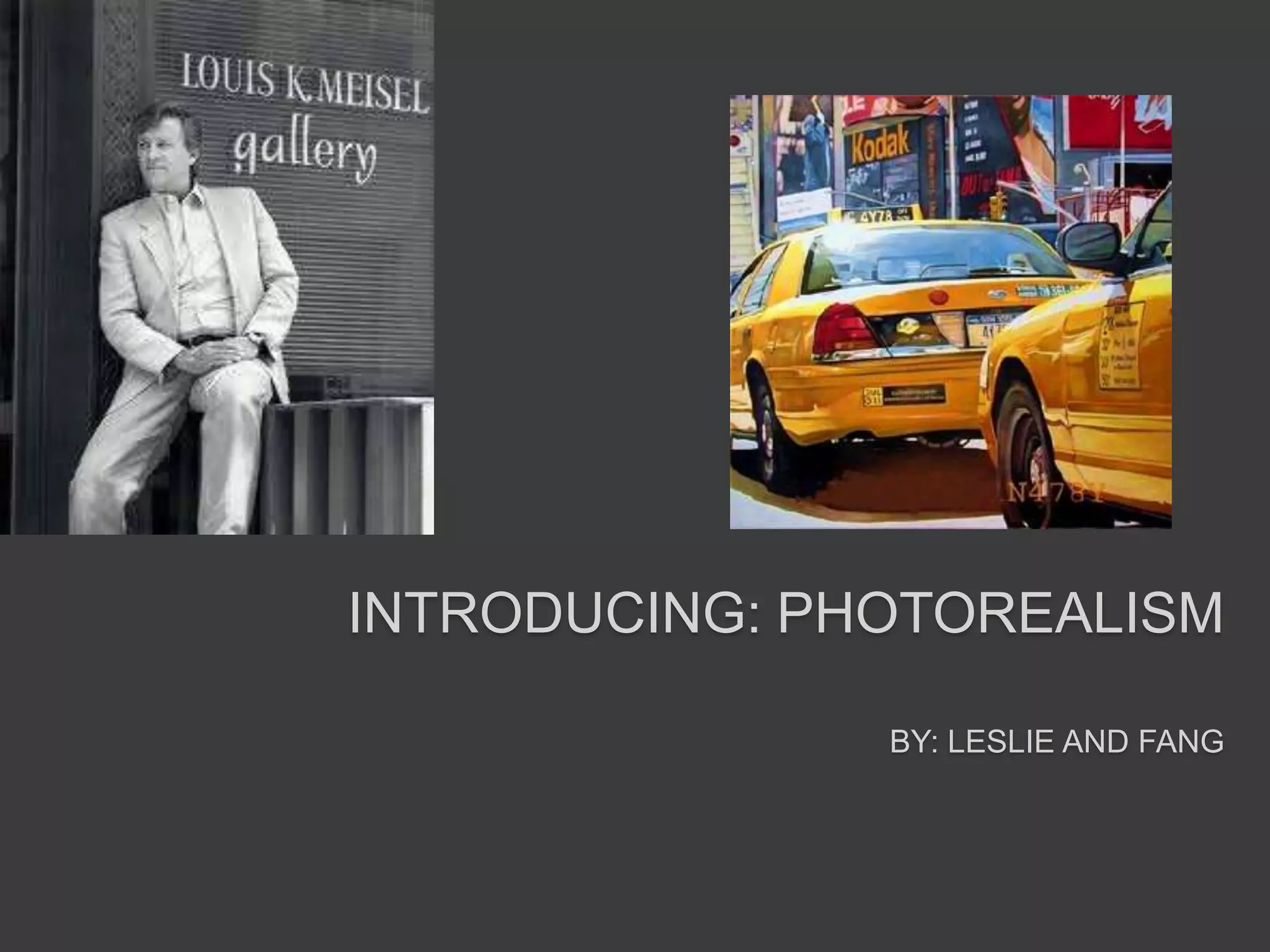
• Term coined by Louis K. Meisel in 1969
• It is also sometimes labeled as Super-Realism, New
  Realism, Sharp Focus Realism, or Hyper-Realism.
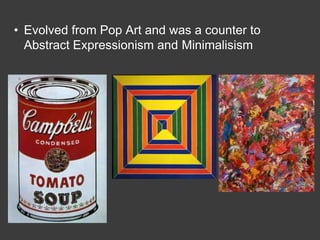
• Evolved from Pop Art and was a counter to
  Abstract Expressionism and Minimalisism
• “Photorealism “came out of Pop yet had the
  affectlessness of Minimalism and, at the same
  time, capitalized on the public's fondness for exact
  replication.”
• Reaction to the ever increasing photographic
  media, which was threatening to lessen the value
  of imagery in art.
• Tried to reclaim the value of an image.
• Photorealism was international, but mainly
  practiced in the U.S.
• The use of a camera and photographs is an acceptance of
   Modernism
• Invention of camera:
        1.     Caused scenic and portrait artists to quit and move to
photography because their work was claimed to be inadequate to the
real thing.
        2.     In the 19th and 20th century, artist used photographs as
an aid in their painting but would deny it in fear that their work to be
called imitations.
        3.     Offered up a lot of experimentation.
• Photography was a break in history and allowed artist to replicate
   something that they witnessed. (Cave Man Drawings)
MEISEL’S 5 POINT DEFINITION FOR
ORIGINATORS
• Use of camera and photograph to gather “info”
• Use of mechanical or semi-mechanical means to transfer
  “info”
• Artist must have technical ability to make the piece seem
  photo realistic
• Work must be exhibited by 1972 to be considered a
  Central Photo Realist
• Artist must have devoted at least 5 years towards
  photorealistic work
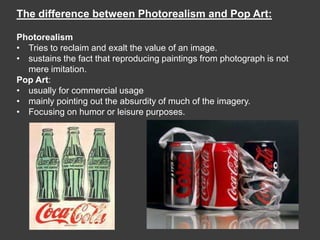
The difference between Photorealism and Pop Art:

Photorealism
• Tries to reclaim and exalt the value of an image.
• sustains the fact that reproducing paintings from photograph is not
  mere imitation.
Pop Art:
• usually for commercial usage
• mainly pointing out the absurdity of much of the imagery.
• Focusing on humor or leisure purposes.
STYLES AND IDEAS
• All styles revolve around the photograph
• Artists try to represent a frozen moment in time
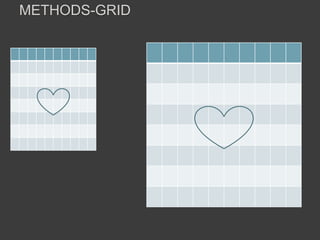
• The photographs slide must be transferred to the
  canvas, 2 primary methods to do so


             Technical method
• The use of machines or projectors to slide the
  image onto the canvas
METHODS-GRID
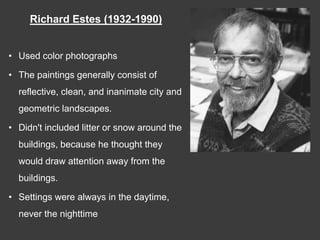
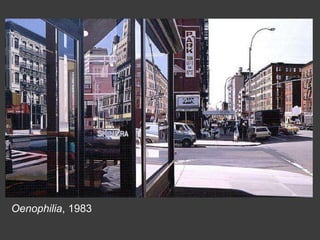
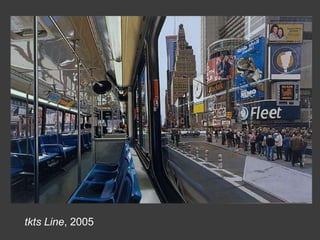
Richard Estes (1932-1990)


• Used color photographs

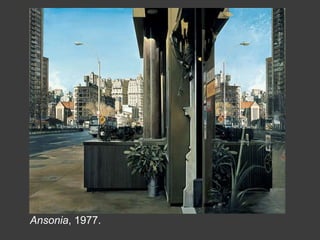
• The paintings generally consist of
  reflective, clean, and inanimate city and
  geometric landscapes.

• Didn't included litter or snow around the
  buildings, because he thought they
  would draw attention away from the
  buildings.

• Settings were always in the daytime,
  never the nighttime
• Avoided using famous cityscapes

• strive to create a three-dimensional feel

• early 1960s are of city dwellers engaged in everyday activities

• Beginning around 1967, he began to paint storefronts and
  buildings with glass windows and their reflections.
Ansonia, 1977.
Oenophilia, 1983
tkts Line, 2005
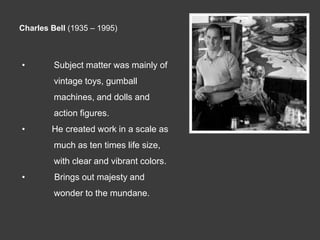
Charles Bell (1935 – 1995)


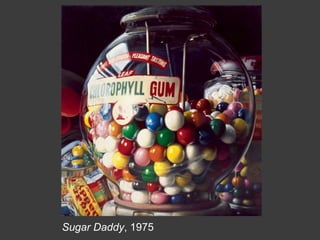
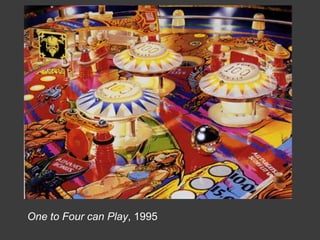
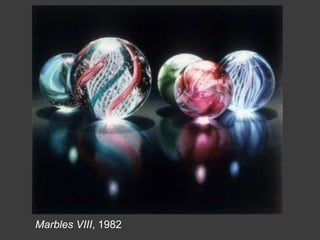
•        Subject matter was mainly of
         vintage toys, gumball
         machines, and dolls and
         action figures.
•       He created work in a scale as
         much as ten times life size,
         with clear and vibrant colors.
•        Brings out majesty and
         wonder to the mundane.
Sugar Daddy, 1975
One to Four can Play, 1995
Marbles VIII, 1982
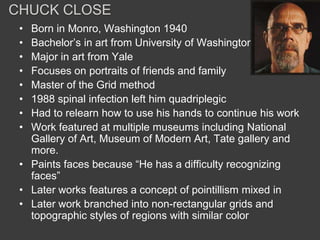
CHUCK CLOSE
 • Born in Monro, Washington 1940
 • Bachelor’s in art from University of Washington
 • Major in art from Yale
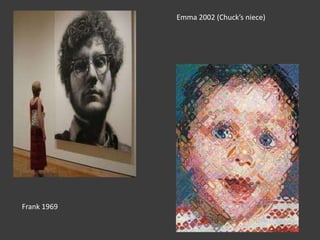
 • Focuses on portraits of friends and family
 • Master of the Grid method
 • 1988 spinal infection left him quadriplegic
 • Had to relearn how to use his hands to continue his work
 • Work featured at multiple museums including National
   Gallery of Art, Museum of Modern Art, Tate gallery and
   more.
 • Paints faces because “He has a difficulty recognizing
   faces”
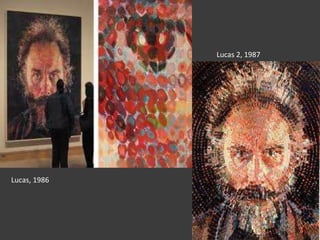
 • Later works features a concept of pointillism mixed in
 • Later work branched into non-rectangular grids and
   topographic styles of regions with similar color
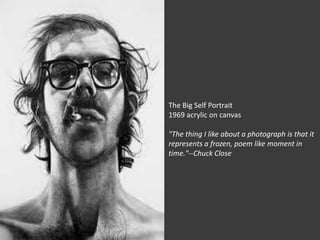
The Big Self Portrait
1969 acrylic on canvas

"The thing I like about a photograph is that it
represents a frozen, poem like moment in
time."--Chuck Close
Emma 2002 (Chuck’s niece)


Frank 1969
Lucas 2, 1987


Lucas, 1986
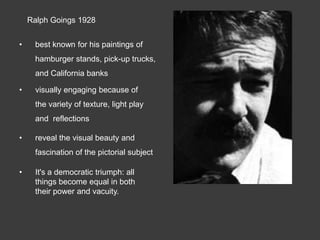
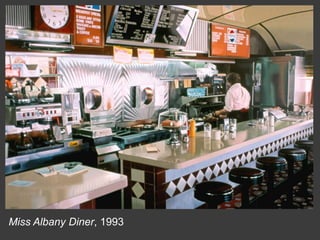
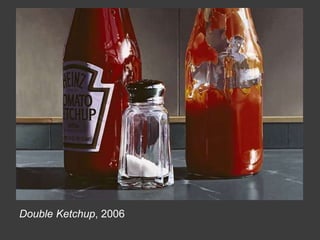
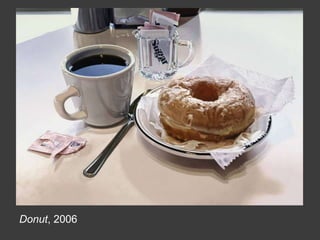
Ralph Goings 1928


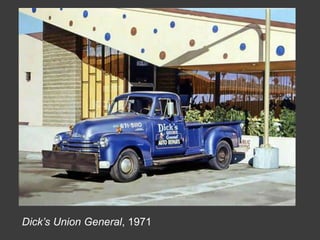
•    best known for his paintings of
     hamburger stands, pick-up trucks,
     and California banks

•     visually engaging because of
     the variety of texture, light play
     and reflections

•    reveal the visual beauty and
     fascination of the pictorial subject

•    It's a democratic triumph: all
     things become equal in both
     their power and vacuity.
Dick’s Union General, 1971
Miss Albany Diner, 1993
Double Ketchup, 2006
Donut, 2006
DUANE HANSON
• Born January 17th, 1925 in Alexandria Minnesota

• Master of Fine Arts degree from Cranbrook Academy of
  Art after a period of teaching high school art
• 1987 honored with Duane Hanson Day, a proclamation
  in Broward County.
• Introduced into Florida Artists Hall of fame in 1992
• Social Observer
STYLE-HANSON

• Heavily influenced by the Pop Art sculptor George Segal
• Known for life-like sculptures made from variable
  materials such as polyester resin, fiberglass, bondo, and
  bronze
• Original pieces depicted brutally violent subjects
• First pieces cast in fiberglass and vinyl
• Clothed sculptors appropriately and posed them for
  action shots
• Used real life models and adjusted as needed
• Predominately middle or lower class, blue collar
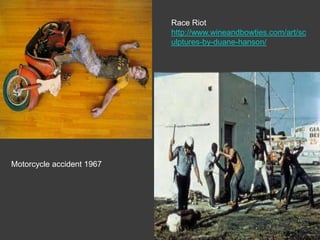
Race Riot
                           http://www.wineandbowties.com/art/sc
                           ulptures-by-duane-hanson/


Motorcycle accident 1967
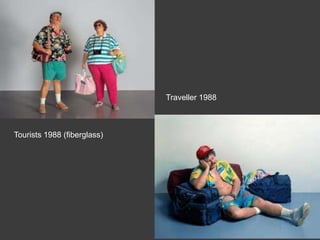
Traveller 1988


Tourists 1988 (fiberglass)
MODERN PHOTOREALISM

• Movement continues and includes some of the
  originators
• New photo realists build upon the foundations of the
  originators
• Many newer artists have strayed from original strict
  definition
• New tech allows artists to be able to be far more
  precision oriented
OVERVIEW

•   Movement began in late 1960s early 1970s
•   Not possible without the invention of the photograph
•   Photorealism is about catching a frozen moment in time
•   Photorealism is not about the photo, but rather the skill
    behind duplicating the image or how they adjust the
    image.
Presentation

Presentation

  • 1.
    INTRODUCING: PHOTOREALISM BY: LESLIE AND FANG
  • 2.
    History: • Began inthe late 1960s • Term coined by Louis K. Meisel in 1969 • It is also sometimes labeled as Super-Realism, New Realism, Sharp Focus Realism, or Hyper-Realism.
  • 3.
    • Evolved fromPop Art and was a counter to Abstract Expressionism and Minimalisism
  • 4.
    • “Photorealism “cameout of Pop yet had the affectlessness of Minimalism and, at the same time, capitalized on the public's fondness for exact replication.” • Reaction to the ever increasing photographic media, which was threatening to lessen the value of imagery in art. • Tried to reclaim the value of an image. • Photorealism was international, but mainly practiced in the U.S.
  • 5.
    • The useof a camera and photographs is an acceptance of Modernism • Invention of camera: 1. Caused scenic and portrait artists to quit and move to photography because their work was claimed to be inadequate to the real thing. 2. In the 19th and 20th century, artist used photographs as an aid in their painting but would deny it in fear that their work to be called imitations. 3. Offered up a lot of experimentation. • Photography was a break in history and allowed artist to replicate something that they witnessed. (Cave Man Drawings)
  • 6.
    MEISEL’S 5 POINTDEFINITION FOR ORIGINATORS • Use of camera and photograph to gather “info” • Use of mechanical or semi-mechanical means to transfer “info” • Artist must have technical ability to make the piece seem photo realistic • Work must be exhibited by 1972 to be considered a Central Photo Realist • Artist must have devoted at least 5 years towards photorealistic work
  • 7.
    The difference betweenPhotorealism and Pop Art: Photorealism • Tries to reclaim and exalt the value of an image. • sustains the fact that reproducing paintings from photograph is not mere imitation. Pop Art: • usually for commercial usage • mainly pointing out the absurdity of much of the imagery. • Focusing on humor or leisure purposes.
  • 8.
    STYLES AND IDEAS •All styles revolve around the photograph • Artists try to represent a frozen moment in time • The photographs slide must be transferred to the canvas, 2 primary methods to do so Technical method • The use of machines or projectors to slide the image onto the canvas
  • 9.
  • 10.
    Richard Estes (1932-1990) •Used color photographs • The paintings generally consist of reflective, clean, and inanimate city and geometric landscapes. • Didn't included litter or snow around the buildings, because he thought they would draw attention away from the buildings. • Settings were always in the daytime, never the nighttime
  • 11.
    • Avoided usingfamous cityscapes • strive to create a three-dimensional feel • early 1960s are of city dwellers engaged in everyday activities • Beginning around 1967, he began to paint storefronts and buildings with glass windows and their reflections.
  • 12.
  • 13.
  • 14.
  • 15.
    Charles Bell (1935– 1995) • Subject matter was mainly of vintage toys, gumball machines, and dolls and action figures. • He created work in a scale as much as ten times life size, with clear and vibrant colors. • Brings out majesty and wonder to the mundane.
  • 16.
  • 17.
    One to Fourcan Play, 1995
  • 18.
  • 19.
    CHUCK CLOSE •Born in Monro, Washington 1940 • Bachelor’s in art from University of Washington • Major in art from Yale • Focuses on portraits of friends and family • Master of the Grid method • 1988 spinal infection left him quadriplegic • Had to relearn how to use his hands to continue his work • Work featured at multiple museums including National Gallery of Art, Museum of Modern Art, Tate gallery and more. • Paints faces because “He has a difficulty recognizing faces” • Later works features a concept of pointillism mixed in • Later work branched into non-rectangular grids and topographic styles of regions with similar color
  • 20.
    The Big SelfPortrait 1969 acrylic on canvas "The thing I like about a photograph is that it represents a frozen, poem like moment in time."--Chuck Close
  • 21.
    Emma 2002 (Chuck’sniece) Frank 1969
  • 22.
  • 23.
    Ralph Goings 1928 • best known for his paintings of hamburger stands, pick-up trucks, and California banks • visually engaging because of the variety of texture, light play and reflections • reveal the visual beauty and fascination of the pictorial subject • It's a democratic triumph: all things become equal in both their power and vacuity.
  • 24.
  • 25.
  • 26.
  • 27.
  • 28.
    DUANE HANSON • BornJanuary 17th, 1925 in Alexandria Minnesota • Master of Fine Arts degree from Cranbrook Academy of Art after a period of teaching high school art • 1987 honored with Duane Hanson Day, a proclamation in Broward County. • Introduced into Florida Artists Hall of fame in 1992 • Social Observer
  • 29.
    STYLE-HANSON • Heavily influencedby the Pop Art sculptor George Segal • Known for life-like sculptures made from variable materials such as polyester resin, fiberglass, bondo, and bronze • Original pieces depicted brutally violent subjects • First pieces cast in fiberglass and vinyl • Clothed sculptors appropriately and posed them for action shots • Used real life models and adjusted as needed • Predominately middle or lower class, blue collar
  • 30.
    Race Riot http://www.wineandbowties.com/art/sc ulptures-by-duane-hanson/ Motorcycle accident 1967
  • 31.
  • 32.
    MODERN PHOTOREALISM • Movementcontinues and includes some of the originators • New photo realists build upon the foundations of the originators • Many newer artists have strayed from original strict definition • New tech allows artists to be able to be far more precision oriented
  • 33.
    OVERVIEW • Movement began in late 1960s early 1970s • Not possible without the invention of the photograph • Photorealism is about catching a frozen moment in time • Photorealism is not about the photo, but rather the skill behind duplicating the image or how they adjust the image.