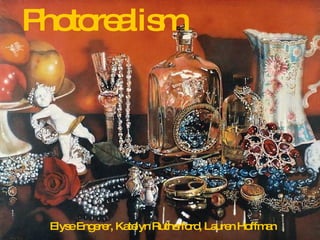
Photorealism Elyse Engerer, Katelyn Rutherford, Lauren Hoffman
What is Photorealism? Style of painting that resembles a photo Meticulous detail Also commonly called: Super Realism, New Realism, Sharp Focus Realism, Verism, Hyper-Realism Produces a sense of reality and depicts the “naked truth”
The Photorealism Movement Began in the 1960’s and 1970’s in the United States and Britain Developed as a reaction to Abstract Expressionism Detachment from Minimalism Similar to the Pop Art movement, who is also influenced by “consumer culture” Capture everyday life of America Takes planning, skill and meticulous detail and concentration.
How It All Began… The term Photorealism was first used by Louis K. Meisel in 1968 in the Whitney Museum Catalogue.  Two years later, upon the request of Stuart M. Speiser, Meisel developed a five-point definition. Five-Point Definition 1.) The Photo-Realist uses a camera and photograph to gather information. 2.) The Photo-Realist uses a mechanical or semi-mechanical means to transfer the information to the canvas.  3.) The Photo-Realist must have the technical ability to make the finished work appear photographic. 4.)The artist must have exhibited work as a Photo-Realist by 1972 to be considered one of the central Photo-Realists. 5.) The artist must have devoted at least 5 years to the development and exhibition.
Technique Often done by oil or acrylic Airbrushed or by hand, no visible brushstrokes. Trial Watercolor paintings Grid System Projector Large Canvases Subjects often include reflective surfaces, street scenes and portraits, all of which were prior planned
Influential Artists Richard Estes Chuck Close Audrey Flack Don Eddy
Richard Estes Born in Kewanee, Illinois in 1936, but later moved to Maine and New York to pursue his career as an artist.  Studied at Art Institute of Chicago Commercial Artist/Publisher/Advertiser Most well-known for street views with intricate glass reflections.
“ Bus Reflections”  (1972)  101 x 132 cm  Oil on canvas
“ Nedick’s” (1970) 121.9 x 167.6 cm Oil on canvas Richard Estes in front of his painting “Downtown” “ Circus Drive-In” (1971) 43.2 x 61 cm Oil on canvas   More Works by Estes
Chuck Close Born in 1940 Studied at the University of Washington School of Art Suffered a spinal blood clot in 1988 leading him to be a quadriplegic  After his tragic accident, his art career continued but he was forced to paint using his mouth.  Most commonly known for his non-expressional portraits. Liked to point out flaws of the human face.
( Before Accident) (After) “ Big Self-Portrait” (1968) Acrylic on canvas 107 1/2 x 83 1/2 in. “ Kiki” 1993 Acrylic on canvas 107 1/2 x 83 1/2 in. “ I discovered about 150 dots is the minimum number  of dots to make a specific recognizable person. You can  make something that looks like a head, with fewer dots,  but you won't be able to give much information about who it is.”
“ Self Portrait” (1995) Screen-print on paper   “ Brad” (2009) Tapestry 104 x 78 in. “ Part of the joy of looking at art is getting in sync in some ways with the decision-making process that the artist used and the record  that's embedded in the work. ” “ Painting is the most magical of mediums.  The transcendence is truly amazing to me  every time I go to a museum and I see how  somebody figured another way to rub colored  dirt on a flat surface and make space where there is no space or make you think of a life  experience.”
Audrey Flack Born in 1931, attended Music and Art School in New York City, studied at Cooper Union and Yale. Started off as Abstract Expressionist Dealt with not being taken seriously for being a woman Sculptor Pioneer Photorealist Most known for emotional effect!
Kennedy Motorcade (1964) 38x42 inches  Oil on canvas “ Crayola” (1972-1973) 28x 40 inches Oil over acrylic on canvas
"Art is a powerful force in this world, it is the visual representation of what we think and what we feel, and how  we think and how we feel."
Don Eddy Born in 1944 in Long Beach, California Attended University of Hawaii and University of California Unlike other artists who use just acrylic, Eddy first paints his canvases green, then purple, then brown.
“ G-II” (1978-1979) 44 x 40 in. Acrylic on Canvas “ G-IV” (1979-1980) Acrylic on Canvas 40 x 30 inches
“ A River Called In Lumen Profero” (2008) 48 x 56 in. Acrylic on Canvas “ Canticle for a Small World(detail)”(2006) 16 panels at 11 x 11 inches Panel

C:\fakepath\photorealism

  • 1.
    Photorealism Elyse Engerer,Katelyn Rutherford, Lauren Hoffman
  • 2.
    What is Photorealism?Style of painting that resembles a photo Meticulous detail Also commonly called: Super Realism, New Realism, Sharp Focus Realism, Verism, Hyper-Realism Produces a sense of reality and depicts the “naked truth”
  • 3.
    The Photorealism MovementBegan in the 1960’s and 1970’s in the United States and Britain Developed as a reaction to Abstract Expressionism Detachment from Minimalism Similar to the Pop Art movement, who is also influenced by “consumer culture” Capture everyday life of America Takes planning, skill and meticulous detail and concentration.
  • 4.
    How It AllBegan… The term Photorealism was first used by Louis K. Meisel in 1968 in the Whitney Museum Catalogue. Two years later, upon the request of Stuart M. Speiser, Meisel developed a five-point definition. Five-Point Definition 1.) The Photo-Realist uses a camera and photograph to gather information. 2.) The Photo-Realist uses a mechanical or semi-mechanical means to transfer the information to the canvas. 3.) The Photo-Realist must have the technical ability to make the finished work appear photographic. 4.)The artist must have exhibited work as a Photo-Realist by 1972 to be considered one of the central Photo-Realists. 5.) The artist must have devoted at least 5 years to the development and exhibition.
  • 5.
    Technique Often doneby oil or acrylic Airbrushed or by hand, no visible brushstrokes. Trial Watercolor paintings Grid System Projector Large Canvases Subjects often include reflective surfaces, street scenes and portraits, all of which were prior planned
  • 6.
    Influential Artists RichardEstes Chuck Close Audrey Flack Don Eddy
  • 7.
    Richard Estes Bornin Kewanee, Illinois in 1936, but later moved to Maine and New York to pursue his career as an artist. Studied at Art Institute of Chicago Commercial Artist/Publisher/Advertiser Most well-known for street views with intricate glass reflections.
  • 8.
    “ Bus Reflections” (1972) 101 x 132 cm Oil on canvas
  • 9.
    “ Nedick’s” (1970)121.9 x 167.6 cm Oil on canvas Richard Estes in front of his painting “Downtown” “ Circus Drive-In” (1971) 43.2 x 61 cm Oil on canvas More Works by Estes
  • 10.
    Chuck Close Bornin 1940 Studied at the University of Washington School of Art Suffered a spinal blood clot in 1988 leading him to be a quadriplegic After his tragic accident, his art career continued but he was forced to paint using his mouth. Most commonly known for his non-expressional portraits. Liked to point out flaws of the human face.
  • 11.
    ( Before Accident)(After) “ Big Self-Portrait” (1968) Acrylic on canvas 107 1/2 x 83 1/2 in. “ Kiki” 1993 Acrylic on canvas 107 1/2 x 83 1/2 in. “ I discovered about 150 dots is the minimum number of dots to make a specific recognizable person. You can make something that looks like a head, with fewer dots, but you won't be able to give much information about who it is.”
  • 12.
    “ Self Portrait”(1995) Screen-print on paper “ Brad” (2009) Tapestry 104 x 78 in. “ Part of the joy of looking at art is getting in sync in some ways with the decision-making process that the artist used and the record that's embedded in the work. ” “ Painting is the most magical of mediums. The transcendence is truly amazing to me every time I go to a museum and I see how somebody figured another way to rub colored dirt on a flat surface and make space where there is no space or make you think of a life experience.”
  • 13.
    Audrey Flack Bornin 1931, attended Music and Art School in New York City, studied at Cooper Union and Yale. Started off as Abstract Expressionist Dealt with not being taken seriously for being a woman Sculptor Pioneer Photorealist Most known for emotional effect!
  • 14.
    Kennedy Motorcade (1964)38x42 inches Oil on canvas “ Crayola” (1972-1973) 28x 40 inches Oil over acrylic on canvas
  • 15.
    "Art is apowerful force in this world, it is the visual representation of what we think and what we feel, and how we think and how we feel."
  • 16.
    Don Eddy Bornin 1944 in Long Beach, California Attended University of Hawaii and University of California Unlike other artists who use just acrylic, Eddy first paints his canvases green, then purple, then brown.
  • 17.
    “ G-II” (1978-1979)44 x 40 in. Acrylic on Canvas “ G-IV” (1979-1980) Acrylic on Canvas 40 x 30 inches
  • 18.
    “ A RiverCalled In Lumen Profero” (2008) 48 x 56 in. Acrylic on Canvas “ Canticle for a Small World(detail)”(2006) 16 panels at 11 x 11 inches Panel