photorealismBy Lyndsay Maresca and Danielle Warren
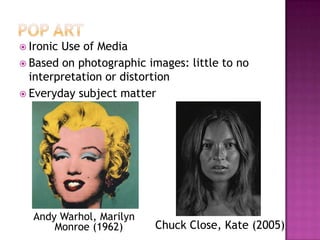
Pop ArtIronic Use of MediaBased on photographic images: little to no interpretation or distortionEveryday subject matterAndy Warhol, Marilyn Monroe (1962)Chuck Close, Kate (2005)
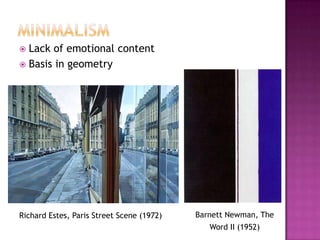
MINIMALISMLack of emotional content
Basis in geometry Barnett Newman, The Word II (1952)Richard Estes, Paris Street Scene (1972)
Historical EventsVIETNAM WAR1955-1975
WATERGATE SCANDAL1972-1974Political UnrestDistrust of GovernmentWho can we trust?
Public reactionPeople did not take the movement seriously, as they believed it was nothing but a copy of a photographPhotorealism is not art because there is no emotion behind itWhy not just take a photograph?
Characteristics:Very detailed to the point where they appear realColors and shapes are not distorted and the subjects are extremely realisticBased off photographs Comment on consumer culture and everyday activity
Technique:Most artists make a small copy of a photograph beforehand and then use it was a guide to their larger picture
Artists pay attention to the detail, such as:
Composition
Perspective
Form
Light
ShadowTechnique:To copy their image onto into a larger scale, artists use tools such as overhead projectorsor the grid method
The grid method is when the artist divides a photograph into sections and draws each section out one by one separately
Airbrushing
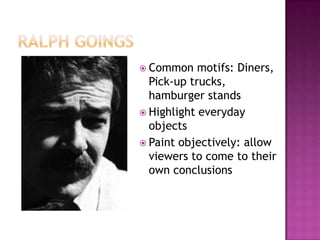
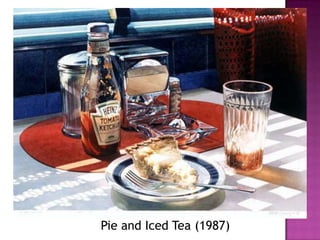
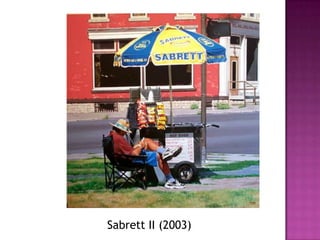
Brush strokes are practically invisibleRalph GoingsCommon motifs: Diners, Pick-up trucks, hamburger standsHighlight everyday objectsPaint objectively: allow viewers to come to their own conclusions
Pie and Iced Tea (1987)
Sabrett II (2003)
Tux (2003)
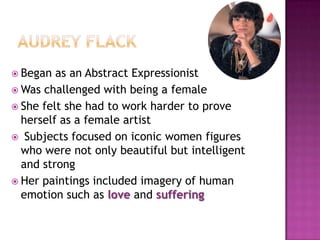
Audrey FlackBegan as an Abstract Expressionist
Was challenged with being a female
She felt she had to work harder to prove herself as a female artist
 Subjects focused on iconic women figures who were not only beautiful but intelligent and strong
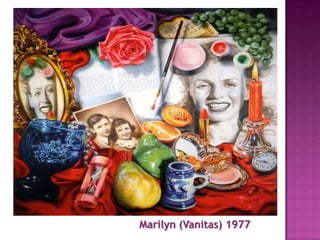
Her paintings included imagery of human emotion such as loveand sufferingAudrey FlackUsed different types of media such as:Acrylic paintAirbrushOil paintOr a mixture of the aboveHer use of color was very vivid and intriguingSaw color as wavelengths of light instead of a material substanceHer subjects are mostly feminine but still hold a the strong and capable feel
Marilyn (Vanitas) 1977
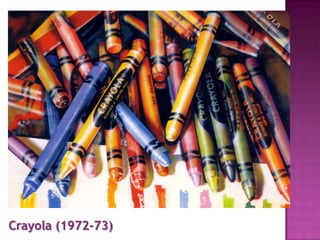
Crayola (1972-73)
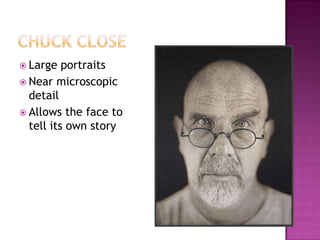
Chuck CloseLarge portraitsNear microscopic detailAllows the face to tell its own story
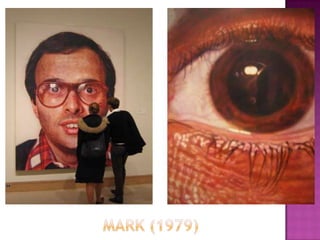
Mark (1979)
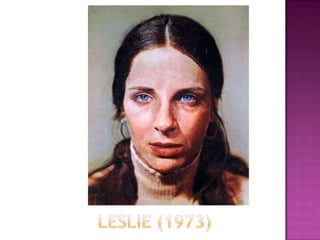
Leslie (1973)
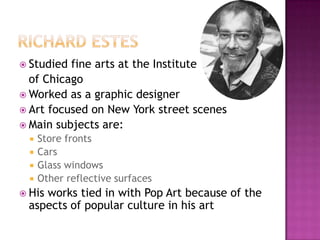
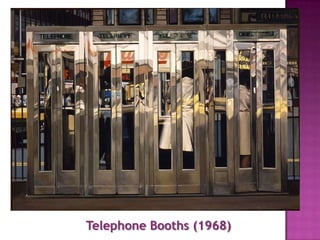
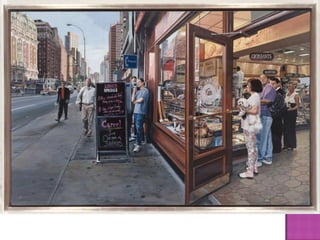
Richard EstesStudied fine arts at the Institute 	of ChicagoWorked as a graphic designer Art focused on New York street scenesMain subjects are:Store frontsCarsGlass windowsOther reflective surfacesHis works tied in with Pop Art because of the aspects of popular culture in his art

Photorealism