1
The Future of Sustainable and
Healthy Eating
Some reflections on the UK debate about
Sustainable Diet Policies, Priorities &
Strategies
Tim Lang
Centre for Food Policy, City University London
Voedingscentrum10th
anniversary conference ‘Together we explore the Future’,
held on the SS De Rotterdam, Rotterdam, The Netherlands,
November 16, 2010
2
Introduction
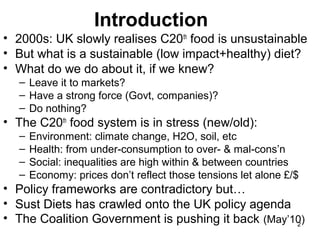
• 2000s: UK slowly realises C20th
food is unsustainable
• But what is a sustainable (low impact+healthy) diet?
• What do we do about it, if we knew?
– Leave it to markets?
– Have a strong force (Govt, companies)?
– Do nothing?
• The C20th
food system is in stress (new/old):
– Environment: climate change, H2O, soil, etc
– Health: from under-consumption to over- & mal-cons’n
– Social: inequalities are high within & between countries
– Economy: prices don’t reflect those tensions let alone £/$
• Policy frameworks are contradictory but…
• Sust Diets has crawled onto the UK policy agenda
• The Coalition Government is pushing it back (May’10)
33
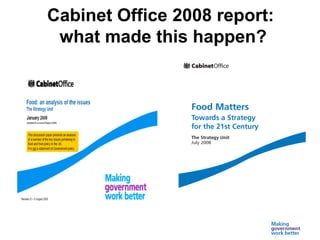
Cabinet Office 2008 report:
what made this happen?
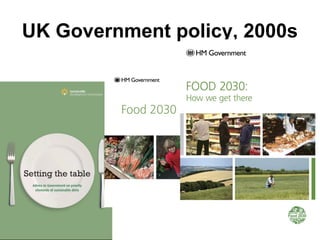
UK Government policy, 2000s
4
5
1. The growth of UK policy on
sustainable food production &
consumption
From fragments to
‘low carbon + healthy’
2000s: tectonic plates move
• Environment: climate change, soil, water etc.
• Resilience: 2000 Lorry strike ‘5 days from shortages’
– Food resilience in question:
 MoD / Cranfield Defra study / Chatham House
• Economy: 2006-08 commodity price spike
Food Matters (HMT PMSU):
 Companies worry about UK buying power
• Health: 2000-07 obesity crisis grows
 National Audit Office (2001), Wanless (2002+04),
CMO (2003), Commons Health Comm.ee (2004),
Chief Scientist’s Foresight report (2008)
6
Meanwhile, institutional reform
• 1990s: MAFF in crisis over food safety,
BSE…
• 1997: Blair and ‘new’ Labour elected
• 2000: creation of FSA, Environ’t Agency, SDC
• 2001: Curry Commission focus on enviro +
farm modernisation
• 2006-08: global food rises  G Brown review
• 2008: Cabinet Office Food Matters report
• 2009: SDC Setting the Table  Integrated
Advice to Consumers 7
8
2. Slow realisation sustainable
production is not enough.
Sustainable consumption has to
be addressed
Policy has a difficult mix:
• A material world with limits
• A biological world which is fragile
• Human physiology created c.500k yrs ago
• A food system delivering ‘feast day’ food daily
• Price signals which don’t internalise costs
• Advertising and marketing distorting needs by
amplifying wants
• Government reluctant to direct consumers
• Consumers who believe they have choice 9
The result?
• Unsustainable Food Production
• Unsustainable Food Supply Chains
• Unsustainable modes of Retailing
• Unsustainable Diets
• Unsustainable Waste
10
11
3. What can we do?
What can we do? Options
• Focus on consumers?
– Label, educate, inform, appeal to do ‘right thing’
• Focus upstream?
– Change food composition, ‘choice-edit’
• Alter land use?
– Meat & dairy are key ‘hotspot
• Do nothing?
– But pressure is building up
• Leave it to EU? Others?
12
13
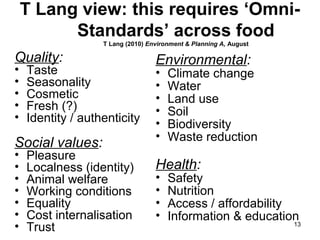
T Lang view: this requires ‘Omni-
Standards’ across food
T Lang (2010) Environment & Planning A, August
Quality:
• Taste
• Seasonality
• Cosmetic
• Fresh (?)
• Identity / authenticity
Social values:
• Pleasure
• Localness (identity)
• Animal welfare
• Working conditions
• Equality
• Cost internalisation
• Trust
Environmental:
• Climate change
• Water
• Land use
• Soil
• Biodiversity
• Waste reduction
Health:
• Safety
• Nutrition
• Access / affordability
• Information & education
14
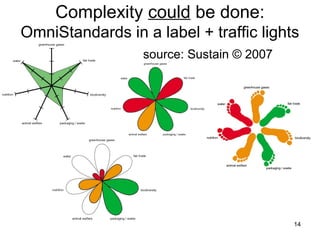
Complexity could be done:
OmniStandards in a label + traffic lights
source: Sustain © 2007
15
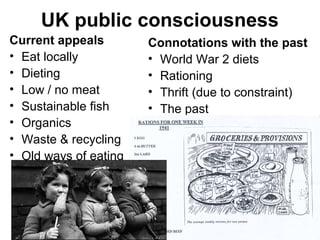
UK public consciousness
Current appeals
• Eat locally
• Dieting
• Low / no meat
• Sustainable fish
• Organics
• Waste & recycling
• Old ways of eating
Connotations with the past
• World War 2 diets
• Rationing
• Thrift (due to constraint)
• The past
16
4. This is the terrain the
SDC’s Setting the Table
report set out to clarify
1717
UK’s Sustainable Development
Commission project 2009
• A scoping project – ie opening not final words
• Taking issue across gov’t: DH, FSA, Defra, EA etc
• Contracted to Oxford University BHF HPG
• 3 processes:
– Literature review
– Stakeholder consultation
– Review existing positions & interventions
• Developed a hierarchy of priorities
• Report done, consulted + Govt and sent to Defra
1818
Key findings
• no definition of ‘sustainable diet’ yet agreed but
stakeholders see need for one
• Identified 10 key guidelines for sustainable diets
• Reviewed 44 published academic research studies
and reports
• Found more positive synergies (win-wins) than
tensions (win-lose) eg
– Lowering consumption of low nutritional value foods
(fatty/sugary foods & drinks) has mainly +ve impacts on
health, environment and reducing social inequalities.
• Found gaps in the evidence, most notably with
respect to economic impacts of dietary changes.
• Produced a 3-level hierarchy of behavioural impact
1919
Identified existing UK framework
guidelines = ‘soft’ cultural advice
• Consume less food
and drink
• Accept different
notions of quality
• Accept variability of
supply
• Shop on foot or over
the internet
• Cook and store foods
in energy conserving
ways
• Prepare food for more
than one person and
for several days
• Reduce food waste
• Reduce consumption
of meat and dairy
products
• Reduce consumption
of food and drinks with
low nutritional value
• Reduce consumption
of bottled water
2020
Changes where health, environmental,
economic and social impacts are likely
to complement each other:
• Reduce consumption of meat & dairy
products
• Reduce food & drink of low nutritional value
(fatty, sugary foods + tea, coffee & alcohol)
• Reduce food waste.
2121
Changes likely to have a significant
positive sustainability impact, but
where gains in one area might have a
more negative impact elsewhere:
• Increase fruit & veg consumption,
particularly seasonal and field grown
• Consume only fish from sustainable stocks
• Eat more foods produced with respect for
wildlife & environment e.g. organic food
2222
Changes making smaller contribution to
dietary sustainability, with largely
complementary effects across issues
• Reduce energy input by shopping on foot or
over the internet
• Cook & store food in energy conserving ways
• Drinking tap water instead of bottled water
2323
Reviewed practical initiatives
• Found 40 on sustainable food supply
– Govt  local food growing projects
• Assessed 12 for the breadth of sustainability
• Only 3 initiatives had good sustainability scope
• Few had adequately evaluated possible impacts
• Some +ve moves towards consistency
– eg Healthier Food Mark for public sector caterers
2424
Recommendations include:
• DA(F) to oversee cross-Govt guidelines
– Step 1: FSA Eatwell Plate become Sust Diet
– Step 2: develop full sustainability guidance
• Defra, FSA, DAs
– seek EU position
– develop evidence on behaviour change
• Food Research Partnership explore
‘hotspots’ eg meat & dairy, fish, soy, palm
• Explore implications for consumer
behaviour and supply chains
25
5. Where to now?
Policy positions in UK vary
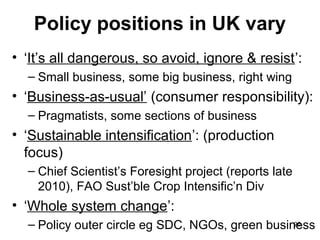
• ‘It’s all dangerous, so avoid, ignore & resist’:
– Small business, some big business, right wing
• ‘Business-as-usual’ (consumer responsibility):
– Pragmatists, some sections of business
• ‘Sustainable intensification’: (production
focus)
– Chief Scientist’s Foresight project (reports late
2010), FAO Sust’ble Crop Intensific’n Div
• ‘Whole system change’:
– Policy outer circle eg SDC, NGOs, green business26
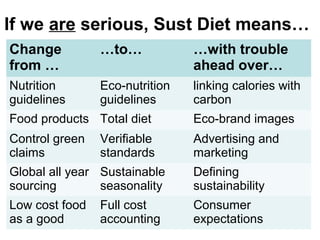
If we are serious, Sust Diet means…
27
Change
from …
…to… …with trouble
ahead over…
Nutrition
guidelines
Eco-nutrition
guidelines
linking calories with
carbon
Food products Total diet Eco-brand images
Control green
claims
Verifiable
standards
Advertising and
marketing
Global all year
sourcing
Sustainable
seasonality
Defining
sustainability
Low cost food
as a good
Full cost
accounting
Consumer
expectations
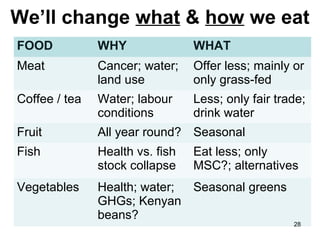
We’ll change what & how we eat
FOOD WHY WHAT
Meat Cancer; water;
land use
Offer less; mainly or
only grass-fed
Coffee / tea Water; labour
conditions
Less; only fair trade;
drink water
Fruit All year round? Seasonal
Fish Health vs. fish
stock collapse
Eat less; only
MSC?; alternatives
Vegetables Health; water;
GHGs; Kenyan
beans?
Seasonal greens
28
29
Companies engaging
• International companies:
– 2002: SAI launched Groupe Danone, Nestlé, Unilever
– 2009 (Oct 16): G30 top TNCs initiative Coca-Cola, Tesco,
Unilever, News International
– 2010: World Economic Forum process (out 2011)
• UK companies:
– 2007: IGD Food Industry Sustainability Strategy
Champions Group focus on low carbon + ethics
– 2008: Tesco gives £25m Manchester SCI
– 3 retailers’ choice-edit M&S Plan A, Co-operative Group, Waitrose
• A product specific approach, not overall diet
Governments start to act (but
focus on consumer choice)
• Sweden publishes Environmentally Effective
Food Choices (2009) = 1st
Sustainable Diet document
• Appeals to responsible consumers & agri-food chain
• Germany: Council on SD’s shopping advice
• NL: Towards Sustainable Production &
Consumption (June 2008)
• France: INRA-CIRAD sustainable food systems (2009-11)
• UK: Integrated Advice to Consumers (led by
Food Standards Agency)
30
Civil society / NGOs
• Bubbling UK ‘democratic experimentalism’
– Sustain: www.sustainweb.org.uk
– WWF: One Planet Diet
– CIWF: ‘eat less meat’ campaign
– Friends of the Earth: meat campaign
– Fife Diet (Vancouver 100 mile diet)
– Food4Life project (2006-11): school food
• International NGO debates about:
– Need to go beyond ingredients to processes
– Full labelling being too complex; can lead to
‘blame the consumer’? [SDC agrees] 31
32
6. Meanwhile a new UK
government is elected
(May 2010)
New Coalition Government
• Focus on cuts:
– Axeing central gov’t and arms-length bodies
– FSA, HPA, SDC, RCEP, CFPA, SACN, etc
• Hints that Food 2030 strategy to remain in
some form with focus on delivery
• Health Responsibility Deals to ‘work with
not against business’ (Alcohol, fitness, food, behaviour,
work)
• Infrastructure uncertainties ahead
– Research, Skills, Education, Standards 33
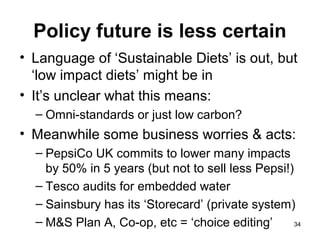
Policy future is less certain
• Language of ‘Sustainable Diets’ is out, but
‘low impact diets’ might be in
• It’s unclear what this means:
– Omni-standards or just low carbon?
• Meanwhile some business worries & acts:
– PepsiCo UK commits to lower many impacts
by 50% in 5 years (but not to sell less Pepsi!)
– Tesco audits for embedded water
– Sainsbury has its ‘Storecard’ (private system)
– M&S Plan A, Co-op, etc = ‘choice editing’ 34
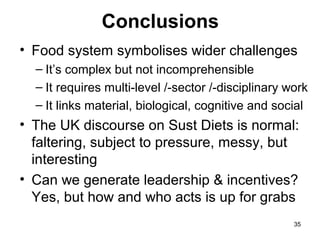
Conclusions
• Food system symbolises wider challenges
– It’s complex but not incomprehensible
– It requires multi-level /-sector /-disciplinary work
– It links material, biological, cognitive and social
• The UK discourse on Sust Diets is normal:
faltering, subject to pressure, messy, but
interesting
• Can we generate leadership & incentives?
Yes, but how and who acts is up for grabs
35
36
Thanks!
t.lang@city.ac.uk

Presentatie Tim Lang

  • 1.
    1 The Future ofSustainable and Healthy Eating Some reflections on the UK debate about Sustainable Diet Policies, Priorities & Strategies Tim Lang Centre for Food Policy, City University London Voedingscentrum10th anniversary conference ‘Together we explore the Future’, held on the SS De Rotterdam, Rotterdam, The Netherlands, November 16, 2010
  • 2.
    2 Introduction • 2000s: UKslowly realises C20th food is unsustainable • But what is a sustainable (low impact+healthy) diet? • What do we do about it, if we knew? – Leave it to markets? – Have a strong force (Govt, companies)? – Do nothing? • The C20th food system is in stress (new/old): – Environment: climate change, H2O, soil, etc – Health: from under-consumption to over- & mal-cons’n – Social: inequalities are high within & between countries – Economy: prices don’t reflect those tensions let alone £/$ • Policy frameworks are contradictory but… • Sust Diets has crawled onto the UK policy agenda • The Coalition Government is pushing it back (May’10)
  • 3.
    33 Cabinet Office 2008report: what made this happen?
  • 4.
  • 5.
    5 1. The growthof UK policy on sustainable food production & consumption From fragments to ‘low carbon + healthy’
  • 6.
    2000s: tectonic platesmove • Environment: climate change, soil, water etc. • Resilience: 2000 Lorry strike ‘5 days from shortages’ – Food resilience in question:  MoD / Cranfield Defra study / Chatham House • Economy: 2006-08 commodity price spike Food Matters (HMT PMSU):  Companies worry about UK buying power • Health: 2000-07 obesity crisis grows  National Audit Office (2001), Wanless (2002+04), CMO (2003), Commons Health Comm.ee (2004), Chief Scientist’s Foresight report (2008) 6
  • 7.
    Meanwhile, institutional reform •1990s: MAFF in crisis over food safety, BSE… • 1997: Blair and ‘new’ Labour elected • 2000: creation of FSA, Environ’t Agency, SDC • 2001: Curry Commission focus on enviro + farm modernisation • 2006-08: global food rises  G Brown review • 2008: Cabinet Office Food Matters report • 2009: SDC Setting the Table  Integrated Advice to Consumers 7
  • 8.
    8 2. Slow realisationsustainable production is not enough. Sustainable consumption has to be addressed
  • 9.
    Policy has adifficult mix: • A material world with limits • A biological world which is fragile • Human physiology created c.500k yrs ago • A food system delivering ‘feast day’ food daily • Price signals which don’t internalise costs • Advertising and marketing distorting needs by amplifying wants • Government reluctant to direct consumers • Consumers who believe they have choice 9
  • 10.
    The result? • UnsustainableFood Production • Unsustainable Food Supply Chains • Unsustainable modes of Retailing • Unsustainable Diets • Unsustainable Waste 10
  • 11.
  • 12.
    What can wedo? Options • Focus on consumers? – Label, educate, inform, appeal to do ‘right thing’ • Focus upstream? – Change food composition, ‘choice-edit’ • Alter land use? – Meat & dairy are key ‘hotspot • Do nothing? – But pressure is building up • Leave it to EU? Others? 12
  • 13.
    13 T Lang view:this requires ‘Omni- Standards’ across food T Lang (2010) Environment & Planning A, August Quality: • Taste • Seasonality • Cosmetic • Fresh (?) • Identity / authenticity Social values: • Pleasure • Localness (identity) • Animal welfare • Working conditions • Equality • Cost internalisation • Trust Environmental: • Climate change • Water • Land use • Soil • Biodiversity • Waste reduction Health: • Safety • Nutrition • Access / affordability • Information & education
  • 14.
    14 Complexity could bedone: OmniStandards in a label + traffic lights source: Sustain © 2007
  • 15.
    15 UK public consciousness Currentappeals • Eat locally • Dieting • Low / no meat • Sustainable fish • Organics • Waste & recycling • Old ways of eating Connotations with the past • World War 2 diets • Rationing • Thrift (due to constraint) • The past
  • 16.
    16 4. This isthe terrain the SDC’s Setting the Table report set out to clarify
  • 17.
    1717 UK’s Sustainable Development Commissionproject 2009 • A scoping project – ie opening not final words • Taking issue across gov’t: DH, FSA, Defra, EA etc • Contracted to Oxford University BHF HPG • 3 processes: – Literature review – Stakeholder consultation – Review existing positions & interventions • Developed a hierarchy of priorities • Report done, consulted + Govt and sent to Defra
  • 18.
    1818 Key findings • nodefinition of ‘sustainable diet’ yet agreed but stakeholders see need for one • Identified 10 key guidelines for sustainable diets • Reviewed 44 published academic research studies and reports • Found more positive synergies (win-wins) than tensions (win-lose) eg – Lowering consumption of low nutritional value foods (fatty/sugary foods & drinks) has mainly +ve impacts on health, environment and reducing social inequalities. • Found gaps in the evidence, most notably with respect to economic impacts of dietary changes. • Produced a 3-level hierarchy of behavioural impact
  • 19.
    1919 Identified existing UKframework guidelines = ‘soft’ cultural advice • Consume less food and drink • Accept different notions of quality • Accept variability of supply • Shop on foot or over the internet • Cook and store foods in energy conserving ways • Prepare food for more than one person and for several days • Reduce food waste • Reduce consumption of meat and dairy products • Reduce consumption of food and drinks with low nutritional value • Reduce consumption of bottled water
  • 20.
    2020 Changes where health,environmental, economic and social impacts are likely to complement each other: • Reduce consumption of meat & dairy products • Reduce food & drink of low nutritional value (fatty, sugary foods + tea, coffee & alcohol) • Reduce food waste.
  • 21.
    2121 Changes likely tohave a significant positive sustainability impact, but where gains in one area might have a more negative impact elsewhere: • Increase fruit & veg consumption, particularly seasonal and field grown • Consume only fish from sustainable stocks • Eat more foods produced with respect for wildlife & environment e.g. organic food
  • 22.
    2222 Changes making smallercontribution to dietary sustainability, with largely complementary effects across issues • Reduce energy input by shopping on foot or over the internet • Cook & store food in energy conserving ways • Drinking tap water instead of bottled water
  • 23.
    2323 Reviewed practical initiatives •Found 40 on sustainable food supply – Govt  local food growing projects • Assessed 12 for the breadth of sustainability • Only 3 initiatives had good sustainability scope • Few had adequately evaluated possible impacts • Some +ve moves towards consistency – eg Healthier Food Mark for public sector caterers
  • 24.
    2424 Recommendations include: • DA(F)to oversee cross-Govt guidelines – Step 1: FSA Eatwell Plate become Sust Diet – Step 2: develop full sustainability guidance • Defra, FSA, DAs – seek EU position – develop evidence on behaviour change • Food Research Partnership explore ‘hotspots’ eg meat & dairy, fish, soy, palm • Explore implications for consumer behaviour and supply chains
  • 25.
  • 26.
    Policy positions inUK vary • ‘It’s all dangerous, so avoid, ignore & resist’: – Small business, some big business, right wing • ‘Business-as-usual’ (consumer responsibility): – Pragmatists, some sections of business • ‘Sustainable intensification’: (production focus) – Chief Scientist’s Foresight project (reports late 2010), FAO Sust’ble Crop Intensific’n Div • ‘Whole system change’: – Policy outer circle eg SDC, NGOs, green business26
  • 27.
    If we areserious, Sust Diet means… 27 Change from … …to… …with trouble ahead over… Nutrition guidelines Eco-nutrition guidelines linking calories with carbon Food products Total diet Eco-brand images Control green claims Verifiable standards Advertising and marketing Global all year sourcing Sustainable seasonality Defining sustainability Low cost food as a good Full cost accounting Consumer expectations
  • 28.
    We’ll change what& how we eat FOOD WHY WHAT Meat Cancer; water; land use Offer less; mainly or only grass-fed Coffee / tea Water; labour conditions Less; only fair trade; drink water Fruit All year round? Seasonal Fish Health vs. fish stock collapse Eat less; only MSC?; alternatives Vegetables Health; water; GHGs; Kenyan beans? Seasonal greens 28
  • 29.
    29 Companies engaging • Internationalcompanies: – 2002: SAI launched Groupe Danone, Nestlé, Unilever – 2009 (Oct 16): G30 top TNCs initiative Coca-Cola, Tesco, Unilever, News International – 2010: World Economic Forum process (out 2011) • UK companies: – 2007: IGD Food Industry Sustainability Strategy Champions Group focus on low carbon + ethics – 2008: Tesco gives £25m Manchester SCI – 3 retailers’ choice-edit M&S Plan A, Co-operative Group, Waitrose • A product specific approach, not overall diet
  • 30.
    Governments start toact (but focus on consumer choice) • Sweden publishes Environmentally Effective Food Choices (2009) = 1st Sustainable Diet document • Appeals to responsible consumers & agri-food chain • Germany: Council on SD’s shopping advice • NL: Towards Sustainable Production & Consumption (June 2008) • France: INRA-CIRAD sustainable food systems (2009-11) • UK: Integrated Advice to Consumers (led by Food Standards Agency) 30
  • 31.
    Civil society /NGOs • Bubbling UK ‘democratic experimentalism’ – Sustain: www.sustainweb.org.uk – WWF: One Planet Diet – CIWF: ‘eat less meat’ campaign – Friends of the Earth: meat campaign – Fife Diet (Vancouver 100 mile diet) – Food4Life project (2006-11): school food • International NGO debates about: – Need to go beyond ingredients to processes – Full labelling being too complex; can lead to ‘blame the consumer’? [SDC agrees] 31
  • 32.
    32 6. Meanwhile anew UK government is elected (May 2010)
  • 33.
    New Coalition Government •Focus on cuts: – Axeing central gov’t and arms-length bodies – FSA, HPA, SDC, RCEP, CFPA, SACN, etc • Hints that Food 2030 strategy to remain in some form with focus on delivery • Health Responsibility Deals to ‘work with not against business’ (Alcohol, fitness, food, behaviour, work) • Infrastructure uncertainties ahead – Research, Skills, Education, Standards 33
  • 34.
    Policy future isless certain • Language of ‘Sustainable Diets’ is out, but ‘low impact diets’ might be in • It’s unclear what this means: – Omni-standards or just low carbon? • Meanwhile some business worries & acts: – PepsiCo UK commits to lower many impacts by 50% in 5 years (but not to sell less Pepsi!) – Tesco audits for embedded water – Sainsbury has its ‘Storecard’ (private system) – M&S Plan A, Co-op, etc = ‘choice editing’ 34
  • 35.
    Conclusions • Food systemsymbolises wider challenges – It’s complex but not incomprehensible – It requires multi-level /-sector /-disciplinary work – It links material, biological, cognitive and social • The UK discourse on Sust Diets is normal: faltering, subject to pressure, messy, but interesting • Can we generate leadership & incentives? Yes, but how and who acts is up for grabs 35
  • 36.