Sustainable food
       for sustainable diets?
The challenge of ecological public health

                          Tim Lang
    Centre for Food Policy, City University London, UK.
                   e: t.lang@city.ac.uk


     Paper to Calouste Gulbenkian Foundation, Lisbon, April 11, 2012
WHAT IS THE PROBLEM?

      The Evidence


                       2
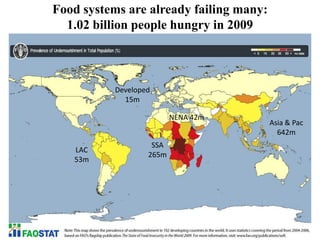
Food systems are already failing many:
  1.02 billion people hungry in 2009


           Developed
             15m

                          NENA 42m
                                         Asia & Pac
                                           642m
                    SSA
   LAC
                   265m
   53m
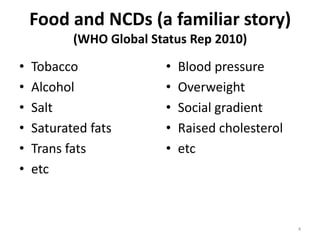
Food and NCDs (a familiar story)
           (WHO Global Status Rep 2010)

•   Tobacco              •   Blood pressure
•   Alcohol              •   Overweight
•   Salt                 •   Social gradient
•   Saturated fats       •   Raised cholesterol
•   Trans fats           •   etc
•   etc


                                                  4
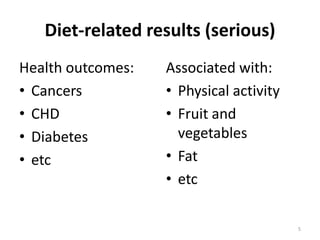
Diet-related results (serious)
Health outcomes:   Associated with:
• Cancers          • Physical activity
• CHD              • Fruit and
• Diabetes           vegetables
• etc              • Fat
                   • etc

                                         5
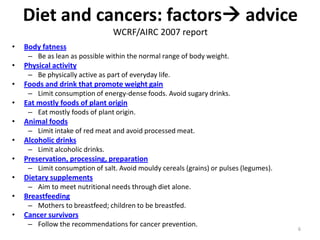
Diet and cancers: factors advice
                                 WCRF/AIRC 2007 report
•   Body fatness
     – Be as lean as possible within the normal range of body weight.
•   Physical activity
     – Be physically active as part of everyday life.
•   Foods and drink that promote weight gain
     – Limit consumption of energy-dense foods. Avoid sugary drinks.
•   Eat mostly foods of plant origin
     – Eat mostly foods of plant origin.
•   Animal foods
     – Limit intake of red meat and avoid processed meat.
•   Alcoholic drinks
     – Limit alcoholic drinks.
•   Preservation, processing, preparation
     – Limit consumption of salt. Avoid mouldy cereals (grains) or pulses (legumes).
•   Dietary supplements
     – Aim to meet nutritional needs through diet alone.
•   Breastfeeding
     – Mothers to breastfeed; children to be breastfed.
•   Cancer survivors
     – Follow the recommendations for cancer prevention.
                                                                                       6
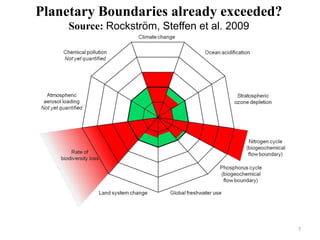
Planetary Boundaries already exceeded?
     Source: Rockström, Steffen et al. 2009


                                              7
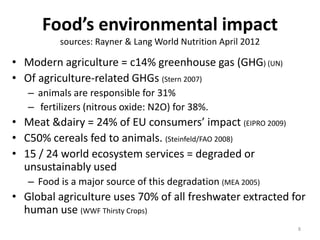
Food’s environmental impact
          sources: Rayner & Lang World Nutrition April 2012

• Modern agriculture = c14% greenhouse gas (GHG) (UN)
• Of agriculture-related GHGs (Stern 2007)
   – animals are responsible for 31%
   – fertilizers (nitrous oxide: N2O) for 38%.
• Meat &dairy = 24% of EU consumers’ impact (EIPRO 2009)
• C50% cereals fed to animals. (Steinfeld/FAO 2008)
• 15 / 24 world ecosystem services = degraded or
  unsustainably used
   – Food is a major source of this degradation (MEA 2005)
• Global agriculture uses 70% of all freshwater extracted for
  human use (WWF Thirsty Crops)
                                                              8
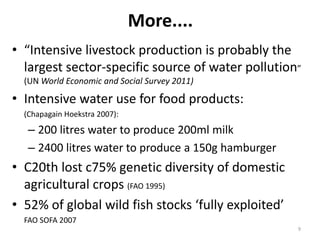
More....
• “Intensive livestock production is probably the
  largest sector-specific source of water pollution”
  (UN World Economic and Social Survey 2011)

• Intensive water use for food products:
  (Chapagain Hoekstra 2007):
   – 200 litres water to produce 200ml milk
   – 2400 litres water to produce a 150g hamburger
• C20th lost c75% genetic diversity of domestic
  agricultural crops (FAO 1995)
• 52% of global wild fish stocks ‘fully exploited’
  FAO SOFA 2007
                                                     9
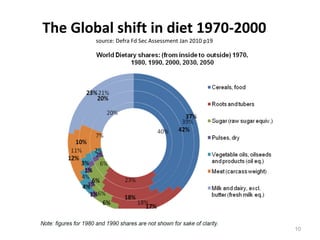
The Global shift in diet 1970-2000
        source: Defra Fd Sec Assessment Jan 2010 p19


                                                       10
This is a cultural transition!
•   What we eat
•   How it is made
•   Where we buy it
•   How and where we consume
•   Food’s meanings not just nutritional impact


                                                  11
But the economics are fragile

       The 2007-08 prices spike
  Is the long drop in prices halted?


                                       12
FAO food price index today
http://www.fao.org/worldfoodsituation/wfs-home/foodpricesindex/en/ [accessed April 6 2012]
FAO food price index 1990-2012
http://www.fao.org/worldfoodsituation/wfs-home/foodpricesindex/en/ [accessed April 6 2012]
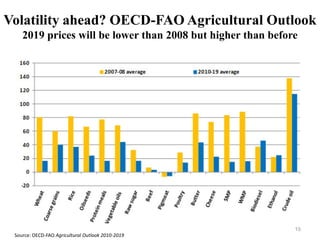
Volatility ahead? OECD-FAO Agricultural Outlook
    2019 prices will be lower than 2008 but higher than before


                                                             15
 Source: OECD-FAO Agricultural Outlook 2010-2019
WHAT IS GOING ON?
         Is this a policy failure?
         Or the result of policy?
Certainly, an evidence-policy MISMATCH


                                         16
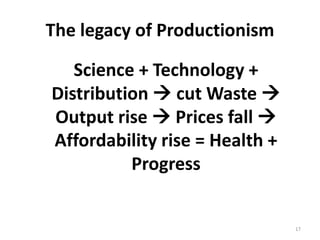
The legacy of Productionism

   Science + Technology +
Distribution  cut Waste 
Output rise  Prices fall 
Affordability rise = Health +
          Progress


                                17
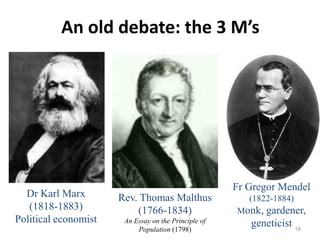
An old debate: the 3 M’s


                                                      Fr Gregor Mendel
  Dr Karl Marx        Rev. Thomas Malthus                (1822-1884)
   (1818-1883)            (1766-1834)                 Monk, gardener,
Political economist    An Essay on the Principle of      geneticist 18
                           Population (1798)
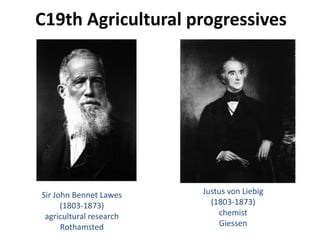
C19th Agricultural progressives


Sir John Bennet Lawes    Justus von Liebig
      (1803-1873)          (1803-1873)
 agricultural research       chemist
      Rothamsted             Giessen
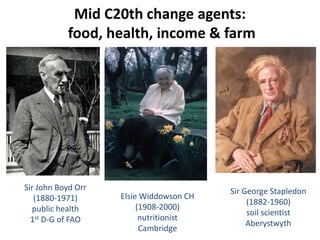
Mid C20th change agents:
           food, health, income & farm


Sir John Boyd Orr                        Sir George Stapledon
   (1880-1971)      Elsie Widdowson CH
                                              (1882-1960)
  public health          (1908-2000)
                                              soil scientist
  1st D-G of FAO          nutritionist
                                              Aberystwyth
                          Cambridge
How is current policy addressing
         the problem?
         Mainly soft measures
   But there are emerging discourses


                                       21
There is no agreement yet on....
•   What a sustainable lifestyle is
•   What sustainable consumption is
•   What sustainable production is
•   What sustainable food systems are
•   What a sustainable diet is


                                        22
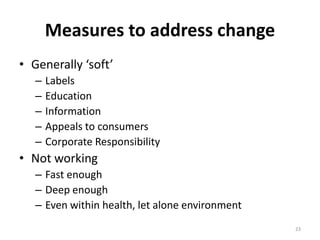
Measures to address change
• Generally ‘soft’
   –   Labels
   –   Education
   –   Information
   –   Appeals to consumers
   –   Corporate Responsibility
• Not working
   – Fast enough
   – Deep enough
   – Even within health, let alone environment
                                                 23
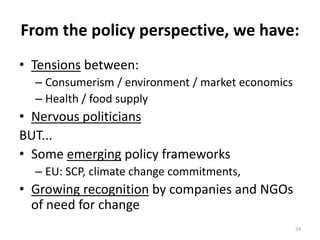
From the policy perspective, we have:
• Tensions between:
  – Consumerism / environment / market economics
  – Health / food supply
• Nervous politicians
BUT...
• Some emerging policy frameworks
  – EU: SCP, climate change commitments,
• Growing recognition by companies and NGOs
  of need for change
                                                   24
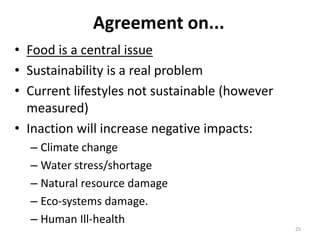
Agreement on...
• Food is a central issue
• Sustainability is a real problem
• Current lifestyles not sustainable (however
  measured)
• Inaction will increase negative impacts:
  – Climate change
  – Water stress/shortage
  – Natural resource damage
  – Eco-systems damage.
  – Human Ill-health
                                                25
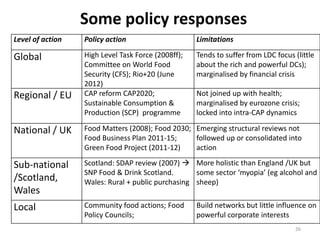
Some policy responses
Level of action   Policy action                     Limitations

Global            High Level Task Force (2008ff);   Tends to suffer from LDC focus (little
                  Committee on World Food           about the rich and powerful DCs);
                  Security (CFS); Rio+20 (June      marginalised by financial crisis
                  2012)
Regional / EU     CAP reform CAP2020;               Not joined up with health;
                  Sustainable Consumption &         marginalised by eurozone crisis;
                  Production (SCP) programme        locked into intra-CAP dynamics

National / UK     Food Matters (2008); Food 2030; Emerging structural reviews not
                  Food Business Plan 2011-15;     followed up or consolidated into
                  Green Food Project (2011-12)    action

Sub-national      Scotland: SDAP review (2007)  More holistic than England /UK but
                  SNP Food & Drink Scotland.       some sector ‘myopia’ (eg alcohol and
/Scotland,        Wales: Rural + public purchasing sheep)
Wales
Local             Community food actions; Food      Build networks but little influence on
                  Policy Councils;                  powerful corporate interests
                                                                                   26
Sustainable Food: some EU
            developments 2008-12
• Sustainable Consumption-Production & Sustainable Industrial
  Policy Action Plan (2008)
• Suitability of the potential extension of the Ecolabel to food
  products
• European Food Sustainable Consumption Production (SCP)
  Roundtable (2009-) co-chairs DG Environment & European
  Food & Feed Trade Associations. Based in FoodDrinkEurope) &
  supported by JRC.
• DG Environment & JRC (2011 -2012): Harmonised framework
  methodology for the calculation of the environmental
  footprint of products.
• Roadmap to a Resource Efficient Europe (2011) part of the
  actions form Europe 2020: A strategy for smart, sustainable
  and inclusive growth (2010)
•
                                                             27
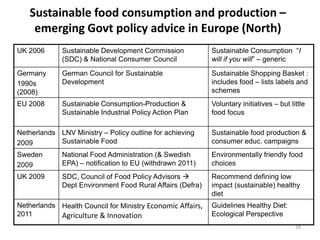
Sustainable food consumption and production –
    emerging Govt policy advice in Europe (North)
UK 2006      Sustainable Development Commission             Sustainable Consumption “I
             (SDC) & National Consumer Council              will if you will” – generic
Germany      German Council for Sustainable                 Sustainable Shopping Basket :
1990s        Development                                    includes food – lists labels and
(2008)                                                      schemes
EU 2008      Sustainable Consumption-Production &           Voluntary initiatives – but little
             Sustainable Industrial Policy Action Plan      food focus

Netherlands LNV Ministry – Policy outline for achieving     Sustainable food production &
2009        Sustainable Food                                consumer educ. campaigns
Sweden       National Food Administration (& Swedish        Environmentally friendly food
2009         EPA) – notification to EU (withdrawn 2011)     choices
UK 2009      SDC, Council of Food Policy Advisors          Recommend defining low
             Dept Environment Food Rural Affairs (Defra)    impact (sustainable) healthy
                                                            diet
Netherlands Health Council for Ministry Economic Affairs,   Guidelines Healthy Diet:
2011        Agriculture & Innovation                        Ecological Perspective
                                                                                          28
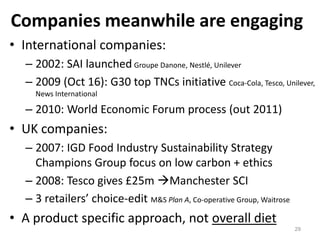
Companies meanwhile are engaging
• International companies:
  – 2002: SAI launched Groupe Danone, Nestlé, Unilever
  – 2009 (Oct 16): G30 top TNCs initiative Coca-Cola, Tesco, Unilever,
    News International

  – 2010: World Economic Forum process (out 2011)
• UK companies:
  – 2007: IGD Food Industry Sustainability Strategy
    Champions Group focus on low carbon + ethics
  – 2008: Tesco gives £25m Manchester SCI
  – 3 retailers’ choice-edit M&S Plan A, Co-operative Group, Waitrose
• A product specific approach, not overall diet
                                                                        29
What is meant by Sustainability
          in policy?
      It is used by bankers, too!


                                    30
Current approach to food sustainability

• A tendency to focus on climate change
  – CO2 is very important ...but....
• Downplays biodiversity, water, soil, land, etc
• Repeats Productionist emphasis on supply
• Downplays culture, consumption ie demand


                                                   31
Key hotspots show food is more than
    an environmental challenge
• Meat & dairy:
   – Aspirational (rises + €) but high impact (health + enviro)
• Waste:
   – 30% after consumers buy it (rich countries)
   – c40% globally at farm level (poor countries)
• Inequalities:
   – Within / between countries (even in EU
• Prices:
   – Failure to internalise full costs
   – But would consumers pay more?
                                                            32
Sustainability: an unclear term?
• Brundtland report 1987
• Triple focus: enviro + society + econ
• “meeting needs now without compromising
  the ability of future generations to meet
  needs”
BUT IS THIS NOW DETAILED ENOUGH?
• I think not


                                              33
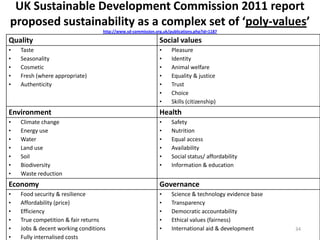
UK Sustainable Development Commission 2011 report
proposed sustainability as a complex set of ‘poly-values’
                                   http://www.sd-commission.org.uk/publications.php?id=1187

Quality                                                       Social values
•   Taste                                                     •     Pleasure
•   Seasonality                                               •     Identity
•   Cosmetic                                                  •     Animal welfare
•   Fresh (where appropriate)                                 •     Equality & justice
•   Authenticity                                              •     Trust
                                                              •     Choice
                                                              •     Skills (citizenship)
Environment                                                   Health
•   Climate change                                            •     Safety
•   Energy use                                                •     Nutrition
•   Water                                                     •     Equal access
•   Land use                                                  •     Availability
•   Soil                                                      •     Social status/ affordability
•   Biodiversity                                              •     Information & education
•   Waste reduction
Economy                                                       Governance
•   Food security & resilience                                •     Science & technology evidence base
•   Affordability (price)                                     •     Transparency
•   Efficiency                                                •     Democratic accountability
•   True competition & fair returns                           •     Ethical values (fairness)
•   Jobs & decent working conditions                          •     International aid & development      34
•   Fully internalised costs
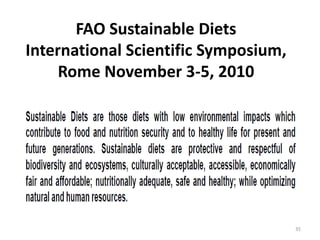
FAO Sustainable Diets
International Scientific Symposium,
     Rome November 3-5, 2010


                                      35
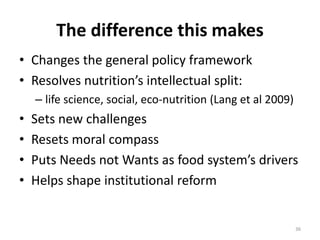
The difference this makes
• Changes the general policy framework
• Resolves nutrition’s intellectual split:
    – life science, social, eco-nutrition (Lang et al 2009)
•   Sets new challenges
•   Resets moral compass
•   Puts Needs not Wants as food system’s drivers
•   Helps shape institutional reform


                                                              36
37
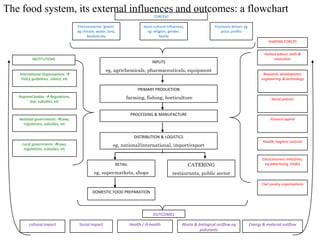
The food system, its external influences and outcomes: a flowchart
                                                                                   CONTEXT

                                     Environmental ‘givens’                  Socio-cultural influences,               Economic drivers eg
                                     eg climate, water, land,                  eg religion, gender,                      price, profits
                                           biodiversity                                family
                                                                                                                                                      SHAPING FORCES


                                                                                                                                                    Human labour, skills &
           INSTITUTIONS                                                                                                                                 education
                                                                                  INPUTS
                                                      eg, agrichemicals, pharmaceuticals, equipment
   International Organizations                                                                                                                    Research, development,
    Policy guidelines, advice, etc                                                                                                                engineering & technology

                                                                          PRIMARY PRODUCTION
   Regional bodies  Regulations,                                farming, fishing, horticulture                                                         Social policies
         law, subsidies, etc


                                                                     PROCESSING & MANUFACTURE
   National governments Laws,                                                                                                                          Finance capital
     regulations, subsidies, etc


                                                                       DISTRIBUTION & LOGISTICS
                                                                                                                                                   Health, hygiene controls
     Local governments Laws,                              eg, national/international, import/export
      regulations, subsidies, etc

                                                                                                                                                   Consciousness industries,
                                                            RETAIL                                        CATERING                                  eg advertising, media

                                               eg, supermarkets, shops                         restaurants, public sector

                                                                                                                                                  Civil society organisations
                                              DOMESTIC FOOD PREPARATION


                                                                                   OUTCOMES

         cultural impact              Social impact                  Health / ill-health             Waste & biological outflow eg          Energy & material outflow
                                                                                                              pollutants
Where do we go from here?

 The Ecological Public Health agenda


                                       39
We must....
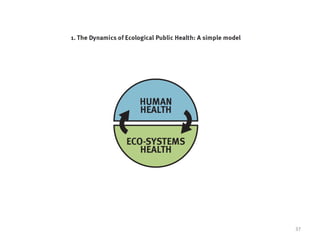
• Champion Ecological Public Health as the
  paradigm (Rayner & Lang 2012)
• Rethink diet around environmental limits:
   – Fork to farm (not farm to fork)
• Begin work on EU Sustainable Dietary Guidelines
• Help redesign food systems around Sust Diets
   – Not around reformed production
• Be open about the moral dimension: Health is
  about social progress!
• Ask if our institutions are fit for this purpose

                                                     40
For us professionally....
• Ask our professional bodies to engage
• Press for our Governments to produce
  sustainable dietary advice (and at EU)
• From CAP Common Sustainable Food Policy
• Include all dimensions that shape conditions
  on which health depends:
  – Material / bio-physiological / social / cognitive


                                                        41
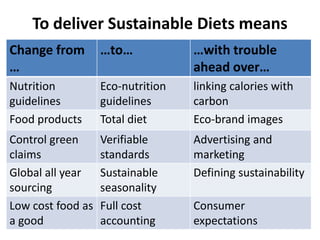
To deliver Sustainable Diets means
Change from        …to…            …with trouble
…                                  ahead over…
Nutrition          Eco-nutrition   linking calories with
guidelines         guidelines      carbon
Food products      Total diet      Eco-brand images
Control green      Verifiable      Advertising and
claims             standards       marketing
Global all year    Sustainable     Defining sustainability
sourcing           seasonality
Low cost food as   Full cost       Consumer
a good             accounting      expectations            42
Conclusions
• Food system change is
    – complex but not incomprehensible
    – requires multi-level /-sector /-disciplinary work
    – links the material, biological, cognitive and social
•   The discourse needs to change
•   Leadership & incentives are sorely needed
•   We need to be active
•   We don’t want change to be forced on us
•   There is enough evidence for policy to change
                                                             43
Thank you!

t.lang@city.ac.uk


                    44

Confiança alimentar abril 2012 Tim Lang

  • 1.
    Sustainable food for sustainable diets? The challenge of ecological public health Tim Lang Centre for Food Policy, City University London, UK. e: t.lang@city.ac.uk Paper to Calouste Gulbenkian Foundation, Lisbon, April 11, 2012
  • 2.
    WHAT IS THEPROBLEM? The Evidence 2
  • 3.
    Food systems arealready failing many: 1.02 billion people hungry in 2009 Developed 15m NENA 42m Asia & Pac 642m SSA LAC 265m 53m
  • 4.
    Food and NCDs(a familiar story) (WHO Global Status Rep 2010) • Tobacco • Blood pressure • Alcohol • Overweight • Salt • Social gradient • Saturated fats • Raised cholesterol • Trans fats • etc • etc 4
  • 5.
    Diet-related results (serious) Healthoutcomes: Associated with: • Cancers • Physical activity • CHD • Fruit and • Diabetes vegetables • etc • Fat • etc 5
  • 6.
    Diet and cancers:factors advice WCRF/AIRC 2007 report • Body fatness – Be as lean as possible within the normal range of body weight. • Physical activity – Be physically active as part of everyday life. • Foods and drink that promote weight gain – Limit consumption of energy-dense foods. Avoid sugary drinks. • Eat mostly foods of plant origin – Eat mostly foods of plant origin. • Animal foods – Limit intake of red meat and avoid processed meat. • Alcoholic drinks – Limit alcoholic drinks. • Preservation, processing, preparation – Limit consumption of salt. Avoid mouldy cereals (grains) or pulses (legumes). • Dietary supplements – Aim to meet nutritional needs through diet alone. • Breastfeeding – Mothers to breastfeed; children to be breastfed. • Cancer survivors – Follow the recommendations for cancer prevention. 6
  • 7.
    Planetary Boundaries alreadyexceeded? Source: Rockström, Steffen et al. 2009 7
  • 8.
    Food’s environmental impact sources: Rayner & Lang World Nutrition April 2012 • Modern agriculture = c14% greenhouse gas (GHG) (UN) • Of agriculture-related GHGs (Stern 2007) – animals are responsible for 31% – fertilizers (nitrous oxide: N2O) for 38%. • Meat &dairy = 24% of EU consumers’ impact (EIPRO 2009) • C50% cereals fed to animals. (Steinfeld/FAO 2008) • 15 / 24 world ecosystem services = degraded or unsustainably used – Food is a major source of this degradation (MEA 2005) • Global agriculture uses 70% of all freshwater extracted for human use (WWF Thirsty Crops) 8
  • 9.
    More.... • “Intensive livestockproduction is probably the largest sector-specific source of water pollution” (UN World Economic and Social Survey 2011) • Intensive water use for food products: (Chapagain Hoekstra 2007): – 200 litres water to produce 200ml milk – 2400 litres water to produce a 150g hamburger • C20th lost c75% genetic diversity of domestic agricultural crops (FAO 1995) • 52% of global wild fish stocks ‘fully exploited’ FAO SOFA 2007 9
  • 10.
    The Global shiftin diet 1970-2000 source: Defra Fd Sec Assessment Jan 2010 p19 10
  • 11.
    This is acultural transition! • What we eat • How it is made • Where we buy it • How and where we consume • Food’s meanings not just nutritional impact 11
  • 12.
    But the economicsare fragile The 2007-08 prices spike Is the long drop in prices halted? 12
  • 13.
    FAO food priceindex today http://www.fao.org/worldfoodsituation/wfs-home/foodpricesindex/en/ [accessed April 6 2012]
  • 14.
    FAO food priceindex 1990-2012 http://www.fao.org/worldfoodsituation/wfs-home/foodpricesindex/en/ [accessed April 6 2012]
  • 15.
    Volatility ahead? OECD-FAOAgricultural Outlook 2019 prices will be lower than 2008 but higher than before 15 Source: OECD-FAO Agricultural Outlook 2010-2019
  • 16.
    WHAT IS GOINGON? Is this a policy failure? Or the result of policy? Certainly, an evidence-policy MISMATCH 16
  • 17.
    The legacy ofProductionism Science + Technology + Distribution  cut Waste  Output rise  Prices fall  Affordability rise = Health + Progress 17
  • 18.
    An old debate:the 3 M’s Fr Gregor Mendel Dr Karl Marx Rev. Thomas Malthus (1822-1884) (1818-1883) (1766-1834) Monk, gardener, Political economist An Essay on the Principle of geneticist 18 Population (1798)
  • 19.
    C19th Agricultural progressives SirJohn Bennet Lawes Justus von Liebig (1803-1873) (1803-1873) agricultural research chemist Rothamsted Giessen
  • 20.
    Mid C20th changeagents: food, health, income & farm Sir John Boyd Orr Sir George Stapledon (1880-1971) Elsie Widdowson CH (1882-1960) public health (1908-2000) soil scientist 1st D-G of FAO nutritionist Aberystwyth Cambridge
  • 21.
    How is currentpolicy addressing the problem? Mainly soft measures But there are emerging discourses 21
  • 22.
    There is noagreement yet on.... • What a sustainable lifestyle is • What sustainable consumption is • What sustainable production is • What sustainable food systems are • What a sustainable diet is 22
  • 23.
    Measures to addresschange • Generally ‘soft’ – Labels – Education – Information – Appeals to consumers – Corporate Responsibility • Not working – Fast enough – Deep enough – Even within health, let alone environment 23
  • 24.
    From the policyperspective, we have: • Tensions between: – Consumerism / environment / market economics – Health / food supply • Nervous politicians BUT... • Some emerging policy frameworks – EU: SCP, climate change commitments, • Growing recognition by companies and NGOs of need for change 24
  • 25.
    Agreement on... • Foodis a central issue • Sustainability is a real problem • Current lifestyles not sustainable (however measured) • Inaction will increase negative impacts: – Climate change – Water stress/shortage – Natural resource damage – Eco-systems damage. – Human Ill-health 25
  • 26.
    Some policy responses Levelof action Policy action Limitations Global High Level Task Force (2008ff); Tends to suffer from LDC focus (little Committee on World Food about the rich and powerful DCs); Security (CFS); Rio+20 (June marginalised by financial crisis 2012) Regional / EU CAP reform CAP2020; Not joined up with health; Sustainable Consumption & marginalised by eurozone crisis; Production (SCP) programme locked into intra-CAP dynamics National / UK Food Matters (2008); Food 2030; Emerging structural reviews not Food Business Plan 2011-15; followed up or consolidated into Green Food Project (2011-12) action Sub-national Scotland: SDAP review (2007)  More holistic than England /UK but SNP Food & Drink Scotland. some sector ‘myopia’ (eg alcohol and /Scotland, Wales: Rural + public purchasing sheep) Wales Local Community food actions; Food Build networks but little influence on Policy Councils; powerful corporate interests 26
  • 27.
    Sustainable Food: someEU developments 2008-12 • Sustainable Consumption-Production & Sustainable Industrial Policy Action Plan (2008) • Suitability of the potential extension of the Ecolabel to food products • European Food Sustainable Consumption Production (SCP) Roundtable (2009-) co-chairs DG Environment & European Food & Feed Trade Associations. Based in FoodDrinkEurope) & supported by JRC. • DG Environment & JRC (2011 -2012): Harmonised framework methodology for the calculation of the environmental footprint of products. • Roadmap to a Resource Efficient Europe (2011) part of the actions form Europe 2020: A strategy for smart, sustainable and inclusive growth (2010) • 27
  • 28.
    Sustainable food consumptionand production – emerging Govt policy advice in Europe (North) UK 2006 Sustainable Development Commission Sustainable Consumption “I (SDC) & National Consumer Council will if you will” – generic Germany German Council for Sustainable Sustainable Shopping Basket : 1990s Development includes food – lists labels and (2008) schemes EU 2008 Sustainable Consumption-Production & Voluntary initiatives – but little Sustainable Industrial Policy Action Plan food focus Netherlands LNV Ministry – Policy outline for achieving Sustainable food production & 2009 Sustainable Food consumer educ. campaigns Sweden National Food Administration (& Swedish Environmentally friendly food 2009 EPA) – notification to EU (withdrawn 2011) choices UK 2009 SDC, Council of Food Policy Advisors  Recommend defining low Dept Environment Food Rural Affairs (Defra) impact (sustainable) healthy diet Netherlands Health Council for Ministry Economic Affairs, Guidelines Healthy Diet: 2011 Agriculture & Innovation Ecological Perspective 28
  • 29.
    Companies meanwhile areengaging • International companies: – 2002: SAI launched Groupe Danone, Nestlé, Unilever – 2009 (Oct 16): G30 top TNCs initiative Coca-Cola, Tesco, Unilever, News International – 2010: World Economic Forum process (out 2011) • UK companies: – 2007: IGD Food Industry Sustainability Strategy Champions Group focus on low carbon + ethics – 2008: Tesco gives £25m Manchester SCI – 3 retailers’ choice-edit M&S Plan A, Co-operative Group, Waitrose • A product specific approach, not overall diet 29
  • 30.
    What is meantby Sustainability in policy? It is used by bankers, too! 30
  • 31.
    Current approach tofood sustainability • A tendency to focus on climate change – CO2 is very important ...but.... • Downplays biodiversity, water, soil, land, etc • Repeats Productionist emphasis on supply • Downplays culture, consumption ie demand 31
  • 32.
    Key hotspots showfood is more than an environmental challenge • Meat & dairy: – Aspirational (rises + €) but high impact (health + enviro) • Waste: – 30% after consumers buy it (rich countries) – c40% globally at farm level (poor countries) • Inequalities: – Within / between countries (even in EU • Prices: – Failure to internalise full costs – But would consumers pay more? 32
  • 33.
    Sustainability: an unclearterm? • Brundtland report 1987 • Triple focus: enviro + society + econ • “meeting needs now without compromising the ability of future generations to meet needs” BUT IS THIS NOW DETAILED ENOUGH? • I think not 33
  • 34.
    UK Sustainable DevelopmentCommission 2011 report proposed sustainability as a complex set of ‘poly-values’ http://www.sd-commission.org.uk/publications.php?id=1187 Quality Social values • Taste • Pleasure • Seasonality • Identity • Cosmetic • Animal welfare • Fresh (where appropriate) • Equality & justice • Authenticity • Trust • Choice • Skills (citizenship) Environment Health • Climate change • Safety • Energy use • Nutrition • Water • Equal access • Land use • Availability • Soil • Social status/ affordability • Biodiversity • Information & education • Waste reduction Economy Governance • Food security & resilience • Science & technology evidence base • Affordability (price) • Transparency • Efficiency • Democratic accountability • True competition & fair returns • Ethical values (fairness) • Jobs & decent working conditions • International aid & development 34 • Fully internalised costs
  • 35.
    FAO Sustainable Diets InternationalScientific Symposium, Rome November 3-5, 2010 35
  • 36.
    The difference thismakes • Changes the general policy framework • Resolves nutrition’s intellectual split: – life science, social, eco-nutrition (Lang et al 2009) • Sets new challenges • Resets moral compass • Puts Needs not Wants as food system’s drivers • Helps shape institutional reform 36
  • 37.
  • 38.
    The food system,its external influences and outcomes: a flowchart CONTEXT Environmental ‘givens’ Socio-cultural influences, Economic drivers eg eg climate, water, land, eg religion, gender, price, profits biodiversity family SHAPING FORCES Human labour, skills & INSTITUTIONS education INPUTS eg, agrichemicals, pharmaceuticals, equipment International Organizations  Research, development, Policy guidelines, advice, etc engineering & technology PRIMARY PRODUCTION Regional bodies  Regulations, farming, fishing, horticulture Social policies law, subsidies, etc PROCESSING & MANUFACTURE National governments Laws, Finance capital regulations, subsidies, etc DISTRIBUTION & LOGISTICS Health, hygiene controls Local governments Laws, eg, national/international, import/export regulations, subsidies, etc Consciousness industries, RETAIL CATERING eg advertising, media eg, supermarkets, shops restaurants, public sector Civil society organisations DOMESTIC FOOD PREPARATION OUTCOMES cultural impact Social impact Health / ill-health Waste & biological outflow eg Energy & material outflow pollutants
  • 39.
    Where do wego from here? The Ecological Public Health agenda 39
  • 40.
    We must.... • ChampionEcological Public Health as the paradigm (Rayner & Lang 2012) • Rethink diet around environmental limits: – Fork to farm (not farm to fork) • Begin work on EU Sustainable Dietary Guidelines • Help redesign food systems around Sust Diets – Not around reformed production • Be open about the moral dimension: Health is about social progress! • Ask if our institutions are fit for this purpose 40
  • 41.
    For us professionally.... •Ask our professional bodies to engage • Press for our Governments to produce sustainable dietary advice (and at EU) • From CAP Common Sustainable Food Policy • Include all dimensions that shape conditions on which health depends: – Material / bio-physiological / social / cognitive 41
  • 42.
    To deliver SustainableDiets means Change from …to… …with trouble … ahead over… Nutrition Eco-nutrition linking calories with guidelines guidelines carbon Food products Total diet Eco-brand images Control green Verifiable Advertising and claims standards marketing Global all year Sustainable Defining sustainability sourcing seasonality Low cost food as Full cost Consumer a good accounting expectations 42
  • 43.
    Conclusions • Food systemchange is – complex but not incomprehensible – requires multi-level /-sector /-disciplinary work – links the material, biological, cognitive and social • The discourse needs to change • Leadership & incentives are sorely needed • We need to be active • We don’t want change to be forced on us • There is enough evidence for policy to change 43
  • 44.