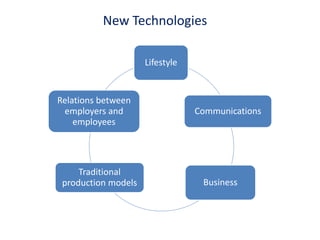
Lifestyle
Communications
Business
Traditional
production models
Relations between
employers and
employees
New Technologies
• It is believe that new technologies undermine the
future of millions of people in the world, but
these developments
facilitate economies of scale,
reduce transaction costs,
promote the best use of specific skills,
improve worker safety,
generate new markets,
contributes to the evolution of societies...
• Transactions costs are been reduced because new
technologies promote free-trade agreements, the
use of digital platforms and allow many employers
to be free-lancers.
• Market competition has changed because there
are more “platform companies” that can enter
markets remotely, there are more start-ups being
developed, the costs of transportation are being
reduced and new technologies increased
efficiencies.
• Jobs will require specific skills:
technological know-how, problem-solving, and
critical thinking,
and soft skills such as perseverance,
collaboration, adaptability and empathy.
• Workers should be lifelong learners.
It is necessary to develop HUMAN CAPITAL
The sum total of a population’s health, skills,
knowledge, experience, and habits.
 Human Capital Index = The contribution of
health and education to productivity of future
workers
• Developing countries need to take rapid
action to ensure they can compete in the
economy of the future.
• In countries with the lowest human capital
investments today, the studies suggests that
the workforce of the future will only be one-
third to one-half as productive as it could be if
people enjoyed full health and received a
high-quality education.
• Increasing human capital benefit the society in
several ways:
Positive economic growth
Higher labor market returns
Lower crime rates
Better the future generations
• To built human capital, governments should
focus in:
Promote healthier diets
Developing sociobehavioral skills
Guarantee good quality education
• But investing in those kind of programs and
policies may be difficult or disincentive
because they may not produce societal or
economic returns for years. They are long
term inversions.
Education
• Even when education is free, to some parents it is
costly to send their children to school (transport,
materials…)
• Poor-quality early childhood development
programs can be more harmful than none at all.
• Poor-quality early childhood development
programs are associated with disappointing
results in children’s language development,
cognitive skills, and sociability.
• Poor-quality early childhood development
programs are consequence of insufficiently
trained caregivers and not appropriated
pedagogy
• It is not the quantity but the quality of the
education
• The most significant investments that people, firms, and
governments can make in the changing nature of work
are in enhancing human capital. A basic level of human
capital, such as literacy and numeracy, is needed for
economic survival. The growing role of technology in life
and business means that all types of jobs require more
advanced cognitive skills.
• The role of human capital is also enhanced because of
the rising demand for sociobehavioral skills. Jobs that
rely on interpersonal interaction will not be readily
replaced by machines. However, to succeed at these
jobs, sociobehavioral skills—acquired in one’s early years
and shaped throughout one’s lifetime—must be strong.
• Human capital is important because there is now a
higher premium on adaptability.
Investing in human capital,
particularly early childhood
high quality education, to
develop high-order cognitive
and socialbehavioral skills
ARGENTINA. The case of the Law
N°27.506 (10/06/2019)
• The Law 27.506 establishes a promotional
regime designed to encourage “the
Knowledge Economy” through the
development of those activities that are
characterized by the intensive use of
technology and that require highly qualified
human capital.
• This law, called "Regime for the Promotion of
the Knowledge Economy" is a new version of
the "Software Law”, although with a broader
extent of application, including more sectors
with the aim of providing tax incentives to
create favorable conditions
 to achieve greater growth,
 to generate employment
and to increase exports.
• Activities included:
Software and computer and digital services;
Audiovisual production and postproduction;
Biotechnology, bioeconomy, biology, biochemistry,
microbiology, bioinformatics, molecular biology,
neurotechnology, genetic engineering,
geoengineering;
Geological services and services related to
electronic and communications;
Professional services, when they are exported;
• Activities included:
Nanotechnology, and nanoscience;
Aerospace and satellite industry, space
technologies;
Engineering for the nuclear industry;
Artificial intelligence, robotics and industrial
internet, internet of things, sensors for
automation processes in production;
Activities of engineering, exact and natural
sciences, agricultural sciences, and medical
sciences related to research and experimental
development tasks.
• It is condition for companies either assign at least
3% of their incomes in investigation and
development or 8% of their salary mass to the
trainee of their employers.
• The companies enjoy different tax benefits.
• The purpose of this regime is not only to crate
favorable conditions for the development of the
"knowledge industry", but to contributes to
increase the supply of technologies that would
impact on the productivity of the economy.
• The agroindustry companies have show a good
performance by adopting and generating new
technologies, that have allowed them to maintain
competitiveness by increasing their productivity.
• There is great potential in projects related to
genetics, biotechnology, agtech and satellite
developments related to the analysis of images
that allow measuring for example yields or soil
fertility.
Agribusiness plays a leading role

Final project

  • 1.
  • 2.
    • It isbelieve that new technologies undermine the future of millions of people in the world, but these developments facilitate economies of scale, reduce transaction costs, promote the best use of specific skills, improve worker safety, generate new markets, contributes to the evolution of societies...
  • 3.
    • Transactions costsare been reduced because new technologies promote free-trade agreements, the use of digital platforms and allow many employers to be free-lancers. • Market competition has changed because there are more “platform companies” that can enter markets remotely, there are more start-ups being developed, the costs of transportation are being reduced and new technologies increased efficiencies.
  • 4.
    • Jobs willrequire specific skills: technological know-how, problem-solving, and critical thinking, and soft skills such as perseverance, collaboration, adaptability and empathy. • Workers should be lifelong learners.
  • 5.
    It is necessaryto develop HUMAN CAPITAL The sum total of a population’s health, skills, knowledge, experience, and habits.  Human Capital Index = The contribution of health and education to productivity of future workers
  • 6.
    • Developing countriesneed to take rapid action to ensure they can compete in the economy of the future. • In countries with the lowest human capital investments today, the studies suggests that the workforce of the future will only be one- third to one-half as productive as it could be if people enjoyed full health and received a high-quality education.
  • 7.
    • Increasing humancapital benefit the society in several ways: Positive economic growth Higher labor market returns Lower crime rates Better the future generations
  • 8.
    • To builthuman capital, governments should focus in: Promote healthier diets Developing sociobehavioral skills Guarantee good quality education • But investing in those kind of programs and policies may be difficult or disincentive because they may not produce societal or economic returns for years. They are long term inversions.
  • 9.
    Education • Even wheneducation is free, to some parents it is costly to send their children to school (transport, materials…) • Poor-quality early childhood development programs can be more harmful than none at all. • Poor-quality early childhood development programs are associated with disappointing results in children’s language development, cognitive skills, and sociability.
  • 10.
    • Poor-quality earlychildhood development programs are consequence of insufficiently trained caregivers and not appropriated pedagogy • It is not the quantity but the quality of the education
  • 11.
    • The mostsignificant investments that people, firms, and governments can make in the changing nature of work are in enhancing human capital. A basic level of human capital, such as literacy and numeracy, is needed for economic survival. The growing role of technology in life and business means that all types of jobs require more advanced cognitive skills. • The role of human capital is also enhanced because of the rising demand for sociobehavioral skills. Jobs that rely on interpersonal interaction will not be readily replaced by machines. However, to succeed at these jobs, sociobehavioral skills—acquired in one’s early years and shaped throughout one’s lifetime—must be strong. • Human capital is important because there is now a higher premium on adaptability.
  • 12.
    Investing in humancapital, particularly early childhood high quality education, to develop high-order cognitive and socialbehavioral skills
  • 13.
    ARGENTINA. The caseof the Law N°27.506 (10/06/2019) • The Law 27.506 establishes a promotional regime designed to encourage “the Knowledge Economy” through the development of those activities that are characterized by the intensive use of technology and that require highly qualified human capital.
  • 14.
    • This law,called "Regime for the Promotion of the Knowledge Economy" is a new version of the "Software Law”, although with a broader extent of application, including more sectors with the aim of providing tax incentives to create favorable conditions  to achieve greater growth,  to generate employment and to increase exports.
  • 15.
    • Activities included: Softwareand computer and digital services; Audiovisual production and postproduction; Biotechnology, bioeconomy, biology, biochemistry, microbiology, bioinformatics, molecular biology, neurotechnology, genetic engineering, geoengineering; Geological services and services related to electronic and communications; Professional services, when they are exported;
  • 16.
    • Activities included: Nanotechnology,and nanoscience; Aerospace and satellite industry, space technologies; Engineering for the nuclear industry; Artificial intelligence, robotics and industrial internet, internet of things, sensors for automation processes in production; Activities of engineering, exact and natural sciences, agricultural sciences, and medical sciences related to research and experimental development tasks.
  • 17.
    • It iscondition for companies either assign at least 3% of their incomes in investigation and development or 8% of their salary mass to the trainee of their employers. • The companies enjoy different tax benefits. • The purpose of this regime is not only to crate favorable conditions for the development of the "knowledge industry", but to contributes to increase the supply of technologies that would impact on the productivity of the economy.
  • 18.
    • The agroindustrycompanies have show a good performance by adopting and generating new technologies, that have allowed them to maintain competitiveness by increasing their productivity. • There is great potential in projects related to genetics, biotechnology, agtech and satellite developments related to the analysis of images that allow measuring for example yields or soil fertility. Agribusiness plays a leading role