Understanding Production Technology
Eric J. Bartelsman
Vrije Universiteit Amsterdam, Tinbergen Institute
Global Forum on Productivity
Ottawa, June 27, 2018
Bartelsman (VU, TI) Production Technology 06/27/18 1 / 29
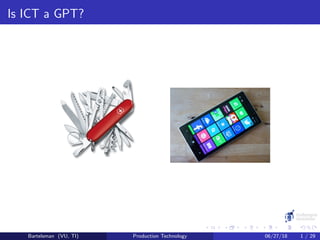
Is ICT a GPT?
Bartelsman (VU, TI) Production Technology 06/27/18 1 / 29
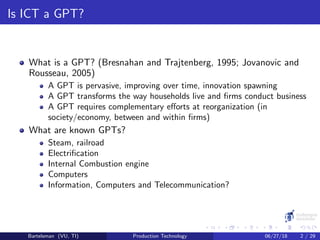
Is ICT a GPT?
What is a GPT? (Bresnahan and Trajtenberg, 1995; Jovanovic and
Rousseau, 2005)
A GPT is pervasive, improving over time, innovation spawning
A GPT transforms the way households live and firms conduct business
A GPT requires complementary efforts at reorganization (in
society/economy, between and within firms)
What are known GPTs?
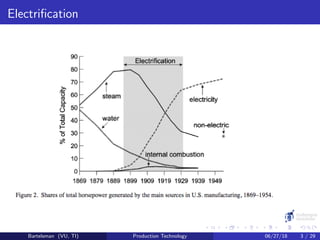
Steam, railroad
Electrification
Internal Combustion engine
Computers
Information, Computers and Telecommunication?
Bartelsman (VU, TI) Production Technology 06/27/18 2 / 29
Electrification
Bartelsman (VU, TI) Production Technology 06/27/18 3 / 29
Empirical Regularities of GPT
Productivity growth is slow during period of development and
adoption
Adoption causes uncertainty, disruption, creative-destruction (churn)
of jobs and firms
Entry, exit, mergers go up. Investment by young firms increase
Wage premium for skilled workers increases
Bartelsman (VU, TI) Production Technology 06/27/18 4 / 29
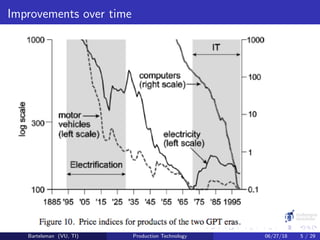
Improvements over time
Bartelsman (VU, TI) Production Technology 06/27/18 5 / 29
ICT is a GPT
While price declines for ICT seem slower than during Computer era,
Byrne-Corrado show continued steep decline. Measurement issues
with cloud, platform, product scope, etc make this hard. E.g.,
increases in real service flows from smartphone are hard to split
between GDP and consumer surplus
Evidence on firm dynamics, dispersion, entrants/exits, investment
could point to GPT (Foster et al. 2018)
Overalll, label of GPT is not defined precisely enough to offer insights
into what is changing in production/consumption and what the
impacts are on statistical measures
A more detailed over view of new technology as well as of statistical
developments can provide a more analytical framework
Bartelsman (VU, TI) Production Technology 06/27/18 6 / 29
12 Disruptive Technologies, (MGI 2013)
Renewable Energy; Advanced Oil and Gas Exploration/Recovery;
Energy Storage
Next Generation Genomics
Advanced Materials; Additive Manufacturing (3D printing)
Autonomous Vehicles; Advanced Robotics; Automation of Knowledge
Work
Cloud Technology; Mobile Computing; Internet of Things
Bartelsman (VU, TI) Production Technology 06/27/18 7 / 29
12 Disruptive Technologies, (MGI 2013)
Five years later: how are the developments?
Energy related: Rapid price declines in energy storage; Oil production
remains high
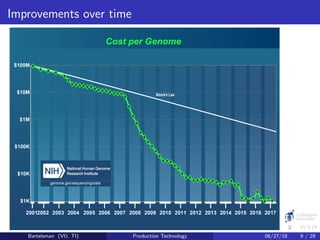
Genomics: continued decline in sequencing costs (now $35) ; a
surprise from CRISPR/Cas9 Editing.
Materials and 3D continue on pace
Continued hype in ICT. Valuations booming.
Autonomous vehicles proceding more rapidly than expected (level 5
broadly launched in 2020/21?)
Machine learning (GAN) has emerged to speed up development of
robotics and other technologies
Bartelsman (VU, TI) Production Technology 06/27/18 8 / 29
Improvements over time
Bartelsman (VU, TI) Production Technology 06/27/18 9 / 29
10 ’Breakthrough’ Technologies
MIT Technology Review, 119(2), March/April 2016
SolarCity Gigafactory (in 2018 finally ramping up production); Power
from the Air (now battery free streaming video)
Immune Engineering; Gene Editing in Plants; DNA App Store
Reusable Rockets; Robot Teachers (ROS, GAN);Tesla Autopilot
Conversational Interfaces; Slack;
Bartelsman (VU, TI) Production Technology 06/27/18 10 / 29
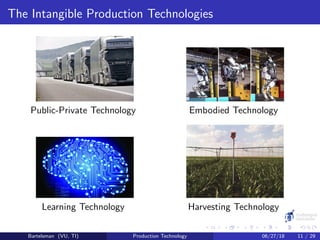
The Intangible Production Technologies
Public-Private Technology Embodied Technology
Learning Technology Harvesting Technology
Bartelsman (VU, TI) Production Technology 06/27/18 11 / 29
Digitisation through 2030
Technology for the coming decade is mostly available now
Timing of uptake, diffusion and impact is harder to assess
Uptake and diffusion depend greatly on economic environment
Policy can influence uptake and diffusion and can mitigate associated
problems
New technologies are changing the ’economic production technology’
used to convert primary inputs into utility
Data and analytical frameworks for economic policy will need to adapt
Bartelsman (VU, TI) Production Technology 06/27/18 12 / 29
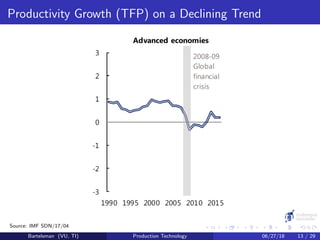
Productivity Growth (TFP) on a Declining Trend
Source: IMF SDN/17/04
Bartelsman (VU, TI) Production Technology 06/27/18 13 / 29
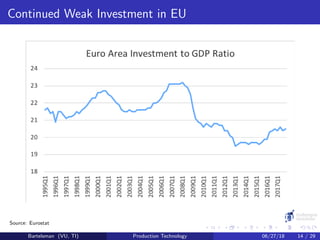
Continued Weak Investment in EU
Source: Eurostat
Bartelsman (VU, TI) Production Technology 06/27/18 14 / 29
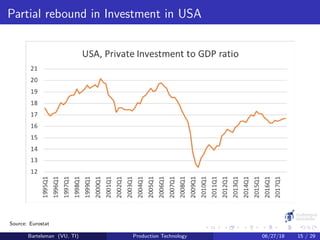
Partial rebound in Investment in USA
Source: Eurostat
Bartelsman (VU, TI) Production Technology 06/27/18 15 / 29
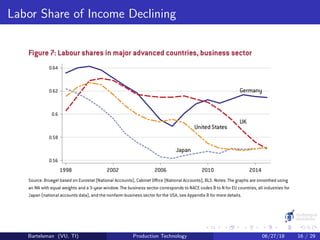
Labor Share of Income Declining
Bartelsman (VU, TI) Production Technology 06/27/18 16 / 29
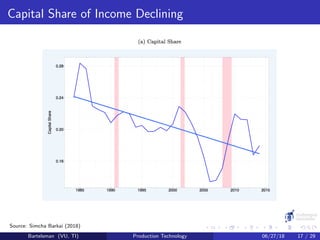
Capital Share of Income Declining
Source: Simcha Barkai (2018)
Bartelsman (VU, TI) Production Technology 06/27/18 17 / 29
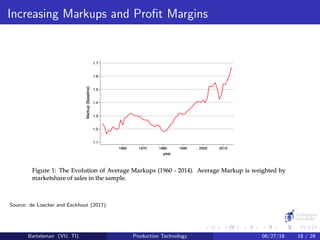
Increasing Markups and Profit Margins
Source: de Loecker and Eeckhout (2017)
Bartelsman (VU, TI) Production Technology 06/27/18 18 / 29
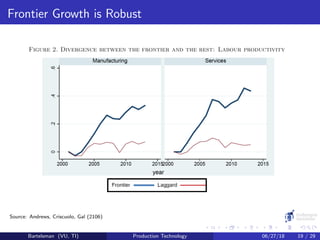
Frontier Growth is Robust
Source: Andrews, Criscuolo, Gal (2106)
Bartelsman (VU, TI) Production Technology 06/27/18 19 / 29
What Can Explain these Features?
Rapidly Changing Technology!
Not just upward shift of production possibilities or interactions
between factors.
The familiar CRTS ’production technology’ AF(K, L) is being
replaced.
Lucas/Hopenhayn/Melitz production with fixed intangible investment,
stochastic productivity and firm dynamics (entry, optimal size, exit).
Alternatively, Kortum-Kramarz/Oberfield Network Production:
transformation of primary inputs (labor, land) into final goods and
services as a ’network’ with digitisation affecting not just production
in a node, but also search and matching costs for new vertices.
The new production technologies have implications for labor markets,
capital markets, output markets, savings-investment, labor-leisure
tradeoff, income distribution.
Bartelsman (VU, TI) Production Technology 06/27/18 20 / 29
Production Technology with Intangibles
Digitalisation has some properties of earlier GPTs, but important new
ones as well
Features of Hopenhayn (1992) production technology:
Entry fee generates draw of ’Intangible asset’; Continuation and scale
of firm are dependent on draw.
Ex-ante expected profit is zero, and profit among incumbents is skewed
Equilibrium with heterogeneous firms either through curvature in profit
function or demand curve
With shift of economy to new production technology, we are
observing:
Volatility of firm outcomes increase with use of new technology
Share of intangibles in total investment increases
Income share of flexible factors decrease
Total rents increase and distribution becomes more skewed
Bartelsman (VU, TI) Production Technology 06/27/18 21 / 29
Why is Measured TFP Growth Low
Researchers are ruling out causes
Business sector has always had new goods and other causes of input
and output mismeasurement
Willingness-to-accept estimates are for consumer surplus, not
necessarily for productivity of suppliers at market prices
Brynjolfsson, Rock and Syverson: full effects needs implementation of
waves of complementary innovations
Spending on intangibles in past decade may not have been measured
as output of capital goods, and returns to these investments will be
highly skewed and have variable and possibly long lags.
New technology could be shifting the GDP production and asset
boundaries
Bartelsman (VU, TI) Production Technology 06/27/18 22 / 29
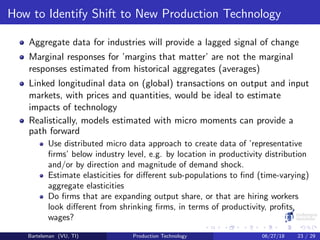
How to Identify Shift to New Production Technology
Aggregate data for industries will provide a lagged signal of change
Marginal responses for ’margins that matter’ are not the marginal
responses estimated from historical aggregates (averages)
Linked longitudinal data on (global) transactions on output and input
markets, with prices and quantities, would be ideal to estimate
impacts of technology
Realistically, models estimated with micro moments can provide a
path forward
Use distributed micro data approach to create data of ’representative
firms’ below industry level, e.g. by location in productivity distribution
and/or by direction and magnitude of demand shock.
Estimate elasticities for different sub-populations to find (time-varying)
aggregate elasticities
Do firms that are expanding output share, or that are hiring workers
look different from shrinking firms, in terms of productivity, profits,
wages?
Bartelsman (VU, TI) Production Technology 06/27/18 23 / 29
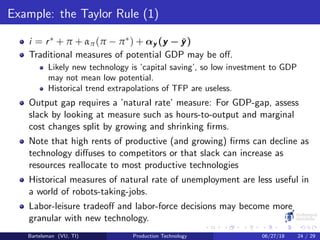
Example: the Taylor Rule (1)
i = r∗ + π + απ(π − π∗) + αy (y − ¯y)
Traditional measures of potential GDP may be off.
Likely new technology is ’capital saving’, so low investment to GDP
may not mean low potential.
Historical trend extrapolations of TFP are useless.
Output gap requires a ’natural rate’ measure: For GDP-gap, assess
slack by looking at measure such as hours-to-output and marginal
cost changes split by growing and shrinking firms.
Note that high rents of productive (and growing) firms can decline as
technology diffuses to competitors or that slack can increase as
resources reallocate to most productive technologies
Historical measures of natural rate of unemployment are less useful in
a world of robots-taking-jobs.
Labor-leisure tradeoff and labor-force decisions may become more
granular with new technology.
Bartelsman (VU, TI) Production Technology 06/27/18 24 / 29
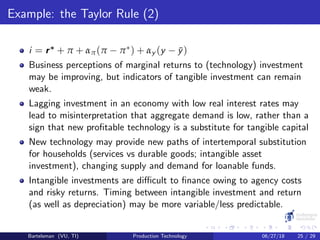
Example: the Taylor Rule (2)
i = r∗ + π + απ(π − π∗) + αy (y − ¯y)
Business perceptions of marginal returns to (technology) investment
may be improving, but indicators of tangible investment can remain
weak.
Lagging investment in an economy with low real interest rates may
lead to misinterpretation that aggregate demand is low, rather than a
sign that new profitable technology is a substitute for tangible capital
New technology may provide new paths of intertemporal substitution
for households (services vs durable goods; intangible asset
investment), changing supply and demand for loanable funds.
Intangible investments are difficult to finance owing to agency costs
and risky returns. Timing between intangible investment and return
(as well as depreciation) may be more variable/less predictable.
Bartelsman (VU, TI) Production Technology 06/27/18 25 / 29
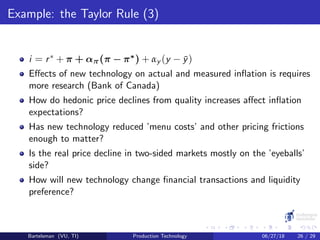
Example: the Taylor Rule (3)
i = r∗ + π + απ(π − π∗) + αy (y − ¯y)
Effects of new technology on actual and measured inflation is requires
more research (Bank of Canada)
How do hedonic price declines from quality increases affect inflation
expectations?
Has new technology reduced ’menu costs’ and other pricing frictions
enough to matter?
Is the real price decline in two-sided markets mostly on the ’eyeballs’
side?
How will new technology change financial transactions and liquidity
preference?
Bartelsman (VU, TI) Production Technology 06/27/18 26 / 29
Example: Structural Policy
How to stimulate the production of new ideas and new technology: IP
and market power vs open source+
How to encourage firms to invest in (adopt) welfare enhancing
technology: carrot and stick; flexible markets
How to keep circular flow of consumption and production going
smoothly: income distribution, mutualization of winner-take-all
How to allay societal fears about jobs, income, future: clear and
factual narrative
How to highlight an encourage socially beneficial aspects of new
technologies: social dialog and directed innovation
Bartelsman (VU, TI) Production Technology 06/27/18 27 / 29
Structural Policy Directions
Rethinking intellectual property rights: crucial, especially wrt data.
Providers of data should remain owners (EU GDPR)
Platforms are markets: and markets are social/communal constructs.
Rethink regulatory approach to platform monopolies
Build public platform: open source infrastructure (e.g. EU platooning
platform)
Regional interventions (eg taxi, scooters, home rental) can be welfare
improving
New forms of income and job solidarity not tied to tangible capital (ie
traditional employer)
By occupation; geographical; by skill type
Trade-offs in solidarity, moral hazard, adverse selection
Incentives for human capital investment
International coordination on taxing intangibles: G20 and OECD
Using AI for policy evaluation and decision making: Public-private
data sharing, continuous experimentation and learning.
Bartelsman (VU, TI) Production Technology 06/27/18 28 / 29
Digital Caveats
Beware of hypes: AI is not yet ’general’, but solves very specific
problems
Watch out for projections of technological magic
Don’t worry unduly about ’singularity’, or machines taking over.
Beware of anthropomorphic actions attributed to machines (learn,
think, imagine, describe)
Positive spillovers often are balanced by negatives
Consider long adoption lags and possibly very low depreciation
Don’t overestimate the near future and don’t underestimate the
longer horizon
see: Rodney Brooks (2017)
Bartelsman (VU, TI) Production Technology 06/27/18 29 / 29

Keynote Bartelsman

  • 1.
    Understanding Production Technology EricJ. Bartelsman Vrije Universiteit Amsterdam, Tinbergen Institute Global Forum on Productivity Ottawa, June 27, 2018 Bartelsman (VU, TI) Production Technology 06/27/18 1 / 29
  • 2.
    Is ICT aGPT? Bartelsman (VU, TI) Production Technology 06/27/18 1 / 29
  • 3.
    Is ICT aGPT? What is a GPT? (Bresnahan and Trajtenberg, 1995; Jovanovic and Rousseau, 2005) A GPT is pervasive, improving over time, innovation spawning A GPT transforms the way households live and firms conduct business A GPT requires complementary efforts at reorganization (in society/economy, between and within firms) What are known GPTs? Steam, railroad Electrification Internal Combustion engine Computers Information, Computers and Telecommunication? Bartelsman (VU, TI) Production Technology 06/27/18 2 / 29
  • 4.
    Electrification Bartelsman (VU, TI)Production Technology 06/27/18 3 / 29
  • 5.
    Empirical Regularities ofGPT Productivity growth is slow during period of development and adoption Adoption causes uncertainty, disruption, creative-destruction (churn) of jobs and firms Entry, exit, mergers go up. Investment by young firms increase Wage premium for skilled workers increases Bartelsman (VU, TI) Production Technology 06/27/18 4 / 29
  • 6.
    Improvements over time Bartelsman(VU, TI) Production Technology 06/27/18 5 / 29
  • 7.
    ICT is aGPT While price declines for ICT seem slower than during Computer era, Byrne-Corrado show continued steep decline. Measurement issues with cloud, platform, product scope, etc make this hard. E.g., increases in real service flows from smartphone are hard to split between GDP and consumer surplus Evidence on firm dynamics, dispersion, entrants/exits, investment could point to GPT (Foster et al. 2018) Overalll, label of GPT is not defined precisely enough to offer insights into what is changing in production/consumption and what the impacts are on statistical measures A more detailed over view of new technology as well as of statistical developments can provide a more analytical framework Bartelsman (VU, TI) Production Technology 06/27/18 6 / 29
  • 8.
    12 Disruptive Technologies,(MGI 2013) Renewable Energy; Advanced Oil and Gas Exploration/Recovery; Energy Storage Next Generation Genomics Advanced Materials; Additive Manufacturing (3D printing) Autonomous Vehicles; Advanced Robotics; Automation of Knowledge Work Cloud Technology; Mobile Computing; Internet of Things Bartelsman (VU, TI) Production Technology 06/27/18 7 / 29
  • 9.
    12 Disruptive Technologies,(MGI 2013) Five years later: how are the developments? Energy related: Rapid price declines in energy storage; Oil production remains high Genomics: continued decline in sequencing costs (now $35) ; a surprise from CRISPR/Cas9 Editing. Materials and 3D continue on pace Continued hype in ICT. Valuations booming. Autonomous vehicles proceding more rapidly than expected (level 5 broadly launched in 2020/21?) Machine learning (GAN) has emerged to speed up development of robotics and other technologies Bartelsman (VU, TI) Production Technology 06/27/18 8 / 29
  • 10.
    Improvements over time Bartelsman(VU, TI) Production Technology 06/27/18 9 / 29
  • 11.
    10 ’Breakthrough’ Technologies MITTechnology Review, 119(2), March/April 2016 SolarCity Gigafactory (in 2018 finally ramping up production); Power from the Air (now battery free streaming video) Immune Engineering; Gene Editing in Plants; DNA App Store Reusable Rockets; Robot Teachers (ROS, GAN);Tesla Autopilot Conversational Interfaces; Slack; Bartelsman (VU, TI) Production Technology 06/27/18 10 / 29
  • 12.
    The Intangible ProductionTechnologies Public-Private Technology Embodied Technology Learning Technology Harvesting Technology Bartelsman (VU, TI) Production Technology 06/27/18 11 / 29
  • 13.
    Digitisation through 2030 Technologyfor the coming decade is mostly available now Timing of uptake, diffusion and impact is harder to assess Uptake and diffusion depend greatly on economic environment Policy can influence uptake and diffusion and can mitigate associated problems New technologies are changing the ’economic production technology’ used to convert primary inputs into utility Data and analytical frameworks for economic policy will need to adapt Bartelsman (VU, TI) Production Technology 06/27/18 12 / 29
  • 14.
    Productivity Growth (TFP)on a Declining Trend Source: IMF SDN/17/04 Bartelsman (VU, TI) Production Technology 06/27/18 13 / 29
  • 15.
    Continued Weak Investmentin EU Source: Eurostat Bartelsman (VU, TI) Production Technology 06/27/18 14 / 29
  • 16.
    Partial rebound inInvestment in USA Source: Eurostat Bartelsman (VU, TI) Production Technology 06/27/18 15 / 29
  • 17.
    Labor Share ofIncome Declining Bartelsman (VU, TI) Production Technology 06/27/18 16 / 29
  • 18.
    Capital Share ofIncome Declining Source: Simcha Barkai (2018) Bartelsman (VU, TI) Production Technology 06/27/18 17 / 29
  • 19.
    Increasing Markups andProfit Margins Source: de Loecker and Eeckhout (2017) Bartelsman (VU, TI) Production Technology 06/27/18 18 / 29
  • 20.
    Frontier Growth isRobust Source: Andrews, Criscuolo, Gal (2106) Bartelsman (VU, TI) Production Technology 06/27/18 19 / 29
  • 21.
    What Can Explainthese Features? Rapidly Changing Technology! Not just upward shift of production possibilities or interactions between factors. The familiar CRTS ’production technology’ AF(K, L) is being replaced. Lucas/Hopenhayn/Melitz production with fixed intangible investment, stochastic productivity and firm dynamics (entry, optimal size, exit). Alternatively, Kortum-Kramarz/Oberfield Network Production: transformation of primary inputs (labor, land) into final goods and services as a ’network’ with digitisation affecting not just production in a node, but also search and matching costs for new vertices. The new production technologies have implications for labor markets, capital markets, output markets, savings-investment, labor-leisure tradeoff, income distribution. Bartelsman (VU, TI) Production Technology 06/27/18 20 / 29
  • 22.
    Production Technology withIntangibles Digitalisation has some properties of earlier GPTs, but important new ones as well Features of Hopenhayn (1992) production technology: Entry fee generates draw of ’Intangible asset’; Continuation and scale of firm are dependent on draw. Ex-ante expected profit is zero, and profit among incumbents is skewed Equilibrium with heterogeneous firms either through curvature in profit function or demand curve With shift of economy to new production technology, we are observing: Volatility of firm outcomes increase with use of new technology Share of intangibles in total investment increases Income share of flexible factors decrease Total rents increase and distribution becomes more skewed Bartelsman (VU, TI) Production Technology 06/27/18 21 / 29
  • 23.
    Why is MeasuredTFP Growth Low Researchers are ruling out causes Business sector has always had new goods and other causes of input and output mismeasurement Willingness-to-accept estimates are for consumer surplus, not necessarily for productivity of suppliers at market prices Brynjolfsson, Rock and Syverson: full effects needs implementation of waves of complementary innovations Spending on intangibles in past decade may not have been measured as output of capital goods, and returns to these investments will be highly skewed and have variable and possibly long lags. New technology could be shifting the GDP production and asset boundaries Bartelsman (VU, TI) Production Technology 06/27/18 22 / 29
  • 24.
    How to IdentifyShift to New Production Technology Aggregate data for industries will provide a lagged signal of change Marginal responses for ’margins that matter’ are not the marginal responses estimated from historical aggregates (averages) Linked longitudinal data on (global) transactions on output and input markets, with prices and quantities, would be ideal to estimate impacts of technology Realistically, models estimated with micro moments can provide a path forward Use distributed micro data approach to create data of ’representative firms’ below industry level, e.g. by location in productivity distribution and/or by direction and magnitude of demand shock. Estimate elasticities for different sub-populations to find (time-varying) aggregate elasticities Do firms that are expanding output share, or that are hiring workers look different from shrinking firms, in terms of productivity, profits, wages? Bartelsman (VU, TI) Production Technology 06/27/18 23 / 29
  • 25.
    Example: the TaylorRule (1) i = r∗ + π + απ(π − π∗) + αy (y − ¯y) Traditional measures of potential GDP may be off. Likely new technology is ’capital saving’, so low investment to GDP may not mean low potential. Historical trend extrapolations of TFP are useless. Output gap requires a ’natural rate’ measure: For GDP-gap, assess slack by looking at measure such as hours-to-output and marginal cost changes split by growing and shrinking firms. Note that high rents of productive (and growing) firms can decline as technology diffuses to competitors or that slack can increase as resources reallocate to most productive technologies Historical measures of natural rate of unemployment are less useful in a world of robots-taking-jobs. Labor-leisure tradeoff and labor-force decisions may become more granular with new technology. Bartelsman (VU, TI) Production Technology 06/27/18 24 / 29
  • 26.
    Example: the TaylorRule (2) i = r∗ + π + απ(π − π∗) + αy (y − ¯y) Business perceptions of marginal returns to (technology) investment may be improving, but indicators of tangible investment can remain weak. Lagging investment in an economy with low real interest rates may lead to misinterpretation that aggregate demand is low, rather than a sign that new profitable technology is a substitute for tangible capital New technology may provide new paths of intertemporal substitution for households (services vs durable goods; intangible asset investment), changing supply and demand for loanable funds. Intangible investments are difficult to finance owing to agency costs and risky returns. Timing between intangible investment and return (as well as depreciation) may be more variable/less predictable. Bartelsman (VU, TI) Production Technology 06/27/18 25 / 29
  • 27.
    Example: the TaylorRule (3) i = r∗ + π + απ(π − π∗) + αy (y − ¯y) Effects of new technology on actual and measured inflation is requires more research (Bank of Canada) How do hedonic price declines from quality increases affect inflation expectations? Has new technology reduced ’menu costs’ and other pricing frictions enough to matter? Is the real price decline in two-sided markets mostly on the ’eyeballs’ side? How will new technology change financial transactions and liquidity preference? Bartelsman (VU, TI) Production Technology 06/27/18 26 / 29
  • 28.
    Example: Structural Policy Howto stimulate the production of new ideas and new technology: IP and market power vs open source+ How to encourage firms to invest in (adopt) welfare enhancing technology: carrot and stick; flexible markets How to keep circular flow of consumption and production going smoothly: income distribution, mutualization of winner-take-all How to allay societal fears about jobs, income, future: clear and factual narrative How to highlight an encourage socially beneficial aspects of new technologies: social dialog and directed innovation Bartelsman (VU, TI) Production Technology 06/27/18 27 / 29
  • 29.
    Structural Policy Directions Rethinkingintellectual property rights: crucial, especially wrt data. Providers of data should remain owners (EU GDPR) Platforms are markets: and markets are social/communal constructs. Rethink regulatory approach to platform monopolies Build public platform: open source infrastructure (e.g. EU platooning platform) Regional interventions (eg taxi, scooters, home rental) can be welfare improving New forms of income and job solidarity not tied to tangible capital (ie traditional employer) By occupation; geographical; by skill type Trade-offs in solidarity, moral hazard, adverse selection Incentives for human capital investment International coordination on taxing intangibles: G20 and OECD Using AI for policy evaluation and decision making: Public-private data sharing, continuous experimentation and learning. Bartelsman (VU, TI) Production Technology 06/27/18 28 / 29
  • 30.
    Digital Caveats Beware ofhypes: AI is not yet ’general’, but solves very specific problems Watch out for projections of technological magic Don’t worry unduly about ’singularity’, or machines taking over. Beware of anthropomorphic actions attributed to machines (learn, think, imagine, describe) Positive spillovers often are balanced by negatives Consider long adoption lags and possibly very low depreciation Don’t overestimate the near future and don’t underestimate the longer horizon see: Rodney Brooks (2017) Bartelsman (VU, TI) Production Technology 06/27/18 29 / 29