
The Past Simple vs The present Perfect
Use
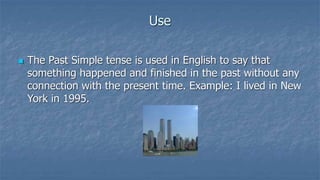
 The Past Simple tense is used in English to say that
something happened and finished in the past without any
connection with the present time. Example: I lived in New
York in 1995.
 This means that at the present time I’m
not living in New York but perhaps
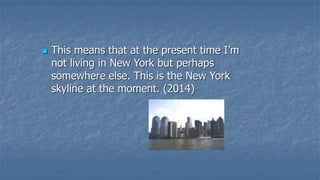
somewhere else. This is the New York
skyline at the moment. (2014)
The Present Perfect usually makes a
connection with the present.
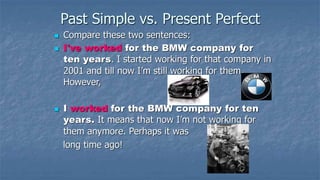
Past Simple vs. Present Perfect
 Compare these two sentences:
 I've worked for the BMW company for
ten years. I started working for that company in
2001 and till now I’m still working for them.
However,
 I worked for the BMW company for ten
years. It means that now I’m not working for
them anymore. Perhaps it was
long time ago!
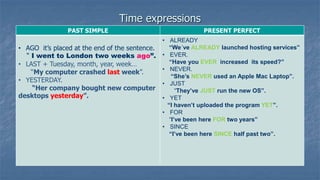
Time expressions
PAST SIMPLE PRESENT PERFECT
• AGO it’s placed at the end of the sentence.
“ I went to London two weeks ago”.
• LAST + Tuesday, month, year, week…
“My computer crashed last week”.
• YESTERDAY.
“Her company bought new computer
desktops yesterday”.
• ALREADY
“We´ve ALREADY launched hosting services”
• EVER.
“Have you EVER increased its speed?”
• NEVER.
“She’s NEVER used an Apple Mac Laptop”.
• JUST
“They’ve JUST run the new OS”.
• YET
“I haven’t uploaded the program YET”.
• FOR
“I’ve been here FOR two years”
• SINCE
“I’ve been here SINCE half past two”.
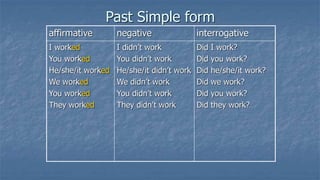
Past Simple form
affirmative negative interrogative
I worked
You worked
He/she/it worked
We worked
You worked
They worked
I didn’t work
You didn’t work
He/she/it didn’t work
We didn’t work
You didn’t work
They didn’t work
Did I work?
Did you work?
Did he/she/it work?
Did we work?
Did you work?
Did they work?
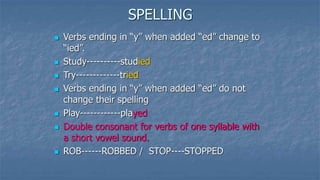
SPELLING
 Verbs ending in “y” when added “ed” change to
“ied”.
 Study----------studied
 Try-------------tried
 Verbs ending in “y” when added “ed” do not
change their spelling
 Play------------played
 Double consonant for verbs of one syllable with
a short vowel sound.
 ROB------ROBBED / STOP----STOPPED
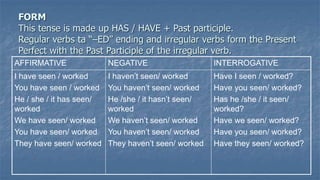
FORM
This tense is made up HAS / HAVE + Past participle.
Regular verbs ta “–ED” ending and irregular verbs form the Present
Perfect with the Past Participle of the irregular verb.
AFFIRMATIVE NEGATIVE INTERROGATIVE
I have seen / worked
You have seen / worked
He / she / it has seen/
worked
We have seen/ worked
You have seen/ worked
They have seen/ worked
I haven’t seen/ worked
You haven’t seen/ worked
He /she / it hasn’t seen/
worked
We haven’t seen/ worked
You haven’t seen/ worked
They haven’t seen/ worked
Have I seen / worked?
Have you seen/ worked?
Has he /she / it seen/
worked?
Have we seen/ worked?
Have you seen/ worked?
Have they seen/ worked?
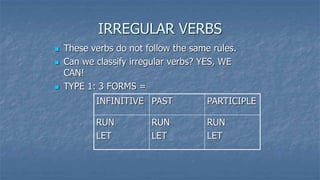
IRREGULAR VERBS
 These verbs do not follow the same rules.
 Can we classify irregular verbs? YES, WE
CAN!
 TYPE 1: 3 FORMS =
INFINITIVE PAST PARTICIPLE
RUN
LET
RUN
LET
RUN
LET
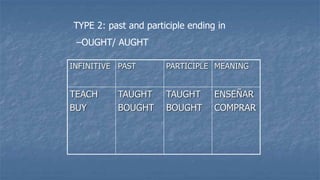
TYPE 2: past and participle ending in
–OUGHT/ AUGHT
INFINITIVE PAST PARTICIPLE MEANING
TEACH
BUY
TAUGHT
BOUGHT
TAUGHT
BOUGHT
ENSEÑAR
COMPRAR
Now it is your turn to classify them!
 Type 3:…….

PRESENT PERFECT VS PAST SIMPLE IN ENGLISH

  • 1.
    The Past Simplevs The present Perfect
  • 2.
    Use  The PastSimple tense is used in English to say that something happened and finished in the past without any connection with the present time. Example: I lived in New York in 1995.
  • 3.
     This meansthat at the present time I’m not living in New York but perhaps somewhere else. This is the New York skyline at the moment. (2014)
  • 4.
    The Present Perfectusually makes a connection with the present.
  • 5.
    Past Simple vs.Present Perfect  Compare these two sentences:  I've worked for the BMW company for ten years. I started working for that company in 2001 and till now I’m still working for them. However,  I worked for the BMW company for ten years. It means that now I’m not working for them anymore. Perhaps it was long time ago!
  • 6.
    Time expressions PAST SIMPLEPRESENT PERFECT • AGO it’s placed at the end of the sentence. “ I went to London two weeks ago”. • LAST + Tuesday, month, year, week… “My computer crashed last week”. • YESTERDAY. “Her company bought new computer desktops yesterday”. • ALREADY “We´ve ALREADY launched hosting services” • EVER. “Have you EVER increased its speed?” • NEVER. “She’s NEVER used an Apple Mac Laptop”. • JUST “They’ve JUST run the new OS”. • YET “I haven’t uploaded the program YET”. • FOR “I’ve been here FOR two years” • SINCE “I’ve been here SINCE half past two”.
  • 7.
    Past Simple form affirmativenegative interrogative I worked You worked He/she/it worked We worked You worked They worked I didn’t work You didn’t work He/she/it didn’t work We didn’t work You didn’t work They didn’t work Did I work? Did you work? Did he/she/it work? Did we work? Did you work? Did they work?
  • 8.
    SPELLING  Verbs endingin “y” when added “ed” change to “ied”.  Study----------studied  Try-------------tried  Verbs ending in “y” when added “ed” do not change their spelling  Play------------played  Double consonant for verbs of one syllable with a short vowel sound.  ROB------ROBBED / STOP----STOPPED
  • 9.
    FORM This tense ismade up HAS / HAVE + Past participle. Regular verbs ta “–ED” ending and irregular verbs form the Present Perfect with the Past Participle of the irregular verb. AFFIRMATIVE NEGATIVE INTERROGATIVE I have seen / worked You have seen / worked He / she / it has seen/ worked We have seen/ worked You have seen/ worked They have seen/ worked I haven’t seen/ worked You haven’t seen/ worked He /she / it hasn’t seen/ worked We haven’t seen/ worked You haven’t seen/ worked They haven’t seen/ worked Have I seen / worked? Have you seen/ worked? Has he /she / it seen/ worked? Have we seen/ worked? Have you seen/ worked? Have they seen/ worked?
  • 10.
    IRREGULAR VERBS  Theseverbs do not follow the same rules.  Can we classify irregular verbs? YES, WE CAN!  TYPE 1: 3 FORMS = INFINITIVE PAST PARTICIPLE RUN LET RUN LET RUN LET
  • 11.
    TYPE 2: pastand participle ending in –OUGHT/ AUGHT INFINITIVE PAST PARTICIPLE MEANING TEACH BUY TAUGHT BOUGHT TAUGHT BOUGHT ENSEÑAR COMPRAR
  • 12.
    Now it isyour turn to classify them!  Type 3:…….