Past Simple.
Vicente Suarez
C.I:27.870.860.
Teacher:
Cesar Velasquez
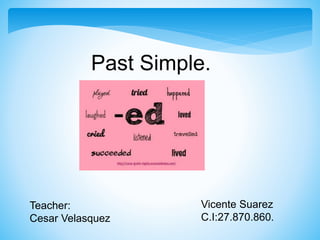
Past Simple.
The Simple Past is a verb tense that is used to describe
actions that have happened in a previous time and that have
already ended.
characteristics
-Indicates the action performed
at a specific moment in the past.
-The main verb of the
sentence is always in the past
Actions that happened at a specific time in the past,
whether known or implied
Actions that started and ended in the past
Actions in the past that are not repeated in the present
Actions that happened at a specific time and that have
already ended
applications
To be able to form a sentence in
the past tense, one must
distinguish between regular and
irregular verbs
.
types
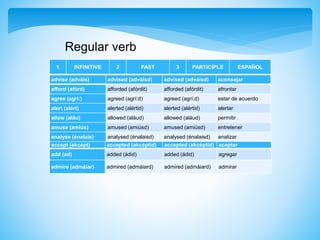
regular
regular verbs form their simple
past by adding the ending ed to
the infinitive
irregular
Irregular verbs get that name to
not follow a certain pattern and
in this case they must be studied
individually
Leonardo da Vinci
painted the Mona Lisa
He bought a car
example example
exercises
regular irregular
Did you watch tv yesterday?
Yes, i watched tv yesterday.
No, i did not watch tv yesteday.
Did you eat fish?
Yes, i ate fish.
No, i did not eat fish.
INFINITIVO PASADO PARTICIPIO SIGNIFICADO
arise arose arisen Elevarse, surgir, originarse.
awake awoke awoken Despertar, mover, excitar.
bear bore born Soportar, sostener, tolerar.
beat beat beaten Batir,revolver, golpear, vencer.
become became become Hacerse,tornarse,convertirse en.
begin began begun Empezar, iniciar.
bend bent bent Doblar, inclinar, torcer.
bet bet bet Apostar
bind bound bound Atar, unir, enlazar.
bite bit bitten Morder.
blow blew blown Soplar
break broke broken Quebrar, partir, romper.
bring brought brought Traer, llevar, conducir.
Irregular verb
Regular verb
accept (akcépt) accepted (akcéptid) accepted (akcéptid) aceptar
add (ad) added (ádid) added (ádid) agregar
admire (admáiar) admired (admáiard) admired (admáiard) admirar
advise (adváis) advised (adváisd) advised (adváisd) aconsejar
afford (afórd) afforded (afórdit) afforded (afórdit) afrontar
agree (agrí:) agreed (agrí:d) agreed (agrí:d) estar de acuerdo
alert (alért) alerted (alértid) alerted (alértid) alertar
allow (aláu) allowed (aláud) allowed (aláud) permitir
amuse (amiús) amused (amiúsd) amused (amiúsd) entretener
analyse (énalais) analysed (énalaisd) analysed (énalaisd) analizar
1 INFINITIVE 2 PAST 3 PARTICIPLE ESPAÑOL

past simple

  • 1.
  • 2.
    Past Simple. The SimplePast is a verb tense that is used to describe actions that have happened in a previous time and that have already ended.
  • 3.
    characteristics -Indicates the actionperformed at a specific moment in the past. -The main verb of the sentence is always in the past
  • 4.
    Actions that happenedat a specific time in the past, whether known or implied Actions that started and ended in the past Actions in the past that are not repeated in the present Actions that happened at a specific time and that have already ended applications
  • 5.
    To be ableto form a sentence in the past tense, one must distinguish between regular and irregular verbs . types regular regular verbs form their simple past by adding the ending ed to the infinitive irregular Irregular verbs get that name to not follow a certain pattern and in this case they must be studied individually Leonardo da Vinci painted the Mona Lisa He bought a car example example
  • 6.
    exercises regular irregular Did youwatch tv yesterday? Yes, i watched tv yesterday. No, i did not watch tv yesteday. Did you eat fish? Yes, i ate fish. No, i did not eat fish.
  • 7.
    INFINITIVO PASADO PARTICIPIOSIGNIFICADO arise arose arisen Elevarse, surgir, originarse. awake awoke awoken Despertar, mover, excitar. bear bore born Soportar, sostener, tolerar. beat beat beaten Batir,revolver, golpear, vencer. become became become Hacerse,tornarse,convertirse en. begin began begun Empezar, iniciar. bend bent bent Doblar, inclinar, torcer. bet bet bet Apostar bind bound bound Atar, unir, enlazar. bite bit bitten Morder. blow blew blown Soplar break broke broken Quebrar, partir, romper. bring brought brought Traer, llevar, conducir. Irregular verb
  • 8.
    Regular verb accept (akcépt)accepted (akcéptid) accepted (akcéptid) aceptar add (ad) added (ádid) added (ádid) agregar admire (admáiar) admired (admáiard) admired (admáiard) admirar advise (adváis) advised (adváisd) advised (adváisd) aconsejar afford (afórd) afforded (afórdit) afforded (afórdit) afrontar agree (agrí:) agreed (agrí:d) agreed (agrí:d) estar de acuerdo alert (alért) alerted (alértid) alerted (alértid) alertar allow (aláu) allowed (aláud) allowed (aláud) permitir amuse (amiús) amused (amiúsd) amused (amiúsd) entretener analyse (énalais) analysed (énalaisd) analysed (énalaisd) analizar 1 INFINITIVE 2 PAST 3 PARTICIPLE ESPAÑOL